11. How would you test a computer's temperature?
Describe how you would test a computer temperature-reading feature or system, including relevant test scenarios and follow-up considerations.
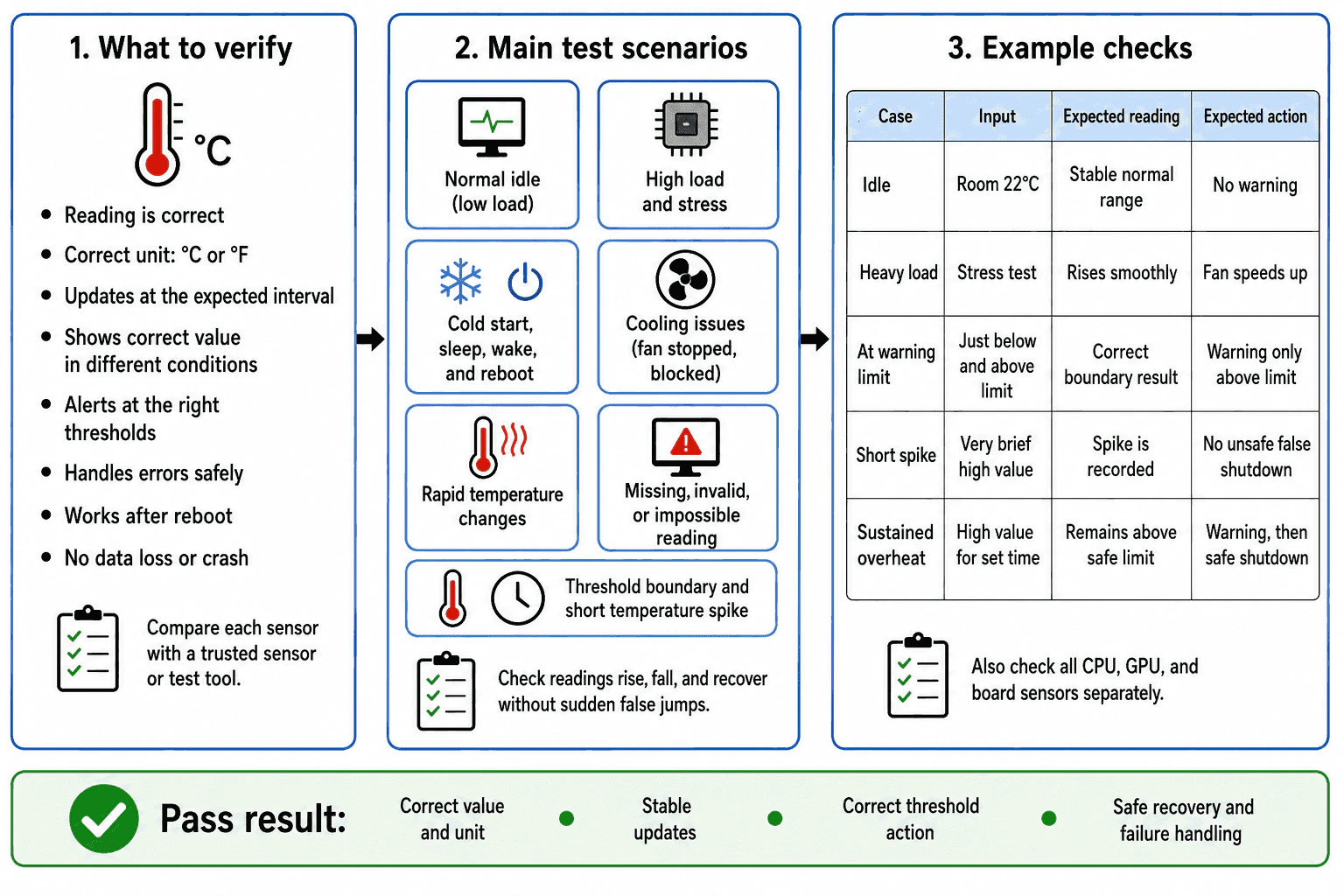
I would test the Python temperature monitoring logic with controlled sensor values, then run integration tests with a real sensor adapter and approved test hardware. I would compare each sensor with a trusted sensor or test tool. I would cover idle load, heavy load, rapid changes, cooling problems, cold start, sleep, wake, reboot, invalid readings, exact warning boundaries, short spikes, and sustained overheating. I would assert the reading, unit, update interval, warning state, fan request, shutdown request, recovery, and error handling. The main tradeoff is that controlled tests are fast and deterministic, but only real hardware tests can confirm sensor accuracy, driver behavior, and the complete cooling path.
I would begin by defining the exact behavior and test boundary. The main system under test is the Python component that reads computer temperature data, validates the value, converts the unit when required, stores or publishes the latest reading, and decides whether to do nothing, increase cooling, show a warning, or request a safe shutdown. The physical sensor, operating system sensor interface, fan controller, and shutdown service are outside the unit test boundary.
- What behavior and test boundary should I cover?
- Which dependencies, environments, and test tools should I assume?
- Which failures, edge cases, and quality risks are most important?
I would first confirm what temperature is being measured. A computer can expose separate CPU, GPU, motherboard, storage, and battery sensors. Each sensor should be tested separately because one correct reading does not prove that every sensor is mapped correctly. I would also confirm whether the feature uses Celsius, Fahrenheit, or both.
For Python unit tests, I would replace the sensor reader with a stub that returns controlled values. A stub is a small replacement that gives known data. I would replace the clock when the behavior depends on an update interval or on how long the temperature stays above a limit. I would use small function scoped pytest fixtures so every test receives a fresh monitor, fresh sensor stub, controlled clock, and fresh action recorders. This prevents one test from leaking alert or timing state into another test.
I would start with normal behavior. An idle case should return a stable normal reading and no warning. A heavy load sequence should rise smoothly and request faster cooling when the specification requires it. When the feature supports both units, I would verify correct Celsius and Fahrenheit conversion. I would also verify that the value updates at the expected interval and that a new valid reading replaces the previous reading.
I would test different physical conditions. These include a normal fan, a slow fan, a stopped fan, and a blocked cooling path. The temperature should rise in a believable direction under poor cooling. After cooling is restored, the readings should fall and the warning state should recover according to the approved rules. The test should not report successful cooling if the fan action failed.
I would test lifecycle events such as cold start, sleep, wake, and reboot. After each event, the correct sensors should be discovered again, readings should resume, stale values should not be presented as current values, and the program should not crash or lose required state.
Boundary tests are essential. I would send values just below, exactly at, and just above each warning and shutdown limit. This catches incorrect comparison rules. The expected result at the exact limit must come from the product specification. I would not invent whether the rule uses greater than or greater than or equal to.
I would test a short temperature spike with controlled time. The spike should be recorded, but it should not cause an unsafe false shutdown when the approved rule requires the value to remain high for a set duration. I would then test sustained overheating. A value that remains above the safe limit for the required time should create the correct warning and then request safe shutdown.
I would test rapid changes by sending a clear sequence that rises, falls, and rises again. I would assert that the readings follow the sequence without unexplained false jumps. I would avoid fixed sleep calls. Instead, I would advance a controlled clock by exact amounts so the result is deterministic.
Failure cases should include missing data, a nonnumeric value, an impossible low value, an impossible high value, a stale timestamp, and a sensor exception. The system should reject invalid readings, expose a clear sensor error, avoid crashing, and avoid silently treating an invalid value as safe. Keeping the last trusted reading is acceptable only when the product specification requires it, and the interface should still show that the current sensor data is unavailable.
I would assert visible behavior and required interactions. The assertions can include the accepted reading, sensor identity, unit, timestamp, update interval, warning state, cooling request, shutdown request, recovery state, and error result. I would use a mock when I need to verify an interaction, such as confirming that the fan controller was called once with the expected level. I would patch the dependency where the monitoring module looks up that dependency.
Each test should clean up its state. Pytest fixtures and monkeypatch can restore replaced functions, clocks, environment values, and temporary files. Hardware tests should return the computer or test device to a safe temperature and normal cooling state after execution.
Unit tests do not prove that the real hardware works. I would add integration tests using the real sensor adapter on a controlled machine, hardware simulator, or approved lab device. These tests should confirm that Python receives the correct sensor values, identifies CPU, GPU, and board sensors correctly, handles operating system permissions, and sends the correct command to the real or controlled cooling and shutdown interface.
I would compare real readings with a trusted external sensor or approved test tool. This checks sensor accuracy and calibration. A software stub cannot validate physical calibration.
In CI, the fast unit suite should run on every change. Hardware integration tests can run on a dedicated runner or scheduled lab job because they may require exclusive device access, controlled load generation, and safe cleanup. Results should be based on observable conditions and controlled time rather than real waiting.
I would not test private implementation details that are not part of the required behavior. I would also not claim that high code coverage proves correct thermal safety behavior. Correct boundaries, reliable sensor integration, failure cases, and safe actions matter more.
- Identify every supported sensor, unit, update interval, warning limit, shutdown limit, and required duration above each limit.
- Define the Python monitoring logic as the unit test boundary.
- Use integration tests for the real sensor adapter, operating system interface, cooling controller, and shutdown path.
- Create function scoped fixtures for a fresh monitor, sensor stub, controlled clock, and action recorders.
- Compare real sensor readings with a trusted sensor or approved test tool.
- Test idle load, heavy load, rapid changes, normal cooling, slow cooling, blocked cooling, and stopped cooling.
- Test cold start, sleep, wake, and reboot behavior.
- Test correct units and the expected update interval.
- Test values just below, exactly at, and just above every warning and shutdown boundary.
- Test a short spike and sustained overheating with controlled time.
- Test missing, invalid, impossible, stale, and exception producing sensor results.
- Assert the reading, sensor identity, unit, timestamp, warning, fan action, shutdown action, recovery, and error result.
- Restore all patched dependencies and return hardware to a safe state.
- Run unit tests on every CI change and hardware integration tests on a controlled runner.
Algorithmic complexity is not the main concern because each test usually processes a small sequence of readings. Unit tests have low runtime and memory cost. The main cost comes from the number of sensors, units, boundaries, timing cases, and failure combinations. A controlled clock keeps time based tests fast because the test does not wait in real time. Hardware integration tests cost more because they require a device, load generation, trusted measurement equipment, exclusive access, safe cooling, cleanup, and longer CI execution. They also need maintenance when operating system drivers or hardware models change.
This testing approach is used in desktop monitoring tools, server health agents, laptop thermal control software, data center node monitors, gaming utilities, embedded controllers, hardware diagnostic tools, and device management systems. It is useful whenever Python reads CPU, GPU, motherboard, storage, battery, or other sensor data and decides whether to display a value, increase cooling, show a warning, record an event, or request safe shutdown.
Interviewers ask this question to see whether the candidate can turn a physical system into a complete and safe test plan. They are evaluating test boundary selection, choice of test level, hardware dependency control, boundary analysis, deterministic time testing, failure handling, and production awareness. A strong answer should distinguish fast Python logic tests from real sensor and hardware validation.
Common mistakes include testing only one normal value, treating every sensor as the same sensor, ignoring Celsius and Fahrenheit conversion, and skipping the exact warning boundary. Another mistake is using fixed sleep calls for spike and sustained heat tests, which can make the suite flaky. Candidates may mock every layer and then claim the real sensor integration works. They may patch the sensor dependency in its original module instead of where the monitoring module looks it up. Shared mutable fixtures can leak alert, timing, or last reading state between tests. Weak assertions may check only that no exception occurred while missing an incorrect unit, stale timestamp, wrong sensor identity, missing fan action, or unsafe shutdown. Other mistakes include accepting impossible values, hiding missing data behind an old reading, ignoring failed cooling actions, forgetting recovery after cooling, leaving test hardware hot, using production machines without safeguards, and treating coverage as proof of thermal safety.
Start by separating Python logic tests from real hardware integration tests. Then explain one idle case, one heavy load case, one exact boundary case, one short spike, one sustained overheat case, and one sensor failure. Mention multiple sensors, trusted sensor comparison, controlled time, cleanup, and the limits of mocked tests.