1. What is Python, and how do Penetration Testers use it safely?
Define Python as a general-purpose programming language and explain its use for authorized reconnaissance, API clients, parsers, evidence normalization, validation, and repeatable test utilities. Cover modules, virtual environments, input validation, timeouts, exception handling, subprocess safety, dependency pinning, secret handling, and bounded concurrency.
Python is a general-purpose programming language that is useful for safe penetration-testing automation. I use it for authorized API calls, parsers, reconnaissance helpers, validation, and evidence processing, with strict scope checks, timeouts, error handling, isolated dependencies, protected secrets, safe subprocess use, and bounded concurrency.
See the Code while reading this explanation.
This question asks two things: what Python is and how a Penetration Tester can use it without turning useful automation into operational risk. Python is a general-purpose programming language with a large standard library and a module system for organizing reusable code. In an authorized assessment, it can automate API requests, parse tool output, normalize evidence, validate observations, and make repeated tasks consistent. The safety decision comes first: code must stay inside written scope, validate untrusted input, fail safely, limit load, protect secrets, and produce evidence that another tester can reproduce.
- What targets and actions are explicitly authorized by the rules of engagement?
- Are there request-rate, concurrency, maintenance-window, retry, or stop-condition limits I must enforce?
- Is the Python utility only processing local evidence, or is it allowed to send requests to in-scope systems?
- Are redirects allowed, and must every redirect destination remain inside the explicit target allowlist?
- Are authentication tokens or other secrets required, and what approved secret-storage method should be used?
- Does the team require a reproducible dependency file or locked environment for assessment utilities?
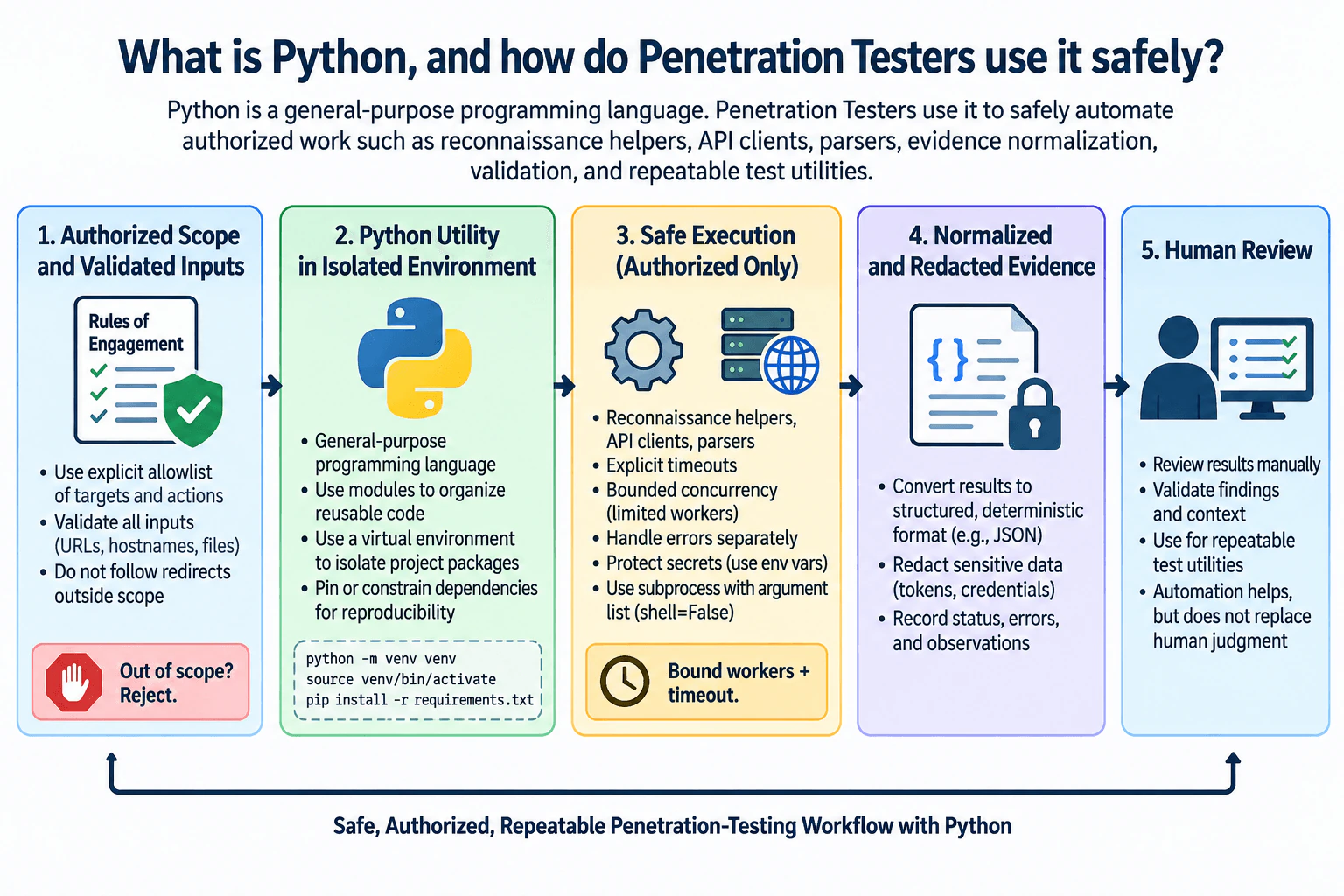
I would start by defining Python. Python is a general-purpose programming language. A module is a reusable Python file or package that exposes functions, classes, or other objects. Penetration Testers use modules from Python's standard library and, when justified, carefully selected third-party packages to build small utilities instead of manually repeating the same work.
The first boundary is authorization. Before my code contacts anything, I treat target names, addresses, URLs, credentials, files, and command output as data that must be validated. I compare network targets against an explicit allowlist rather than assuming that anything discovered during reconnaissance automatically becomes authorized. If a target does not match scope, the utility rejects it instead of continuing. I also consider redirect behavior because an initially approved URL can redirect to a different host; automation must not silently follow that request outside scope.
For reconnaissance and API clients, Python can make repeated requests, collect status information, and normalize responses into structured evidence. The utility should have an explicit timeout so a slow service cannot leave workers hanging indefinitely. Retries, when used, should be limited rather than infinite and should respect the rules of engagement. Request rates and worker counts should stay below authorized limits. Bounded concurrency means I choose a fixed maximum number of simultaneous tasks rather than creating a new worker for every discovered target. This improves speed while protecting service availability.
Input validation matters because automation increases the effect of a mistake. I validate data types, allowed URL schemes, target membership, credential placement, lengths, required fields, and expected formats before performing an action. Parsers should also expect malformed or incomplete input. A parser receiving unexpected tool output should record a controlled error instead of silently converting bad data into a finding.
Exception handling makes failure visible and predictable. I catch expected failures at the correct boundary, record enough context to investigate them, and avoid broad exception handling that hides programming errors. A timeout should be reported as a timeout, malformed data as a parsing or validation error, an out-of-scope target as a scope rejection, and an HTTP response as an observation rather than automatically as a vulnerability. Deterministic structured output, such as sorted JSON records, makes evidence easier to compare between runs.
I isolate project dependencies with a virtual environment so assessment packages are separated from unrelated Python environments. For a reproducible assessment environment, dependency versions can be constrained or pinned in the team's approved requirements or lock mechanism. The important tradeoff is that repeatability must not become permanent use of outdated dependencies, so pinned environments still need maintenance and security review.
Secrets should not be hard-coded in source code, URLs, command-line examples, logs, or committed configuration. I prefer the organization's approved secret mechanism and pass only the secret needed for the current operation. When an environment variable is appropriate, the program reads it at runtime and never prints its value. Logs and evidence should redact authorization headers, session tokens, passwords, cookies, and other reusable credentials.
Subprocess calls need another trust boundary. If Python must invoke an approved local tool, I pass arguments as a list and avoid building a shell command from untrusted text. I normally keep shell execution disabled, set a timeout, capture output deliberately, allowlist the executable when practical, and validate every user-controlled argument before invoking the program. I also use the least privilege needed for the utility.
Virtual environments, validation, timeouts, exception handling, subprocess controls, secrets, redirects, and concurrency solve different problems. None of them proves that a target is secure or that a vulnerability exists. The evidence still has to be reviewed. I validate automation with synthetic positive, negative, malformed-input, boundary, timeout, duplicate-input, and regression cases before depending on it in an assessment. For network utilities, I start with a tiny authorized test set and low concurrency, confirm the output, and expand only within the agreed rules of engagement.
The main tradeoff is speed versus safety and confidence. More concurrency may finish faster but creates more load and can make failures harder to interpret. Automatic retries may improve resilience but also repeat traffic and increase load. More third-party libraries may reduce development time but increase dependency maintenance and supply-chain exposure. Strong input validation and deterministic evidence require more engineering effort, but they reduce accidental scope violations and make results easier to reproduce and review.
- Read the written authorization and convert approved targets and actions into explicit configuration.
- Validate every supplied target, URL, file, and option before use, including scheme, hostname, embedded credentials, and scope membership.
- Load required secrets from an approved runtime source without logging them.
- Use isolated, reviewed dependencies and a reproducible environment.
- Perform only the least intrusive authorized operation, with explicit timeouts, request limits, bounded retries when permitted, and a bounded worker count.
- Prevent automatic redirects from silently crossing the approved target boundary unless each destination is independently validated.
- Handle scope rejection, malformed data, redirects, HTTP responses, network errors, timeouts, and parser failures separately.
- Normalize results into deterministic structured evidence with sensitive values redacted.
- Validate the utility first with synthetic positive, negative, boundary, malformed-input, timeout, duplicate-input, and regression cases.
- Run against a small authorized target set before expanding within the rules of engagement.
- Review the evidence manually rather than treating automation output as proof of a vulnerability.
This example is intentionally a small, non-destructive Python utility. Its input is an ordered list of HTTPS URLs plus an explicit hostname allowlist. Duplicate URLs are accepted and checked independently; output is sorted by sanitized URL for deterministic reporting. It rejects embedded URL credentials, validates every hostname before a request, prevents HTTP redirects from being followed automatically, uses an explicit timeout, limits concurrent workers, and returns structured results. It does not perform exploitation or discovery. Authentication can be supplied through an environment variable, but the token is never included in output. Every success and failure result contains only a sanitized origin; user information, paths, queries, and fragments are omitted because they may contain secrets. Malformed URLs use a fixed redacted label, and validation errors do not echo raw input. Redirects, HTTP errors, network failures, and timeouts become separate evidence states instead of terminating the complete run. No automatic retry is performed because retry policy and rate limits must come from the rules of engagement. The subprocess helper demonstrates a safer pattern for an approved local command: the executable is allowlisted, arguments are passed as a list, shell execution is disabled, and a timeout is mandatory.
from __future__ import annotations

import json
import os
import socket
import subprocess
from concurrent.futures import ThreadPoolExecutor
from dataclasses import asdict, dataclass
from typing import Iterable
from urllib.error import HTTPError, URLError
from urllib.parse import urlparse
from urllib.request import HTTPRedirectHandler, Request, build_opener


# Safe defaults: keep the utility small and bounded unless the rules of
# engagement explicitly permit different values.
DEFAULT_TIMEOUT_SECONDS = 5.0
DEFAULT_MAX_WORKERS = 3


@dataclass(frozen=True)
class Result:
    url: str
    outcome: str
    status: int | None
    detail: str


class NoRedirectHandler(HTTPRedirectHandler):
    """Stop automatic redirects and expose them as HTTPError observations."""

    def redirect_request(self, req, fp, code, msg, headers, newurl):
        # Raising HTTPError here ensures this redirect is not delegated to
        # another redirect handler and no request is sent to the new target.
        raise HTTPError(req.full_url, code, msg, headers, fp)


def safe_url_for_output(url: str) -> str:
    """Keep only a validated origin; paths, queries and fragments may hold secrets."""
    try:
        parsed = urlparse(url)
        host = parsed.hostname
        if parsed.scheme not in {"http", "https"} or not host:
            return "[REDACTED URL]"
        # Reject unusual host text rather than echoing attacker-controlled data.
        import ipaddress
        import re

        try:
            address = ipaddress.ip_address(host)
            host = f"[{address}]" if address.version == 6 else str(address)
        except ValueError:
            if not re.fullmatch(r"[A-Za-z0-9.-]+", host):
                return "[REDACTED URL]"
            host = host.lower()
        port = parsed.port
        authority = host + (f":{port}" if port is not None else "")
        return f"{parsed.scheme}://{authority}/[REDACTED]"
    except (TypeError, ValueError):
        # Never echo raw input or parser error text for malformed URLs.
        return "[REDACTED URL]"


def validate_url(url: str, allowed_hosts: set[str]) -> str:
    """Return the URL only when its request boundary is explicitly allowed."""
    parsed = urlparse(url)

    # HTTPS is required by this example so an accidental plaintext request
    # does not expose an authorization token.
    if parsed.scheme != "https":
        raise ValueError("Only HTTPS URLs are allowed")

    if not parsed.hostname:
        raise ValueError("URL must contain a hostname")

    # Credentials embedded in a URL can leak through logs and evidence, so
    # this utility rejects them; output is independently sanitized on every path.
    if parsed.username is not None or parsed.password is not None:
        raise ValueError("Credentials must not be embedded in the URL")

    host = parsed.hostname.lower()

    # Exact membership is deliberate. A discovered neighboring hostname does
    # not automatically become authorized.
    if host not in allowed_hosts:
        raise ValueError(f"Host is outside the approved allowlist: {host}")

    return url


def check_url(
    url: str,
    allowed_hosts: set[str],
    timeout_seconds: float,
    token: str | None,
) -> Result:
    """Perform one bounded, read-only HTTP GET against an authorized URL."""
    safe_url = safe_url_for_output(url)
    try:
        validated_url = validate_url(url, allowed_hosts)

        headers = {
            "User-Agent": "authorized-security-validation/1.0",
            "Accept": "application/json,text/plain,*/*",
        }

        # The secret is used only for the request and is never copied into the
        # Result object or printed by this program.
        if token:
            headers["Authorization"] = f"Bearer {token}"

        request = Request(validated_url, headers=headers, method="GET")

        # Automatic redirects are disabled because the Location destination
        # might be outside the approved scope.
        opener = build_opener(NoRedirectHandler())

        # The timeout bounds blocking network operations. Only a small
        # response prefix is read to keep local evidence collection bounded.
        with opener.open(request, timeout=timeout_seconds) as response:
            response.read(1024)
            return Result(
                url=safe_url,
                outcome="response",
                status=response.status,
                detail="Authorized request completed",
            )

    except ValueError:
        return Result(
            url=safe_url, outcome="rejected", status=None, detail="URL rejected by validation"
        )
    except HTTPError as exc:
        # Redirect responses are observations only. They are not followed and
        # do not automatically become findings.
        if 300 <= exc.code < 400:
            return Result(
                url=safe_url,
                outcome="redirect",
                status=exc.code,
                detail="Redirect observed but not followed",
            )
        return Result(
            url=safe_url,
            outcome="http_error",
            status=exc.code,
            detail="Server returned an HTTP error response",
        )
    except URLError as exc:
        # urllib may wrap socket timeouts inside URLError. Classify those as
        # timeouts instead of generic network errors.
        if isinstance(exc.reason, (TimeoutError, socket.timeout)):
            return Result(
                url=safe_url,
                outcome="timeout",
                status=None,
                detail="Request exceeded the configured timeout",
            )
        return Result(
            url=safe_url,
            outcome="network_error",
            status=None,
            detail=type(exc.reason).__name__,
        )
    except (TimeoutError, socket.timeout):
        return Result(
            url=safe_url,
            outcome="timeout",
            status=None,
            detail="Request exceeded the configured timeout",
        )


def run_checks(
    urls: Iterable[str],
    allowed_hosts: set[str],
    max_workers: int = DEFAULT_MAX_WORKERS,
    timeout_seconds: float = DEFAULT_TIMEOUT_SECONDS,
) -> list[Result]:
    """Check URLs with explicitly bounded concurrency."""
    if not 1 <= max_workers <= 10:
        raise ValueError("max_workers must be between 1 and 10")

    if not 0.1 <= timeout_seconds <= 30.0:
        raise ValueError("timeout_seconds must be between 0.1 and 30 seconds")

    # Normalize the allowlist once so hostname comparison is deterministic.
    normalized_hosts = {host.lower() for host in allowed_hosts}

    # Runtime secret loading avoids embedding the credential in source code.
    token = os.environ.get("PENTEST_API_TOKEN")

    # Input order and duplicates are preserved here. Each duplicate therefore
    # causes another authorized request; callers should deduplicate first when
    # repeated requests are unnecessary under the rules of engagement.
    url_list = list(urls)

    with ThreadPoolExecutor(max_workers=max_workers) as executor:
        results = list(
            executor.map(
                lambda url: check_url(
                    url,
                    normalized_hosts,
                    timeout_seconds,
                    token,
                ),
                url_list,
            )
        )

    # Sort by URL and outcome for deterministic evidence representation.
    # Identical duplicate records remain present.
    return sorted(results, key=lambda item: (item.url, item.outcome))


def run_approved_command(program: str, args: list[str]) -> subprocess.CompletedProcess[str]:
    """Demonstrate a safer subprocess pattern for a pre-approved local tool."""
    allowed_programs = {"printf"}
    if program not in allowed_programs:
        raise ValueError("Program is not on the local command allowlist")

    # Arguments are passed separately and shell=False is explicit. This avoids
    # interpreting user-controlled text as shell syntax.
    return subprocess.run(
        [program, *args],
        shell=False,
        capture_output=True,
        text=True,
        timeout=3,
        check=False,
    )


if __name__ == "__main__":
    # Synthetic documentation domains keep the example non-destructive. In a
    # real engagement, this set must come directly from approved scope data.
    approved_hosts = {"example.com", "example.org"}
    targets = [
        "https://example.com/",
        "https://example.org/",
        "https://outside.example.net/",
    ]

    results = run_checks(targets, approved_hosts)
print(json.dumps([asdict(item) for item in results], indent=2, sort_keys=True))A Penetration Tester can use this approach for an authorized API assessment that needs the same harmless request sent to several approved endpoints, for parsing scanner or command output into normalized evidence, for validating that supplied or discovered hostnames remain inside the approved scope, for converting assessment observations into consistent JSON records, or for building small regression utilities used during an authorized retest.
Interviewers want to see whether the candidate understands Python as a programming language rather than only as a collection of security scripts. They also want practical judgment: whether the tester can automate authorized work without accidentally leaving scope, overloading a service, leaking credentials, executing untrusted commands, losing evidence, or producing results that cannot be reproduced.
Common mistakes are treating every discovered host as automatically in scope, accepting arbitrary URLs or commands without validation, allowing redirects to cross the target boundary, running unlimited threads, omitting network timeouts, retrying indefinitely, catching every exception and hiding the cause, concatenating untrusted values into shell commands, hard-coding API tokens, placing credentials in URLs, printing secrets into logs, installing assessment packages into a shared environment without isolation, using dependencies without a reproducibility and maintenance plan, and treating a script's output as proof of a vulnerability without manual validation.
Lead with the safety decision, not with Python syntax. Define Python in one sentence, give two or three realistic penetration-testing uses, and then explain the boundaries: explicit scope, validated inputs, timeouts, redirect control, bounded concurrency, safe subprocess handling, isolated dependencies, protected secrets, deterministic evidence, and manual verification.