This interview guide is for educational and informational purposes only. It is designed to help readers prepare, but it does not guarantee any interview result, hiring decision, offer, or outcome. Interview questions, hiring criteria, and preferred answers can vary by employer, interviewer, industry, location, and time. All answers, examples, and explanations in this guide are suggested examples for interview preparation, not definitive answers or instructions for professional practice. They are based on research and judgment, are provided without warranties of any kind, and should be adapted to the question, role, and applicable laws and professional requirements. Diagrams are simplified illustrations intended to highlight the main concepts and their relationships; actual situations, systems, and practices may be more complex. Alternative approaches may be equally valid or better suited to a particular question, context, or interviewer. To the fullest extent permitted by applicable law, the contributors and publisher are not liable for decisions made, actions taken, or losses incurred based on this guide.
State Laws and Professional Responsibilities
Laws and requirements governing an occupation vary by state and jurisdiction. You are responsible for checking the current laws, licensing requirements, and scope-of-practice rules that apply to your location and role, and for ensuring that your answers and actions comply with them. Adapt examples in this guide to those requirements. This guide is not legal advice.
Identity, Image, and Privacy Notice
To respect individual privacy, some names, profile photographs, avatars, biographical details, and other identifying information displayed in this guide may be replaced with pseudonyms, licensed stock images, illustrative avatars, composite images, or representative descriptions. Unless a person is expressly identified as an actual contributor, a displayed name, image, or profile should not be understood as depicting or identifying a specific candidate, interviewer, employee, or other real individual. These representations are provided for editorial and illustrative purposes only and do not imply endorsement, employment, participation, or affiliation with this guide or any company mentioned in it. Any resemblance to an actual person is coincidental.
Company Notice
This guide is an independent educational resource and is not affiliated with, endorsed by, sponsored by, or approved by the company named in this guide. Company names identify reported interview experiences or the employer context of clearly labeled original practice exercises. Interview practices can change without notice, and inclusion of company-specific content does not mean these questions are official, complete, or guaranteed to be asked. To the fullest extent permitted by law, the author, contributors, and publisher are not responsible for outcomes related to use of this material.
Content Accuracy and Verification
To the fullest extent permitted by applicable law, we do not represent or warrant that interview guides, questions, answers, examples, or diagrams are accurate, complete, current, error-free, or suitable for any particular purpose. You are responsible for independently reviewing and verifying the information before relying on it.
Questions or comments?
Contact us for general questions, or share feedback, technical corrections, and comments with the community.
1. In an authorized binary-security review, what is the BSS section in an Executable and Linkable Format (ELF) file?Exploitation And Post ExploitationMediumGoogle
Short Interview Answer (30-60 seconds)
The .bss section represents data that needs writable memory at runtime but does not need initialized bytes stored in the ELF file. It is normally SHT_NOBITS. The loader reserves memory for it, and that memory is initialized to zero when the program starts.
Detailed Explanation
The key idea is that .bss separates runtime memory size from bytes physically stored in an ELF file. Uninitialized global and static objects can require significant writable memory when a process runs, even though storing thousands of zero bytes in the executable would add no useful information. ELF normally represents this kind of section as SHT_NOBITS: the section has a defined memory size but does not occupy corresponding file space for its contents. When the executable is loaded, memory for that part of the process image is provided and initialized with zeroes.
Useful Questions to Ask the Interviewer
Are you asking mainly about the ELF file representation or also how .bss appears in process memory?
Should I explain the difference between .bss and initialized data such as .data?
Do you want the answer from a reverse-engineering and binary-review perspective?
How to Explain It in an Interview
Start with the practical distinction: .bss represents data that needs space in the running process but does not require its initial zero values to be stored byte-for-byte in the ELF file.
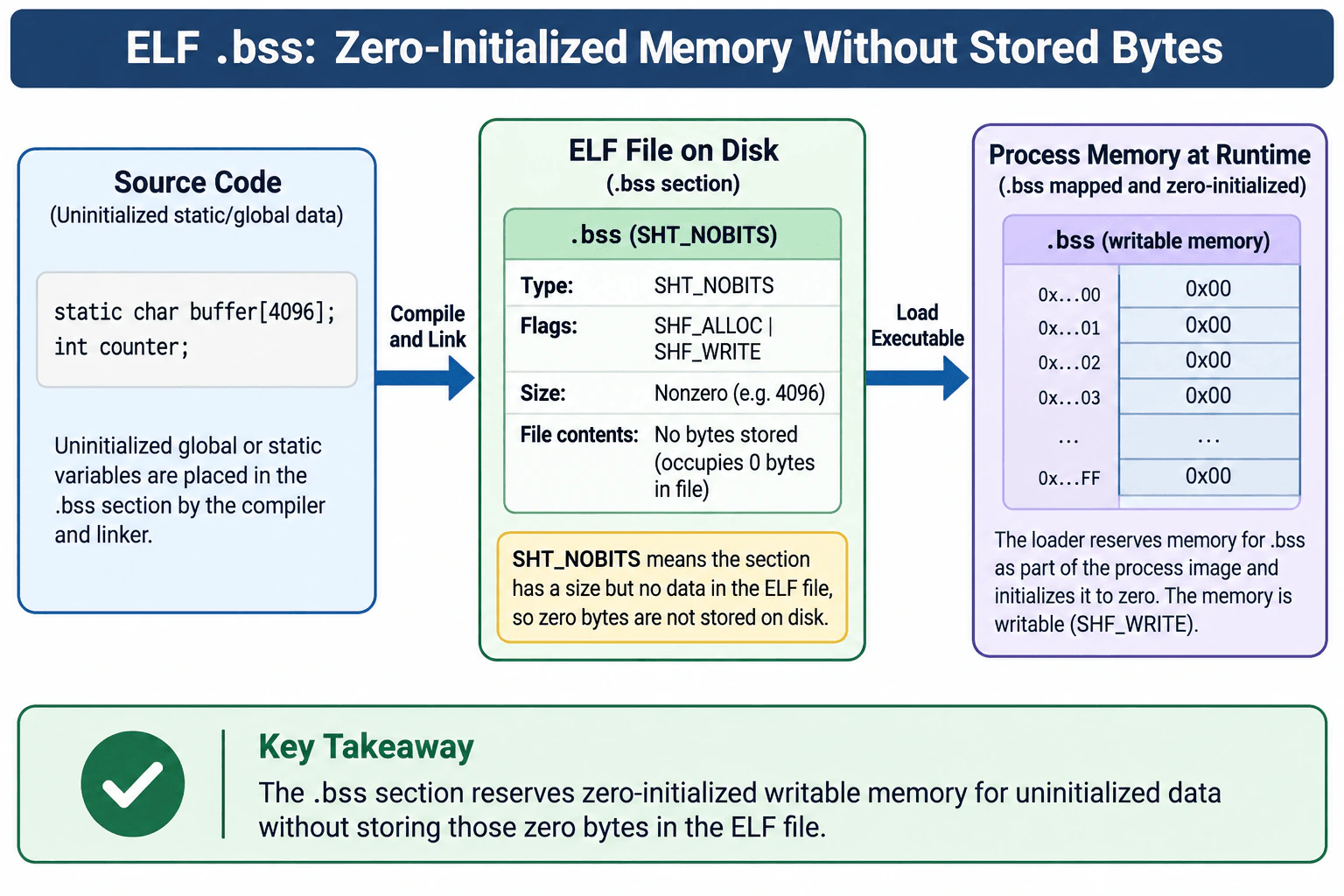
A common example is an uninitialized global or static declaration such as static char buffer[4096]; or int counter;. The compiler and linker can place such objects in .bss. The resulting section is normally SHT_NOBITS and commonly has SHF_ALLOC and SHF_WRITE attributes. SHF_ALLOC means the section occupies memory during process execution, while SHF_WRITE means that memory is writable.
The important disk-to-memory relationship is that SHT_NOBITS gives the section a logical size without requiring corresponding section contents in the file. Therefore, a 4096-byte object can require roughly that amount of runtime storage without adding 4096 zero bytes as .bss contents on disk.
At load time, the relevant loadable segment provides memory for the .bss region. The portion not backed by file bytes is initialized to zero before the program begins normal execution. This matches the diagram's flow from uninitialized source-level global or static data, through an ELF .bss section with SHT_NOBITS, to writable zero-initialized process memory.
For a penetration tester, this matters during static and dynamic binary analysis. On disk, searching for a large sequence of zero bytes is not how .bss is identified. Instead, ELF metadata describes the section and its memory size. At runtime, those objects occupy real virtual memory and may contain changing values after the program starts.
The main limitation is that section names are conventions rather than the fundamental mechanism used by the operating system to create the process image. Runtime mappings are driven by loadable program segments, so a stripped or unusual binary should be analyzed using ELF metadata rather than assuming that a literal section named .bss must always be available. Also, .bss being writable and zero-initialized does not itself indicate a vulnerability; it is normal executable data organization.
Technical Approach
Confirm that the reviewed binary is an ELF object and keep the examination within the authorized assessment scope.
Inspect the ELF section metadata and identify the .bss section when present.
Check its type and attributes; ordinary .bss is normally SHT_NOBITS and commonly has SHF_ALLOC and SHF_WRITE.
Compare its declared size with its file representation: SHT_NOBITS has a memory size without corresponding section data bytes stored in the file.
Relate the section to the appropriate loadable segment in the process image, where memory for the .bss region is provided and initialized to zero.
During dynamic analysis, treat the resulting addresses as normal writable process memory and observe only the behavior needed for the authorized review.
Do not interpret the existence, size, or writability of .bss alone as evidence of exploitation or security impact.
Practical Insights
Using .bss is efficient in file storage because the executable does not need to contain a large block of explicit zero bytes for uninitialized data. The runtime memory cost still exists because the process needs space for those variables. For binary analysis, the human and tooling cost is usually small when ELF metadata is intact, but analysis becomes harder when binaries are stripped, transformed, or organized in a nonstandard way. There is no special security benefit or vulnerability simply from using .bss; the main tradeoff is smaller on-disk representation while retaining the required writable runtime memory.
Why Interviewers Ask This
This question checks whether the candidate understands the relationship between an ELF file on disk and its process image in memory. A penetration tester who reviews native binaries should understand where global and static data commonly reside, why .bss normally occupies memory but not corresponding file-backed data space, and why its initial runtime contents are zero. It also tests whether the candidate can distinguish section metadata from actual stored bytes instead of treating every ELF section as a literal block of file contents.
Common interview mistakes
Common mistakes include saying that .bss literally stores a block of zero bytes in the executable, confusing .bss with .data, or saying that it consumes no memory. It normally consumes runtime memory but has no corresponding section data bytes in the file. Another mistake is treating SHT_NOBITS as meaning the section has no size; it can have a substantial size even though its contents occupy no file space. Candidates may also overstate that every uninitialized variable must always appear in a literal section named .bss, ignoring compiler, linker, object-format, and optimization details. Finally, the existence of writable .bss memory should not be presented as a vulnerability by itself.
Interview tip
Give the answer as a disk-versus-memory contrast: .bss has a size in the process image, but its initial zero bytes are not stored in the ELF file. Then mention SHT_NOBITS, zero initialization at startup, and one simple uninitialized global or static variable example.
Interviewer may ask next
What is the difference between the .bss and .data sections in an ELF file?
.data normally contains initialized writable data whose initial values must be represented by bytes in the file, so it is commonly SHT_PROGBITS with allocation and write attributes. .bss is normally SHT_NOBITS: it contributes writable memory to the process image without storing corresponding initial data bytes in the file, and its initial runtime memory is zeroed. Both can therefore become writable process memory, but their on-disk representations are different.
Does .bss itself create a security vulnerability because it is writable?
No. Writable .bss memory is normal program behavior and is not a vulnerability by itself. Security impact depends on how the program accesses that memory. For example, a memory-safety defect could make a global buffer relevant to an authorized investigation, but the tester must separately establish the defective access, reachable condition, resulting behavior, and impact. The mere presence or size of .bss proves none of those things.
2. What is your greatest weakness in your own authorized security work?BehavioralEasyGoogle
Interview tip:
Use STAR to structure your answer: briefly explain the Situation and Task, make Action the most detailed part, and finish with the Result. For example, describe a time when you spent too much effort perfecting evidence for lower risk findings, how you recognized that this could slow important security communication, what you changed in your testing and reporting process, and how you now balance accuracy with risk based priorities.
Situation
During a previous authorized penetration test, I noticed that one of my weaknesses was spending too much time trying to make every finding and piece of evidence perfect. I wanted each result to be fully proven before I moved on, even when some findings were lower risk and already had enough evidence to support them.
Task
My responsibility was to complete the agreed security testing, document reliable evidence, and make sure the most important risks were communicated clearly. I realized that being thorough was useful, but spending the same amount of time on every finding could reduce the time available for higher risk areas.
Action
I changed how I managed my testing. At the start of each test period, I ranked the areas I needed to investigate by potential impact and likelihood. When I found an issue, I first collected enough evidence to confirm that it was real and within the authorized scope. I then asked myself whether more testing would materially change the risk assessment or recommendation. If it would not, I documented what I had and moved to the next priority instead of continuing only to make the evidence look more complete. For important findings, I still spent additional time validating the attack path, checking the affected conditions, and making sure the evidence supported the severity. I also started communicating significant findings earlier instead of waiting until every lower risk item was finished. This helped me keep accuracy while making better use of the limited testing time.
Result
My work became more focused on security impact rather than perfection. I was still able to provide clear and defensible evidence, but I became better at protecting time for the areas that mattered most. I learned that good penetration testing requires both technical depth and judgment about when enough evidence is enough.
Why Interviewers Ask This
Interviewers ask this question to see whether a candidate can identify a genuine weakness without hiding it, take responsibility for improving it, and show sound professional judgment. A strong answer demonstrates self awareness, learning, and the ability to improve security work without sacrificing accuracy or responsible testing.
Interviewer may ask next
How do you decide when you have collected enough evidence for a finding?
I make sure the evidence clearly proves the issue, shows the affected condition, and supports the risk I am assigning. I also consider whether more testing would change the severity, remediation advice, or confidence in the finding. If it would not, I document the evidence I already have and move to the next priority.
What would you do if you were unsure whether to continue investigating a lower risk finding?
I would compare the possible value of more investigation with the remaining scope and higher risk work. If the additional testing could reveal a more serious attack path, I would continue. If the issue was already confirmed and more work would only add minor detail, I would record what I had, note any limitations, and focus on the more important areas.
3. Describe an experience in your own authorized security work where you showed initiative, stepped up, or took leadership.BehavioralMediumGoogle
Interview tip:
Use STAR to structure your answer: briefly explain the Situation and Task, make Action the most detailed part, and finish with the Result. For example, describe an authorized security assessment where you noticed an important area was not receiving enough attention, took ownership of investigating it, coordinated with the team, communicated risk clearly, and helped drive the work to a useful result.
Situation
During an authorized web application penetration test in my last role, our team was working through the agreed scope and testing the main user functions. While reviewing the application, I noticed that several sensitive actions depended on object identifiers sent by the browser. I believed the access control around those identifiers needed deeper testing because a weakness there could allow one user to reach another user's data.
Task
My responsibility was to complete my assigned testing, but I also wanted to make sure this possible access control risk was properly evaluated before the assessment ended. I decided to step up and take ownership of the investigation while keeping the rest of the team informed and staying within the approved scope.
Action
I first confirmed that the affected functions and test accounts were authorized for testing. I then mapped how the application used object identifiers across several requests. I compared requests from different test accounts and changed only the identifiers that were already available through the authorized accounts. This allowed me to test whether the server checked ownership instead of trusting information sent by the browser. I found a repeatable case where the server returned information that should have remained limited to another test account. I stopped after gathering enough evidence to prove the issue and avoided accessing unnecessary data. I documented the request flow, the expected behavior, the actual behavior, and the security impact in simple terms. I then shared the finding with the other testers so they could avoid duplicating the same work and could check whether similar access control patterns existed elsewhere in the application. I also raised the issue with the assessment lead early rather than waiting until the final report. We reviewed the evidence together, agreed on the severity based on the reachable data and authorization failure, and adjusted our remaining testing priorities so we could examine related functions before the engagement ended.
Result
The team confirmed that the access control weakness affected more than one related function, and the client received a clear explanation of the root problem and how to fix it. My initiative helped the team focus on an important risk while there was still time to investigate it properly. I learned that leadership during a penetration test does not always mean managing people. It can also mean noticing an important gap, taking responsible ownership, communicating early, and helping the team make better decisions.
Why Interviewers Ask This
Interviewers ask this question to understand whether a candidate takes responsible ownership instead of waiting for detailed direction. A strong answer shows that the candidate can recognize an important security issue, act within authorization, communicate with the team, make sound decisions, and help move an assessment forward without creating unnecessary risk.
Interviewer may ask next
Why did you raise the issue with the assessment lead before finishing all of your testing?
I raised it early because the finding could affect how we used the remaining assessment time. I had enough evidence to show that the authorization problem was real, so waiting until the final report could have reduced our chance to test related functions. Sharing it early allowed the team to review the risk, avoid duplicate work, and agree on the right testing priorities.
What would you do differently if you faced a similar situation again?
I would use the same careful approach, but I would create a small access control test matrix earlier in the assessment. I would list the sensitive functions, the available test roles, and the expected permissions for each one. That would make it easier to spot authorization gaps sooner while still keeping every test within the approved scope.
Penetration Tester Resume Examples
Explore the resume examples below to find the one that best matches your target Penetration Tester role.
Disclaimer: This interview guide is for educational and informational purposes only. It is designed to help readers prepare, but it does not guarantee any interview result, hiring decision, offer, or outcome. Interview questions, hiring criteria, and preferred answers can vary by employer, interviewer, industry, location, and time. All answers, examples, and explanations in this guide are suggested examples for interview preparation, not definitive answers or instructions for professional practice. They are based on research and judgment, are provided without warranties of any kind, and should be adapted to the question, role, and applicable laws and professional requirements. Diagrams are simplified illustrations intended to highlight the main concepts and their relationships; actual situations, systems, and practices may be more complex. Alternative approaches may be equally valid or better suited to a particular question, context, or interviewer. To the fullest extent permitted by applicable law, the contributors and publisher are not liable for decisions made, actions taken, or losses incurred based on this guide.
State Laws and Professional Responsibilities: Laws and requirements governing an occupation vary by state and jurisdiction. You are responsible for checking the current laws, licensing requirements, and scope-of-practice rules that apply to your location and role, and for ensuring that your answers and actions comply with them. Adapt examples in this guide to those requirements. This guide is not legal advice.
Company Notice: This guide is an independent educational resource and is not affiliated with, endorsed by, sponsored by, or approved by the company named in this guide. Company names identify reported interview experiences or the employer context of clearly labeled original practice exercises. Interview practices can change without notice, and inclusion of company-specific content does not mean these questions are official, complete, or guaranteed to be asked. To the fullest extent permitted by law, the author, contributors, and publisher are not responsible for outcomes related to use of this material.
Content Accuracy and Verification: To the fullest extent permitted by applicable law, we do not represent or warrant that interview guides, questions, answers, examples, or diagrams are accurate, complete, current, error-free, or suitable for any particular purpose. You are responsible for independently reviewing and verifying the information before relying on it.