This interview guide is for educational and informational purposes only. It is designed to help readers prepare, but it does not guarantee any interview result, hiring decision, offer, or outcome. Interview questions, hiring criteria, and preferred answers can vary by employer, interviewer, industry, location, and time. All answers, examples, and explanations in this guide are suggested examples for interview preparation, not definitive answers or instructions for professional practice. They are based on research and judgment, are provided without warranties of any kind, and should be adapted to the question, role, and applicable laws and professional requirements. Diagrams are simplified illustrations intended to highlight the main concepts and their relationships; actual situations, systems, and practices may be more complex. Alternative approaches may be equally valid or better suited to a particular question, context, or interviewer. To the fullest extent permitted by applicable law, the contributors and publisher are not liable for decisions made, actions taken, or losses incurred based on this guide.
State Laws and Professional Responsibilities
Laws and requirements governing an occupation vary by state and jurisdiction. You are responsible for checking the current laws, licensing requirements, and scope-of-practice rules that apply to your location and role, and for ensuring that your answers and actions comply with them. Adapt examples in this guide to those requirements. This guide is not legal advice.
Identity, Image, and Privacy Notice
To respect individual privacy, some names, profile photographs, avatars, biographical details, and other identifying information displayed in this guide may be replaced with pseudonyms, licensed stock images, illustrative avatars, composite images, or representative descriptions. Unless a person is expressly identified as an actual contributor, a displayed name, image, or profile should not be understood as depicting or identifying a specific candidate, interviewer, employee, or other real individual. These representations are provided for editorial and illustrative purposes only and do not imply endorsement, employment, participation, or affiliation with this guide or any company mentioned in it. Any resemblance to an actual person is coincidental.
Company Notice
This guide is an independent educational resource and is not affiliated with, endorsed by, sponsored by, or approved by the company named in this guide. Company names identify reported interview experiences or the employer context of clearly labeled original practice exercises. Interview practices can change without notice, and inclusion of company-specific content does not mean these questions are official, complete, or guaranteed to be asked. To the fullest extent permitted by law, the author, contributors, and publisher are not responsible for outcomes related to use of this material.
Content Accuracy and Verification
To the fullest extent permitted by applicable law, we do not represent or warrant that interview guides, questions, answers, examples, or diagrams are accurate, complete, current, error-free, or suitable for any particular purpose. You are responsible for independently reviewing and verifying the information before relying on it.
Questions or comments?
Contact us for general questions, or share feedback, technical corrections, and comments with the community.
1. Explain a secure architecture for a web server.Web Application SecurityMediumAmazon
i Question Details
Consider the web server in an authorized threat-modeling review.
Short Interview Answer (30-60 seconds)
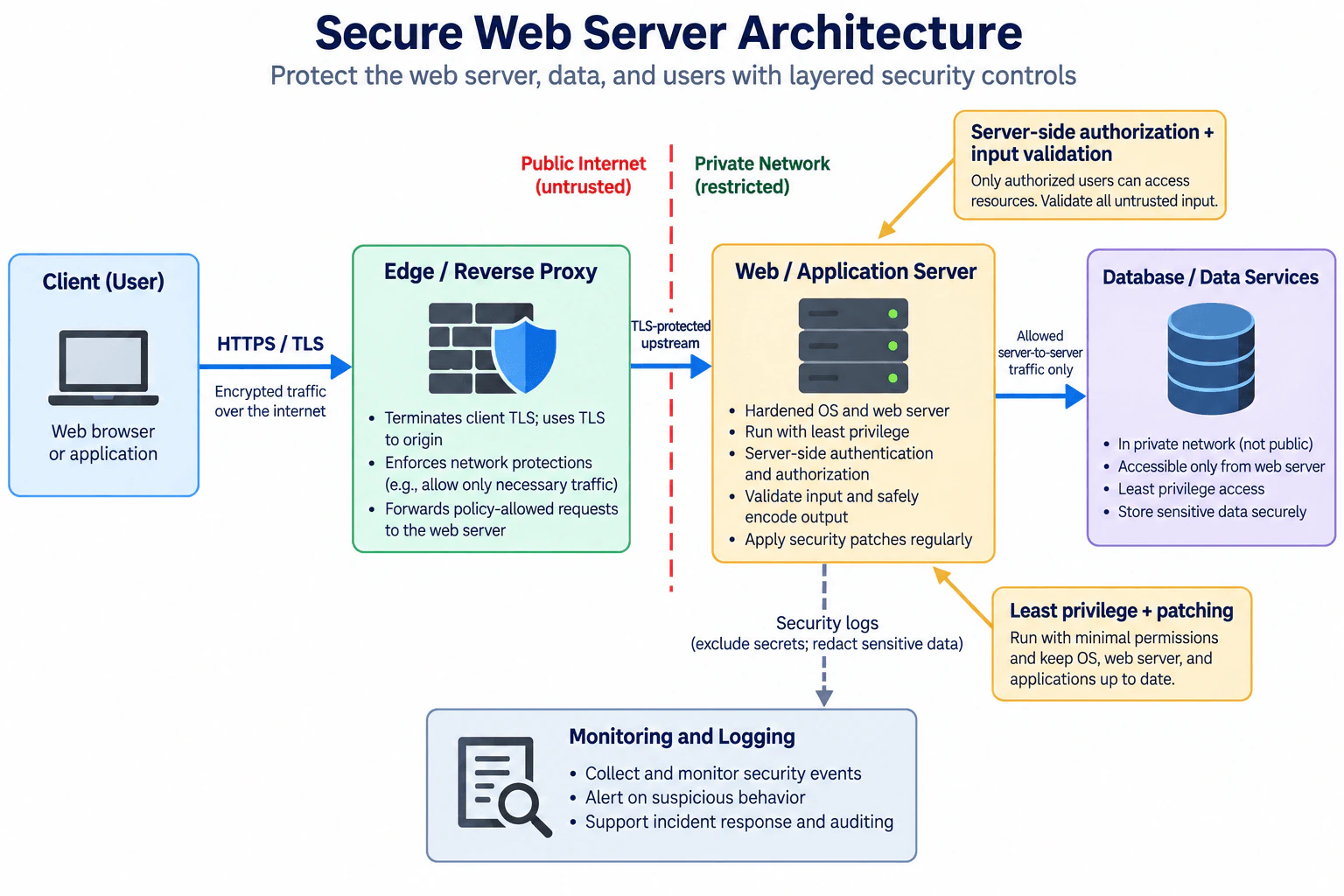
I would place an edge or reverse proxy in front of a hardened web server, use HTTPS/TLS to the client and TLS to the origin, keep application and data services in a restricted private network, enforce server-side authorization and validation, use least privilege, patch regularly, restrict database traffic, and centralize security logging.
Detailed Explanation
The main goal is defense in depth: expose only the minimum public surface, protect traffic in transit, keep application and data systems behind a restricted network boundary, and enforce security again at the server. The reverse proxy filters traffic according to policy, but the application must still authenticate users, authorize each sensitive action, validate untrusted input, encode output safely, and run with minimal privileges. Database access should be private and limited to required server-to-server communication. Monitoring provides evidence when prevention fails.
Useful Questions to Ask the Interviewer
Is the web server directly internet-facing, or can an edge or reverse proxy front it?
Does the application need separate database or other data services behind the web server?
Are there any required internal integrations that need inbound or outbound network access?
What availability requirements affect patching, failover, and monitoring decisions?
How to Explain It in an Interview
Start from the outside and move inward.
The client communicates with the service over HTTPS using TLS. This protects confidentiality and integrity while traffic crosses the public internet. TLS protects the connection, but it does not mean the endpoint itself is automatically trustworthy.
Put an edge or reverse proxy between the internet and the application server. It terminates the client-side TLS connection, applies network-level protections, and forwards only requests allowed by its policy. The upstream connection to the origin should also use TLS so traffic remains protected between the proxy and the web server.
Treat the internal side as restricted, not automatically trusted. The web or application server should not rely only on network location. It should use a hardened operating system and web-server configuration, disable unnecessary services, receive security patches regularly, and run with the minimum privileges needed.
Enforce application security on the server. Authentication establishes who the user is. Authorization decides whether that identity may perform a requested action. Authorization should be checked server-side and should fail closed when access is not allowed. Validate untrusted input before processing it, but do not treat validation as a replacement for context-appropriate output encoding. Output encoding prevents untrusted data from being interpreted as executable browser content when it is rendered.
Keep database and data services private. They should not be directly reachable from the public internet. Permit only the server-to-server paths the application needs, and use a least-privileged service identity or account for data access. A compromised web server could still threaten the database, so segmentation and least privilege reduce impact rather than eliminating risk.
Send security events to centralized monitoring and logging. Useful evidence includes authentication and authorization failures, unexpected application behavior, backend TLS failures, and other security-relevant events. Do not record reusable secrets such as passwords, access tokens, or encryption keys. Sensitive information that must be logged should be minimized, masked, sanitized, hashed, or otherwise protected according to its purpose.
The safe-failure principle is important throughout the architecture. If authorization fails, access should be denied. If a protected backend connection cannot be established securely, the system should not silently downgrade to an unprotected path. If a database operation is not allowed, the application should return a controlled error instead of exposing internal details.
For an authorized threat-modeling review, I would validate that each intended trust boundary and flow actually matches the deployed design: public client to reverse proxy, TLS-protected proxy to origin, application server to approved data services, and application logs to monitoring. I would also verify that there are no unintended direct paths around these controls.
The main tradeoff is complexity. Extra network boundaries, encrypted internal connections, centralized monitoring, patch management, and least-privilege identities require configuration and operational work. However, each layer limits a different failure mode. No individual control guarantees security, and residual risk remains if application logic, dependencies, credentials, or the server itself are compromised.
Technical Approach
Identify the public client, reverse proxy, web or application server, database or data services, and monitoring system.
Mark the public-internet and restricted-private-network boundary.
Verify HTTPS/TLS from the client to the edge and TLS protection from the edge to the origin.
Confirm that only policy-allowed requests reach the web server and that unintended direct origin access is blocked.
Review server hardening, unnecessary services, patching, and runtime privileges.
Verify server-side authentication and authorization, input validation, and context-appropriate output encoding.
Confirm that database access is private, limited to required server-to-server flows, and uses least privilege.
Review security logging to confirm useful events are captured while reusable secrets and unnecessary sensitive data are excluded or redacted.
Validate safe failure behavior for denied authorization, backend TLS failure, and unavailable data services.
Document residual risks and retest the intended boundaries after changes.
Practical Insights
This architecture costs more to operate than placing one web server directly on the internet. The reverse proxy, internal TLS, restricted network rules, centralized logs, patching process, and least-privileged identities all need configuration, monitoring, and maintenance. More layers can also make troubleshooting harder. However, the cost buys separation: a mistake or compromise in one layer is less likely to expose every system. Teams also need time to test patches, rotate credentials, review alerts, and verify that security rules do not block legitimate traffic.
Why Interviewers Ask This
Interviewers want to see whether you can design defense in depth, define trust boundaries, separate network controls from application controls, protect sensitive data, apply least privilege, and explain how prevention, monitoring, and response work together. They also want to see whether you avoid treating a private network, reverse proxy, or firewall as inherently trusted or sufficient by itself.
Common interview mistakes
Common mistakes are exposing the origin server directly to the internet, assuming a private network is automatically trusted, terminating TLS at the proxy and then sending cleartext traffic to the origin, treating proxy filtering as a substitute for server-side authorization, confusing authentication with authorization, relying on input validation instead of also using context-appropriate output encoding, running the application or database with excessive privileges, allowing broad database connectivity, skipping regular patching, logging passwords or tokens, and collecting logs without monitoring or responding to them.
Interview tip
Explain the architecture from outside to inside: client, edge, restricted application tier, private data tier, then monitoring. For each layer, state what security property it adds and what it does not guarantee. Emphasize that network location does not create trust, authorization is enforced server-side, internal traffic remains protected, and logging supports detection rather than replacing prevention.
Interviewer may ask next
Why use a reverse proxy if the application server already performs authentication and authorization?
The reverse proxy and application server solve different problems. The proxy reduces the exposed attack surface, terminates client TLS, applies network-level policy, and can reject traffic that should never reach the application. The application server still must authenticate identities and authorize actions because the proxy cannot understand every application object, user role, or business rule. Keeping both layers provides defense in depth without treating the proxy as a complete security boundary.
What happens if the web server is compromised even though it is inside the restricted private network?
The architecture should assume that compromise is still possible. Least-privileged runtime permissions and database credentials limit what the compromised server can access. Network rules restrict which backend services it can reach. Centralized logs and alerts can provide evidence of suspicious behavior. The database remains private, but the compromised server may still have legitimate access to some data, so segmentation reduces blast radius rather than removing all risk. Recovery would require containing the server, rotating affected credentials, patching the root cause, restoring a known-good state, and validating the original path again.
2. What is the seven-layer OSI model in an authorized network-security review?Network And Active DirectoryEasyAmazon
Short Interview Answer (30-60 seconds)
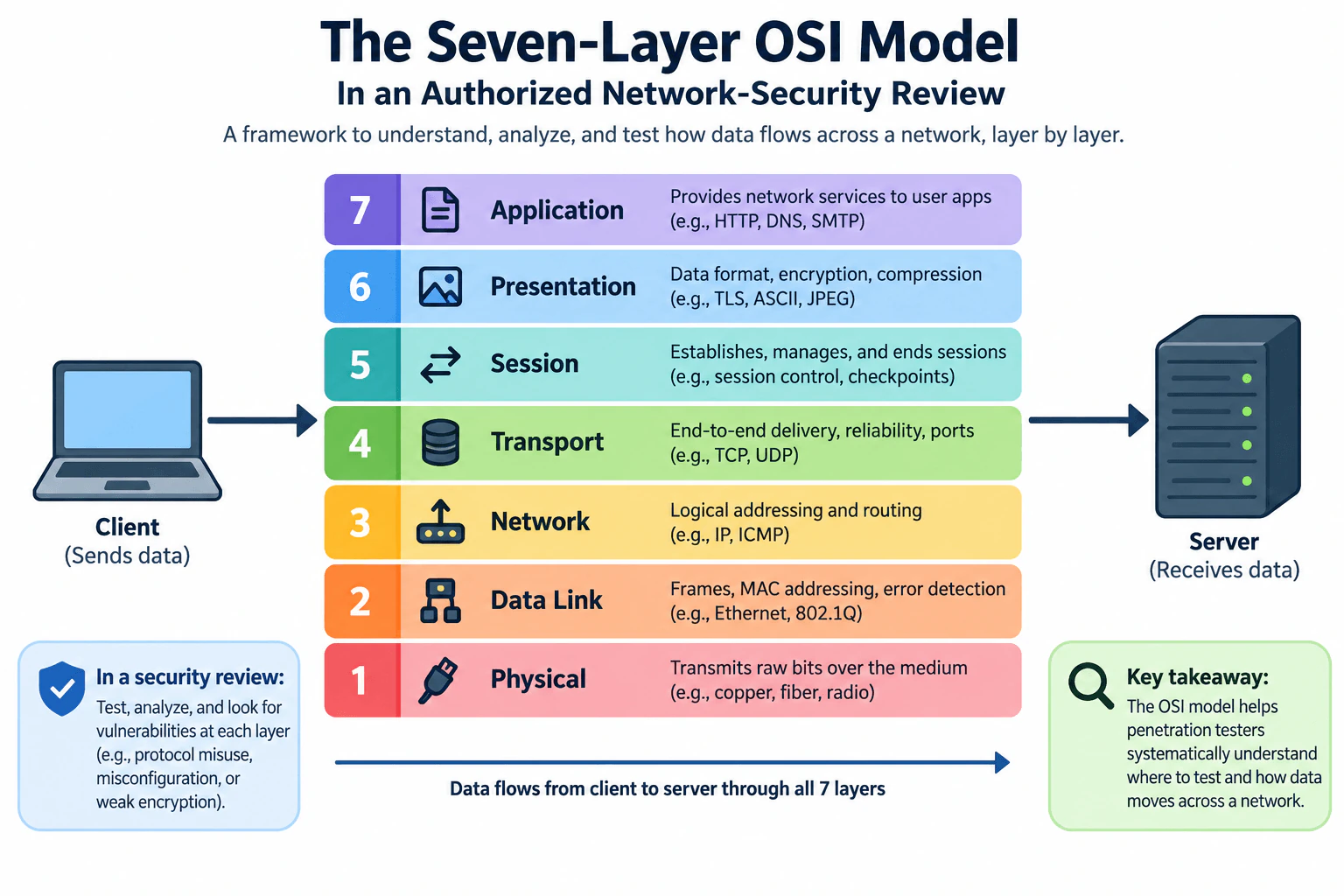
The OSI model organizes network communication into seven layers: Physical, Data Link, Network, Transport, Session, Presentation, and Application. During an authorized review, I use it to understand where traffic flows and to classify observations, misconfigurations, and possible weaknesses without treating the model itself as a security control.
Detailed Explanation
The practical purpose of the OSI model in a security review is to give me a structured way to reason about network communication. It divides communication into seven conceptual layers, from the physical medium at Layer 1 to application-facing network services at Layer 7. I can use those layers to locate where an observed behavior occurs and choose appropriate evidence to examine. The model does not prove that a weakness is exploitable, and modern Internet protocols do not always map perfectly to one OSI layer. It is primarily an analysis and troubleshooting framework.
Useful Questions to Ask the Interviewer
Do you want only the seven layers and their functions, or also how a penetration tester uses them during an authorized review?
Should I give a simple client-to-server example to show how data moves through the layers?
How to Explain It in an Interview
I would start from Layer 1 and move upward:
Physical — Layer 1: This layer carries raw bits over a physical or wireless medium. Examples include copper, fiber, and radio. During an authorized review, physical connectivity or transmission problems can be classified here.
Data Link — Layer 2: This layer handles local-link communication using frames and link-layer addressing, such as MAC addresses. Ethernet and IEEE 802.1Q VLAN tagging are common examples. This layer is useful when reasoning about local network behavior and segmentation at the link level.
Network — Layer 3: This layer handles logical addressing and routing between networks. IP is the main example shown in the diagram, and ICMP provides network-layer control and diagnostic messaging for IP. A tester can use this layer to reason about source and destination addresses, routes, and network boundaries.
Transport — Layer 4: This layer provides end-to-end transport functions. TCP provides reliable, connection-oriented delivery, while UDP provides connectionless datagram transport without TCP-style reliability. Ports help identify transport endpoints. I should not say that every Layer 4 protocol provides reliability because UDP does not.
Session — Layer 5: Conceptually, this layer establishes, manages, and terminates communication sessions or dialogs and can support synchronization or checkpoints. In modern Internet implementations, these functions are often combined with application libraries or other layers rather than appearing as a separate protocol layer.
Presentation — Layer 6: Conceptually, this layer deals with representation of data, including translation, encoding, compression, and encryption-related transformations. Formats such as ASCII or JPEG illustrate representation functions. TLS is often placed near this layer in teaching diagrams because it transforms and protects application data, but real Internet protocol mappings do not always align exactly with OSI boundaries.
Application — Layer 7: This is the layer closest to user applications and provides application-facing network services. Common examples include HTTP, DNS, and SMTP. During an authorized assessment, observations about an application protocol can be organized at this layer.
The diagram shows a client sending data toward a server through the seven conceptual layers. When sending, information is logically processed down the stack toward transmission; the receiving system processes it back up toward the application. This is a conceptual representation rather than a claim that every deployed protocol stack implements seven separate software modules.
For security work, the key decision is: At which layer is the observed behavior occurring, and what evidence supports that conclusion? For example, an IP routing problem belongs primarily at the Network layer, while an HTTP behavior belongs primarily at the Application layer. Some technologies span or do not cleanly align with a single OSI layer, so I use the model as a reasoning aid rather than forcing every protocol into an exact box.
The security-review boundary is also important. I analyze only systems and traffic covered by the authorization and rules of engagement. Identifying a protocol, reachable service, or unusual behavior at one layer does not by itself prove a vulnerability or impact. I would gather appropriate evidence and validate any security conclusion separately.
The main limitation is that the OSI model is a reference model, not an implementation specification for the modern Internet. Its value is simplicity: it gives testers and defenders a shared vocabulary for discussing where communication functions, failures, and security observations occur.
Technical Approach
Start with the observed client-to-server communication and confirm that it is within the authorized scope.
Identify the relevant communication function rather than immediately calling it a vulnerability.
Map the observation to the most useful OSI layer: Physical, Data Link, Network, Transport, Session, Presentation, or Application.
Trace the relevant evidence, such as the medium, frame behavior, IP addresses and route, transport protocol and ports, session behavior, data representation or encryption, or application protocol.
Remember that some real protocols span conceptual OSI boundaries, so do not force an artificial one-to-one mapping.
Validate the observed behavior independently before making a security finding. A layer classification explains where something occurs; it does not prove exploitability or impact.
Practical Insights
The OSI model itself has almost no operational or financial cost because it is a conceptual framework. Its main cost is the time needed to understand which layer is relevant and gather suitable evidence. The seven-layer structure makes communication easier to explain and troubleshoot, but real systems may combine several OSI functions, so forcing every protocol into exactly one layer can create confusion. For a security review, additional effort comes from safely validating an observation instead of assuming that a protocol, port, or unusual behavior represents a vulnerability.
Why Interviewers Ask This
Interviewers want to confirm that I understand fundamental network layering and can apply it practically during an authorized assessment. A penetration tester should be able to connect observed traffic or behavior to the appropriate layer instead of treating every network issue as the same problem. The question also tests whether I understand that the OSI model is a conceptual reference model rather than a literal description of every modern protocol implementation.
Common interview mistakes
A common mistake is memorizing the seven names without understanding what they represent. Another is saying every modern network literally implements seven separate OSI layers. It is also incorrect to say that all Transport-layer protocols provide reliable delivery; TCP does, while UDP does not provide TCP-style reliability. Another mistake is forcing technologies such as TLS into one exact layer without acknowledging that real protocol stacks do not always map cleanly to the OSI model. In a penetration test, the biggest security mistake is treating a layer, protocol, reachable port, or scanner observation as proof of a vulnerability without validating the actual weakness and impact.
Interview tip
Name the layers in order, give one simple function for each, and then explain why the model matters to a penetration tester: it helps classify where network behavior occurs. Mention that it is a conceptual reference model, so real Internet protocols may not map perfectly to one layer. That demonstrates understanding rather than simple memorization.
Interviewer may ask next
How does data move through the OSI layers between a client and a server?
Conceptually, when the client sends data, the information is processed from the upper layers down toward the Physical layer for transmission. The receiving server processes the received information upward from the lower layers toward the Application layer. Each layer provides services to the layer above it and uses services from the layer below it. This is commonly described as encapsulation on the sending side and decapsulation on the receiving side. The diagram's client-to-server arrow represents this overall flow, but real Internet implementations do not necessarily contain seven physically separate processing components.
What is an important limitation of using the OSI model during a penetration test?
The main limitation is that it is a conceptual reference model rather than a literal implementation map for every modern network. Some technologies combine functions associated with several OSI layers or do not fit neatly into one layer. For example, TLS is often associated with Presentation-layer concepts in teaching material, but its practical placement depends on how the protocol stack is viewed. I therefore use OSI to organize reasoning and communication, while basing security conclusions on the actual protocols, configuration, traffic, and evidence observed in the authorized environment.
3. In an authorized remote-access review, explain how SSH works in technical detail.Network And Active DirectoryMediumAmazon
Short Interview Answer (30-60 seconds)
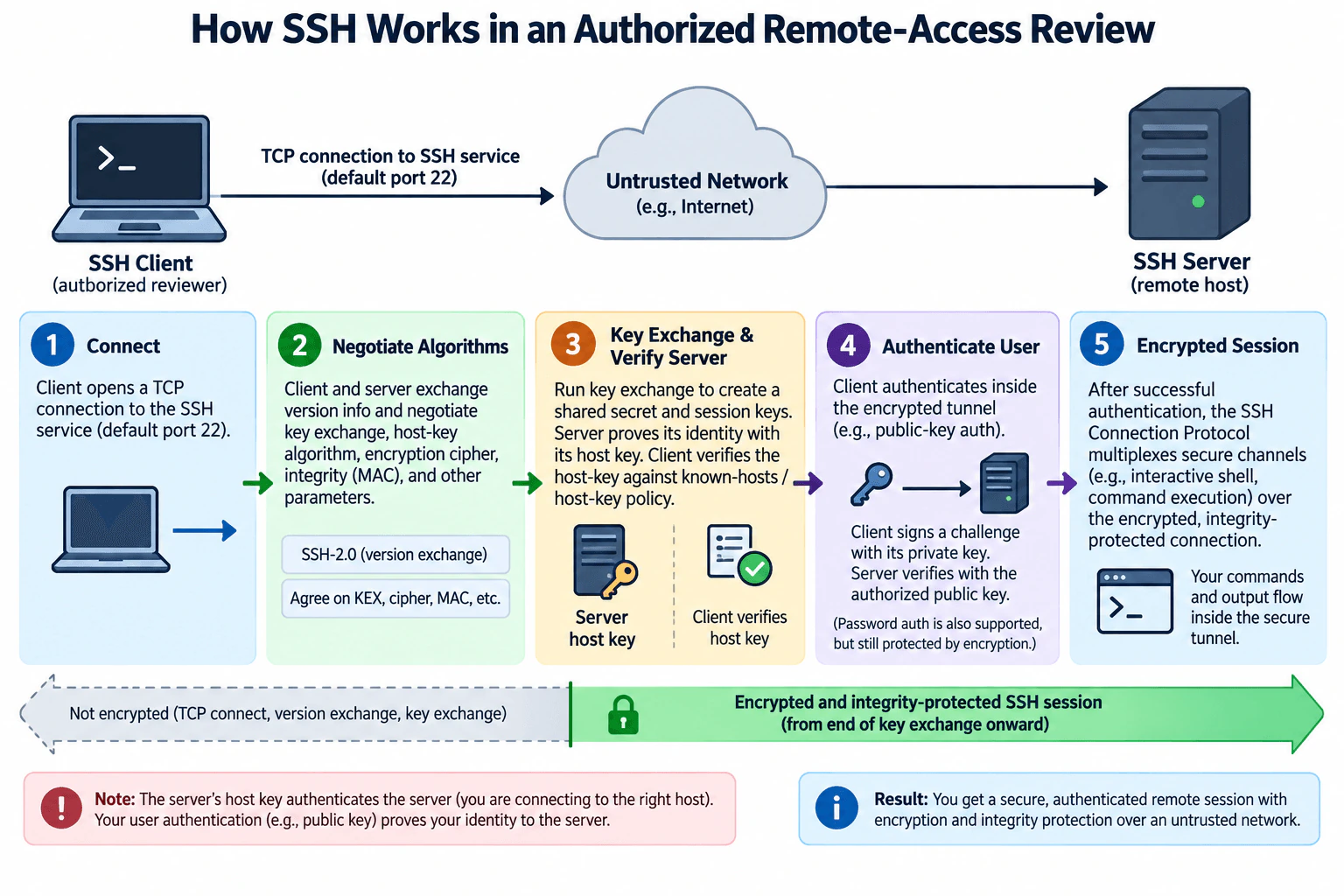
SSH normally starts with a TCP connection to port 22, negotiates algorithms, performs key exchange, verifies the server host key, and establishes encrypted, integrity-protected transport. The client then authenticates, commonly with a public key. After success, SSH multiplexes secure channels such as a shell or command session.
Detailed Explanation
This question is asking me to trace what happens from an authorized SSH client to a remote SSH server and explain where trust and encryption begin. I would separate five stages: TCP connection, protocol and algorithm negotiation, key exchange plus server verification, user authentication, and the encrypted application session. The important distinction is that the initial TCP connection itself is not the security boundary. SSH establishes cryptographic keys and authenticates the server during the transport-layer exchange. User authentication then runs through that protected transport before remote commands or other SSH channels are allowed.
Useful Questions to Ask the Interviewer
Should I explain SSH at the protocol level, or also describe what I would validate during the authorized review?
Should I assume normal direct SSH over TCP port 22, as shown in the diagram?
Should I focus on public-key authentication while also mentioning password authentication as an alternative?
How to Explain It in an Interview
I would start with the practical goal: SSH, or Secure Shell, gives the authorized client a confidential, integrity-protected, authenticated way to use a remote system across an untrusted network.
Connect over TCP. The SSH client opens a TCP connection to the remote SSH service. Port 22 is the standard SSH port and is the default shown in the diagram, although a server can be configured to listen elsewhere. At this point, TCP gives reliable byte transport but does not itself provide SSH encryption or authentication.
Exchange identification and negotiate algorithms. The SSH peers first exchange protocol identification strings. They then exchange key-exchange initialization messages and negotiate compatible algorithms. These include the key-exchange method, server host-key algorithm, encryption algorithms, integrity algorithms, and other supported transport parameters. The important point is that both sides select mutually supported cryptographic parameters rather than assuming them. rfc-editor.org
Perform key exchange and authenticate the server. The negotiated key-exchange mechanism lets both sides establish shared secret material without transmitting the resulting session keys directly across the network. SSH derives encryption and integrity keys from the key-exchange result. With an explicit server-authentication key exchange, the server proves control of its host private key by signing the exchange data. The client validates that proof and decides whether the corresponding host key represents the expected server. In a normal known-host workflow, the client compares the observed host key with a previously trusted host-key record or another approved host-key policy. An unexpected host-key change is security-significant because blindly accepting it can defeat server authentication. rfc-editor.org
The diagram labels the transport before completion of the initial key exchange as not encrypted and the traffic after key exchange as encrypted and integrity protected. More precisely, the negotiated protection begins when the peers exchange the protocol's new-keys messages and start using the newly derived keys. From that point, higher-level SSH traffic runs through the protected transport. rfc-editor.org
Authenticate the user inside the protected transport. SSH user authentication is a separate layer above the transport layer. With public-key authentication, the server determines whether the offered public key is acceptable for the requested account, and the client proves possession of the corresponding private key with a digital signature. The diagram simplifies this as signing a challenge. More precisely, the public-key authentication signature is bound to the SSH session and authentication request rather than being a generic reusable challenge response. Password authentication is also supported, but the password is sent only after the SSH transport has established confidentiality protection.
Authentication can fail safely. An invalid signature, unacceptable public key, incorrect password, or unsatisfied authentication policy should result in authentication failure rather than an authenticated session. Likewise, failure to negotiate acceptable transport algorithms or failure to validate the expected server identity should stop the trusted connection rather than silently lowering the security requirement.
Open SSH connection channels. After user authentication succeeds, the SSH connection protocol operates through the protected transport. It can multiplex multiple logical channels over one SSH connection. For example, an authorized user may receive an interactive shell or execute a command. The diagram correctly represents commands and their output as travelling inside the encrypted, integrity-protected connection.
For an authorized remote-access review, I would collect evidence for each important boundary instead of treating one observation as proof of everything. TCP reachability proves that a network path to the service exists; it does not prove that authentication succeeds or that a vulnerability exists. I would verify the expected destination, TCP port, SSH identification, negotiated algorithms, server host-key identity, permitted authentication method, successful or rejected authentication outcome, and resulting authorized session behavior. I would avoid credential guessing or disruptive testing unless the rules of engagement explicitly allowed it.
The main tradeoff is between usability and assurance. SSH can safely cross an untrusted network because encryption, integrity protection, server authentication, and user authentication address different problems. However, cryptography does not decide whether the authenticated account has appropriate operating-system permissions. SSH also cannot protect an endpoint whose private keys or host itself are already compromised. Key management, trusted host-key verification, account authorization, and endpoint security therefore remain important outside the encrypted tunnel.
Technical Approach
Confirm that the remote host, network path, SSH service, identity, and authentication method are inside the written authorization scope.
Trace the expected client-to-server path and confirm the SSH TCP destination and configured port, using port 22 only when that is the expected configuration.
Establish one normal SSH connection and observe the protocol identification and algorithm negotiation without attempting disruptive scanning or credential guessing.
Verify that key exchange completes and record the negotiated transport properties needed for the review.
Validate the server host-key identity against the approved trust source; treat an unexplained mismatch as a failed trust decision rather than automatically accepting it.
Exercise only the approved user-authentication method. For public-key authentication, confirm that authentication succeeds only when the client can prove possession of an authorized private key.
After authentication, verify only the authorized remote-session behavior, such as opening a shell or permitted command channel.
Record evidence separately for TCP reachability, SSH service identification, server authentication, user authentication, and authorized session access so that none is incorrectly presented as proof of another.
Practical Insights
SSH adds several small costs in exchange for secure remote access. The client and server spend CPU time on key exchange, signatures, encryption, and integrity checks, but this overhead is normally modest for administrative sessions. Administrators must protect client private keys and server host keys, maintain trusted host-key information, manage which user public keys are authorized, remove stale access, and investigate unexpected host-key changes. Operational complexity increases when many hosts or users are involved because key rotation and trust distribution must be controlled. Stronger cryptographic policy can also reduce compatibility with old clients or servers, so organizations must balance interoperability against accepting outdated or disallowed algorithms.
Why Interviewers Ask This
Interviewers want to see whether I understand that SSH is more than an encrypted TCP connection. I should distinguish transport establishment, algorithm negotiation, key exchange, server host authentication, user authentication, and the final connection protocol. For a penetration tester, they also want evidence that I understand trust boundaries and failure behavior: an unexpected host key should not simply be ignored, successful TCP connectivity does not prove authentication, and successful SSH authentication does not automatically imply unrestricted privilege on the remote host.
Common interview mistakes
A common mistake is saying that SSH becomes secure merely because TCP port 22 is reachable. TCP connectivity only establishes the transport path. Another mistake is mixing server authentication with user authentication: the server host key lets the client verify the remote server, while user authentication proves an identity to the server. It is also wrong to say the client's private key is sent to the server; public-key authentication uses a signature to prove possession of that private key. Another mistake is treating the public-key signature as an arbitrary reusable challenge response instead of a signature bound to the SSH session and authentication request. Finally, automatically accepting an unexpected host key removes an important server-authentication protection.
Interview tip
Explain SSH as a five-stage flow and name the trust decision at each stage. Emphasize that key exchange plus host-key verification establishes the protected transport, then user authentication happens inside it. Finish by separating network reachability, server identity, user identity, and post-authentication authorization.
Interviewer may ask next
What is the difference between an SSH server host key and a user's SSH public key?
They authenticate different identities. The SSH server has a host private key and corresponding public host key. During key exchange, the server uses its host private key to authenticate itself, and the client checks whether the public host key is trusted for that destination. A user's public key is instead used for user authentication. The server authorizes that public key for an account, while the user's private key stays on the client side. The client signs session-bound authentication data, and the server verifies the signature with the authorized public key. Therefore, host-key verification answers 'Is this the expected server?' while user public-key authentication answers 'Can this client prove possession of the approved user credential?'
What should happen if the SSH server's host key unexpectedly changes?
The client should treat an unexpected host-key change as a trust failure that needs investigation rather than silently accepting the new key. A legitimate change can happen after host replacement or key rotation, but an unexplained change could also mean that the client is reaching a different system or that the connection is being intercepted. During an authorized review, I would stop the trust decision, compare the observed host-key fingerprint with the approved source, determine whether the change was expected, and update the trusted record only after independent validation. The encrypted connection alone is not enough if the client has not authenticated the intended server.
4. How would you secure an Amazon EC2 instance in an environment you are authorized to assess?Cloud SecurityMediumAmazon
Short Interview Answer (30-60 seconds)
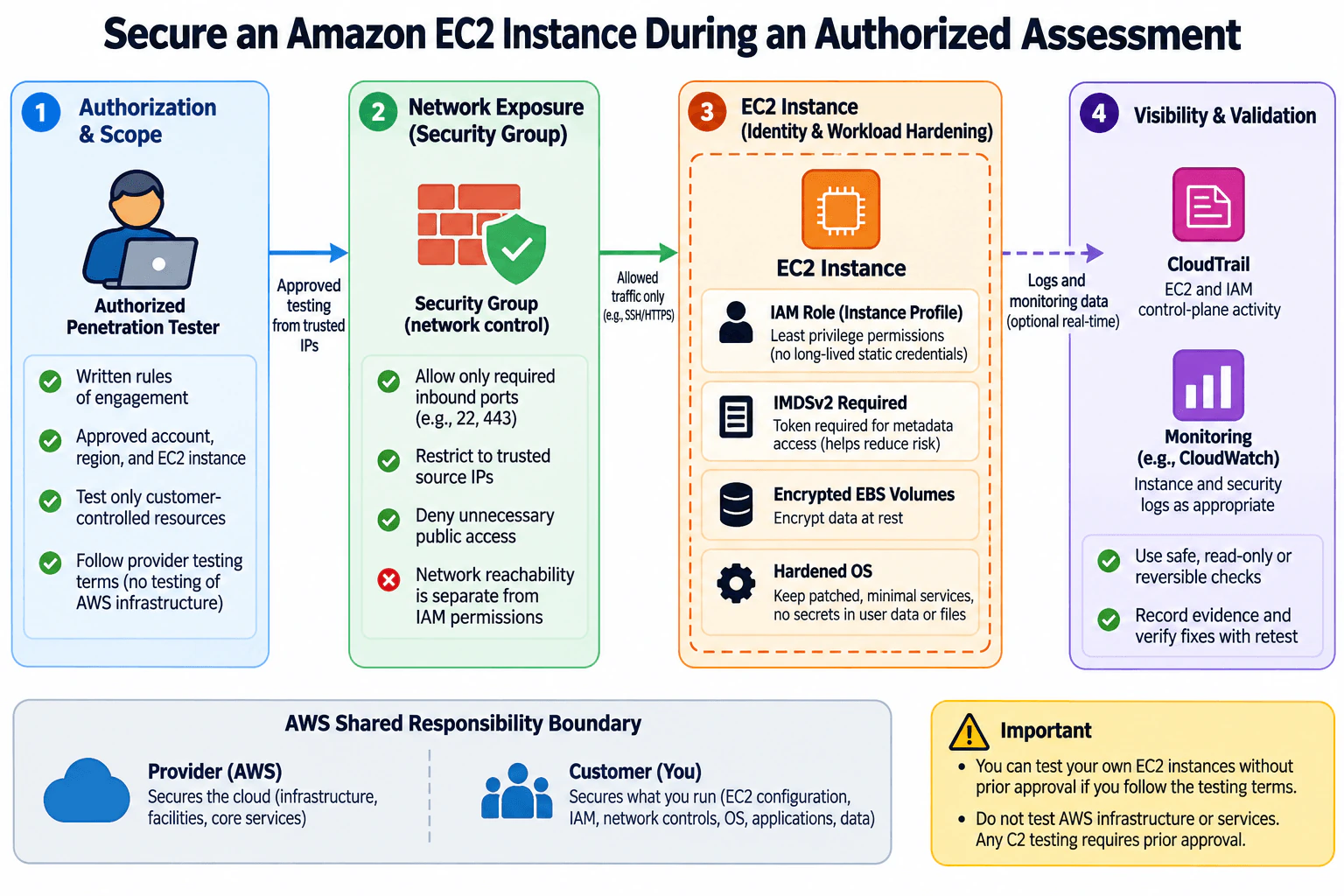
I would confirm authorization first, then restrict network exposure, apply least-privilege IAM, require IMDSv2, encrypt EBS, harden and patch the OS, and enable useful logging and monitoring. I would validate each control with safe, reversible checks, document evidence, and retest after remediation.
Detailed Explanation
Securing an EC2 instance means protecting both how people reach it and what the workload can do after access is obtained. In an authorized assessment, I would first confirm the exact AWS account, Region, instance, approved tester identity, trusted source addresses, and rules of engagement. I would then review network exposure, workload identity, metadata protection, storage encryption, operating-system hardening, and visibility. I would keep the work inside the customer-controlled environment, use non-destructive validation first, record evidence, and retest confirmed fixes rather than assuming that a configuration is secure.
Useful Questions to Ask the Interviewer
Is the instance intended to be publicly reachable, or should access come only from trusted internal or administrative networks?
Which inbound services are actually required, such as SSH on port 22 or HTTPS on port 443?
Does the instance need an IAM role to call AWS services, and what exact permissions does the workload require?
Are CloudTrail and instance or security logs already collected, and where should assessment evidence be recorded?
Are there any provider-policy, availability, or change-control restrictions beyond the normal rules of engagement?
How to Explain It in an Interview
I would organize the assessment in four connected parts.
First, I establish authorization and scope. I confirm the written rules of engagement, the approved AWS account and Region, the exact EC2 instance, the tester identity, and the trusted IP addresses from which testing may originate. AWS secures the underlying cloud infrastructure, while the customer is responsible for areas such as EC2 network configuration, guest operating-system security, credentials, applications, and data. I would test only customer-controlled resources covered by the authorization. AWS permits customers to assess supported services such as their own EC2 instances without prior approval when the activity follows its penetration-testing policy. Command and Control testing requires prior approval, and customers must not test AWS infrastructure or AWS services themselves.
Second, I reduce network exposure with the instance's security group. I allow only the inbound services the workload truly needs and restrict administrative access to trusted source IP ranges where possible. For example, port 22 should not be broadly open simply because SSH exists, and port 443 should be exposed only when the workload actually needs HTTPS. Security groups control network reachability, but network reachability is separate from IAM authorization. Reaching a TCP port does not mean an identity has permission to perform AWS API actions.
Third, I harden the EC2 workload itself. If the instance needs AWS permissions, I use an IAM role through an instance profile with only the actions and resources the workload requires instead of storing long-lived access keys on disk. I require Instance Metadata Service Version 2, or IMDSv2, so metadata requests require session tokens and IMDSv1 is disabled for that instance. I encrypt attached EBS volumes so data at rest is protected. I also keep the guest operating system patched, remove unnecessary services and packages, and avoid placing reusable secrets in user data or ordinary files.
Fourth, I verify visibility and the deployed state. I review CloudTrail for relevant EC2 and IAM control-plane activity and use suitable monitoring, such as CloudWatch-supported metrics and logs, for the instance and its security signals where configured. Logging is a detection control; it does not replace prevention through IAM, network restrictions, metadata settings, encryption, or host hardening.
For validation, I start with read-only discovery and reversible tests. I verify the effective security-group path from the authorized source, inspect the actual instance role and permissions, confirm that IMDSv2 is required, verify EBS encryption, review patch and service state, and confirm that expected control-plane activity is recorded. I record the principal, resource, action, condition, network path, observed evidence, remediation owner, and retest result where applicable.
Safe failure matters. If a check would require destructive modification, expose a reusable credential, affect another tenant, create uncontrolled traffic, or risk availability, I stop and use a safer proof or obtain explicit approval. I do not treat a potentially weak setting as proof of exploitation.
The main limitation is that no single control proves the instance is secure. A narrow security group does not prove IAM is least privileged, IMDSv2 does not remove every application-level risk, encryption does not prevent an authorized process from reading decrypted data, and CloudTrail or monitoring does not prevent compromise. The tradeoff is between strong restriction and operational need: every open port, IAM permission, installed service, and monitoring component should have a justified purpose. After remediation, I repeat the same safe checks against the deployed configuration to confirm that the original path is actually closed.
Technical Approach
Confirm written authorization, AWS account, Region, EC2 instance, tester identity, trusted source IPs, and stop conditions.
Review security-group reachability and allow only required inbound services from appropriate sources.
Review the EC2 instance profile and verify that the workload uses a least-privilege IAM role rather than long-lived static credentials.
Confirm that IMDSv2 is required and IMDSv1 access is disabled for the instance.
Verify that attached EBS volumes are encrypted without exposing key material.
Review the guest operating system for patch state, unnecessary services, and unsafe secret storage.
Confirm relevant CloudTrail coverage and appropriate instance or security monitoring.
Use read-only or reversible evidence to validate each finding, avoid destructive actions, document the exact observed path, assign remediation ownership, and safely retest.
Practical Insights
The technical cost is mostly configuration review, patching, IAM design, encryption, and monitoring rather than a complex algorithm. Operational cost can increase when teams restrict ports, remove services, rotate access methods, or tighten IAM because applications may depend on existing access. Logging and monitoring also create storage, analysis, and alert-maintenance work. Encryption and key-management choices can add policy and lifecycle responsibility. Human effort is required to maintain patching, review permissions, respond to alerts, and retest changes. Stronger controls should therefore be applied according to the instance's real access and workload needs.
Why Interviewers Ask This
This question tests whether I can secure and assess an EC2 instance as a complete system rather than treating one setting as sufficient. The interviewer is looking for judgment around authorized scope, AWS shared responsibility, network reachability, IAM and workload identity, metadata protection, storage encryption, operating-system hardening, logging, safe validation, and retesting.
Common interview mistakes
Common mistakes include opening SSH or application ports to far more source addresses than necessary; assuming a security group also controls IAM permissions; attaching an overly broad instance role; storing long-lived AWS keys or other reusable secrets on the host; leaving IMDSv1 available when IMDSv2 can be required; overlooking unencrypted EBS volumes; neglecting operating-system patching and unnecessary services; assuming CloudTrail records every host-level event; treating logging as a preventive control; testing outside the approved account, Region, resource, or provider policy; and making destructive changes when read-only or reversible evidence would be sufficient.
Interview tip
Present the answer as a layered flow: authorization and scope, network exposure, instance identity and hardening, then visibility and validation. Explicitly separate network reachability from IAM permission and AWS responsibility from customer responsibility. Finish by explaining how you would prove the controls safely and retest them instead of simply listing security settings.
Interviewer may ask next
Why would you require IMDSv2 on the EC2 instance?
IMDSv2 requires a session token for instance metadata requests. When the instance is configured with HTTP tokens required, IMDSv1 is disabled. This makes metadata access harder to abuse through some request-forging or misconfiguration paths. I would still treat the instance role as a separate control and keep its IAM permissions least privileged because IMDSv2 does not make an overly powerful role safe.
What if the application needs broader network or IAM access than your preferred hardened configuration?
I would not remove access blindly. I would identify the exact business and technical dependency, narrow the permission or network path as much as possible, and document the remaining exposure. For network access, that might mean limiting ports and source ranges. For IAM, it means limiting actions, resources, and applicable conditions. If broader access must remain, I would strengthen monitoring and other compensating controls, record the residual risk, and validate the final deployed state.
5. Tell me about a time you handled a difficult conversation during authorized security work.BehavioralMediumAmazon
Interview tip:
Use STAR to structure your answer: briefly explain the Situation and Task, make Action the most detailed part, and finish with the Result. For example, describe an authorized security test where a finding created concern or disagreement, explain your responsibility, show how you discussed the evidence and risk calmly, clarified the testing scope, listened to the other person's concerns, agreed on a practical next step, and reached a constructive result.
Situation
During an authorized penetration test in my last role, I found an access control issue that allowed a user with limited permissions to reach information that should have required a higher level of access. When I shared the finding with the application team, one engineer strongly disagreed with my assessment. They were concerned that I had gone beyond the approved testing scope and that the finding could delay an upcoming release.
Task
My responsibility was to make sure the security issue was understood accurately while also protecting the working relationship with the team. I needed to confirm that my testing had stayed within the written authorization, explain the risk without making the conversation defensive, and help the team decide on a safe next step.
Action
I first kept the conversation focused on facts instead of opinions. I showed the engineer the approved scope and explained the exact sequence of actions I had taken. I made it clear that I had used only the permitted test account and had stopped as soon as I confirmed that access was possible. I then reproduced the issue with the engineer present so we could look at the same evidence together. I explained that the main concern was not the amount of data I had viewed during testing. The concern was that the application trusted the user's request without checking whether that user was allowed to access the requested resource. I also listened carefully to the engineer's concern about the release schedule. Instead of arguing that the release should simply stop, I asked what controls could be added safely before release and what changes would require more development time. We agreed that the team would add an authorization check on the affected request, review similar endpoints, and then provide a test build for validation. I documented the finding, the evidence, the agreed scope, and the next steps so there was a clear record of the conversation and decision.
Result
The conversation became much more constructive once we reviewed the evidence and authorization together. The team accepted the finding and addressed the access control problem before moving forward. I then retested the change and confirmed that the unauthorized access was blocked. I learned that difficult security conversations are easier to resolve when I stay calm, separate the technical evidence from personal judgment, listen to operational concerns, and work with the team on a practical solution.
Why Interviewers Ask This
Interviewers ask this question to evaluate whether a penetration tester can handle disagreement or tension professionally during authorized security work. A strong answer shows that the candidate respects scope, communicates evidence clearly, listens to concerns, stays calm under pressure, and works toward a security decision without damaging trust.
Interviewer may ask next
How did you respond when the engineer said you had gone beyond the authorized scope?
I did not argue or dismiss the concern. I opened the approved scope and walked through the exact actions I had taken. I showed that I had used the permitted account, tested only the authorized application behavior, and stopped after confirming the issue. Reviewing the authorization and evidence together helped us move the discussion away from assumptions and back to the facts.
What would you do differently if a similar disagreement happened again?
I would involve the application team earlier when I reach a finding that could affect an important release or create uncertainty about scope. I would still document and validate the issue carefully, but an earlier conversation could help surface concerns before they become a larger disagreement. I would keep the same approach of using clear evidence, confirming authorization, listening to the team's constraints, and agreeing on practical next steps.
6. Describe a threat-modeling exercise you personally performed.BehavioralHardAmazon
i Question Details
Use a real exercise from your authorized security work. Identify its three most important threats, the mitigations you applied, and one security tradeoff you chose to leave unaddressed.
Interview tip:
Use STAR to structure your answer: briefly explain the Situation and Task, make Action the most detailed part, and finish with the Result. For example, describe an authorized security assessment where you mapped the system, identified the three most important threats, prioritized practical mitigations with the engineering team, explained why those threats mattered, and made a clear security tradeoff when one lower priority risk could not be addressed immediately.
Situation
During a previous authorized security assessment, I reviewed a web application that allowed users to upload documents and later retrieve them through an authenticated account. Before starting deeper testing, I performed a threat modeling exercise because the application handled sensitive files and exposed several paths between the browser, application server, storage service, and administrative functions.
Task
I was responsible for identifying the most important ways an attacker could abuse those trust boundaries and turning the findings into practical testing priorities and mitigations. I needed to focus on threats that could cause the greatest harm rather than creating a long list of every possible weakness.
Action
I first drew a simple data flow showing the user, browser, application server, authentication service, file storage, and administrator functions. I marked each place where data crossed from one level of trust to another. I then reviewed what an attacker could control at each point and grouped the risks by likely impact and realistic attack paths. The first major threat I identified was unauthorized access to another user's files through weak object authorization. I tested how file identifiers were handled and recommended that every file request verify ownership on the server instead of trusting an identifier supplied by the browser. The second major threat was malicious file upload. An attacker could try to upload active or dangerous content and later cause it to be processed or served in an unsafe way. I recommended strict file type validation, server generated file names, isolated storage, malware scanning, and serving uploaded content in a way that prevented execution. The third major threat was abuse of privileged administrative functions after account compromise. I recommended stronger authorization checks for administrative actions, additional authentication for sensitive operations, and detailed security logging so suspicious actions could be investigated. I reviewed these threats with the application team and explained why I ranked them above several lower impact findings. One tradeoff we chose to leave unaddressed at that time was adding a more complex content inspection process for every uploaded document. It would have required significant processing and operational changes. We kept the simpler validation and scanning controls, documented the remaining risk, and agreed that the stronger inspection control should be reconsidered if the application began accepting more complex or higher risk file types.
Result
The exercise gave the team a clear view of the application's main attack paths and helped us focus the penetration test on the areas where a successful attack would matter most. The team accepted the key authorization, upload security, and privileged access recommendations, and the remaining tradeoff was documented rather than ignored. I learned that useful threat modeling is not about finding the largest number of theoretical threats. It is about connecting realistic attacker actions to system design, choosing the most important risks, and making security decisions that the engineering team can actually implement.
Why Interviewers Ask This
Interviewers ask this question to see whether a penetration tester can reason about a system before running tools or individual tests. A strong answer shows that the candidate can identify trust boundaries, prioritize realistic threats, connect those threats to practical mitigations, communicate risk clearly, and make deliberate security tradeoffs when every possible control cannot be implemented.
Interviewer may ask next
Why did you choose those three threats as the highest priorities?
I chose them because each one connected a realistic attacker action to sensitive data or privileged control. Unauthorized file access could expose another user's information, malicious uploads could create a path to unsafe content handling, and abuse of administrative functions could give an attacker much broader control. I prioritized them over lower impact issues because they had clearer attack paths and more serious consequences for the application.
How did you decide that the additional content inspection control could be left unaddressed?
I looked at the file types the application accepted, the protections already planned, and the operational cost of adding deeper inspection. Strict validation, isolated storage, malware scanning, and safe content delivery reduced the immediate risk. The stronger inspection process would have added significant complexity for a risk that was lower under the current use case, so I documented the remaining exposure and defined the conditions that should cause the team to revisit that decision.
Penetration Tester Resume Examples
Explore the resume examples below to find the one that best matches your target Penetration Tester role.
Disclaimer: This interview guide is for educational and informational purposes only. It is designed to help readers prepare, but it does not guarantee any interview result, hiring decision, offer, or outcome. Interview questions, hiring criteria, and preferred answers can vary by employer, interviewer, industry, location, and time. All answers, examples, and explanations in this guide are suggested examples for interview preparation, not definitive answers or instructions for professional practice. They are based on research and judgment, are provided without warranties of any kind, and should be adapted to the question, role, and applicable laws and professional requirements. Diagrams are simplified illustrations intended to highlight the main concepts and their relationships; actual situations, systems, and practices may be more complex. Alternative approaches may be equally valid or better suited to a particular question, context, or interviewer. To the fullest extent permitted by applicable law, the contributors and publisher are not liable for decisions made, actions taken, or losses incurred based on this guide.
State Laws and Professional Responsibilities: Laws and requirements governing an occupation vary by state and jurisdiction. You are responsible for checking the current laws, licensing requirements, and scope-of-practice rules that apply to your location and role, and for ensuring that your answers and actions comply with them. Adapt examples in this guide to those requirements. This guide is not legal advice.
Company Notice: This guide is an independent educational resource and is not affiliated with, endorsed by, sponsored by, or approved by the company named in this guide. Company names identify reported interview experiences or the employer context of clearly labeled original practice exercises. Interview practices can change without notice, and inclusion of company-specific content does not mean these questions are official, complete, or guaranteed to be asked. To the fullest extent permitted by law, the author, contributors, and publisher are not responsible for outcomes related to use of this material.
Content Accuracy and Verification: To the fullest extent permitted by applicable law, we do not represent or warrant that interview guides, questions, answers, examples, or diagrams are accurate, complete, current, error-free, or suitable for any particular purpose. You are responsible for independently reviewing and verifying the information before relying on it.