
1. What is the difference between big-endian and little-endian byte order?
Compare the representation of multibyte values in memory during an explicitly authorized binary-security review.
Big-endian stores the most significant byte at the lowest memory address, while little-endian stores the least significant byte there. For 0x12345678, big-endian is 0x12 0x34 0x56 0x78 and little-endian is 0x78 0x56 0x34 0x12 at increasing memory addresses.
Big-endian and little-endian describe the order in which the individual bytes of a multibyte value are stored or serialized. The practical decision is simple: before interpreting raw bytes, determine which byte order the binary format, protocol, or target architecture expects. In big-endian order, the highest-order byte goes at the lowest address. In little-endian order, the lowest-order byte goes at the lowest address. The attached diagram uses the same 32-bit value, 0x12345678, to show that the intended value does not change; only its byte arrangement changes.
- Are we interpreting bytes from memory, a binary file, or a serialized protocol field?
- Is the byte order defined by the format or protocol, or should I discuss the target machine's native order?
- Should I explain the difference using a concrete multibyte hexadecimal value?
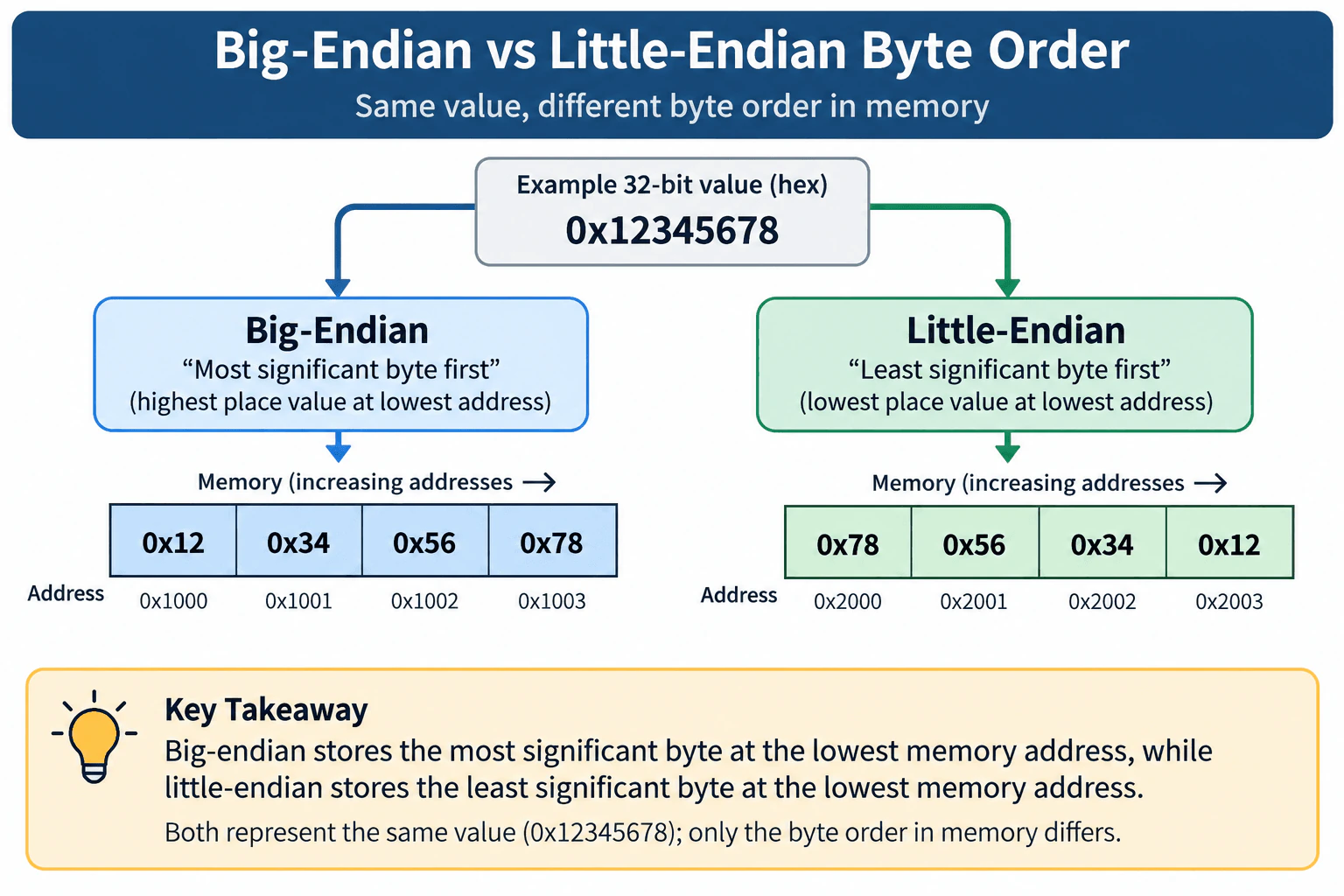
Start with the lowest memory address because that is where the difference is easiest to see. Suppose the 32-bit value is 0x12345678. It consists of four bytes: 0x12, 0x34, 0x56, and 0x78. Here, 0x12 is the most significant byte, meaning it contributes the highest place value, while 0x78 is the least significant byte.
With big-endian order, increasing addresses contain 0x12, 0x34, 0x56, and 0x78. The most significant byte is therefore stored at the lowest address. With little-endian order, increasing addresses contain 0x78, 0x56, 0x34, and 0x12. The least significant byte is stored at the lowest address. This matches the approved diagram.
The important point is that endianness does not change the intended numeric value. It changes how that value is represented as bytes. If the same raw byte sequence is interpreted using the wrong byte order, software can decode a different numeric value. That matters during an authorized binary-security review because offsets, lengths, integers, addresses, or structured fields can be misunderstood if their required byte order is ignored.
The responsibility boundary is the format being interpreted. Do not assume that every field uses the host machine's native byte order. A file format, protocol, instruction set, or serialization specification can define a byte order independently. Many Internet protocols use big-endian representation for multibyte numeric fields, commonly called network byte order, but the exact format or protocol specification remains the source of truth.
A safe validation method is to use a known synthetic value such as 0x12345678 and compare the observed four bytes with the documented order. This gives reproducible evidence without modifying the target. A limitation is that simply seeing a byte sequence does not by itself prove its intended endianness; you still need the format, protocol, or architecture definition to interpret it correctly. The main tradeoff is between convenience and correctness: assuming native byte order may be easy, but explicitly following the defined byte order prevents incorrect parsing across different systems.
- Identify the multibyte field being interpreted and its documented format or architecture.
- Determine the expected byte order instead of assuming the host system's native order.
- Read the bytes from the lowest address toward higher addresses.
- For big-endian, interpret the first byte as the most significant byte; for little-endian, interpret it as the least significant byte.
- Validate the interpretation with a known synthetic value such as 0x12345678 when possible.
- Record the byte sequence and interpreted value as reproducible evidence without modifying the target.
For a fixed-width integer such as the 32-bit value in the diagram, byte-order interpretation is effectively constant-time and uses negligible extra memory. The important cost is human and maintenance risk: a wrong assumption can make a parser misread lengths, offsets, identifiers, or addresses. There is no special financial or compliance cost inherent to endianness itself, but incorrect parsing can waste investigation time or produce incorrect findings. Making byte order explicit in code and documentation reduces that risk.
Interviewers ask this to check whether you can correctly interpret raw multibyte data during binary analysis. A penetration tester may inspect memory, file structures, packet fields, crash data, or binary formats, so choosing the wrong byte order can produce the wrong numeric interpretation and lead to an incorrect security conclusion.
Common mistakes are saying that endianness reverses individual bits instead of bytes, forgetting that the comparison is about byte placement at increasing memory addresses, assuming every file or protocol uses the machine's native byte order, and saying that big-endian and little-endian represent different intended values. Another mistake is interpreting a raw byte sequence without first checking the specification that defines that field.
Use one hexadecimal example. Say that 0x12345678 is stored as 0x12 0x34 0x56 0x78 at increasing addresses for big-endian and 0x78 0x56 0x34 0x12 for little-endian. Then state the rule: big-endian puts the most significant byte at the lowest address; little-endian puts the least significant byte there.


