2 Apple Penetration Tester Interview Questions & Answers

apple icon

Questions with Detailed ExplanationsWith Detailed Explanations

(Last Updated: September 13, 2026)

1. In an authorized network-security review, how do symmetric and asymmetric keys differ?Network And Active DirectoryEasyApple

Short Interview Answer (30-60 seconds)

Symmetric encryption uses the same secret key to encrypt and decrypt data. Asymmetric cryptography uses a public/private key pair, where the public key can be shared and the private key stays secret. Symmetric methods are usually faster; asymmetric methods support public-key encryption, signatures, and secure secret establishment.

Detailed Explanation

The practical difference is the key model and the trust it requires. Symmetric cryptography uses one secret key for an operation and its inverse, such as encrypting and decrypting data. Asymmetric cryptography uses two mathematically related keys: a public key that may be distributed and a private key that must remain protected. Depending on the scheme, the pair can support encryption and decryption, digital signing and verification, or establishing shared secrets. In a network-security review, the key question is whether each key is used and protected according to its intended role.

Useful Questions to Ask the Interviewer
  1. Do you want the comparison focused on encryption, or should I also mention digital signatures and key establishment?
  2. Should I explain the difference from a penetration-testing validation perspective as well?
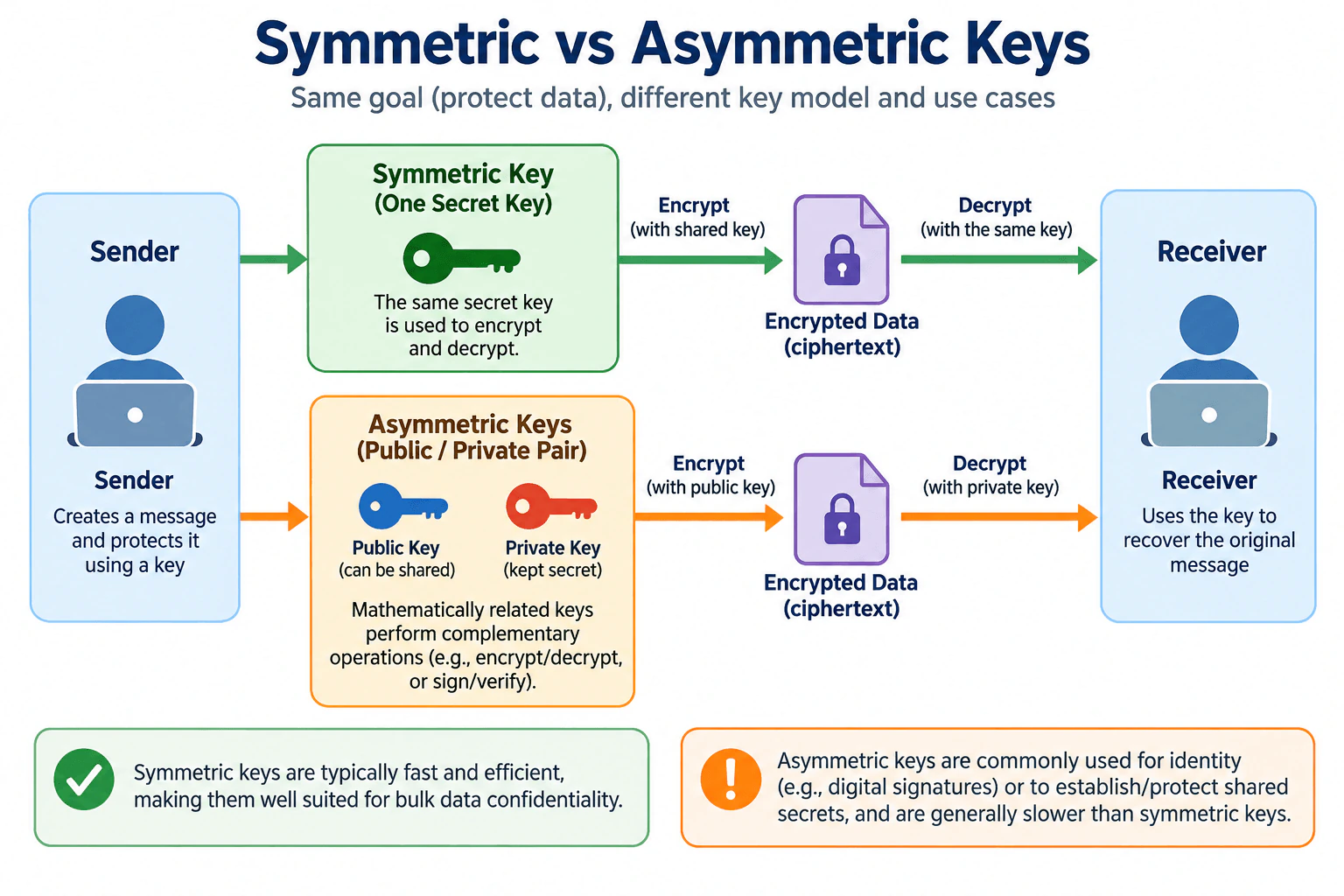
In an authorized network-security review, how do symmetric and asymmetric keys differ? diagram
How to Explain It in an Interview

Start with the simplest distinction: symmetric means one secret key; asymmetric means a public/private key pair.

For symmetric encryption, the sender encrypts plaintext with a shared secret key. The receiver uses that same secret key to recover the plaintext from the ciphertext. The important trust boundary is key distribution: both authorized parties must obtain and protect the secret without exposing it. If that shared secret is disclosed, an unauthorized party may be able to perform the cryptographic operations allowed by that key.

For asymmetric encryption, the two keys have different roles. In a common public-key encryption pattern, a sender encrypts data for a recipient using the recipient's public key, and the recipient decrypts it using the corresponding private key. The public key can be distributed, but the private key must remain secret. Asymmetric cryptography can also support digital signatures: a private key is used to create a signature and the corresponding public key is used to verify it.

The performance tradeoff shown in the diagram is also important. Symmetric cryptography is generally efficient and is well suited to protecting larger amounts of data. Asymmetric operations are generally more computationally expensive, so real systems often combine the two approaches: asymmetric cryptography can help establish or protect a shared secret, and symmetric cryptography can then protect the bulk data.

In an authorized network-security review, I would not treat the presence of either key type as proof that security is correct. I would verify the intended purpose, which party holds each key, which keys are allowed to be shared, where the encryption boundary begins and ends, and whether secret or private keys are properly protected. I would also verify that the actual cryptographic protocol and configuration use the keys in roles supported by that scheme.

A safe failure principle is that loss or exposure of a secret or private key should trigger the system's defined key-replacement or revocation process where applicable. A public key, by contrast, is designed to be distributed, although its authenticity may still need to be validated so that users do not trust an attacker's substituted public key.

The main limitation is that 'symmetric versus asymmetric' describes the key model, not the complete security of a system. Security also depends on the algorithm, protocol, key sizes and parameters, key generation, storage, distribution, authentication, implementation quality, and operational handling.

Technical Approach
  1. Identify the exact cryptographic operation being reviewed: encryption, decryption, signing, verification, or shared-secret establishment.
  2. Identify every key involved and classify it as a symmetric secret key, public key, or private key.
  3. Trace who possesses each key and whether that possession matches the design: symmetric secrets and private keys should remain protected, while public keys may be distributed.
  4. Trace the data flow from plaintext to ciphertext and back, confirming that the correct key role is used for each operation.
  5. Verify the trust boundary for key distribution or public-key authenticity rather than assuming that encryption alone solves authentication.
  6. Review how sensitive keys are generated, stored, rotated, replaced, or revoked as applicable to the approved environment.
  7. Record configuration and protocol evidence and report only verified weaknesses; do not label the use of symmetric or asymmetric cryptography itself as a vulnerability.
Practical Insights

Symmetric cryptography is usually cheaper in computing time and works well for large amounts of data, but both parties need a safe way to obtain the shared secret. Asymmetric cryptography makes public-key distribution possible and supports capabilities such as signatures, but private keys require strong protection and the operations are usually more computationally expensive. Operational cost also includes key generation, storage, rotation, recovery, public-key validation where applicable, monitoring, and incident response if sensitive keys are exposed.

Why Interviewers Ask This

This question checks whether the candidate understands a basic cryptographic trust boundary: symmetric systems depend on protecting one shared secret, while asymmetric systems separate a shareable public key from a protected private key. It also tests whether the candidate can explain why the two models are used for different purposes without incorrectly treating one as universally more secure.

Common interview mistakes

A common mistake is saying symmetric encryption uses two identical keys; it uses one shared secret key for both the operation and its inverse. Another mistake is saying the public and private keys are interchangeable in every asymmetric algorithm. Their permitted operations depend on the specific scheme. Candidates also sometimes say asymmetric cryptography is simply 'more secure.' That is too broad: the two approaches solve different problems and security depends on the complete protocol and key management. Finally, do not assume that encryption automatically authenticates the peer or proves that a public key belongs to the intended recipient.

Interview tip

Lead with 'one shared secret key versus a public/private key pair.' Then explain the trust boundary, the common encrypt/decrypt flow shown in the diagram, and the main tradeoff: symmetric cryptography is efficient for bulk data, while asymmetric cryptography supports public-key operations such as encryption, signatures, and shared-secret establishment.

Interviewer may ask next
Why are symmetric and asymmetric cryptography often used together?

They have complementary strengths. Asymmetric cryptography can help establish or protect shared keying material without requiring both parties to begin with the same secret, while symmetric cryptography is generally more efficient for protecting the larger volume of application data. A protocol can therefore use asymmetric mechanisms during setup or authentication and then use a symmetric session key for ongoing encryption.

What is the main security risk if a key is exposed?

The impact depends on the key type and protocol. Exposure of a symmetric secret can allow an unauthorized party to perform operations that rely on that shared key. Exposure of an asymmetric private key can undermine operations assigned to that private key, such as decryption or signing. A public key is intended to be shared, but its authenticity still matters because accepting a substituted attacker's public key can redirect trust.

2. Introduce yourself, emphasizing your strongest specialties.BehavioralEasyApple

Question Details

Base your introduction on your real experience in authorized security work.

Interview tip:

Use STAR to structure your answer: briefly explain the Situation and Task, make Action the most detailed part, and finish with the Result. For example, describe a previous authorized security project that shows your strongest penetration testing specialties, the responsibilities you owned, how you tested safely, how you communicated important findings, and what you learned from the work.

Situation

In my last role, I worked on authorized penetration testing where I assessed applications and supporting infrastructure for security weaknesses. My strongest areas became web application testing, authentication and access control testing, and clear reporting that helps engineering teams understand both the risk and the fix.

Task

My responsibility was to test only the approved scope, identify weaknesses that could create meaningful risk, validate findings carefully, and give the team useful evidence without disrupting normal systems. I also needed to explain technical issues in a way that developers and security teams could act on.

Action

I started each assessment by reviewing the authorized scope, test accounts, rules of engagement, and any areas that required extra care. I then mapped the application and its main attack surface before testing individual features. I focused closely on authentication, session handling, access control, input validation, and application logic because small mistakes in these areas can expose sensitive functions or data. When I found something suspicious, I reproduced it carefully and used the minimum testing needed to confirm the issue. I documented the affected request, the conditions required to reproduce the behavior, the security impact, and practical remediation guidance. I also communicated significant findings early instead of waiting until the final report, especially when the development team could begin investigating them immediately. This combination of careful technical testing and clear communication became one of my strongest specialties.

Result

The assessment gave the team clear, reproducible findings they could prioritize and address. It also strengthened my approach as a penetration tester. I learned that my best work comes from combining disciplined testing, strong knowledge of application security, careful validation, and communication that turns a technical weakness into an actionable security improvement.

Why Interviewers Ask This

Interviewers ask this question to understand the candidate's professional focus, practical penetration testing experience, and ability to explain their strengths clearly. A strong answer shows relevant security specialties, responsible testing habits, ownership of the work, and the ability to communicate technical findings effectively.

Interviewer may ask next
Which of those penetration testing specialties would you consider your strongest?

I would consider web application testing my strongest area, especially authentication and access control. I enjoy understanding how an application is supposed to separate users and privileges, then testing whether those controls remain effective when requests, sessions, and application flows are manipulated within the authorized scope.

How do you make sure your testing is both thorough and safe?

I begin with the approved scope and rules of engagement, then map the attack surface before testing more deeply. I validate findings with the minimum activity needed to prove the issue, avoid unnecessary changes to data or systems, document what I do, and communicate early if a test could create operational risk or if I discover something that needs immediate attention.

Disclaimer: This interview guide is for educational and informational purposes only. It is designed to help readers prepare, but it does not guarantee any interview result, hiring decision, offer, or outcome. Interview questions, hiring criteria, and preferred answers can vary by employer, interviewer, industry, location, and time. All answers, examples, and explanations in this guide are suggested examples for interview preparation, not definitive answers or instructions for professional practice. They are based on research and judgment, are provided without warranties of any kind, and should be adapted to the question, role, and applicable laws and professional requirements. Diagrams are simplified illustrations intended to highlight the main concepts and their relationships; actual situations, systems, and practices may be more complex. Alternative approaches may be equally valid or better suited to a particular question, context, or interviewer. To the fullest extent permitted by applicable law, the contributors and publisher are not liable for decisions made, actions taken, or losses incurred based on this guide.

State Laws and Professional Responsibilities: Laws and requirements governing an occupation vary by state and jurisdiction. You are responsible for checking the current laws, licensing requirements, and scope-of-practice rules that apply to your location and role, and for ensuring that your answers and actions comply with them. Adapt examples in this guide to those requirements. This guide is not legal advice.

Company Notice: This guide is an independent educational resource and is not affiliated with, endorsed by, sponsored by, or approved by the company named in this guide. Company names identify reported interview experiences or the employer context of clearly labeled original practice exercises. Interview practices can change without notice, and inclusion of company-specific content does not mean these questions are official, complete, or guaranteed to be asked. To the fullest extent permitted by law, the author, contributors, and publisher are not responsible for outcomes related to use of this material.

Content Accuracy and Verification: To the fullest extent permitted by applicable law, we do not represent or warrant that interview guides, questions, answers, examples, or diagrams are accurate, complete, current, error-free, or suitable for any particular purpose. You are responsible for independently reviewing and verifying the information before relying on it.