
1. How would you threat-model a Signal-like messaging application during an explicitly authorized security assessment?
I would scope the authorized clients and messaging service first, map the encrypted sender-to-server-to-recipient flow, then threat-model endpoints, key verification, malicious server behavior, metadata, delivery abuse, and local storage. I would validate each claim with minimally disruptive tests and report evidence, limitations, and residual risk.
This question asks me to build a threat model for a secure messaging system while staying strictly inside an authorized penetration-test scope. I would not start by attacking the cryptography. I would first define what I may test, then understand how the sender device, messaging service, and recipient device exchange encrypted messages. From that model, I would identify realistic threats to keys, devices, message delivery, metadata, and local data. Finally, I would validate selected threats safely, collect minimal evidence, and clearly separate demonstrated findings from assumptions and remaining risk.
- Are both client applications and the messaging service explicitly in scope?
- Are test accounts, approved source addresses, and a defined testing window available?
- May I test message manipulation, replay, reordering, duplication, and delivery failure using only test accounts?
- Are third-party services such as push-notification providers explicitly excluded unless separately approved?
- Are client-side storage, multi-device behavior, and identity-key verification part of the assessment objective?
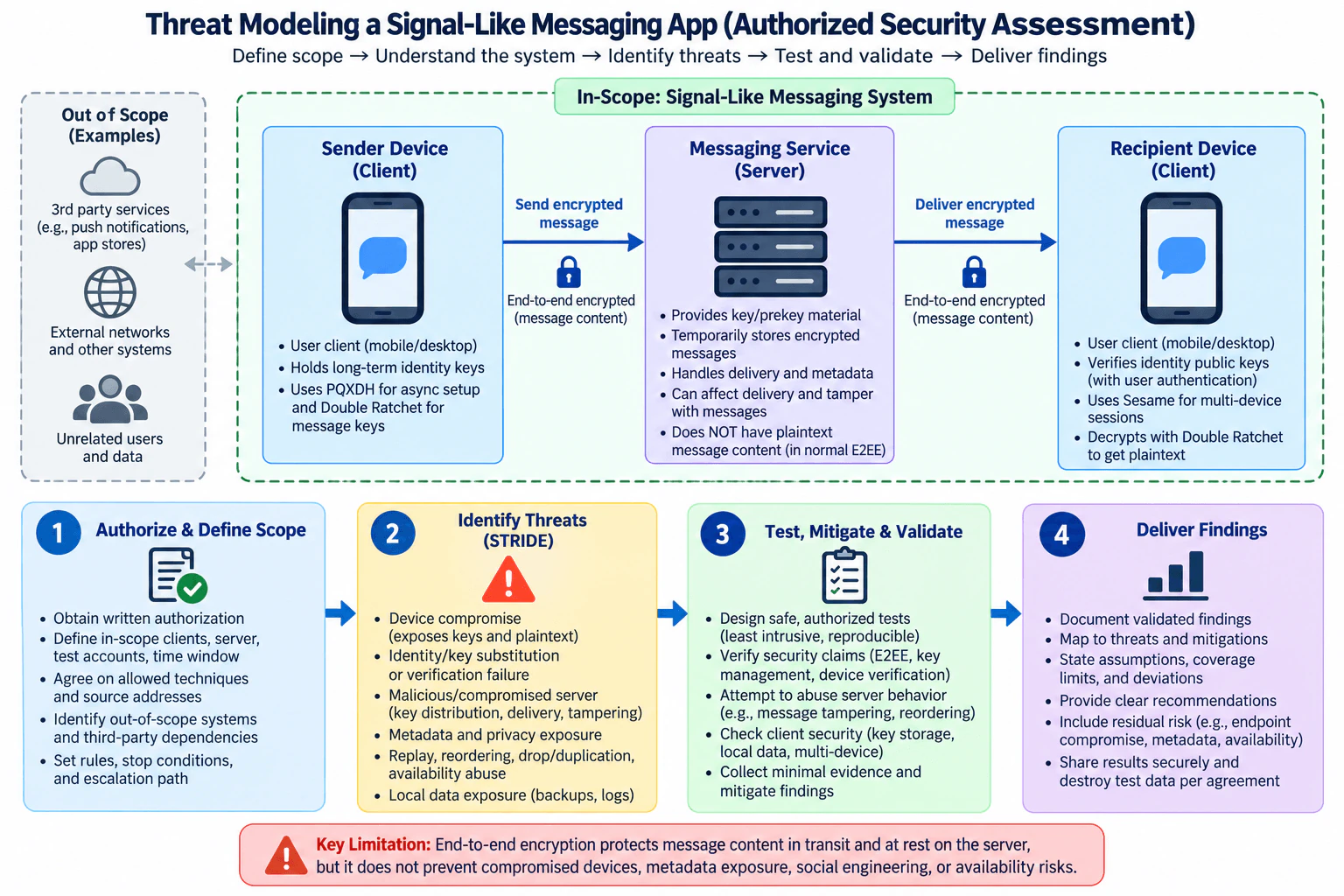
I would use a scope-first threat-modeling process.
First, I establish authorization and the responsibility boundary. I confirm the approved client builds, messaging service, test accounts, dates, source addresses, allowed techniques, prohibited actions, stop conditions, escalation contact, evidence rules, and data-retention requirements. Third-party services, external networks, unrelated users, and their data stay outside the testing boundary unless separate authorization exists. The rules of engagement define exactly what the assessment team is permitted to test.
Second, I map the system shown in the diagram. A sender device holds its long-term identity keys and sends end-to-end encrypted message content through the messaging service to a recipient device. The service can provide public identity-key and prekey material, temporarily store encrypted messages, and influence message delivery, but under the modeled normal end-to-end encryption design it does not receive plaintext message content. The recipient device authenticates or verifies identity-related public-key information and decrypts messages locally.
For the Signal-like cryptographic model shown in the diagram, PQXDH is the initial public-key authenticated key-agreement mechanism that can use prekeys published to the server to establish shared secret material. The Double Ratchet then derives new message keys as communication continues. Sesame is the session-management layer for asynchronous, multi-device messaging. These roles should remain separate because PQXDH, Double Ratchet, and Sesame solve different parts of the secure-messaging problem. signal.org
Third, I identify threats around the actual trust boundaries instead of assuming that strong encryption solves every problem. I can use STRIDE as a structured checklist, but I only keep categories that map to realistic system behavior. Important threats here include device compromise exposing keys or plaintext, identity-key substitution or failed verification, a malicious or compromised messaging service manipulating key distribution or message delivery, metadata and privacy exposure, replay or duplication, message reordering or dropping, availability abuse, and sensitive information left in local backups or logs.
The messaging service is an important adversarial boundary because it can affect delivery even when it cannot read normal end-to-end encrypted message content. Sesame explicitly models messages as potentially corrupted, deleted, reordered, delayed, duplicated, or forged before they reach a mailbox, including by a malicious server. That means these are reasonable behaviors to validate during an authorized assessment without claiming beforehand that the product is vulnerable. signal.org
Fourth, I translate each threat into a testable security claim. For example: does tampered ciphertext fail authentication and get rejected; does an unexpected identity-key change trigger the intended verification behavior; can duplicated or reordered test messages create unsafe application state; does a controlled malicious-service simulation expose plaintext that should remain endpoint-only; and does local storage expose sensitive synthetic test data beyond the intended boundary? I use approved accounts, synthetic content, and the least intrusive reproducible technique.
Safe failure behavior matters. For authenticated decryption, a failed authentication check should terminate message processing rather than accept the modified plaintext. The current Double Ratchet specification states that authentication failure raises an exception that terminates processing, and its receive procedure discards the message and associated state changes when processing fails. signal.org
I then collect only enough evidence to reproduce and support each conclusion: the relevant request or message state, observed client behavior, approved logs, timestamps, and test-account context. I avoid unnecessary capture of reusable credentials, unrelated user information, or message content. If testing could affect production availability, cross into unrelated users or third parties, or exceed a signed rule of engagement, I stop and use the agreed escalation path instead of continuing.
Finally, I report validated findings, map them back to the affected threat and security property, explain mitigations, and document assumptions, deviations, coverage limits, and residual risk. A major limitation is that end-to-end encryption protects message content under its stated assumptions, but it does not by itself prevent endpoint compromise, metadata exposure, social engineering, or service-availability attacks. A successful assessment therefore gives evidence about the paths actually tested; it does not prove that the entire messaging system is secure.
- Confirm signed authorization, ownership, in-scope clients and service, test accounts, source addresses, testing window, allowed techniques, prohibited actions, stop conditions, escalation contacts, and third-party exclusions.
- Map the sender device, messaging service, recipient device, encrypted message flow, identity and prekey material, temporary encrypted-message storage, and multi-device session behavior shown in the approved architecture.
- Mark the main trust and responsibility boundaries, especially endpoint-to-service interactions and excluded third-party dependencies.
- Use STRIDE as a checklist and retain only threats that fit the modeled system: endpoint compromise, identity or key substitution, malicious server behavior, metadata exposure, replay, reordering, duplication, message dropping, availability abuse, and local-data exposure.
- Convert each relevant threat into a specific security claim and expected safe behavior.
- Test only approved claims using synthetic messages, authorized accounts, minimally disruptive techniques, and attributable test activity.
- Validate results with reproducible evidence and distinguish a demonstrated condition from a theoretical threat or assumption.
- Stop and escalate if testing risks availability, reaches unrelated users or third parties, or exceeds the signed rules of engagement.
- Report validated findings, mitigation guidance, assumptions, coverage limitations, deviations, and residual risk, then securely dispose of assessment data according to the agreed retention plan.
The main cost is not computational complexity; it is assessment effort and operational risk. Client testing requires multiple controlled devices or sessions and careful handling of keys and local data. Server-side testing may need engineering support, logging, test accounts, and controlled failure scenarios. Multi-device, replay, reordering, and delivery tests increase test combinations. Strong evidence handling adds storage and review work. Restricting tests to safe production conditions can reduce coverage, while a dedicated test environment improves safety but may behave differently from production. Third-party exclusions can also leave meaningful residual risk that the assessment cannot directly validate.
This question tests whether I can combine threat modeling with disciplined penetration-test scoping. The interviewer wants to see whether I understand that end-to-end encryption is only one security property, can reason across client, server, identity, metadata, and availability boundaries, and can turn threats into safe, authorized tests without treating hypothetical weaknesses as proven vulnerabilities.
Common mistakes are starting exploitation before defining the signed scope; treating third-party infrastructure as authorized merely because the customer uses it; assuming end-to-end encryption means the whole application is secure; focusing only on cryptographic algorithms while ignoring endpoint compromise, metadata, delivery manipulation, availability, and local storage; treating STRIDE as a checklist to dump instead of selecting relevant threats; describing a hypothetical malicious-server capability as a proven vulnerability; testing with real user content when synthetic data is sufficient; continuing after a stop condition; collecting excessive evidence; and claiming that a limited penetration test proves complete security.
Lead with scope, then draw the sender device, messaging service, and recipient device as one encrypted flow. Explain that you threat-model the boundaries around encryption, not just the cipher. Use STRIDE only as a threat checklist, name a few high-value threats, convert them into safe testable claims, and finish with evidence, limitations, and residual risk.


