119 Penetration Tester Interview Questions & Answers

105 top • 6 Amazon • 2 Apple • 3 Google • 1 Meta • 1 Microsoft • 1 NVIDIA

Penetration Tester icon

Questions with Detailed ExplanationsWith Detailed Explanations

(Last Updated: September 13, 2026)

11. What is Go, and why might a Penetration Tester encounter it?Language SpecificEasy

Question Details

Define Go as a statically typed compiled language with built-in concurrency support. Explain packages, interfaces, goroutines, channels, errors, modules, binaries, and common uses in cloud services and security tools. Cover safe source review, dependency inspection, input validation, timeouts, and authorized testing.

Short Interview Answer (30-60 seconds)

Go is a statically typed, compiled language with built-in concurrency features. Penetration Testers often encounter it in cloud services, network software, and security tools. I review Go source, dependencies, inputs, errors, timeouts, goroutines, channels, and binaries while keeping testing explicitly authorized and non-destructive.

Detailed Explanation

This question asks whether I understand what Go is and why it matters during penetration testing. Go is a statically typed, compiled programming language with explicit support for concurrent programming. Programs are organized into packages and can be built into executable programs. A tester may encounter Go in cloud services, APIs, network utilities, command-line applications, and security tools. I should understand its code structure, dependency model, error handling, and concurrency features well enough to review source, binaries, untrusted inputs, timeouts, and failure behavior safely within written authorization. go.dev

Useful Questions to Ask the Interviewer
  1. Am I reviewing Go source code, a compiled binary, or both?
  2. Is the application a service, API, command-line tool, or security utility?
  3. Which components, identities, and environments are explicitly in scope?
  4. Are dependency files such as go.mod and go.sum available for review?
  5. Are there request-rate limits, availability constraints, or stop conditions for active testing?
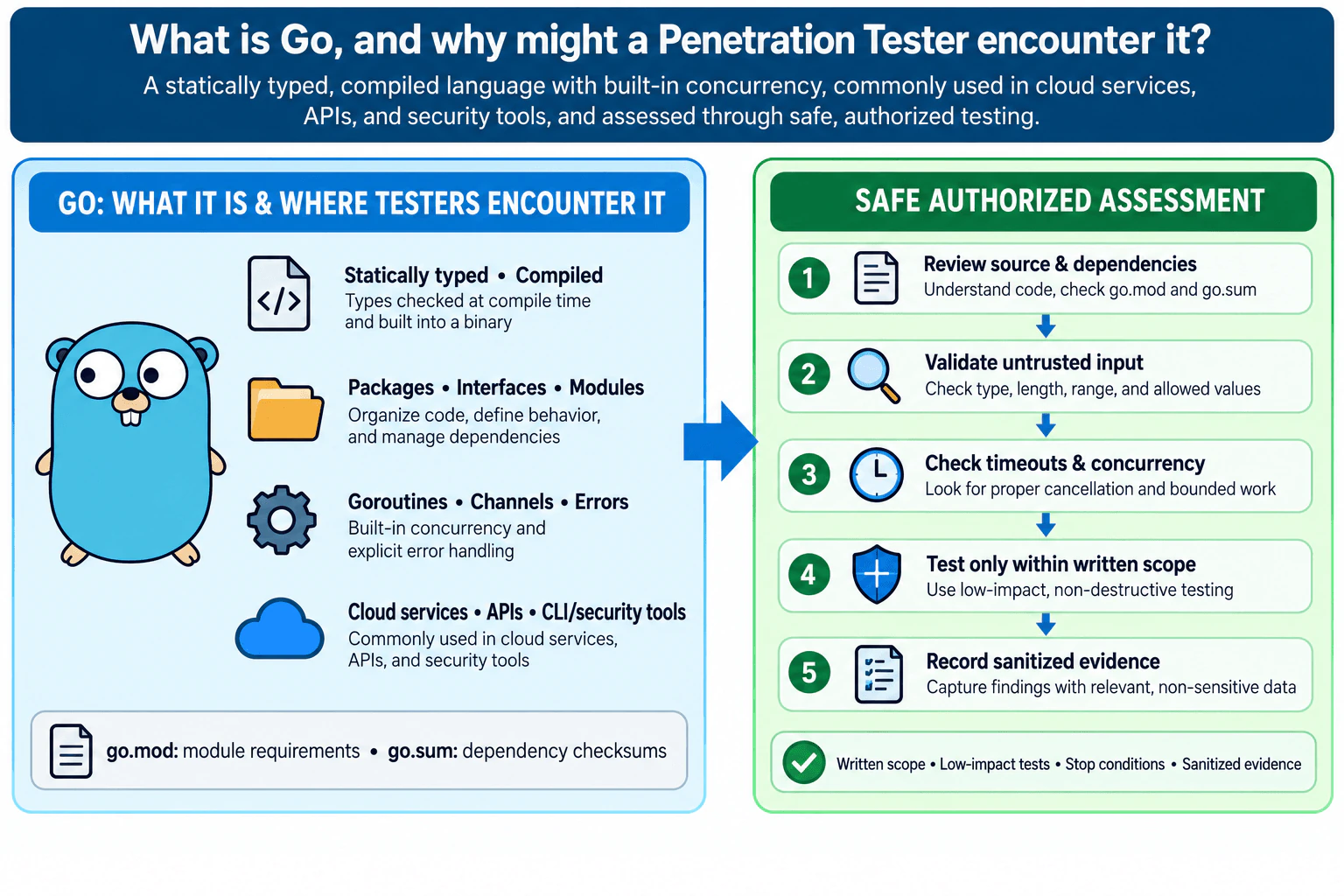
What is Go, and why might a Penetration Tester encounter it? diagram
How to Explain It in an Interview
1. Start with what Go is

Go is a statically typed, compiled programming language. Statically typed means the compiler checks whether values are used with compatible types. Compiled means Go source is translated into executable machine code before normal execution. Go is also garbage-collected and has explicit language support for concurrent programming. go.dev

For a Penetration Tester, the practical decision is to understand enough Go to follow the real security-relevant behavior of the application. I may review source code, a compiled program, or both. I do not assume that Go itself makes an application secure or insecure.

2. Understand packages and modules

Go programs are organized into packages. A package is a collection of source files that are compiled together and provide related functions, types, variables, and constants. A module is a collection of related Go packages released together. A go.mod file declares the module and its dependency requirements. go.dev

During an authorized source review, I inspect the packages that handle external input, authentication, authorization, network access, file access, and other sensitive operations. I also inspect module dependencies and their versions. A dependency being present does not by itself prove that the application is vulnerable. I still need evidence that the relevant code and affected behavior apply to the assessed build.

3. Understand interfaces

An interface describes behavior using method requirements. A Go type satisfies an interface when its method set meets the interface requirements; it does not normally need an explicit implements declaration. go.dev

This matters during source review because a function may accept an interface while the actual implementation is defined elsewhere. I trace the concrete implementation before deciding how validation, authorization, storage, network access, or another security-sensitive operation really behaves.

4. Understand goroutines and channels

A goroutine is a function executing concurrently with other work. A function call can be started as a goroutine with the go statement. A channel carries typed values between goroutines and can also provide synchronization. Channel operations may block depending on the channel state and corresponding send or receive operations. go.dev

During review, I check whether concurrency is bounded and whether shared state is synchronized correctly. I look for work that may continue after cancellation, goroutines that cannot terminate, channel operations that can block indefinitely, and resource use that can grow without a safe limit. I do not claim an availability issue until I can validate the relevant behavior safely.

5. Understand Go error handling

Go commonly represents failures with values that satisfy the built-in error interface. Functions often return a normal value together with an error, and callers are expected to handle the error appropriately. The predeclared error interface contains an Error() string method. go.dev

During source review, I look for ignored errors, unsafe fallback behavior, excessive information returned to an untrusted caller, and cases where authorization or validation failures do not stop the operation. A security-sensitive failure should normally prevent the unsafe action rather than silently continue.

I also distinguish ordinary returned errors from panics. A panic represents an abnormal execution condition. Recover can stop a panic from continuing up the call stack in appropriate code, but it is not a substitute for normal validation and error handling.

6. Review input validation at trust boundaries

Inputs can arrive through HTTP requests, command-line arguments, configuration files, environment variables, files, network protocols, or other external sources. I first determine which inputs are trusted and which cross a trust boundary.

I trace untrusted values from their entry point to sensitive operations. I check expected type, syntax, length, range, allowed values, and any required authorization relationship. I also verify that validation occurs before the sensitive operation and that one package does not incorrectly assume another package already validated the data.

I use synthetic test data whenever possible. Suspicious-looking source code is only an observation until the complete path and behavior are verified.

7. Check timeouts, cancellation, and retries

Network and other potentially slow operations should have bounded execution appropriate to the application. Go programs commonly use context values to carry cancellation and deadline signals across operations, while client and server APIs may provide additional timeout controls.

For an authorized review, I check whether downstream work observes cancellation, whether a request can wait indefinitely, and whether retries can unexpectedly multiply work or requests. I do not deliberately exhaust resources. I use low rates, safe inputs, explicit stop conditions, and the least intrusive test that can confirm the observation.

8. Review compiled Go binaries carefully

A tester may receive a compiled Go executable without its complete source. That changes the evidence available, but it does not prove that the program is either secure or vulnerable.

I determine what artifacts are authorized and available, such as the executable, configuration, documented interfaces, build information, runtime behavior, and any corresponding source or module files. I distinguish observed facts from inference. I do not claim that a particular dependency, source path, build option, or vulnerability exists unless the available evidence supports that conclusion.

9. Understand why penetration testers encounter Go

Go supports networked and concurrent programs and produces compiled executables, so it is commonly suitable for services, command-line utilities, infrastructure software, and tooling. A Penetration Tester can therefore encounter Go while assessing cloud-facing services, internal APIs, network software, infrastructure components, or security utilities.

The useful security questions remain application-specific: where trust boundaries are, how identities and authorization are handled, how untrusted input is validated, how dependencies are managed, whether secrets are exposed, how failures behave, and whether concurrency or external operations can affect availability.

10. Keep testing authorized and measurable

Before active testing, I confirm the approved targets, environment, identities, allowed actions, request limits, prohibited techniques, and stop conditions. I prefer source and configuration review when available and then use the smallest reproducible active test needed to validate an observation.

I capture evidence such as the relevant source location, dependency entry, sanitized request and response, error behavior, or reproducible test result. I avoid collecting unnecessary credentials, tokens, personal information, or unrelated data. If a test could affect availability, alter persistent state, or cross into another system, I do not perform it unless that action is specifically authorized.

Limitations and tradeoffs

Source review can show how code is intended to behave, but source alone does not prove that the same code, dependencies, configuration, or build options are running in a particular environment. Binary-only assessment usually provides less source-level context. Concurrency can improve responsiveness and throughput, but poorly bounded concurrency can increase resource use and make failures harder to reason about. Timeouts limit stuck operations, but values that are too short can terminate legitimate work. Dependency findings also require context because identifying a module or version is not the same as demonstrating an exploitable application path.

Technical Approach
  1. Confirm written authorization, the exact Go application or binary in scope, allowed identities, test environment, request limits, and stop conditions.
  2. Identify whether source code, go.mod, go.sum, configuration, build artifacts, or only a compiled binary is available.
  3. Map relevant packages, interfaces, external inputs, sensitive operations, and trust boundaries without assuming a vulnerability.
  4. Inspect module dependencies and versions, then determine whether any security-relevant dependency finding actually applies to the assessed code and build.
  5. Trace untrusted input through parsing and validation before security-sensitive file, network, authentication, authorization, or operating-system operations.
  6. Review returned errors and failure paths to ensure unsafe operations stop safely and sensitive details are not unnecessarily exposed.
  7. Review goroutines, channels, shared state, cancellation, timeouts, retries, and concurrency limits for unsafe or unbounded behavior.
  8. Validate observations with synthetic positive, negative, malformed-input, boundary, and timeout cases using low-impact requests.
  9. Record sanitized, reproducible evidence and separate demonstrated technical behavior from assumed business impact.
  10. Stop at the approved boundary, clean up any permitted temporary test artifacts, and retest only the relevant corrected behavior after remediation.
Practical Complexity & Trade-offs

The main cost is the time needed to follow real behavior across packages, interfaces, dependencies, and concurrent code. Source review is easier when build and module information is available. Binary-only review may require more effort because source-level context can be missing. Dependency review creates ongoing maintenance because versions change. Active validation must be rate limited to protect service availability. More concurrency can improve performance, but it can also increase resource use and make failures harder to reproduce. Short timeouts reduce the risk of stuck work, while overly aggressive timeouts can interrupt legitimate operations. These are engineering and operational tradeoffs rather than guarantees of security.

Where it is used

This approach is useful during an authorized assessment of a Go-based web API, cloud service, internal microservice, network utility, command-line application, infrastructure component, or security tool. It is also useful in source-assisted reviews where go.mod and related source files are available, and in assessments where a compiled Go executable must be evaluated together with its configuration, documented interfaces, and observed runtime behavior.

Why Interviewers Ask This

Interviewers want to know whether the candidate understands the Go programming model and can connect it to practical security review. A strong answer should explain Go-specific concepts such as packages, interfaces, goroutines, channels, error values, modules, and compiled programs while showing sound judgment around dependency inspection, input validation, timeouts, concurrency, evidence, and authorized testing.

Common interview mistakes

Common mistakes include describing Go only as a compiled language without connecting packages, interfaces, goroutines, channels, errors, and modules to security review. Another mistake is treating a dependency version as automatic proof of exploitability. Testers may also overlook ignored errors, insufficient input validation, missing cancellation, absent timeouts, unbounded concurrency, unsafe shared-state access, or blocked channel operations. It is also incorrect to assume that a compiled binary is secure simply because source code is unavailable. Finally, active testing without confirmed scope, rate limits, permitted actions, and stop conditions can create unnecessary operational risk.

Interview tip

Define Go first, then connect each Go-specific concept to a practical review decision. Explain that you trace real input and control flow, validate dependency findings instead of assuming exploitability, review concurrency and failure behavior carefully, preserve evidence, and keep every active test explicitly authorized, bounded, and non-destructive.
Interviewer may ask next
What would you review first in a Go application's source code during an authorized penetration test?

I would first identify the application's entry points and trust boundaries, then trace external inputs into security-sensitive operations. I would review package structure, concrete interface implementations, authentication and authorization decisions, input validation, error handling, and external network or operating-system interactions. I would also inspect module dependencies. For concurrent code, I would check goroutines, channels, shared state, cancellation, and timeouts. I would validate suspicious paths with bounded synthetic tests rather than treating source patterns as proof of a vulnerability.

What security tradeoff should you consider when reviewing goroutines and channels?

Concurrency can improve responsiveness and throughput, but uncontrolled concurrency can consume resources, leave goroutines running after work should stop, or make behavior difficult to reason about. Channels provide communication and synchronization, but incorrect blocking, closing, or cancellation behavior can stall work. I would check that concurrency is appropriately bounded, shared data is synchronized, operations support cancellation and timeouts where needed, and failure paths release resources. I would validate suspected availability effects with low-impact authorized tests rather than intentionally exhausting the service.

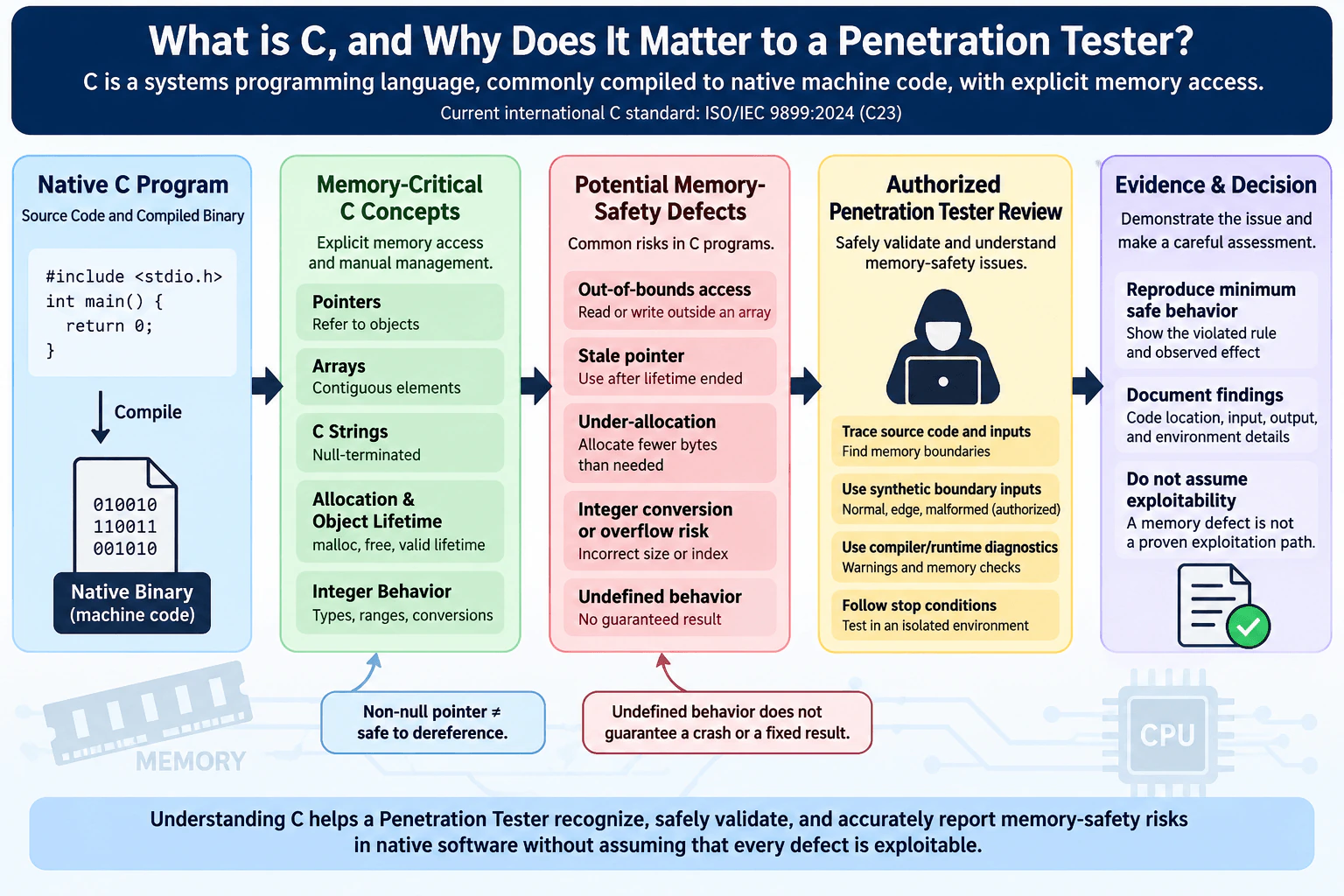
12. What is C, and why does it matter to a Penetration Tester?Language SpecificEasy

Question Details

Define C as a compiled systems programming language with explicit memory access. Explain pointers, arrays, strings, allocation, object lifetime, integer behavior, and undefined behavior. Connect these concepts to authorized review of native programs and memory-safety risks without providing harmful exploitation instructions.

Short Interview Answer (30-60 seconds)

C is a systems programming language commonly compiled to native code with explicit memory access. Understanding pointers, arrays, strings, allocation, lifetimes, integers, and undefined behavior helps a Penetration Tester review native programs, recognize memory-safety risks, and validate suspected defects safely within authorization.

Detailed Explanation

This question asks why C knowledge matters when reviewing native software. C is commonly compiled to native machine code and gives programmers explicit control over memory. That makes details such as object size, pointer validity, array bounds, string termination, allocation, lifetime, and integer arithmetic important to security. A Penetration Tester uses these concepts to understand whether a native program may access memory incorrectly and to validate suspicious behavior safely. The goal is to prove the programming defect and its observed effect within authorization, not to assume that every memory error is exploitable.

Useful Questions to Ask the Interviewer
  1. Are we discussing source-code review, testing a compiled native program, or both?
  2. Is the goal to explain C concepts generally or to describe how I would validate a suspected memory-safety issue?
  3. What operating system, compiler, architecture, and build configuration should I assume if implementation-specific behavior matters?
  4. Do I have written authorization to execute the program with synthetic boundary inputs in an isolated test environment?
What is C, and why does it matter to a Penetration Tester? diagram
How to Explain It in an Interview
1. Start with the practical decision

C matters because a tester reviewing native software must decide whether unusual behavior points to a real memory-safety defect, an expected implementation detail, or insufficient evidence. I would first identify the C rule and memory boundary involved, then reproduce only the minimum safe behavior needed to support or reject the finding.

2. What C is

C is a systems programming language commonly implemented by translating source code into executable machine code for a target environment. The C standard defines the language syntax, constraints, and semantics, but it does not require one specific compilation mechanism. The current published international C standard is ISO/IEC 9899:2024, commonly associated with C23.

C matters in penetration testing because native programs often use explicit memory addresses, fixed-size objects, manually managed storage, and integer calculations that influence memory access. A mistake in one of those areas can create a memory-safety defect.

3. Pointers

A pointer is a value used to refer to an object or function. For memory review, I ask whether the pointer is valid for the intended operation, whether it refers to storage whose lifetime has not ended, and whether any pointer arithmetic stays within the rules for the relevant array object.

A non-null pointer is not automatically safe to dereference. It may refer to storage that is no longer valid, may have been calculated incorrectly, or may not designate an object that can legally be accessed in the intended way.

C also permits a pointer value that points one element past the end of an array for limited operations such as comparison or arithmetic. That one-past pointer must not be dereferenced as an array element.

4. Arrays

A C array is an object containing a contiguous sequence of elements of one type. An array's size may be established at compile time or, for supported variable-length arrays, at runtime. An individual array object still has a definite bound while it exists.

During review, I check every index and offset that can reach an array. I trace where the length comes from, whether the calculation can produce a value outside the permitted range, and whether the program checks the actual destination capacity before accessing an element.

Array expressions are converted to pointers to their first element in many contexts. Because the resulting pointer generally does not carry the original array length, functions that receive such pointers often need a separate trustworthy size or another clear boundary contract.

5. Strings

A C string is a sequence of characters terminated by a null character, '\0', and stored in a character array or other suitable character storage. The backing storage must be large enough for the character data and the terminating null character.

I review string copying, concatenation, formatting, scanning, and length calculations to verify that the program knows the real capacity of the destination and does not read beyond the available source object. A missing terminator or incorrect capacity can cause operations to continue beyond the intended string boundary.

I would report the demonstrated boundary error and supporting evidence rather than automatically claiming a specific exploitation result.

6. Allocation and object lifetime

C provides library functions such as malloc, calloc, realloc, and free for dynamically allocated storage. During review, I ask whether the requested size was calculated safely, whether allocation failure is handled, which code owns the storage, whether accesses remain within the allocated size, and whether the storage is released at the correct time.

Object lifetime tells me when an object exists and when accessing it through a pointer is permitted. Memory-safety problems can arise when code accesses storage after the relevant object's lifetime has ended, releases the same allocation incorrectly more than once, leaks allocations, or allocates fewer bytes than later operations assume.

The exact runtime consequence depends on the program, implementation, build, allocator, and surrounding state, so I do not infer exploitability from the defect alone.

7. Integer behavior

Integers often control indexes, lengths, allocation sizes, loop limits, and pointer offsets. That means integer correctness and memory safety are closely connected.

I check the integer type, range, signedness, conversions, and arithmetic before trusting a size or offset. For unsigned integer types, arithmetic is defined using modulo behavior based on the type's range. In contrast, signed integer overflow is undefined behavior.

Conversions between integer types can also change a value when it cannot be represented directly in the destination type. A value that looked valid before conversion may therefore become unsuitable for a later size or boundary operation. I prefer validating values before dangerous arithmetic and before using the result for allocation, indexing, or memory movement.

8. Undefined behavior

Undefined behavior means the C standard imposes no requirements on the program's behavior after the relevant language rule is violated. Memory-related examples can include invalid dereferences, some out-of-bounds accesses, accessing objects outside their valid lifetime, and signed integer overflow.

This matters because I cannot safely reason that undefined behavior will always crash, always wrap, always return the same value, or behave identically across compilers and optimization levels. One test run shows only what happened in that environment.

As a tester, I document the violated rule, the conditions that reach it, and the reproducible observed behavior. I keep any further security impact clearly marked as demonstrated or inferred.

9. Safe authorized review approach

I first confirm the approved program, testing environment, permitted inputs, and stop conditions. If source code is available, I trace externally controlled or variable-length data into arrays, strings, allocation sizes, indexes, offsets, pointer calculations, and lifetime decisions.

I identify the actual size and lifetime of the relevant object at each important memory access. I also examine error paths, because allocation failure, malformed input, zero-length values, maximum-length values, and conversion boundaries can exercise code that normal inputs do not reach.

For runtime validation, I prefer a controlled test build, synthetic data, and the least intrusive input needed to reproduce the issue. Where available and authorized, development diagnostics such as compiler warnings or memory-safety instrumentation can provide supporting evidence without requiring an exploitation chain.

10. Evidence and safe failure

Useful evidence can include the relevant source expression, the exact synthetic input, expected object boundary, actual program response, compiler and build details when relevant, and diagnostic output from approved testing tools.

A safer program validates lengths, integer ranges, allocation results, indexes, and object state before performing the dangerous memory operation. Invalid input should be rejected with a controlled error rather than allowing memory access to continue with an invalid size or pointer.

A crash may demonstrate abnormal behavior, but a crash alone does not prove the exact root cause or a particular security impact. I correlate it with source analysis or reliable runtime diagnostics before making that conclusion.

11. Limitations and tradeoffs

Observed C behavior can depend on the target architecture, compiler, optimization settings, C library, allocator, build configuration, and surrounding program state. Source review can identify violations and risky logic, but it may not prove how a deployed binary behaves. Runtime testing gives concrete observations, but it covers only the paths and environments tested.

Using both methods, when authorized, gives stronger confidence. The tradeoff is coverage versus intrusiveness. More runtime testing can cover additional boundary cases, but native-program failures may affect process availability. A Penetration Tester should therefore use isolated environments when possible, honor stop conditions, and prefer small reproducible tests over unnecessarily aggressive testing.

Technical Approach
  1. Confirm written authorization, the exact native component, available source or binary, target environment, permitted inputs, and stop conditions.
  2. Identify inputs that influence memory sizes, indexes, offsets, string lengths, allocation amounts, or object ownership.
  3. Trace the relevant C objects, their types, bounds, pointer relationships, and lifetimes.
  4. Review integer types, ranges, signedness, conversions, and arithmetic before trusting size or offset calculations.
  5. Check allocations for safe size calculation, failure handling, ownership, valid access bounds, release, and later reuse.
  6. Check array and string operations against the real object capacity, including space for a null terminator where a C string requires one.
  7. Identify operations that may invoke undefined behavior rather than assuming a particular runtime result.
  8. Validate suspected defects only with synthetic normal, boundary, malformed, zero-length, maximum-length, and regression inputs in the approved environment.
  9. Capture the minimum evidence needed to show the violated rule or boundary and separate demonstrated behavior from inferred impact.
  10. Retest the corrected build with the original safe reproducer and nearby boundary cases.
Time & Space Complexity

The main technical cost is careful reasoning about pointers, object sizes, lifetimes, integer conversions, and undefined behavior. Runtime diagnostics can increase confidence but may require a special build and additional testing time. Operationally, malformed inputs can crash native processes, so controlled environments and stop conditions matter. Maintenance becomes harder when ownership and size information are passed through many functions without clear contracts. The human cost is that reviewers need solid C knowledge. The benefit is more accurate memory-safety findings, stronger evidence, and fewer unsupported claims about exploitability.

Where it is used

This knowledge is useful during authorized review of native command-line tools, operating-system components, network services, parsers, embedded software, device software, C libraries, language runtimes, and applications that depend on native C components. It is especially relevant when investigating suspicious crashes, incorrect bounds checks, unsafe string handling, allocation-size mistakes, invalid pointer use, object-lifetime errors, or integer calculations that control memory access.

Why Interviewers Ask This

Interviewers want to know whether the candidate understands why C requires careful reasoning about memory rather than treating memory-safety findings as tool messages alone. A strong answer connects pointers, arrays, strings, allocation, object lifetime, integer behavior, and undefined behavior to safe review of native software while separating demonstrated evidence from assumptions about security impact.

Common interview mistakes

Common mistakes are saying a pointer is safe simply because it is non-null; treating arrays and pointers as identical language objects; forgetting that a one-past array pointer may exist but cannot be dereferenced as an element; forgetting the null terminator when calculating C-string capacity; trusting a size calculation without checking the arithmetic and conversions that produced it; treating signed integer overflow as normal wraparound; assuming every integer conversion preserves the original value; accessing storage after the relevant object's lifetime has ended; assuming undefined behavior must cause a crash; and labeling a memory bug exploitable without evidence for the required conditions. Another mistake is jumping directly to exploitation instead of first proving the C rule, boundary, and observable defect with a bounded authorized test.

Interview tip

Organize the answer around four questions: What object exists? How large is it? Which pointer or index may access it? Is the object still within its valid lifetime? Then connect strings, allocations, integers, and undefined behavior to those questions. Finish by explaining that a memory-safety defect should be supported by reproducible evidence and should not automatically be labeled exploitable.

Interviewer may ask next
What is the difference between a pointer, an array, and a C string?

A pointer is a value used to refer to an object or function. An array is an object containing a contiguous sequence of elements of one type. In many expressions, an array expression is converted to a pointer to its first element, but an array and a pointer remain different C language concepts. A C string is a null-terminated sequence of characters stored in suitable character storage. For security review, I track the real array or allocated-object capacity separately from the pointer value and verify that string operations stay within that capacity and preserve the required terminator.

Why is undefined behavior important when investigating a memory-safety finding?

Undefined behavior means the C standard does not require a particular result once the relevant language rule is violated. A tester therefore should not assume that the program must crash, wrap, continue normally, or behave the same way on another compiler or build. I identify the violated rule, record the conditions that reach it, reproduce the minimum safe observable behavior in the authorized environment, and describe only the security impact supported by evidence. That produces a stronger finding than predicting an exploitation outcome from undefined behavior alone.

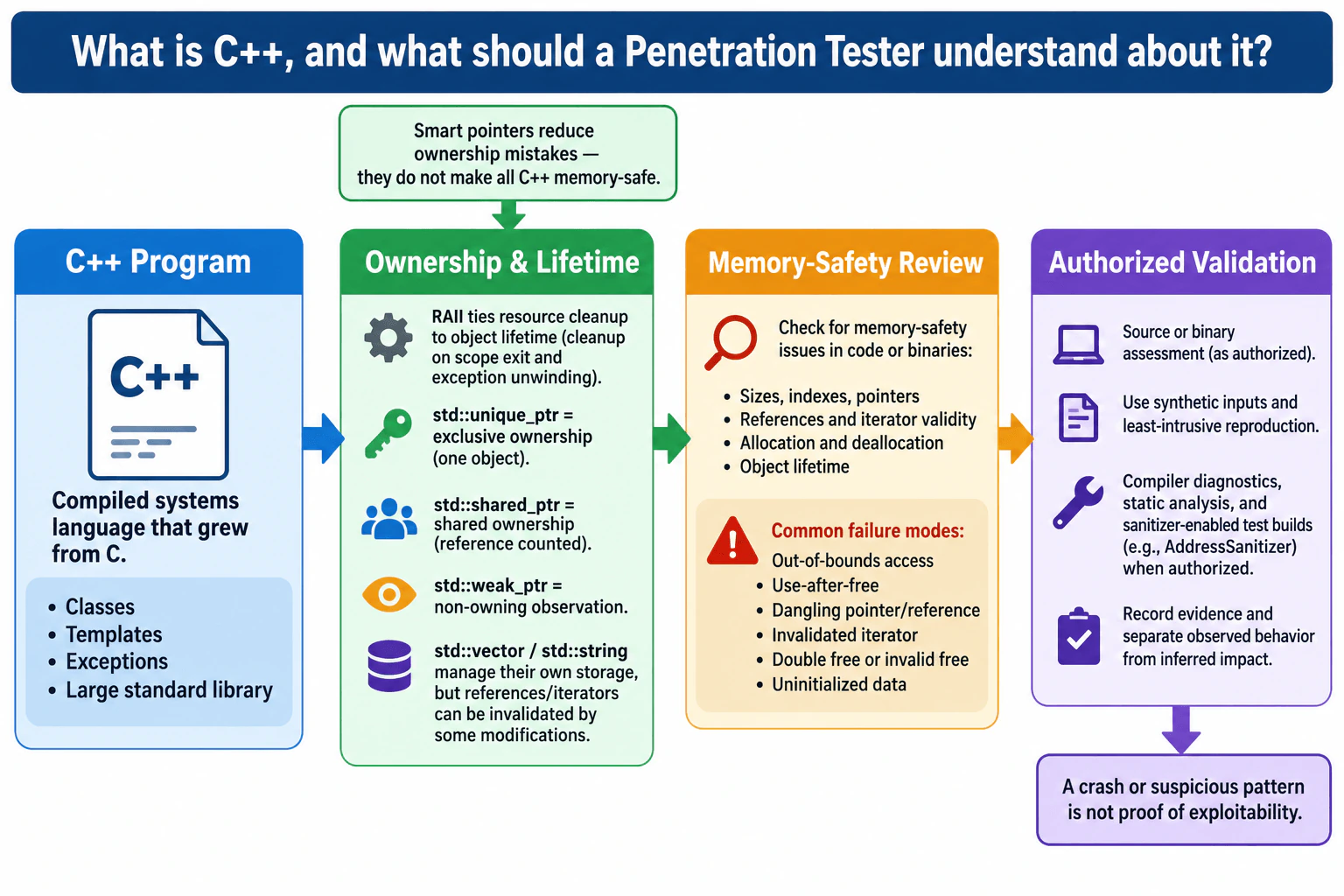
13. What is C++, and what should a Penetration Tester understand about it?Language SpecificEasy

Question Details

Define C++ as a compiled systems language that extends C with classes, templates, exceptions, and a large standard library. Explain resource ownership, RAII, smart pointers, containers, object lifetime, and memory-safety failure modes relevant to authorized source and binary assessment.

Short Interview Answer (30-60 seconds)

C++ is a compiled systems language that grew from C and adds classes, templates, exceptions, and a large standard library. As a Penetration Tester, I focus on ownership, RAII, smart pointers, containers, object lifetime, and memory-safety failures such as out-of-bounds access and use-after-free.

Detailed Explanation

This question asks whether I understand C++ as both a programming language and a security-relevant memory model. The practical decision is not simply to search for raw pointers. I need to determine who owns each resource, how long each object remains valid, how cleanup happens, and whether code can access memory outside a valid object or lifetime. During an authorized source or binary assessment, I use that model to identify suspicious memory behavior and then validate it safely. I do not call a suspicious pattern a vulnerability until the evidence supports that conclusion.

Useful Questions to Ask the Interviewer
  1. Is the assessment source-assisted, binary-only, or both?
  2. Which C++ language version, compiler, target platform, and build configuration are in scope?
  3. Are third-party libraries and C or operating-system interfaces included in the authorized scope?
  4. Can I use compiler sanitizers, debug symbols, or special test builds supplied by the development team?
  5. What level of proof is permitted for a suspected memory-safety issue without risking service stability or production data?
What is C++, and what should a Penetration Tester understand about it? diagram
How to Explain It in an Interview

C++ is a compiled, statically typed systems programming language that historically grew from C. It supports low-level memory access while also providing higher-level features such as classes, templates, exceptions, generic containers, algorithms, and automatic resource-management patterns. Because C++ gives programmers significant control over memory and object lifetime, security review requires understanding both the abstractions and the lower-level rules beneath them.

The first concept I would explain is resource ownership. A resource can be heap memory, a file handle, a socket, a lock, or another object that requires cleanup. I want to know which object is responsible for releasing that resource and whether the relationship is unique ownership, shared ownership, or non-owning access.

RAII means Resource Acquisition Is Initialization. It is a core C++ resource-management pattern where ownership is tied to an object's lifetime. An object's constructor or initialization establishes its resource-owning state, and its destructor releases the resource. When correctly designed, this gives deterministic cleanup when scope ends, including during normal returns and stack unwinding caused by exceptions.

Smart pointers express common ownership relationships for dynamically allocated objects. std::unique_ptr represents exclusive ownership. std::shared_ptr represents shared ownership through a reference-counted control block, and std::weak_ptr provides a non-owning relationship to an object managed by std::shared_ptr. Smart pointers reduce many manual new and delete mistakes, but they do not make an entire program memory-safe.

Standard containers are also important. Types such as std::vector and std::string manage their own storage, which reduces manual allocation and cleanup. I still review how they are used. A pointer, reference, or iterator into a container can become invalid after particular modifying operations, especially when storage is reallocated. Bounds also matter because some access operations, such as operator[], do not perform bounds checking, while alternatives such as at() perform checked access and report an out-of-range condition.

Object lifetime is one of the most important C++ security concepts. Every object has a defined period during which operations on that object are valid. A pointer, reference, or iterator can remain after the object or referenced element is no longer valid. Using such a stale reference can produce undefined behavior and may appear as a dangling-pointer, use-after-free, or invalidated-iterator defect.

During an authorized review, I trace attacker-controlled or otherwise untrusted inputs toward memory-sensitive operations. I ask: Who owns this buffer? What is its valid size? Can an index, offset, count, or length exceed that boundary? Can a pointer or reference survive longer than the object it refers to? Can a container operation invalidate an iterator or reference that is later reused? Can two ownership paths release the same resource? Can an exception or callback change the expected lifetime?

Relevant failure modes include out-of-bounds reads and writes, use-after-free, dangling pointers and references, invalidated iterators, double deletion, incorrect ownership transfer, null-pointer dereference, use of uninitialized data, and integer or size calculations that cause an incorrect memory boundary. Problems can also occur at lower-level boundaries such as raw buffers, legacy C interfaces, custom allocators, or manual lifetime management.

I would not treat the mere presence of raw pointers, new, delete, casts, or unchecked operations as proof of a vulnerability. They are review signals. The surrounding ownership rules, input constraints, control flow, and reachable execution path determine whether there is an actual defect and whether it has security impact.

For source-assisted testing, I combine manual ownership and lifetime reasoning with compiler diagnostics, static analysis, and, when authorized, instrumented builds such as AddressSanitizer or UndefinedBehaviorSanitizer. I use synthetic test data and the least intrusive reproduction necessary. Evidence should identify the relevant input, execution path, observed failure, and affected memory or object boundary without exposing unrelated secrets or personal data.

For binary-only assessment, the same ownership and lifetime model still helps, but some source-level abstractions may be difficult to recover after compilation and optimization. I can reason from allocations and deallocations, buffer sizes, parser behavior, object use, indirect calls, observed crashes, symbols when available, and dynamic instrumentation. A binary crash can demonstrate abnormal behavior without by itself proving the original source-level defect or exploitability, so I separate direct evidence from inference.

The trust and responsibility boundary is the authorized target and test environment. A suspected memory bug does not justify uncontrolled corruption, persistence, or destructive proof. I follow the rules of engagement, stop conditions, approved data boundaries, and least-intrusive validation method. When a controlled test build or synthetic fixture can prove the issue, that is preferable to risking a production service.

The main tradeoff is that modern C++ features can significantly reduce manual resource-management errors while preserving the low-level control for which C++ is used. RAII, smart pointers, and containers improve ownership and cleanup, but raw pointers, borrowed references, iterator invalidation, unsafe interfaces, concurrency, manual lifetime management, and logic errors can still cross those safety boundaries. I therefore use ownership and lifetime reasoning to find candidate defects and reproducible evidence to decide whether they are real security findings.

Technical Approach
  1. Confirm the authorized source code, binaries, libraries, platforms, build configuration, and test environment.
  2. Identify security-relevant or untrusted input paths and the C++ objects, buffers, containers, or parsers they reach.
  3. Trace ownership of important resources and classify relationships as exclusive, shared, or non-owning.
  4. Review RAII usage, destructors, smart-pointer semantics, manual allocation, and ownership transfers.
  5. Trace object, pointer, reference, and iterator lifetimes across scope changes, exceptions, callbacks, container modifications, and asynchronous work.
  6. Review indexes, offsets, lengths, counts, conversions, and allocation-size calculations for boundary mistakes.
  7. Identify candidate failures such as out-of-bounds access, use-after-free, dangling references, invalidated iterators, double deletion, and uninitialized data.
  8. Validate each candidate using the least intrusive method permitted by the rules of engagement, preferably with synthetic input and an instrumented test build when available.
  9. Preserve reproducible evidence and distinguish demonstrated behavior from inferred security impact.
  10. Recommend a root-cause fix to ownership, lifetime, bounds, or interface handling, then safely retest the corrected path.
Practical Complexity & Trade-offs

C++ security review can require more effort than reviewing a language with automatic memory management because the tester may need to reason about ownership, object lifetime, aliases, raw pointers, container invalidation, and low-level memory operations. Source code, debug symbols, compiler warnings, and sanitizer-enabled builds can improve speed and confidence. Binary-only analysis and optimized builds usually require more investigation. Instrumentation can add memory and runtime overhead, so it is normally suited to controlled testing rather than being treated as a zero-cost production control. Safer ownership patterns also reduce maintenance burden, but low-level interfaces still require careful review.

Where it is used

This knowledge is useful in authorized assessments of C++ desktop applications, native network services, parsers, libraries, agents, embedded software, systems components, game or graphics software, and native modules exposed through larger applications. It is especially relevant when untrusted input reaches buffer manipulation, parsing, serialization, manual allocation, legacy C interfaces, complex ownership relationships, or binaries where memory corruption is suspected.

Why Interviewers Ask This

Interviewers want to know whether the candidate can reason about C++ source code or compiled binaries using the language's real ownership, lifetime, and memory model. A strong Penetration Tester should recognize safer patterns such as RAII, smart pointers, and standard containers while also identifying boundaries where manual memory management, raw pointers, unchecked indexing, invalidated references, or incorrect lifetime assumptions can create security-relevant defects.

Common interview mistakes

A common mistake is describing C++ only as C with classes and ignoring templates, exceptions, the standard library, RAII, and object-lifetime rules. Another is treating every raw pointer as a vulnerability or assuming smart pointers make all memory operations safe. Testers may also confuse allocated storage with a valid live object, overlook dangling references or invalidated iterators, assume all container access is bounds-checked, or claim exploitability from a crash alone. In an authorized assessment, using destructive proof when a controlled synthetic reproduction is sufficient is also a mistake.

Interview tip

Lead with ownership and lifetime. Briefly define C++, then explain RAII, smart pointers, containers, and object lifetime before discussing memory-safety failures. Make it clear that suspicious code is a candidate finding, while a vulnerability conclusion requires safe and reproducible evidence.

Interviewer may ask next
What is RAII, and why does it matter during a C++ security review?

RAII means Resource Acquisition Is Initialization. It ties resource ownership to an object's lifetime so cleanup occurs through the object's destructor when that lifetime ends. This reduces many manual cleanup mistakes and works well with normal scope exit and exception unwinding. During security review, I check whether resources actually follow clear RAII ownership and pay closer attention where code uses manual allocation, raw owning pointers, or borrowed references whose lifetime is uncertain.

Do smart pointers make C++ memory-safe?

No. Smart pointers improve ownership and lifetime management, but they solve only part of the problem. std::unique_ptr models exclusive ownership, while std::shared_ptr and std::weak_ptr support shared and non-owning relationships. Code can still contain out-of-bounds access, dangling raw references, invalidated iterators, incorrect size calculations, unsafe buffer operations, concurrency defects, or errors at native interfaces. I treat smart pointers as an important ownership mechanism, not proof that the complete program is memory-safe.

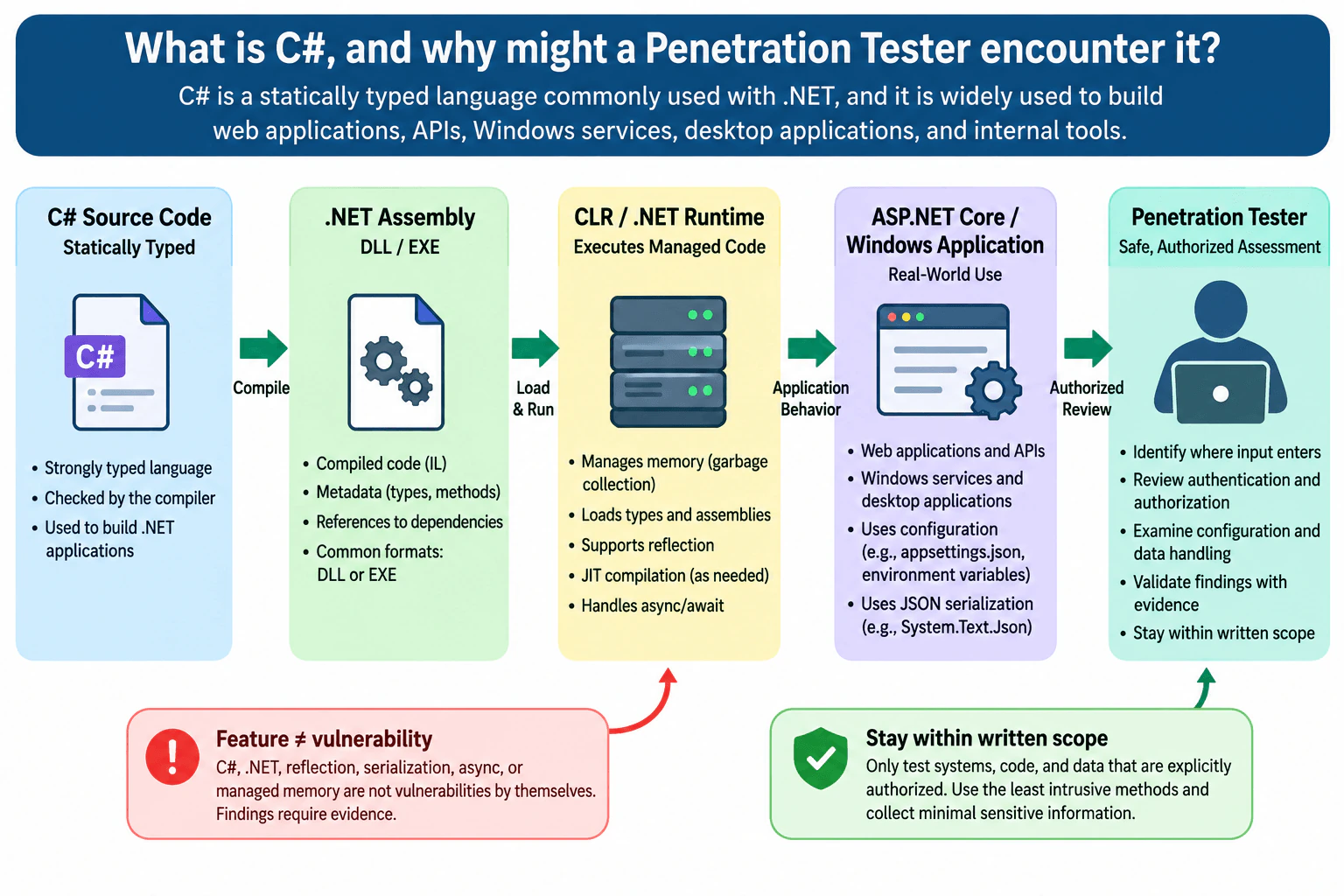
14. What is C#, and why might a Penetration Tester encounter it?Language SpecificEasy

Question Details

Define C# as a statically typed language commonly compiled for .NET. Explain assemblies, the common language runtime, managed memory, reflection, async code, configuration, serialization, and common web-service use. Connect these concepts to authorized application review and Windows assessment.

Short Interview Answer (30-60 seconds)

C# is a statically typed language commonly used with .NET. Penetration Testers encounter it in ASP.NET Core services, Windows applications, and enterprise tools. Understanding assemblies, the runtime, managed memory, reflection, async code, configuration, and serialization helps them trace security boundaries and evaluate application behavior accurately.

Detailed Explanation

This question asks whether I understand what C# is and why its .NET ecosystem matters during an authorized penetration test. C# is a statically typed programming language commonly used to build .NET applications. I should recognize how C# code is compiled into assemblies, how the .NET runtime executes managed code, and how managed memory, reflection, asynchronous programming, configuration, and serialization affect application behavior. I should then connect those concepts to realistic ASP.NET Core and Windows assessments while avoiding a common mistake: treating a language or runtime feature as proof of a vulnerability without reproducible evidence.

Useful Questions to Ask the Interviewer
  1. Are we discussing an ASP.NET Core application, a Windows desktop or service application, or C#/.NET applications generally?
  2. Is source code available, or is this primarily a deployed-application or binary-assisted assessment?
  3. Are application binaries, supporting assemblies, and configuration files explicitly included in the authorized scope?
What is C#, and why might a Penetration Tester encounter it? diagram
How to Explain It in an Interview

I would start with the practical decision: if I identify C# and .NET, I know what application structure and runtime concepts I may need to understand before testing deeper.

Assumption: the application, binaries, configuration, and any test activity I discuss are explicitly covered by the written scope and rules of engagement.

C# is statically typed. This means variables and expressions have defined types that the compiler can check. C# code targeting .NET is commonly compiled into assemblies, usually DLL or EXE files. Assemblies contain Common Intermediate Language code, metadata about types and members, and references to dependencies. That information helps explain how the application is organized, but seeing a particular class, method, or dependency does not prove a security issue.

The .NET runtime executes managed code and provides services such as type loading, memory allocation, garbage collection, exception handling, and code execution through runtime compilation or other supported execution modes. Managed memory means the runtime normally manages object allocation and reclamation instead of requiring ordinary C# code to manually free memory. This removes many manual memory-management responsibilities, but it does not make the application automatically secure. Authorization errors, injection flaws, sensitive-data exposure, unsafe native interoperability, unsafe code, resource exhaustion, and business-logic problems can still exist.

Reflection lets .NET code inspect type metadata and, when allowed by the program, dynamically discover or interact with types and members at runtime. Frameworks may use reflection for dependency injection, model binding, plugin loading, or serialization. Reflection is not itself a vulnerability. During an authorized review, I would ask whether untrusted input can improperly influence which types, members, or operations are selected, and I would validate any suspected security impact with the least intrusive reproducible test.

C# also commonly uses async and await for asynchronous operations such as network, file, or database work. Asynchronous code lets an operation wait without unnecessarily blocking the executing thread. During security review, I care about whether validation, authorization, cancellation, exception handling, resource limits, and shared state remain correct across asynchronous flows. I would not claim a race condition or concurrency flaw merely because async code exists.

Configuration is important because .NET applications can receive security-sensitive behavior from several configuration sources. Modern .NET applications can use file-based configuration, environment variables, command-line values, and other configuration providers. ASP.NET Core commonly uses files such as appsettings.json, while older .NET Framework applications may use XML files such as Web.config or App.config. In an authorized review, I would check relevant configuration for insecure settings, unnecessary diagnostic exposure, environment-specific differences, or improperly stored secrets. Any sensitive evidence should be minimized and redacted.

Serialization converts objects to a transferable or storable representation and deserialization reconstructs data from that representation. JSON is common in .NET web services, and System.Text.Json is a standard .NET JSON serialization library. System.Text.Json can obtain serialization metadata through runtime reflection or use source-generated metadata. From a penetration-testing perspective, the important question is how untrusted serialized input is interpreted, validated, and authorized. I would identify the actual serializer and its configuration before drawing conclusions, rather than assuming every form of deserialization is unsafe.

C# is especially relevant to web testing because ASP.NET Core is widely used for web applications and APIs. In a scoped application, I may encounter endpoints, middleware, dependency injection, authentication and authorization logic, model binding, configuration, JSON serialization, database access, and logging. I would trace where untrusted requests enter, where identity is established, where authorization decisions happen, how data crosses trust boundaries, and what evidence demonstrates the observed behavior.

C# is also relevant during Windows assessments because Windows services, desktop applications, internal enterprise tools, and other software may be implemented with .NET. If assemblies are supplied or explicitly included in scope, their metadata and code structure can help identify dependencies, configuration expectations, application entry points, and security-relevant paths. Static inspection can improve understanding, but a suspected issue still needs appropriate validation before it becomes a finding.

The main limitation is that identifying C#, .NET, reflection, serialization, async code, configuration, or managed memory does not establish a vulnerability. These are implementation characteristics. A defensible penetration-testing finding requires evidence that a security property or trust boundary can actually be violated within the approved scope. The tradeoff is that deeper source or assembly analysis can increase confidence and coverage, but it also takes more review time and still has to be connected to observable application behavior.

Technical Approach
  1. Confirm that the C#/.NET application, binaries, configuration, and proposed test actions are covered by written authorization.
  2. Identify the application type, such as an ASP.NET Core service, Windows service, desktop application, or library, and determine the relevant .NET environment from available evidence.
  3. Review available source, assemblies, dependencies, and configuration while minimizing collection of secrets or personal data.
  4. Trace untrusted inputs across parsing, serialization, reflection, asynchronous processing, authentication, authorization, and data-access boundaries only where those features are present.
  5. Form a specific security hypothesis instead of treating a language feature as a vulnerability.
  6. Validate that hypothesis using the least intrusive reproducible technique allowed by the rules of engagement.
  7. Preserve evidence such as the relevant request, response, code path, configuration state, or application behavior while redacting secrets.
  8. Separate demonstrated technical impact from assumptions and retest after remediation when authorized.
Practical Complexity & Trade-offs

The main cost is analyst time. A small application with source code may be straightforward to understand, while a large application can contain many projects, assemblies, dependencies, configuration sources, and asynchronous paths. Binary-only assessment can require extra effort to reconstruct application structure. Reflection and dynamic behavior can also make control flow harder to follow. Managed memory reduces ordinary manual memory-management work for developers, but it does not remove the need to review authorization, input handling, resource use, native interoperability, and data exposure. Operationally, the tester must also protect service availability, minimize sensitive evidence, and stay within scope. Deeper analysis can increase confidence, but it costs more time and does not replace runtime validation.

Where it is used

This knowledge is useful during authorized reviews of ASP.NET Core websites and APIs, C# Windows services, enterprise desktop applications, internal administrative tools, and .NET libraries or assemblies supplied for assessment. It helps the tester understand how input enters the application, how code is organized, where identity and authorization decisions occur, how configuration influences behavior, how serialized data crosses boundaries, and which runtime characteristics are relevant to a specific security hypothesis.

Why Interviewers Ask This

Interviewers want to know whether the candidate can recognize a C#/.NET application, understand the runtime and application concepts that matter during security review, and connect those concepts to safe, authorized assessment of web applications and Windows software. They also want the candidate to distinguish technology features from actual vulnerabilities that require evidence.

Common interview mistakes

Common mistakes include saying C# and .NET are the same thing, describing the runtime as only a compiler, assuming managed memory prevents all memory-related security problems, treating reflection or serialization as automatically vulnerable, assuming every .NET application uses the same configuration format, and claiming that finding an interesting method or dependency in an assembly proves exploitability. Another mistake is starting intrusive testing before confirming scope, application boundaries, and the evidence needed to support a finding.

Interview tip

Define C# first, then connect the important .NET concepts directly to penetration testing. Explain that assemblies reveal application structure, the runtime executes managed code, managed memory handles ordinary object lifetime, reflection enables dynamic inspection, async changes execution flow, configuration affects runtime behavior, and serialization crosses data boundaries. Finish by emphasizing that these features guide investigation but require evidence before they become security findings.

Interviewer may ask next
What is a .NET assembly, and why is it useful during an authorized application review?

A .NET assembly is a compiled deployment unit, commonly a DLL or EXE, containing code, metadata, type information, and dependency references used by a .NET application. If an assembly is explicitly in scope, it can help a tester understand application components, classes, methods, dependencies, and security-relevant code paths. That information can guide testing, but the presence of a method, dependency, or configuration reference is not itself proof of a vulnerability.

Does managed memory in C# mean memory-related security problems are impossible?

No. The .NET runtime normally manages allocation and garbage collection for managed objects, so ordinary C# code avoids much manual memory management. However, that does not eliminate security risk. Applications can still have authorization errors, resource-exhaustion problems, sensitive-data exposure, unsafe code, or flaws involving native interoperability. Managed memory changes the risk profile; it does not prove that the application is secure.

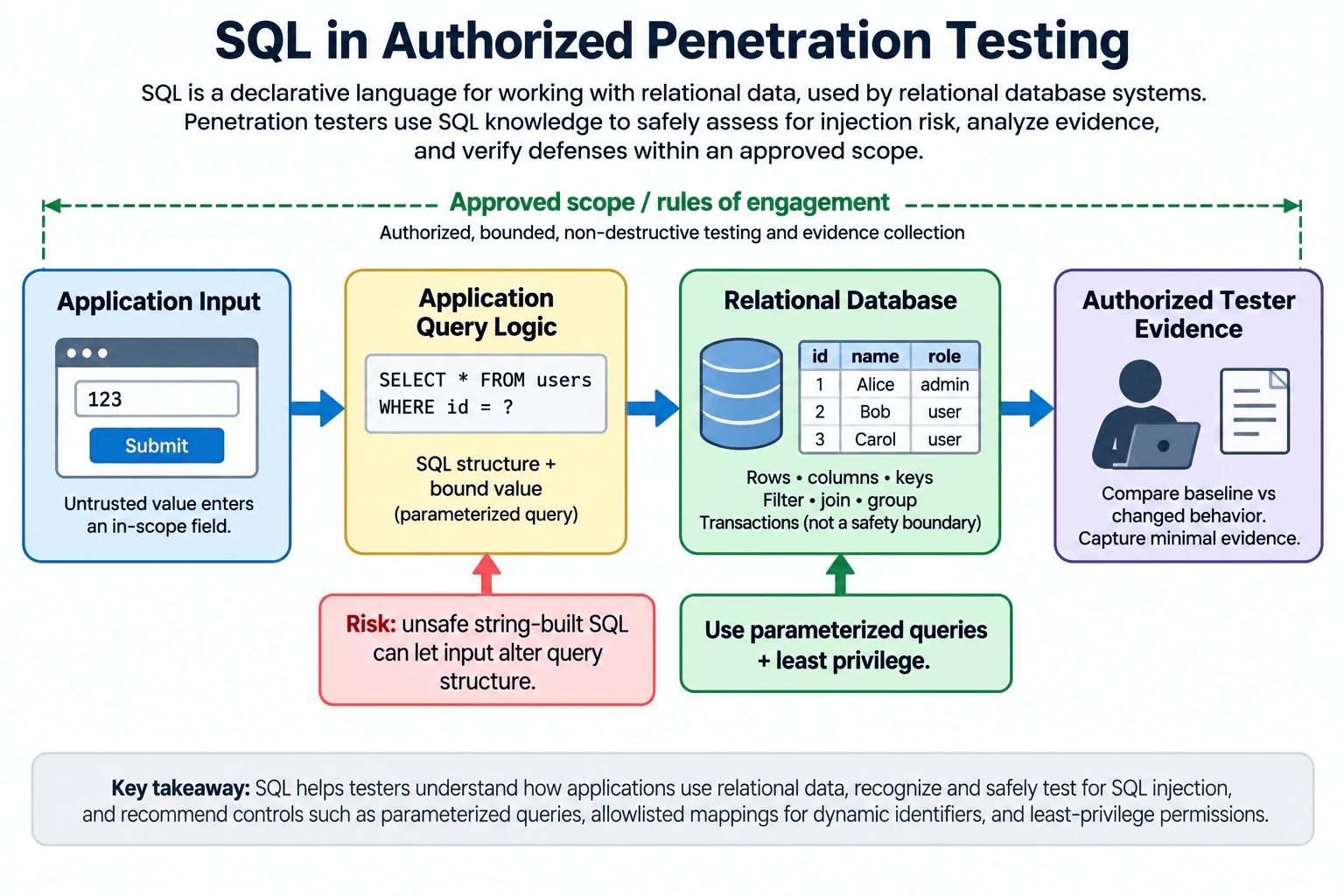
15. What is SQL, and how is it used in authorized penetration testing?Language SpecificEasy

Question Details

Define SQL as a declarative language for relational data. Explain tables, keys, filtering, joins, grouping, transactions, permissions, and parameterized queries. Connect SQL to authorized injection testing and evidence analysis while distinguishing SQL syntax from a database product and avoiding unsafe production changes.

Short Interview Answer (30-60 seconds)

SQL is a declarative language for working with relational data. In authorized penetration testing, I use SQL knowledge to understand application queries, safely assess possible SQL injection, analyze permitted evidence, and verify defenses such as parameterized queries and least-privilege permissions without making unsafe production changes.

Detailed Explanation

SQL is a declarative language used to work with relational data. Declarative means I describe the result I want rather than writing every processing step. A penetration tester should understand SQL because applications commonly use it to communicate with relational database systems. I need to recognize tables, keys, filters, joins, grouping, transactions, permissions, and parameter handling. This knowledge helps me understand how application input reaches a query, safely assess authorized SQL injection paths, interpret evidence, and recommend fixes while avoiding unnecessary access or changes to production data.

Useful Questions to Ask the Interviewer
  1. Should I keep the answer database-product neutral, or use a particular relational database as an example?
  2. Is the assessment performed in a dedicated test environment or against production under strict non-destructive rules?
  3. Are source code and database or application logs available, or is this a black-box test?
  4. What database identities, privileges, targets, and test actions are explicitly authorized by the rules of engagement?
What is SQL, and how is it used in authorized penetration testing? diagram
How to Explain It in an Interview

I would first separate SQL from a database product. SQL is a language used by relational database systems. Products such as PostgreSQL, MySQL, Microsoft SQL Server, and Oracle Database implement SQL, but each can have product-specific syntax, data types, functions, permissions, and behavior. Therefore, I would not assume that a technique or syntax from one database works identically on another.

A relational database commonly organizes information into tables. A table has rows and columns. A row represents one record, and a column represents an attribute with a defined data type. A primary key uniquely identifies a row. A foreign key references a key in another table and represents a relationship between the tables. Keys can also help the database enforce data integrity rules.

For reading data, SELECT identifies the requested expressions or columns. WHERE filters rows according to conditions. JOIN combines related rows from multiple tables. GROUP BY places rows with matching grouping values together so aggregate functions such as COUNT or SUM can calculate results for each group. HAVING can filter groups after grouping. Understanding these operations helps a tester reason about what an application query is intended to do and how untrusted input could affect that intent.

Transactions group database operations into a logical unit of work. Successful work may be committed, while supported operations can often be rolled back before commit. However, a transaction is not a safety boundary or authorization mechanism. I would never assume that rollback makes destructive penetration testing acceptable. UPDATE, DELETE, schema changes, privilege changes, or other state-changing operations should be avoided unless they are explicitly authorized and genuinely required by the engagement.

Permissions are another important security boundary. A database identity should receive only the privileges needed for its job. For example, an application account that needs limited reads should not automatically have database-administrator privileges. During a penetration test, I record the identity and privileges actually observed. I do not claim that an injection flaw provides administrative access or write capability unless those capabilities were authorized to test and were actually demonstrated.

The main penetration-testing connection is SQL injection. SQL injection can occur when an application creates executable SQL in a way that lets untrusted input change the intended SQL structure. Unsafe string concatenation is a common cause. During an authorized assessment, I first identify the exact in-scope input and application path and establish normal behavior. I then use the least intrusive, bounded test needed to determine whether controlled input appears able to affect query interpretation. I avoid unnecessary data extraction, data changes, creation of database objects, expensive queries, deliberate service disruption, or activity outside the approved scope.

Evidence should be reproducible and proportional to the finding. In a black-box assessment, useful evidence can include the sanitized request, relevant input, response, status information, and repeatable behavioral difference. If source review is authorized, I can trace untrusted input to the database API and determine whether values are safely bound as parameters or concatenated into SQL text. Approved application or database logs can provide supporting evidence. A single unusual error does not by itself prove SQL injection, so I repeat safe observations and consider alternative explanations before reporting a confirmed finding.

For prevention, prepared statements with parameterized queries are a primary defense recommended by OWASP. The application defines the SQL structure separately from the values supplied at runtime. Bound parameter values are treated as data instead of becoming new SQL syntax, preventing them from changing the intended query structure when the API is used correctly. Input validation remains useful as an additional defense, but it should not replace correct parameterization for data values.

Parameterized queries have an important boundary. Bind parameters normally represent data values, not arbitrary SQL identifiers or grammar elements. If an application must let a user choose something structural, such as an approved sort direction or column, the application should map that choice to a small allowlist of known-safe values rather than directly inserting uncontrolled text. Placeholder syntax and binding APIs also differ by database driver, so I verify the actual technology rather than assuming one universal SQL syntax.

SQL is also useful for authorized evidence analysis. If the rules of engagement provide read-only access to a dedicated test dataset or approved security records, filtering, joins, and grouping can help correlate relevant records and verify observations. I keep queries narrow, return only the minimum data needed, use the least-privileged identity available, and protect evidence according to the engagement's retention and handling requirements.

Finally, I separate demonstrated impact from possible impact. If I safely demonstrate only that an input changes intended query behavior, that is what I report. I do not claim that the entire database can be read, records can be modified, privileges can be escalated, or operating-system access can be obtained unless those outcomes were explicitly authorized and actually demonstrated. This keeps the finding technically accurate while reducing unnecessary risk.

Technical Approach
  1. Confirm written authorization, exact targets, test identities, allowed actions, prohibited actions, rate limits, and stop conditions.
  2. Identify the in-scope input that may influence a database operation and capture a normal baseline request and response.
  3. Determine through authorized black-box observation, source review, or approved logs whether untrusted input reaches SQL construction.
  4. Use the least intrusive and non-destructive test variation necessary to determine whether the input can alter intended query behavior.
  5. Avoid unnecessary data extraction, UPDATE or DELETE operations, schema changes, privilege changes, expensive queries, and access outside the approved scope.
  6. Capture only the evidence needed to reproduce the observation, and redact credentials, tokens, personal data, and unrelated sensitive information.
  7. Repeat the safe observation and compare it with baseline behavior to reduce the chance of a false positive.
  8. Recommend parameterized queries for data values, allowlisted mappings for approved dynamic SQL elements, and least-privilege database permissions.
  9. Retest the same authorized path after remediation and report only behavior that was directly observed.
Practical Complexity & Trade-offs

The SQL concepts themselves are not expensive, but secure implementation and testing require time and coordination. Developers may need to replace unsafe string-built queries with parameterized database APIs and review dynamic query logic. Database administrators may need to reduce excessive permissions. Security teams need controlled accounts, safe test data, logs, and regression tests. Non-destructive production testing can provide less certainty than testing in an isolated environment, but it reduces the risk of outages, data corruption, privacy exposure, recovery work, and compliance problems. Maintenance matters because new query paths can reintroduce injection risk if secure coding patterns are not consistently followed.

Where it is used

This knowledge is used when testing authorized web applications, APIs, internal applications, administrative portals, and other systems that interact with relational databases. It is also useful during source-code review, where a tester traces untrusted input into database APIs; during remediation validation after a SQL injection finding; and during evidence analysis when the tester has approved, least-privileged access to a dedicated dataset, application records, or security logs.

Why Interviewers Ask This

Interviewers want to confirm that the candidate understands SQL itself rather than treating SQL as a database product. They also want to see whether the candidate can connect relational data concepts to authorized penetration testing, recognize SQL injection risk, gather defensible evidence, avoid unsafe database changes, and explain practical prevention controls.

Common interview mistakes

Common mistakes include calling SQL a database instead of a language; assuming every relational database uses identical SQL syntax; confusing primary and foreign keys; confusing WHERE filtering with GROUP BY aggregation; assuming transactions make destructive testing safe; treating one database error as proof of SQL injection; extracting sensitive data merely to prove impact; performing unauthorized state-changing queries; ignoring the database identity's actual privileges; recommending input validation alone instead of parameterization for data values; assuming identifiers such as column names can always be represented by normal bind parameters; and reporting hypothetical consequences as demonstrated impact.

Interview tip

Start by saying that SQL is a declarative language, not a database product. Briefly explain tables, keys, filtering, joins, grouping, transactions, and permissions. Then connect those concepts to authorized SQL injection testing. Emphasize non-destructive evidence, parameterized queries, least privilege, product-specific behavior, and the difference between demonstrated and hypothetical impact.

Interviewer may ask next
Why do parameterized queries help prevent SQL injection?

Parameterized queries separate the SQL statement's structure from supplied data values. The application defines the SQL code first and sends values through the database driver's parameter-binding mechanism. When used correctly, those values remain data rather than becoming new SQL syntax, so they cannot change the intended structure of the statement. OWASP recommends prepared statements with parameterized queries as a primary SQL injection defense. The exact placeholder and binding syntax depends on the database driver or product.

What are the limitations of SQL injection testing in a production environment?

Production testing must stay within written authorization and protect confidentiality, integrity, availability, and privacy. I use the least intrusive reproducible method, honor rate limits and stop conditions, avoid unnecessary data access and state changes, and collect only the evidence needed for the finding. These restrictions can mean that some possible impacts are intentionally not demonstrated. I report that limitation clearly and distinguish directly observed behavior from plausible but unverified consequences.

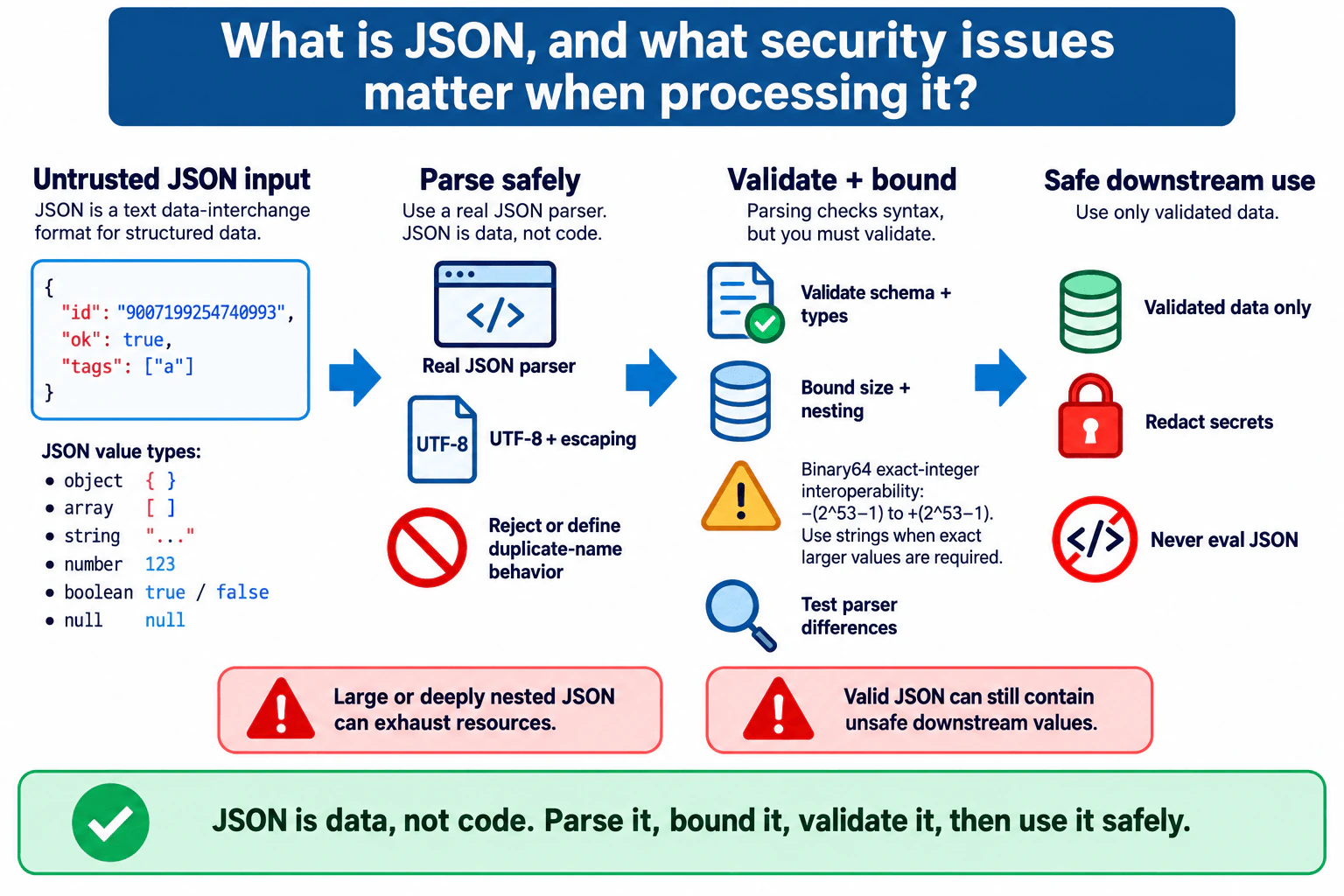
16. What is JSON, and what security issues matter when processing it?Language SpecificEasy

Question Details

Define JSON as a text format for objects, arrays, strings, numbers, booleans, and null. Explain encoding, escaping, duplicate member names, number precision, nesting, schemas, parser differences, size limits, and safe handling of untrusted assessment data. Clarify that JSON is a data format, not executable code.

Short Interview Answer (30-60 seconds)

JSON is a text format for objects, arrays, strings, numbers, booleans, and null; it is data, not executable code. With untrusted JSON, I use a real parser, validate structure and types, bound size and nesting, handle duplicate names and number precision carefully, and never evaluate the text as code.

Detailed Explanation

JSON, or JavaScript Object Notation, is a text format for exchanging structured data. A JSON value can be an object, array, string, number, boolean, or null. For a Penetration Tester, the practical security decision is to treat JSON collected from an assessment target as untrusted data, not executable instructions. Safe processing means using a standards-aware parser, validating the expected structure and types, controlling input size and nesting, handling duplicate names and numeric precision carefully, and storing only necessary evidence. Valid JSON syntax does not prove that its contents are trustworthy, authorized, or safe for downstream use.

Useful Questions to Ask the Interviewer
  1. Is the JSON coming from an HTTP response, a file, a tool export, or another untrusted source?
  2. Do we have a defined schema or expected fields and data types?
  3. Must malformed JSON, duplicate member names, or unknown fields be rejected?
  4. Are there limits for document size, array length, string length, or nesting depth?
  5. Do any numeric fields require exact integer or decimal precision?
  6. Does the JSON contain credentials, tokens, personal data, or other evidence requiring redaction?
What is JSON, and what security issues matter when processing it? diagram
How to Explain It in an Interview

I would begin with the format itself. JSON is a serialized text representation of a value. Objects use name/value members inside braces, arrays use ordered values inside brackets, strings use double quotes, numbers use JSON number syntax, and the literal values true, false, and null are also valid. JSON does not define functions or executable statements. A JSON parser converts text into data structures; it should not execute the text.

Encoding and escaping matter because parsers must agree on what characters a string represents. RFC 8259 requires JSON text exchanged between systems outside a closed ecosystem to use UTF-8. Inside strings, quotation marks, reverse solidus characters, and control characters have defined escaping requirements. I let the JSON library perform decoding and escaping rather than writing custom string replacements, because custom handling can interpret the same input differently from the real parser. rfc-editor.org

Duplicate member names are an important ambiguity. RFC 8259 says names within an object should be unique and notes that implementations behave differently when duplicate names occur. Some keep one value, some reject the document, and some expose all occurrences. That can become a security problem when validation and downstream components interpret the same document differently. For security-sensitive tooling, I prefer rejecting duplicate member names where the parser supports it, or enforcing one explicit documented policy before security decisions are made. rfc-editor.org

Numbers also need care. JSON defines textual number syntax, but it does not require every implementation to represent every value with the same precision or range. RFC 8259 notes that integers from -9007199254740991 through 9007199254740991 are reliably interoperable among implementations using common IEEE 754 binary64 behavior. I-JSON also recommends representing greater-magnitude or higher-precision values as strings when exact interchange is required. Therefore, if an identifier or other security-relevant value must remain exact, I choose a representation that the producer and consumer explicitly agree can preserve exactly instead of silently accepting rounding. rfc-editor.org

Nesting and size are availability boundaries. A document can be syntactically valid but still contain enormous arrays, very long strings, or extreme nesting. Parsing and later processing can consume excessive memory, CPU, or stack space. JSON itself does not define one universal safe maximum size or depth, so limits are application and parser decisions. I set documented byte, collection, string, and nesting limits based on the expected assessment workflow and reject over-limit data with a controlled error rather than continuing with partially interpreted content.

A schema is useful after syntactic parsing. Parsing tells me that the text follows JSON syntax; it does not tell me that the fields have the expected meaning. For example, a field expected to hold an array of findings should not silently become a string, object, or unexpectedly large collection. I validate required fields, allowed types, acceptable lengths or ranges, and whether unknown fields are permitted. Schema validation is a structural control, not proof that the source or values are trustworthy.

Parser differences are another trust-boundary issue. Components may differ in duplicate-name handling, number representation, member-order visibility, Unicode edge cases, accepted resource limits, and whether they accept non-standard extensions. I test the actual parser used by the assessment tool instead of assuming every JSON implementation behaves identically. When JSON crosses between systems, I prefer conservative, documented representations and regression-test important boundary cases.

For untrusted penetration-testing evidence, I would use a bounded processing pipeline. First, confirm that the data belongs to the authorized assessment workflow. Then enforce an input-size limit, decode using the expected encoding, parse with a real JSON parser, reject malformed or ambiguous content, validate the expected structure and types, and pass only validated data to downstream logic. I never use eval or another code-evaluation mechanism to process JSON, and I do not concatenate untrusted JSON values into shell commands, database statements, file paths, templates, or other interpreters without the separate validation and escaping required by that destination.

I would also minimize retained evidence. If JSON contains authorization headers, session tokens, passwords, personal information, or unrelated response data, I avoid storing it unless it is needed for the authorized assessment. Logs should contain enough information to reproduce the parser decision without leaking reusable secrets. Stored evidence should follow the engagement's access, retention, and disposal requirements.

Validation should use synthetic positive, negative, and boundary cases. I would test a normal document, malformed syntax, incorrect escaping, duplicate member names, very large or high-precision numbers, wrong field types, missing fields, unknown fields, deep nesting, oversized arrays or strings, and an over-limit document. The expected result should be deterministic: either one documented accepted representation or a controlled rejection with no partial security decision.

The main limitation is that safe JSON parsing does not establish that the content is honest, authorized, or safe in every later context. A perfectly valid string can still be dangerous if it is later interpreted as a command, path, URL, query fragment, or template expression. Every downstream boundary needs its own context-specific validation. Stricter schemas and limits improve predictability and resilience, but they can reject legitimate extensions or unusually large evidence, so those rules should come from the actual interface and assessment requirements rather than arbitrary assumptions.

Technical Approach
  1. Confirm that the JSON belongs to the authorized assessment workflow and identify the expected source, consumer, and structure.
  2. Define deterministic size, nesting, string, and collection limits appropriate to that interface.
  3. Enforce the input-size limit before allowing an unbounded document into memory where practical.
  4. Decode using the expected character encoding and parse with a standards-aware JSON library rather than manual string processing or code evaluation.
  5. Reject malformed syntax and apply an explicit duplicate-member policy, preferably rejection when ambiguity would affect a security decision.
  6. Validate the expected object or array structure, required fields, types, lengths, ranges, and permitted unknown fields.
  7. Handle precision-sensitive numeric values with a representation that preserves the required exactness.
  8. Redact unnecessary secrets or sensitive evidence before logging or storage.
  9. Pass validated values only to safe typed operations and apply separate context-specific validation at each downstream boundary.
  10. Verify behavior with synthetic normal, malformed, duplicate-name, precision, type-confusion, deep-nesting, oversized-input, and regression cases.
Time & Space Complexity

For a normal document, parsing and validation generally require work that grows with the amount of input examined, and retained parsed data uses memory that grows with the data kept. Exact performance depends on the parser, schema validator, data shape, and runtime, so I would not promise one universal constant. Very large documents, long strings, large arrays, or deep nesting can increase CPU and memory use. Schema checks, duplicate detection, evidence redaction, and stricter limits add implementation and maintenance work, but they improve predictability. Limits must be tested because limits that are too small can reject legitimate evidence, while limits that are too large increase availability risk.

Where it is used

A Penetration Tester commonly processes JSON when reviewing REST API requests and responses, importing scanner or testing-tool results, parsing exported assessment evidence, inspecting application configuration or metadata, validating API behavior, and transferring structured findings between authorized testing tools. The same safeguards matter whenever data from a target or external tool crosses into trusted parsing, storage, reporting, or automation logic.

Why Interviewers Ask This

Interviewers want to see whether the candidate understands JSON itself and the security boundary created when untrusted structured data enters a penetration-testing tool. A strong answer distinguishes parsing from execution and recognizes interoperability and availability risks such as duplicate object member names, numeric precision differences, malformed escaping, excessive nesting, oversized documents, schema mismatches, and different parser behavior.

Common interview mistakes

Common mistakes include saying that JSON is executable because its name contains JavaScript; using eval or another execution mechanism instead of a JSON parser; manually parsing JSON with string splitting or regular expressions; assuming duplicate member names have one universal meaning; assuming every parser preserves very large or highly precise numbers identically; treating syntactically valid JSON as semantically trusted; ignoring UTF-8, escaping, and Unicode edge cases; accepting unlimited document size or nesting; relying on parser defaults without testing them; validating field names but not types, lengths, or ranges; logging complete assessment responses containing credentials or tokens; and passing parsed strings into commands, file operations, templates, or other interpreters without separate destination-specific validation.

Interview tip

Start by saying that JSON is data, not code. Then organize the answer around three decisions: parse it predictably, bound its resource use, and validate it before trust. Cover encoding and escaping, duplicate names, number precision, size and nesting, schemas, parser differences, and safe evidence handling. Finish by explaining that valid JSON can still contain unsafe values for downstream contexts.

Interviewer may ask next
Why are duplicate JSON object member names a security concern?

Because different JSON implementations can handle the same duplicate names differently. RFC 8259 notes that some implementations expose only one value, others reject the object, and others expose all duplicates. If validation and downstream processing use different interpretations, they can disagree about a security-sensitive field. I avoid that ambiguity by requiring unique names or rejecting duplicates before the data affects a security decision. rfc-editor.org

Does schema validation make untrusted JSON safe?

No. A schema can verify expected structure, data types, required fields, lengths, ranges, and other declared constraints, but it does not establish that the source is trustworthy or that a value is safe in every downstream context. A schema-valid string could still be unsafe if later used as a command argument, file path, URL, database value, or template input. Each downstream boundary still needs the correct context-specific handling.

17. What is YAML, and what should a Penetration Tester know about .yaml and .yml files?Language SpecificEasy

Question Details

Define YAML as a human-readable data-serialization language commonly stored with .yaml or .yml extensions. Explain mappings, sequences, scalars, indentation, anchors, aliases, tags, schemas, parser-dependent typing, unsafe construction, alias expansion, secret exposure, and strict validation of security configuration.

Short Interview Answer (30-60 seconds)

YAML is a human-readable data-serialization language widely used for configuration. I would understand its mappings, sequences, scalars, indentation, anchors, aliases, tags, and typing rules, then check for unsafe construction, alias-expansion risks, exposed secrets, and security settings that are not strictly validated.

Detailed Explanation

See the Code while reading this explanation.

The practical decision is to treat YAML as structured input that can control security-sensitive behavior, not as harmless text. YAML is a human-readable data-serialization language, and .yaml and .yml are common file extensions. A Penetration Tester should understand mappings, sequences, scalars, indentation, anchors, aliases, tags, and schema-driven type resolution. The tester should then determine which parser and application consume the file, because interpretation can vary. For security-sensitive YAML, the key checks are safe construction, bounded parsing, secret handling, and strict validation of the parsed configuration.

Useful Questions to Ask the Interviewer
  1. Which application or service consumes the YAML file?
  2. Which YAML parser, parser version, and YAML schema or typing rules are in use?
  3. Is the YAML trusted configuration, user-controlled input, or generated by another system?
  4. Is there an approved application schema or configuration specification used to validate the parsed result?
What is YAML, and what should a Penetration Tester know about .yaml and .yml files? diagram
How to Explain It in an Interview
1. Define YAML and its basic structure

YAML is a data-serialization language designed to represent structured data in a readable text format. Its three basic node kinds are mappings, sequences, and scalars. A mapping represents key-value relationships. A sequence is an ordered list. A scalar is a single value such as text, a number, a boolean, or null. Block-style YAML uses indentation to express scope, so indentation affects the resulting structure.

2. Understand .yaml and .yml files

Both .yaml and .yml are used for YAML files. The extension does not change the YAML language or its security properties. What matters is which parser and application process the file and what configuration meaning they assign to the parsed values.

3. Verify the parsed structure, not only how the file looks

A tester should determine what data structure the parser actually creates. Small indentation changes can move values between mappings and sequences or make a document invalid. For security configuration, I would compare the parsed structure with the application's expected structure instead of trusting a visual review alone.

4. Understand schemas and parser-dependent typing

YAML schemas define how plain scalar values are resolved into tags and data types. YAML 1.2 defines recommended failsafe, JSON, and core schemas, with the core schema recommended as a default unless another schema is selected. Real libraries may support different YAML versions, schemas, compatibility behavior, or custom resolvers. Therefore, a Penetration Tester should verify the actual parser behavior instead of assuming that a value which looks like a string, boolean, number, or null is interpreted identically everywhere.

An application validation schema is a separate concept. After YAML is parsed, the application should still validate required keys, allowed values, data types, ranges, and unknown fields according to its own configuration rules.

5. Know anchors and aliases

An anchor, written with &, identifies a node so it can be referenced later. An alias, written with *, refers to that anchored node. These features reduce duplication, but complex or excessive alias use can increase parser work and memory consumption. For attacker-controlled YAML, I would determine whether the parser places reasonable limits on input size, nesting, aliases, memory use, and processing time. I would test those limits only with bounded synthetic input rather than attempting disruptive resource exhaustion against a production system.

6. Treat tags and object construction as a trust boundary

YAML tags identify the type or intended interpretation of nodes. Some libraries also support application-specific constructors that transform tagged input into native application objects. That becomes dangerous when untrusted YAML can request powerful object construction. The safe design is to use a loader or parser mode that accepts only the required data types and rejects unexpected or application-specific tags. For example, PyYAML documents safe_load as a restricted loader for standard YAML tags and warns that unrestricted loading of untrusted input can construct unsafe Python objects.

7. Check for exposed secrets

Configuration files can contain passwords, tokens, private keys, connection strings, or other reusable credentials. During an authorized assessment, I would inspect YAML for such material while minimizing exposure. A field named password or token is not proof that a valid credential is present. I would collect only the evidence needed, redact sensitive values from screenshots and reports, and avoid using discovered credentials unless the rules of engagement specifically authorize that validation.

8. Strictly validate security configuration

Successful YAML parsing proves only that the parser accepted the document. It does not prove that the resulting configuration is safe. Security-sensitive applications should validate expected keys, required fields, types, allowed values, ranges, and unknown fields after parsing. Invalid or ambiguous security settings should fail safely instead of silently falling back to a weaker configuration.

9. Validate with safe synthetic cases

For an authorized test, I would use synthetic inputs covering valid YAML, malformed indentation, missing required fields, unexpected keys, wrong data types, unsupported tags, bounded alias use, and boundary-sized values. I would record the input, parser or application response, validation result, and relevant error messages. This creates reproducible evidence without exposing production secrets or intentionally exhausting resources.

10. State the limitation

Reviewing a YAML file alone does not prove that the deployed system uses that exact file or that a suspicious value creates a vulnerability. The full trust boundary is YAML text to parser to application validation to the consuming component. I would verify that path and clearly separate demonstrated behavior from assumed security impact.

Key Insight / Why This Solution Works
  1. Confirm that the YAML file and consuming application are within the authorized scope.
  2. Identify the parser, parser version, parser options, YAML schema or resolver behavior, and whether the input is trusted.
  3. Inspect or parse the document using a safe mode that does not permit unnecessary application-specific object construction.
  4. Verify mappings, sequences, scalars, indentation, anchors, aliases, tags, and resolved data types.
  5. Check for secrets while minimizing and redacting sensitive evidence.
  6. Use bounded synthetic cases for malformed indentation, missing fields, unexpected keys, wrong types, unsupported tags, aliases, and boundary-sized input.
  7. Verify that the application strictly validates security-sensitive configuration after parsing and fails safely on invalid values.
  8. Record reproducible evidence and separate demonstrated behavior from assumed impact.
  9. Retest the same safe cases after remediation.
Example

This synthetic YAML example demonstrates the language features a Penetration Tester should recognize without containing real credentials or performing any action. security and logging are mappings. allowed_environments is a sequence. Values such as true and 30 are scalars that the parser resolves according to its schema or resolver rules. The &secure_defaults anchor identifies a mapping, and *secure_defaults is an alias referring to that node. The explicit !!str tag marks INFO as a YAML string. In a real application, the parsed result should then be validated against approved configuration rules, with incorrect types, unsupported tags, unexpected keys, and invalid values rejected.

Code
# Synthetic YAML configuration for safe review only.
security: &secure_defaults
  tls_required: true
  session_timeout_minutes: 30
  allowed_environments:
    - development
    - staging

# The alias refers to the previously anchored mapping.
baseline: *secure_defaults

logging:
  enabled: true
  # Explicit standard YAML tag: resolve this scalar as a string.
  level: !!str "INFO"

# Use a reference rather than placing a real secret in this file.
secret_reference: "external-secret-store-reference"
Where it is used

This approach is useful when reviewing authorized application configuration, CI/CD configuration, infrastructure and deployment definitions, security-tool rules, container-orchestration configuration, and other systems where YAML values influence security behavior. The exact meaning of each setting depends on the application consuming the YAML, so the tester must verify that application's documented configuration and actual parser behavior.

Why Interviewers Ask This

Interviewers want to know whether the candidate can read YAML accurately and understand the security boundary between YAML text, the parser, application validation, and the component that consumes the resulting configuration. They also evaluate whether the tester recognizes unsafe construction, resource-exhaustion risks, secret exposure, parser-dependent typing, and weak validation of security-sensitive settings.

Common interview mistakes

Common mistakes are treating YAML as plain text instead of parsed structured data; assuming indentation errors are harmless; assuming scalar typing is identical across YAML versions, schemas, and parsers; overlooking anchors and aliases; permitting unnecessary application-specific object construction from untrusted YAML; performing dangerous resource-exhaustion tests in production; treating a successful parse as proof that the configuration is valid; accepting unknown keys or unsafe defaults; storing reusable secrets directly in YAML; and claiming exploitation without verifying how the consuming application actually uses the parsed value.

Interview tip

Lead with the practical security decision: understand what the parser actually constructs and strictly validate security-sensitive configuration. Then explain mappings, sequences, scalars, indentation, anchors, aliases, tags, parser-dependent typing, unsafe construction, alias expansion, and secret exposure. Distinguish YAML parsing from application validation and avoid assuming every parser behaves identically.

Interviewer may ask next
What is the difference between a YAML anchor and an alias?

An anchor identifies a node so it can be referenced later. It uses &, such as &defaults. An alias uses *, such as *defaults, and refers to an anchored node. They reduce duplication, but with untrusted input a tester should also verify that the parser safely handles complex or excessive alias processing.

Why can parsing untrusted YAML be risky even when the YAML is syntactically valid?

Syntactic validity only means the parser accepts the document. Depending on the parser and configuration, tags or constructors may create application objects, excessive aliases or nesting may consume resources, scalar types may differ from what the application expects, and valid YAML may still contain dangerous configuration or exposed secrets. Untrusted YAML should therefore use restrictive parsing, bounded resource use, and strict post-parse validation.

18. What is HCL, and how does Terraform use it?Language SpecificEasy

Question Details

Define HashiCorp Configuration Language as a structured configuration language used by Terraform and related tools. Explain blocks, arguments, expressions, variables, values, modules, providers, state, plans, and policy checks. Connect it to authorized infrastructure review while protecting state files and credentials.

Short Interview Answer (30-60 seconds)

HCL is HashiCorp's structured configuration language. Terraform uses an HCL-based language to declare infrastructure with blocks, arguments, expressions, variables, modules, and providers. Terraform evaluates that configuration with provider information and state to create a plan. During authorized review, I inspect these artifacts while protecting state files, plans, and credentials.

Detailed Explanation

This question asks whether I understand the language Terraform uses to describe infrastructure and how that configuration becomes an infrastructure change. HCL is a structured configuration language designed for human-readable configuration. Terraform builds its own configuration language on HCL and gives specific meaning to blocks, arguments, expressions, variables, modules, and providers. For security review, I also need to understand that Terraform uses configuration, state, and provider information to calculate a plan. I review these artifacts only within authorized scope and treat state, saved plans, credentials, and sensitive variable values as protected data.

Useful Questions to Ask the Interviewer
  1. Are you asking about Terraform configuration syntax only, or should I also explain state, plans, providers, modules, and policy enforcement?
  2. Should I describe how a Penetration Tester reviews Terraform files without applying infrastructure changes?
What is HCL, and how does Terraform use it? diagram
How to Explain It in an Interview

I would start with the practical idea: HCL provides the language structure, while Terraform defines what that structure means for infrastructure.

HCL stands for HashiCorp Configuration Language. It is a structured configuration language designed for readable configuration. Terraform's configuration language is based on HCL and is declarative, meaning I describe the intended infrastructure rather than writing the individual procedural steps Terraform must execute.

Terraform syntax is mainly built around blocks, arguments, and expressions. A block is a container that usually represents some configuration object or feature. A block has a type, may have labels, and contains arguments or nested blocks. Common Terraform blocks include resource, data, variable, output, module, provider, and terraform.

An argument assigns a value to a name. The general form is name = expression. The expression on the right can be a literal value, a reference, a function call, a conditional expression, or another supported expression.

Expressions produce values. Terraform supports values such as strings, numbers, booleans, lists or tuples, maps or objects, sets, and null. Expressions can also reference values elsewhere in the configuration, which is how one resource, variable, module, or data source can feed information into another configuration element.

Input variables provide values to a module. They let teams reuse the same configuration with controlled differences between environments. Variable declarations can specify type constraints, defaults, descriptions, validation rules, whether null is permitted, and whether a value is sensitive. Current Terraform also supports ephemeral variables, which can be used for values that should not be persisted in state or plan files when the surrounding context supports ephemeral values.

The sensitive setting is important but has a limitation. Marking an input or output as sensitive causes Terraform to redact it from normal CLI and HCP Terraform output, and expressions derived from a sensitive value normally remain sensitive. However, sensitive values can still be stored in state and plan files. Therefore, I do not treat sensitive = true as a complete secret-storage control. For supported temporary secrets, ephemeral values can prevent persistence in state and plan files, but they have usage restrictions and do not replace proper credential management.

A module is a collection of Terraform configuration that Terraform manages as one logical unit. The configuration where Terraform is run is the root module, and it can call child modules. Modules expose inputs and outputs and make infrastructure reusable. During an authorized review, I inspect relevant child modules instead of reviewing only the root module, because a short module call can create many resources and permissions.

Providers are plugins Terraform uses to interact with external systems and APIs. Terraform configurations declare required provider sources and version constraints in the terraform block, while provider blocks configure provider instances. Provider-specific configuration can include regions, endpoints, aliases, or authentication-related settings. Credentials should generally come from approved external mechanisms supported by the provider rather than being hard-coded into version-controlled HCL.

Providers are an important trust boundary. A Terraform configuration may look harmless, but the provider identity determines what external actions Terraform can perform. During an authorized assessment, I verify the expected provider source, version constraints, aliases, credential source, and effective privilege without collecting or exposing reusable credentials unnecessarily.

Terraform state records Terraform's knowledge about managed infrastructure and maps resource instances in the configuration to remote objects and their known attributes. Terraform uses state to understand which remote objects correspond to configuration objects and to help calculate changes. State may contain detailed infrastructure information and sensitive values, including secrets in some configurations. Local state is stored as a plaintext file, so it must not be treated as harmless source code. Remote-state protection depends on the selected backend or platform.

I therefore treat Terraform state as sensitive evidence. I avoid committing local state to source control, restrict access to remote state, protect it in storage and transit using the controls supported by the selected backend, and redact sensitive values before including evidence in a penetration-testing report.

A Terraform plan is the proposed set of actions Terraform calculates for a run. Terraform evaluates the configuration, prior state, and information it retrieves through providers to determine what changes would move the managed infrastructure toward the declared configuration. terraform plan previews those proposed actions and does not itself apply the infrastructure changes described by the plan.

For an authorized review, a plan is often safer evidence than immediately applying configuration because I can inspect proposed creation, update, replacement, or destruction before an apply. However, generating a plan can still require provider access and can read remote-object information. Saved plan files can also contain sensitive data in cleartext representation, including sensitive values, so I protect saved plans like state files and do not publish them as ordinary test artifacts.

Policy checks add governance around Terraform runs. In HCP Terraform, organizations can use policy-as-code frameworks including Sentinel, Open Policy Agent using Rego, and the newer native Terraform policy framework. The native Terraform policy framework uses HCL-based syntax and is currently documented as beta, so HashiCorp advises against using the beta feature in production environments. Sentinel and OPA policy sets can inspect Terraform run or plan information and, depending on their enforcement configuration, report or stop noncompliant runs.

I would never assume that policy enforcement exists simply because Terraform is in use. During a review, I verify which framework is actually configured, which workspaces or projects the policy set applies to, the enforcement level, whether overrides are possible, and the result of the relevant policy evaluation. A passing policy proves only that the evaluated configuration or plan satisfied the rules that were actually written and enforced; it does not prove that the infrastructure is completely secure.

For penetration testing, my normal approach is review-first and non-destructive. I first confirm written authorization and identify the Terraform repositories, modules, providers, state backends, workspaces, and environments that are in scope. I inspect the HCL for security-relevant configuration such as unintended network exposure, excessive identity permissions, insecure resource settings, untrusted module or provider sources, weak version constraints, or unsafe handling of sensitive values.

I then trace variables, local values, module inputs, outputs, provider aliases, and resource references to understand the effective configuration. I avoid assuming that a variable name such as private, secure, or sensitive proves a security property. I verify the actual resource setting or resulting plan instead.

Where permitted, I use Terraform validation and an approved plan to strengthen the review before considering any apply operation. I do not run terraform apply, destroy resources, import resources, modify state, or change production infrastructure merely to investigate a finding unless the rules of engagement explicitly authorize that action and the risk has been accepted.

The responsibility boundary matters because HCL source code is not the whole system. Terraform configuration can depend on child modules, provider plugins, provider APIs, variable sources, state backends, credentials, external data sources, and resources that may have changed outside Terraform. A source-code review therefore shows configuration intent but does not by itself prove the exact deployed state.

State is also not independent proof of the current remote environment. It represents Terraform's recorded knowledge and can become different from remote reality when infrastructure changes outside Terraform or when Terraform has not refreshed the relevant information. A plan can help identify some differences by consulting providers, but the evidence available depends on provider behavior, permissions, configuration, and the operation being performed.

My evidence would include the exact HCL location, relevant module path, Terraform resource address, provider context, validation result, approved plan evidence, policy result where applicable, and any independently authorized platform observation needed to confirm the finding. I minimize evidence and redact passwords, private keys, API tokens, session credentials, sensitive outputs, and other unnecessary secret material.

The main tradeoff is confidence versus operational risk. Reading HCL is very low impact but can miss drift and runtime conditions. Reviewing a plan provides stronger evidence about Terraform's proposed actions but can require live provider access and can expose sensitive data. Inspecting state can provide useful mappings and attributes but creates confidentiality risk. Direct platform validation can give stronger evidence of deployed behavior but requires additional privileges and must remain within scope. Applying configuration gives direct change evidence but changes infrastructure, so I use it only when explicitly authorized and necessary.

No single HCL review, state file, plan, policy result, or platform observation proves complete infrastructure security. I combine only the minimum evidence required for the authorized objective and clearly separate confirmed observations from assumptions.

Technical Approach
  1. Confirm written authorization and identify the Terraform repositories, modules, workspaces, providers, backends, and environments that are in scope.
  2. Review the HCL structure, including blocks, arguments, expressions, variables, module calls, provider requirements, and security-relevant resource settings.
  3. Trace variables, local values, module inputs, outputs, and references to understand effective configuration without exposing credentials.
  4. Review required provider sources, version constraints, aliases, credential sources, and effective identities using least-privileged access.
  5. Inspect state only when authorized and necessary, treating it as sensitive evidence.
  6. Prefer configuration validation and an approved Terraform plan to understand proposed infrastructure changes before any apply operation.
  7. Review applicable policy results, scope, enforcement level, and override behavior without assuming that passing policies prove security.
  8. Correlate configuration, plan, state, and independently authorized platform observations when stronger validation is required.
  9. Record minimal, redacted evidence and clearly separate confirmed findings from assumptions or unverified drift.
  10. Do not apply configuration, destroy resources, modify state, or otherwise change infrastructure unless the rules of engagement explicitly permit the action.
Practical Complexity & Trade-offs

Reading HCL is usually low operational risk and relatively inexpensive because it can often be done from source code. Following nested modules, expressions, provider aliases, and environment-specific variables adds analyst time and review complexity. Generating a plan may require live provider access and can expose sensitive information, so access control and secure evidence handling add operational work. Reviewing remote state, policy results, and deployed infrastructure can improve confidence but requires more permissions and coordination. Large Terraform estates also increase maintenance cost because modules, providers, policies, dependencies, and state structures change over time. The safest review may provide less runtime certainty, while deeper validation gives stronger evidence but creates more confidentiality, access, and change risk.

Where it is used

This approach is useful during an authorized infrastructure-as-code security assessment, cloud penetration test, pre-deployment security review, CI/CD security assessment, or remediation retest. A tester may review Terraform HCL and an approved plan to identify risky network exposure, excessive identity permissions, insecure resource settings, unsafe provider or module dependencies, weak configuration controls, or secret-handling problems before infrastructure changes are applied. The same concepts are useful when validating whether an approved Terraform remediation would change the intended resources while keeping state, saved plans, and credentials protected.

Why Interviewers Ask This

Interviewers want to confirm that the candidate understands Terraform configuration beyond memorizing commands. A Penetration Tester should recognize how HCL represents infrastructure, where configuration and trust boundaries appear, how providers and modules affect the resulting infrastructure, and why plans, state files, variables, credentials, and policy results can contain security-sensitive information.

Common interview mistakes

A common mistake is saying that HCL and Terraform are the same thing. HCL is the general configuration-language foundation, while Terraform defines Terraform-specific language features and semantics on top of it. Another mistake is saying Terraform simply executes an HCL file from top to bottom; Terraform evaluates expressions, references, dependencies, provider schemas, state, and graph relationships rather than treating the configuration like a sequential shell script. Testers may also assume that sensitive = true prevents a secret from being stored in state or saved plans, which is incorrect. Other mistakes include reviewing only the root module, ignoring provider identities and child modules, hard-coding credentials in HCL, treating state as perfect proof of deployed reality, assuming a clean plan or passing policy proves security, or running terraform apply during an assessment without explicit authorization.

Interview tip

Explain the flow in one sentence first: Terraform uses an HCL-based declarative language to describe infrastructure, providers connect Terraform to external APIs, state records Terraform's known mappings and attributes, and a plan shows proposed changes. Then connect it to penetration testing by saying you prefer read-only configuration and plan review, protect state, plans, and credentials, and validate deployed reality separately when authorized.

Interviewer may ask next
What is the difference between Terraform configuration, state, and a plan?

Configuration is the HCL-based description of the intended infrastructure. State is Terraform's stored record that maps Terraform resource instances to known remote objects and records attributes Terraform uses during operations. A plan is the proposed set of actions Terraform calculates using the configuration, prior state, and information obtained through providers. Configuration expresses intent, state helps Terraform track managed objects, and the plan previews proposed changes. State and saved plan files can contain sensitive information, so I protect both and do not treat either as automatically safe to share.

Why is reviewing Terraform HCL alone not enough for a penetration test?

HCL primarily shows intended configuration. The deployed environment can differ because of drift, external changes, runtime conditions, provider behavior, values supplied outside the reviewed files, or implementation details hidden inside child modules. I therefore use HCL as one evidence source and, when authorized, correlate it with relevant module contents, provider configuration, an approved Terraform plan, protected state information, policy results, and direct platform observations. I still avoid unnecessary apply operations because stronger runtime validation must be balanced against confidentiality, privilege, availability, and change risk.

19. What is Rego, and how does it express security policy?Language SpecificEasy

Question Details

Define Rego as the declarative policy language used by Open Policy Agent. Explain input, data, rules, decisions, defaults, variables, comprehensions, built-in functions, tests, and bundles. Cover authorization and configuration-review uses with explicit inputs, deterministic tests, versioned policy, and safe failure behavior.

Short Interview Answer (30-60 seconds)

Rego is OPA's declarative policy language. It evaluates structured input plus policy data and derives decisions through rules. I use explicit inputs, default-deny authorization, variables, comprehensions, built-ins, deterministic tests, and reviewed versioned bundles so security decisions are predictable, testable, and fail safely.

Detailed Explanation

See the Code while reading this explanation.

This question asks how Rego represents security decisions rather than how to write a general-purpose program. Rego is the declarative language used by Open Policy Agent. A caller supplies input, policies can read reference information under data, and rules calculate decisions such as whether access is allowed or which configuration items violate a requirement. The important security idea is to make those inputs and outputs explicit, use safe defaults, test expected and unexpected cases deterministically, version policy with its supporting data, and make the integrating system fail safely if a required decision cannot be obtained.

Useful Questions to Ask the Interviewer
  1. Are we discussing Rego mainly for runtime authorization, configuration review, or both?
  2. What fields and data types are guaranteed to exist in the input document?
  3. Which information is request-specific input and which information is trusted reference data?
  4. Should an unavailable, undefined, malformed, or errored decision deny the operation, report an evaluation error, or follow another documented behavior?
  5. How are policy and reference-data versions promoted, identified, and rolled back?
What is Rego, and how does it express security policy? diagram
How to Explain It in an Interview

I would start with the practical decision: Rego lets us separate a security decision from application code. The application or review tool supplies structured facts, OPA evaluates Rego, and the caller consumes the resulting policy decision.

Rego is declarative. I describe the conditions that make a rule produce a result instead of writing a sequence of commands that mutate program state. For example, an authorization policy can define allow as false by default and make it true only when the supplied facts satisfy an approved rule.

The first important document is input. input is the evaluation-specific document supplied to OPA. For authorization, it might contain a subject, action, resource, and contextual attributes. For configuration review, it might contain a parsed configuration object. The policy should rely only on documented fields and expected data types. Missing or malformed fields must not accidentally create permission.

The second important document is data. data is OPA's base and virtual document namespace. Loaded JSON or YAML reference data appears there, and rule results are also addressed through data by package path. Reference information might include approved roles, resource classifications, or configuration requirements. I keep the trust distinction clear: placing a value under input or data does not itself prove that its source is trustworthy.

Rego works with JSON-like scalar values, arrays, objects, and also sets. Arrays preserve order and may contain duplicate values. Sets represent unique values and are unordered. Objects map unique keys to values. That distinction matters when a policy requires deterministic collection semantics: I do not depend on set ordering, and I choose arrays when meaningful ordering or duplicates must be preserved.

Rules express decisions. A complete rule can produce one value such as a Boolean allow. Other rules can derive sets, objects, arrays, or other values. For configuration review, a collection can represent multiple violations. I define an intentional output contract so the enforcement point knows whether it received an allow or deny decision, a collection of findings, an undefined result, or an evaluation error.

Defaults are especially important for authorization. default allow := false gives the allow rule a false value when no normal allow rule produces another result. That is a clear default-deny pattern and avoids treating an unmatched authorization request as permission. It does not solve infrastructure failures by itself; the caller must separately handle an unavailable OPA instance, invalid policy, malformed request, bundle failure, or evaluation error.

Variables name values used during evaluation. Rego variables are not ordinary mutable variables in an imperative program. For example, role := input.subject.role binds a local value for use by later expressions. Clear variable names make authorization logic easier to review, while unsafe or unbound variable use can make policy difficult to understand or invalid.

Comprehensions construct arrays, sets, or objects from values satisfying expressions. A set comprehension such as {action | action := data.role_permissions[role][_]} can derive the unique actions associated with a role. Comprehensions are useful for authorization and configuration findings, but I keep them simple because dense policy is harder to review and maintain.

Built-in functions provide policy-oriented operations for strings, collections, numbers, time, encoding, cryptography, tokens, networking, and other supported tasks. For example, count() returns the size of a collection. I choose built-ins deliberately and keep the core security decision readable rather than hiding authorization logic inside complicated transformations.

Testing is part of the policy lifecycle. OPA discovers test rules whose names start with test_ when opa test runs. I create deterministic positive, negative, missing-field, malformed-input, boundary, and regression cases using synthetic data. For authorization, I test both expected allows and expected denies. For configuration review, I test compliant and noncompliant inputs. In CI, opa test --fail-on-empty can prevent an accidentally empty test selection from being treated as a successful test run.

Bundles are OPA's packaging mechanism for distributing policies and supporting data. A bundle can contain Rego modules, data.json or data.yaml, and manifest metadata. A manifest may include a revision identifier, and current bundles can specify their Rego language version. I treat the complete bundle as a reviewed security artifact: test it, identify its revision or release version, promote it through controlled deployment, and keep a rollback path. Policy and supporting data should be released together when their meanings depend on each other.

For runtime authorization, the important trust boundary is between the system producing attributes, OPA evaluating policy, and the component enforcing the returned decision. Rego cannot make an untrusted identity claim trustworthy. If a client can invent role: admin and the application forwards that value as trusted input, a logically correct policy can still produce the wrong security outcome. Authentication, attribute integrity, and final enforcement therefore remain responsibilities of the surrounding system.

For configuration review, Rego can evaluate a structured configuration and derive violations without changing the target. That makes it suitable for non-destructive authorized assessment. I would use approved or synthetic configuration data, identify the exact policy and data version used, preserve the evaluation evidence, and validate relevant findings in context. A Rego rule match alone does not prove an exploitable vulnerability or business impact.

Safe failure behavior must be explicit. A normal negative authorization decision should deny access. An undefined result must never be silently converted into allow. Evaluation errors, malformed inputs, unavailable policy evaluation, rejected bundles, or other operational failures should follow a documented failure policy. For a security-critical authorization boundary, failing closed is normally the safer design unless an explicitly approved availability requirement calls for another controlled strategy. The enforcement application, not Rego alone, determines that operational failure behavior.

The main tradeoff is separation and reuse versus additional policy lifecycle and integration responsibility. Rego makes policies centrally reviewable, testable, and reusable, but complex policies can become difficult to understand. OPA also depends on trustworthy input, correct policy and data distribution, observable evaluation, and an enforcement point that actually honors the result. A Penetration Tester should therefore review the complete chain: attribute provenance, input shape, data, policy logic, tests, bundle version, returned decision, failure behavior, and real enforcement.

Technical Approach
  1. Define the exact policy decision, such as runtime authorization or configuration compliance.
  2. Define the structured input contract, including required fields, types, trusted sources, optional fields, and behavior for missing or malformed values.
  3. Separate evaluation-specific input from supporting information available through data.
  4. Define the output contract, such as a Boolean authorization decision or a structured collection of configuration findings.
  5. For authorization, establish an explicit safe default such as default allow := false, then add narrowly scoped rules for approved cases.
  6. Use clear variable bindings and choose arrays, sets, or objects according to required ordering and duplicate semantics.
  7. Use comprehensions only when deriving collections materially simplifies the policy, and use built-ins for well-defined transformations.
  8. Write deterministic Rego tests for permitted, denied, missing-field, malformed, boundary, and regression cases using synthetic data.
  9. Run the tests in CI and use empty-test protection when needed so missing test discovery cannot silently look successful.
  10. Package reviewed Rego and supporting data into a controlled bundle when bundles are used, identify the deployed revision or release version, and maintain rollback.
  11. Verify that the caller supplies trustworthy attributes, handles undefined and error states explicitly, and actually enforces the returned decision.
  12. For an authorized assessment, preserve only necessary policy, test, bundle-version, and decision evidence and do not infer an exploit or impact that was not demonstrated.
Practical Complexity & Trade-offs

There is no single useful Big-O value for all Rego policies because evaluation cost depends on the rules, input size, reference data, collection scans, comprehensions, and built-ins used. A simple authorization rule over a few scalar fields can be small, while rules that repeatedly iterate over large collections can cost more CPU and memory. Operational cost is also important: teams must review policies, maintain deterministic tests, version policy and data, distribute bundles safely, monitor failures, and keep input contracts synchronized. Central policy can reduce duplicated logic, but fail-closed behavior and external policy dependencies can affect availability if the surrounding design is not resilient.

Example

This compact Rego v1 example uses one valid package so the policy and its synthetic tests form a valid module. input provides the evaluation-specific subject, action, and resource. data.role_permissions represents supporting reference data. The authorization rule defaults to false. A real set comprehension derives unique allowed actions, and the count built-in demonstrates a simple derived value. The tests cover an allowed action, a denied action, and a missing required resource field. In a production repository, tests are commonly placed in a separate _test package or file, but that separation is organizational rather than required for the example.

Code
package security.authz

# Deny authorization unless an allow rule explicitly succeeds.
default allow := false

# Derive a set of unique actions for the requester's role.
# data.role_permissions is supporting reference data supplied to OPA.
allowed_actions := {action |
    role := input.subject.role
    action := data.role_permissions[role][_]
}

# Allow only an approved action when the required resource identifier exists.
allow if {
    input.resource.id
    input.action in allowed_actions
}

# Return a small structured result useful for controlled evaluation and logging.
decision := {
    "allow": allow,
    "allowed_action_count": count(allowed_actions)
}

# Deterministic tests use only synthetic inputs and synthetic reference data.
# A known permitted action must evaluate to true.
test_reader_can_read if {
    allow with input as {
        "subject": {"role": "reader"},
        "action": "read",
        "resource": {"id": "synthetic-document"}
    } with data.role_permissions as {
        "reader": ["read"],
        "writer": ["read", "write"]
    }
}

# A reader requesting an unapproved action must remain denied.
test_reader_cannot_write if {
    not allow with input as {
        "subject": {"role": "reader"},
        "action": "write",
        "resource": {"id": "synthetic-document"}
    } with data.role_permissions as {
        "reader": ["read"],
        "writer": ["read", "write"]
    }
}

# Missing required resource information must not accidentally grant access.
test_missing_resource_is_denied if {
    not allow with input as {
        "subject": {"role": "reader"},
        "action": "read"
    } with data.role_permissions as {
        "reader": ["read"]
    }
}
Where it is used

Rego is useful when an organization wants policy decisions separated from application implementation. Runtime authorization can decide whether an authenticated subject may perform an action on a resource using trusted attributes. Configuration-review policy can evaluate structured infrastructure, deployment, or application configuration and return policy violations before or during an authorized assessment. A Penetration Tester can non-destructively review Rego modules, supporting data, tests, bundle metadata, synthetic evaluation results, and enforcement behavior to identify overly broad authorization logic, unsafe defaults, incorrect trust assumptions, missing negative tests, or configuration-policy gaps.

Why Interviewers Ask This

Interviewers want to know whether the candidate understands Rego as a declarative policy language rather than a normal procedural language, and whether they can reason safely about policy inputs, reference data, rules, defaults, variables, comprehensions, built-ins, tests, versioning, and failure behavior. For a Penetration Tester, this also tests whether the candidate can review authorization and configuration policies for overly broad rules, unsafe defaults, missing input assumptions, unexpected data dependencies, and gaps between the intended security policy and the decision OPA actually produces.

Common interview mistakes

A common mistake is describing Rego as a procedural scripting language and explaining its rules as a fixed sequence of commands. Another is treating input and data as interchangeable or assuming values are trustworthy merely because OPA can read them. Security mistakes include omitting a deliberate default-deny authorization rule, assuming default allow := false also handles OPA outages or evaluation errors, trusting client-supplied roles, depending on set ordering, or allowing an enforcement point to ignore the decision. Other mistakes include calling a partial-set rule a comprehension, writing invalid modules with multiple package declarations, testing only successful authorization, allowing empty test discovery in CI, deploying policy without tracking its supporting data or bundle revision, and claiming that a policy match alone proves a vulnerability or business impact.

Interview tip

Lead with one sentence: Rego declaratively maps structured input and policy data to a policy decision. Then explain input, data, rules, defaults, variables, collection types, comprehensions, built-ins, tests, and bundles through one small authorization example. Finish with trustworthy attributes, deterministic negative tests, explicit default deny, and caller-enforced safe failure behavior.

Interviewer may ask next
What is the difference between input and data in Rego?

input is the document supplied for the current evaluation, such as the authenticated subject, requested action, resource, or configuration object being reviewed. data is OPA's document namespace containing loaded base data and results produced by policy rules. For security, provenance still matters: a role or identity is not trustworthy simply because it appears in input or data. The surrounding system must ensure security-sensitive attributes come from an approved and integrity-protected source.

Does `default allow := false` guarantee that an application always fails closed?

No. It makes the Rego allow rule evaluate to false when no other allow rule produces a value, which is useful for default-deny authorization. It does not determine what an application does when OPA is unavailable, policy or bundle loading fails, input is malformed, evaluation returns an error, or the application ignores the result. The enforcement component must define and test those failure paths. For a security-critical authorization boundary, deny-on-failure is normally the safer behavior unless an explicitly approved availability design requires a different controlled strategy.

20. What is a Dockerfile, and what does a Penetration Tester review in it?Language SpecificEasy

Question Details

Define a Dockerfile as a declarative build recipe for a container image. Explain instructions, base images, layers, build context, users, copied files, package installation, entry points, secrets, provenance, and reproducibility. Focus on authorized configuration review and safe validation rather than destructive container actions.

Short Interview Answer (30-60 seconds)

A Dockerfile is a declarative recipe for building a container image. I review its base image, instructions, layers, build context, copied files, package installs, runtime user, entry point, secrets, provenance, and reproducibility, then safely validate concerns without treating configuration alone as proof of exploitability.

Detailed Explanation

A Dockerfile is a declarative build recipe: an ordered text file that tells a Docker-compatible builder how to create a container image. A Penetration Tester reviews it to understand which base image is trusted, what files enter the build, what commands install software, which user receives privileges, and how the container starts. The review also checks secrets, image layers, provenance, and reproducibility. The practical decision is whether the configuration creates a credible security concern that deserves safe validation, without assuming that an unusual instruction or weak practice automatically proves exploitability.

Useful Questions to Ask the Interviewer
  1. Am I reviewing only the Dockerfile, or may I also inspect the build context, .dockerignore file, image metadata, and CI build configuration?
  2. Is this a static configuration review only, or may I perform an approved non-destructive build in an isolated environment?
  3. Does the organization require approved base images, digest pinning, non-root execution, dependency controls, provenance attestations, or reproducible builds?
What is a Dockerfile, and what does a Penetration Tester review in it? diagram
How to Explain It in an Interview

I start with the build boundary. A Dockerfile describes how inputs such as a base image, source files, packages, build tools, and configuration become a container image. The build context is the set of files made available to the builder. COPY and ADD can bring content from that context into the image, while .dockerignore rules can exclude unwanted files before they are sent as build context.

First, I review FROM instructions. FROM selects a base image and starts a build stage. I check whether the image comes from an expected registry or repository and whether its identity is controlled. A mutable tag can later resolve to different image content, while a digest identifies specific content. Digest pinning improves traceability and repeatability, but it also means the team needs an update process so security fixes are not missed.

Next, I trace instructions in build order. RUN executes commands during the build and creates filesystem changes used by later steps. I inspect package installation, repository configuration, downloaded artifacts, integrity or signature checks when appropriate, temporary files, and unnecessary tools left in the final image. I do not report an unpinned dependency or external download as automatically exploitable. It is evidence of a reproducibility or supply-chain concern that needs context and validation.

I then review image layers and multi-stage builds. Each stage can create filesystem changes that contribute to the resulting image. Multi-stage builds can keep compilers, build tools, and intermediate artifacts out of the final runtime stage. I trace what is copied between stages and whether unnecessary or sensitive material reaches the final image. I avoid relying on a later deletion as the main protection for a secret that should never have entered ordinary image filesystem content in the first place.

COPY and ADD deserve close attention because they move content into the build. I check source paths, destination paths, ownership, permissions, and whether the instruction is broader than necessary. For example, copying an entire project directory can unintentionally make development files, local configuration, source-control data, or credentials available to the build if the context and ignore rules are poorly controlled. I verify the effective context before claiming that a sensitive file was actually included.

For package installation, I review where dependencies come from, how versions are selected, whether downloaded artifacts are verified when the ecosystem supports it, and whether build-only dependencies remain in the final stage. Tighter version control improves repeatability, but strict pinning creates maintenance work because teams must deliberately update dependencies when security fixes become available.

USER controls which user and optional group apply to later Dockerfile instructions and, unless overridden at runtime, the container's configured process. I check that the final runtime stage intentionally uses only the privileges the application needs. If no USER is set in the Dockerfile, I verify what user is inherited from the base image rather than automatically claiming that the container runs as root. Running as a non-root user reduces potential impact, but it does not replace host, orchestrator, filesystem, Linux capability, or network controls.

I also review ENTRYPOINT and CMD. ENTRYPOINT defines the executable or command that the container is intended to run, while CMD supplies a default command or default arguments depending on how it is used. I verify that the startup process matches the expected application, that scripts do not introduce unnecessary shell interpretation, and that arguments and environment values are handled predictably. Exec-form instructions make the executable and arguments explicit and generally avoid an automatically inserted command shell.

Secret handling is another important boundary. I look for passwords, API tokens, private keys, credentials, or other sensitive values placed directly in the Dockerfile, copied into ordinary image files, or passed through ARG or ENV. Docker's build guidance treats ARG and ENV as inappropriate mechanisms for build secrets because sensitive values can persist in image data or metadata. With BuildKit, secret mounts or SSH mounts can make approved secrets temporarily available to a build step without intentionally baking them into ordinary image content. I still inspect resulting artifacts because a command that reads a secret could itself write that value somewhere persistent.

For provenance, I check whether the organization records evidence about how an image was built and which inputs were involved. BuildKit can generate provenance attestations describing build information, and SBOM attestations can describe software artifacts associated with the image or build. These records improve supply-chain visibility and policy enforcement, but they do not prove that the image is free of vulnerabilities or that every input is trustworthy.

For reproducibility, I look for uncontrolled inputs that may cause the same source to produce different results, such as mutable image tags, changing package repositories, floating dependency versions, uncontrolled downloads, or timestamps. Digests, controlled dependencies, fixed build inputs, and supported mechanisms such as SOURCE_DATE_EPOCH can improve reproducibility. Reproducibility is useful for comparing outputs and investigating supply-chain changes, but it is not the same as security correctness.

My validation remains authorized and non-destructive. I can compare the Dockerfile with .dockerignore rules and approved build inputs, inspect image configuration and history, confirm the configured runtime user and startup command, record image digests, review attestations, and reproduce a build in an isolated test environment when permission allows it. I preserve the relevant Dockerfile version, image identity, and observations as evidence.

The main limitation is that a Dockerfile is only one part of container security. Static review cannot by itself prove application vulnerabilities, runtime privilege escalation, orchestrator configuration, host isolation, network exposure, or production secret handling. If a concern depends on runtime behavior, I state that limitation and request separate authorized validation rather than presenting an assumption as a confirmed finding.

The tradeoff is security assurance versus maintenance and build convenience. Narrow build contexts, controlled dependencies, least-privileged users, multi-stage builds, secure secret handling, immutable image identities, provenance, and reproducibility controls improve confidence, but they require disciplined CI processes and regular updates.

Technical Approach
  1. Confirm the authorized review scope and identify which supporting artifacts may be inspected.
  2. Read every FROM instruction and identify base-image sources, tags, digests, and build stages.
  3. Trace important Dockerfile instructions such as RUN, COPY, ADD, ARG, ENV, USER, ENTRYPOINT, and CMD in execution order.
  4. Review package repositories, downloaded artifacts, dependency selection, and verification controls.
  5. Inspect the build context and .dockerignore rules for unnecessary or sensitive files.
  6. Trace files and artifacts through image layers and multi-stage COPY operations into the final image.
  7. Verify the effective runtime user and whether privileges are intentionally minimized.
  8. Review ENTRYPOINT, CMD, and startup scripts for predictable execution and unnecessary shell interpretation.
  9. Check for secrets embedded in the Dockerfile, ordinary build arguments, environment variables, copied files, or persistent build output.
  10. Review image provenance, attestations, dependency identity, and reproducibility controls.
  11. Validate findings through approved static inspection or an isolated non-destructive build.
  12. Record evidence, limitations, remediation guidance, and residual risk without claiming exploitability that was not demonstrated.
Practical Complexity & Trade-offs

A Dockerfile review is usually cheaper and safer than active exploitation because much of the work is static inspection. The technical effort grows when there are many build stages, dependencies, external downloads, or files in the build context. Reproducing a build can require additional CI, registry, and storage access. Digest pinning and stricter dependency controls improve repeatability but require regular maintenance to receive security updates. Multi-stage builds and non-root execution can require engineering changes. Provenance and SBOM generation add CI and storage work. Static review is also limited because it does not prove how the container, host, orchestrator, application, network, or production secrets behave at runtime.

Where it is used

This approach is used during authorized container-security assessments, application penetration tests, CI/CD reviews, software supply-chain reviews, pre-production security checks, and remediation retests. It is useful when a team wants to understand exactly what goes into an image, where dependencies come from, what privileges the application receives, how the container starts, how build secrets are handled, and whether the resulting image can be traced to controlled inputs.

Why Interviewers Ask This

The interviewer wants to confirm that the candidate understands how a container image is built and can review Dockerfile-specific security boundaries. This includes judging base-image trust, copied content, package sources, privileges, startup behavior, secret handling, supply-chain provenance, and reproducibility while separating static configuration concerns from demonstrated runtime impact.

Common interview mistakes

Common mistakes include treating every Dockerfile weakness as a confirmed vulnerability, checking only the final stage instead of tracing all relevant stages, ignoring the build context and .dockerignore file, assuming that a broad COPY definitely included a sensitive file without verifying the context, passing secrets through ARG or ENV, assuming that later deletion is the best protection for data that should never have entered image filesystem content, overlooking the effective runtime USER, confusing RUN with CMD or ENTRYPOINT, assuming that an image tag is immutable, treating digest pinning as a substitute for patch management, and claiming that provenance, an SBOM, or reproducibility proves that an image is secure. Another mistake is reporting runtime impact from static Dockerfile evidence alone.

Interview tip

Lead with the definition, then review the Dockerfile in build order: FROM and base-image identity, build context and copied files, RUN and dependencies, layers, USER, ENTRYPOINT and CMD, secrets, provenance, and reproducibility. Finish by explaining that static review identifies credible risks, while runtime impact requires separate authorized validation.

Interviewer may ask next
Why should a Penetration Tester care about the build context and .dockerignore file?

The build context defines which files are available to the builder. COPY and ADD can use files from that context, so a context that contains unnecessary or sensitive material increases the chance that those files become available during the build or enter the image. A .dockerignore file removes matching paths from the context before the build uses them. I would inspect both the Dockerfile and the effective context before reporting exposure, because a broad COPY instruction by itself does not prove that a specific sensitive file was present.

Does pinning a base image by digest make the container secure and reproducible?

No. A digest identifies specific image content and prevents that base reference from silently resolving to different content, which improves traceability and repeatability. It does not prove that the selected image is secure, vulnerability-free, or appropriate. Pinning also stops automatic movement to newer image content, so the organization needs a deliberate update process for fixes. Full reproducibility still depends on other inputs such as packages, downloads, build tools, source files, and timestamps.

More questions load as you scroll

Disclaimer: This interview guide is for educational and informational purposes only. It is designed to help readers prepare, but it does not guarantee any interview result, hiring decision, offer, or outcome. Interview questions, hiring criteria, and preferred answers can vary by employer, interviewer, industry, location, and time. All answers, examples, and explanations in this guide are suggested examples for interview preparation, not definitive answers or instructions for professional practice. They are based on research and judgment, are provided without warranties of any kind, and should be adapted to the question, role, and applicable laws and professional requirements. Diagrams are simplified illustrations intended to highlight the main concepts and their relationships; actual situations, systems, and practices may be more complex. Alternative approaches may be equally valid or better suited to a particular question, context, or interviewer. To the fullest extent permitted by applicable law, the contributors and publisher are not liable for decisions made, actions taken, or losses incurred based on this guide.

State Laws and Professional Responsibilities: Laws and requirements governing an occupation vary by state and jurisdiction. You are responsible for checking the current laws, licensing requirements, and scope-of-practice rules that apply to your location and role, and for ensuring that your answers and actions comply with them. Adapt examples in this guide to those requirements. This guide is not legal advice.

Content Accuracy and Verification: To the fullest extent permitted by applicable law, we do not represent or warrant that interview guides, questions, answers, examples, or diagrams are accurate, complete, current, error-free, or suitable for any particular purpose. You are responsible for independently reviewing and verifying the information before relying on it.