This interview guide is for educational and informational purposes only. It is designed to help readers prepare, but it does not guarantee any interview result, hiring decision, offer, or outcome. Interview questions, hiring criteria, and preferred answers can vary by employer, interviewer, industry, location, and time. All answers, examples, and explanations in this guide are suggested examples for interview preparation, not definitive answers or instructions for professional practice. They are based on research and judgment, are provided without warranties of any kind, and should be adapted to the question, role, and applicable laws and professional requirements. Diagrams are simplified illustrations intended to highlight the main concepts and their relationships; actual situations, systems, and practices may be more complex. Alternative approaches may be equally valid or better suited to a particular question, context, or interviewer. To the fullest extent permitted by applicable law, the contributors and publisher are not liable for decisions made, actions taken, or losses incurred based on this guide.
State Laws and Professional Responsibilities
Laws and requirements governing an occupation vary by state and jurisdiction. You are responsible for checking the current laws, licensing requirements, and scope-of-practice rules that apply to your location and role, and for ensuring that your answers and actions comply with them. Adapt examples in this guide to those requirements. This guide is not legal advice.
Identity, Image, and Privacy Notice
To respect individual privacy, some names, profile photographs, avatars, biographical details, and other identifying information displayed in this guide may be replaced with pseudonyms, licensed stock images, illustrative avatars, composite images, or representative descriptions. Unless a person is expressly identified as an actual contributor, a displayed name, image, or profile should not be understood as depicting or identifying a specific candidate, interviewer, employee, or other real individual. These representations are provided for editorial and illustrative purposes only and do not imply endorsement, employment, participation, or affiliation with this guide or any company mentioned in it. Any resemblance to an actual person is coincidental.
Company Notice
This guide is an independent educational resource and is not affiliated with, endorsed by, sponsored by, or approved by the company named in this guide. Company names identify reported interview experiences or the employer context of clearly labeled original practice exercises. Interview practices can change without notice, and inclusion of company-specific content does not mean these questions are official, complete, or guaranteed to be asked. To the fullest extent permitted by law, the author, contributors, and publisher are not responsible for outcomes related to use of this material.
Content Accuracy and Verification
To the fullest extent permitted by applicable law, we do not represent or warrant that interview guides, questions, answers, examples, or diagrams are accurate, complete, current, error-free, or suitable for any particular purpose. You are responsible for independently reviewing and verifying the information before relying on it.
Questions or comments?
Contact us for general questions, or share feedback, technical corrections, and comments with the community.
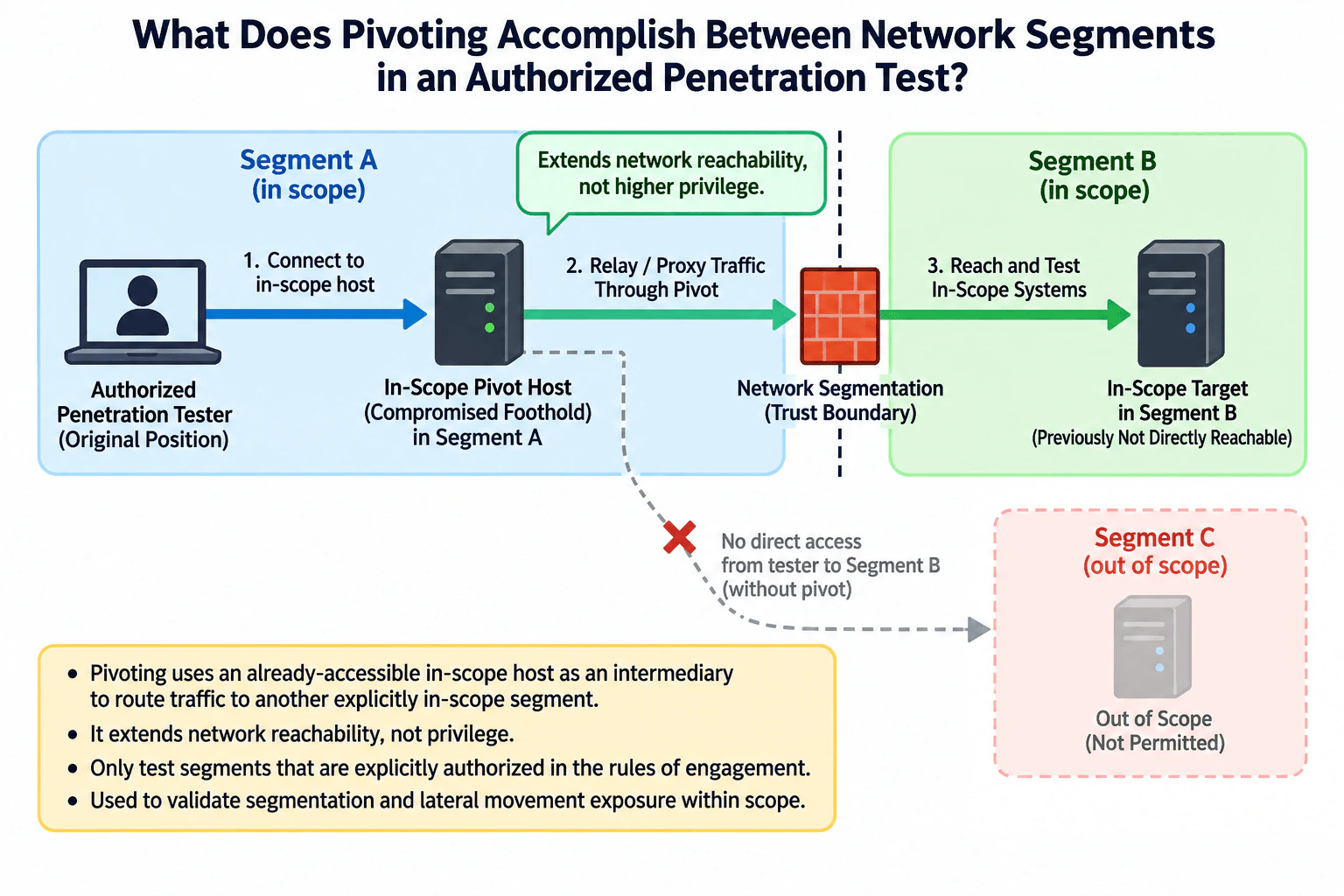
81. What does pivoting accomplish between network segments explicitly included in an authorized penetration test?Exploitation And Post ExploitationMedium
Short Interview Answer (30-60 seconds)
Pivoting uses an already-accessible in-scope host as an intermediary to relay traffic into another explicitly authorized network segment that the tester cannot reach directly. It expands network reachability, not privilege, and helps validate whether segmentation limits lateral-movement paths as intended.
Detailed Explanation
Pivoting answers a reachability problem. An authorized tester already has access to an in-scope host in one network segment, but another approved segment is not directly reachable from the tester's original position. The tester uses that foothold as an intermediary so permitted traffic can reach the second segment. The important point is that pivoting changes the network path, not the tester's privilege by itself. It can demonstrate whether segmentation restricts movement between approved zones, while every destination, action, and boundary must remain explicitly authorized.
Useful Questions to Ask the Interviewer
Are both the pivot host in Segment A and the destination systems in Segment B explicitly included in the rules of engagement?
Is the goal only to prove reachability across the segmentation boundary, or to continue with specific authorized testing in Segment B?
Are there restrictions on which services, protocols, test identities, traffic volumes, or testing times may cross the boundary?
What is the stop condition if the pivot reveals a route toward an out-of-scope segment or system?
How to Explain It in an Interview
Start with the practical decision: use pivoting only when an approved foothold can act as an intermediary and another explicitly in-scope segment is not directly reachable from the tester's original position.
In the diagram, the authorized tester first reaches the in-scope pivot host in Segment A. The pivot host then relays or proxies the tester's permitted traffic toward Segment B. That traffic crosses the network segmentation trust boundary and reaches the approved target in Segment B, which was previously not directly reachable from the tester's starting position.
This demonstrates the central distinction: pivoting extends network reachability, but it does not automatically increase privilege. A tester may become able to communicate with another system without gaining any additional operating-system, application, or identity privilege. Any later privilege escalation or compromise of another target is a separate testing decision and must not be assumed from successful pivoting.
The test should use the smallest proof necessary. For example, confirming that an explicitly approved service on the Segment B target is reachable through the pivot may be enough to validate the tested segmentation path. Record the original tester position, pivot host, destination segment, segmentation boundary crossed, approved target, and observed result so the path can be reproduced and explained.
Safe failure behavior is equally important. The diagram shows Segment C as out of scope. Even if the pivot host has some network path toward that segment, the tester must not continue into it. Technical reachability never creates authorization. The rules of engagement remain the controlling scope boundary.
The main limitation is that one successful pivot proves only the tested path under the tested conditions. It does not prove that every host in Segment B is reachable, that every segmentation rule is ineffective, that higher privilege was obtained, or that business impact occurred. The tradeoff is coverage versus safety: broader testing may reveal more lateral-movement exposure, but every additional destination and action increases operational risk and therefore requires explicit authorization, controlled traffic, evidence, and cleanup.
Technical Approach
Confirm that the tester's starting position, the pivot host in Segment A, the intended target in Segment B, and the boundary being crossed are explicitly authorized.
Define the minimum objective, such as proving that a specific approved target or service in Segment B is reachable through the pivot.
Use the already-accessible in-scope host as the intermediary and relay or proxy only the traffic needed for that objective.
Verify that the approved Segment B target is reachable through the pivot while it remains not directly reachable from the tester's original position.
Record the complete tested path: tester position, pivot host, segmentation boundary, destination segment, approved target, and observed result.
Do not treat successful reachability as proof of higher privilege, successful compromise of the destination, or business impact.
Stop if the discovered path leads toward Segment C or any other out-of-scope destination.
Remove temporary forwarding or test state if any was introduced, restore changed state, and document completion.
Practical Insights
The main cost is operational rather than computational. A pivot adds another network hop and another system that must remain available during the test, so troubleshooting can become harder when connections fail. It also creates more monitoring and coordination work because security teams may observe traffic crossing an internal segmentation boundary. Testing more destinations gives broader coverage but increases the risk of touching systems that were not approved. The safest approach is to validate only the specific authorized path needed, collect reproducible evidence, and remove any temporary test state afterward.
Why Interviewers Ask This
Interviewers want to know whether you understand pivoting as a network-reachability technique rather than automatically treating it as privilege escalation. They also want to see whether you can reason about segmentation boundaries, lateral-movement exposure, authorization, evidence, and safe stopping when a technically reachable network or target is outside the approved scope.
Common interview mistakes
Common mistakes include saying that pivoting automatically gives higher privilege, treating every technically reachable network as authorized, confusing pivoting with privilege escalation, assuming one successful path proves that all segmentation is ineffective, or continuing into an out-of-scope segment because a route exists. Another mistake is focusing only on tools or commands instead of explaining the security concept: the important idea is using an approved foothold as an intermediary to extend reachability across an authorized network boundary. Testers should also avoid unnecessary scanning, excessive traffic, persistence, credential collection, or other activity beyond the minimum proof required.
Interview tip
Lead with one sentence: pivoting changes where your traffic can reach, not what privilege you automatically have. Then describe the path from the tester to the in-scope foothold in Segment A, across the segmentation boundary to the approved target in Segment B, and finish by stating that any path toward Segment C or another out-of-scope destination is a hard stop.
Interviewer may ask next
How is pivoting different from lateral movement?
Pivoting is a connectivity technique: an intermediary host relays or routes traffic so another network or system becomes reachable. Lateral movement is the broader process of moving from one system or security boundary to another. Pivoting can enable an authorized lateral-movement test, but creating a pivot alone does not prove that another host was compromised or that higher privilege was obtained.
What should you do if the pivot makes an out-of-scope network reachable?
Do not continue into that network. Technical reachability does not expand the authorization granted by the rules of engagement. Record the relevant observation if permitted, stop at the approved boundary, notify the engagement contact when required, and continue only if the scope is formally changed through the authorized process.
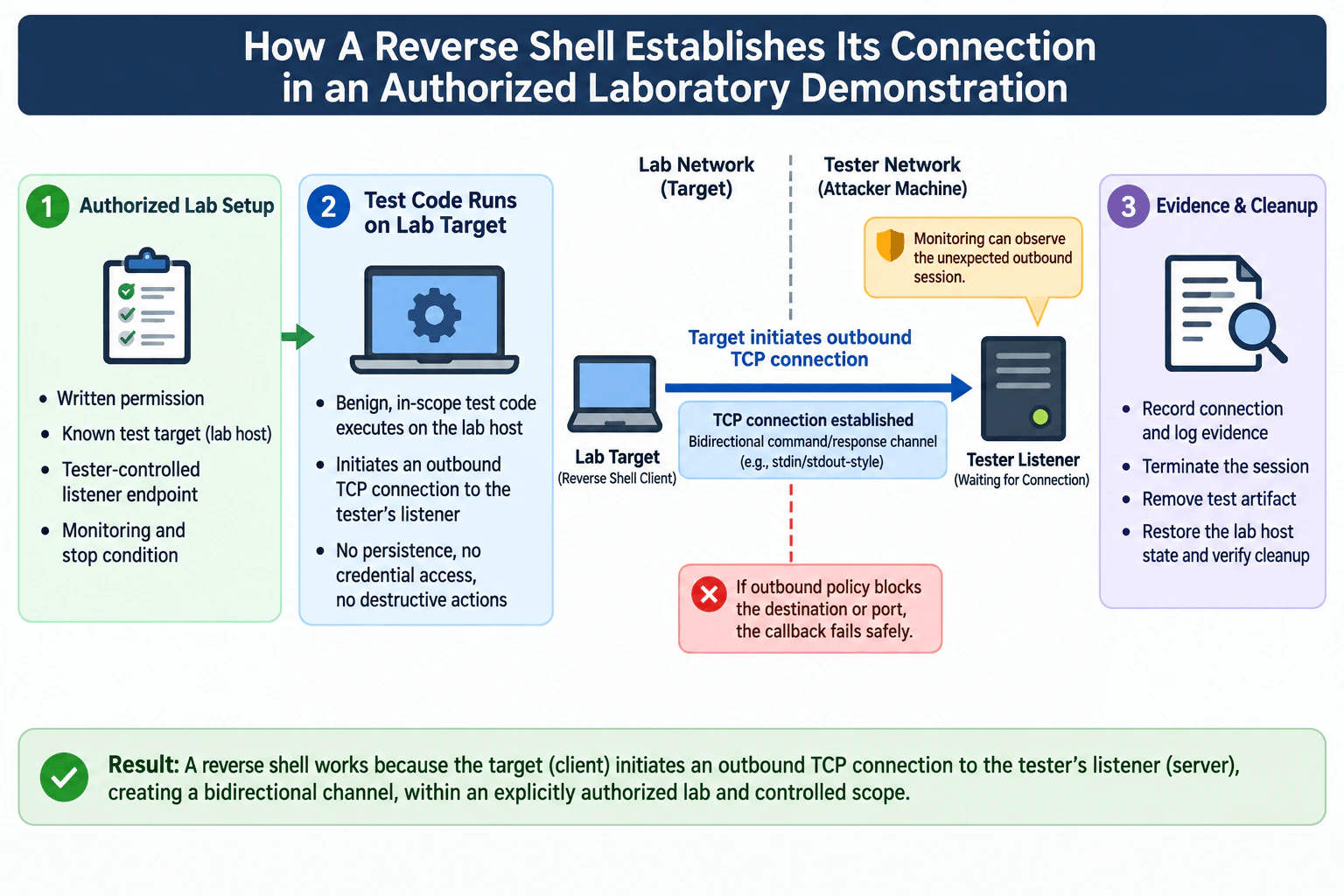
82. How does a reverse shell establish its connection in an explicitly authorized laboratory demonstration?Exploitation And Post ExploitationMedium
Short Interview Answer (30-60 seconds)
A reverse shell has the authorized lab target initiate an outbound TCP connection to a tester-controlled listener. Once TCP establishes the connection, the same session can carry bidirectional command and response data. If outbound policy blocks the approved destination or port, the callback fails and no shell session is established.
Detailed Explanation
A reverse shell reverses the usual direction of session initiation. In the authorized laboratory shown here, benign in-scope test code already running on the lab target starts an outbound TCP connection toward a tester-controlled listener. The target therefore acts as the TCP connection initiator, while the tester system waits for the connection. If TCP connection establishment succeeds, the resulting connection can carry a bidirectional command-and-response stream. This controlled demonstration proves only the tested connection path and session behavior; it does not by itself prove persistence, credential access, privilege escalation, lateral movement, or broader compromise.
Useful Questions to Ask the Interviewer
Should I assume the benign test code is already running on the authorized lab target?
Should I focus only on how the TCP connection is initiated, or also explain the resulting bidirectional session?
Should I include how outbound filtering and monitoring affect the demonstration?
Should I describe the expected evidence and cleanup steps after the session ends?
How to Explain It in an Interview
Start with the direction of the connection. A reverse shell is called "reverse" because the lab target initiates the network connection toward the tester-controlled listener. The listener is already waiting on the tester side. The target then attempts an outbound TCP connection to that approved endpoint.
For TCP, the target is the active connection initiator and the listener is the passive endpoint waiting to accept the connection. TCP connection establishment must succeed before the application-level command-and-response session can be treated as connected.
Once the connection exists, TCP supports data transfer in both directions. In the approved diagram, that established connection becomes a bidirectional command-and-response channel, similar to standard input and standard output. The tester should use only the smallest benign interaction needed to demonstrate the authorized behavior.
The network boundary is important. The target is on the lab network, while the listener is on the tester-controlled network. Written permission should cover the known test target and the tester-controlled listener endpoint. Monitoring coordination and a stop condition should also be defined before execution. The test must not create persistence, collect real credentials, disable defenses, destroy data, or perform activity outside the approved scope.
Outbound policy provides an important failure case. If policy blocks the approved listener destination or port, the target cannot establish that callback. The correct result is a failed connection that is recorded as evidence; the tester should not attempt to bypass the control unless separately authorized.
Monitoring can observe the outbound session and provide useful defensive evidence. Useful evidence includes connection and relevant log records, timestamps, and confirmation of whether the controlled session was established. Evidence should demonstrate the tested behavior without claiming broader impact that was not actually shown.
After the demonstration, terminate the session, remove the test artifact, restore any changed lab-host state, and verify cleanup. This matches the diagram's final evidence-and-cleanup stage.
The key limitation is that a successful controlled callback proves only that the authorized target could establish the tested connection to the approved listener and, when demonstrated, exchange the limited bidirectional session data. It does not prove persistence, higher privilege, credential compromise, lateral movement, or unrestricted access.
The main tradeoff is confidence versus intrusiveness. A real controlled callback provides stronger evidence than only assuming the path is reachable, but it creates an actual network session. Keeping the target, endpoint, session duration, interaction, and collected data tightly bounded gives useful evidence while reducing operational risk.
Technical Approach
Confirm written authorization, the known lab target, the tester-controlled listener endpoint, monitoring coordination, cleanup plan, and stop condition.
Confirm that benign in-scope test code is permitted to run on the lab target.
Place the tester-controlled listener in a waiting state.
Allow the lab target to initiate the approved outbound TCP connection toward that listener.
Treat the reverse-shell transport as established only after the TCP connection succeeds.
Use the established connection only for the minimum benign bidirectional command-and-response proof required by the demonstration.
If outbound policy blocks the destination or port, record the failed callback and stop rather than bypassing the control.
Record connection and log evidence.
Terminate the session, remove the test artifact, restore changed lab-host state, and verify cleanup.
Practical Insights
The technical load for one controlled laboratory connection is small, but the operational work matters. The tester must confirm authorization, configure the approved listener, coordinate monitoring, watch the stop condition, record evidence, and verify cleanup. Human cost is mainly staff time for preparation, observation, review, and restoration. Financial cost is normally limited in a small lab because the demonstration needs little infrastructure, although maintaining dedicated test systems and monitoring still has a cost. Governance or compliance effort means following the written rules of engagement and evidence-handling requirements; no specific law or framework should be assumed. Maintenance includes keeping the lab, network policy, monitoring, evidence process, and cleanup procedure reliable.
Why Interviewers Ask This
Interviewers want to confirm that you understand the defining network behavior of a reverse shell: the target initiates the connection toward a waiting tester-controlled listener rather than requiring the tester to initiate a new inbound connection to the target. They also want to see whether you can explain the trust boundary, outbound-policy failure case, monitoring, evidence collection, scope limits, and cleanup without confusing connection establishment with persistence, privilege escalation, credential access, or broader compromise.
Common interview mistakes
Common mistakes include saying that the tester initiates the reverse-shell TCP connection toward the target, confusing the waiting listener with the connection initiator, or assuming that blocking new inbound connections to the target automatically blocks the reverse shell. Another mistake is treating a successful TCP connection as proof of persistence, privilege escalation, credential access, lateral movement, or full compromise. Testers may also omit the approved callback endpoint, monitoring coordination, outbound-policy failure case, evidence collection, session termination, artifact removal, state restoration, or cleanup verification. Attempting to bypass a blocked callback, collect real credentials, establish persistence, or perform destructive actions is outside this demonstration unless separately and explicitly authorized.
Interview tip
Lead with the defining point: the authorized lab target initiates an outbound TCP connection to a waiting tester-controlled listener. Then explain that the established TCP connection carries bidirectional command-and-response data, mention the outbound-policy failure case and monitoring, and finish with evidence collection and cleanup. Keep the explanation bounded to what the laboratory demonstration actually proves.
Interviewer may ask next
Why can a reverse shell work when new inbound connections to the target are blocked?
Because the target initiates the new connection toward the tester-controlled listener. If network policy permits that specific outbound TCP connection, it may establish even though unsolicited new inbound connections toward the target are blocked. This is not guaranteed: outbound filtering, routing, host controls, or a blocked destination or port can still prevent the callback.
What does a successful reverse-shell connection prove, and what does it not prove?
It proves that the authorized target could establish the tested connection to the approved listener and, if demonstrated, exchange the limited bidirectional command-and-response data shown in the test. It does not by itself prove persistence, higher privilege, credential theft, lateral movement, unrestricted network access, or business impact. Those are separate claims requiring separate authorization and evidence.
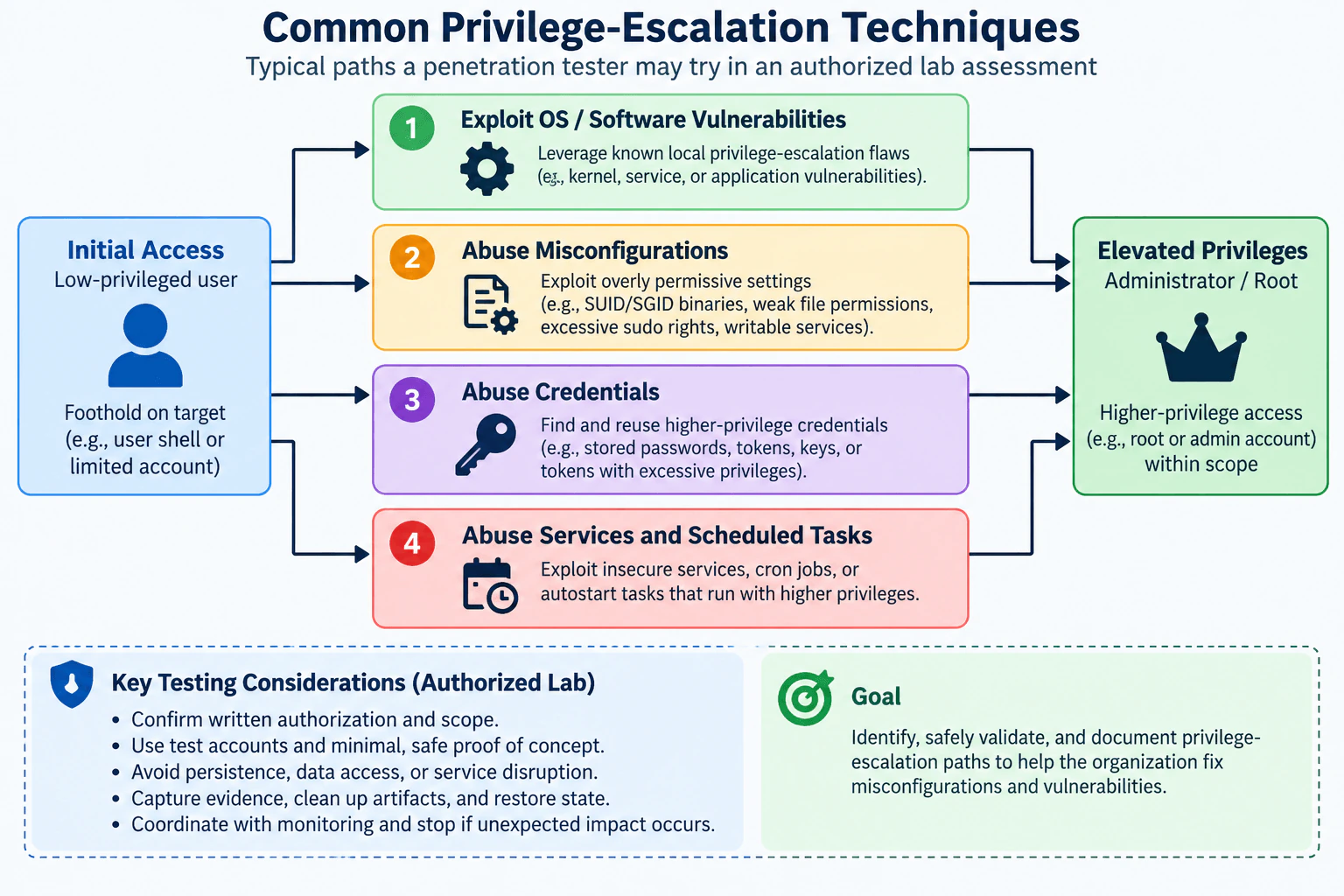
83. Which common privilege-escalation techniques would you consider for an explicitly authorized laboratory assessment?Exploitation And Post ExploitationMedium
Short Interview Answer (30-60 seconds)
I would check software vulnerabilities, privilege-related misconfigurations, approved higher-privilege credentials or tokens, and insecure services or scheduled tasks. In the authorized lab, I would use the smallest safe proof, confirm the privilege transition, collect reproducible evidence, avoid disruption or persistence, and restore the environment afterward.
Detailed Explanation
This question asks whether I know the common ways a low-privileged user can become an administrator, root user, or otherwise gain higher permissions during an explicitly authorized laboratory assessment. I would not start by blindly running exploits. I would first confirm the approved target, test account, scope, expected evidence, safety limits, monitoring coordination, cleanup plan, and stop conditions. Then I would examine a small set of common escalation paths and validate only the minimum proof needed. The goal is to demonstrate a real privilege transition safely, document how it happened, and leave the laboratory environment in its expected state afterward.
Useful Questions to Ask the Interviewer
Is the assessment limited to local privilege escalation on one host, or are identity and cloud permission paths also in scope?
What operating systems, services, or scheduled-task mechanisms are present in the lab?
May I validate higher-privilege test credentials if they are intentionally exposed, or should credential testing remain observational?
What actions are explicitly prohibited, such as persistence, defense modification, unnecessary data access, or service interruption?
What evidence is expected to prove the privilege transition, and what cleanup or restoration steps are required?
How to Explain It in an Interview
I would begin with the authorized low-privilege foothold shown in the diagram. This could be a standard user shell or another limited test account. Before attempting elevation, I would verify that the account, host, and technique are within the rules of engagement.
The first path I would consider is an operating-system or software vulnerability. A vulnerable kernel component, privileged service, driver, or application can sometimes allow code that starts with low privilege to execute with higher privilege. I would first confirm that the relevant software, version, or configuration is actually affected. A public exploit or proof of concept does not by itself prove that the laboratory target is exploitable. If validation is permitted, I would use a benign and bounded proof rather than performing unnecessary post-exploitation activity.
The second path is misconfiguration. I would look for overly permissive elevation controls, weak file or executable permissions, excessive sudo-style rights, SUID or SGID configurations where relevant, or another configuration that lets a low-privileged account influence something executed with greater privilege. The important point is not merely finding a suspicious setting. I need to show that it creates a real and authorized privilege transition.
The third path is higher-privilege credential or token exposure. If the laboratory intentionally makes an approved privileged test credential, key, token, or account available to the low-privileged user, I would determine whether it grants higher access. I would not extract unrelated real credentials or collect reusable secrets simply because they are accessible. The proof should use approved test identities and only enough access to demonstrate the privilege increase.
The fourth path is insecure services and scheduled tasks. A service, scheduled job, cron-style task, or autostart mechanism may execute with administrator or root privileges while depending on a file, executable, path, or configuration that the lower-privileged account can influence. If that condition exists, I would validate the path with the smallest non-destructive change permitted by the laboratory and stop once the higher-privilege execution or access is demonstrated.
These four paths match the diagram's flow from the low-privileged foothold to elevated privileges. For whichever path is tested, I would record the starting identity, prerequisite, affected vulnerability or configuration, action taken, boundary crossed, and resulting identity or permission level. Reaching administrator, root, or another higher-privileged context proves a technical privilege transition, but it does not automatically prove every possible downstream objective or business impact.
Safety is part of the answer. I would avoid persistence, unnecessary data access, defense tampering, destructive changes, and service disruption. I would coordinate with monitoring when required and stop if unexpected impact occurs. After testing, I would capture reproducible evidence, remove test artifacts, restore changed state, and verify that the laboratory environment is functioning as expected.
The main tradeoff is confidence versus intrusiveness. Merely identifying a risky permission or vulnerable component can produce a false positive, while fully exercising every possible consequence creates unnecessary risk. In an authorized laboratory, the better approach is the smallest reliable proof that demonstrates the low-privilege-to-high-privilege transition and gives defenders enough evidence to reproduce and remediate the issue.
Technical Approach
Confirm written authorization, target, low-privilege test identity, scope, monitoring coordination, cleanup plan, and stop conditions.
Record the starting identity, privilege level, and permitted target resources.
Check the four common paths shown in the diagram: software or operating-system vulnerabilities, privilege-related misconfigurations, approved higher-privilege credential or token exposure, and insecure privileged services or scheduled tasks.
Verify the prerequisite and affected state before attempting active validation.
Select the least intrusive permitted proof for the strongest candidate path.
Execute only enough of the path to demonstrate the identity or privilege transition.
Record the prerequisite, action, evidence, boundary crossed, and before-and-after privilege.
Stop once sufficient proof is obtained; do not add persistence, disable defenses, access unnecessary data, or create disruption.
Remove test artifacts and restore any modified state.
Verify cleanup and provide reproducible evidence for remediation and later retesting.
Practical Insights
The main cost is testing effort and operational risk rather than algorithmic complexity. Software-vulnerability testing can require careful version and prerequisite validation. Configuration checks may be faster, but a permissive setting is not enough unless the complete privilege path is proven. Credential testing creates sensitive-data handling risk, so approved test identities are safer. Service and scheduled-task testing may require controlled state changes and cleanup. More aggressive validation can increase confidence, but it also increases the chance of instability or unintended access. The preferred tradeoff is the smallest safe test that gives strong, reproducible evidence.
Why Interviewers Ask This
Interviewers want to see whether the candidate knows the main privilege-escalation paths and can evaluate them safely. A strong answer separates identifying a possible technique from proving an actual privilege transition, explains the move from a low-privileged account to higher privileges, respects authorization and scope, and includes evidence collection, stop conditions, cleanup, and restoration rather than treating successful elevation as the only goal.
Common interview mistakes
Common mistakes include running a public exploit without first proving the target is affected; treating a suspicious permission as confirmed privilege escalation without validating the complete path; collecting real passwords, keys, or tokens when an approved synthetic or test identity is enough; confusing successful code execution with administrator or root access; continuing into persistence or unrelated post-exploitation after the required proof is obtained; failing to record the starting and resulting identities; ignoring monitoring coordination or stop conditions; and leaving modified files, tasks, services, or other test artifacts behind after the assessment.
Interview tip
Name a few strong technique families instead of listing every possible trick. Then show judgment: start from the approved low-privilege identity, verify the prerequisite, use minimal proof, explicitly confirm the transition to higher privileges, capture reproducible evidence, stop when the finding is proven, and restore the environment.
Interviewer may ask next
How would you decide whether a suspicious misconfiguration is a real privilege-escalation vulnerability?
I would trace the complete path from the approved low-privileged identity to the privileged action. I would confirm that the low-privileged account can actually influence the relevant file, setting, service, task, executable, or elevation mechanism and that the affected component operates with greater privilege. If active validation is permitted, I would use a benign marker or another minimal proof to demonstrate the privilege transition. I would record the prerequisite, before-and-after privilege, evidence, and cleanup. A permissive-looking setting alone is not enough if it cannot produce the higher-privileged outcome.
What would you do if proving privilege escalation could disrupt the laboratory system?
I would not automatically perform the disruptive step. I would compare the expected confidence gain with the authorized safety limits and stop conditions. If a less intrusive proof can demonstrate the same privilege transition, I would use it. If more intrusive validation is genuinely necessary, I would obtain the required approval and monitoring coordination before proceeding. If unexpected impact occurs, I would stop, notify the responsible team as required, restore changed state, and document both what was proven and what remains unverified.
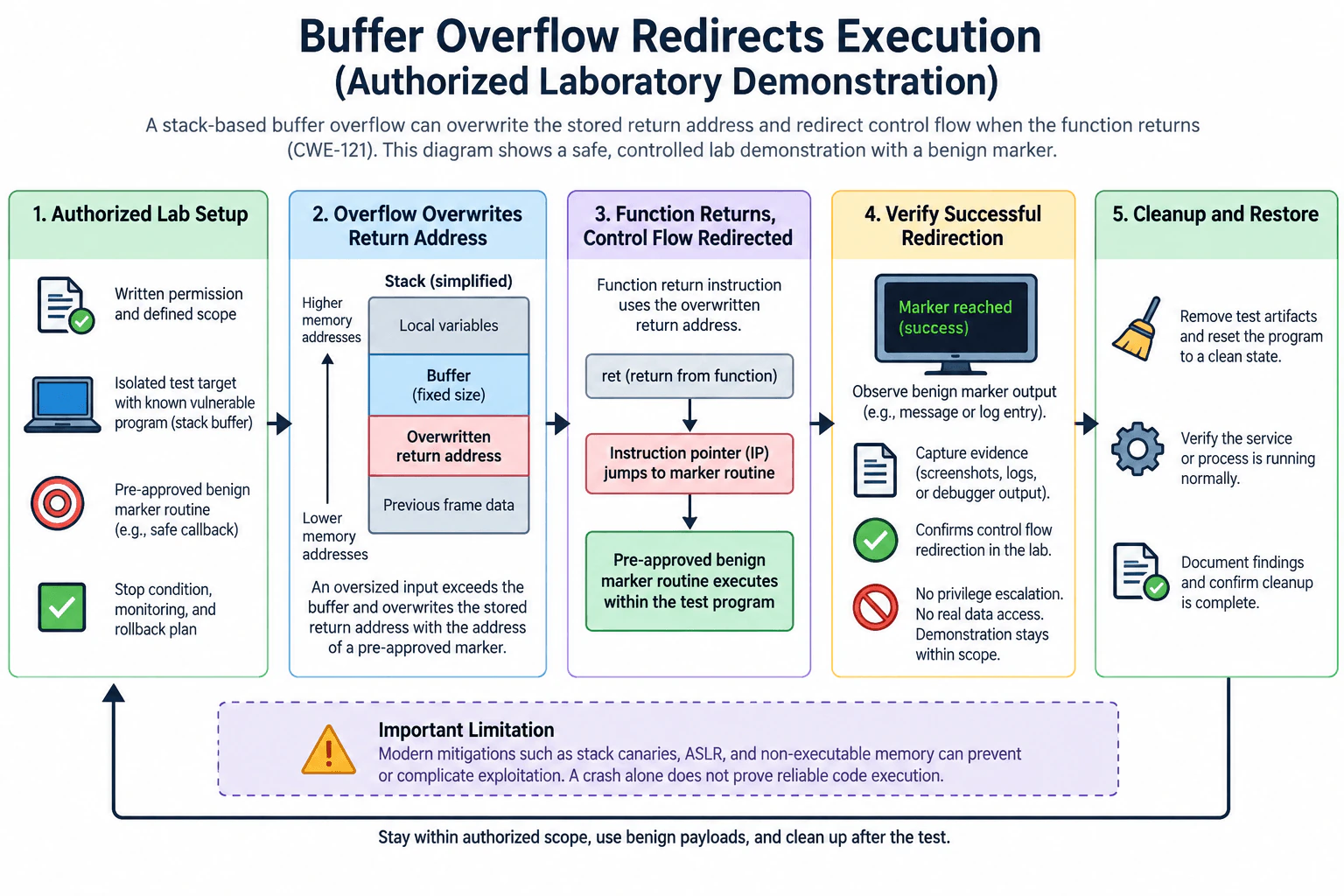
84. How can a buffer overflow redirect execution in an explicitly authorized laboratory demonstration?Exploitation And Post ExploitationHard
Short Interview Answer (30-60 seconds)
A stack-based buffer overflow can overwrite a stored return address. When the vulnerable function returns, execution may follow the replacement address. In an authorized lab, redirect only to a benign marker routine, verify that marker, capture evidence, then remove artifacts and restore the test state.
Detailed Explanation
This question asks whether I understand the control-flow effect of a stack-based buffer overflow and can demonstrate it safely. In an explicitly authorized, isolated lab, an oversized input can write beyond a fixed-size stack buffer and alter the function's stored return address. When the function returns, the processor may continue at the altered address instead of the original caller. The safest proof redirects only to a pre-approved benign marker routine, captures evidence that the marker ran, avoids privilege escalation or real data access, and then removes test artifacts and restores the program state.
Useful Questions to Ask the Interviewer
Is the target an isolated laboratory program explicitly approved for this controlled demonstration?
Is the goal only to prove control-flow redirection, or should I also explain why modern mitigations can prevent it?
What evidence is expected: debugger state, logs, a screenshot, or a benign marker message?
What stop condition should I follow if the program behaves differently from the expected laboratory path?
How to Explain It in an Interview
The practical decision is to prove only the smallest amount of control-flow impact needed. I would first confirm written authorization, the exact isolated target, the known vulnerable condition, monitoring coordination, expected marker behavior, the cleanup plan, and the stop condition.
The central mechanism is a stack-based buffer overflow. A local fixed-size buffer can exist in a function's stack frame. If the program writes more data than that buffer can hold without enforcing the boundary, adjacent stack data can be overwritten. One security-sensitive value can be the stored return address, which identifies where execution should continue after the current function finishes.
In the approved diagram, the oversized input crosses the fixed-size buffer boundary and overwrites the stored return address with the address of a pre-approved benign marker routine. When the function performs its return operation, the processor uses the altered return address, so the instruction pointer transfers control to that marker routine. The marker performs only a harmless action, such as producing a message or controlled log entry. This demonstrates control-flow redirection without attempting persistence, privilege escalation, credential access, lateral movement, or access to real data.
I would validate success by observing the benign marker output and recording reproducible evidence, such as debugger output, a screenshot, or relevant logs. That proves the laboratory control-flow effect. It does not automatically prove reliable arbitrary code execution, privilege escalation, reachability of another objective, or business impact.
The safety boundary matters. The test stays inside the explicitly authorized laboratory target and uses only the approved benign destination. If the process crashes unexpectedly, affects anything outside the target, or reaches a defined stop condition, I stop rather than extending the demonstration.
Modern mitigations can prevent or complicate this path. Stack canaries can detect corruption of stack control data before a function returns. Address Space Layout Randomization, or ASLR, makes useful memory addresses less predictable. Non-executable memory can prevent execution from regions intended only for data. These controls do not change the basic overflow concept, but they can stop or complicate successful control-flow redirection. Therefore, a crash alone does not prove reliable execution redirection.
After collecting the minimum evidence, I remove test artifacts, reset the program to a clean state, verify that the service or process runs normally, and document both the demonstrated effect and the limits of the test. The main tradeoff is confidence versus safety: stronger exploitation might prove more, but an authorized laboratory demonstration should stop once the required control-flow behavior has been shown with the least intrusive proof.
Technical Approach
Confirm written authorization, the isolated target, the known vulnerable state, monitoring coordination, cleanup plan, and stop condition.
Confirm that the objective is only to demonstrate controlled execution redirection.
Use the laboratory's approved oversized test input against the fixed-size stack buffer.
Observe whether the overflow reaches and overwrites the stored return address.
Allow the function to return and verify that execution reaches only the pre-approved benign marker routine.
Capture reproducible evidence such as benign marker output, debugger state, screenshots, or logs.
Record that the result proves control-flow redirection in this laboratory setup, not necessarily reliable arbitrary code execution or broader impact.
Remove test artifacts, reset the program, restore changed state, and verify that the service or process runs normally.
Practical Insights
The technical cost is mainly the time needed to prepare a safe isolated target, reproduce the vulnerable condition, observe the stack behavior, collect evidence, and restore the environment. Modern mitigations such as stack canaries, ASLR, and non-executable memory can make the demonstration harder or stop it completely. Operationally, coordination with the lab owner and monitoring team is important so expected marker activity or a test failure is understood. The safest approach minimizes time and risk by stopping as soon as the benign marker proves the required control-flow change.
Why Interviewers Ask This
Interviewers want to see whether you understand the control-flow mechanism behind a stack-based buffer overflow while applying disciplined penetration-testing judgment. A strong answer explains the stored return address, the point at which execution is redirected, the minimum safe proof needed in an authorized laboratory, the evidence to capture, the limitations introduced by modern mitigations, and the need to restore the environment afterward.
Common interview mistakes
Common mistakes are treating a crash as proof of successful execution redirection, claiming arbitrary code execution or privilege escalation when only a marker was demonstrated, using a real shell or credential-stealing payload when a benign marker is enough, ignoring the stored-return-address transition, overlooking modern mitigations, continuing after the required proof has already been obtained, moving outside the authorized target, and failing to remove artifacts or verify that the program returned to a clean state.
Interview tip
Lead with the mechanism in one sentence: an unchecked stack write can overwrite the stored return address, and the function's return can then redirect execution. Immediately add the safety boundary: in an authorized isolated lab, redirect only to a benign marker, capture the minimum evidence, explain mitigation limits, and clean up afterward.
Interviewer may ask next
Why is reaching a benign marker stronger evidence than simply crashing the program?
A crash proves that the input disturbed program state, but it does not prove that the tester controlled where execution went. Reaching a pre-approved benign marker after the function returns demonstrates a specific control-flow transition associated with the overwritten return address. Even then, I would report only what was demonstrated: controlled redirection in that laboratory setup, not automatically reliable arbitrary code execution, privilege escalation, or wider business impact.
What can prevent the return-address overwrite from becoming a successful redirection?
Several mitigations can interrupt the path. A stack canary can detect stack corruption before the function returns. ASLR can make the intended destination difficult to predict. Non-executable memory can prevent execution from regions intended only for data. Other control-flow protections may also interfere. Therefore, the observed result may be detected corruption or safe process termination rather than marker execution, and a crash alone should not be reported as successful controlled redirection.
85. How would you discover and validate remote code execution within an explicitly authorized laboratory assessment?Exploitation And Post ExploitationHard
Short Interview Answer (30-60 seconds)
I would confirm scope and stop conditions, verify a credible RCE candidate and its prerequisites, then use the smallest benign proof of execution. I would capture reproducible evidence, identify the execution privilege, avoid persistence or real data, clean up every artifact, restore state, and document only the impact actually demonstrated.
Detailed Explanation
The question asks how I would move from a possible remote code execution, or RCE, finding to a defensible proof inside an explicitly authorized laboratory. The key decision is not simply whether an exploit or proof of concept exists. I need to show that the target is reachable and affected, that controlled code execution actually occurred, and what identity and privilege executed it. At the same time, I must stay within scope, minimize impact, collect reproducible evidence, honor stop conditions, coordinate monitoring when required, and return the laboratory environment to its expected state.
Useful Questions to Ask the Interviewer
What exact systems, services, accounts, and network paths are authorized for testing?
Are there prohibited actions, maintenance windows, or immediate stop conditions?
Is a specific suspected vulnerability already known, or should I discover candidate RCE paths myself?
What form of benign proof is approved: controlled output, a unique marker, a synthetic record, or an authorized callback?
Should the security operations or IT team know about the test, and what notification or escalation process applies?
What evidence and cleanup verification does the laboratory owner expect at the end?
How to Explain It in an Interview
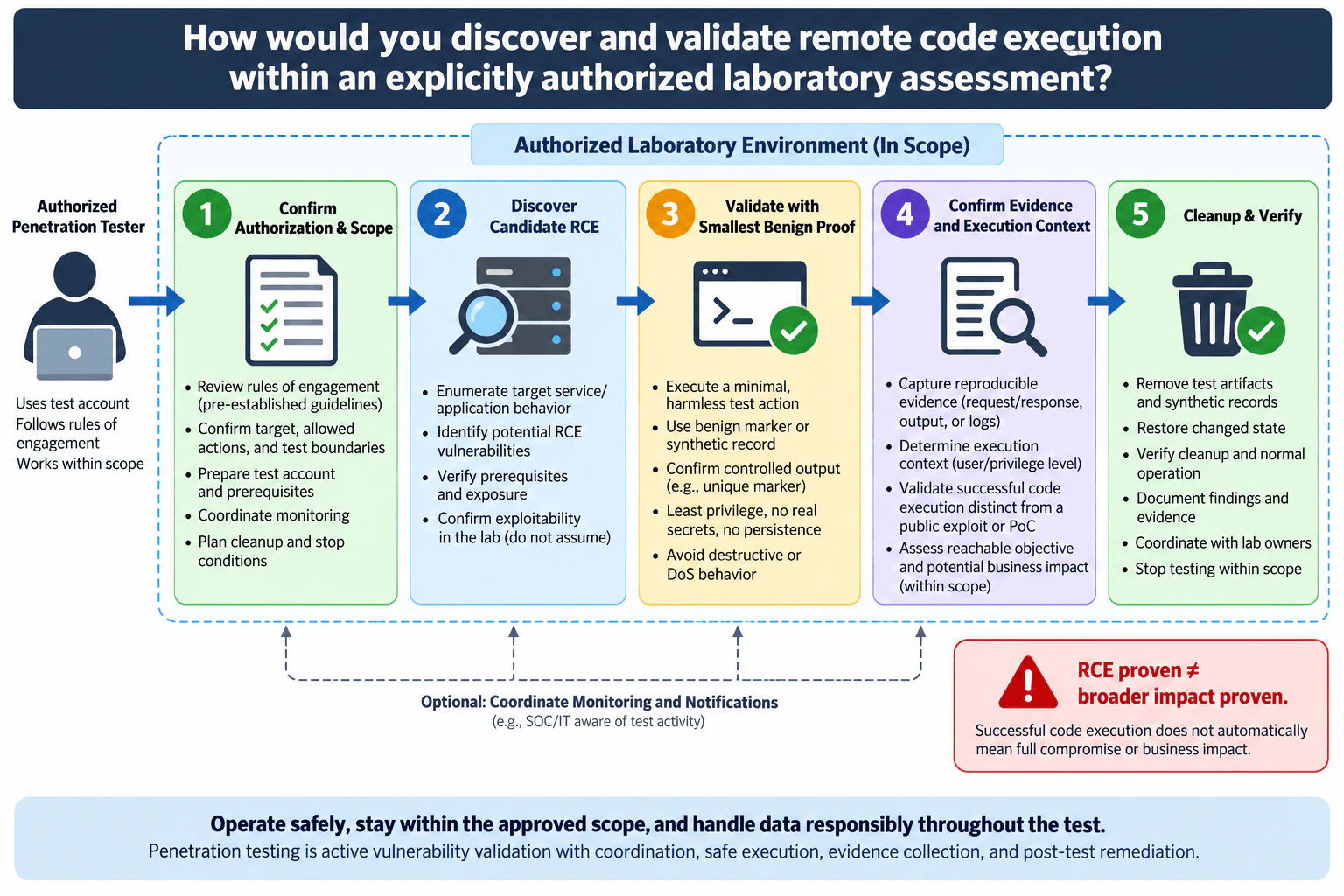
I would use the same five-stage flow shown in the diagram.
Confirm Authorization and Scope. I start with the written rules of engagement. I verify the exact target, allowed actions, test boundaries, test account, prerequisites, monitoring coordination, cleanup plan, and stop conditions. I also confirm what the benign test action is expected to do and what it must not do. The authorization boundary matters because successful access to one component does not authorize testing another component. If scope becomes uncertain or an unexpected incident occurs, I stop the affected activity and contact the designated owner instead of making assumptions.
Discover Candidate RCE. I enumerate only the authorized service or application behavior needed to answer the question. I identify plausible RCE conditions and verify prerequisites such as reachability, affected version or configuration, required authentication state, exposed functionality, and expected evidence. A public exploit or proof of concept shows that a technique exists; it does not prove this specific target is exploitable. Likewise, a scanner finding or vulnerable-looking version is not proof that remote code execution actually works in the laboratory.
Validate with the Smallest Benign Proof. If the candidate remains credible and the action is authorized, I perform the minimum harmless test that can demonstrate execution. I prefer a unique benign marker, synthetic record, controlled output, or another pre-approved proof. I confirm beforehand that the test will not establish persistence, access real secrets, alter unrelated data, disable defenses, create denial of service, or move outside scope. I use the least privilege available. The goal is to establish execution, not to maximize control over the target.
Confirm Evidence and Execution Context. I capture enough information for another authorized tester to reproduce the finding: the relevant request or trigger, observed output or marker, timestamps when useful, and supporting application or system logs when available. I determine the identity and privilege level under which the code executed. This matters because code running as a restricted service identity is different from code running with administrative privileges. I explicitly separate successful code execution from privilege escalation, lateral movement, reachable objectives, full compromise, and business impact. RCE alone does not prove any of those broader outcomes.
Cleanup and Verify. I remove test artifacts and synthetic records, restore any changed state, and verify that the target is operating normally. I document the demonstrated path, prerequisites, evidence, execution context, limitations, cleanup performed, and remediation recommendation, and I coordinate with the laboratory owners as required. If remediation is later applied, I retest the original path in the authorized environment to verify that the deployed fix prevents the demonstrated behavior.
Monitoring and notification are supporting activities across the workflow rather than a separate exploitation stage. When the rules of engagement require coordination with security operations or IT, I make sure they can distinguish authorized test activity from a real incident while still preserving useful detection evidence.
The main tradeoff is confidence versus test impact. A larger proof might demonstrate additional potential consequences, but it also increases operational and safety risk. In an authorized laboratory, I prefer the smallest proof that establishes the finding with high confidence. The main limitation is that the test proves only what was directly observed. If I demonstrate RCE as a low-privileged identity, I should not claim administrative control, access to unrelated data, lateral movement, persistence, or broader business impact without separate authorization and evidence.
Technical Approach
Read the written authorization and rules of engagement.
Confirm the target, allowed actions, test account, prerequisites, expected benign proof behavior, monitoring plan, cleanup plan, and stop conditions.
Enumerate only the authorized service or application behavior needed to identify plausible RCE paths.
Verify reachability and the affected version, configuration, authentication state, or other prerequisites before exploitation.
Distinguish a vulnerability indication, public exploit, proof of concept, and theoretical exploitability from confirmed execution on the target.
If authorized, execute the smallest benign proof using least privilege and synthetic or disposable evidence.
Confirm controlled execution through observable output, a unique marker, authorized logs, or another bounded evidence source.
Record the execution identity and privilege level and separate proven RCE from privilege escalation, lateral movement, broader compromise, or business impact.
Stop immediately if scope becomes uncertain, the target becomes unstable, or another defined stop condition occurs.
Remove test artifacts and synthetic records, restore changed state, verify normal operation, document the finding, and retest remediation when requested.
Practical Insights
The technical cost is usually moderate because the tester must understand the authorized application or service, its reachable attack surface, and the suspected execution path before validating it. Operational cost can be higher because exploit validation can affect stability, so monitoring, coordination, stop conditions, and recovery planning matter. Human cost includes approvals, communication with system owners, evidence review, and cleanup. Financial cost depends on laboratory resources and specialist time. Governance cost comes from following the rules of engagement and handling test data correctly. Maintenance cost appears after remediation because the fix should be deployed, verified, and protected against regression.
Why Interviewers Ask This
Interviewers want to see whether the candidate can validate remote code execution without turning an authorized laboratory assessment into uncontrolled exploitation. The key judgment is knowing the difference between discovering a possible vulnerability and proving actual execution, while respecting authorization, minimizing impact, collecting defensible evidence, understanding the execution context, and restoring the environment afterward.
Common interview mistakes
Common mistakes include treating a scanner result or public exploit as proof that the target is exploitable; testing before confirming the exact scope, prerequisites, payload behavior, and stop conditions; using a destructive or unnecessarily powerful payload when a benign marker is enough; collecting real credentials or sensitive data when synthetic evidence would work; establishing persistence; disabling defenses; causing denial of service; failing to record the execution identity and privilege level; claiming full compromise or business impact from RCE alone; continuing after unexpected instability; and forgetting to remove test artifacts and verify that the environment was restored.
Interview tip
Lead with authorization and the smallest defensible proof. Then explain the flow clearly: confirm scope, discover a candidate RCE path, verify prerequisites, demonstrate benign execution, capture evidence and execution context, separate proven RCE from broader impact, and clean up. Emphasize that strong penetration testing proves the finding with sufficient evidence while creating as little additional risk as possible.
Interviewer may ask next
How would you confirm RCE if the application does not return the command output directly?
I would use an authorized observation method that creates the least additional impact. Depending on the laboratory design and rules of engagement, that could be an approved unique marker, synthetic record, application or system log entry, or controlled callback to infrastructure specifically authorized for the assessment. I would correlate the original trigger with that evidence so I can distinguish real execution from a network error or false positive. I would not create persistence, access real data, or contact arbitrary external infrastructure just to obtain stronger proof.
If you prove RCE, can you report that the server is fully compromised?
No. I would report exactly what was demonstrated. RCE proves that controlled code executed through the tested path. I would separately record the identity and privilege level of that execution and any objective actually reached within scope. Administrative control, privilege escalation, lateral movement, access to sensitive data, persistence, and business impact are separate claims that require separate authorization and evidence. The report should distinguish demonstrated technical impact from possible but unproven consequences.
86. What is penetration-testing automation?Scripting And AutomationEasy
i Question Details
Define penetration-testing automation as scripts and tools that make authorized discovery, parsing, validation, evidence collection, and retesting repeatable. Explain explicit targets, input validation, rate limits, timeouts, retries, deterministic output, logging, secret handling, least privilege, dry runs, safe failure, and human approval for intrusive actions.
Short Interview Answer (30-60 seconds)
Penetration-testing automation means using scripts and tools to make authorized discovery, parsing, validation, evidence collection, and retesting repeatable. I would combine explicit scope, validated inputs, rate limits, timeouts, bounded retries, least privilege, protected secrets, deterministic output, useful logs, dry runs, safe failure, and human approval before intrusive actions.
Detailed Explanation
Penetration-testing automation means using scripts and tools to perform repeatable parts of an authorized assessment without removing safety controls or human judgment. The practical goal is consistency: the same approved targets and inputs should follow the same controlled process and produce structured, traceable evidence. Automation can handle discovery, parsing, validation, logging, evidence collection, and retesting. It should validate inputs, apply rate limits, use timeouts and bounded retries, protect secrets, run with least privilege, support dry runs, fail safely, and require human approval before an intrusive action.
Useful Questions to Ask the Interviewer
What systems and target identifiers are explicitly approved and in scope?
Which actions are considered intrusive and require human approval?
What rate limits, timeouts, or availability constraints must the automation respect?
What evidence and output format should be retained for comparison and retesting?
How to Explain It in an Interview
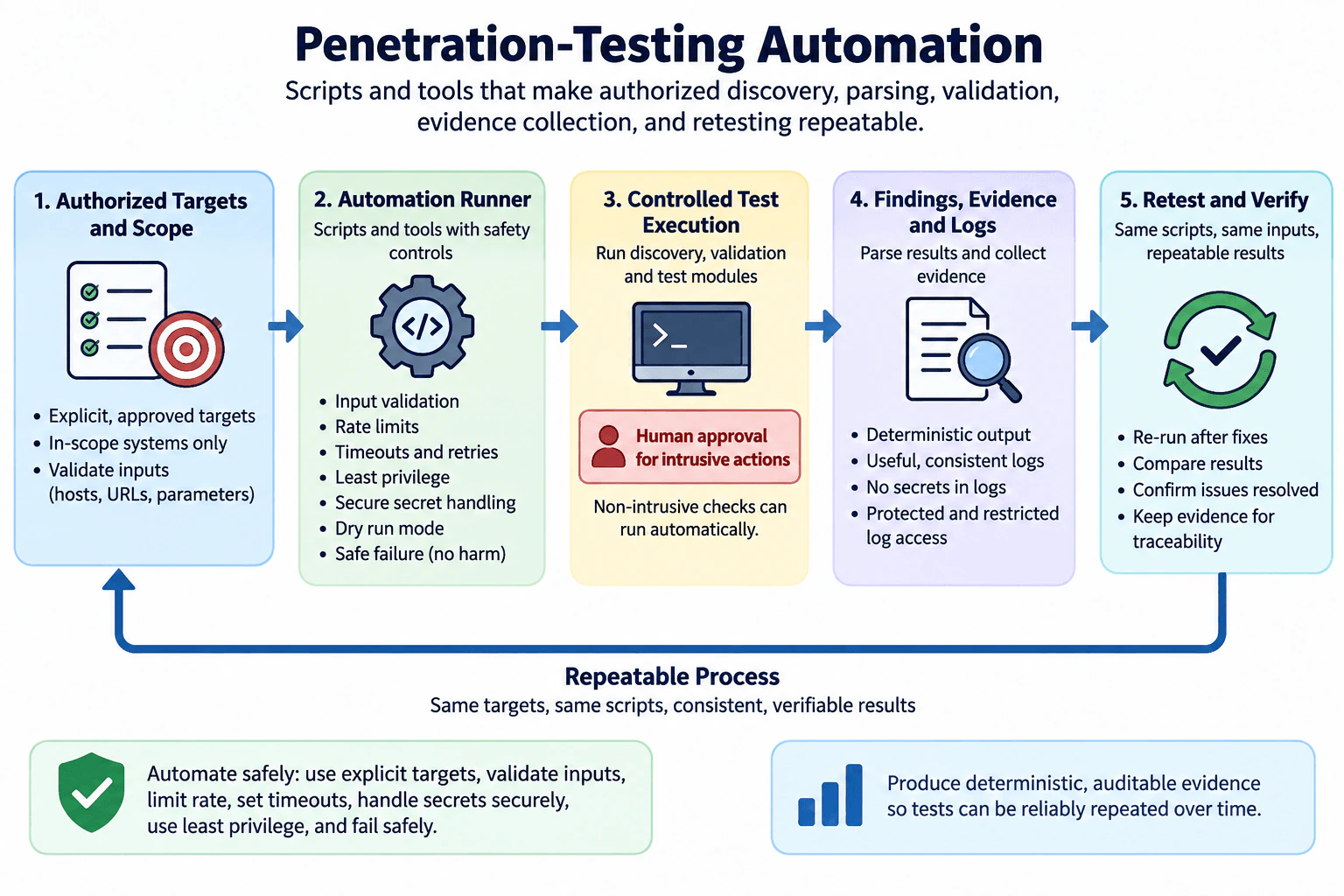
Start with authorized targets and scope. Automation should receive an explicit set of approved targets, such as permitted hosts or URLs, rather than discovering arbitrary systems and acting on them. Inputs such as hosts, URLs, and parameters should be validated before execution so malformed or out-of-scope values are rejected.
Next, place the safety controls in the automation runner. Rate limits control how quickly requests or checks are performed. Timeouts stop a stalled operation from waiting forever. Retries should be bounded so a temporary failure does not create an uncontrolled loop. The process should use the minimum privileges required for the approved checks. Reusable credentials or tokens should be handled securely and must not be written into normal logs. A dry-run mode is useful because it lets the tester review scope and planned actions without performing the real operation.
The controlled test-execution stage runs only authorized discovery, validation, and test modules. Non-intrusive checks may run automatically when the approved rules of engagement permit them. An intrusive action should not execute merely because a script reaches that step. The workflow should stop at an approval gate and require an authorized human to decide whether to continue.
The next stage is findings, evidence, and logs. Tool output should be parsed into a predictable structure instead of relying only on terminal text. Deterministic output means equivalent captured inputs are processed with stable field names, ordering, and formatting. It does not mean a live target must return identical observations on every run because target state can change. Logs should record useful actions, errors, and results while excluding secrets. Evidence and logs should have protected, restricted access.
Finally, automation supports repeatable retesting. After a finding is remediated, the tester can rerun the same approved scripts against the same approved targets, compare the new evidence with the earlier evidence, and confirm whether the issue is resolved. Keeping evidence for traceability makes that comparison easier to review and defend.
Safe failure applies throughout the workflow. Invalid targets or parameters should be rejected before execution. A timeout, exhausted retry limit, or unexpected error should produce an explicit failure result and stop or skip the affected action according to the testing policy. Failure must never broaden scope, silently continue into a more intrusive operation, or expose a secret.
The main tradeoff is speed and consistency versus human judgment. Automation is excellent for repetitive, bounded tasks and consistent evidence collection, but it cannot correctly decide every security question. Target conditions can change, automated validation can still produce false positives or false negatives, and intrusive actions can affect availability or data. Human review therefore remains important for interpreting evidence and approving higher-risk actions.
Technical Approach
Load the explicit approved target set and testing rules.
Validate target identifiers, URLs, parameters, and configuration before execution.
Run a dry run when appropriate to show the planned actions without performing them.
Execute only approved non-intrusive discovery and validation using defined rate limits, timeouts, and bounded retries.
Use least privilege and handle secrets securely without exposing them in logs.
Stop at a human approval gate before any intrusive action.
Parse results into deterministic structured output and create useful, consistent logs.
Store evidence with protected and restricted access.
Fail safely on invalid input, timeout, exhausted retries, or unexpected state.
After remediation, rerun the same approved scripts and targets, compare the evidence, and confirm whether the issue is resolved.
Time & Space Complexity
Automation reduces repeated manual work and makes retesting more consistent, but it adds engineering and operational cost. Scripts must be maintained when tools, inputs, or environments change. Rate limits and timeouts can make testing slower, but they help protect service stability. Logging and evidence storage use space and require access controls. Secret handling adds setup work but reduces credential exposure. Human approval gates reduce fully unattended execution but are appropriate for intrusive actions. The main ongoing cost is keeping the automation safe, predictable, maintainable, and aligned with the current approved scope.
Where it is used
This approach is useful in authorized assessments that repeat the same bounded tasks across approved assets. Examples include running discovery against an approved target list, parsing tool output into a consistent format, validating findings with safe checks, collecting logs and evidence, and rerunning the same checks after remediation. It is especially useful when a penetration-testing team needs repeatable, auditable results without allowing scripts to expand scope or automatically perform intrusive actions.
Why Interviewers Ask This
Interviewers want to know whether you understand that penetration-testing automation is not simply running security tools faster. Good automation must remain inside authorized scope, protect the tested environment, produce useful evidence, handle failures safely, and keep a human decision point before intrusive actions.
Common interview mistakes
Common mistakes are accepting arbitrary targets instead of enforcing approved scope, trusting unvalidated input, running without rate limits, omitting timeouts, using unlimited retries, running with excessive privileges, hardcoding credentials, writing secrets into logs, producing inconsistent output that is difficult to compare, skipping dry runs when they would reduce risk, silently continuing after errors, and allowing intrusive actions to execute without explicit human approval. Another mistake is assuming deterministic processing means a live target will always produce identical observations; the target can change between runs.
Interview tip
Explain automation as a controlled repeatability mechanism, not unattended exploitation. Follow the same flow as the diagram: approved targets and scope, a safety-controlled automation runner, controlled execution with human approval for intrusive actions, deterministic findings and evidence, and repeatable retesting.
Interviewer may ask next
Why are deterministic output and logging important in penetration-testing automation?
They make results easier to compare, review, and reproduce. Deterministic output uses stable fields, ordering, and formatting so equivalent captured inputs are processed consistently. Logs provide traceability for what the automation attempted, what succeeded or failed, and when it happened. Useful logs should support evidence collection without exposing reusable secrets.
Why should intrusive actions require human approval if the testing is already authorized?
Written authorization defines the allowed scope, but some approved actions can still have greater operational impact. A human approval gate gives the tester a chance to confirm the exact target, current conditions, rules of engagement, and expected risk immediately before the intrusive step. It prevents a routine automation path, unexpected input, or failure condition from automatically escalating into a higher-impact action.
87. What is a penetration-test finding?Reporting And RemediationEasy
i Question Details
Define a penetration-test finding as a reproducible, evidence-backed description of a verified weakness and its context. Explain affected scope, prerequisites, steps, evidence, technical and business impact, severity rationale, root cause, remediation, compensating controls, limitations, ownership, retest criteria, and the difference between a finding and an unvalidated scanner alert.
Short Interview Answer (30-60 seconds)
A penetration-test finding is a verified, reproducible weakness supported by evidence and context. It explains the affected scope, prerequisites, impact, severity rationale, root cause, remediation, owner, limitations, and retest criteria. An unvalidated scanner alert is only a potential issue, not a confirmed finding.
Detailed Explanation
A penetration-test finding is more than an alert or suspicious observation. It is a documented weakness that the tester has validated and can reproduce within the authorized scope. The finding should tell the reader what is affected, what conditions are required, how the issue was demonstrated, what evidence supports it, and why it matters technically and to the business. It should also explain severity rationale, root cause, remediation, ownership, limitations, any compensating controls, and exactly how the organization will verify the result during retesting.
Useful Questions to Ask the Interviewer
Do you want the definition only, or should I also explain the lifecycle through remediation and retesting?
Should I describe severity using a framework such as CVSS, or keep the explanation framework-neutral?
Should I discuss how sensitive evidence is protected in the report?
How to Explain It in an Interview
Start with the practical decision: a potential observation becomes a penetration-test finding only after the tester has enough evidence to verify that the weakness exists and can be reproduced under defined conditions.
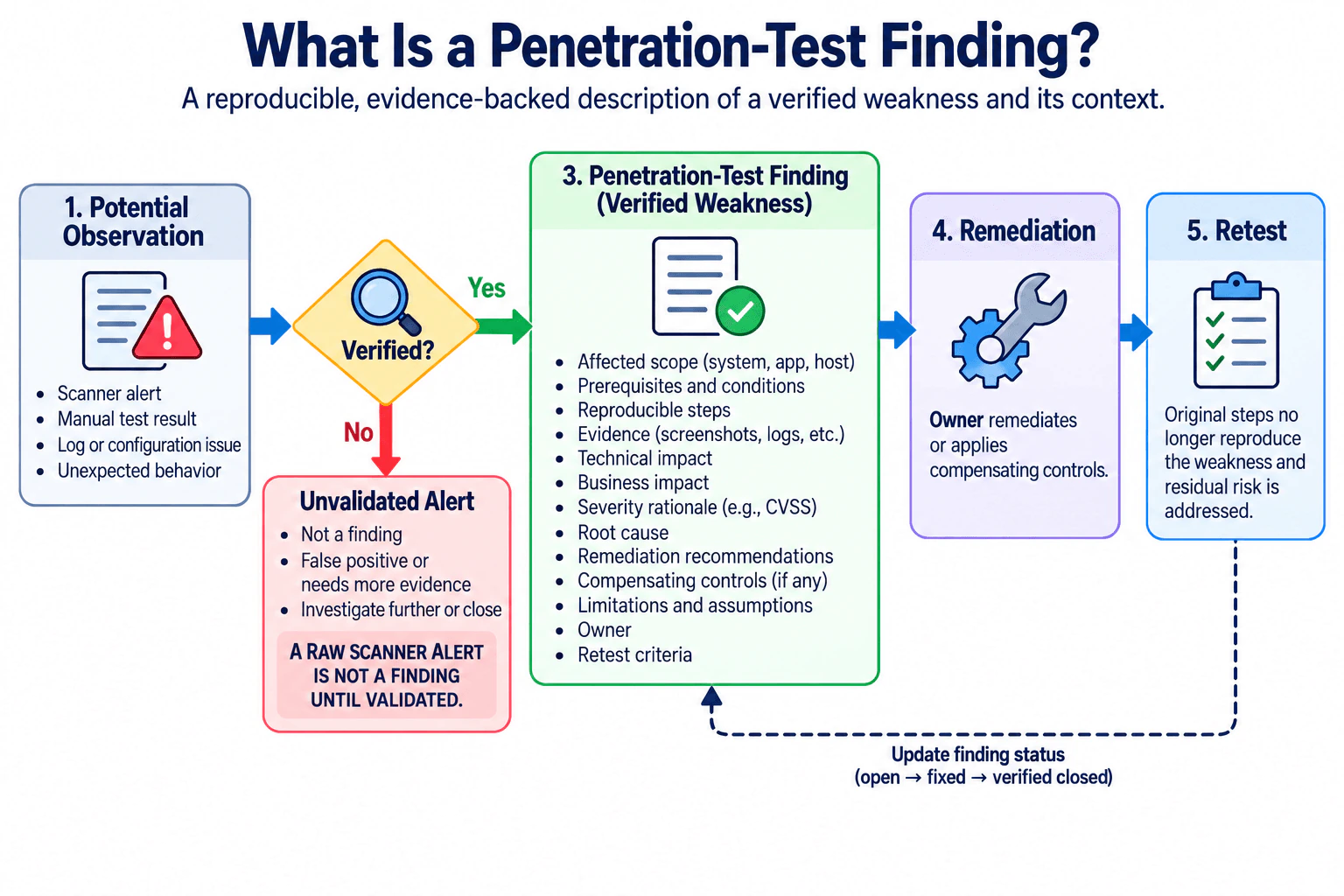
The lifecycle in the diagram begins with a potential observation. It may come from a scanner alert, a manual test result, a log or configuration issue, or unexpected behavior. At this stage it is not automatically a finding. The tester validates the observation. If it cannot be verified, it remains an unvalidated alert. It may need more evidence, further investigation, or closure as a false positive when the evidence supports that conclusion.
If the weakness is verified, the tester creates the penetration-test finding. The finding identifies the affected scope, such as the relevant system, application, host, component, or environment. It records the prerequisites and conditions needed for the weakness to occur so the reader understands the exact context in which it was demonstrated.
Next, document reproducible steps. They should be clear enough for an authorized engineer or tester to recreate the observed condition without guessing. The evidence may include sanitized screenshots, logs, requests and responses, configuration excerpts, or other artifacts. Sensitive information such as credentials, tokens, personal data, or unnecessary customer data should be minimized or redacted and access to the report should be appropriately restricted.
The finding separates technical impact from business impact. Technical impact explains what security property or system capability is affected under the demonstrated conditions. Business impact explains why that technical effect matters to the organization. Do not present an assumed business consequence as if the test proved it.
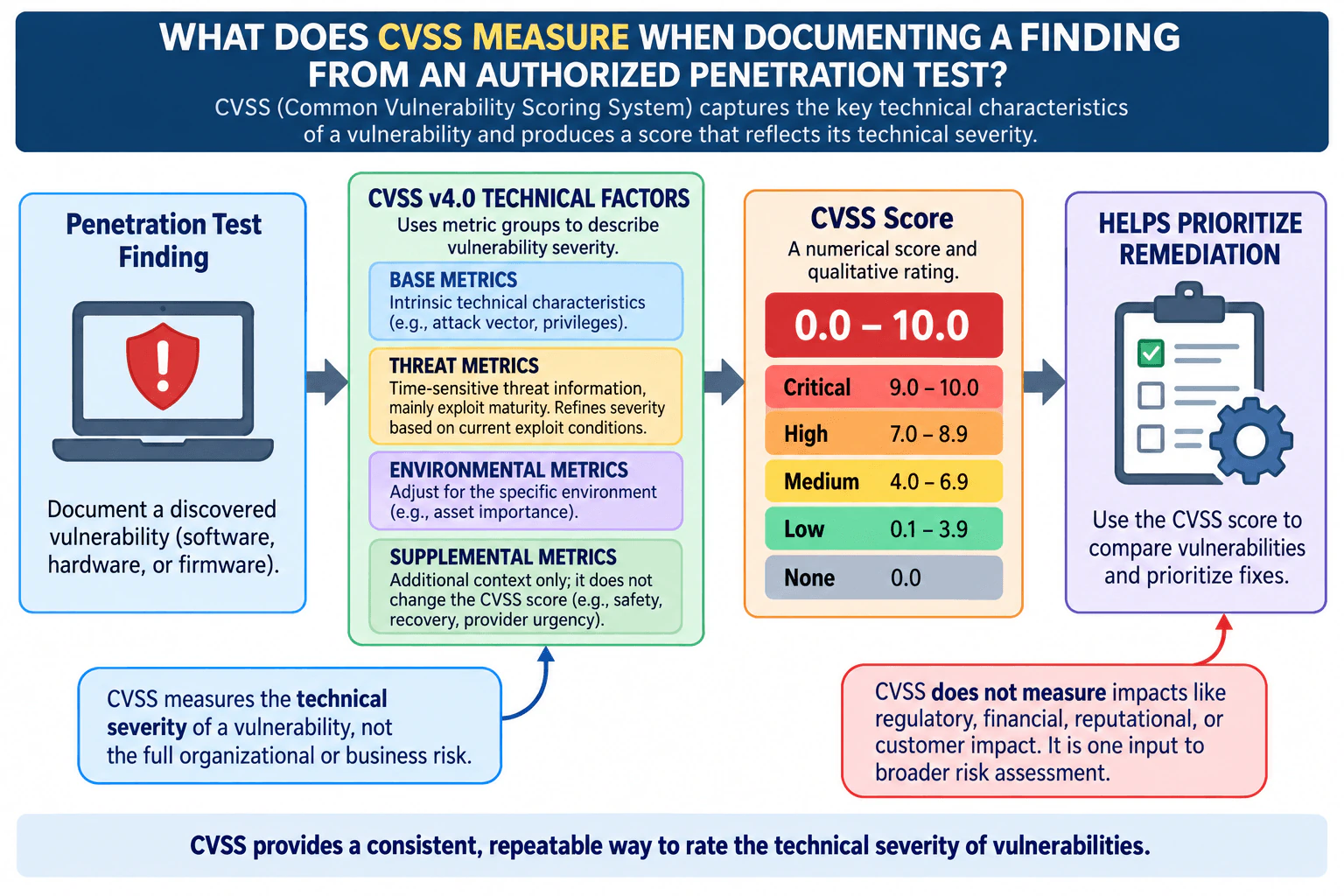
The severity rationale explains why the finding receives its rating. A framework such as CVSS can help communicate technical severity, but a score should not be treated as the whole risk decision. CVSS v4.0 separates Base, Threat, Environmental, and Supplemental metrics, while organizational risk and remediation priority can also depend on business and operational context. first.org
A useful finding also identifies the root cause rather than only the visible symptom. Remediation should address that root cause where practical. If the permanent correction cannot be implemented immediately, a compensating control may reduce exposure, but it should be described honestly as risk reduction rather than proof that the underlying weakness has disappeared.
Ownership identifies the team responsible for remediation and follow-up. Limitations state what the test did not establish, what remained outside scope, or what assumptions constrained the conclusion. This prevents the report from implying more assurance than the evidence supports.
Finally, define retest criteria. After the owner remediates the issue or applies an approved compensating control, the tester repeats the original validation against the effective deployed state. The expected result is that the original reproduction steps no longer demonstrate the weakness and that residual risk is appropriately addressed. Where relevant and authorized, the retest should also consider likely bypass paths rather than assuming that a code change or automated scan alone proves closure. OWASP reporting guidance similarly emphasizes findings that technical teams can understand, replicate, and resolve, and explicitly supports updating finding status during a retest. owasp.org
The distinction is simple: a scanner alert says that something may be wrong. A penetration-test finding says that the weakness was validated, records the evidence and context, explains why it matters, identifies how it should be addressed, assigns ownership, and defines how remediation will be verified.
Technical Approach
Record the potential observation without assuming it is a finding.
Validate the condition within the authorized scope using a safe, reproducible method.
If it cannot be validated, keep it as an unvalidated alert, investigate further, or close it as a false positive when supported by evidence.
If verified, identify the affected scope and prerequisites.
Document reproducible steps and sanitized supporting evidence.
Explain demonstrated technical impact and relevant business impact separately.
Assign severity with a clear rationale rather than relying only on an automated score.
Identify the root cause and recommend remediation that addresses it.
Record compensating controls separately when they are used to reduce risk temporarily or where a full fix is not yet possible.
Assign an owner, document limitations, and define retest criteria.
After remediation, retest the original condition against the effective deployed state and check relevant authorized bypass paths when appropriate.
Update the finding status based on retest evidence and record any residual risk.
Practical Insights
The main cost is human and operational effort rather than algorithmic complexity. The tester spends time validating the issue, reproducing it safely, collecting evidence, explaining impact, and writing useful remediation guidance. Engineering teams then need time to understand and correct the root cause. Retesting adds another validation cycle. Too little evidence lowers confidence, while excessive evidence collection can create security or privacy risk. Severity and remediation priority also require judgment because technical severity does not automatically equal business risk or urgency.
Why Interviewers Ask This
Interviewers want to know whether you can turn testing observations into defensible findings that technical teams and risk owners can act on. They are testing whether you understand validation, evidence, scope, impact, severity rationale, root cause, remediation, ownership, limitations, compensating controls, and retesting instead of simply copying scanner output into a report.
Common interview mistakes
Common mistakes include treating every scanner alert as a confirmed finding, omitting reproducible steps, failing to identify affected scope or prerequisites, collecting more sensitive evidence than necessary, mixing assumed business impact with demonstrated technical impact, copying a severity score without explaining its rationale, recommending only a symptom-level workaround instead of addressing the root cause, presenting a compensating control as if it removed the underlying weakness, leaving ownership unclear, hiding testing limitations, and closing a finding merely because a change was deployed or an automated scan no longer reports it without retesting the original condition.
Interview tip
Lead with the distinction between a potential observation and a verified finding. Then follow the diagram's lifecycle: validate, document scope and evidence, explain technical and business impact, justify severity, identify root cause and remediation, assign ownership, state limitations, and define how the result will be retested. Emphasize that closure should be supported by evidence.
Interviewer may ask next
What is the difference between a penetration-test finding and a scanner alert?
A scanner alert is an automated indication that a potential weakness may exist. It can be a useful observation, but it may lack context or be a false positive. A penetration-test finding has been validated and is supported by reproducible steps, evidence, affected scope, prerequisites, impact, severity rationale, and remediation information. Until the alert is verified, it should not be presented as a confirmed finding.
When should a penetration-test finding be considered closed?
A finding should be closed when the agreed retest criteria are satisfied by defensible evidence. The tester should verify the effective deployed state and confirm that the original reproduction steps no longer demonstrate the weakness. Where relevant and authorized, likely bypass paths should also be considered. If a compensating control is used instead of removing the root cause, the remaining residual risk should be documented rather than claiming that the underlying weakness no longer exists.
88. What does a CVE identifier tell the reader of an authorized penetration-test report?Reporting And RemediationEasy
Short Interview Answer (30-60 seconds)
A CVE identifier is a common reference to a specific publicly disclosed vulnerability. In a penetration-test report, it helps the reader find the corresponding vulnerability record and supporting information. The CVE ID itself does not tell you severity, exploitability, proof of compromise, or the complete remediation.
Detailed Explanation
A CVE identifier tells the reader that the reported finding is being mapped to a specific, publicly disclosed vulnerability. It gives everyone a common reference, such as CVE-2024-1234, so the reader can locate the corresponding CVE Record and related authoritative information. The CVE ID is an identifier, not a full risk assessment. It does not by itself prove that the tested asset is vulnerable, show that exploitation succeeded, assign business impact, provide a severity score, name a required patch, or prove that remediation has been completed successfully.
Useful Questions to Ask the Interviewer
Do you want me to explain only what the CVE identifier represents, or also how it should be used in a penetration-test finding?
Should I distinguish a CVE identifier from related severity information such as CVSS?
How to Explain It in an Interview
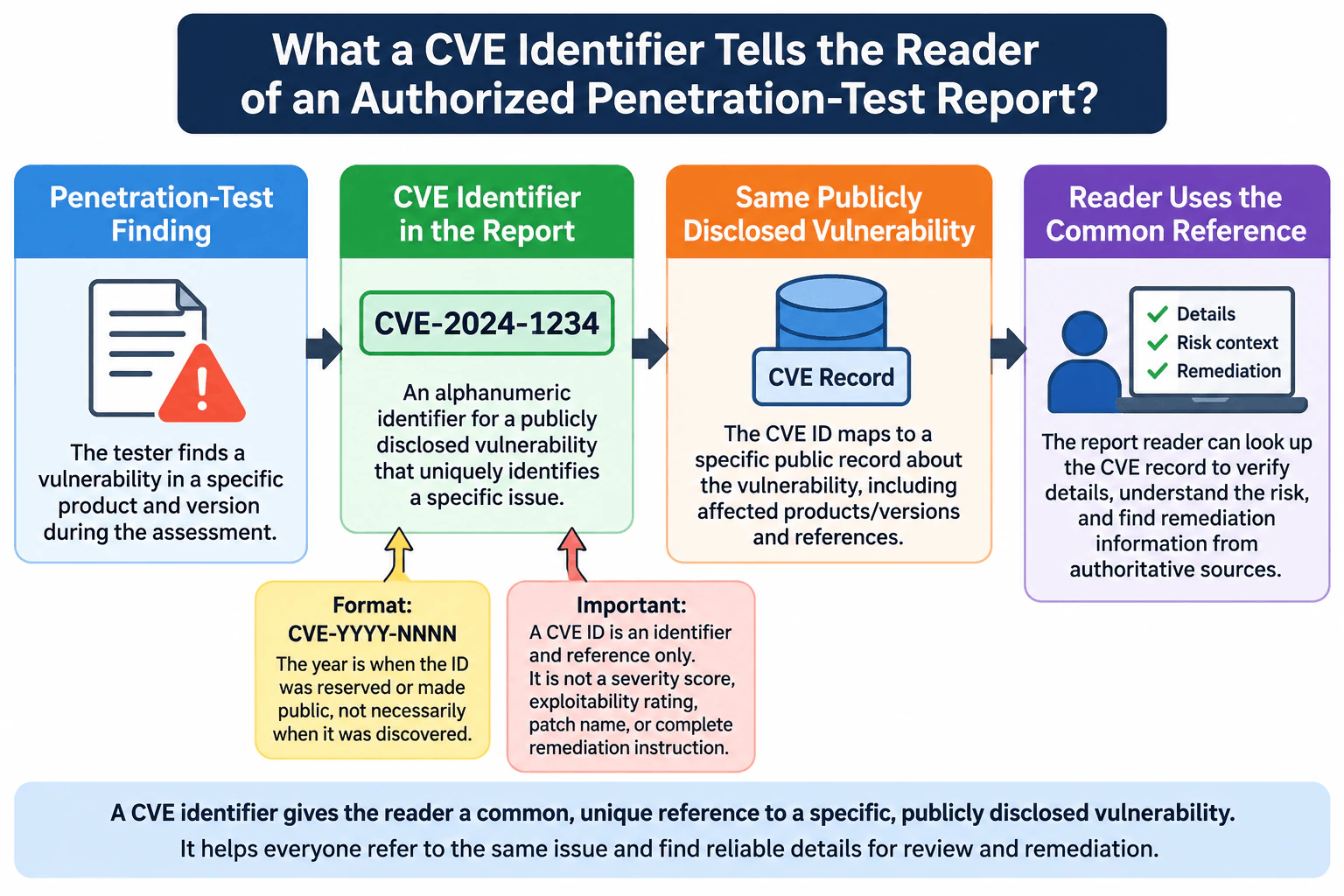
Start with the practical meaning: a CVE ID is a common identifier for a specific publicly disclosed vulnerability. For example, a penetration-test report might reference "CVE-2024-1234." The year portion relates to when the identifier was reserved or the vulnerability was made public; it is not necessarily the year the vulnerability was discovered.
The diagram shows the core flow clearly. First, the authorized tester identifies a vulnerability affecting a particular product or version during the assessment. If that condition corresponds to a known CVE, the report cites the CVE identifier. That identifier maps the report finding to the same publicly disclosed vulnerability represented by the CVE Record. The reader can then use the common reference to review details such as affected products and versions, descriptions, and public references, and to locate appropriate remediation information from authoritative sources.
The important boundary is that the CVE identifier is only a reference. It does not establish that the client's particular asset is vulnerable. The penetration-test report still needs its own evidence showing that the tested product, version, configuration, and observed condition match the finding. A CVE reference also does not prove successful exploitation or compromise.
Severity and exploitability are separate concepts. A CVE ID does not contain a severity score or exploitability rating. Related sources may provide severity or other risk information, but the tester must still evaluate the actual exposure, evidence, and environment rather than treating the identifier as the complete risk decision.
The same separation applies to remediation. A CVE identifier can help the reader find relevant vendor advisories, references, fixes, or mitigation information, but the identifier itself is not a patch name or complete remediation instruction. The appropriate remediation must be verified for the affected product and version.
A useful reporting rule is therefore: use the CVE ID as the common external reference, and use the penetration-test finding for the environment-specific evidence and risk explanation. Before relying on it, verify that the identifier and associated information actually match the tested condition and that the record remains applicable.
Practical Insights
Using a CVE identifier adds little technical or operational cost. The important work is validating that the CVE actually applies to the tested product, version, and condition, and checking the relevant authoritative information before publishing the report. Human review matters because a scanner match or similar product name alone can produce an incorrect mapping. The report may also need maintenance if the associated vulnerability information or vendor guidance changes.
Why Interviewers Ask This
Interviewers want to confirm that you understand the role of CVE identifiers in professional reporting: they provide a common reference to a specific publicly disclosed vulnerability and help readers correlate a penetration-test finding with known vulnerability information without confusing the identifier itself with severity, exploitability, impact, or remediation.
Common interview mistakes
Common mistakes are treating a CVE ID as a severity score, assuming that citing a CVE proves the tested asset is vulnerable, claiming that the CVE proves successful exploitation, confusing CVE with CVSS, and assuming that the identifier itself contains complete remediation instructions. Another mistake is treating the year in the identifier as necessarily the vulnerability's discovery year.
Interview tip
Lead with one sentence: a CVE ID is a common reference to a specific publicly disclosed vulnerability. Then explain the boundary: it helps the reader find relevant vulnerability information, but it does not by itself prove exposure, exploitation, severity, business risk, or remediation success.
Interviewer may ask next
What is the difference between a CVE identifier and a CVSS score?
A CVE identifier provides a common reference to a specific publicly disclosed vulnerability. CVSS is separate and is used to express vulnerability severity. The CVE ID itself does not contain the severity score, so a report should not treat the identifier as the complete risk assessment.
Does citing a CVE in a penetration-test report prove that the tested asset is vulnerable?
No. The CVE provides a reference to the known vulnerability, but the report still needs evidence that the tested product, version, configuration, and observed condition match it. A CVE reference or scanner match alone does not prove exposure, successful exploitation, or compromise.
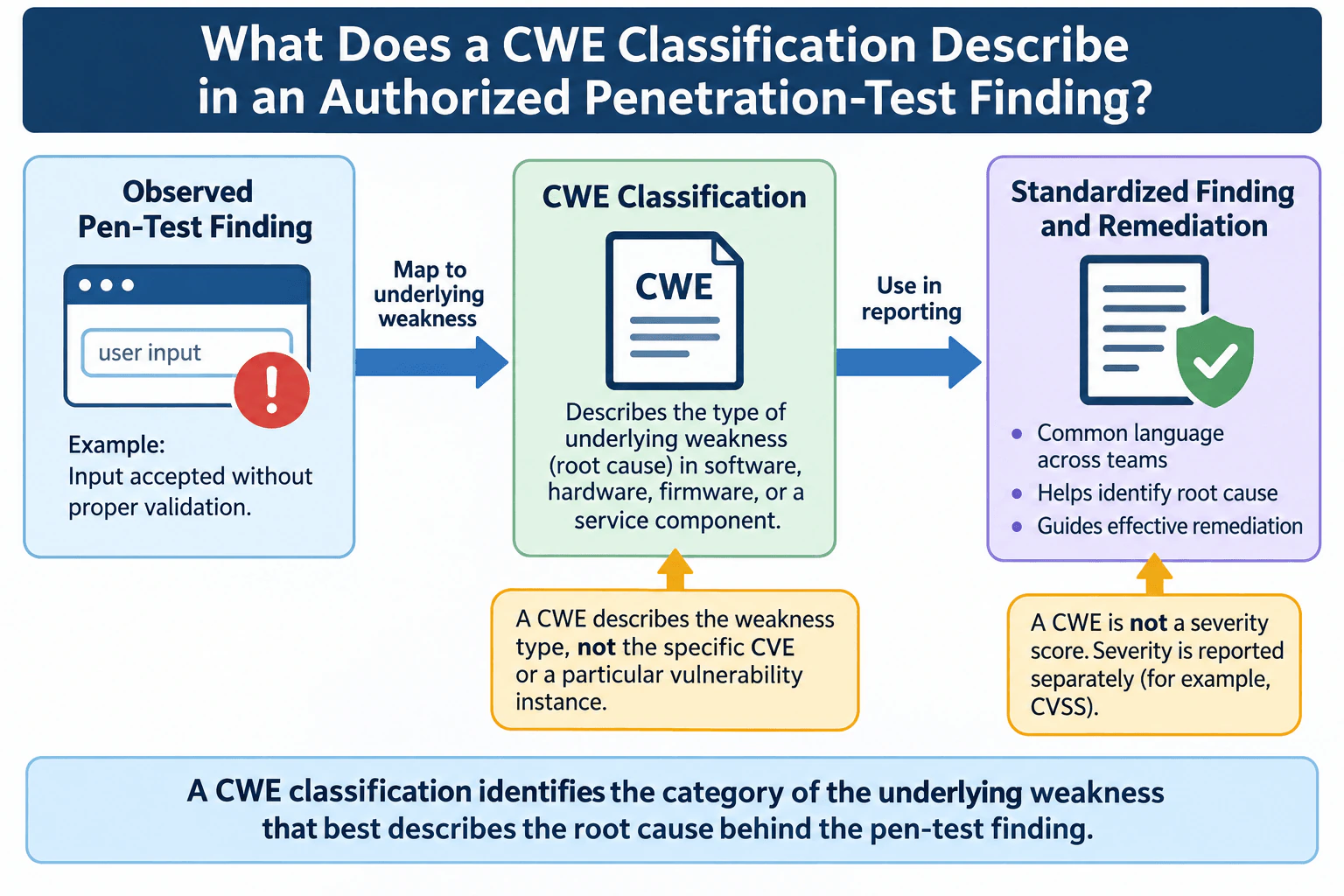
89. What does a CWE classification describe in an authorized penetration-test finding?Reporting And RemediationEasy
Short Interview Answer (30-60 seconds)
A CWE classification describes the underlying weakness type behind a penetration-test finding. It provides a standardized category for communicating that weakness. CWE does not identify a particular vulnerability instance and is not a severity score such as CVSS.
Detailed Explanation
A CWE, or Common Weakness Enumeration, classification describes the type of underlying weakness that best characterizes an authorized penetration-test finding. The practical task is to take the validated finding and map its technical condition to the most appropriate CWE. CWE provides standardized descriptions of weaknesses that can exist in software, firmware, hardware, or service components. This gives security and development teams a common language for discussing the weakness and its remediation. A CWE is a weakness classification, not a particular vulnerability instance, and it does not by itself determine the finding's severity.
Useful Questions to Ask the Interviewer
Do you want me to explain only what CWE represents, or also how it is used in a penetration-test report?
Should I also distinguish CWE from a particular vulnerability identifier and from severity scoring?
How to Explain It in an Interview
Start with the observed and validated penetration-test finding. The tester has evidence of a security-relevant condition within the authorized scope. The reporting decision is to identify the underlying weakness type that best explains that condition and map the finding to the appropriate CWE classification.
The flow is: observed finding -> map to the underlying weakness -> record the CWE classification in the standardized finding. This matches the diagram. CWE gives teams a common vocabulary for describing weaknesses and can help developers understand the technical cause and choose an appropriate remediation.
For example, if a finding involves improper handling of untrusted input, the tester should identify the specific weakness demonstrated by the evidence and select the most appropriate CWE rather than choosing a broad category only because the symptoms look similar. The mapping must follow the verified technical condition.
CWE should not be confused with a particular vulnerability instance. A CWE identifies and describes a weakness type or category. It also does not provide the finding's severity. Severity must be evaluated separately from the CWE classification. CVSS, for example, is a separate framework for communicating vulnerability characteristics and severity.
The important limitation is that a CWE mapping alone does not prove exploitability, impact, priority, or successful remediation. Those conclusions require separate evidence and reasoning. The classification improves consistency in reporting, but the tester must still document what was actually observed and avoid claiming more than the authorized evidence supports.
Technical Approach
Validate the finding using authorized evidence.
Identify the technical weakness demonstrated by that evidence.
Map the finding to the most appropriate CWE classification.
Record the CWE with the finding so teams have a standardized description of the weakness.
Assess severity, impact, priority, and remediation separately rather than deriving them from the CWE number.
Practical Insights
CWE classification has little computing cost because it is mainly an analysis and reporting task. The main cost is tester time and judgment. An inaccurate mapping can mislead readers about the weakness and its remediation, so the tester should choose the most appropriate CWE supported by the evidence instead of guessing from the symptom.
Why Interviewers Ask This
Interviewers want to confirm that the candidate understands what CWE represents in a penetration-test report and can distinguish weakness classification from a particular vulnerability instance and from severity assessment.
Common interview mistakes
Common mistakes include treating CWE as the identifier for one particular vulnerability instance, treating a CWE number as a severity score, selecting a CWE from the visible symptom without understanding the underlying weakness, choosing an unnecessarily broad CWE when the evidence supports a more precise one, and assuming the CWE classification alone proves impact or remediation priority.
Interview tip
Lead with the practical answer: CWE describes the underlying weakness type. Then explain that it provides standardized language for reporting and remediation. Finish by distinguishing CWE from a particular vulnerability instance and from severity scoring.
Interviewer may ask next
How is a CWE classification different from a CVE identifier?
A CWE classifies a type of weakness, while a CVE identifier refers to a specific publicly disclosed vulnerability record. A penetration-test finding can be mapped to an appropriate CWE even when no applicable CVE exists. CWE describes the weakness class; CVE identifies a particular known vulnerability record.
Does assigning a CWE tell you how severe the penetration-test finding is?
No. CWE identifies the weakness classification, not the severity of the particular finding. Severity must be assessed separately using the actual vulnerability characteristics, exploitability, impact, exposure, and relevant environmental context. CVSS can be used to communicate vulnerability severity, but the CWE itself is not a severity score.
90. What does CVSS measure when documenting a finding from an authorized penetration test?Reporting And RemediationEasy
Short Interview Answer (30-60 seconds)
CVSS measures the technical severity of a vulnerability. It uses defined technical metrics to produce a score from 0.0 to 10.0 and can map that score to a severity rating. It helps compare findings, but CVSS alone does not represent complete business or organizational risk.
Detailed Explanation
CVSS, or the Common Vulnerability Scoring System, provides a consistent way to describe the technical severity of a vulnerability found during an authorized penetration test. It captures defined characteristics of the vulnerability and produces a numerical score from 0.0 to 10.0. That score can also be expressed as None, Low, Medium, High, or Critical. In a report, the score helps readers compare technical severity across findings and supports remediation discussions. However, CVSS is not a complete business-risk score because organizational consequences and priorities require additional context.
Useful Questions to Ask the Interviewer
Are you asking specifically about the CVSS Base score or about the broader CVSS v4.0 metric groups?
Would you like me to explain how CVSS severity differs from business risk and remediation priority?
How to Explain It in an Interview
Start with the practical point: CVSS measures vulnerability severity. It gives a standardized way to describe how serious a technical vulnerability is relative to other vulnerabilities.
In CVSS v4.0, the Base metric group represents intrinsic characteristics of the vulnerability that are intended to remain constant across time and environments. Base metrics cover exploitability factors such as attack vector, attack complexity, attack requirements, privileges required, and user interaction. They also cover technical impact to confidentiality, integrity, and availability for the vulnerable system and, where applicable, a subsequent system.
The Threat metric group adds time-sensitive information. In CVSS v4.0, its scoring metric is Exploit Maturity, which reflects the current maturity or availability of exploitation activity. Environmental metrics refine severity for a particular environment by considering factors such as security requirements and modified vulnerability characteristics.
Supplemental metrics provide additional context about a vulnerability, such as safety, recovery, vulnerability response effort, and provider urgency. They do not change the calculated CVSS score. This matches the diagram's distinction between scoring inputs and additional context.
The resulting score is on a 0.0-to-10.0 scale. The qualitative ranges are None at 0.0, Low from 0.1 to 3.9, Medium from 4.0 to 6.9, High from 7.0 to 8.9, and Critical from 9.0 to 10.0.
When documenting a penetration-test finding, that score gives the report a consistent technical severity reference. It can help teams compare findings and support remediation prioritization, but it should not be treated as the entire prioritization decision. Regulatory impact, financial impact, reputational impact, customer impact, asset importance, exposure, existing controls, and other organizational factors can matter outside the CVSS severity calculation.
The responsibility boundary is therefore important: the tester should score only characteristics supported by the authorized test evidence and the applicable CVSS definitions. The tester should not invent exploitation conditions, impact, or business consequences simply to raise or lower a score. The report should keep technical severity separate from broader organizational risk so the final finding remains defensible.
Technical Approach
Confirm the technical characteristics demonstrated by the authorized penetration-test evidence.
Select the applicable CVSS v4.0 metric values without inventing conditions or impact.
Record the resulting score and, when useful, its qualitative severity rating.
Keep the CVSS technical severity separate from unsupported business-impact claims.
Use the score as one input when comparing findings and discussing remediation priority with the organization.
Practical Insights
CVSS itself does not require complex infrastructure, but accurate scoring takes analyst time and careful judgment. The main operational cost is keeping scoring consistent across testers and documenting why each metric value was selected. Threat and environmental context can also change, so organizations may reassess those values. The main human tradeoff is simplicity versus context: one standardized score is easy to compare, but it cannot replace a broader assessment of business, financial, regulatory, operational, and remediation factors.
Why Interviewers Ask This
Interviewers want to confirm that you understand what CVSS represents when reporting a penetration-test finding. A strong answer distinguishes technical vulnerability severity from broader concepts such as business impact, organizational risk, exploit likelihood, and remediation priority.
Common interview mistakes
Common mistakes include calling CVSS a complete risk score, assuming the highest CVSS score must always be remediated first, inventing technical impact that was not demonstrated, mixing metric definitions from different CVSS versions, or treating Supplemental metrics as if they change the CVSS v4.0 numerical score. Another mistake is publishing or discussing a score without enough rationale to explain why the chosen metric values apply.
Interview tip
Lead with one clear sentence: CVSS measures technical vulnerability severity, not complete business risk. Then mention the 0.0-to-10.0 scale and briefly explain the Base, Threat, Environmental, and Supplemental metric groups. Finish by saying that the score helps compare findings and support remediation decisions but should be combined with organizational context.
Interviewer may ask next
What is the difference between CVSS severity and business risk?
CVSS severity describes the technical characteristics and potential technical impact of a vulnerability. Business risk also depends on organizational context such as asset importance, exposure, threat conditions, financial consequences, regulatory obligations, customer impact, and existing controls. Therefore, CVSS can contribute to a risk decision, but the score alone should not be presented as the organization's complete risk rating.
Do all CVSS v4.0 metric groups change the final numerical score?
No. Base, Threat, and Environmental metrics are used in the CVSS v4.0 severity calculation. Supplemental metrics provide additional contextual information but do not change the calculated CVSS score. This is why a penetration-test report should distinguish the numerical severity score from supplemental context and from broader business-risk analysis.
More questions load as you scroll
Disclaimer: This interview guide is for educational and informational purposes only. It is designed to help readers prepare, but it does not guarantee any interview result, hiring decision, offer, or outcome. Interview questions, hiring criteria, and preferred answers can vary by employer, interviewer, industry, location, and time. All answers, examples, and explanations in this guide are suggested examples for interview preparation, not definitive answers or instructions for professional practice. They are based on research and judgment, are provided without warranties of any kind, and should be adapted to the question, role, and applicable laws and professional requirements. Diagrams are simplified illustrations intended to highlight the main concepts and their relationships; actual situations, systems, and practices may be more complex. Alternative approaches may be equally valid or better suited to a particular question, context, or interviewer. To the fullest extent permitted by applicable law, the contributors and publisher are not liable for decisions made, actions taken, or losses incurred based on this guide.
State Laws and Professional Responsibilities: Laws and requirements governing an occupation vary by state and jurisdiction. You are responsible for checking the current laws, licensing requirements, and scope-of-practice rules that apply to your location and role, and for ensuring that your answers and actions comply with them. Adapt examples in this guide to those requirements. This guide is not legal advice.
Content Accuracy and Verification: To the fullest extent permitted by applicable law, we do not represent or warrant that interview guides, questions, answers, examples, or diagrams are accurate, complete, current, error-free, or suitable for any particular purpose. You are responsible for independently reviewing and verifying the information before relying on it.