This interview guide is for educational and informational purposes only. It is designed to help readers prepare, but it does not guarantee any interview result, hiring decision, offer, or outcome. Interview questions, hiring criteria, and preferred answers can vary by employer, interviewer, industry, location, and time. All answers, examples, and explanations in this guide are suggested examples for interview preparation, not definitive answers or instructions for professional practice. They are based on research and judgment, are provided without warranties of any kind, and should be adapted to the question, role, and applicable laws and professional requirements. Diagrams are simplified illustrations intended to highlight the main concepts and their relationships; actual situations, systems, and practices may be more complex. Alternative approaches may be equally valid or better suited to a particular question, context, or interviewer. To the fullest extent permitted by applicable law, the contributors and publisher are not liable for decisions made, actions taken, or losses incurred based on this guide.
State Laws and Professional Responsibilities
Laws and requirements governing an occupation vary by state and jurisdiction. You are responsible for checking the current laws, licensing requirements, and scope-of-practice rules that apply to your location and role, and for ensuring that your answers and actions comply with them. Adapt examples in this guide to those requirements. This guide is not legal advice.
Identity, Image, and Privacy Notice
To respect individual privacy, some names, profile photographs, avatars, biographical details, and other identifying information displayed in this guide may be replaced with pseudonyms, licensed stock images, illustrative avatars, composite images, or representative descriptions. Unless a person is expressly identified as an actual contributor, a displayed name, image, or profile should not be understood as depicting or identifying a specific candidate, interviewer, employee, or other real individual. These representations are provided for editorial and illustrative purposes only and do not imply endorsement, employment, participation, or affiliation with this guide or any company mentioned in it. Any resemblance to an actual person is coincidental.
Company Notice
This guide is an independent educational resource and is not affiliated with, endorsed by, sponsored by, or approved by the company named in this guide. Company names identify reported interview experiences or the employer context of clearly labeled original practice exercises. Interview practices can change without notice, and inclusion of company-specific content does not mean these questions are official, complete, or guaranteed to be asked. To the fullest extent permitted by law, the author, contributors, and publisher are not responsible for outcomes related to use of this material.
Content Accuracy and Verification
To the fullest extent permitted by applicable law, we do not represent or warrant that interview guides, questions, answers, examples, or diagrams are accurate, complete, current, error-free, or suitable for any particular purpose. You are responsible for independently reviewing and verifying the information before relying on it.
Questions or comments?
Contact us for general questions, or share feedback, technical corrections, and comments with the community.
51. How does API property-level authorization differ from object-level authorization in an authorized access-control assessment?Web Application SecurityHard
Short Interview Answer (30-60 seconds)
Object-level authorization asks, "May this user access this specific object?" Property-level authorization asks, "Which fields of that object may this user read or change?" I test both separately with authorized identities and synthetic data, then verify server-side enforcement and regression tests.
Detailed Explanation
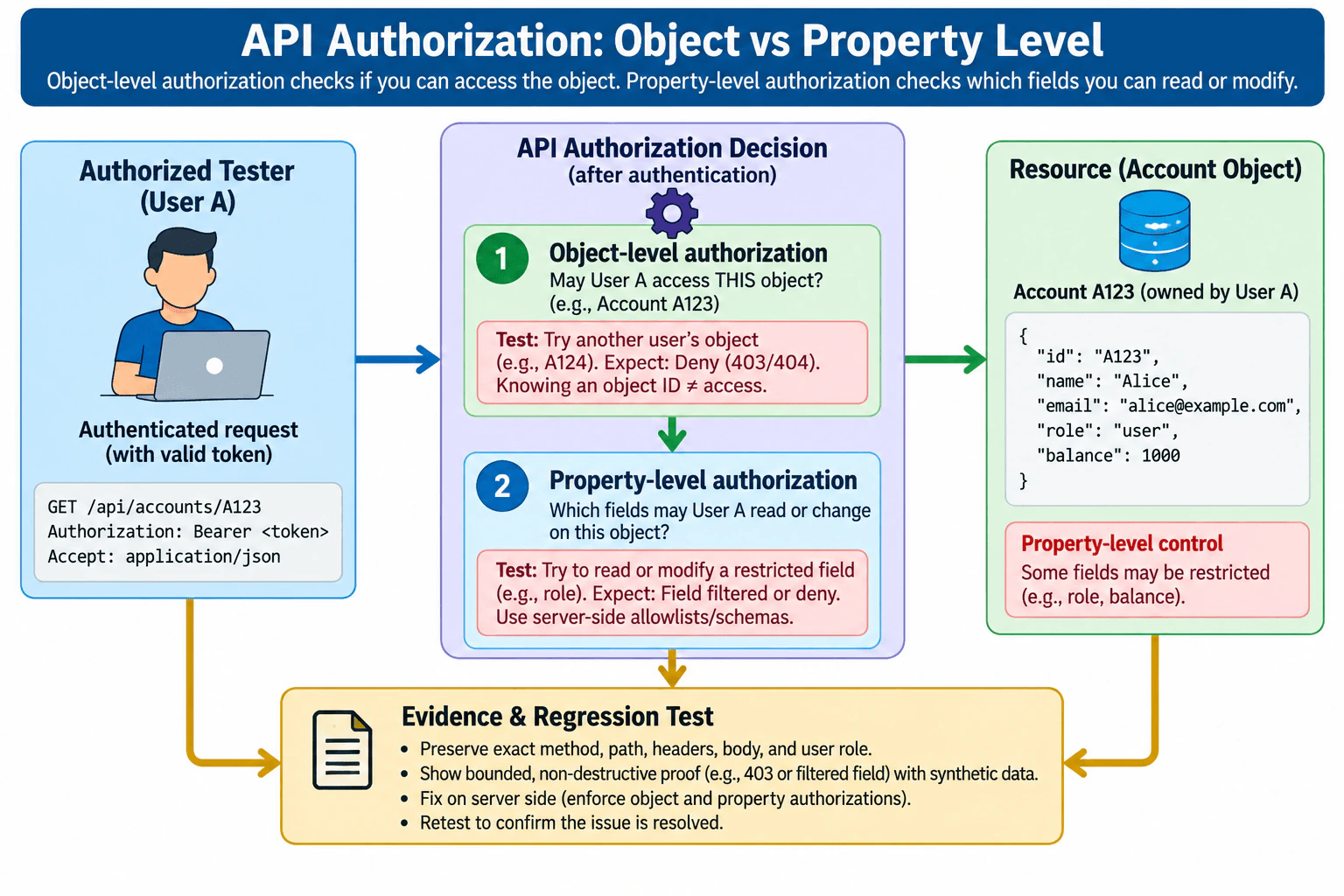
The practical difference is the authorization boundary being tested. Object-level authorization protects a whole resource, such as whether User A may access account A123 instead of another user's account. Property-level authorization protects individual fields inside an accessible resource, such as whether User A may read or change role or balance. Authentication only establishes who the requester is; it does not answer either authorization question. In an authorized assessment, I test both layers with bounded synthetic data, preserve the exact request context, and treat only reproducible unauthorized access or modification as verified impact.
Useful Questions to Ask the Interviewer
Which API roles, accounts, objects, and properties are explicitly in scope for authorization testing?
Do we have two authorized test identities and synthetic objects so cross-user object checks can be performed safely?
Which properties are expected to be readable, writable, restricted, or completely hidden for each role?
Are there stop conditions or restrictions on modifying state during the assessment?
How to Explain It in an Interview
I start with the two different authorization decisions. Object-level authorization asks whether the authenticated principal may perform the requested action on this particular object. In the diagram, User A sends an authenticated GET request to /api/accounts/A123. The API must verify that User A is allowed to access account A123. Authentication and knowledge of the identifier A123 do not grant that permission by themselves.
For an authorized object-level test, I capture the legitimate request and preserve its method, path structure, relevant headers, cookies if present, body if present, content type, encoding, session or token context, and user role. I then change only the approved object reference to a synthetic object representing another test user's resource, such as A124. The expected secure result is denial. Depending on the API's design, that may be represented by a forbidden or not-found response. If the protected object is actually returned or modified, I reproduce the behavior with the minimum evidence needed before reporting unauthorized object access.
Property-level authorization is the more granular decision about fields inside an object. After User A is permitted to work with account A123, the API still has to decide which properties that role may read or modify. The diagram uses role and balance as examples of fields that may be restricted even though the account object itself is accessible. For reads, I verify that a restricted property is omitted, filtered, or otherwise denied according to the intended policy. For writes, I verify that an unauthorized property is rejected or ignored rather than automatically bound to the server-side object.
The important trust boundary is the server-side authorization decision. Client-side hiding is not sufficient because a requester can inspect or construct API requests directly. Object authorization should therefore be enforced whenever an API operation accesses an object by an identifier or equivalent reference. Property authorization should also be enforced server-side by explicitly controlling which fields each role may return or update. Response schemas, input schemas, and explicit allowlists can support this property-level enforcement.
The two controls solve different problems and must not be confused. A correct object-level check can still expose a property the user should not see. A correct property-level rule does not make it acceptable to access someone else's object. In the diagram's flow, the API first establishes whether the requested object is authorized and then applies the applicable field-level rules before data is returned or modified.
I collect evidence using the minimum safe proof. I preserve the exact HTTP method, path, relevant headers, cookies, request body, content type, encoding, authentication context, and user role needed to reproduce the result. I use synthetic data and bounded requests rather than exposing real secrets or unnecessary personal information. For object-level testing, useful evidence is the controlled difference between access to A123 and an attempted request for the approved cross-user object A124. For property-level testing, useful evidence is whether a restricted field such as role or balance is returned or accepted for a role that should not have that permission.
A suspicious response alone is not proof of impact. A different status code, response size, or timing observation does not by itself establish unauthorized access. I verify whether protected object data or a restricted property was actually disclosed or changed before concluding that authorization failed.
For remediation, I recommend server-side enforcement at both levels. The server should verify authorization for every requested object and explicitly control which properties the authenticated role may read or modify. Input and output schemas or explicit property allowlists can reduce accidental field exposure or mass assignment. A WAF rule or client-side check is not a complete fix for missing application authorization.
Finally, I run a regression test using the same role and preserved request context. I confirm that the original cross-object request is denied, the restricted property is filtered or denied as intended, and the legitimate A123 request still works. The main limitation is coverage: testing one endpoint, role, object, property, or HTTP method does not prove every authorization path is correct. Broader combinations increase confidence, but the assessment must remain inside written scope and use the least intrusive test set that produces reliable evidence.
Technical Approach
Confirm written scope, authorized test identities, synthetic objects, allowed API methods, expected object ownership, property permissions, and stop conditions.
Capture a legitimate baseline such as User A sending GET /api/accounts/A123, and preserve the HTTP method, path, relevant headers, cookies if present, body if present, content type, encoding, authentication context, and role.
Test object-level authorization by changing only the approved object reference to a synthetic object belonging to another authorized test identity, such as A124. Verify that access is denied and do not treat knowledge of the identifier as permission.
Return to A123, which User A may access, and test property-level authorization using an approved restricted property such as role or balance.
For a read test, verify that the property is omitted, filtered, or denied according to policy. For a permitted write-method test, verify that unauthorized properties are rejected or ignored and do not change server-side state.
Record only the minimum synthetic, non-sensitive evidence necessary to demonstrate the authorization result.
Recommend server-side object authorization plus explicit property controls such as input and output schemas or allowlists where appropriate.
Retest the same object and property paths after remediation and, where in scope, verify equivalent HTTP methods or representations that could use separate authorization logic.
Practical Insights
The main cost is maintaining and testing two layers of authorization. Object rules define which resources each identity may access, while property rules define which fields each role may read or modify. More roles, endpoints, methods, objects, and fields create more combinations to maintain and regression-test. Engineering teams also need clear ownership and policy definitions. Explicit schemas and allowlists add maintenance work when models change, but they reduce accidental exposure. Broader test coverage gives more confidence, while smaller bounded tests are faster and safer. The right balance is enough coverage to verify meaningful authorization boundaries without exceeding the authorized assessment scope.
Why Interviewers Ask This
This question checks whether the candidate understands authorization at two different levels. A strong penetration tester must distinguish access to a specific resource from access to fields inside that resource, test both safely with authorized identities and synthetic data, preserve reproducible evidence, and recommend server-side controls rather than assuming authentication or knowledge of an object identifier is sufficient.
Common interview mistakes
Common mistakes are treating authentication as proof of authorization, assuming possession of an object identifier grants access, testing only cross-object access while ignoring restricted fields, or testing fields without considering whether the user may access the object itself. Other mistakes include relying on the client to hide sensitive properties, automatically binding user input to server-side objects, using real sensitive data instead of synthetic records, changing several request variables at once, treating a status-code difference as verified impact, recommending only a WAF or UI restriction, failing to preserve the original request context, and skipping regression testing after the server-side fix.
Interview tip
Use one sentence to separate the layers: object-level authorization controls which specific resource the user may access; property-level authorization controls which fields of that resource the user may read or modify. Then give one safe example for each, emphasize server-side enforcement, and finish with evidence and regression testing.
Interviewer may ask next
How would you safely test object-level and property-level authorization on the same API?
I would first capture an authorized baseline such as User A sending GET /api/accounts/A123 and preserve the method, headers, cookies if present, content type, encoding, authentication context, and role. For the object-level check, I would change only the identifier to an approved synthetic object such as A124 that belongs to another authorized test identity and verify denial. Then I would return to A123 and test an approved restricted property such as role or balance. For reads, I would verify that the field is filtered or denied. For an authorized write-method test, I would verify that the restricted property is rejected or ignored. I would keep the proof bounded and record only minimum synthetic evidence.
Why is property-level authorization still necessary when object-level authorization is correct?
Because permission to access an object does not imply permission to every property inside it. A user may legitimately access account A123 while still being forbidden from seeing or changing fields such as role or balance. Correct object-level enforcement can therefore coexist with broken property-level authorization. Both decisions need independent server-side enforcement and regression tests.
52. How does UNION-based SQL injection work in an authorized test of a deliberately vulnerable application?Web Application SecurityHard
Short Interview Answer (30-60 seconds)
In an authorized test, UNION-based SQL injection abuses unsafe dynamic SQL so a tester-controlled SELECT is combined with the application's original SELECT. Compatible results can then appear in the normal response. I would prove it with synthetic data, stop at minimum impact, fix the query with parameterization, and retest.
Detailed Explanation
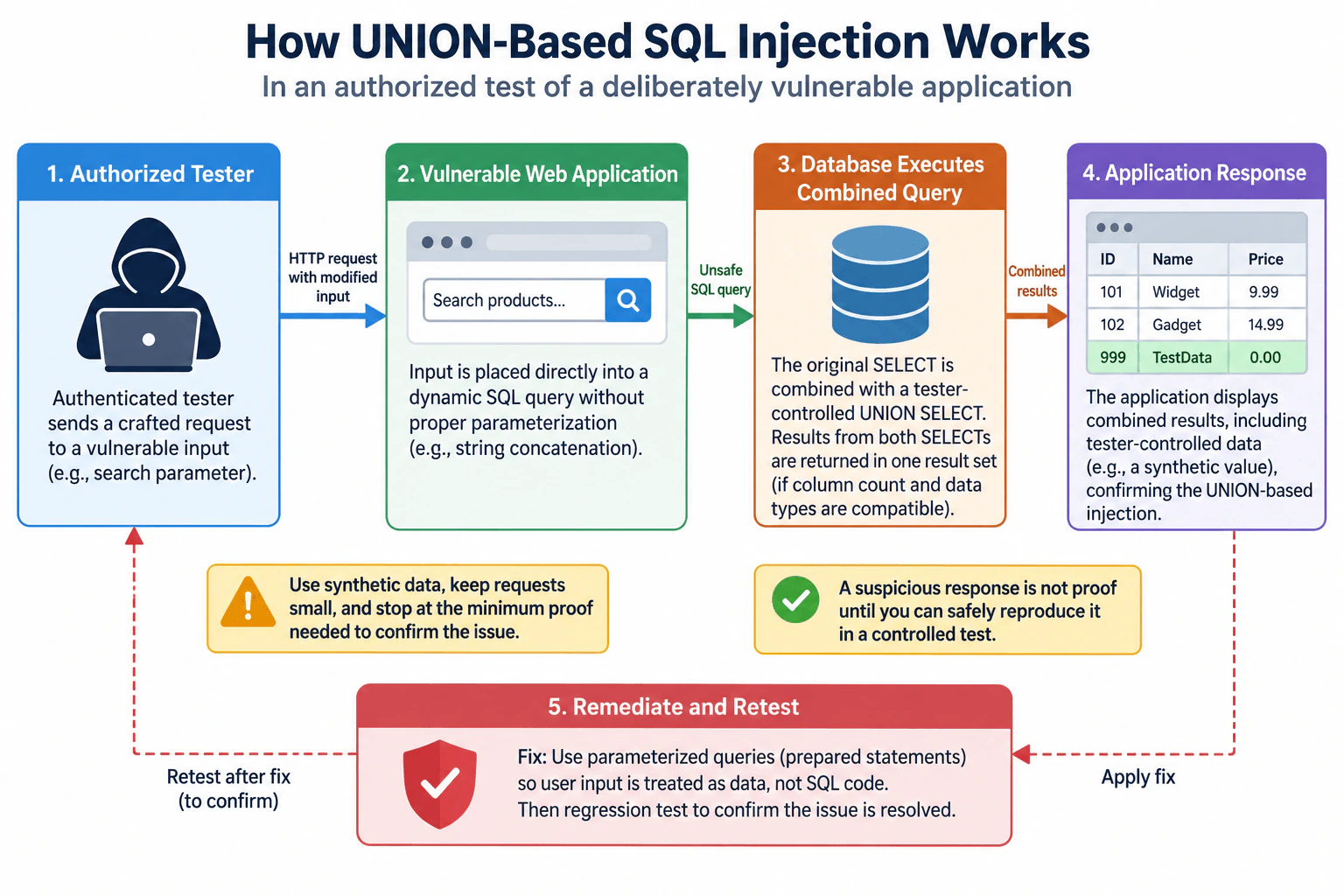
The question asks how UNION-based SQL injection changes the normal request-to-database flow during an authorized test. The key issue is unsafe dynamic SQL: user-controlled input becomes part of the SQL structure instead of remaining data. A tester can then make the database combine the application's original SELECT result with a controlled SELECT result. The result sets must have the required matching number of columns and compatible data types. A safe proof is a synthetic tester-controlled value appearing in the application's normal response. The test should stop at that minimum proof and avoid unnecessary sensitive data.
Useful Questions to Ask the Interviewer
Which endpoint, parameter, HTTP method, authenticated role, and session state are in scope?
Is synthetic test data available for a non-destructive proof?
Should the test stop as soon as a controlled value is reproducibly returned?
Should I also explain remediation and regression testing?
How to Explain It in an Interview
The practical decision is to prove that the application lets an authorized tester's input change the structure of a database SELECT query, while using the least intrusive reproducible test.
First, the authenticated tester sends a crafted request to an approved vulnerable input, such as a search parameter. The request must stay within the authorized scope and preserve the relevant method, session, role, parameter, and request state needed for reproduction.
Second, the vulnerable web application places that input directly into a dynamically constructed SQL statement instead of using proper parameterization. This crosses the important trust boundary: data controlled by the requester is being interpreted as SQL code by the server-side query construction logic.
Third, UNION causes the database to combine the application's original SELECT with the tester-controlled SELECT. For the combined query to work, the SELECT statements need the required matching number of result columns, and corresponding values need compatible data types. The database then returns one combined result set.
Fourth, the application displays those returned rows through its normal response. A harmless synthetic value supplied by the tester can therefore appear alongside normal application data. That controlled result is stronger evidence than an error or unusual response because it demonstrates that tester-controlled SQL affected the returned database result.
The proof should remain bounded. Use synthetic data, keep requests small, avoid real credentials or unnecessary personal data, and stop once the minimum reproducible evidence is obtained. A suspicious response alone should not be described as verified impact until it can be safely reproduced in the controlled test.
The root-cause fix is server-side parameterization using prepared statements so user input is handled as data rather than SQL code. Input validation may be useful as defense in depth, but it does not replace parameterized queries. After the fix is deployed, repeat the same regression test using the same endpoint, method, parameter, role, and relevant session state. The expected result is that the input can no longer alter the SQL structure or cause a tester-controlled SELECT result to appear.
A limitation is that one successful proof demonstrates the tested injection path only. It does not establish that every endpoint or parameter in the application is vulnerable. Likewise, one successful retest confirms the tested remediation path but does not replace broader application-wide SQL injection testing.
Technical Approach
Confirm authorization and identify the exact vulnerable endpoint, parameter, HTTP method, authenticated role, session state, and other request details required to reproduce the test.
Send a harmless baseline request and record the normal application response.
Modify only the approved input in a bounded way to determine whether it can alter the SQL query structure.
Determine only the minimum result-shape information needed for UNION behavior, including the required number of columns and compatible data types.
Use a harmless synthetic tester-controlled value in the additional SELECT and submit the minimum request needed for proof.
Verify whether that synthetic value appears in the application's normal response. Treat an unexplained error or changed response as suspicious, not as verified impact by itself.
Stop once the minimum reproducible proof is obtained and retain only the evidence needed for reporting.
Remediate the affected server-side query with a prepared statement or equivalent parameterized query.
Repeat the same authorized regression test and confirm that the input is treated only as data and no longer changes the SQL structure.
Practical Insights
The test can be small when the vulnerable input is already known because only a limited number of controlled requests may be needed. The main operational cost is careful reproduction: keeping the correct endpoint, method, session, role, parameter, and request state while avoiding unnecessary impact. The remediation cost depends on how many application queries use unsafe string construction. Parameterized queries may require code changes and regression tests across affected data-access paths. Additional defenses such as input validation and least-privilege database permissions can reduce risk, but they do not replace correcting the unsafe query construction.
Why Interviewers Ask This
This question checks whether the candidate understands how UNION-based SQL injection changes a vulnerable database query, the compatibility requirements for combining SELECT results, how the combined result can become visible through the application, and how to demonstrate the issue safely during an authorized penetration test. It also evaluates whether the candidate can distinguish a suspicious response from verified impact and identify parameterized queries as the root-cause remediation.
Common interview mistakes
Common mistakes include treating a database error as proof of successful UNION-based injection; accessing real credentials or personal information when a synthetic value is sufficient; forgetting the column-count and data-type compatibility requirements; changing multiple request elements at once and losing reproducibility; failing to record the correct method, parameter, role, or session state; continuing testing after the minimum proof is established; recommending only filtering, client-side validation, or a WAF instead of correcting unsafe query construction; and failing to regression-test the deployed parameterized-query fix.
Interview tip
Explain the flow in four parts: the authorized tester controls an input, the vulnerable application builds unsafe dynamic SQL, UNION combines compatible SELECT results, and the normal response shows a synthetic controlled value. Finish with minimum-safe proof, parameterized queries as the root-cause fix, and a regression retest.
Interviewer may ask next
Why do the SELECT statements used with UNION need compatible result shapes?
UNION combines rows from multiple SELECT statements into one result set. The SELECT statements therefore need the required matching number of output columns, and corresponding values must use compatible data types. If those requirements are not met, the database will normally reject the combined query instead of returning the intended combined result. In an authorized test, I would determine only the minimum structural information needed for a synthetic proof.
How would you verify that the remediation fixed the UNION-based SQL injection?
I would repeat the same authorized regression test using the same endpoint, HTTP method, vulnerable parameter, authenticated role, session conditions, and harmless synthetic input. With a properly parameterized query, the supplied value should be treated only as data and should no longer alter the SQL structure or make a tester-controlled SELECT result appear in the response. I would also verify that the affected server-side query path actually uses parameter binding rather than relying only on filtering or client-side validation.
53. What is network and Active Directory penetration testing?Network And Active DirectoryEasy
i Question Details
Define this work as an authorized assessment of hosts, services, protocols, segmentation, directory identities, authentication paths, trusts, privileges, and administrative tiers. Explain safe enumeration, lockout limits, test credentials, attack-path validation, evidence, detection, cleanup, remediation, and retesting.
Short Interview Answer (30-60 seconds)
It is an authorized assessment that safely maps network hosts, services, protocols, segmentation, Active Directory identities, trusts, authentication paths, privileges, and admin tiers, validates realistic attack paths with controlled test credentials, collects evidence and detection signals, then supports cleanup, remediation, and retesting.
Detailed Explanation
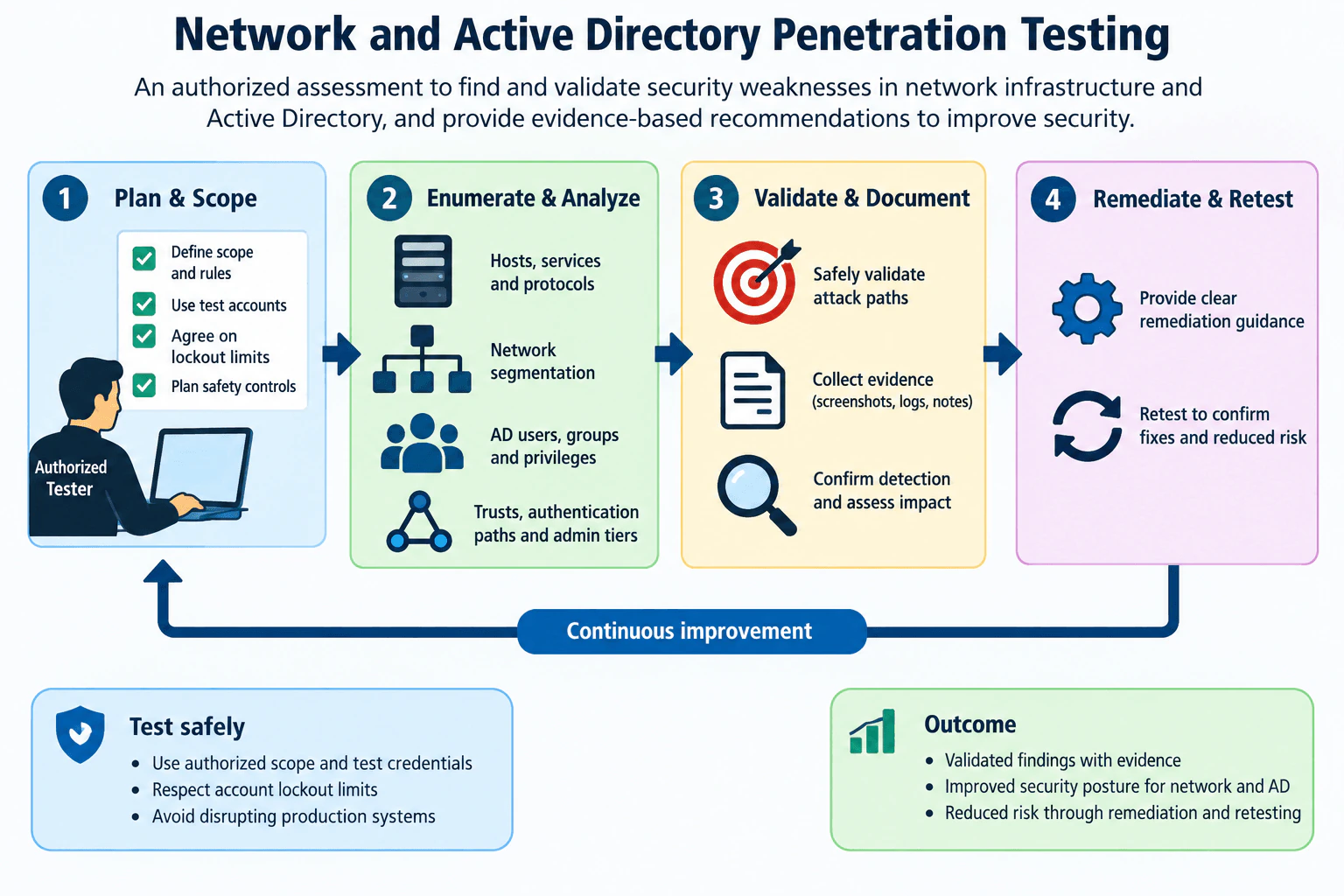
Network and Active Directory penetration testing asks whether an authorized tester can identify and safely validate security weaknesses across network infrastructure and directory identities. The work starts with agreed scope and safety rules. The tester discovers hosts, services, protocols, segmentation, users, groups, privileges, trusts, authentication paths, and administrative tiers. Test credentials and known lockout limits reduce unnecessary risk. The tester then validates meaningful attack paths, records evidence and detection signals, removes temporary test artifacts, recommends remediation, and retests the affected paths to confirm that the demonstrated risk has been reduced.
Useful Questions to Ask the Interviewer
What networks, hosts, domains, trusts, and administrative tiers are in scope?
Are test accounts provided, and what privileges should each account have?
What account-lockout, retry, timing, and service-availability limits must the test respect?
Which production systems or testing techniques are explicitly excluded?
Should the assessment also verify whether defensive monitoring detects the approved test activity?
How to Explain It in an Interview
Start with authorization and scope. The tester must know which networks, hosts, Active Directory domains, identities, trusts, and administrative tiers are permitted targets. The rules of engagement should also define the schedule, safety controls, test credentials, excluded systems, stop conditions, and escalation contacts.
Next, perform safe enumeration. On the network side, identify authorized hosts, exposed services and protocols, and segmentation boundaries. In Active Directory, enumerate relevant users, groups, privileges, trusts, authentication relationships, and administrative tiers. Enumeration tells the tester what exists and how components relate; it does not by itself prove that a vulnerability or exploitable attack path exists.
Use approved test credentials when authenticated testing is part of the engagement. Determine the effective account-lockout policy that applies to those identities before performing actions that could create failed authentication attempts. Active Directory can apply different password and lockout settings to different accounts, so the safe retry limit must come from the approved environment rather than from an assumed universal value.
Then validate attack paths. An attack path is a sequence of reachable systems, authentication relationships, trusts, permissions, or privileges that could allow movement from an approved starting point toward a more sensitive system or administrative level. The tester should validate only the minimum portion needed to prove the security issue and should avoid unnecessary lateral movement or privilege use.
For network paths, record the important context: the authorized source or vantage point, destination, relevant route or segmentation boundary, protocol or service, identity when applicable, and whether the tested access was allowed or denied. A discovered host, reachable service, or open port shows exposure or connectivity; it does not by itself prove an exploitable vulnerability or business impact.
Evidence should show what was actually tested and demonstrated. Useful evidence can include approved screenshots, logs, timestamps, request and response details, notes, affected identities or systems, and the observed privilege level. Where defensive validation is in scope, record whether expected logging, monitoring, or alerting observed the approved activity. Do not claim a detection failure unless the relevant telemetry and expected detection behavior were actually assessed.
Safety applies throughout the engagement. Respect account-lockout limits, rate and retry constraints, maintenance windows, availability requirements, and agreed stop conditions. If testing approaches a lockout threshold, causes unexpected instability, or would cross an authorization boundary, stop that activity and follow the agreed escalation process instead of forcing the test to continue.
After validation, remove temporary test artifacts and restore approved temporary changes. Report the demonstrated path, evidence, affected systems or identities, security impact, and root cause. Remediation may include removing excessive privileges, correcting permissions, strengthening segmentation, reducing unnecessary trust exposure, or separating administrative access according to least privilege and administrative tiers.
Finally, retest the affected path after remediation. The retest should confirm that the original demonstrated path no longer works as before and that the intended control is active from the relevant authorized vantage point. Retesting increases confidence but does not prove that every possible path has disappeared. Residual risk can remain in untested systems, changing identities and permissions, new configuration errors, or areas outside the engagement scope.
The main tradeoff is coverage versus operational safety. Broader enumeration and deeper validation can increase confidence, but aggressive testing can also increase account-lockout risk, service impact, alert volume, and test duration. A professional assessment therefore uses the least disruptive method that produces enough evidence to support a defensible finding.
Technical Approach
Define written authorization, scope, rules of engagement, schedule, safety limits, exclusions, stop conditions, and escalation contacts.
Confirm approved network ranges, hosts, Active Directory domains, trusts, identities, administrative tiers, and segmentation boundaries.
Prepare approved test credentials and determine the effective account-lockout and retry limits for those identities.
Build candidate attack paths from observed network reachability, directory relationships, permissions, trusts, and privilege boundaries.
Validate only the minimum necessary parts of each authorized attack path, stopping before lockout, instability, or unauthorized impact.
Collect evidence showing the starting identity or vantage point, relevant path, observed behavior, demonstrated impact, and applicable detection signals.
Remove temporary test artifacts and restore approved temporary changes.
Recommend root-cause remediation such as least privilege, permission correction, stronger segmentation, trust reduction, or administrative-tier separation.
Retest the original demonstrated path after remediation and document whether the risk has been reduced.
Practical Insights
The technical cost depends on how many networks, hosts, directory objects, trusts, segmentation boundaries, and authentication paths are in scope. Large environments take longer because more relationships must be examined and validated. Operational cost also matters: aggressive scanning or authentication attempts can create load, alerts, account lockouts, or service disruption, so testing may need slower rates or maintenance windows. Human effort includes coordination with network, identity, security operations, and system owners. Evidence handling, cleanup, remediation, and retesting add time but improve confidence. No penetration test provides complete certainty because systems, permissions, and configurations can change after testing.
Why Interviewers Ask This
Interviewers want to know whether the candidate understands that network and Active Directory penetration testing is more than scanning hosts or listing directory objects. A strong answer demonstrates authorization, controlled enumeration, identity and privilege reasoning, safe attack-path validation, evidence collection, operational safety, detection awareness, remediation, cleanup, and retesting.
Common interview mistakes
Common mistakes include treating an open port or scanner result as a proven vulnerability, testing beyond the authorized scope, using unnecessary privileged credentials instead of controlled test accounts, ignoring account-lockout limits, performing uncontrolled credential attempts, assuming every directory relationship is exploitable, confusing a possible attack path with validated impact, checking only allowed segmentation paths and not expected denied paths, collecting more sensitive evidence than necessary, making unsupported claims about detection, leaving test artifacts behind, recommending generic fixes without identifying the root cause, and failing to retest after remediation.
Interview tip
Present the answer as a simple lifecycle: plan and scope, safely enumerate and analyze, validate and document meaningful attack paths, then clean up, remediate, and retest. Emphasize that enumeration identifies possibilities, while controlled validation and evidence support a real finding.
Interviewer may ask next
How would you safely test Active Directory when account lockouts are a concern?
First determine the effective lockout policy for the approved test identities instead of assuming one fixed threshold. Prefer provided test accounts, minimize failed authentication attempts, use conservative timing and retry limits, and coordinate with the system owner. Stop before the applicable limit or whenever the rules of engagement require it. If unexpected lockouts or service impact occur, stop the activity, preserve the evidence, notify the agreed contact, and follow the engagement escalation process.
What is the difference between discovering a possible attack path and proving one?
Discovery identifies relationships that might form a path, such as network reachability, group membership, a trust, an authentication relationship, or an excessive permission. That shows possibility, not necessarily impact. Validation safely tests whether the authorized starting identity can actually use the relevant relationships to reach the specific approved security outcome. The tester should demonstrate only the minimum impact needed for evidence and should never claim more access or privilege than was actually proven.
54. What are Active Directory objects in a directory included in an authorized assessment?Network And Active DirectoryEasy
Short Interview Answer (30-60 seconds)
Active Directory objects are directory entries such as users, groups, computers, organizational units, and Group Policy Objects. During a penetration test, I enumerate and assess only the AD objects explicitly included in the authorized scope and rules of engagement.
Detailed Explanation
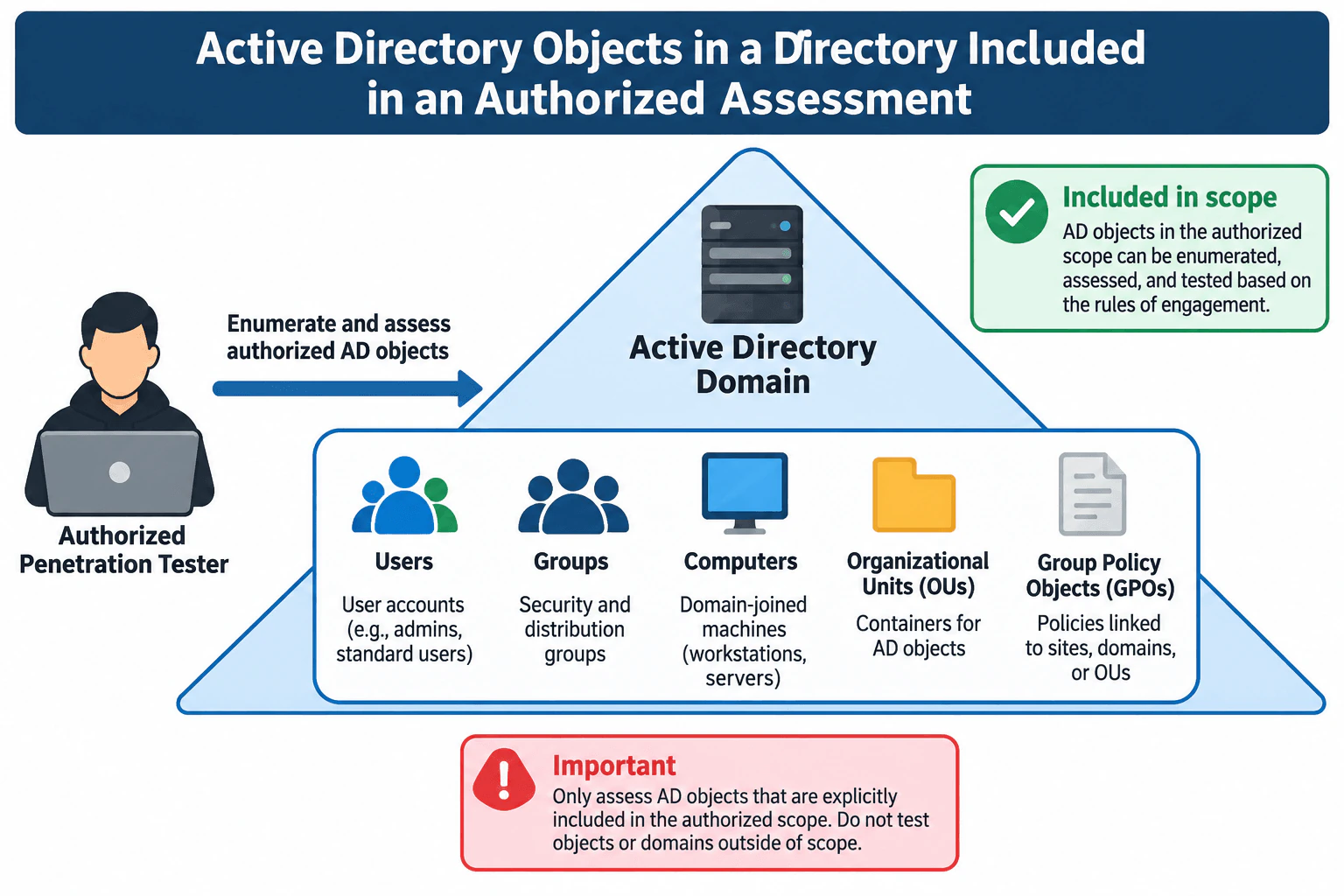
This question asks what a penetration tester may find as objects inside an Active Directory domain that is part of an authorized assessment. Active Directory stores information as directory objects. These objects represent identities, machines, containers, and policy information. The approved diagram shows five important examples: users, groups, computers, organizational units, and Group Policy Objects. The practical security point is that finding an object does not automatically authorize further testing. The written assessment scope and rules of engagement define which domains and objects the tester may enumerate, assess, or test.
Useful Questions to Ask the Interviewer
Is the whole Active Directory domain in scope, or only specified organizational units, systems, or accounts?
Is authenticated directory enumeration allowed, and what test identity should be used?
Are any privileged accounts, production systems, or Group Policy Objects excluded from active testing?
Are there privacy, rate, availability, or evidence-handling limits for the assessment?
How to Explain It in an Interview
Start with the practical definition: an Active Directory object is an entry stored in the directory that represents something Active Directory manages or organizes.
Users: User objects represent user accounts, such as administrator accounts and standard user accounts. They contain directory attributes associated with those identities.
Groups: Group objects collect members for purposes such as access control or distribution. Security groups can be used when assigning permissions, while distribution groups are mainly used for distribution purposes. Group membership can reveal important relationships, but membership alone is not proof of a vulnerability.
Computers: Computer objects represent domain-joined machines such as workstations and servers. A computer object shows that the directory has an identity for that machine. It does not by itself prove that the machine is currently reachable, active, misconfigured, or vulnerable.
Organizational Units, or OUs: OUs are directory containers used to organize Active Directory objects. They can contain objects such as users, groups, and computers and can also contain nested OUs. OUs are commonly used for organization, delegated administration, and Group Policy scope.
Group Policy Objects, or GPOs: GPOs contain policy settings that can apply to users and computers. GPOs can be linked to Active Directory sites, domains, and OUs. Their effective application depends on Group Policy processing and scope, so merely finding a GPO does not prove that it applies to every object in the domain.
The responsibility boundary is the authorized assessment scope. The tester should first confirm which Active Directory domains and objects are approved. The tester then enumerates only the permitted directory information using an approved identity and method. Relevant evidence can include object names, types, approved attributes, memberships, container relationships, and policy links.
The safe failure behavior is to stop and obtain clarification when an object, domain, or activity is outside or unclear in the written authorization. The tester should not assume that directory visibility equals permission to test.
Enumeration provides evidence about directory structure and relationships, not proof of a security weakness. Any suspected vulnerability or misconfiguration requires separate, authorized validation. A limitation is that the tester can generally observe only the objects and attributes visible to the supplied identity, so restricted permissions may reduce coverage.
The main tradeoff is coverage versus safety and privacy. Wider visibility can provide a better understanding of Active Directory relationships, but the tester should collect only information necessary for the assessment and avoid unnecessary exposure of sensitive directory data.
Technical Approach
Read the written scope and rules of engagement.
Confirm the authorized Active Directory domain, organizational units, systems, and identities.
Use only the approved tester identity and permitted level of access.
Identify relevant in-scope object types such as users, groups, computers, OUs, and GPOs.
Record only the approved attributes and relationships needed for the assessment.
Treat enumeration as evidence of directory structure, not proof of a vulnerability.
Validate any suspected weakness separately using a safe, authorized, and non-destructive method.
Stop and obtain clarification when an object or activity is outside or unclear in the authorized scope.
Practical Insights
Understanding the basic object types is simple, but a large Active Directory environment can contain many users, groups, computers, OUs, and GPOs. More objects mean more relationships and evidence to review. Broader enumeration also increases privacy and evidence-handling concerns. The tester therefore balances useful coverage with assessment time, safety, data minimization, and the exact authorized scope.
Why Interviewers Ask This
Interviewers want to confirm that the candidate understands the main types of Active Directory objects and can explain their purpose in simple terms. They also want to see whether the candidate understands that discovering an object does not automatically make it an authorized test target or prove that it is vulnerable.
Common interview mistakes
Common mistakes include treating every visible directory object as automatically in scope, assuming that a computer object proves the associated host is reachable or vulnerable, confusing organizational units with security groups, treating all groups as security groups, assuming a GPO applies everywhere merely because it exists, collecting unnecessary sensitive directory data, and performing intrusive testing without explicit authorization.
Interview tip
Name the five object types shown in the diagram first: users, groups, computers, OUs, and GPOs. Then state the key assessment rule: discovering an Active Directory object is neither permission to attack it nor proof of a vulnerability. Testing must remain inside the written scope.
Interviewer may ask next
What is the difference between an Active Directory group and an organizational unit?
A group is a collection of members and can be used for purposes such as access control or distribution. An organizational unit is a directory container used to organize objects and support delegated administration and Group Policy scope. Putting a user in an OU is therefore different from making that user a member of a group.
Does finding an Active Directory object during enumeration mean it is safe to test that object?
No. Discovery only shows that the authorized tester can observe the object with the available directory access. The written scope and rules of engagement determine whether that object and any further testing against it are permitted. If authorization is unclear, the tester should stop and obtain clarification.
55. What information does packet sniffing provide in an authorized network assessment?Network And Active DirectoryEasy
Short Interview Answer (30-60 seconds)
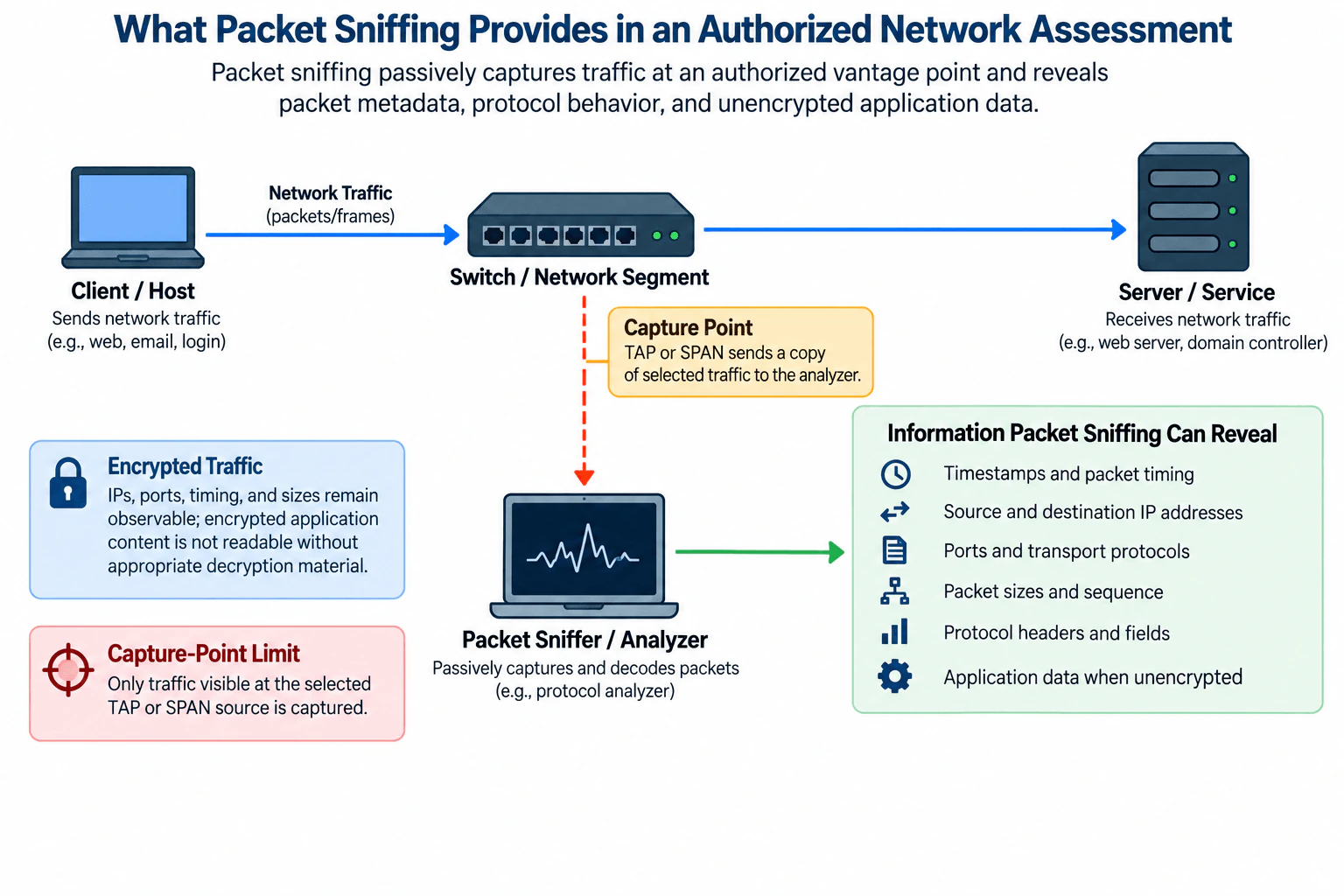
Packet sniffing shows traffic visible at an authorized capture point. It can reveal IP addresses, ports, protocols, timestamps, packet sizes, ordering, protocol headers, and unencrypted application data. Encrypted payloads are normally unreadable, and traffic outside the selected capture point may not be visible.
Detailed Explanation
Packet sniffing lets an authorized penetration tester inspect network packets or frames visible at a chosen capture point. It can show which IP addresses are communicating, which transport protocols and ports are in use, when packets are observed, their sizes and ordering, and fields in protocol headers. For TCP traffic, sequence information can also help explain the conversation. If application data is not encrypted, its contents may be readable. If it is encrypted, useful metadata can remain visible, but protected application content normally cannot be read without appropriate authorized decryption material. Capture location limits what the tester can observe.
Useful Questions to Ask the Interviewer
Where is the authorized capture point: a network TAP, a SPAN or mirrored source, or a host interface?
Is the goal to understand communication patterns, validate a protocol, troubleshoot behavior, or collect evidence for a security finding?
Is approved decryption material available, or should encrypted application content be treated as unreadable?
How to Explain It in an Interview
Start with the practical point: packet sniffing provides direct packet-level evidence about network conversations visible from the authorized capture point.
In the diagram, a client or host communicates with a server or service through a network switch or segment. A TAP or SPAN source supplies a copy of selected traffic to a packet sniffer or analyzer. The analyzer observes and decodes that copied traffic; it is not shown altering the normal client-to-server flow.
From the capture, I can examine timestamps and packet timing, source and destination IP addresses, ports and transport protocols, packet sizes and ordering, and protocol headers and fields. For protocols such as TCP, protocol fields can include sequence-related information. When application data is sent without encryption, the capture may also expose that application content.
Encryption changes the level of visibility. With encrypted application traffic, metadata such as IP addresses, transport ports, timing, packet sizes, and observable protocol fields can still provide useful evidence, while the protected application content normally remains unreadable unless appropriate decryption material is available and its use is authorized.
The capture-point boundary is equally important. A TAP or SPAN source provides only the traffic available or selected at that vantage point. Traffic on another segment, path, or unselected interface may not appear. Therefore, the absence of a packet in one capture does not prove that the communication never occurred elsewhere.
For evidence, I would document the capture location, authorized scope, time window, traffic selection or filters, and the relevant packet observations. I would make conclusions proportional to that evidence. Seeing communication to a particular IP address or port can demonstrate observed network activity, but packet sniffing by itself does not prove that the service is vulnerable or that exploitation succeeded.
The main tradeoff is detailed visibility versus limited scope and sensitive-data exposure. Packet captures can provide strong technical evidence, but they may represent only one network vantage point and may contain confidential information. In an authorized assessment, I would capture only what is needed for the agreed objective and handle the resulting evidence according to the approved assessment rules.
Technical Approach
Confirm that packet capture is authorized and identify the approved network vantage point.
Capture only traffic needed for the assessment objective, such as traffic copied from the selected TAP or SPAN source.
Identify the communicating source and destination IP addresses.
Review timestamps, transport protocols, ports, packet sizes, packet ordering, and relevant protocol-header fields.
For TCP traffic, examine sequence-related fields when they help explain the conversation.
Inspect application data only when it is readable and authorized for review.
Treat encrypted application content as unreadable unless appropriate authorized decryption material is available.
Record the capture point, time window, and relevant selection or filter conditions so the evidence can be interpreted correctly.
Report only conclusions directly supported by the captured traffic.
Practical Insights
Technically, focused packet capture is usually straightforward, but large captures can require significant storage, processing, and review time. Operationally, the team must choose the correct capture point because one TAP or SPAN source may not see every path. Human effort can increase when analysts must separate useful packets from large amounts of normal traffic. Financial cost may come from capture infrastructure, storage, tooling, and analyst time. Privacy, contractual, or compliance requirements may affect how captured data is collected, stored, shared, retained, and deleted. Maintenance includes keeping capture procedures, filters, permissions, evidence storage, and documentation controlled and reproducible.
Why Interviewers Ask This
Interviewers want to confirm that you understand what packet capture can directly reveal, what remains observable when traffic is encrypted, and why the capture location matters. A strong answer separates packet-level evidence from assumptions and does not treat observed traffic, an open port, or a protocol as proof of a vulnerability.
Common interview mistakes
Common mistakes are saying that packet sniffing automatically sees all traffic on the network, claiming that encrypted application content is readable without suitable decryption material, treating packet observations as proof of a vulnerability, and forgetting that the capture point determines visibility. Another mistake is interpreting source and destination information without considering the network vantage point or collecting more traffic than the authorized assessment requires.
Interview tip
Lead with what packet sniffing reveals, then immediately state its two key limits: capture-point visibility and encryption. Use evidence-focused language such as "the capture shows" or "the packets demonstrate" instead of claiming that packet sniffing alone proves a vulnerability.
Interviewer may ask next
What can you still learn from packet sniffing when the application traffic is encrypted?
You can still learn useful metadata from traffic visible at the authorized capture point. Depending on the protocol and layer being observed, this can include source and destination IP addresses, transport ports, timestamps, packet sizes, packet ordering, and visible protocol-header fields. For TCP, sequence-related fields may also be available. The protected application content itself should be treated as unreadable unless appropriate authorized decryption material is available.
Why does the packet-capture location matter during a network assessment?
A packet sniffer can analyze only traffic delivered or copied to its capture interface. A TAP or SPAN source therefore defines the tester's visibility. Traffic using another segment, path, interface, or unselected source may not appear in the capture. Because of this, missing packets at one capture point do not prove that the communication never occurred elsewhere.
56. How do TCP and UDP differ in an authorized network-security assessment?Network And Active DirectoryEasy
Short Interview Answer (30-60 seconds)
TCP is connection-oriented and provides reliable, ordered delivery, so its responses often give clearer port-state evidence. UDP has no connection setup or delivery guarantee, so results can be more ambiguous. I use service-specific UDP probes, controlled retries, and safe timing before drawing conclusions.
Detailed Explanation
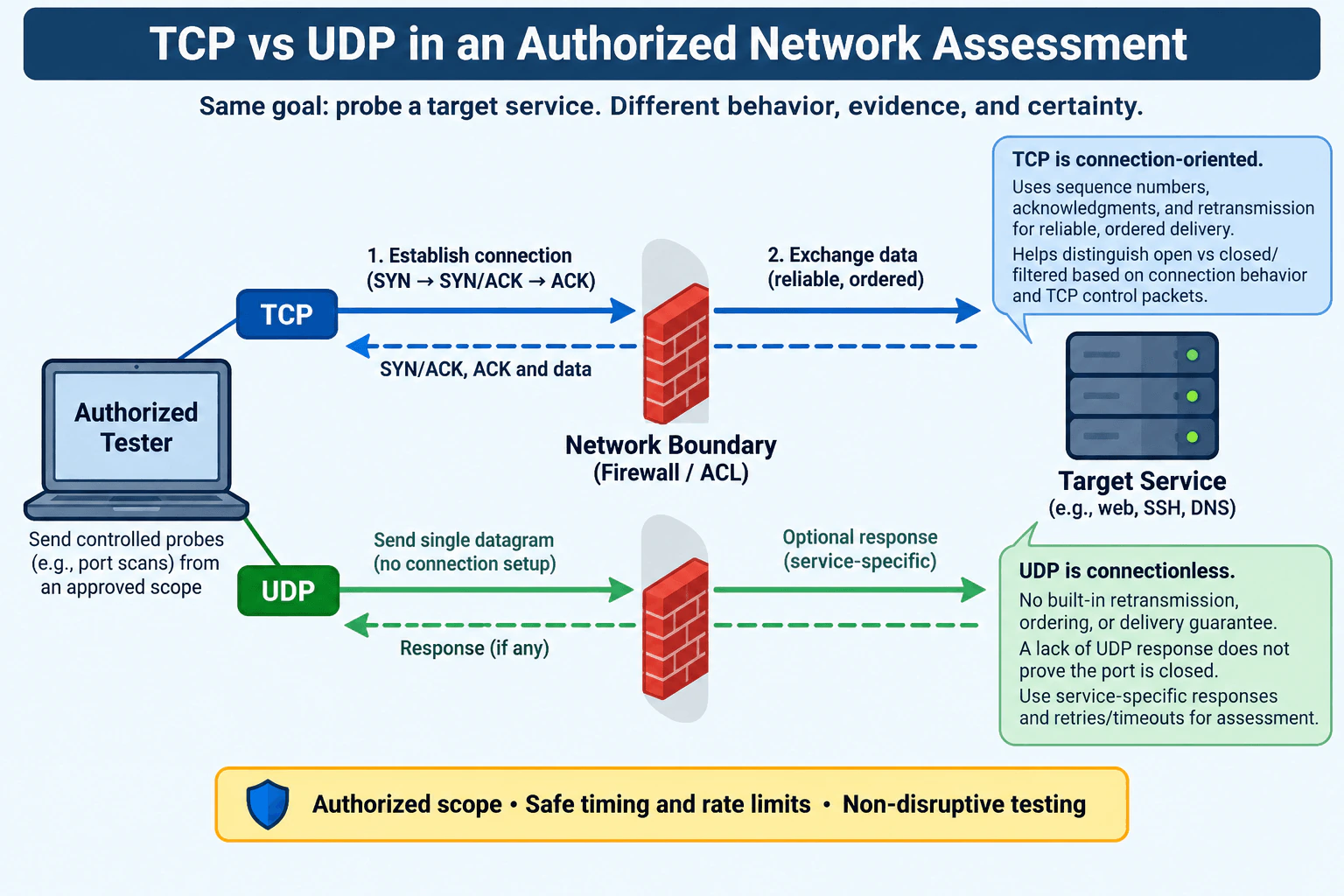
This question asks how TCP and UDP change the evidence an authorized tester can collect from a target service. TCP is connection-oriented: endpoints establish a connection, and TCP provides a reliable, in-order byte stream using sequence numbers, acknowledgments, and retransmission. UDP is connectionless: a tester can send a datagram without a handshake, but UDP does not guarantee delivery, ordering, or retransmission. In practice, TCP usually gives clearer connection-state evidence, while UDP often requires service-specific probes, controlled retries, and careful interpretation because silence does not prove a port is closed.
Useful Questions to Ask the Interviewer
Are both TCP and UDP services included in the approved assessment scope?
What authorized source network or testing vantage point should be used?
Is there a firewall or access-control list between the tester and the target service?
What timing, retry, and rate limits are required to protect service availability?
How to Explain It in an Interview
Start with the transport behavior. TCP is connection-oriented. In the normal connection flow shown in the diagram, the tester sends SYN, the target replies with SYN/ACK, and the tester sends ACK. After the connection is established, TCP provides a reliable, in-order byte stream. Sequence numbers and acknowledgments help detect missing data, and TCP retransmits data when loss is detected.
The diagram shows the authorized tester sending controlled TCP traffic across a network boundary such as a firewall or access-control list toward the target service. TCP control responses can provide useful evidence about whether the path and service accept a connection. In an assessment, this generally gives more explicit port-state evidence than UDP. However, a responding TCP port proves exposure or service reachability, not a vulnerability or verified impact.
UDP behaves differently. It is connectionless, so the tester can send a datagram without a TCP-style connection setup. The diagram shows a single UDP datagram crossing the same network boundary toward the target service. The service may return a service-specific response, a network device or host may return an error, or there may be no response. UDP itself does not provide built-in retransmission, ordering, or delivery guarantees.
The lack of a UDP response is an important limitation. Silence does not prove that the port is closed. A firewall may silently drop the probe or response, the application may ignore a request it does not understand, or the packet may be lost. Therefore, an authorized tester should use a valid service-specific request when appropriate, apply only approved retries and timeouts, and keep the result ambiguous when the evidence is inconclusive.
The network boundary matters for both protocols. A firewall or access-control list can permit, reject, or silently drop traffic. The tester should record the authorized source, destination, protocol, destination port, target service, testing vantage point, and observed response. This helps separate network reachability, port state, and service identification from later findings such as a configuration weakness, exploitable vulnerability, or verified impact.
Safe testing is also essential. Keep traffic inside written scope, use safe timing and rate limits, and avoid disruptive testing. UDP retries can increase traffic when responses are missing, so they should be bounded. TCP connection attempts can also consume service resources, so they should be controlled and stopped if service stability is affected.
The main tradeoff is confidence versus testing effort. TCP supplies more transport-level feedback and reliable delivery behavior, so results are often easier to interpret. UDP has less connection overhead, but assessment evidence can be less certain and may require more protocol-specific knowledge, retries, and validation. In both cases, report only what the observed evidence supports.
Technical Approach
Confirm that the tester source, target host, protocol, destination ports, and network path are explicitly authorized.
Identify whether each scoped service uses TCP, UDP, or both instead of assuming both transports behave the same way.
For TCP, send a controlled connection-oriented probe and record the TCP response observed across the firewall or access-control boundary.
If a full TCP connection is appropriate and authorized, establish it using the normal SYN, SYN/ACK, ACK sequence and perform only non-destructive service validation.
For UDP, send a controlled service-specific datagram when the protocol supports one.
Record a UDP response, returned network error, or lack of response as separate evidence states.
If UDP is silent, use only the approved number of retries and timeout intervals; do not label silence as proof that the port is closed.
Correlate the result with the source, destination, protocol, port, service, boundary, and observed response before reporting it.
Keep traffic within approved timing and rate limits and stop if service availability or stability is affected.
Practical Insights
TCP results are often easier to interpret because TCP provides explicit connection behavior and reliable delivery. UDP testing can take more time because a valid service may remain silent, filtering may also produce silence, and the tester may need service-specific requests plus controlled retries. Both protocols create network and service load, so timing and rate limits matter. The operational cost is mainly the effort needed to understand the service, validate ambiguous evidence, document the network path, and avoid false conclusions.
Why Interviewers Ask This
Interviewers want to know whether you understand how TCP and UDP behave on the network and how those differences affect safe port-state and service validation during an authorized assessment. They are also checking whether you can interpret network evidence carefully instead of treating every response, timeout, or reachable port as proof of a vulnerability.
Common interview mistakes
Common mistakes include treating TCP and UDP as if they provide the same evidence, assuming every TCP assessment must complete a full application connection, treating a reachable port as a vulnerability, assuming no UDP response means the port is closed, sending inappropriate generic UDP probes when a service-specific request is needed, using excessive retries, ignoring the firewall or ACL boundary, and reporting a scanner state without recording the source, destination, protocol, port, and observed evidence.
Interview tip
Lead with the protocol difference: TCP is connection-oriented and reliable, while UDP is connectionless and gives less certain response evidence. Then connect that difference to assessment practice by mentioning the TCP handshake, UDP ambiguity, service-specific validation, firewall boundaries, safe retries, and the rule that an open or reachable port is not automatically a vulnerability.
Interviewer may ask next
Why can a UDP port be difficult to classify during a network-security assessment?
A UDP service may not answer an unexpected or invalid datagram even when it is listening. A firewall can also silently drop the probe or response, and UDP does not guarantee delivery. Therefore, no response alone cannot prove that the port is closed. I would use an authorized service-specific request, controlled retries and timeouts, and report the result as ambiguous when the evidence remains inconclusive.
Does an open TCP or UDP port prove that the target is vulnerable?
No. An open or responding port shows network exposure or service reachability from that authorized testing location. The tester still has to identify the service and separately validate any configuration weakness, exploitable vulnerability, and impact within scope. Port state, service identification, vulnerability, and verified impact are different conclusions.
57. How does Kerberos authenticate users to services in an Active Directory environment under authorized review?Network And Active DirectoryMedium
Short Interview Answer (30-60 seconds)
Kerberos uses the domain controller's Key Distribution Center to issue a TGT and then a service ticket for the requested SPN. The client presents that service ticket with a fresh authenticator to the service, which validates the Kerberos evidence and then applies its authorization policy.
Detailed Explanation
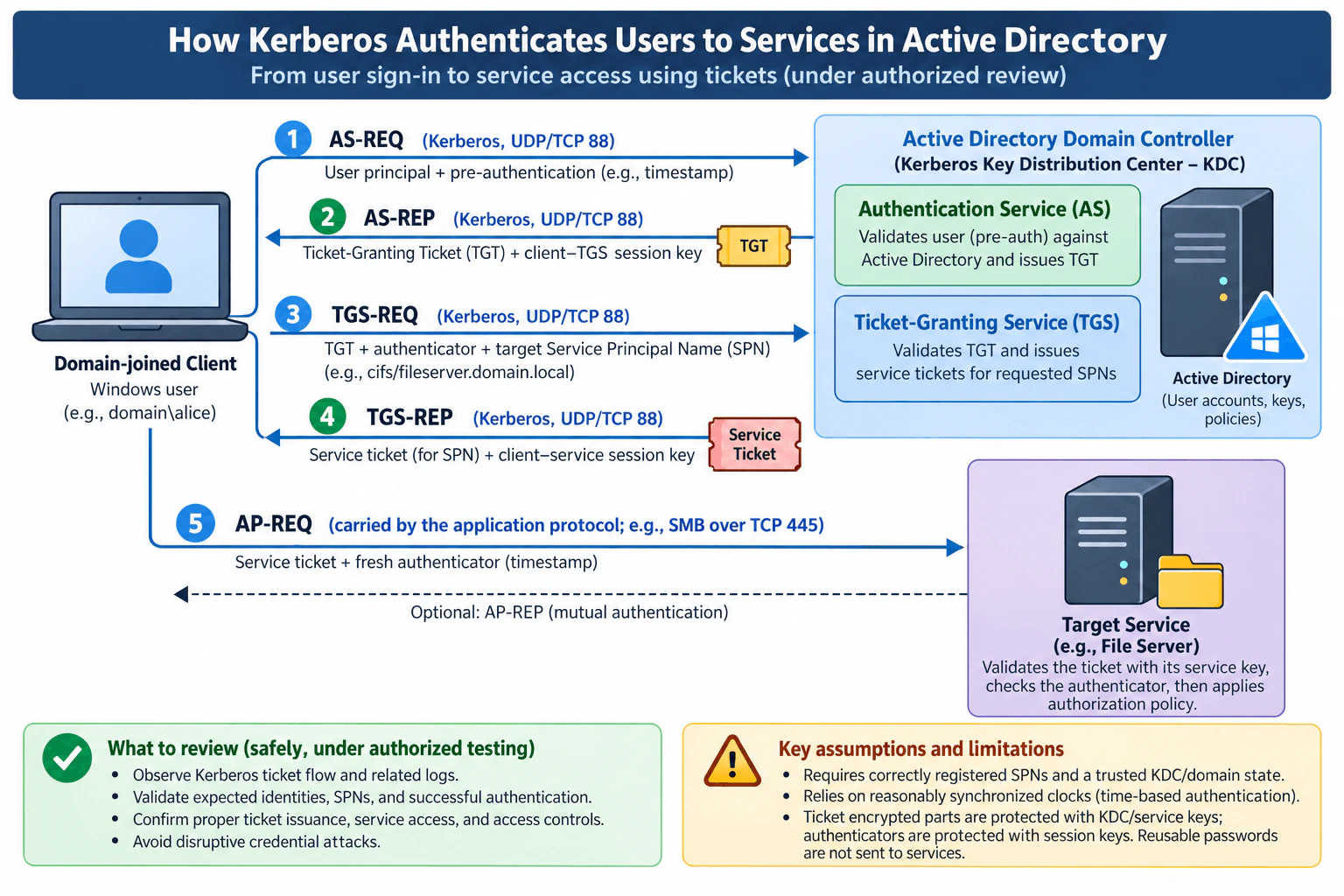
Kerberos lets a domain user prove identity to services without sending a reusable password to each service. In Active Directory, the Key Distribution Center, or KDC, runs on a domain controller and provides the Authentication Service and Ticket-Granting Service. The client first obtains a Ticket-Granting Ticket, or TGT. It then uses that TGT to request a service ticket for a Service Principal Name, or SPN. Finally, the client presents the service ticket and a fresh authenticator to the target service, which validates them before separately applying authorization policy.
Useful Questions to Ask the Interviewer
Which domain, client, domain controllers, and target services are inside the authorized review scope?
Are we validating only normal Kerberos authentication behavior, or are configuration weaknesses also in scope?
Which service and SPN should be used for the approved validation example?
Are packet captures and authentication logs approved as evidence sources?
Are disruptive credential attacks, relaying, ticket manipulation, or exploitation explicitly excluded?
How to Explain It in an Interview
The practical decision is to verify that a domain client receives the correct Kerberos tickets, presents them to the intended service, and receives access only when both authentication and the service's authorization checks succeed.
The domain-joined client starts the Authentication Service exchange with the KDC on the Active Directory domain controller. It sends an AS-REQ containing the user's principal information and, in the common pre-authentication flow shown in the diagram, timestamp-based pre-authentication data. Client-to-KDC Kerberos exchanges use TCP or UDP port 88.
The Authentication Service validates the pre-authentication data for the user. If the request is valid, the KDC sends an AS-REP containing a Ticket-Granting Ticket and a client-to-TGS session key. The TGT is protected for the KDC and allows the client to make later service-ticket requests without sending the user's reusable password to target services.
When the user wants a particular service, the client sends a TGS-REQ to the Ticket-Granting Service. The request includes the TGT, an authenticator, and the target Service Principal Name. An SPN identifies the Kerberos service instance, for example the CIFS identity of an approved file server.
The TGS validates the TGT and authenticator. If valid, it returns a TGS-REP containing a service ticket for that SPN and a client-to-service session key. The encrypted part of the service ticket is protected with the key associated with the target service so that the service can validate the ticket.
The client sends an AP-REQ to the target service. This Kerberos application exchange is carried by the application's protocol rather than by a separate port-88 service connection. In the file-server example shown in the diagram, SMB can carry the exchange over TCP 445. The AP-REQ contains the service ticket and a fresh authenticator protected with the client-to-service session key.
The target service validates the service ticket with its service key and checks the authenticator with the client-to-service session key. The authenticator's freshness helps defend against simple replay of an old application request. After Kerberos authentication succeeds, the service separately applies its authorization policy to decide what the authenticated identity may access.
If mutual authentication is requested, the service can return an AP-REP so the client can authenticate the service as well. AP-REP is therefore conditional rather than required for every Kerberos application exchange.
The main trust relationship is among the client, the KDC on the domain controller, and the target service. The KDC is trusted to issue tickets for domain identities and registered service identities. The target service is responsible for validating its service ticket and enforcing authorization. Correct SPN registration and reasonably synchronized clocks are important assumptions because Kerberos depends on the intended service identity and time-based authenticators.
During an authorized review, I would observe the normal Kerberos ticket flow and related logs, confirm the expected user identity and SPN, verify that the KDC issues the expected TGT and service ticket, and confirm that the intended service accepts or denies the request according to policy. I would avoid disruptive credential attacks, relaying, or exploitation unless those actions were separately and explicitly authorized.
A successful Kerberos exchange demonstrates authentication to the service, not unlimited authorization. The service still decides whether the authenticated identity may read a file, access a share, or perform another operation. Another limitation is that observing one successful ticket exchange does not prove that every SPN, service account, domain configuration, or authorization rule is secure.
Technical Approach
Confirm written authorization, the domain, client, domain controllers, target service, expected identity, and expected SPN.
From the approved domain-joined client, observe the AS-REQ and AS-REP exchange with the KDC and confirm that a TGT is issued for the expected identity.
Observe the TGS-REQ and TGS-REP exchange and confirm that the requested SPN matches the approved target service and that a service ticket is returned.
Observe the application connection carrying the AP-REQ, such as approved SMB traffic to the file server, and confirm that the service ticket and fresh authenticator are presented to the intended service.
Confirm that the target service validates the Kerberos authentication and then separately applies its authorization policy.
If mutual authentication is part of the approved scenario, confirm the AP-REP response.
Correlate client, KDC, and service evidence while minimizing collection of credentials, tickets, and other sensitive material.
Record successful and expected denied outcomes, and stop if testing could affect account lockout, service stability, or availability.
Practical Insights
Kerberos is efficient because a client can reuse a valid TGT to request service tickets instead of repeating a full credential-based authentication for every service. Operational cost comes from maintaining reliable domain controllers, correct SPNs and service keys, synchronized clocks, protected privileged accounts, useful authentication logs, and troubleshooting processes. For an authorized review, the main human cost is defining scope and correlating client, KDC, and service evidence. The safest approach avoids password guessing, relaying, or disruptive testing unless those actions are explicitly authorized.
Why Interviewers Ask This
Interviewers want to see whether the candidate understands the Kerberos trust model in Active Directory, including the client, domain controller, Key Distribution Center, Authentication Service, Ticket-Granting Service, Ticket-Granting Ticket, Service Principal Name, service ticket, authenticator, and target service. They also want the candidate to distinguish authentication from authorization and explain how to validate the flow safely during an authorized assessment without turning normal verification into disruptive credential testing.
Common interview mistakes
Common mistakes are saying that the user's password is sent to the target service, confusing the TGT with the service ticket, treating the Authentication Service and Ticket-Granting Service as unrelated systems instead of KDC functions on the domain controller, forgetting that the TGS request identifies the target through an SPN, saying that the AP exchange itself always uses port 88, assuming AP-REP is mandatory when it is associated with mutual authentication, or treating successful Kerberos authentication as proof that the user is authorized for every resource. During testing, another mistake is moving from normal ticket observation to credential attacks, relaying, or exploitation without explicit authorization.
Interview tip
Explain the flow in three phases: get a TGT, exchange it for a service ticket, then present that ticket to the service. Name AS-REQ/AS-REP, TGS-REQ/TGS-REP, and AP-REQ, but keep the explanation centered on why each step exists. Finish by separating authentication from authorization and mention that an authorized review should validate identities, SPNs, ticket issuance, service acceptance, logs, and expected denials without unnecessary credential attacks.
Interviewer may ask next
What is the difference between a Ticket-Granting Ticket and a service ticket in Kerberos?
A Ticket-Granting Ticket is issued by the KDC's Authentication Service after the initial authentication step and is presented to the Ticket-Granting Service when the client needs tickets for individual services. A service ticket is issued for a specific target service identified by an SPN. The client presents that service ticket to the target service, not the TGT. This separation lets the user authenticate to the domain and then obtain tickets for individual services without sending a reusable password to each service.
What can cause a legitimate Kerberos authentication flow to fail even when the user's credentials are correct?
Failures can result from an incorrect or duplicate SPN, inability to reach the KDC, account or ticket policy problems, a service-key mismatch, excessive clock skew affecting time-based authentication checks, or the target service rejecting the ticket. Kerberos authentication can also succeed while access is denied because the service's authorization policy does not permit the requested action. During an authorized review, I would correlate client, KDC, and service evidence before concluding which condition caused the failure.
58. Where are Group Policy Objects stored in an Active Directory environment included in an authorized review?Network And Active DirectoryMedium
Short Interview Answer (30-60 seconds)
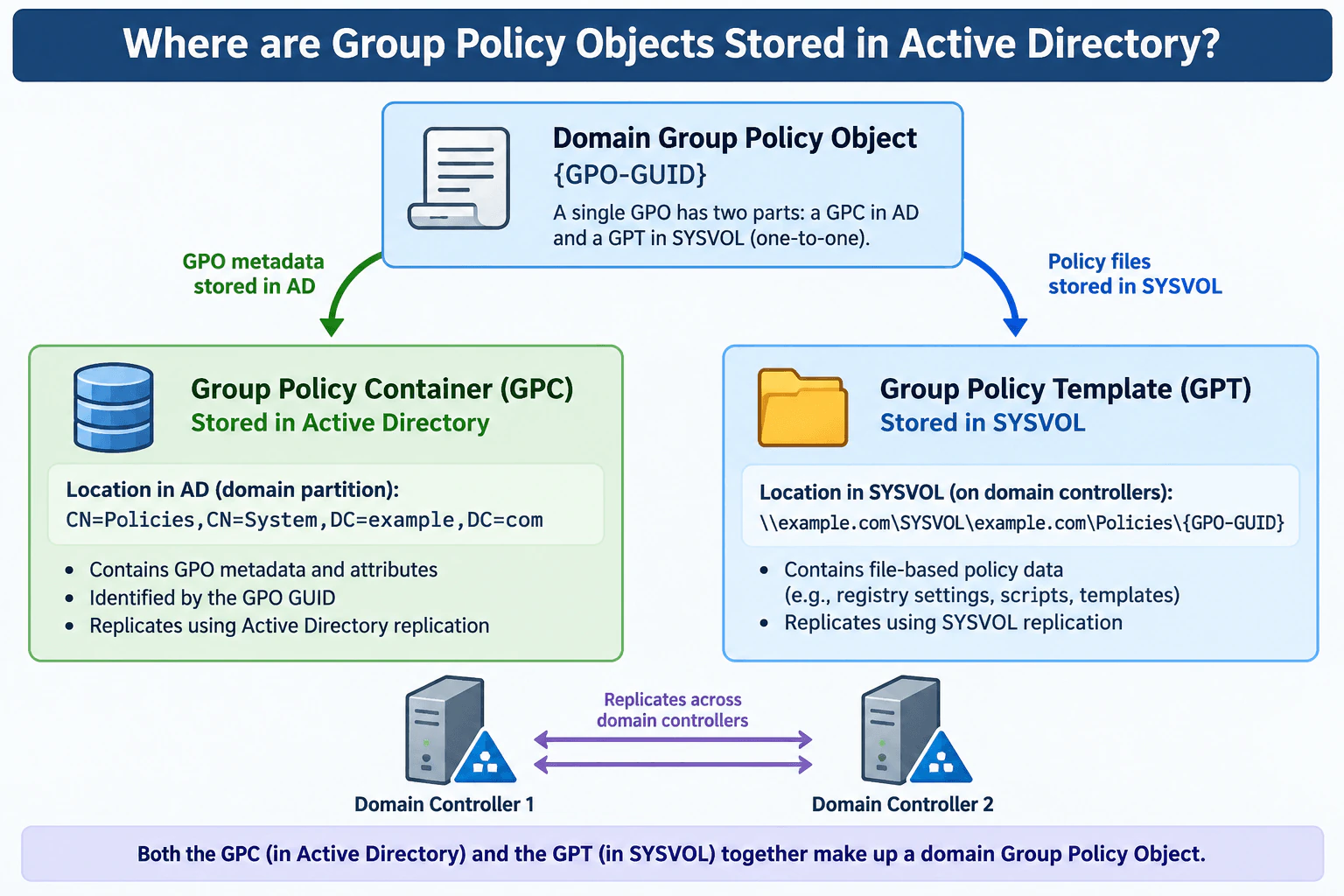
A domain GPO has two linked parts. The Group Policy Container is stored in the Active Directory domain partition, while the Group Policy Template is stored in SYSVOL on domain controllers. Together, these two components make up the complete domain GPO.
Detailed Explanation
The key point is that a domain Group Policy Object is not stored in only one place. It has two linked components. The Group Policy Container, or GPC, is stored in the Active Directory domain partition and contains GPO metadata and attributes. The Group Policy Template, or GPT, is stored in SYSVOL on domain controllers and contains file-based policy data. The GPO's globally unique identifier, or GUID, identifies the corresponding policy components. During an authorized review, both locations matter because examining only one component gives an incomplete view of the domain GPO.
Useful Questions to Ask the Interviewer
Is the review limited to identifying where GPO data is stored, or should I also explain how the two components replicate?
Should I describe the typical Active Directory and SYSVOL locations for a domain GPO?
Is the environment using domain-based Group Policy rather than only Local Group Policy?
How to Explain It in an Interview
Start with the two-part model. A domain Group Policy Object consists of a Group Policy Container and a Group Policy Template.
The Group Policy Container, or GPC, is the Active Directory portion. It is stored in the domain partition under the Policies container, typically beneath CN=Policies,CN=System,DC=example,DC=com. The GPC contains GPO metadata and attributes, including identification and version-related information. This directory component is replicated through Active Directory replication.
The Group Policy Template, or GPT, is the file-based portion. It is stored in the domain's SYSVOL structure on domain controllers. A typical path is \\example.com\SYSVOL\example.com\Policies\{GPO-GUID}. It contains file-based policy data such as registry policy files, scripts, and other policy files. SYSVOL content is replicated between domain controllers through the domain's SYSVOL replication mechanism.
The important point is that these are two storage locations for one logical domain GPO. Active Directory stores the GPC, and SYSVOL stores the GPT. The corresponding GPC and GPT together represent that GPO.
For an authorized penetration test, I would treat both as evidence sources. I would inspect the GPC to understand directory-side metadata and inspect the corresponding GPT to understand file-based policy content. I would keep the review read-only unless the rules of engagement explicitly authorize changes.
A useful validation step is to correlate the GPC with its corresponding SYSVOL policy folder using the GPO identifier and directory metadata. If replication consistency is part of the review, I would also record which domain controller supplied the evidence because replicated copies can temporarily differ while changes are converging.
The main limitation is that locating a GPO does not prove that the policy is applied to a particular user or computer, and it does not prove a vulnerability. Effective application depends on factors such as GPO links, scope, security filtering, inheritance, processing rules, and the resulting client state. Those are separate validation questions. Reviewing both storage components requires slightly more effort, but it avoids drawing conclusions from only part of the GPO.
Technical Approach
Confirm that the review is authorized and that the target is a domain-based GPO.
Identify the GPO and its GUID or other approved identifier.
Review the corresponding Group Policy Container in the Active Directory domain partition under the Policies container.
Review the corresponding Group Policy Template under the domain's SYSVOL Policies path.
Correlate the GPC and GPT using the GPO identifier and relevant directory metadata.
Record relevant metadata and file-based policy evidence without modifying production content.
If replication consistency is in scope, compare evidence from the appropriate domain controllers and document any observed differences.
Do not claim that the GPO is effective on a target system merely because its storage components exist; validate application separately if authorized and required.
Practical Insights
The technical cost is low for simply locating the two GPO components, but a complete review takes more time because Active Directory metadata and SYSVOL files must both be examined and correlated. Operational risk is low when the review remains read-only. Maintenance complexity comes from the fact that the two components use different replication paths and must remain consistent across domain controllers. Human error is also possible if a reviewer mistakes the existence of a GPO for proof that it applies to a specific user or computer. Financial and compliance costs depend on the organization's environment and are not established by this question alone.
Why Interviewers Ask This
Interviewers want to confirm that you understand the two-part storage model of a domain Group Policy Object and can distinguish Active Directory metadata from file-based policy content in SYSVOL. For a penetration tester, this also shows that you know which evidence sources should be reviewed without confusing either storage location with the complete GPO.
Common interview mistakes
Common mistakes are saying that GPOs are stored only in Active Directory or only in SYSVOL; confusing the Group Policy Container with the Group Policy Template; treating the SYSVOL folder alone as the entire GPO; forgetting that the two components correspond to the same logical GPO; assuming that finding a GPO proves it is applied to a particular user or computer; and modifying GPO data during a review without explicit authorization. Another mistake is ignoring replication and assuming that every domain controller must show an identical copy at every instant while changes are propagating.
Interview tip
Lead with the two-part answer: GPC in the Active Directory domain partition and GPT in SYSVOL. Then give one typical location for each and explain that both components together make up the domain GPO. For a penetration-testing interview, add that you would review both read-only and would not confuse GPO storage with proof of actual policy application.
Interviewer may ask next
What is the difference between the Group Policy Container and the Group Policy Template?
The Group Policy Container is the directory-side portion of a domain GPO. It is stored in the Active Directory domain partition and contains GPO metadata and attributes. The Group Policy Template is the file-side portion stored in SYSVOL on domain controllers and contains file-based policy data such as registry policy files and scripts. Together, the corresponding GPC and GPT form the logical domain GPO.
If a GPO exists in Active Directory and SYSVOL, does that prove it is applied to a specific computer?
No. The existence of the GPC and GPT shows that the domain GPO exists, but it does not prove that the GPO applies to a particular computer or user. Effective application depends on factors such as where the GPO is linked, its scope, security filtering, inheritance and processing rules, and the target's actual policy processing. Those factors must be validated separately if they are part of the authorized review.
59. Where does Active Directory store user-account data in a domain under authorized review?Network And Active DirectoryMedium
Short Interview Answer (30-60 seconds)
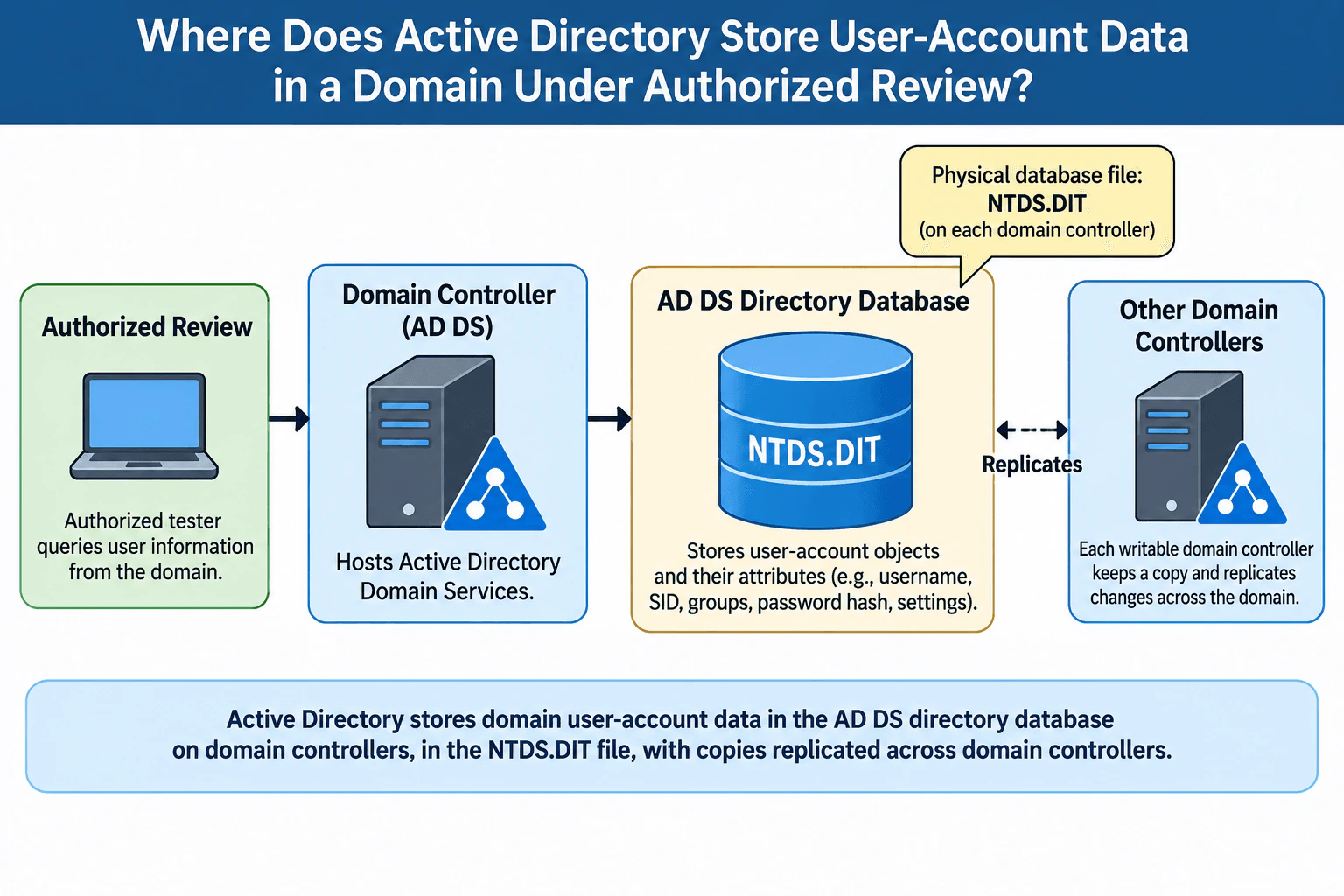
Active Directory Domain Services stores domain user accounts as directory objects in the AD DS database on domain controllers. The physical database file is Ntds.dit. Writable domain controllers keep replicas of the domain directory partition, and AD DS replication propagates changes between them.
Detailed Explanation
The practical answer is that Active Directory Domain Services, or AD DS, stores domain user accounts as directory objects in its database on domain controllers. The physical database file is Ntds.dit. User objects contain attributes such as account names, security identifiers, group relationships, account settings, and protected credential-related data. In a normal domain, writable domain controllers that host the domain directory partition maintain writable replicas of that partition. AD DS replication propagates directory changes between those domain controllers so their copies of the directory can converge.
Useful Questions to Ask the Interviewer
Are you asking specifically about AD DS domain accounts rather than local Windows accounts?
Do you want only the physical storage location, or should I also explain replication between domain controllers?
Is the authorized review limited to normal directory queries, or is offline database analysis explicitly in scope?
How to Explain It in an Interview
Start with the storage location. A domain user is an object in the AD DS directory. The directory database is hosted on domain controllers, and its physical database file is Ntds.dit.
The main responsibility boundary is the domain controller. The diagram shows an authorized tester querying user information from the domain, the domain controller hosting Active Directory Domain Services, and AD DS storing the directory objects in Ntds.dit. During a normal authorized review, the tester should use approved directory or administrative interfaces and the permissions granted by the rules of engagement rather than treating Ntds.dit as an ordinary file.
User-account objects contain attributes. These can include the username, security identifier or SID, group relationships, account settings, and protected credential-related information such as password-derived data. The database therefore contains sensitive identity information, but that does not mean an ordinary directory query can read every stored attribute. AD DS access controls and special protections restrict sensitive data.
The diagram also shows replication to other domain controllers. Writable domain controllers that hold the same domain directory partition maintain writable replicas. When a directory object or attribute changes on one writable domain controller, AD DS replication propagates that change to other domain controllers that hold a replica of that partition. This distributed model lets multiple domain controllers provide directory and authentication services.
For evidence during an authorized review, confirm the domain and domain-controller role through approved administrative information and use a least-privileged directory query to observe permitted user-object attributes. Seeing a user object through AD DS supports the conclusion that the account is stored in the directory. It does not prove that every sensitive attribute is readable or that direct access to Ntds.dit is permitted.
A useful limitation is that replication behavior depends on the type of domain controller and directory partition. A writable domain controller stores a writable replica of its local domain partition. A read-only domain controller stores read-only directory partitions and has different password-caching behavior. Global catalog servers additionally hold partial, read-only replicas of other domains in the forest.
The main tradeoff is availability versus protection and operational complexity. Replicated directory storage avoids dependence on a single domain controller, but administrators must protect every domain controller that holds sensitive directory data and maintain healthy replication. Replication also is not the same as backup because unwanted or accidental directory changes can replicate to other controllers.
Technical Approach
Confirm that the scope is an authorized AD DS domain review and that the question concerns domain accounts rather than local machine accounts.
Identify the domain controller as the system hosting Active Directory Domain Services.
State that domain user accounts are directory objects stored in the AD DS directory database.
Identify Ntds.dit as the physical AD DS database file on a domain controller.
Explain that writable domain controllers holding the domain directory partition maintain replicas and exchange directory changes through AD DS replication.
Validate the conclusion through approved, least-privileged directory or administrative evidence rather than attempting direct database-file access unless that activity is explicitly authorized.
Do not claim that every stored attribute is readable to the tester; access remains controlled by AD DS permissions and protections.
Practical Insights
The storage concept is simple, but operating it securely takes work. Multiple domain controllers improve availability because the domain does not depend on one server. The cost is that administrators must patch, monitor, back up, secure, and maintain replication for multiple systems. Each domain controller that holds sensitive directory data must be strongly protected. During an authorized review, the tester should use only the permissions and account information needed for the assessment.
Why Interviewers Ask This
This checks whether the candidate understands where Active Directory Domain Services stores domain identities, the role of domain controllers and Ntds.dit, and why replicated directory copies exist. It also tests whether the candidate can distinguish AD DS domain-account storage from unrelated stores such as SYSVOL, the local Security Accounts Manager database, or an ordinary application database.
Common interview mistakes
Common mistakes include saying that all user-account data exists only on one central domain controller, confusing Ntds.dit with SYSVOL, confusing domain accounts with accounts stored in the local Security Accounts Manager database, or implying that an authorized tester can simply open Ntds.dit like a normal file. Another mistake is treating AD DS replication as a backup mechanism. Replication propagates directory state and changes, so it does not replace proper backup and recovery. Candidates should also avoid implying that every sensitive attribute can be read through a normal directory query.
Interview tip
Lead with the direct answer: domain user accounts are AD DS objects stored in the Ntds.dit directory database on domain controllers. Then add that writable domain controllers replicate the domain directory partition. Mention permissions or read-only domain controllers only if the interviewer asks for more detail.
Interviewer may ask next
Do all writable domain controllers in a domain store the same user-account data?
Writable domain controllers that host the domain directory partition maintain writable replicas of that partition, which includes the domain's user objects. AD DS replication propagates object and attribute changes between those domain controllers so the replicas converge. Replication is not necessarily instantaneous, so temporary differences can exist while changes are propagating.
Can an authorized penetration tester directly read Ntds.dit to review user accounts?
Not as part of a normal least-privileged directory review. Ntds.dit is a protected AD DS database containing sensitive directory and credential-related data. An authorized tester should normally query permitted directory information through approved AD DS or administrative interfaces. Direct acquisition or offline analysis of Ntds.dit should occur only when the rules of engagement explicitly authorize that activity and appropriate handling controls are in place.
60. How does Kerberoasting work in an authorized Active Directory laboratory assessment?Network And Active DirectoryHard
Short Interview Answer (30-60 seconds)
Kerberoasting uses a valid domain identity to request a service ticket for an SPN. The domain controller returns a ticket encrypted using the service account's Kerberos key material. In an authorized lab, that ticket can be tested offline to determine whether the service account uses a weak password.
Detailed Explanation
Kerberoasting tests whether normal Active Directory Kerberos service-ticket behavior can expose a weak service-account password. In the authorized lab shown, the tester signs in with a normal domain account and obtains a valid ticket-granting ticket, or TGT. The tester requests a service ticket for an approved Service Principal Name, or SPN. The domain controller's Key Distribution Center, or KDC, returns the ticket encrypted using key material associated with the service account. The returned ticket can then be saved and analyzed offline, without sending password guesses back to the domain controller.
Useful Questions to Ask the Interviewer
Is the assessment restricted to an isolated Active Directory laboratory with written authorization and no production systems?
Are offline password tests explicitly allowed, and are only approved laboratory wordlists or synthetic credentials in scope?
Should I discuss both legacy RC4 and modern AES Kerberos encryption types?
Do you want prevention and detection controls in addition to the Kerberoasting flow?
How to Explain It in an Interview
The practical decision is whether an approved SPN-backed service account has credential or Kerberos configuration weaknesses that make its password realistically recoverable, while keeping all testing inside the authorized laboratory boundary.
First, the authorized tester signs in with an ordinary domain user account. Normal Kerberos authentication provides that user with a valid ticket-granting ticket, or TGT. Kerberoasting does not require the tester to begin with domain-administrator privileges.
Next, the tester selects an approved service identified by a Service Principal Name, or SPN. In the diagram, the example is HTTP/webapp. The tester sends a Kerberos TGS-REQ to the domain controller's KDC for that target SPN using the valid TGT.
The KDC processes the request and returns a TGS-REP containing the requested service ticket. The service-ticket portion is encrypted using key material associated with the account that owns the SPN. The exact cryptographic derivation depends on the negotiated Kerberos encryption type. With RC4-HMAC, the relevant account key is based on the account's NT password hash. AES Kerberos encryption uses password-derived AES key material instead. Therefore, it is more precise to say that the ticket is protected by the service account's Kerberos key rather than saying that every ticket literally contains or is encrypted with an NTLM hash.
The returned service ticket can be saved for offline analysis. This is the central security property Kerberoasting abuses: candidate passwords can be evaluated locally against the captured ticket material instead of being submitted repeatedly to the domain controller. In this authorized laboratory, testing should use only approved wordlists or synthetic credentials, remain bounded and rate-limited, and follow the agreed stop conditions.
There are two safe result paths. If an approved weak service-account password is recovered, the tester has demonstrated weak credential resistance and records only the evidence required by the rules of engagement. If no approved password candidate succeeds, the correct conclusion is that no weak password was demonstrated within that wordlist, compute budget, and time limit. It does not prove that the password is impossible to recover or that the account has no other security weaknesses.
The trust boundary is the isolated Active Directory laboratory. The domain controller is performing legitimate Kerberos behavior when it issues an authorized service ticket. The mere ability of a domain user to request that ticket is therefore not itself proof of a vulnerability. The security concern is whether the service-account key can be derived from a weak password within a practical offline search and what privileges that account would provide if its credential were recovered.
For evidence, Windows domain controllers can record Kerberos service-ticket requests as Security Event 4769 when the relevant auditing is enabled. Event 4769 is generated when the KDC receives a TGS ticket request and includes useful information such as the requesting account, service, client address, result, and ticket encryption type. Defenders can look for unusual volumes, unusual target services, unexpected encryption types, or other activity that differs from the normal service-ticket baseline. A single Event 4769 record is not automatically malicious because legitimate Kerberos use also generates these events.
For mitigation, use long, unique service-account passwords and prefer group Managed Service Accounts, or gMSAs, where compatible. Windows manages gMSA passwords automatically, reducing reliance on manually maintained service-account secrets. Prefer AES-capable Kerberos configurations where supported and identify and remediate remaining RC4 dependencies rather than assuming RC4 is required. Service accounts should also receive only the permissions needed by their services so that a recovered password has limited impact.
The main tradeoff is confidence versus safety and cost. A small, bounded offline test is safer and faster but only measures resistance against the tested candidates and available compute. A larger search can test more possibilities but increases processing time, handling of sensitive ticket material, and the chance of exceeding the authorized scope. The rules of engagement should therefore define the permitted wordlists, compute limits, evidence retention, credential handling, and stop conditions before testing begins.
Technical Approach
Confirm written authorization, isolated laboratory scope, approved identities and SPNs, offline-testing limits, evidence requirements, retention rules, and stop conditions.
Sign in with the authorized ordinary domain account and use its normal Kerberos TGT.
Select only an approved SPN-backed laboratory service account, such as the HTTP/webapp example shown in the diagram.
Request the service ticket through the domain controller's KDC and record the relevant TGS request and response evidence.
Save only the minimum service-ticket material required for the approved assessment.
Perform bounded offline password testing using only approved laboratory wordlists or synthetic credentials; do not send repeated password guesses to the domain controller.
Record either a demonstrated weak laboratory password or the narrower result that no tested candidate succeeded.
Correlate the activity with domain-controller Event 4769 evidence where Kerberos service-ticket auditing is enabled.
Recommend strong unique service-account passwords or gMSAs, AES-capable Kerberos configuration, remediation of unnecessary RC4 dependencies, least privilege, and monitoring of unusual service-ticket requests.
Protect or dispose of retained ticket and credential material according to the laboratory rules, then retest the same approved path after remediation.
Practical Insights
The online Kerberos part is small because the tester requests a normal service ticket from the domain controller. Most password-testing work happens offline, so its cost is mainly local computing time. That time depends on how many password candidates are tested, the available hardware, and the Kerberos encryption type. Operational costs include defining authorization, protecting captured tickets and any recovered laboratory credential, limiting wordlists and compute, reviewing Event 4769 evidence, and disposing of sensitive test artifacts. Remediation can require administrator and application-owner effort to replace weak service-account passwords, adopt gMSAs, confirm AES compatibility, reduce legacy RC4 dependencies, and verify that service permissions remain correct.
Why Interviewers Ask This
Interviewers want to see whether you understand the Kerberos trust flow behind Kerberoasting, why an ordinary authenticated domain user can legitimately obtain service tickets, why the returned ticket can support offline password testing, and how to evaluate that risk safely. They also expect you to distinguish normal Kerberos behavior from an actual weakness, collect useful evidence such as domain-controller Event 4769 records, and recommend practical defenses such as strong service-account credentials, group Managed Service Accounts, modern AES-capable Kerberos configuration, reduced RC4 dependency, and least privilege.
Common interview mistakes
Common mistakes include describing Kerberoasting as a flaw in the domain controller, claiming that requesting a service ticket requires administrator privileges, or saying that the ticket directly contains the service account's plaintext password. Another mistake is saying every Kerberos service ticket is simply encrypted with the account's NTLM hash. RC4-HMAC uses key material based on the NT password hash, while AES uses different password-derived key material. Testers also overstate negative results when they claim that an unsuccessful bounded password search proves the account is secure. Other mistakes are running the assessment against production systems without authorization, using uncontrolled offline search workloads, retaining recovered credentials unnecessarily, treating every Event 4769 as malicious, and assuming that changing encryption alone compensates for weak service-account passwords or excessive privileges.
Interview tip
Explain the flow in four parts that match the diagram: an authorized domain user has a valid TGT, requests a service ticket for an approved SPN, receives a ticket encrypted using the service account's Kerberos key material, and tests that ticket offline with approved laboratory candidates. Then separate normal Kerberos behavior from demonstrated weak-password impact and finish with Event 4769 monitoring, strong service-account passwords or gMSAs, AES-capable configuration, reduced RC4 dependency, and least privilege.
Interviewer may ask next
Why can a normal domain user perform the ticket-request part of Kerberoasting?
Kerberos is designed so authenticated users can request service tickets for services identified by SPNs. A user with a valid TGT can send a TGS-REQ to the KDC for an SPN, and the KDC can return the corresponding service ticket. Therefore, obtaining the ticket through normal Kerberos behavior is not by itself proof of a vulnerability. The relevant weakness is demonstrated when authorized offline testing shows that the service account uses a password weak enough for its Kerberos key to be derived within the allowed search. Any resulting impact then depends on the permissions and access assigned to that service account.
What are the main limitations and defenses against Kerberoasting?
Obtaining a service ticket does not guarantee password recovery. Offline testing succeeds only when a tested password candidate produces the correct service-account Kerberos key, so long, randomly generated passwords can make recovery impractical within the assessment limits. Defenses include strong unique service-account passwords, gMSAs where supported, AES-capable Kerberos configuration, identification and remediation of unnecessary RC4 dependencies, least-privilege permissions, and monitoring Event 4769 for unusual TGS request patterns or encryption types. A monitoring alert still requires context because normal Kerberos activity also generates service-ticket requests.
More questions load as you scroll
Disclaimer: This interview guide is for educational and informational purposes only. It is designed to help readers prepare, but it does not guarantee any interview result, hiring decision, offer, or outcome. Interview questions, hiring criteria, and preferred answers can vary by employer, interviewer, industry, location, and time. All answers, examples, and explanations in this guide are suggested examples for interview preparation, not definitive answers or instructions for professional practice. They are based on research and judgment, are provided without warranties of any kind, and should be adapted to the question, role, and applicable laws and professional requirements. Diagrams are simplified illustrations intended to highlight the main concepts and their relationships; actual situations, systems, and practices may be more complex. Alternative approaches may be equally valid or better suited to a particular question, context, or interviewer. To the fullest extent permitted by applicable law, the contributors and publisher are not liable for decisions made, actions taken, or losses incurred based on this guide.
State Laws and Professional Responsibilities: Laws and requirements governing an occupation vary by state and jurisdiction. You are responsible for checking the current laws, licensing requirements, and scope-of-practice rules that apply to your location and role, and for ensuring that your answers and actions comply with them. Adapt examples in this guide to those requirements. This guide is not legal advice.
Content Accuracy and Verification: To the fullest extent permitted by applicable law, we do not represent or warrant that interview guides, questions, answers, examples, or diagrams are accurate, complete, current, error-free, or suitable for any particular purpose. You are responsible for independently reviewing and verifying the information before relying on it.