This interview guide is for educational and informational purposes only. It is designed to help readers prepare, but it does not guarantee any interview result, hiring decision, offer, or outcome. Interview questions, hiring criteria, and preferred answers can vary by employer, interviewer, industry, location, and time. All answers, examples, and explanations in this guide are suggested examples for interview preparation, not definitive answers or instructions for professional practice. They are based on research and judgment, are provided without warranties of any kind, and should be adapted to the question, role, and applicable laws and professional requirements. Diagrams are simplified illustrations intended to highlight the main concepts and their relationships; actual situations, systems, and practices may be more complex. Alternative approaches may be equally valid or better suited to a particular question, context, or interviewer. To the fullest extent permitted by applicable law, the contributors and publisher are not liable for decisions made, actions taken, or losses incurred based on this guide.
State Laws and Professional Responsibilities
Laws and requirements governing an occupation vary by state and jurisdiction. You are responsible for checking the current laws, licensing requirements, and scope-of-practice rules that apply to your location and role, and for ensuring that your answers and actions comply with them. Adapt examples in this guide to those requirements. This guide is not legal advice.
Identity, Image, and Privacy Notice
To respect individual privacy, some names, profile photographs, avatars, biographical details, and other identifying information displayed in this guide may be replaced with pseudonyms, licensed stock images, illustrative avatars, composite images, or representative descriptions. Unless a person is expressly identified as an actual contributor, a displayed name, image, or profile should not be understood as depicting or identifying a specific candidate, interviewer, employee, or other real individual. These representations are provided for editorial and illustrative purposes only and do not imply endorsement, employment, participation, or affiliation with this guide or any company mentioned in it. Any resemblance to an actual person is coincidental.
Company Notice
This guide is an independent educational resource and is not affiliated with, endorsed by, sponsored by, or approved by the company named in this guide. Company names identify reported interview experiences or the employer context of clearly labeled original practice exercises. Interview practices can change without notice, and inclusion of company-specific content does not mean these questions are official, complete, or guaranteed to be asked. To the fullest extent permitted by law, the author, contributors, and publisher are not responsible for outcomes related to use of this material.
Content Accuracy and Verification
To the fullest extent permitted by applicable law, we do not represent or warrant that interview guides, questions, answers, examples, or diagrams are accurate, complete, current, error-free, or suitable for any particular purpose. You are responsible for independently reviewing and verifying the information before relying on it.
Questions or comments?
Contact us for general questions, or share feedback, technical corrections, and comments with the community.
71. How does CloudTrail differ from CloudWatch when reviewing evidence from an authorized AWS assessment?Cloud SecurityMedium
Short Interview Answer (30-60 seconds)
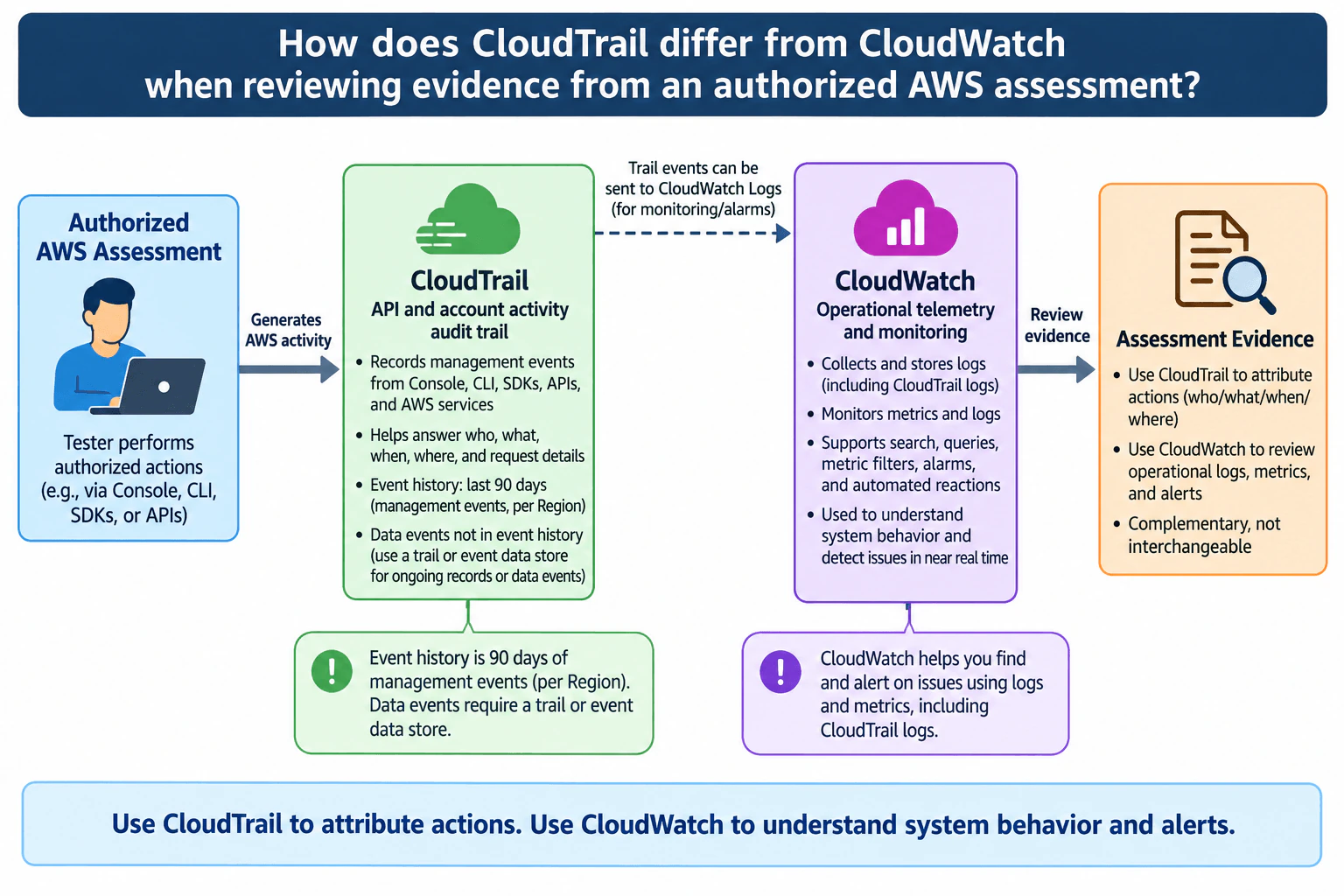
CloudTrail is primarily the audit trail for AWS account activity, helping answer who did what, when, and where. CloudWatch focuses on operational telemetry such as logs, metrics, searches, and alarms. During an authorized assessment, use both because they provide complementary evidence.
Detailed Explanation
CloudTrail and CloudWatch answer different evidence questions during an authorized AWS assessment. CloudTrail is the better starting point when you need attribution: who or what performed an AWS action, what happened, when it occurred, where the request came from, and related request details. CloudWatch is mainly for operational monitoring, so it helps you examine logs, metrics, searches, filters, alarms, and system behavior. The practical decision is simple: use CloudTrail to attribute recorded AWS actions and use CloudWatch to understand the operational behavior surrounding those actions. docs.aws.amazon.com
Useful Questions to Ask the Interviewer
Which authorized AWS accounts and Regions are in scope?
What assessment time window must the evidence cover?
Do we have only CloudTrail Event history, or is a trail or event data store available?
Which CloudWatch log groups, metrics, filters, and alarms are authorized for review?
Is the CloudTrail trail configured to send events to CloudWatch Logs?
How to Explain It in an Interview
Start with CloudTrail when the evidence question is about attribution. CloudTrail records account activity as events, including activity performed through the AWS Management Console, AWS CLI, SDKs, APIs, and supported AWS services. Event fields can identify information such as the requester, service, action, time, source, request parameters, and other details that help reconstruct what occurred. docs.aws.amazon.com
The diagram correctly highlights an important CloudTrail limitation. Event history provides the past 90 days of management events in each AWS Region. It does not show data events. For an ongoing record, events older than 90 days, or selected data-event coverage, the assessment must use an appropriately configured trail or event data store. A missing item in Event history therefore does not by itself prove that the activity never happened. docs.aws.amazon.com
Use CloudWatch when the evidence question is about operational behavior. CloudWatch monitors AWS resources and applications and provides metrics, logs, queries, dashboards, and alarms. CloudWatch Logs can centralize and search log data from applications, AWS services, and CloudTrail. This makes it useful for examining errors, operational patterns, resource behavior, and configured alerts around the time of an authorized assessment action. docs.aws.amazon.com
The two services can work together. A CloudTrail trail can be configured to send matching events to CloudWatch Logs. CloudWatch can then search those events and use monitoring features around them. The important limitation is that CloudTrail sends only the events that match the trail configuration, so CloudWatch cannot create missing CloudTrail evidence that was never selected or recorded. docs.aws.amazon.com
During an authorized assessment, I would first confirm the permitted accounts, Regions, identities, services, time range, and evidence sources. I would use read-only evidence access where possible and avoid changing production state merely to prove that logging exists. I would correlate timestamps, principals, actions, resources, and operational telemetry only within the approved scope.
The tradeoff is coverage versus operational cost and complexity. CloudTrail provides strong attribution for the AWS activity it records. CloudWatch provides richer operational context, searching, metrics, and alerting. More logging and longer retention can improve investigation quality, but they can also increase storage, query, configuration, and maintenance costs. Neither service alone proves that every possible AWS or workload event was captured.
Technical Approach
Confirm the authorized AWS accounts, Regions, identities, services, time window, and evidence sources.
Use CloudTrail first when the question is who or what performed an AWS action, which action occurred, when it occurred, or where the request originated.
Check whether the required CloudTrail evidence is available in the 90-day regional Event history or requires a trail or event data store.
Use CloudWatch to review authorized logs, metrics, searches, filters, and alarms that explain operational behavior around the activity.
If the trail sends events to CloudWatch Logs, correlate those CloudTrail events with the available operational telemetry.
Record the relevant principal, action, resource, Region, timestamp, evidence source, and any known logging limitation.
Report only conclusions supported by evidence that was actually recorded and available within the authorized scope.
Practical Insights
The main cost is operational rather than algorithmic. Reviewing recent CloudTrail management events is simple, but longer retention and additional event types require logging configuration and storage. CloudWatch logs, metrics, queries, filters, and alarms can add ingestion, storage, query, and maintenance costs. More telemetry usually gives investigators better context, but teams must also manage permissions, retention, alert quality, and evidence volume.
Why Interviewers Ask This
Interviewers want to see whether a penetration tester can distinguish AWS audit evidence from operational telemetry and choose the correct evidence source. A strong answer also explains how CloudTrail and CloudWatch can work together while recognizing the coverage and retention limits of each source.
Common interview mistakes
A common mistake is describing CloudTrail and CloudWatch as interchangeable logging services. Another is using CloudWatch as the primary source for identifying exactly which AWS principal performed an account action when CloudTrail is designed for that audit trail. It is also incorrect to assume CloudTrail Event history stores all event types indefinitely; Event history contains the past 90 days of management events per Region and excludes data events. Finally, do not treat missing evidence as proof that nothing happened until you have checked the account, Region, time window, event type, trail configuration, collection, and retention.
Interview tip
Lead with the distinction: CloudTrail helps answer 'who did what, when, and where,' while CloudWatch helps explain 'what was happening operationally.' Then mention the 90-day management-event limit of CloudTrail Event history and explain that a trail can send selected events to CloudWatch Logs.
Interviewer may ask next
Can CloudTrail events be reviewed through CloudWatch?
Yes. A CloudTrail trail can send events that match its configuration to a CloudWatch Logs log group. CloudWatch Logs can then store, search, filter, and monitor those events. This does not make CloudWatch a replacement for CloudTrail: CloudTrail produces the audit events, while CloudWatch provides operational monitoring and analysis around the delivered logs. docs.aws.amazon.com
What should you check if an expected action is missing from CloudTrail Event history?
First check the AWS account, Region, time window, and event type. Event history contains only the past 90 days of management events in a Region and does not show data events, Insights events, or network activity events. For ongoing records, older events, or other selected event types, review the applicable trail or event data store and confirm what was configured to be recorded. docs.aws.amazon.com
72. What does this AWS S3 deny policy do, and what problems would you flag in an authorized review?Cloud SecurityHard
i Question Details
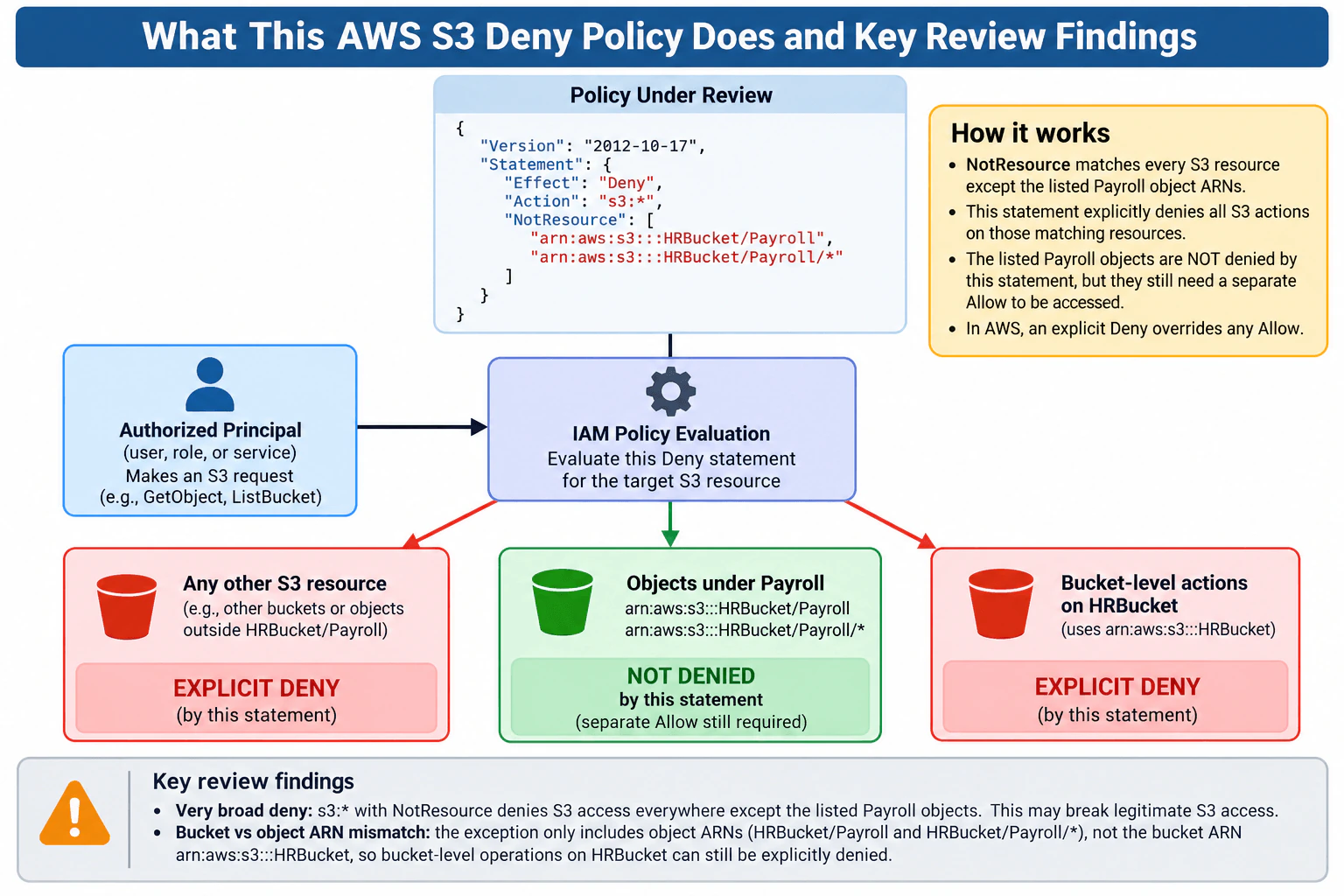
Review this complete policy as written: {"Version":"2012-10-17","Statement":{"Effect":"Deny","Action":"s3:*","NotResource":["arn:aws:s3:::HRBucket/Payroll","arn:aws:s3:::HRBucket/Payroll/*"]}}
Short Interview Answer (30-60 seconds)
It explicitly denies S3 actions on resources other than the two Payroll object ARNs. Payroll objects are only excluded from this Deny and still need an Allow. I would flag the broad s3:* scope and the missing HRBucket bucket ARN, which can block bucket-level operations.
Detailed Explanation
The practical result is a restrictive AWS S3 guardrail. In this Deny statement, NotResource means the listed Payroll object ARNs are excluded from this particular denial, while other applicable S3 resources match it. The statement does not grant access to Payroll objects; another applicable Allow is still required. The important defect to notice is that arn:aws:s3:::HRBucket itself is not excluded. Bucket-level actions such as s3:ListBucket use the bucket ARN, so they can still be explicitly denied even when access to Payroll objects is otherwise intended.
Useful Questions to Ask the Interviewer
Where is this statement applied, and which authorized principal is being evaluated?
Is the intended access limited to Payroll objects, or must the principal also perform bucket-level operations on HRBucket?
Which exact S3 actions does the principal need for the approved business function?
Which other applicable policy layers must be considered when determining effective permission?
How to Explain It in an Interview
Start with the policy decision. The Effect is Deny and the Action is s3:*. NotResource reverses normal Resource matching: the Deny applies to applicable S3 resources other than the resources listed in NotResource. AWS documents this exact general pattern as a way to deny S3 access everywhere except selected resources.
The two exceptions are object-style ARNs. arn:aws:s3:::HRBucket/Payroll refers to an object whose key is Payroll, while arn:aws:s3:::HRBucket/Payroll/* covers objects below the Payroll/ prefix. Requests whose resource is one of those object paths are not denied by this statement.
That green path does not mean the request is automatically allowed. AWS authorization is deny-by-default. An applicable Allow must still authorize the requested action and resource. If an applicable explicit Deny exists, that Deny overrides an Allow. Therefore, the safe conclusion is 'not denied by this statement,' not 'has Payroll access.'
The first review finding is the breadth of the rule. s3:* combined with NotResource creates a strong guardrail across S3 resources outside the exception. This can be intentional, but it can also block legitimate current or future S3 access. An authorized reviewer should confirm that this blast radius matches the intended design.
The second finding is the bucket-versus-object ARN mismatch shown in the diagram. Bucket-level S3 operations use the bucket resource ARN arn:aws:s3:::HRBucket. That ARN is not in NotResource. As a result, an operation such as s3:ListBucket on HRBucket can match this Deny and be explicitly denied. This matters because applications that read objects under a prefix often also require a bucket-level listing permission.
For an authorized validation, identify the exact principal, action, and resource being evaluated. Review all applicable permission sources before claiming effective access. Then use read-only or otherwise non-destructive validation where permitted. Representative checks should distinguish an object under HRBucket/Payroll, an object outside that path, and a bucket-level request to HRBucket. Do not use destructive S3 operations merely because s3:* appears in the statement.
The evidence should record the principal, requested S3 action, evaluated resource ARN, applicable policy decision, and observed result. If remediation is required, the policy owner should decide whether the intended exception also needs the bucket ARN and which exact S3 actions are necessary. Retest the same representative paths after the change.
The main tradeoff is strength versus flexibility. An explicit Deny is a strong guardrail because it can override an Allow, but a broad NotResource design can also create unexpected failures when new buckets, prefixes, or bucket-level operations are introduced. The main limitation is that this statement alone cannot prove the principal's complete effective permissions. The AWS account, organization structure, region, and other policy context are not specified, so they should not be invented.
Technical Approach
Confirm the authorized principal and where the statement is applied.
Read Effect, Action, and NotResource together.
Identify the two listed Payroll ARNs as object resources.
Treat other applicable S3 resources as matching the explicit Deny.
Treat the listed Payroll objects only as excluded from this Deny, not automatically allowed.
Check whether bucket-level operations require arn:aws:s3:::HRBucket and note that this ARN is not excluded.
Review other applicable policy layers to determine effective permission.
Validate representative requests safely and non-destructively.
Record the principal, action, resource, policy decision, evidence, remediation owner, and retest result.
Practical Insights
The policy is short, but the operational cost can be high because its Deny has a large blast radius. New S3 buckets or new access requirements can fail until the exception is updated. Troubleshooting also requires knowing whether an operation uses a bucket ARN or an object ARN. A narrower policy can require more design work, but it is usually easier to understand, test, and maintain.
Why Interviewers Ask This
This tests whether the candidate understands AWS IAM Deny semantics, the NotResource element, S3 bucket-versus-object resource types, and effective permission. It also tests whether the candidate can distinguish an exception from a Deny from an actual Allow and identify operational problems without assuming that a policy statement proves successful access.
Common interview mistakes
Common mistakes are saying the policy grants access to Payroll, treating arn:aws:s3:::HRBucket/Payroll as the HRBucket bucket ARN, overlooking that bucket-level actions use arn:aws:s3:::HRBucket, and forgetting that an explicit Deny overrides an applicable Allow. Another mistake is declaring the principal's complete effective permissions from this single statement without checking the other policies that apply to the request.
Interview tip
Lead with the distinction between 'not denied' and 'allowed.' Then identify the missing HRBucket bucket ARN and explain why bucket-level operations can still be denied. Finish by saying you would verify effective permission with the exact principal, action, resource ARN, and safe authorized testing.
Interviewer may ask next
Does this policy allow the principal to read objects under HRBucket/Payroll?
No, not by itself. The two Payroll object ARNs are excluded from this particular Deny, but the requested action still needs an applicable Allow. If no Allow applies, the request is implicitly denied. If another applicable explicit Deny applies, that Deny also takes precedence.
Why can s3:ListBucket on HRBucket fail even though Payroll is excluded from the Deny?
s3:ListBucket is a bucket-level permission evaluated against the bucket resource ARN arn:aws:s3:::HRBucket. The NotResource list contains only the Payroll object ARNs and does not contain the HRBucket bucket ARN. Therefore, this Deny can match the bucket-level request and explicitly deny it.
73. Why can SSRF expose EC2 instance metadata through IMDSv1 during an authorized cloud assessment?Cloud SecurityHard
Short Interview Answer (30-60 seconds)
SSRF can make an EC2-hosted application query IMDS from inside the instance. IMDSv1 does not require the IMDSv2 session token, so metadata may be returned. If an IAM role is attached, temporary credentials may also be exposed, with impact determined by that role's permissions.
Detailed Explanation
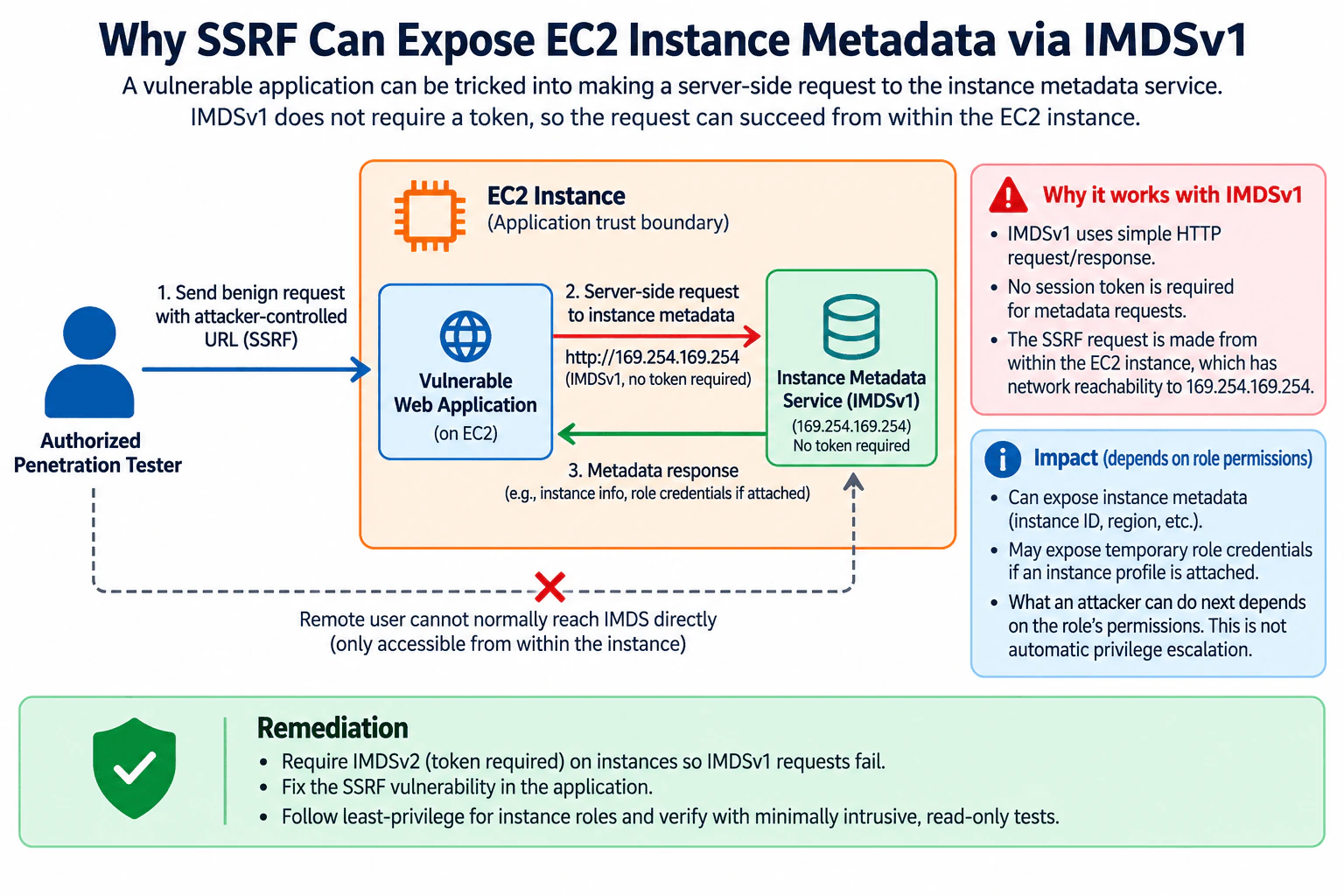
The practical issue is a trust-boundary bypass. A remote tester normally cannot directly reach the EC2 Instance Metadata Service, but a vulnerable web application running on the instance can make server-side requests from inside that boundary. If IMDSv1 is available, those metadata requests do not require the IMDSv2 session token. The response can therefore contain instance information and, when an IAM role is associated with the instance, temporary role credentials. Exposure does not automatically mean privilege escalation; the real impact depends on the permissions of the workload identity.
Useful Questions to Ask the Interviewer
Is the EC2 instance and vulnerable application explicitly included in the authorized assessment scope?
Is IMDSv1 currently permitted, or is the instance configured to require IMDSv2?
Is an IAM role associated with the instance, and are we allowed to validate its presence without retrieving reusable credential values?
What minimum evidence is acceptable for proving metadata reachability without exposing secrets?
How to Explain It in an Interview
Start with the trust boundary shown in the diagram. The authorized tester sends a benign request containing tester-controlled input to a vulnerable web application running on EC2. The tester is outside the application trust boundary. The important point is that the web application, not the tester's remote machine, makes the second request.
The application can make a server-side request to the EC2 Instance Metadata Service at the link-local IPv4 address 169.254.169.254. AWS documents IMDSv1 as a request/response method and IMDSv2 as a session-oriented method. IMDSv2 requires a token obtained with a PUT request and requires that token on subsequent metadata requests. When token usage is configured as required, requests without a valid token receive a 401 Unauthorized response. docs.aws.amazon.com
That difference explains the SSRF risk in the diagram. With IMDSv1, the simple metadata request does not need the IMDSv2 session token. If the vulnerable application accepts untrusted destination input and can reach IMDS, it can request metadata from inside the EC2 instance and receive the response. The application has effectively turned an external input into an internal request.
The response may include ordinary instance metadata. If an IAM role is associated with the instance, the IAM security-credentials metadata category contains temporary security credentials for that role. AWS documents an IMDSv1 request path for retrieving those role credentials without an IMDSv2 token. docs.aws.amazon.com
Impact must be described carefully. Reaching IMDS does not automatically create administrator access or prove privilege escalation. If no relevant IAM role is associated with the instance, the role-credential path shown in the diagram is not available. If role credentials are available, what they can do is limited by the role's effective permissions and other applicable authorization controls. Therefore, the assessment should separate demonstrated metadata exposure from assumed downstream impact.
The safest assessment uses the least intrusive proof. First confirm written scope for the application and instance. Then demonstrate the SSRF behavior with controlled, non-destructive input. Prove metadata reachability with non-secret information where possible instead of retrieving full temporary credentials. Record the affected application, instance, request path, observed response, IMDS configuration, and relevant workload identity information permitted by the rules of engagement.
Remediation should be layered, exactly as shown in the diagram. Fix the SSRF vulnerability so untrusted input cannot cause arbitrary server-side requests. Configure the EC2 instance to require IMDSv2 so IMDSv1 requests fail. AWS confirms that an instance can be configured to accept only IMDSv2 and that tokenless requests fail when token usage is required. docs.aws.amazon.com Finally, apply least privilege to the instance role so a compromised workload identity has only the permissions the application actually needs.
A useful limitation is that IMDSv2 is defense in depth, not a substitute for repairing SSRF. A sufficiently capable server-side request primitive may present different risks, so the root application flaw still needs remediation. During retesting, verify both controls: the application should no longer make the unwanted internal request, and a tokenless metadata request should fail when IMDSv2 is required.
Technical Approach
Confirm written authorization for the specific application, EC2 instance, AWS account, region, and metadata-testing path.
Demonstrate the suspected SSRF with a benign controlled destination before testing IMDS reachability.
Verify whether the vulnerable application can make a server-side request toward the EC2 metadata service.
Determine through authorized configuration evidence whether IMDSv1 is permitted or IMDSv2 is required.
Use the minimum read-only evidence necessary to confirm metadata exposure; avoid retrieving reusable credential values when non-secret metadata is sufficient.
Determine whether an IAM role is associated with the instance using authorized configuration evidence where possible.
If role exposure is relevant, evaluate potential impact from the role's effective permissions without assuming privilege escalation.
Recommend fixing SSRF, requiring IMDSv2, and applying least privilege to the instance role.
Retest the original path safely and confirm that the unwanted SSRF path is blocked and tokenless IMDS requests fail when IMDSv2 is required.
Practical Insights
The remediation cost is usually manageable but can involve several teams. Fixing SSRF requires application changes and testing. Requiring IMDSv2 can require compatibility checks for software, SDKs, agents, proxies, or container networking that legitimately use instance metadata. Least-privilege IAM work can take additional time because teams must identify the permissions the workload actually needs. The operational tradeoff is stronger security versus migration effort and the risk of breaking older metadata consumers. Changes should therefore be staged and tested before broad enforcement.
Why Interviewers Ask This
Interviewers want to see whether the candidate understands the trust-boundary problem behind SSRF in an EC2 workload. A remote user normally does not directly query IMDS, but a vulnerable application running on the instance may be able to query it on the user's behalf. A strong answer also distinguishes metadata exposure from automatic privilege escalation, explains when temporary IAM role credentials may be available, and recommends safe layered remediation without unnecessarily collecting credentials during an authorized assessment.
Common interview mistakes
Common mistakes are saying the remote user directly connects to IMDS, claiming every SSRF automatically exposes IAM credentials, or treating metadata access as automatic privilege escalation. Another mistake is saying IMDSv2 fixes the SSRF vulnerability itself; it is a defense-in-depth control for metadata access, while the application flaw still needs remediation. During an assessment, retrieving and retaining full temporary credentials when a non-secret proof is sufficient also creates unnecessary risk. A strong answer keeps the flow clear: remote input reaches the vulnerable application, the application makes the internal metadata request, IMDSv1 does not require the IMDSv2 token, and any downstream impact depends on the available workload identity and its permissions.
Interview tip
Explain the flow in four parts: authorized tester, vulnerable EC2 web application, IMDSv1, and metadata response. Then state why it works: the application makes the request from inside the instance and IMDSv1 does not require the IMDSv2 token. Finish by saying role credentials are conditional and impact depends on effective IAM permissions.
Interviewer may ask next
How does requiring IMDSv2 reduce this SSRF risk?
IMDSv2 uses session-oriented requests. A client first obtains an instance-specific token with a PUT request and then includes that token in later metadata requests. When the instance is configured to require IMDSv2, a metadata request without a valid token receives a 401 Unauthorized response. That blocks the simple tokenless IMDSv1 request path shown in the diagram. It is defense in depth rather than a replacement for fixing SSRF itself. docs.aws.amazon.com
Does successful SSRF access to EC2 metadata prove privilege escalation?
No. It proves the vulnerable application can reach metadata through the tested server-side path. An IAM role associated with the instance can make temporary role credentials available through instance metadata, but the actions possible with those credentials depend on the role's effective permissions. The finding therefore proves metadata exposure, while privilege escalation or broader cloud impact requires separate authorized evidence. docs.aws.amazon.com
74. How do IAM permissions boundaries constrain access in a cloud environment under authorized review?Cloud SecurityHard
Short Interview Answer (30-60 seconds)
A permissions boundary does not grant access; it limits the maximum permissions an IAM user or role can receive from identity-based policies. I verify the intersection of the identity policy and boundary, then safely test allowed and denied actions while considering other applicable policies and explicit Deny rules.
Detailed Explanation
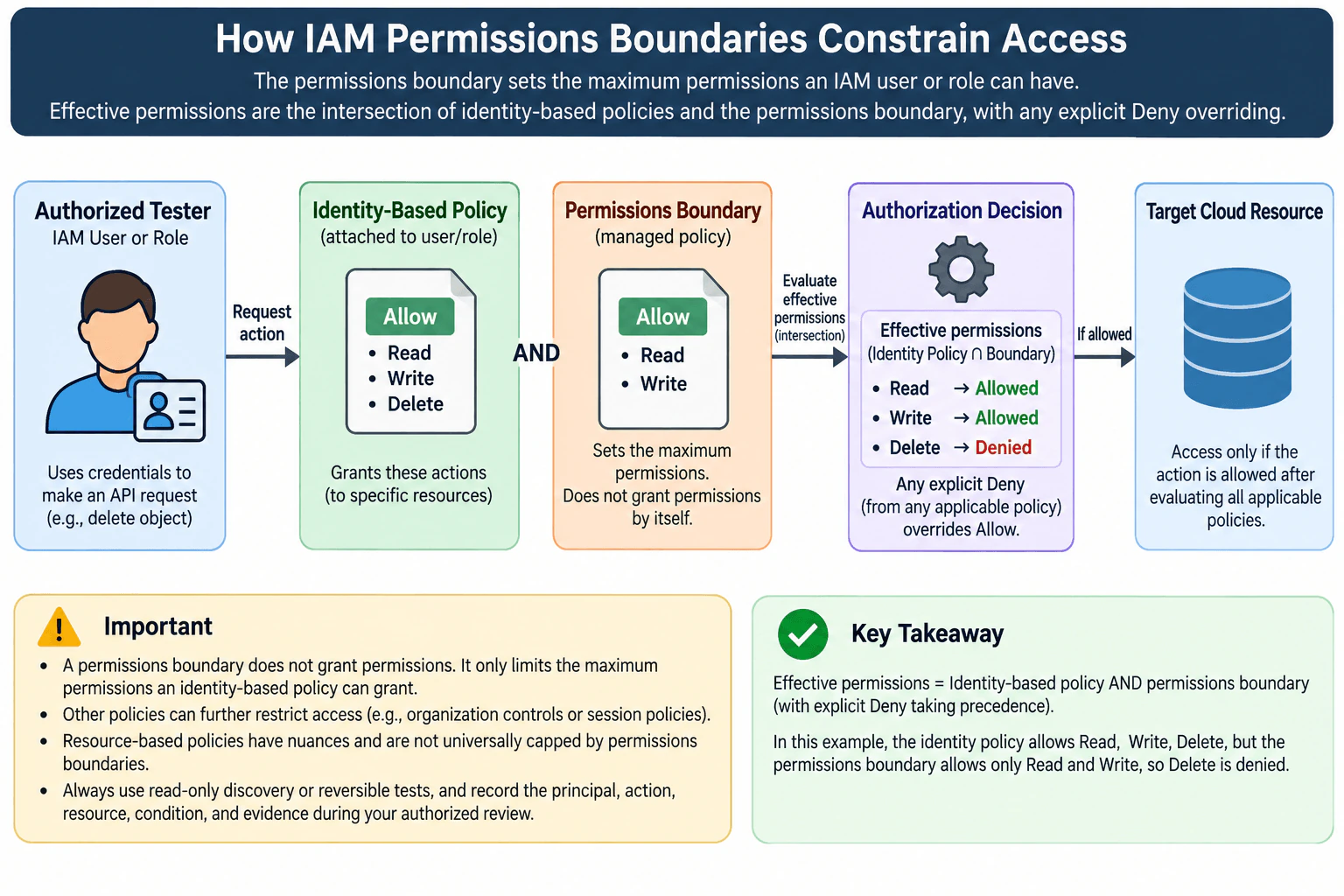
The practical goal is to determine what an authorized IAM user or role can actually do, not what one policy appears to allow. In AWS, a permissions boundary is a managed policy that limits the maximum permissions identity-based policies can grant. Effective permissions for those two policy types are their intersection. For example, if an identity policy allows Read, Write, and Delete while the boundary allows only Read and Write, Delete is not permitted. During review, I validate this safely and consider other applicable policies before concluding the principal's true access.
Useful Questions to Ask the Interviewer
Is the review limited to one AWS account, or does it include multiple accounts in an AWS Organization?
Which IAM user or role and target resources are explicitly authorized for testing?
Are resource-based policies, session policies, or AWS Organizations service control policies in scope?
May I perform reversible API requests, or should validation remain read-only?
How to Explain It in an Interview
I would first establish the scope boundary. The cloud provider is AWS. The customer controls IAM users, roles, identity policies, permissions boundaries, resource policies, organization controls, and the authorization granted to the tester. AWS operates the IAM authorization system that evaluates those policies. I would identify the exact AWS account or authorized organization, principal, target resource, action, and conditions. IAM identities are evaluated at the account level; individual target services or resources may be regional or global, so I would record the relevant resource location rather than assuming one region applies to every IAM decision.
The central rule is that a permissions boundary limits what an identity-based policy can grant. It does not create permission by itself. If an identity-based policy grants Read, Write, and Delete, but the boundary permits only Read and Write, the effective identity permissions contain Read and Write. Delete remains denied because it is outside the boundary. If either the identity policy or permissions boundary contains an explicit Deny for an action, that Deny overrides an Allow. An explicit Deny in another applicable policy type also causes the request to be denied.
I would separate this IAM control-plane decision from network reachability and data-plane behavior. A principal might have an IAM Allow but still be unable to reach a service because of network controls, or the service may apply an additional resource policy. Likewise, workload identities such as application roles must be evaluated as the actual principal making the request rather than assuming a human user's permissions apply to the workload.
For an authorized test, I would inspect the identity-based policy and attached permissions boundary first. I would calculate the expected intersection for specific principal-action-resource combinations. I would then use read-only discovery or another reversible proof to confirm an allowed action and, when permitted by the rules of engagement, confirm that an action outside the boundary is rejected without creating destructive effects. I would avoid deletion, uncontrolled scaling, exposure of secrets, or activity outside the authorized account or tenant.
I would also check every other policy type that can affect the same request. AWS Organizations service control policies and session policies can further restrict effective permissions, and an explicit Deny in an applicable policy causes the request to be denied. Resource-based policies require special care: permissions boundaries do not universally cap every resource-based grant. Within the same account, a resource-based policy that grants directly to an IAM user ARN is not limited by an implicit deny in that user's permissions boundary. A grant to an IAM role ARN is limited by the role's permissions boundary, while a grant directly to an IAM role session ARN is not limited by an implicit deny in the boundary. Therefore, I would never state that the boundary alone represents all effective access.
Evidence should record the exact principal, requested action, target resource, relevant conditions, applicable identity policy, permissions boundary, other policy types considered, request result, and supporting logs or API responses. If Read and Write succeed while Delete is denied exactly as predicted by the attached diagram, that supports the boundary evaluation for those tested requests. It does not prove that every resource, policy path, or session has the same effective permissions.
The main tradeoff is that permissions boundaries provide a strong delegation guardrail without requiring administrators to define every identity permission themselves, but they add policy-evaluation complexity. A reviewer must consider identity policies together with boundaries and any applicable organization, session, and resource policies. The safe failure behavior is denial when the required Allow is absent from the identity-policy-and-boundary intersection or when an applicable explicit Deny takes precedence.
Technical Approach
Confirm written authorization, the AWS account or organization, the IAM user or role, target resources, actions, and stop conditions.
Read the principal's identity-based policies and attached permissions boundary.
For each approved principal-action-resource combination, calculate the permissions allowed by both policies.
Check for applicable explicit Deny statements and additional restrictions such as service control policies or session policies.
Review relevant resource-based policies separately because their interaction with boundaries depends on the principal type being granted access.
Validate expected access with read-only discovery or another reversible request first.
Where explicitly authorized, verify that an action outside the boundary is denied without performing destructive operations.
Record the principal, resource, action, conditions, policy evidence, request result, network path when relevant, remediation owner, and safe retest procedure.
Practical Insights
The technical cost is policy-analysis complexity: several policy types may affect the same request. The operational cost is the time needed to map principals, actions, resources, conditions, and policy relationships accurately. Human error is a major risk because a reviewer may mistake a boundary for a permission grant or overlook a resource-based policy exception. Financial cost is normally indirect, mainly engineering and review time. Compliance and governance work may increase because authorization, evidence, and changes must be documented. Maintenance grows as identities, policies, accounts, and services change, so effective-access checks should be repeated after meaningful IAM changes.
Why Interviewers Ask This
Interviewers want to know whether I understand the difference between permissions that grant access and guardrails that limit access. They also want to see whether I can reason about effective IAM permissions instead of reading one policy in isolation, recognize explicit Deny behavior and resource-policy nuances, and validate access safely during an authorized penetration test.
Common interview mistakes
Common mistakes are saying that a permissions boundary grants permissions, treating the boundary as the principal's complete effective permission set, or assuming an Allow in the identity policy is sufficient. Another mistake is ignoring explicit Deny, AWS Organizations service control policies, session policies, or resource-based policies. Reviewers may also confuse IAM authorization with network reachability or assume a denied destructive operation should be executed just to prove denial. A safe review predicts the decision first and uses read-only or reversible validation wherever possible.
Interview tip
Lead with one sentence: a permissions boundary limits the maximum permissions an identity policy can grant but does not grant access itself. Then use the Read, Write, Delete example from the diagram, explain the intersection, mention explicit Deny and resource-policy nuances, and finish with how you would validate it safely under written authorization.
Interviewer may ask next
What happens if an identity-based policy allows an action but the permissions boundary does not allow it?
For permissions granted through the identity-based policy, the action is outside the identity-policy-and-boundary intersection and is therefore not granted. In the diagram's example, the identity policy allows Read, Write, and Delete, while the boundary allows only Read and Write, so Delete is denied through that identity-policy path. I would still inspect applicable resource-based policies and other policy types before making a broader statement about every possible authorization path.
Does a permissions boundary always limit permissions granted through a resource-based policy?
No. Resource-based policy evaluation has principal-specific rules. Within the same account, a resource-based policy that grants directly to an IAM user ARN is not limited by an implicit deny in that user's permissions boundary. A grant to an IAM role ARN is limited by the role's boundary, while a grant directly to an IAM role session ARN is not limited by an implicit deny in the boundary. An explicit Deny in an applicable policy still takes precedence, so I would identify the exact principal and policy path before concluding how the boundary affects access.
75. What security considerations apply when an AWS service needs cross-account access during an authorized review?Cloud SecurityHard
Short Interview Answer (30-60 seconds)
Use a narrowly trusted cross-account IAM role and short-lived STS credentials instead of long-lived keys. Restrict who can assume the role, grant only required actions and resources, apply supported resource-side conditions, preserve explicit denies, validate safely within scope, and confirm the activity in CloudTrail.
Detailed Explanation
The practical decision is to treat the access as a controlled crossing from an authorized source account into a target account. Assuming the design uses an IAM workload role and STS AssumeRole, verify the exact source identity, target role, allowed resources, actions, conditions, and written review scope. The source should receive only temporary credentials, and the target role should provide only the permissions needed for safe validation. Resource-side controls may also apply. The review should avoid destructive changes, reusable credential exposure, and activity outside the authorized accounts while collecting reliable CloudTrail evidence.
Useful Questions to Ask the Interviewer
Which source account, workload identity, target account, IAM role, resources, actions, and AWS Regions are explicitly authorized?
Is the caller an IAM workload role, an AWS service principal, or an authorized third-party service?
Does the target service rely on the assumed role alone, or does it also use a resource-based policy?
Are read-only or reversible test actions and dedicated test resources available?
Which CloudTrail events or other approved evidence must be retained for the review?
How to Explain It in an Interview
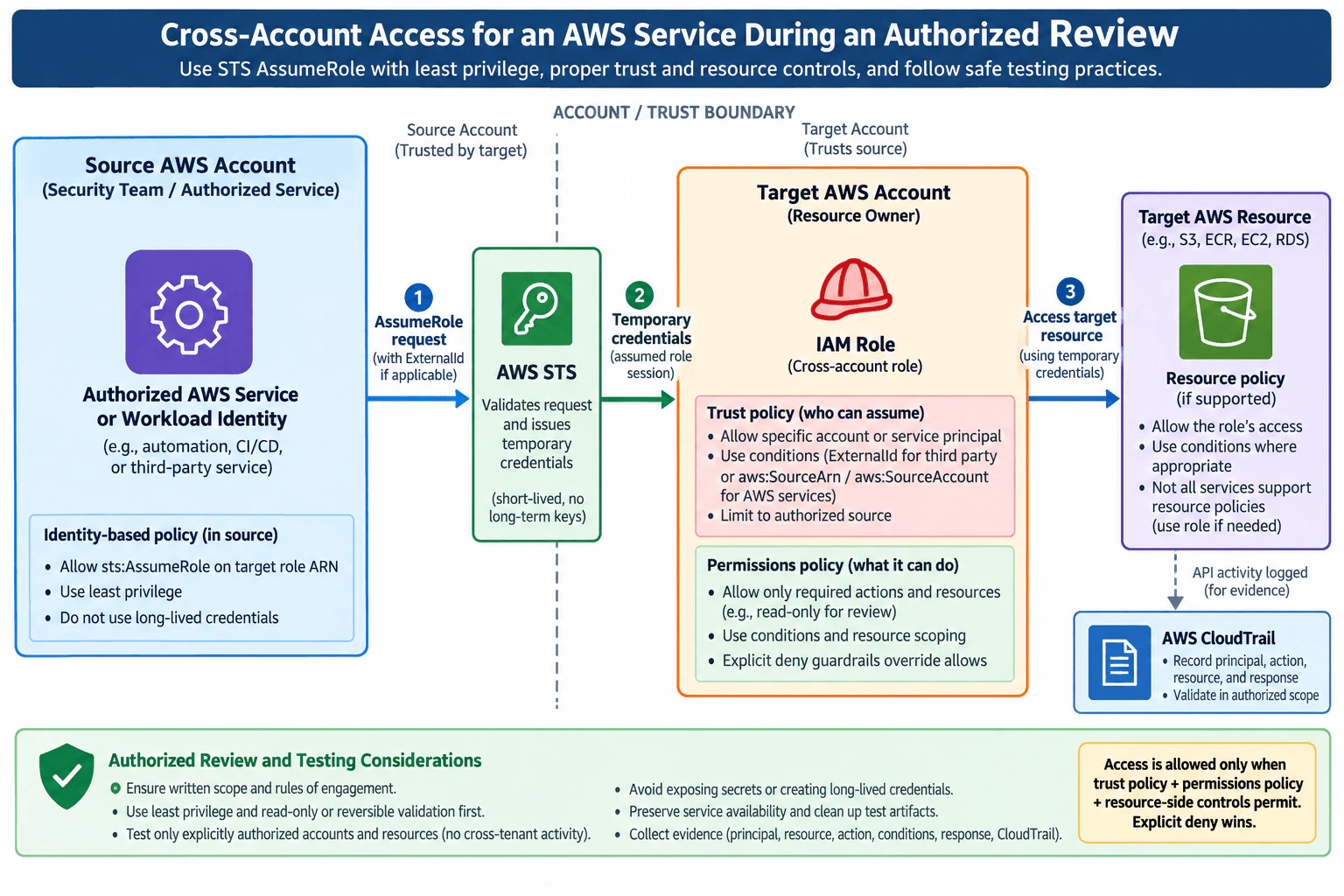
I would start with the account and trust boundary shown in the diagram. The source AWS account contains the authorized service or workload identity. For the illustrated AssumeRole pattern, I assume that identity is an IAM principal such as a workload role. Its identity-based policy should allow sts:AssumeRole only on the intended target-role ARN, not broadly across roles or accounts.
The target AWS account owns the cross-account IAM role. Its trust policy controls who may assume the role. I would restrict the trusted principal to the authorized source and add conditions that match the actual integration. If an authorized third-party service assumes the role for multiple customers, sts:ExternalId can help prevent the cross-account confused-deputy problem. When an AWS service principal is involved, AWS-documented source conditions such as aws:SourceArn or aws:SourceAccount can reduce cross-service confused-deputy risk where that service supports them.
If the AssumeRole request is authorized, AWS STS returns temporary security credentials for an assumed-role session. Those credentials should be short-lived and should not be converted into long-lived stored access keys. Obtaining the session is only one part of the authorization path.
The target role permissions policy controls what that assumed-role session can do. I would allow only the required actions on the required resources, preferably read-only or otherwise reversible actions for a review. Conditions and resource scoping should narrow the permissions further. Other applicable policy types, such as session policies, permissions boundaries, AWS Organizations controls, or resource policies, can further restrict effective permissions. An applicable explicit deny overrides an allow.
The diagram also shows a target resource policy. I would evaluate such a policy only when the target AWS service supports and uses one. It should grant only the required access and appropriate conditions. A resource-based policy is not universally required, so I would verify the authorization model of the actual service rather than assuming every target resource uses one.
I would treat network reachability separately from IAM authorization when the target API or workload requires a particular network path. A principal can have IAM permission but still lack network connectivity, and network connectivity alone does not provide IAM authorization.
For the authorized review, I would use the least intrusive proof first. I would test only the explicitly authorized accounts, role, resources, and actions. I would avoid deletion, uncontrolled scaling, secret exposure, long-lived credential creation, and access to another tenant. If the request reaches an unexpected account, resource, or privilege level, I would stop rather than expanding the test automatically.
CloudTrail provides the evidence path shown in the diagram. I would correlate the AssumeRole event and the subsequent API activity with the principal or assumed-role session, target account, action, resource, request context, response, and time. This demonstrates effective access more reliably than reviewing policy text alone.
The main limitation is that the diagram represents an STS AssumeRole design. Some AWS services use service-specific cross-account mechanisms instead. Therefore, the exact trust model, supported condition keys, resource-policy behavior, network requirements, and logging coverage must be verified for the real service. The tradeoff is to grant enough temporary access to perform a meaningful review while keeping the trust relationship narrow, observable, and easy to revoke.
Technical Approach
Confirm written authorization, the source and target AWS accounts, Regions, source workload identity, target role, target resources, permitted actions, and stop conditions.
Confirm that the illustrated AssumeRole pattern is the correct cross-account mechanism for the service being reviewed.
Verify that the source IAM identity can call sts:AssumeRole only for the intended target-role ARN.
Review the target role trust policy and identify the exact trusted principal and relevant conditions.
Use sts:ExternalId for an authorized third-party AssumeRole integration when needed to address cross-account confused-deputy risk, or AWS-documented source conditions for supported AWS service-principal interactions.
Confirm that STS returns temporary assumed-role credentials and that no long-lived access keys are introduced.
Review the target role permissions and limit them to required actions, resources, and conditions. Confirm that applicable explicit denies continue to block forbidden requests.
Review a resource-based policy only when the target service supports and uses one, and confirm that it does not widen the authorized path.
Check network reachability separately when the target service requires a specific network path.
Perform only read-only or reversible validation against explicitly authorized resources. Avoid deletion, uncontrolled scaling, secret exposure, and cross-tenant activity.
Correlate the AssumeRole event and subsequent authorized API calls with CloudTrail evidence.
Record the exact principal, resource, action, conditions, result, remediation owner, residual limitation, and safe retest procedure.
Practical Insights
The main technical cost is designing and reviewing IAM trust and permission policies, checking service-specific resource controls, and validating CloudTrail evidence. Very narrow permissions can require more setup and coordination, but broad permissions increase security risk. Short-lived sessions reduce credential exposure but may need renewal during a long review. Logging adds storage and investigation work but makes the access path observable. Human effort is also required to agree on scope, identify the correct principals and resources, review policy interactions, and perform a safe retest after remediation.
Why Interviewers Ask This
Interviewers want to see whether the candidate understands that cross-account access is an effective-permission problem, not a single IAM setting. The candidate should reason about the source workload identity, STS AssumeRole, the target role trust policy, the role permissions policy, resource policies where supported, policy conditions, explicit denies, safe testing, and CloudTrail evidence. They also want judgment about confused-deputy protections, temporary credentials, authorization boundaries, service-specific behavior, and avoiding destructive or cross-tenant testing.
Common interview mistakes
Common mistakes include trusting an entire source account when a narrower principal can be used, allowing broad sts:AssumeRole, granting excessive target-role permissions, storing long-lived credentials instead of using STS sessions, using ExternalId or service condition keys without matching the actual integration, forgetting confused-deputy protections when they apply, assuming every AWS service supports the same resource-policy model, ignoring applicable explicit denies or organization controls, treating IAM permission as proof of network reachability, testing destructive operations when read-only evidence is sufficient, exposing reusable secrets, crossing into an unauthorized account, and declaring a policy exploitable without proving the effective authorized access path.
Interview tip
Explain the flow in the same order as the diagram: authorized source identity, STS AssumeRole request, target-role trust policy, temporary credentials, least-privilege role permissions, resource policy where supported, safe resource access, and CloudTrail evidence. Mention that applicable explicit denies override allows and that service-specific behavior must be verified.
Interviewer may ask next
How would you reduce confused-deputy risk in this cross-account design?
First identify the type of caller. For an authorized third party assuming a role for multiple customers, restrict the trusted principal and require the third party's unique sts:ExternalId value in the target role trust policy. For supported AWS service-principal access, use AWS-documented source conditions such as aws:SourceArn or aws:SourceAccount where appropriate. I would verify the condition keys supported by that specific service and confirm that the intended source succeeds while unauthorized sources fail.
What does a successful AssumeRole request prove, and what does it not prove?
It proves that the caller satisfied the requirements to obtain that target-role session at that time. It does not prove that every target-resource action will succeed. The role permissions, session policies if present, permissions boundaries, AWS Organizations controls, applicable resource policies, explicit denies, service-specific authorization rules, and network reachability can still restrict later requests. I would therefore perform one narrowly scoped authorized resource action and confirm the resulting evidence before concluding that effective cross-account access exists.
76. What are exploitation and post-exploitation in an authorized penetration test?Exploitation And Post ExploitationEasy
i Question Details
Define exploitation as controlled validation that a weakness can produce agreed impact, and post-exploitation as bounded validation of what that access permits next. Explain prerequisites, reliability, test data, least impact, privilege boundaries, pivoting limits, evidence, stop conditions, cleanup, detection, and why persistence or destructive actions require explicit authorization.
Short Interview Answer (30-60 seconds)
Exploitation safely proves that a weakness can produce an agreed impact. Post-exploitation then checks what the obtained access permits next, within explicit scope. I use the smallest reliable proof, document privilege and boundaries, verify expected detection, stop at defined limits, and completely clean up afterward.
Detailed Explanation
The practical difference is that exploitation answers, "Can this weakness produce the agreed impact?" while post-exploitation answers, "Now that access exists, what is safely and explicitly permitted to be validated next?" Neither phase means doing everything technically possible. Before testing, I confirm written authorization, the target and affected state, prerequisites, test accounts and synthetic data, expected payload behavior, monitoring coordination, cleanup steps, and stop conditions. I then use the smallest reliable proof, record what privilege was actually obtained, stay inside defined boundaries, collect reproducible evidence, and restore the environment when finished.
Useful Questions to Ask the Interviewer
What targets, accounts, systems, and actions are explicitly in scope?
What technical impact is enough to prove the finding without going further?
Are privilege escalation, lateral movement, or pivoting explicitly permitted?
What test accounts, synthetic records, benign markers, or controlled callbacks should be used?
What stop conditions or production-safety limits apply?
Should defenders expect the activity so logging or alerts can be validated?
What cleanup and restoration steps are required after testing?
How to Explain It in an Interview
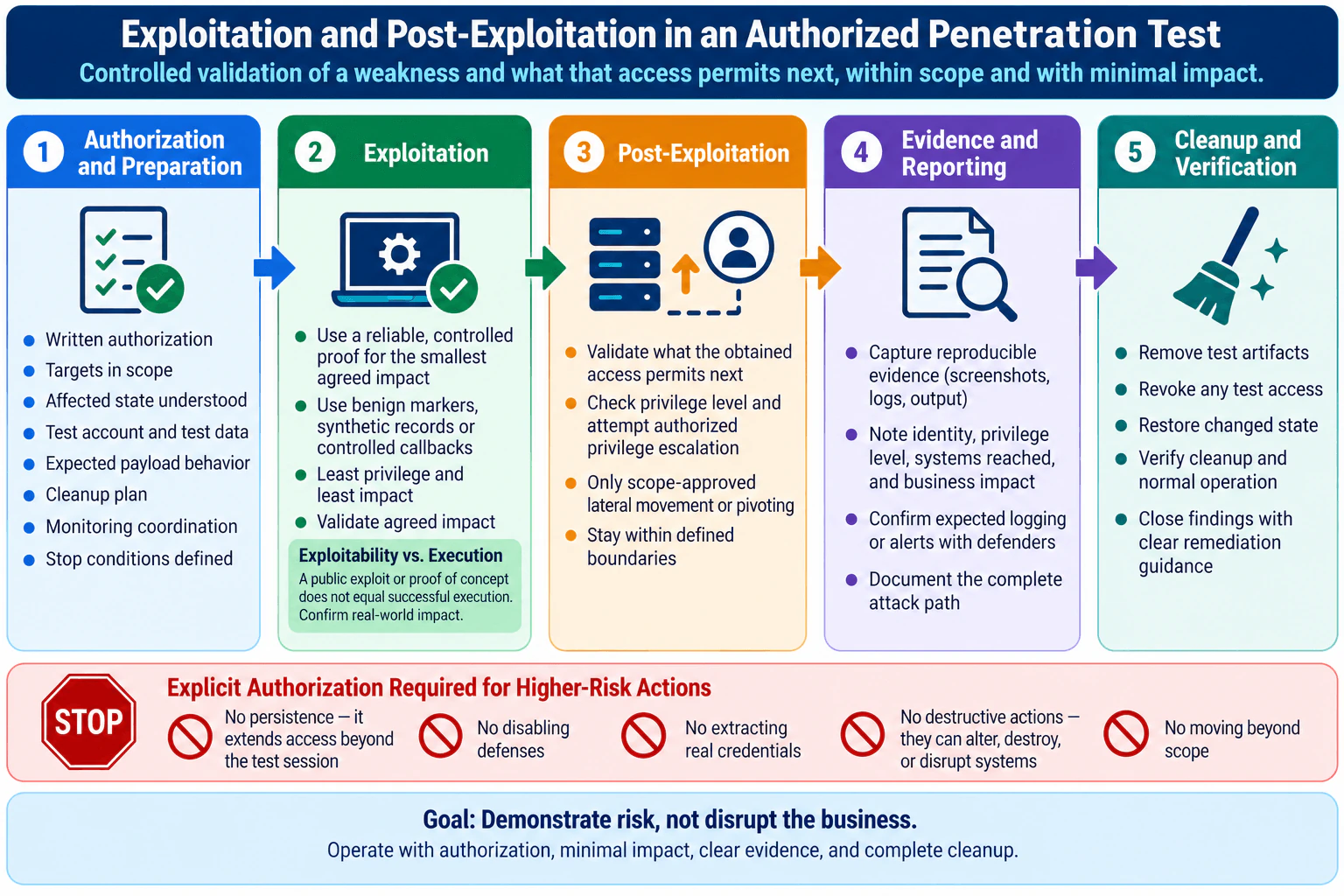
Exploitation is controlled validation of a weakness. Before executing anything, I confirm authorization, the target, prerequisites, affected state, test account, expected payload behavior, safety limits, monitoring coordination, cleanup plan, and stop conditions. I also verify that the proposed proof is reliable enough to answer the question without creating unnecessary impact.
A public exploit or proof of concept is not the same as confirmed exploitability on the authorized target. Even successful execution does not automatically prove higher privilege, access to another system, a reachable objective, or business impact. I therefore use a reliable, controlled proof that demonstrates only the smallest agreed impact.
Where possible, I use benign markers, synthetic records, test accounts, or controlled callbacks instead of real business data. I stay least privileged and avoid collecting unnecessary secrets. The goal is to prove the finding with enough evidence, not to maximize access.
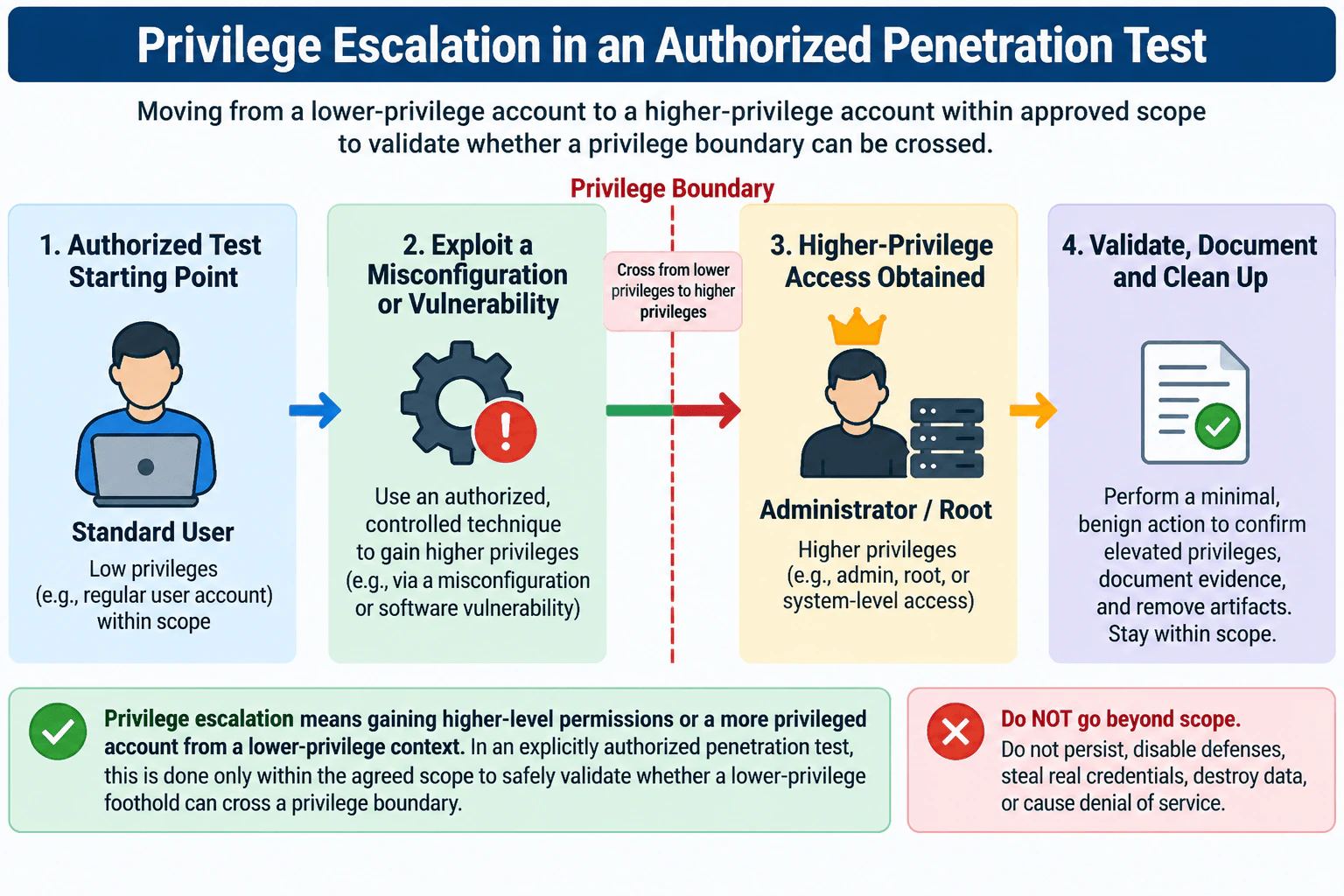
Post-exploitation begins only after access has been obtained. I first identify the current identity and privilege level. Then every next action becomes a separate scope decision. If privilege escalation is authorized, I validate whether the current identity can gain higher permissions. If lateral movement or pivoting is authorized, I validate only the approved path to an in-scope system or objective. I record the prerequisite, identity transition, boundary crossed, evidence, resulting privilege, and systems reached.
The rules of engagement remain the main boundary throughout the test. I do not continue merely because a path is technically possible. The diagram correctly treats persistence, disabling defenses, extracting real credentials, destructive actions, denial of service, and movement beyond scope as higher-risk actions that require explicit authorization. Persistence extends access beyond the immediate test session, while destructive actions can alter, destroy, or disrupt systems or data. If a stop condition is reached, unexpected impact occurs, or the next action is outside scope, I stop rather than continue automatically.
Evidence should be reproducible and proportionate. I capture only what is needed, such as screenshots, logs, relevant output, the identity and privilege observed, systems legitimately reached, and the demonstrated impact. When defender coordination is part of the engagement, I also confirm whether expected logging or alerts appeared. Successful exploitation and successful detection are separate observations, so both can provide useful evidence.
Cleanup is part of the testing lifecycle. I remove test artifacts, revoke temporary test access, restore changed state, verify cleanup and normal operation, and document the complete validated path. I then provide remediation guidance that addresses the root cause. After remediation, a retest should verify that the original path no longer works and that the changed state has been correctly restored.
The main tradeoff is confidence versus operational risk. Going farther may provide more evidence, but every additional privilege change, pivot, data interaction, or system change increases risk. A good penetration tester therefore uses the smallest reliable proof that answers the agreed question and proceeds further only when the next action is explicitly authorized and adds meaningful validation.
Technical Approach
Confirm written authorization, target scope, affected state, prerequisites, test accounts or synthetic data, expected payload behavior, monitoring coordination, cleanup plan, and stop conditions.
Validate that the suspected weakness is applicable before attempting intrusive activity.
Choose the smallest reliable and controlled proof that can demonstrate the agreed impact.
Execute only against the authorized target and record the actual result instead of assuming success from the existence of a public exploit or proof of concept.
Identify the access actually obtained, including the current identity and privilege level.
Before each post-exploitation action, perform a new scope check for privilege escalation, lateral movement, pivoting, or objective validation.
Follow only explicitly authorized paths and stop when sufficient evidence has been collected, a stop condition occurs, or a boundary would be crossed.
Capture reproducible evidence and, when required, confirm expected logging or alerts with defenders.
Remove test artifacts, revoke temporary access, restore changed state, and verify normal operation.
Document the complete validated path, demonstrated impact, limitations, remediation, and required retest.
Practical Insights
The main cost is operational risk rather than algorithmic complexity. More exploitation steps take more tester and defender time and create more chances of affecting production. Privilege escalation and lateral movement require extra care because they cross identity or system boundaries. Monitoring coordination adds work but can validate detection. Cleanup and restoration also take time, but they prevent test artifacts or temporary access from becoming new risks. The safest approach is therefore the minimum number of actions needed to prove the finding with enough confidence.
Why Interviewers Ask This
Interviewers want to know whether the candidate understands that penetration testing is controlled validation rather than unrestricted compromise. A strong answer separates exploitability, successful execution, obtained privilege, reachable objectives, and demonstrated impact. It also shows good judgment around authorization, safe test data, privilege boundaries, lateral movement, detection, evidence, stop conditions, and cleanup.
Common interview mistakes
Common mistakes include treating the existence of a public exploit as proof that the authorized target is exploitable, assuming successful execution automatically proves higher privilege or business impact, using real data when synthetic data would work, extracting real credentials unnecessarily, escalating privileges without a separate scope check, pivoting merely because another system is reachable, continuing after the agreed impact has already been proven, disabling defenses, establishing persistence without explicit permission, ignoring expected logging or alerts, failing to honor stop conditions, and leaving test artifacts, temporary access, or changed state behind.
Interview tip
Lead with the distinction: exploitation proves that a weakness can create the agreed impact; post-exploitation validates what the resulting access permits next. Then explain authorization, the smallest reliable proof, benign test data, privilege and pivot boundaries, reproducible evidence, detection, stop conditions, and cleanup. Make it clear that technically possible does not mean authorized.
Interviewer may ask next
How do you decide how far to continue after exploitation succeeds?
I treat every next action as a separate authorization and risk decision. First I record the identity and privilege actually obtained. Then I check whether another step, such as privilege escalation, lateral movement, pivoting, or reaching an objective, is explicitly in scope and whether it adds meaningful evidence. If the agreed impact is already proven, the next action is unnecessary, unexpected impact occurs, or a stop condition or scope boundary is reached, I stop. The goal is the smallest reliable proof, not the maximum access technically possible.
Why do persistence and destructive actions require explicit authorization?
They create materially higher operational risk than a minimal proof. Persistence intentionally extends access beyond the immediate test session. Destructive actions can alter, destroy, or disrupt systems and data, including service availability. Because these actions normally go beyond what is needed to demonstrate a vulnerability, I perform them only when the rules of engagement explicitly authorize them and define the safety controls, stop conditions, monitoring coordination, cleanup, and recovery expectations.
77. What is an exploit in an explicitly authorized penetration-testing exercise?Exploitation And Post ExploitationEasy
Short Interview Answer (30-60 seconds)
An exploit is code, a technique, or a sequence of actions that intentionally uses a vulnerability to produce an unintended result. In an authorized penetration test, it is used within defined scope and safety limits to validate risk, collect evidence, and then restore any changed state.
Detailed Explanation
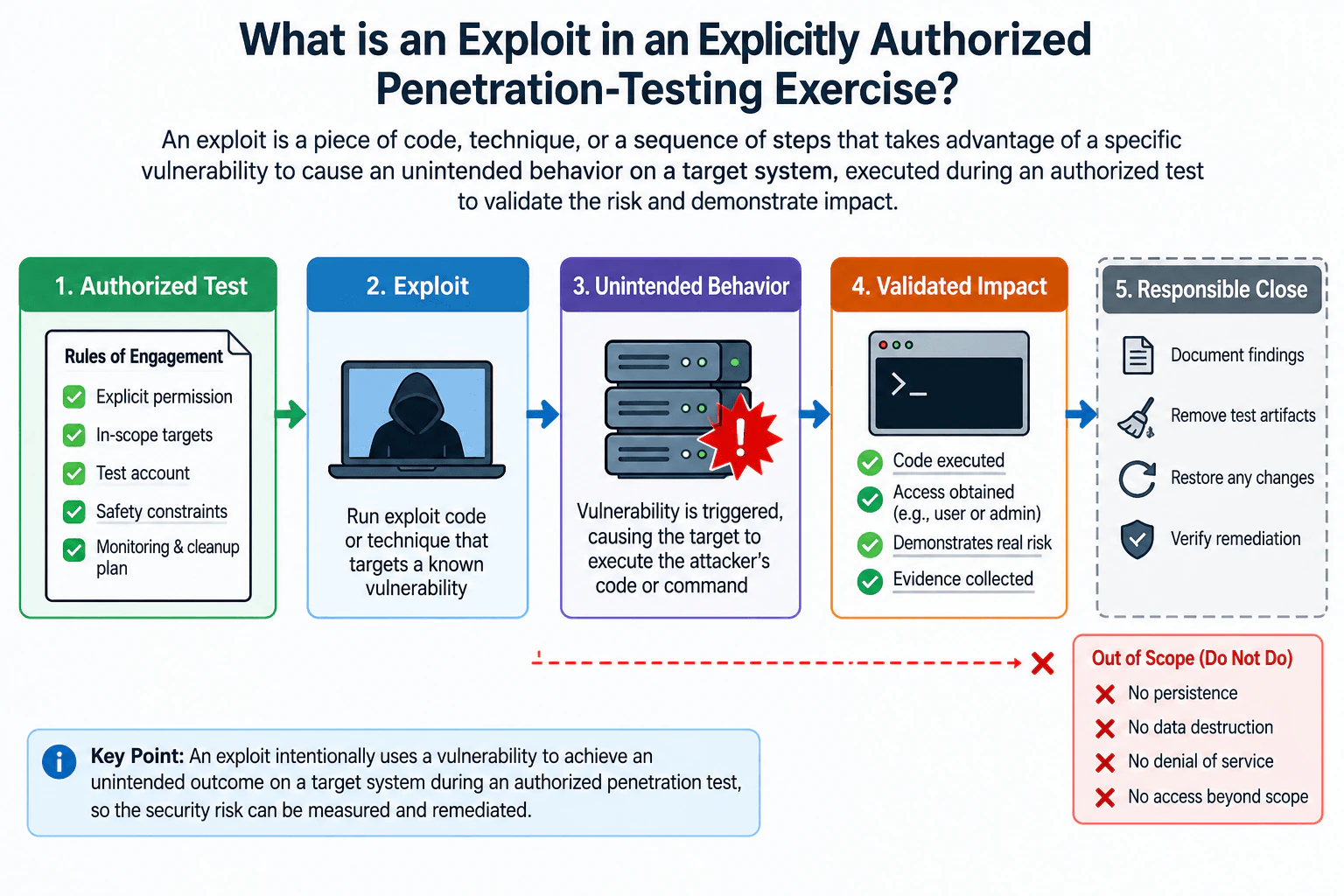
An exploit is the method used to take advantage of a vulnerability; it is not the vulnerability itself. In an explicitly authorized penetration test, the tester uses exploit code or a controlled technique against an approved target to verify whether the weakness can actually produce an unintended result, such as controlled code execution or obtaining a different level of access. The important point is control: permission, scope, test accounts, safety limits, monitoring, and cleanup are agreed before testing. The tester proves only what is necessary, records evidence, and restores any changed state afterward.
Useful Questions to Ask the Interviewer
Are you asking mainly for the definition of an exploit, or also how it should be safely used during a penetration test?
Should I explain the difference between a vulnerability, exploitability, successful exploitation, and demonstrated impact?
Should I include the Rules of Engagement and cleanup responsibilities in the answer?
How to Explain It in an Interview
Start with the distinction between a vulnerability and an exploit. A vulnerability is the weakness. An exploit is the code, technique, or sequence of actions used to take advantage of that weakness and cause an unintended result.
In a professional penetration test, exploitation happens only after authorization and scope are established. The Rules of Engagement define what targets are allowed, what actions are permitted, which test identities or accounts may be used, relevant safety constraints, monitoring coordination, cleanup expectations, and when the tester must stop. The tester should confirm that the suspected vulnerability and its prerequisites apply to the target before attempting exploitation.
The exploit is then used in a controlled way. The goal is not to cause maximum damage. It is to obtain the smallest proof needed to validate the finding. For example, the proof might show that controlled code executed or that an approved test identity obtained a level of access that should not have been available. The tester should not establish persistence, destroy data, cause denial of service, or access systems beyond the agreed scope unless such actions are separately and explicitly authorized.
After the exploit attempt, the tester validates and documents what actually happened. Evidence should distinguish several different claims: an exploit or proof of concept exists; the target appears vulnerable; the exploit executed successfully; some access or privilege was obtained; and a particular technical or business impact was demonstrated. These are not automatically the same conclusion. Successful code execution, for example, proves an important technical condition but does not by itself prove every possible business impact.
The final responsibility is to close the test safely. The tester documents the finding, removes test artifacts, restores any changed state, and confirms that the environment is returned to the agreed condition. If remediation is later performed, the relevant exploit path can be retested under authorization to verify that the original weakness is no longer exploitable.
The main tradeoff is confidence versus operational risk. More intrusive exploitation may reveal more possible impact, but it also increases the chance of disrupting a real system. A good penetration tester therefore uses the least intrusive reproducible technique that provides enough evidence for the finding.
Technical Approach
Confirm explicit authorization, the in-scope target, allowed test identity, safety constraints, monitoring coordination, cleanup expectations, and stop conditions.
Verify that the suspected vulnerability and its required conditions actually apply to the target.
Choose the least intrusive exploit technique that can provide the required proof.
Execute only the authorized action and stop if the result or impact begins to exceed the Rules of Engagement.
Record reproducible evidence of the observed result and any access obtained.
Separate the demonstrated technical result from assumed wider business impact.
Document the finding, remove test artifacts, restore changed state, and verify cleanup.
If remediation is later completed, retest the original path under authorization.
Practical Insights
The main cost is not algorithmic complexity but operational risk and testing effort. A simple exploit attempt may take little time, while safely validating prerequisites, coordinating monitoring, collecting evidence, and restoring the system can take longer. More aggressive testing may provide greater confidence about possible impact, but it also increases the chance of downtime, data exposure, or unexpected state changes. Using the smallest useful proof reduces that risk. Teams may also spend time reviewing evidence, fixing the root cause, and retesting after remediation.
Why Interviewers Ask This
Interviewers want to confirm that you understand the difference between a vulnerability and an exploit and that exploitation in professional penetration testing is controlled by explicit authorization, scope, safety limits, evidence requirements, and cleanup responsibilities. They also want to see that you distinguish successful execution or obtained access from broader business impact.
Common interview mistakes
Common mistakes are calling the vulnerability itself an exploit; assuming that a public proof of concept means the specific target is exploitable; treating successful execution as proof of every possible business impact; testing without explicit authorization or outside the defined target scope; using a more intrusive payload than necessary; continuing after a stop condition is reached; collecting sensitive information unnecessarily; establishing persistence; destroying data; causing denial of service; accessing systems beyond scope; failing to capture reproducible evidence; and leaving test files, accounts, configuration changes, or other artifacts behind after the exercise.
Interview tip
Lead with one sentence: the vulnerability is the weakness, while the exploit is the method used to exercise that weakness. Then add the professional boundary: in a penetration test, exploitation must be explicitly authorized, controlled, minimally intrusive, evidenced, and followed by cleanup.
Interviewer may ask next
What is the difference between a vulnerability, an exploit, and successful exploitation?
A vulnerability is a weakness in a system, application, configuration, or control. An exploit is the code, technique, or sequence of actions used to take advantage of that weakness. Successful exploitation means the technique actually produced the intended test result on the specific authorized target, such as controlled code execution or obtaining an approved higher-privilege context. The existence of public exploit code does not prove that every system is vulnerable, and successful exploitation does not automatically prove every possible business impact.
How do you prove an exploit works without creating unnecessary risk?
First confirm that the action is explicitly allowed by the Rules of Engagement and that the target and prerequisites are in scope. Then use the least intrusive technique that can produce reproducible evidence, such as a benign marker or controlled result rather than destructive actions or real sensitive data. Stop when the required proof is obtained or when a stop condition is reached. Record what happened, remove test artifacts, restore changed state, and verify cleanup.
78. What is the purpose of post-exploitation work during an explicitly authorized penetration test?Exploitation And Post ExploitationEasy
Short Interview Answer (30-60 seconds)
Post-exploitation safely answers, "What can this confirmed foothold actually reach or affect?" The tester validates reachable systems and privilege paths within scope, gathers reproducible evidence, stops at the smallest sufficient proof, and then removes test artifacts and restores changed state.
Detailed Explanation
Post-exploitation begins after an authorized foothold has been confirmed. Its purpose is to determine what that access can realistically reach or influence without turning the test into unrestricted attacker activity. The tester checks only approved paths, uses the least intrusive proof, and may validate reachable systems or possible privilege escalation when those actions are explicitly in scope. The result should separate demonstrated technical impact from potential business impact, record the tested path and evidence, and leave the environment clean by removing artifacts, reverting changes, and verifying system stability.
Useful Questions to Ask the Interviewer
What systems, accounts, and trust boundaries are explicitly in scope for post-exploitation?
Are privilege escalation and movement to another approved system permitted by the rules of engagement?
What stop conditions or operational safety limits must the tester follow?
What type of evidence is acceptable without exposing real credentials or sensitive production data?
What cleanup and state-restoration steps are required after validation?
How to Explain It in an Interview
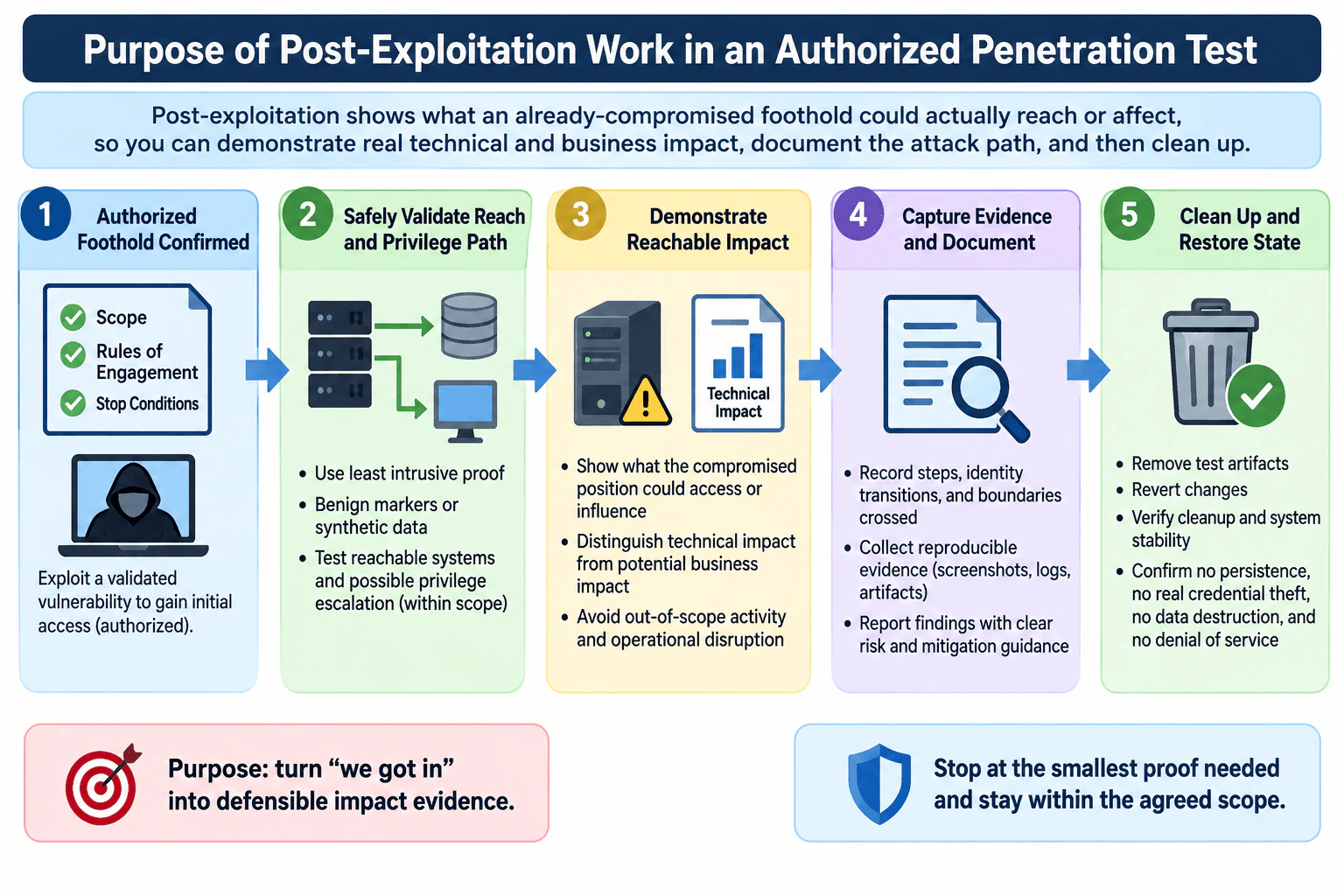
Start with the practical goal: post-exploitation turns "we got in" into defensible evidence of what that access actually means.
First, confirm the authorized foothold and the applicable rules of engagement. The tester should know the approved target, scope, stop conditions, and cleanup expectations before extending the test. Initial access by itself does not prove how far an attacker could go.
Next, safely validate reach and privilege. The tester can determine which approved systems or resources are reachable and whether an authorized privilege transition is possible. This should use the least intrusive proof, such as benign markers or synthetic data, instead of collecting real credentials or sensitive records unnecessarily. Any privilege change, identity transition, or boundary crossed should be documented clearly.
Then demonstrate only reachable impact. The objective is to show what the compromised position could access or influence. A successful technical action is evidence of technical impact, but it does not automatically prove every possible business consequence. Potential business impact should therefore be described separately from what was actually demonstrated.
Evidence should make the result reproducible and defensible. Record the relevant steps, identity transitions, boundaries crossed, observations, screenshots, logs, or approved test artifacts. This gives defenders enough information to understand the tested path and prioritize remediation.
Finally, clean up and restore state. Remove test artifacts, revert changes, and verify that the tested systems are stable and returned to the expected state. Do not establish persistence, disable defenses, extract real credentials, destroy data, cause denial of service, or continue beyond the agreed scope.
The main tradeoff is confidence versus operational risk. Testing farther can provide stronger evidence about reachable impact, but every additional action increases the chance of affecting production systems. A good penetration tester therefore stops once the smallest authorized proof is sufficient to support the finding.
Technical Approach
Confirm that the foothold was obtained during an explicitly authorized test and identify the applicable scope, rules of engagement, and stop conditions.
Identify the current test identity, privilege level, approved assets, and trust boundaries that may be evaluated.
Use the least intrusive method to validate what approved systems or resources are reachable from the foothold.
If privilege escalation or movement to another approved system is permitted, validate only the minimum path needed and record the prerequisite, identity transition, and boundary crossed.
Demonstrate reachable technical impact with benign markers, synthetic data, or another controlled proof rather than unnecessary access to real sensitive information.
Separate what was directly demonstrated from potential business consequences that were not tested.
Capture reproducible evidence, including the tested steps, relevant observations, identity changes, boundaries crossed, screenshots, logs, or approved artifacts.
Stop when sufficient evidence has been collected or when a defined stop condition is reached.
Remove test artifacts, revert changes, and verify system stability and restored state.
Report the validated path, demonstrated impact, limitations, and remediation guidance.
Practical Insights
The main cost is operational risk and testing effort rather than algorithmic complexity. Each extra post-exploitation step takes time to authorize, execute, observe, document, and clean up. Moving farther through privileges or systems may provide stronger evidence, but it also increases the chance of disturbing production services or exposing sensitive information. Coordination with system owners or monitoring teams may also require staff time. The safest approach is to gather enough evidence to prove the finding without performing unnecessary actions.
Why Interviewers Ask This
Interviewers want to know whether you understand that gaining access is not the end of a penetration test. They are checking whether you can safely determine the real impact of that foothold, respect scope and stop conditions, distinguish demonstrated technical impact from potential business impact, collect reproducible evidence, and restore the tested environment to a known clean state.
Common interview mistakes
Common mistakes include treating initial access as proof of maximum impact, continuing farther than the authorized scope allows, escalating privileges or moving to another system without checking permission, using real sensitive data when a benign marker would prove the same point, assuming technical impact automatically equals business impact, collecting unnecessary credentials, creating persistence, disabling security controls, failing to record identity transitions and boundaries crossed, and leaving test artifacts or configuration changes behind after the test.
Interview tip
Lead with the purpose: post-exploitation determines what a confirmed foothold actually means in terms of reachable risk. Then emphasize explicit authorization, the smallest necessary proof, clear evidence, and cleanup. A strong answer shows that you can validate impact without behaving like an unrestricted attacker.
Interviewer may ask next
How far should a penetration tester continue during post-exploitation?
Only as far as the written scope and rules of engagement permit, and only as far as needed to prove the finding. Before privilege escalation, movement to another system, or another sensitive action, the tester should confirm that the action is authorized and does not violate a stop condition. Once the smallest sufficient proof demonstrates the reachable impact, continuing simply to show that more damage is possible adds unnecessary operational risk.
What is the limitation of post-exploitation evidence?
Post-exploitation proves only what was actually and safely validated under the test conditions. Reaching one approved resource does not prove that every similar resource is reachable, and demonstrating technical access does not automatically prove a specific financial or business consequence. The report should clearly separate observed facts from untested possibilities and explain any paths that were intentionally not pursued because of scope or safety limits.
79. What does Metasploit provide for an explicitly authorized penetration-testing engagement?Exploitation And Post ExploitationEasy
Short Interview Answer (30-60 seconds)
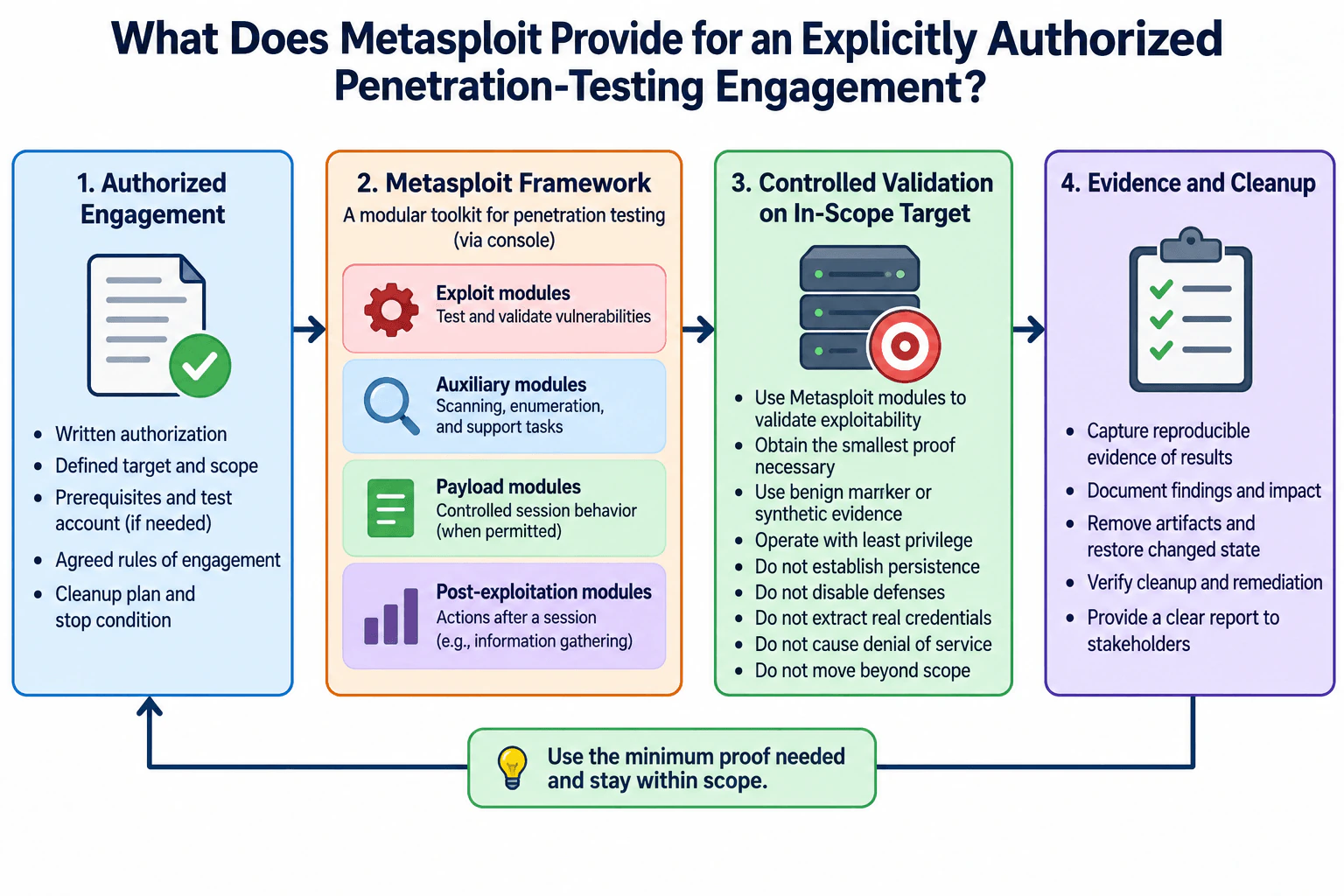
Metasploit is a modular penetration-testing framework providing exploit, auxiliary, payload, and post-exploitation modules. In an authorized engagement, these capabilities help validate vulnerabilities, obtain only the minimum proof needed, collect reproducible evidence, and support controlled follow-on testing, cleanup, remediation verification, and reporting within scope.
Detailed Explanation
The question asks what practical capabilities Metasploit gives a penetration tester during an explicitly authorized engagement. The key point is that Metasploit is not only an exploit launcher. It is a modular framework for tasks such as vulnerability validation, scanning and enumeration, controlled payload execution, and post-exploitation activity after a session exists. Those capabilities must stay inside the agreed target and rules of engagement. A professional tester uses the minimum proof needed, records reproducible evidence, avoids unnecessary impact, removes test artifacts, restores changed state, and clearly reports what was actually demonstrated.
Useful Questions to Ask the Interviewer
Is the question focused on Metasploit Framework capabilities or also on the authorized testing workflow around them?
Should I explain how authorization and rules of engagement limit exploit and post-exploitation activity?
Should I include evidence collection, cleanup, and remediation verification in the answer?
How to Explain It in an Interview
Start with the practical decision: Metasploit is a modular penetration-testing framework used to validate security findings on systems the tester is explicitly authorized to test.
The first boundary is authorization. Before exploitation, the tester should confirm written authorization, the exact target and scope, prerequisites, any required test account, agreed rules of engagement, monitoring coordination when required, the expected proof, a cleanup plan, and stop conditions. These limits determine what the tester may do even when Metasploit technically supports additional actions.
Metasploit provides several relevant module types. Exploit modules are used to exercise vulnerabilities. Auxiliary modules support tasks such as scanning, enumeration, and other supporting operations. Payload modules define code or behavior associated with exploitation. Post-exploitation modules are used after a session exists for authorized follow-on actions such as gathering system information. Official Metasploit documentation identifies exploit, auxiliary, payload, and post module types, and describes post-exploitation as activity performed after a session is opened. docs.rapid7.com
The next decision is how much proof is necessary. The existence of an exploit module does not by itself prove that a particular target is vulnerable. The tester still needs to confirm that the target is in scope and that the relevant prerequisites and affected state are present. When exploitation is permitted, an exploit can carry a compatible payload and successful exploitation may create a session, but the result must be observed rather than assumed. docs.rapid7.com
The diagram's safety boundary is important. The tester should obtain the smallest proof necessary, preferably with a benign marker or synthetic evidence where that is sufficient, and operate with least privilege. The tester should not establish persistence, disable defenses, extract real credentials, cause denial of service, or move beyond scope merely because the framework can support powerful follow-on actions. Each additional action requires its own authorization and purpose.
Evidence should distinguish different levels of proof. A public exploit, a proof of concept, an apparently affected system, successful execution, an obtained session or privilege level, and demonstrated business impact are not the same thing. The report should state exactly what was observed and avoid claiming broader impact that was not tested.
Post-exploitation should also remain bounded. Metasploit supports post-exploitation actions after a session is available, including actions such as gathering system information, but those actions depend on the established session and the permitted test objective. docs.rapid7.com
Finally, the tester captures reproducible evidence, documents the demonstrated finding and impact, removes test artifacts, restores changed state, verifies cleanup, and verifies remediation when that is part of the engagement.
The main tradeoff is confidence versus operational risk. More invasive testing can sometimes provide stronger evidence, but it can also increase service, privacy, and recovery risk. The preferred approach is therefore the minimum reliable proof that answers the security question while remaining inside the authorized scope.
Technical Approach
Confirm written authorization, exact in-scope targets, rules of engagement, prerequisites, affected state, any required test account, monitoring coordination, cleanup plan, and stop conditions.
Identify the security finding to validate and confirm that the selected Metasploit capability is appropriate for the approved target.
Use auxiliary modules when scanning, enumeration, or supporting validation is sufficient.
If exploitation is explicitly permitted, select an appropriate exploit module and compatible, controlled payload behavior for the approved target and objective.
Obtain only the smallest proof necessary, using benign or synthetic evidence where practical and operating with least privilege.
If a session exists, use post-exploitation modules only when separately authorized and only to the depth needed for the objective.
Capture reproducible evidence and clearly distinguish observed facts from assumptions or inferred impact.
Stop when the agreed objective or stop condition is reached.
Remove test artifacts, restore changed state, verify cleanup, document the demonstrated finding and impact, and verify remediation when required.
Practical Insights
The main cost is operational rather than algorithmic. The tester spends time confirming scope, checking prerequisites, selecting and reviewing appropriate modules, coordinating with system owners or monitoring teams, collecting evidence, and cleaning up afterward. More invasive exploitation may increase confidence that a weakness is exploitable, but it also increases the chance of service disruption, unwanted data exposure, or difficult recovery. Using the minimum necessary proof usually gives a better balance between confidence and safety. Teams also need ongoing maintenance to keep Metasploit, its modules, and testing procedures current.
Why Interviewers Ask This
Interviewers ask this to check whether the candidate understands what Metasploit provides and how it should be used professionally. A strong answer distinguishes its major module types, explains that exploitation is bounded by written authorization and scope, and shows judgment around minimum-impact validation, evidence, cleanup, remediation verification, and reporting rather than describing Metasploit only as an exploitation tool.
Common interview mistakes
A common mistake is describing Metasploit only as an exploit launcher. It is a modular framework with exploit, auxiliary, payload, and post-exploitation capabilities. Another mistake is assuming that an available exploit module proves that the target is vulnerable or that exploitation will succeed. Candidates also sometimes imply that obtaining a session automatically permits privilege escalation, credential collection, persistence, lateral movement, or broader post-exploitation. Those are separate actions that require explicit authorization and scope. Other mistakes include using more invasive proof than necessary, collecting real sensitive data when benign evidence would work, failing to define stop conditions, and forgetting evidence collection, artifact removal, state restoration, cleanup verification, and reporting.
Interview tip
Lead with one sentence: Metasploit is a modular framework for controlled vulnerability validation during an authorized penetration test. Then name exploit, auxiliary, payload, and post-exploitation modules, explain the scope boundary, and finish with minimum proof, evidence, cleanup, remediation verification, and reporting. Avoid turning the answer into a list of commands or exploit examples.
Interviewer may ask next
Does having a Metasploit exploit module mean a target is definitely exploitable?
No. An available exploit module means Metasploit contains logic intended to exercise a particular vulnerability or condition, but it does not prove that the specific target is affected or that exploitation will succeed. The tester still has to confirm scope, prerequisites, affected state, safe settings, and the observed result. A scanner finding, an available exploit, successful execution, an obtained session or privilege level, and demonstrated business impact are different levels of evidence and should not be treated as equivalent.
What should a tester do after Metasploit successfully validates a vulnerability?
The tester should stop at the minimum proof required by the rules of engagement unless additional actions are explicitly authorized. Capture reproducible evidence, document exactly what was demonstrated, and avoid unnecessary persistence, credential collection, defense changes, denial of service, or movement beyond scope. Then remove test artifacts, terminate controlled test activity, restore changed state, verify cleanup, report the demonstrated finding and impact, and verify remediation if that is part of the engagement.
80. What does privilege escalation mean in an explicitly authorized penetration test?Exploitation And Post ExploitationEasy
Short Interview Answer (30-60 seconds)
Privilege escalation is gaining higher permissions from a lower-privilege starting point, such as moving from a standard user to administrator or root. In an authorized penetration test, it is performed only within scope using a controlled technique, minimal benign proof, documented evidence, and cleanup.
Detailed Explanation
Privilege escalation means proving that a lower-privilege identity or security context can obtain higher privileges. For example, an authorized tester may begin as a standard user and determine whether an approved misconfiguration or vulnerability allows administrator or root-level access. The important concept is the privilege boundary being crossed. In a penetration test, gaining higher privileges does not give the tester unlimited permission. The tester must remain inside the agreed scope, use a controlled and minimally intrusive technique, confirm only the access needed to prove the finding, record reproducible evidence, and remove any test artifacts or changed state afterward.
Useful Questions to Ask the Interviewer
Should I explain privilege escalation only at the concept level, or also describe how I would validate it safely during a test?
Should I assume the tester already has an authorized low-privilege account on the target?
Do you want me to focus mainly on the privilege boundary, the testing safeguards, or both?
How to Explain It in an Interview
Start with the privilege change. The tester begins with a lower-privilege identity, such as a standard user account. An authorized misconfiguration or vulnerability may allow that identity to obtain greater permissions. The transition from the lower privilege level to the higher privilege level crosses a privilege boundary.
Before testing that path, confirm that the target, starting identity, suspected weakness, escalation activity, safety limits, stop condition, and cleanup plan are covered by the rules of engagement. Authorization to test one target or obtain one level of access does not automatically authorize every action that becomes technically possible after elevation.
Next, use the least intrusive controlled technique that can demonstrate the privilege transition. The goal is not to exercise every administrator or root capability. A minimal benign action is enough when it reliably confirms that the higher privilege level was obtained.
The evidence should show the complete path: the lower-privilege starting identity, the authorized weakness that was exercised, the privilege boundary that was crossed, and the resulting higher-privilege state. This distinguishes a suspected weakness from demonstrated privilege escalation.
After validation, document the evidence and clean up. Remove test artifacts and restore changed state. Do not establish persistence, disable defenses, steal real credentials, destroy data, cause denial of service, or continue beyond the authorized scope.
A key limitation is that obtaining administrator or root access proves a technical privilege change, but it does not automatically prove every possible business impact. Report the technical impact that was actually demonstrated and clearly distinguish it from impact that was only inferred.
The main tradeoff is confidence versus safety. Additional actions after escalation might demonstrate more consequences, but they also increase operational risk. In an explicitly authorized penetration test, the preferred approach is the smallest safe proof that establishes the privilege boundary can be crossed.
Technical Approach
Confirm that the target, starting account, suspected weakness, privilege-escalation activity, safety limits, stop condition, and cleanup plan are explicitly authorized.
Record the starting identity and its lower privilege level.
Use the approved misconfiguration or vulnerability with a controlled, minimally intrusive technique.
Determine whether the action crosses the intended privilege boundary.
If higher privileges are obtained, perform only a minimal benign validation needed to confirm the elevated state.
Capture reproducible evidence of the starting identity, weakness, privilege transition, boundary crossed, and resulting privilege.
Stop when the authorized objective has been proven.
Document the finding, remove test artifacts, restore changed state, and verify cleanup.
Practical Insights
There is no meaningful algorithmic time or space complexity for this conceptual question. The important costs are operational and human. The tester must spend time checking authorization, understanding the starting permissions, choosing a safe validation method, coordinating with system owners when required, collecting evidence, and verifying cleanup. Financial or maintenance cost is usually indirect, such as staff time or temporary testing coordination. The main risk cost is operational: doing more with elevated privileges may increase confidence, but it can also increase the chance of changing data or disrupting a service. The safest approach uses the minimum activity necessary to prove the privilege transition.
Why Interviewers Ask This
Interviewers want to confirm that you understand privilege escalation as a change from lower privileges to higher privileges, not simply initial access. They also want to see that you understand the testing judgment around authorization, scope, the privilege boundary, minimal validation, evidence collection, stop conditions, and cleanup.
Common interview mistakes
Common mistakes are defining privilege escalation as simply gaining initial access, failing to identify the lower and higher privilege states, treating administrator or root access as permission to do anything, assuming that finding a vulnerability automatically proves successful privilege escalation, and performing unnecessary actions after elevated access is obtained. Other mistakes include failing to document the privilege boundary, starting identity, evidence, stop condition, and cleanup, or going beyond scope by establishing persistence, disabling defenses, taking real credentials, destroying data, or causing denial of service.
Interview tip
Give the definition first: privilege escalation is a transition from lower privileges to higher privileges. Then explain the authorized flow: start with limited access, safely validate an approved weakness, cross the privilege boundary, prove the higher privilege with a minimal benign action, document evidence, stay within scope, and clean up. Separate demonstrated technical access from assumed business impact.
Interviewer may ask next
How is privilege escalation different from initial access?
Initial access means obtaining an authorized foothold or starting level of access to the target. Privilege escalation happens from that lower-privilege context when the tester crosses a permission boundary and obtains greater privileges. For example, starting with a standard-user test account is initial access; safely demonstrating that it can become administrator or root is privilege escalation.
How much should a tester do after obtaining administrator or root privileges?
Only as much as the explicitly authorized objective requires. The tester should normally perform a minimal benign action to confirm the elevated privilege, capture reproducible evidence, and stop. Higher privilege does not expand the agreed scope. The tester should not establish persistence, disable defenses, steal real credentials, destroy data, cause denial of service, or perform other unauthorized actions. Test artifacts should then be removed and changed state restored.
More questions load as you scroll
Disclaimer: This interview guide is for educational and informational purposes only. It is designed to help readers prepare, but it does not guarantee any interview result, hiring decision, offer, or outcome. Interview questions, hiring criteria, and preferred answers can vary by employer, interviewer, industry, location, and time. All answers, examples, and explanations in this guide are suggested examples for interview preparation, not definitive answers or instructions for professional practice. They are based on research and judgment, are provided without warranties of any kind, and should be adapted to the question, role, and applicable laws and professional requirements. Diagrams are simplified illustrations intended to highlight the main concepts and their relationships; actual situations, systems, and practices may be more complex. Alternative approaches may be equally valid or better suited to a particular question, context, or interviewer. To the fullest extent permitted by applicable law, the contributors and publisher are not liable for decisions made, actions taken, or losses incurred based on this guide.
State Laws and Professional Responsibilities: Laws and requirements governing an occupation vary by state and jurisdiction. You are responsible for checking the current laws, licensing requirements, and scope-of-practice rules that apply to your location and role, and for ensuring that your answers and actions comply with them. Adapt examples in this guide to those requirements. This guide is not legal advice.
Content Accuracy and Verification: To the fullest extent permitted by applicable law, we do not represent or warrant that interview guides, questions, answers, examples, or diagrams are accurate, complete, current, error-free, or suitable for any particular purpose. You are responsible for independently reviewing and verifying the information before relying on it.