This interview guide is for educational and informational purposes only. It is designed to help readers prepare, but it does not guarantee any interview result, hiring decision, offer, or outcome. Interview questions, hiring criteria, and preferred answers can vary by employer, interviewer, industry, location, and time. All answers, examples, and explanations in this guide are suggested examples for interview preparation, not definitive answers or instructions for professional practice. They are based on research and judgment, are provided without warranties of any kind, and should be adapted to the question, role, and applicable laws and professional requirements. Diagrams are simplified illustrations intended to highlight the main concepts and their relationships; actual situations, systems, and practices may be more complex. Alternative approaches may be equally valid or better suited to a particular question, context, or interviewer. To the fullest extent permitted by applicable law, the contributors and publisher are not liable for decisions made, actions taken, or losses incurred based on this guide.
State Laws and Professional Responsibilities
Laws and requirements governing an occupation vary by state and jurisdiction. You are responsible for checking the current laws, licensing requirements, and scope-of-practice rules that apply to your location and role, and for ensuring that your answers and actions comply with them. Adapt examples in this guide to those requirements. This guide is not legal advice.
Identity, Image, and Privacy Notice
To respect individual privacy, some names, profile photographs, avatars, biographical details, and other identifying information displayed in this guide may be replaced with pseudonyms, licensed stock images, illustrative avatars, composite images, or representative descriptions. Unless a person is expressly identified as an actual contributor, a displayed name, image, or profile should not be understood as depicting or identifying a specific candidate, interviewer, employee, or other real individual. These representations are provided for editorial and illustrative purposes only and do not imply endorsement, employment, participation, or affiliation with this guide or any company mentioned in it. Any resemblance to an actual person is coincidental.
Company Notice
This guide is an independent educational resource and is not affiliated with, endorsed by, sponsored by, or approved by the company named in this guide. Company names identify reported interview experiences or the employer context of clearly labeled original practice exercises. Interview practices can change without notice, and inclusion of company-specific content does not mean these questions are official, complete, or guaranteed to be asked. To the fullest extent permitted by law, the author, contributors, and publisher are not responsible for outcomes related to use of this material.
Content Accuracy and Verification
To the fullest extent permitted by applicable law, we do not represent or warrant that interview guides, questions, answers, examples, or diagrams are accurate, complete, current, error-free, or suitable for any particular purpose. You are responsible for independently reviewing and verifying the information before relying on it.
Questions or comments?
Contact us for general questions, or share feedback, technical corrections, and comments with the community.
61. What account condition enables AS-REP roasting, and how does the mechanism work in an authorized Active Directory lab?Network And Active DirectoryHard
Short Interview Answer (30-60 seconds)
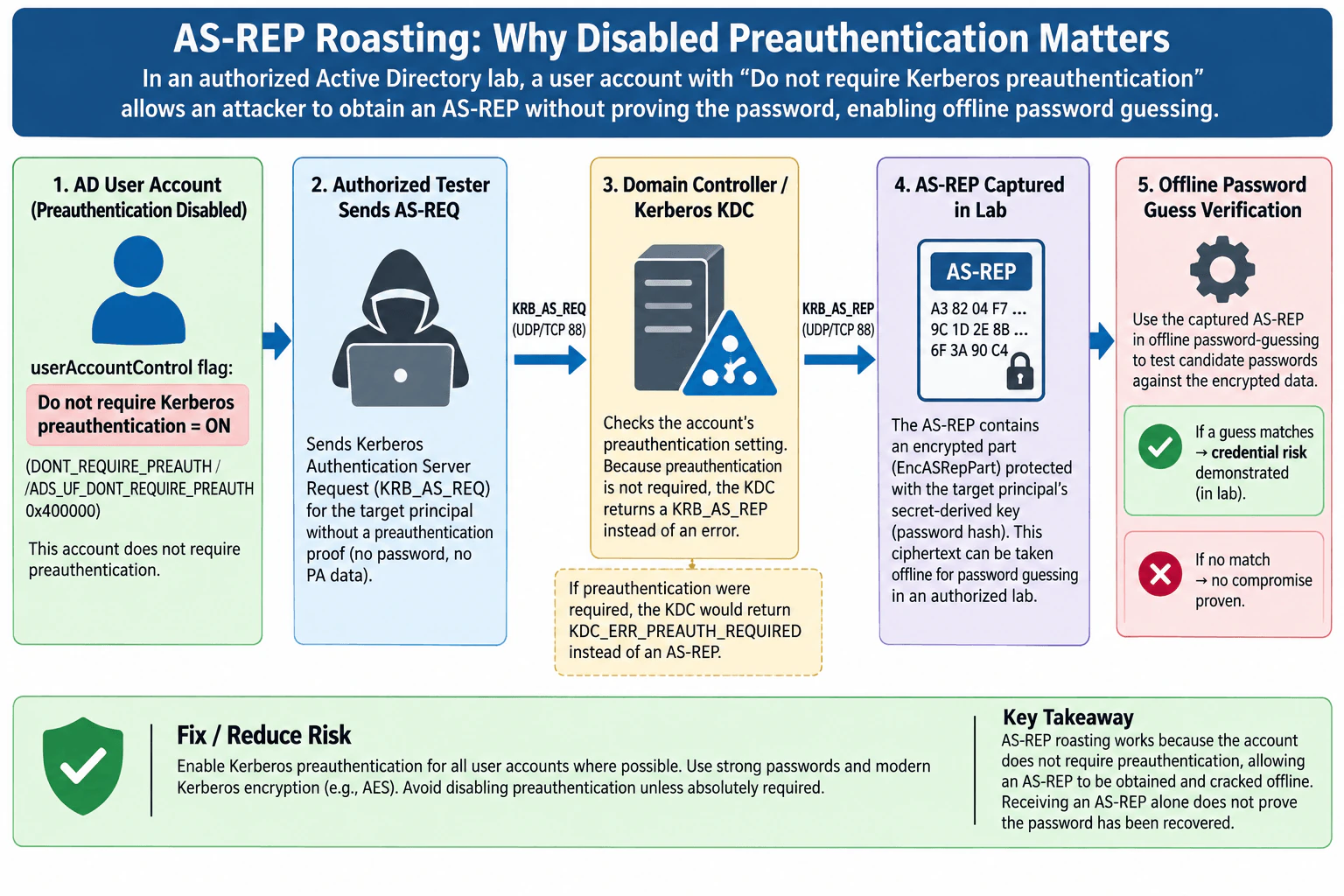
AS-REP roasting requires an account with Kerberos preauthentication disabled, represented by the DONT_REQ_PREAUTH account-control flag. A tester can request an AS-REP without first proving knowledge of the password, capture its password-key-encrypted reply data, and test password guesses offline.
Detailed Explanation
AS-REP roasting depends on one specific account condition: the target Active Directory user does not require Kerberos preauthentication. In the diagram, this is the "Do not require Kerberos preauthentication" setting. An authorized tester sends a Kerberos Authentication Server Request, or AS-REQ, without the normal password-based preauthentication data. The domain controller's Key Distribution Center, or KDC, can then return an Authentication Server Reply, or AS-REP. Part of that reply is encrypted with the user's long-term Kerberos key, allowing password guesses to be checked offline.
Useful Questions to Ask the Interviewer
Should I explain only the Kerberos mechanism, or also describe safe validation and remediation in the authorized lab?
Can I assume the target account is an approved test account and the tester has written authorization?
Should I also explain what happens when Kerberos preauthentication is enabled?
How to Explain It in an Interview
Start with the account condition. In Active Directory, the relevant userAccountControl flag is DONT_REQ_PREAUTH, whose hexadecimal value is 0x400000. The graphical account option is "Do not require Kerberos preauthentication." This is the condition that makes the account AS-REP roastable.
The trust boundary is between the authorized tester host and the Active Directory domain controller acting as the Kerberos KDC. Kerberos KDC traffic supports both UDP and TCP, normally on port 88. The tester sends a KRB_AS_REQ for the approved target principal without the normal password-based preauthentication proof.
If preauthentication is not required for that account, the KDC can return a KRB_AS_REP instead of first demanding additional preauthentication. The AS-REP contains a Ticket Granting Ticket and a separate encrypted reply portion, commonly called EncASRepPart. The important material for AS-REP roasting is the encrypted reply portion, which is protected with the user's long-term Kerberos key.
The diagram uses the phrase "password hash" as simple teaching shorthand. More precisely, Kerberos uses a long-term encryption key derived from the user's password according to the selected encryption type. For RC4-based Kerberos that key corresponds to the NT hash, while AES Kerberos keys are derived from the password using the Kerberos string-to-key process. The core mechanism remains the same: the captured AS-REP gives the tester encrypted material against which candidate passwords can be verified offline.
Offline guessing is important because the individual guesses are not sent to the domain controller. Therefore, normal account-lockout counters do not limit those offline checks. That does not mean the password will be recovered. Password strength and the encryption type materially affect practical cracking difficulty.
The result must be described carefully. Receiving the AS-REP demonstrates that the account allows the roastable path. If an authorized offline guess matches, credential exposure is demonstrated in the lab. If no tested guess matches, compromise has not been proven. The absence of a successful guess does not remove the underlying configuration weakness.
The failure path shown in the diagram is also important. When the account requires preauthentication, an initial AS-REQ that lacks required preauthentication data can receive KDC_ERR_PREAUTH_REQUIRED rather than the roastable AS-REP path. That difference is useful evidence when validating remediation.
For safe validation, use only approved accounts and the minimum number of Kerberos requests needed to demonstrate behavior. Avoid unnecessary credential-recovery activity unless it is explicitly authorized. Retain only the evidence needed for the assessment. The primary remediation is to enable Kerberos preauthentication for user accounts wherever possible. Strong passwords and modern Kerberos encryption reduce residual password-guessing risk, but they are not substitutes for requiring preauthentication.
The main limitation is that obtaining an AS-REP is not the same as recovering a password or proving access to domain resources. It establishes roastability. Actual credential compromise requires a successful offline guess and any further authentication or access validation must remain separately authorized.
Technical Approach
1. Confirm written authorization and restrict testing to the approved Active Directory lab and target account. 2. Verify that the approved account has the "Do not require Kerberos preauthentication" condition, corresponding to DONT_REQ_PREAUTH. 3. From the authorized tester host, send a minimal Kerberos AS-REQ for the target principal without password-based preauthentication data to the domain controller's KDC on Kerberos port 88. 4. Record the KDC response. An AS-REP demonstrates the roastable path; a preauthentication-required error demonstrates that additional preauthentication is required for that request. 5. If an AS-REP is returned, retain only the encrypted reply material needed as assessment evidence. 6. Perform offline password-guess verification only when explicitly authorized and only against approved lab material. 7. Report roastability separately from password recovery. Do not claim compromise merely because an AS-REP was obtained. 8. Remediate by requiring Kerberos preauthentication where possible and repeat the same bounded validation to confirm that the original roastable path is no longer available.
Practical Insights
The network impact of validating the condition is small because only a limited Kerberos request and response are needed. Offline password guessing can be much more expensive because it consumes local CPU or GPU resources and may run for a long time without success. Strong passwords increase that cost substantially. Operationally, remediation requires identifying affected accounts, checking whether any legitimate compatibility exception exists, enabling preauthentication where possible, and retesting dependent applications. Requiring preauthentication removes the normal AS-REP roasting condition for those accounts.
Why Interviewers Ask This
Interviewers want to confirm that the candidate understands the exact Active Directory account condition behind AS-REP roasting, the Kerberos Authentication Service exchange, why the returned encrypted material supports offline password guessing, and the difference between demonstrating roastability and proving credential compromise. They also want sound penetration-testing judgment: the test should be explicitly authorized, bounded to the approved lab, minimally intrusive, and should not be confused with online password spraying.
Common interview mistakes
Common mistakes include saying that every Kerberos account can be AS-REP roasted, confusing AS-REP roasting with Kerberoasting, claiming that the TGT itself is encrypted with the user's password key, and treating receipt of an AS-REP as proof that the user's password has been cracked. Another mistake is describing the offline guesses as online login attempts that should trigger account lockout. A further technical mistake is treating "password hash" as universally literal: with modern AES Kerberos encryption, the long-term key is derived through Kerberos string-to-key processing rather than simply being the NT hash.
Interview tip
Lead with the required account condition, then explain the two-message flow: an AS-REQ without preauthentication is sent to the KDC, and an AS-REP containing password-key-protected reply data is returned. Finish by explaining that the material can be tested offline, but receiving it proves roastability, not successful password recovery.
Interviewer may ask next
How is AS-REP roasting different from Kerberoasting?
AS-REP roasting targets user accounts that do not require Kerberos preauthentication and abuses the initial Authentication Service exchange. The tester requests an AS-REP without first proving knowledge of that user's password and then tests the encrypted AS-REP reply material offline. Kerberoasting instead requests service tickets for service principal names and targets encrypted material from those service tickets. The required account conditions and Kerberos exchanges are different.
Does receiving an AS-REP mean the target account has been compromised?
No. Receiving the AS-REP demonstrates that the account permits the roastable authentication path and provides encrypted material that can be tested offline. Compromise is demonstrated only if an authorized password guess is successfully verified and any subsequent use of the recovered credential is separately permitted by the assessment scope. If no guess succeeds, password recovery has not been proven, although the preauthentication-disabled configuration weakness still exists.
62. How does NTLM authentication relay work in an explicitly authorized Active Directory lab?Network And Active DirectoryHard
Short Interview Answer (30-60 seconds)
NTLM relay forwards a user's live NTLM challenge-response authentication to another NTLM-accepting service instead of cracking the password. If the target accepts it without effective signing or binding protections, a session can be created as that user, limited to the user's existing permissions on that target.
Detailed Explanation
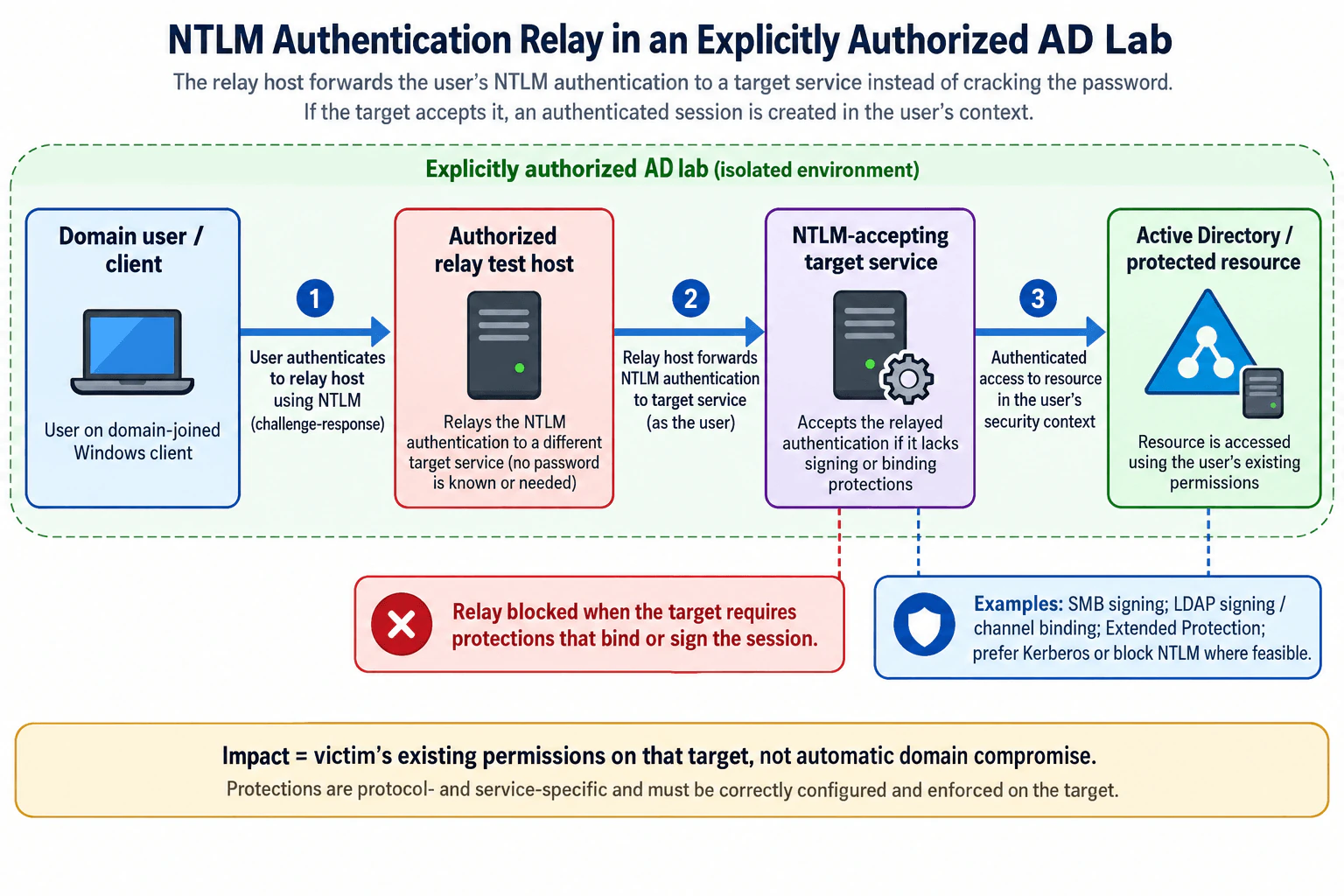
NTLM relay is misuse of a live authentication exchange, not password recovery. In the explicitly authorized Active Directory lab shown in the diagram, a domain user authenticates with NTLM to a controlled relay test host. The relay host forwards that authentication exchange to a different NTLM-accepting target service. If the target accepts it without effective protections that sign or bind the session, it can authenticate the connection in the user's security context. Access to the protected resource then depends on that user's existing permissions. Successful relay alone does not prove privilege escalation or domain compromise.
Useful Questions to Ask the Interviewer
Is the exercise limited to an isolated, explicitly authorized lab with designated test identities and systems?
Which NTLM-accepting target service is in scope?
Which signing, channel-binding, or Extended Protection controls are expected to be enabled or intentionally absent?
What harmless proof of access is permitted after successful authentication?
How to Explain It in an Interview
The practical question is whether a target service can accept a user's NTLM authentication when that authentication is forwarded through another host instead of being used only on the original connection.
The approved diagram has four components. First, a domain user on a domain-joined Windows client performs NTLM challenge-response authentication to the authorized relay test host. The password itself is not sent to the relay host. Second, the relay host forwards the live NTLM authentication exchange to a different NTLM-accepting target service. It does not need to crack or learn the user's password. Third, the target decides whether that authentication is acceptable. If the service lacks an effective protection that binds or signs the authentication or subsequent session as required by that protocol, it may establish an authenticated session in the user's context. Fourth, that session can reach a protected resource only with permissions already granted to that identity.
The trust problem is therefore not that Active Directory automatically gives the relay host extra privileges. The weakness is that an authentication exchange accepted on one connection can be forwarded and accepted by another service when the relevant protocol and service configuration do not sufficiently protect against relay.
The failure path is equally important. If the target requires the appropriate signing or binding protection, the relayed authentication or subsequent protected session cannot be used in the same way and the relay is blocked. The exact protection is service-specific. Examples represented in the diagram include required SMB signing for SMB, LDAP signing and LDAP channel binding where applicable, and Extended Protection for Authentication. Prefer Kerberos where supported and reduce or block unnecessary NTLM use after compatibility testing.
Evidence should stay narrow and reproducible. Record the designated test identity, controlled relay host, approved target service, whether the target accepted or rejected the authentication, the protection state being tested, and the exact harmless resource action that was actually permitted. Do not treat successful authentication as proof of unrestricted access. Authentication establishes identity; authorization decides what that identity can do.
The main limitation is that relayability depends on the target protocol, service configuration, authentication protections, network path, and the user's permissions. The diagram intentionally does not name a specific target protocol or port, so those values should be documented from the actual authorized lab rather than invented. Even when authentication succeeds, the demonstrated impact remains limited to the permissions available to the relayed identity on that target.
The main tradeoff is security versus compatibility. Requiring signing or binding, enforcing Extended Protection where supported, preferring Kerberos, and restricting NTLM reduce relay risk. However, older applications or configurations can still depend on NTLM, so organizations should identify legitimate dependencies and test compatibility before broadly restricting it.
Technical Approach
Confirm written authorization, isolated-lab scope, designated test identity, approved relay host, target service, permitted proof action, and stop conditions.
Record the user's expected permissions on the target before testing so later impact is not overstated.
Verify the intended path shown in the diagram: domain client to controlled relay host, relay host to the approved NTLM-accepting target service, then target service to the protected resource.
Observe the designated test client's NTLM authentication to the controlled relay host and confirm that the password itself is neither requested nor recovered.
Determine whether the approved target accepts or rejects the forwarded authentication exchange.
Compare behavior with the target's relevant signing or binding protection enforced.
If authentication succeeds, perform only the pre-approved harmless resource action and record the exact authorization demonstrated.
Stop at the approved proof point, retain only necessary evidence, restore any intentionally changed lab configuration, and report both successful and blocked paths.
Practical Insights
The authentication flow is conceptually small, but safe validation has operational cost. You need an isolated or tightly controlled environment, designated test accounts, approved services, logging, and time to compare protected and intentionally vulnerable configurations. Requiring signing, channel binding, Extended Protection, Kerberos, or NTLM restrictions can create compatibility work because older systems may still depend on NTLM. The main human cost is careful scoping, evidence review, remediation planning, and coordination with system owners. The main tradeoff is stronger relay resistance versus the work required to identify and update legitimate legacy dependencies.
Why Interviewers Ask This
Interviewers want to see whether you understand the difference between recovering a password and relaying an authentication exchange, can identify the trust failure that enables relay, can separate authentication from authorization, and know which service-specific protections can block the attack. They also want evidence that you would validate the behavior safely in an isolated, explicitly authorized environment without exaggerating the demonstrated impact.
Common interview mistakes
Common mistakes include saying NTLM relay cracks or reveals the password; claiming that the relay host gains new privileges automatically; treating successful authentication as unrestricted authorization; assuming every NTLM-capable service is relayable; ignoring protocol-specific signing or binding protections; inventing a target protocol or port that was not specified; claiming domain compromise from a limited successful session; and performing relay testing without explicit authorization and safe constraints. A good answer reports only the identity, target, protection state, and permissions that were actually demonstrated.
Interview tip
Lead with the key distinction: NTLM relay forwards a live challenge-response exchange instead of cracking a password. Walk through the client, authorized relay host, NTLM-accepting target, and protected resource. Then explain that signing or binding protections can block the relay and that successful access is limited to the relayed identity's existing permissions.
Interviewer may ask next
Why can signing or channel-binding protections stop an NTLM relay?
They make the authentication or protected session depend on properties of the intended connection, service, or secure channel rather than accepting a freely forwarded exchange. For example, required SMB signing protects SMB messages with a session key, while channel-binding and Extended Protection can bind Windows authentication to the secure channel or intended service. A relay host that only forwards the authentication cannot satisfy those protections as though it were the original authenticated endpoint.
Does successful NTLM relay mean the Active Directory domain is compromised?
No. Successful relay means the target accepted the relayed identity and established a session in that identity's context. Authorization still determines what the identity can access or change. If that user has only limited rights on the target, the demonstrated impact is limited to those rights. A defensible finding reports the exact target, identity, protection state, and verified permissions instead of assuming privilege escalation or domain-wide compromise.
63. Which attacks can affect Diffie–Hellman key exchange, and why, in an authorized protocol-security review?Network And Active DirectoryHard
Short Interview Answer (30-60 seconds)
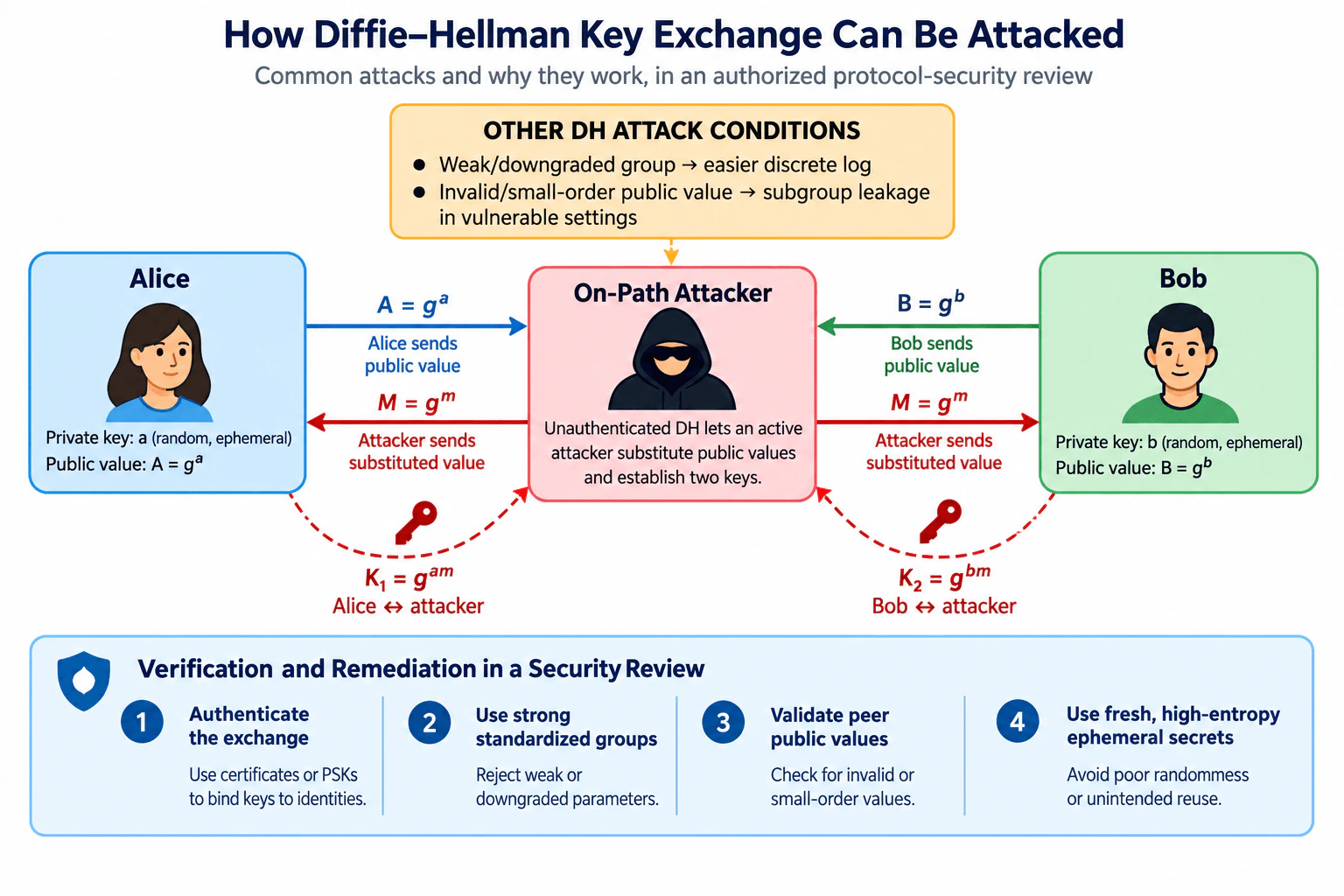
Unauthenticated Diffie-Hellman can be attacked by an active man-in-the-middle that substitutes public values and creates separate keys with each peer. Weak or downgraded groups can make discrete logarithms easier, while invalid or small-order public values can enable subgroup leakage in vulnerable implementations.
Detailed Explanation
Diffie-Hellman lets two peers derive a shared secret across an untrusted network, but the exchange is secure only when its surrounding protocol handles authentication, parameter strength, public-value validation, and secret generation correctly. The review should therefore ask whether an attacker can replace public values, force weaker groups, or supply invalid or small-order values. Testing must stay inside the written authorization and use controlled observations rather than disruptive exploitation. The goal is to prove the protocol property that failed, not simply show that Diffie-Hellman appears in a handshake.
Useful Questions to Ask the Interviewer
Is the review limited to passive configuration and handshake validation, or are controlled active protocol tests explicitly authorized?
Which Diffie-Hellman variant and parameter groups are in scope: finite-field DH, elliptic-curve DH, or both?
How is the exchange authenticated, for example with certificates, signatures, or pre-shared keys?
Are downgrade behavior and malformed or invalid peer public values included in the rules of engagement?
How to Explain It in an Interview
The practical decision is to determine whether the protocol protects the Diffie-Hellman exchange from public-value substitution and unsafe parameters.
First, consider an active man-in-the-middle attack. Alice generates a private value a and sends A = g^a. Bob generates b and sends B = g^b. If the exchange is not authenticated, an on-path attacker can intercept both values and substitute its own public value M = g^m. Alice then derives K1 = g^(am) with the attacker, while Bob derives K2 = g^(bm) with the attacker. Alice and Bob therefore do not share the same secret with each other. The root cause is missing authentication of the key exchange, not a failure of the Diffie-Hellman mathematics itself.
Second, inspect the accepted group or domain parameters. A weak or successfully downgraded group gives less resistance to solving the discrete-logarithm problem. In a review, I would confirm which standardized groups the implementation accepts and whether weaker alternatives can be negotiated when they should be rejected.
Third, check peer public-value validation. In finite-field Diffie-Hellman, accepting an invalid or small-order public value can create small-subgroup problems in vulnerable protocol modes, especially where a long-lived private exponent is involved. Public values should be checked against the rules required by the selected group and protocol before the shared secret is used.
Fourth, verify that ephemeral private values are generated with strong randomness and are not unintentionally reused. Fresh high-entropy secrets reduce exposure from predictability or accidental reuse.
The trust boundary is the unauthenticated network path between the two peers. Authentication binds the exchanged key material to the expected peer identity. Strong standardized groups provide adequate mathematical strength. Public-value validation rejects values outside the permitted group behavior. Fresh ephemeral secrets reduce exposure from predictable or reused private values.
For safe validation, I would inspect negotiated parameters, protocol traces, configuration, and authentication evidence first. If controlled active testing is authorized, I would use a test environment or synthetic endpoints to verify whether unauthenticated substitution, downgrade acceptance, or invalid-value handling is possible without collecting real secrets or interrupting production traffic. If peer authentication or public-value validation fails, the exchange should terminate rather than continue with an untrusted key.
A limitation is that observing support for Diffie-Hellman, or even observing an accepted group, does not by itself prove exploitation. The final finding should distinguish configuration weakness from demonstrated protocol impact. Strong groups also do not solve missing authentication, and authentication alone does not make an unsafe group or invalid public value acceptable.
Technical Approach
Confirm written authorization, target endpoints, protocol variants, and whether controlled active testing is allowed.
Capture or inspect a normal authorized handshake and identify the Diffie-Hellman group, peer public values, and authentication mechanism.
Verify that the exchange is authenticated and that each peer binds the negotiated key material to the expected identity.
Review accepted groups and negotiation behavior for weak or unintended downgrade paths.
Verify peer public-value validation appropriate to the selected Diffie-Hellman group.
Confirm ephemeral private values are generated from a strong randomness source and are not intentionally reused.
If explicitly authorized, reproduce suspected weaknesses only against controlled or synthetic endpoints using non-destructive tests.
Record exact evidence, separate configuration weakness from verified impact, recommend remediation, and retest the corrected behavior.
Practical Insights
The technical cost is usually moderate because the reviewer needs protocol traces, configuration access, and enough cryptographic knowledge to distinguish a real weakness from normal Diffie-Hellman behavior. Active validation may require an isolated test environment because modifying handshakes in production can affect availability. Operationally, stronger standardized groups and public-value checks add little compared with the security benefit, but legacy compatibility can make removing weak parameters harder. Authentication introduces certificate, key, or pre-shared-key management. Fresh ephemeral secrets depend on reliable randomness. Ongoing maintenance includes keeping protocol libraries, allowed groups, trust stores, and test cases current.
Why Interviewers Ask This
Interviewers want to see whether the candidate understands that Diffie-Hellman provides key agreement but does not automatically authenticate the communicating parties. They also expect the candidate to recognize parameter-strength and public-value-validation weaknesses, explain why those weaknesses matter, and describe a safe, evidence-based protocol review rather than treating a scanner result or theoretical weakness as proven compromise.
Common interview mistakes
Common mistakes are saying that Diffie-Hellman itself authenticates the peers; describing a man-in-the-middle attack without showing that the attacker substitutes public values and forms two different shared keys; assuming a strong group prevents man-in-the-middle attacks; treating every supported older group as automatically exploitable; discussing small-subgroup attacks without noting that they depend on group validation and protocol mode; ignoring private-value randomness or reuse; and performing active downgrade or malformed-value tests on production systems without explicit authorization. Another mistake is claiming compromise from a handshake observation alone instead of separating theoretical weakness, configuration weakness, and verified impact.
Interview tip
Lead with the three attack classes: unauthenticated man-in-the-middle, weak or downgraded groups, and invalid or small-order public values. Then explain why each works and finish with the four checks shown in the diagram: authenticate the exchange, use strong standardized groups, validate peer public values, and use fresh high-entropy ephemeral secrets.
Interviewer may ask next
Why does unauthenticated Diffie-Hellman allow a man-in-the-middle attack even when the group is cryptographically strong?
A strong group protects the discrete-logarithm problem, but it does not prove who supplied a public value. An active attacker can intercept A = g^a and B = g^b and replace them with M = g^m. Alice then derives K1 = g^(am) with the attacker, and Bob derives K2 = g^(bm) with the attacker. Authentication, such as signatures, certificates, or an appropriate pre-shared-key mechanism, is needed to bind the key exchange to the expected peer.
What is the important limitation when testing for small-subgroup attacks?
The presence of Diffie-Hellman does not mean a small-subgroup attack exists. The risk depends on the selected group, whether peer public values are validated, and how static or ephemeral private values are used. In an authorized review, I would first verify the protocol and validation rules, then use a controlled test only if active malformed-value testing is permitted. I would report an exploitable condition only when the implementation actually accepts an unsafe value and the resulting impact is demonstrated safely.
64. Does obtaining a server’s private key reveal all its previously captured TLS traffic?Network And Active DirectoryHard
i Question Details
For an authorized cryptographic review, explain what determines the answer rather than assuming a particular TLS key exchange.
Short Interview Answer (30-60 seconds)
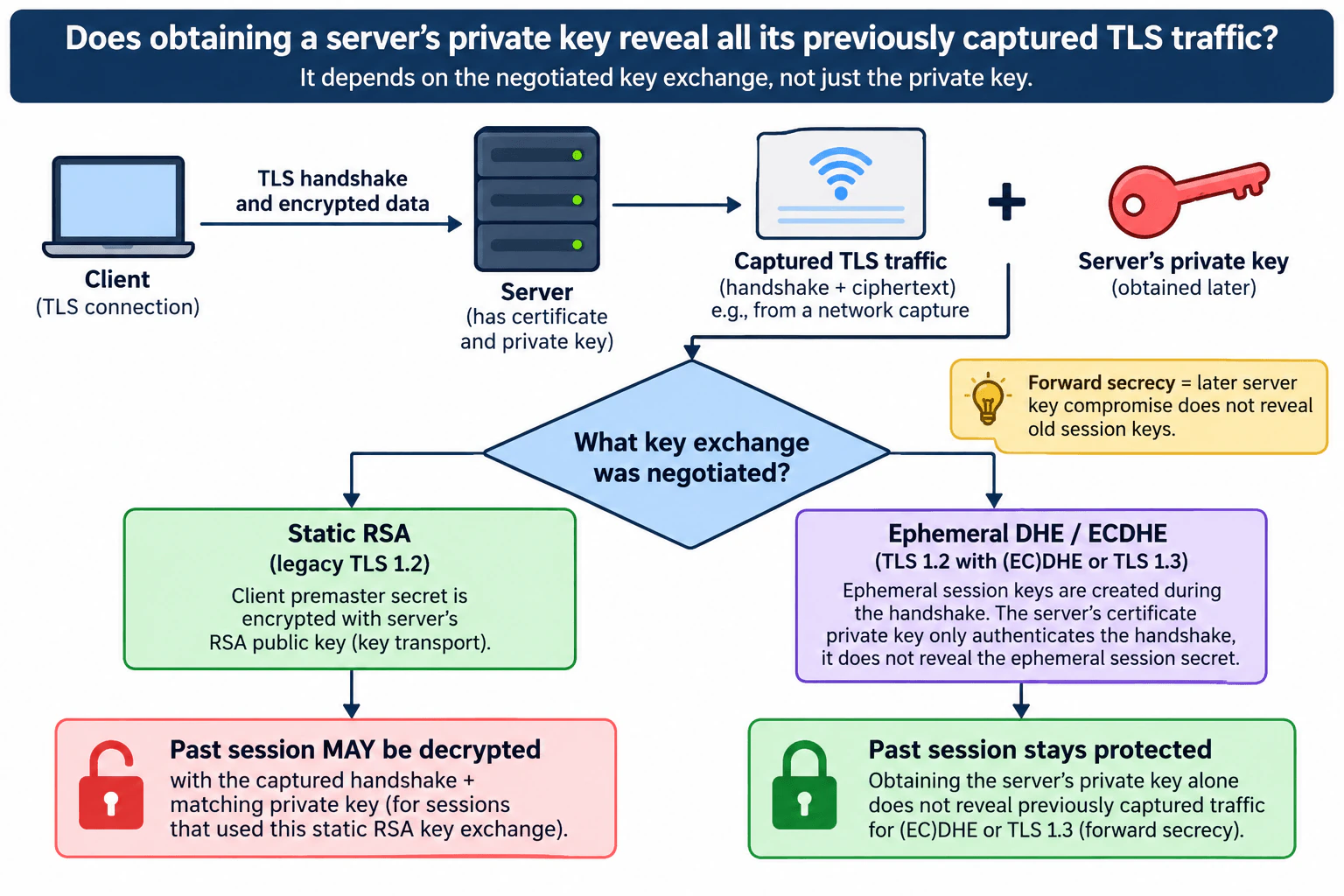
No. Check the negotiated key exchange. Legacy static RSA key transport can make old captured sessions decryptable with the matching private key. Ephemeral DHE or ECDHE provides forward secrecy, so later compromise of the server's long-term private key does not reveal those earlier session secrets.
Detailed Explanation
Obtaining a server's private key does not automatically expose all previously captured TLS traffic. The deciding factor is how each connection established its session keys. In legacy static RSA key transport, the client encrypts a premaster secret with the server's RSA public key, and the server decrypts it with the matching private key. A later holder of that private key may therefore recover the premaster secret from a sufficient historical capture. With ephemeral Diffie-Hellman, such as DHE or ECDHE, temporary key material creates the shared secret, so the long-term certificate key does not reveal old session secrets. rfc-editor.org
Useful Questions to Ask the Interviewer
Which TLS versions and key-exchange mechanisms were negotiated in the captured sessions?
Does the capture contain the complete handshake and encrypted application records needed for the review?
Is the obtained private key the same key corresponding to the server certificate used during the historical sessions?
Are we reviewing legacy static RSA sessions, ephemeral DHE/ECDHE sessions, TLS 1.3 sessions, or a mixture?
How to Explain It in an Interview
Start with the practical decision: inspect the negotiated TLS version and key exchange for each captured connection before deciding whether the server private key can help decrypt it.
For legacy static RSA key transport in TLS 1.2 or earlier, the client generates a premaster secret, encrypts it with the RSA public key from the server certificate, and sends the encrypted value in the handshake. The server uses its matching RSA private key to recover that premaster secret. The TLS master secret and record-protection keys are then derived from it. Therefore, if an authorized reviewer later obtains the same RSA private key and has the required historical handshake and ciphertext, previously captured sessions protected by that static RSA key may be decryptable. RFC 5246 explicitly notes that compromise of a static RSA key causes loss of confidentiality for sessions protected under that key. rfc-editor.org
Ephemeral DHE and ECDHE work differently. The client and server generate temporary Diffie-Hellman values for the connection and derive the shared secret from those ephemeral values. The server's certificate private key can authenticate the exchange, but it is not the ephemeral shared secret. Obtaining that long-term private key later therefore does not reconstruct the old ephemeral secret or derived traffic keys. This property is forward secrecy: compromise of a long-term authentication key does not reveal earlier forward-secret session keys. nvlpubs.nist.gov
TLS 1.3 also removed static RSA key transport. In its certificate-based ephemeral key-exchange modes, fresh (EC)DHE keys provide forward secrecy. TLS 1.3 can also use pre-shared-key modes, so it is more precise to identify the actual negotiated mode rather than simply treating the protocol version as proof of a particular key exchange. Even so, possession of the server's certificate private key alone does not provide the RSA-key-transport decryption path that existed in legacy TLS. rfc-editor.org
The diagram's main boundary is therefore correct: captured handshake plus ciphertext and the later-obtained server private key go into a decision about the negotiated key exchange. The static RSA branch can lead to retrospective decryption when the required capture and matching key are available. The ephemeral DHE/ECDHE branch remains protected because the server's certificate private key does not reveal the historical ephemeral session secret.
For an authorized review, validate the conclusion from evidence instead of assuming it. Inspect the TLS handshake to determine the negotiated version and key exchange. For a legacy static RSA session, confirm that the historical certificate corresponds to the obtained private key and that the capture includes the necessary handshake records. For an ephemeral DHE/ECDHE session, document that the key agreement used temporary Diffie-Hellman values and that the long-term private key alone cannot reconstruct the old shared secret.
Use a conservative failure rule: do not report historical traffic as decryptable merely because a server private key was obtained. Report decryption as possible only when the evidence shows a compatible legacy static RSA key exchange, the supplied key matches the historical server key, and the required capture data exists.
The important limitation is that forward secrecy protects against later compromise of the server's long-term private key; it does not protect a session if its actual ephemeral private values, negotiated shared secret, or derived traffic secrets were separately exposed. Likewise, a matching static RSA key does not help if the session used an ephemeral key exchange.
Technical Approach
Confirm that the packet capture, private key, and cryptographic review are explicitly authorized.
Inspect each captured TLS handshake and record the negotiated TLS version and key exchange.
Separate legacy static RSA key-transport sessions from ephemeral DHE/ECDHE sessions and other modes.
For a static RSA session, verify that the captured server certificate corresponds to the obtained RSA private key and that the necessary handshake and ciphertext were captured.
If those conditions hold, conclude that retrospective decryption may be possible because the RSA private key can recover the encrypted premaster secret.
For DHE/ECDHE, conclude that the long-term server private key alone cannot recover the historical ephemeral shared secret.
For TLS 1.3, identify the negotiated key-establishment mode rather than assuming one solely from the version; static RSA key transport is not supported.
Report conclusions per session and protect all private-key material and decrypted authorized evidence as sensitive data. rfc-editor.org
Practical Insights
The main cost is careful evidence review rather than active network testing. Each captured connection may need its handshake inspected to determine the TLS version and key exchange. Historical certificate and private-key matching also takes time. Large packet captures increase storage and analyst effort. Handling a real server private key creates security and governance risk, so access should be tightly controlled. Forward secrecy reduces the risk that a later server-key compromise exposes old traffic, although it can also make authorized retrospective troubleshooting impossible unless session-specific secrets were separately collected through an approved process.
Why Interviewers Ask This
This tests whether the candidate understands the difference between a server's long-term authentication key and the secrets used to establish TLS traffic keys. A strong answer should identify the negotiated key exchange, explain forward secrecy, avoid assuming that every TLS session behaves like legacy RSA key transport, and describe how an authorized reviewer would verify the conclusion from captured handshake evidence.
Common interview mistakes
Common mistakes are saying that a server private key always decrypts old TLS traffic, assuming that an RSA certificate means the session used RSA key transport, confusing certificate authentication with session-key establishment, overlooking DHE/ECDHE forward secrecy, or claiming that TLS 1.3 supports static RSA key transport. Another mistake is treating possession of a private key as proof of successful historical decryption without checking the negotiated handshake, matching the key to the historical certificate, and confirming that the required packet data was captured.
Interview tip
Lead with: "It depends on the negotiated key exchange." Then contrast legacy static RSA with ephemeral DHE/ECDHE. Explain that static RSA can expose the encrypted premaster secret to a later holder of the matching private key, while forward-secret exchanges create separate ephemeral secrets that the long-term certificate key cannot reconstruct.
Interviewer may ask next
Why can a legacy static RSA TLS session be vulnerable to retrospective decryption?
In legacy RSA key transport, the client generates a premaster secret and encrypts it with the RSA public key from the server certificate. The server's matching private key decrypts that value. If an authorized reviewer later obtains the same private key and has the necessary historical handshake, the reviewer may recover the premaster secret and derive the session keys. This is different from using an RSA certificate only to authenticate an ephemeral key exchange. rfc-editor.org
Why does ECDHE protect previously captured traffic after the server's certificate private key is compromised?
ECDHE derives the connection's shared secret from temporary elliptic-curve Diffie-Hellman values. The server's long-term certificate private key authenticates the handshake but is not the ephemeral shared secret. Obtaining that certificate key later therefore does not reconstruct the old ECDHE secret or its derived traffic keys. That is the forward-secrecy property shown in the diagram. rfc-editor.org
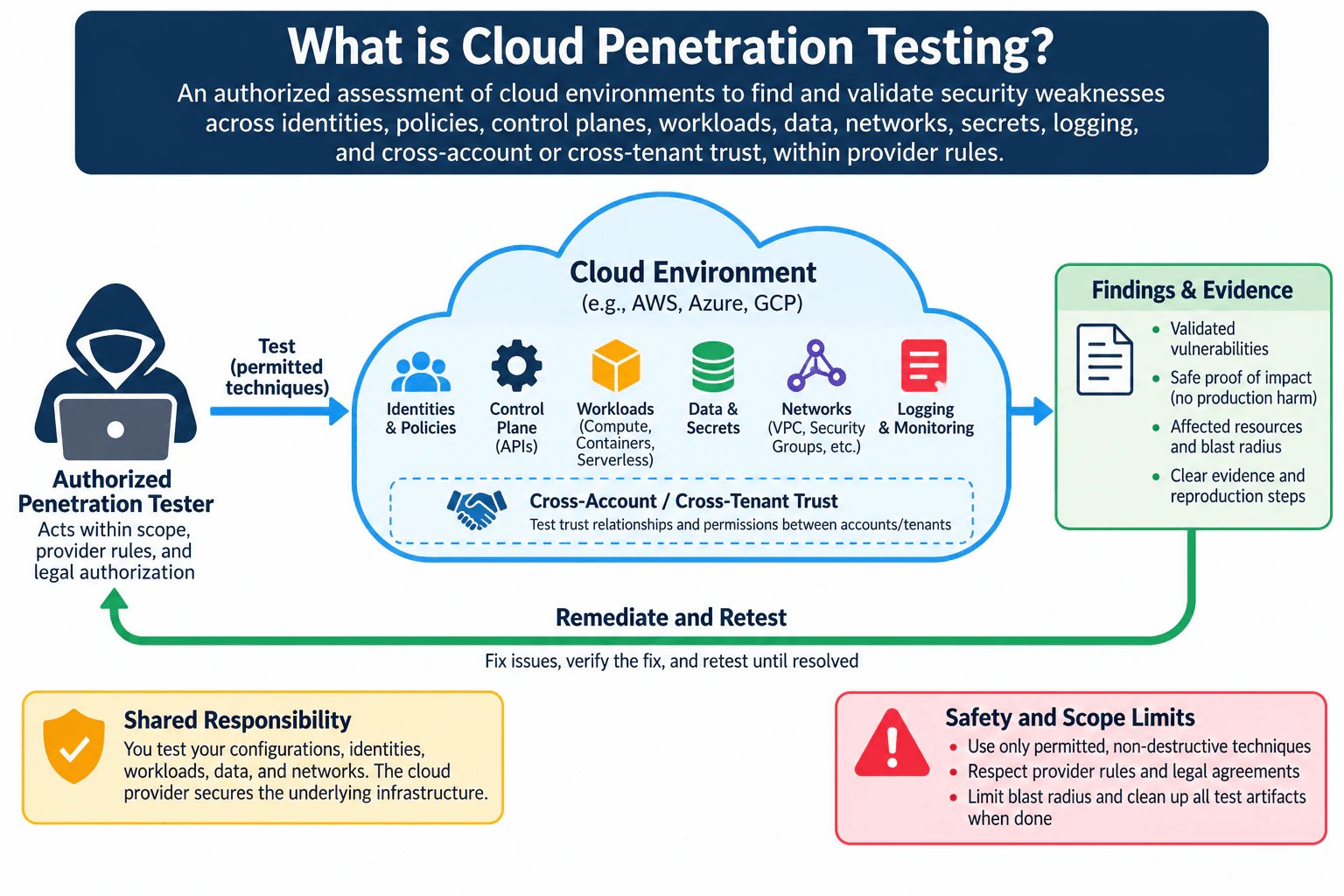
65. What is cloud penetration testing?Cloud SecurityEasy
i Question Details
Define cloud penetration testing as an authorized assessment of identities, policies, control planes, workloads, data, networks, secrets, logging, and cross-account or cross-tenant trust within provider rules. Explain shared responsibility, permitted techniques, safe proof, blast-radius limits, evidence, cleanup, remediation, and retesting.
Short Interview Answer (30-60 seconds)
Cloud penetration testing is an authorized assessment of customer-controlled cloud resources and trust relationships. I test identities, policies, control-plane APIs, workloads, data, networks, secrets, logging, and cross-account trust using permitted techniques, collect safe evidence, limit impact, clean up, support remediation, and retest the fix.
Detailed Explanation
Cloud penetration testing means safely testing an authorized cloud environment to find and validate security weaknesses. Unlike a simple network test, it includes identities, policies, control-plane APIs, workloads, data, networks, secrets, logging, and trust between accounts or tenants. The tester must know exactly what is in scope, which actions the provider permits, and where customer responsibility ends. The objective is not to cause maximum impact. It is to produce enough controlled evidence to prove the weakness, protect production, limit the blast radius, clean up test artifacts, support remediation, and verify the deployed fix with a retest.
Useful Questions to Ask the Interviewer
Which cloud organizations, accounts or subscriptions, regions, and resources are authorized for testing?
Which identities and roles may the tester use, and are cross-account or cross-tenant trust relationships in scope?
What provider-specific testing rules and prohibited activities apply?
Are production workloads included, and what stop conditions or blast-radius limits must be followed?
What evidence can be collected, and what data-handling or cleanup requirements apply?
How to Explain It in an Interview
Start with authorization. A cloud penetration test begins with written permission and a precise scope. That scope should identify the authorized cloud environment, customer-controlled accounts or subscriptions, resources, identities, services, regions when relevant, and permitted testing methods. Testing another customer's resources, another tenant, or provider-owned infrastructure is not automatically authorized simply because it is reachable from the same cloud.
Next, explain the shared-responsibility boundary. The cloud provider and customer have different security responsibilities, and the exact split depends on the service model. In general, the provider protects the underlying cloud infrastructure while the customer remains responsible for many configurations, identities, workloads, data, and access decisions. A penetration tester therefore concentrates on the customer's authorized attack surface rather than treating the provider's shared infrastructure as a target.
Then test the cloud environment as one connected security system. The approved diagram shows identities and policies, control-plane APIs, workloads such as compute, containers, and serverless functions, data and secrets, network controls such as virtual networks and security groups, and logging and monitoring. It also shows cross-account or cross-tenant trust. These relationships matter because a weakness is often caused by a combination of identity permissions, policies, trust configuration, network reachability, and workload behavior rather than one setting alone.
The tester should distinguish configuration from demonstrated impact. A permissive-looking policy is a finding candidate, but it does not by itself prove that an action is effectively allowed. Where authorization permits, the tester uses the least intrusive method needed to confirm the effective principal, target resource, action, relevant conditions, and network path. Read-only discovery and reversible proofs should be preferred before state-changing actions.
Safety is a major part of cloud testing. Use only provider-permitted and engagement-approved techniques. Avoid uncontrolled scaling, destructive changes, denial-of-service behavior, excessive traffic, unnecessary secret exposure, and activity outside authorized accounts or tenants. The blast radius should be intentionally limited. If a safe proof can demonstrate the issue with a synthetic object, harmless request, or minimal read, there is no reason to create production harm merely to strengthen the finding.
Evidence should be reproducible and minimal. Record the tested identity, relevant resource, attempted action, applicable conditions, network path when relevant, observed response, affected authorized resources, demonstrated blast radius, and supporting logs or screenshots. Evidence should show what was actually proven instead of presenting theoretical impact as fact. Sensitive values such as reusable credentials should be redacted or avoided unless their collection is explicitly necessary and authorized. Findings should include clear reproduction steps that can be safely repeated by the authorized team.
Logging and monitoring are also part of the assessment. The tester can verify whether authorized test actions create the expected audit evidence and whether defenders have enough information to investigate them. Logging does not prevent an authorization weakness by itself; it supports detection, investigation, and validation.
After testing, remove temporary users, files, objects, rules, tokens, test workloads, or other artifacts created during the engagement and verify that changed state has been restored. Findings should describe the root cause, evidence, affected authorized resources, demonstrated impact, recommended remediation, and the appropriate remediation owner.
Finally, retest after remediation. Repeat the original safe validation path against the deployed environment and confirm that the vulnerable behavior is no longer possible. Where reasonable, check closely related trust or permission paths so that a narrow fix has not left an obvious bypass.
The main tradeoff is confidence versus operational risk. More invasive testing may sometimes provide stronger evidence, but cloud systems can scale quickly and may serve production users. A professional penetration test stops once sufficient reproducible evidence has been collected. Provider rules can also differ by platform and testing technique, so the rules of engagement must be checked for the specific environment before testing.
Technical Approach
Obtain written authorization and define the exact cloud organization, accounts or subscriptions, identities, resources, services, and test boundaries.
Review the applicable cloud provider's current security-testing rules and identify prohibited or specially approved activities.
Map the customer-versus-provider responsibility boundary so provider-owned or other-tenant infrastructure is not treated as an authorized target.
Perform read-only discovery of identities and policies, control-plane access, workloads, data and secrets, network paths, logging and monitoring, and authorized cross-account or cross-tenant trust.
Form a specific hypothesis about an effective weakness instead of treating configuration alone as proof.
Validate the hypothesis with the least intrusive permitted technique, limiting blast radius and avoiding unnecessary access to sensitive data.
Record reproducible evidence: principal, resource, action, relevant conditions, network path, observed result, affected resources, demonstrated blast radius, and available logs.
Stop when sufficient safe proof is obtained; do not increase impact merely to make the finding look stronger.
Remove test artifacts and verify any changed state has been restored.
Report the finding with clear evidence and reproduction steps, support root-cause remediation, and retest the deployed fix using the original safe validation path.
Practical Insights
Cloud penetration testing has several kinds of cost. Technical cost comes from understanding identities, policies, APIs, workloads, networks, data, secrets, logging, and trust relationships across many services. Operational cost comes from protecting production and preventing tests from causing outages, unintended changes, or unwanted scaling. Human cost includes coordination between testers, cloud owners, security teams, and remediation owners. Financial cost can increase if tests create compute, storage, logging, or network usage. Compliance and privacy requirements may restrict which data can be viewed or retained. Maintenance cost continues because cloud architectures, services, permissions, and provider testing rules can change.
Why Interviewers Ask This
Interviewers want to know whether the candidate understands that cloud penetration testing is broader than testing public hosts and network ports. A strong answer should show judgment around authorization, provider rules, shared responsibility, identities and policies, control-plane APIs, workloads, data and secrets, networks, logging, trust relationships, safe proof, evidence, blast-radius control, cleanup, remediation, and retesting.
Common interview mistakes
Common mistakes include starting without precise written authorization; assuming everything reachable from a cloud account is automatically safe to test; ignoring provider-specific testing rules; treating a configuration finding as proven exploitability; focusing only on public IP addresses while ignoring identities, policies, APIs, secrets, logging, and trust relationships; confusing network reachability with effective permission; accessing another account or tenant without explicit permission; collecting real sensitive data when synthetic proof is enough; exposing reusable secrets in evidence; using destructive, denial-of-service, or excessive-traffic techniques; failing to limit blast radius; forgetting to remove temporary test artifacts; claiming that logging prevents an authorization weakness; and reporting remediation without performing a safe retest.
Interview tip
Lead with three ideas: authorization, shared responsibility, and safe proof. Then describe the diagram's flow: an authorized tester uses permitted techniques against customer-controlled cloud identities, policies, control-plane APIs, workloads, data and secrets, networks, logging, and trust relationships; records findings and evidence; limits production impact; cleans up; remediates; and retests until the issue is resolved.
Interviewer may ask next
How is cloud penetration testing different from traditional penetration testing?
Traditional penetration testing often emphasizes hosts, applications, and networks. Cloud penetration testing includes those areas but also places strong emphasis on identity, API-driven control planes, resource and identity policies, managed services, workload identities, secrets, logging, and trust between accounts or tenants. It also has a provider responsibility boundary and provider-specific testing rules. A tester must therefore reason about effective permission and cloud trust relationships, not only whether a network service is reachable.
How do you prove a cloud vulnerability without creating unnecessary production risk?
Use the least intrusive reproducible proof allowed by the engagement. Start with read-only discovery, identify the exact principal, resource, action, relevant conditions, and network path, and then perform the smallest reversible action needed to validate the hypothesis. Prefer synthetic data and harmless test resources when possible. Stop after sufficient evidence is collected, avoid destructive or high-volume activity, redact sensitive information, remove test artifacts, restore changed state, document affected resources and blast radius, and repeat the same safe validation after remediation.
66. What does cloud identity and access management control in an environment under authorized assessment?Cloud SecurityEasy
Short Interview Answer (30-60 seconds)
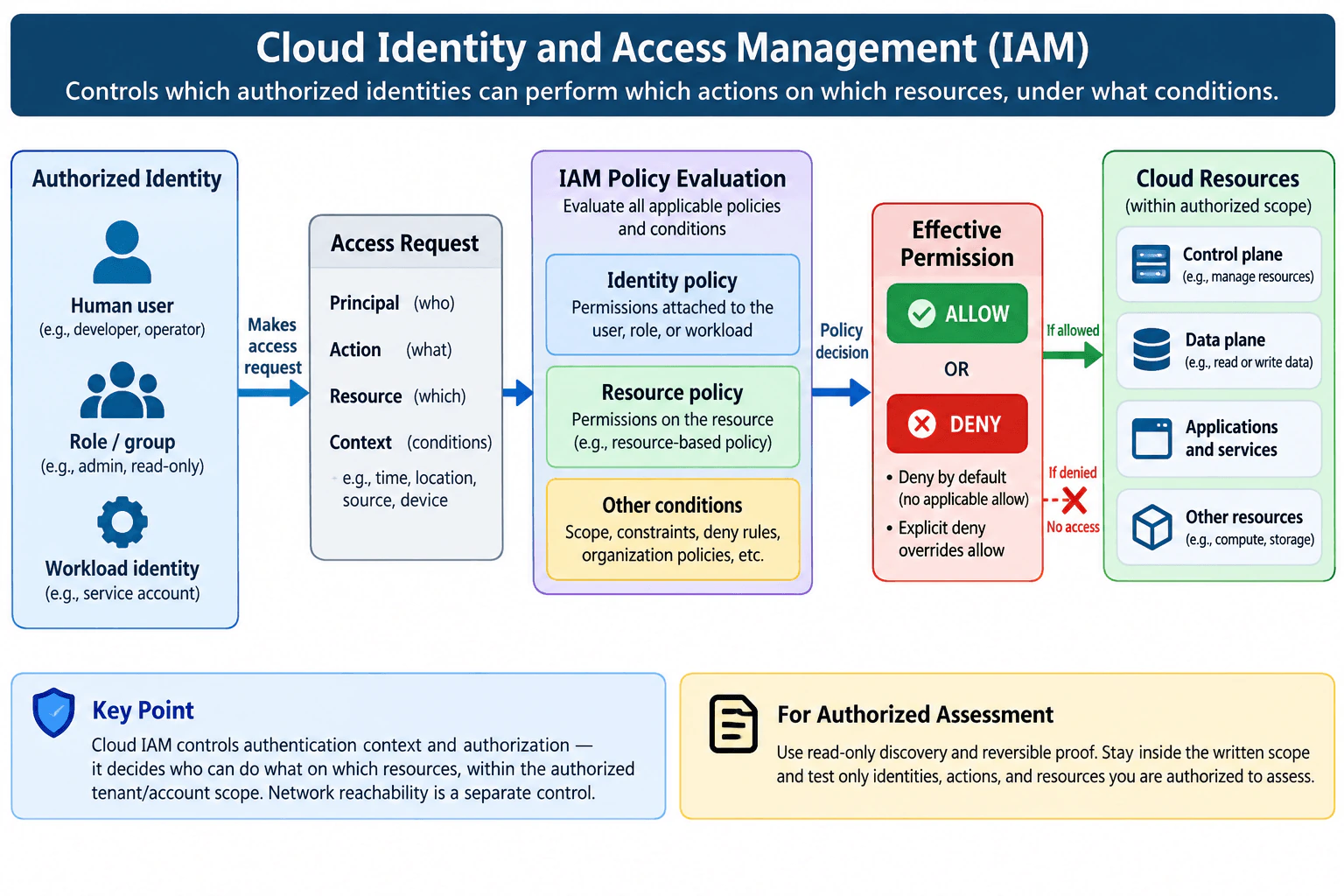
Cloud IAM controls who can perform which actions on which resources and under what conditions. It evaluates applicable identity and resource policies plus other constraints to determine effective permission, then allows or denies the request. During testing, I verify that access safely and only within scope.
Detailed Explanation
Cloud identity and access management, or IAM, answers a practical access question: which identity may perform which action on which cloud resource, and under what conditions? The identity may be a human user, a role or group-derived identity, or a workload identity such as a service account. An access request contains the principal, action, resource, and context. IAM evaluates the applicable policies and constraints to calculate effective permission. The result is an allow or deny decision. During an authorized assessment, the tester verifies that decision safely without assuming that a policy configuration alone proves usable access.
Useful Questions to Ask the Interviewer
Which cloud organization, tenant, accounts, or subscriptions are explicitly in scope?
Which human and workload identities am I authorized to assess?
Should the assessment cover both control-plane and data-plane permissions?
Are state-changing requests prohibited, or may I use a small reversible proof when needed?
How to Explain It in an Interview
The practical decision is whether a specific principal can perform a specific action against a specific resource under the current conditions. This is the core idea shown in the diagram: authorized identity -> access request -> IAM policy evaluation -> effective permission -> cloud resource or denial.
The request can be understood as four parts. The principal is who is making the request. The action is what that principal wants to do. The resource is the target. The context contains conditions that may affect the decision, such as source, location, device state, time, tags, or other provider-supported attributes.
IAM evaluates the policies that apply to the request. The diagram separates identity policies, which grant or restrict permissions associated with an identity, from resource policies, which control access at the resource. Other constraints, organization-level rules, permission boundaries, or deny controls may also affect the final result depending on the cloud provider.
The important output is the effective permission, not merely the existence of a role or policy. If the complete policy evaluation permits the action, the request is allowed. If no applicable permission allows it, the request is denied. Some providers also support explicit deny mechanisms that take precedence over allows; the exact evaluation order and policy interaction must be checked in that provider's current documentation.
IAM can govern control-plane operations, such as creating, modifying, or managing cloud resources, and data-plane operations, such as reading or writing service data when those actions are exposed through the provider's authorization model. The same access-control idea applies to human identities and workload identities.
The responsibility boundary also matters. The cloud provider operates the underlying IAM enforcement mechanisms. The customer configures its tenant or organization, accounts or subscriptions, identities, roles, policies, resource permissions, and relevant constraints. The authorized tester assesses only the approved customer-controlled scope and must not test another tenant, account, subscription, or organization without explicit permission.
For validation, begin with read-only discovery. Record the exact principal, requested action, target resource, relevant conditions, and expected effective permission. If stronger proof is required and the rules of engagement allow it, use the least intrusive reversible request that demonstrates the permission without deleting resources, causing uncontrolled scaling, exposing secrets, or unnecessarily accessing sensitive data.
A key limitation is that IAM permission does not automatically prove network reachability. An identity may be authorized by policy but unable to reach the service because of routing, firewall, private-endpoint, or other network controls. Conversely, reaching a service does not prove authorization to perform an operation. Treat network reachability and IAM authorization as separate decisions.
The main tradeoff is confidence versus test impact. Static policy review is safer and faster, but complex policy interactions can make effective access difficult to infer. A carefully bounded runtime check gives stronger evidence, but it introduces more operational risk. The best assessment uses read-only analysis first and adds only the smallest reversible validation needed.
Technical Approach
Confirm the authorized provider environment, organization or tenant, accounts or subscriptions, regions if relevant, identities, and resources.
Identify the principal being assessed: human user, role or group-derived identity, or workload identity.
Identify the exact requested action, target resource, and relevant request conditions.
Review the applicable identity policies, resource policies, and provider-specific constraints or deny rules.
Determine the expected effective permission: allow or deny.
Use read-only discovery first to compare configuration with the expected access decision.
If the rules of engagement permit it, perform one minimal and reversible request to validate the effective permission.
Record the principal, action, resource, conditions, observed result, and supporting evidence while minimizing sensitive data collection.
Report excessive access, unexpected denial, or policy ambiguity to the appropriate remediation owner and perform a safe retest after changes.
Practical Insights
IAM testing usually has low infrastructure cost because much of the work is policy and permission analysis. Complexity increases as the number of identities, accounts, resources, inherited policies, resource policies, conditions, and organization-level constraints grows. Human effort can become significant because testers and administrators must understand how those rules combine. Runtime validation gives stronger evidence than configuration review alone, but it carries more operational risk, so it should use the smallest reversible proof. IAM analysis also does not replace network-path testing because authorization and reachability are separate controls.
Why Interviewers Ask This
Interviewers want to know whether the candidate understands IAM as the cloud access-control layer rather than simply a list of users and roles. A strong answer connects identities, actions, resources, policies, conditions, and effective permissions, while recognizing that network reachability is a separate control and that testing must remain inside the authorized cloud scope.
Common interview mistakes
Common mistakes include treating a role name as proof of effective access, checking only identity policies while ignoring resource policies and other constraints, assuming policy evaluation works identically across all cloud providers, confusing network reachability with IAM authorization, assuming every authenticated identity is authorized, testing outside the approved tenant or account scope, using destructive actions when read-only or reversible evidence is sufficient, collecting unnecessary credentials or sensitive data, and reporting configuration alone without validating the effective permission for the specific principal, action, resource, and conditions.
Interview tip
Lead with the simple rule: IAM controls who can do what on which resource and under what conditions. Then explain principal, action, resource, policy evaluation, and the effective allow or deny decision. Finish by saying that during an authorized assessment you verify effective permission safely and treat network reachability as a separate control.
Interviewer may ask next
What is the difference between an identity policy and a resource policy?
An identity policy grants or restricts permissions associated with an identity such as a user, role, or workload identity. A resource policy controls which principals may access a particular resource and under what conditions. The provider evaluates the applicable policies and other constraints to determine the effective permission. The exact combination and precedence rules vary by cloud provider, so an assessor should verify the provider's current documentation.
If IAM shows that an action is allowed, does that prove the tester can reach and use the resource?
No. IAM authorization and network reachability are separate controls. A policy may allow an action while routing, firewall rules, private endpoints, or other network restrictions prevent the request from reaching the service. During an authorized assessment, record the IAM permission decision separately from the network path and validate the network path only when it is within scope.
67. What does least privilege mean for cloud permissions in an authorized review?Cloud SecurityEasy
Short Interview Answer (30-60 seconds)
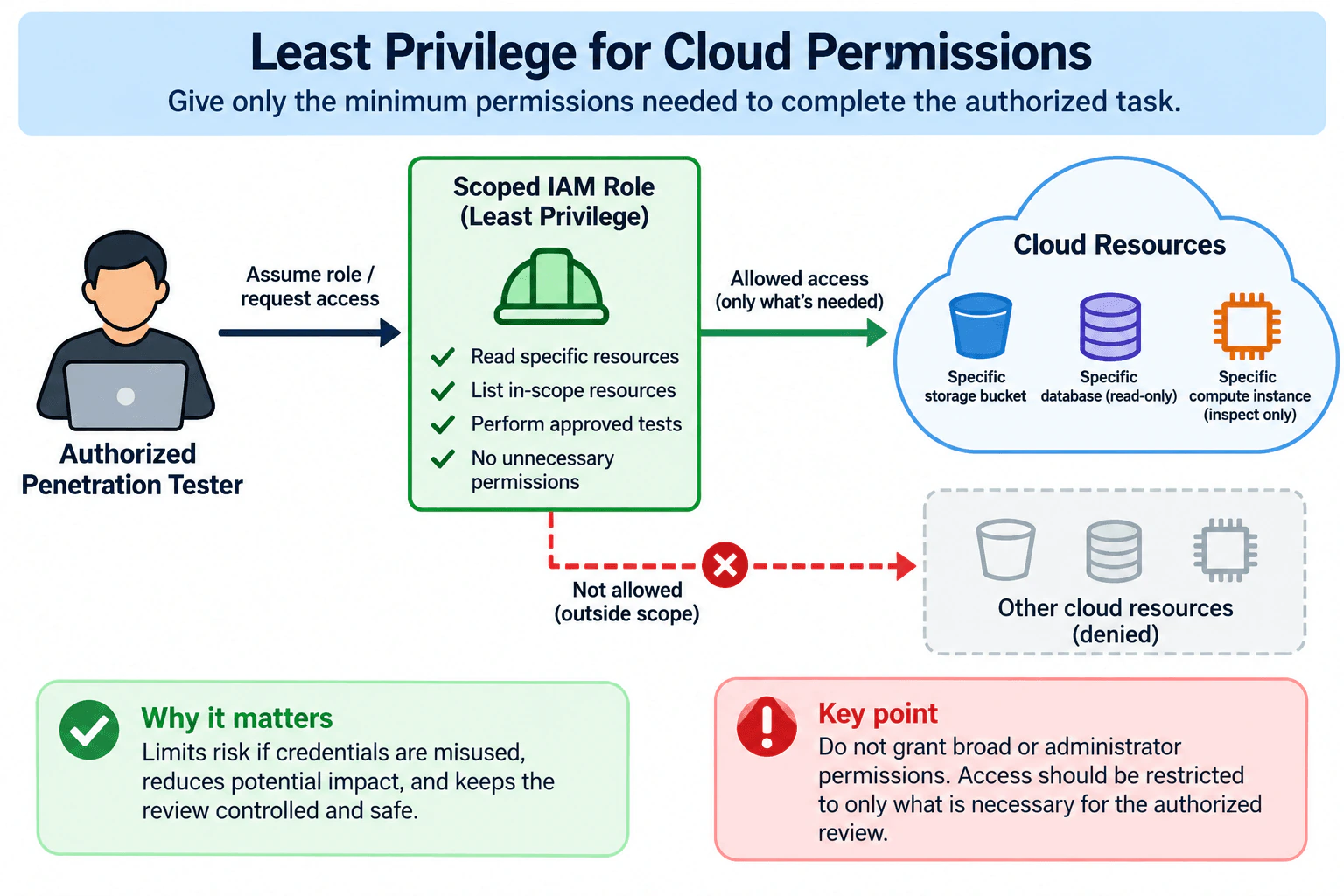
Least privilege means granting the penetration tester only the permissions required for the authorized task. The tester can access specific in-scope resources and perform approved actions, while unrelated resources and broad administrative permissions remain unavailable.
Detailed Explanation
Least privilege means giving an authorized penetration tester only the cloud permissions needed to complete the approved task. The tester may assume a scoped identity or role, but that identity should expose only the required resources and actions. For example, the approved review may allow reading a specific storage resource, reading a particular database, or inspecting a specific compute instance. Access to unrelated cloud resources or unnecessary administrator capabilities should remain denied. This reduces potential impact if credentials are misused and keeps the review within its authorized boundary.
Useful Questions to Ask the Interviewer
Which cloud resources and actions are explicitly in scope for the review?
Should the tester receive a dedicated scoped role or use an existing authorized identity?
Are any write, administrative, or privilege-changing actions required for the approved testing?
How to Explain It in an Interview
Start with the practical decision: give the tester only the permissions necessary for the approved work, not broad cloud access.
The diagram shows an authorized penetration tester requesting or assuming a scoped IAM role. IAM means identity and access management. The role defines what the tester is allowed to do. Its permissions should match the authorized task, such as reading specific resources, listing in-scope resources, and performing only approved tests.
The important boundary is between in-scope and out-of-scope cloud resources. The scoped role permits access only where the review requires it. In the diagram, this includes a specific storage resource, a specific database with read-only access, and a specific compute instance that can be inspected. Other cloud resources remain denied because they are outside the required scope.
This matches the least-privilege principle: authorized access should be limited to the minimum resources and authorizations needed to perform the assigned task. It reduces risk because a compromised or accidentally misused tester credential has fewer capabilities. It also limits the potential impact of mistakes during the assessment. Broad administrator permissions should not be granted merely for convenience when narrower permissions are sufficient.
A tester should validate least privilege by comparing the approved scope with the permissions actually available to the assigned identity and by using safe, authorized checks to confirm required access works while unnecessary access does not. A denial of an out-of-scope action is the expected safe behavior.
Least privilege does not guarantee that every permitted action is harmless. An allowed permission can still expose sensitive data or create risk if it is broader than necessary at the resource or action level. Effective permissions may also depend on more than one access-control mechanism, so the reviewer should evaluate the access the tester can actually exercise rather than relying only on the name of a role or a single policy document.
The tradeoff is that tighter permissions require more planning and can occasionally block a legitimate test action. When that happens, the correct response is to request a narrowly scoped authorization change for the required action rather than giving the tester permanent broad or administrator access.
Technical Approach
Confirm the approved cloud resources and testing actions.
Identify the tester identity or scoped IAM role used for the review.
Map each required task to the minimum resource and action permissions needed.
Exclude unrelated, destructive, privilege-changing, and broad administrative permissions unless they are explicitly required and authorized.
Use the scoped role to perform the approved tests against the in-scope resources.
Safely confirm that required actions are allowed and unnecessary or out-of-scope actions are denied.
If a legitimate test step is blocked, request only the additional permission required for that specific approved task.
Practical Insights
The main technical cost is the work needed to design, review, and maintain narrowly scoped permissions. Operationally, very tight permissions can slow a review if a required action was missed and access must be adjusted. Human effort is needed to understand the testing scope and translate it into permissions. Financial cost is usually indirect, such as engineering and security-review time. Maintenance requires permissions to be reviewed when the testing scope changes. The security benefit is reduced potential impact from mistakes or credential misuse.
Why Interviewers Ask This
Interviewers want to know whether the candidate understands that authorization for a penetration test does not mean unlimited cloud access. A strong answer shows that permissions should be scoped to the required identity, resources, and actions so the review remains useful without creating unnecessary risk.
Common interview mistakes
Common mistakes include giving the tester administrator access simply because the review is authorized, granting broad resource access when only a few resources are in scope, giving write permissions when read-only access is sufficient, and checking only a written policy instead of the tester's effective access. Another mistake is treating an authorization document as permission to interact with cloud resources that were not included in the approved scope.
Interview tip
Lead with one sentence: only grant the permissions needed for the approved task. Then explain the diagram's flow from the authorized tester to a scoped IAM role, allowed access to specific in-scope resources, and denial of unnecessary access. Mention that this limits the impact of mistakes or credential misuse.
Interviewer may ask next
How would you verify that a penetration tester really has least-privileged cloud access?
First compare the approved testing scope with the permissions assigned to the tester's identity or role. Then use safe, authorized checks to confirm that required actions work only on the intended resources. Also verify that unnecessary or out-of-scope actions are denied. The important result is the effective access the tester can actually exercise, not simply the presence of a narrowly named role or policy.
What should you do if least-privileged permissions prevent an authorized test step?
Do not replace the scoped role with broad administrator access by default. Identify the exact resource and action that are required, confirm that the step is within the approved review scope, and request only the additional permission needed. Remove or reduce that permission when it is no longer required. This keeps the assessment useful while maintaining the least-privilege principle.
68. What does a cloud security group control in an environment under authorized assessment?Cloud SecurityEasy
Short Interview Answer (30-60 seconds)
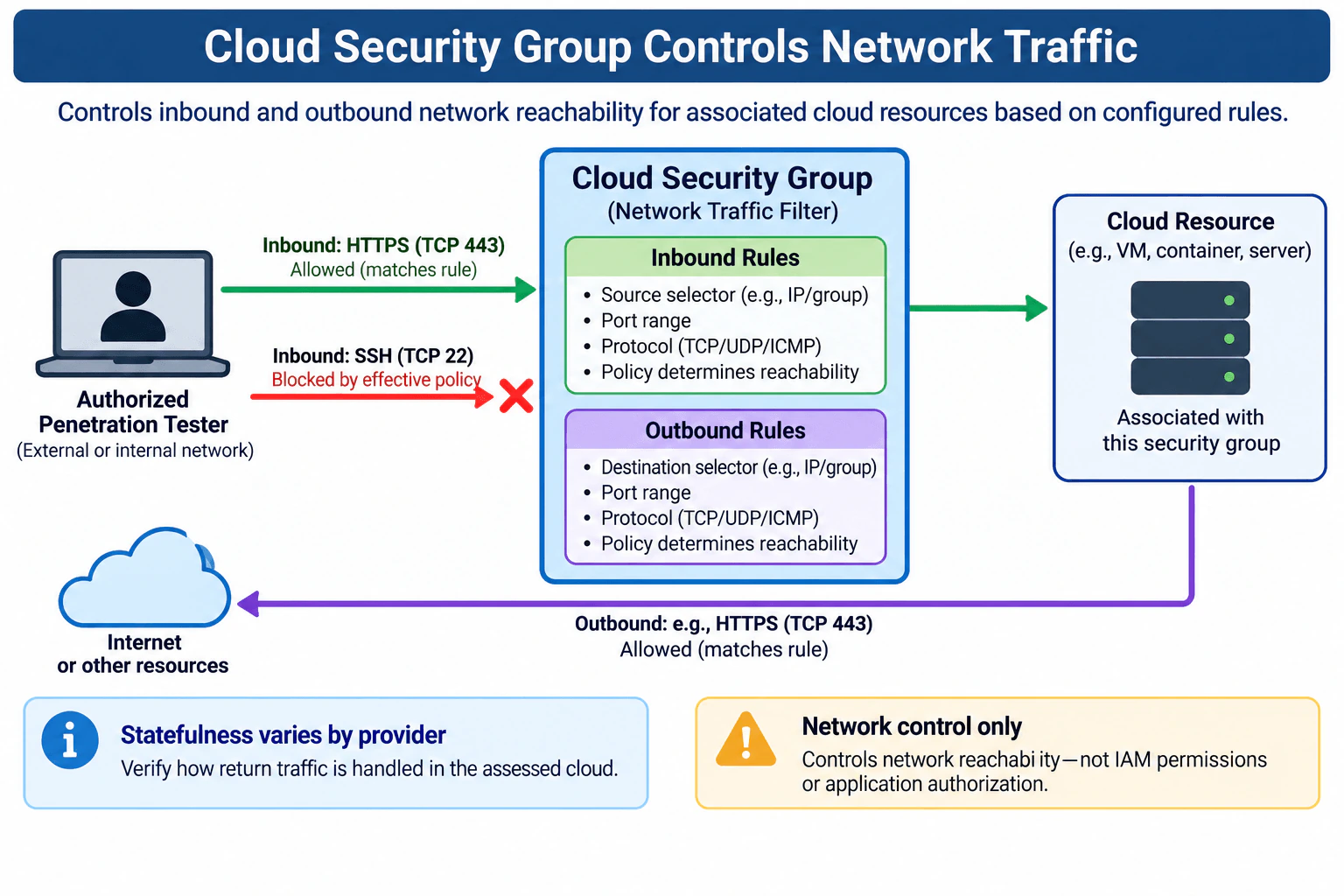
A cloud security group controls inbound and outbound network reachability for associated cloud resources. It evaluates traffic using attributes such as source or destination, port range, and protocol. During an authorized test, I verify allowed and blocked paths without confusing network access with IAM or application authorization.
Detailed Explanation
A cloud security group controls whether network traffic can reach or leave an associated cloud resource according to configured rules. In an authorized assessment, I examine the effective inbound and outbound policy and verify it with safe network tests. Typical rule inputs include source or destination, port range, and protocol. An allowed HTTPS path may reach the workload, while an SSH path can be blocked by the effective policy. This proves network reachability only. It does not prove identity permissions or application access, and return-traffic behavior should be confirmed for the specific provider.
Useful Questions to Ask the Interviewer
Which cloud provider and type of security-group control are we assessing?
Which cloud resources and network paths are explicitly in scope?
Which inbound and outbound connections are expected to be reachable?
How to Explain It in an Interview
Start with the practical boundary: a cloud security group is a network traffic filter associated with cloud resources. It controls inbound and outbound reachability according to its effective rule set.
For inbound traffic, I look at the source selector, destination resource, port range, protocol, and the final effective network-policy decision. For example, the approved diagram shows HTTPS on TCP port 443 reaching the associated resource because the effective policy permits that path. It also shows an SSH attempt on TCP port 22 stopping before the resource because the effective policy blocks it.
For outbound traffic, the same idea applies in the opposite direction. I examine whether the associated resource can initiate traffic toward the Internet or another resource based on destination, port range, protocol, and the effective policy. The diagram shows an allowed outbound HTTPS path toward the Internet or another resource.
The important trust boundary is the network boundary around the associated workload. Passing this network check does not mean the caller has application-level access. Identity and access management, resource permissions, workload identity, and application authorization are separate controls. A security group can make a service reachable while another control still denies the requested operation.
I also avoid assuming identical behavior across providers. Stateful handling of response traffic is provider-specific in this provider-neutral explanation, so I verify the assessed platform's documented behavior before interpreting return traffic as evidence of a separate inbound or outbound permission.
During an authorized penetration test, I first inspect the effective configuration using read-only access when available. I then validate only approved paths with low-impact connection attempts from known test sources. I record the tested source, destination, port, protocol, associated resource, observed result, and relevant network policy. A successful connection demonstrates network reachability for that tested path. A blocked attempt demonstrates that the tested path was not reachable under those test conditions, but additional evidence is needed before attributing the block to one specific control. Neither result alone proves broader application permission or complete isolation.
The main tradeoff is simplicity versus certainty. Configuration review is fast and low risk, but effective reachability can also depend on resource association, routing, other network controls, and provider-specific behavior. A bounded connectivity test provides stronger evidence of the actual path, but it must stay within the written scope and avoid disruptive scanning or unnecessary access.
Technical Approach
Confirm the authorized cloud account or subscription, region, resource, and test source are in scope.
Identify the cloud security group or applicable network control associated with the target resource.
Review its effective inbound and outbound policy using read-only discovery where possible.
Map each approved test path by source or destination, port range, and protocol.
Send only low-impact, authorized connection attempts for the expected allowed and blocked paths.
Record whether each path reached the associated resource or was blocked by the effective network policy.
Verify provider-specific stateful return-traffic behavior before interpreting responses.
Report network reachability separately from IAM permissions and application authorization.
Practical Insights
The technical cost is usually low because checking rules and a few approved network paths is straightforward, but effective reachability can become harder when several security groups, routes, or other network controls interact. Operational risk is low when tests are narrowly scoped and non-destructive. Human effort comes from confirming ownership, expected traffic, and rule intent. Financial cost is normally small unless extensive cloud logging or test infrastructure is required. Compliance cost comes from following the written rules of engagement and provider policies. Maintenance cost grows when rule sets become large or inconsistent across environments.
Why Interviewers Ask This
Interviewers want to confirm that I understand the boundary of a cloud security group: it is primarily a network traffic control, not an identity, application authorization, or general cloud security control. They also want to see whether I can test effective reachability safely instead of assuming that a rule listing alone proves exposure.
Common interview mistakes
Common mistakes are saying that a security group controls IAM permissions, assuming that network reachability proves application access, treating every cloud provider's security-group behavior as identical, reviewing only inbound rules and ignoring outbound traffic, assuming configuration alone proves exposure, testing outside the authorized source or resource scope, attributing a blocked path to the security group without enough evidence, and interpreting stateful return traffic without checking the provider's documented behavior.
Interview tip
Lead with one sentence: a cloud security group controls network reachability to and from associated resources. Then explain inbound versus outbound rules, give one allowed and one blocked path, and finish by separating network filtering from IAM and application authorization.
Interviewer may ask next
How would you safely verify that a security-group rule is actually effective during a penetration test?
I would first confirm the resource, source, destination, port, protocol, and test window are authorized. I would review the effective network policy using read-only discovery, then send a small, non-destructive connection attempt from the approved source. I would record whether the traffic reached the associated resource or was blocked and correlate that result with the relevant configuration and other network controls. I would not treat a configuration entry alone as proof of exposure or assume that one specific control caused a blocked path without supporting evidence.
Why does an allowed security-group path not prove that the tester can use the application or cloud service?
Because the security group controls network reachability, not the complete authorization decision. After traffic reaches the resource, IAM policies, workload identities, resource policies, authentication, and application authorization can still deny the requested action. An allowed network path therefore proves only that the tested endpoint was reachable under the tested network conditions.
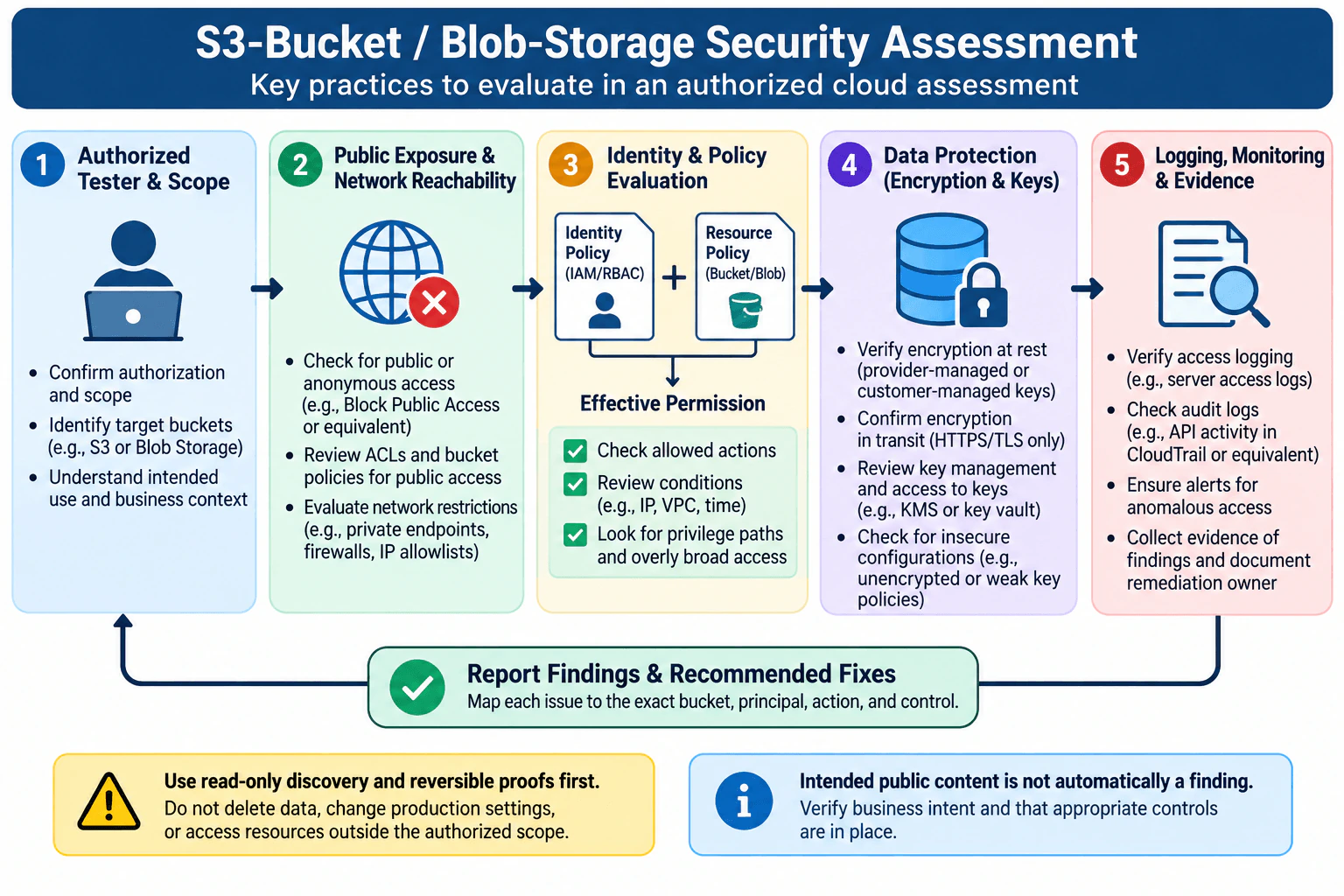
69. Which S3-bucket or blob-storage security practices should an authorized cloud assessment evaluate?Cloud SecurityMedium
Short Interview Answer (30-60 seconds)
I would check public or anonymous exposure, identity and resource policies, effective permissions, network restrictions, encryption and key access, and logging. I would start with read-only discovery, safely validate only approved paths, confirm business intent, and document the exact principal, resource, action, conditions, evidence, and remediation owner.
Detailed Explanation
This question asks how an authorized penetration tester should evaluate the security of an in-scope S3 bucket or blob-storage container. The practical goal is to determine whether the intended identities can reach the intended storage, perform only the intended actions, use approved network paths, protect data with the required encryption and key controls, and leave useful audit evidence. The assessment should begin with read-only discovery and reversible proofs, stay inside the approved cloud boundary, confirm whether any public access is intentional, and record the exact principal, resource, action, condition, network path, evidence, and remediation owner.
Useful Questions to Ask the Interviewer
Which cloud provider, organization or tenant, accounts or subscriptions, regions, buckets or containers, and tester identities are explicitly in scope?
Is any public or anonymous access intentionally required for these storage resources?
Are safe data-plane validation requests allowed, or should testing remain configuration-only?
Which public, private-endpoint, VPC, virtual-network, VPN, or other network paths are approved for validation?
Which logging sources and remediation owners should be included in the final evidence?
How to Explain It in an Interview
I would follow the same flow as the assessment diagram: establish the authorized scope, evaluate public exposure and network reachability, determine effective permissions from identity and resource policies, verify data protection, and finally verify logging and collect evidence.
First, I define the authorized tester and scope. I identify the provider, organization or tenant, account or subscription, region, target bucket or blob container, approved tester identity, intended business use, and allowed network paths. I also confirm the customer-versus-provider responsibility boundary. The provider operates the managed storage service, while the customer normally controls its identities, storage configuration, policies, encryption choices, network restrictions, and logging configuration. I stay inside the written rules of engagement and never test another tenant, account, subscription, or storage resource without authorization.
Second, I check public exposure and network reachability. I determine whether anonymous or public access is possible and whether that exposure is intended. For S3, this includes applicable Block Public Access settings, ACLs where relevant, bucket policies, and other resource-level controls. For blob storage, I check equivalent anonymous-access and container-access settings. I also review network restrictions such as private endpoints, storage firewalls, VPC or virtual-network controls, IP allowlists, and policy conditions where they are part of the approved design. I do not automatically report intentionally public content as a vulnerability; I verify whether the exposure matches the documented business purpose and whether write or administrative access remains restricted.
Third, I evaluate identity and resource policies together to determine effective permission. An identity policy grants or restricts actions for a user, role, service identity, or equivalent principal. A resource policy applies permissions to the bucket, container, access point, or equivalent storage resource. I review the exact principal, requested action, resource, and conditions, and I account for explicit denies and other applicable restrictions. I look for overly broad read, write, delete, policy-change, or administrative privileges, weak conditions, and unintended privilege paths. A single policy document is not enough to prove the final access decision because effective permission can depend on multiple policy layers and conditions.
Fourth, I verify data protection. I check encryption at rest and confirm whether provider-managed or customer-managed keys match the intended security design. Where customer-managed keys are used, I review who can use and administer those keys because storage permissions and key permissions work together. I also verify that data in transit uses the required encrypted transport, such as HTTPS with TLS, and look for configurations that could allow weaker transport where that matters to the design. I avoid claiming that encryption alone prevents unauthorized access; encryption protects data only when the surrounding identity and key controls are also appropriate.
Fifth, I verify logging, monitoring, and evidence. I check whether access logging and audit logging are configured to capture the events needed for investigation and detection. For S3, that can include server access logging and CloudTrail activity, including object-level data events when they are intentionally configured. For blob storage, I check the equivalent storage and activity logging. I also review whether anomalous access can be detected. For every finding, I collect evidence that identifies the bucket or container, principal, action, conditions, network path, observed result, and responsible remediation owner.
My validation method stays non-destructive. I begin with read-only discovery and existing configuration or log evidence. If the rules of engagement permit a data-plane proof, I use the least-privileged approved identity and only a benign synthetic or explicitly approved test object. I do not delete production data, modify production permissions merely to prove a point, expose secrets, trigger uncontrolled scaling, or access resources outside scope. If stronger proof would require a destructive or unsafe action, I stop and document the configuration evidence and the remaining uncertainty instead.
The main limitation is that one configuration value or one successful or denied request does not prove every possible access path. Effective access can change with the principal, action, resource, policy conditions, network path, key permissions, and higher-level controls. That is why the assessment records those details for each test and uses safe retesting after remediation.
The main tradeoff is confidence versus operational risk. More live data-plane testing can provide stronger proof, but it can also increase the chance of touching sensitive data or changing production state. A good assessment gets most of its confidence from read-only discovery, policy evaluation, network review, encryption and key review, and logs, then uses small reversible proofs only where they materially reduce uncertainty. The final report maps every confirmed issue to the exact storage resource, principal, action, control, supporting evidence, remediation owner, and safe retest.
Technical Approach
Confirm written authorization, cloud provider, organization or tenant, accounts or subscriptions, regions, target buckets or containers, approved tester identities, allowed network paths, and stop conditions.
Identify the intended business use of each in-scope storage resource, including whether any public access is expected.
Review public or anonymous exposure controls, ACLs where applicable, bucket or container policies, and relevant network restrictions.
Review identity policies and resource policies together and determine effective permissions for the exact principals, actions, resources, and conditions being assessed.
Look for unintended privilege paths or overly broad read, write, delete, or administrative access.
Verify encryption at rest, encrypted transport, and access to customer-managed keys when those keys are used.
Verify access logging, audit logging, object-level or data-plane logging where required, and monitoring for unusual access.
Use read-only discovery first and perform only approved, least-privileged, reversible validation with synthetic or explicitly approved data when stronger proof is needed.
Record the exact principal, resource, action, condition, network path, evidence, observed result, remediation owner, limitation, and safe retest for each finding.
Practical Insights
The main technical cost is that several controls must be evaluated together. Identity policies, resource policies, public-access settings, network restrictions, and key permissions can interact, so checking only one layer can produce a false conclusion. Safer testing can take longer because destructive shortcuts should be avoided. Detailed data-plane logging can also create storage and analysis cost. Customer-managed keys give more control but add key-policy, administration, rotation, and recovery work. Private network paths reduce public exposure but add networking and DNS complexity. Human effort is also needed to confirm business intent, assign remediation ownership, and retest the deployed fix.
Why Interviewers Ask This
This question tests whether the candidate understands cloud object-storage security as an effective-access problem rather than a simple configuration checklist. A strong answer connects public exposure, network reachability, identity and resource policies, encryption and key management, logging, safe validation, business intent, evidence, and remediation while remaining inside an authorized and non-destructive assessment scope.
Common interview mistakes
Common mistakes are checking only whether a bucket or container is marked public; treating all intentional public content as a vulnerability; reviewing only the resource policy while ignoring identity policies and other effective-permission controls; assuming a private endpoint automatically disables every public access path; assuming encryption by itself prevents unauthorized reads; assuming object-level audit activity is always logged; testing with an administrator instead of the actual principal being assessed; downloading sensitive data just to prove access; changing production permissions for convenience; and reporting a weakness without recording the exact principal, resource, action, condition, network path, evidence, and remediation owner.
Interview tip
Organize the answer as one flow: scope, public exposure and network reachability, effective permissions, data protection, then logging and evidence. Keep returning to the exact principal, resource, action, condition, and network path. Emphasize read-only discovery, reversible proofs, business intent, and safe failure instead of presenting a generic cloud-security checklist.
Interviewer may ask next
Why is checking only the bucket or container policy not enough?
Because effective permission can depend on both identity and resource policies plus applicable denies, conditions, higher-level controls, network restrictions, and key permissions. I would evaluate the exact principal, action, resource, conditions, and network path together. If configuration review still leaves uncertainty, I would perform only an authorized, least-privileged, non-destructive validation.
What would you do if the storage appears public but the business says public access is intentional?
I would not automatically report the public access itself as a vulnerability. I would verify that only the intended content and actions are exposed, that anonymous write or administrative access is not available, that sensitive data is not mixed with public content, that network and policy controls match the intended design, and that appropriate logging exists. I would report only unintended or excessive exposure and document the approved public-use case and safe retest.
70. Which cloud misconfigurations commonly enable breaches and deserve attention during an authorized assessment?Cloud SecurityMedium
Short Interview Answer (30-60 seconds)
I focus first on public exposure, permissive network access, excessive IAM privileges, insecure secrets, and logging gaps. I verify the effective access path safely, record evidence, and avoid assuming that a risky configuration alone proves a breach is possible.
Detailed Explanation
The main decision is whether a cloud configuration creates a real path from an untrusted actor to sensitive data or powerful cloud actions. During an authorized assessment, I first look for exposed resources or management endpoints, weak network restrictions, excessive identity permissions, insecure or long-lived credentials, and missing audit logging. I then test the effective access with the least intrusive method available. I do not treat configuration alone as proof of exploitation. I record the principal, resource, permitted action, network path, and evidence while staying inside the approved cloud boundary.
Useful Questions to Ask the Interviewer
Which cloud organizations, accounts or subscriptions, regions, identities, and services are in scope?
Are anonymous-access checks and validation of effective IAM permissions allowed?
May I use synthetic test objects or other reversible proofs to confirm access without touching production data?
Which logging sources should be available for validating the assessment activity?
How to Explain It in an Interview
I would organize the assessment around the attack path shown in the diagram: exposure, access, privilege, impact, and visibility.
First, I check public exposure. A storage resource, API, administration service, or other endpoint can become dangerous when it is reachable from the Internet without the intended authentication or network restriction. Broad network rules such as allowing access from 0.0.0.0/0 also deserve attention when they expose a service that should be restricted. Public reachability is not automatically a vulnerability, because some services are intentionally public, so I verify the intended design and the effective authorization before reporting impact.
Second, I examine identity and access management. IAM controls what a user, role, workload, or service can do. I look for excessive permissions, broad roles, weak conditions, and combinations that let a low-privileged identity reach sensitive resources. The important concept is effective permission: what the principal can actually do after identity policies, resource policies, conditions, and other applicable controls are evaluated. I prefer read-only permission analysis and safe test actions instead of changing or deleting resources.
Third, I check secrets and credentials. Long-lived credentials stored insecurely can turn an initial foothold into authenticated cloud access. I avoid collecting reusable secrets unless the rules of engagement specifically require it. Where possible, I prove the issue using metadata, configuration evidence, redacted values, or a tightly bounded test identity instead of exposing a real secret.
Fourth, I validate potential impact on sensitive data or critical resources. A dangerous path might allow reading data, modifying resources, or reaching additional services. I demonstrate only the minimum authorized impact needed to prove the finding. For example, I can use a synthetic object or a harmless read operation rather than downloading real sensitive data or modifying production resources. I clearly separate demonstrated technical impact from possible business impact.
Finally, I check audit logging because weak or missing logging makes malicious activity harder to detect and investigate. Logging is a detective control, not a replacement for access control. Some cloud platforms or services require additional configuration before particular data-access events are recorded, so I verify whether the relevant activity is actually captured. Evidence should include the exact principal, action, resource, result, and corresponding log record when available.
The main preventive controls are least privilege, restricted public access, protected credentials, and appropriate audit logging. The tradeoff is that tighter controls can increase administration and may break legitimate workloads if applied without understanding dependencies. Logging also adds storage, monitoring, and operational cost. After remediation, I retest the original path because a policy that looks corrected in configuration does not prove the deployed effective state is secure.
Technical Approach
Confirm the written scope, cloud boundary, approved identities, accounts or subscriptions, regions, services, and provider testing rules.
Enumerate Internet-facing resources and identify unintended public storage, management endpoints, or overly broad network exposure.
Review effective IAM access for excessive permissions, broad roles, and paths from the approved test identity to sensitive resources.
Inspect authorized configuration evidence for insecure or unnecessarily long-lived credentials without exposing reusable secrets.
Validate potential data or resource access with read-only or reversible proofs using synthetic data where possible.
Check whether relevant control-plane and data-access activity is recorded by the configured audit logging.
Record the exact principal, resource, action, conditions, network path, result, and supporting evidence.
Recommend least privilege, restricted public access, protected secrets, and appropriate logging, then safely retest the original path.
Practical Insights
The technical cost is mainly the time needed to map identities, policies, network paths, storage permissions, and logs across the approved cloud environment. Operationally, stricter permissions can break applications if dependencies are not understood, while additional logging creates storage and monitoring cost. Human effort is also important because cloud permissions can be spread across identity policies, resource policies, network controls, and service settings. Maintenance requires repeated reviews because new resources and policy changes can recreate exposure. The safest approach favors read-only discovery and small reversible tests, which may take longer but reduces production risk.
Why Interviewers Ask This
This question tests whether I can recognize the cloud configuration mistakes that most often create real attack paths, distinguish configuration risk from demonstrated impact, and validate findings safely within an authorized scope.
Common interview mistakes
Common mistakes are treating every public resource as automatically vulnerable, reporting an overly broad policy without checking effective permissions, assuming 0.0.0.0/0 alone proves compromise, collecting real secrets or sensitive data when safer proof is available, using destructive actions to demonstrate impact, and treating logging as a preventive access control. Another mistake is reviewing only IAM identity policies while ignoring resource policies, network reachability, conditions, and the actual principal involved. A tester should also avoid claiming data theft or resource modification unless that impact was safely demonstrated or clearly stated as potential impact.
Interview tip
Lead with the highest-value areas: public exposure, IAM, secrets, and logging. Then explain that you validate the complete effective access path with safe evidence instead of assuming that a suspicious configuration is exploitable.
Interviewer may ask next
How would you safely prove that a cloud storage misconfiguration is exploitable without exposing real sensitive data?
I would first confirm that the storage resource and access method are explicitly in scope. I would inspect its effective access configuration and then use the least intrusive proof available, such as accessing a synthetic test object or performing an approved metadata or listing operation. I would avoid downloading production-sensitive content. I would record the test principal, resource, operation, response, and relevant audit log, then stop once the exposure is proven.
Why is an overly permissive IAM role not automatically proof of a breach path?
A broad role shows potential risk, but actual impact depends on effective permission and reachability. Other policies, explicit denies, conditions, resource policies, or network restrictions may prevent the action. I therefore trace the approved principal to the target resource and validate only the minimum safe action needed. This separates a configuration weakness from a demonstrated attack path and avoids overstating the finding.
More questions load as you scroll
Disclaimer: This interview guide is for educational and informational purposes only. It is designed to help readers prepare, but it does not guarantee any interview result, hiring decision, offer, or outcome. Interview questions, hiring criteria, and preferred answers can vary by employer, interviewer, industry, location, and time. All answers, examples, and explanations in this guide are suggested examples for interview preparation, not definitive answers or instructions for professional practice. They are based on research and judgment, are provided without warranties of any kind, and should be adapted to the question, role, and applicable laws and professional requirements. Diagrams are simplified illustrations intended to highlight the main concepts and their relationships; actual situations, systems, and practices may be more complex. Alternative approaches may be equally valid or better suited to a particular question, context, or interviewer. To the fullest extent permitted by applicable law, the contributors and publisher are not liable for decisions made, actions taken, or losses incurred based on this guide.
State Laws and Professional Responsibilities: Laws and requirements governing an occupation vary by state and jurisdiction. You are responsible for checking the current laws, licensing requirements, and scope-of-practice rules that apply to your location and role, and for ensuring that your answers and actions comply with them. Adapt examples in this guide to those requirements. This guide is not legal advice.
Content Accuracy and Verification: To the fullest extent permitted by applicable law, we do not represent or warrant that interview guides, questions, answers, examples, or diagrams are accurate, complete, current, error-free, or suitable for any particular purpose. You are responsible for independently reviewing and verifying the information before relying on it.