119 Penetration Tester Interview Questions & Answers

105 top • 6 Amazon • 2 Apple • 3 Google • 1 Meta • 1 Microsoft • 1 NVIDIA

Penetration Tester icon

Questions with Detailed ExplanationsWith Detailed Explanations

(Last Updated: September 13, 2026)

21. What is a Kubernetes manifest, and what security controls can it define?Language SpecificEasy

Question Details

Define a Kubernetes manifest as YAML or JSON that declares desired API objects. Explain metadata, specifications, namespaces, workloads, services, service accounts, security contexts, resources, secrets, network policies, and admission controls. Connect it to authorized cluster-configuration review and schema validation.

Short Interview Answer (30-60 seconds)

A Kubernetes manifest is YAML or JSON that declares desired Kubernetes API objects. I review metadata and specs for namespaces, workloads, Services, ServiceAccounts, security contexts, resources, Secrets, NetworkPolicies, and admission controls, then validate the schema and, when authorized, verify what the cluster actually enforces.

Detailed Explanation

See the Code while reading this explanation.

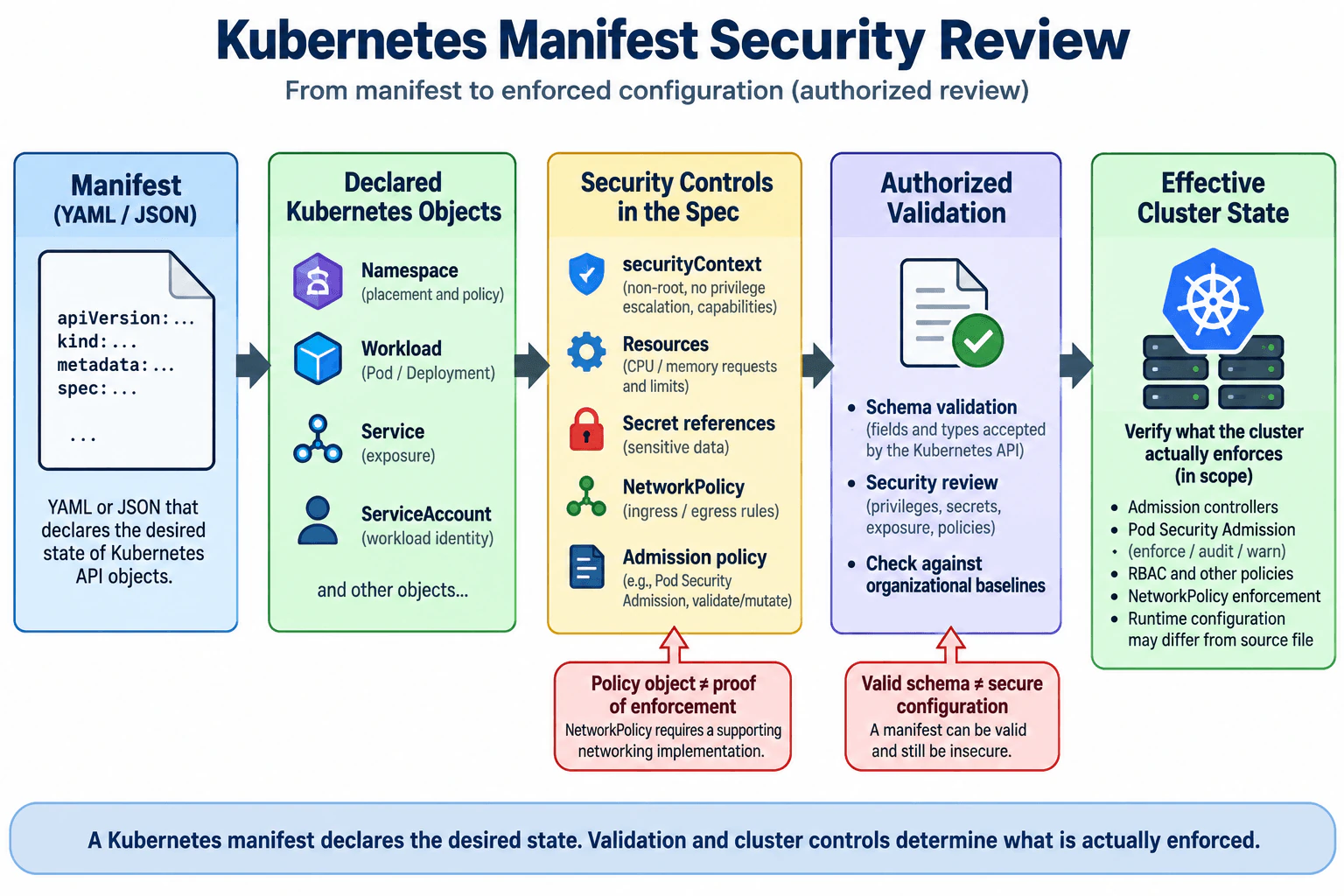
A Kubernetes manifest is a YAML or JSON document that declares the desired state of one or more Kubernetes API objects. It normally identifies an API version and object kind, gives metadata such as a name, namespace, labels, or annotations, and supplies the object's specification. For security review, I do more than check whether the file parses. I examine workload identity, privileges, resource controls, secret handling, network access, and admission policy, validate the object against the target Kubernetes API, and separate declared configuration from controls that the cluster actually enforces.

Useful Questions to Ask the Interviewer
  1. Am I reviewing manifest files only, or may I compare them with objects deployed in an authorized cluster?
  2. Which namespaces, workloads, and related policy objects are in scope?
  3. Should I assess only built-in Kubernetes controls, or also approved admission policies used by the environment?
  4. Is there an organization-defined Kubernetes security baseline that the manifests must satisfy?
What is a Kubernetes manifest, and what security controls can it define? diagram
How to Explain It in an Interview

I would start with the manifest structure. apiVersion selects the Kubernetes API group and version used for the object. kind identifies the object type, such as Deployment, Service, ServiceAccount, Secret, or NetworkPolicy. metadata identifies the object and can contain its name, namespace, labels, and annotations. spec normally describes the desired configuration for that object's type.

Namespaces organize namespaced resources and provide a scope for authorization and policy. I check that a workload is placed in the intended namespace and that the expected namespace-level controls apply there. I would not call a namespace a complete security boundary by itself because effective isolation also depends on authorization, admission policy, networking, node security, and other cluster controls.

For workloads such as Pods, Deployments, and Jobs, I inspect the Pod specification or Pod template. A securityContext can constrain how a Pod or container runs. Important examples include requiring a non-root identity, preventing privilege escalation, dropping unnecessary Linux capabilities, using a read-only root filesystem where the application supports it, and applying an appropriate seccomp profile. Some settings are Pod-level and others are container-level, so I check the exact field rather than treating the presence of one securityContext as proof that the workload is hardened.

I also review workload identity. serviceAccountName selects the Kubernetes ServiceAccount used by a Pod. The ServiceAccount provides an identity; authorization controls such as RBAC determine what that identity is permitted to do. If a workload does not need Kubernetes API credentials, disabling automatic ServiceAccount-token mounting can reduce unnecessary credential exposure. I therefore review ServiceAccount selection, token mounting, and the identity's effective authorization separately.

Resource requests and limits describe CPU and memory requirements or constraints. Requests help the scheduler make placement decisions, while limits constrain resource use according to Kubernetes runtime behavior. From a security perspective, reasonable resource controls can reduce the effect of accidental or abusive resource consumption, but they are not a complete denial-of-service defense. I compare them with the environment's workload requirements rather than assuming one fixed value is correct everywhere.

Secrets are Kubernetes API objects used to hold sensitive data. Workload manifests can reference Secrets through mechanisms such as volumes or environment variables. During a penetration-test review, I avoid exposing Secret values unless access is explicitly required and authorized. I look for sensitive values embedded directly in ordinary manifests, unnecessary Secret access, and broad workload permissions. I also remember that the Secret kind by itself does not guarantee complete confidentiality; storage protection, authorization, encryption configuration, and application handling still matter.

A Service provides a stable network endpoint for selected Pods. I review its selectors, ports, and type to understand how the workload can be reached. A Service is not an authorization control by itself. Exposure must be considered together with authentication, authorization, NetworkPolicy, ingress or gateway configuration, and any external infrastructure that is in scope.

A NetworkPolicy can define allowed ingress and egress for selected Pods. I inspect Pod selectors, namespace selectors, IP blocks when present, ports, and policyTypes. A key limitation is that a NetworkPolicy object only produces the intended filtering when the cluster networking implementation supports and enforces Kubernetes NetworkPolicy. Therefore, the manifest shows intended policy, while authorized runtime verification is needed before claiming that traffic is actually blocked or allowed.

Admission controls sit at the Kubernetes API request boundary. Admission controllers can validate or mutate requests before an object is persisted. Kubernetes includes Pod Security Admission, which can apply Pod Security Standards to namespaces through enforce, audit, and warn labels. Kubernetes also supports admission-related API objects such as ValidatingAdmissionPolicy and admission webhook configurations. Some admission behavior, however, comes from API-server configuration rather than an ordinary workload manifest. I therefore identify which admission mechanism is being reviewed and verify that it is active instead of assuming that a policy file automatically controls the cluster.

For an authorized configuration review, I begin read-only. I parse each YAML or JSON document, identify its apiVersion and kind, and validate its fields against the Kubernetes API schema appropriate to the target environment. Schema validation can catch malformed values, unknown fields, unsupported structures, or type errors. It does not prove that a valid object is secure. I then perform semantic checks for excessive privileges, unnecessary ServiceAccount credentials, unsafe Secret handling, unintended Service exposure, missing resource controls, overly broad network access, and weak or missing admission requirements.

If cluster access is explicitly in scope, I compare source manifests with effective deployed objects and relevant policy configuration. Defaults, admission mutation, controllers, deployment tooling, or later configuration changes can make the live object different from the source file. I collect only the evidence needed to support the finding, redact credentials and Secret values, and avoid modifying production resources unless the rules of engagement expressly authorize a controlled change.

The main tradeoff is that static manifest review is safe, repeatable, and useful before deployment, but it cannot prove runtime enforcement. Cluster-side verification gives stronger evidence about effective configuration and policy behavior, but it requires authorized access and greater operational care. I therefore report separately what the manifest declares, what schema validation accepts, what policy intends to require, and what the authorized environment demonstrably enforces.

Key Insight / Why This Solution Works
  1. Confirm the authorized manifests, namespaces, workloads, policy objects, and any permitted cluster access.
  2. Parse every YAML or JSON document and identify its apiVersion, kind, metadata, and spec.
  3. Validate each object against the Kubernetes API schema appropriate to the target environment.
  4. Review namespace placement and namespace-level policy.
  5. Inspect workload Pod specifications for security contexts, ServiceAccount selection, token mounting, and resource requests or limits.
  6. Review Services for unintended exposure.
  7. Review Secret references without unnecessarily retrieving or displaying Secret values.
  8. Review NetworkPolicies for intended ingress and egress restrictions and verify that the cluster networking implementation supports enforcement before claiming isolation.
  9. Review applicable admission controls, including Pod Security Admission or other authorized admission-policy objects.
  10. When explicitly authorized, compare source manifests with effective deployed objects and active policy configuration.
  11. Record redacted evidence and distinguish declared configuration from demonstrated enforcement.
Example

This Kubernetes YAML example shows several security-relevant controls in one bounded configuration. The Namespace demonstrates Pod Security Admission labels. The ServiceAccount avoids automatic API-token mounting because the example workload does not require Kubernetes API access. The Deployment uses non-root execution, RuntimeDefault seccomp, blocked privilege escalation, dropped Linux capabilities, a read-only root filesystem, and resource requests and limits. The NetworkPolicy demonstrates a default-deny policy for the selected example Pods. It contains no real credentials or Secret values. Before using similar settings in production, validate the manifest against the target cluster's API and confirm that the application's required traffic and filesystem behavior are compatible.

Code
apiVersion: v1
kind: Namespace
metadata:
  name: example
  labels:
    # Enforce the built-in Restricted Pod Security Standard in this namespace.
    pod-security.kubernetes.io/enforce: restricted
    # Warn when submitted Pods do not satisfy the same intended level.
    pod-security.kubernetes.io/warn: restricted
---
apiVersion: v1
kind: ServiceAccount
metadata:
  name: example-app
  namespace: example
# This synthetic workload does not need Kubernetes API credentials.
automountServiceAccountToken: false
---
apiVersion: apps/v1
kind: Deployment
metadata:
  name: example-app
  namespace: example
spec:
  replicas: 2
  selector:
    matchLabels:
      app: example-app
  template:
    metadata:
      labels:
        app: example-app
    spec:
      # Use a dedicated workload identity.
      serviceAccountName: example-app
      # Do not mount an API token when the application does not need one.
      automountServiceAccountToken: false
      securityContext:
        # Require containers in the Pod to run as non-root.
        runAsNonRoot: true
        # Use the container runtime's default seccomp profile.
        seccompProfile:
          type: RuntimeDefault
      containers:
        - name: app
          # Synthetic placeholder image; replace only with an approved application image.
          image: example.invalid/authorized-demo/app:1.0
          securityContext:
            # Prevent this process from gaining additional privileges.
            allowPrivilegeEscalation: false
            # Remove Linux capabilities unless a reviewed application need requires one.
            capabilities:
              drop:
                - ALL
            # Make the image filesystem read-only when application behavior permits it.
            readOnlyRootFilesystem: true
          resources:
            # Requests assist scheduling; limits constrain CPU and memory consumption.
            requests:
              cpu: 100m
              memory: 128Mi
            limits:
              cpu: 500m
              memory: 256Mi
---
apiVersion: networking.k8s.io/v1
kind: NetworkPolicy
metadata:
  name: example-app-default-deny
  namespace: example
spec:
  # Apply the policy only to the example application's Pods.
  podSelector:
    matchLabels:
      app: example-app
  # With no allow rules, selected Pods are isolated for both directions
  # when the cluster networking implementation enforces NetworkPolicy.
  policyTypes:
    - Ingress
    - Egress
Where it is used

This approach is used in authorized Kubernetes configuration assessments, cloud-native penetration tests, CI/CD security reviews, pre-deployment manifest checks, container-platform reviews, and remediation verification. It is useful when testers need to evaluate workload privilege, identity, secret handling, resource controls, network exposure, and admission policy without starting with intrusive runtime testing.

Why Interviewers Ask This

Interviewers want to know whether the candidate understands Kubernetes declarative configuration and can identify where security-relevant settings are expressed. For a Penetration Tester, the important judgment is recognizing risky configuration while separating desired state in a manifest from admission decisions, authorization, network enforcement, and the effective deployed state.

Common interview mistakes

Common mistakes include calling YAML itself a security control, forgetting that Kubernetes manifests can also be JSON, treating namespaces as complete isolation, and assuming a ServiceAccount automatically has least privilege. Other mistakes are assuming a Secret object is completely protected just because its kind is Secret, treating a Service as an authorization mechanism, or claiming that NetworkPolicy blocks traffic without confirming enforcement by the cluster networking implementation. Testers may also see a valid securityContext and overlook ServiceAccount tokens, resource settings, Service exposure, admission policy, or other container-level and Pod-level fields. Finally, schema-valid configuration can still be insecure, and a secure-looking source manifest may differ from the effective deployed object.

Interview tip

Start with the definition: a manifest is YAML or JSON describing desired Kubernetes API objects. Then group the security review into identity, privilege, resources, secrets, network exposure, and admission. Finish by explaining that schema validation checks structure, while authorized cluster verification is needed to prove effective enforcement.
Interviewer may ask next
What is the difference between schema validation and a security review of a Kubernetes manifest?

Schema validation checks whether an object uses fields, structures, and data types accepted by the target Kubernetes API. A security review asks whether those valid settings create an acceptable security posture. For example, configuration can be structurally valid while still requesting excessive privileges or exposing a workload more broadly than intended. I use schema validation first and then evaluate the security meaning of the accepted configuration.

Does a NetworkPolicy manifest guarantee that selected Pods are isolated?

No. The manifest declares the intended network policy, but actual enforcement depends on the cluster networking implementation supporting Kubernetes NetworkPolicy and on the complete set of policies affecting those Pods. During an authorized assessment, I review the selectors and rules and, when runtime validation is permitted, verify effective enforcement before claiming that traffic is blocked or allowed.

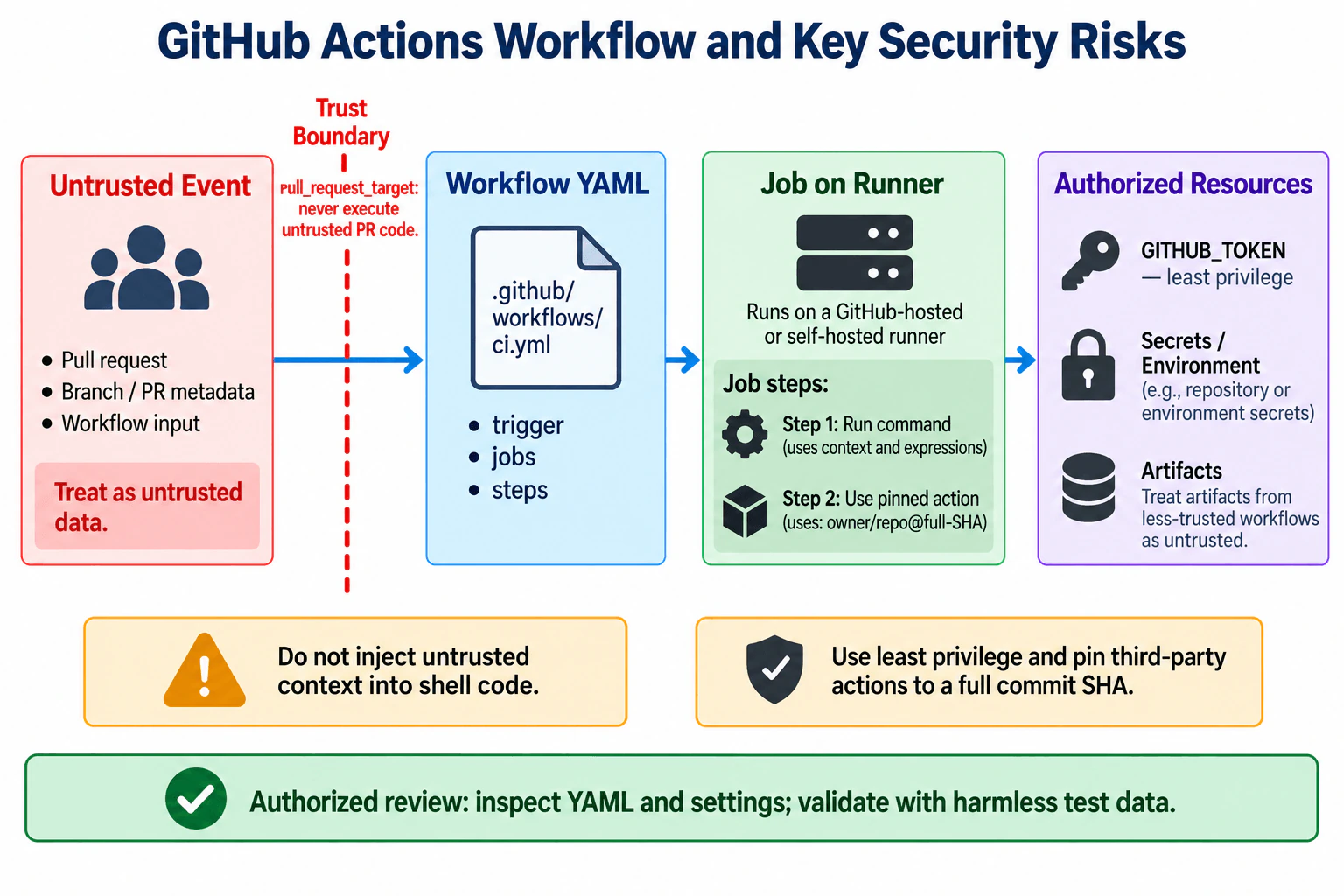
22. What is a GitHub Actions workflow, and what security risks should a Penetration Tester review?Language SpecificEasy

Question Details

Define a GitHub Actions workflow as YAML automation triggered by repository events. Explain jobs, steps, runners, actions, permissions, secrets, artifacts, environments, expressions, and event context. Cover least-privileged tokens, pinned dependencies, untrusted pull-request data, command injection, and authorized CI review.

Short Interview Answer (30-60 seconds)

A GitHub Actions workflow is YAML automation triggered by repository events. I would review triggers, jobs, runners, actions, expressions, token permissions, secrets, artifacts, and environments, focusing on least privilege, pinned dependencies, untrusted pull-request data, command injection, and privileged execution paths.

Detailed Explanation

The practical decision is whether a GitHub Actions workflow lets untrusted repository or pull-request data cross into a more trusted execution context. A workflow is YAML automation triggered by repository events and composed of jobs, steps, runners, actions, expressions, permissions, secrets, artifacts, and environments. For an authorized review, I trace each trigger and untrusted input to the code and privileges it can reach. I then check token scope, secret exposure, dependency pinning, runner trust, artifact handling, and command construction. The goal is to prevent attacker-controlled data or code from gaining unintended execution, credentials, write access, or deployment authority.

Useful Questions to Ask the Interviewer
  1. Is the review limited to workflow YAML, or does it also include repository, organization, environment, and runner settings?
  2. Are workflows triggered by pull requests from forks or other contributors without write access?
  3. Are GitHub-hosted runners, self-hosted runners, or both in scope?
  4. May I inspect effective token permissions, environment protection rules, action references, reusable workflows, and artifact flows without accessing secret values?
  5. Is this a static configuration review, or may I perform approved non-destructive validation in a dedicated branch or test repository?
What is a GitHub Actions workflow, and what security risks should a Penetration Tester review? diagram
How to Explain It in an Interview
1. Define a GitHub Actions workflow

A GitHub Actions workflow is an automated process defined in a YAML file, normally in the repository's .github/workflows directory. An event such as a push, pull request, scheduled event, or manual dispatch can trigger it. A workflow contains one or more jobs. A job runs on a runner and contains steps. A step can execute a command or invoke a reusable action.

A runner is the compute environment that executes the job. It can be GitHub-hosted or self-hosted. An action is reusable automation called with uses:. Expressions use the ${{ ... }} syntax to read contexts and calculate values. Contexts contain information about the workflow run, event, repository, jobs, steps, runner, and other state. GitHub warns that some context properties can contain attacker-controlled data and must be treated as untrusted input. docs.github.com

2. Start with the event and trust boundary

I first inspect the workflow's on configuration and determine who can cause each event. A trusted push by a maintainer and a pull request from an external fork have different trust levels. I then identify which event properties, files, branch names, pull-request metadata, artifacts, or other inputs are controlled by an untrusted contributor.

The important security question is where those values flow next. I trace them into shell commands, action inputs, file paths, API requests, conditions, outputs, deployment logic, or any other component that can interpret them. The presence of ${{ ... }} is not itself a vulnerability. The risk appears when attacker-controlled text reaches a component that can interpret that text as instructions or executable code. GitHub specifically documents pull-request titles, bodies, branch references, labels, commit messages, and similar context values as potentially untrusted. docs.github.com

3. Review jobs, steps, and runners

For every job, I record the runner, permissions, environment, dependencies, reusable workflows, and steps. I check whether untrusted code can execute in a job that has more trust than necessary.

GitHub-hosted and self-hosted runners have different security boundaries. A self-hosted runner can have access to organization-controlled networks, files, credentials, or other infrastructure, so I review whether untrusted workflows are allowed to execute on it and whether the runner is isolated and ephemeral where required. A successful workflow run does not prove the runner or workflow is secure.

4. Review GITHUB_TOKEN permissions

GitHub provides a GITHUB_TOKEN to jobs so workflows can authenticate to GitHub. Its effective permissions depend on enterprise, organization, repository, event, workflow, and job configuration. The workflow-level or job-level permissions key can reduce those permissions. GitHub recommends granting only the minimum permissions required. If individual permissions are specified, permissions not listed are set to none. docs.github.com

I check whether jobs have unnecessary write capabilities, for example repository-content, package, pull-request, issue, deployment, or other write access. A test or lint job that only needs source code should normally not also receive deployment or repository-write authority.

I also remember that an action can access the job's GitHub token through the workflow context even when the workflow author does not explicitly pass a GITHUB_TOKEN value to that action. Therefore, action trust and token permissions must be reviewed together.

5. Review secrets and environments

Secrets are sensitive values made available to workflows. I review which jobs can receive them, not the secret values themselves. I check whether untrusted jobs unnecessarily receive credentials, whether those credentials have excessive privileges, and whether logs, files, outputs, artifacts, commands, or external tools could expose them.

GitHub performs automatic redaction for supported secret patterns and registered secrets, but masking is not a complete security boundary. Sensitive values should still be minimized, scoped narrowly, rotated when appropriate, and never deliberately printed during a penetration test. docs.github.com

Environments add another control boundary for deployment jobs. They can be used with protection rules and environment-specific secrets. When required reviewers protect an environment, GitHub does not make its environment secrets available to the job until the required approval has been granted. docs.github.com

6. Review third-party actions and dependency pinning

Every uses: entry can introduce executable dependency code. I identify who owns the referenced action or reusable workflow and whether its reference is immutable. A mutable branch or tag can later point to different code.

For third-party actions, GitHub's security guidance recommends pinning to a full-length commit SHA for the strongest protection against unexpected changes to the referenced action. Pinning improves dependency integrity, but it does not prove that the pinned code is safe. The source can still contain vulnerabilities or unsafe behavior. Pinning also creates maintenance work because updates must be deliberately reviewed and adopted. docs.github.com

7. Treat pull-request data as untrusted

Pull requests are a major trust boundary because contributors may control code, filenames, branch names, titles, bodies, commit data, dependencies, and build configuration. I check whether any of that data reaches a workflow that has secrets, write-capable tokens, deployment authority, or trusted infrastructure.

I pay particular attention to pull_request_target. GitHub documents that this event runs with elevated trust: the workflow runs from the base repository context and receives the base repository's token and access to repository and organization secrets. By default, it does not execute the fork's code. The dangerous pattern appears when the workflow deliberately retrieves attacker-controlled pull-request code and then executes it inside that privileged context. GitHub describes this as a high-risk pattern and provides dedicated hardening guidance. docs.github.com

A safer design keeps untrusted code execution in a lower-privilege workflow and performs privileged follow-up work separately. However, privilege separation only works if data transferred from the less-trusted workflow is still treated as untrusted.

8. Review command injection paths

I trace attacker-controlled context values into every run: block. Directly interpolating an untrusted value into an inline shell script can cause the shell to interpret attacker-supplied characters as part of the script.

GitHub recommends safer patterns such as passing the untrusted value through an intermediate environment variable or using an action that handles the value as data rather than inserting it into generated shell code. Validation should match the intended data type and use. I do not assume that quoting alone protects every shell or interpreter boundary. docs.github.com

The same reasoning applies beyond shell scripts. Untrusted input should not become executable configuration, command-line syntax, dynamically evaluated expressions, unsafe file paths, or parameters to another component that interprets the value as code.

9. Review artifacts, outputs, and cross-workflow data

Artifacts, outputs, caches, and other transferred data can cross trust boundaries. I determine who can produce each item, who consumes it, and whether the consumer gives it more trust than the producer had.

A privileged workflow must not blindly execute a script, binary, build output, configuration file, or other active content produced by an untrusted workflow. GitHub specifically warns that workflows using privileged events such as workflow_run must treat artifacts coming from less-trusted workflows as untrusted data. docs.github.com

10. Review reusable workflows and inherited permissions

Reusable workflows can hide important security behavior outside the calling YAML file. I inspect the called workflow, its inputs, secrets, and permissions. GitHub documents that a called workflow cannot elevate GITHUB_TOKEN permissions beyond those passed by the caller, but inherited defaults still need to be understood and minimized. docs.github.com

I therefore include referenced reusable workflows in the authorized review scope whenever they materially affect the execution path.

11. Validate findings safely

For an authorized penetration test, I begin with static analysis of workflow YAML and relevant GitHub settings. If execution testing is approved, I use a dedicated test branch, fork, or synthetic repository and harmless marker values. For example, I can demonstrate that an untrusted pull-request title reaches a shell command without trying to read real credentials or modify production resources.

I preserve evidence such as the workflow file, event type, relevant context path, effective permissions, action references, runner type, environment rules, redacted logs, and a benign reproducible test. I do not print secrets, publish packages, alter production data, deploy code, or access unrelated infrastructure unless those actions are explicitly authorized.

12. Safe failure, remediation, and retest

A safer workflow should fail closed when validation or authorization is missing. A privileged operation should not proceed merely because an input is malformed, an approval check fails, or an untrusted artifact cannot be verified.

Remediation should address the root cause. Examples include narrowing token permissions, removing secrets from untrusted jobs, separating privileged and unprivileged workflows, replacing direct expression interpolation in shell code, isolating self-hosted runners, using protected environments, or pinning trusted action dependencies.

After remediation, I retest the original benign path and likely bypasses. I verify the deployed workflow and effective repository settings rather than only reviewing a proposed YAML change.

13. Limitations and tradeoffs

Static YAML review cannot prove that every action, reusable workflow, runner image, dependency, external service, organization policy, or credential is secure. Repository-level YAML may also inherit important settings from organization or enterprise configuration. Seeing a potentially dangerous data flow does not by itself prove successful exploitation; the execution and privilege context must be verified.

Least privilege requires more configuration. Full-SHA pinning creates dependency-update work. Environment approvals can slow deployment. Workflow separation adds complexity. Strong isolation for self-hosted runners has operational cost. These tradeoffs are usually justified when the alternative allows untrusted contributions to reach reusable credentials, write privileges, deployments, or trusted infrastructure.

Assumption: no separate audited diagram was supplied with this text-audit request, so this correction preserves the original question's stated components and trust relationships without inventing diagram-specific architecture.

Technical Approach
  1. Confirm written authorization and which repositories, workflow files, reusable workflows, runners, environments, and GitHub settings are in scope.
  2. Enumerate workflow triggers and classify who can cause each event.
  3. Map each job, step, runner, action, reusable workflow, permission set, secret boundary, artifact flow, environment, and expression.
  4. Identify untrusted input from pull requests, issues, branch names, commit metadata, artifacts, workflow inputs, or other event context.
  5. Trace untrusted input into run: scripts, action inputs, file operations, outputs, API calls, and privileged jobs.
  6. Record effective GITHUB_TOKEN permissions and flag authority beyond each job's real need.
  7. Review secret availability, credential scope, environment protection, and possible log or artifact exposure without retrieving secret values.
  8. Review action and reusable-workflow references for trusted ownership and immutable pinning where appropriate.
  9. Examine privileged triggers, especially pull_request_target, for retrieval and execution of untrusted code.
  10. Review artifacts and outputs crossing from less-trusted to more-privileged workflows.
  11. Inspect runner trust, especially whether untrusted jobs can reach persistent or internally connected self-hosted runners.
  12. Validate suspected paths with synthetic, non-destructive marker data in an approved test context.
  13. Preserve redacted evidence, document limitations, recommend root-cause remediation, and retest the deployed state.
Practical Complexity & Trade-offs

The YAML itself is usually inexpensive to review, but a complete assessment can require repository, organization, environment, reusable-workflow, runner, dependency, and external credential settings. Least-privilege permissions and separate trusted and untrusted workflows increase configuration work. Pinning actions to immutable commits improves dependency integrity but requires maintenance when updates are released. Environment approvals can slow deployments. Proper isolation of self-hosted runners adds infrastructure and operational cost. The main tradeoff is developer convenience and delivery speed versus limiting how much authority untrusted workflow input or code can reach.

Where it is used

This review is used for CI/CD pipelines that build, test, scan, package, publish, release, or deploy software through GitHub Actions. Typical authorized situations include assessing a repository before enabling external contributions, reviewing deployment workflows, evaluating self-hosted runner exposure, checking whether pull-request workflows have excessive privileges, reviewing third-party action dependencies, assessing reusable workflows, investigating artifact trust between workflows, or retesting GitHub Actions controls after remediation.

Why Interviewers Ask This

This question checks whether the candidate understands GitHub Actions as both YAML-based CI/CD automation and a security boundary. A strong answer should explain workflows, events, jobs, steps, runners, actions, contexts, expressions, tokens, secrets, artifacts, and environments, then connect them to realistic risks such as excessive permissions, untrusted pull-request input, command injection, mutable dependencies, unsafe privileged triggers, and inappropriate trust between jobs or workflows.

Common interview mistakes

Common mistakes include treating all GitHub events as equally trusted; reviewing YAML syntax without tracing trust boundaries; giving every job broad GITHUB_TOKEN permissions; assuming an action cannot access the job token because it was not explicitly passed as an input; exposing powerful secrets to jobs processing untrusted code; directly interpolating pull-request titles, branch names, issue text, or similar values into shell scripts; trusting mutable third-party action references; assuming a full-SHA pin proves an action is safe; checking out and executing untrusted pull-request code inside a privileged pull_request_target workflow; trusting artifacts simply because another workflow created them; allowing untrusted workloads on persistent self-hosted runners without adequate isolation; assuming secret masking prevents all leakage; and attempting to steal credentials or modify production resources when a harmless synthetic test can demonstrate the same security flaw.

Interview tip

Lead with the trust boundary. Explain what triggers the workflow, what data or code an untrusted contributor controls, and what privileges that input can reach. Then cover token permissions, secrets, runners, dependencies, expressions, artifacts, and environments. Emphasize least privilege, privilege separation, and safe reproducible validation rather than simply listing GitHub Actions features.

Interviewer may ask next
Why is `pull_request_target` more security-sensitive than a normal pull-request workflow from a fork?

pull_request_target executes the workflow from the base repository in an elevated-trust context and can receive the base repository's GITHUB_TOKEN and repository or organization secrets. By default, it does not execute the fork's code, which is why it can safely support tasks such as labeling. The serious risk appears when the workflow retrieves attacker-controlled pull-request code or artifacts and then executes them with those privileges. I would keep untrusted code out of that privileged context, grant minimum token permissions, restrict secrets, and separate untrusted testing from privileged follow-up operations. docs.github.com

Does pinning a third-party action to a full commit SHA make the workflow completely secure?

No. A full commit SHA makes the referenced action revision immutable, so a branch or tag cannot later move the workflow to different code without changing the workflow file. It does not prove that the pinned source is safe. The action can still contain vulnerabilities, unsafe behavior, or risky dependencies. I would combine pinning with source and ownership review, least-privileged tokens, restricted secrets, controlled updates, runner isolation, and monitoring. docs.github.com

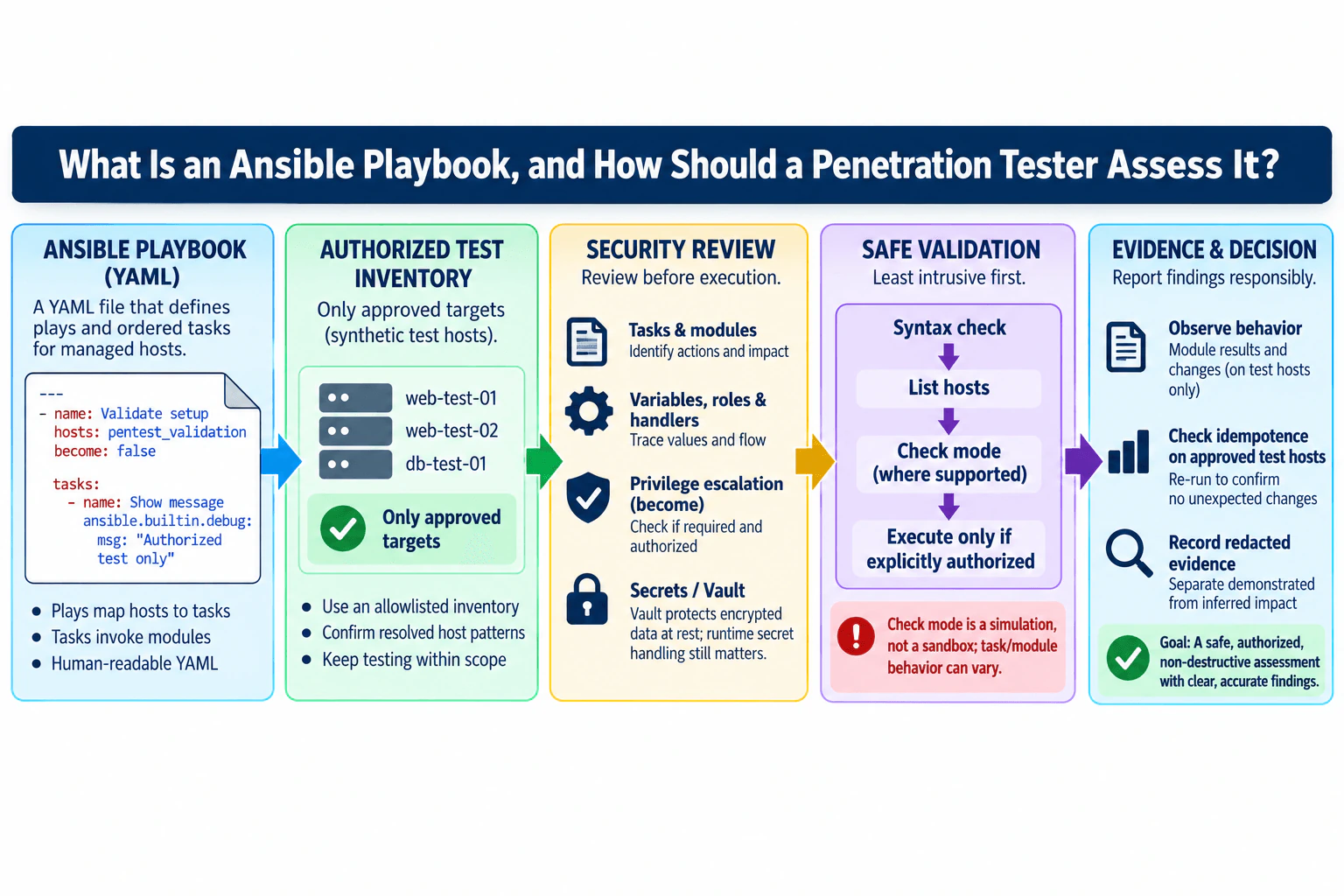
23. What is an Ansible playbook, and how should a Penetration Tester assess it?Language SpecificEasy

Question Details

Define an Ansible playbook as YAML describing ordered automation tasks for managed hosts. Explain inventories, plays, modules, variables, roles, handlers, privilege escalation, check mode, vault data, idempotence, and secrets. Focus on authorized review, bounded test inventories, and non-destructive validation.

Short Interview Answer (30-60 seconds)

An Ansible playbook is YAML that maps managed hosts to ordered automation tasks. I assess its effective inventory, modules, variables, roles, handlers, privilege escalation, and secrets, then validate it with bounded test hosts, syntax and host checks, and Ansible check mode where the involved modules support it.

Detailed Explanation

See the Code while reading this explanation.

An Ansible playbook is a YAML automation document that tells Ansible which managed hosts to target and which ordered tasks to run. A play connects a host pattern to tasks, and tasks normally call modules. For a Penetration Tester, the main decision is whether the playbook can be reviewed and validated without crossing the approved scope or causing harmful changes. I would trace the effective inventory, variables, roles, handlers, privilege escalation, and secrets before execution, then validate with a tightly bounded test inventory and check mode where supported, using normal execution only when explicitly authorized.

Useful Questions to Ask the Interviewer
  1. Which inventory hosts or groups are explicitly authorized for this assessment?
  2. Is the engagement limited to static review, or may I execute the playbook on designated test hosts?
  3. Is privilege escalation authorized, and which identity or become user is permitted?
  4. May I inspect decrypted Vault data, or should I assess only how encrypted values are stored, referenced, and protected at runtime?
  5. Are any roles, collections, dynamic inventory sources, delegated hosts, or external dependencies outside scope?
What is an Ansible playbook, and how should a Penetration Tester assess it? diagram
How to Explain It in an Interview
1. Define the playbook and its interface

Ansible playbooks are machine-parseable YAML used to record and execute configuration, deployment, and orchestration steps. A play typically contains a host pattern and an ordered list of tasks. Tasks usually invoke modules, while inventory supplies the managed hosts and may also supply host or group variables. docs.ansible.com

The important inputs are the playbook YAML, inventory, variables, configuration, credentials, roles, collections, and command-line options. YAML values can be scalars, lists, and mappings. During execution, Ansible produces per-task results such as whether a task was successful, changed state, failed, or could not reach a host. A tester should treat those results as evidence, not automatically as proof of a vulnerability.

2. Establish the authorized target boundary first

Before reviewing task behavior, I determine the effective host set. A play's hosts pattern can select a host, group, or broader set from inventory, and runtime options such as --limit can further restrict execution. I would use only an inventory containing approved test systems and confirm the resolved targets before any execution.

A useful safe validation sequence is to perform a syntax check and inspect the resolved host list before reaching managed systems. Current ansible-playbook supports --syntax-check, --list-hosts, --check, and --diff. docs.ansible.com

I also review delegation because a task can execute on a host other than the host selected by the play. That delegated execution crosses another responsibility boundary and must also be explicitly in scope. Ansible documents that delegated tasks use connection, become, shell, and related settings from the delegated-to host context. docs.ansible.com

3. Trace tasks and modules in execution order

I walk through every task and identify the exact module or action being invoked. I prefer fully qualified collection names when reviewing because they make the module source clearer and reduce ambiguity between similarly named content.

I classify tasks by effect: read-only inspection, file or configuration change, package operation, service change, command execution, network operation, or another state-changing action. Generic command and shell execution deserve extra review because their behavior depends heavily on their arguments. For example, Ansible's command-module documentation specifically recommends command over shell when shell processing is unnecessary because shell metacharacter parsing can cause unexpected command execution if quoting is incorrect. docs.ansible.com

Task order matters, but host concurrency also matters. Under Ansible's default linear strategy, a task is normally run across the affected hosts before the next task proceeds, while settings such as forks, serial, throttle, or a different strategy can change concurrency and rollout behavior. A tester should review those settings when parallel activity could affect safety or availability. docs.ansible.com

4. Resolve variables instead of trusting the nearest definition

Variables can come from inventory, playbooks, roles, included files, registered task results, facts, and runtime extra variables. If the same variable is defined in several places, Ansible applies precedence rules to choose the effective value. Extra variables have particularly high precedence. docs.ansible.com

For security review, I trace the final value of variables that influence hostnames, file paths, module arguments, commands, templates, credentials, privilege settings, or conditions. I also check whether operator-controlled values can unexpectedly broaden scope or alter security-sensitive behavior.

A safe design should fail closed when a required value is missing. For example, a missing scope variable should not silently fall back to all or another broad host pattern.

5. Follow roles, includes, and indirect behavior

Roles can automatically load related tasks, handlers, variables, defaults, files, templates, dependencies, custom modules, and plugins. Therefore, reviewing only the top-level playbook can miss important behavior. docs.ansible.com

I follow every referenced role, import, include, and relevant dependency. I pay particular attention to role defaults versus role variables because they have different precedence, and I inspect custom modules or plugins when they are actually used.

6. Review handlers carefully

A handler is a special task normally triggered by a notify action after another task reports a change. A common pattern is updating a configuration file and notifying a handler that restarts a service.

Handlers matter to a penetration test because the immediate task and the eventual operational effect may be separated in the YAML. By default, handlers normally run at the end of the play. If another task later fails on a host, a previously notified handler does not run on that host by default, although Ansible provides force-handler behavior that can change this. docs.ansible.com

I therefore trace both the notifying task and its handler and consider what state remains if execution fails partway through.

7. Assess privilege escalation

Ansible uses become plugins for privilege escalation or changing the execution user. I inspect become, become_user, become_method, inventory variables, configuration, and command-line settings that could influence the actual privilege context. Current Ansible tooling exposes dedicated become options for this purpose. docs.ansible.com

The security question is whether the requested privilege is necessary, permitted, and tightly scoped. During testing I use the least privileged approved identity. I do not enable privilege escalation merely because the playbook expects it.

Successful execution with an elevated authorized account demonstrates what that authorized account can do. It does not by itself prove an exploitable privilege-escalation vulnerability.

8. Review secrets and Vault data

I search for passwords, API tokens, private keys, become credentials, connection credentials, and other reusable secrets in inventories, variables, roles, templates, command arguments, output, and supporting files.

Ansible Vault encrypts variables and files and is designed to protect sensitive content such as passwords or keys from being stored as plaintext. However, official Ansible documentation explicitly states that Vault protects data at rest only. Once decrypted for use, playbook and plugin authors remain responsible for preventing disclosure. docs.ansible.com

I therefore check for runtime leakage through logs, debug output, registered results, command arguments, generated files, callbacks, and diff output. I minimize collection of real secrets and redact reusable values from evidence.

Diff mode also needs care because Ansible warns that diff output can expose sensitive information. Sensitive tasks can disable diff output with diff: false. docs.ansible.com

9. Use check mode, but do not treat it as a sandbox

When the relevant modules support it, ansible-playbook --check attempts to predict changes without applying them. Diff mode can additionally show supported before-and-after information. docs.ansible.com

Check-mode support is module-specific. Some modules have full support, some partial support, and some cannot meaningfully predict their actions. For example, ansible.builtin.command has only partial check-mode support because arbitrary commands cannot generally be simulated. docs.ansible.com

A task can also explicitly force normal behavior with check_mode: false, so I inspect task-level settings before trusting a check-mode run. Check mode is therefore a useful safety control, not an isolation boundary.

10. Check idempotence

Idempotence means that after the system already matches the requested state, another equivalent run should normally avoid unnecessary changes. Many Ansible modules are designed around desired state, but a tester should verify the particular tasks rather than assuming the entire playbook is idempotent.

If execution is authorized, I test idempotence only on a disposable or otherwise approved test target. I compare a permitted convergence run with a second controlled run. Unexpected repeated changes can indicate unstable inputs, imperative commands, incorrect change reporting, or poor task design.

A lack of idempotence is not automatically a security vulnerability. I report a security finding only when I can connect the behavior to a demonstrated security consequence, such as repeated permission changes, secret exposure, unnecessary privileged actions, or unsafe service disruption.

11. Review retries, timeouts, errors, and failure behavior where relevant

Ansible does not give every playbook one universal retry or timeout behavior. Connection settings, module behavior, asynchronous operations, task constructs, and playbook logic can affect how long an operation waits or whether it retries. I therefore inspect these only where the playbook actually uses them.

I also review failed_when, changed_when, ignored failures, blocks, rescue behavior, and unreachable-host handling when they could hide a failure or allow later tasks to proceed under an unsafe assumption. Ansible allows task failure behavior to be customized, so a green-looking run is meaningful only if those rules have also been reviewed. docs.ansible.com

12. Validate with the least intrusive sequence

My preferred sequence is:

  1. Static YAML and dependency review.
  2. Confirm the approved inventory and privilege context.
  3. Run syntax checking.
  4. List the effective hosts without executing the playbook.
  5. Inspect module-specific check-mode and diff-mode support.
  6. Run check mode only against a bounded test inventory where it adds useful evidence.
  7. Use normal execution only on explicitly authorized test systems when runtime behavior cannot otherwise be established.
  8. Re-run safely where needed to test idempotence.
  9. Record minimal, redacted evidence.

This sequence increases confidence gradually while limiting operational risk.

13. State the evidence and limitations

Useful evidence includes the playbook and task name, effective host pattern, resolved test inventory, module name, role or handler path, relevant variable source, privilege context, redacted check-mode output, and state observed on the approved test system.

Static review can identify risky execution paths but cannot prove every runtime outcome. Check mode cannot simulate every module or dependency. A test-host run demonstrates behavior only in that test environment. Production impact remains an inference unless the engagement explicitly permits safe confirmation there.

The main tradeoff is confidence versus risk. Static review is safest but gives less runtime evidence. Check mode adds confidence but has incomplete coverage. Controlled execution gives stronger evidence but requires greater authorization, isolation, monitoring, and cleanup. I use the least intrusive method that can answer the assessment question.

Technical Approach
  1. Confirm written authorization, rules of engagement, approved inventories, test hosts, identities, and permitted privilege level.
  2. Parse the YAML structure and identify every play, host pattern, task, role, import, include, handler, and delegated action.
  3. Resolve the effective host set and confirm that every directly or indirectly targeted system is authorized.
  4. Perform a syntax check and inspect the effective host list before task execution.
  5. Review each module and argument for read-only behavior, state changes, command execution, unsafe input handling, and destructive potential.
  6. Trace security-sensitive variables through inventory, playbooks, roles, facts, registered results, includes, and runtime overrides using the applicable precedence rules.
  7. Review roles, dependencies, custom modules, plugins, handlers, and notifications for indirect effects.
  8. Review become and related settings for least privilege and authorized escalation boundaries.
  9. Identify secrets and Vault-protected data and check for plaintext or runtime disclosure without unnecessarily collecting secret values.
  10. Review concurrency, retries, timeouts, error handling, and failure behavior when they materially affect safety or interpretation.
  11. Check each relevant module's check-mode and diff-mode support and identify any task-level overrides.
  12. Run check mode only against an explicitly bounded test inventory when it provides useful non-destructive evidence.
  13. If normal execution is explicitly authorized and necessary, use only designated disposable or controlled hosts and stop if unexpected targets, privileges, or state changes appear.
  14. Re-run a permitted test where useful to evaluate idempotence.
  15. Save minimal, redacted evidence and clearly separate demonstrated behavior from inferred production impact.
Practical Complexity & Trade-offs

The main cost is reviewer time. Small playbooks can be simple, but large Ansible repositories may spread behavior across inventories, variable files, roles, handlers, collections, templates, and custom plugins. Dynamic inventories and variable precedence add more review work. Operational risk also matters because a mistaken target pattern or privileged state-changing task can affect many systems quickly, especially when execution is parallel. A dedicated test inventory and disposable hosts cost more to maintain but reduce production risk. Check mode is cheaper and safer than normal execution, but its accuracy depends on module support. Evidence handling adds work because secrets and sensitive diff output must be minimized and redacted. There is no justified memory or performance claim for the playbook itself without inspecting the specific modules, inventory size, strategy, forks, and target systems.

Example

This YAML is a safe validation fixture rather than a penetration payload. It demonstrates the playbook structure using an explicitly named test group, no privilege escalation, an ordinary variable, a non-destructive assertion, and a debug task. The inventory supplied at runtime must still contain only authorized test hosts. The example intentionally makes no system changes, so it can illustrate structure without implying that check mode alone provides isolation.

Code
---
# Safe fixture: the runtime inventory must contain only authorized test hosts.
- name: Validate Ansible structure on approved test hosts
  hosts: pentest_validation
  gather_facts: false
  become: false # Do not escalate privileges unless the engagement explicitly permits it.

  vars:
    validation_marker: "authorized-ansible-review"

  tasks:
    # Assert an expected synthetic value without changing the managed host.
    - name: Confirm the synthetic validation value
      ansible.builtin.assert:
        that:
          - validation_marker == "authorized-ansible-review"
        fail_msg: "Unexpected validation input; stop the bounded test."
        success_msg: "Synthetic validation input is correct."

    # Produce a deterministic, non-secret message for test evidence.
    - name: Record safe validation status
      ansible.builtin.debug:
        msg: "Authorized Ansible validation completed without a state-changing task."
Where it is used

This assessment approach is used during authorized reviews of infrastructure-as-code repositories, configuration-management systems, CI/CD pipelines, internal platform automation, deployment tooling, cloud or server hardening automation, and penetration-test engagements where Ansible controls explicitly in-scope systems. It is especially useful before a playbook is promoted into production or when an organization needs evidence that automation uses bounded inventories, appropriate privileges, protected secrets, predictable task behavior, and safe failure handling.

Why Interviewers Ask This

Interviewers want to know whether the candidate understands that an Ansible playbook is executable infrastructure automation, not merely harmless YAML. They are testing whether the Penetration Tester can identify what hosts the automation can affect, what privileges and secrets it uses, how indirect behavior such as roles and handlers changes execution, and how to validate the playbook without causing unauthorized or unnecessary changes.

Common interview mistakes

Common mistakes include treating YAML as passive text, reviewing only the top-level playbook while ignoring roles and handlers, assuming the inventory name proves the actual targets are authorized, and failing to trace variable precedence. Testers may also overlook delegated tasks, broad host patterns, or runtime overrides. Another mistake is assuming --check guarantees that nothing meaningful can execute; check-mode behavior depends on the module, and tasks can override check mode. Treating Vault as complete secret protection is also incorrect because Vault protects encrypted data at rest, not every runtime exposure path. Enabling become unnecessarily increases testing risk. Finally, non-idempotent behavior or a task marked changed should be investigated, but neither should automatically be labeled a vulnerability without a demonstrated security consequence.

Interview tip

Lead with scope: first determine exactly which hosts the playbook can affect and with what identity. Then explain how you trace tasks, modules, variables, roles, handlers, privilege escalation, and secrets. Finish with the validation ladder: syntax and host checks, check mode where supported, and normal execution only on explicitly authorized test systems. Mention that check mode is useful but is not a sandbox.

Interviewer may ask next
Why should a Penetration Tester not rely only on Ansible check mode?

Check mode is a prediction mechanism, not a security boundary. Its accuracy depends on module support. Some modules have full support, some have partial support, and arbitrary command execution cannot generally be simulated accurately. A task can also specify check_mode: false, which can force normal behavior even during a check-mode run. I would therefore inspect task-level settings and module documentation first, confirm the effective hosts, use an allowlisted test inventory, and treat check-mode output as supporting evidence rather than proof that the entire playbook is harmless.

Does using Ansible Vault mean the playbook handles secrets securely?

No. Ansible Vault encrypts variables and files and protects that content at rest, but the data must be decrypted when Ansible uses it. Runtime behavior can still expose a secret through output, debug tasks, registered results, templates, generated files, command arguments, callback plugins, or diff output. I would review those paths, minimize access to real secret values, disable sensitive diff output where appropriate, redact evidence, and report the demonstrated disclosure path instead of copying reusable credentials into the assessment.

24. What is a regular expression, and how should penetration-testing tools use regex safely?Language SpecificEasy

Question Details

Define a regular expression as a pattern language for matching text. Explain literals, character classes, quantifiers, groups, alternation, anchors, escaping, and engine differences. Connect regex to response analysis and evidence parsing while covering representative tests, Unicode, input limits, catastrophic backtracking, and structured parsing when a schema exists.

Short Interview Answer (30-60 seconds)

Regex is a pattern language for matching text. I use it for bounded response analysis and evidence extraction, with simple tested patterns, known engine behavior, Unicode handling, and input limits. I avoid catastrophic backtracking and use a structured parser whenever the input already has a defined schema.

Detailed Explanation

A regular expression, usually called regex, is a small pattern language used to find, validate, or extract text. For a penetration tester, the practical decision is whether regex is the right parser for the evidence being examined. Regex works well for bounded pieces of unstructured text, such as identifying a known marker in an authorized test response. It should not replace a real parser when JSON, XML, or another schema exists. Safe use also requires understanding regex syntax, the chosen engine, Unicode behavior, input size, performance limits, and possible false matches.

Useful Questions to Ask the Interviewer
  1. Which regex engine or programming environment does the tool use?
  2. Is the input unstructured text, or does it have a format such as JSON or XML that should be parsed structurally?
  3. Can the response or evidence text be attacker-controlled or unusually large?
  4. Do we need exact full-string validation, extraction of a field, or only detection of a marker?
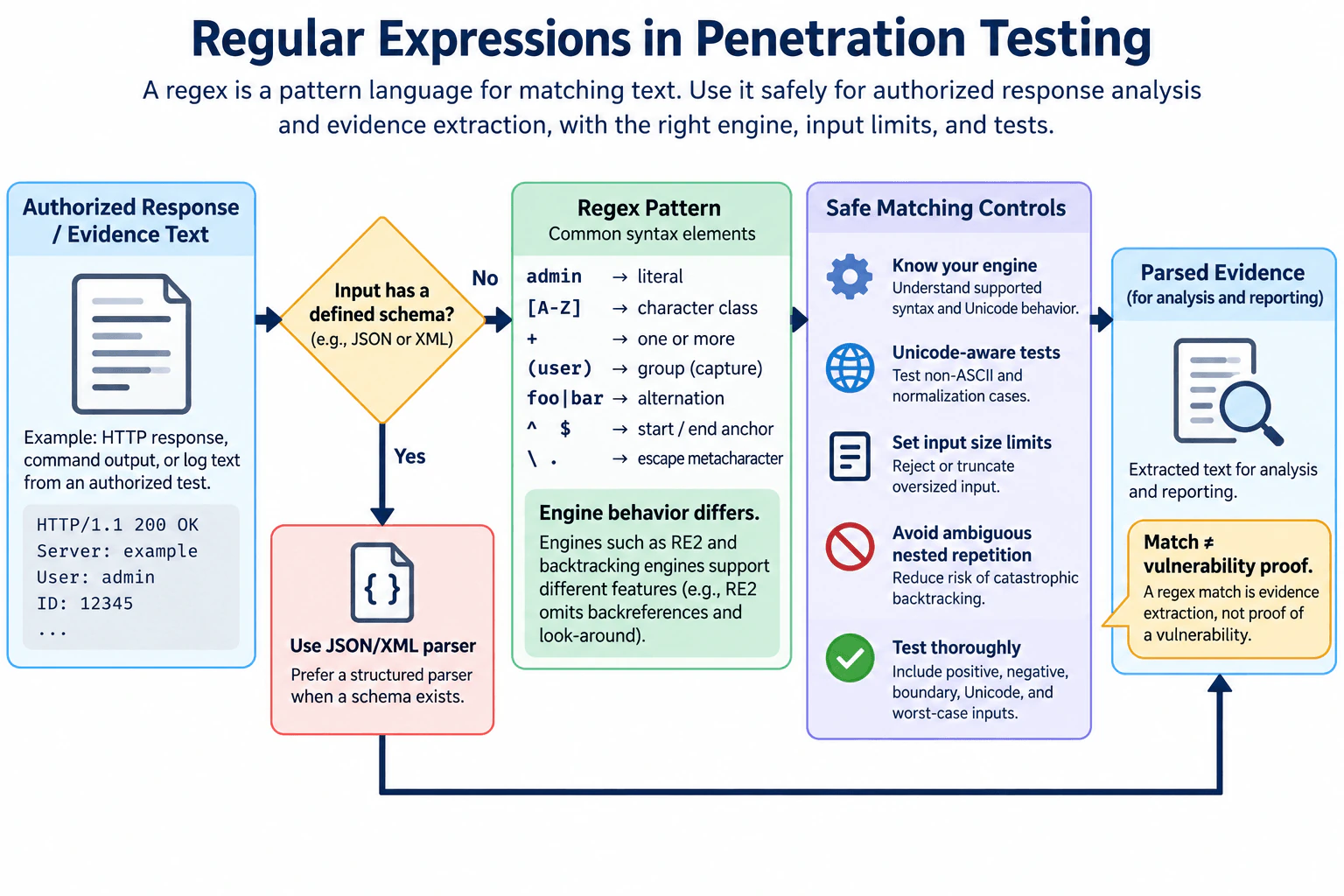
What is a regular expression, and how should penetration-testing tools use regex safely? diagram
How to Explain It in an Interview

I would start by defining regex. A regular expression describes a pattern that a regex engine tries to match against text. The input is normally text. Depending on the API, the output may be a match or no-match result, one or more matching substrings, or captured groups. If a tool scans repeatedly, the API also determines match ordering and whether overlapping matches are possible; those details should be confirmed rather than assumed.

The basic building blocks are straightforward. Literals match ordinary characters. For example, admin matches those characters. Character classes such as [A-Z] describe a set or range of characters. Quantifiers control repetition: * usually means zero or more, + means one or more, ? means zero or one, and forms such as {2,4} specify a bounded count. Parentheses create groups and may capture matched text. Alternation with | means one pattern or another. Anchors such as ^ and $ constrain where a match occurs, although their exact behavior can change with engine options such as multiline mode. Backslashes are commonly used for escaping metacharacters or introducing special sequences, so escaping must also be correct in the programming language or configuration format that contains the regex.

Regex is not one perfectly universal language. Engines such as PCRE-style engines, Python's regular-expression engine, and RE2 share common syntax but differ in supported features, Unicode behavior, matching semantics, and performance characteristics. A pattern accepted by one engine may be rejected or behave differently in another. RE2, for example, does not support backreferences or look-around assertions and guarantees asymptotically linear match time in the length of the input, while backtracking engines may support more constructs but can have much worse behavior for some patterns and inputs. Therefore I identify and test against the exact engine used by the penetration-testing tool.

For penetration testing, I use regex mainly after an authorized request has produced response text or after another authorized tool has generated evidence that needs bounded extraction. For example, I might search a synthetic or approved test response for a known marker and capture a small associated value. The trust boundary matters because response content may be controlled by the tested application or another untrusted source. I therefore treat the input as untrusted data and do not let a regex match alone become proof of a vulnerability. The surrounding request, response, scope, and reproducible observation still determine what the evidence means.

The main performance risk in backtracking engines is catastrophic backtracking, also called a regex denial-of-service risk when untrusted input can trigger it. Ambiguous repeated constructs, especially nested repetition or overlapping alternatives, can cause the engine to explore many possible matching paths before succeeding or failing. A small expression can therefore consume excessive CPU time on a specially shaped string. I reduce that risk by simplifying the pattern, removing unnecessary ambiguity, preferring explicit bounds where practical, restricting input size before matching, and selecting an engine with stronger runtime guarantees when its syntax is sufficient.

Input limits should exist even when the regex itself appears safe. A linear-time matcher still does more work as input grows, and storing or copying large responses also costs memory. I define the maximum evidence size the parser will inspect, reject or truncate oversized input according to the tool's evidence policy, and record that the result is partial if truncation could affect the conclusion. For high-volume tooling, I also avoid uncontrolled concurrency so many individually safe matches do not collectively exhaust CPU or memory.

Unicode needs deliberate handling. Text may contain multi-byte encodings, non-ASCII characters, combining characters, and visually similar characters. Regex engines can differ in what character classes such as \w, \d, or case-insensitive matching include. Some engines also do not normalize equivalent Unicode representations automatically. I define whether the parser operates on decoded Unicode text or bytes, use the appropriate engine mode, and test representative non-ASCII and normalization cases when they can affect evidence matching.

I validate the pattern with synthetic cases before trusting it in a testing workflow. I include a positive case that must match, a negative case that must not match, minimum and maximum expected lengths, empty input when relevant, Unicode text, malformed input, oversized input, and regression cases for previous parsing mistakes. For a backtracking engine, I also include deliberately difficult non-matching strings that exercise ambiguous repetitions. The expected output for every fixture should be deterministic so a failed parser test is easy to investigate.

Safe failure behavior is important. An invalid pattern, no match, ambiguous match, oversized input, decoding error, or resource-limit failure should produce an explicit parsing outcome rather than a fabricated value or security finding. Retries usually do not help deterministic regex failures, so the tool should not retry them blindly. The original authorized evidence should remain available for review when permitted, while credentials, tokens, personal data, and unrelated sensitive content should be minimized or redacted according to the engagement rules.

For evidence quality, I preserve enough context to show why the extracted value matters. A parser should distinguish the raw observation from its interpretation. If a regex finds a marker, I validate the surrounding response and any relevant request metadata before reporting a conclusion. This reduces false positives caused by matching unrelated page text, reflected input, comments, logs, or error messages.

If the response has a defined schema, I prefer the corresponding parser. JSON should normally be parsed as JSON, XML with an appropriately and safely configured XML parser, and other structured formats with their native parser or schema-aware library. Regex can still be useful for a small textual field after structured parsing, but using regex to reproduce a grammar that already has a parser creates unnecessary correctness and maintenance risk.

The tradeoff is simplicity versus reliability. Regex is compact and convenient for small text-matching jobs, but complex patterns become difficult to review, may behave differently across engines, and can create performance or false-positive problems. I keep patterns small, explicit, bounded, tested, and tied to a clear evidence decision. Regex helps extract text; it does not by itself prove exploitability, impact, or a security finding.

Assumption: no separate penetration-testing diagram was supplied with this text-audit stage, so the corrected answer follows the exact question and written specification without inventing diagram-specific components, controls, or flows.

Technical Approach
  1. Confirm that the evidence source and parsing activity are within the authorized testing scope.
  2. Identify whether the input is unstructured text or has a defined schema; use the structured parser when a schema exists.
  3. Confirm the exact regex engine, supported syntax, Unicode behavior, anchoring rules, and performance model.
  4. Define the smallest pattern needed for the matching or extraction decision.
  5. Set an explicit maximum input size before matching and define behavior for oversized or malformed input.
  6. Avoid ambiguous nested repetition and overlapping alternatives in backtracking engines; prefer explicit bounds where practical.
  7. Define deterministic outputs for match, no match, invalid pattern, ambiguous extraction, decoding failure, oversized input, and resource-limit failure.
  8. Test synthetic positive, negative, empty, boundary, Unicode, malformed, oversized, difficult non-match, and regression cases.
  9. Preserve enough authorized request and response context to validate the evidence while minimizing sensitive data.
  10. Treat extracted text as an observation that still needs interpretation and validation.
  11. Re-test the pattern whenever the response format, regex engine, flags, encoding assumptions, or extraction requirement changes.
Time & Space Complexity

For a simple regex, development and maintenance cost are usually low. CPU cost depends on both the engine and the pattern. RE2-style matching can provide linear-time guarantees for supported patterns, while some backtracking engines can take extremely long on pathological patterns and inputs. Memory also matters because the tool must hold or scan response data, so input limits and bounded concurrency are useful. Human cost rises as expressions become difficult to read. Operationally, false matches or missed matches can waste analyst time or weaken evidence quality. Maintenance cost increases when different tools use different engines, flags, encodings, or syntax. Privacy and compliance costs also matter if response parsing captures secrets or personal data, so evidence should be minimized, redacted, retained only as required, and access-controlled.

Where it is used

Regex is useful in authorized penetration-testing tools when examining bounded unstructured text, such as locating a known marker in an HTTP response, extracting a small value from predictable command output, classifying line-oriented evidence, identifying a known pattern in synthetic test fixtures, or normalizing a limited textual field before manual validation. It is also useful after structured parsing when one specific field contains free-form text. It is a poor choice for parsing an entire JSON, XML, YAML, or other structured document when a reliable parser for that format is available.

Why Interviewers Ask This

Interviewers want to know whether the candidate understands basic regex syntax and can apply it safely to penetration-testing automation. A strong answer shows that regex is useful for matching unstructured text but is not a universal parser. It also demonstrates awareness of engine-specific behavior, Unicode, false matches, resource-exhaustion risks from pathological patterns, input limits, and the need to validate parsing logic before relying on extracted text as security evidence.

Common interview mistakes

Common mistakes include treating regex as a universal parser; assuming all engines support the same features; forgetting that the host programming language may require another layer of escaping; using broad expressions such as .* when a narrower pattern is clearer; relying on ^, $, ., character classes, or case-insensitive matching without checking engine flags and Unicode behavior; ignoring encoding and normalization; running backtracking patterns over unlimited untrusted input; using nested repetition or overlapping alternatives that can trigger catastrophic backtracking; testing only successful matches; failing to define behavior for no-match, malformed, or oversized input; allowing many regex operations to run with uncontrolled concurrency; logging sensitive matches unnecessarily; retrying deterministic parser failures; and treating a matched string as proof of a vulnerability without validating the complete authorized request and response evidence.

Interview tip

Define regex first, then connect it to one practical penetration-testing use: bounded extraction from authorized evidence. Explain literals, classes, quantifiers, groups, alternation, anchors, and escaping briefly. Then emphasize the judgment points: know the engine, understand Unicode, constrain input, test difficult failure cases, avoid catastrophic backtracking, preserve evidence context, and prefer a structured parser when a schema exists.

Interviewer may ask next
Why can the same regular expression behave differently in different tools?

Different tools may use different regex engines, flags, encodings, or matching APIs. Engines share concepts such as literals, character classes, quantifiers, groups, alternation, and anchors, but they do not support every construct identically. Unicode classes, case-insensitive matching, multiline anchors, look-around, backreferences, and performance characteristics can differ. For example, RE2 intentionally omits backreferences and look-around assertions and guarantees asymptotically linear matching time for its supported syntax. I therefore identify the actual engine and test the pattern in that environment instead of assuming a pattern copied from another tool is equivalent.

What is catastrophic backtracking, and how would you reduce the risk in a penetration-testing parser?

Catastrophic backtracking occurs when a backtracking regex engine explores a very large number of possible matching paths, often because ambiguous repeated constructs are combined with input that nearly matches but eventually fails. This can consume excessive CPU time and become a denial-of-service problem when input is untrusted. I reduce the risk by simplifying the expression, removing overlapping or nested repetition where possible, adding explicit bounds, limiting input size, testing difficult non-matching strings, bounding concurrency, and choosing a linear-time engine such as RE2 when its supported syntax meets the requirement. If the input has a defined schema, I use the correct structured parser instead.

25. What is an authorized penetration test?Penetration TestingEasy

Question Details

Define an authorized penetration test as a time-bounded, scoped security assessment that safely validates whether realistic attack paths can achieve agreed objectives. Explain written authorization, rules of engagement, assets, exclusions, test identities, stop conditions, evidence, communication, cleanup, reporting, remediation, retesting, and residual risk. Distinguish it from a vulnerability scan, audit, bug bounty, and red-team exercise.

Short Interview Answer (30-60 seconds)

An authorized penetration test is a written-approved, time-bounded security assessment of defined assets. The tester follows agreed rules of engagement, safely validates realistic attack paths, records evidence, communicates important findings, cleans up test artifacts, reports risk, supports remediation, and retests fixes.

Detailed Explanation

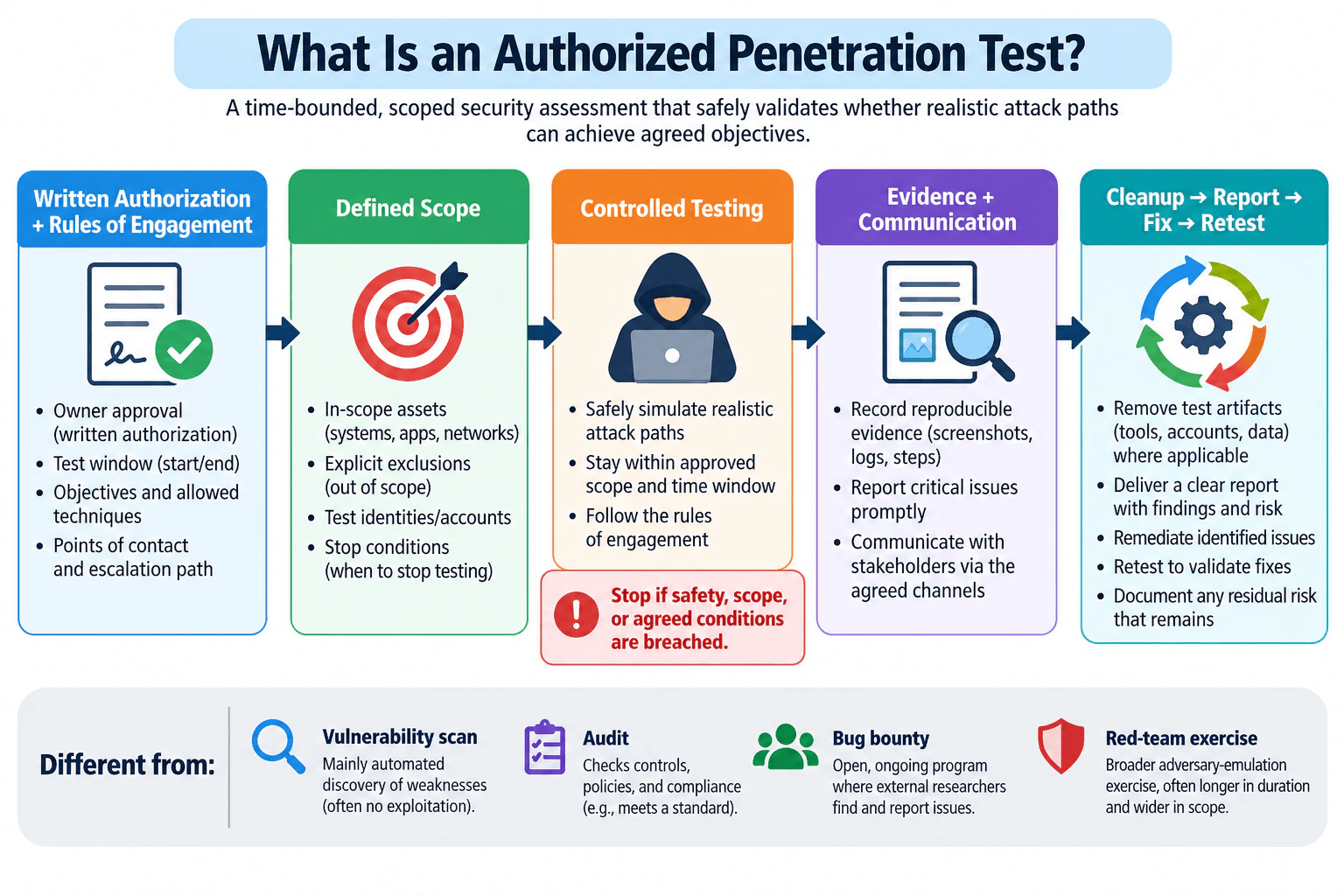
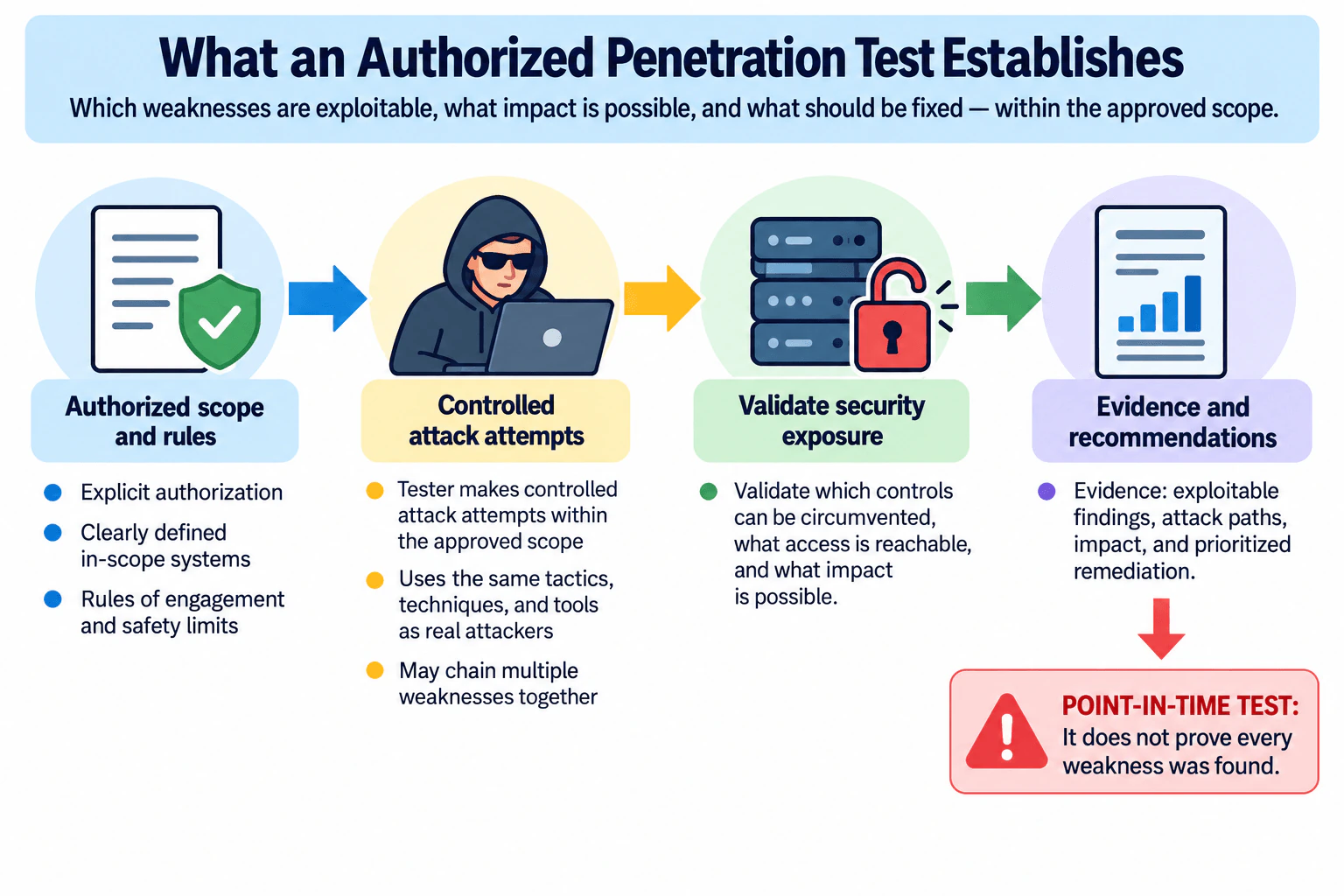
An authorized penetration test is a controlled security assessment performed with written permission. It has a defined start and end time, approved assets, exclusions, objectives, test identities, allowed techniques, and rules of engagement. The tester safely follows realistic attack paths to see whether agreed objectives can actually be achieved. The work must remain inside the approved scope, stop when defined safety conditions occur, produce reproducible evidence, and use agreed communication channels. After testing, applicable artifacts are removed, findings are reported, fixes are made and retested, and any remaining residual risk is documented.

Useful Questions to Ask the Interviewer
  1. Which systems, applications, networks, accounts, and environments are explicitly in scope?
  2. Which assets, techniques, times, or actions are excluded or prohibited?
  3. What are the test objectives, and what evidence is required to show that an objective was achieved?
  4. Which test identities or accounts should be used, and what privileges should they have?
  5. What conditions require testing to stop, and who are the escalation or emergency contacts?
  6. How should critical findings and normal status updates be communicated?
  7. Are any third-party services involved that require separate authorization or restrictions?
  8. What cleanup, reporting, remediation, and retesting deliverables are expected?
What is an authorized penetration test? diagram
How to Explain It in an Interview

I would explain the engagement as one controlled flow.

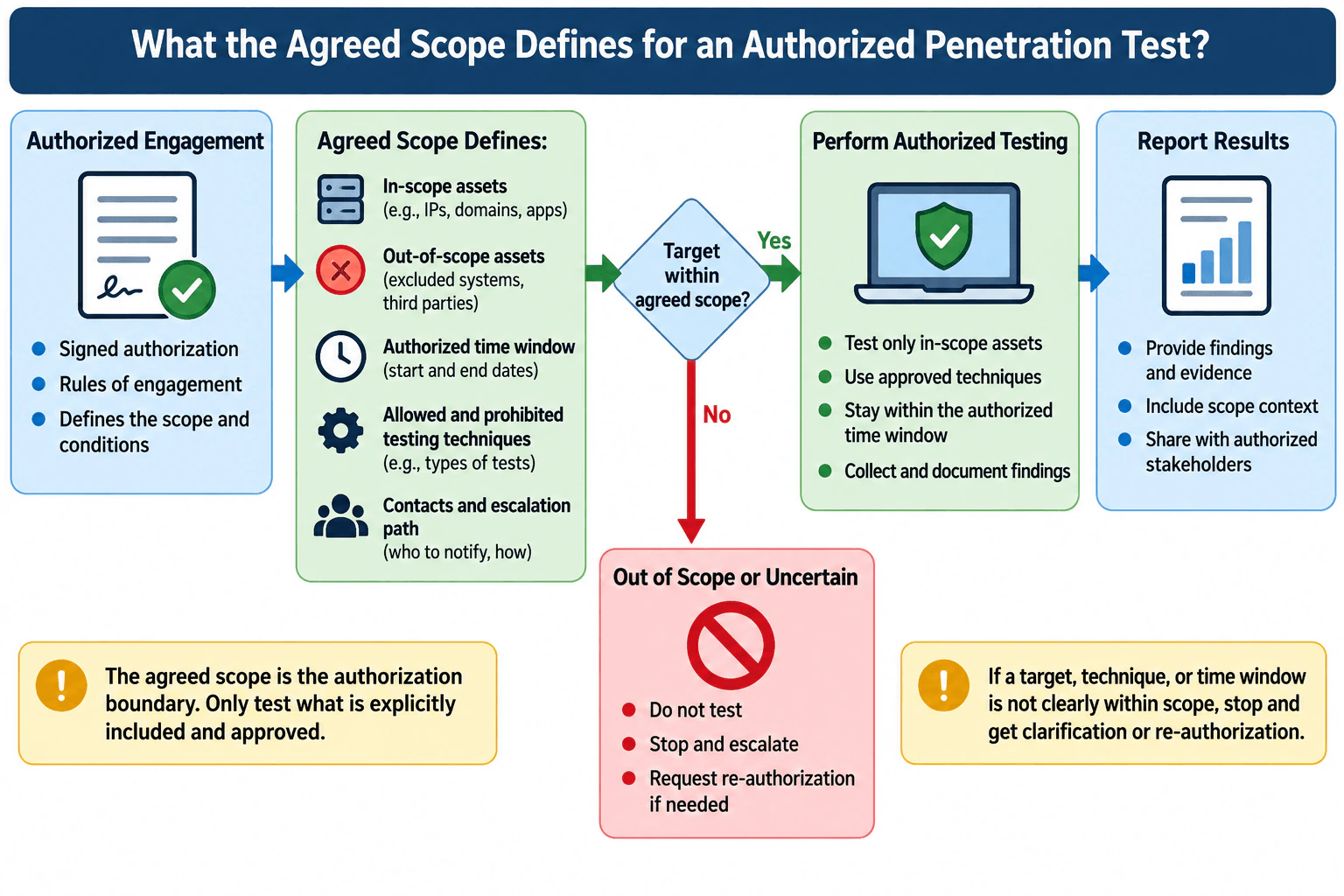
First, I confirm written authorization and the rules of engagement. Written authorization establishes that the asset owner or authorized party has approved the security test. The rules of engagement define how the test may be performed, including the test window, objectives, allowed techniques, prohibited actions, points of contact, and escalation path. Permission from one organization does not automatically authorize testing an unrelated third party, so third-party assets remain outside testing unless the required approval exists.

Second, I define the scope. I identify the systems, applications, networks, and other assets that are in scope, along with explicit exclusions. I also confirm the test identities or accounts and their expected privileges. The scope is a hard responsibility boundary. Discovering a related system during testing does not make that system authorized. If testing needs to expand, I stop that path until the scope is formally updated and approved.

Third, I perform controlled testing. I use realistic attack paths only within the approved assets, time window, allowed techniques, and rules of engagement. The objective is not to cause maximum damage. It is to obtain enough safe, reproducible evidence to demonstrate whether an agreed security objective can be achieved. If safety, scope, or another agreed condition is breached, I stop the affected activity and follow the escalation process rather than continuing the test.

Fourth, I collect evidence and communicate. Evidence can include relevant screenshots, logs, observations, and reproducible steps. I collect only what is needed to support the finding and avoid unnecessary sensitive data. Critical issues are communicated promptly through the agreed channel, while normal status updates and other findings follow the agreed communication process. Evidence should support what was actually demonstrated; an assumed business impact should not be presented as a proven result.

Fifth, I close the engagement properly. I remove applicable test tools, temporary accounts, test data, or other test artifacts and verify that test-created state is no longer needed. I then deliver a clear report describing findings, demonstrated risk, coverage limits, and recommended remediation. After fixes are deployed, I retest the affected paths as agreed to determine whether the original issue is resolved. Any meaningful risk that remains after remediation is documented as residual risk for the appropriate owner to review or accept.

A penetration test is different from a vulnerability scan because a scan mainly discovers potential weaknesses, often through automated checks, while a penetration test safely validates selected weaknesses or realistic attack paths within an authorized engagement. An audit mainly checks controls, policies, records, or requirements against defined criteria. A bug bounty is a program in which eligible external researchers find and report vulnerabilities under published rules, often for rewards. A red-team exercise is broader adversary emulation intended to test security capabilities against defined objectives and may run longer or cover a wider attack path than a typical penetration test.

The main tradeoff is depth versus safety and coverage. A tightly controlled test reduces operational risk but may leave some paths untested. A penetration test therefore provides evidence about the assets, paths, identities, and conditions that were actually tested; it does not prove that the entire organization is secure. Those coverage limits and any residual risk should be stated clearly.

Technical Approach
  1. Obtain written authorization before testing.
  2. Confirm objectives, rules of engagement, start and end times, allowed techniques, prohibited actions, contacts, and escalation paths.
  3. Define in-scope assets, explicit exclusions, test identities, privileges, and third-party boundaries.
  4. Translate the objectives into safe, testable security claims and evidence requirements.
  5. Follow realistic attack paths only inside the approved scope and time window.
  6. Stop the affected activity if a defined safety, scope, or engagement condition is breached and use the agreed escalation process.
  7. Record reproducible evidence and communicate critical issues through the agreed channels.
  8. Remove applicable test artifacts and restore test-created state where required.
  9. Report findings, demonstrated impact, coverage limitations, remediation recommendations, and residual risk.
  10. Retest agreed fixes and document the final result without overstating assurance.
Practical Insights

The main cost is not algorithmic complexity. It is operational coordination. More assets and attack paths require more tester time, evidence review, communication, remediation work, and retesting. Wider scope can increase coverage but also increases business risk and coordination needs. Narrower scope is safer and faster but can leave important paths untested. Test accounts, evidence storage, cleanup, reporting, and stakeholder availability also add human and maintenance effort. The engagement should therefore use enough depth to answer the agreed objectives without performing unnecessary or disruptive testing.

Why Interviewers Ask This

Interviewers want to know whether I understand that penetration testing is not simply trying to find vulnerabilities. It is a controlled security engagement with explicit authorization, boundaries, safety rules, evidence requirements, communication, cleanup, reporting, remediation, and retesting. They are also testing whether I can distinguish penetration testing from related activities such as vulnerability scanning, audits, bug bounty programs, and red-team exercises.

Common interview mistakes

Common mistakes are starting testing without clear written authorization; treating one organization's permission as permission to test an unapproved third party; using an unclear or outdated asset list; failing to define exclusions, test accounts, allowed techniques, prohibited actions, or the test window; continuing after a stop condition occurs; collecting more sensitive evidence than needed; failing to communicate critical findings promptly; leaving test accounts, tools, or data behind; reporting assumed impact as proven impact; skipping remediation validation; and claiming that a successful penetration test proves the whole environment is secure. Another mistake is describing a vulnerability scan, audit, bug bounty, or red-team exercise as if it were the same type of engagement.

Interview tip

Lead with authorization and scope, then walk through the same simple flow as the diagram: written authorization and rules of engagement, defined scope, controlled testing, evidence and communication, then cleanup, reporting, remediation, retesting, and residual risk. Emphasize that a professional penetration tester claims only what was safely demonstrated inside the approved boundary.

Interviewer may ask next
What should you do if you discover an interesting system that is outside the approved penetration-test scope?

Do not test it. Record enough information to identify the scope issue without performing unauthorized testing, and notify the agreed contact if appropriate. If the organization wants that system tested, obtain an approved scope change or separate authorization first. A technical relationship to an in-scope asset does not automatically make another system authorized.

What should happen if penetration testing begins to affect production stability?

Follow the predefined stop condition. Stop the affected testing activity, preserve the minimum information needed to explain what occurred, and contact the agreed escalation or emergency contact through the defined communication channel. Do not continue simply to obtain stronger proof. Resume only when the responsible parties determine that it is safe and still authorized to do so, and document the interruption and resulting coverage limitation in the final report.

26. What does an authorized penetration test aim to establish about an organization’s security?Penetration TestingEasy

Short Interview Answer (30-60 seconds)

An authorized penetration test establishes which weaknesses can be exploited in practice, what access and impact those weaknesses may allow, and what should be fixed first. It provides evidence within an approved scope and test period, not a guarantee that every security weakness has been discovered.

Detailed Explanation

The main goal is to establish the organization’s real security exposure within an approved scope. Instead of only identifying possible weaknesses, the tester makes controlled attack attempts to determine whether security controls can actually be circumvented, what level of access is reachable, and what impact is possible. The result should provide evidence of exploitable findings, attack paths, impact, and remediation priorities. Authorization and rules of engagement define the testing boundary. The conclusion is limited to what was tested during that engagement, so it should never be presented as proof that the organization has no other weaknesses.

Useful Questions to Ask the Interviewer
  1. Are you asking about the security outcome of the penetration test, or also how its scope and rules of engagement are established?
  2. Should I explain how penetration testing differs from simply identifying vulnerabilities with a scanner?
  3. Do you want me to include the limitations of what a penetration test can prove?
What does an authorized penetration test aim to establish about an organization’s security? diagram
How to Explain It in an Interview

Start with the practical decision: a penetration test helps the organization understand which weaknesses matter because they can be used in a realistic attack path.

First, establish the authorization boundary. Testing must have explicit permission, clearly defined in-scope systems, and rules of engagement that describe what the tester may and may not do. Systems, services, or third parties outside that authorization remain outside the test.

Second, make controlled attack attempts within that approved boundary. The tester can use realistic attacker tactics, techniques, and tools and may combine multiple weaknesses when that behavior is permitted. The purpose is not simply to collect vulnerability names. It is to determine whether a weakness can lead to meaningful security exposure.

Third, validate the result. The tester looks for evidence showing which controls can be circumvented, what access becomes reachable, and what technical impact can actually be demonstrated. Demonstrated technical impact should be separated from business impact that has only been inferred.

If an action would exceed the approved scope, rules of engagement, or safety limits, the tester stops that action and obtains the required authorization before proceeding.

Fourth, turn the evidence into useful recommendations. The result should describe exploitable findings, relevant attack paths, demonstrated impact, and prioritized remediation so the organization can focus on the weaknesses that create meaningful risk.

The main limitation is coverage. A penetration test is bounded by its authorization, selected systems, allowed techniques, available time, and environmental constraints. It is therefore a point-in-time assessment. A successful test can demonstrate that a weakness or attack path exists, but an unsuccessful attempt does not prove that no weakness exists. Residual risk remains even after identified findings are remediated.

Technical Approach
  1. Confirm explicit authorization, clearly defined in-scope systems, and the applicable rules of engagement.
  2. Identify the security objectives that the engagement is intended to validate.
  3. Perform controlled, authorized attack attempts using only permitted techniques.
  4. Validate which controls can be circumvented, what access is reachable, and what impact can be demonstrated.
  5. Record reproducible evidence without overstating results.
  6. Report exploitable findings, attack paths, demonstrated impact, and prioritized remediation.
  7. Clearly state coverage limits and that the result represents a point-in-time assessment.
Practical Insights

The main costs are people, time, coordination, and operational risk rather than algorithmic complexity. Broader scope and deeper testing usually require more tester time and coordination with system owners. Production testing may need stricter safety controls and monitoring. Evidence must be handled and stored securely. Remediation and retesting add engineering and maintenance effort. Some organizations may also have contractual or compliance requirements that affect planning. The main tradeoff is coverage versus safety, time, and cost: deeper testing can provide stronger evidence, but every action must remain within the authorized rules of engagement.

Why Interviewers Ask This

Interviewers want to see whether the candidate understands that penetration testing goes beyond listing possible vulnerabilities. A good tester uses controlled, authorized attack attempts to validate realistic attack paths and impact, produces useful evidence for remediation, stays inside the agreed scope, and communicates the limits of what the engagement can establish.

Common interview mistakes

Common mistakes are saying that a penetration test proves an organization is secure, treating it as the same thing as a vulnerability scan, assuming every discovered vulnerability must be exploited, ignoring the authorization boundary, testing assets that were not approved, claiming business impact that was not demonstrated, and treating an unsuccessful attack attempt as proof that no vulnerability exists. Another mistake is reporting technical findings without connecting them to attack paths, impact, and remediation priorities.

Interview tip

Lead with the outcome: a penetration test validates exploitable weaknesses, reachable access, and potential impact within an authorized scope. Then mention evidence and prioritized remediation. Finish with the key limitation that it is a bounded, point-in-time assessment and cannot prove every weakness has been found.

Interviewer may ask next
How is a penetration test different from a vulnerability scan?

A vulnerability scan mainly identifies potential weaknesses using automated or semi-automated checks. A penetration test goes further by using controlled, authorized techniques to validate whether selected weaknesses can actually be used in an attack path and what access or impact can be demonstrated. The penetration test therefore provides stronger evidence about exploitability, but it is still limited by scope, time, and rules of engagement.

If a penetration test finds no exploitable weaknesses, does that mean the organization is secure?

No. It means the tester did not demonstrate an exploitable weakness under the conditions, scope, techniques, and time available for that engagement. A penetration test is a point-in-time assessment and cannot cover every possible weakness or future change. The report should document coverage limits, assumptions, and remaining risk instead of claiming complete security.

27. What does the agreed scope define for an authorized penetration test?Penetration TestingEasy

Short Interview Answer (30-60 seconds)

The agreed scope defines the test's authorization boundary: which assets may be tested, what is excluded, which techniques are allowed or prohibited, the approved time window, and who to contact or escalate to. Anything outside or unclear should not be tested without clarification or updated authorization.

Detailed Explanation

The agreed scope tells the penetration tester exactly where authorization begins and ends. Before testing, it identifies the approved assets, excluded systems or third parties, allowed and prohibited techniques, testing dates or hours, and the contacts used for communication and escalation. These rules become the decision boundary for every testing action. The tester performs authorized techniques only against in-scope targets and during the approved window. If a target, technique, or timing is outside the scope or uncertain, the safe action is to stop and obtain clarification or updated authorization before continuing.

Useful Questions to Ask the Interviewer
  1. Are you asking mainly about the technical boundaries of scope, or should I also explain the rules of engagement and escalation process?
  2. Should I include how I would handle a system or third-party dependency whose authorization is unclear?
  3. Do you want me to explain what happens when the scope needs to change during the engagement?
What does the agreed scope define for an authorized penetration test? diagram
How to Explain It in an Interview

The practical decision is simple: before performing an action, confirm that the target, technique, and timing are all covered by the agreed authorization.

The scope identifies the in-scope assets, such as approved IP addresses, domains, or applications. It also identifies exclusions, including systems or third-party assets that must not be tested. Permission from one customer does not automatically authorize testing of infrastructure owned or controlled by another party.

The rules of engagement describe how the approved testing may be performed. They can define allowed and prohibited techniques, the authorized testing window, and operational restrictions intended to reduce unnecessary disruption. Contacts and escalation paths identify who the tester should notify when a question, unexpected condition, or scope issue appears.

The diagram's main decision is whether a proposed target and action are within the agreed scope. If yes, the tester proceeds only against in-scope assets, uses approved techniques, and stays within the authorized time window. Findings and supporting evidence are then documented and reported to authorized stakeholders with the relevant scope context.

If the target, technique, or timing is outside the agreed scope or is not clearly covered, the tester should not continue with that action. The safe failure behavior is to stop, escalate through the agreed contact path, and obtain clarification or updated authorization when required. This prevents an assumption from silently expanding the engagement boundary.

The scope also limits what the final assessment can claim. A penetration test provides evidence about the systems, techniques, and period actually covered by the engagement; it does not prove that excluded assets or untested paths are secure. Clear scope therefore trades broader coverage for controlled risk, operational safety, and defensible authorization.

Technical Approach
  1. Confirm that signed or written authorization and the rules of engagement are approved before testing begins.
  2. Identify the explicitly in-scope assets and the assets or third parties that are excluded.
  3. Confirm the techniques that are allowed and any actions that are prohibited.
  4. Confirm the authorized testing window and the agreed contacts and escalation path.
  5. Before each testing action, check whether the target, technique, and timing are within the agreed scope.
  6. If all conditions are authorized, perform only the approved testing and collect the evidence needed to support the findings.
  7. If any condition is outside scope or unclear, do not test it; stop and escalate for clarification or updated authorization.
  8. Report findings and evidence to authorized stakeholders and include the relevant scope context and coverage limitations.
Practical Insights

Scoping adds planning and coordination work before testing, but it reduces authorization and operational risk. A narrow scope can make testing faster and safer, but it provides less coverage. A broader scope can provide more coverage but usually requires more time, coordination, testing effort, evidence handling, and stakeholder availability. Clear exclusions, testing windows, and escalation contacts also reduce the chance that testing reaches an unapproved asset or causes unnecessary disruption.

Why Interviewers Ask This

Interviewers want to know whether you understand that penetration testing is controlled by explicit authorization and rules of engagement, not simply by technical capability. A strong answer shows that you can recognize testing boundaries, follow approved techniques and schedules, avoid unapproved systems or third-party assets, escalate uncertainty, and report findings with the correct scope context.

Common interview mistakes

Common mistakes include treating general customer permission as unlimited permission to test, failing to distinguish in-scope assets from excluded or third-party systems, using a technique that was not approved, continuing after the authorized test window ends, assuming an unclear target is allowed, ignoring the agreed escalation path, and reporting results without explaining scope limitations. Another mistake is treating scope as only a list of IP addresses; the authorization boundary can also cover techniques, timing, communication, and operational conditions.

Interview tip

Lead with the phrase "authorization boundary." Then explain the four main scope elements shown in the diagram: approved and excluded assets, allowed and prohibited techniques, the authorized time window, and contacts or escalation. Finish with the safest rule: if the target, technique, or timing is outside or unclear, stop and obtain clarification before testing.

Interviewer may ask next
What should you do if you discover a potentially vulnerable system that is not listed in the agreed scope?

Do not test or exploit it. Record only enough non-intrusive information to identify the scope concern, stop any action directed at that system, and use the agreed escalation path to notify the appropriate contact. Testing should continue against that system only after its ownership and authorization are confirmed and the engagement scope is formally clarified or updated.

What is the tradeoff between a narrow and a broad penetration testing scope?

A narrow scope is usually easier to control, faster to test, and less likely to affect unrelated systems, but it provides evidence about fewer assets and attack paths. A broader scope can provide better coverage but requires more time, coordination, authorization, evidence handling, and operational safeguards. In either case, the report should clearly state what was tested and what remained outside the assessment.

28. What does defense in depth mean when evaluating security through an authorized penetration test?Penetration TestingEasy

Short Interview Answer (30-60 seconds)

Defense in depth means using multiple independent and reinforcing security layers. During an authorized penetration test, I evaluate whether network, identity, application, host, detection, and response controls work together so that a failure in one layer can still be blocked, detected, or contained by another.

Detailed Explanation

Defense in depth means protecting an asset with multiple layers instead of depending on one security control. During an authorized penetration test, the practical goal is to evaluate how those layers behave together along approved test paths. For example, a network or perimeter control may fail to stop test traffic, but identity controls, application or host controls, or detection and response controls may still protect the sensitive data or critical service. The tester works only within the agreed scope and rules of engagement. The result shows how the tested layers performed; it does not prove that the environment has zero remaining risk.

Useful Questions to Ask the Interviewer
  1. Are you asking about the defense-in-depth principle itself or how I would validate it during a penetration test?
  2. Should I explain the full layered path or focus on one particular security layer?
  3. Should I include how detection, incident response, containment, and recovery are evaluated?
What does defense in depth mean when evaluating security through an authorized penetration test? diagram
How to Explain It in an Interview

The practical decision is to evaluate the whole defensive chain rather than judging security from one control.

A typical authorized path can begin with network and perimeter controls such as firewalls, intrusion detection or prevention systems, network segmentation, and filtering or allow lists. These controls can restrict, inspect, or detect incoming test traffic.

If one control does not stop the approved test path, another layer should still provide protection. Identity and access controls can include strong authentication, multi-factor authentication, least-privilege authorization, and account or session controls. These determine whether the tested identity is allowed to perform an action.

Application and host controls add another layer. The approved diagram includes secure configuration, input validation, patch management, and host-based controls such as endpoint detection and response. These controls reduce the chance that reaching an application or host automatically results in access to the protected asset.

Detection, monitoring, and response form another important layer. Logging, alerting, detection, incident response, containment, and recovery help defenders observe and react to activity that earlier preventive controls did not stop. Defense in depth therefore includes prevention as well as the ability to detect, respond, contain, and recover.

The authorization boundary is the signed scope and rules of engagement. Rules of engagement define the guidelines and constraints for the security test and establish what activities the test team is authorized to perform. The penetration tester sends only approved test traffic against approved assets and uses approved techniques. A control failure is evidence about that tested path; it is not permission to test outside the approved scope.

Validation should follow the approved path and record reproducible evidence of what each relevant layer allowed, blocked, detected, or contained. A useful finding explains where a control did not stop the path, which later controls still worked, and what evidence supports that conclusion without claiming more impact than was demonstrated.

Safe failure means that when one security control fails or is bypassed during the authorized path, other layers should continue reducing risk. A later control may block access, limit privilege, detect activity, support containment, or help recovery. This is the central idea shown in the diagram: one control can fail without the entire defensive chain failing.

The main limitation is coverage. A penetration test samples scoped paths during a defined engagement. Successful results on those paths do not prove that every possible attack path has been tested or that residual risk is zero. The tradeoff is that testing more layers and interactions can provide stronger evidence about defense in depth, but it requires more time, coordination, and operational care.

Technical Approach
  1. Confirm that the test path, assets, identities, techniques, timing, and other relevant constraints are authorized by the rules of engagement.
  2. Identify the defensive layers protecting the scoped asset, following the diagram's chain from network or perimeter controls through identity and access controls, application or host controls, and detection, monitoring, and response controls.
  3. Exercise only the approved path using the least disruptive technique needed to answer the test objective.
  4. Record what each relevant layer allows, blocks, detects, or contains instead of treating the first control failure as the end of the evaluation.
  5. Validate whether later layers still protect the sensitive data or critical service when an earlier control does not stop the approved test path.
  6. Collect reproducible evidence such as observed responses, security events, or agreed logs without collecting unnecessary sensitive data.
  7. Report demonstrated control behavior, tested coverage, limitations, and residual risk without claiming that the penetration test proves complete security.
Practical Insights

Defense in depth improves resilience, but every additional layer has a cost. Technical costs include configuring and maintaining network, identity, application, host, monitoring, and response controls. Operational costs include reviewing alerts, investigating events, coordinating teams, and testing changes. Human costs include training and clear ownership. More controls can also create complexity if they are poorly coordinated. During a penetration test, broader coverage takes more time and can create additional operational risk, so testing should remain authorized, targeted, reproducible, and minimally disruptive.

Why Interviewers Ask This

Interviewers want to know whether you understand that security should not depend on one control and whether you can evaluate layered protections as one coordinated system during an authorized test. They also want to see that you understand authorization, scope, detection, response, and the limits of what a penetration test can prove.

Common interview mistakes

A common mistake is describing defense in depth as simply having many security products. The important point is that multiple layers provide independent or mutually reinforcing protection. Another mistake is stopping the assessment after showing that one control can be bypassed instead of checking whether later authorized layers still block, limit, detect, or contain the path. It is also incorrect to treat authorization for one scoped environment as permission to test anything reachable from it. Finally, do not claim that successful results on the tested paths prove zero risk; a penetration test covers only its defined scope and conditions.

Interview tip

Lead with the simple idea: one control can fail, so later layers should still protect the asset. Then walk through the diagram's chain—network or perimeter, identity and access, application or host, and detection, monitoring, and response—and finish by stating that an authorized penetration test validates tested paths, not every possible risk.

Interviewer may ask next
How would you test defense in depth without exceeding the penetration test scope?

I would first confirm the approved assets, test identities, techniques, source addresses, dates, and prohibited actions in the rules of engagement. Then I would follow only an authorized path through the relevant security layers and use the least disruptive technique necessary. I would record whether each layer allowed, blocked, detected, or contained the activity. If continuing would require testing an out-of-scope asset or third-party service, I would stop and obtain the required approval before proceeding.

If every tested layer blocks the penetration tester, does that prove the environment is secure?

No. It shows that the tested controls handled the specific authorized paths and conditions successfully. A penetration test has limited scope, time, identities, techniques, and coverage, so untested paths may still contain weaknesses. The report should state what was tested, what evidence was observed, any limitations, and the remaining risk instead of claiming complete security.

29. How does an authorized penetration test differ from a vulnerability assessment?Penetration TestingEasy

Short Interview Answer (30-60 seconds)

A vulnerability assessment finds and prioritizes potential weaknesses, usually with scanning and analysis. An authorized penetration test actively validates selected weaknesses by safely attempting exploitation within written scope and rules of engagement, showing whether they are exploitable and what practical impact they may have.

Detailed Explanation

This question asks whether you understand the practical difference between discovering weaknesses and proving their impact. A vulnerability assessment is mainly a discovery and prioritization activity. It identifies potential vulnerabilities but normally does not prove that an attacker can exploit them. An authorized penetration test goes further by safely attempting to exploit selected vulnerabilities and may combine weaknesses to demonstrate practical impact. The important boundary is authorization: active testing must remain inside the written scope and rules of engagement. Both approaches support remediation, and neither can guarantee that every weakness will be discovered.

Useful Questions to Ask the Interviewer
  1. Are we comparing a vulnerability assessment with a full authorized penetration test on the same target systems?
  2. Should I focus mainly on methodology, or also explain scope and rules of engagement?
  3. Do you want me to discuss how findings from each activity are validated and prioritized?
How does an authorized penetration test differ from a vulnerability assessment? diagram
How to Explain It in an Interview

Start with the practical decision: use a vulnerability assessment when the main goal is broad discovery and prioritization of potential weaknesses. Use an authorized penetration test when the goal is to determine whether selected weaknesses can actually be exploited and what impact that could create.

The shared starting point is the target environment. For an authorized penetration test, written authorization and rules of engagement define what systems, applications, IP ranges, techniques, and testing periods are allowed. These boundaries matter because penetration testing can involve actions that mimic real attacks. A tester must not go beyond the approved scope or assume that permission from one organization automatically covers third-party systems.

A vulnerability assessment typically uses automated scanners plus analyst review to identify likely weaknesses such as known vulnerable software, missing patches, or misconfigurations. The output is a prioritized list of potential vulnerabilities. A scanner result is evidence that a weakness may exist, but it does not by itself prove that the weakness is exploitable or demonstrate the resulting impact.

A penetration test takes selected findings further. The tester performs controlled, authorized validation by attempting to exploit vulnerabilities using the least disruptive technique that is sufficient to demonstrate the issue. A penetration test may also chain multiple weaknesses when that behavior is allowed by the rules of engagement. The important result is stronger evidence: the tester can show whether exploitation was possible and what access or practical impact was actually demonstrated.

Both paths should lead to useful findings and remediation actions. Vulnerability assessment results help teams reduce a broad set of weaknesses. Penetration-test evidence helps teams understand validated attack paths and prioritize issues whose practical impact has been demonstrated. In both cases, conclusions should distinguish observed evidence from assumed business impact.

There are tradeoffs. Vulnerability assessments generally provide broader and more repeatable coverage and are easier to run regularly, but automated tools can produce false positives and may miss weaknesses that require human reasoning. Penetration tests usually provide deeper validation and can reveal combinations of weaknesses, but they require more expertise, time, coordination, and operational care. Active testing also carries more risk, so agreed safety boundaries and stop conditions are important.

Finally, neither method proves that a system is secure. Testing is limited by the defined scope, available time, techniques, access, system state, and tester or tool coverage. Undetected vulnerabilities can remain after either activity. That residual risk should be stated rather than claiming that a clean assessment or penetration test guarantees security.

Technical Approach
  1. Confirm the written authorization, target systems, scope, rules of engagement, allowed techniques, timing, and safety limits before active testing.
  2. Perform vulnerability discovery using appropriate automated and manual analysis to identify and prioritize potential weaknesses.
  3. For a vulnerability assessment, document and review the identified weaknesses without claiming that scan results prove exploitability.
  4. For a penetration test, select relevant findings and perform controlled validation only within the authorized boundaries.
  5. When permitted, determine whether multiple weaknesses can be combined to demonstrate a realistic attack path.
  6. Record reproducible evidence of what was observed or demonstrated without overstating business impact.
  7. Report prioritized findings and remediation guidance.
  8. State coverage limits and residual risk because neither activity guarantees discovery of every weakness.
Practical Insights

A vulnerability assessment is usually easier to repeat across many systems because much of the discovery can be automated, although analysts still need time to review false positives and prioritize findings. A penetration test usually costs more time and skilled human effort because testers manually investigate, validate, and sometimes chain weaknesses. It also creates greater operational risk because active exploitation can affect real systems. Organizations therefore need stronger planning, coordination, safety limits, and communication for penetration tests. Neither method provides complete coverage, so both have ongoing operational and maintenance costs.

Why Interviewers Ask This

Interviewers want to know whether you understand that vulnerability discovery and exploitation-based validation are different activities. They also want to see that you recognize the authorization boundary: penetration testing may mimic real attacks, so the tester must stay within the approved scope, techniques, timing, and safety limits.

Common interview mistakes

A common mistake is saying that a vulnerability assessment is completely automated. Automated scanning is common, but human analysis is still important for interpreting and prioritizing results. Another mistake is claiming that every penetration test must exploit every vulnerability; testers should validate only what is necessary and authorized. Do not describe a penetration test as simply a better vulnerability scan. Its key difference is controlled validation of exploitability and impact. Also avoid claiming that either activity proves the system is secure or finds every vulnerability. Finally, never ignore written authorization and rules of engagement when discussing active penetration testing.

Interview tip

Lead with one clear contrast: a vulnerability assessment asks, "What weaknesses might exist?" while an authorized penetration test asks, "Can selected weaknesses actually be exploited, and what impact can be safely demonstrated?" Then mention written scope, rules of engagement, evidence, remediation, and the limitation that neither method guarantees complete coverage.

Interviewer may ask next
Can a vulnerability assessment be part of a penetration test?

Yes. Vulnerability discovery and analysis can be an early part of a penetration test. The penetration test then goes beyond discovery by performing controlled, authorized validation of selected vulnerabilities and, when allowed, testing whether multiple weaknesses can be combined. The distinction is therefore not that the activities can never overlap, but that penetration testing includes attack-oriented validation intended to demonstrate exploitability or practical impact.

Why not perform penetration testing instead of vulnerability assessments all the time?

Penetration testing is more labor-intensive, requires greater expertise and coordination, and can create more operational risk because it may use real exploit techniques. Vulnerability assessments are generally more suitable for frequent, broad coverage and can identify many potential weaknesses efficiently. Penetration tests provide deeper validation but cover only the authorized scope and available testing window. Using both gives a better balance between breadth, depth, cost, safety, and confidence.

30. What distinguishes black-box, gray-box, and white-box approaches to an authorized penetration test?Penetration TestingEasy

Short Interview Answer (30-60 seconds)

Black-box gives the tester little or no internal knowledge, gray-box gives partial knowledge or limited access, and white-box gives extensive internal details. Less knowledge gives a more external attacker-like perspective, while more knowledge usually supports deeper and more efficient testing. All three must stay inside the authorized scope.

Detailed Explanation

This question asks how the amount of internal knowledge and access given to an authorized tester changes the test. Black-box testing starts with little or no internal detail, so the tester works mainly from an external attacker-like perspective. Gray-box testing provides partial knowledge, such as selected credentials or architecture information. White-box testing provides extensive knowledge, such as source code, architecture, and configuration details. The main tradeoff is external realism versus context, depth, and efficiency. The chosen box model does not change the authorization boundary or permit testing outside the approved scope.

Useful Questions to Ask the Interviewer
  1. Are you using black-box, gray-box, and white-box specifically to describe how much information and access the tester receives?
  2. Would you like me to explain the main tradeoff and when each approach is useful?
What distinguishes black-box, gray-box, and white-box approaches to an authorized penetration test? diagram
How to Explain It in an Interview

Start with the practical decision: choose how much internal knowledge and access the tester should receive for the engagement objective.

Black-box testing: The tester receives little or no internal detail about the target system. The tester approaches the application, servers, or network mainly from the outside and discovers what is publicly accessible or otherwise observable within the authorized test. This gives the most realistic external attacker-like perspective of the three approaches. The tradeoff is that more of the test window may be spent on discovery, so some deeper internal paths may receive less coverage.

Gray-box testing: The tester receives partial knowledge or limited access. As shown in the diagram, this can include some credentials, limited access, or selected architecture or design details. It combines elements of black-box and white-box testing. The tester still performs meaningful discovery but can use the provided context to reach important authenticated or internal paths more efficiently. This makes gray-box a balanced option when both realism and targeted coverage matter.

White-box testing: The tester receives extensive internal knowledge. The diagram shows examples such as source code, architecture, configuration details, and internal design knowledge. This allows the tester to focus directly on important paths and is generally more efficient for finding issues, especially in custom applications. It usually supports deeper coverage than a low-knowledge test, but it is less representative of an external tester who begins without internal information.

The diagram represents these approaches as a continuum. Black-box is on the low-knowledge side and emphasizes a more realistic external perspective. Gray-box sits in the middle with partial knowledge and balanced context. White-box is on the high-knowledge side and emphasizes deeper coverage and efficiency.

The authorization boundary remains the same for all three. Before testing, the tester must have written permission for the target assets and understand the allowed techniques, prohibited actions, test window, and rules of engagement. Receiving credentials, architecture documents, configuration information, or source code does not authorize testing additional assets or unapproved third parties.

Evidence and reporting should also identify the testing approach because it affects how findings should be interpreted. A black-box test does not prove that internal implementation is secure simply because the tester did not reach a weakness. A white-box test does not perfectly reproduce what an unknown external attacker would discover without internal knowledge. None of the approaches guarantees complete coverage, so limitations and residual risk should be stated clearly.

Technical Approach
  1. Confirm written authorization, approved target assets, test window, allowed techniques, prohibited actions, and rules of engagement.
  2. Identify the engagement objective and decide how much internal knowledge and access should be provided.
  3. Choose black-box when the objective emphasizes an external attacker-like perspective with little or no internal information.
  4. Choose gray-box when partial credentials, limited access, or selected design information provide useful context while preserving some discovery.
  5. Choose white-box when extensive internal information is appropriate for deeper and more efficient coverage.
  6. Perform only authorized, minimally disruptive testing against the approved target.
  7. Record evidence and clearly document the testing approach, assumptions, coverage limits, and findings.
Practical Insights

Black-box testing can require more discovery time because the tester starts with less information. Gray-box testing can reduce that discovery cost while keeping some external perspective. White-box testing can be more efficient because the tester can use source code, architecture, and configuration knowledge to focus on important paths, although reviewing that extra information also takes skilled effort. The total operational cost still depends on scope, system size, access setup, coordination, evidence handling, and the available test window.

Why Interviewers Ask This

Interviewers want to see whether you understand that black-box, gray-box, and white-box testing mainly differ in the tester's starting knowledge and access. They also want to know whether you can explain the tradeoff between external realism, available context, testing depth, and efficiency without confusing the chosen approach with the authorization boundary.

Common interview mistakes

A common mistake is saying that black-box means unauthorized testing. Black-box, gray-box, and white-box can all be authorized penetration-testing approaches. Another mistake is treating the terms as fixed toolsets rather than levels of tester knowledge and access. Gray-box does not require one specific type of credential; it simply provides partial knowledge or access. White-box does not guarantee that every vulnerability will be found, and black-box does not prove internal code is secure when a weakness is not externally discovered. Extra white-box information also never expands the approved scope by itself.

Interview tip

Lead with the core distinction: the amount of internal knowledge and access given to the tester. Then explain the continuum shown in the diagram: black-box favors external realism, gray-box provides balanced context, and white-box favors deeper and generally more efficient coverage. Finish by stating that all three remain subject to the same authorization and scope boundaries.

Interviewer may ask next
When would you choose gray-box testing instead of black-box or white-box testing?

I would choose gray-box when the objective needs a balance between an external perspective and efficient coverage of important authenticated or internal paths. The tester might receive selected credentials, limited access, or selected architecture information without receiving complete source code or full internal design details. This reduces unnecessary discovery while preserving some realistic testing. The exact information provided should be defined before testing and remain within the written rules of engagement.

Does white-box testing always provide better security assurance than black-box testing?

No. White-box testing provides more internal knowledge and usually supports deeper and more efficient coverage, but it answers a different testing question. Black-box testing is better suited to showing what can be discovered and reached from a low-knowledge external perspective. Neither approach guarantees complete coverage. The correct choice depends on the engagement objective, and the final report should state the methodology, assumptions, and coverage limitations.

More questions load as you scroll

Disclaimer: This interview guide is for educational and informational purposes only. It is designed to help readers prepare, but it does not guarantee any interview result, hiring decision, offer, or outcome. Interview questions, hiring criteria, and preferred answers can vary by employer, interviewer, industry, location, and time. All answers, examples, and explanations in this guide are suggested examples for interview preparation, not definitive answers or instructions for professional practice. They are based on research and judgment, are provided without warranties of any kind, and should be adapted to the question, role, and applicable laws and professional requirements. Diagrams are simplified illustrations intended to highlight the main concepts and their relationships; actual situations, systems, and practices may be more complex. Alternative approaches may be equally valid or better suited to a particular question, context, or interviewer. To the fullest extent permitted by applicable law, the contributors and publisher are not liable for decisions made, actions taken, or losses incurred based on this guide.

State Laws and Professional Responsibilities: Laws and requirements governing an occupation vary by state and jurisdiction. You are responsible for checking the current laws, licensing requirements, and scope-of-practice rules that apply to your location and role, and for ensuring that your answers and actions comply with them. Adapt examples in this guide to those requirements. This guide is not legal advice.

Content Accuracy and Verification: To the fullest extent permitted by applicable law, we do not represent or warrant that interview guides, questions, answers, examples, or diagrams are accurate, complete, current, error-free, or suitable for any particular purpose. You are responsible for independently reviewing and verifying the information before relying on it.