119 Penetration Tester Interview Questions & Answers

105 top • 6 Amazon • 2 Apple • 3 Google • 1 Meta • 1 Microsoft • 1 NVIDIA

Penetration Tester icon

Questions with Detailed ExplanationsWith Detailed Explanations

(Last Updated: September 13, 2026)

31. Which phases make up an authorized penetration-testing engagement?Penetration TestingEasy

Short Interview Answer (30-60 seconds)

I would describe five phases: pre-engagement authorization and scoping, reconnaissance, active security testing, post-exploitation validation and cleanup, and reporting and retesting. Throughout the engagement, every action stays within the signed rules of engagement, and any new target or scope change requires approval before testing continues.

Detailed Explanation

An authorized penetration test is a structured lifecycle, not just an exploitation step. A simple way to explain it is: first obtain written authorization and define the scope; then gather information about approved targets; next validate security weaknesses using approved techniques; after that, confirm the demonstrated impact and clean up test artifacts; finally, report the findings and retest agreed fixes. The exact phase names can vary across methodologies, but authorization, scope, safety, evidence, and accountability apply throughout the engagement.

Useful Questions to Ask the Interviewer
  1. Do you want the phases described using a specific methodology, or is a practical end-to-end lifecycle acceptable?
  2. Should I include retesting as part of the reporting phase or describe it as a separate follow-up activity?
  3. Should I focus only on the phases, or also explain the rules of engagement that control them?
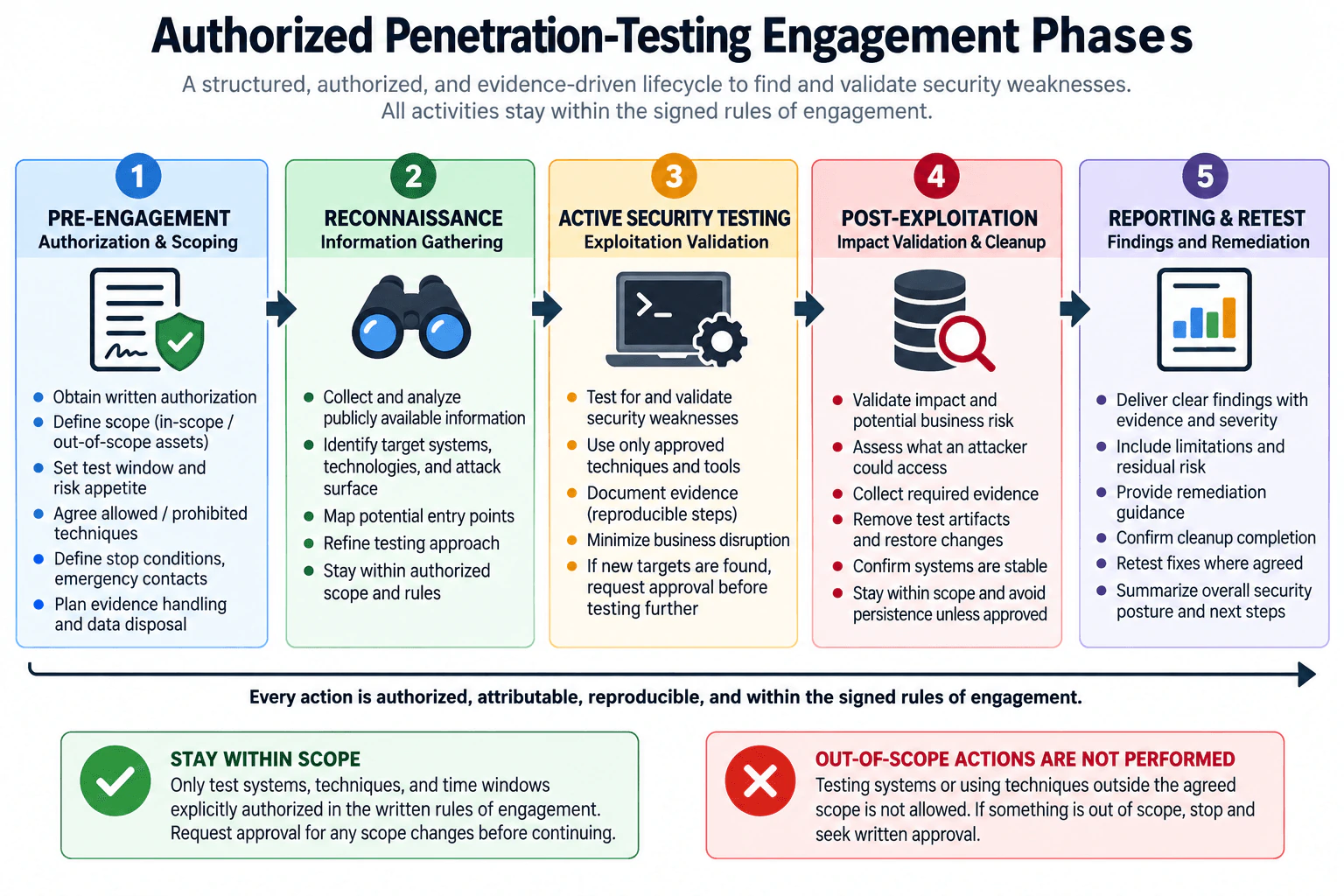
Which phases make up an authorized penetration-testing engagement? diagram
How to Explain It in an Interview
  1. Pre-engagement: authorization and scoping Before testing starts, obtain written authorization and agree on the rules of engagement. Define which assets are in scope and out of scope, the test window, approved and prohibited techniques, test accounts or approved source addresses when relevant, stop conditions, emergency contacts, communication expectations, and evidence handling and disposal. Testing must not begin against an asset simply because it is reachable. If ownership or third-party authorization is unclear, treat that asset as out of scope until approval is confirmed.
  1. Reconnaissance: information gathering Collect and analyze information about authorized targets. This can include publicly available information and approved in-scope observations. Identify target systems and technologies, map the attack surface and potential entry points, and refine the testing approach. Reconnaissance does not expand authorization. Discovering another system, dependency, or target does not make it automatically in scope.
  1. Active security testing: exploitation validation Test and validate suspected security weaknesses using only approved techniques and tools. The goal is to determine whether a weakness can actually be demonstrated and to collect reproducible evidence. Keep testing minimally disruptive. If testing reveals a new target or requires an action outside the agreed rules, stop that path and request approval before continuing.
  1. Post-exploitation: impact validation and cleanup After a weakness has been safely demonstrated, validate only the impact needed to support the finding. Assess what access was actually demonstrated, collect the required evidence, avoid unnecessary persistence or data access, remove test artifacts, restore changed state where possible, and confirm systems are stable. Keep demonstrated technical impact separate from assumed business impact.
  1. Reporting and retesting Deliver clear findings supported by evidence. Include severity or risk, limitations, residual risk, remediation guidance, cleanup status, and next steps. State what was tested and what was not tested so the report does not overstate assurance. When agreed, retest remediated findings to verify that the original weakness is no longer reproducible.

The responsibility boundary across all five phases is the signed rules of engagement. Every action must be authorized, attributable, reproducible, and inside that boundary. Out-of-scope actions are not performed. If scope needs to change, testing of the new target or technique waits for written approval.

Technical Approach
  1. Obtain written authorization and agree on scope, timing, permitted techniques, prohibited actions, contacts, stop conditions, communication, and evidence handling.
  2. Perform reconnaissance and information gathering only for authorized targets.
  3. Identify and safely validate security weaknesses using approved techniques while recording reproducible evidence and minimizing disruption.
  4. Validate only the necessary impact, remove test artifacts, restore changed state, and confirm system stability.
  5. Report findings, limitations, residual risk, remediation guidance, and cleanup status, then retest agreed fixes. At every step, stop and seek approval before crossing the established scope or rules of engagement.
Practical Insights

The main costs are tester time, specialist skill, coordination with system owners, operational attention, and possible service risk. Broader scope and deeper validation can increase confidence and coverage, but they also require more time and may increase disruption risk. Strong scoping, communication, stop conditions, careful evidence handling, and minimally disruptive testing reduce that risk. Retesting adds effort but provides stronger evidence that a remediation works. A penetration test still cannot prove that no other vulnerabilities exist, especially in systems, paths, techniques, or time periods outside the agreed coverage.

Why Interviewers Ask This

Interviewers want to know whether you understand penetration testing as a controlled, authorized engagement rather than simply running tools or attempting exploits. A strong answer shows that you can move from written authorization and scope through reconnaissance, controlled validation, cleanup, reporting, and retesting while keeping actions attributable, reproducible, minimally disruptive, and within the agreed rules of engagement.

Common interview mistakes

Common mistakes are starting technical testing before written authorization is complete, treating every discovered asset as automatically in scope, using an unapproved technique, confusing vulnerability scanning with penetration testing, collecting more sensitive data than necessary, continuing after a stop condition is reached, leaving test artifacts behind, and reporting conclusions that go beyond the evidence collected. Another mistake is presenting one set of phase names as universally fixed; accepted methodologies can group the activities differently, so the important point is the controlled lifecycle and authorization boundary.

Interview tip

Lead with the five-phase lifecycle, then emphasize that authorization and scope control every phase. Mention that methodologies may use different phase names, but a professional engagement always moves from planning and reconnaissance through controlled validation, cleanup, reporting, and agreed retesting without crossing the rules of engagement.
Interviewer may ask next
What should a penetration tester do if reconnaissance reveals a potentially vulnerable system that was not included in the original scope?

Do not actively test it. Record that the system was discovered, stop any testing path that would target it, and contact the authorized engagement owner. Testing can continue against that system only after the scope is formally updated and any required ownership or third-party permission is confirmed. Technical reachability is not the same as authorization.

How is a penetration test different from a vulnerability scan?

A vulnerability scan mainly identifies possible weaknesses, often through automated checks. A penetration test goes further by having an authorized tester safely validate selected weaknesses and demonstrate their practical impact within agreed limits. That requires stronger scoping, rules of engagement, evidence collection, safety controls, cleanup, and reporting. Neither approach proves that every vulnerability has been found.

32. How does threat modeling guide an authorized penetration test?Penetration TestingMedium

Short Interview Answer (30-60 seconds)

Threat modeling tells me where to focus; written authorization tells me what I may test. I prioritize credible threats, convert them into measurable test hypotheses, execute only within the signed rules of engagement, and feed the evidence back into the threat model to refine risk and identify remaining gaps.

Detailed Explanation

Threat modeling guides an authorized penetration test by turning an understanding of the system into focused, risk-based test objectives. I first identify in-scope assets, data flows, trust boundaries, dependencies, assumptions, and plausible adversarial paths. I then prioritize credible threats and convert important ones into testable security claims with clear success criteria and evidence requirements. Threat modeling does not grant permission. The signed rules of engagement define the authorization boundary for assets, timing, accounts, source addresses, techniques, and safety conditions. Test results then refine the threat model and reveal remaining coverage gaps and residual risk.

Useful Questions to Ask the Interviewer
  1. What assets and environments are explicitly in scope and out of scope?
  2. Which threat scenarios or security objectives are most important to validate?
  3. Are there test accounts, approved source addresses, or specific test windows I must use?
  4. Which techniques are allowed or prohibited, and what conditions require me to stop or escalate?
  5. Are any assets or dependencies operated by third parties that require separate approval?
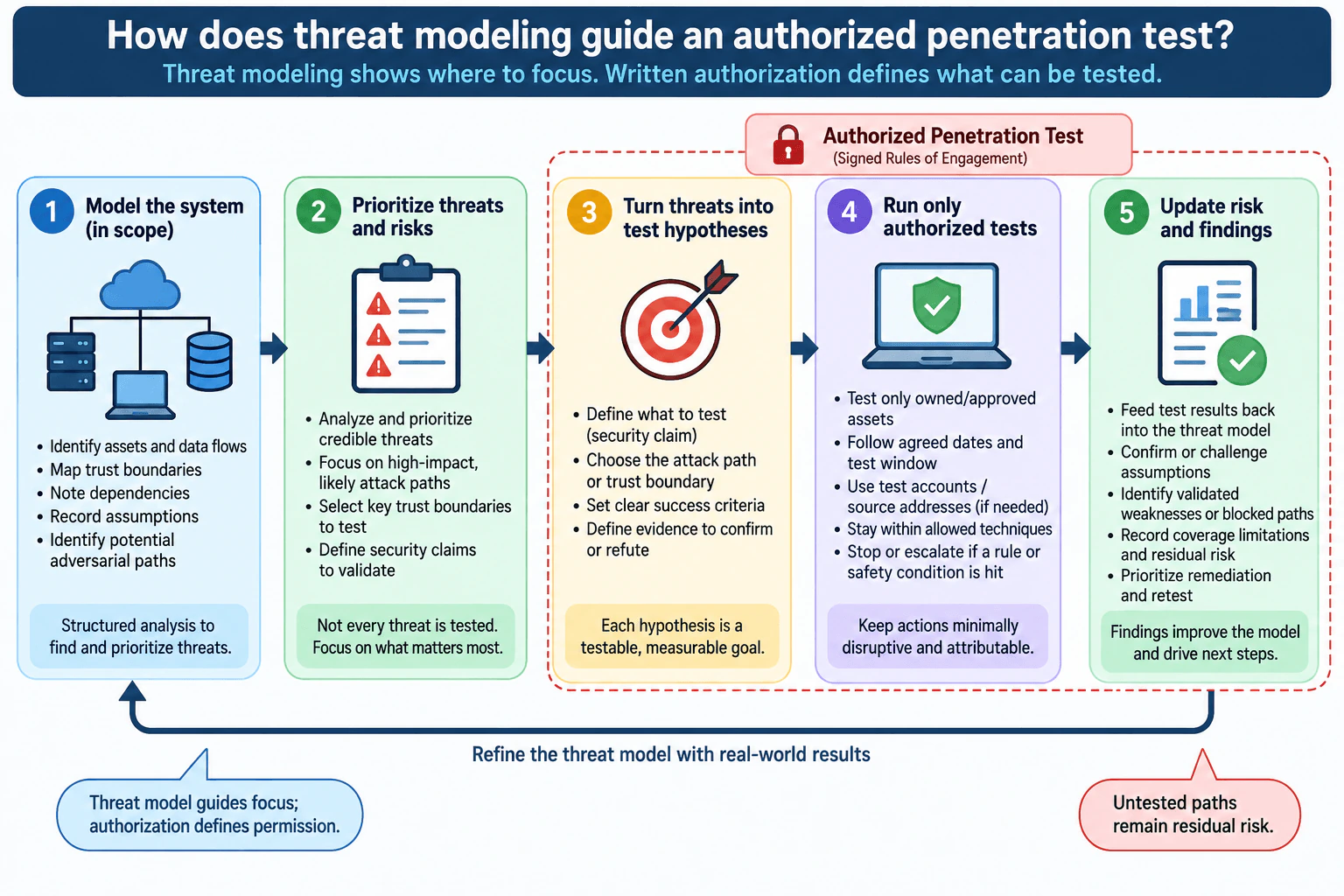
How does threat modeling guide an authorized penetration test? diagram
How to Explain It in an Interview

The practical decision is to use threat modeling to decide what deserves testing, while using written authorization to decide what is permitted.

  1. Model the in-scope system. Identify important assets and data flows, map trust boundaries, note dependencies and assumptions, and consider plausible adversarial paths. This creates a structured view of where security failures could matter.
  1. Prioritize threats and risks. Focus on credible, higher-impact attack paths instead of trying to test every theoretical threat. The threat model helps identify the security claims and trust boundaries that provide the most useful coverage.
  1. Turn threats into test hypotheses. For each selected threat, define what security property should be validated, which authorized attack path or trust boundary is relevant, what counts as success or failure, and what evidence is needed. Each hypothesis should be testable and measurable.
  1. Apply the authorization boundary. The threat model can suggest a valuable test, but it does not authorize that test. Perform only actions covered by the signed rules of engagement. Stay within approved assets, dates, techniques, test accounts, and source addresses. If a useful path crosses an unapproved asset or third-party dependency, stop at that boundary unless additional authorization is obtained.
  1. Run authorized tests safely. Use the least disruptive technique that can answer the security question. Keep actions attributable and reproducible. If a stop condition or safety issue is reached, stop the affected activity and follow the agreed escalation path rather than continuing for more evidence.
  1. Update risk and findings. Feed results back into the threat model. Confirmed weaknesses show that a tested security claim did not hold. Blocked paths can provide useful evidence for the specific condition tested, but they do not prove the entire system is secure. Record challenged assumptions, validated weaknesses, coverage limitations, and residual risk, then prioritize remediation and any authorized retest.

The main tradeoff is coverage versus safety and time. Threat modeling helps spend limited testing effort on the risks that matter most, but prioritization means some paths remain untested. Those untested paths remain residual risk and should be reported rather than presented as proof that no weakness exists.

Technical Approach
  1. Confirm the signed authorization and rules of engagement before testing.
  2. Model the authorized system: assets, data flows, trust boundaries, dependencies, assumptions, and plausible adversarial paths.
  3. Rank credible threats and select the highest-value paths for validation.
  4. Convert each selected threat into a testable security claim with success criteria and required evidence.
  5. Check every proposed test against the approved assets, dates, test accounts, source addresses, techniques, prohibited actions, and third-party constraints.
  6. Execute only authorized, minimally disruptive tests and collect attributable, reproducible evidence.
  7. Stop or escalate when an agreed safety condition, scope question, or unexpected dependency is encountered.
  8. Map results back to the original threats, security claims, and assumptions.
  9. Document validated weaknesses, blocked paths, coverage limitations, residual risk, remediation priorities, and appropriate retest needs.
Practical Insights

Threat modeling adds planning work before testing, but it can reduce wasted effort by focusing the engagement on the risks that matter most. The main operational cost is keeping the system model, assumptions, scope, and rules of engagement accurate. More coverage requires more tester time, coordination, test accounts, evidence review, and sometimes additional approvals. Production-safety limits can reduce how deeply some threats can be validated. Third-party dependencies may also create coverage gaps. These limits should be reported clearly instead of being treated as complete assurance. Updating the threat model after findings or system changes adds maintenance work, but it makes future tests more focused.

Why Interviewers Ask This

Interviewers want to see whether the candidate understands that threat modeling and authorization solve different problems. Threat modeling provides risk-based focus by identifying important assets, trust boundaries, credible threats, and attack paths. Written authorization and the signed rules of engagement define what the tester is permitted to test. A strong answer also shows judgment about translating threats into measurable test hypotheses, collecting reproducible evidence, stopping or escalating safely, recognizing untested paths, and feeding results back into the threat model without overstating assurance.

Common interview mistakes

A common mistake is treating the threat model as permission to test every identified attack path. It is not; the signed rules of engagement define permission. Another mistake is trying to test every theoretical threat instead of prioritizing credible, high-value paths. Testers may also create vague objectives without defining a security claim, success criteria, or evidence. Other mistakes include crossing into an unapproved asset or third-party dependency, continuing after a stop condition, using more disruptive techniques than necessary, treating a blocked test as proof that the whole system is secure, and failing to document assumptions, untested paths, coverage limitations, and residual risk.

Interview tip

Use the sentence "Threat modeling guides focus; authorization defines permission" as your anchor. Then walk through the diagram in order: model the system, prioritize threats, create test hypotheses, run only authorized tests, and feed the evidence back into the threat model. Mention untested paths as residual risk to show that you understand the limits of penetration-test assurance.

Interviewer may ask next
What would you do if the threat model identifies an important attack path that crosses an out-of-scope or third-party system?

I would not test through that path under the existing authorization. I would document why the path matters, identify the scope or third-party dependency blocking validation, and raise it through the agreed engagement contact. Testing could continue only if the necessary authorization and rules of engagement were formally updated. Otherwise, I would record that path as a coverage limitation and residual risk rather than claiming it was validated.

If a prioritized threat cannot be exploited during the penetration test, does that prove the system is secure against it?

No. It only shows what happened under the specific authorized conditions that were tested. A blocked path can support a security claim for that tested condition when the evidence is reproducible, but it does not prove that every variation, identity, environment, or attack path is safe. I would record the tested conditions, evidence, assumptions, and coverage limits, then update the threat model accordingly. Untested or constrained paths remain residual risk.

33. How should a tester protect sensitive information encountered during an authorized engagement?Penetration TestingMedium

Short Interview Answer (30-60 seconds)

I would minimize what I collect, store necessary evidence only in approved protected locations, restrict access to authorized people, redact unnecessary secrets or personal data, follow the agreed retention period, and securely dispose of the information after the engagement while keeping enough evidence to support the finding.

Detailed Explanation

Sensitive information found during a penetration test should be treated as protected engagement data, not as ordinary test output. The practical goal is to collect the minimum evidence needed to demonstrate a finding while preventing unnecessary exposure, copying, or retention. Before testing, I would confirm the rules for evidence handling, who may access it, where it may be stored, how it may be transmitted, how long it may be retained, and how it must be disposed of. Authorization to test an asset does not automatically authorize unrestricted use, copying, or disclosure of information discovered during testing.

Useful Questions to Ask the Interviewer
  1. What types of sensitive information could be encountered, such as credentials, personal information, business records, or cryptographic secrets?
  2. Does the rules of engagement document specify approved storage, transmission, retention, and disposal requirements?
  3. Who is authorized to access raw evidence during the engagement?
  4. Are there specific requirements for redacting sensitive values from screenshots, logs, notes, or the final report?
  5. What is the escalation process if highly sensitive information or unexpected third-party data is discovered?
How to Explain It in an Interview

I would use a data-minimization approach. Data minimization means collecting only the information necessary for the testing objective. If I can prove a finding using a small redacted sample, I should not copy an entire database, mailbox, file share, or credential set.

First, I would follow the written rules of engagement. The agreement should define how evidence is handled, which systems or repositories may hold it, who can receive it, the retention period, and the required disposal process. If those rules are unclear, I would stop the affected activity and ask the authorized engagement contact before collecting or moving more sensitive data.

Second, I would reduce exposure at the point of collection. I would avoid copying reusable passwords, API keys, tokens, private keys, personal records, or confidential documents unless they are necessary to demonstrate the finding and their collection is permitted. When a complete value is unnecessary, I would redact or mask it. For example, a screenshot can demonstrate unauthorized access without displaying a complete credential or every customer record visible on the page.

Third, I would protect retained evidence. Sensitive evidence should stay in approved storage with access limited to people who need it for the engagement. Test notes, screenshots, logs, exported records, and report drafts should not be placed in personal accounts, public collaboration tools, or uncontrolled local folders. Evidence should also be protected while being transferred through the communication or file-sharing method approved for the engagement.

Fourth, I would separate raw evidence from the final report where practical. The report usually needs enough information for the customer to reproduce and remediate the finding, but it rarely needs complete secrets or large amounts of personal data. I would use redacted screenshots, partial identifiers, carefully selected examples, and references to separately protected evidence when that still makes the finding understandable and reproducible.

Fifth, I would control disclosure. Sensitive information should be shared only with the authorized recipients defined for the engagement. If I unexpectedly encounter especially sensitive information or data that appears to belong to an unapproved third party, I would avoid further access, preserve only the minimum necessary observation, and use the agreed escalation path. Customer authorization does not automatically grant permission to test an unapproved third party or expand the approved handling of third-party information.

Sixth, I would maintain evidence integrity and traceability. For important evidence, I would record what was observed, when it was observed, the authorized test context, and how the evidence supports the finding. This makes the result attributable and reproducible without encouraging unnecessary data collection. I would not modify customer data merely to create stronger-looking evidence.

Finally, I would follow the agreed retention and disposal process. Sensitive working files should not remain indefinitely on tester devices or collaboration systems after they are no longer required. At the end of the approved retention period, I would securely dispose of engagement copies according to the agreed process and verify cleanup of temporary test artifacts where applicable.

The main tradeoff is evidence quality versus data exposure. Collecting more information can sometimes make a finding easier to demonstrate, but it also increases confidentiality, privacy, operational, and compliance risk. The better approach is to keep the smallest amount of evidence that still makes the conclusion clear and defensible. No handling process completely removes risk, so access, retention, and disclosure should remain as limited as reasonably possible.

Technical Approach
  1. Confirm the engagement's written data-handling rules before collecting sensitive evidence.
  2. Decide whether the information is actually needed to demonstrate the authorized finding.
  3. Collect the minimum necessary sample and avoid bulk copying when a smaller sample is sufficient.
  4. Redact or mask credentials, personal information, tokens, and other unnecessary sensitive values.
  5. Store evidence only in approved protected locations and restrict access to authorized participants.
  6. Transfer evidence only through approved communication or file-sharing methods.
  7. Record enough context to keep evidence attributable and reproducible without unnecessary collection.
  8. Escalate unexpected highly sensitive information or possible third-party data through the agreed engagement contact path.
  9. Share only the minimum necessary information in reports and other deliverables.
  10. Retain evidence only for the agreed period and securely dispose of it when it is no longer required.
Practical Insights

The technical cost includes maintaining secure storage, access controls, protected transfer methods, and evidence-tracking processes. The operational cost is the extra time needed to review, redact, classify, and securely share evidence. Human error remains important because a tester can accidentally copy a secret into notes, screenshots, tickets, or chat systems. Compliance or contractual requirements may also restrict where data can be stored or who can access it. Stronger controls can make collaboration slower, but weak controls increase the risk of exposing customer information. Retaining less data usually reduces storage, review, breach, and cleanup risk.

Why Interviewers Ask This

Interviewers want to see whether the tester understands that authorization to perform a security test does not remove the responsibility to protect customer data. The answer demonstrates judgment around data minimization, confidentiality, evidence handling, access control, retention, disclosure, escalation, and secure disposal while preserving enough evidence to support defensible findings.

Common interview mistakes

Common mistakes include collecting entire data sets when one redacted record would prove the finding, copying secrets into ordinary notes or chat messages, storing evidence in personal or unapproved locations, leaving complete credentials visible in screenshots, sharing raw evidence too broadly, assuming all discovered third-party data is covered by the customer's authorization, keeping engagement data indefinitely, and deleting evidence too early before the customer can validate the finding. Another mistake is focusing only on confidentiality while forgetting evidence integrity, traceability, agreed retention, escalation, and secure disposal.

Interview tip

Lead with data minimization: collect only what is necessary to prove the finding. Then explain secure storage, least-privilege access, redaction, controlled sharing, escalation, retention, and disposal. Emphasize that authorization to test does not mean unlimited permission to copy, retain, or disclose sensitive information.

Interviewer may ask next
What should you do if you discover valid production credentials during the test?

I would avoid unnecessary use or copying of the credentials. I would capture only the minimum evidence needed to show that the credential was exposed, redact the reusable value from normal notes and reports, protect any necessary raw evidence, and follow the engagement's escalation process. I would not use the credential to access additional systems unless that activity is specifically authorized and necessary for the agreed test objective. If the rules require immediate notification, revocation, or rotation, I would contact the authorized customer representative through the agreed channel.

What if preserving enough evidence conflicts with the goal of minimizing sensitive data?

I would keep the smallest evidence set that still makes the finding reproducible and defensible. That may mean using a redacted screenshot, a limited sample, metadata, or a reference to separately protected raw evidence instead of copying a complete data set into the report. If stronger evidence would require materially more sensitive data, I would discuss that tradeoff with the authorized engagement contact before collecting it. The limitation should also be documented rather than overstating what the available evidence proves.

34. How would you prevent an authorized penetration test from interrupting the client’s normal operations?Penetration TestingMedium

Short Interview Answer (30-60 seconds)

I would define operational safety controls in the rules of engagement, use the least disruptive techniques first, control request volume, test during approved windows, monitor for impact, and stop immediately at agreed thresholds. Higher-risk testing would require separate approval, and any reduced coverage would be clearly documented.

Detailed Explanation

The question asks how I would conduct an authorized penetration test without causing avoidable downtime or disrupting normal business activity. My approach would be to manage availability risk before testing begins and continuously during the engagement. I would define safe operating limits in the rules of engagement, coordinate timing with the client, use minimally disruptive techniques, control test intensity, monitor for signs of degradation, and establish clear stop and escalation conditions. If a technique could materially affect service availability or production data, I would require explicit approval and stronger safeguards before using it.

Useful Questions to Ask the Interviewer
  1. Is the assessment being performed against production systems, a staging environment, or both?
  2. Are there business-critical services or periods when testing must not occur?
  3. Which techniques are prohibited or require separate approval because they could affect availability or data integrity?
  4. What operational conditions should cause testing to stop immediately?
  5. Who are the emergency contacts, and what escalation path should be used if testing appears to affect production?
How to Explain It in an Interview

I would start with the rules of engagement, which are the written operating boundaries for the test. Authorization gives permission to test, but it does not mean every technique is safe or permitted. Before testing, I would confirm the exact in-scope assets, approved dates and times, test identities or source addresses where relevant, allowed techniques, prohibited actions, third-party dependencies, communication expectations, and emergency contacts.

Next, I would identify activities that have a higher chance of disrupting normal operations. Examples include very high request volume, resource-intensive testing, destructive validation, actions that modify production state, or techniques intended to test denial-of-service behavior. I would not perform these simply because the engagement is authorized. They should be explicitly approved in the rules of engagement and coordinated with the client. If that approval is absent, I would not perform them.

For ordinary testing, I would use the least intrusive technique that can provide reliable evidence. I would begin with low request volume and limited concurrency rather than immediately generating heavy traffic. I would avoid unnecessary retries, minimize changes to production data, use designated test accounts where available, and prefer reversible validation over actions that could permanently alter or delete information.

I would also protect the responsibility boundary. Client authorization applies only to systems and dependencies that are properly included in the engagement. If the target application uses a third-party platform or service, I would verify whether that provider is approved for testing. I would never assume that permission from the client automatically authorizes testing another organization.

Before active testing, I would define stop conditions. A stop condition is an agreed event that requires the tester to pause the relevant activity. Depending on the engagement, examples may include unexpected service errors, a client-reported performance problem, instability in a critical service, unexpected data modification, or an instruction from the authorized client contact. The exact conditions should be agreed before testing rather than invented after a problem occurs.

During testing, I would keep important actions attributable and observable. I would record when significant test activity occurs and use approved tester accounts or source addresses where appropriate. The client can compare that information with monitoring, application logs, infrastructure telemetry, and incident alerts. This makes it easier to determine whether a service problem may be related to the assessment.

If I see evidence that testing may be affecting normal operations, I would stop the relevant activity first. I would preserve enough evidence to explain what occurred, contact the agreed emergency or escalation contact, and avoid repeatedly reproducing the behavior while the system may be unstable. I would resume only after the client confirms that continued testing is safe and still authorized.

Recovery is also part of safe testing. If the engagement permits controlled changes to application state, test data, accounts, or other resources, I would remove temporary artifacts and restore changed state where required. I would then verify that cleanup succeeded rather than assuming it did.

Finally, I would document any safety-driven coverage limitations. For example, if high-load testing or destructive validation was excluded to protect production, I would state that clearly in the report. I would not claim that the system was proven resilient to a scenario that was never tested.

The main tradeoff is coverage versus operational safety. Conservative testing may provide less assurance about weaknesses that appear only under aggressive or destructive conditions. That tradeoff is acceptable when it is agreed with the client and reported honestly. The objective is to obtain useful security evidence without creating an unnecessary operational incident.

Technical Approach
  1. Confirm written authorization and the exact production assets included in scope.
  2. Define operational safety controls in the rules of engagement, including the test window, allowed techniques, prohibited actions, test identities or source addresses where relevant, third-party boundaries, and communication expectations.
  3. Agree on emergency contacts, escalation procedures, and explicit stop conditions before active testing begins.
  4. Identify techniques that could materially affect availability, capacity, data integrity, or production state and require separate approval for those activities.
  5. Start with the least intrusive reproducible method and use only the request volume, concurrency, and repetitions needed to gather reliable evidence.
  6. Observe client feedback and relevant operational signals while keeping important tester actions attributable by time, source, account, and activity where practical.
  7. If an agreed stop condition occurs or testing appears to cause degradation, stop the relevant activity immediately and escalate through the approved contact path.
  8. Resume only after the client confirms that continued testing is safe and authorized.
  9. Remove temporary test artifacts and verify restoration of intentionally changed state where applicable.
  10. Report the tested coverage, excluded disruptive techniques, assumptions, deviations, and remaining uncertainty without overstating assurance.
Practical Insights

Safer production testing requires more coordination because the tester and client may need approved schedules, monitoring, emergency contacts, and rapid escalation procedures. Limiting request rates or excluding disruptive techniques can make the assessment slower and may leave some scenarios untested. Client operations staff may also need to spend time monitoring the engagement. However, these costs are usually preferable to causing downtime, corrupting data, affecting users, or triggering an unnecessary incident. The main tradeoff is that stronger safety limits reduce disruption risk but can also reduce coverage of high-load or destructive scenarios.

Why Interviewers Ask This

Interviewers want to know whether the tester can balance meaningful security validation with the client's need to keep production services available. A strong answer shows that authorization alone is not enough. The tester must define safe operating boundaries, choose minimally disruptive techniques, recognize signs of operational impact, communicate quickly, stop when required, and report any testing limitations without overstating assurance.

Common interview mistakes

Common mistakes include treating written authorization as permission to perform any technique; starting aggressive scans or high-concurrency testing without considering operational impact; testing during critical business periods without coordination; performing destructive or denial-of-service-style validation without explicit approval; ignoring third-party ownership boundaries; failing to define stop conditions and emergency contacts; repeatedly reproducing a problem after signs of instability appear; making unnecessary changes to production data; failing to clean up test artifacts; and hiding reduced test coverage instead of documenting the safety limitation.

Interview tip

Lead with the idea that authorization does not remove the tester's responsibility to protect availability. Explain prevention first, then monitoring and stop conditions, then escalation and recovery. Finish with the key tradeoff: safer testing can reduce coverage, so limitations must be documented instead of overstating assurance.

Interviewer may ask next
What would you do if the client wanted a potentially disruptive test against a production system?

I would treat it as a higher-risk activity rather than ordinary testing. I would confirm that the exact technique, asset, timing, and expected operational risk are explicitly authorized. I would agree on additional safeguards such as a controlled test window, responsible operations contacts, monitoring, clear stop conditions, and a recovery plan. If a staging or dedicated test environment can answer the same security question with acceptable confidence, I would discuss that option. If production testing is still required, I would use the minimum activity necessary to meet the objective and stop immediately if the agreed safety conditions are reached.

Does limiting request rates and avoiding disruptive techniques weaken the penetration test?

It can reduce coverage, especially for weaknesses that appear only under high load, destructive conditions, or aggressive concurrency. That does not make the engagement invalid if the limitation is intentional and clearly documented. I would state which scenarios were not tested, why they were excluded, and what uncertainty remains. The client can then decide whether to accept that residual risk or authorize separate testing under safer conditions.

35. Why does an authorized penetration test require a clean testing environment?Penetration TestingMedium

Short Interview Answer (30-60 seconds)

A clean testing environment provides a known baseline, so results can be attributed to the current engagement instead of old tools, artifacts, credentials, sessions, or configuration changes. It improves reproducibility, evidence quality, data separation, and operational safety while keeping every action inside the authorized scope and rules of engagement.

Detailed Explanation

A clean testing environment means starting an authorized penetration test from a known and controlled baseline. The goal is not simply to make the tester's computer tidy. It is to reduce uncertainty about where traffic, files, credentials, configuration changes, and evidence came from. Old test artifacts or unrelated processes can create misleading observations, hide real behavior, or make results difficult to reproduce. A controlled environment also helps separate customer data, limit unintended impact, protect evidence, perform reliable cleanup, and demonstrate that recorded activity belongs to the current authorized engagement.

Useful Questions to Ask the Interviewer
  1. Is the clean environment a dedicated tester workstation, a virtual machine, a customer-provided environment, or a combination of these?
  2. Does the rules of engagement require specific source addresses, test accounts, approved tools, logging controls, or network paths?
  3. Is testing being performed against production, staging, or another explicitly authorized environment?
  4. Are there customer or third-party restrictions on software, credentials, data storage, routing, or testing techniques?
  5. What evidence must be retained, and what test data or artifacts must be securely removed after the engagement?
How to Explain It in an Interview

The practical decision is to begin testing from a known baseline instead of an environment carrying unknown state from earlier work.

First, I confirm the authorization and rules of engagement. A clean environment does not expand permission. I still verify the approved assets, dates, test accounts, source addresses, allowed techniques, prohibited actions, stop conditions, emergency contacts, and relevant third-party dependencies before sending test traffic.

Next, I establish a controlled tester environment. That normally means using only the tools, accounts, credentials, network paths, files, and evidence locations required for the current engagement. Previous customer data, reusable credentials, stale proxy sessions, old payloads, unrelated scripts, cached authentication material, and unexplained background processes should be removed or isolated so they cannot affect the current test.

This creates a clearer responsibility boundary. If I observe a request, response, log entry, created file, account action, or configuration change, I have greater confidence that it came from the current engagement rather than a previous test or unrelated activity. That improves attribution, but it does not by itself prove that an observation is a vulnerability.

A known baseline also improves reproducibility. Important findings should be supported by enough evidence that an authorized tester can repeat the safe validation step under the same relevant conditions. I record the target, test identity, source, time, request, response, environmental assumptions, and any state that materially affects the result. This helps reviewers distinguish demonstrated behavior from assumptions.

A clean environment also improves safety. I use the least privilege and least intrusive technique needed for the objective, avoid unnecessary collection of sensitive data, and honor the engagement's stop conditions. If I see unexpected service impact, an unclear scope boundary, or an unapproved third-party dependency, I stop the affected activity and use the defined escalation path rather than continuing because the system is technically reachable.

Evidence handling is another reason. Penetration-test output may contain sensitive configuration details, tokens, screenshots, logs, or customer data. Separating the current engagement from unrelated work reduces the chance of mixing customers' information. I minimize what I collect, restrict access, preserve useful context and integrity, follow the agreed retention period, and securely dispose of evidence when required.

At the end of testing, I perform cleanup and validation. I remove authorized temporary files, accounts, sessions, or configuration changes when required by the engagement, restore changed state where applicable, and verify the cleanup instead of assuming it succeeded. I also document deviations and environmental constraints.

The main tradeoff is setup and maintenance effort. Dedicated virtual machines, engagement-specific accounts, controlled evidence storage, logging, resets, and cleanup procedures require time and coordination. A perfectly isolated environment may also be impossible when the actual target is production. The goal is therefore not perfect isolation; it is a sufficiently controlled and documented baseline that improves confidence, repeatability, accountability, evidence handling, and safety without overstating what the test can prove.

Technical Approach
  1. Confirm the signed authorization, in-scope assets, test dates, source addresses, test accounts, allowed techniques, prohibited actions, third-party restrictions, stop conditions, emergency contacts, and communication path.
  2. Establish a known testing baseline using only the approved tools, configurations, identities, network paths, and evidence locations needed for the engagement.
  3. Remove or isolate unrelated customer data, stale sessions, reusable credentials, old artifacts, cached authentication material, and unexplained processes that could affect attribution or safety.
  4. Record the important baseline information, including the authorized test identity, source, relevant configuration, test window, and environmental assumptions.
  5. Perform only authorized, minimally disruptive testing while collecting enough evidence to associate observations with the current test.
  6. Safely reproduce important findings where required and distinguish demonstrated behavior from assumptions or business-impact estimates.
  7. Stop and escalate if a defined stop condition, unexpected impact, scope ambiguity, or unapproved third-party dependency appears.
  8. At engagement completion, remove authorized temporary artifacts, restore required state, verify cleanup, protect retained evidence, and dispose of data according to the agreed retention rules.
  9. Document deviations, environmental constraints, and coverage limitations so the report does not overstate assurance.
Practical Insights

The main cost is preparation and operational discipline rather than algorithmic complexity. A dedicated workstation or virtual machine takes time to configure, patch, reset, and maintain. Separate test accounts and source addresses may require coordination with the customer. Evidence storage needs access control, retention rules, and cleanup procedures. Logging and documentation add human effort. These costs are balanced by clearer attribution, better reproducibility, safer customer-data separation, and a lower chance that leftover tools or artifacts affect the engagement. When production itself is noisy or shared, the tester must document that limitation because a clean tester environment cannot remove all uncertainty from the target environment.

Why Interviewers Ask This

Interviewers want to know whether the candidate understands that professional penetration testing requires controlled conditions, not only technical attack skills. They are evaluating whether the tester can separate current engagement activity from leftover or unrelated activity, preserve reliable evidence, reproduce observations, protect customer information, clean up test artifacts, and operate safely within the authorized scope and rules of engagement.

Common interview mistakes

Common mistakes include treating a clean environment as only a freshly installed operating system; reusing credentials, evidence, or sensitive files from another engagement; leaving old proxy sessions, payloads, scripts, cached authentication material, or test artifacts active; failing to document source addresses and test identities; mixing evidence between customers; assuming every observed artifact was created by the current test; changing the target environment without recording the change; continuing after unexpected impact or scope uncertainty; retaining unnecessary sensitive data; failing to verify cleanup; and assuming that a clean environment removes the need to validate findings. Another serious mistake is believing that customer authorization permits testing a reachable third-party service that is outside the signed scope.

Interview tip

Lead with the phrase "known baseline." Then connect it to attribution, reproducibility, evidence quality, customer-data separation, and operational safety. Add that a clean environment does not expand authorization and does not guarantee that every finding is valid. That shows both technical discipline and engagement-level judgment.

Interviewer may ask next
What would you do before starting a penetration test from a fresh testing virtual machine?

I would first confirm the signed scope and rules of engagement, including approved targets, dates, source addresses, test accounts, allowed techniques, prohibited actions, third-party restrictions, stop conditions, and contacts. I would then configure only the required approved tools and credentials, verify that unrelated engagement data, old sessions, cached authentication material, and stale artifacts are absent or isolated, establish protected evidence storage, record the important baseline configuration, and perform only an approved connectivity or validation check against an explicitly authorized target. A fresh virtual machine is useful only when its configuration and activity still follow the engagement authorization.

Does using a clean testing environment guarantee that penetration-test results are accurate?

No. A clean environment reduces uncertainty and makes attribution and reproduction easier, but it does not prove that every observation is a valid vulnerability. Production traffic, load balancers, caching, security controls, distributed components, changing application state, environmental differences, and other concurrent activity can still affect results. Important findings must therefore be validated with safe, reproducible evidence, and the report should document assumptions, deviations, coverage limitations, and any uncertainty that remains.

36. What should you do after discovering a financial API outside the written scope?Penetration TestingHard

Question Details

On day three of an authorized web test, you discover an undocumented internal API that appears to process financial transactions. Explain your next steps.

Short Interview Answer (30-60 seconds)

I would stop testing that API because it is outside the written scope. I would preserve minimal discovery evidence, notify the authorized engagement contact, confirm ownership and third-party constraints, and require a written scope change before performing any further testing.

Detailed Explanation

The key decision is to stop before actively testing the newly discovered API. Finding it during an authorized engagement does not automatically make it authorized for testing. Because it appears to process financial transactions, I would avoid sending test transactions, enumerating functionality, testing authentication, or accessing additional sensitive data. I would preserve only the minimum evidence showing how it was discovered, notify the agreed engagement contact, confirm ownership and third-party dependencies, and request written scope clarification. Testing would continue only if the API is formally added to scope with clear rules, safety limits, and evidence-handling requirements.

Useful Questions to Ask the Interviewer
  1. Does the current rules-of-engagement document explicitly exclude undocumented internal services, or is scope defined by a broader asset boundary?
  2. Who is authorized to approve a scope change for this engagement?
  3. Has ownership of the API been confirmed, including whether any part is operated by a third party?
  4. If the API is added to scope, are there restrictions on creating, changing, or cancelling financial transactions?
  5. What evidence-handling and data-retention rules apply if the API exposes sensitive information?
How to Explain It in an Interview
  1. Stop at the authorization boundary.

I would not continue probing the API simply because it is reachable from an in-scope application. Written authorization and the signed rules of engagement define what I may test. An undocumented service can still be outside that boundary.

I would avoid additional requests intended to enumerate endpoints, test authentication, access more data, or exercise transaction functions. I would also avoid any state-changing action. Stopping here is the safest behavior because it prevents an accidental unauthorized test or unintended impact.

  1. Record the discovery without expanding the test.

I would document only what I already observed during authorized activity. Useful evidence could include the time of discovery, the in-scope workflow that revealed the API reference, and the service identifier if collecting it is allowed by the engagement's evidence rules.

I would not claim that the API is vulnerable, insecure, exploitable, or definitely processing real financial transactions. The scenario says it appears to process financial transactions, so its exact function remains an assumption until authorized validation occurs.

  1. Escalate through the agreed communication path.

I would notify the designated engagement contact or escalation contact defined in the rules of engagement. I would explain that an apparently sensitive service was discovered outside the written scope and that I stopped further interaction with it.

This gives the client an opportunity to determine whether the API belongs to them, whether another internal team owns it, whether a third party operates any dependency, and whether testing could affect production transactions or business operations.

  1. Confirm ownership and responsibility boundaries.

Before testing continues, I would ask the client to confirm who owns and operates the API. Customer permission to test one environment does not automatically authorize testing of systems or services belonging to another organization.

If a third-party dependency is involved, I would require the necessary approval or keep that dependency outside scope. The responsibility boundary must be clear before further activity.

  1. Require a written scope change if the client wants it tested.

If the client decides the API should be assessed, I would require the change to be documented in writing through the agreed authorization process rather than relying on an informal statement such as "go ahead."

The updated authorization should identify the asset and objective and clarify the test window, permitted source addresses if relevant, test accounts, allowed techniques, prohibited actions, stop conditions, emergency contacts, communication expectations, and evidence-handling requirements.

For a financial API, I would specifically clarify whether state-changing operations are prohibited, whether only synthetic or designated test data may be used, and which conditions require immediate testing suspension.

  1. Resume only with the least intrusive authorized method.

After written approval, I would begin with the minimum interaction required to validate the approved objective. I would use designated test identities, non-destructive techniques, and only the privileges granted for the engagement. I would minimize access to real customer, payment, or transaction data and avoid actions outside the approved objective.

If the client cannot provide safe test accounts, confirm ownership, or define acceptable transaction behavior, I would document that as a coverage limitation instead of bypassing those constraints.

  1. Keep evidence attributable and traceable.

The engagement record should distinguish the initial discovery from any later authorized validation. This makes it clear which observations occurred before the scope change and which tests occurred after approval.

Evidence should be minimized, protected, retained according to the agreed requirements, and securely disposed of when required. Reusable credentials, tokens, or sensitive financial information should not be collected merely because they are accessible.

  1. State the limitation clearly if approval is not granted.

If authorization is never expanded, I would report that the API was discovered but not tested because it was outside scope. I would not assign an unsupported vulnerability conclusion or imply that its security was assessed.

The tradeoff is reduced coverage and remaining uncertainty about that API. That is preferable to unauthorized testing. The final report should accurately separate what was observed, what was tested, and what remained outside the engagement boundary.

Technical Approach
  1. Stop active interaction with the newly discovered API.
  2. Check the written scope and rules of engagement to confirm that the API is not already authorized.
  3. Preserve only minimal evidence from the authorized activity that revealed it.
  4. Do not enumerate endpoints, test authentication, exercise transaction functions, access additional data, or perform state-changing requests.
  5. Notify the designated engagement or escalation contact.
  6. Ask the client to confirm asset ownership and any third-party dependencies.
  7. If the client wants testing to continue, obtain a written scope change defining the asset, objective, test window, test identities, allowed techniques, prohibited actions, stop conditions, emergency contacts, and evidence-handling requirements.
  8. Resume only after authorization is clear, using least-intrusive, non-destructive testing within the approved boundary.
  9. Keep evidence that distinguishes initial discovery from later authorized validation.
  10. If authorization is not granted, record the API as an untested scope limitation rather than claiming a security finding.
Practical Insights

The main cost is coordination rather than technical complexity. Stopping and requesting approval can delay the engagement, especially if ownership is unclear or several teams must approve the change. A sensitive financial service may also require additional test accounts, monitoring, change-control coordination, evidence protections, or a restricted test window. These controls increase human and operational effort, but they reduce the risk of unauthorized transactions, service disruption, sensitive-data exposure, contractual problems, or disputes about permission. If the API remains outside scope, the tradeoff is lower coverage and residual uncertainty about its security.

Why Interviewers Ask This

This question tests whether the candidate understands that technical access does not equal authorization. Interviewers want to see disciplined judgment around scope boundaries, sensitive financial systems, escalation, evidence handling, ownership, third-party dependencies, and formal scope-change approval. A strong penetration tester protects the client and the testing team by stopping before performing unauthorized actions, documenting the discovery accurately, and obtaining written permission before expanding testing.

Common interview mistakes

A common mistake is assuming that anything reachable from an in-scope application is automatically in scope. Another is performing a few supposedly harmless requests to learn what the API does before asking permission. Even low-impact probing can cross the authorization boundary. Testers may also rely on verbal approval, ignore third-party ownership, collect more sensitive evidence than necessary, or describe an untested API as vulnerable based only on its name or apparent purpose. Another mistake is failing to document the scope deviation, making later evidence difficult to attribute. The correct response is to stop, document minimally, escalate, verify ownership, obtain written authorization if scope changes, and clearly report any remaining coverage limitation.

Interview tip

Lead with the practical decision: "I stop testing the API because it is outside written scope." Then explain minimal evidence collection, escalation, ownership verification, written scope-change approval, safe testing conditions, and the limitation if approval is not granted. Emphasize that discovering an asset is not the same as being authorized to test it.

Interviewer may ask next
What if the client verbally tells you to continue testing the financial API immediately?

I would still pause until the authorization is documented through the agreed approval process. For a newly discovered sensitive system, verbal permission can leave uncertainty about the exact asset, permitted techniques, prohibited actions, test window, data handling, and third-party ownership. I would ask the authorized contact to record the scope change in writing and clarify the rules of engagement. Once that approval is complete, I can resume using the least intrusive authorized techniques. If the approval cannot be documented, I would keep the API outside scope and record the resulting coverage limitation.

What if the API is clearly owned by the client but the engagement ends tomorrow?

Client ownership alone does not expand the written scope. I would explain the discovery and the limited time remaining, then let the authorized engagement owner choose between a formal scope change, a future follow-up test, or leaving the API untested. If a scope change is approved, I would narrow the objective to what can be safely and meaningfully validated within the remaining window instead of rushing broad testing. If there is not enough time for responsible validation, I would document the API as discovered but not assessed and recommend a separate authorized review.

37. What should happen when your authorized penetration test accidentally interrupts a client service?Penetration TestingHard

Short Interview Answer (30-60 seconds)

I would immediately stop the activity that might be affecting the service, follow the engagement's stop and escalation procedures, contact the client's emergency contact, preserve useful evidence, support recovery without making unauthorized changes, and resume testing only after the client confirms stability and explicitly approves continuation.

Detailed Explanation

An accidental service interruption changes the priority from security testing to protecting availability and helping the client recover safely. I should stop the activity that may be contributing to the problem and follow the written rules of engagement. I should quickly notify the agreed emergency contact, report only facts I can support, preserve relevant test records, and avoid making unapproved recovery changes. Testing should remain paused until the client confirms the service is stable, the situation has been assessed enough to continue safely, and the authorized contact approves resumption.

Useful Questions to Ask the Interviewer
  1. What stop conditions and emergency escalation process were agreed before testing?
  2. Who has authority to declare the service recovered and approve restarting the test?
  3. Are testers permitted to perform any recovery actions, or must recovery remain entirely with the client's operations team?
  4. What evidence and communication records must be preserved after an unexpected service impact?
How to Explain It in an Interview

The first decision is to stop potentially disruptive testing. Continuing to reproduce the issue could increase the outage or destroy useful evidence. I would stop the specific activity immediately and, if the rules of engagement require it, pause the wider engagement until the client gives direction.

Next, I would use the predefined escalation path. The rules of engagement should identify stop conditions, emergency contacts, communication expectations, and who can authorize changes to the test. I would contact the designated person through the agreed urgent channel rather than improvising a new escalation path during the outage.

My first notification would be short and factual. I would state what test activity was running, which in-scope service I observed as affected, when I noticed the interruption, what I stopped, and any immediately available observations. I would separate confirmed facts from assumptions. Seeing an outage during my test does not by itself prove that my activity caused it.

I would then preserve evidence that could help the client investigate. Useful records may include timestamps, tester source addresses, commands or requests that were issued, tool logs, test-account activity, and observed responses. I would minimize unnecessary sensitive information and protect the evidence according to the engagement's handling and retention requirements.

The responsibility boundary also matters. Authorization to test a system does not automatically authorize me to restart servers, change production configuration, trigger failover, delete data, or make other operational changes. Unless recovery actions are explicitly authorized, the client's operations or incident-response team should control restoration. I can provide my test timeline and observations to help them.

After recovery, I would coordinate safe validation. The client should confirm that the affected service and important dependencies are stable. We should compare monitoring information with the testing timeline and determine whether there is enough evidence to link the interruption to the test. If causation is uncertain, I would record that uncertainty rather than claim that the test caused the outage.

Before resuming, I would review why the existing safety controls did not prevent the disruption. The client and testing team may need to reduce request rates, remove a technique from scope, use a safer environment, narrow the target set, change the test window, add monitoring, or require additional approval before similar activity is repeated. Any material change should be documented and approved through the engagement's scope-change process.

Testing should resume only after the authorized client contact says it is safe to continue and any revised constraints are understood. If the risky technique is no longer approved, I would document the resulting coverage limitation instead of performing it anyway.

The main tradeoff is coverage versus operational safety. Stopping the test may reduce coverage or delay delivery, but continuing during a service interruption can create greater business impact and reduce confidence in the engagement. A professional penetration test accepts that limitation and documents what could not safely be tested.

Finally, the engagement record should capture the interruption, escalation, evidence, recovery status, deviations from the original plan, any approved methodology changes, and remaining coverage limits. The goal is not to hide accidental impact. It is to respond safely, transparently, reproducibly, and within the client's authorization.

Technical Approach
  1. Stop the test action that may be contributing to the service interruption and honor the engagement's stop conditions.
  2. Record the time, affected in-scope service, current test activity, tester source information, and immediate observations without repeatedly reproducing the failure.
  3. Notify the designated emergency contact through the agreed escalation channel and communicate confirmed facts separately from assumptions.
  4. Preserve relevant test evidence while minimizing unnecessary sensitive data.
  5. Allow the authorized client operations or incident-response team to control recovery unless the tester has explicit permission to perform specific recovery actions.
  6. Support investigation by correlating test activity with client monitoring, logs, and service behavior.
  7. Confirm service stability using safe validation and state that the test caused, contributed to, or merely coincided with the interruption only when evidence supports that conclusion.
  8. Review the failed safety assumptions and agree on any changes to techniques, rate limits, targets, monitoring, test window, or approval requirements.
  9. Obtain explicit authorization before resuming testing.
  10. Document the interruption, response, approved changes, coverage limitations, and remaining risk in the engagement records and final deliverables.
Practical Insights

The immediate technical cost is the time needed to stop testing, preserve evidence, investigate the interruption, and validate recovery. The operational cost may be higher because client engineers may need to restore or check production services. There can also be financial impact from downtime, although the tester should not estimate that impact without client evidence. Human cost includes urgent coordination between testers, operations, security, and management. Compliance or contractual obligations may affect how an outage is reported, but those requirements depend on the specific client and agreement. Safer retesting can add schedule and maintenance cost because rate limits, monitoring, test windows, or environments may need to change. The main tradeoff is accepting less testing coverage when necessary to protect service availability.

Why Interviewers Ask This

Interviewers want to see whether the tester treats client safety and service availability as more important than continuing the test. The question evaluates judgment under pressure, knowledge of rules of engagement, stop conditions, escalation, evidence preservation, recovery boundaries, and the discipline to avoid making an outage worse while determining whether testing contributed to it.

Common interview mistakes

Common mistakes include continuing the test to prove that the interruption is reproducible, assuming the tester caused the outage without evidence, delaying notification while trying to diagnose everything alone, ignoring the agreed emergency escalation path, restarting or modifying production systems without explicit authorization, deleting logs or test artifacts that could help investigation, exposing unnecessary sensitive information in incident communications, resuming as soon as the service responds without client approval, and omitting the event or resulting coverage limitation from the engagement record.

Interview tip

Lead with the decision to stop the potentially disruptive activity. Then explain escalation, factual evidence, client-controlled recovery, safe validation, methodology changes, and explicit authorization before resuming. Emphasize that protecting service availability is more important than completing every planned test.

Interviewer may ask next
What if you are not sure whether your penetration test actually caused the service interruption?

I would still stop the activity that could reasonably be contributing to the interruption and notify the client through the agreed escalation path. I would preserve timestamps, test activity, source information, tool logs, and observed responses so they can be compared with the client's monitoring and system logs. I would describe the relationship as unconfirmed until the evidence supports a conclusion. The priority is to avoid increasing the impact, not to prove causation while the service is unstable.

What if the client asks you to repeat the disruptive test after the service has recovered?

I would repeat it only if the requested action remains authorized and the client has explicitly approved the risk and conditions for retesting. Before repeating it, I would agree on safer controls such as a controlled window, stronger monitoring, reduced intensity, narrower targets, or a non-production environment when practical. I would also reconfirm the stop condition and emergency contact. If the risk cannot be reduced to an acceptable level, I would recommend not repeating the action and document the resulting coverage limitation.

38. How would you handle an unexpected, previously unknown vulnerability during an authorized security assessment?Penetration TestingHard

Short Interview Answer (30-60 seconds)

I would preserve minimal evidence, confirm whether further validation is allowed by the rules of engagement, and avoid increasing impact just to prove severity. If the next step is risky or outside scope, I would pause that path, escalate through the agreed contact, and continue only with appropriate authorization.

Detailed Explanation

This question asks how I would react when an authorized assessment reveals security behavior that was not expected or previously known. The important decision is not how aggressively I can exploit it. The important decision is how to validate the observation without exceeding authorization or creating unnecessary risk. I would first confirm what I actually observed, preserve only the evidence needed to support it, review the rules of engagement and stop conditions, and determine whether safe validation is still permitted. If deeper testing changes the approved scope or materially increases risk, I would pause that path and escalate before continuing.

Useful Questions to Ask the Interviewer
  1. Does the rules-of-engagement document define an immediate escalation process for critical or unexpected findings?
  2. Are there explicit stop conditions for production instability, sensitive-data exposure, privilege escalation, or third-party impact?
  3. Can the tester perform limited validation of an unexpected finding, or is additional written approval required first?
  4. Who is the authorized emergency contact or decision-maker if the finding may require a scope change?
  5. What evidence-handling requirements apply if the finding exposes credentials, personal information, or other sensitive data?
How to Explain It in an Interview

I would handle the discovery as a controlled change in risk, not as permission to continue deeper exploitation.

First, I would stop increasing the impact of that particular test path. I would record exactly what I observed, including the affected in-scope asset, the authorized test action that produced the behavior, the time, the test identity or account used when relevant, and enough request, response, log, or screenshot evidence to support later reproduction. I would avoid collecting additional sensitive data merely because it appears accessible.

Second, I would review the written authorization and rules of engagement. The key decision is whether the next validation step is already permitted. A limited confirmation of unexpected behavior may be allowed, while extracting real records, obtaining additional privileges, changing production data, disrupting service, or interacting with an unapproved third-party system may not be. Permission from the customer also does not automatically authorize testing assets owned or controlled by another organization.

Third, I would assess immediate safety. If continued testing could affect availability, expose significant sensitive information, alter production state, expose reusable credentials, or cross an ownership or responsibility boundary, I would pause that path and use the defined escalation process. If an agreed stop condition has already been reached, I would follow it rather than improvising.

Fourth, I would notify the authorized contact using the agreed communication channel. I would communicate facts instead of unsupported conclusions: what action I performed, what I observed, which authorized asset was involved, what evidence exists, what remains unverified, and why further validation may require approval. I would not call the issue a confirmed zero-day, claim complete compromise, or assign business impact unless the available evidence supports those statements.

Fifth, if additional testing would change scope, technique, privilege, timing, or operational risk, I would obtain documented approval before continuing. The engagement owner may authorize one narrowly bounded validation step, ask me to stop testing that path, move validation to a safer environment, or involve the defensive or engineering team. Any approved change should remain traceable to the rules of engagement.

If limited validation is already authorized, I would use the least intrusive reproducible method that can distinguish a real vulnerability from a false positive. The goal is to demonstrate the failed security property with sufficient evidence, not to maximize damage. I would record the relevant precondition, authorized action, observable result, and privilege level while stopping once the necessary evidence has been collected.

Evidence handling is also important. I would minimize sensitive content, redact unnecessary secrets, store evidence only in the approved location, restrict access to authorized people, and follow the engagement's retention and secure-disposal requirements. If testing creates temporary artifacts or changes state, I would remove those artifacts when authorized and verify that the environment is restored.

The final report would separate observed facts, safely demonstrated technical impact, unverified possibilities, scope limitations, and recommended remediation. I would not present possible worst-case consequences as demonstrated results. If remediation is later deployed, I would perform an authorized retest of the original condition and relevant safe bypass cases to verify the effective deployed state rather than assuming the issue has been fixed.

The main tradeoff is confidence versus safety. More aggressive exploitation can sometimes increase certainty, but it may also increase availability, privacy, legal, compliance, or operational risk. A professional penetration test does not require maximum exploitation. It requires enough trustworthy and reproducible evidence to support a defensible finding while staying inside written authorization and the agreed rules of engagement.

Technical Approach
  1. Stop increasing the impact of the unexpected test path.
  2. Record the exact observation and preserve only the evidence needed to support and reproduce it.
  3. Confirm that the affected asset, test identity, test window, technique, and proposed next step remain inside written authorization and the rules of engagement.
  4. Check whether an agreed stop condition, prohibited action, or third-party boundary has been reached.
  5. If additional validation could materially increase risk or exceed authorization, pause that path and contact the authorized escalation point.
  6. Communicate observed facts, uncertainty, available evidence, and the proposed next step without overstating severity or impact.
  7. Obtain documented approval before any material scope expansion or higher-risk validation.
  8. If validation is permitted, use the least intrusive reproducible technique and stop when sufficient evidence exists.
  9. Minimize, protect, retain, and dispose of evidence according to the engagement requirements.
  10. Document limitations and remediation guidance, remove test artifacts when applicable, and perform an authorized retest after remediation.
Practical Insights

The main costs are usually coordination, time, and operational caution rather than computing power. Pausing and escalating can slow the assessment, especially when a decision-maker must approve the next step. Limited validation may leave some uncertainty about maximum impact, but aggressive validation can increase outage, privacy, compliance, legal, and business risk. Evidence must also be stored, reviewed, retained, and disposed of securely. The practical balance is to collect enough safe evidence for a reliable finding without creating unnecessary production impact or silently expanding the engagement.

Why Interviewers Ask This

Interviewers want to see whether the candidate can balance technical curiosity with authorization, safety, evidence quality, and professional judgment. A strong answer shows that discovering a potentially new vulnerability does not automatically justify deeper exploitation. The tester should know when to stop, how to preserve evidence, when to escalate, how to avoid overstating impact, and how to obtain additional approval when validation would exceed the existing rules of engagement.

Common interview mistakes

Common mistakes include treating the discovery as permission to exploit as deeply as possible, continuing after a defined stop condition, testing an unapproved third-party asset, collecting excessive sensitive data, using destructive proof when safer validation is available, failing to preserve reproducible evidence, and calling the finding a confirmed zero-day or full compromise without sufficient evidence. Another mistake is silently changing the engagement's scope or risk level instead of obtaining documented approval for the additional testing.

Interview tip

Lead with the decision to control risk and stay inside written authorization. Then explain evidence preservation, rules-of-engagement review, stop conditions, escalation, least-intrusive validation, evidence handling, and clear reporting. Show that strong penetration-testing judgment includes knowing when deeper exploitation is unnecessary or unauthorized.

Interviewer may ask next
What would you do if the client verbally asks you to exploit the unexpected vulnerability further, but the existing rules of engagement do not allow that action?

I would not treat an informal verbal request as sufficient authority for a material scope or risk change. I would explain that the proposed action is outside the current rules of engagement and ask the authorized engagement owner to document the change through the agreed approval process. The update should clearly define any additional asset, technique, privilege level, test window, or permitted impact. Until that approval is confirmed, I would preserve the existing evidence and avoid the additional exploitation.

How would you handle the finding if you cannot safely prove its full impact without risking a production outage?

I would stop before the risky validation step and document the limitation clearly. I would record what was directly observed, the conditions required to reproduce it, the technical impact safely demonstrated, and the additional impact that remains unverified. I would then discuss safer options with the authorized contact, such as reproducing the condition in a controlled environment or approving a narrowly bounded test during an appropriate maintenance window. I would not risk a production outage merely to increase confidence in the severity assessment.

39. What is web application penetration testing?Web Application SecurityEasy

Question Details

Define web application penetration testing as an authorized assessment of browser, server, API, identity, session, data-flow, and business-logic controls. Explain mapping, authentication, authorization, input handling, state changes, rate limits, evidence, impact validation, cleanup, and retesting without treating an automated scan as sufficient proof.

Short Interview Answer (30-60 seconds)

Web application penetration testing is an authorized, hands-on assessment of a web application's browser, server, APIs, identity, sessions, inputs, and business logic. The tester maps the attack surface, safely tests controls, validates real impact with evidence, reports findings, cleans up, and retests fixes.

Detailed Explanation

Web application penetration testing means safely testing an application with written authorization to determine whether its security controls work in real use. The tester does more than run a scanner. They first understand the browser, server, APIs, users, sessions, data flows, and business actions. Then they test authentication, authorization, session management, input handling, state changes, business logic, and rate limits. Suspected weaknesses are manually validated using the minimum safe proof. Evidence is recorded, demonstrated impact is separated from assumptions, test artifacts are removed, and fixes are retested.

Useful Questions to Ask the Interviewer
  1. What application, API endpoints, environments, and user roles are in scope?
  2. What rules of engagement, test windows, rate limits, and stop conditions apply?
  3. Will approved test accounts and synthetic data be available for different privilege levels?
  4. Are state-changing actions permitted, and what cleanup requirements apply?
What is web application penetration testing? diagram
How to Explain It in an Interview

The practical goal is to answer one question: can an authorized tester demonstrate a real security weakness in the application without causing unnecessary harm?

  1. Define scope and authorization. Start with written permission, the allowed application or API targets, test accounts, environments, rules of engagement, and success criteria. Anything outside that scope is not tested.
  1. Map the application. Understand the browser-facing pages, server and API endpoints, roles, sessions, inputs, data flows, state-changing operations, and important business workflows. This identifies the attack surface and the places where trust or privilege changes.
  1. Test the security controls. Exercise authentication, which checks who a user is, and authorization, which checks what that user is allowed to do. Also test session management, input handling, sensitive state changes, business logic, and rate-limit or abuse protections where they are in scope. Use approved test accounts, synthetic data, bounded requests, and non-destructive techniques.
  1. Validate impact instead of trusting scanner output. A suspicious response is only a lead. The tester manually reproduces the behavior and determines what was actually possible, such as access to approved synthetic test data or an unauthorized action within the permitted test environment. The proof should be the minimum needed to establish the issue.
  1. Capture reproducible evidence. Record enough detail to reproduce the finding, including the user role, application workflow, relevant request and response behavior, and important state before and after the test. Avoid collecting real secrets or unnecessary personal data. Separate demonstrated technical impact from possible business impact.
  1. Report, clean up, and retest. Explain the root cause, evidence, impact, and remediation guidance. Remove test records and other artifacts created during testing and restore changed state where required. After the application team deploys a fix, repeat the original test and reasonable nearby variations to confirm that the issue is resolved.

The main limitation is that no penetration test proves an application has no vulnerabilities. Coverage depends on scope, available roles, testing time, application state, and permitted actions. Automation improves speed and discovery coverage, but manual reasoning is especially important for authorization and business-logic problems. The tradeoff is between deeper coverage and the time, cost, operational risk, and restrictions needed to keep testing safe.

Technical Approach
  1. Confirm written authorization, scope, environments, test accounts, rules of engagement, success criteria, and stop conditions.
  2. Map browser pages, API endpoints, roles, sessions, objects, inputs, state transitions, data flows, and sensitive actions.
  3. Establish expected behavior for each approved role and workflow.
  4. Safely test authentication, authorization, session management, input handling, state changes, business logic, and rate-limit protections that are relevant to the mapped surface.
  5. Treat scanner or tool findings as leads, not proof. Manually reproduce suspicious behavior using bounded, non-destructive tests and synthetic data.
  6. Capture reproducible evidence showing the role, workflow, relevant request or action, response, and demonstrated impact.
  7. Report the root cause, impact, remediation guidance, and a regression test.
  8. Remove test artifacts and restore changed state where required.
  9. Retest the original path and reasonable nearby variations after remediation.
Practical Insights

The largest cost is usually skilled testing time because a tester must understand how the application works and manually verify important findings. Automated tools can examine many pages or endpoints quickly, but they can produce false positives and may miss role-specific or business-logic problems. More roles, APIs, workflows, and environments increase testing and evidence-management work. Safe production testing can also require coordination, rate limits, monitoring, stop conditions, and cleanup. Retesting adds effort, but it provides confidence that the deployed remediation actually resolves the demonstrated problem.

Why Interviewers Ask This

Interviewers want to know whether the candidate understands web application penetration testing as a controlled, evidence-based security assessment rather than simply running an automated scanner. A strong answer shows that the tester can work within written authorization, map the application, distinguish authentication from authorization, safely test important controls, validate impact, collect reproducible evidence, clean up test artifacts, and retest fixes.

Common interview mistakes

Common mistakes are treating an automated scan as proof, testing without clear written scope, skipping application mapping, confusing authentication with authorization, testing only browser happy paths while ignoring APIs and state changes, using destructive proof when a safer demonstration is sufficient, reporting a suspicious response without validating impact, collecting unnecessary sensitive data, failing to capture reproducible evidence, leaving test artifacts behind, and declaring an issue fixed without retesting the deployed remediation.

Interview tip

Explain the lifecycle in the same simple order as the diagram: plan and get authorization, map the application, test security controls, validate impact and capture evidence, then report, clean up, and retest. Emphasize that automated scans support discovery but do not replace manual validation.

Interviewer may ask next
Why is an automated vulnerability scan not the same as a web application penetration test?

A scanner mainly identifies patterns or responses that may indicate weaknesses. Those results can include false positives and may not show whether a real security boundary can actually be crossed. A penetration test adds human reasoning: the tester understands roles, sessions, objects, workflows, and business logic, safely reproduces suspicious behavior, validates demonstrated impact, captures evidence, explains remediation, cleans up test artifacts, and retests. Automation is useful for discovery and coverage, but it is one input to the assessment rather than sufficient proof by itself.

How do you validate a web application finding without creating unnecessary risk?

Use the minimum safe proof needed to demonstrate the behavior. Stay within written scope, use approved test accounts and synthetic data, keep requests bounded, follow stop conditions, and avoid unnecessary access to secrets or personal information. Reproduce the issue clearly enough to distinguish a real vulnerability from a false positive, record the role and relevant workflow or request behavior, and stop once the required impact is demonstrated. Then remove test artifacts, restore changed state where required, and retest after remediation.

40. What is cross-site scripting in the context of an authorized web assessment?Web Application SecurityEasy

Short Interview Answer (30-60 seconds)

XSS occurs when untrusted input reaches a web page or DOM sink and the browser treats it as executable content instead of data. During an authorized assessment, I use a harmless proof, confirm real browser execution, identify the XSS type, and recommend fixing the unsafe sink.

Detailed Explanation

Cross-site scripting, or XSS, means untrusted input reaches browser-rendered content and is interpreted as executable code instead of harmless data. In an authorized web assessment, the key decision is whether the application only reflects or stores the input, or whether that input actually reaches an unsafe browser sink and executes. I use a harmless, unique canary at an in-scope entry point, follow how the application handles it, and verify the result in the browser with a non-destructive proof. Simple reflection is evidence worth investigating, but it is not by itself proof of XSS.

Useful Questions to Ask the Interviewer
  1. Is the question asking only for the XSS concept, or also how I would safely validate it during an assessment?
  2. Should I explain reflected, stored, and DOM-based XSS separately?
  3. Should I include remediation and retesting, or focus only on identification?
What is cross-site scripting in the context of an authorized web assessment? diagram
How to Explain It in an Interview

The practical definition is: XSS happens when untrusted content reaches an unsafe browser execution context. The important trust boundary is between data controlled by a user or another untrusted source and the browser context that may interpret HTML or script-capable content.

The authorized testing flow matches the diagram. First, the tester sends a harmless, unique test value to an in-scope entry point such as a parameter, form field, or comment. The request stays bounded and non-destructive. Second, the web application may reflect the value immediately in an HTTP response or store it for later delivery. Third, the browser receives and renders the content, or client-side code reads the input and writes it into the page. Finally, XSS is verified only when the untrusted content reaches an executable browser context and a safe proof confirms that behavior.

There are three useful paths to distinguish. Reflected XSS occurs when input from a request is returned in a response and then reaches an executable context in the browser. Stored XSS occurs when untrusted input is saved by the application and later delivered to a browser where it executes. DOM-based XSS occurs in client-side code when data from a source such as a URL or form reaches an unsafe Document Object Model, or DOM, sink and becomes executable.

The evidence must separate a suspicious response from verified impact. Seeing a canary string in the HTTP response proves reflection, not XSS. Correct output encoding may cause the browser to display the same characters safely as text. I would therefore confirm the browser behavior with the least intrusive technique allowed by the rules of engagement and avoid accessing real secrets, unnecessary session data, or personal information.

For remediation, I would fix the unsafe data-to-sink path. For server-generated HTML, use context-aware output encoding so untrusted data is emitted as data in the correct HTML, attribute, URL, CSS, or JavaScript context. For client-side rendering, use safe DOM APIs that treat values as text rather than HTML. If the application intentionally allows user-supplied HTML, sanitize it with an appropriate HTML sanitizer before it reaches an HTML-capable sink. Content Security Policy can reduce the chance that injected script executes, but it is defense in depth rather than the root-cause fix. A WAF is also a supporting mitigation, not a complete solution.

After remediation, I would repeat the original bounded test as a regression test and confirm that the same input is now treated as harmless data rather than executable content. I would also test closely related rendering paths where appropriate. The main limitation is that validating one sink does not prove the entire application is free from XSS. Different server-side templates, browser contexts, and client-side data flows can have separate unsafe sinks and may require additional testing.

Technical Approach
  1. Confirm that the target, entry point, user role, and browser workflow are within the written assessment scope.
  2. Choose a harmless unique canary and submit it through the relevant parameter, form, comment, or other authorized input.
  3. Observe whether the application reflects the value immediately, stores it for later delivery, or passes it into client-side code.
  4. Follow the value to the browser and identify the rendering context or DOM sink where it is used.
  5. Do not label reflection alone as XSS; verify browser execution or an equivalent safe, non-destructive proof within the rules of engagement.
  6. Classify the demonstrated path as reflected, stored, or DOM-based when that classification is supported by the evidence.
  7. Record the minimum request and response details needed to reproduce the finding, including the relevant method, path, parameters, headers, cookies, body, content type, encoding, and user role when applicable, while avoiding unnecessary secrets or personal data.
  8. Recommend context-aware output encoding for server-generated output, safe DOM APIs for client-side rendering, or HTML sanitization when HTML must be accepted. Treat CSP and WAF controls only as defense in depth.
  9. Retest the original path after remediation and confirm that untrusted input is handled as data rather than executable content.
Practical Insights

There is no meaningful algorithmic time or space complexity for this conceptual security question. The technical cost is finding every place where untrusted data reaches HTML, attributes, URLs, JavaScript, CSS, or unsafe DOM APIs because each context can need a different defense. The operational cost is keeping testing safe and reproducible without affecting real users or data. The human and maintenance costs include developer review, secure coding changes, regression testing, and checking new templates or client-side features. CSP and WAF rules may add operational work, but they should support rather than replace the root-cause fix.

Why Interviewers Ask This

Interviewers want to see whether the candidate understands that XSS is about untrusted content becoming executable in a user's browser, not merely about seeing input reflected in a response. They also want practical testing judgment: staying within authorization, using a harmless proof, distinguishing reflected, stored, and DOM-based paths, validating actual execution, and recommending root-cause remediation rather than relying only on defense-in-depth controls such as a WAF or Content Security Policy.

Common interview mistakes

Common mistakes include calling any reflected input XSS without verifying browser execution, using an unsafe proof that accesses real cookies or sensitive data, ignoring DOM-based paths because the server response looks harmless, treating input validation alone as sufficient protection, applying one output-encoding method to every browser context, assuming CSP or a WAF fixes the root cause, failing to preserve the request details needed to reproduce the finding, and failing to retest the affected sink after remediation.

Interview tip

Lead with one sentence: XSS is untrusted input becoming executable content in the browser. Then explain the safe assessment flow: harmless canary, application handling, browser rendering, and verified execution. Finish by distinguishing reflected, stored, and DOM-based XSS and stating that the real fix is at the unsafe data-to-sink path.

Interviewer may ask next
What is the difference between reflected, stored, and DOM-based XSS?

Reflected XSS happens when untrusted input arrives in a request, is returned in the application's response, reaches an executable browser context, and executes. Stored XSS happens when the application saves untrusted input and later serves it to a browser where it reaches an executable context. DOM-based XSS happens primarily in client-side code when data from a source such as a URL or form reaches an unsafe DOM sink. All three share the same core problem: untrusted data reaches a browser context that interprets it as executable content.

Why is seeing a test string reflected in an HTTP response not enough to confirm XSS?

Reflection only proves that the application returned the input. The browser might display it safely as text because of correct context-aware output encoding, sanitization, or a safe rendering API. To confirm XSS, the tester must demonstrate that the untrusted content reaches an executable browser context using a harmless, authorized proof. This separates a suspicious response from a verified vulnerability.

More questions load as you scroll

Disclaimer: This interview guide is for educational and informational purposes only. It is designed to help readers prepare, but it does not guarantee any interview result, hiring decision, offer, or outcome. Interview questions, hiring criteria, and preferred answers can vary by employer, interviewer, industry, location, and time. All answers, examples, and explanations in this guide are suggested examples for interview preparation, not definitive answers or instructions for professional practice. They are based on research and judgment, are provided without warranties of any kind, and should be adapted to the question, role, and applicable laws and professional requirements. Diagrams are simplified illustrations intended to highlight the main concepts and their relationships; actual situations, systems, and practices may be more complex. Alternative approaches may be equally valid or better suited to a particular question, context, or interviewer. To the fullest extent permitted by applicable law, the contributors and publisher are not liable for decisions made, actions taken, or losses incurred based on this guide.

State Laws and Professional Responsibilities: Laws and requirements governing an occupation vary by state and jurisdiction. You are responsible for checking the current laws, licensing requirements, and scope-of-practice rules that apply to your location and role, and for ensuring that your answers and actions comply with them. Adapt examples in this guide to those requirements. This guide is not legal advice.

Content Accuracy and Verification: To the fullest extent permitted by applicable law, we do not represent or warrant that interview guides, questions, answers, examples, or diagrams are accurate, complete, current, error-free, or suitable for any particular purpose. You are responsible for independently reviewing and verifying the information before relying on it.