This interview guide is for educational and informational purposes only. It is designed to help readers prepare, but it does not guarantee any interview result, hiring decision, offer, or outcome. Interview questions, hiring criteria, and preferred answers can vary by employer, interviewer, industry, location, and time. All answers, examples, and explanations in this guide are suggested examples for interview preparation, not definitive answers or instructions for professional practice. They are based on research and judgment, are provided without warranties of any kind, and should be adapted to the question, role, and applicable laws and professional requirements. Diagrams are simplified illustrations intended to highlight the main concepts and their relationships; actual situations, systems, and practices may be more complex. Alternative approaches may be equally valid or better suited to a particular question, context, or interviewer. To the fullest extent permitted by applicable law, the contributors and publisher are not liable for decisions made, actions taken, or losses incurred based on this guide.
State Laws and Professional Responsibilities
Laws and requirements governing an occupation vary by state and jurisdiction. You are responsible for checking the current laws, licensing requirements, and scope-of-practice rules that apply to your location and role, and for ensuring that your answers and actions comply with them. Adapt examples in this guide to those requirements. This guide is not legal advice.
Identity, Image, and Privacy Notice
To respect individual privacy, some names, profile photographs, avatars, biographical details, and other identifying information displayed in this guide may be replaced with pseudonyms, licensed stock images, illustrative avatars, composite images, or representative descriptions. Unless a person is expressly identified as an actual contributor, a displayed name, image, or profile should not be understood as depicting or identifying a specific candidate, interviewer, employee, or other real individual. These representations are provided for editorial and illustrative purposes only and do not imply endorsement, employment, participation, or affiliation with this guide or any company mentioned in it. Any resemblance to an actual person is coincidental.
Company Notice
This guide is an independent educational resource and is not affiliated with, endorsed by, sponsored by, or approved by the company named in this guide. Company names identify reported interview experiences or the employer context of clearly labeled original practice exercises. Interview practices can change without notice, and inclusion of company-specific content does not mean these questions are official, complete, or guaranteed to be asked. To the fullest extent permitted by law, the author, contributors, and publisher are not responsible for outcomes related to use of this material.
Content Accuracy and Verification
To the fullest extent permitted by applicable law, we do not represent or warrant that interview guides, questions, answers, examples, or diagrams are accurate, complete, current, error-free, or suitable for any particular purpose. You are responsible for independently reviewing and verifying the information before relying on it.
Questions or comments?
Contact us for general questions, or share feedback, technical corrections, and comments with the community.
41. What is cross-site request forgery in an authorized web-security assessment?Web Application SecurityEasy
Short Interview Answer (30-60 seconds)
CSRF makes an authenticated browser send an unintended state-changing request to a trusted site, often with its valid session cookie. In an authorized test, I prove it safely with synthetic data, verify the state change, and recommend server-side CSRF defenses plus regression testing.
Detailed Explanation
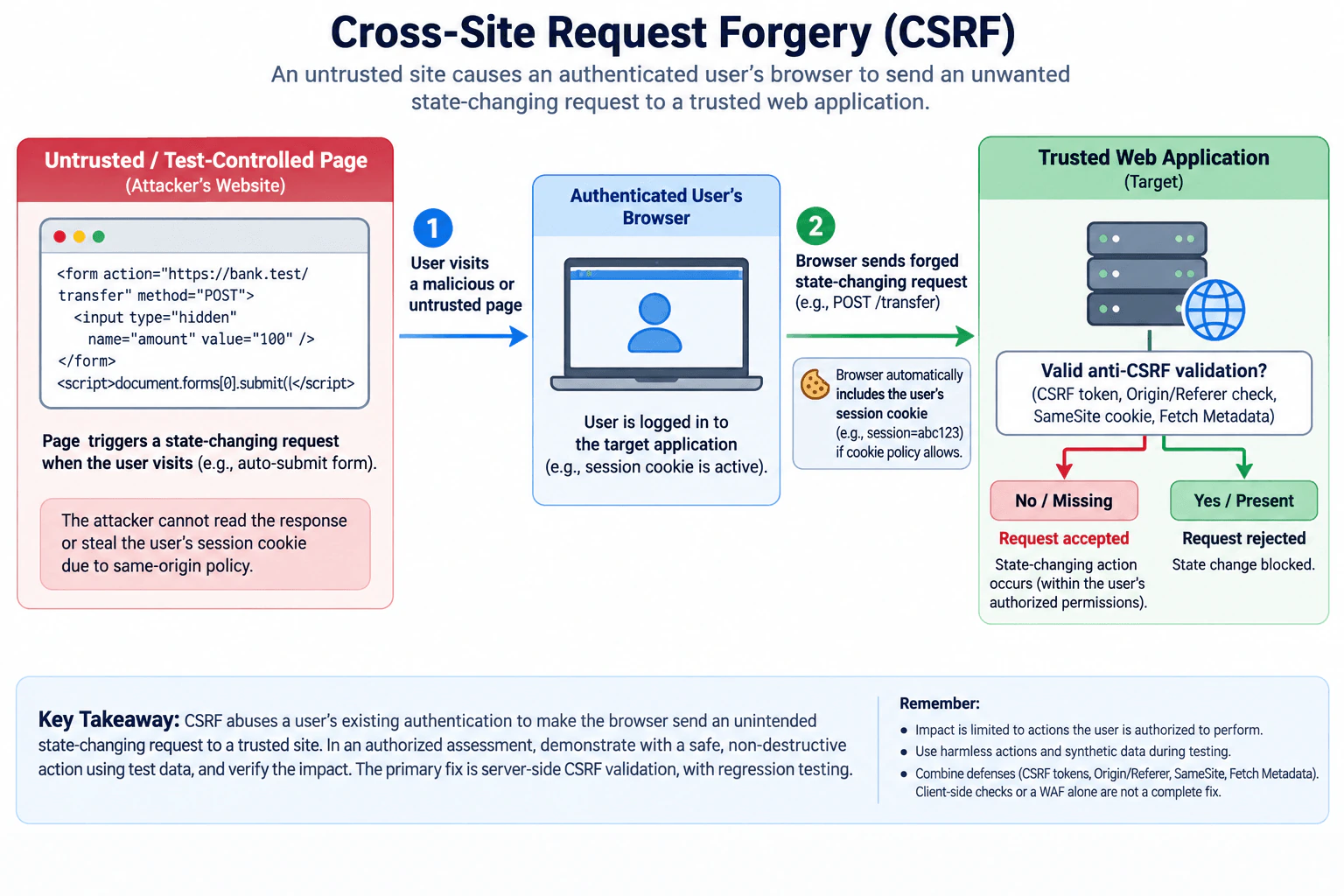
Cross-site request forgery, or CSRF, happens when an untrusted page causes an authenticated user's browser to send an unintended state-changing request to a trusted web application. The browser may automatically attach the user's valid session cookie when cookie policy allows. If the server treats that authenticated session as sufficient proof of intent and lacks effective anti-CSRF validation, it may process the action. In an authorized assessment, the tester demonstrates this only with a harmless, bounded, reversible action using synthetic data, then verifies the actual state change and retests after remediation.
Useful Questions to Ask the Interviewer
Which state-changing endpoint and test account are explicitly in scope?
May I use a synthetic, reversible action to demonstrate impact?
Which defenses are expected, such as anti-CSRF tokens, Origin or Referer validation, SameSite cookies, or Fetch Metadata?
Are there any stop conditions or workflows that must not be changed?
How to Explain It in an Interview
The practical question is whether the trusted application can tell the difference between a request intentionally initiated by its authenticated user and a forged cross-site request triggered by an untrusted page.
The trust boundary is between the untrusted or tester-controlled page and the trusted web application. The authenticated user's browser sits between them. The user is already logged in to the trusted application, so the browser has an active session cookie.
The untrusted page can trigger a state-changing request, such as a POST to a transfer-like test endpoint. If cookie policy allows, the browser automatically includes the target application's session cookie. Authentication can therefore succeed even though the user did not intend the action. The server must not treat possession of a valid session cookie alone as proof that the request was intentionally initiated from the trusted application.
The same-origin policy generally prevents the untrusted page from directly reading protected cross-origin response data or the target site's session cookie, but it does not stop all cross-origin requests from being sent. A normal cross-origin HTML form submission is a common example. That is why CSRF can work even when the attacker cannot read the response.
In an authorized assessment, I first capture the legitimate workflow and record the exact HTTP method, path, relevant parameters, content type, session context, and any anti-CSRF controls. I then reproduce only the minimum cross-site behavior needed to test the condition. I use a tester-controlled page, a test account, synthetic data, and a harmless action.
A successful HTTP response is not enough to confirm CSRF. I verify whether the expected test state actually changed. If the server processes the state-changing request without valid anti-CSRF proof, that is evidence of the issue within the authorized scope.
The trusted application should fail safely. A forged state-changing request should be rejected when required anti-CSRF validation is missing or invalid. Common protections include unpredictable anti-CSRF tokens validated by the server, Origin or Referer validation, and Fetch Metadata checks such as Sec-Fetch-Site. SameSite cookie settings can reduce when session cookies are sent cross-site and are useful as defense in depth, but they have limitations and should not automatically be treated as a universal replacement for request validation.
For sensitive actions, additional user interaction or re-authentication can provide extra protection. A WAF rule or client-side check alone is not a complete root-cause fix because the final security decision belongs on the server.
After remediation, I repeat the same safe cross-site test. The forged request should be rejected and the state should remain unchanged, while the normal trusted workflow should still work. I also test similar state-changing endpoints for consistent protection.
The main tradeoff is security versus compatibility. Strict Origin, Fetch Metadata, or SameSite policies can affect legitimate cross-origin integrations or navigation flows. Any required exception should therefore be explicit, narrowly scoped, and protected with an appropriate server-side control.
Technical Approach
Confirm written authorization, the test account, the exact state-changing endpoint, and a harmless reversible action.
Capture the legitimate request and preserve its HTTP method, path, parameters, content type, session context, and relevant headers.
Identify the existing anti-CSRF controls, including token validation, Origin or Referer checks, SameSite cookie behavior, and Fetch Metadata handling where applicable.
From a tester-controlled untrusted origin, trigger only the minimum cross-site request needed to test the behavior using synthetic data.
Observe whether the browser sends the state-changing request with the authenticated session cookie under the applicable cookie policy.
Verify the actual server-side state after the request instead of treating an HTTP status code alone as proof.
Record whether the trusted application accepts or rejects the request and which anti-CSRF decision caused that outcome.
Recommend a server-side root-cause defense and do not present a WAF or client-side check as the complete fix.
Retest after remediation to confirm the forged request is rejected while the legitimate workflow still succeeds.
Remove or reverse any test state created during validation.
Practical Insights
CSRF testing is usually not computationally expensive. The main cost is operational. The tester must identify relevant state-changing workflows, use controlled test accounts, preserve request details, and avoid affecting real users. Anti-CSRF tokens add server and application logic. Origin, Referer, and Fetch Metadata checks require careful treatment of legitimate cross-origin flows. SameSite cookies are relatively simple to configure but can affect navigation or integrations and have known limitations. Regression testing adds maintenance work because protections must remain consistent as endpoints and application behavior change.
Why Interviewers Ask This
Interviewers want to confirm that the candidate understands that CSRF abuses an authenticated browser session rather than stealing the user's password or session cookie. They also want to see whether the tester can distinguish authentication from proof of user intent, cross the browser-to-application trust boundary safely, verify real impact instead of relying only on an HTTP response, and recommend appropriate server-side defenses.
Common interview mistakes
Common mistakes include calling every cross-origin request CSRF, confusing CSRF with session-cookie theft, assuming authentication proves user intent, assuming the same-origin policy blocks all cross-origin requests, declaring a finding from a 200 response without verifying a state change, using destructive real-world actions to prove impact, ignoring SameSite cookie behavior, and recommending only a WAF or client-side validation. Another mistake is testing only one state-changing endpoint when similar endpoints may apply CSRF protection inconsistently.
Interview tip
Lead with the core trust problem: the browser can send the user's valid session automatically, but that does not prove the user intended the action. Then explain one safe test, how you verify the state change, which server-side controls should reject the forged request, and how you retest.
Interviewer may ask next
Why does the same-origin policy not completely prevent CSRF?
The same-origin policy mainly restricts an untrusted origin from reading protected data from another origin. It does not prevent every cross-origin request from being sent. For example, a browser can submit a cross-origin HTML form. If the target's cookie policy permits the session cookie to accompany that request and the server lacks effective anti-CSRF validation, the state-changing action may still be processed even though the untrusted page cannot read the response.
Is SameSite on the session cookie enough to prevent CSRF?
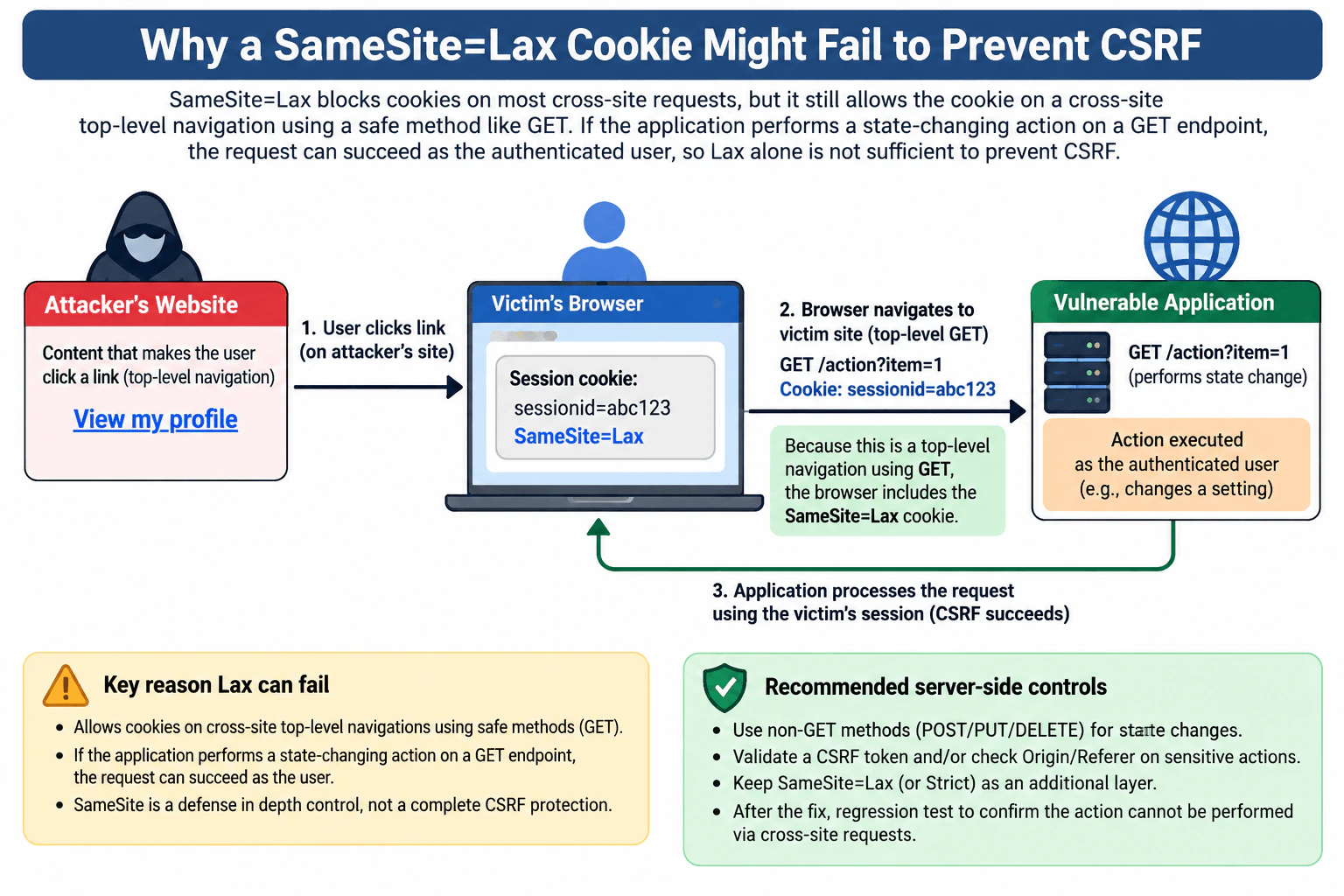
SameSite can significantly reduce CSRF risk by controlling when cookies are included with cross-site requests, but it has limitations. Lax and Strict have different compatibility effects, same-site is not the same as same-origin, and application workflows can create exceptions. I normally treat SameSite as defense in depth and combine it with an appropriate server-side control such as anti-CSRF token validation, Origin or Referer validation, or Fetch Metadata checks.
42. What makes SQL injection a security risk in a web application undergoing an authorized assessment?Web Application SecurityEasy
Short Interview Answer (30-60 seconds)
SQL injection is risky because untrusted input can alter the SQL query a web application sends to its database. The database may execute the changed query with the application's privileges, potentially exposing or modifying data. In an authorized test, prove this safely with bounded, non-destructive evidence.
Detailed Explanation
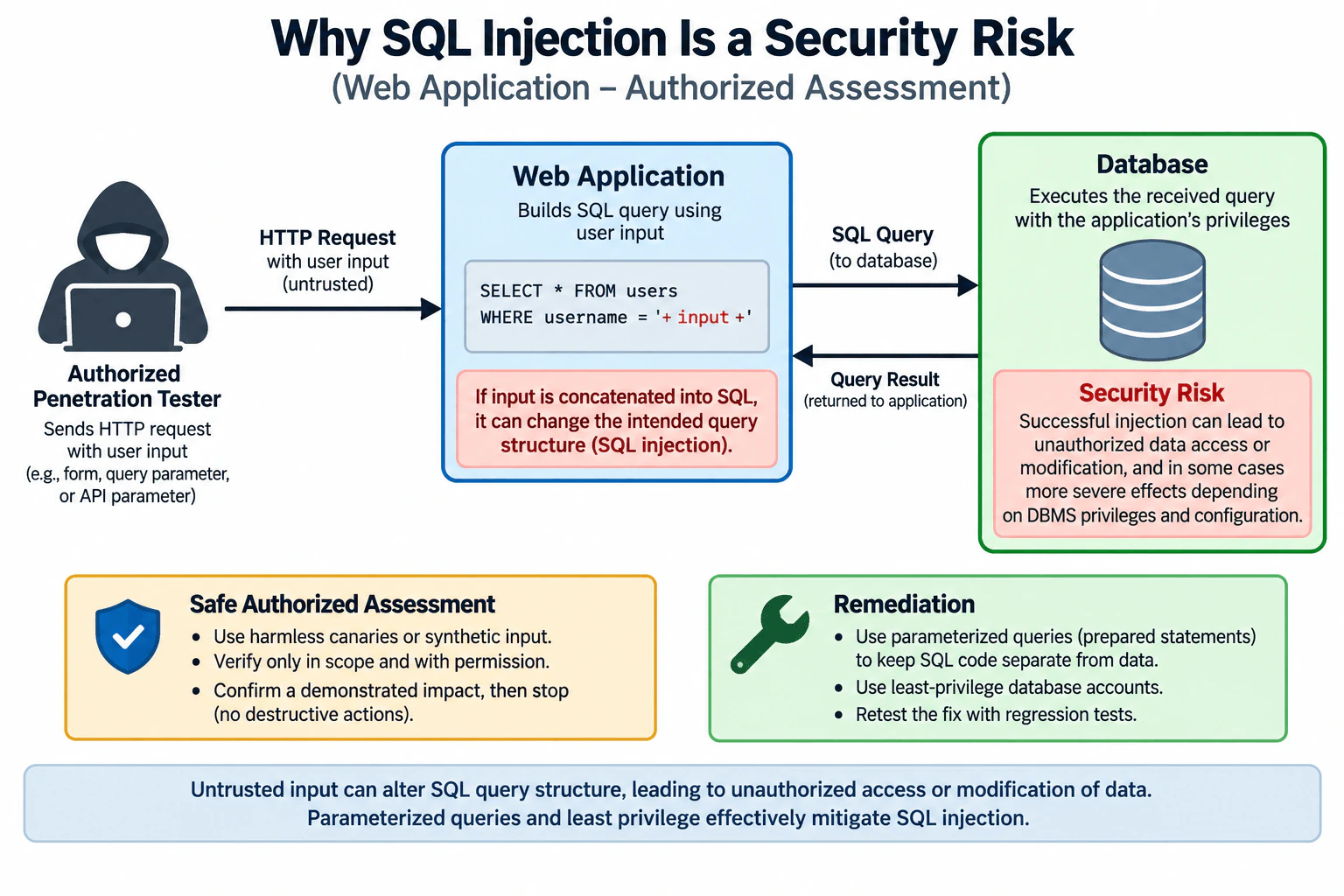
The question asks why SQL injection creates security risk and how that risk should be handled during an authorized assessment. The key issue is that untrusted HTTP input may be combined directly with SQL code. If this happens, the input can change the intended query structure instead of remaining only data. The application then sends that query to the database, which executes it with the application's database privileges. This can lead to unauthorized data access or modification. The tester should use harmless or synthetic input, prove only the minimum necessary impact, and avoid destructive actions.
Useful Questions to Ask the Interviewer
Is the assessment limited to a test environment, or is production testing also authorized?
Which database-backed application inputs and workflows are in scope?
What stop conditions apply if database behavior changes unexpectedly?
Should impact be demonstrated only with synthetic or designated test data?
How to Explain It in an Interview
Start with the main flow shown in the diagram: an authorized penetration tester sends an HTTP request containing untrusted user input to the web application. If the application builds a SQL query by concatenating that input directly into the SQL text, the input can change the intended query structure. That is the SQL injection weakness.
The application then sends the resulting SQL query to the database. The database executes the received query with the privileges of the application's database account and returns the query result to the application. This is why SQL injection is a security risk: a successful injection can cause unauthorized data access or modification. More severe effects may be possible, but they depend on the database management system privileges and configuration and should not be claimed without evidence.
During an authorized assessment, the tester should remain inside the written scope and use the least intrusive proof. Harmless canaries, synthetic values, bounded requests, and non-destructive checks are appropriate. A database error, unusual response, or timing difference by itself is only an observation. The tester should reproduce the behavior safely and confirm a demonstrated impact before reporting it as verified. Once enough evidence exists to prove the issue, the tester should stop rather than access unnecessary sensitive data or alter production records.
The root-cause remediation is to separate SQL code from untrusted data. Parameterized queries, also called prepared statements, define the SQL structure first and bind user-supplied values separately so those values cannot change the intended SQL command structure. Least-privilege database accounts reduce the potential damage if a weakness remains, but least privilege does not remove the injection flaw. After the fix is deployed, the original safe test should be repeated as a regression test.
A key limitation is that discovering SQL injection does not prove every possible consequence. Actual impact depends on the affected query, application behavior, available data, database account privileges, and database configuration. The assessment tradeoff is confidence versus safety: collect enough reproducible evidence to establish the risk while avoiding unnecessary data exposure, modification, or service disruption.
Technical Approach
Confirm written authorization, the in-scope application input, and any stop conditions.
Capture a normal HTTP request and response as the baseline, preserving the relevant method, path, parameter, headers, cookies, body, content type, encoding, and user role when applicable.
Send a bounded, harmless test value through the same input to determine whether it can influence database-backed behavior.
Compare the result with the baseline and look for reproducible evidence that the input changes the intended query behavior.
Repeat only as needed to rule out a false positive, using synthetic or designated test data and avoiding destructive actions.
Record demonstrated impact separately from possible but unverified consequences.
Recommend parameterized queries as the root-cause remediation and least-privilege database accounts as defense in depth.
Retest the same authorized path after remediation as a regression test.
Practical Insights
There is no meaningful Big-O complexity for this question. The important costs are operational. Testing takes time to capture a baseline, reproduce evidence, coordinate authorization, and avoid affecting real data or availability. Remediation may require developers to replace string-built SQL with parameterized queries and administrators to review database privileges. Regression testing adds maintenance work, but it helps prevent the flaw from returning. Least-privilege database accounts can require more role management, but they reduce the possible damage if an injection or another database-facing weakness remains.
Why Interviewers Ask This
Interviewers want to see whether the candidate understands the trust boundary between user-controlled input, application-generated SQL, and the database. They also want to hear how database privileges affect impact, how to distinguish suspicious behavior from demonstrated impact, how to test safely within authorization, and why parameterized queries are the root-cause remediation.
Common interview mistakes
Common mistakes include treating every database error as confirmed SQL injection, claiming data access or modification without demonstrating it, using destructive tests when a harmless proof is enough, accessing unnecessary real data, or testing outside the written scope. Another mistake is presenting client-side validation, a WAF, or input filtering as the complete remediation. The root cause should be addressed with server-side parameterized queries. Least privilege reduces potential impact but does not fix unsafe query construction. Testers should also avoid assuming that SQL injection automatically provides database administrator or operating-system access.
Interview tip
Explain the flow first: untrusted HTTP input reaches a web application, unsafe query construction lets that input alter SQL structure, and the database executes the resulting query with the application's privileges. Then mention safe authorized proof, parameterized queries, least privilege, and regression testing. Keep demonstrated impact separate from possible impact.
Interviewer may ask next
What is the best primary remediation for SQL injection?
Use parameterized queries, also called prepared statements, so the SQL structure is defined separately from user-supplied values. Bound values remain data and cannot change the intended SQL command structure. Least-privilege database accounts should also be used to reduce potential impact, but least privilege is defense in depth and does not replace parameterization.
Why should a penetration tester stop after proving a bounded SQL injection impact?
An authorized assessment needs enough reproducible evidence to demonstrate the vulnerability, not the maximum possible damage. Once a harmless, bounded test proves that controlled input can change database-backed behavior, further actions such as modifying real records, extracting unnecessary sensitive data, or disrupting the database add risk without being necessary. More severe consequences should be described as potential impact unless they were specifically authorized and safely demonstrated.
43. What is HTTP parameter pollution in an application undergoing an authorized request-handling review?Web Application SecurityMedium
Short Interview Answer (30-60 seconds)
HTTP parameter pollution happens when the same parameter name appears more than once and different application layers may interpret the values differently. I test that behavior safely and compare results. Duplicate parameters alone are not a vulnerability; I need demonstrated security impact before reporting one.
Detailed Explanation
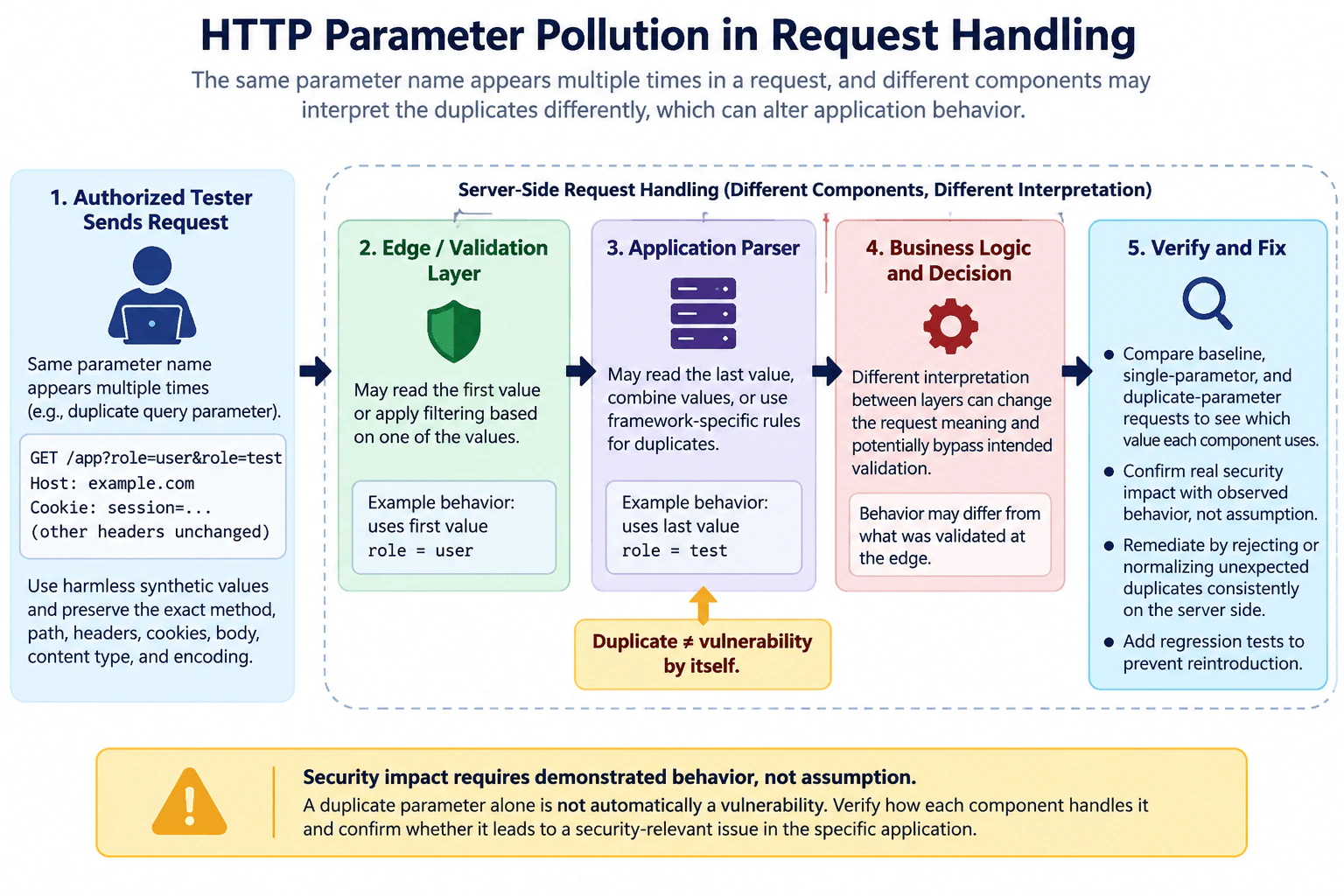
The practical goal is to determine how each relevant server-side component interprets repeated HTTP parameters and whether inconsistent interpretation changes a security-sensitive decision. HTTP parameter pollution, or HPP, occurs when the same parameter name appears multiple times in one request. Different components may select the first value, select the last value, combine values, reject the request, or apply another implementation-specific rule. HTTP URI syntax does not define one universal application rule for duplicate parameter names, so the real application behavior must be observed. A duplicate parameter by itself is not proof of a vulnerability.
Useful Questions to Ask the Interviewer
Which endpoint, HTTP method, parameter, user role, and request format are in scope?
Are there edge validation, proxy, gateway, framework, or application layers that may parse the same parameter?
Which application decisions are security-sensitive enough to require proof of impact?
Are there production-safety limits or stop conditions for repeated requests?
How to Explain It in an Interview
I would explain HPP as a consistency problem between request-processing layers. The same HTTP parameter name can appear more than once, but different components may not choose the same effective value.
I would start with a legitimate baseline request and preserve the exact HTTP method, path, headers, cookies, body, content type, encoding, and user role. I would use harmless synthetic values so the test is bounded and non-destructive.
The diagram uses the example GET /app?role=user&role=test. This does not claim that a real application's role parameter controls authorization. It is a synthetic teaching example. In the illustrated behavior, the edge or validation layer reads the first value, so it sees role = user. The later application parser reads the last value, so it sees role = test. These first-value and last-value behaviors are examples of possible implementations, not universal HTTP rules.
The important trust boundary is between the edge or validation layer and the later application parser and business logic. If the first layer validates one value but the later layer acts on another, the request meaning can change after validation. That can potentially bypass intended validation or change a security-sensitive business decision.
However, the mismatch alone is still not enough to call it a vulnerability. I would compare a baseline request, a single-parameter request using the alternate synthetic value, and a duplicate-parameter request. I would observe which value each component uses and compare the resulting behavior. Where authorized logs or traces are available, I would use them as supporting evidence.
I would only report a security vulnerability if the duplicate handling causes demonstrated security-relevant impact in the specific application. A suspicious response, parser difference, or duplicate parameter without verified impact should remain an observation rather than being overstated.
For remediation, I would fix the behavior on the server side. If a parameter should have one value, reject unexpected duplicates. If multiple values are legitimate, normalize them according to one documented rule before validation and business logic. Every layer that makes a security decision should use the same canonical interpretation.
After the fix, I would add regression tests for the baseline, single-parameter, and duplicate-parameter cases. The main tradeoff is that rejecting duplicates is simpler and reduces ambiguity, but it can break legitimate multi-value inputs. Supporting legitimate duplicates requires a clear parsing contract and consistent handling across every relevant layer.
Technical Approach
Confirm that the endpoint, HTTP method, parameter, user role, request format, and testing activity are authorized and in scope.
Capture a normal baseline request and response.
Preserve the exact method, path, headers, cookies, body, content type, encoding, and role while changing only the parameter values needed for the test.
Send a request containing one harmless alternate synthetic value and record the behavior.
Send a duplicate-parameter request, such as the diagram's synthetic GET /app?role=user&role=test, and record the behavior.
Compare the baseline, single-parameter, and duplicate-parameter results to determine whether components use the first value, last value, combined values, rejection, or another rule.
Where authorized evidence exists, correlate responses with server-side logs or traces to identify how the edge or validation layer and application parser interpreted the parameter.
Check whether the interpretation difference changes a security-sensitive business decision or bypasses intended validation.
Treat duplicate parsing without demonstrated security impact as an observation, not automatically as a vulnerability.
Remediate by rejecting unexpected duplicates or normalizing legitimate duplicates consistently on the server side before validation and business logic.
Add regression tests and retest the deployed behavior.
Practical Insights
The technical cost is usually small for one endpoint but grows when many endpoints, frameworks, proxies, gateways, or services parse requests differently. Testing also takes more time when the effective value is visible only through indirect behavior or server-side logs. Rejecting unexpected duplicates is simple and reduces ambiguity, but it may break legitimate multi-value parameters. Supporting duplicates safely requires a documented parsing rule and consistent implementation across layers. Regression tests add maintenance work, but they help prevent later framework or configuration changes from reintroducing inconsistent request handling.
Why Interviewers Ask This
This question tests whether the candidate understands HPP as an ambiguity in request parsing, can reason across multiple server-side components, and can distinguish unusual behavior from verified security impact. It also checks whether the tester uses controlled evidence, preserves request context, and recommends a server-side fix with regression testing instead of assuming that duplicate parameters are automatically exploitable.
Common interview mistakes
Common mistakes include treating any duplicate parameter as a confirmed vulnerability; assuming that all servers or frameworks use the first or last value; changing multiple request properties at the same time and losing a clean comparison; using real sensitive values instead of synthetic data; claiming an authorization or validation bypass without demonstrating it; testing only the final response without considering earlier parsing or validation layers; recommending only a client-side control or filtering rule instead of correcting server-side parsing; and failing to add regression tests after remediation.
Interview tip
Lead with the main distinction: duplicate parameters can create parsing ambiguity, but ambiguity is not automatically a vulnerability. Then walk through the same flow as the diagram: authorized request, edge or validation interpretation, application parser interpretation, business-logic decision, evidence-based verification, server-side remediation, and regression testing.
Interviewer may ask next
How would you safely verify whether HTTP parameter pollution has real security impact?
I would compare three controlled requests using harmless synthetic data: a normal baseline, a single-parameter request with an alternate value, and a duplicate-parameter request. I would preserve the method, path, headers, cookies, body, content type, encoding, and user role. Then I would compare responses and, where authorized, server-side logs or traces to determine which value each layer uses. I would report a vulnerability only if the interpretation difference causes a demonstrated security-relevant effect.
What is the main limitation or tradeoff when fixing duplicate-parameter handling?
Rejecting unexpected duplicates is the simplest option for parameters that should contain one value because it removes ambiguity. The tradeoff is that strict rejection can break legitimate multi-value parameters. If duplicates are valid, the application should define one canonical parsing rule, normalize the values consistently before validation and business logic, and regression-test that behavior across every relevant request-processing layer.
44. How do reflected, stored, and DOM-based XSS differ in an authorized web assessment?Web Application SecurityMedium
Short Interview Answer (30-60 seconds)
Reflected XSS returns untrusted request data in the immediate response. Stored XSS persists it and serves it later. DOM-based XSS occurs when client-side JavaScript sends untrusted data to an unsafe DOM sink. I verify each safely with harmless markers, then remediate and retest.
Detailed Explanation
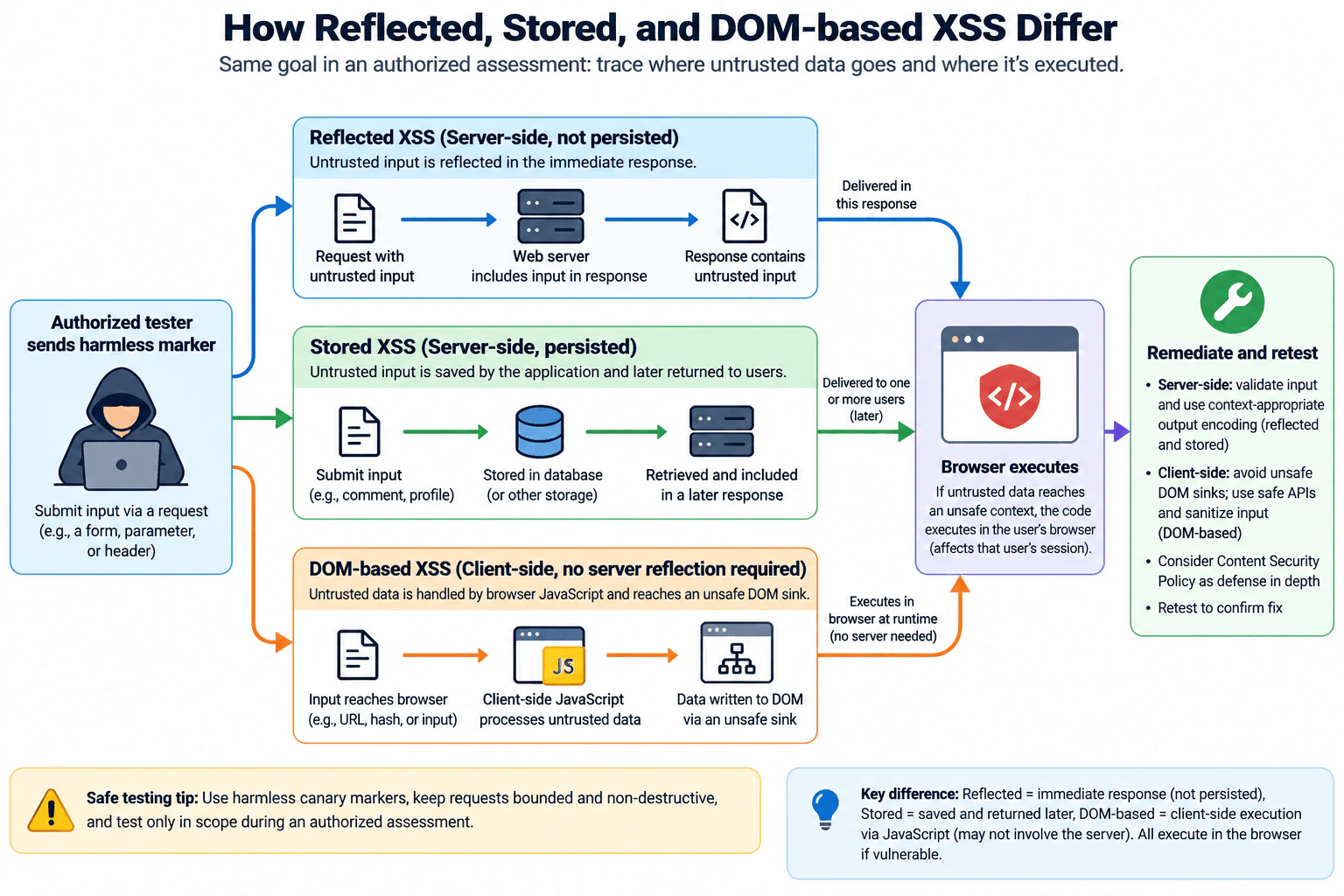
This question asks me to distinguish three XSS paths by following untrusted data from its source to the browser. Reflected XSS is server-side and non-persistent: request data is returned in the same response. Stored XSS is server-side and persistent: the application saves the data and later returns it to one or more users. DOM-based XSS is client-side: browser JavaScript processes untrusted data and writes it into an unsafe Document Object Model sink. In an authorized assessment, I use harmless markers, bounded requests, and synthetic data rather than real secrets or destructive payloads.
Useful Questions to Ask the Interviewer
Are all three XSS types within the written assessment scope?
Can I create synthetic test content for stored-input paths such as comments or profiles?
Are authenticated roles or specific browser workflows required to reach the relevant rendering paths?
What cleanup or stop conditions apply to persisted test data?
How to Explain It in an Interview
I start with the practical distinction: all three can cause untrusted data to reach an unsafe browser execution context, but the data takes a different path.
For reflected XSS, the authorized tester sends a harmless marker in an in-scope request, such as a form field, parameter, or header. The web server includes that input in the immediate response. I trace whether the value reaches an unsafe output context and verify only the minimum safe behavior needed to establish the finding. The important property is that this flow is not persisted; the value returns through the same request-response cycle.
For stored XSS, the tester submits harmless synthetic input to an approved persistent field such as a comment or profile value. The application stores the value in a database or other storage. A later request retrieves that stored value, the server includes it in a response, and one or more users may receive the unsafe content. The key difference is persistence and delayed delivery. Because stored content can reach other users, I keep the test account, data, audience, and cleanup tightly controlled.
For DOM-based XSS, the important processing boundary moves into the browser. Untrusted data can come from a URL, hash, form value, or another browser-accessible source. Client-side JavaScript processes that data and writes it into an unsafe Document Object Model, or DOM, sink. The vulnerable transformation happens at browser runtime and does not require the server to reflect the untrusted value in its response. Server communication can still exist in the overall page flow, so I classify the issue by the client-side source-to-sink path rather than by assuming the server is never involved.
The evidence I keep is specific to the path. For reflected XSS, that means the exact bounded request and the response showing where the harmless marker was returned. For stored XSS, it includes the authorized submission, evidence that the synthetic value persisted, and the later response that retrieved it. For DOM-based XSS, it includes the browser-controlled source, the client-side JavaScript path, the unsafe sink, and the resulting browser behavior. A reflected string by itself is not proof of executable XSS.
Remediation follows the same data path shown in the diagram. For reflected and stored server-rendered data, validate input according to application rules and use context-appropriate output encoding where untrusted values are rendered. When user-authored HTML is intentionally allowed, use appropriate HTML sanitization instead of treating ordinary output encoding as a universal solution. For DOM-based XSS, avoid unsafe DOM sinks, prefer safe browser APIs that treat untrusted values as text, and sanitize content when HTML must be accepted. Content Security Policy is useful defense in depth, but it should not replace the root-cause fix.
After remediation, I repeat the original bounded test and verify that the marker is treated as data rather than executable content. For stored testing, I also remove synthetic test records when required by the rules of engagement. This gives a regression test for the exact path that originally failed.
The main limitation is that one tested source and sink does not prove the whole application is free of XSS. Different templates, browser-side components, output contexts, and stored-data paths may process the same input differently. The tradeoff is coverage versus safety: broader source-to-sink testing increases confidence, but an authorized assessment should remain bounded, reproducible, non-destructive, and limited to approved users and data.
Technical Approach
Confirm written authorization, in-scope pages, roles, persistent fields, and cleanup rules.
Choose a unique harmless canary marker and synthetic test data.
For a reflected path, place the marker in one approved request input and trace whether the same response returns it into an unsafe browser context.
For a stored path, submit the marker to an approved persistent field, verify that it persists, then observe the later retrieval and rendering path using controlled test users.
For a DOM-based path, identify the browser-side source, follow the client-side JavaScript data flow, and determine whether the value reaches an unsafe DOM sink without requiring server reflection.
Preserve the exact request, response, browser state, user role, source, sink, encoding, and other reproduction details that materially affect the tested path.
Demonstrate only the minimum safe impact needed to distinguish simple reflection from browser execution.
Recommend context-appropriate output encoding for server-rendered values, safe DOM APIs and sanitization where needed for client-side rendering, and use Content Security Policy only as defense in depth.
Remove persistent test artifacts when required and retest the original path after remediation.
Practical Insights
The main cost is testing coverage. Reflected testing is often faster because the input and response occur in one request-response cycle. Stored testing takes more care because test data persists, can appear later, and may reach other users, so controlled accounts and cleanup matter. DOM-based testing can require more manual browser and JavaScript analysis because the important source-to-sink flow happens at runtime. Operationally, the tester must preserve enough evidence to reproduce the issue without collecting unnecessary personal data or secrets. Maintenance cost comes from regression testing when templates, sanitizers, output contexts, or client-side rendering logic change.
Why Interviewers Ask This
Interviewers want to know whether the candidate can distinguish three commonly confused XSS data flows, identify where the unsafe transformation occurs, choose the right authorized testing method for each case, distinguish simple reflection from verified browser execution, and recommend a root-cause remediation instead of treating every XSS path as identical.
Common interview mistakes
A common mistake is saying that all three types differ only by where a payload is stored. DOM-based XSS is primarily distinguished by the vulnerable client-side source-to-sink flow. Another mistake is treating simple reflection as proof of XSS without verifying that the value reaches an unsafe browser context. Testers also sometimes claim that DOM-based input never reaches the server; server communication may occur, but server reflection is not required for the DOM-based vulnerability. For stored XSS, using shared or real user data instead of isolated synthetic content creates unnecessary risk. On remediation, relying only on input filtering, a WAF, or Content Security Policy misses the root cause. Context-appropriate output encoding, safe DOM sinks, and sanitization where HTML is intentionally allowed are the important fixes.
Interview tip
Explain the three paths as data flows: reflected means request to immediate response, stored means input to storage to later response, and DOM-based means browser source through client-side JavaScript to an unsafe DOM sink. Then briefly cover harmless verification, root-cause remediation, and retesting.
Interviewer may ask next
How would you safely verify that reflected input is actually XSS rather than simple reflection?
I would first confirm that the harmless marker appears in the response and identify its exact browser parsing context. Reflection alone proves only a data-flow observation. Within the written scope, I would then use the least intrusive bounded proof needed to determine whether the browser treats the value as executable content. I would preserve the exact request and response and avoid accessing cookies, tokens, personal data, or other sensitive information. If the value is safely encoded and remains text, I would not report executable XSS merely because it was reflected.
Why can DOM-based XSS be missed when testing only HTTP requests and responses?
Because the vulnerable transformation can happen after the page reaches the browser. Client-side JavaScript may read an untrusted browser source and write it into an unsafe DOM sink at runtime. The server response does not have to reflect that value in the vulnerable location. An assessor therefore needs to trace the client-side source-to-sink flow and observe the resulting DOM behavior while keeping the test bounded and authorized.
45. How would you test an in-scope application for insecure direct object references using authorized test accounts?Web Application SecurityMedium
Short Interview Answer (30-60 seconds)
I would use two authorized accounts with different test objects, capture Account A's valid request, keep its session and request unchanged, substitute Account B's object reference, and verify whether the server denies access. Any confirmed cross-account access is documented, remediated with server-side object authorization, and retested.
Detailed Explanation
The question asks how to verify object-level authorization safely with controlled test identities. I would use two authorized accounts that own different synthetic objects, establish a valid request as Account A, and then keep Account A's authenticated session while changing only the object reference to Account B's object. The key decision is whether the server checks Account A's permission for that specific object before returning or modifying it. I would use bounded, non-destructive requests, preserve exact evidence, confirm real unauthorized impact before reporting a finding, and retest after server-side remediation.
Useful Questions to Ask the Interviewer
Are both test accounts and their objects explicitly included in the authorized scope?
Which object types and operations are permitted for testing, such as read, update, delete, or export?
Are there stop conditions or sensitive actions that must remain read-only?
Should the test cover only users with the same role, or also approved accounts with different privileges?
How to Explain It in an Interview
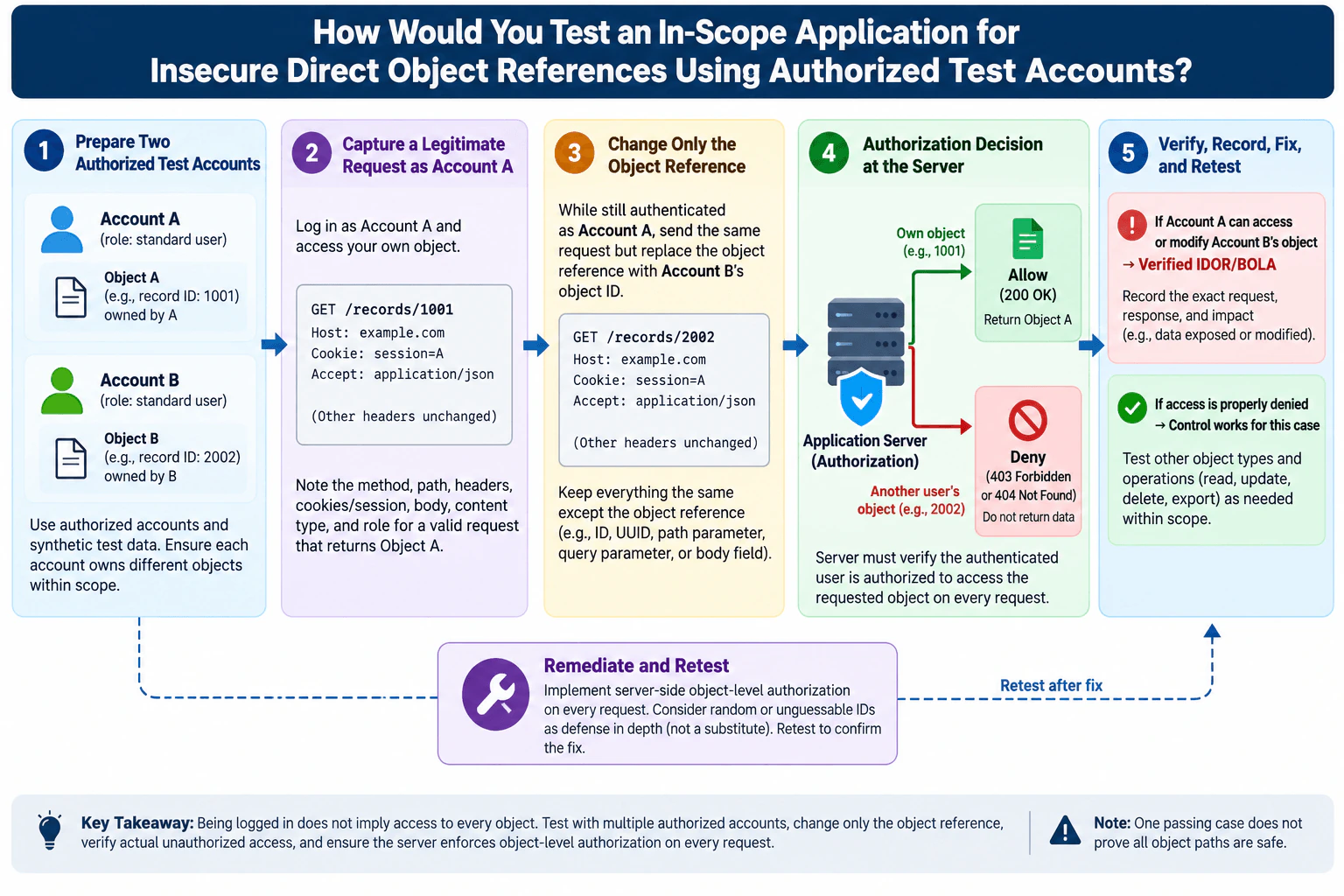
I would start by mapping the relevant roles, sessions, endpoints, object references, and expected ownership relationships. For the horizontal authorization test shown in the diagram, I would prepare Account A and Account B as authorized standard users. Each account should own a different synthetic object, such as Object A with identifier 1001 and Object B with identifier 2002.
Next, I would log in as Account A and make a legitimate request for Object A. The diagram uses GET /records/1001 with Account A's session. I would preserve the HTTP method, path, headers, cookie or other session data, body if present, content type, encoding, and Account A's role so the baseline is reproducible.
Then I would remain authenticated as Account A and send the same request again, changing only the object reference from Object A to Account B's known test object, for example from /records/1001 to /records/2002. Object references may appear in a path parameter, query parameter, header, request body, UUID, or another client-controlled field. Keeping unrelated request details unchanged helps isolate the authorization decision.
The important trust boundary is the application server. Authentication proves that the request is associated with Account A, but it does not mean Account A is authorized to access every object. The server should verify that the authenticated user is allowed to perform the requested action on the requested object for every relevant request. This matches current OWASP guidance for object-level authorization.
If Account A requests its own object and receives the expected content, that establishes the baseline. When Account A requests Account B's object, secure behavior is to deny unauthorized access and return no protected data. A 403 Forbidden response is one possible denial. An application may also intentionally return 404 Not Found to avoid revealing whether a protected resource exists. The security property is the denial of unauthorized object access, not one mandatory status code.
If Account A can read or modify Account B's object, I would treat that as evidence of broken object-level authorization after confirming that Account A was not supposed to have that access under the application's business rules. In web testing this is commonly described as an insecure direct object reference, or IDOR; API security commonly describes the same object-level authorization failure as BOLA, broken object-level authorization.
I would demonstrate only the minimum safe impact. I would use synthetic data and bounded requests and avoid exposing real secrets or unnecessary personal information. For a write operation, I would perform it only when explicitly authorized and would prefer a harmless test value or canary that can be safely restored.
For evidence, I would record the exact baseline request, altered-object request, relevant responses, Account A's authenticated role, the expected ownership of both objects, and the demonstrated effect. A suspicious response alone is not enough. For example, a generic 200 response does not by itself prove IDOR unless the response actually reveals or changes an object that Account A should not access.
If access is properly denied, I would record that the control worked for that specific case and continue with other in-scope object types and operations, such as read, update, delete, or export where authorized. One passing case does not prove that every object path is protected because another endpoint or operation may implement authorization differently.
For remediation, I would recommend server-side object-level authorization on every relevant request. The server should validate the authenticated user's permission for both the requested action and the requested object before returning data or changing state. Random or unguessable identifiers can be useful defense in depth, but they must not replace authorization checks.
After remediation, I would repeat the original Account A to Object B test and verify that unauthorized access is denied while legitimate access to Account A's own object still works. I would also add regression coverage for the affected object types and relevant operations so future changes are less likely to reintroduce the same authorization weakness.
The main tradeoff is coverage versus testing time and operational safety. More accounts, objects, endpoints, and operations provide better confidence, but testing must remain within written scope and use the least intrusive proof. The main limitation is that a successful denial for one request proves only that specific path, role, object, and operation. It does not prove the entire application is free of IDOR.
Technical Approach
Confirm that the application, accounts, objects, endpoints, and operations are in the authorized scope.
Prepare at least two authorized test accounts with different synthetic objects.
Map the relevant role, session, endpoint, object reference, and expected ownership relationship.
As Account A, request Object A and capture the complete valid baseline request and response.
Keep Account A's authentication and all unrelated request details unchanged.
Replace only the object reference with Account B's known test-object reference.
Send the bounded request and observe whether the server returns, modifies, deletes, exports, or otherwise acts on Object B.
Treat a denial with no unauthorized data or state change as a passing result for that specific case.
If unauthorized access occurs, verify only the minimum safe impact and preserve reproducible evidence.
Report the root cause as missing or incorrect server-side object-level authorization when the evidence supports that conclusion.
Recommend authorization checks for the authenticated user, requested action, and requested object on every relevant server-side request.
Retest the original path after remediation and add regression coverage for other relevant object types and operations.
Practical Insights
The technical cost is usually low for a small manual test because two controlled accounts can quickly show whether one user can access another user's object. Coverage becomes more expensive when there are many roles, object types, endpoints, and operations. Operational risk should stay low by using synthetic data and bounded, non-destructive requests. Human effort is needed to understand real ownership and sharing rules so legitimate shared access is not reported as a vulnerability. Remediation can require changes across several server endpoints if authorization is implemented inconsistently. Regression tests add maintenance work but reduce the chance that future changes reintroduce the same flaw. No specific financial or compliance cost can be assumed without application context.
Why Interviewers Ask This
Interviewers want to see whether the candidate understands that authentication and authorization are different, knows how to test IDOR or broken object-level authorization safely with controlled identities and objects, can preserve reproducible HTTP evidence, and can distinguish a suspicious response from verified unauthorized access. They also want to see judgment around non-destructive testing, server-side remediation, coverage limitations, and regression testing.
Common interview mistakes
Common mistakes include testing with only one account and guessing identifiers instead of using known objects from another authorized account; confusing authentication with authorization; changing the session, method, body, and object reference at the same time so the authorization decision cannot be isolated; assuming any 200 response proves IDOR without confirming unauthorized data or state access; requiring one specific denial status code; performing destructive operations without explicit permission; exposing real sensitive data when synthetic proof is enough; treating random UUIDs as a replacement for authorization; testing only read access while ignoring other approved operations; and declaring the application safe after one object path is denied.
Interview tip
Explain the test as a controlled Account A versus Account B authorization check: establish Account A's valid baseline, change only the object reference to Account B's known test object, and evaluate the server's object-level authorization decision. Emphasize synthetic data, exact reproducible evidence, minimum safe impact, server-side remediation, and retesting.
Interviewer may ask next
What if the application uses UUIDs or other unpredictable object identifiers instead of sequential IDs?
I would test the same authorization property. Unpredictable identifiers make guessing harder, but they do not prove that access is authorized. With two authorized test accounts, I already know an object identifier belonging to Account B, so while authenticated as Account A I can substitute that known test identifier in the relevant request. The server must still verify whether Account A is permitted to perform the requested action on Account B's object. Random identifiers are useful defense in depth, not a substitute for server-side object-level authorization.
If Account A receives 403 or 404 when requesting Account B's object, can you conclude that the application has no IDOR vulnerabilities?
No. That result shows only that the specific account, object, endpoint, method, and operation tested did not provide unauthorized access. Other object types, alternate endpoints, request locations, or approved operations such as update, delete, or export may use different authorization logic. I would record the passing case and then test other relevant paths within scope. After remediation of any finding, I would also add regression tests because one passing case does not prove that every object-access path is protected.
46. In an authorized session review, which threats do HttpOnly, Secure, and SameSite cookie attributes address?Web Application SecurityMedium
Short Interview Answer (30-60 seconds)
HttpOnly protects cookie confidentiality from JavaScript access, reducing session theft through XSS. Secure prevents the browser from sending the cookie over insecure transport. SameSite restricts cross-site cookie sending, helping mitigate CSRF. They are complementary controls, not complete fixes for XSS, weak sessions, or every CSRF scenario.
Detailed Explanation
This question asks whether I can map each session-cookie attribute to the specific attack path it reduces. HttpOnly protects the cookie from script-readable APIs such as document.cookie. Secure controls transport and keeps the cookie on secure channels such as HTTPS. SameSite controls whether the browser attaches the cookie to cross-site requests, which helps against CSRF. In an authorized review, I would verify the attributes on the real session cookie and confirm browser behavior safely. I would also explain that these settings reduce risk but do not replace broader session, XSS, TLS, or CSRF defenses.
Useful Questions to Ask the Interviewer
Are we reviewing the primary authenticated session cookie or other application cookies too?
Is the application expected to support cross-site login, embedded content, or other workflows that may affect the SameSite choice?
Is the entire authenticated session required to use HTTPS?
How to Explain It in an Interview
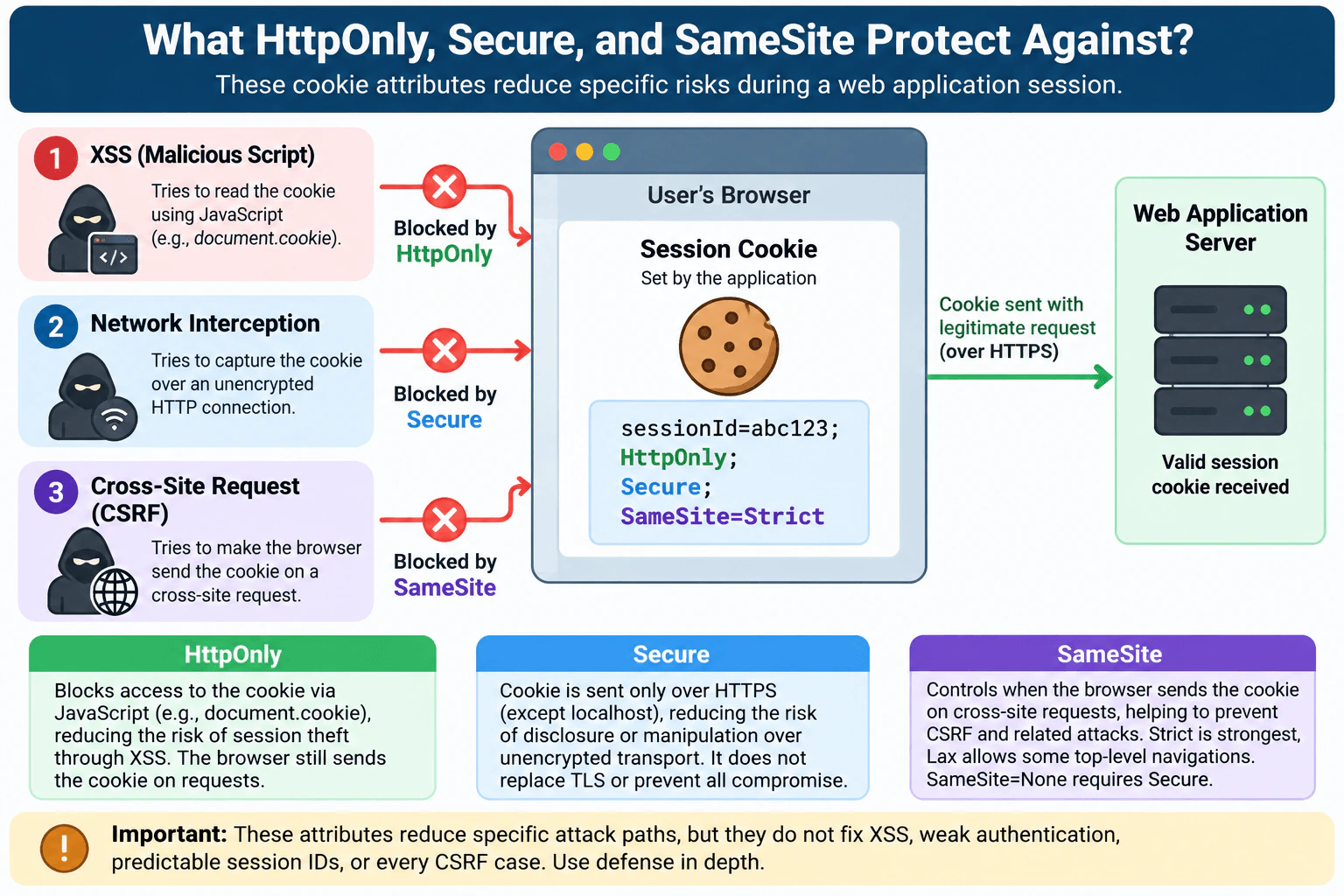
I would start with the practical mapping: HttpOnly addresses script access, Secure addresses insecure transport, and SameSite addresses unwanted cross-site cookie sending.
HttpOnly: The browser does not expose an HttpOnly cookie through script-accessible cookie APIs such as document.cookie. This reduces the chance that an XSS payload can directly read and steal the session identifier. It does not fix XSS itself. A malicious script may still perform authenticated actions because the browser can automatically include the HttpOnly cookie with requests that otherwise meet the cookie's sending rules.
Secure: A Secure cookie is sent only over a secure channel, normally HTTPS, with the localhost exception used by browsers. This reduces the risk of the session cookie being exposed through transmission over unencrypted HTTP. Secure is a transport restriction on the cookie; it does not encrypt the cookie by itself, replace TLS, or prevent application-layer compromise.
SameSite: SameSite controls whether the browser sends the cookie with cross-site requests. SameSite=Strict excludes the cookie from cross-site requests. SameSite=Lax permits some top-level cross-site navigations using safe methods. SameSite=None permits cross-site use and requires Secure. Limiting automatic cookie attachment across sites helps mitigate CSRF. SameSite should still be treated as defense in depth rather than the only CSRF control for sensitive state-changing operations.
The trust boundary in the approved diagram is between the user's browser, hostile script or cross-site content, the network path, and the web application server. The valid path is the browser sending the session cookie to the application over HTTPS. The blocked or constrained paths are JavaScript reading the cookie, the cookie being sent over unencrypted HTTP, and the cookie being sent on disallowed cross-site requests.
For an authorized review, I would inspect the Set-Cookie response for the session cookie, verify HttpOnly, Secure, and the intended SameSite value, and then use a test account with harmless requests to confirm browser behavior. Evidence should preserve the relevant header and observed request behavior while redacting the reusable session value.
The main limitation is that these attributes do not solve every session problem. HttpOnly does not remove XSS and does not stop an injected script from causing requests that the browser is allowed to make. Secure does not replace TLS or prevent all session compromise. SameSite does not replace CSRF tokens or appropriate origin-based protections in every application design. They also do not address weak authentication, predictable session identifiers, or unrelated authorization flaws. Their value comes from combining them as layered session defenses.
Technical Approach
Identify the application's actual authenticated session cookie using an authorized test account.
Inspect the Set-Cookie response and record whether HttpOnly, Secure, and SameSite are present and which SameSite mode is configured.
Confirm that HttpOnly prevents script-accessible cookie APIs such as document.cookie from exposing the session cookie, without attempting to steal or reuse the token.
Confirm that the Secure cookie is sent only through the application's secure HTTPS flow and is not transmitted over ordinary HTTP.
Use a harmless cross-site request scenario that matches the application's expected workflow to confirm the configured SameSite behavior.
Compare the observed behavior with the intended design, especially any legitimate cross-site navigation, embedded content, or authentication requirement.
Record the relevant response header and request behavior as evidence while redacting the session value.
Report any missing or unsuitable attribute together with the specific attack path it affects and retest after remediation.
Practical Insights
This review is usually low cost because the main work is inspecting response headers and confirming browser behavior with a test account. HttpOnly and Secure normally have little maintenance cost. SameSite needs more design care because Strict or Lax can affect legitimate cross-site login, redirects, embedded workflows, or third-party integrations. Testing should cover important supported authentication flows and relevant browsers. The operational cost is mainly regression testing when session or cross-site behavior changes.
Why Interviewers Ask This
Interviewers want to see whether the candidate can distinguish three commonly confused session-cookie controls, map each one to the threat it actually addresses, and explain their limits without claiming that cookie attributes fix XSS, replace TLS, or eliminate every CSRF case.
Common interview mistakes
A common mistake is saying HttpOnly prevents XSS. It does not; it mainly stops script-accessible APIs from reading the cookie. Another mistake is saying Secure encrypts the cookie itself. It does not; it restricts transmission to secure channels. A third mistake is saying SameSite completely prevents CSRF. It reduces cross-site cookie sending, but protection depends on the configured mode and application workflow. It is also wrong to treat these attributes as replacements for HTTPS, strong session identifiers, server-side authorization, XSS prevention, or appropriate CSRF defenses.
Interview tip
Answer with a simple three-part mapping first: HttpOnly means script access, Secure means transport, and SameSite means cross-site requests. Then give one limitation for each. That shows both technical knowledge and good security judgment.
Interviewer may ask next
If a session cookie is HttpOnly, can an XSS vulnerability still be dangerous?
Yes. HttpOnly prevents JavaScript from directly reading the cookie through normal script-accessible cookie APIs, but it does not remove the XSS vulnerability. Malicious script running in the application's origin may still perform authenticated actions because the browser can automatically attach the HttpOnly cookie to requests that otherwise satisfy the cookie's sending rules. XSS still needs to be fixed at its root cause.
Why is SameSite not always enough as the only CSRF defense?
SameSite is a strong browser-side defense in depth, but its behavior depends on whether the cookie uses Strict, Lax, or None and on the application's legitimate cross-site flows. Some designs need cross-site navigation or authentication behavior that prevents using the strictest setting. For sensitive state-changing actions, the application should use appropriate server-side CSRF protections as well rather than relying on SameSite alone.
47. How can automatic request-to-model binding create mass-assignment vulnerabilities in an API under authorized review?Web Application SecurityMedium
Short Interview Answer (30-60 seconds)
Automatic binding is dangerous when it maps unexpected client fields into sensitive server-side properties. I would safely add a synthetic canary field to a legitimate request, verify whether it persists, then fix the issue with an explicit allowlist or input DTO and regression tests.
Detailed Explanation
This question asks whether an API can accidentally let a valid user change fields that the endpoint never intended to expose. The key issue is not whether the user is authenticated. It is whether the server blindly maps request fields into model properties. Under authorized testing, I would start from a legitimate profile update, add a harmless synthetic value to a sensitive property, and verify whether that value reaches the model and persisted state. I would not claim privilege escalation unless that separate effect is safely demonstrated.
Useful Questions to Ask the Interviewer
Which update endpoint, HTTP method, object, and synthetic test account are in scope?
Which properties are intended to be client-editable, and which must remain server-controlled?
What approved method can I use to verify persisted state without exposing real user data?
If the sensitive property changes, is any further impact test such as privilege escalation separately authorized?
How to Explain It in an Interview
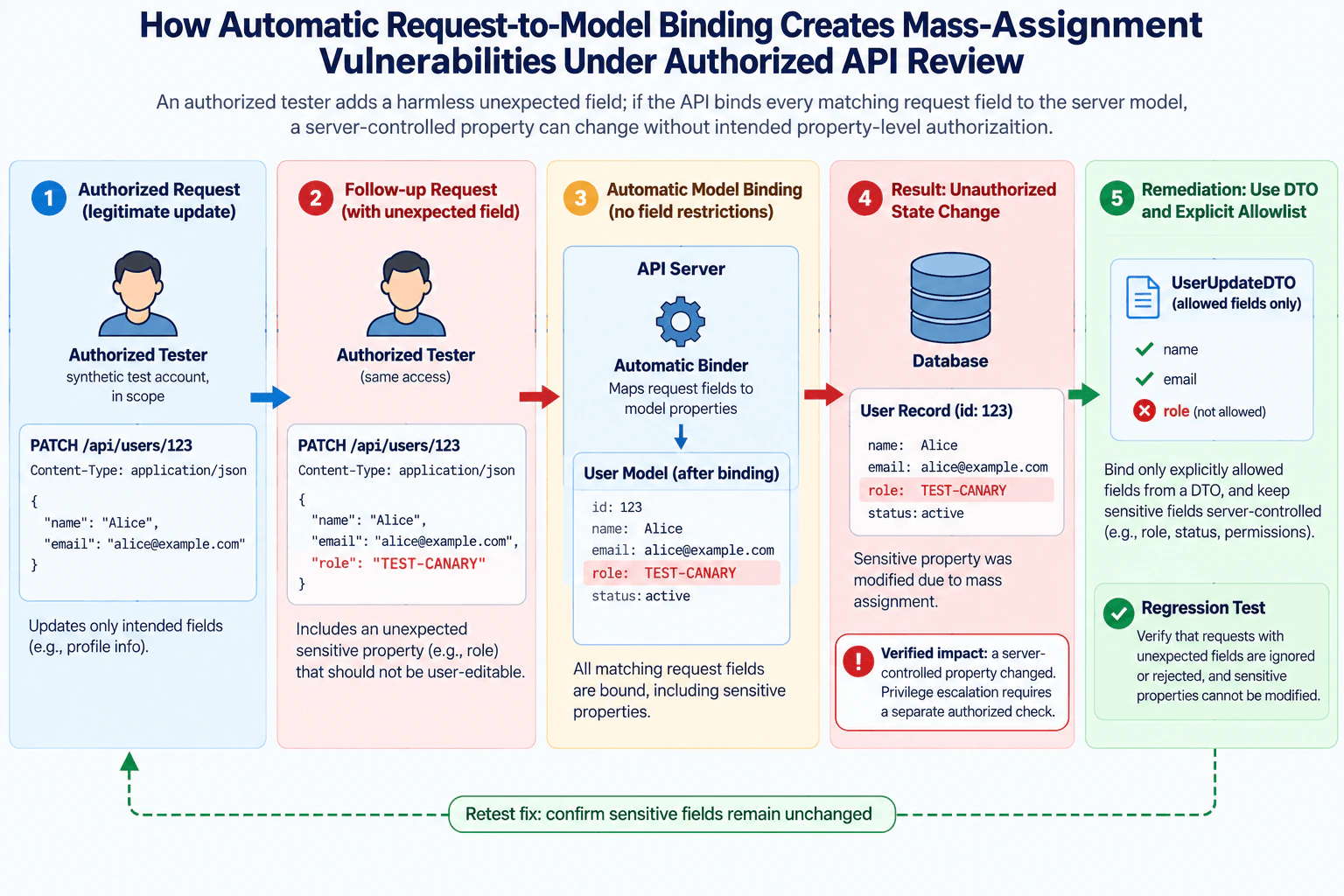
The practical decision is to test property-level authorization, not just endpoint authentication. The diagram's baseline is an authorized tester using a synthetic account to send PATCH /api/users/123 with Content-Type: application/json and only intended profile fields such as name and email.
Next, send the same authorized request with the same identity, method, path, content type, and normal fields, but add one harmless unexpected property: role: TEST-CANARY. The canary is deliberately non-privileged. Its purpose is only to show whether a server-controlled property can be changed.
The vulnerable path is request -> automatic binder -> user model -> database. If the binding layer maps every matching request field into the model without a field allowlist, the unexpected role property may be copied into the in-memory user object. If the application then persists that object, the database contains role: TEST-CANARY. That is verified unauthorized property modification. OWASP describes the same underlying weakness as allowing a user to change a sensitive object property they should not be able to access, and recommends avoiding generic automatic binding where possible and allowing changes only to properties the client should update. owasp.org
The trust boundary is between client-controlled request data and server-controlled object state. Authentication answers who sent the request. It does not answer whether that identity may modify every property. Input validation also does not replace authorization: a value can be syntactically valid and still be unauthorized for that caller to set.
For evidence, preserve the baseline request, the follow-up request containing TEST-CANARY, the relevant response, and a safe observation of the resulting stored state. A response that merely echoes the canary is suspicious but not enough to prove persistence. The strongest bounded proof is that the server-controlled property actually changes on the synthetic test record.
The safe failure behavior after remediation is that name and email continue to update normally while role is ignored or rejected according to the API contract and remains unchanged. The preferred server-side fix is a dedicated input DTO or explicit property allowlist that contains only client-editable fields. Sensitive properties such as role, status, and permissions stay server-controlled. A WAF rule or client-side check is not a complete fix because the vulnerable binding decision happens on the server.
Finally, add a regression test that repeats the request with the extra role field and confirms the sensitive property is unchanged. A limitation is important: storing TEST-CANARY proves unauthorized property modification, but it does not by itself prove privilege escalation. Any privilege-effect test must be separately authorized. The main tradeoff is additional DTO/schema and test maintenance in exchange for a safer default when new internal model properties are added.
Technical Approach
Confirm written authorization, the synthetic test account, the PATCH /api/users/123 endpoint, and which properties are intended to be client-editable.
Capture the legitimate baseline request with the same method, path, content type, body structure, and tester identity shown in the diagram.
Repeat that request and add only the harmless unexpected property role: TEST-CANARY.
Observe the response and safely check the synthetic user's persisted state.
If role: TEST-CANARY is stored, record the verified flow: request -> automatic binder -> user model -> database.
Report only the demonstrated impact: unauthorized modification of a server-controlled property. Do not claim privilege escalation unless separately authorized and proven.
Remediate with a dedicated UserUpdateDTO or equivalent explicit allowlist that accepts intended fields such as name and email but not role.
Retest the same request and confirm the unexpected field is ignored or rejected and the sensitive property remains unchanged.
Restore any modified synthetic state and retain only the minimum evidence needed for the finding.
Practical Insights
The implementation cost is usually low to moderate. Developers must define the fields each update endpoint accepts and keep the DTO or allowlist aligned with legitimate API changes. Regression tests add a small maintenance cost. The benefit is a safer default: new internal properties do not automatically become client-editable. For testers, the proof is inexpensive and low risk when it uses a synthetic account, one bounded request change, and a harmless canary value.
Why Interviewers Ask This
This question tests whether the candidate understands that authentication to an endpoint does not authorize modification of every property on the underlying object. It also tests safe evidence gathering, the distinction between verified property modification and stronger impacts such as privilege escalation, and the ability to recommend a server-side root-cause fix. OWASP's current API guidance treats unauthorized modification of sensitive object properties as Broken Object Property Level Authorization and notes that mass assignment is a previous name for this behavior. owasp.org
Common interview mistakes
Common mistakes are using a real privileged value instead of a harmless canary, assuming authentication authorizes every object property, changing several request details at once and losing a clean baseline, treating an echoed response as proof of persisted impact, claiming privilege escalation when only property modification was demonstrated, recommending only client-side validation or a WAF rule, and relying on a denylist that may miss future sensitive properties. Another mistake is testing real user records when a synthetic account can provide the same evidence safely.
Interview tip
Explain the diagram as one flow: start with the legitimate PATCH request, add one harmless unexpected role value, show how unrestricted binding copies it into the model and database, separate verified property modification from unproven privilege escalation, then finish with an explicit DTO or allowlist and a regression retest.
Interviewer may ask next
How would you verify the issue safely without granting yourself real administrative privileges?
Use a synthetic test account and a harmless canary such as TEST-CANARY in the server-controlled role property. Keep the original method, path, content type, identity, and intended fields unchanged. Then verify whether the canary is persisted. If it is, that proves unauthorized property modification without using a real administrative role. Any stronger impact test should require separate authorization.
Why is an explicit allowlist or input DTO safer than only blocking known sensitive fields?
A denylist protects only properties already recognized as dangerous. If developers later add another internal property, broad automatic binding may expose it unless the denylist is updated. An allowlist or dedicated DTO reverses the default: only intentionally client-editable fields such as name and email are accepted, while new server-side properties remain unavailable until explicitly added.
48. For an authorized web assessment, how does server-side request forgery differ from cross-site request forgery?Web Application SecurityMedium
Short Interview Answer (30-60 seconds)
SSRF tricks the vulnerable server into making an attacker-influenced request to another resource. CSRF tricks a victim's authenticated browser into sending an unwanted request to the trusted application. SSRF abuses server-side network access; CSRF abuses the user's authenticated browser session.
Detailed Explanation
The practical distinction is who sends the forged request and which trust boundary is abused. With SSRF, attacker-controlled input causes the vulnerable web application server to contact another internal or external resource. The server's network position and permissions matter. With CSRF, a malicious website or similar cross-site trigger causes an authenticated victim's browser to send an unwanted request to the trusted web application. The browser may automatically include session cookies or other ambient credentials. Both involve forged requests, but the sender, target, evidence, impact, and defenses are different.
Useful Questions to Ask the Interviewer
Should I explain only the conceptual difference, or also describe safe validation steps?
Are authenticated browser workflows in scope for CSRF testing?
Are server-side URL-fetching, callback, or webhook features in scope for SSRF testing?
Are internal services or controlled external test endpoints explicitly authorized as SSRF destinations?
How to Explain It in an Interview
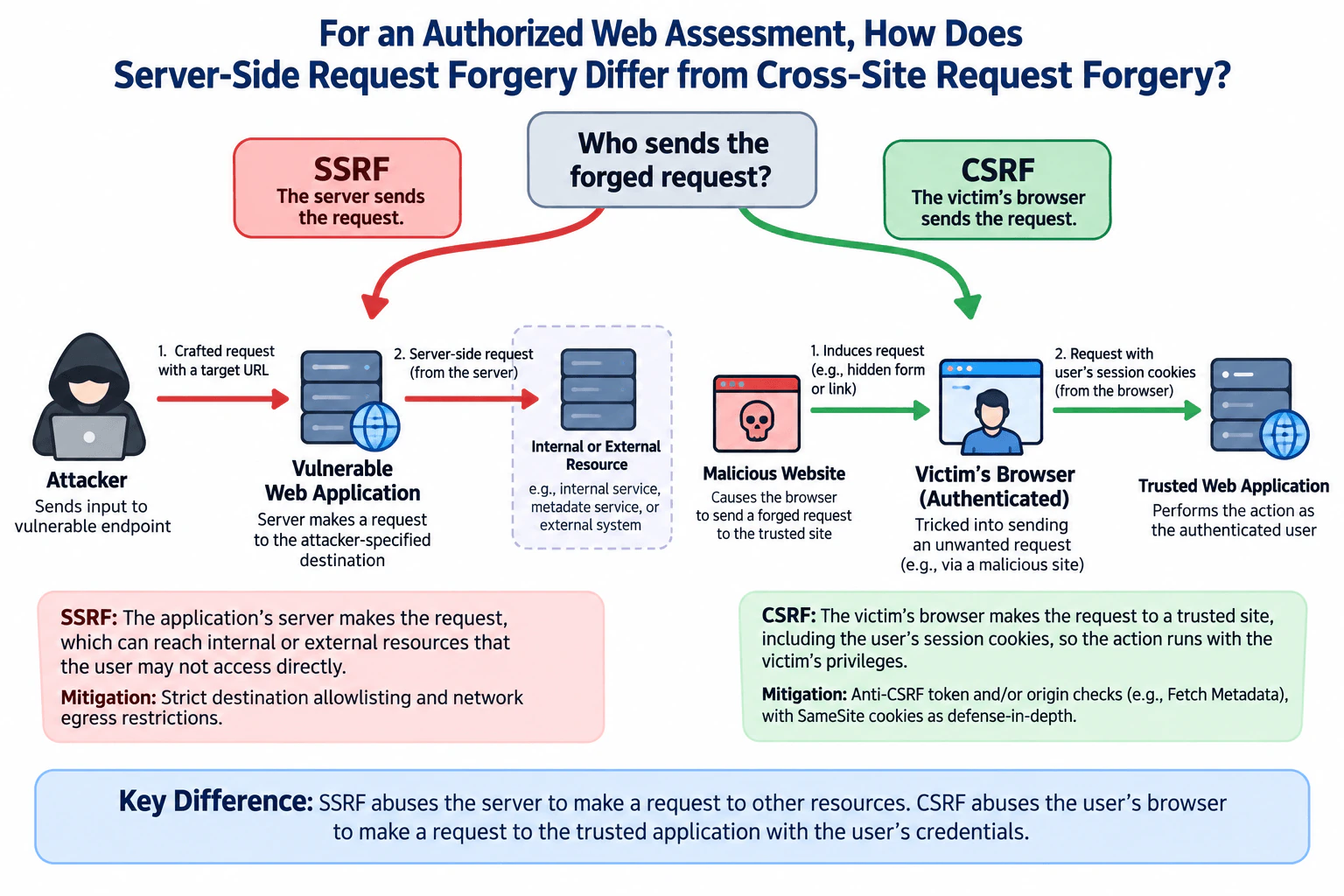
Start with one question: who sends the forged request?
For SSRF, the application server sends it. The diagram's flow is attacker input to a vulnerable web application, followed by a server-side request to an internal or external resource. The attacker influences the destination, but the request to that resource originates from the vulnerable server. This matters because the server may have network access or permissions that the original user does not have. During an authorized test, I would prove only that bounded server-side request behavior exists; I would not assume that sensitive internal data is reachable merely because an outbound request succeeded.
For CSRF, the victim's authenticated browser sends the request. The diagram's flow is a malicious website inducing a request, the authenticated victim's browser sending it with the user's session context, and the trusted web application processing it as that user if its CSRF defenses do not reject the request. The important boundary is the browser's authenticated relationship with the trusted application. CSRF does not require the vulnerable application to initiate an attacker-selected outbound connection to another network resource.
That gives the central interview distinction: SSRF abuses the server to make a request to another resource; CSRF abuses the user's browser to make a request to the trusted application with the user's authenticated context.
The defenses follow the same distinction. For SSRF, the root problem is unsafe server-side destination handling. When the application should communicate only with known destinations, use strict destination allowlisting and robust validation. Add network egress restrictions and least privilege as defense in depth so the application cannot freely reach unnecessary internal or external resources. Validation must account for how destinations are parsed and resolved instead of relying on a simple string check alone.
For CSRF, protect state-changing endpoints on the trusted application. Use server-validated anti-CSRF tokens where appropriate. Server-side request-source checks can also help, such as validating Origin or Referer and, for suitable modern-browser deployments, applying a Fetch Metadata policy based on headers such as Sec-Fetch-Site. SameSite cookies are useful defense in depth, but they should not automatically be treated as a complete CSRF solution in every deployment.
For safe validation, SSRF should use a harmless controlled destination or canary that shows the server made the request without accessing real secrets or unnecessary internal data. Preserve the relevant request parameters and observable evidence. For CSRF, use an authorized test account and a synthetic or reversible state-changing action, then verify whether a cross-site request is accepted without the expected server-side CSRF protection. Preserve the method, path, relevant headers, cookies, body, content type, and user role needed to reproduce the behavior.
The main limitation is that one suspicious observation is not the same as verified impact. Successful server-side connectivity does not by itself prove sensitive SSRF impact. Likewise, a missing anti-CSRF token does not by itself prove exploitable CSRF if another effective server-side control rejects the cross-site action. The tradeoff is confidence versus safety: collect enough evidence to prove the behavior, but stop before unnecessary interaction with sensitive systems or data.
Technical Approach
Confirm written authorization, scope, test accounts, allowed targets, and stop conditions.
Identify the two different trust paths: server-originated requests for SSRF and authenticated browser-originated requests for CSRF.
For SSRF, locate an in-scope feature where user-controlled input can influence a server-side destination, such as URL fetching, callbacks, or webhooks.
Use a harmless controlled destination or canary and verify that the application server, not the tester's browser, initiated the request.
Record the exact input and the observable evidence, but do not contact sensitive internal resources unless explicitly authorized and necessary.
For CSRF, choose an authorized state-changing action performed by an authenticated browser session using a test account.
Determine whether a cross-site trigger can make the browser send that action with the user's session context.
Verify whether server-side defenses such as anti-CSRF token validation, Origin or Referer checks, or an applicable Fetch Metadata policy reject the request.
Preserve the exact HTTP method, path, relevant headers, cookies, body, content type, encoding, and user role required to reproduce any verified behavior.
Recommend root-cause remediation and regression-test the same bounded paths after the fix.
Practical Insights
The technical cost is moderate because SSRF and CSRF require different test setups. SSRF testing may need a controlled callback endpoint and coordination with network owners so internal systems are not contacted accidentally. CSRF testing needs an authorized authenticated test account and a harmless reversible state-changing action. Operationally, SSRF destination allowlists and egress rules require maintenance when legitimate integrations change. CSRF protections must be applied consistently to state-changing endpoints. The main human cost is correctly mapping trust boundaries and avoiding conclusions from incomplete evidence. These controls can also add maintenance and testing work when applications, integrations, or browser behavior change.
Why Interviewers Ask This
Interviewers ask this to check whether you can distinguish two similarly named request-forgery vulnerabilities by the request sender, trust boundary, target, likely impact, validation method, and appropriate defenses. They also want to see whether you can test each issue safely during an authorized assessment instead of treating SSRF and CSRF as interchangeable vulnerabilities.
Common interview mistakes
Common mistakes are treating SSRF and CSRF as the same vulnerability because both contain 'request forgery'; saying the attacker directly sends the final SSRF request to the internal resource; saying the server sends the forged CSRF request instead of the victim's browser; assuming CSRF requires stolen credentials; assuming a missing anti-CSRF token automatically proves exploitable CSRF; assuming any successful outbound connection proves sensitive SSRF impact; treating SameSite cookies as a universal standalone CSRF fix; relying on a WAF or client-side validation as the complete remediation; and using sensitive internal resources or real user actions when a harmless proof is sufficient.
Interview tip
Lead with 'who sends the forged request?' Then give the two flows in one sentence each: SSRF uses the application server to reach another resource; CSRF uses the victim's authenticated browser to act on the trusted application. Finish by matching each flow to its main server-side defenses.
Interviewer may ask next
What is the safest way to validate suspected SSRF during an authorized assessment?
Use a controlled, harmless destination or canary and make the smallest request needed to prove that the application server initiated the outbound connection. Record the original request and observable evidence, avoid retrieving real secrets or sensitive internal data, and stop once server-side request behavior is confirmed. Successful connectivity proves request capability, not automatically the maximum possible impact.
Does the absence of an anti-CSRF token automatically mean an application is vulnerable to CSRF?
No. A token is a common defense, but exploitability depends on whether an attacker can actually cause an authenticated browser to send a state-changing request that the server accepts. Other effective server-side controls, such as Origin or Referer validation or an appropriate Fetch Metadata policy, may reject the cross-site request. SameSite cookies can also reduce exposure in some cases, but they are generally defense in depth rather than proof by themselves. Test the complete browser-to-application flow instead of inferring vulnerability from one missing control.
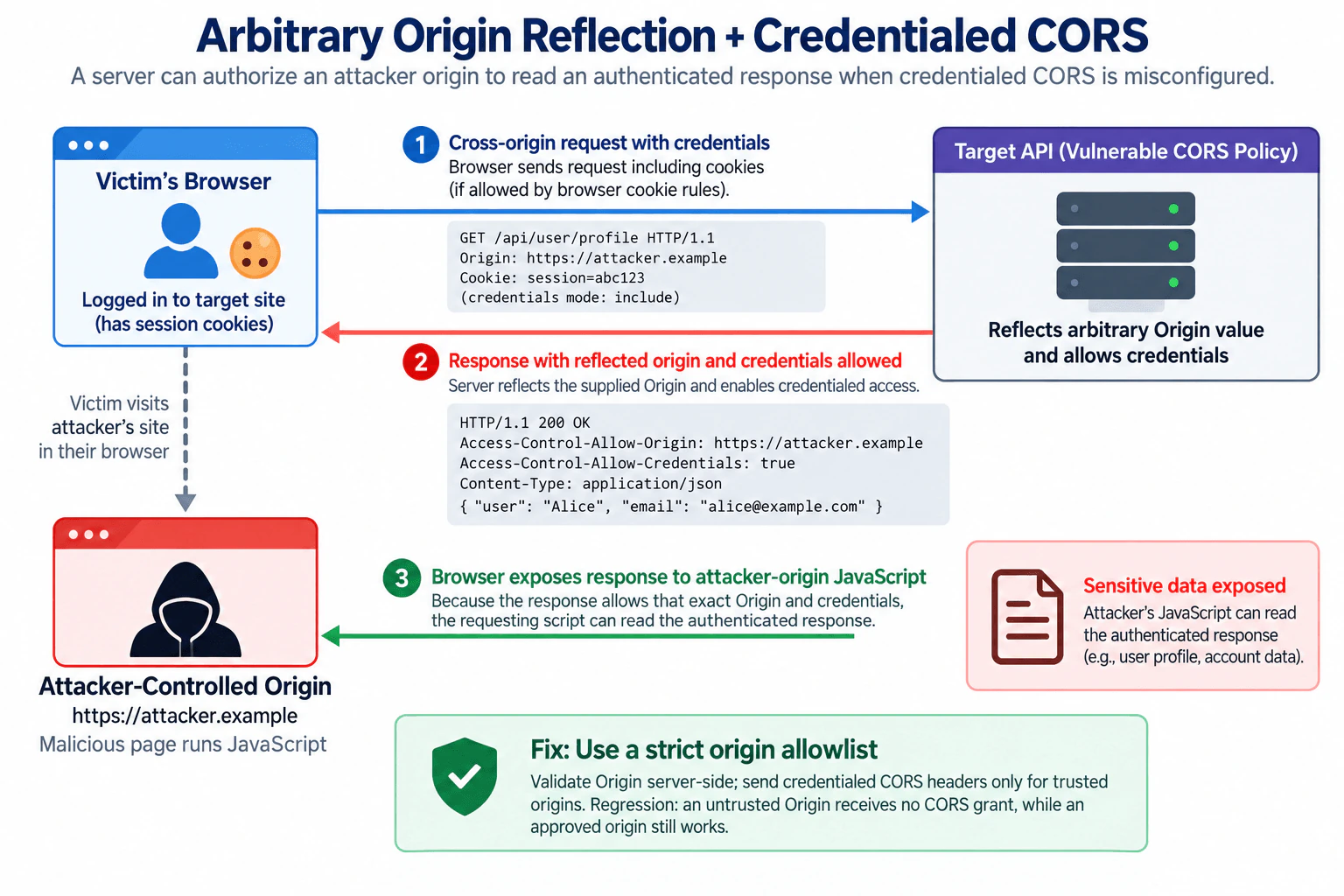
49. Why can reflecting arbitrary origins together with credentialed CORS create a vulnerability during an authorized browser-security review?Web Application SecurityHard
Short Interview Answer (30-60 seconds)
If an API reflects any requesting Origin and also allows credentials, an untrusted site may be allowed by the browser to read an authenticated response. During an authorized review, I verify this safely with a test account and synthetic data, then recommend a strict trusted-origin allowlist.
Detailed Explanation
The question asks why two CORS behaviors become dangerous when combined. CORS, or Cross-Origin Resource Sharing, controls whether browser JavaScript may read a response from another origin. If the API copies an arbitrary Origin into Access-Control-Allow-Origin and also sends Access-Control-Allow-Credentials: true, the browser may expose an authenticated response to JavaScript from that untrusted origin. The important condition is that credentials, such as an eligible session cookie, must actually be sent under the browser's cookie and credential rules. A permissive header pattern alone is therefore suspicious evidence, not automatically proven impact.
Useful Questions to Ask the Interviewer
Is the affected endpoint authenticated and expected to return user-specific or otherwise sensitive data?
Are credentialed cross-origin requests intentionally required for any trusted front-end origins?
May I use a dedicated test account, synthetic data, and an approved test origin during validation?
Should the review cover only this endpoint or other endpoints using the same CORS policy?
How to Explain It in an Interview
The practical decision is to treat arbitrary origin reflection plus credential support as a potentially serious CORS misconfiguration and then verify whether it creates real browser-readable impact.
First, map the three important actors shown in the diagram: the attacker-controlled origin, the victim's browser, and the target API. The browser is the enforcement point for CORS. The API controls which requesting origins receive a CORS grant through its response headers.
In the approved example, the user is already logged in to the target application and has an eligible session cookie. The browser visits an attacker-controlled page. JavaScript on that page makes a cross-origin GET request to /api/user/profile with credentials enabled. The browser sends an Origin value such as https://attacker.example. Whether the session cookie is actually attached still depends on normal browser cookie rules, including SameSite and other credential restrictions.
The vulnerable behavior appears when the target API does not compare the Origin against a trusted allowlist. Instead, it reflects the supplied value and returns both Access-Control-Allow-Origin: https://attacker.example and Access-Control-Allow-Credentials: true. For a request whose credentials mode is include, an explicit matching Access-Control-Allow-Origin value together with Access-Control-Allow-Credentials: true can allow the browser to share the response with the calling JavaScript. Access-Control-Allow-Origin: * cannot be used to share a response in this credentialed case; the dangerous behavior here is reflecting the specific untrusted origin.
The browser can then expose the authenticated response to JavaScript running under the attacker-controlled origin. If that response contains account information or another protected value, the untrusted page can read it. That is the important security impact: not merely that a cross-origin request was sent, but that attacker-origin JavaScript was allowed to read a response associated with the authenticated user's session.
During an authorized review, I would prove this with the minimum safe evidence. I would use a dedicated test account, a controlled test origin, and synthetic or non-sensitive response data. I would preserve the exact HTTP method, path, Origin header, credential mode, relevant cookie behavior, response headers, and observed browser result. I would avoid collecting real user secrets or unnecessary personal data.
A useful negative control is also important. I would repeat the same bounded test from an untrusted origin after the policy is corrected. If the server does not grant CORS access to that origin, browser JavaScript should be unable to read the protected response even if the underlying HTTP request is otherwise processed. This separates request delivery from cross-origin response disclosure.
The server-side fix is to validate Origin against a strict allowlist of origins that are genuinely trusted to read the resource. The API should send credentialed CORS headers only when that cross-origin credential use is necessary. For an untrusted origin, it should omit the CORS grant rather than reflecting the supplied value. This is a server policy correction; a client-side check or WAF rule is not a complete root-cause fix.
The regression test should verify both sides of the policy. An approved origin should continue to work when credentialed cross-origin access is required, while an untrusted origin should receive no usable CORS grant and its JavaScript should be unable to read the protected response.
There are important limitations. A reflected Origin and Access-Control-Allow-Credentials: true do not by themselves prove that sensitive data is exposed. The browser may not send the session cookie because of SameSite or other cookie rules, the endpoint may return only public data, or application authorization may still prevent access. The assessment should therefore separate a permissive CORS configuration from demonstrated browser-readable impact.
The main tradeoff is compatibility versus trust. Broad origin handling is easy for developers but expands which web origins can receive browser-readable responses. A strict allowlist requires configuration and maintenance, but it keeps credentialed cross-origin access limited to explicitly trusted applications.
Technical Approach
Confirm written authorization, the target endpoint, the test account, and the controlled test origin.
Record the normal authenticated request to the in-scope endpoint, including method, path, session context, and response type.
From the controlled untrusted origin, make the same bounded cross-origin request with browser credentials enabled.
Observe the Origin request header and whether the browser is permitted to attach the test session credentials under its cookie rules.
Inspect the response for an explicit Access-Control-Allow-Origin value matching the untrusted test origin and Access-Control-Allow-Credentials: true.
Verify browser-readable impact using only synthetic or non-sensitive test data rather than assuming exposure from headers alone.
Preserve the relevant request, response, browser observation, and test-account context as evidence without retaining unnecessary secrets or personal data.
Recommend server-side Origin allowlisting and credentialed CORS only for trusted origins that require it.
Retest after remediation: an approved origin should still work, while an untrusted origin should receive no usable CORS grant and should be unable to read the protected response.
Practical Insights
The technical cost is usually low to moderate because the core review needs a browser, a controlled origin, a test account, and careful capture of requests and responses. The operational cost is keeping the trusted-origin allowlist accurate across environments. Development teams may need coordination when legitimate front ends are added or removed. A very broad policy is easier to maintain but creates more security risk. A strict policy takes more maintenance but reduces which origins can read credentialed responses. Testing should also avoid real sensitive data, which may require dedicated test accounts and synthetic records.
Why Interviewers Ask This
Interviewers want to see whether the candidate understands that CORS is a browser-enforced response-sharing policy, not an authentication mechanism. A strong answer connects the Origin header, browser credential rules, server response headers, authenticated data, safe validation, and the difference between merely observing permissive headers and proving that an untrusted origin can read a protected response.
Common interview mistakes
Common mistakes are treating CORS as authentication, declaring a vulnerability only because Access-Control-Allow-Credentials: true appears, and failing to verify whether the untrusted Origin is actually accepted. Another mistake is assuming credentials are always sent; SameSite and other browser cookie rules can prevent that. Testers may also confuse sending a cross-origin request with reading its response. For this issue, browser-readable authenticated data is the stronger proof. Finally, recommending a wildcard, client-side validation, or only a WAF rule misses the root cause: the server must grant CORS access only to explicitly trusted origins.
Interview tip
Explain the browser flow in three steps: the untrusted origin starts a credentialed request, the API reflects that origin and allows credentials, and the browser exposes the authenticated response to that origin's JavaScript. Then add the key qualification: prove that credentials are actually sent and that protected data is readable before claiming impact.
Interviewer may ask next
Why is Access-Control-Allow-Origin: * different from reflecting a specific attacker-controlled origin when credentials are included?
For a CORS request whose credentials mode is include, the browser does not accept Access-Control-Allow-Origin: * as authorization to share the response. The server must return an explicit matching origin, and Access-Control-Allow-Credentials must be true for the credentialed response to be shared. That is why reflecting the attacker's exact origin can be dangerous.
What could prevent this CORS misconfiguration from producing real data exposure even when the response reflects an untrusted Origin?
Several conditions can stop the impact. The browser may not send the session cookie because of SameSite or other credential rules, the endpoint may not return sensitive data, application authorization may reject access, or the required CORS headers may not permit the browser to expose the actual response. That is why a penetration tester should verify browser-readable impact with a controlled test account rather than treating the header pattern alone as proof.
50. Why might a SameSite=Lax cookie fail to prevent CSRF in an application undergoing an authorized assessment?Web Application SecurityHard
Short Interview Answer (30-60 seconds)
SameSite=Lax can still send a session cookie on a cross-site top-level navigation using a safe method such as GET. If that GET endpoint changes server state, the action may execute as the authenticated user. SameSite should therefore remain defense in depth, not the application's only CSRF protection.
Detailed Explanation
SameSite=Lax helps reduce cross-site request forgery, or CSRF, by limiting when a browser sends a cookie across sites. However, Lax intentionally allows the cookie on a cross-site top-level navigation when the request uses a safe HTTP method such as GET. This supports normal navigation from one site to another. The weakness appears when an application incorrectly performs a state-changing operation through GET. In that case, following a cross-site link can include the user's valid session cookie, allowing the server to process the request as that authenticated user.
Useful Questions to Ask the Interviewer
Is the assessment explicitly authorized to test the affected state-changing workflow?
Does the application expose a GET endpoint that changes server-side state?
Is the relevant session cookie explicitly configured with SameSite=Lax?
Can the assessment use a synthetic account and a harmless, reversible state change?
Does the sensitive action already require a CSRF token or server-side Origin or Referer validation?
How to Explain It in an Interview
The practical decision is not to treat SameSite=Lax as the application's only CSRF protection. It is a browser-enforced defense-in-depth control with an intentional exception for cross-site top-level navigation that uses a safe HTTP method.
The diagram shows the important flow. A user has an authenticated browser session with a session cookie marked SameSite=Lax. A different website causes the user to follow a link to the target application. The browser performs a top-level GET navigation, such as GET /action?item=1. Because the request is a top-level navigation using a safe method, the SameSite=Lax session cookie can be included.
The request then reaches the application with the user's authenticated session. If that GET endpoint performs a state-changing action, such as changing a setting, and the server relies on the session cookie without an appropriate CSRF defense, the action can execute as the authenticated user. That is why SameSite=Lax can fail to prevent this CSRF path.
The important trust boundary is between the external site that initiates the navigation and the target application that receives the authenticated request. The browser's cookie behavior does not prove that the cross-site initiator is trusted. Authentication tells the server which session sent the request; it does not prove that the user intentionally authorized the state-changing action.
During an authorized assessment, I would use the minimum safe proof. I would map the exact HTTP method, path, parameters, session cookie behavior, user role, and expected state transition. I would use a synthetic account and a harmless, reversible action. I would reproduce only the cross-site top-level navigation needed to test the behavior and avoid exposing real reusable session values in evidence.
I would not treat a successful HTTP response alone as proof of impact. I would verify that the expected test state actually changed. That separates a suspicious request from demonstrated technical impact.
The root cause is not that SameSite=Lax is malfunctioning. The browser is behaving as designed. The application has allowed a safe method such as GET to mutate server-side state and has relied too heavily on SameSite as a CSRF control.
The primary server-side remediation is to remove state changes from GET endpoints. State-changing operations should use an appropriate non-GET method such as POST, PUT, PATCH, or DELETE. Sensitive state-changing requests should also use a proper CSRF defense, such as a validated CSRF token. Server-side Origin or Referer validation can provide an additional check where appropriate. SameSite=Lax or SameSite=Strict should remain an additional browser-side layer rather than the sole control.
After remediation, I would regression-test the original path. A cross-site top-level GET should no longer change state. The replacement state-changing request should fail safely when required CSRF validation is missing or invalid, while the legitimate same-site workflow with valid protection should still succeed.
The tradeoff is that SameSite=Lax preserves normal cross-site link navigation better than SameSite=Strict. Strict provides stronger cookie isolation but can affect legitimate flows where users arrive from another site. Regardless of the cookie mode, correct HTTP method semantics and server-side CSRF protection remain the stronger design.
Technical Approach
Confirm written authorization and identify the specific state-changing workflow that is in scope.
Use a synthetic authenticated account and confirm that the relevant session cookie is configured with SameSite=Lax.
Record the exact endpoint, HTTP method, parameters, user role, session behavior, and expected state before testing.
Determine whether a GET or another safe-method endpoint performs a server-side state change.
From an approved cross-site test page, perform only the required top-level navigation to that endpoint.
Confirm whether the browser includes the authenticated SameSite=Lax session cookie with the request.
Verify impact using a harmless, reversible state change rather than relying only on the HTTP response.
Record the minimum reproducible evidence without exposing reusable session secrets.
Recommend removing state changes from GET endpoints and adding appropriate server-side CSRF validation.
Regression-test the original cross-site path and confirm that it can no longer change state.
Practical Insights
The assessment itself usually needs only a small number of controlled requests, so the testing cost is low. The larger cost may be application changes if state-changing GET routes must be redesigned. Developers may need to update forms, routing, API clients, automated tests, and CSRF validation. Keeping SameSite as an additional layer adds little maintenance cost. Regression tests add some ongoing work, but they help prevent the vulnerable behavior from returning. SameSite=Strict can provide stronger isolation than Lax, but it may also affect legitimate cross-site navigation and sign-in workflows.
Why Interviewers Ask This
Interviewers want to see whether the candidate understands the exact boundary of SameSite=Lax, can distinguish browser cookie behavior from server-side CSRF protection, recognizes that safe HTTP methods such as GET should not change server state, and can validate the behavior safely during an authorized assessment. They also expect practical server-side remediation and a regression test rather than treating SameSite as a complete control.
Common interview mistakes
Common mistakes include assuming SameSite=Lax blocks every cross-site request; forgetting that Lax can include cookies on cross-site top-level navigations using safe methods; allowing GET endpoints to modify server state; confusing authentication with proof that the user intentionally initiated the action; treating HTTP 200 as verified impact without checking the resulting state; exposing real session cookies in evidence; performing a destructive action when a harmless proof is sufficient; recommending SameSite=Strict as the only fix; or relying on a WAF or client-side check instead of correcting the server-side request design and CSRF validation.
Interview tip
Lead with the browser rule: SameSite=Lax can send the cookie on a cross-site top-level GET. Then connect it to the application flaw: the GET endpoint changes state. Finish with the server-side fix—use non-GET methods for mutations, validate CSRF protection, retain SameSite as defense in depth, and regression-test the original path.
Interviewer may ask next
Why is changing the state-changing endpoint from GET to POST not sufficient by itself?
Changing the operation from GET to POST corrects the HTTP-method design and also prevents an explicitly SameSite=Lax cookie from being sent on an ordinary cross-site POST. However, the application should still require a proper server-side CSRF defense for sensitive state changes, such as a validated CSRF token, with Origin or Referer validation where appropriate. SameSite should remain an additional layer rather than the only protection.
Would changing the cookie from SameSite=Lax to SameSite=Strict completely solve the issue?
SameSite=Strict would block the session cookie in more cross-site navigation cases and would reduce this specific attack path, but it is not the root-cause fix. The application should not change state through GET, and sensitive state-changing requests should use server-side CSRF validation. Strict can also affect legitimate cross-site navigation because the browser may omit the session cookie when the user follows a link from another site.
More questions load as you scroll
Disclaimer: This interview guide is for educational and informational purposes only. It is designed to help readers prepare, but it does not guarantee any interview result, hiring decision, offer, or outcome. Interview questions, hiring criteria, and preferred answers can vary by employer, interviewer, industry, location, and time. All answers, examples, and explanations in this guide are suggested examples for interview preparation, not definitive answers or instructions for professional practice. They are based on research and judgment, are provided without warranties of any kind, and should be adapted to the question, role, and applicable laws and professional requirements. Diagrams are simplified illustrations intended to highlight the main concepts and their relationships; actual situations, systems, and practices may be more complex. Alternative approaches may be equally valid or better suited to a particular question, context, or interviewer. To the fullest extent permitted by applicable law, the contributors and publisher are not liable for decisions made, actions taken, or losses incurred based on this guide.
State Laws and Professional Responsibilities: Laws and requirements governing an occupation vary by state and jurisdiction. You are responsible for checking the current laws, licensing requirements, and scope-of-practice rules that apply to your location and role, and for ensuring that your answers and actions comply with them. Adapt examples in this guide to those requirements. This guide is not legal advice.
Content Accuracy and Verification: To the fullest extent permitted by applicable law, we do not represent or warrant that interview guides, questions, answers, examples, or diagrams are accurate, complete, current, error-free, or suitable for any particular purpose. You are responsible for independently reviewing and verifying the information before relying on it.