119 Penetration Tester Interview Questions & Answers

105 top • 6 Amazon • 2 Apple • 3 Google • 1 Meta • 1 Microsoft • 1 NVIDIA

Penetration Tester icon

Questions with Detailed ExplanationsWith Detailed Explanations

(Last Updated: September 13, 2026)

1. What is Python, and how do Penetration Testers use it safely?Language SpecificEasy

Question Details

Define Python as a general-purpose programming language and explain its use for authorized reconnaissance, API clients, parsers, evidence normalization, validation, and repeatable test utilities. Cover modules, virtual environments, input validation, timeouts, exception handling, subprocess safety, dependency pinning, secret handling, and bounded concurrency.

Short Interview Answer (30-60 seconds)

Python is a general-purpose programming language that is useful for safe penetration-testing automation. I use it for authorized API calls, parsers, reconnaissance helpers, validation, and evidence processing, with strict scope checks, timeouts, error handling, isolated dependencies, protected secrets, safe subprocess use, and bounded concurrency.

Detailed Explanation

See the Code while reading this explanation.

This question asks two things: what Python is and how a Penetration Tester can use it without turning useful automation into operational risk. Python is a general-purpose programming language with a large standard library and a module system for organizing reusable code. In an authorized assessment, it can automate API requests, parse tool output, normalize evidence, validate observations, and make repeated tasks consistent. The safety decision comes first: code must stay inside written scope, validate untrusted input, fail safely, limit load, protect secrets, and produce evidence that another tester can reproduce.

Useful Questions to Ask the Interviewer
  1. What targets and actions are explicitly authorized by the rules of engagement?
  2. Are there request-rate, concurrency, maintenance-window, retry, or stop-condition limits I must enforce?
  3. Is the Python utility only processing local evidence, or is it allowed to send requests to in-scope systems?
  4. Are redirects allowed, and must every redirect destination remain inside the explicit target allowlist?
  5. Are authentication tokens or other secrets required, and what approved secret-storage method should be used?
  6. Does the team require a reproducible dependency file or locked environment for assessment utilities?
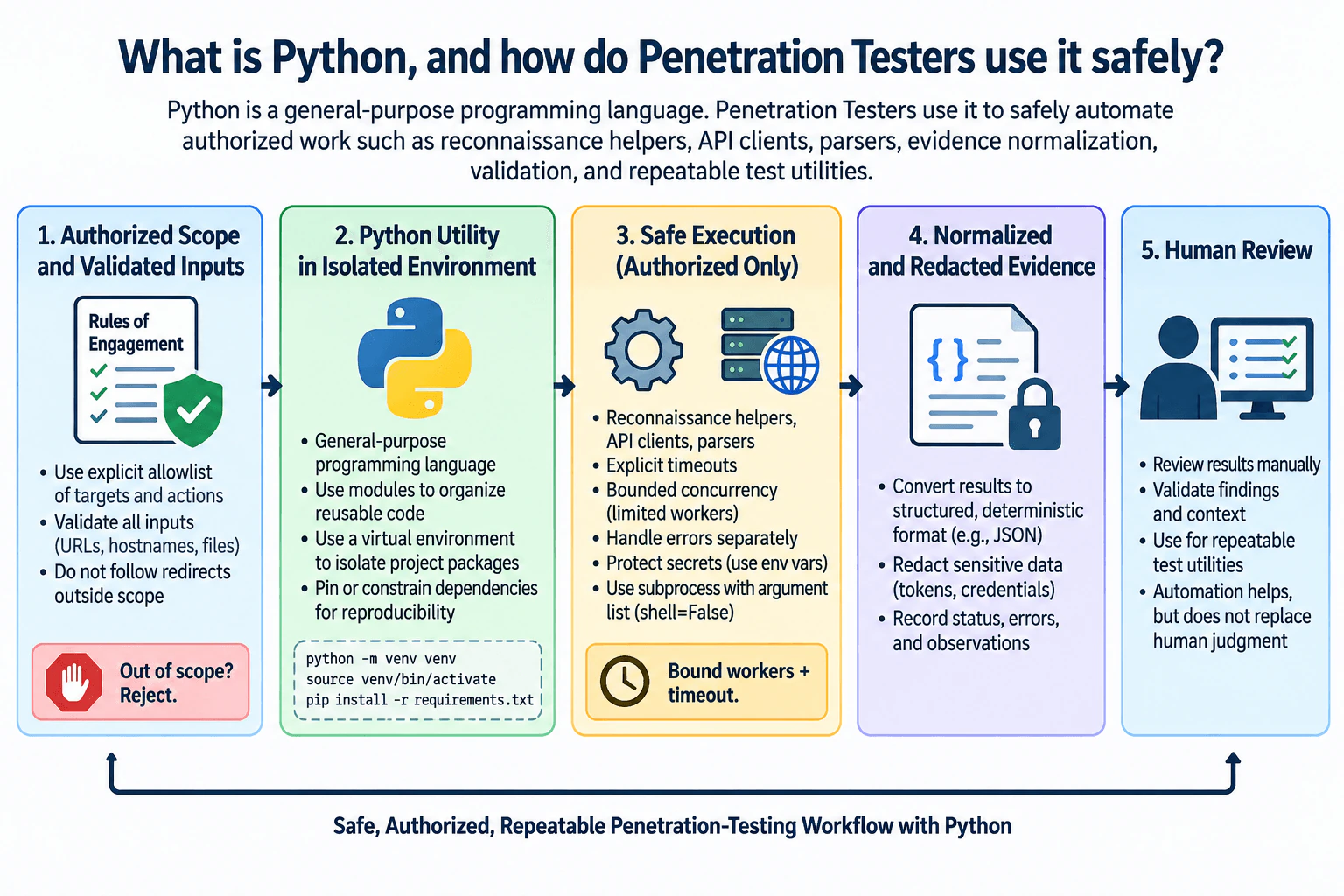
What is Python, and how do Penetration Testers use it safely? diagram
How to Explain It in an Interview

I would start by defining Python. Python is a general-purpose programming language. A module is a reusable Python file or package that exposes functions, classes, or other objects. Penetration Testers use modules from Python's standard library and, when justified, carefully selected third-party packages to build small utilities instead of manually repeating the same work.

The first boundary is authorization. Before my code contacts anything, I treat target names, addresses, URLs, credentials, files, and command output as data that must be validated. I compare network targets against an explicit allowlist rather than assuming that anything discovered during reconnaissance automatically becomes authorized. If a target does not match scope, the utility rejects it instead of continuing. I also consider redirect behavior because an initially approved URL can redirect to a different host; automation must not silently follow that request outside scope.

For reconnaissance and API clients, Python can make repeated requests, collect status information, and normalize responses into structured evidence. The utility should have an explicit timeout so a slow service cannot leave workers hanging indefinitely. Retries, when used, should be limited rather than infinite and should respect the rules of engagement. Request rates and worker counts should stay below authorized limits. Bounded concurrency means I choose a fixed maximum number of simultaneous tasks rather than creating a new worker for every discovered target. This improves speed while protecting service availability.

Input validation matters because automation increases the effect of a mistake. I validate data types, allowed URL schemes, target membership, credential placement, lengths, required fields, and expected formats before performing an action. Parsers should also expect malformed or incomplete input. A parser receiving unexpected tool output should record a controlled error instead of silently converting bad data into a finding.

Exception handling makes failure visible and predictable. I catch expected failures at the correct boundary, record enough context to investigate them, and avoid broad exception handling that hides programming errors. A timeout should be reported as a timeout, malformed data as a parsing or validation error, an out-of-scope target as a scope rejection, and an HTTP response as an observation rather than automatically as a vulnerability. Deterministic structured output, such as sorted JSON records, makes evidence easier to compare between runs.

I isolate project dependencies with a virtual environment so assessment packages are separated from unrelated Python environments. For a reproducible assessment environment, dependency versions can be constrained or pinned in the team's approved requirements or lock mechanism. The important tradeoff is that repeatability must not become permanent use of outdated dependencies, so pinned environments still need maintenance and security review.

Secrets should not be hard-coded in source code, URLs, command-line examples, logs, or committed configuration. I prefer the organization's approved secret mechanism and pass only the secret needed for the current operation. When an environment variable is appropriate, the program reads it at runtime and never prints its value. Logs and evidence should redact authorization headers, session tokens, passwords, cookies, and other reusable credentials.

Subprocess calls need another trust boundary. If Python must invoke an approved local tool, I pass arguments as a list and avoid building a shell command from untrusted text. I normally keep shell execution disabled, set a timeout, capture output deliberately, allowlist the executable when practical, and validate every user-controlled argument before invoking the program. I also use the least privilege needed for the utility.

Virtual environments, validation, timeouts, exception handling, subprocess controls, secrets, redirects, and concurrency solve different problems. None of them proves that a target is secure or that a vulnerability exists. The evidence still has to be reviewed. I validate automation with synthetic positive, negative, malformed-input, boundary, timeout, duplicate-input, and regression cases before depending on it in an assessment. For network utilities, I start with a tiny authorized test set and low concurrency, confirm the output, and expand only within the agreed rules of engagement.

The main tradeoff is speed versus safety and confidence. More concurrency may finish faster but creates more load and can make failures harder to interpret. Automatic retries may improve resilience but also repeat traffic and increase load. More third-party libraries may reduce development time but increase dependency maintenance and supply-chain exposure. Strong input validation and deterministic evidence require more engineering effort, but they reduce accidental scope violations and make results easier to reproduce and review.

Key Insight / Why This Solution Works
  1. Read the written authorization and convert approved targets and actions into explicit configuration.
  2. Validate every supplied target, URL, file, and option before use, including scheme, hostname, embedded credentials, and scope membership.
  3. Load required secrets from an approved runtime source without logging them.
  4. Use isolated, reviewed dependencies and a reproducible environment.
  5. Perform only the least intrusive authorized operation, with explicit timeouts, request limits, bounded retries when permitted, and a bounded worker count.
  6. Prevent automatic redirects from silently crossing the approved target boundary unless each destination is independently validated.
  7. Handle scope rejection, malformed data, redirects, HTTP responses, network errors, timeouts, and parser failures separately.
  8. Normalize results into deterministic structured evidence with sensitive values redacted.
  9. Validate the utility first with synthetic positive, negative, boundary, malformed-input, timeout, duplicate-input, and regression cases.
  10. Run against a small authorized target set before expanding within the rules of engagement.
  11. Review the evidence manually rather than treating automation output as proof of a vulnerability.
Example

This example is intentionally a small, non-destructive Python utility. Its input is an ordered list of HTTPS URLs plus an explicit hostname allowlist. Duplicate URLs are accepted and checked independently; output is sorted by sanitized URL for deterministic reporting. It rejects embedded URL credentials, validates every hostname before a request, prevents HTTP redirects from being followed automatically, uses an explicit timeout, limits concurrent workers, and returns structured results. It does not perform exploitation or discovery. Authentication can be supplied through an environment variable, but the token is never included in output. Every success and failure result contains only a sanitized origin; user information, paths, queries, and fragments are omitted because they may contain secrets. Malformed URLs use a fixed redacted label, and validation errors do not echo raw input. Redirects, HTTP errors, network failures, and timeouts become separate evidence states instead of terminating the complete run. No automatic retry is performed because retry policy and rate limits must come from the rules of engagement. The subprocess helper demonstrates a safer pattern for an approved local command: the executable is allowlisted, arguments are passed as a list, shell execution is disabled, and a timeout is mandatory.

Code
from __future__ import annotations

import json
import os
import socket
import subprocess
from concurrent.futures import ThreadPoolExecutor
from dataclasses import asdict, dataclass
from typing import Iterable
from urllib.error import HTTPError, URLError
from urllib.parse import urlparse
from urllib.request import HTTPRedirectHandler, Request, build_opener


# Safe defaults: keep the utility small and bounded unless the rules of
# engagement explicitly permit different values.
DEFAULT_TIMEOUT_SECONDS = 5.0
DEFAULT_MAX_WORKERS = 3


@dataclass(frozen=True)
class Result:
    url: str
    outcome: str
    status: int | None
    detail: str


class NoRedirectHandler(HTTPRedirectHandler):
    """Stop automatic redirects and expose them as HTTPError observations."""

    def redirect_request(self, req, fp, code, msg, headers, newurl):
        # Raising HTTPError here ensures this redirect is not delegated to
        # another redirect handler and no request is sent to the new target.
        raise HTTPError(req.full_url, code, msg, headers, fp)


def safe_url_for_output(url: str) -> str:
    """Keep only a validated origin; paths, queries and fragments may hold secrets."""
    try:
        parsed = urlparse(url)
        host = parsed.hostname
        if parsed.scheme not in {"http", "https"} or not host:
            return "[REDACTED URL]"
        # Reject unusual host text rather than echoing attacker-controlled data.
        import ipaddress
        import re

        try:
            address = ipaddress.ip_address(host)
            host = f"[{address}]" if address.version == 6 else str(address)
        except ValueError:
            if not re.fullmatch(r"[A-Za-z0-9.-]+", host):
                return "[REDACTED URL]"
            host = host.lower()
        port = parsed.port
        authority = host + (f":{port}" if port is not None else "")
        return f"{parsed.scheme}://{authority}/[REDACTED]"
    except (TypeError, ValueError):
        # Never echo raw input or parser error text for malformed URLs.
        return "[REDACTED URL]"


def validate_url(url: str, allowed_hosts: set[str]) -> str:
    """Return the URL only when its request boundary is explicitly allowed."""
    parsed = urlparse(url)

    # HTTPS is required by this example so an accidental plaintext request
    # does not expose an authorization token.
    if parsed.scheme != "https":
        raise ValueError("Only HTTPS URLs are allowed")

    if not parsed.hostname:
        raise ValueError("URL must contain a hostname")

    # Credentials embedded in a URL can leak through logs and evidence, so
    # this utility rejects them; output is independently sanitized on every path.
    if parsed.username is not None or parsed.password is not None:
        raise ValueError("Credentials must not be embedded in the URL")

    host = parsed.hostname.lower()

    # Exact membership is deliberate. A discovered neighboring hostname does
    # not automatically become authorized.
    if host not in allowed_hosts:
        raise ValueError(f"Host is outside the approved allowlist: {host}")

    return url


def check_url(
    url: str,
    allowed_hosts: set[str],
    timeout_seconds: float,
    token: str | None,
) -> Result:
    """Perform one bounded, read-only HTTP GET against an authorized URL."""
    safe_url = safe_url_for_output(url)
    try:
        validated_url = validate_url(url, allowed_hosts)

        headers = {
            "User-Agent": "authorized-security-validation/1.0",
            "Accept": "application/json,text/plain,*/*",
        }

        # The secret is used only for the request and is never copied into the
        # Result object or printed by this program.
        if token:
            headers["Authorization"] = f"Bearer {token}"

        request = Request(validated_url, headers=headers, method="GET")

        # Automatic redirects are disabled because the Location destination
        # might be outside the approved scope.
        opener = build_opener(NoRedirectHandler())

        # The timeout bounds blocking network operations. Only a small
        # response prefix is read to keep local evidence collection bounded.
        with opener.open(request, timeout=timeout_seconds) as response:
            response.read(1024)
            return Result(
                url=safe_url,
                outcome="response",
                status=response.status,
                detail="Authorized request completed",
            )

    except ValueError:
        return Result(
            url=safe_url, outcome="rejected", status=None, detail="URL rejected by validation"
        )
    except HTTPError as exc:
        # Redirect responses are observations only. They are not followed and
        # do not automatically become findings.
        if 300 <= exc.code < 400:
            return Result(
                url=safe_url,
                outcome="redirect",
                status=exc.code,
                detail="Redirect observed but not followed",
            )
        return Result(
            url=safe_url,
            outcome="http_error",
            status=exc.code,
            detail="Server returned an HTTP error response",
        )
    except URLError as exc:
        # urllib may wrap socket timeouts inside URLError. Classify those as
        # timeouts instead of generic network errors.
        if isinstance(exc.reason, (TimeoutError, socket.timeout)):
            return Result(
                url=safe_url,
                outcome="timeout",
                status=None,
                detail="Request exceeded the configured timeout",
            )
        return Result(
            url=safe_url,
            outcome="network_error",
            status=None,
            detail=type(exc.reason).__name__,
        )
    except (TimeoutError, socket.timeout):
        return Result(
            url=safe_url,
            outcome="timeout",
            status=None,
            detail="Request exceeded the configured timeout",
        )


def run_checks(
    urls: Iterable[str],
    allowed_hosts: set[str],
    max_workers: int = DEFAULT_MAX_WORKERS,
    timeout_seconds: float = DEFAULT_TIMEOUT_SECONDS,
) -> list[Result]:
    """Check URLs with explicitly bounded concurrency."""
    if not 1 <= max_workers <= 10:
        raise ValueError("max_workers must be between 1 and 10")

    if not 0.1 <= timeout_seconds <= 30.0:
        raise ValueError("timeout_seconds must be between 0.1 and 30 seconds")

    # Normalize the allowlist once so hostname comparison is deterministic.
    normalized_hosts = {host.lower() for host in allowed_hosts}

    # Runtime secret loading avoids embedding the credential in source code.
    token = os.environ.get("PENTEST_API_TOKEN")

    # Input order and duplicates are preserved here. Each duplicate therefore
    # causes another authorized request; callers should deduplicate first when
    # repeated requests are unnecessary under the rules of engagement.
    url_list = list(urls)

    with ThreadPoolExecutor(max_workers=max_workers) as executor:
        results = list(
            executor.map(
                lambda url: check_url(
                    url,
                    normalized_hosts,
                    timeout_seconds,
                    token,
                ),
                url_list,
            )
        )

    # Sort by URL and outcome for deterministic evidence representation.
    # Identical duplicate records remain present.
    return sorted(results, key=lambda item: (item.url, item.outcome))


def run_approved_command(program: str, args: list[str]) -> subprocess.CompletedProcess[str]:
    """Demonstrate a safer subprocess pattern for a pre-approved local tool."""
    allowed_programs = {"printf"}
    if program not in allowed_programs:
        raise ValueError("Program is not on the local command allowlist")

    # Arguments are passed separately and shell=False is explicit. This avoids
    # interpreting user-controlled text as shell syntax.
    return subprocess.run(
        [program, *args],
        shell=False,
        capture_output=True,
        text=True,
        timeout=3,
        check=False,
    )


if __name__ == "__main__":
    # Synthetic documentation domains keep the example non-destructive. In a
    # real engagement, this set must come directly from approved scope data.
    approved_hosts = {"example.com", "example.org"}
    targets = [
        "https://example.com/",
        "https://example.org/",
        "https://outside.example.net/",
    ]

    results = run_checks(targets, approved_hosts)
    print(json.dumps([asdict(item) for item in results], indent=2, sort_keys=True))
Where it is used

A Penetration Tester can use this approach for an authorized API assessment that needs the same harmless request sent to several approved endpoints, for parsing scanner or command output into normalized evidence, for validating that supplied or discovered hostnames remain inside the approved scope, for converting assessment observations into consistent JSON records, or for building small regression utilities used during an authorized retest.

Why Interviewers Ask This

Interviewers want to see whether the candidate understands Python as a programming language rather than only as a collection of security scripts. They also want practical judgment: whether the tester can automate authorized work without accidentally leaving scope, overloading a service, leaking credentials, executing untrusted commands, losing evidence, or producing results that cannot be reproduced.

Common interview mistakes

Common mistakes are treating every discovered host as automatically in scope, accepting arbitrary URLs or commands without validation, allowing redirects to cross the target boundary, running unlimited threads, omitting network timeouts, retrying indefinitely, catching every exception and hiding the cause, concatenating untrusted values into shell commands, hard-coding API tokens, placing credentials in URLs, printing secrets into logs, installing assessment packages into a shared environment without isolation, using dependencies without a reproducibility and maintenance plan, and treating a script's output as proof of a vulnerability without manual validation.

Interview tip

Lead with the safety decision, not with Python syntax. Define Python in one sentence, give two or three realistic penetration-testing uses, and then explain the boundaries: explicit scope, validated inputs, timeouts, redirect control, bounded concurrency, safe subprocess handling, isolated dependencies, protected secrets, deterministic evidence, and manual verification.
Interviewer may ask next
Why would you use a Python virtual environment for a penetration-testing utility?

A virtual environment isolates the utility's installed Python packages from the base Python environment and from unrelated projects. That makes dependency conflicts less likely and makes the assessment environment easier to recreate. I would record or lock the required dependencies according to the team's packaging process, review dependency changes, and avoid assuming that pinning removes the need for future security updates.

What is the risk of increasing concurrency in a Python reconnaissance utility?

More concurrency can reduce execution time, but it also increases simultaneous load, can trigger rate limits, may affect service availability, and can make failures harder to interpret. I therefore use an explicit worker limit derived from the rules of engagement, start with a small authorized test set, apply timeouts and stop conditions, and increase concurrency only when the authorized limits permit that level of activity.

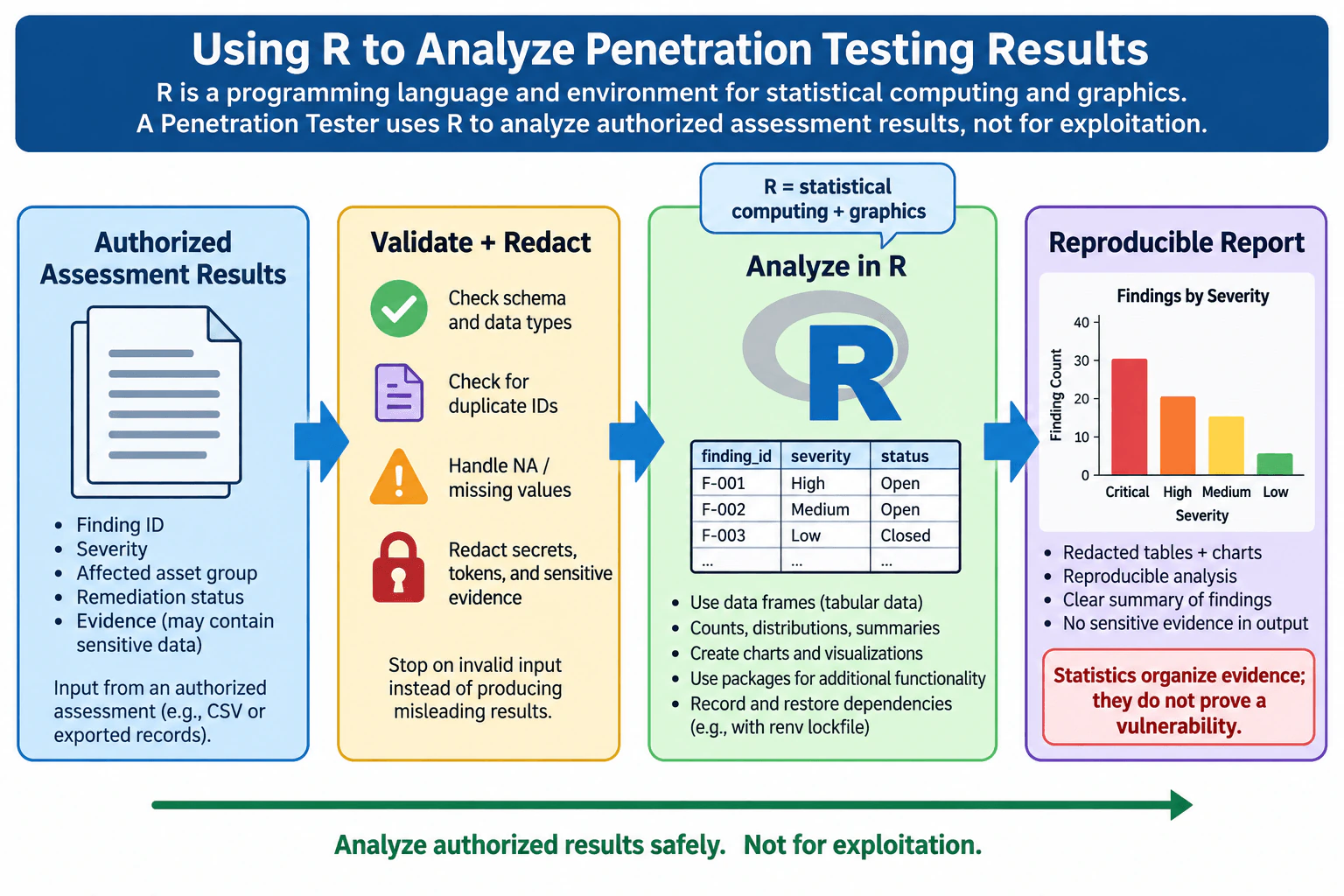
2. What is R, and when might a Penetration Tester use it?Language SpecificEasy

Question Details

Define R as a programming language and environment for statistical computing and graphics. Explain appropriate penetration-testing uses such as analyzing authorized assessment results, summarizing large finding sets, measuring distributions, and producing reproducible charts. Cover packages, data frames, missing values, input validation, dependency control, and redaction of sensitive evidence.

Short Interview Answer (30-60 seconds)

R is a programming language and environment for statistical computing and graphics. A Penetration Tester might use it to analyze authorized assessment results, summarize large finding sets, measure distributions, and create reproducible charts while validating inputs, controlling dependencies, handling missing data, and redacting sensitive evidence.

Detailed Explanation

See the Code while reading this explanation.

This question asks whether I understand R and can choose it for an appropriate penetration-testing task. R is a programming language and environment for statistical computing, data manipulation, and graphics. In penetration testing, its strongest role is usually analysis after authorized evidence has been collected. I can use R to organize assessment results, summarize large finding sets, calculate useful distributions, and create reproducible charts. I also need to explain data frames, packages, missing values, input validation, dependency control, and careful redaction of sensitive evidence before results are shared.

Useful Questions to Ask the Interviewer
  1. Are we discussing analysis of already collected assessment results, or collecting new data as well?
  2. What input format should I assume, such as CSV, another tabular export, or an existing R data frame?
  3. Does the assessment data contain credentials, tokens, personal information, internal identifiers, or other evidence that must be redacted?
  4. Do you want only summary statistics, or should the output also include reproducible charts for reporting?
What is R, and when might a Penetration Tester use it? diagram
How to Explain It in an Interview

I would start with the practical decision: I use R when the main problem is analyzing and communicating authorized assessment data. I would not choose R simply because I am doing penetration testing, and I would not treat statistical output as proof of a vulnerability.

R is a language and environment for statistical computing and graphics. The R environment includes facilities for data handling, calculations, data analysis, graphical display, and programming. It can also be extended through packages.

A realistic use is analyzing a large, already authorized finding set. For example, assume a structured export has one row per finding and columns such as finding identifier, severity, affected asset group, and remediation status. I could use R to count findings by severity, calculate proportions, examine distributions, identify missing fields, and create charts that help reviewers understand the assessment. These summaries organize evidence; they do not independently prove exploitation, exploitability, or business impact.

A data frame is a common R structure for tabular information. It contains columns that can have different data types while sharing the same rows. In this example, the input is a bounded assessment data set rather than a live target. Expected inputs are structured records with defined columns and allowed values. Outputs are aggregate counts, validation results, and optionally redacted charts or tables. I would validate that required columns exist, identifiers are present and unique, expected fields use suitable data types, categorical values are within an approved set, and the input is not unexpectedly empty. Malformed input should stop the analysis with a clear error instead of silently producing misleading statistics.

Missing values also need explicit handling. In R, NA represents a missing value. I would count missing values before calculating statistics and decide whether a calculation should exclude them, display them as a separate category, or stop because a required field is incomplete. I would never silently interpret a missing severity or remediation status as a safe value.

Packages extend R with additional functionality. For a small analysis, base R may be enough and avoids unnecessary dependencies. If external packages are needed, I would use approved sources and record the project's dependency state. A project-environment tool such as renv can record package versions in a lockfile and later restore them, which improves reproducibility. I would review dependency changes rather than allowing uncontrolled package installation or upgrades.

The trust boundary is between sensitive authorized assessment evidence and the analytical or reporting environment. Assessment exports should be treated as potentially sensitive and as untrusted input to the analysis code. I would minimize the fields loaded and redact information that is not needed. That can include passwords, API keys, session tokens, personal data, confidential response bodies, or internal identifiers. Redaction should occur before sensitive values reach shared tables, charts, logs, or reports.

For validation, I would first run the analysis against synthetic fixtures containing valid records, duplicates, missing values, invalid severity labels, empty input, and malformed fields. I would verify that invalid input fails safely, missing values remain visible, duplicate identifiers are rejected, aggregate ordering is deterministic, and charts match the calculated summaries. The same validated workflow would then be applied only to data from the authorized assessment.

Timeouts, retries, rate limits, and concurrency are normally not part of this offline analysis because the example does not contact live systems. If an R workflow later integrates with an authorized external service, those controls would need to be defined separately according to the rules of engagement and service limits.

R is particularly useful when an engagement produces enough structured data that manual counting or spreadsheet work becomes difficult to reproduce. Its statistical and graphical capabilities make it suitable for distributions, summaries, and repeatable reporting.

The tradeoff is that R is not automatically the best language for every security task. A small finding set may not justify a separate analysis pipeline, and another tool may already fit the team's workflow. Packages add maintenance and supply-chain considerations. Statistical patterns can help prioritize investigation, but they cannot replace technical validation of individual findings or establish business impact by themselves.

Key Insight / Why This Solution Works
  1. Confirm that the data comes from the authorized assessment and identify only the fields needed for analysis.
  2. Minimize the input and remove or redact unnecessary secrets and sensitive evidence.
  3. Validate required columns, expected field types, allowed categorical values, unique finding identifiers, and non-empty input.
  4. Load the validated records into an R data frame.
  5. Count and report missing values explicitly rather than silently assigning defaults.
  6. Normalize categorical ordering so summaries are deterministic.
  7. Produce bounded summaries such as counts, proportions, and distributions.
  8. Generate only charts that answer a reporting question and contain no sensitive evidence or unnecessary identifiers.
  9. Record any required package dependencies so another authorized reviewer can reproduce the environment.
  10. Validate the workflow with synthetic valid, missing-value, duplicate, malformed, empty, and boundary cases before processing real assessment evidence.
  11. Review exported tables and graphics again for sensitive information before sharing them.
Example

This R example uses only synthetic assessment data and base R, so it performs no network activity and requires no external package. It creates a data frame, validates the required schema, checks data types and allowed severity values, rejects duplicate identifiers, reports missing values, redacts a synthetic secret pattern, produces a deterministic severity summary, and creates an aggregate bar chart. In a real engagement, the same analysis pattern would be applied only to approved assessment exports. If external packages were needed, I would record and lock their versions so the authorized analysis can be reproduced.

Code
# Synthetic assessment data only: base R, no packages or network requests.
findings <- data.frame(
  finding_id = c("F-001", "F-002", "F-003", "F-004"),
  severity = c("High", "Medium", "High", NA_character_),
  status = c("Open", "Open", "Closed", "Needs review"),
  evidence = c("Synthetic response sample",
               "Synthetic token=demo-secret-value",
               "Synthetic configuration sample", NA_character_),
  stringsAsFactors = FALSE
)

required_columns <- c("finding_id", "severity", "status", "evidence")
missing_columns <- setdiff(required_columns, names(findings))
if (length(missing_columns) > 0L) {
  stop("Missing required columns: ", paste(missing_columns, collapse = ", "))
}
if (nrow(findings) == 0L) stop("The assessment data set is empty.")

# Validate character columns before using string operations.
wrong_types <- required_columns[
  !vapply(findings[required_columns], is.character, logical(1))
]
if (length(wrong_types) > 0L) {
  stop("Expected character columns: ", paste(wrong_types, collapse = ", "))
}
if (anyNA(findings$finding_id) || any(trimws(findings$finding_id) == "")) {
  stop("Every finding must have a non-empty finding_id.")
}
if (anyDuplicated(findings$finding_id) > 0L) {
  stop("Duplicate finding_id values detected.")
}

severity_order <- c("Critical", "High", "Medium", "Low", "Informational")
known_severity <- findings$severity[!is.na(findings$severity)]
if (any(!known_severity %in% severity_order)) {
  stop("Unexpected severity value detected.")
}

# Report missingness explicitly; never treat missing severity as zero risk.
missing_by_column <- colSums(is.na(findings[required_columns]))
print(missing_by_column)

# Redact the synthetic pattern before evidence can be displayed or exported.
# Real exports require approved rules covering their actual secret formats.
redact_evidence <- function(value) {
  gsub("token=[^[:space:]]+", "token=[REDACTED]", value)
}
findings$evidence <- redact_evidence(findings$evidence)

# Fixed factor levels retain zero-count categories in a deterministic order.
severity <- findings$severity
severity[is.na(severity)] <- "Missing"
severity_counts <- table(factor(
  severity, levels = c(severity_order, "Missing")
))
print(severity_counts)
stopifnot(
  identical(as.integer(severity_counts), c(0L, 2L, 1L, 0L, 0L, 1L)),
  is.na(findings$evidence[4L]),
  !any(grepl("demo-secret-value", findings$evidence), na.rm = TRUE)
)

# Aggregate chart contains no raw evidence or sensitive identifiers.
# Use a temporary PDF device so this also works without a graphical display.
chart_path <- tempfile(pattern = "synthetic-severity-", fileext = ".pdf")
grDevices::pdf(chart_path, width = 9, height = 5)
tryCatch(
  graphics::barplot(
    severity_counts,
    main = "Synthetic Authorized Assessment Findings by Severity",
    xlab = "Severity", ylab = "Finding count",
    col = "steelblue", las = 2, cex.names = 0.8
  ),
  finally = grDevices::dev.off()
)
message("Aggregate chart saved to: ", chart_path)
Where it is used

R is useful when an authorized penetration test produces enough structured results that repeatable statistical analysis adds value. Examples include summarizing a large finding register by severity or remediation status, measuring distributions across authorized asset groups, comparing repeated assessment data when the underlying populations are comparable, checking data-quality problems such as missing classifications, and producing reproducible aggregate charts for an internal security report. It is most appropriate when the objective is analysis and communication rather than exploitation.

Why Interviewers Ask This

The interviewer wants to see whether I understand what R actually is and can choose it for an appropriate penetration-testing task. The question tests whether I can distinguish statistical analysis and reporting from exploitation, work safely with assessment data, reason about packages and data frames, handle missing values correctly, validate input, manage dependencies, and protect sensitive evidence.

Common interview mistakes

Common mistakes are describing R only as a charting tool instead of a programming language and statistical-computing environment; choosing it for exploitation when the question is mainly about analysis; treating a statistical count or pattern as proof of a vulnerability; ignoring NA values and therefore producing misleading totals; importing assessment exports without validating their schema and data types; allowing duplicate findings to distort summaries; producing inconsistent category ordering; using unnecessary or uncontrolled packages; copying credentials, tokens, personal data, or raw evidence into plots and reports; and assuming redaction is complete without reviewing the final exported artifacts.

Interview tip

Lead with the decision: R is mainly useful to a Penetration Tester for reproducible analysis of authorized assessment data. Define R first, then give one simple finding-analysis example. Mention data frames, explicit NA handling, input validation, controlled dependencies, and redaction. Finish by saying that statistics organize evidence but do not replace technical validation.

Interviewer may ask next
How would you safely analyze a penetration-test finding export in R?

I would first confirm that the export belongs to the authorized engagement and minimize it to the fields needed for analysis. I would validate the schema, expected data types, allowed categories, unique identifiers, and non-empty input before calculating anything. I would load the records into a data frame, count NA values explicitly, redact unnecessary credentials, tokens, personal information, and sensitive evidence, and then calculate deterministic summaries or charts. I would test the workflow with synthetic malformed, duplicate, missing-value, empty, and boundary cases first. If external R packages are required, I would control and record those dependencies so another authorized reviewer can reproduce the result.

What are the limitations or tradeoffs of using R for penetration-testing analysis?

R is strong for statistical analysis, data manipulation, and graphics, but it does not make an assessment conclusion automatically correct. Poor or incomplete input can still produce precise-looking but misleading results. Small engagements may not need a separate R workflow, and external packages add dependency, maintenance, and supply-chain risk. Sensitive evidence also requires careful minimization and redaction. I would therefore use R when reproducible analysis provides clear value, validate the underlying security evidence separately, and keep the analysis environment and dependencies controlled.

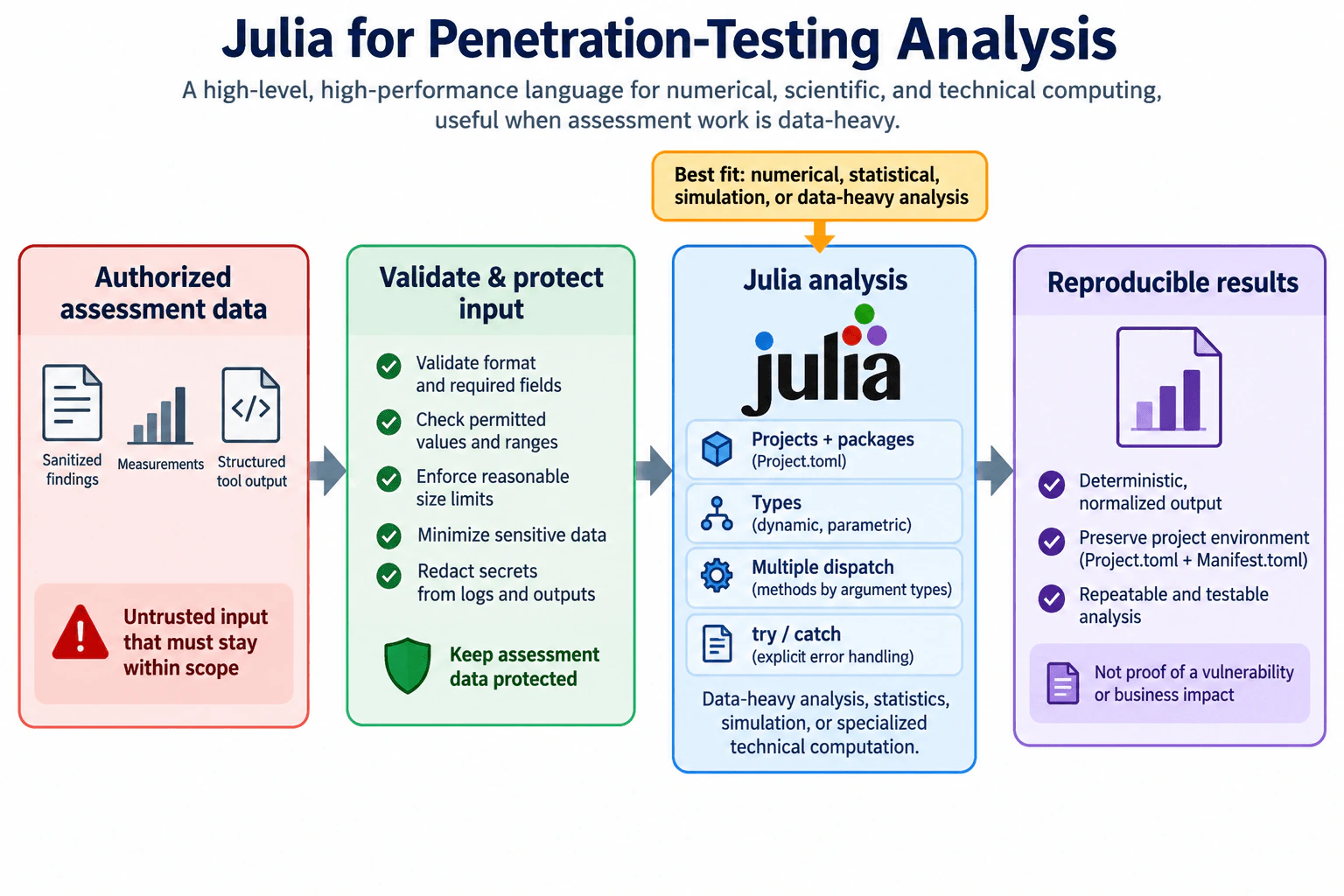
3. What is Julia, and when might it be useful in penetration-testing analysis?Language SpecificEasy

Question Details

Define Julia as a high-level, high-performance programming language for numerical and technical computing. Explain where a tester might encounter it in data-heavy analysis or specialized tooling, while covering projects, packages, types, multiple dispatch, error handling, reproducibility, input validation, and protection of assessment data.

Short Interview Answer (30-60 seconds)

Julia is a high-level, high-performance language for numerical and technical computing. I might use it for data-heavy penetration-testing analysis, simulations, or specialized tooling. I would keep the work reproducible with Julia projects, validate assessment inputs, handle errors explicitly, control dependencies, and protect sensitive testing data.

Detailed Explanation

See the Code while reading this explanation.

This question is mainly about deciding when Julia is a sensible analysis tool rather than treating it as a default penetration-testing language. Julia is a high-level programming language designed for numerical, scientific, and technical computing, with multiple dispatch as a core programming model. For an authorized tester, it can be useful when assessment work becomes data-heavy, mathematical, statistical, or computationally demanding. I would also explain how Julia projects and packages support reproducible work, how types organize data, and how input validation, explicit error handling, and secure handling of assessment data keep the workflow controlled.

Useful Questions to Ask the Interviewer
  1. Is the Julia use case mainly offline analysis of collected assessment data, or development of specialized testing tooling?
  2. What kinds of authorized data would the analysis receive, such as synthetic findings, measurements, or sanitized tool output?
  3. Are there restrictions on third-party Julia packages or requirements for reproducible environments?
  4. Does the assessment data have specific storage, retention, or access-control requirements?
What is Julia, and when might it be useful in penetration-testing analysis? diagram
How to Explain It in an Interview

I would start with the practical decision: Julia is useful when penetration-testing work needs strong numerical or technical-computing capabilities, but I would not choose it simply because it can produce fast native code. For routine shell automation or ordinary security-tool orchestration, a language already standardized by the team may be simpler. Julia becomes more attractive when I need to analyze large structured result sets, perform statistical calculations, model measurements, run simulations, or build specialized research-oriented analysis code.

Julia uses projects and environments to make dependencies explicit. Project.toml describes the project at a high level, including direct dependencies and compatibility constraints. Manifest.toml records the resolved dependency graph and exact package versions. Keeping the project and manifest with the analysis code allows another analyst to instantiate the same package environment, which improves reproducibility. Recreating the environment does not by itself prove that the original data, assumptions, or analysis logic were correct.

Packages provide reusable Julia functionality and are normally loaded with import or using. For assessment work, I would keep the dependency set small, use approved package sources, pin or preserve the resolved environment where reproducibility matters, and review important third-party dependencies according to the team's software-supply-chain requirements.

Julia is dynamically typed, but it also has a rich type system. I can define structures that represent important analysis concepts instead of passing loosely structured values everywhere. For example, a sanitized finding can have a category, severity, and confidence value. Type annotations are useful when they clarify interfaces, constrain representations, or support dispatch, but I would not add them everywhere without a reason.

Multiple dispatch is a central Julia feature. A generic function can have several methods, and Julia selects the most specific applicable method from the types of all arguments. In analysis tooling, that can keep related behavior under one operation while supporting different approved data representations. I would keep the method design simple and avoid ambiguous or unnecessary dispatch rules because they make code harder to review.

Assessment input should still be treated as untrusted data. Even output from an authorized security tool can be malformed, unexpectedly large, incomplete, or contain sensitive values. Before processing it, I would validate the expected format, required fields, permitted values, numeric ranges, and reasonable size limits. I would reject invalid records or quarantine them for review rather than silently coercing them into apparently valid evidence.

For failures, Julia supports exceptions with throw and try/catch, and finally can be used for cleanup that must run whether an operation succeeds or fails. I would catch errors only where the analysis can make a safe and explicit decision. A malformed record, for example, may be rejected with a structured reason, while an unexpected system or logic error should normally stop the affected analysis path rather than being hidden and reported as success.

Reproducibility also requires more than package versions. I would preserve the analysis code, relevant configuration, Julia version information when needed, sanitized or synthetic test fixtures, and the project environment. Output that will be compared between runs should use deterministic normalization and ordering where practical. Tests should include valid records, malformed input, boundary values, empty input, and regression cases.

Assessment data is a separate security boundary. I would collect only what the analysis needs, keep raw evidence separate from synthetic development fixtures, restrict access to authorized personnel, avoid printing secrets or sensitive values into logs, and follow the engagement's storage, retention, transfer, and secure-disposal requirements. Test fixtures should use synthetic or sanitized values whenever real evidence is unnecessary.

The main tradeoff is operational fit. Julia offers strong numerical-computing capabilities and expressive abstractions, but adding another language and package ecosystem creates training, dependency-management, review, and maintenance costs. For a small parsing or orchestration task, that overhead may not be justified. For substantial numerical, statistical, simulation, or specialized technical analysis, Julia can be a strong choice. Using Julia improves how data is analyzed; it does not itself demonstrate a vulnerability, prove business impact, or expand the authorized scope of a penetration test.

Key Insight / Why This Solution Works
  1. Confirm that Julia provides a real advantage for the authorized analysis, such as numerical, statistical, simulation, or data-heavy computation.
  2. Define the expected input format and use only assessment data permitted by the rules of engagement.
  3. Create a dedicated Julia project and make required dependencies explicit.
  4. Preserve Project.toml and the resolved Manifest.toml when reproducibility matters.
  5. Represent important analysis concepts with clear Julia types where that improves correctness, readability, or dispatch behavior.
  6. Validate file format, size, required fields, permitted values, numeric ranges, and other untrusted inputs before processing them.
  7. Use multiple dispatch only where different data representations genuinely need different implementations.
  8. Handle expected errors explicitly and fail safely on unexpected or malformed input instead of manufacturing a successful result.
  9. Normalize and deterministically order outputs when stable comparison or regression testing is needed.
  10. Minimize retained evidence, redact secrets from logs and outputs, and protect assessment data according to the engagement requirements.
  11. Test with synthetic positive, negative, malformed, empty, boundary, and regression cases.
Example

This safe Julia example analyzes only synthetic finding records. A struct gives each record a defined shape. Multiple dispatch provides separate scoring behavior for different severity value types represented with Val. The constructor validates permitted severity values, confidence boundaries, and category size before a record enters the analysis. The analysis catches expected validation failures, records only a non-sensitive error type, and sorts output deterministically. It performs no network requests, subprocess execution, credential handling, exploitation, or interaction with real targets.

Code
# Safe Julia example: analyze synthetic assessment records only.

# A common abstract type lets related finding records share one interface.
abstract type AbstractFinding end

# A concrete type gives each accepted record a predictable representation.
struct Finding <: AbstractFinding
    category::String
    severity::Symbol
    confidence::Float64
end

# Validate externally supplied values before they influence the analysis.
function make_finding(category::AbstractString, severity::Symbol, confidence::Real)
    allowed_severities = (:info, :low, :medium, :high)
    severity in allowed_severities || throw(ArgumentError("unsupported severity"))

    c = Float64(confidence)
    isfinite(c) || throw(ArgumentError("confidence must be finite"))
    0.0 <= c <= 1.0 || throw(ArgumentError("confidence must be between 0 and 1"))

    clean_category = strip(String(category))
    isempty(clean_category) && throw(ArgumentError("category must not be empty"))
    length(clean_category) <= 80 || throw(ArgumentError("category is too long"))

    return Finding(clean_category, severity, c)
end

# Multiple dispatch selects the method for the severity value type.
severity_score(::Val{:info}, confidence::Float64) = 0.0
severity_score(::Val{:low}, confidence::Float64) = 1.0 * confidence
severity_score(::Val{:medium}, confidence::Float64) = 2.0 * confidence
severity_score(::Val{:high}, confidence::Float64) = 3.0 * confidence

# Convert the validated severity symbol into a Val instance for dispatch.
function severity_score(f::Finding)
    return severity_score(Val(f.severity), f.confidence)
end

function analyze_synthetic(rows)
    findings = Finding[]
    rejection_types = String[]

    for row in rows
        try
            # Validate each synthetic record before accepting it.
            push!(findings, make_finding(row.category, row.severity, row.confidence))
        catch err
            # Record only the error type so input contents are not copied into logs.
            push!(rejection_types, string(typeof(err)))
        end
    end

    # Stable ordering makes repeated runs easier to compare and test.
    sort!(findings; by = f -> (f.category, String(f.severity), f.confidence))

    return (
        accepted = length(findings),
        rejected = length(rejection_types),
        total_score = sum(severity_score, findings; init = 0.0),
        findings = findings,
        rejection_types = rejection_types,
    )
end

# Synthetic fixture only; never substitute real assessment secrets here.
fixture = [
    (category = "synthetic-web", severity = :medium, confidence = 0.90),
    (category = "synthetic-config", severity = :low, confidence = 0.75),
    (category = "synthetic-invalid", severity = :unknown, confidence = 0.50),
]

result = analyze_synthetic(fixture)
println("accepted=", result.accepted, " rejected=", result.rejected)
println("total_score=", result.total_score)
Where it is used

Julia can be useful in authorized penetration-testing work when a tester needs to process substantial collections of sanitized findings or measurements, perform statistical analysis of assessment observations, model technical behavior, run simulations, analyze timing or performance measurements, or develop specialized research tooling with meaningful numerical computation. It is less compelling for a simple wrapper around existing command-line tools when a language already standardized by the team can perform the job more simply.

Why Interviewers Ask This

The interviewer wants to know whether I understand what Julia is, where it fits compared with more common scripting languages, and whether I can use its language and package features safely for security analysis. They also want to see judgment around reproducibility, input handling, failures, dependencies, and protection of sensitive penetration-testing data.

Common interview mistakes

Common mistakes are describing Julia simply as a faster replacement for Python, choosing it for every security automation task, or ignoring why its numerical and technical-computing strengths matter to the specific analysis. Another mistake is saying dynamic typing means Julia has no useful type system; Julia supports abstract, primitive, composite, parametric, and other types, and method dispatch uses argument types. Testers can also overuse multiple dispatch, lose reproducibility by relying on an uncontrolled global environment, accept malformed tool output without validation, swallow exceptions and produce misleading results, make unsupported performance claims, or place credentials and sensitive assessment evidence in logs, source code, notebooks, or test fixtures.

Interview tip

Lead with the decision: choose Julia when the assessment has meaningful numerical, statistical, simulation, or data-heavy analysis needs. Then explain projects and packages for reproducibility, types and multiple dispatch for organized logic, and input validation plus explicit error handling for safe processing. Finish by stating that Julia is a tool choice whose additional ecosystem and maintenance cost must be justified.

Interviewer may ask next
How do Julia's types and multiple dispatch help when building analysis tooling?

Julia is dynamically typed, but I can define abstract and concrete types to represent meaningful analysis concepts. A generic function can then have several methods, and Julia chooses the most specific applicable method from the types of all arguments. That can keep specialized analysis behavior organized without large chains of manual type checks. I would use it only where the data representations genuinely need different behavior, because excessive or ambiguous methods make the program harder to review and maintain.

What is an important limitation or tradeoff of using Julia for penetration-testing analysis?

The main tradeoff is ecosystem and operational fit. Julia can be a strong choice for substantial numerical or scientific computation, but a security team may already standardize on other languages and tooling. Introducing Julia means maintaining another runtime, dependency set, environment, review process, and skill set. It can also have startup and compilation overhead before optimized code runs. I would therefore choose it only when its analytical strengths materially help the task, while preserving the project environment and continuing to validate and protect all assessment data.

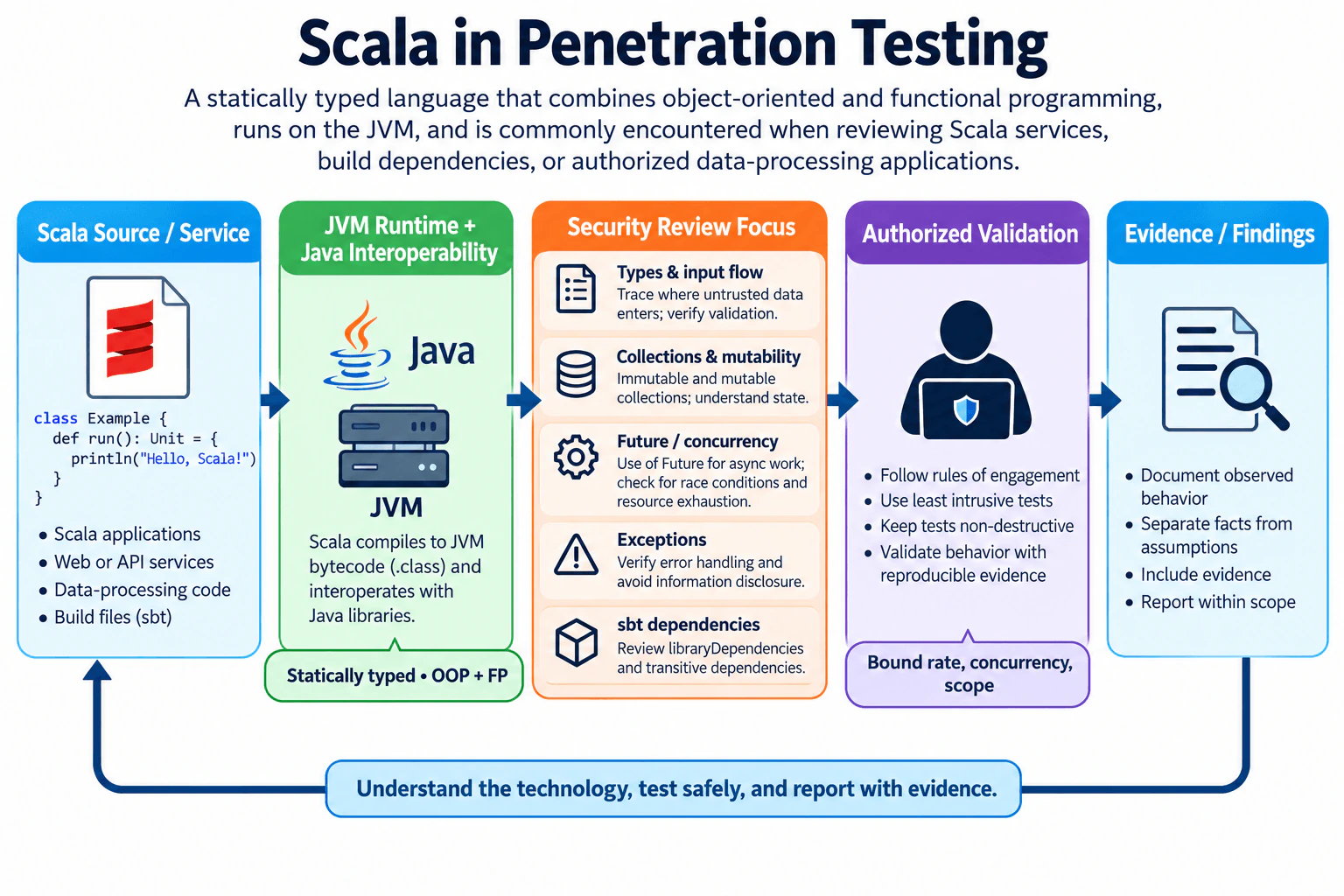
4. What is Scala, and why might a Penetration Tester encounter it?Language SpecificEasy

Question Details

Define Scala as a statically typed language that combines object-oriented and functional programming on the JVM. Explain its relevance when reviewing Scala services or processing authorized assessment data in JVM and distributed-data environments. Cover types, collections, immutability, concurrency, build dependencies, exception handling, and safe test boundaries.

Short Interview Answer (30-60 seconds)

Scala is a statically typed language that combines object-oriented and functional programming and works closely with the JVM and Java ecosystem. A Penetration Tester may encounter it in Scala services, build dependencies, or distributed-data systems and should understand its types, collections, concurrency, exceptions, and safe testing boundaries.

Detailed Explanation

This question asks whether I understand what Scala is and why it matters during penetration testing. Scala is a statically typed language combining object-oriented and functional programming, and in JVM applications it compiles to JVM bytecode and interoperates closely with Java. A tester may therefore encounter Scala source, compiled JVM services, libraries, build definitions, or data-processing components. I should understand Scala's types, collections, immutable and mutable state, concurrency, dependencies, and exception behavior well enough to review them accurately while keeping every assessment authorized, bounded, non-destructive, and supported by reproducible evidence.

Useful Questions to Ask the Interviewer
  1. Am I reviewing Scala source code, a compiled JVM service, or both?
  2. Is the task application review, dependency review, or processing authorized assessment data?
  3. What systems and test actions are explicitly permitted by the rules of engagement?
  4. Does the application use concurrent or distributed processing that requires stricter request-rate or concurrency limits?
What is Scala, and why might a Penetration Tester encounter it? diagram
How to Explain It in an Interview

I would start by defining Scala. It is a general-purpose, statically typed programming language. Statically typed means the compiler checks many type relationships before the program runs. Scala supports object-oriented programming through classes, objects, and traits, while also supporting functional programming concepts such as first-class functions, higher-order functions, pattern matching, and transformations that can favor immutable values. In the JVM environment relevant to this question, Scala code can compile to JVM class files and interoperate directly with Java libraries and APIs.

That JVM relationship matters to a Penetration Tester. A Scala application may depend on Java libraries and other JVM components, so reviewing a Scala service can require understanding both Scala source and the surrounding JVM ecosystem. I would not assume that behavior is secure or vulnerable merely because it is written in Scala. I would follow actual inputs, transformations, trust boundaries, authorization decisions, dependencies, and runtime behavior.

Types are one useful review point. Scala's type system catches many type-related mistakes at compile time, but static typing is not the same as security validation. Untrusted input can still reach a sensitive operation when validation, authorization, or business logic is incorrect. I would identify where untrusted data enters, what type conversions or parsing occur, and where the data crosses a trust boundary instead of treating type safety as proof of safe input handling.

Collections are also common in Scala. Lists, sequences, sets, maps, and related collection abstractions are often used to transform application or assessment data. Scala distinguishes immutable collections from mutable collections. Immutable collections do not change in place; operations that conceptually add, remove, or update elements return another collection. Mutable collections can change in place. When reviewing mutable collections, I pay more attention to which code can modify shared state and whether concurrency can make the resulting behavior difficult to predict.

Immutability is broader than collections. A val prevents reassignment of that reference, while a var permits reassignment. However, a val can still refer to an object whose internal state is mutable. I therefore inspect the actual object's behavior instead of assuming that every val means all reachable data is immutable.

Concurrency matters because Scala applications may perform asynchronous or parallel work. Scala's standard library includes Future, which represents a computation that may later complete successfully with a value or fail with an exception. When reviewing concurrent code, I look for shared mutable state, unsafe assumptions about execution order, unobserved asynchronous failures, missing timeout handling, and resource-exhaustion risks. During an authorized assessment, I also bound my own request rate and concurrency so the test itself does not create an availability problem, especially in production or distributed-data systems.

Build dependencies are another important area. Scala projects commonly use sbt, where managed libraries can be declared through libraryDependencies. Dependency resolution can also bring in transitive dependencies, so I would inspect the resolved dependency tree rather than reviewing only direct declarations. A dependency's presence or version alone does not prove exploitability. I would verify the resolved version, affected functionality, actual use, configuration, reachability, and reproducible behavior before reporting security impact.

Exception handling tells me how the application behaves when operations fail. Scala supports normal JVM exception handling with constructs such as try, catch, and finally, while asynchronous computations such as Future can complete with exceptions as failures. I would review whether expected errors are handled safely, whether sensitive internal information reaches responses or logs, whether asynchronous failures are observed, and whether failure paths leave the application in a safe state. I would not deliberately trigger destructive failure conditions outside the agreed test scope.

A Penetration Tester might also use Scala to process authorized assessment data when the organization already works in the Scala or JVM ecosystem. Collections and functional transformations can help normalize approved datasets. In that case, I would define the input and output formats, reject malformed input safely, preserve deterministic output where practical, minimize sensitive data, redact reusable secrets from logs, and keep any network activity restricted to explicitly approved targets.

The main tradeoff is that Scala provides expressive abstractions, compile-time type checking, and strong support for immutable programming, but none of those features removes authorization, dependency, runtime, concurrency, configuration, or business-logic risk. Immutable patterns can make state easier to reason about, while advanced type features, asynchronous code, contextual abstractions, and large dependency graphs can increase review complexity for someone unfamiliar with the codebase. My security conclusion therefore comes from observed application behavior and reproducible evidence, not from language features alone.

Technical Approach
  1. Confirm whether the authorized target is Scala source, a JVM service, build configuration, or assessment-data processing code.
  2. Identify the permitted inputs, outputs, identities, trust boundaries, and testing actions.
  3. Review Scala-specific behavior relevant to the target, including types, collections, mutable state, asynchronous execution, exception paths, and input parsing.
  4. Inspect the build configuration and resolved dependency tree when dependencies are relevant.
  5. Validate suspected behavior using the least intrusive reproducible test allowed by the rules of engagement.
  6. Bound request rates, retries, timeouts, and concurrency, especially for production or distributed systems.
  7. Capture necessary evidence while minimizing sensitive data and redacting reusable secrets.
  8. Separate demonstrated behavior from assumptions, record limitations, and stop testing when an agreed safety boundary is reached.
Practical Complexity & Trade-offs

Scala's compile-time type checking and immutable programming patterns can make some mistakes easier to prevent or reason about, but they do not replace security testing. For a tester, an important human cost is learning enough Scala and JVM behavior to follow the code correctly. Large dependency trees increase review and maintenance work. Concurrent or distributed applications need more operational care because excessive requests or parallel work can affect availability. Tests should therefore use explicit scope, safe request rates, bounded concurrency, timeouts, and stop conditions. Privacy or compliance costs depend on the actual assessment data and environment, not on Scala itself.

Where it is used

A Penetration Tester may encounter Scala while reviewing an authorized JVM-based web service or API, reading Scala source during secure code review, inspecting an sbt build and its resolved dependencies, examining asynchronous application behavior, or reviewing approved data-processing software in a Scala or JVM-based distributed-data environment. Scala may also be used internally to normalize synthetic or explicitly authorized assessment results when it fits the organization's existing JVM toolchain.

Why Interviewers Ask This

Interviewers want to know whether the candidate can recognize Scala, understand its JVM and programming-model characteristics, and apply that knowledge when reviewing Scala applications or safely processing assessment data. They are also checking whether the tester understands that language features alone do not prove a vulnerability and that findings require authorized, reproducible evidence.

Common interview mistakes

Common mistakes are describing Scala only as Java with functional features, assuming static typing prevents security vulnerabilities, assuming every val makes the referenced object fully immutable, ignoring mutable collections or shared state in concurrent code, treating Future as automatically safe concurrency, reviewing only direct dependencies instead of resolved transitive dependencies, or treating an exception as proof of a vulnerability. Another mistake is reporting a dependency as exploitable only because its version appears affected without confirming the resolved version, relevant code path, configuration, reachability, runtime conditions, and authorized evidence. Testers should also avoid uncontrolled concurrency or destructive testing outside explicit scope.

Interview tip

Start with one clear definition: Scala is a statically typed language combining object-oriented and functional programming and, in JVM applications, interoperates closely with Java. Then connect it to what a Penetration Tester reviews: types and data flow, collections and mutability, concurrency, exceptions, and JVM dependencies. Finish by emphasizing that language features guide the review, while authorized and reproducible evidence determines the finding.

Interviewer may ask next
How does Scala's immutability help when reviewing security-sensitive or concurrent code?

Immutable values and collections reduce the number of places where shared data can unexpectedly change, which can make data flow and concurrent behavior easier to reason about. Scala distinguishes immutable and mutable collections, and val prevents reassignment of a reference. However, immutability is not a security control by itself. A val can still refer to a mutable object, and immutable code can still contain authorization, validation, dependency, configuration, or business-logic flaws. I would verify the actual data flow and runtime behavior rather than treating immutability as proof of security.

What would you check first when reviewing the dependencies of a Scala service?

I would identify the project's build configuration and inspect the dependencies actually resolved for the application. In an sbt project, that includes direct entries such as libraryDependencies and the resolved dependency tree so transitive libraries and version resolution are visible. I would then confirm the exact relevant version and how the library is used before making a security conclusion. A dependency version by itself does not prove exploitability; affected functionality, reachability, configuration, runtime conditions, and reproducible authorized evidence still matter.

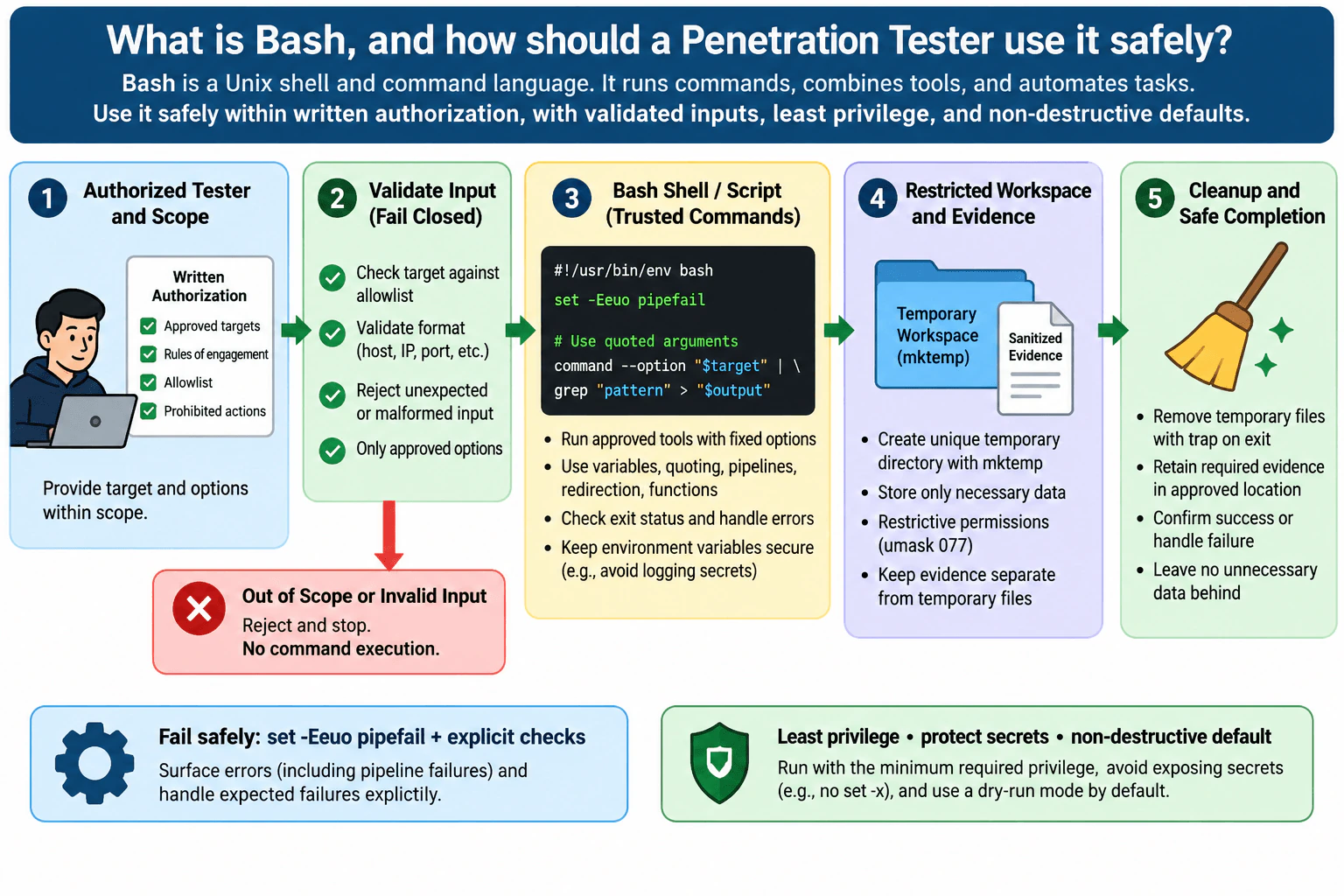
5. What is Bash, and how should a Penetration Tester use it safely?Language SpecificEasy

Question Details

Define Bash as a Unix shell and command language. Explain commands, pipelines, variables, quoting, redirection, functions, exit status, and environment handling. Connect Bash to authorized test orchestration and parsing while covering strict error handling, untrusted-input validation, safe quoting, temporary files, least privilege, secret protection, and non-destructive defaults.

Short Interview Answer (30-60 seconds)

Bash is a Unix shell and command language for running and combining commands. I use it for authorized test orchestration and parsing, but I validate scope, quote variables, handle failures carefully, protect secrets, use safe temporary files, keep least privilege, and default to non-destructive behavior.

Detailed Explanation

See the Code while reading this explanation.

The question asks whether I understand Bash itself and whether I can use it safely during an authorized penetration test. Bash is a Unix shell and command language. It reads commands, expands variables, connects programs with pipelines, redirects input and output, supports functions, and reports success or failure through exit status. For penetration testing, the practical decision is to use Bash as a controlled orchestration layer around approved tools, not as permission to run arbitrary commands. Safety depends on strict scope checking, careful quoting, validated inputs, least privilege, protected secrets, predictable error handling, and non-destructive defaults.

Useful Questions to Ask the Interviewer
  1. What systems, hosts, or test fixtures are explicitly inside the authorized scope?
  2. Are there commands or actions that the rules of engagement prohibit even on in-scope systems?
  3. Should the script only parse existing output, or may it also launch approved test commands?
  4. What evidence should the script retain, and what information must be redacted or deleted afterward?
  5. Are there required rate limits, stop conditions, maintenance windows, or privilege restrictions?
What is Bash, and how should a Penetration Tester use it safely? diagram
How to Explain It in an Interview

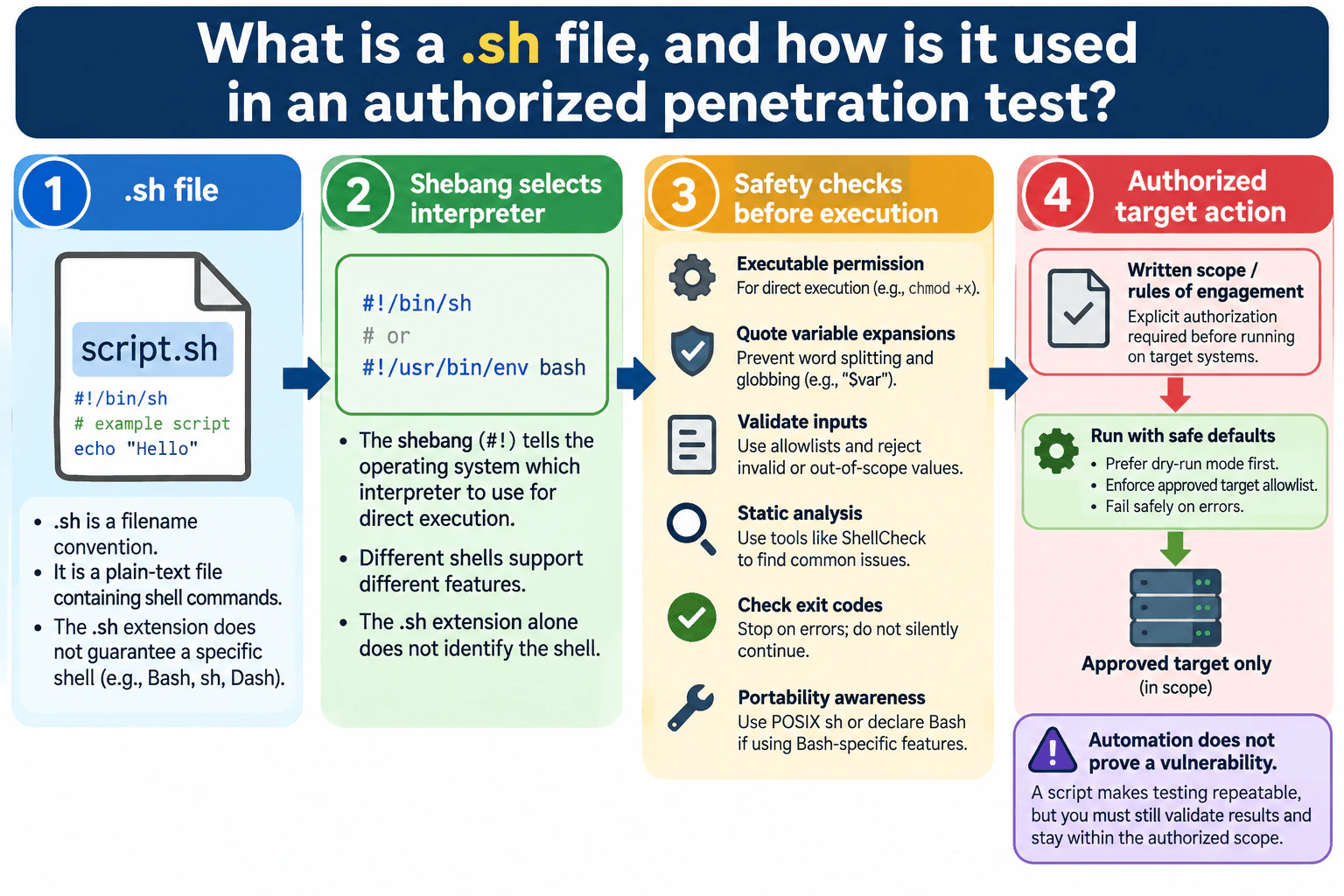
I would start by defining Bash. Bash is both an interactive Unix shell and a command language. The shell reads command text, performs expansions, starts programs, connects their input and output, and returns an exit status. Bash scripts often use the .sh extension, but Bash does not require that extension. A script can be run by explicitly invoking Bash, such as bash script.sh, or it can be executed directly when the file is executable and its shebang selects the intended interpreter.

1. Commands and arguments

A simple Bash command has a command name followed by arguments. For example, printf '%s\n' "$target" calls printf and passes the expanded value of target as one argument. The important security point is that data should remain data. I do not build a command string from untrusted text and then evaluate it. I pass validated values as separate, quoted arguments to known commands.

2. Pipelines

A pipeline connects the output of one command to the input of the next command with |. This is useful for safe parsing and normalization. For example, an authorized tester might take output already produced by an approved tool and filter it with utilities such as grep, awk, sed, or sort. By default, Bash normally uses the exit status of the last command in a pipeline. With set -o pipefail, the pipeline instead returns failure when an earlier command fails, using the status of the rightmost command that exited nonzero. I still handle expected failures explicitly rather than assuming the shell options understand my intent.

3. Variables and quoting

Bash variables commonly hold text values, and expansion rules determine how those values are interpreted. Unquoted parameter expansion can undergo word splitting and pathname expansion. Therefore, I normally use "$variable" when passing a value as one argument. I also avoid eval for data-driven command construction because it causes another round of shell parsing and can turn attacker-controlled characters into shell syntax.

Single quotes preserve enclosed characters literally except that a single quote cannot appear directly inside single-quoted text. Double quotes still allow selected expansions such as parameter expansion and command substitution while preventing ordinary word splitting and pathname expansion of the resulting value. I choose the quoting style based on whether expansion is intentionally required. When I need a list of command arguments, I use a Bash array and expand it with "${array[@]}" so each array element remains a separate argument.

4. Redirection

Bash can redirect standard input, standard output, and standard error. Examples include >, >>, <, and 2>. Redirection is useful for evidence capture, but > can overwrite an existing file. For penetration testing, I write only to an approved working directory, avoid predictable privileged paths, use restrictive permissions, and make overwriting deliberate. I do not redirect sensitive command output into a world-readable location.

5. Functions

Functions let me group repeatable logic such as scope validation, logging, cleanup, or parsing. I keep functions small and give them clear inputs and outputs. A function should return a meaningful exit status rather than silently hiding failure. This makes the script easier to review before it is used in an authorized engagement.

6. Exit status and strict failure handling

Commands report an exit status. Status 0 conventionally means success, while a nonzero status indicates some kind of failure or alternate condition defined by the command. Bash exposes the previous command's status through $?, but I prefer control structures that test a command directly, such as if command; then ... fi, when I need to branch on success or failure.

For safety-focused automation, I may start with set -Eeuo pipefail. -e requests exit after certain unhandled command failures, -u treats expansion of an unset parameter as an error in many common cases, -o pipefail makes pipeline failures visible instead of relying only on the final command, and -E causes the ERR trap to be inherited by shell functions, command substitutions, and subshell environments. These options improve failure visibility, but they are not a complete safety mechanism. Bash deliberately suppresses or changes errexit behavior in several conditional and compound-command contexts, so expected and important failure paths still need explicit checks.

7. Environment handling

Environment variables are inherited by child processes and are convenient for configuration, but they are not automatically a secure secret store. I do not print the entire environment into logs because it may contain credentials, tokens, proxy values, or other sensitive information. I export only values that child processes actually need, avoid putting secrets into command lines or logs when possible, unset temporary sensitive shell variables when useful, and keep tracing such as set -x disabled around sensitive values because tracing can expose expanded commands and arguments.

8. Validate untrusted input before using it

Hostnames, IP addresses, file names, ports, tool output, and operator-supplied arguments should be treated as untrusted until validated. The strongest control is not clever escaping; it is narrowing the accepted input. For example, a script can require that a target exactly match an entry in an approved allowlist. If the value does not match, the script should fail closed before launching any test command.

I also use -- where a command supports the end-of-options convention before passing data that could begin with a dash. This reduces the risk that a data value is interpreted as an option. Because support for -- is command-specific, I verify the behavior of the exact utility rather than assuming every command accepts it.

9. Safe temporary files

I do not create temporary files with predictable names such as /tmp/results.txt. Predictable names can create collisions or unsafe interactions with files created by another process. I use mktemp where available to obtain a unique temporary file or directory, set a restrictive umask, store only the minimum required data, and register cleanup with trap so temporary artifacts are removed when the script exits. I also keep evidence that must be retained separate from disposable temporary data so cleanup does not accidentally delete required records.

10. Least privilege

The script should run as the least-privileged identity that can perform the approved task. I do not run an entire penetration-testing orchestration script with elevated privilege simply because one possible operation might require it. If a privileged action is explicitly authorized and necessary, I isolate that requirement, make the privilege boundary obvious, and avoid carrying elevated privilege into unrelated parsing or evidence-processing steps.

11. Non-destructive defaults

A safe penetration-testing script should default to planning, validation, parsing, or low-impact collection. Actions that could change state or affect availability should require an explicit operator choice and authorization. A useful pattern is a --dry-run mode that shows the validated intended action without running the operational command. Dry-run is only a preview; it does not prove that the real command will succeed or be harmless. Immediately before execution, the script should enforce the target allowlist and other stop conditions again where state could have changed.

12. Evidence and validation

For evidence, I record structured facts such as timestamp, approved target, operation name, exit status, and sanitized output location. I avoid logging secrets and unnecessary sensitive content. I validate the script first against synthetic inputs: one allowed target, one denied target, malformed input, option-like input beginning with -, empty values, a simulated command failure, and temporary-file cleanup. I also test any timeout or interruption behavior that the real wrapper implements. This gives positive, negative, boundary, malformed-input, failure, and regression coverage without depending on a real vulnerability.

Example flow

A safe Bash orchestration flow is: operator supplies a target -> script validates that target against the authorized allowlist -> script keeps the executable and fixed options in trusted code and passes validated data as quoted arguments -> dry-run shows the intended action -> explicit execution runs the approved non-destructive command -> output is written to a restricted workspace -> exit status is checked -> sanitized evidence that must be retained is moved or copied to its approved evidence location -> temporary artifacts are cleaned up.

The main tradeoff is convenience versus control. Bash makes short automation fast to write and integrates naturally with Unix command-line tools. However, its expansion, quoting, redirection, and error-handling rules make unsafe command construction easy. For complex data structures, heavy concurrency, complicated parsing, or large software projects, another language may be easier to maintain and test safely. Bash is a good choice when the workflow is small, transparent, command-oriented, and carefully bounded.

Key Insight / Why This Solution Works
  1. Confirm written authorization, approved targets, prohibited actions, rate limits, stop conditions, and allowed privilege level.
  2. Accept the target and other operator inputs only through clearly defined parameters.
  3. Validate the target against an exact allowlist before constructing or launching an operational test command.
  4. Reject empty, malformed, unexpected, or out-of-scope input.
  5. Keep the executable and fixed options in trusted script code; pass validated values as separately quoted arguments or array elements.
  6. Enable appropriate strict shell options and explicitly handle expected or safety-critical failures.
  7. Default to dry-run or another non-destructive mode and require an explicit flag for approved execution.
  8. Create a restricted temporary workspace with mktemp and a restrictive umask.
  9. Run with least privilege and avoid unnecessary environment inheritance or secret exposure.
  10. Capture sanitized evidence, command outcome, and exit status in the approved evidence location.
  11. Remove disposable temporary artifacts with a trap while preserving evidence that must be retained.
  12. Validate behavior with synthetic allowed, denied, malformed, option-like, failure, interruption, and cleanup cases before authorized use.
Example

This Bash example demonstrates a safe orchestration pattern using synthetic targets only. It does not exploit anything or assume a vulnerability. It enables strict error behavior, uses a restrictive file-creation mask, validates the requested target against a fixed authorization allowlist, keeps command construction in an array so arguments remain separate, defaults to dry-run mode, creates a unique temporary directory with mktemp, avoids environment dumps and command tracing, checks the command outcome, and removes disposable temporary files with trap. The executable action is only Bash's printf builtin, so the example remains non-destructive while showing controls that should wrap an approved testing command.

Code
#!/usr/bin/env bash

# Stop on many unhandled failures, reject unset variables,
# inherit ERR traps where applicable, and detect pipeline failures.
set -Eeuo pipefail

# New files created by this script should be private by default.
umask 077

# This demonstration intentionally uses synthetic authorized targets only.
readonly -a ALLOWED_TARGETS=(
  "app01.test.invalid"
  "app02.test.invalid"
)

# Print usage without exposing environment variables or secrets.
usage() {
  printf 'Usage: %s --target TARGET [--execute]\n' "$0" >&2
}

# Return success only when the complete target exactly matches
# one entry in the authorization allowlist.
is_allowed_target() {
  local requested=$1
  local allowed

  for allowed in "${ALLOWED_TARGETS[@]}"; do
    if [[ "$requested" == "$allowed" ]]; then
      return 0
    fi
  done

  return 1
}

# Default to dry-run so the operational action is not executed accidentally.
target=''
execute=false

while (($# > 0)); do
  case $1 in
    --target)
      # Require a following value before reading it.
      if (($# < 2)); then
        usage
        exit 2
      fi
      target=$2
      shift 2
      ;;
    --execute)
      execute=true
      shift
      ;;
    --)
      shift
      break
      ;;
    *)
      printf 'Rejected unknown argument: %s\n' "$1" >&2
      usage
      exit 2
      ;;
  esac
done

# Reject unexpected positional arguments after the option parser.
if (($# > 0)); then
  printf 'Unexpected positional arguments were supplied.\n' >&2
  usage
  exit 2
fi

# Reject missing input before constructing any command.
if [[ -z "$target" ]]; then
  printf 'A target is required.\n' >&2
  exit 2
fi

# Fail closed when the target is not explicitly authorized.
if ! is_allowed_target "$target"; then
  printf 'Target is outside the authorized allowlist.\n' >&2
  exit 3
fi

# Create a unique private workspace instead of a predictable /tmp path.
workdir=$(mktemp -d)

# Always remove disposable temporary data when the script exits.
cleanup() {
  rm -rf -- "$workdir"
}
trap cleanup EXIT HUP INT TERM

# Keep trusted command elements and validated data as separate array entries.
# printf is harmless and stands in for a separately approved testing command.
command=(printf 'Authorized synthetic check for target: %s\n' "$target")

if [[ "$execute" != true ]]; then
  # Dry-run prints shell-escaped arguments without executing the command.
  printf 'DRY RUN:'
  printf ' %q' "${command[@]}"
  printf '\n'
  exit 0
fi

# Capture only harmless synthetic output inside the restricted workspace.
evidence_file="$workdir/evidence.txt"

if "${command[@]}" > "$evidence_file"; then
  printf 'Synthetic authorized action completed successfully.\n'
  printf 'Temporary evidence path: %s\n' "$evidence_file"
else
  status=$?
  printf 'Authorized action failed with exit status %d.\n' "$status" >&2
  exit "$status"
fi

# A real engagement should copy only approved, sanitized evidence that must
# be retained to its controlled evidence store before the EXIT trap runs.
# Do not dump the environment or enable command tracing around secrets.
Where it is used

Bash is useful in authorized penetration testing for small command-oriented workflows such as validating an engagement target against an allowlist, launching a pre-approved low-impact tool with fixed options, chaining Unix utilities to normalize existing output, checking exit statuses, collecting sanitized evidence, preparing restricted temporary workspaces, and cleaning disposable test artifacts. It is also useful for repeatable local test-fixture setup or post-processing when the workflow is transparent and does not require complex application logic.

Why Interviewers Ask This

Interviewers want to know whether the candidate understands Bash as more than a list of commands. A Penetration Tester often uses shells to coordinate approved tools, filter command output, collect evidence, and automate repetitive work. The important judgment is whether the tester can do that without introducing command injection, accidental expansion, secret leakage, unsafe file handling, privilege mistakes, or destructive behavior outside the approved rules of engagement.

Common interview mistakes

Common mistakes are treating Bash input as trusted, building command strings and passing them to eval, leaving variables unquoted, forgetting that unquoted expansion can split words and expand pathnames, assuming set -e catches every possible failure, ignoring failures inside pipelines, assuming every utility supports --, writing evidence to predictable or overly permissive temporary files, logging the whole environment, enabling set -x around secrets, running the whole script as root unnecessarily, accepting targets without an exact authorization check, deleting evidence that must be retained during cleanup, and making disruptive behavior the default instead of an explicit approved action. Another mistake is using Bash after a workflow has grown too complex to review and test safely.

Interview tip

Lead with the safety decision: Bash is useful for small authorized orchestration tasks, but shell expansion makes careless automation risky. Then explain quoting, exact scope validation, strict but explicit failure handling, safe temporary files, least privilege, secret protection, exit-status checking, and non-destructive defaults. A short safe example is stronger than listing many shell commands.

Interviewer may ask next
Why is quoting variables so important in Bash?

Because Bash performs expansions before a command runs. An unquoted variable expansion can be split into multiple words and can trigger pathname expansion, changing the intended argument boundaries. I normally pass data as "$value" and use arrays such as "${args[@]}" for command arguments. I also avoid constructing a string and evaluating it with eval. Validation is still required because quoting protects shell argument boundaries but does not prove that a target or value is authorized or semantically safe.

Is `set -Eeuo pipefail` enough to make a Bash penetration-testing script safe?

No. It improves failure visibility, but it does not enforce authorization, validate targets, protect secrets, limit privilege, prevent unsafe tool options, create safe temporary files, or guarantee non-destructive behavior. Bash also has contexts where errexit does not behave like a simple 'stop on every error' rule. I use strict options as one layer, then add explicit input validation, exact allowlists, quoted arguments, command-specific error checks, cleanup, safe evidence retention, and synthetic tests of expected failure paths.

6. What is a .sh file, and how is it used in an authorized penetration test?Language SpecificEasy

Question Details

Define a .sh file as a conventional filename for a shell script rather than a language guarantee. Explain the importance of the shebang, the selected shell, executable permissions, portability, quoting, exit codes, ShellCheck-style validation, controlled inputs, and explicit authorization before commands act on target systems.

Short Interview Answer (30-60 seconds)

A .sh file usually contains shell commands, but the extension alone does not define the interpreter. I verify the shebang and target shell, quote inputs, handle exit codes, check portability and permissions, run ShellCheck-style validation, and require explicit authorization before any command touches an approved target.

Detailed Explanation

See the Code while reading this explanation.

The practical decision is to treat a .sh file as a shell-script file whose real behavior depends on the interpreter that reads it, not on its filename extension. Before using one in a penetration test, I identify the intended shell, inspect the shebang, confirm how it will be invoked, validate its inputs, and verify that target-facing actions are explicitly authorized. I also review quoting, exit handling, portability, permissions, and static-analysis findings. The goal is controlled, repeatable automation that stays inside scope and fails safely instead of executing unintended commands or silently continuing after an error.

Useful Questions to Ask the Interviewer
  1. Which shell is expected to run the script, such as POSIX sh, Bash, Dash, or Ksh?
  2. Will the script only process local test data, or may it run commands against approved target systems?
  3. What target allowlist, test window, rate limits, credentials, and stop conditions are defined in the rules of engagement?
  4. Must the script be portable across different Unix-like systems, or may it depend on Bash-specific features?
What is a .sh file, and how is it used in an authorized penetration test? diagram
How to Explain It in an Interview

A .sh file is normally a plain-text file containing shell commands. The .sh suffix is only a filename convention. It does not prove that the script is written for POSIX sh, Bash, Dash, Ksh, or another shell. ShellCheck's official SC2148 documentation makes the same distinction: the .sh extension is too generic for ShellCheck to infer a specific target shell.

The next thing I inspect is the shebang, the first line beginning with #!. Examples include #!/bin/sh and #!/usr/bin/env bash. When an executable script is directly executed through the operating system's program-execution mechanism, the shebang identifies the interpreter to use. It also helps tools such as ShellCheck analyze the script using the intended shell's rules. This matters because different shells support different syntax and features.

I also distinguish direct execution from explicitly starting an interpreter. A command such as bash script.sh asks Bash to read the file and does not require the script itself to have its execute bit enabled, although the invoking user must be able to read it. Direct execution such as ./script.sh normally requires execute permission and a usable interpreter declaration. The GNU Bash manual describes shell scripts as text files containing shell commands and notes that a script can be made executable by enabling its execute bit.

In a penetration test, possession of a script is not authorization to run its commands. Written authorization and the rules of engagement define the boundary. Before target-facing execution, I confirm the approved targets, permitted actions, testing window, credentials or identity, rate limits, and stop conditions. The script should reject missing, malformed, or out-of-scope target information instead of guessing what the tester intended.

Inputs are an important security boundary in shell programming. Unquoted shell expansions may undergo word splitting and pathname expansion, which can change the arguments a command receives. ShellCheck's SC2086 guidance specifically warns about this behavior. I therefore quote expansions such as "$target" unless splitting or globbing is deliberately required and safely controlled.

I also avoid constructing a command as one large string from untrusted input and then passing it to eval. Shell syntax gives characters such as spaces, semicolons, redirects, substitutions, and metacharacters special meaning. If externally controlled text reaches a shell parser in the wrong context, it can become command injection. I instead keep the command fixed and pass validated values as separately quoted arguments.

Safe defaults are useful for penetration-testing automation. If a script can perform target-facing actions, a dry-run mode can first show the intended bounded operation without performing it. Moving from preview to execution should require an explicit decision, and the script should still enforce the approved target allowlist. A dry run improves safety but does not replace written authorization because it cannot prove that later execution is permitted.

Exit codes are also important. GNU Bash documents zero as successful command completion and nonzero as failure for the shell's purposes. A script should inspect the status of important commands and stop or report a clear failure when continuing would make the result unreliable or unsafe. Printed output alone is not proof that a command completed successfully.

Before operational use, I run static analysis such as ShellCheck. ShellCheck can identify many common shell problems, including unsafe unquoted expansions, shell-specific syntax used with the wrong interpreter, and portability mistakes. Static analysis is valuable evidence about code quality, but it cannot prove that a target is authorized, a security finding is valid, or executing a command is operationally safe.

I validate the script with synthetic inputs before using approved target data. Useful cases include an allowed value, an out-of-scope value, an empty input, a malformed input, an input containing spaces or shell metacharacters, an unknown option, and a simulated command failure. Expected behavior should be deterministic: valid inputs follow the planned path, rejected inputs cause no target action, and failures produce a clear nonzero status.

Portability is a tradeoff. Restricting a script to POSIX-compatible sh syntax can improve portability across systems that provide a conforming sh, while Bash-specific features can make some validation or data handling easier. If I intentionally use Bash features, I declare Bash as the interpreter and test the script under the Bash version provided by the authorized testing environment instead of assuming generic sh behavior.

Finally, a .sh script is automation, not proof of a vulnerability. It can make an authorized procedure repeatable and help capture consistent evidence, but I still validate the observed behavior, separate demonstrated facts from assumptions, protect sensitive output, use least privilege, and stop whenever an action would cross the approved testing boundary.

Technical Approach
  1. Read the .sh file and identify its intended interpreter from the shebang, documentation, or explicit invocation method.
  2. Confirm written authorization, approved targets, permitted actions, testing window, privileges, rate limits, and stop conditions.
  3. Decide whether the script will be invoked directly or through a named interpreter and verify the required file permissions.
  4. Review external inputs and validate them against expected formats and explicit target allowlists.
  5. Quote shell expansions and keep executable command names and control syntax separate from externally supplied data.
  6. Avoid eval and similar reparsing of externally controlled command strings.
  7. Use a dry-run or other non-destructive preview where it materially reduces operational risk.
  8. Check important exit codes and fail safely rather than silently continuing after errors.
  9. Run ShellCheck-style static analysis using the correct target shell.
  10. Test valid, invalid, empty, malformed, metacharacter-containing, and command-failure cases with synthetic data.
  11. Execute only explicitly approved target-facing actions and capture the minimum evidence needed for the assessment.
Practical Complexity & Trade-offs

A small shell script is usually fast to write and has low compute and memory cost, but its main costs are human review and operational risk. Shell parsing, quoting, environment differences, permissions, and dependencies on external commands can make a short script behave differently across systems. Static analysis and synthetic tests add a little development and maintenance work but improve reliability. POSIX-style syntax can improve portability, while Bash-specific features may make implementation easier but add an interpreter dependency. Compliance and security costs increase when scripts handle credentials, sensitive evidence, or production targets, so those inputs and outputs should be minimized and protected.

Example

This Bash example demonstrates the requested safety concepts without performing scanning, exploitation, or any network action. The shebang explicitly selects Bash. The script accepts one synthetic target and an optional mode, validates the target against a fixed allowlist, quotes expansions, defaults to dry-run behavior, checks invalid inputs through nonzero exit codes, and requires a separate execution acknowledgement before entering execution mode. Its execution path performs only a harmless local printf command. Any replacement with a real target-facing command would require separate review and explicit authorization.

Code
#!/usr/bin/env bash

# Treat use of an unset variable as an error.
set -u

usage() {
  printf 'Usage: %s TARGET [--execute]\n' "$0" >&2
  exit 2
}

# Accept one target and, optionally, an explicit execution switch.
[[ $# -ge 1 && $# -le 2 ]] || usage

target=$1
mode=${2:---dry-run}

# Synthetic examples only. A real engagement must use its exact approved scope.
readonly ALLOWED_TARGET_1='test-app.example.invalid'
readonly ALLOWED_TARGET_2='test-api.example.invalid'

# Validate the complete quoted target value against the fixed allowlist.
case "$target" in
  "$ALLOWED_TARGET_1" | "$ALLOWED_TARGET_2") ;;
  *)
    printf 'ERROR: target is not in the approved allowlist: %s\n' "$target" >&2
    exit 3
    ;;
esac

case "$mode" in
  --dry-run)
    # Safe default: report the bounded intended action without target activity.
    printf 'DRY RUN: approved target validated: %s\n' "$target"
    printf 'No target-facing command was executed.\n'
    ;;

  --execute)
    # Require a separate acknowledgement before leaving dry-run mode.
    if [[ ${AUTHORIZED_TEST:-} != 'YES' ]]; then
      printf 'ERROR: execution requires AUTHORIZED_TEST=YES.\n' >&2
      exit 4
    fi

    # Harmless local demonstration only; this performs no network operation.
    if ! /usr/bin/printf 'AUTHORIZED DEMO: target=%s\n' "$target"; then
      printf 'ERROR: demonstration command failed.\n' >&2
      exit 5
    fi
    ;;

  *)
    printf 'ERROR: unknown mode: %s\n' "$mode" >&2
    usage
    ;;
esac

exit 0
Where it is used

An authorized penetration tester may use a .sh script to perform repeatable local preparation, validate that supplied targets match an approved allowlist, invoke explicitly permitted assessment tools with controlled arguments, normalize command results, collect limited evidence, or perform approved cleanup checks. Shell scripts are especially useful on Unix-like testing systems when a small, transparent sequence of commands needs to be reproduced consistently. The script must not discover or add unauthorized targets merely because automation makes doing so convenient.

Why Interviewers Ask This

The interviewer wants to know whether I understand that .sh is a filename convention rather than a language definition, and whether I can safely use shell automation during an authorized penetration test. They are also checking my judgment around interpreter selection, portability, executable permissions, quoting, input handling, command failures, static analysis, and authorization boundaries.

Common interview mistakes

Common mistakes are assuming every .sh file is Bash, ignoring the shebang, using Bash-only syntax while declaring #!/bin/sh, confusing direct execution with interpreter-based execution, enabling execute permission without reviewing the script, leaving expansions unquoted, passing externally controlled text through eval, letting user input choose arbitrary commands, ignoring important nonzero exit statuses, hard-coding or logging secrets, skipping shell-specific static analysis, and allowing automation to expand beyond the approved target list. Another mistake is treating successful script execution as proof of a security finding; the observed security behavior still needs appropriate validation.

Interview tip

Lead with the key distinction: .sh is a naming convention, not a language guarantee. Then connect the shebang to the real interpreter and explain direct versus interpreter-based execution. Finish with penetration-testing judgment: explicit authorization, allowlisted targets, validated and quoted inputs, safe defaults, exit-code handling, ShellCheck, synthetic validation, and no target-facing action outside the rules of engagement.

Interviewer may ask next
What is the difference between #!/bin/sh and #!/usr/bin/env bash in a .sh file?

#!/bin/sh requests the interpreter available at /bin/sh, so the script should use syntax supported by the intended sh environment. #!/usr/bin/env bash runs env so that it locates bash using the process environment's PATH and invokes it. The second form therefore depends on PATH resolution. If my script uses Bash-specific features, I declare and test Bash deliberately rather than assuming that a generic .sh filename implies Bash.

Why is ShellCheck not enough to prove that an authorized penetration-testing shell script is safe?

ShellCheck is static analysis. It can find many shell bugs, quoting mistakes, portability problems, and interpreter mismatches, but it cannot determine whether a target is authorized, whether an action is permitted by the rules of engagement, whether credentials have appropriate privilege, or whether an observed result proves a vulnerability. I combine it with manual review, explicit scope validation, synthetic tests, safe defaults, controlled execution, exit-code checks, and evidence validation.

7. What is PowerShell, and how do Penetration Testers use it safely?Language SpecificEasy

Question Details

Define PowerShell as a cross-platform shell and automation language built around structured objects and cmdlets. Explain pipelines, modules, remoting, execution context, error handling, and authorized Windows assessment uses. Cover constrained privilege, governed scripts, logging, input validation, test credentials, secret handling, and cleanup.

Short Interview Answer (30-60 seconds)

PowerShell is a cross-platform shell, scripting language, and automation platform built around cmdlets and structured .NET objects. Penetration Testers use it for authorized Windows assessment and evidence collection while limiting privilege, validating inputs, protecting credentials, preserving logs, handling failures safely, and cleaning up afterward.

Detailed Explanation

See the Code while reading this explanation.

PowerShell is a cross-platform command shell, scripting language, and automation platform used heavily for Windows administration. Unlike traditional shells that mainly pass text, PowerShell commands normally produce structured .NET objects whose properties can move through a pipeline. For a Penetration Tester, the important decision is not simply whether PowerShell can perform an action, but whether that action is authorized, necessary, least privileged, observable, and reversible. Safe use means controlling execution context, scripts, modules, remoting, credentials, inputs, logging, errors, evidence, and cleanup throughout the assessment.

Useful Questions to Ask the Interviewer
  1. Are we discussing local PowerShell assessment, PowerShell remoting, or both?
  2. What systems and test identities are explicitly included in the rules of engagement?
  3. Are there organizational controls such as application control, constrained endpoints, script signing, or centralized PowerShell logging that the tester must preserve?
  4. Is the goal configuration review, evidence collection, validation of a known control, or broader authorized Windows assessment?
What is PowerShell, and how do Penetration Testers use it safely? diagram
How to Explain It in an Interview
1. Start with what PowerShell is

PowerShell combines a command-line shell, a scripting language, and an automation platform. Current PowerShell is cross-platform and runs on Windows, Linux, and macOS. Its distinctive feature is its object-based model. A command called a cmdlet can return objects with named properties and methods instead of returning only formatted text.

For example, a command that retrieves processes returns process objects. The next command in a pipeline can filter or select properties directly. This is usually safer and more reliable than parsing human-readable screen output.

2. Explain cmdlets and pipelines

A cmdlet is a PowerShell command designed to perform a focused operation. Cmdlet names normally use a Verb-Noun form such as Get-Process or Get-Service.

The pipeline operator, |, sends output objects from one command to the next command. Because those values remain structured objects, the tester can select exact fields, filter predictable properties, sort results, or serialize evidence without fragile text parsing.

A safe assessment pipeline should have predictable behavior. I know the expected input type, the properties I use, whether multiple or duplicate objects can appear, how empty results are handled, and how errors are recorded.

3. Treat modules as dependencies

A PowerShell module packages commands, functions, variables, and related resources. I do not automatically import an unknown module simply because it is convenient. For an assessment, I use approved modules from trusted sources, record relevant versions when reproducibility matters, and avoid introducing unnecessary code onto a target.

This matters because imported code executes inside the PowerShell environment and can expand what the session is able to do. Module approval is therefore part of the trust boundary.

4. Understand execution context and privilege

Every PowerShell command runs under an identity and security context. I establish that context before performing assessment work. I prefer a dedicated test account with only the permissions required by the rules of engagement rather than an administrator account by default.

I also distinguish execution policy from a true security boundary. PowerShell execution policy is a safety feature that controls conditions for loading configuration files and running scripts, but Microsoft explicitly states that it is not a security system that restricts user actions. Therefore, I do not treat changing or bypassing execution policy as my normal way to make a test work. I follow the organization's governed script process instead.

PowerShell also has language modes. ConstrainedLanguage restricts parts of the language and access to some APIs. Setting the LanguageMode property manually is useful for experimentation but is not sufficient enforcement. Microsoft documents system application-control policy or an appropriately configured session endpoint as the mechanisms used to enforce restricted language behavior.

5. Use remoting only through approved boundaries

PowerShell remoting lets commands execute in another PowerShell session or on another authorized computer. That crosses both a network boundary and an identity boundary, so I first confirm that the destination, account, endpoint, and permitted actions are all within scope.

I use dedicated test credentials, avoid broad administrator rights when narrower access is sufficient, and prefer restricted or governed endpoints when the environment provides them. Just Enough Administration, or JEA, is a PowerShell security technology that can restrict users to a defined set of cmdlets, functions, and external commands through configured endpoints.

I never expand from one approved host to another merely because the same credentials work there. Authorization is defined by the engagement scope, not by technical reachability.

6. Govern scripts and validate input

A reusable penetration-testing script should have explicit parameters rather than hidden assumptions. Values representing hostnames, paths, identifiers, or other scope-sensitive inputs should be validated before use. The script should reject unexpected input rather than joining it into dynamically constructed commands.

I avoid Invoke-Expression for untrusted or externally supplied strings because turning data into executable PowerShell creates command-injection risk. When a cmdlet supports named parameters, I pass validated values directly to those parameters.

For potentially state-changing automation, a dry-run or PowerShell's WhatIf capability is useful when the selected command supports ShouldProcess. Read-only collection should remain read-only by design.

7. Handle errors explicitly

PowerShell distinguishes terminating and non-terminating errors. For controlled automation, I make important failures observable instead of silently continuing.

I commonly use try, catch, and finally for operations where failure changes the reliability of the evidence. When necessary, -ErrorAction Stop can make a relevant non-terminating error behave as a terminating error so that catch handles it consistently.

The safe behavior is to fail closed for scope or authorization problems, report the affected operation, avoid continuing with uncertain state, and never interpret missing output as proof that a security control passed.

8. Protect credentials and secrets

I prefer temporary, dedicated test credentials supplied through an approved mechanism. I do not hard-code passwords, access tokens, or reusable secrets in a .ps1 file, command history, source repository, transcript, or evidence package.

SecureString and PSCredential can reduce accidental plain-text handling in some workflows, but they do not make a secret universally safe. The operating-system account, host, process memory, logging configuration, and credential-storage mechanism still matter. I therefore minimize how long a credential exists and where it is exposed.

9. Preserve useful logging without leaking secrets

PowerShell on Windows supports logging mechanisms such as module logging, script block logging, and transcription. Script block logging can record processed commands, functions, scripts, and script blocks. These records can give defenders useful evidence of assessment activity.

Logging also has a security and privacy tradeoff because command or script content can contain sensitive values. I avoid placing secrets in command text, use the organization's approved logging configuration, restrict access to assessment logs, and redact sensitive evidence before reporting it. I do not weaken logging simply to make testing less visible unless the written rules of engagement explicitly define a controlled logging test.

10. Use PowerShell for bounded Windows assessment work

Useful authorized examples include collecting operating-system information, reviewing service configuration, checking firewall or security settings available to the test identity, validating access-control observations, inspecting approved event information, and normalizing results for evidence.

I begin with the least intrusive read-only checks. I do not claim that a configuration observation proves exploitability. If a deeper validation is needed, it requires explicit scope and a defined stop condition.

11. Validate the result

I validate both the script and the conclusion. For automation, I test expected input, empty input, malformed input, denied access, missing resources, and other relevant failure cases using synthetic or lab data where possible. If network operations are involved, I also define timeouts, retry limits, and bounded concurrency rather than allowing indefinite waits or uncontrolled parallel execution.

For assessment evidence, I record enough context to reproduce the observation: target identifier, test identity or privilege level when relevant, timestamp, command purpose, normalized result, and any error. Secrets and unnecessary personal data are excluded or redacted.

12. Clean up and state limitations

After the authorized work, I remove temporary files, temporary sessions, test-created resources, and other assessment artifacts that the rules of engagement require me to remove. I verify cleanup rather than assuming it succeeded.

PowerShell itself does not make an assessment safe. Safety depends on authorization, identity boundaries, script provenance, input handling, privilege, logging, target stability, and operator judgment. A successful PowerShell command also proves only what that command observed under that specific execution context. It does not prove that every user, endpoint, or attack path behaves the same way.

Key Insight / Why This Solution Works
  1. Confirm written scope, approved Windows targets, allowed actions, stop conditions, and test identities.
  2. Identify whether the task is local or uses PowerShell remoting and define the identity and network boundary before executing anything.
  3. Use the least-privileged dedicated test account and prefer read-only cmdlets first.
  4. Use approved, reviewed scripts and trusted modules rather than copying unknown code onto the target.
  5. Accept explicit parameters and validate scope-sensitive values before using them.
  6. Pass validated values directly to cmdlet parameters instead of converting untrusted strings into executable commands.
  7. Use dry-run or WhatIf semantics for supported state-changing operations when appropriate.
  8. Define bounded timeout, retry, and concurrency behavior when network operations are involved.
  9. Handle important errors explicitly with try/catch and fail safely when authorization, scope, or evidence becomes uncertain.
  10. Store no reusable secrets in source code or command text and use approved credential handling.
  11. Preserve appropriate PowerShell and assessment logs while minimizing or protecting sensitive content.
  12. Record normalized, reproducible evidence without treating missing output as proof of security.
  13. Close remote sessions, remove authorized temporary artifacts, verify restored state, and report limitations and residual uncertainty.
Example

This PowerShell example demonstrates a safe, local, read-only assessment helper. It accepts an explicit computer name but intentionally permits only the local machine, preventing accidental expansion to remote targets. It checks the execution context, collects a small set of non-destructive Windows system facts as structured objects, records errors without hiding them, produces structured JSON output, and does not request or store credentials. The example does not change security settings, create persistence, bypass execution policy, invoke arbitrary command strings, or perform exploitation. It assumes the required Windows PowerShell modules and permissions for the queried information are available.

Code
[CmdletBinding()]
param(
    # Explicit scope input. This example intentionally supports only the local host.
    [Parameter(Mandatory = $false)]
    [ValidateNotNullOrEmpty()]
    [string]$ComputerName = $env:COMPUTERNAME
)

Set-StrictMode -Version Latest
$ErrorActionPreference = 'Stop'

try {
    # Fail closed if the caller attempts to use this read-only example remotely.
    if ($ComputerName -ne $env:COMPUTERNAME -and $ComputerName -ne 'localhost') {
        throw "Out-of-scope target. This example permits only the local computer."
    }

    # Record execution context without collecting passwords or reusable secrets.
    $identity = [System.Security.Principal.WindowsIdentity]::GetCurrent()
    $principal = [System.Security.Principal.WindowsPrincipal]::new($identity)
    $isAdministrator = $principal.IsInRole(
        [System.Security.Principal.WindowsBuiltInRole]::Administrator
    )

    # Collect a small, read-only set of structured Windows facts for authorized review.
    $os = Get-CimInstance -ClassName Win32_OperatingSystem
    $firewallProfiles = Get-NetFirewallProfile |
        Select-Object Name, Enabled, DefaultInboundAction, DefaultOutboundAction

    # Produce a stable schema as structured evidence instead of parsing display text.
    $result = [ordered]@{
        ComputerName  = $env:COMPUTERNAME
        Identity      = $identity.Name
        Administrator = $isAdministrator
        LanguageMode  = $ExecutionContext.SessionState.LanguageMode.ToString()
        OS            = [ordered]@{
            Caption = $os.Caption
            Version = $os.Version
        }
        FirewallProfiles = @($firewallProfiles)
        Status           = 'Completed'
    }

    $result | ConvertTo-Json -Depth 5
}
catch {
    # Report a bounded failure. Do not silently treat missing evidence as success.
    [ordered]@{
        ComputerName = $ComputerName
        Status       = 'Failed'
        Error        = $_.Exception.Message
    } | ConvertTo-Json -Depth 3

    exit 1
}
finally {
    # No temporary files, sessions, credentials, or system changes are created.
}
Where it is used

PowerShell is useful during authorized Windows penetration tests, internal security assessments, configuration reviews, and security-control validation. A tester may use it to collect approved operating-system and service information, review accessible security configuration, inspect event information, normalize object-based results, or perform narrowly scoped checks through an approved PowerShell remoting endpoint. It is especially useful where the environment already uses PowerShell for administration and defenders want assessment activity to remain observable through existing logging and governance controls.

Why Interviewers Ask This

Interviewers want to know whether the candidate understands PowerShell as more than a command prompt. They are testing knowledge of object-based pipelines, cmdlets, modules, remoting, privilege and execution context, error handling, and Windows administration. They also want evidence of security judgment: using PowerShell only within written scope, avoiding unnecessary privilege, protecting credentials, validating inputs, preserving useful logs, and cleaning up assessment artifacts.

Common interview mistakes

Common mistakes include describing PowerShell as only a Windows command prompt, forgetting that its pipeline normally carries structured objects, importing untrusted modules, running every assessment as Administrator, and treating technical access as authorization. Other mistakes are concatenating untrusted input into executable commands, using Invoke-Expression unnecessarily, hard-coding credentials, suppressing errors, assuming empty output means a control passed, disabling governance controls just to make a script run, and leaving remote sessions or temporary artifacts behind. A particularly important conceptual mistake is treating execution policy as a security boundary; Microsoft documents it as a safety feature rather than a security system that restricts user actions.

Interview tip

Lead with PowerShell's object-based model, then connect each feature to safe testing. Explain pipelines, modules, execution context, remoting, errors, credentials, logging, and cleanup as one controlled workflow. Emphasize that permission and least privilege come before capability, and clearly distinguish an observed configuration from proof of exploitability.

Interviewer may ask next
Why are PowerShell object pipelines useful to a Penetration Tester compared with parsing command-line text?

PowerShell pipelines normally pass structured objects with known properties instead of only formatted strings. A tester can select or filter fields such as a service name, status, or configuration property directly. That makes automation less dependent on spacing, localization, or display formatting. It also makes evidence easier to serialize into formats such as JSON. I still validate the object type, expected properties, empty results, multiple or duplicate results, and error behavior because structured data does not automatically make a conclusion correct.

What are the main limitations or tradeoffs of using PowerShell remoting during a penetration test?

Remoting increases coverage and automation, but it also crosses identity and network boundaries and can increase operational risk. The tester must confirm that every remote destination, credential, endpoint, and action is explicitly authorized. Least-privileged test accounts and restricted endpoints reduce risk but may limit visibility. Remoting also creates authentication and activity records, which is useful for detection but requires careful secret and evidence handling. A successful remote connection proves only what that particular identity and endpoint allow; it does not authorize access to other reachable systems.

8. What is Java, and why does it matter in penetration testing?Language SpecificEasy

Question Details

Define Java as a class-based language that compiles to bytecode for the Java Virtual Machine. Explain why testers must understand Java applications, archives, dependencies, serialization, reflection, memory management, and common server frameworks. Keep examples bounded to source review, configuration review, and authorized validation.

Short Interview Answer (30-60 seconds)

Java is a class-based language whose compiled code commonly runs as JVM bytecode. It matters because testers often review Java code, archives, dependencies, serialization, reflection, memory behavior, and frameworks. Understanding those areas helps me trace security boundaries and safely validate real findings within the approved scope.

Detailed Explanation

This question asks whether I understand Java itself and the Java-specific areas that matter during an authorized penetration test. Java is a class-based programming language whose source code is commonly compiled into class files containing instructions for the Java Virtual Machine, or JVM. A tester may therefore review source code, bytecode, application archives, third-party libraries, serialization, reflection, memory behavior, and server-framework configuration. The goal is not to label these features as vulnerabilities. The goal is to understand security boundaries, follow untrusted data, collect evidence, and validate suspicious behavior safely.

Useful Questions to Ask the Interviewer
  1. Am I reviewing Java source code, compiled application archives, a running application, or a combination of these?
  2. Are third-party dependencies and server-framework configuration included in the authorized scope?
  3. Is active validation permitted, or should I limit the exercise to source, archive, and configuration review?
What is Java, and why does it matter in penetration testing? diagram
How to Explain It in an Interview

I would start with Java's execution model. Java source is commonly compiled into the JVM class-file format. The current Java SE 26 JVM specification states that code executed by the JVM is represented in a hardware- and operating-system-independent class-file format, and class files contain JVM instructions, commonly called bytecodes. docs.oracle.com This matters because a tester may receive readable source, compiled .class files, or packaged application artifacts rather than one simple source tree.

Next, I would inspect application archives. A JAR is a Java archive that can contain classes, resources, metadata, and a manifest. Java's current JarFile API also supports multi-release JARs, where version-specific entries may exist under META-INF/versions. docs.oracle.com A server application may also be supplied as a WAR archive. I would inventory the packaged classes, configuration, embedded libraries, and entry points without changing production state. This helps establish what is actually deployed instead of relying only on documentation or build assumptions.

Dependencies matter because Java applications often depend on external libraries and frameworks. I would identify the dependency names and versions supported by build files, manifests, packaged libraries, or other available evidence. If a dependency is associated with a security advisory, that is still only a lead. I must determine whether the affected component and code path are actually present, configured in the relevant way, and reachable in the authorized environment before calling it an exploitable finding.

Serialization deserves special attention. Serialization converts object state into a form that can be stored or transmitted, while deserialization reconstructs objects from that representation. Oracle's Java documentation explicitly warns that deserializing untrusted data is inherently dangerous. ObjectInputFilter can restrict classes, array lengths, graph depth, object counts, and related characteristics during deserialization. docs.oracle.com During review, I would identify where ObjectInputStream or another serialization mechanism receives data, determine whether an untrusted party can influence that data, and inspect the filtering and validation applied at that boundary. I would use only safe, non-destructive validation permitted by the rules of engagement.

Reflection is another important Java feature. Java's reflection APIs provide programmatic information about loaded classes and access to fields, methods, and constructors within JVM encapsulation and security restrictions. docs.oracle.com Reflection is widely useful for dynamic application behavior, but it can make data flow and authorization harder to follow. I would trace whether untrusted values influence class names, method selection, field access, or other reflective decisions and then verify what restrictions apply. The presence of reflection by itself is not a vulnerability.

I would also understand Java memory management. The JVM specification defines runtime areas such as JVM stacks, the heap, the method area, and runtime constant pools, while details such as the garbage-collection algorithm are implementation choices rather than fixed JVM behavior. docs.oracle.com For a tester, this knowledge helps explain object lifetime, resource use, thread behavior, memory-pressure conditions, and why malformed or unexpectedly large input might affect service availability. I would not claim that garbage collection or memory use is itself a security flaw, and any stress or availability testing would require explicit authorization and conservative limits.

Finally, I would review the server framework and configuration. Java server frameworks may control routing, object binding, sessions, authentication, authorization, dependency injection, serialization, and error handling. I would trace a real request from an authorized entry point through framework configuration into application code, looking for the exact place where trust changes or a security decision occurs. I would verify whether validation and authorization happen at the correct boundary rather than assuming annotations or framework defaults provide complete protection.

My practical approach is evidence first. I inventory the Java application, identify the actual packages and dependencies, trace untrusted inputs through Java and framework code, review Java-specific risk areas, and perform the least intrusive validation allowed by the engagement. A dependency match, reflective call, serializer, or unusual configuration setting is not automatically a finding. I need reproducible evidence connecting an authorized input to the observed security-relevant behavior.

The main limitation is that source review alone may miss environment-specific configuration, generated code, dynamically loaded classes, dependency differences, runtime reflection, or framework behavior that appears only after deployment. Dynamic validation can improve confidence, but it introduces operational risk. Scope, test identities, request limits, stop conditions, evidence handling, and cleanup should therefore be agreed before active testing.

Technical Approach
  1. Confirm the authorized assets and whether source review, archive review, configuration review, dependency review, and active validation are permitted.
  2. Identify the Java application structure, relevant class files, JAR or WAR archives, configuration, and externally reachable entry points.
  3. Inventory third-party dependencies and record versions only where supported by evidence.
  4. Trace untrusted inputs through framework handlers and application code to security-sensitive operations.
  5. Review Java-specific areas such as deserialization, reflection, dynamic loading, resource handling, memory-sensitive behavior, and framework configuration.
  6. Verify where authentication, authorization, and input validation occur across trust boundaries.
  7. Validate only concrete suspicious paths with synthetic or otherwise approved data and the least intrusive method allowed by the rules of engagement.
  8. Capture reproducible evidence, distinguish confirmed behavior from assumptions, clean up any permitted test state, and document limitations and residual risk.
Practical Complexity & Trade-offs

Java review has several costs. Technically, large applications may contain many classes, libraries, framework layers, and indirect calls, so tracing one request can take significant effort. Operationally, active testing can affect threads, heap usage, databases, or downstream services, so request rates and stop conditions matter. Human cost comes from understanding custom code and framework behavior. Dependency review requires continuing maintenance because deployed libraries change. Evidence may also contain sensitive information, so collection, storage, redaction, retention, and disposal need appropriate controls.

Where it is used

This approach is used during authorized reviews of Java web applications, APIs, internal services, application servers, and packaged enterprise software. It is especially useful when a tester receives Java source code or JAR/WAR artifacts, needs to inventory dependencies, encounters Java object serialization or reflection, investigates memory or resource-handling behavior, or must understand framework-managed routing, authentication, authorization, data binding, and configuration before performing safe validation.

Why Interviewers Ask This

Interviewers want to know whether the candidate understands the Java execution model and can connect Java-specific features to realistic security review work. A strong answer distinguishes source code, JVM bytecode, packaged archives, dependencies, runtime behavior, serialization, reflection, memory management, and framework configuration. It should also show careful judgment: a suspicious library, reflective operation, or deserialization path is evidence to investigate, not proof of a vulnerability.

Common interview mistakes

Common mistakes include saying Java source runs directly on the JVM without recognizing the compilation and class-file model, ignoring packaged archives and dependencies, treating every outdated library as an exploitable vulnerability, assuming every reflective operation is unsafe, or claiming that serialization alone proves code execution. Another mistake is reviewing application methods while ignoring framework configuration and runtime behavior. During active testing, testers can also create unnecessary risk through destructive serialized payloads, uncontrolled resource-exhaustion tests, excessive concurrency, or activity outside the authorized targets.

Interview tip

Start with a clear definition of Java and the JVM execution model. Then connect it to the areas a penetration tester actually reviews: archives, dependencies, serialization, reflection, memory behavior, and server frameworks. Emphasize that these are investigation areas rather than automatic vulnerabilities, and finish by explaining that conclusions require bounded, reproducible evidence.

Interviewer may ask next
Why is Java deserialization important to a penetration tester?

Java deserialization reconstructs objects from serialized data. The security concern becomes important when an application deserializes data that an untrusted party can influence. Oracle warns that deserializing untrusted data is inherently dangerous, and Java provides ObjectInputFilter for restricting classes and object-graph characteristics. docs.oracle.com As an authorized tester, I would locate the deserialization boundary, identify the data source, review filtering and validation, trace the reachable application behavior, and perform only safe validation permitted by the engagement. I would not claim exploitation merely because ObjectInputStream exists.

What is the limitation of reviewing only Java source code?

Source review gives strong visibility into intended application logic, but it may not show the complete deployed state. The running application can contain different dependency versions, packaged resources, environment-specific configuration, generated classes, dynamically loaded components, reflection, or framework behavior that is difficult to resolve statically. I would therefore compare source findings with actual build or deployment artifacts when they are in scope and use carefully bounded runtime validation when permitted. That improves confidence without assuming that a suspicious source pattern is reachable or exploitable.

9. What is JavaScript, and why is it important in web penetration testing?Language SpecificEasy

Question Details

Define JavaScript as the programming language used by browsers and many server runtimes. Explain its execution model, objects, closures, promises, modules, browser APIs, DOM interaction, and same-origin context. Connect these concepts to authorized client-side and Node.js review without confusing JavaScript with Java.

Short Interview Answer (30-60 seconds)

JavaScript is a programming language used heavily in browsers and also in runtimes such as Node.js. Penetration testers need it to understand client-side logic, DOM behavior, asynchronous requests, browser security boundaries, and server-side JavaScript. JavaScript and Java are separate languages.

Detailed Explanation

JavaScript is a programming language standardized as ECMAScript and implemented by JavaScript engines. Browsers use it to add application logic, respond to events, work with the DOM, call browser APIs, and perform asynchronous operations. Server runtimes such as Node.js also execute JavaScript but expose different capabilities. For a penetration tester, the practical goal is to understand where untrusted data enters, how code transforms it, which security boundary applies, and where the value is finally used. This helps the tester review real behavior without assuming that suspicious code automatically proves a vulnerability.

Useful Questions to Ask the Interviewer
  1. Should I focus mainly on browser-side JavaScript, or also cover Node.js?
  2. Do you want me to explain the browser same-origin boundary and DOM interaction in detail?
  3. Should I connect the language concepts to a typical authorized source-code and runtime review?
What is JavaScript, and why is it important in web penetration testing? diagram
How to Explain It in an Interview
1. Define JavaScript correctly

JavaScript is a programming language standardized through ECMAScript. A JavaScript engine parses and executes the language, while a host environment provides surrounding capabilities. A browser supplies objects and APIs such as window, document, events, timers, storage, and fetch(). Node.js provides a different server-side environment and its own APIs. JavaScript and Java are separate languages with different runtimes, type systems, libraries, and execution models.

2. Understand the execution model

JavaScript executes synchronous code through execution contexts and a call stack. Browser environments coordinate asynchronous work through an event loop and task queues. A long-running synchronous operation can delay other queued work. Promises and async/await make asynchronous flows easier to express, but the tester still needs to understand the real execution order.

This matters because a security-relevant value can be created, validated, changed, or consumed at different points in an asynchronous flow. During authorized review, I follow the actual data and control flow rather than judging one isolated line.

3. Understand objects

Objects are fundamental JavaScript values that contain properties and can expose methods. Application state, configuration, parsed responses, framework data, and references to DOM elements commonly appear as objects.

For penetration testing, I trace where untrusted values enter an object, whether they are transformed or validated, and where the properties are later consumed. The fact that application code placed a value inside an object does not make that value trusted.

4. Understand closures

A closure is a function together with access to the lexical environment in which the function was created. This lets a function continue to access variables from an outer scope even after the outer function has finished executing.

Closures matter during review because authentication state, request parameters, feature decisions, callbacks, or other important values may be captured inside functions instead of appearing as global variables. I therefore identify which value a closure will actually reference when the callback executes.

5. Understand promises and asynchronous logic

A Promise represents the eventual result of an asynchronous operation. It begins pending and can later become fulfilled or rejected. Promise handlers and async/await are common around network requests and other asynchronous work.

For security review, I follow success and failure paths. I check when a security decision is made, what happens if an operation fails, and whether later code continues under an incorrect assumption. Asynchronous code can make these paths less obvious during a simple source scan.

6. Understand modules

ECMAScript modules organize JavaScript using import and export. Node.js supports ECMAScript modules and also supports its CommonJS module system. nodejs.org

Modules matter because a security-sensitive operation may be implemented several imports away from the visible caller. During source review, I trace imported functions, exported values, initialization logic, configuration, and dependency boundaries before deciding where validation or authorization really occurs.

7. Understand browser APIs and the DOM

The DOM, or Document Object Model, represents the page so JavaScript can read and change elements, attributes, text, forms, and other document state. Client-side security review often requires tracing data from a source to the operation that consumes it. OWASP's web testing guidance specifically describes DOM-based testing in terms of identifying relevant sources and sinks. owasp.org

In an authorized test, I inspect application code and browser behavior to determine whether untrusted data reaches a security-sensitive DOM operation. I prefer harmless synthetic values and record the input source, transformations, consuming operation, execution context, and observable result. Seeing a sensitive API such as innerHTML is a reason to investigate; it is not proof of exploitability by itself. OWASP also recommends safer DOM APIs such as textContent when untrusted data should be treated only as text. cheatsheetseries.owasp.org

8. Understand the same-origin context

The same-origin policy is an important browser security boundary. In the normal URL case, two resources are same-origin when their scheme, host, and port match. Different paths alone do not create different origins. There are special cases such as opaque and inherited origins, so I check the actual browser context rather than applying the rule mechanically. developer.mozilla.org

For a penetration tester, this means JavaScript's ability to access data depends on the origin and the relevant browser policy. Cross-origin access through APIs such as fetch() or XMLHttpRequest can be permitted through correctly configured CORS response headers. CORS controls browser cross-origin access; it is not a replacement for authentication or server-side authorization. developer.mozilla.org

9. Review client-side JavaScript safely

Assume the tester has written authorization, defined targets, approved accounts, and rules of engagement. I first inspect source code and browser behavior without changing application state unnecessarily. I map possible inputs such as URL values, form data, API responses, browser storage, and messages to the code that processes them.

I then examine DOM operations, requests, client-side state, event handlers, authentication or authorization assumptions, and origin boundaries. If runtime validation is needed, I use approved test accounts and harmless synthetic data first. I stop if the rules of engagement or service stability require it.

The evidence should identify the exact input source, transformation path, consuming operation or security decision, browser context, and observed result. I separate demonstrated behavior from assumed impact and do not report a vulnerability solely because a dangerous-looking function exists.

10. Review Node.js separately

Node.js executes JavaScript outside a normal browser page and exposes server-oriented capabilities through its runtime and modules. Browser concepts such as the DOM and the browser same-origin policy therefore should not be assumed to govern Node.js code.

During an authorized Node.js review, I trace application inputs through routing, authorization checks, modules, dependencies, data handling, file or process operations, network operations, secrets, and error paths that actually exist in scope. I also distinguish JavaScript language behavior from capabilities supplied by Node.js or third-party packages.

11. Validate conclusions and understand the limitation

Knowing JavaScript helps a penetration tester follow what an application actually does instead of relying only on visible HTTP traffic or keyword searches. Static source review provides structure, while controlled runtime observation can confirm which branches, values, and APIs are actually reached.

The limitation is that JavaScript knowledge alone cannot prove an application secure or vulnerable. Framework behavior, backend authorization, browser defenses, server configuration, dependencies, deployment settings, and other services can change the outcome. Deeper tracing takes more analyst time, but it usually provides stronger evidence and fewer false conclusions than treating every suspicious JavaScript construct as a confirmed finding.

Technical Approach
  1. Confirm written authorization, approved targets, accounts, environment, permitted actions, and stop conditions.
  2. Identify whether the JavaScript executes in a browser, Node.js, or both because their host capabilities and security boundaries differ.
  3. Map important modules, objects, closures, callbacks, promises, and asynchronous control flow.
  4. For browser code, trace untrusted inputs through application logic to DOM operations, network requests, storage, messaging, or security decisions while recording the relevant origin context.
  5. For Node.js, trace inputs through routing, authorization, modules, dependencies, and file, process, network, or other runtime APIs that are actually in scope.
  6. Validate suspicious behavior with harmless synthetic inputs and the least intrusive reproducible technique.
  7. Capture the exact input, transformation, consuming operation, context, and observed result as evidence.
  8. Separate demonstrated behavior from assumptions, document limitations, and retest remediation when authorized.
Practical Complexity & Trade-offs

JavaScript itself does not make a penetration test expensive, but modern JavaScript applications can take significant analyst time to understand. Minified bundles, frameworks, asynchronous promises, closures, generated code, many modules, and third-party dependencies increase technical and maintenance effort. Browser and Node.js components may also require separate review because their trust boundaries differ. Operationally, testing needs approved accounts, stable test environments, scope controls, and safe evidence handling. Human review costs more than simple automated scanning, but it can reduce false positives. Compliance and governance effort can also increase when testing touches sensitive data, so evidence should be minimized, protected, and retained only as required.

Where it is used

This knowledge is used when reviewing single-page applications, JavaScript-heavy websites, browser-based dashboards, front ends that call APIs with fetch(), applications using client-side storage or web messaging, browser extensions when explicitly in scope, and backend services implemented with Node.js. It is especially useful when the tester must trace client-side data flow, understand DOM changes, evaluate origin boundaries, follow asynchronous logic, inspect imported modules, or determine whether server-side JavaScript handles untrusted input safely.

Why Interviewers Ask This

Interviewers want to know whether the candidate understands how JavaScript executes and can connect core language features to authorized web-security review. A strong answer distinguishes JavaScript from Java, separates the JavaScript language from browser and Node.js host capabilities, and explains how objects, closures, promises, modules, DOM interaction, browser APIs, and same-origin boundaries affect security analysis.

Common interview mistakes

Common mistakes are treating JavaScript and Java as the same language; confusing JavaScript language features with capabilities supplied by a browser or Node.js; assuming asynchronous JavaScript means all code runs in parallel; ignoring closures and promise ordering while tracing data; treating every innerHTML, eval(), or similar sensitive API as proof of a vulnerability without following the data path; assuming the same-origin policy blocks every form of cross-origin interaction; treating CORS as authentication or authorization; ignoring imported modules and dependencies; applying browser DOM or same-origin rules directly to Node.js; testing outside written scope; and claiming security impact that was never safely demonstrated.

Interview tip

Start by defining JavaScript and clearly separating it from Java. Then explain the language-versus-host distinction, execution model, objects, closures, promises, modules, DOM interaction, and same-origin context. Finish by separating browser review from Node.js review and explaining that a penetration tester follows real data flow and validates conclusions with authorized, non-destructive evidence.

Interviewer may ask next
What is the difference between browser JavaScript and Node.js from a penetration-testing perspective?

The JavaScript language is largely the same, but the host environment and available capabilities differ. Browser JavaScript receives browser APIs such as the DOM, window, storage, events, messaging, and fetch(), and it operates within browser security boundaries such as the same-origin policy. Node.js runs outside a browser page and exposes server-side capabilities through Node APIs and installed modules. Therefore I review browser code for client-side data flow, DOM operations, browser storage, messaging, requests, and origin boundaries, while I review Node.js for server-side authorization, input handling, modules, dependencies, secrets, and file, process, or network operations that are actually used by the application.

Does finding a dangerous JavaScript function such as `innerHTML` or `eval()` automatically prove a vulnerability?

No. A sensitive function is a review point, not proof by itself. I determine whether untrusted data can reach that operation, what validation or transformation occurs first, which browser or server context executes it, and what behavior can be safely demonstrated within scope. For DOM security issues, OWASP testing guidance emphasizes examining the relationship between controllable sources and relevant sinks. owasp.org A confirmed finding needs reproducible evidence of the unsafe data flow and relevant impact; a sensitive function that never receives attacker-controlled data may not be exploitable.

10. What is TypeScript, and what should a Penetration Tester know when reviewing it?Language SpecificEasy

Question Details

Define TypeScript as a statically typed superset of JavaScript that is transpiled to JavaScript. Explain types, interfaces, generics, narrowing, compiler options, source maps, and the difference between compile-time checks and runtime security. Connect it to authorized source review and API testing.

Short Interview Answer (30-60 seconds)

TypeScript is a statically typed superset of JavaScript that is transpiled to JavaScript. I use its types and compiler settings to understand intended contracts, but I verify security at runtime because TypeScript's static types are normally erased and do not validate untrusted API data by themselves.

Detailed Explanation

TypeScript is a statically typed superset of JavaScript that adds syntax for static type checking before code runs and is normally transpiled to JavaScript for execution. TypeScript source commonly uses .ts or .tsx files. For a Penetration Tester, the practical decision is to treat its type information as useful design evidence, not as a runtime security boundary. I review types, interfaces, generics, narrowing, compiler options, and source maps to understand intended behavior. I then trace untrusted inputs to real runtime controls and safely test the application's actual API behavior. Assumption: no separate diagram was supplied in this stage, so this explanation follows the written question.

Useful Questions to Ask the Interviewer
  1. Am I reviewing original TypeScript source, emitted JavaScript, or both?
  2. Is the scope limited to source review, or does it also include authorized API testing?
  3. Which TypeScript compiler configuration and build process are used in the application?
  4. Are source maps available only internally, or can production users retrieve them?
What is TypeScript, and what should a Penetration Tester know when reviewing it? diagram
How to Explain It in an Interview
1. Start with what TypeScript is

TypeScript builds on JavaScript and adds a static type system and TypeScript-specific syntax. Its compiler can check the source for type errors before execution and emit JavaScript that runs in a browser, Node.js, or another JavaScript runtime. TypeScript preserves JavaScript's runtime behavior, and its static type information is normally erased from the resulting JavaScript. typescriptlang.org

The main security consequence is simple: passing the TypeScript type checker does not prove that runtime input is trustworthy or that an application is secure.

2. Understand types

Types describe what kind of value the developer expects. A function may accept a string, an object may contain a numeric id, or a value may have a union type such as string | undefined.

During source review, I use these declarations to understand the intended contract. I pay special attention to places where that contract becomes weaker, such as explicit any, inferred any, unsafe type assertions, or assumptions that external data already has an expected shape.

A type declaration is not runtime input validation. A remote API client can send data that does not match the TypeScript type because the client is not constrained by the server's compile-time declarations.

3. Understand interfaces

An interface describes the expected shape of an object and can define properties, optional fields, methods, and relationships between types.

For a tester, interfaces are useful documentation. They can reveal the application's expected request or response structure and help create safe positive, negative, missing-field, and wrong-type API cases. However, an interface exists for static checking and does not itself reject a malformed HTTP request at runtime.

4. Understand generics

Generics let code describe relationships between types while remaining reusable. They commonly use type parameters such as <T>.

During security review, I trace which concrete runtime value eventually reaches a sensitive operation instead of assuming that a generic constraint guarantees trust. Generic type information does not become an automatic runtime security check after the code is transpiled.

5. Understand narrowing

Narrowing is how TypeScript refines a broad type after the program performs a check. Examples include typeof value === "string", property-presence checks, discriminated unions, and appropriate instanceof checks.

Some narrowing operations correspond to real JavaScript runtime checks, so I distinguish those checks from purely static assumptions. I also ask whether the runtime check proves the property that matters for security. For example, confirming that a value is a string does not prove that the caller is authorized to access the resource named by that string.

6. Review compiler options

I inspect tsconfig.json because compiler settings determine how the project is checked and emitted. The strict option enables a family of stricter type-checking behaviors. noImplicitAny reports cases where TypeScript would otherwise infer any in relevant declarations or expressions. TypeScript's official configuration documentation confirms that noImplicitAny is enabled by strict unless individually overridden. typescriptlang.org

These options can catch programming mistakes earlier and make review easier, but they remain development controls. They do not replace runtime input validation, authentication, authorization, output encoding, safe database access, or other application security controls.

I also inspect relevant build settings because the target language level, module configuration, included files, and build tooling influence what JavaScript is actually deployed.

7. Review source maps

When the sourceMap compiler option is enabled, TypeScript can emit .js.map or .jsx.map files that allow tools to map emitted JavaScript back to original TypeScript source locations. typescriptlang.org

During an authorized penetration test, I check whether deployed source maps are intentionally accessible. If they are in scope and retrievable, I inspect only the minimum information needed to determine what they disclose. Public availability alone is not automatically a vulnerability. I would base a finding on demonstrated exposure and meaningful security impact rather than the existence of a source-map file by itself.

8. Separate compile-time checks from runtime security

This is the most important boundary. TypeScript's static checker analyzes source before execution, but its type annotations are normally removed from emitted JavaScript. The official TypeScript documentation explicitly describes TypeScript as a static type checker and explains that compiled JavaScript has no TypeScript type information. typescriptlang.org

Therefore, data arriving from HTTP requests, browser storage, messages, files, environment variables, third-party services, or other external boundaries must still be treated according to its runtime trust level. Runtime code must perform the validation and authorization required for the operation.

I would not report a vulnerability merely because an interface looks weak or a type is broad. I trace the value to the real runtime control and reproduce unexpected behavior safely before making a finding.

9. Connect source review to authorized API testing

Suppose the TypeScript source describes an API request containing userId and displayName. I first use the declaration to understand the intended data shape. I then find the runtime validation and authorization logic associated with those fields.

Within the written rules of engagement, I can send synthetic requests containing expected values, missing values, incorrect primitive types, additional properties, and relevant boundary values. I keep testing rate-limited, non-destructive, and confined to approved targets.

The goal is to answer concrete runtime questions: Does the server reject malformed data safely? Does it validate important fields independently of TypeScript's declarations? Does it authorize access to the requested object rather than merely accepting a syntactically valid identifier?

Evidence should include the relevant source path and reproducible request and response behavior. Reusable credentials, tokens, and unrelated sensitive data should be removed or redacted.

10. Understand limitations and tradeoffs

TypeScript can improve maintainability, developer feedback, refactoring confidence, and understanding of application contracts. Stricter compiler settings can expose more mistakes but may create migration and maintenance work in an existing codebase. TypeScript's documentation also notes that future versions may introduce additional checks under strict, which can cause new type errors after an upgrade. typescriptlang.org

Source maps improve debugging but can expose additional implementation details if deployed where they were not intended to be accessible.

Most importantly, static typing cannot prove that runtime data is trustworthy or that authentication, authorization, business rules, and other runtime security controls are correct. I therefore combine TypeScript source review with bounded runtime verification and report only conclusions supported by evidence.

Technical Approach
  1. Confirm written authorization, approved application or API targets, permitted test methods, rate limits, and stop conditions.
  2. Identify the in-scope TypeScript source, tsconfig.json, build process, emitted or bundled JavaScript, and source-map artifacts.
  3. Map important external inputs to their TypeScript types, interfaces, generic abstractions, and narrowing logic.
  4. Review compiler settings such as strict and noImplicitAny to understand the static-checking posture without treating those settings as runtime controls.
  5. Trace untrusted values across runtime trust boundaries and locate the actual validation, authentication, authorization, encoding, or other controls relevant to the operation.
  6. Where source maps are deployed, determine whether they are intentionally accessible and what information they actually disclose without assuming their existence is a vulnerability.
  7. Create bounded API tests using synthetic expected, missing, wrong-type, malformed, extra-field, and relevant boundary inputs. Keep requests within approved targets and rate limits.
  8. Record deterministic evidence such as the relevant source path, request, response, and observed behavior while redacting reusable credentials and unrelated sensitive information.
  9. Reproduce unexpected behavior safely before reporting it and separate demonstrated technical impact from assumed business impact.
  10. After remediation, repeat the smallest relevant test to confirm that the deployed runtime control, rather than only the TypeScript declaration, now enforces the intended behavior.
Time & Space Complexity

TypeScript usually makes code easier to understand because types document expected values and stricter compiler settings can catch mistakes earlier. The cost is additional configuration, type maintenance, build work, and possible migration effort when stricter checks expose existing problems. A penetration test can also require more review time when the tester must follow generic types, generated JavaScript, bundler output, and runtime controls together. Source maps help development and debugging but may disclose additional implementation detail if exposed unintentionally. Static typing does not remove the need to test runtime validation, authentication, authorization, and other security controls.

Where it is used

This approach is useful when reviewing TypeScript web front ends, Node.js services, serverless functions, API clients, shared libraries, and other JavaScript applications written partly or fully in TypeScript. It is especially useful during an authorized white-box or gray-box penetration test where the tester can compare declared request or response types with real server behavior, inspect tsconfig.json, trace runtime validation and authorization, and determine whether deployed source maps reveal information that was not intended for public access.

Why Interviewers Ask This

Interviewers want to see whether the candidate understands both TypeScript and its security boundary. A strong Penetration Tester should recognize that TypeScript can improve developer feedback and make data contracts easier to understand, but it does not automatically validate untrusted runtime data, enforce authorization, sanitize input, or prevent application vulnerabilities. The question also checks whether the tester can connect source review to safe API testing instead of treating static types as proof of runtime security.

Common interview mistakes

Common mistakes include saying that TypeScript validates runtime API requests automatically, treating an interface as a runtime security control, assuming successful type checking proves an application is secure, overlooking any or unsafe type assertions, and confusing type narrowing with complete business-rule validation. Another mistake is reporting an accessible source map as a vulnerability without determining what it actually reveals and whether that creates meaningful risk. A tester can also reach the wrong conclusion by reading only .ts declarations without tracing the runtime JavaScript, validation, authorization, and application behavior that actually enforce the trust boundary.

Interview tip

Lead with the boundary: TypeScript gives useful compile-time type checking, but the deployed JavaScript still receives runtime data that must be validated and authorized. Then briefly explain types, interfaces, generics, narrowing, compiler options, and source maps. Finish by connecting source review to bounded, authorized API tests. Do not describe static typing as a security boundary.

Interviewer may ask next
If an API request matches a TypeScript interface, can the server trust it without additional validation?

No. A TypeScript interface describes an expected object shape for static type checking, but that type information is normally erased from emitted JavaScript. A remote client is not constrained by the interface and can send missing properties, additional properties, wrong primitive types, or otherwise malformed data. The server still needs appropriate runtime validation and must independently enforce authentication and authorization. During an authorized test, I would compare the declared interface with the runtime controls and send bounded synthetic requests to verify the actual behavior.

What security concern should a Penetration Tester consider when TypeScript source maps are available in production?

Source maps can let debugging tools associate emitted JavaScript with original TypeScript source and may therefore expose more implementation detail than the JavaScript alone. I would first confirm that the source-map files are in scope, determine whether their exposure is intentional, and inspect only the minimum information needed. I would then assess what they actually disclose rather than automatically calling their presence a vulnerability. Any finding should be based on demonstrated exposure and meaningful risk, with sensitive evidence minimized and redacted.

More questions load as you scroll

Disclaimer: This interview guide is for educational and informational purposes only. It is designed to help readers prepare, but it does not guarantee any interview result, hiring decision, offer, or outcome. Interview questions, hiring criteria, and preferred answers can vary by employer, interviewer, industry, location, and time. All answers, examples, and explanations in this guide are suggested examples for interview preparation, not definitive answers or instructions for professional practice. They are based on research and judgment, are provided without warranties of any kind, and should be adapted to the question, role, and applicable laws and professional requirements. Diagrams are simplified illustrations intended to highlight the main concepts and their relationships; actual situations, systems, and practices may be more complex. Alternative approaches may be equally valid or better suited to a particular question, context, or interviewer. To the fullest extent permitted by applicable law, the contributors and publisher are not liable for decisions made, actions taken, or losses incurred based on this guide.

State Laws and Professional Responsibilities: Laws and requirements governing an occupation vary by state and jurisdiction. You are responsible for checking the current laws, licensing requirements, and scope-of-practice rules that apply to your location and role, and for ensuring that your answers and actions comply with them. Adapt examples in this guide to those requirements. This guide is not legal advice.

Content Accuracy and Verification: To the fullest extent permitted by applicable law, we do not represent or warrant that interview guides, questions, answers, examples, or diagrams are accurate, complete, current, error-free, or suitable for any particular purpose. You are responsible for independently reviewing and verifying the information before relying on it.