This interview guide is for educational and informational purposes only. It is designed to help readers prepare, but it does not guarantee any interview result, hiring decision, offer, or outcome. Interview questions, hiring criteria, and preferred answers can vary by employer, interviewer, industry, location, and time. All answers, examples, and explanations in this guide are suggested examples for interview preparation, not definitive answers or instructions for professional practice. They are based on research and judgment, are provided without warranties of any kind, and should be adapted to the question, role, and applicable laws and professional requirements. Diagrams are simplified illustrations intended to highlight the main concepts and their relationships; actual situations, systems, and practices may be more complex. Alternative approaches may be equally valid or better suited to a particular question, context, or interviewer. To the fullest extent permitted by applicable law, the contributors and publisher are not liable for decisions made, actions taken, or losses incurred based on this guide.
State Laws and Professional Responsibilities
Laws and requirements governing an occupation vary by state and jurisdiction. You are responsible for checking the current laws, licensing requirements, and scope-of-practice rules that apply to your location and role, and for ensuring that your answers and actions comply with them. Adapt examples in this guide to those requirements. This guide is not legal advice.
Identity, Image, and Privacy Notice
To respect individual privacy, some names, profile photographs, avatars, biographical details, and other identifying information displayed in this guide may be replaced with pseudonyms, licensed stock images, illustrative avatars, composite images, or representative descriptions. Unless a person is expressly identified as an actual contributor, a displayed name, image, or profile should not be understood as depicting or identifying a specific candidate, interviewer, employee, or other real individual. These representations are provided for editorial and illustrative purposes only and do not imply endorsement, employment, participation, or affiliation with this guide or any company mentioned in it. Any resemblance to an actual person is coincidental.
Company Notice
This guide is an independent educational resource and is not affiliated with, endorsed by, sponsored by, or approved by the company named in this guide. Company names identify reported interview experiences or the employer context of clearly labeled original practice exercises. Interview practices can change without notice, and inclusion of company-specific content does not mean these questions are official, complete, or guaranteed to be asked. To the fullest extent permitted by law, the author, contributors, and publisher are not responsible for outcomes related to use of this material.
Content Accuracy and Verification
To the fullest extent permitted by applicable law, we do not represent or warrant that interview guides, questions, answers, examples, or diagrams are accurate, complete, current, error-free, or suitable for any particular purpose. You are responsible for independently reviewing and verifying the information before relying on it.
Questions or comments?
Contact us for general questions, or share feedback, technical corrections, and comments with the community.
21. Design a delivery workflow system.System DesignHardAmazon
i Question Details
Design a delivery workflow in which a delivery person scans products, updates delivery states, triggers emails, and uses an OTP or pictures for delivery confirmation.
Short Interview Answer (30-60 seconds)
At a high level, this system helps a delivery person scan products, update delivery states, notify the customer, and prove that delivery happened. The main challenge is keeping the state correct while supporting two proof choices. I would explain it in three flows: scan and update, state-change email, and delivery confirmation. The app sends scanned data through the services, while the Confirmation Manager handles OTP or picture proof. The trade-off is a clear workflow with more service-to-service steps.
Detailed Explanation
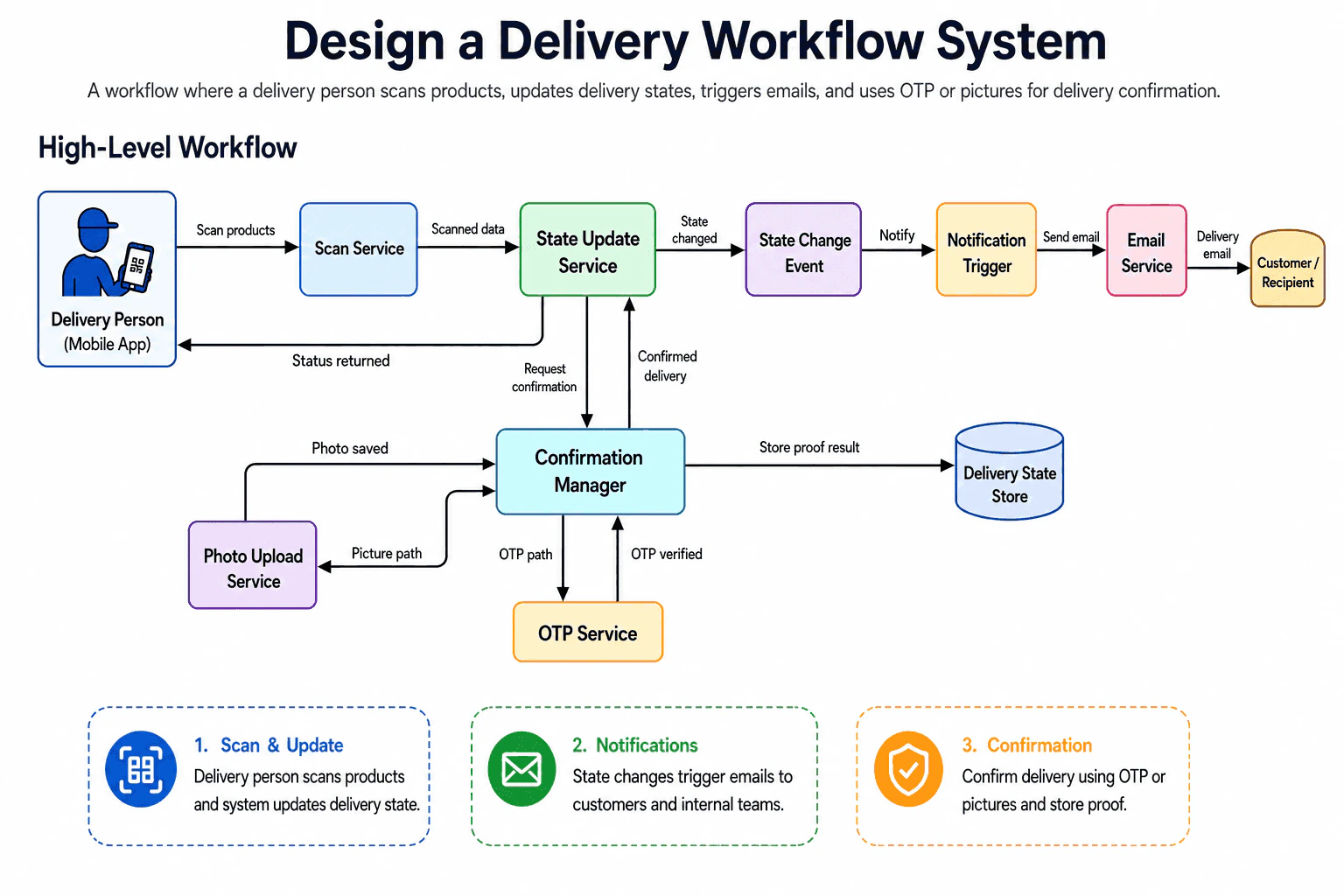
The system must move a delivery from product scanning to final proof. It must update the delivery state, return useful status to the driver, send a customer email after a state change, and accept either OTP or picture confirmation. The difficult part is keeping these actions in the correct order. The diagram organizes the design into a scan path, a notification path, and a confirmation path.
Useful Questions to Ask the Interviewer
Which user flows and system capabilities are required for the first version?
What traffic, data volume, latency, and availability targets should I design for?
Which consistency, security, geographic, and cost constraints matter most?
How to Explain It in an Interview
1. Explain the goal and the main idea
I would start by saying that the Delivery Person Mobile App begins the workflow. The driver scans products before changing the delivery state. The system then returns the current status to the same app.
A normal scan does not prove that the package reached the customer. Final confirmation therefore uses a separate Confirmation Manager. This component accepts either OTP proof or picture proof.
2. Explain the scan and state-update flow
For the scan path, the Delivery Person Mobile App sends “Scan products” to the Scan Service. The Scan Service passes “Scanned data” to the State Update Service. This service updates the delivery state.
The State Update Service sends “Status returned” back to the mobile app. This gives the driver a clear result. It also sends “State changed” to the State Change Event, which starts the email path.
3. Explain the state-change email flow
The State Change Event sends “Notify” to the Notification Trigger. The trigger sends “Send email” to the Email Service. The Email Service sends the “Delivery email” to the Customer or Recipient.
This path is separate from the status-return arrow. The diagram therefore keeps driver feedback and customer notification as two clear relationships. It does not show a queue, retry worker, or email failure rule, so I would not claim those features.
4. Explain the delivery-confirmation flow
When proof is needed, the State Update Service sends “Request confirmation” to the Confirmation Manager. The manager controls both proof choices.
For OTP, the Confirmation Manager sends the “OTP path” to the OTP Service. The OTP Service returns “OTP verified” to the manager.
For a picture, the manager sends the “Picture path” to the Photo Upload Service. That service saves the picture and returns “Photo saved” to the manager.
After either proof path succeeds, the Confirmation Manager sends “Store proof result” to the Delivery State Store. It then sends “Confirmed delivery” back to the State Update Service. This keeps final state handling with the State Update Service.
5. Explain trade-offs and missing failure rules
The benefit is that each component has one clear job. Scanning, state changes, email, and proof confirmation are easy to follow. The two proof paths also give the workflow more flexibility.
The downside is that final confirmation needs several service calls. The diagram does not define retries, timeouts, duplicate-request handling, or what happens when OTP and picture confirmation both fail. I would call these open design decisions instead of inventing behavior that is not shown.
Engineering Considerations / Design Trade-offs
The benefit is that every major step has a clear owner. The Scan Service handles scans. The State Update Service changes delivery state. The Confirmation Manager handles OTP and picture proof. This makes the workflow easy to explain and change. The downside is that confirmation needs several service calls. A slow proof step can delay the final state update. The email path is separate from the status-return path, which keeps both relationships clear. However, the diagram does not show retries, timeouts, or duplicate protection. Those rules would need separate design decisions.
Why Interviewers Ask This
Interviewers ask this question to see whether you can turn a real delivery process into clear system flows. They want to test how you separate scanning, state updates, customer notification, and proof of delivery. They also look for correct arrow direction, clear ownership, and honest trade-offs. A strong answer follows the diagram without inventing queues, databases, guarantees, or failure behavior that was never defined.
Interviewer may ask next
What would you change if the OTP Service is temporarily unavailable?
I would keep the same design, but I would not mark the delivery as confirmed while the OTP Service is unavailable. The affected path is the arrow from the Confirmation Manager to the OTP Service and the “OTP verified” return arrow.
The driver could use the existing picture path instead. The Confirmation Manager would send “Picture path” to the Photo Upload Service. After the service returns “Photo saved,” the manager would store the proof result in the Delivery State Store. It would then send “Confirmed delivery” to the State Update Service.
This keeps correctness because the final state still requires proof. It does not add a new component or change who owns confirmation. The main downside is that picture proof may take more time and data. The diagram does not show automatic fallback, so the product would need a clear rule telling the driver when to choose the picture path.
How would the design handle the same product scan being sent twice?
I would keep the same component roles and make sure each delivery update is handled as its own workflow. The State Update Service would still receive scanned data, return status to the mobile app, create the State Change Event, and request confirmation when proof is needed.
The important correctness rule is that “Confirmed delivery” must return from the Confirmation Manager before the State Update Service treats the delivery as complete. The proof result must also be sent to the Delivery State Store. Customer email still follows the State Change Event through the Notification Trigger and Email Service.
The diagram does not show duplicate-request protection. If the mobile app sends the same scan twice, the current design does not explain how to avoid two state changes or two emails. That rule would need to be added later. The downside is extra logic, but it prevents repeated updates from creating incorrect results.
22. Tell me about a project you could not deliver completely or for which you had to make tradeoffs.BehavioralHardAmazon
Interview tip:
Use STAR to structure your answer: briefly explain the Situation and Task, make Action the most detailed part, and finish with the Result. For example, describe a realistic project where you could not complete the full scope, identified the most important user need, explained the tradeoffs early, worked with the team to reduce risk, and delivered a reliable core solution.
Situation
In my last role, I worked on a Python service that collected data from several external systems and prepared it for internal reports. The original plan included automated data collection, historical data processing, advanced validation, and a dashboard. During development, one external system changed its access rules, and another system provided data that was less consistent than expected. We could no longer complete the full scope by the agreed delivery date.
Task
I was responsible for the Python data processing service. I needed to protect the most important reporting need, keep the data reliable, and help the team decide which features to delay. I also needed to explain the technical limits clearly so that the product owner could make an informed decision.
Action
I first separated the required features from the useful but optional features. The required path was collecting current data, validating important fields, storing clean records, and producing the main report. Historical processing, the dashboard, and some advanced validation rules were not required for the first release. I created a small Python test script to measure the quality of data from each external system. This showed that one source needed extra validation and manual review before we could trust it. I shared these findings with the product owner and the rest of the team. I explained what we could deliver safely, what we should delay, and what could go wrong if we tried to complete everything at once. I recommended releasing the core reporting flow first. I added clear validation errors, logging, and a retry process for temporary connection failures. I also designed the processing steps so that delayed features could be added later without replacing the core service. The team handled the report interface and deployment work, while I focused on the Python processing logic, tests, and technical documentation. I gave regular updates and raised new risks as soon as I found them instead of waiting until the deadline.
Result
We did not deliver every feature from the original plan, but we delivered the most important reporting flow in a reliable form. Users could receive the current report, and the team had a clear plan for adding the delayed work later. The early communication prevented confusion about the reduced scope. I learned that completing less work can be the correct decision when it protects data quality and user trust. I also learned to test external dependencies early because they can change the practical scope of a project.
Why Interviewers Ask This
Interviewers ask this question to understand how a candidate responds when a plan cannot be completed as expected. They are evaluating prioritization, ownership, communication, technical judgment, and the ability to make responsible tradeoffs. A strong answer shows that the candidate protects the most important outcome, explains risks early, and learns from the experience.
Interviewer may ask next
How did you decide which features to delay?
I compared each feature with the main user need and the risk of delivering it too quickly. Current data collection, validation, storage, and reporting were necessary for a useful release. Historical processing and the dashboard added value, but users could still complete their main work without them. I delayed those features so that we could focus on a smaller solution that we could test and support properly.
What would you do differently on a similar project now?
I would test every external system during the planning stage instead of waiting for full development to begin. I would create a small working connection, review sample data, and confirm access limits early. This would help the team estimate the work more accurately and identify backup options before the delivery plan was finalized.
23. Tell me about a time when you received critical feedback and how you handled it.BehavioralMediumAmazon
Interview tip:
Use STAR to structure your answer: briefly explain the Situation and Task, make Action the most detailed part, and finish with the Result. For example, describe a time when someone gave you difficult feedback about your work, how you listened without becoming defensive, clarified the concern, improved your approach, communicated your progress, and used the experience to become a better developer.
Situation
In my last role, I built a Python service that processed data from several internal systems. During a code review, a senior developer told me that my solution worked, but the code was too difficult to maintain. Some functions handled validation, data conversion, logging, and database updates in one place. My first reaction was disappointment because I had spent a lot of time on the solution.
Task
I was responsible for addressing the feedback before the service was released. I also needed to understand the deeper problem so I would not repeat the same design mistake in future work.
Action
I thanked the reviewer and asked for specific examples instead of defending my code. We reviewed one large function together. The reviewer explained that each function should have one clear responsibility. This makes code easier to test, change, and understand. I wrote down the main concerns and repeated them in my own words to confirm that I understood correctly. I then divided the large function into smaller functions for validation, conversion, persistence, and error handling. I added focused unit tests for each part so that future changes could be checked safely. I also improved the names of several variables and functions because clear names reduce the effort needed to understand the code. After making the changes, I sent the reviewer a short summary of what I had changed and why. I asked for another review to confirm that I had addressed the real concern, not only the visible symptoms. I later added the same checks to my personal review list before submitting new code.
Result
The revised code was easier for the team to review, test, and extend. The service was released with a cleaner structure, and later changes were simpler because each part had a clear purpose. I learned that critical feedback is most useful when I separate it from my emotions, ask for concrete examples, and turn it into a repeatable improvement in how I work.
Why Interviewers Ask This
Interviewers ask this question to understand whether a candidate can accept difficult feedback without becoming defensive. They also want to see whether the candidate listens carefully, takes ownership, improves the work, and applies the lesson to future situations. A strong answer shows self awareness, professional maturity, and a genuine ability to learn from others.
Interviewer may ask next
What would you have done if you disagreed with the feedback?
I would have asked the reviewer to explain the risk with a concrete example. I would then compare both approaches using factors such as readability, testing effort, and future maintenance. If I still disagreed, I would share my reasoning calmly and ask the team to decide based on the needs of the service rather than personal preference.
How has this feedback changed the way you write Python code now?
I now check whether each function has one clear purpose before I request a review. I also look for mixed responsibilities, unclear names, hidden side effects, and missing tests. This helps me find maintainability problems earlier and makes code reviews more focused.
24. Tell me about a time you had to learn something new and apply it in your work.BehavioralMediumAmazon
Interview tip:
Use STAR to structure your answer: briefly explain the Situation and Task, make Action the most detailed part, and finish with the Result. For example, describe a project where you had to learn an unfamiliar Python tool, understand how it worked, apply it to a real problem, communicate your approach, and deliver a reliable result.
Situation
In my last role, our team maintained a Python service that processed large data files. The service was becoming slow because it handled each file one step at a time. I had not worked with asynchronous processing before, but I believed it could help the service perform independent tasks without waiting for each one to finish.
Task
I was responsible for learning the required concepts and deciding whether asynchronous Python was suitable for our service. I also needed to introduce the change safely because the service was already used by other teams.
Action
I first studied how the asyncio library works. It allows Python to pause one waiting task and continue another task instead of leaving the program idle. I created a small local example that read several test files and called a simulated external service. This helped me understand where asynchronous code was useful and where normal code was simpler. I then reviewed our existing workflow and found that most of the delay came from waiting for network responses, not from calculations. That mattered because asynchronous processing is most useful for waiting operations. I changed one small part of the service first instead of rewriting the full workflow. I used async functions for the external calls and added a limit on how many requests could run at the same time. The limit protected the external service from receiving too many requests. I also added error handling and tests for timeouts, failed requests, and partial results. I shared the design with my team and explained the risks in simple terms. After their review, we tested the change with sample files and compared the output with the existing version before releasing it gradually.
Result
The updated service completed file processing more quickly and remained stable during testing and regular use. The team also gained a clear example that could be reused for similar waiting tasks. I learned that learning a new tool is not only about understanding its syntax. I must also confirm that it fits the problem, test the risks, and introduce it in a controlled way.
Why Interviewers Ask This
Interviewers ask this question to evaluate curiosity, adaptability, judgment, and the ability to turn new knowledge into useful work. A strong answer shows that the candidate can learn independently, choose an appropriate solution, communicate it clearly, and apply it without creating unnecessary risk.
Interviewer may ask next
How did you decide that asynchronous processing was the right approach?
I measured where the service spent most of its time and found that it was mainly waiting for network responses. Since the delay came from waiting rather than heavy calculations, asynchronous processing was a good fit. I also tested the idea on a small part of the workflow before changing the main service.
What would you do differently if you faced a similar learning challenge now?
I would create the small test example earlier and document the key findings while I learned. That would help me compare options faster and make the team review easier. I would still introduce the change gradually because that reduced risk and gave us time to confirm the results.
25. Tell me about a time when a teammate was facing difficulties or was not performing their work.BehavioralHardAmazon
Interview tip:
Use STAR to structure your answer: briefly explain the Situation and Task, make Action the most detailed part, and finish with the Result. For example, describe a time when a teammate was struggling with assigned work, how you spoke with them privately, understood the cause, offered practical support, protected the project, and helped the team complete the work successfully.
Situation
In my last role, our team was preparing a Python service for an important release. One teammate was responsible for adding input validation and automated tests, but the work was repeatedly delayed. During team meetings, they gave very short updates and seemed uncomfortable discussing the problem. The delay was starting to block my integration work and could have affected the release.
Task
I needed to complete my own integration work while helping the team remove the blocker. I also wanted to understand the teammate's difficulty before making assumptions. My goal was to support them, keep the project moving, and avoid creating blame or embarrassment.
Action
I first spoke with the teammate privately instead of raising the issue in a group meeting. I asked whether the task requirements were clear and whether anything was making the work difficult. They explained that they were unfamiliar with part of the validation library and were also dealing with several urgent support requests. I reviewed the remaining work with them and separated it into smaller parts. We agreed that they would finish the core validation rules, while I would help create the initial test structure and examples. I explained the test setup as we worked so that they could continue independently rather than simply handing the task to me. I also spoke with our team lead about the competing support work without sharing unnecessary personal details. We adjusted the priorities so the teammate had protected time for the release task. I added short check ins to confirm progress and remove technical blockers, but I made sure they still owned their part of the work. I also updated the team early about the revised plan so everyone understood the dependencies and could adjust their work.
Result
The teammate completed the validation work, and we integrated it with the automated tests before the release. The project moved forward without creating conflict, and the teammate became more comfortable asking for help earlier. I learned that a performance problem may have a technical or workload cause that is not visible in a group setting. I now start with a private and respectful conversation, then create a clear plan that supports the person while protecting the team's commitments.
Why Interviewers Ask This
Interviewers ask this question to evaluate how a candidate handles a teammate's performance problem without creating blame or conflict. A strong answer shows empathy, direct communication, sound judgment, ownership, practical support, and the ability to protect team commitments while helping another person improve.
Interviewer may ask next
Why did you speak with the teammate privately before involving the team lead?
I wanted to understand the cause before escalating the issue. A private conversation gave the teammate space to explain the technical gap and competing support work without feeling embarrassed. After I understood the problem, I involved the team lead only to adjust priorities and protect the release.
What would you have done if the teammate still did not complete the work?
I would have documented the remaining blocker, explained its effect on the release, and discussed it directly with the team lead. I would have proposed a clear backup plan, such as reassigning the critical part of the task, while keeping the conversation focused on delivery needs and observed facts rather than personal judgment.
26. Tell me about a time you handled a customer issue.BehavioralMediumAmazon
Interview tip:
Use STAR to structure your answer: briefly explain the Situation and Task, make Action the most detailed part, and finish with the Result. For example, describe a customer issue caused by unexpected application behavior, how you listened to the customer, investigated the technical cause, communicated clearly, delivered a safe fix, and confirmed that the issue was resolved.
Situation
In my last role, a customer reported that some records were missing from a report generated by our Python application. The customer used the report for an important daily process and was concerned that the system could no longer be trusted.
Task
I was responsible for investigating the issue, keeping the customer informed, and delivering a safe solution without creating new problems for other users. I also needed to understand whether the data was truly missing or whether the report logic was filtering it incorrectly.
Action
I first spoke with the customer to understand what they expected to see and which records appeared to be missing. I repeated the issue back in simple words so we agreed on the exact problem. I then asked for a few examples and used them to reproduce the behavior in a test environment. I found that the records were stored correctly in the database, but a recent change in the Python report service treated an empty optional field as invalid and removed those records from the result. I explained this finding to the customer and made it clear that their data had not been lost. I updated the filtering logic so the optional field was handled correctly. I added tests for records with values, empty values, and missing values because those cases could behave differently in Python. I also reviewed nearby report logic to make sure the same assumption was not used elsewhere. Before releasing the fix, I asked another developer to review my change and worked with the support team to test the report using the customer examples. I kept the customer updated during the investigation and avoided giving a completion promise until the fix had passed our checks.
Result
The corrected report included the expected records, and the customer confirmed that it supported their daily process again. The issue was resolved without changing or restoring any stored data because the data had always been present. I learned that handling a customer issue requires both technical investigation and clear communication. A correct fix matters, but the customer also needs to understand what happened and why the solution is reliable.
Why Interviewers Ask This
Interviewers ask this question to evaluate customer focus, ownership, communication, and problem solving. A strong answer shows that the candidate listens carefully, investigates facts before making assumptions, explains technical findings in simple language, delivers a safe solution, and confirms that the customer is satisfied.
Interviewer may ask next
Why did you involve the customer before starting the technical investigation?
I needed to understand the customer’s expected result and see real examples of the problem. That helped me reproduce the correct issue instead of investigating based on an incomplete support message. It also showed the customer that I was listening and taking ownership.
What would you do differently if a similar issue happened again?
I would add checks for optional and empty fields earlier when reviewing report changes. I would also include customer style examples in the test cases before release. This would make the tests closer to real use and could prevent the same type of issue from reaching the customer.
27. Tell me about a time you handled tasks with a strict deadline.BehavioralMediumAmazon
Interview tip:
Use STAR to structure your answer: briefly explain the Situation and Task, make Action the most detailed part, and finish with the Result. For example, describe a realistic Python project where you clarified the deadline, ranked tasks by risk and user impact, reduced unnecessary scope, communicated progress early, tested the critical workflow, and delivered a reliable result.
Situation
In my last role, our team needed to release an update to a Python data processing service before an important reporting deadline. The update had to support a new input format and fix an error that caused some records to be skipped. We had only a few working days because the report could not be delayed.
Task
I was responsible for updating the Python processing logic, adding tests, and helping prepare the release. My goal was to finish the essential work on time without creating a risky change that could damage existing reports.
Action
I first reviewed the required changes with the product owner and another developer. I separated the work into essential tasks and optional improvements. This helped us protect the deadline and avoid spending time on changes that users did not need immediately. I then traced the data flow from file validation to database storage and identified the smallest safe place to add support for the new format. I updated the parser so it could handle both the old and new inputs. I also added clear validation messages so invalid records would be reported instead of silently skipped. I wrote unit tests for the parser and an integration test for the full processing flow. While I worked, I shared progress and risks with the team each day. When I found an unclear input rule, I raised it immediately instead of making an assumption that could cause rework. Near the deadline, I asked another developer to review the most important code path while I checked the release steps and logs. We moved a minor cleanup task to a later release because it did not affect correctness or the user deadline.
Result
We completed the required update before the reporting deadline, and the service processed both input formats correctly. The team also had clear tests and validation messages that made the release easier to verify. I learned that strict deadlines are easier to manage when I confirm the real priority early, reduce unnecessary scope, communicate risks quickly, and protect enough time for testing.
Why Interviewers Ask This
Interviewers ask this question to understand how a candidate works under time pressure. They are evaluating prioritization, ownership, communication, technical judgment, and the ability to deliver reliable work without ignoring quality. A strong answer shows that the candidate can make careful tradeoffs and keep other people informed.
Interviewer may ask next
Why did you move the cleanup task to a later release?
The cleanup task did not affect the required behavior, data correctness, or reporting deadline. Completing it would have reduced the time available for testing the critical processing flow. I documented it for the next release so it would not be forgotten.
What would you do differently if you handled the same deadline again?
I would ask for sample files and confirm every input rule at the start of the work. The unclear rule caused a small interruption during development. Earlier confirmation would reduce that risk and give the team more time for review and release checks.
28. Tell me about a time you faced challenges while working on something and how you overcame them.BehavioralMediumAmazon
Interview tip:
Use STAR to structure your answer: briefly explain the Situation and Task, make Action the most detailed part, and finish with the Result. For example, describe a difficult Python project, your responsibility, the problems you found, how you set priorities, worked with the team, made technical decisions, and delivered a reliable result.
Situation
In my last role, I worked on a Python service that collected data from several external APIs and prepared it for an internal reporting system. During final testing, we found that some APIs returned incomplete data, some responded slowly, and one changed its response format without notice. These issues caused the service to fail and put the planned release at risk.
Task
I was responsible for making the data collection process reliable and helping the team complete the release. I needed to fix the immediate failures, protect the service from similar problems, and keep the team informed about the risks and progress.
Action
I first reviewed the logs and reproduced each failure with saved API responses. This helped me separate our code problems from problems caused by the external services. I then listed the issues by impact. I handled invalid response data first because it could create incorrect reports. I added clear validation before the data entered our system. When required fields were missing, the service recorded the problem and skipped only the affected item instead of stopping the whole process. For slow or temporary failures, I added limited retries with a longer pause after each attempt. This reduced repeated pressure on the external APIs while giving temporary problems time to recover. I also added time limits so one slow request could not block the full job. For the changed response format, I created a small translation layer that converted different API formats into one format used by our service. This kept the rest of the code simple and made future changes easier to manage. I wrote tests using realistic saved responses for successful calls, missing fields, slow calls, and changed formats. I shared the main risks and my proposed plan with the team. I also worked with the reporting developer to confirm that skipped records were shown clearly instead of being treated as complete data. We reviewed the changes together before releasing them.
Result
The service became stable enough for the release and handled external API problems without failing the entire process. The reporting team could also see when data was incomplete and investigate it safely. I learned that difficult technical problems become easier when I separate them into clear failure cases, solve the highest risk first, and communicate the impact early.
Why Interviewers Ask This
Interviewers ask this question to understand how a candidate responds when work becomes difficult or uncertain. They look for structured problem solving, ownership, sound priorities, communication, collaboration, and the ability to learn from challenges instead of becoming blocked by them.
Interviewer may ask next
Why did you focus on data validation before improving the retry logic?
I focused on validation first because incorrect data could reach the reporting system and appear trustworthy. A temporary API failure was visible, but bad data could create a hidden business problem. Protecting data quality was therefore the highest priority.
What would you do differently if you faced a similar challenge now?
I would add saved response tests and clear monitoring earlier in the project. That would help us detect format changes, missing fields, and slow responses before final testing. I would also agree with the team in advance on how incomplete data should appear in reports.
29. Tell me about a situation where you had to deep dive into a problem.BehavioralHardAmazon
i Question Details
Describe the situation and be prepared for detailed follow-up questions about what you investigated, why you investigated it, what you found, and how the findings affected the result.
Interview tip:
Use STAR to structure your answer: briefly explain the Situation and Task, make Action the most detailed part, and finish with the Result. For example, describe a difficult software issue where you gathered evidence, traced the full request flow, tested possible causes, worked with the team, found the root cause, and used the findings to deliver a reliable fix.
Situation
In my last role, a Python service sometimes processed the same background job more than once. The issue was difficult to reproduce. It appeared only during brief network problems, and our normal application logs did not clearly show why it happened.
Task
I was responsible for finding the root cause and preventing repeated processing. I also needed to make sure that any fix would not cause valid jobs to be lost.
Action
I first mapped the complete job flow, from the API request to the database write and the background worker. I did this because checking only the worker code could hide a problem in another part of the flow. I then added temporary structured logs with the job identifier, attempt number, worker name, database state, and event time. Structured logs store details in named fields, which made it easier to compare related events. I reviewed the logs from several failures and found that the worker completed the database update, but sometimes lost the network connection before it could confirm completion to the queue. The queue then treated the job as unfinished and sent it again. I confirmed this by reproducing the connection failure in a test environment. Next, I checked whether the database update was safe to repeat. It was not, because the code performed the action before checking whether that job had already completed. I changed the flow so the worker first stored a unique job identifier in the same database transaction as the business update. A transaction makes related database changes succeed or fail together. If the same job arrived again, the worker found the existing identifier and returned without repeating the action. I added tests for normal processing, repeated delivery, worker failure, and database rollback. I shared the evidence and proposed fix with the team before release so we could review the failure cases together.
Result
The repeated processing stopped, and the service continued to handle valid retries safely. The investigation also gave the team clearer logs and stronger tests for similar failures. I learned that a deep dive should follow the full system flow and use evidence to remove possible causes one at a time, rather than focusing only on the place where the error becomes visible.
Why Interviewers Ask This
Interviewers ask this question to evaluate curiosity, analytical thinking, ownership, and attention to detail. A strong answer shows that the candidate can gather evidence, test assumptions, find a root cause, explain why it happened, and turn the findings into a reliable solution.
Interviewer may ask next
Why did you choose to make the job safe to repeat instead of only changing the queue retry settings?
I chose to make the job safe to repeat because background queues can deliver the same job again during network failures or worker restarts. Changing retry settings might reduce how often the issue appeared, but it would not remove the underlying risk. The database check made repeated delivery safe while still allowing valid retries.
What would you do differently if you faced a similar problem now?
I would add the unique job identifier, structured logs, and repeated delivery tests when the workflow is first designed. I would also document where the queue confirms completion and what happens when that confirmation fails. This would make the failure mode easier to understand before it reaches production.
30. Tell me about the hardest problem you have solved.BehavioralHardAmazon
Interview tip:
Use STAR to structure your answer: briefly explain the Situation and Task, make Action the most detailed part, and finish with the Result. For example, describe a difficult Python system problem, your responsibility for finding the cause, the steps you took to reduce risk, how you worked with others, why you chose the final solution, and what improved after the fix.
Situation
In my last role, I supported a Python service that processed important data from several external systems. The service started producing incomplete results during busy periods. The failures were difficult to reproduce because each external system behaved differently, and the logs did not show where data was being lost.
Task
I was responsible for finding the root cause and delivering a safe fix without stopping normal processing. I also needed to make the service easier to monitor so the same type of problem could be found faster in the future.
Action
I first mapped the full data flow from the incoming request to the final database write. I added temporary structured logging at each important step so every record could be followed through the service. Structured logging means storing details in named fields instead of one long text message. This helped me compare successful records with failed records. I found that the service was running several tasks at the same time, but it shared one mutable Python object between those tasks. When two tasks updated the object together, one task could overwrite data created by another task. I wrote a small test that repeatedly ran the same work in parallel and confirmed the issue. I then changed the design so each task created and returned its own result. A separate step combined the results after all tasks finished. I chose this approach instead of adding a lock because isolated data was simpler to understand and reduced the chance of another timing problem. I added tests for normal input, partial external failures, repeated records, and slow responses. I also worked with the team to review the change, explain the failure clearly, and plan a gradual release. During the release, I watched error logs and compared processed records with source records before allowing all traffic to use the new version.
Result
The incomplete results stopped, and the service became more reliable during busy periods. The new logs and tests also made later production issues easier to investigate. I learned that the hardest problems often require improving visibility before changing code. I also learned to prefer simple data ownership over shared mutable state when Python tasks run at the same time.
Why Interviewers Ask This
Interviewers ask this question to understand how a candidate handles complex and uncertain problems. A strong answer shows structured investigation, technical judgment, ownership, clear communication, careful risk management, and learning from the experience.
Interviewer may ask next
Why did you avoid using a lock around the shared object?
A lock could have prevented two tasks from changing the object at the same moment, but it would have kept the shared design and made the code harder to reason about. Giving each task its own result removed the source of the conflict and made testing simpler.
What would you do differently if you faced this problem again?
I would add record tracing and tests that run several tasks at the same time earlier. The missing visibility caused most of the investigation time, so I would make those controls part of the original service design instead of adding them only after a production problem.
More questions load as you scroll
Disclaimer: This interview guide is for educational and informational purposes only. It is designed to help readers prepare, but it does not guarantee any interview result, hiring decision, offer, or outcome. Interview questions, hiring criteria, and preferred answers can vary by employer, interviewer, industry, location, and time. All answers, examples, and explanations in this guide are suggested examples for interview preparation, not definitive answers or instructions for professional practice. They are based on research and judgment, are provided without warranties of any kind, and should be adapted to the question, role, and applicable laws and professional requirements. Diagrams are simplified illustrations intended to highlight the main concepts and their relationships; actual situations, systems, and practices may be more complex. Alternative approaches may be equally valid or better suited to a particular question, context, or interviewer. To the fullest extent permitted by applicable law, the contributors and publisher are not liable for decisions made, actions taken, or losses incurred based on this guide.
State Laws and Professional Responsibilities: Laws and requirements governing an occupation vary by state and jurisdiction. You are responsible for checking the current laws, licensing requirements, and scope-of-practice rules that apply to your location and role, and for ensuring that your answers and actions comply with them. Adapt examples in this guide to those requirements. This guide is not legal advice.
Company Notice: This guide is an independent educational resource and is not affiliated with, endorsed by, sponsored by, or approved by the company named in this guide. Company names identify reported interview experiences or the employer context of clearly labeled original practice exercises. Interview practices can change without notice, and inclusion of company-specific content does not mean these questions are official, complete, or guaranteed to be asked. To the fullest extent permitted by law, the author, contributors, and publisher are not responsible for outcomes related to use of this material.
Content Accuracy and Verification: To the fullest extent permitted by applicable law, we do not represent or warrant that interview guides, questions, answers, examples, or diagrams are accurate, complete, current, error-free, or suitable for any particular purpose. You are responsible for independently reviewing and verifying the information before relying on it.