
1. What do you expect a doctor to order for an elderly patient that comes in with a coccyx wound, tachycardia and fever?
For an elderly patient presenting with a coccyx wound, tachycardia and fever, explain which diagnostic tests, monitoring, and treatment orders you would expect the responsible clinician to consider, and how the bedside nurse would recognize and escalate worsening organ dysfunction while remaining within nursing scope.
I would treat this as possible infection with risk for sepsis, not assume that fever and tachycardia alone confirm sepsis. I would expect blood cultures, ideally before antimicrobials when feasible, lactate, CBC with platelets, metabolic and organ function tests, and evaluation of the coccyx wound and other possible sources. If infection is sufficiently likely, I would expect prompt empiric antimicrobials, IV crystalloid if hypoperfusion or resuscitation requires it, and source control evaluation. As the nurse, I would monitor vital signs, mental status, urine output, oxygenation, bleeding, and other signs of organ decline, report worsening promptly, and trend and document the response.
The key idea is to recognize possible infection early while looking for evidence of organ dysfunction. An elderly patient with a coccyx wound, fever, and tachycardia may have an infection, but those findings alone do not prove sepsis. Sepsis means life threatening organ dysfunction caused by a dysregulated response to infection.
- Is there already evidence of new organ dysfunction, such as altered mental status, reduced urine output, worsening oxygenation, bleeding, or abnormal laboratory results?
- Are there other possible infection sources or noninfectious explanations for the deterioration?
- What orders or standing protocols have already been initiated?
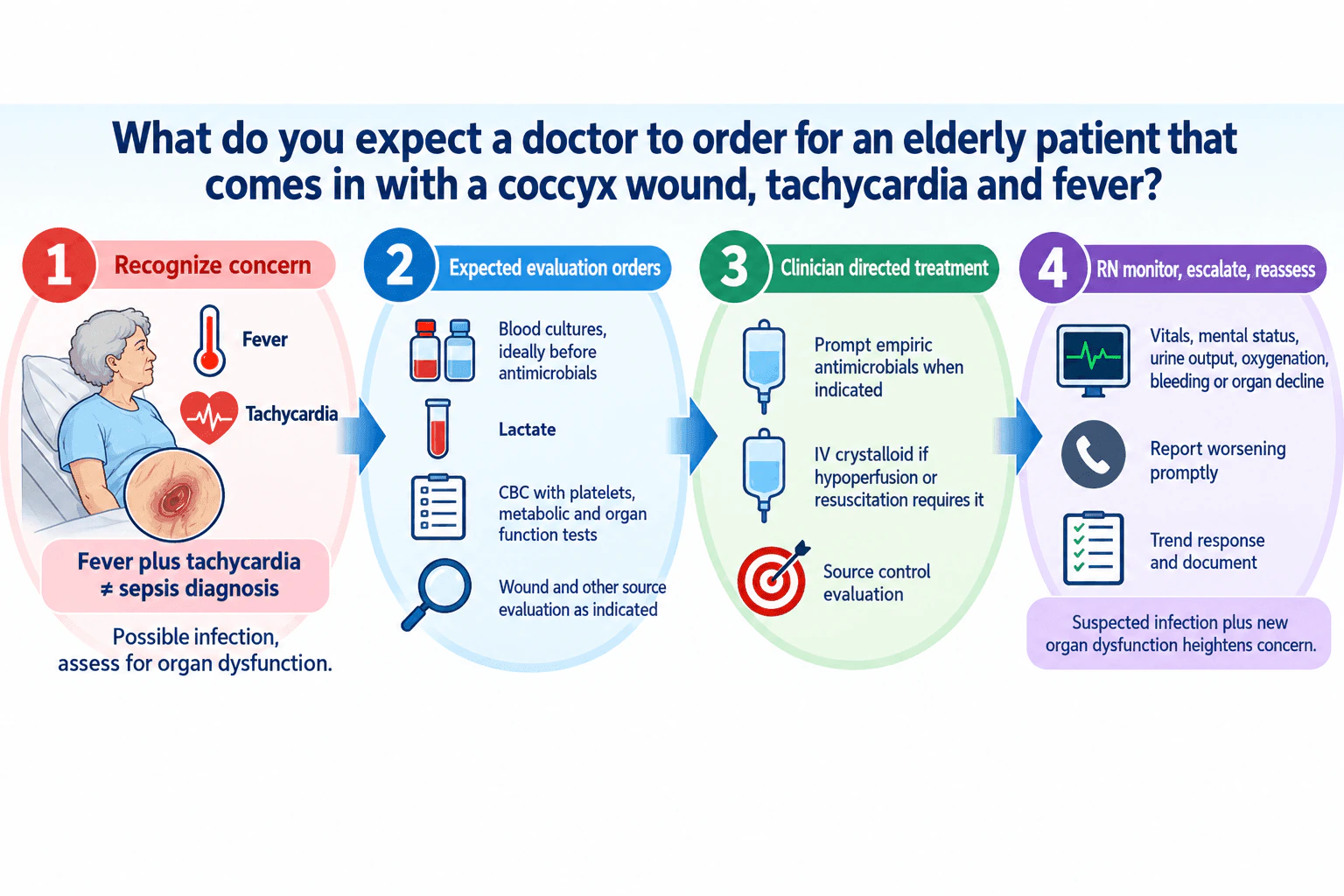
I would first recognize the patient as potentially infected and at risk for deterioration rather than diagnosing sepsis from fever and tachycardia alone. The coccyx wound is an important possible source, but I would still consider other sources and noninfectious causes until the clinical picture is clearer.
I would expect the responsible clinician to consider blood cultures as soon as possible and ideally before antimicrobials when doing so does not delay urgent therapy. I would also expect a lactate, CBC with platelets, metabolic testing, organ function testing, and focused evaluation of the wound and other suspected sources. These findings help identify infection, tissue hypoperfusion, hematologic abnormalities, and evolving organ dysfunction.
If infection is sufficiently likely, I would expect prompt empiric antimicrobials based on the suspected source and clinical context. IV crystalloid may be ordered when hypoperfusion or resuscitation requires it, with repeated assessment of the patient's response. The clinician would also evaluate whether source control is needed. I would not independently prescribe antimicrobials, fluids, or source control procedures unless an authorized protocol specifically applies.
At the bedside, I would trend vital signs, mental status, urine output, oxygenation, bleeding, platelet and organ function trends, and the overall clinical trajectory. New confusion, reduced urine output, worsening oxygenation, bleeding, or other organ decline would increase concern and trigger prompt communication and escalation.
I would reassess after ordered interventions, document the response, and report continued or worsening deterioration promptly. Suspected infection plus new organ dysfunction raises concern for sepsis, while deterioration without convincing infection should keep noninfectious causes in the differential.
This question tests whether the nurse can recognize a potentially serious infection without overdiagnosing sepsis, anticipate an appropriate clinician directed evaluation, distinguish nursing assessment from prescribing decisions, identify emerging organ dysfunction, and escalate deterioration promptly. It also tests whether the nurse understands that sepsis is life threatening organ dysfunction caused by a dysregulated response to infection rather than fever or tachycardia alone.
Common mistakes include calling the patient septic based only on fever and tachycardia, assuming every coccyx wound is the infection source, waiting for diagnostic certainty before escalating deterioration, treating a screening score as a definitive diagnosis, overlooking platelet changes or bleeding as possible evidence of worsening organ dysfunction, and describing antimicrobials, fluids, or source control as independent bedside nursing prescriptions.
Organize the answer in the same order as the diagram and bedside reasoning: recognize possible infection, anticipate evaluation orders, describe clinician directed treatment, then explain what the nurse monitors, reports, reassesses, and documents. Explicitly state that fever plus tachycardia does not by itself diagnose sepsis.


