This interview guide is for educational and informational purposes only. It is designed to help readers prepare, but it does not guarantee any interview result, hiring decision, offer, or outcome. Interview questions, hiring criteria, and preferred answers can vary by employer, interviewer, industry, location, and time. All answers, examples, and explanations in this guide are suggested examples for interview preparation, not definitive answers or instructions for professional practice. They are based on research and judgment, are provided without warranties of any kind, and should be adapted to the question, role, and applicable laws and professional requirements. Diagrams are simplified illustrations intended to highlight the main concepts and their relationships; actual situations, systems, and practices may be more complex. Alternative approaches may be equally valid or better suited to a particular question, context, or interviewer. To the fullest extent permitted by applicable law, the contributors and publisher are not liable for decisions made, actions taken, or losses incurred based on this guide.
State Laws and Professional Responsibilities
Laws and requirements governing an occupation vary by state and jurisdiction. You are responsible for checking the current laws, licensing requirements, and scope-of-practice rules that apply to your location and role, and for ensuring that your answers and actions comply with them. Adapt examples in this guide to those requirements. This guide is not legal advice.
Identity, Image, and Privacy Notice
To respect individual privacy, some names, profile photographs, avatars, biographical details, and other identifying information displayed in this guide may be replaced with pseudonyms, licensed stock images, illustrative avatars, composite images, or representative descriptions. Unless a person is expressly identified as an actual contributor, a displayed name, image, or profile should not be understood as depicting or identifying a specific candidate, interviewer, employee, or other real individual. These representations are provided for editorial and illustrative purposes only and do not imply endorsement, employment, participation, or affiliation with this guide or any company mentioned in it. Any resemblance to an actual person is coincidental.
Company Notice
This guide is an independent educational resource and is not affiliated with, endorsed by, sponsored by, or approved by the company named in this guide. Company names identify reported interview experiences or the employer context of clearly labeled original practice exercises. Interview practices can change without notice, and inclusion of company-specific content does not mean these questions are official, complete, or guaranteed to be asked. To the fullest extent permitted by law, the author, contributors, and publisher are not responsible for outcomes related to use of this material.
Content Accuracy and Verification
To the fullest extent permitted by applicable law, we do not represent or warrant that interview guides, questions, answers, examples, or diagrams are accurate, complete, current, error-free, or suitable for any particular purpose. You are responsible for independently reviewing and verifying the information before relying on it.
Questions or comments?
Contact us for general questions, or share feedback, technical corrections, and comments with the community.
1. What are the steps of the nursing process?Nursing FundamentalsEasy
i Question Details
Explain assessment, nursing diagnosis, planning, implementation, and evaluation in routine Registered Nurse practice.
Short Interview Answer (30-60 seconds)
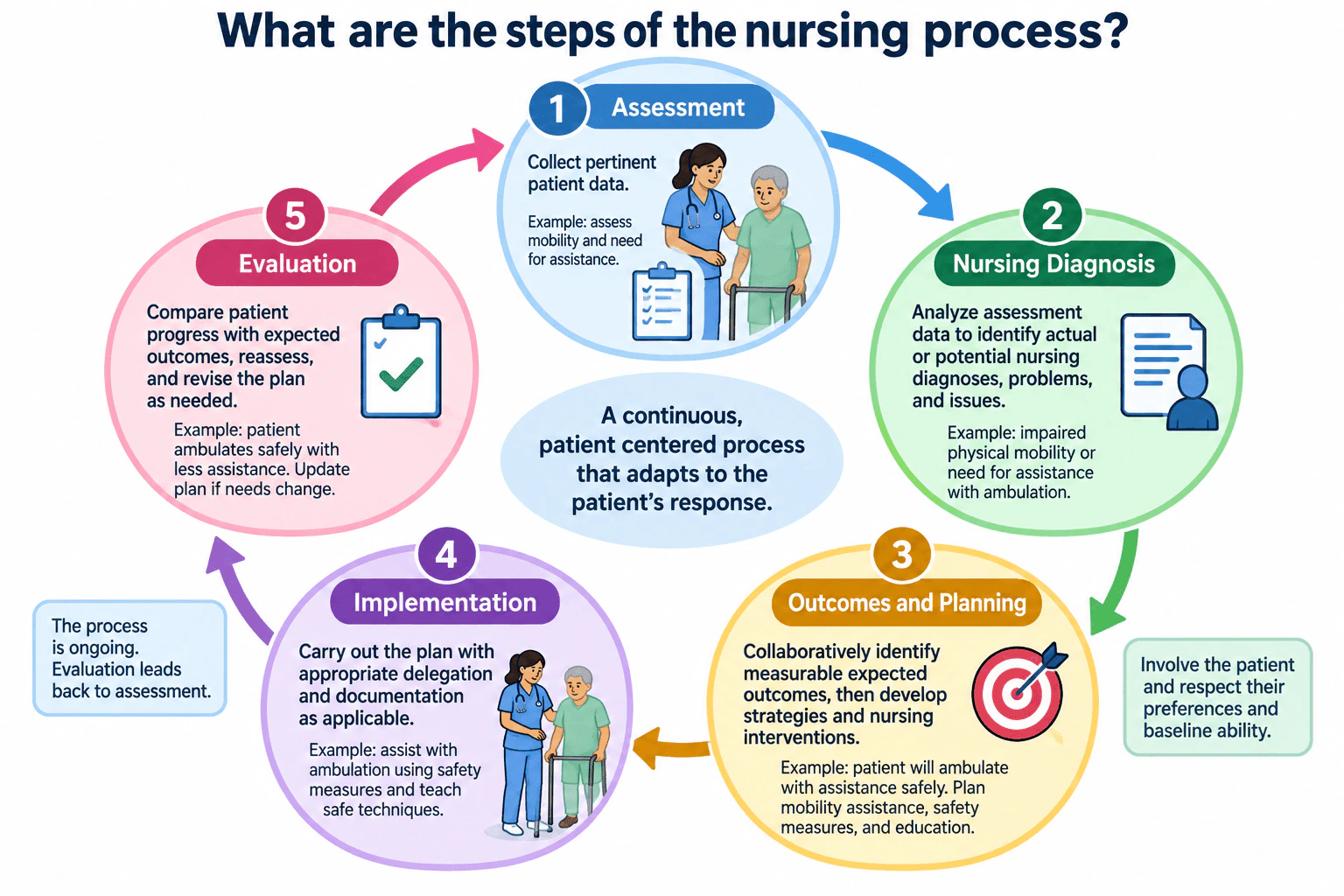
The nursing process follows five connected stages: Assessment, Nursing Diagnosis, Outcomes and Planning, Implementation, and Evaluation. First, I collect pertinent patient data. Then I analyze those findings to identify nursing diagnoses or problems. Next, I work with the patient when appropriate to establish measurable expected outcomes and plan nursing interventions. I implement the plan safely and document relevant care. Finally, I compare the patient's response with the expected outcomes. If the patient's needs change, evaluation leads back to assessment and the plan is revised.
Detailed Explanation
The nursing process is an ongoing cycle that helps an RN move from patient information to individualized nursing care and then determine whether that care is working. The five connected stages in this diagram are Assessment, Nursing Diagnosis, Outcomes and Planning, Implementation, and Evaluation. Current nursing diagnosis guidance also emphasizes that accurate nursing diagnoses depend on relevant assessment data and clinical judgment about human responses. nanda.org
Useful Questions to Ask the Interviewer
How does your nursing team document individualized patient goals and reassessment?
How are changes in a patient's assistance needs communicated among the care team?
How to Explain It in an Interview
Core Nursing Concept
Assessment comes first. I collect pertinent patient data and consider the patient's preferences, baseline ability, and assistance needs. I then analyze those findings to identify actual or potential nursing diagnoses, problems, or patient responses that nursing care can address.
Patient Needs
In Outcomes and Planning, I identify measurable expected outcomes with the patient when appropriate and develop nursing interventions that connect directly to the assessment and nursing diagnosis. For example, if assessment shows that a patient needs help with mobility, an expected outcome may be safe ambulation with the appropriate level of assistance.
Nursing Care
Implementation means carrying out the nursing plan safely. In the mobility example, I may assist with ambulation using appropriate safety measures, provide teaching, use appropriate delegation when applicable, and document the care provided. I continue to observe the patient's response rather than treating implementation as the end of the process.
Response to Care
Evaluation means comparing the patient's progress with the expected outcomes. If the patient ambulates safely with less assistance, that response informs the next plan. If the patient's assistance needs increase or the expected outcome is not achieved, I reassess the patient and revise the plan. This makes the nursing process continuous and patient centered rather than a one time checklist.
Why Interviewers Ask This
Interviewers are assessing whether the nurse understands the nursing process as connected clinical reasoning rather than a memorized list. A strong answer links assessment findings to nursing judgment, patient centered outcomes and planning, safe implementation, and evaluation with reassessment when the patient's response or needs change.
Common interview mistakes
Common mistakes include listing the steps without connecting them to a patient goal, planning interventions before completing an adequate assessment, confusing a medical diagnosis with a nursing diagnosis, choosing outcomes that cannot be evaluated, overlooking patient preferences or baseline ability, and completing an intervention without evaluating the patient's response or revising the plan when needs change.
Interview tip
Use one simple example to connect all five stages. For mobility, explain that you first assess the patient's baseline ability and assistance needs, identify the nursing problem supported by those findings, set a measurable mobility outcome and plan, assist with mobility using appropriate safety measures, and then evaluate whether the patient's response matches the expected outcome. End by explaining that a change in assistance needs sends you back to assessment.
Interviewer may ask next
How do you verify that the nursing process is working for the patient?
I compare the patient's current response with the expected outcome established during planning. I reassess the relevant findings, confirm the patient's understanding and response to care, document the result, and determine whether the outcome was achieved or whether the plan needs revision. Evaluation can lead directly back to assessment because the nursing process is continuous.
What would you do if the patient's mobility assistance needs increased?
I would return to Assessment and reassess the patient's current mobility, baseline ability, assistance needs, preferences, and other relevant findings. I would then update the nursing judgment as supported by the new assessment, revise the expected outcome and plan, implement the revised nursing care within RN scope and local policy, communicate relevant changes, and evaluate the patient's response to the updated plan.
2. What is evidence-based practice in nursing?Nursing FundamentalsEasy
Short Interview Answer (30-60 seconds)
Evidence based practice in nursing means using the best available current evidence together with nursing clinical expertise and the patient's values and preferences to guide care. For example, when planning routine mobility assistance, I would use current guidance, consider the patient's baseline ability and goals, provide care within my scope and applicable policy, and reassess the patient's response. The goal is care that is current, patient centered, and responsive to outcomes.
Detailed Explanation
Evidence based practice is a structured way to make nursing decisions using the best available evidence, professional clinical expertise, and the patient's values and preferences. The American Nurses Association describes evidence based nursing as using current research while incorporating nursing judgment and the patient's values, and the Agency for Healthcare Research and Quality similarly describes evidence based practice as combining current best evidence with clinical expertise and patient values and preferences. nursingworld.org
A routine example is mobility assistance. Evidence and established guidance can inform safe mobility practices, but the nurse still considers the patient's baseline ability, current assistance needs, understanding, goals, and preferences. The nurse provides appropriate care within scope and applicable policy, observes the patient's response, and updates the nursing plan when the patient's needs change.
Useful Questions to Ask the Interviewer
How does your nursing team help nurses access current clinical guidelines and research?
How are nurses involved when new evidence suggests that a routine nursing practice should be reviewed?
What resources are available to help nurses evaluate evidence before applying it to practice?
How to Explain It in an Interview
Core Nursing Concept
I would explain that evidence based practice brings together the best available evidence, nursing clinical expertise, and the patient's values and preferences. It supports nursing judgment rather than replacing it.
Patient Needs
I would consider the patient's goals, preferences, baseline ability, understanding, and current needs. Evidence may support a general approach, but nursing care still needs to fit the individual patient.
Nursing Care
For a routine care decision, I would identify credible current evidence, consider whether it applies to the patient, use my nursing judgment, and provide care within my scope and applicable policy. If a proposed change requires an order or action outside my authority, I would communicate with the appropriate member of the health care team rather than making an unauthorized change.
Response to Care
I would reassess the patient's response and determine whether the care is helping meet the intended goal. If the patient's condition, ability, preferences, or response changes, I would reconsider the plan, communicate relevant changes, and update nursing care appropriately.
Why Interviewers Ask This
Interviewers ask this question to assess whether the nurse understands that professional nursing decisions should be informed by credible current evidence, clinical judgment, and the individual patient's preferences and circumstances rather than habit or tradition alone. They also want to see that the nurse considers the patient's response when evaluating whether care remains appropriate.
Common interview mistakes
Common mistakes include describing evidence based practice as simply following a research article, relying on habit or tradition without checking current evidence, ignoring the patient's preferences or circumstances, assuming evidence applies identically to every patient, or changing care without considering nursing scope, applicable orders, policy, and the patient's response.
Interview tip
Start with the three core elements: best available evidence, nursing clinical expertise, and patient values and preferences. Then give one simple routine care example and explain how you would reassess the patient's response. This shows that you understand both the definition and how evidence becomes patient centered nursing care.
Interviewer may ask next
How would you verify that the evidence you are using is appropriate for nursing practice?
I would check current authoritative guidance and high quality research, then consider the validity, relevance, and applicability of the evidence to the nursing question and the individual patient. I would also confirm that the proposed care is consistent with nursing scope, applicable policy, and any required orders. If the evidence or my authority to apply it were unclear, I would consult the appropriate clinical resource or health care team member before changing care.
How would evidence based practice change if the patient's mobility assistance needs changed?
I would reassess the patient's current mobility, baseline function, goals, preferences, and level of assistance needed. The underlying evidence may still be relevant, but how it is applied may need to change. I would update nursing care within my scope and applicable policy, communicate the change when relevant, and reassess the patient's response to the revised plan.
3. How do you adapt basic nursing care for a patient with limited mobility?Nursing FundamentalsMedium
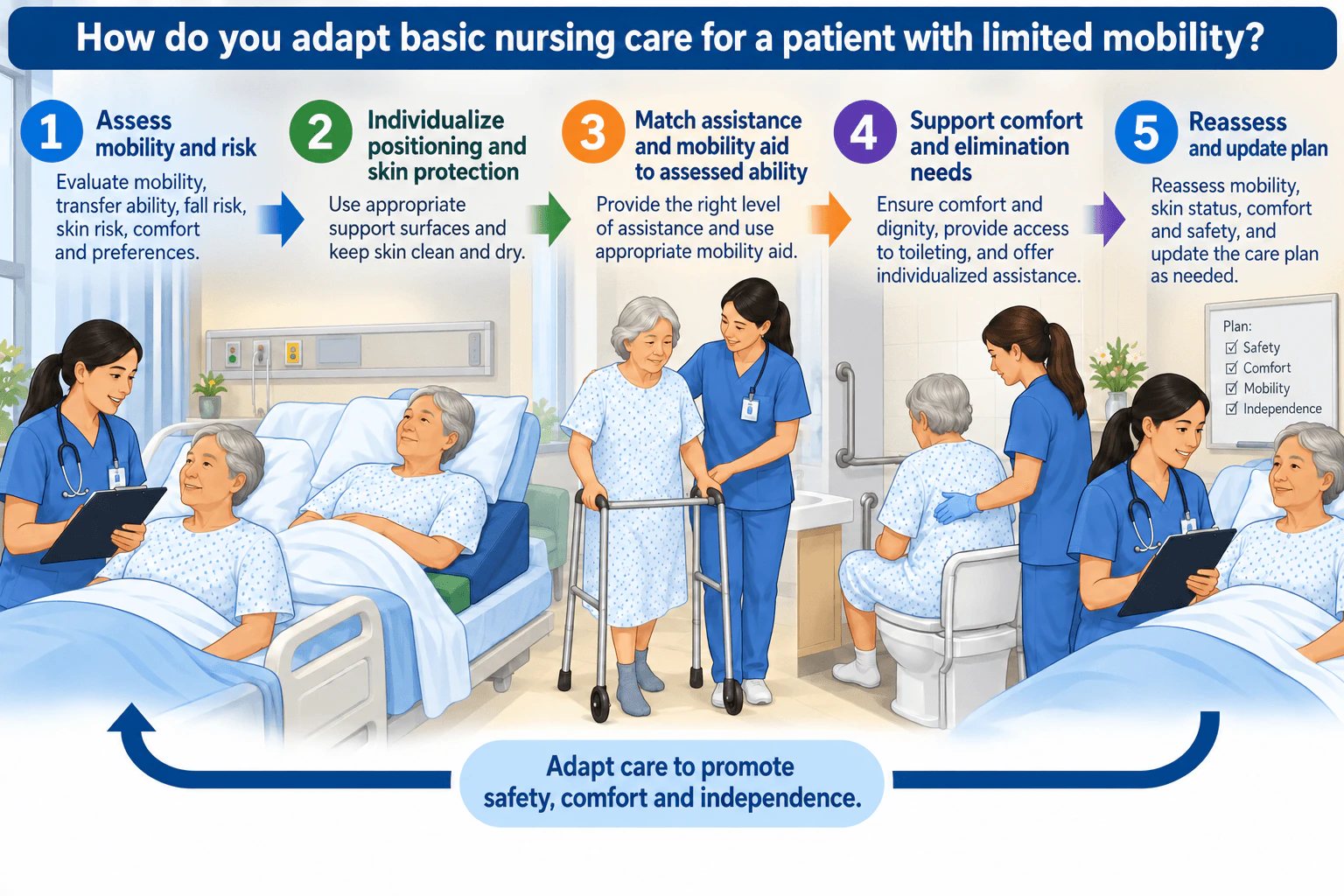
I start by assessing mobility, transfer ability, fall risk, skin risk, comfort, and patient preferences. I individualize positioning and skin protection, use appropriate support surfaces according to the patient's needs and applicable policy, and manage moisture so the skin is kept clean and protected. For mobility, I match assistance and the mobility aid to the patient's assessed ability. I also support comfort, dignity, access to needed items, and individualized toileting. Then I reassess mobility, skin status, comfort, and safety and update the care plan when assistance needs change.
Detailed Explanation
Limited mobility changes basic nursing care because the patient may need more protection from pressure injury, falls, discomfort, and loss of independence. I use the nursing process to keep care matched to the patient's current ability and goals rather than assuming the same level of help is appropriate throughout the shift.
Useful Questions to Ask the Interviewer
What mobility assessment process and safe patient handling resources are used on the unit?
How are changes in mobility or assistance needs communicated to the care team?
What positioning, support surface, and mobility resources are available for patients who need additional assistance?
How to Explain It in an Interview
Core Nursing Concept
I begin by assessing the patient's mobility, transfer ability, fall risk, skin risk, comfort, preferences, and goals. For a specific mobility task, I match the level of assistance and available equipment to what the patient can safely do at that time. VA safe patient handling guidance similarly uses assessment of the patient's ability for a specific task to determine the degree of assistance and equipment that may be needed. mobile.va.gov
Patient Needs
I individualize positioning and pressure injury prevention. That includes repositioning based on mobility and skin risk, using an appropriate support surface when indicated, and keeping the skin clean while managing moisture. AHRQ pressure injury prevention resources identify skin assessment, repositioning, pressure relieving equipment, hygiene, and moisture management as important preventive measures. ahrq.gov If a support surface or intervention requires an order, protocol, or another professional under local policy, I follow that process rather than acting outside my scope.
Nursing Care
For mobility, I provide the amount of assistance that matches the assessment and use the established mobility aid or safe patient handling equipment when appropriate. I support as much safe independence as possible. I also keep needed items accessible and provide individualized toileting assistance while maintaining privacy, comfort, and dignity.
Response to Care
I reassess mobility, skin status, comfort, and safety after care and whenever the patient's ability changes. If a patient who previously needed less assistance now needs more, I reassess before the next mobility task, change the assistance or equipment within the established plan and scope, communicate the change to the care team, and update the care plan. This keeps basic care aligned with the patient's current needs and goals.
Why Interviewers Ask This
Interviewers want to see whether the nurse can connect routine basic care to the patient's current functional ability, safety, comfort, skin protection, dignity, and independence. The question evaluates assessment, person centered care, pressure injury prevention, safe mobility support, elimination assistance, reassessment, communication, and the ability to change the care plan when the patient's needs change.
Common interview mistakes
Common mistakes include continuing the same assistance level without reassessment, repositioning without considering the patient's ability and preferences, overlooking skin or toileting needs, providing unnecessary physical assistance that limits independence, using mobility equipment without matching it to the patient's assessed ability and established plan, and failing to communicate or document a meaningful change in mobility needs.
Interview tip
Organize the answer as one care cycle that matches the diagram: assess mobility and risk, individualize positioning and skin protection, match assistance and the mobility aid to assessed ability, support comfort and elimination needs, then reassess and update the plan. Connect each step to safety, comfort, dignity, and independence.
Interviewer may ask next
How would you verify that the adapted care plan is working?
I would reassess the patient's mobility, transfer ability, skin status, comfort, toileting access, and safety after care. I would also ask whether the assistance provided supports the patient's preferences and independence. I would compare the response with the care goals, document relevant findings, and adjust or communicate the plan when the response shows that the patient's needs have changed.
What would you do if the patient's mobility assistance needs increased during the shift?
I would reassess the patient's current ability before the next mobility task rather than continuing the previous level of assistance. I would match assistance and available equipment to the new assessment within the established plan, nursing scope, and local policy. I would also reassess positioning, skin protection, comfort, and toileting needs, communicate the change to the care team, and update the care plan so subsequent care reflects the patient's current needs.
4. How do you develop a nursing care plan for a patient with multiple comorbidities?Nursing FundamentalsMedium
i Question Details
Explain how assessment findings, patient goals, nursing priorities, interventions, collaboration, and evaluation shape the plan.
Short Interview Answer (30-60 seconds)
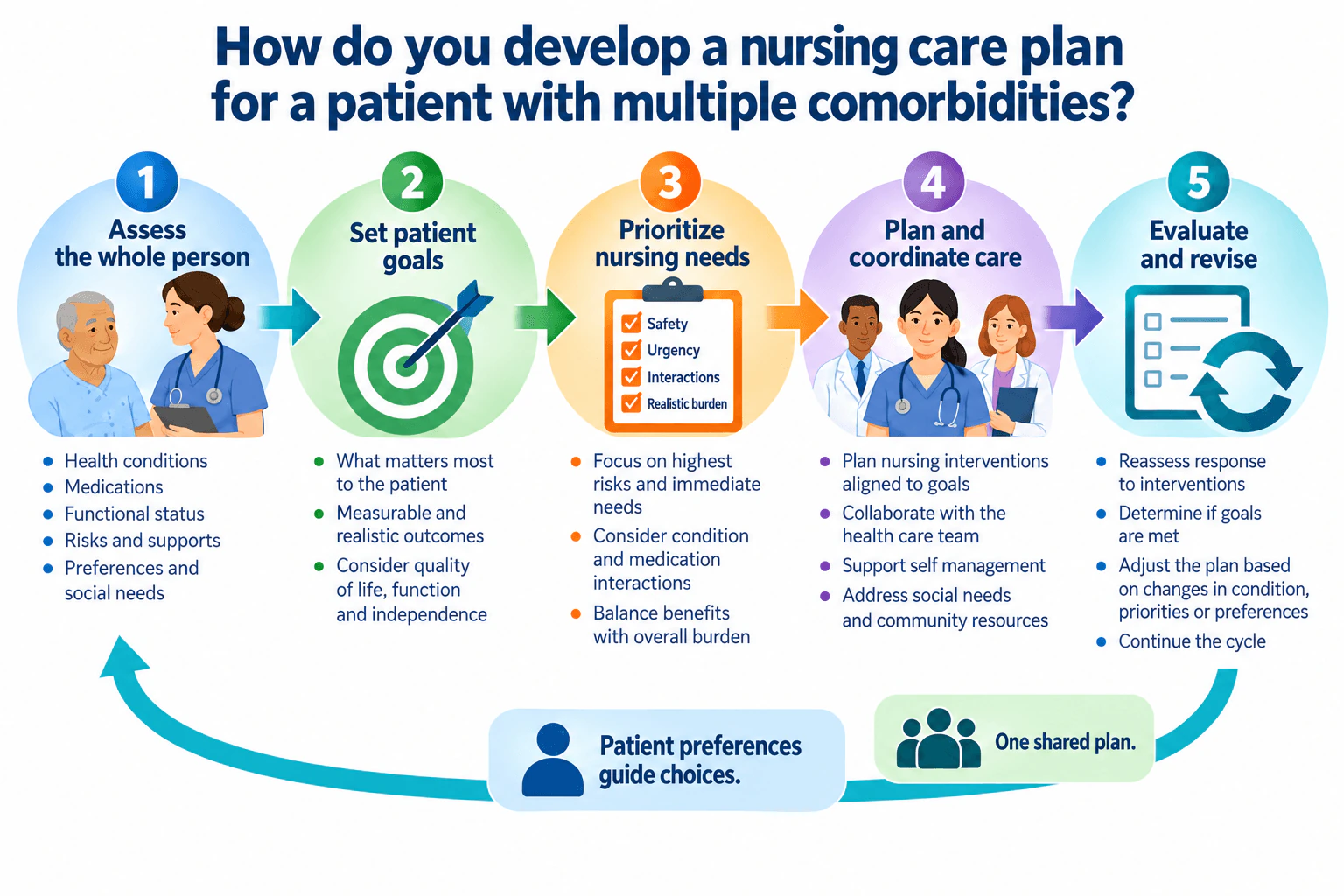
I start with a whole person assessment that includes the patient's conditions, medications, function, risks, supports, preferences, and social needs. With the patient, I establish measurable and realistic goals. I then prioritize the most important nursing needs based on safety, urgency, interactions among conditions and treatments, and the overall burden of care. I choose nursing interventions that support those goals and collaborate with the appropriate members of the health care team. Finally, I reassess the patient's response and revise the plan whenever the condition, goals, priorities, preferences, or assistance needs change.
Detailed Explanation
A care plan for a patient with multiple comorbidities should connect the whole person assessment to what matters most to the patient. The goal is not to create a separate checklist for every condition. It is to develop one coordinated plan in which assessment findings lead to patient goals, nursing priorities, interventions, collaboration, evaluation, and revision. Person centered care planning for multiple chronic conditions similarly emphasizes the whole person, patient goals and preferences, coordination, and a shared individualized plan. ahrq.gov
Useful Questions to Ask the Interviewer
How are nursing care plans updated and communicated across the health care team in this setting?
What resources are available when functional or social needs affect the patient's plan of care?
How are patients and families involved in setting and reviewing care goals?
How to Explain It in an Interview
Core Nursing Concept
I would begin by assessing the whole person. I would review the patient's health conditions, medications, functional status, risks, available supports, preferences, and relevant social needs. I would look for interactions among conditions, medications, and treatments rather than treating each problem independently. The nursing process uses assessment findings to guide nursing judgment, goals, planning, implementation, and evaluation. nursingworld.org
Patient Needs
Next, I would identify what matters most to the patient and establish measurable, realistic goals. I would prioritize nursing needs according to safety, urgency, interactions, function, and the realistic burden of the overall plan. For patients with multimorbidity, authoritative guidance also emphasizes patient goals, values, priorities, treatment burden, and individualized planning. nice.org.uk
Nursing Care
I would select nursing interventions that directly support the agreed goals and are within RN scope. I would implement ordered therapies according to the applicable orders and local policy and communicate concerns that require another professional's evaluation or decision. I would collaborate with the health care team so that the patient's different needs are addressed through one coordinated plan rather than conflicting plans. Care coordination is particularly important for people with multiple chronic conditions. ahrq.gov
If the patient's mobility assistance needs increased, for example, I would reassess current mobility, tolerance, safety, baseline ability, preferences, and available support. I would update the mobility related goal and nursing interventions, communicate the change, and coordinate additional evaluation or services when indicated.
Response to Care
I would reassess the patient's response, determine whether the goals are being met, document relevant findings and care, and revise the plan when the patient's condition, priorities, preferences, function, or assistance needs change. Evaluation is an ongoing part of the nursing process, and the care plan is modified as needed. nursingworld.org
Why Interviewers Ask This
Interviewers want to know whether the nurse can turn complex assessment information into one safe, individualized care plan. The question tests whether the nurse can connect patient goals to nursing priorities, choose appropriate interventions, collaborate within professional scope, recognize competing needs and treatment burden, and revise the plan when reassessment shows that the patient's needs or response have changed.
Common interview mistakes
Common mistakes include treating every comorbidity as a separate checklist, listing nursing process steps without connecting them to a patient goal, overlooking medication or treatment interactions, ignoring function or social needs, choosing interventions that are not linked to measurable goals, failing to clarify responsibilities across the health care team, and leaving the care plan unchanged when reassessment shows that the patient's needs or response have changed.
Interview tip
Explain the reasoning as one connected cycle: assess the whole person, establish patient goals, prioritize nursing needs, plan and coordinate interventions, then evaluate and revise. Connect each major nursing decision to a patient goal and clearly distinguish nursing actions from decisions or treatments that require an order or another professional.
Interviewer may ask next
How do you verify that the nursing care plan is working?
I compare current assessment findings and the patient's reported response with the measurable goals in the plan. I confirm whether the planned nursing interventions were carried out, check the patient's understanding and participation, and determine whether the targeted outcomes are being achieved. I document the response and revise the plan when goals are not being met or when new assessment findings change the priorities. Continuous evaluation and modification are part of the nursing process. nursingworld.org
How would the care plan change if the patient's mobility assistance needs increased?
I would reassess the patient's current mobility, tolerance, safety risks, baseline ability, preferences, and available support. I would update the mobility related goal and nursing interventions to match the new assistance needs, communicate the change to the health care team, and coordinate additional evaluation or ordered services when indicated. I would then reassess the patient's response and revise the plan again if the clinical context or assistance needs changed.
5. How would you revise a care plan when a patient is not progressing toward expected outcomes?Nursing FundamentalsHard
i Question Details
Explain reassessment, identification of barriers, collaboration, updated priorities, revised interventions, and continued evaluation.
Short Interview Answer (30-60 seconds)
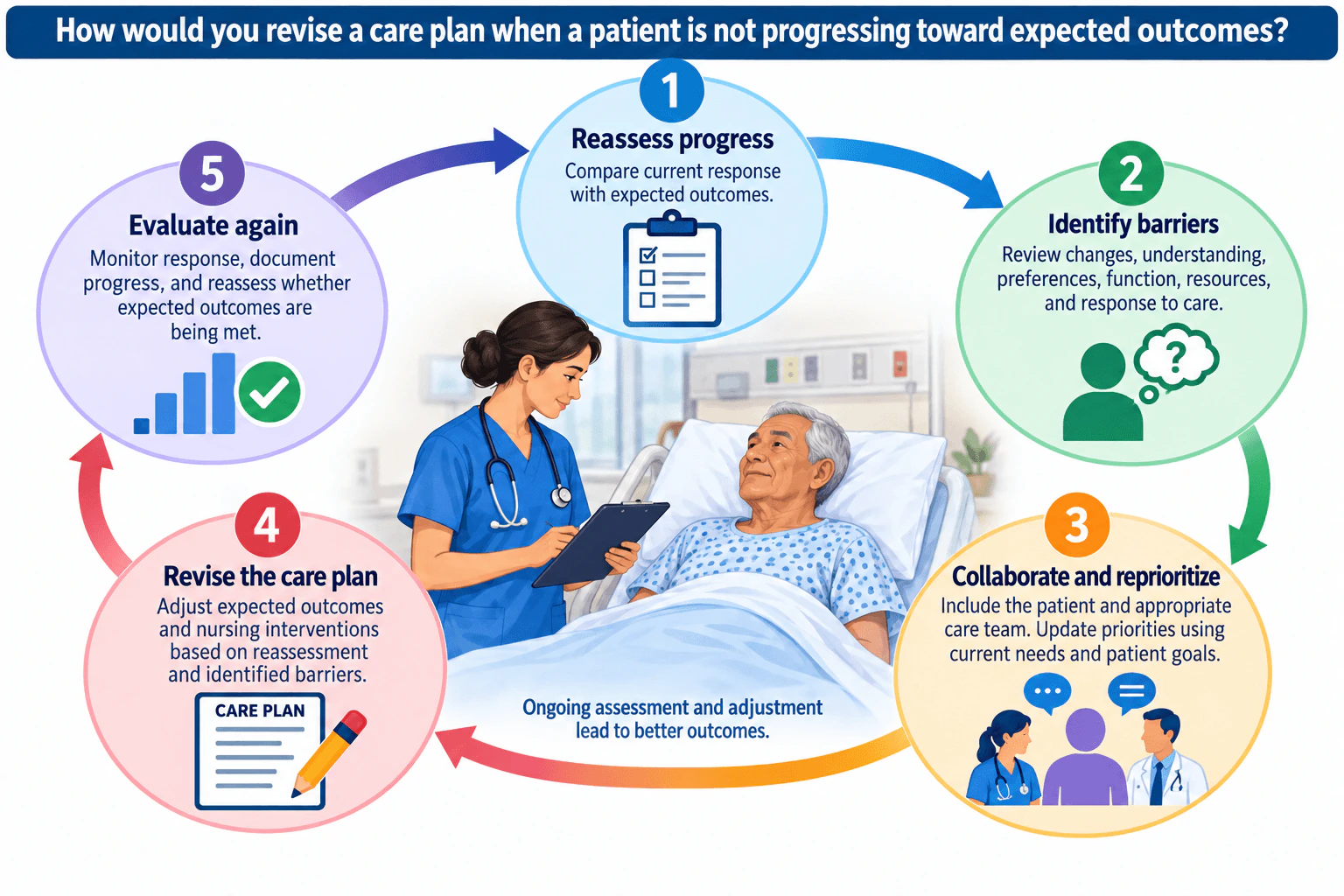
I would first reassess the patient and compare the current response with the expected outcomes. Then I would identify barriers to progress, collaborate with the patient and appropriate care team, and reprioritize current needs. Based on that reassessment, I would revise expected outcomes or nursing interventions as indicated. I would continue monitoring the patient's response, document progress, and evaluate again. If the expected outcomes are still not being met, I would repeat the process and adjust the plan again.
Detailed Explanation
A care plan should be revised when reassessment shows that the patient is not progressing toward expected outcomes. The goal is to understand why progress is limited, update priorities, change the plan when appropriate, and continue evaluating the patient's response. Nursing process guidance describes evaluation as comparing reassessment findings with expected outcomes and modifying the nursing care plan when needed. ncbi.nlm.nih.gov
Useful Questions to Ask the Interviewer
Would you like me to describe this using a routine inpatient example?
Should I focus mainly on independent nursing actions or also discuss interprofessional collaboration?
Would you like me to include communication and documentation of the revised plan?
How to Explain It in an Interview
Reassess Progress
I would start by reassessing the patient and comparing the current response with the expected outcomes. I would determine whether progress is occurring and whether the current plan still matches the patient's needs.
Identify Barriers
If progress is limited, I would look for contributing factors such as changes in condition, understanding, preferences, function, available resources, or response to the current care. I would also consider whether the expected outcomes are still realistic and appropriate.
Collaborate and Reprioritize
I would involve the patient and the appropriate care team, then update priorities based on current needs and patient goals. Planning should remain individualized and collaborative. ncbi.nlm.nih.gov
Revise and Evaluate Again
I would revise expected outcomes or nursing interventions based on the reassessment and identified barriers. Actions requiring another professional or an order would be addressed through the appropriate team member. I would then monitor the patient's response, document progress, and compare the new findings with the revised outcomes. If progress remains insufficient, I would repeat the cycle. This keeps the care plan responsive rather than allowing ineffective care to continue unchanged. ncbi.nlm.nih.gov
Why Interviewers Ask This
Interviewers are assessing whether the nurse recognizes that a care plan is dynamic and should respond to the patient's current needs and response to care. A strong answer demonstrates reassessment, recognition of barriers, patient involvement, collaboration, reprioritization, appropriate revision of nursing interventions, documentation, and continued evaluation. Current nursing process guidance supports evaluating progress toward outcomes and revising the nursing care plan when outcomes are not met. ncbi.nlm.nih.gov
Common interview mistakes
Common mistakes include continuing the same interventions without reassessing the patient, changing the plan before identifying barriers, focusing on tasks instead of expected patient outcomes, failing to involve the patient, overlooking changed priorities, making changes outside nursing scope, or failing to document and reevaluate the response.
Interview tip
Organize the answer as the same continuous loop shown in the diagram: reassess progress, identify barriers, collaborate and reprioritize, revise the care plan, and evaluate again. Connect every change to the patient's current response and expected outcomes rather than simply listing nursing process steps.
Interviewer may ask next
How would you verify that the revised care plan is working?
I would reassess the patient, compare current findings with the revised expected outcomes, and document whether progress is occurring. I would also confirm the patient's understanding and response to the revised care. If the outcomes are still not being achieved, I would identify any remaining barriers and revise the plan again as appropriate. Current nursing process guidance supports continuous evaluation of patient status and care plan effectiveness. ncbi.nlm.nih.gov
What would you do if the patient's clinical context changed after the plan was revised?
I would reassess the patient using the new information, determine whether priorities and expected outcomes have changed, and update nursing interventions that are within registered nursing scope. I would involve the appropriate care team when additional orders or professional input are required, document the changes, and continue evaluating the patient's response.
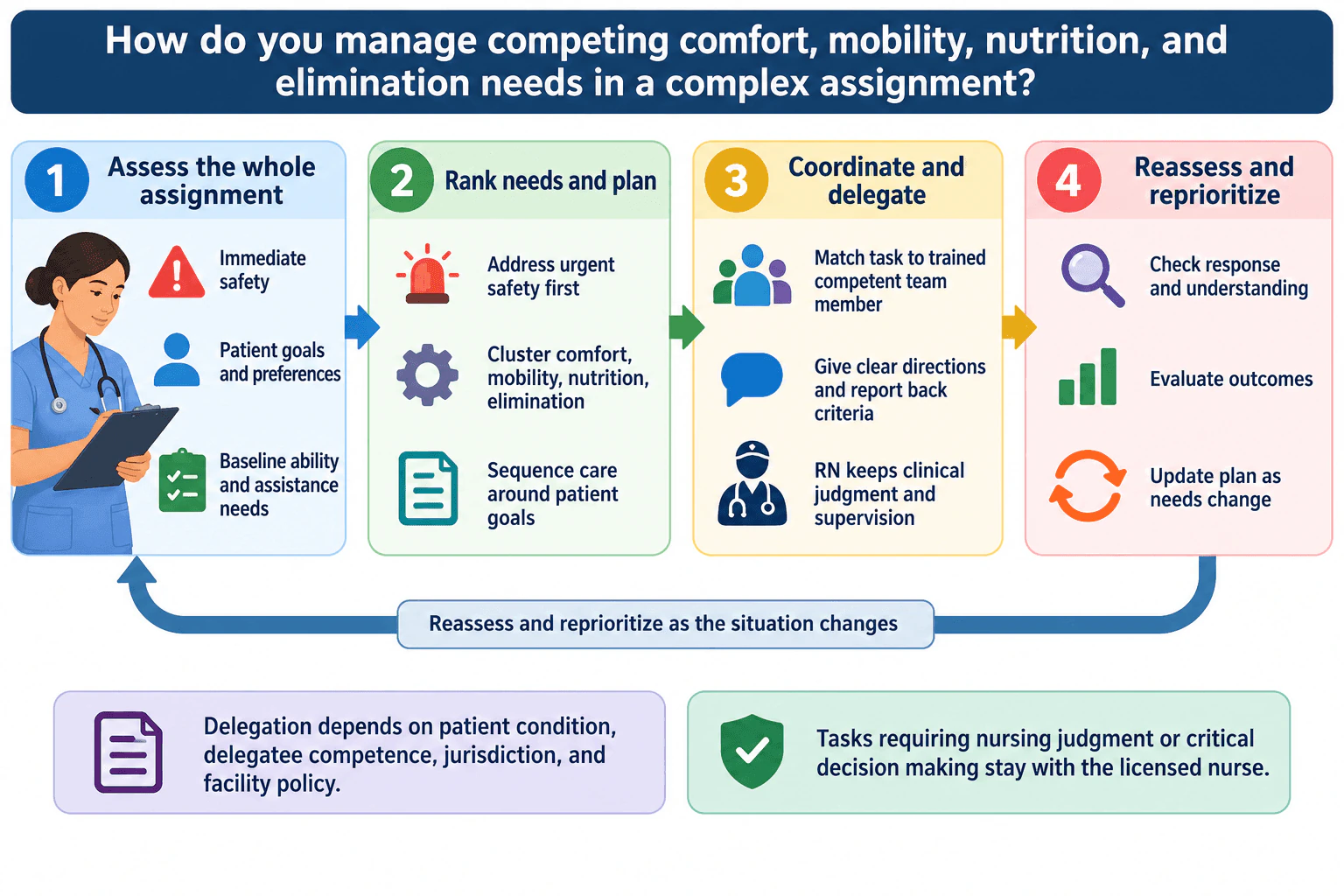
6. How do you manage competing comfort, mobility, nutrition, and elimination needs in a complex assignment?Nursing FundamentalsHard
i Question Details
Describe how you rank needs, coordinate care, delegate appropriately, preserve safety, and reassess after interventions.
Short Interview Answer (30-60 seconds)
I start by assessing the whole assignment for immediate safety concerns, patient goals and preferences, baseline abilities, and assistance needs. I then rank and sequence comfort, mobility, nutrition, and elimination care around those priorities. I delegate appropriate tasks only when the patient's condition, team member competence, jurisdiction, and facility policy support it, while retaining nursing judgment and supervision. After care, I check the patient's response and understanding, evaluate outcomes, and reprioritize as the situation changes.
Detailed Explanation
Competing basic care needs are managed as a continuous nursing process rather than a fixed task list. I first assess the whole assignment for immediate safety concerns, then connect comfort, mobility, nutrition, and elimination needs to each patient's goals, preferences, baseline ability, and required assistance. I rank and sequence care according to those findings and adjust the plan as the situation changes.
Useful Questions to Ask the Interviewer
How does your organization define RN, LPN or VN, and assistive personnel responsibilities for routine care and delegation?
What communication process is expected when a delegated task reveals a change in patient condition?
How are changes in mobility or assistance needs communicated across the care team?
How to Explain It in an Interview
Patient Needs
I assess the entire assignment before simply working down a task list. Immediate safety concerns come first. I then consider comfort, mobility, nutrition, and elimination together with patient goals, preferences, baseline function, and current assistance needs. Without specific findings, I would not claim that one routine need always has the same priority.
Nursing Care
I cluster and sequence compatible care around patient goals. For example, if a patient needs help with toileting and is also preparing to sit in a chair for a meal, I can coordinate elimination, safe mobility, positioning, comfort, and meal preparation rather than treating each as an unrelated task. I would change that sequence if assessment findings or patient preferences make another approach safer or more appropriate.
When delegation is appropriate, I match the task to a trained, competent team member. I give clear directions and define what information must be reported back. The decision depends on the patient's condition, the delegatee's competence, applicable jurisdiction, and facility policy. Clinical reasoning, nursing judgment, and critical decision making are not delegated. I retain appropriate supervision and evaluate the outcome of delegated care.
Response to Care
After interventions, I reassess rather than assuming the plan worked. I check the patient's response and understanding, evaluate outcomes, and look for changes in ability or assistance needs. If those needs change, I update priorities and the care plan. For example, if a patient now requires more mobility assistance, I reconsider how mobility, toileting, positioning, meals, comfort, and delegated tasks are coordinated, then reassess again after the revised plan is carried out.
Why Interviewers Ask This
The interviewer is evaluating whether the nurse can manage several competing basic care needs through assessment, prioritization, coordination, appropriate delegation, communication, supervision, and reassessment. A strong answer shows that patient safety and individual goals guide the plan, that delegation reflects patient condition and team member competence, and that the nurse changes priorities when the patient's response or assistance needs change.
Common interview mistakes
Common mistakes include following a rigid task list without first assessing safety and patient goals, assuming comfort, mobility, nutrition, or elimination always has the same priority, ignoring baseline ability or patient preferences, delegating without considering patient condition or team member competence, delegating work that requires nursing judgment or critical decision making, giving unclear directions without report back criteria, and failing to reassess after care.
Interview tip
Describe prioritization as a repeating cycle: assess the whole assignment, rank needs around safety and patient goals, coordinate and delegate appropriately, then reassess and reprioritize. A brief routine care example shows how the nursing process guides the patient's goal instead of merely naming its steps.
Interviewer may ask next
How do you verify that delegated care was completed safely and achieved the intended result?
Before delegation, I define the task, patient specific considerations, expected result, and findings that must be reported back. I remain available for guidance and provide appropriate supervision. After the task, I verify completion through communication and reassessment of the patient. I evaluate the patient's response rather than treating task completion alone as success, and I revise the plan when the outcome or patient condition changes.
How would your plan change if a patient's mobility assistance needs increased during the shift?
I would reassess the patient because the increased assistance need can change priorities across the basic care plan. I would update the level of help required, reconsider how mobility, toileting, positioning, meals, and comfort are sequenced, communicate the change to relevant team members, and reconsider any delegated tasks based on the patient's new condition. I would then reassess the patient's response and continue to reprioritize as needed.
7. What is the main purpose of defining nursing scope of practice?Ethics And Professional PracticeEasy
Short Interview Answer (30-60 seconds)
The main purpose of defining nursing scope of practice is to clarify what a nurse is authorized and accountable to do. This protects patients and the public while supporting safe, lawful, ethical, and competent care. Because scope can vary by jurisdiction, license, education, competence, role, setting, and policy, a nurse should verify the applicable requirements when there is uncertainty.
Detailed Explanation
Defining nursing scope of practice establishes the boundaries of professional nursing practice. It helps determine what activities, interventions, responsibilities, and roles a nurse may undertake and when additional education, competence, authorization, consultation, or involvement from another professional is needed. The American Nurses Association describes nursing scope as addressing what nurses do, why they do it, how they practice, who practices, where practice occurs, and when nursing practice occurs. The breadth of an individual nurse's practice also depends on factors such as education, role, experience, setting, population, and lawful authority. nursingworld.org
Useful Questions to Ask the Interviewer
How does this organization help nurses access current scope guidance and clinical policies?
What resources should a nurse use when uncertain whether an activity falls within the Registered Nurse role?
What consultation process should a nurse follow when a scope concern remains unresolved?
How to Explain It in an Interview
Professional Principle
I would explain that scope of practice defines the boundaries of nursing authority and responsibility. Its main purpose is to protect patients and the public by helping nurses practice within their lawful authority, education, competence, and professional standards.
Nursing Responsibilities
If I were uncertain about a particular activity, I would first clarify exactly what is being requested. I would then determine whether the activity is permitted by the applicable nurse practice law, regulations, professional standards, and other relevant requirements. I would also confirm that the practice setting has appropriate policies and resources and that I have the education and current competence needed to perform the activity safely. The National Council of State Boards of Nursing decision making framework specifically considers legal authority, evidence, setting policies, education, competence, resources, reasonable nursing judgment, and accountability. ncsbn.org
Consultation and Follow Up
If the answer remained unclear, I would not assume that the activity is within my scope simply because someone requested it. I would consult appropriate organizational resources and, when necessary, the relevant nursing regulatory body or another authorized professional resource. This supports safe care while respecting the responsibilities of other professionals and the limits of my own role.
Why Interviewers Ask This
Interviewers are evaluating whether the nurse understands professional accountability and recognizes that safe practice requires knowing the limits of the Registered Nurse role. A strong answer shows that the nurse would verify legal authority, professional standards, competence, and applicable organizational policy rather than assuming that being asked to perform an activity automatically makes it appropriate.
Common interview mistakes
Common mistakes include treating scope of practice as one universal list of tasks, assuming that an employer request automatically authorizes an activity, confusing another professional's responsibilities with the Registered Nurse role, assuming that previous experience alone proves current competence, or applying rules from one jurisdiction to another without verification. Another mistake is treating disagreement with a patient as evidence that the patient lacks decision making capacity.
Interview tip
Keep the answer centered on patient protection, public protection, and professional accountability. State that scope defines the boundaries of nursing practice, then explain that you would verify applicable law, professional standards, competence, and organizational policy whenever the boundary is unclear.
Interviewer may ask next
How would you verify whether a specific activity is within your nursing scope of practice?
I would identify the exact activity, jurisdiction, role, and practice setting. I would review the applicable nurse practice law and regulations, nursing regulatory body guidance, relevant professional standards, and organizational policy. I would also verify that I have the necessary education and current competence and that appropriate resources are available. If an order, protocol, supervision, or another professional's authorization is required for that activity, I would verify that requirement. If uncertainty remained, I would seek appropriate consultation before proceeding. This approach is consistent with the National Council of State Boards of Nursing scope decision making framework. ncsbn.org
What would you do if you were asked to perform an unfamiliar procedure that might be within the Registered Nurse scope?
I would not assume that possible legal authority alone means I should perform it. I would clarify the procedure, verify that it is permitted in the applicable jurisdiction and supported by relevant professional standards and organizational policy, and determine whether I have the necessary education and current competence. I would also verify any required order, protocol, supervision, equipment, and other resources. If I could not establish that the activity was appropriate for my role or that I could perform it safely, I would seek consultation or escalation rather than proceeding independently.
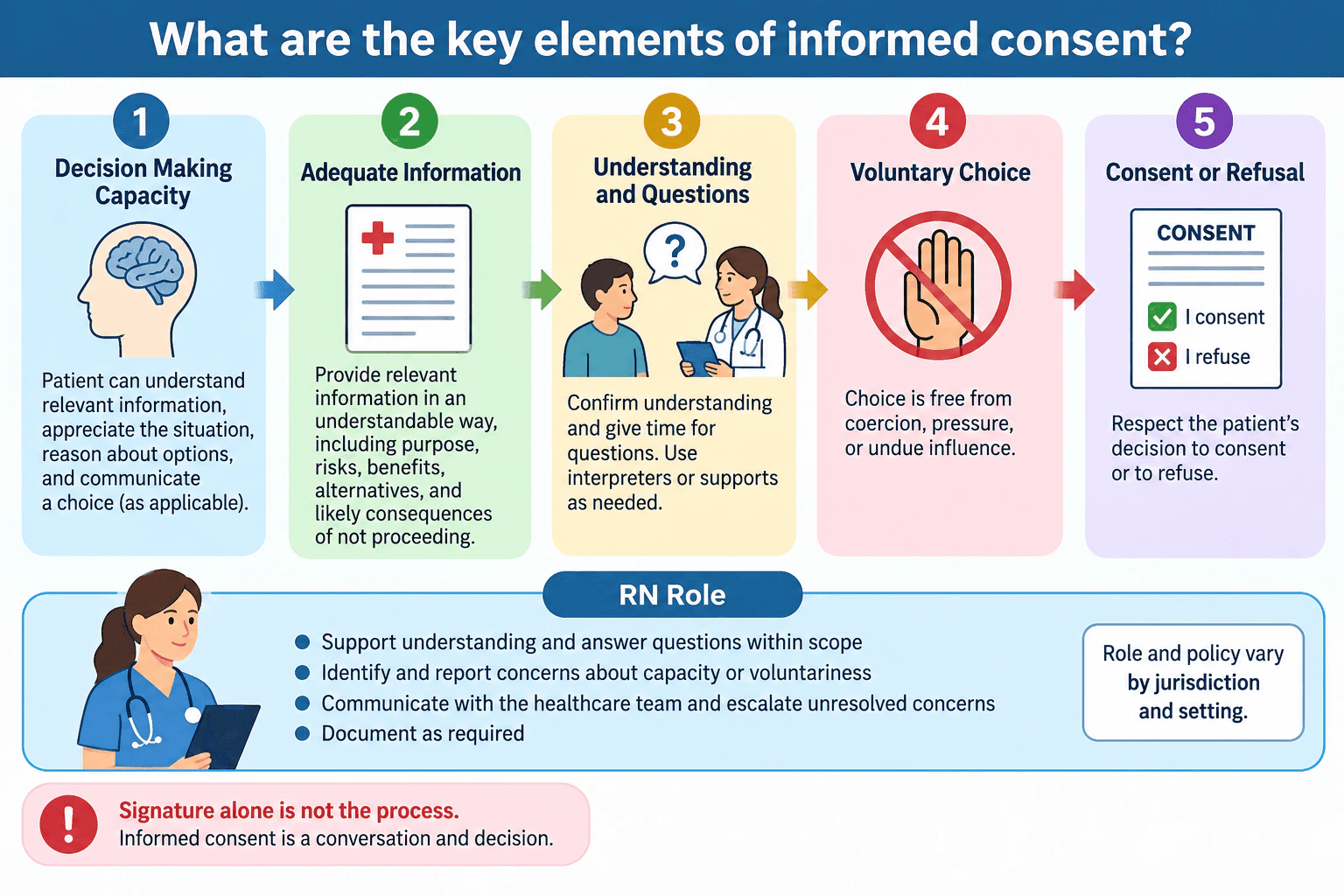
8. What are the key elements of informed consent?Ethics And Professional PracticeEasy
i Question Details
Explain capacity, adequate information, voluntariness, opportunity for questions, and the nurse's role in supporting understanding and following local policy.
Short Interview Answer (30-60 seconds)
The key elements of informed consent are decision making capacity, adequate information, understanding and an opportunity to ask questions, voluntariness, and a genuine choice to consent or refuse. The information should be understandable and relevant to the decision, including the purpose of the proposed care, expected benefits, risks, alternatives, and likely consequences of not proceeding when applicable. The nurse supports understanding within scope, identifies and reports concerns about capacity or voluntariness, communicates unresolved concerns to the healthcare team, respects the patient's decision, and documents according to applicable requirements. The exact nurse role depends on jurisdiction, setting, scope, and local policy.
Detailed Explanation
Informed consent is an ongoing communication and decision process. A signature may document a decision, but a signature alone does not establish that informed consent occurred. The patient needs decision making capacity for the specific choice, adequate information presented in an understandable way, an opportunity to ask questions and clarify information, freedom from coercion or undue influence, and a genuine choice to consent or refuse.
Useful Questions to Ask the Interviewer
Which jurisdiction and clinical setting should I use for this consent scenario?
Is the nurse proposing the care, or supporting a consent process led by another healthcare professional?
Are there concerns about capacity, communication needs, or voluntariness?
How to Explain It in an Interview
Professional Principle
I would explain that informed consent protects patient autonomy and requires more than obtaining a signature. I would first consider whether the patient has decision making capacity for the specific decision. A patient should not be considered incapable simply because the patient disagrees with the recommended plan.
Patient Rights and Preferences
The patient should receive adequate information in an understandable form. Relevant information can include the purpose of the proposed care, expected benefits, risks, alternatives, and likely consequences of not proceeding. The patient should have time to ask questions and receive clarification. Interpreters or other communication supports should be used when needed. The final choice must be voluntary and free from coercion, pressure, or undue influence. A capable and adequately informed patient may consent or refuse.
Nursing Responsibilities
The nurse should support understanding, answer questions that fall within nursing scope, and direct questions outside that scope to the appropriate healthcare professional. The nurse should identify and report concerns about capacity or voluntariness, communicate with the healthcare team, escalate unresolved concerns, respect the patient's valid decision, and document as required. The nurse should not assume responsibility for obtaining every procedure consent because the responsible professional can vary by jurisdiction, setting, intervention, scope, and local policy.
Consultation and Follow Up
If capacity, understanding, voluntariness, or the validity of consent remains uncertain, I would pause the relevant nursing action when appropriate, follow local policy, and consult the responsible healthcare professional or other designated resource. I would document the concern, communication, decision, and any required follow up.
Why Interviewers Ask This
Interviewers want to know whether the nurse understands patient autonomy, informed decision making, capacity, voluntariness, refusal of care, professional scope, communication, and appropriate escalation. A strong answer shows that the nurse can support a patient's decision without assuming that disagreement means incapacity and can distinguish nursing responsibilities from those of other healthcare professionals.
Common interview mistakes
Common mistakes include treating a signature as the entire consent process, assuming refusal means the patient lacks capacity, giving information beyond one's professional scope, pressuring the patient to accept recommended care, failing to address communication barriers, overlooking possible coercion or undue influence, failing to escalate unresolved concerns, or assuming that the nurse is always responsible for obtaining procedure consent. Another mistake is presenting one jurisdiction's consent rules as universal.
Interview tip
Use the same five part structure as the diagram: decision making capacity, adequate information, understanding and questions, voluntary choice, and consent or refusal. Then briefly explain the RN role in supporting understanding, recognizing concerns, communicating and escalating when needed, respecting the patient's decision, documenting as required, and following jurisdiction specific and setting specific policy.
Interviewer may ask next
How would you verify that the consent process is adequate before proceeding with nursing care?
I would confirm that the decision relates to the proposed care, that the patient appears able to make the specific decision, that relevant information has been provided in a way the patient can understand, that the patient has had an opportunity to ask questions, and that the choice appears voluntary. I would also check the required documentation and local policy. If I had concerns about capacity, misunderstanding, coercion, or whether the proper consent process occurred, I would communicate with the responsible healthcare professional and escalate according to policy rather than relying on a signature alone.
What would you do if a patient who previously agreed to care now refuses it?
I would recognize the patient's current decision and pause the proposed care when appropriate. I would clarify the patient's concerns without pressuring the patient, determine whether there is a communication or capacity concern within my role, provide or obtain any needed clarification, notify the responsible healthcare professional when appropriate, and document the refusal and related communication according to local requirements. A change of mind or disagreement with the recommendation alone does not establish incapacity.
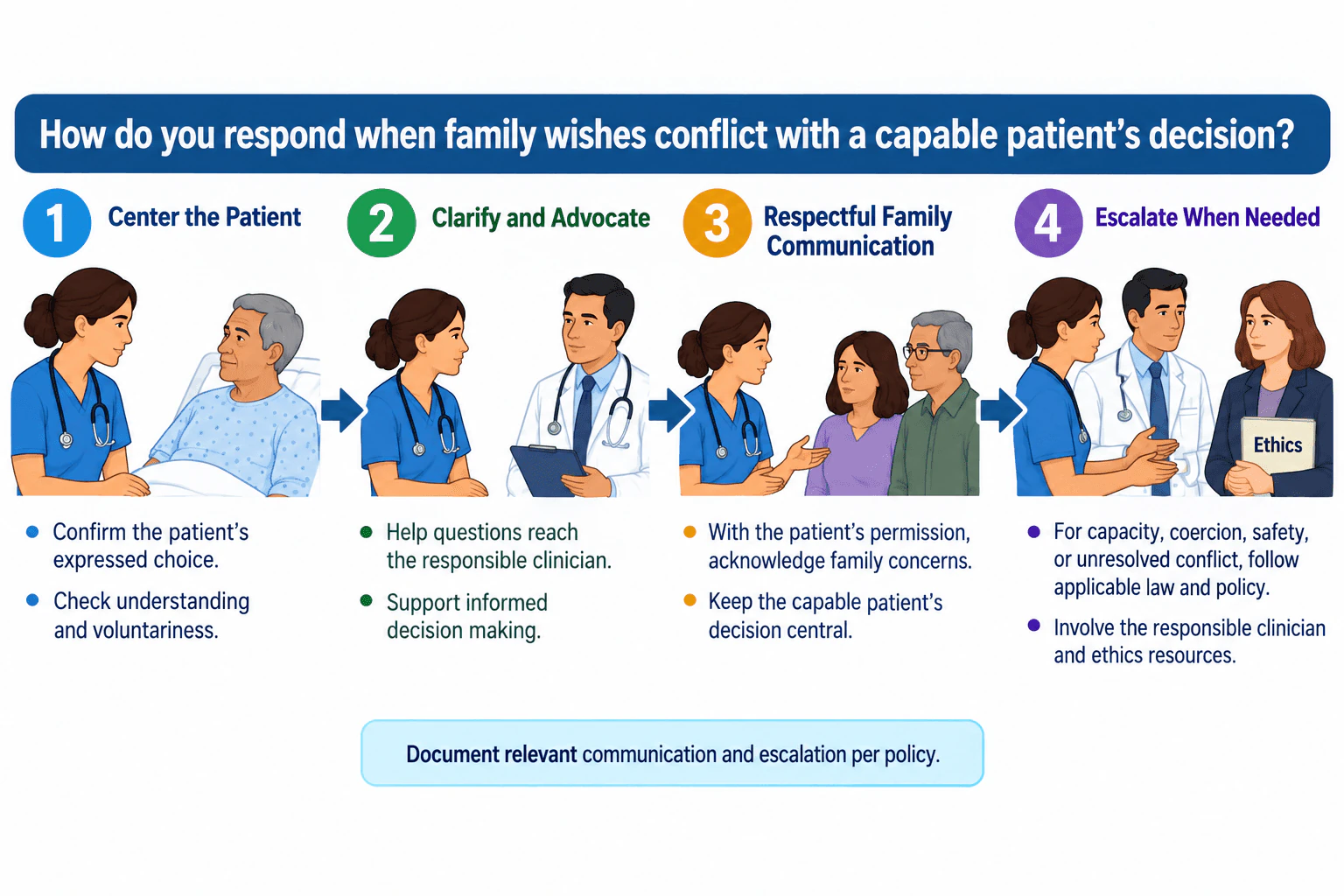
9. How do you respond when family wishes conflict with a capable patient's decision?Ethics And Professional PracticeMedium
i Question Details
Explain centering the patient's expressed wishes, clarifying understanding, maintaining respectful communication, and involving appropriate clinical or ethics resources.
Short Interview Answer (30-60 seconds)
I would keep the capable patient's informed and voluntary decision central. I would confirm the patient's expressed choice and understanding, support informed decision making, and make sure unanswered questions reach the responsible clinician. With the patient's permission, I would acknowledge the family's concerns respectfully while maintaining professional boundaries and staying within nursing scope. I would not treat disagreement alone as evidence of incapacity. If there are concerns about capacity, coercion, safety, or unresolved conflict, I would follow applicable law and policy, involve the responsible clinician and ethics resources as appropriate, and document the relevant communication and escalation.
Detailed Explanation
A capable patient remains the central decision maker when family members disagree with the patient's choice. My nursing role is to advocate for the patient's rights and preferences, support informed consent or refusal, check whether the patient understands the information presented and is acting voluntarily, maintain professional boundaries, communicate within my scope, and bring unresolved questions to the responsible clinician. Family disagreement by itself is not evidence that the patient lacks decision making capacity.
Useful Questions to Ask the Interviewer
What jurisdiction and care setting should I assume?
Is the patient already established as having decision making capacity for this decision?
What organizational resources are available for unresolved ethical conflict?
How to Explain It in an Interview
Professional Principle
I would begin by centering the capable patient's expressed decision. The patient should receive understandable information, have an opportunity to ask questions, and be free to accept or refuse care without coercion. My primary professional commitment remains to the patient even when family members prefer a different course.
Patient Rights and Preferences
I would speak directly with the patient and, when appropriate, provide a private opportunity to confirm the patient's choice. I would check understanding and voluntariness rather than assuming that disagreement means incapacity. If the patient wants family involved, I would include them within the limits of the patient's permission and applicable confidentiality requirements.
Nursing Responsibilities
I would communicate honestly within my nursing scope, support informed decision making, and help questions reach the clinician responsible for explaining the proposed intervention when that explanation falls outside my role. I would acknowledge family concerns respectfully while keeping the capable patient's decision central. I would maintain professional boundaries and would not allow pressure from family members to replace the patient's expressed wishes. I would not present the nurse as automatically responsible for obtaining every procedure consent because responsibilities vary by jurisdiction, setting, procedure, and policy.
Consultation and Follow Up
If there are concerns about capacity, coercion, safety, or persistent conflict, I would follow applicable law, professional standards, and organizational policy. I would involve the responsible clinician and, when appropriate, ethics or other institutional resources. I would document the relevant patient preferences, communication, concerns, consultation, and escalation according to policy.
Why Interviewers Ask This
Interviewers are assessing whether the nurse can advocate for patient autonomy, respect consent and refusal, communicate therapeutically with family, maintain professional boundaries, stay within nursing scope, recognize concerns about capacity or coercion, and use appropriate consultation and escalation when conflict cannot be resolved.
Common interview mistakes
Common mistakes include allowing family preference to replace the decision of a capable patient, equating disagreement with incapacity, discussing patient information with family without appropriate permission, failing to respect consent or refusal, crossing professional boundaries, giving explanations or making decisions outside nursing scope, assuming the nurse obtains every procedure consent, or failing to escalate concerns about coercion, capacity, safety, or unresolved conflict through appropriate clinical and ethics channels.
Interview tip
State the governing principle first: the capable patient's informed and voluntary decision remains central. Then follow the same sequence as the diagram: confirm the patient's choice and understanding, support informed decision making, communicate with family with the patient's permission, maintain professional boundaries, escalate unresolved concerns appropriately, and document relevant communication and escalation.
Interviewer may ask next
How would you verify that the patient's decision is informed and voluntary?
I would assess whether the patient appears to understand the information already provided, can communicate a choice, and is making that choice without apparent coercion or undue influence. I would invite questions and make sure unanswered questions reach the responsible clinician. I would not independently declare incapacity merely because the patient chooses differently from the family or care team. If capacity is uncertain, I would follow the applicable clinical process, jurisdictional requirements, and organizational policy and involve the appropriate clinician.
What changes if the patient may no longer have decision making capacity?
The situation changes because capacity must be addressed for the decision at hand according to applicable law, professional responsibilities, and organizational policy. The nurse should continue to involve the patient to the greatest extent possible, communicate observed concerns, and help ensure that any authorized surrogate or alternate decision maker follows the appropriate standard for decision making. Unresolved disagreement or concern should be escalated to the responsible clinician and appropriate ethics or institutional resources rather than allowing family preference alone to determine care.
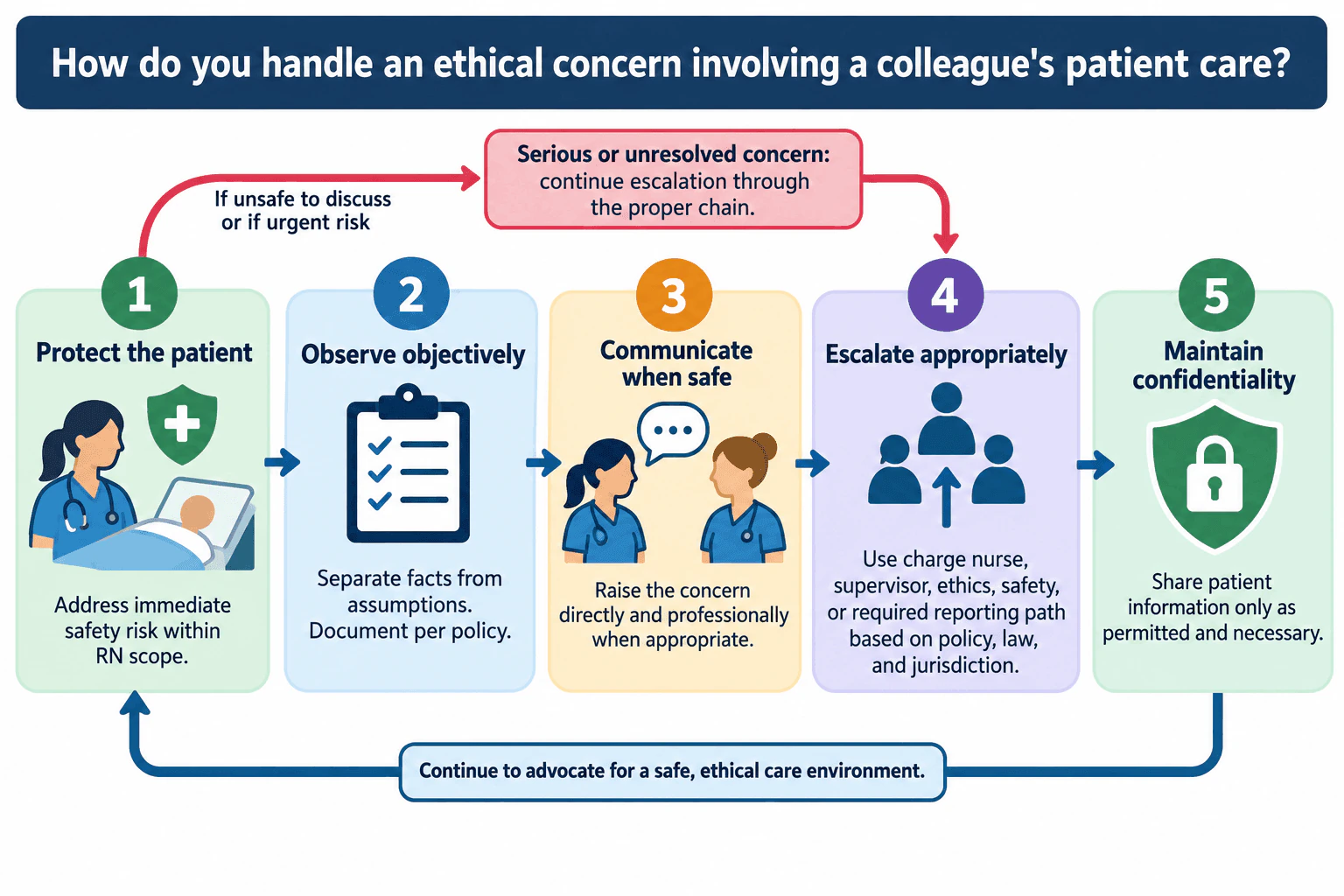
10. How do you handle an ethical concern involving a colleague's patient care?Ethics And Professional PracticeMedium
i Question Details
Describe immediate protection of the patient, objective observation, appropriate direct communication when safe, escalation through the proper chain, and confidentiality.
Short Interview Answer (30-60 seconds)
I put patient safety first. If there is an immediate risk, I act within my RN scope and applicable policy to protect the patient. I objectively identify what I observed, separate facts from assumptions, and document according to policy. When it is safe and appropriate, I address the concern directly and professionally with the colleague. If that would be unsafe, the concern is serious, or it remains unresolved, I escalate through the proper chain or required reporting process. I maintain confidentiality throughout and continue advocating until the concern has been appropriately addressed.
Detailed Explanation
An ethical concern involving a colleague should be handled as a patient safety and professional practice issue rather than as a personal conflict. The sequence is to protect the patient, observe objectively, communicate directly when safe, escalate appropriately, and maintain confidentiality. The exact chain of command and reporting obligations depend on the jurisdiction, setting, applicable law, professional standards, and organizational policy.
Useful Questions to Ask the Interviewer
What escalation pathway does this organization use for unresolved patient safety or ethical concerns?
What resources are available, such as nursing leadership, ethics consultation, or patient safety services?
How are nurses expected to document and report concerns while protecting confidentiality?
How to Explain It in an Interview
Nursing Responsibilities
I first protect the patient from any immediate safety risk within my RN scope and applicable policy. I then identify exactly what I observed and separate objective facts from assumptions. Documentation should follow organizational policy and should accurately reflect relevant observations and actions.
Professional Communication
When it is safe and appropriate, I raise the concern directly and professionally with the colleague. I focus on the patient care issue and the observed facts rather than making accusations or assumptions about intent. Direct discussion may clarify the situation and allow the concern to be addressed promptly.
Consultation and Escalation
If direct discussion would be unsafe, the concern is serious, or the issue remains unresolved, I use the appropriate escalation pathway. Depending on the setting, this may involve the charge nurse, nursing supervisor, ethics resource, patient safety resource, or another reporting process required by policy or law. I continue escalating an unresolved threat to patient safety through the appropriate chain rather than assuming that one report ends my responsibility.
Confidentiality and Follow Up
I protect confidentiality throughout the process. I share patient information only with people who are permitted to receive it and only to the extent necessary for care, review, or required reporting. I follow up through the appropriate process and continue advocating for a safe and ethical care environment. Because requirements differ by jurisdiction and organization, I verify the applicable policy and professional obligations rather than treating one local process as universal.
Why Interviewers Ask This
Interviewers are assessing whether the nurse can advocate for patient safety while remaining objective, professional, accountable, and respectful of confidentiality. They also want to see whether the nurse understands appropriate direct communication, escalation, documentation, scope of practice, and the fact that reporting requirements and organizational pathways vary by jurisdiction and setting.
Common interview mistakes
Common mistakes include failing to address an immediate safety risk, treating assumptions as established facts, confronting a colleague when doing so would be unsafe, making the issue personal rather than patient focused, failing to escalate an unresolved serious concern, documenting inaccurately or contrary to policy, sharing patient information unnecessarily, or assuming that one facility's reporting process applies everywhere.
Interview tip
Present your answer in the same clear sequence as the diagram: protect the patient, observe objectively, communicate when safe, escalate appropriately, and maintain confidentiality. Mention that serious or unresolved concerns require continued escalation through the proper pathway and that scope, reporting duties, and chain of command depend on the jurisdiction and organization.
Interviewer may ask next
How would you verify that you followed the correct reporting and escalation process?
I would review the applicable organizational policy, relevant nursing practice requirements for the jurisdiction, and any reporting obligations that apply to the situation. If clarification were needed, I would consult the appropriate nursing leader, ethics resource, patient safety resource, or other authorized source. I would document according to policy and verify that required follow up occurred while maintaining confidentiality.
What would you do differently if the colleague's action created an immediate threat to the patient?
I would prioritize immediate patient protection within my RN scope and the setting's authorized processes. I would not delay necessary safety action simply to discuss the concern with the colleague first. After addressing the immediate risk, I would promptly notify the appropriate leader or reporting pathway, document objective facts according to policy, escalate as required, maintain confidentiality, and continue advocating until the concern was appropriately addressed.
More questions load as you scroll
Registered Nurse Resume Examples
Explore the resume examples below to find the one that best matches your target Registered Nurse role.
Disclaimer: This interview guide is for educational and informational purposes only. It is designed to help readers prepare, but it does not guarantee any interview result, hiring decision, offer, or outcome. Interview questions, hiring criteria, and preferred answers can vary by employer, interviewer, industry, location, and time. All answers, examples, and explanations in this guide are suggested examples for interview preparation, not definitive answers or instructions for professional practice. They are based on research and judgment, are provided without warranties of any kind, and should be adapted to the question, role, and applicable laws and professional requirements. Diagrams are simplified illustrations intended to highlight the main concepts and their relationships; actual situations, systems, and practices may be more complex. Alternative approaches may be equally valid or better suited to a particular question, context, or interviewer. To the fullest extent permitted by applicable law, the contributors and publisher are not liable for decisions made, actions taken, or losses incurred based on this guide.
State Laws and Professional Responsibilities: Laws and requirements governing an occupation vary by state and jurisdiction. You are responsible for checking the current laws, licensing requirements, and scope-of-practice rules that apply to your location and role, and for ensuring that your answers and actions comply with them. Adapt examples in this guide to those requirements. This guide is not legal advice.
Content Accuracy and Verification: To the fullest extent permitted by applicable law, we do not represent or warrant that interview guides, questions, answers, examples, or diagrams are accurate, complete, current, error-free, or suitable for any particular purpose. You are responsible for independently reviewing and verifying the information before relying on it.