This interview guide is for educational and informational purposes only. It is designed to help readers prepare, but it does not guarantee any interview result, hiring decision, offer, or outcome. Interview questions, hiring criteria, and preferred answers can vary by employer, interviewer, industry, location, and time. All answers, examples, and explanations in this guide are suggested examples for interview preparation, not definitive answers or instructions for professional practice. They are based on research and judgment, are provided without warranties of any kind, and should be adapted to the question, role, and applicable laws and professional requirements. Diagrams are simplified illustrations intended to highlight the main concepts and their relationships; actual situations, systems, and practices may be more complex. Alternative approaches may be equally valid or better suited to a particular question, context, or interviewer. To the fullest extent permitted by applicable law, the contributors and publisher are not liable for decisions made, actions taken, or losses incurred based on this guide.
State Laws and Professional Responsibilities
Laws and requirements governing an occupation vary by state and jurisdiction. You are responsible for checking the current laws, licensing requirements, and scope-of-practice rules that apply to your location and role, and for ensuring that your answers and actions comply with them. Adapt examples in this guide to those requirements. This guide is not legal advice.
Identity, Image, and Privacy Notice
To respect individual privacy, some names, profile photographs, avatars, biographical details, and other identifying information displayed in this guide may be replaced with pseudonyms, licensed stock images, illustrative avatars, composite images, or representative descriptions. Unless a person is expressly identified as an actual contributor, a displayed name, image, or profile should not be understood as depicting or identifying a specific candidate, interviewer, employee, or other real individual. These representations are provided for editorial and illustrative purposes only and do not imply endorsement, employment, participation, or affiliation with this guide or any company mentioned in it. Any resemblance to an actual person is coincidental.
Company Notice
This guide is an independent educational resource and is not affiliated with, endorsed by, sponsored by, or approved by the company named in this guide. Company names identify reported interview experiences or the employer context of clearly labeled original practice exercises. Interview practices can change without notice, and inclusion of company-specific content does not mean these questions are official, complete, or guaranteed to be asked. To the fullest extent permitted by law, the author, contributors, and publisher are not responsible for outcomes related to use of this material.
Content Accuracy and Verification
To the fullest extent permitted by applicable law, we do not represent or warrant that interview guides, questions, answers, examples, or diagrams are accurate, complete, current, error-free, or suitable for any particular purpose. You are responsible for independently reviewing and verifying the information before relying on it.
Questions or comments?
Contact us for general questions, or share feedback, technical corrections, and comments with the community.
21. What are standard precautions and why are they important?Patient Safety And Infection PreventionEasy
i Question Details
Explain the routine infection prevention principles applied to patient care and why they reduce transmission risk.
Short Interview Answer (30-60 seconds)
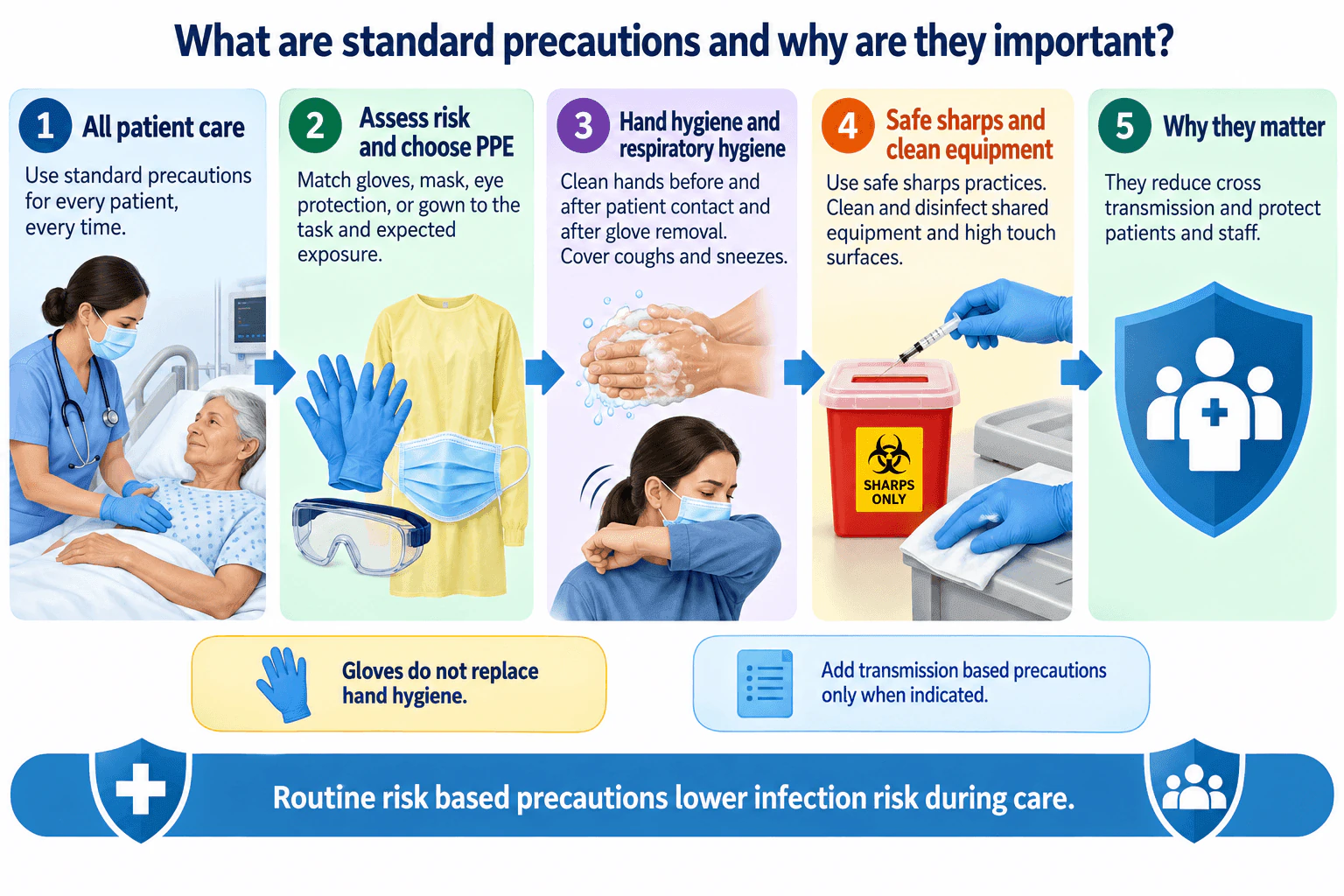
Standard precautions are the routine infection prevention practices used for every patient. I assess the care activity and expected exposure, then use measures such as hand hygiene, appropriate personal protective equipment, respiratory hygiene, safe sharps practices, and cleaning and disinfection. Gloves do not replace hand hygiene. These precautions reduce transmission risk and protect patients and healthcare personnel. If additional precautions are required for a suspected or confirmed infection, I continue standard precautions and add the appropriate transmission based precautions. cdc.gov
Detailed Explanation
Standard precautions are the basic infection prevention practices used during all patient care. They apply regardless of whether an infection has already been identified. The nurse considers the care activity and anticipated exposure, then chooses the measures appropriate to that risk.
Useful Questions to Ask the Interviewer
Is there a particular patient care activity or exposure you would like me to use as an example?
Would you like me to explain how standard precautions differ from transmission based precautions?
Should I focus on bedside application or the general infection prevention principles?
How to Explain It in an Interview
Safety Principle
I would start by saying that standard precautions apply to all patient care. They are based on risk assessment and are intended to protect healthcare personnel while reducing spread of infection between patients. cdc.gov
Prevention Measures
I perform hand hygiene at the appropriate times and choose gloves, a mask, eye protection, or a gown according to the task and expected exposure. Respiratory hygiene is also part of standard precautions. I use safe sharps practices and make sure shared equipment and patient care surfaces are cleaned and disinfected appropriately. cdc.gov
Gloves do not replace hand hygiene. If gloves are required, hand hygiene is performed before donning them when indicated and after removing them. cdc.gov
Patient Context And Checks
The exact precautions depend on the procedure, anticipated exposure, patient condition, and current guidance. I would not use the same personal protective equipment for every task. If a patient has a suspected or confirmed infection requiring additional controls, standard precautions remain in place and the appropriate transmission based precautions are added. cdc.gov
Rationale And Reassessment
The goal is to reduce opportunities for infectious agents to move between patients, healthcare personnel, equipment, and the care environment. If the task or exposure risk changes during care, I reassess and adjust the precautions according to current guidance and applicable facility procedures.
Why Interviewers Ask This
Interviewers are evaluating whether the nurse understands that standard precautions apply to every patient while the specific protective measures are selected according to the task and anticipated exposure. A strong answer shows appropriate risk assessment, correct use of personal protective equipment, continued hand hygiene even when gloves are used, safe sharps and equipment practices, and recognition that transmission based precautions are added when additional infection control measures are indicated.
Common interview mistakes
Common mistakes include assuming gloves replace hand hygiene, using the same personal protective equipment for every care activity without assessing exposure risk, focusing only on hand hygiene while overlooking respiratory hygiene, sharps safety, or equipment cleaning, and confusing standard precautions with transmission based precautions. Transmission based precautions are additional measures and do not replace standard precautions. cdc.gov
Interview tip
Use a simple bedside sequence: standard precautions apply to every patient, assess the task and expected exposure, choose the appropriate protective measures, perform hand hygiene correctly, handle sharps and equipment safely, and explain that these actions reduce transmission. Mention that gloves do not replace hand hygiene and that transmission based precautions are added when indicated.
Interviewer may ask next
How would you verify which precautions are appropriate for a specific care activity?
I would identify the procedure and anticipated exposure to blood, body fluids, mucous membranes, nonintact skin, contaminated equipment, or respiratory secretions, then check current infection prevention guidance and applicable facility procedures. I would select personal protective equipment and other measures based on that verified exposure risk rather than assuming one set of precautions applies to every activity.
What changes if the patient has a suspected infection that requires additional precautions?
I would continue standard precautions and add the transmission based precautions appropriate to the suspected route of transmission and clinical context. Transmission based precautions are an additional tier used for patients who may have infectious agents requiring measures beyond standard precautions. cdc.gov
22. How do you respond when a colleague repeatedly misses infection control precautions?Patient Safety And Infection PreventionMedium
i Question Details
Describe immediate safety action, respectful feedback, education, escalation when needed, and documentation according to policy.
Short Interview Answer (30-60 seconds)
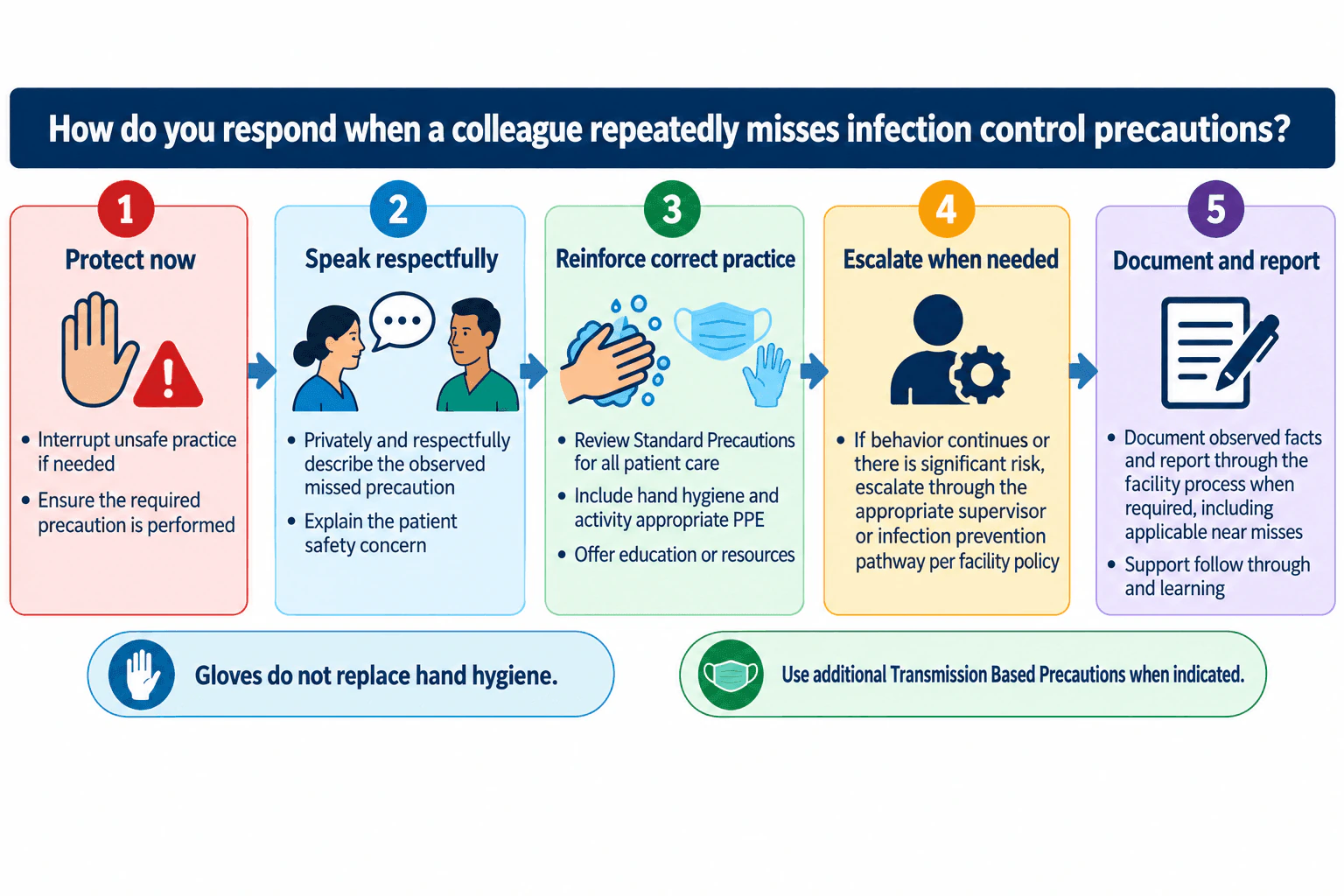
I would protect the patient first and interrupt an unsafe practice if needed. Then I would speak with the colleague privately and respectfully, describe the specific precaution that was missed, and explain the patient safety concern. I would reinforce the correct Standard Precautions, including hand hygiene and activity appropriate personal protective equipment, and offer education or resources. If the behavior continues or creates significant risk, I would escalate through the appropriate supervisor or infection prevention pathway according to facility policy. I would document observed facts and report applicable incidents or near misses through the facility process.
Detailed Explanation
Repeated missed infection control precautions require both immediate patient protection and a professional response to the underlying behavior. I would focus on the specific observed action rather than making assumptions about the colleague. Standard Precautions apply to all patient care, while additional Transmission Based Precautions are used when the patient's suspected or confirmed infection and the care situation indicate that they are needed. Gloves do not replace hand hygiene.
Useful Questions to Ask the Interviewer
What infection prevention escalation pathway does this organization use for repeated safety concerns?
How are staff expected to document and report infection control incidents or near misses?
How to Explain It in an Interview
Safety Principle
My first responsibility is patient safety. If a missed precaution creates an immediate risk, I would interrupt the unsafe practice and make sure the required precaution is performed before care continues when appropriate.
Respectful Feedback
I would speak with the colleague privately when possible. I would describe the specific behavior I observed, explain the patient safety concern, and avoid personal or accusatory language. The goal is to correct the unsafe practice and support reliable adherence.
Prevention Measures
I would reinforce the precautions that apply to the actual care activity. Standard Precautions include hand hygiene and selecting personal protective equipment according to the anticipated exposure. Gloves do not replace hand hygiene. If the patient requires additional Transmission Based Precautions, those precautions are added according to the clinical situation and current guidance. I would offer education, clarification, or infection prevention resources if the colleague appears uncertain about the correct practice.
Monitoring and Reporting
If the colleague continues to miss precautions, or if there is significant risk to patients or staff, I would escalate through the appropriate supervisor or infection prevention pathway according to facility policy. I would document objective facts rather than opinions and use the facility safety reporting process when required, including applicable near misses. I would support follow through and learning so the response promotes safer future practice rather than focusing only on blame.
Why Interviewers Ask This
Interviewers are assessing whether the nurse can protect patients immediately while using professional communication, correct infection prevention practices, appropriate escalation, factual documentation, and a safety focused approach to repeated nonadherence.
Common interview mistakes
Common mistakes include ignoring repeated missed precautions, confronting the colleague in a humiliating or accusatory way, assuming gloves replace hand hygiene, treating the same personal protective equipment as appropriate for every care activity, confusing Standard Precautions with additional Transmission Based Precautions, delaying escalation despite continued or significant risk, and documenting opinions instead of objective observations.
Interview tip
Organize the response in the same sequence shown in practice: protect the patient, speak respectfully, reinforce the correct precaution, escalate repeated or significant risk, then document and report according to policy. This demonstrates immediate safety judgment, professional communication, and support for learning.
Interviewer may ask next
How would you verify which infection control precautions are required before correcting the colleague?
I would verify the care activity, anticipated exposure, available patient infection information, current infection prevention guidance, and the facility's applicable policy. Standard Precautions apply to all patient care, with personal protective equipment selected according to the exposure risk. Additional Transmission Based Precautions are added when the patient's suspected or confirmed infection and current guidance indicate they are needed. If I remained uncertain, I would consult the appropriate infection prevention resource rather than guess.
What would you do differently if the missed precaution created an immediate exposure risk?
I would prioritize immediate safety by interrupting the unsafe practice, protecting the patient and staff from further exposure, and making sure the required precaution is performed. I would then follow the facility pathway for any indicated exposure assessment or containment, notify the appropriate supervisor or infection prevention resource, document objective facts, and complete required safety reporting. Respectful discussion and education would still occur, but they would not delay actions needed to control the immediate risk.
23. How do you prioritize infection prevention during an outbreak on your unit?Patient Safety And Infection PreventionMedium
i Question Details
Explain isolation or transmission based precautions as directed, hand hygiene, PPE, communication, environmental measures, and coordination with infection prevention.
Short Interview Answer (30-60 seconds)
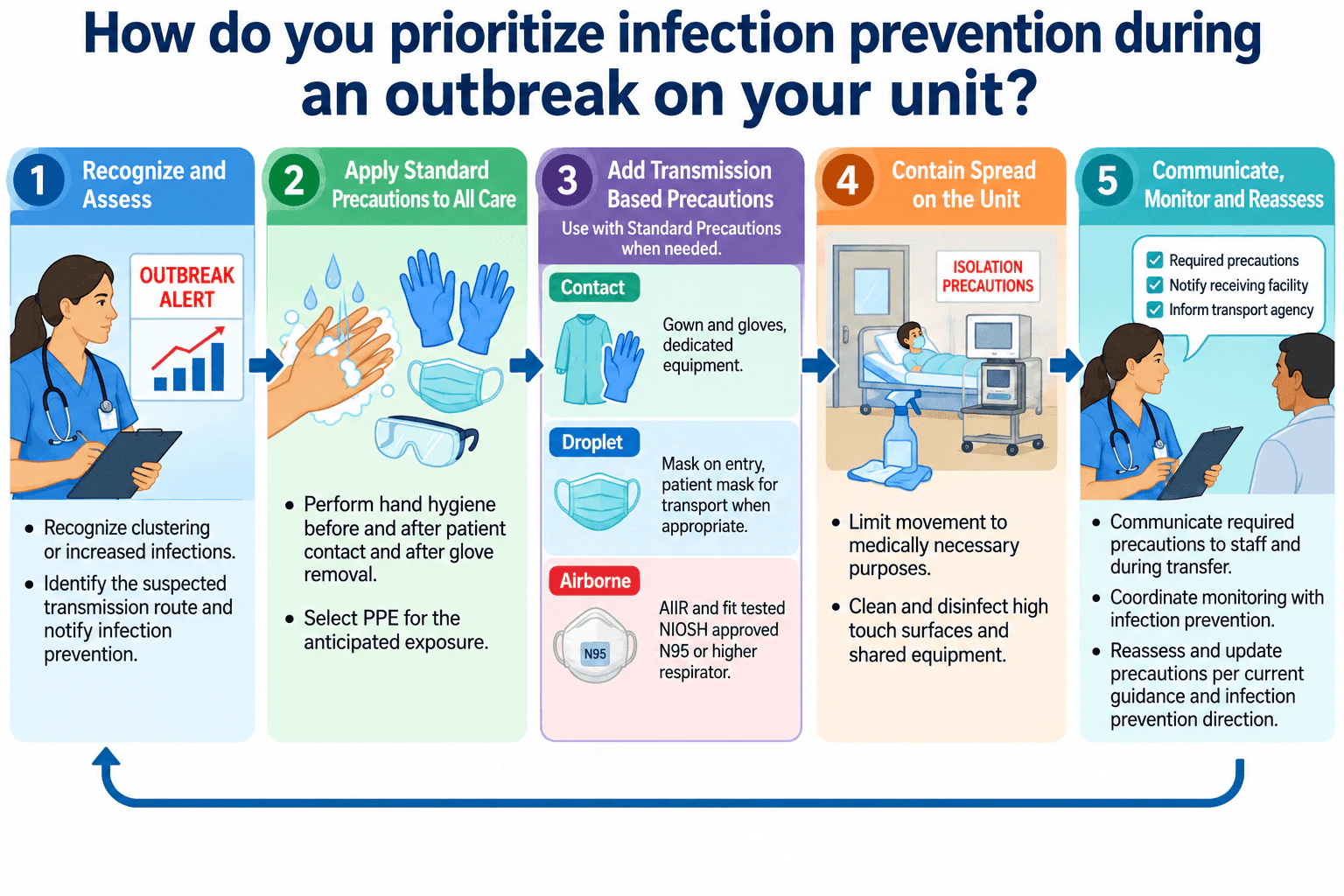
During an outbreak, I focus first on interrupting transmission. I recognize clustering or increased infections, identify the suspected route, and notify infection prevention. Standard Precautions continue for all patients, including hand hygiene and PPE based on anticipated exposure. I add Contact, Droplet, or Airborne Precautions when indicated, limit unnecessary movement, support cleaning and disinfection of high touch surfaces and shared equipment, clearly communicate precautions during care and transfer, and reassess precautions as clinical and laboratory information changes.
Detailed Explanation
During an outbreak, the priority is to interrupt transmission while continuing safe patient care. Standard Precautions remain the foundation for every patient. Additional Transmission Based Precautions are selected according to the suspected or confirmed route of spread, current guidance, and local infection prevention direction.
Useful Questions to Ask the Interviewer
Is there a specific suspected organism or transmission route in this scenario?
What isolation resources and infection prevention support are available on the unit?
Should I assume the facility outbreak protocol has already been activated?
How to Explain It in an Interview
Safety Principle
I would first recognize clustering or an unusual increase in infections, identify the likely transmission route from available clinical information, and notify or coordinate with infection prevention. I would not wait for every laboratory result before following indicated precautions when transmission is reasonably suspected.
Prevention Measures
Standard Precautions apply to all patient care. I would perform hand hygiene at the appropriate moments and select PPE according to anticipated exposure. Gloves do not replace hand hygiene.
If additional precautions are indicated, I would apply the appropriate transmission category. For Contact Precautions, this can include gown and gloves and dedicated patient care equipment. For Droplet Precautions, health care personnel wear a mask on entry, and a patient who must leave the room should wear a mask when appropriate. For Airborne Precautions, appropriate placement includes an airborne infection isolation room when available, with health care personnel using a fit tested NIOSH approved N95 or higher level respirator.
Patient Risks
I would limit movement outside the room to medically necessary purposes when required by the applicable precautions. I would also support appropriate cleaning and disinfection of high touch surfaces and shared equipment because contaminated environmental surfaces and equipment can contribute to transmission.
Monitoring and Reporting
I would communicate required precautions to staff and to receiving teams during transfer. I would coordinate ongoing surveillance with infection prevention and reassess precautions when clinical findings, laboratory information, or current guidance changes. The key is to match precautions to the actual exposure and transmission risk rather than using one universal checklist.
Why Interviewers Ask This
Interviewers are evaluating whether the nurse can recognize increased transmission risk, distinguish Standard Precautions from additional Transmission Based Precautions, select actions according to the suspected route and exposure, coordinate with infection prevention, and continually reassess precautions as new information becomes available.
Common interview mistakes
Common mistakes include treating gloves as a substitute for hand hygiene, assuming every outbreak requires the same isolation measures, applying Transmission Based Precautions without considering the suspected route, overlooking shared equipment and high touch surfaces, allowing unnecessary patient movement, failing to communicate precautions during transfer, and continuing precautions without reassessing new clinical or laboratory information.
Interview tip
Organize the response as a priority sequence: recognize the outbreak risk, maintain Standard Precautions, add the correct Transmission Based Precautions, contain opportunities for spread, then communicate and reassess. Emphasize that precautions are selected from the exposure and transmission route rather than from a single universal checklist.
Interviewer may ask next
How would you verify that the precautions you selected are appropriate?
I would verify the suspected or confirmed transmission route against current infection control guidance and the facility protocol, then coordinate with infection prevention. I would also confirm that patient placement, PPE, environmental measures, transport precautions, and communication requirements match that route. As laboratory or clinical information becomes available, I would reassess whether the precautions should continue, change, or be discontinued.
What would change if the suspected infection required Airborne Precautions instead of Droplet Precautions?
I would use the requirements for Airborne Precautions rather than relying on Droplet measures alone. That includes appropriate placement in an airborne infection isolation room when available and use of a fit tested NIOSH approved N95 or higher level respirator by health care personnel. Patient movement would be limited to medically necessary purposes, and the patient would wear a mask during necessary transport when possible. I would communicate the Airborne Precautions clearly to receiving staff and continue reassessment with infection prevention.
24. How would you respond to a rise in falls or infections on your unit?Patient Safety And Infection PreventionHard
i Question Details
Explain how you would identify patterns, protect patients, communicate concerns, support root cause review, and monitor improvement actions.
Short Interview Answer (30-60 seconds)
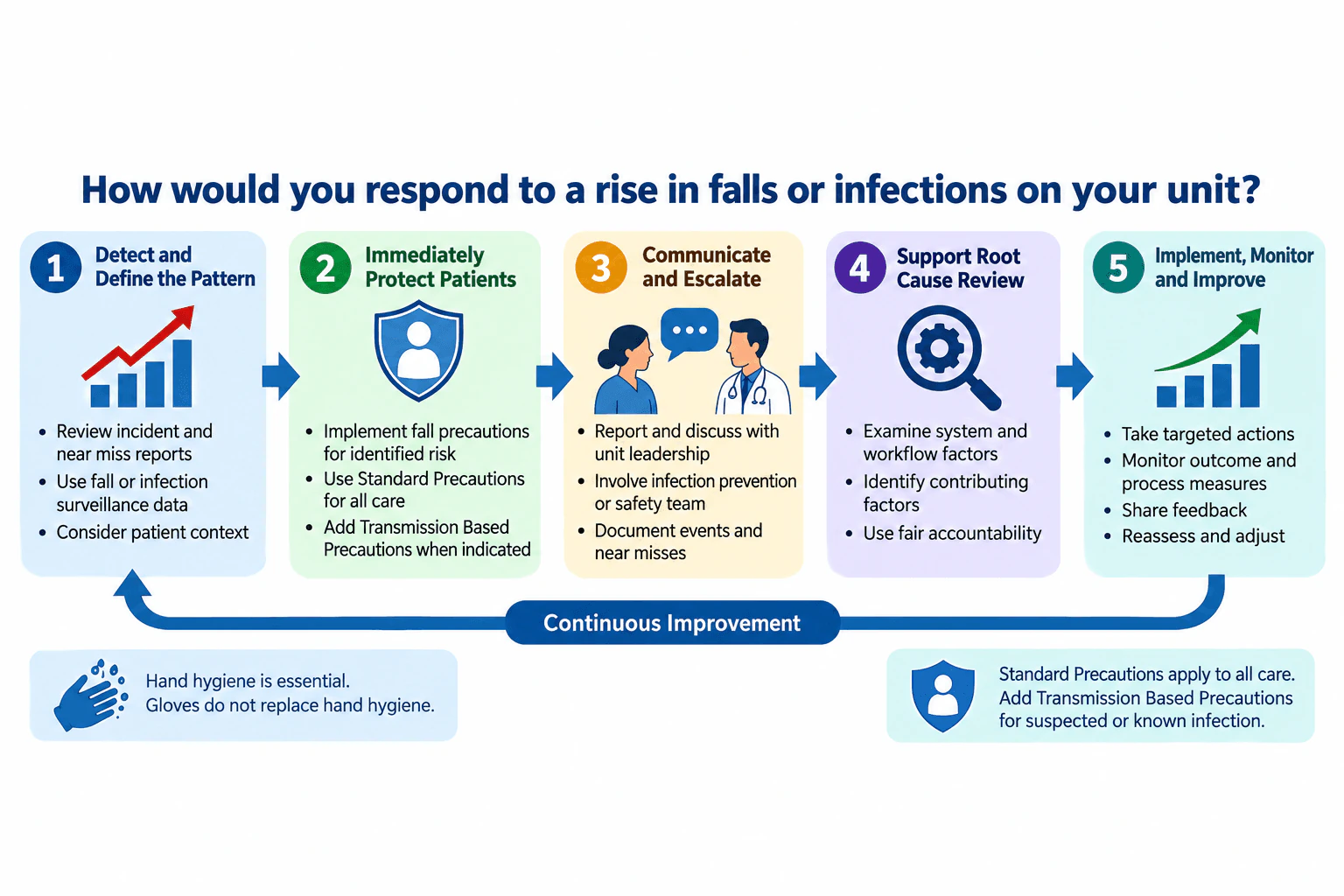
I would first define the pattern using incident reports, near miss reports, fall or infection surveillance data, and patient context. At the same time, I would protect patients with risk specific precautions. For falls, I would use individualized prevention measures for identified risks. For infection concerns, I would use Standard Precautions for all patient care and add Transmission Based Precautions when indicated. I would communicate the trend to unit leadership, involve the appropriate safety or infection prevention team, document events and near misses, support a systems focused root cause review, and then monitor targeted improvement actions using outcome and process measures with ongoing feedback and reassessment.
Detailed Explanation
A rise in falls or infections is both an immediate patient safety concern and a signal that the unit may have a recurring system problem. I would respond in the same sequence shown in the diagram: define the pattern, protect patients, communicate and escalate, support root cause review, then measure whether corrective actions actually work.
Useful Questions to Ask the Interviewer
What surveillance, incident reporting, and quality data are available to the unit?
Which teams normally participate in safety or infection reviews at this organization?
How are improvement actions and results communicated back to frontline staff?
How to Explain It in an Interview
Safety Principle
I would first determine what has changed rather than reacting to one event or number in isolation. I would review incident and near miss reports, fall or infection surveillance data, timing, location, repeated circumstances, and relevant patient context. I would use the organization's established definitions and reporting processes rather than inventing my own threshold.
Patient Risks
While the pattern is being reviewed, I would address current patient risk. For falls, I would reassess affected patients and use individualized fall precautions for identified risks. For infection concerns, Standard Precautions apply to all patient care. Transmission Based Precautions are added when a suspected or confirmed infection requires additional measures to prevent transmission. Hand hygiene remains essential, and gloves do not replace hand hygiene.
Prevention Measures
I would report and discuss the trend with unit leadership and involve infection prevention or the appropriate patient safety team. I would document events and near misses according to the reporting process. During root cause review, I would examine system and workflow factors and identify contributing factors rather than focusing only on individual mistakes. Fair accountability still matters, but the purpose is to understand why events occurred and reduce the chance of recurrence.
Monitoring and Reporting
After contributing factors are identified, I would support targeted corrective actions. I would monitor outcome measures, such as whether falls or infections decrease, and process measures showing whether intended prevention practices are occurring. I would share feedback with the team, reassess the interventions, and adjust them when the data show that risk remains.
Why Interviewers Ask This
Interviewers are assessing whether the nurse can recognize a developing safety signal, protect patients before the investigation is complete, communicate and document concerns appropriately, participate in a systems focused review, and use measurement and reassessment rather than assuming one intervention solved the problem. They also want to see that infection precautions and fall prevention are selected according to the actual risk rather than treated as one universal checklist.
Common interview mistakes
Common mistakes include reacting to isolated events without checking for a pattern, delaying immediate patient protection while waiting for a formal review, treating every patient or care activity with the same precautions, assuming gloves replace hand hygiene, using additional infection precautions without considering the transmission risk, focusing only on individual blame instead of contributing system factors, failing to report near misses, and implementing an intervention without measuring whether it changed outcomes or practice.
Interview tip
Present the response as a continuous improvement loop: define the pattern, protect patients immediately, communicate and document, examine contributing system factors with fair accountability, then implement targeted actions and measure the result. Be specific about how fall prevention differs from infection precautions, and emphasize feedback and reassessment until the data show sustained improvement.
Interviewer may ask next
How would you verify that the apparent rise in falls or infections represents a real pattern?
I would review incident reports, near miss reports, surveillance data, dates, locations, patient context, and repeated circumstances using the organization's established definitions and data collection methods. I would also check whether reporting practices, patient population, or care activity changed in a way that could affect the numbers. For an infection concern, I would involve infection prevention when appropriate to confirm that cases are being identified and classified consistently. I would verify the pattern without delaying immediate protection for patients who are currently at risk.
How would your response change if the increase involved infections rather than falls?
The overall improvement process would remain the same, but the immediate protective actions and specialists involved would change. For infection concerns, I would continue Standard Precautions for all patient care, reinforce hand hygiene, and add Transmission Based Precautions when indicated by the suspected or confirmed infection. I would involve infection prevention and review surveillance patterns and possible transmission opportunities. For falls, I would focus immediate protection on individualized fall risks and appropriate fall precautions. In either situation, I would communicate concerns, document events and near misses, support systems focused review, monitor targeted actions, share feedback, and reassess results.
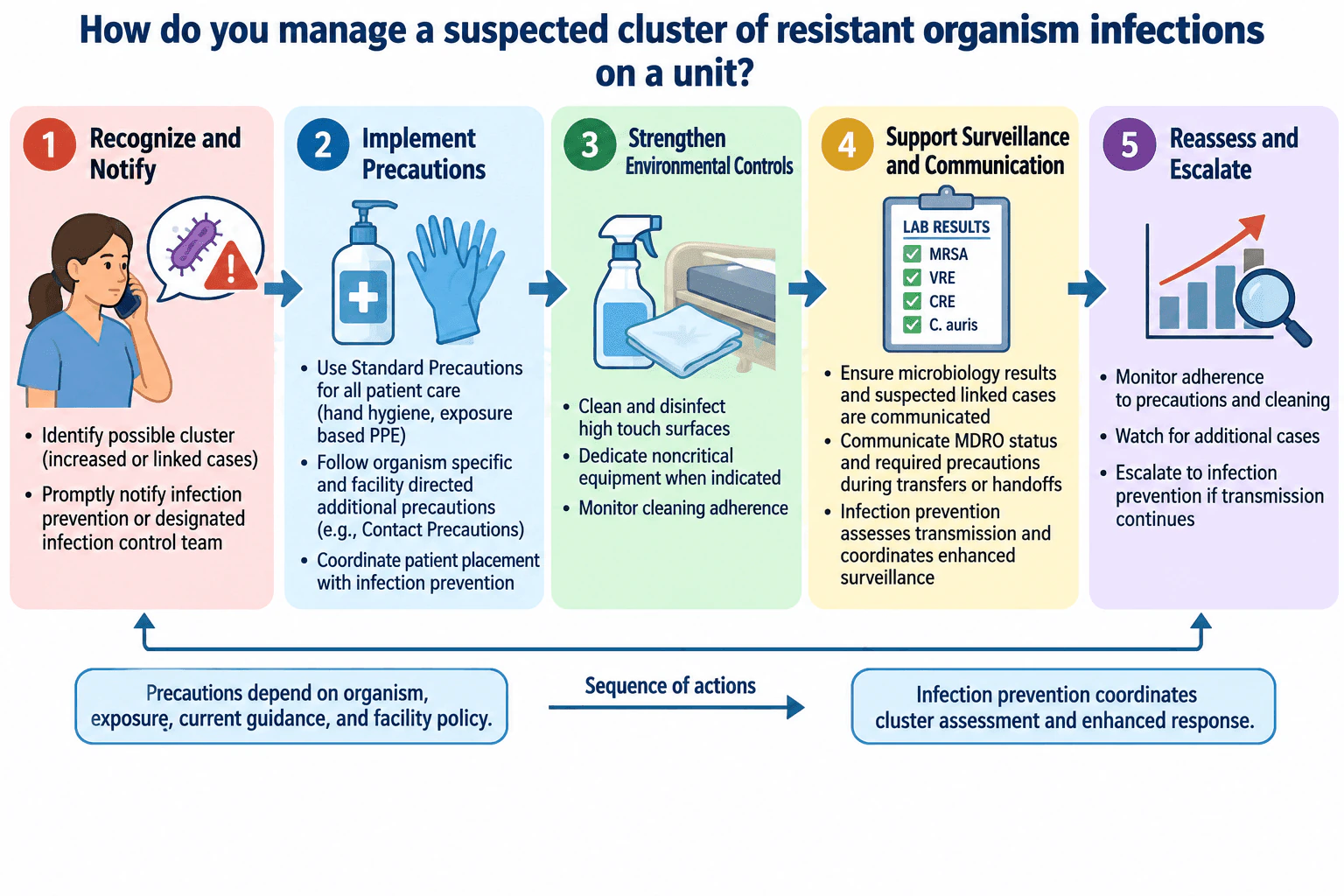
25. How do you manage a suspected cluster of resistant organism infections on a unit?Patient Safety And Infection PreventionHard
i Question Details
Describe prompt notification, appropriate precautions, coordination with infection prevention, environmental controls, surveillance support, and communication.
Short Interview Answer (30-60 seconds)
I would first identify whether cases may be linked and promptly notify infection prevention or the designated infection control team. I would follow current guidance for the suspected organism and exposure, including appropriate precautions, hand hygiene, and personal protective equipment when indicated. I would support environmental cleaning, communicate relevant information during handoffs, assist with surveillance activities, and continue reassessment for additional cases or changes in the response plan.
Detailed Explanation
A suspected cluster of resistant organism infections requires prompt recognition, coordinated communication, appropriate precautions, environmental controls, surveillance support, and reassessment. The nurse helps limit transmission by following evidence based infection prevention practices and collaborating with the infection prevention team.
Useful Questions to Ask the Interviewer
What resistant organism or transmission concern is suspected on the unit?
What infection prevention resources and protocols are available in this setting?
What role does the nurse have in surveillance and reporting activities?
How to Explain It in an Interview
Safety Principle
I would treat a suspected cluster as a patient safety concern requiring prompt notification and coordinated action. I would verify the concern, communicate with infection prevention, and avoid assuming that the same precautions apply to every organism or care activity.
Prevention Measures
I would use Standard Precautions for patient care and apply additional transmission precautions when indicated by the exposure, procedure, organism, and current guidance. I would support hand hygiene, appropriate personal protective equipment, patient placement coordination, and environmental controls such as cleaning high touch surfaces and managing shared equipment.
Monitoring and Reporting
I would support communication of microbiology results and relevant organism status during transfers and handoffs. I would assist with surveillance activities, monitor adherence to precautions and cleaning processes, and escalate concerns if additional cases or ongoing transmission are suspected.
The goal is to contain spread while supporting a coordinated infection prevention response.
Why Interviewers Ask This
This question evaluates nursing judgment during a potential infection prevention event. It assesses whether the nurse can identify a safety concern, escalate appropriately, select precautions based on risk, collaborate with infection prevention, and support a coordinated response.
Common interview mistakes
Common mistakes include applying one precaution checklist to every organism, assuming gloves replace hand hygiene, delaying notification of infection prevention, failing to communicate resistant organism status during transitions, and focusing only on one patient instead of possible transmission patterns.
Interview tip
Organize the answer around recognition, notification, precautions, environmental controls, surveillance, communication, and reassessment. Emphasize collaboration with infection prevention and selection of precautions based on exposure and current guidance.
Interviewer may ask next
How would you verify that the precautions selected for a resistant organism cluster are appropriate?
I would verify the suspected organism, exposure type, and current infection prevention guidance. I would collaborate with infection prevention and confirm that precautions match the transmission risk and care activity.
How would your response change if additional cases continued to appear despite initial precautions?
I would continue communication with infection prevention, support enhanced surveillance, reinforce appropriate precautions and environmental controls, and reassess the response plan based on new information.
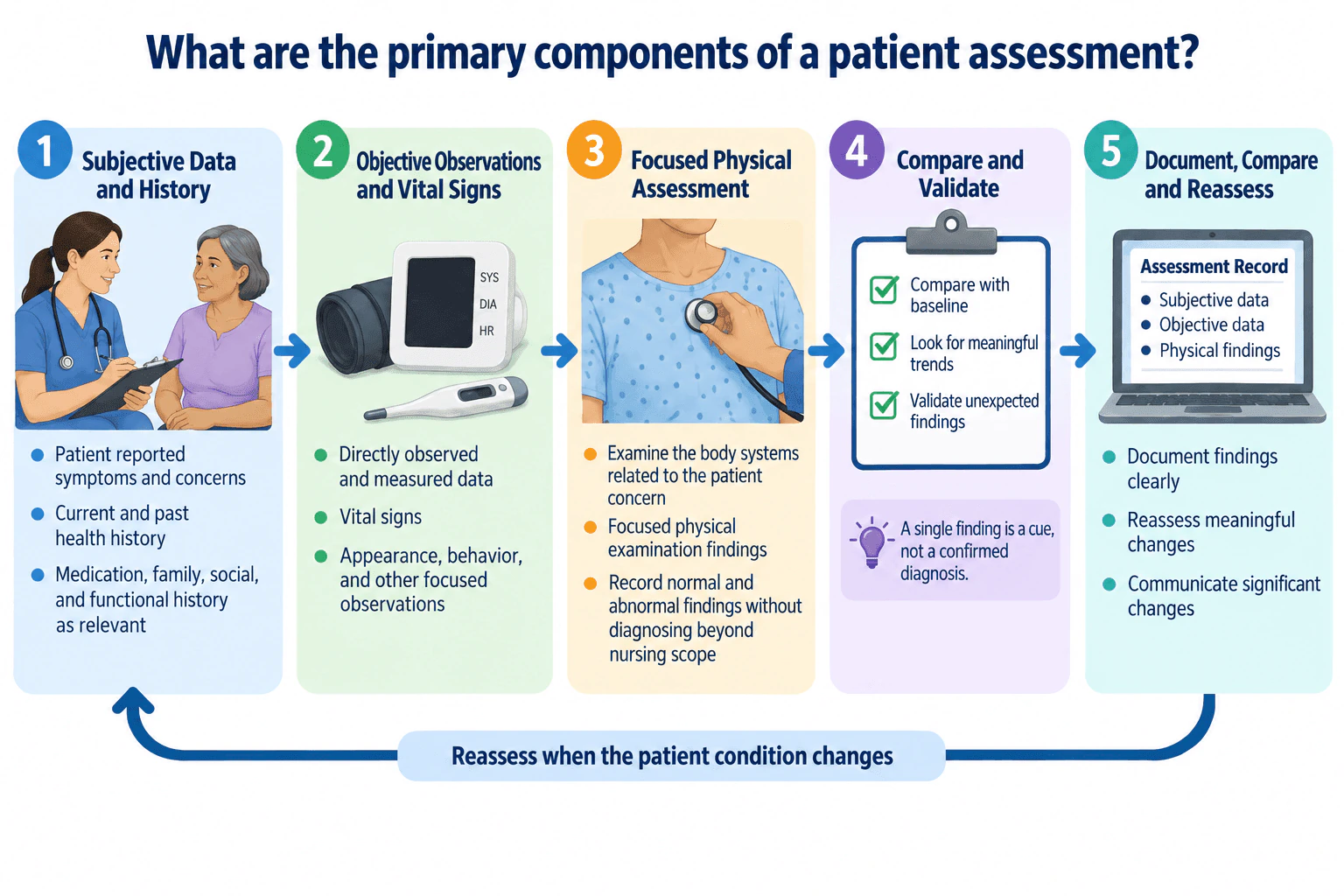
26. What are the primary components of a patient assessment?Patient Assessment And Clinical JudgmentEasy
i Question Details
Describe subjective and objective data, focused observations, vital signs, history, and physical assessment findings.
Short Interview Answer (30-60 seconds)
A patient assessment combines subjective and objective data. Subjective data include the patient's symptoms, concerns, and relevant current and past history. Objective data include direct observations, vital signs, and focused physical examination findings. I compare the findings with the patient's baseline and trends, validate anything unexpected, document clearly, communicate significant changes, and reassess when the patient's condition changes.
Detailed Explanation
A patient assessment combines information from the patient with findings the nurse observes and measures. Subjective data include the patient's reported symptoms, concerns, and relevant health, medication, family, social, and functional history. Objective data include vital signs, appearance, behavior, focused observations, and physical examination findings. The depth of the assessment depends on the purpose of the encounter. An initial or comprehensive assessment gathers a broader baseline, while a focused assessment concentrates on the current concern and related body systems.
Useful Questions to Ask the Interviewer
Is this an initial comprehensive assessment or a focused assessment of a specific concern?
Is there an established baseline or previous assessment available for comparison?
Are there specific documentation or communication expectations in this care setting?
How to Explain It in an Interview
Assessment Findings
I begin by separating subjective from objective data. Subjective data are what the patient reports, including symptoms, concerns, and relevant history. Objective data are what I directly observe or measure, including vital signs, appearance, behavior, and focused physical examination findings.
Clinical Reasoning
I organize the assessment around the patient's current concern and clinical context. For a focused assessment, I examine the body systems related to that concern and record the relevant normal and abnormal findings. I compare new findings with the patient's known baseline and previous trends when those data are available. I also validate unexpected or inconsistent findings before interpreting their significance. A single finding is a clinical cue, not a confirmed diagnosis.
Reassessment and Communication
Assessment is ongoing. When the patient's condition changes, I reassess the relevant findings and compare them with prior information. I document the assessment clearly and communicate significant changes to the appropriate healthcare team members according to nursing scope and local policy.
Why Interviewers Ask This
Interviewers are evaluating whether the nurse can gather relevant assessment information, distinguish patient reported information from observed and measured findings, recognize meaningful changes from baseline, validate unexpected findings, and use clinical judgment without treating a single observation as a confirmed diagnosis.
Common interview mistakes
Common mistakes include mixing subjective and objective data, collecting information without relating it to the patient's current concern, failing to compare findings with an available baseline or trend, accepting an unexpected finding without validation, treating one observation as a confirmed diagnosis, and failing to document or communicate a meaningful change.
Interview tip
Structure the answer in the same sequence used during assessment: gather subjective history, collect objective observations and vital signs, perform the focused physical assessment, compare and validate findings, then document, communicate, and reassess meaningful changes.
Interviewer may ask next
How would you verify an unexpected assessment finding?
I would confirm that the finding was obtained accurately, repeat or reassess it when appropriate, review related subjective and objective data, and compare it with the patient's baseline and recent trends. I would keep the observed finding separate from my interpretation, document the verified information, and communicate a meaningful change according to nursing scope and local policy.
How would your assessment change if the patient developed a new symptom?
I would perform a focused reassessment directed at the new symptom while considering the patient's overall condition. I would obtain the patient's description of the symptom, collect relevant observations and vital signs, examine the related body systems, compare the findings with baseline and previous trends, validate unexpected findings, document the change, and communicate significant findings.
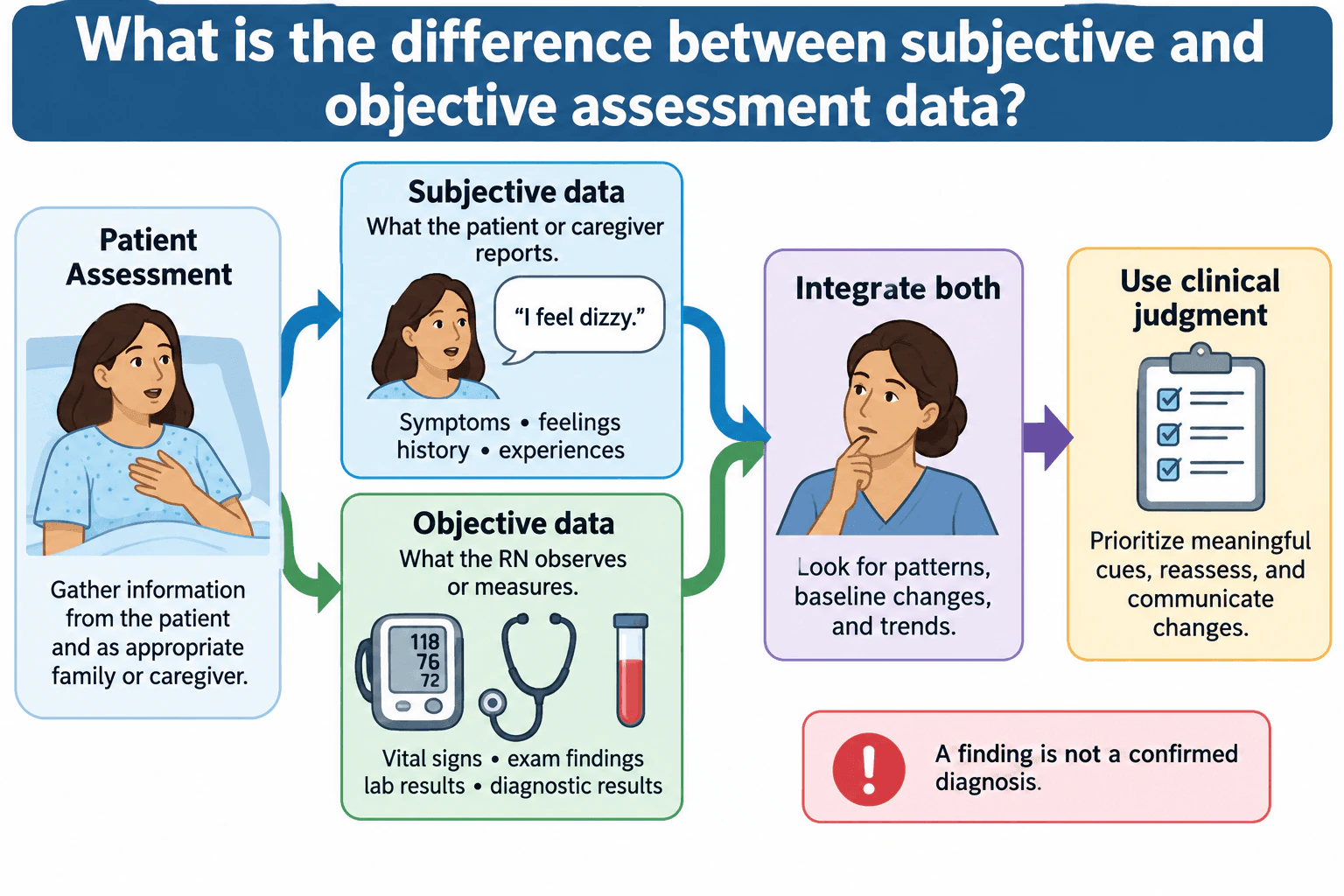
27. What is the difference between subjective and objective assessment data?Patient Assessment And Clinical JudgmentEasy
i Question Details
Define each type and explain how both contribute to nursing assessment and clinical judgment.
Short Interview Answer (30-60 seconds)
Subjective data are what the patient or, when appropriate, a caregiver reports, such as dizziness, pain, feelings, history, or other experiences. Objective data are findings the nurse observes or measures, such as vital signs, physical examination findings, laboratory results, and diagnostic results. Both contribute to nursing assessment because the nurse integrates the patient perspective with observable findings to recognize patterns, compare current findings with baseline information and trends, prioritize meaningful cues, reassess, and communicate important changes. A single finding does not automatically confirm a diagnosis.
Detailed Explanation
Subjective and objective data are complementary parts of nursing assessment. Subjective data describe the patient perspective. They include symptoms, feelings, history, and experiences reported by the patient or, when appropriate, a caregiver. For example, a patient saying, "I feel dizzy" is subjective because it describes an experience reported by the patient.
Objective data are findings the nurse observes or measures. Examples include vital signs, physical examination findings, laboratory results, and diagnostic results. Nurses use both types of information as assessment cues and consider them together rather than relying on only one source.
Useful Questions to Ask the Interviewer
Would you like an example of how I would combine subjective and objective findings during an assessment?
Should I explain how I would compare a new finding with the patient's baseline and recent trend?
Would you like me to discuss how I would verify or reassess an unexpected finding?
How to Explain It in an Interview
Assessment Findings
I would explain that subjective data come from the patient's perspective. They include reported symptoms, feelings, history, and experiences. A statement such as "I feel dizzy" is subjective data.
Objective data are findings that the nurse can observe or measure. Examples include vital signs, physical examination findings, laboratory results, and diagnostic results.
Clinical Reasoning
I would integrate both types of data and look for meaningful patterns, changes from the patient's baseline, and trends over time. Clinical judgment includes recognizing relevant cues, analyzing how those cues relate to the patient's presentation, and deciding which findings require the most attention.
I would keep reported or observed findings separate from my interpretation. For example, dizziness is a reported symptom, while a measured blood pressure is objective data. Neither finding alone automatically confirms a diagnosis.
Reassessment and Communication
If a finding is unexpected or does not fit the other assessment data, I would verify the information and reassess as appropriate. I would compare new findings with previous findings when available and communicate meaningful changes to the appropriate team member. This keeps the assessment focused on the patient's current condition while supporting accurate clinical judgment.
Why Interviewers Ask This
Interviewers want to know whether the nurse can distinguish patient reported information from observable or measurable findings and then use both appropriately during assessment. The question also evaluates whether the nurse can recognize meaningful cues, compare findings with baseline information and trends, reassess when appropriate, and communicate changes without making conclusions that exceed the available evidence or Registered Nurse scope.
Common interview mistakes
Common mistakes include labeling a patient reported symptom as objective data, treating an interpretation as though it were an observed fact, ignoring the patient perspective because measurable findings appear unchanged, relying on one isolated finding without comparing it with the baseline or trend, and treating a single observation as a confirmed diagnosis.
Interview tip
Give one simple paired example, such as the patient reporting dizziness as subjective data and the nurse measuring vital signs as objective data. Then explain that the nurse integrates both, compares them with baseline findings and trends, reassesses unexpected information, and communicates meaningful changes. This demonstrates both accurate definitions and practical clinical judgment.
Interviewer may ask next
How would you verify an unexpected assessment finding?
I would first identify whether the information is subjective or objective. I would clarify reported information with the patient when appropriate and repeat or validate an objective measurement using the appropriate assessment technique or equipment. I would compare the finding with the patient's baseline, recent trends, related assessment findings, and available records. If the change remained meaningful, I would document it and communicate it to the appropriate team member according to the clinical context and local policy.
What if the patient's subjective report changes but the objective findings remain unchanged?
I would still take the new subjective report seriously because symptoms and experiences are important assessment data. I would clarify the change, perform a focused reassessment relevant to the concern, compare current findings with the patient's baseline and trend, and identify any additional information that is missing. I would not assume that unchanged objective findings rule out a meaningful clinical change, and I would communicate significant new information according to the clinical context.
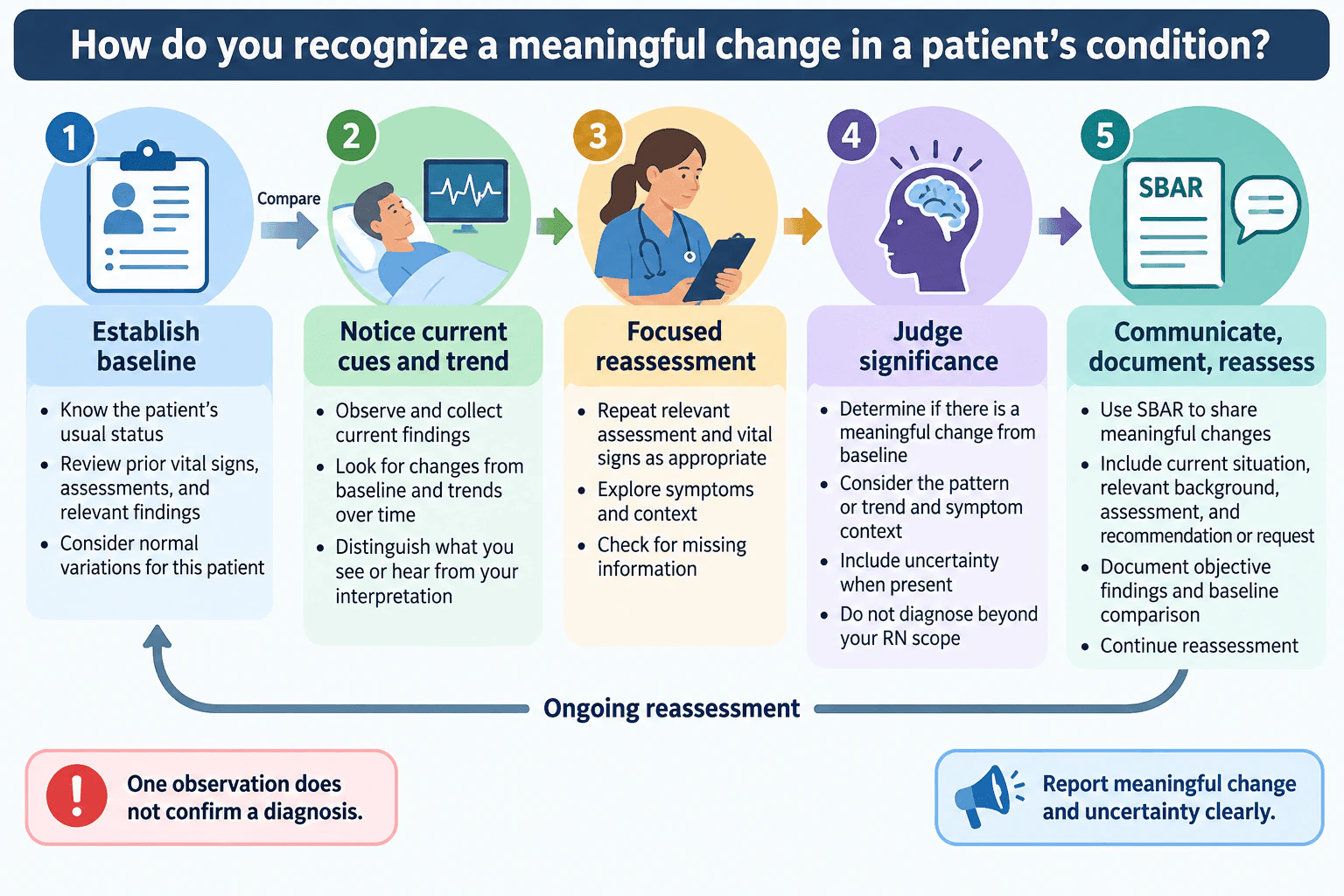
28. How do you recognize a meaningful change in a patient's condition?Patient Assessment And Clinical JudgmentMedium
i Question Details
Explain comparison with baseline, trends, focused reassessment, symptom context, communication, and documentation.
Short Interview Answer (30-60 seconds)
I compare the patient's current condition with their established baseline and recent trends. I gather objective findings and the patient's symptom report, repeat relevant vital signs and focused assessment findings when appropriate, and look for a consistent change rather than relying on one isolated observation. I consider symptom context and missing information, separate what I observed from what I think it may mean, and avoid diagnosing beyond my Registered Nurse scope. If the change is meaningful, I communicate the current situation, relevant background, assessment, and recommendation or request, document the findings and baseline comparison, and continue reassessment.
Detailed Explanation
A meaningful change is a clinically important difference from the patient's usual condition or recent pattern. I recognize it by combining baseline information, current findings, trends, focused reassessment, and symptom context. One abnormal observation may be important, but by itself it does not establish a diagnosis. I separate what I directly observe or measure from my interpretation and identify information that is still missing.
Useful Questions to Ask the Interviewer
Is there an established baseline or recent trend available for comparison?
What current symptoms, vital signs, or assessment findings are available?
Are there relevant changes in treatment, medications, activity, or clinical context that should be considered?
How to Explain It in an Interview
Assessment Findings
I first establish what is usual for that patient by reviewing the available baseline, previous assessments, vital signs, and relevant findings. I then collect current objective findings and the patient's report of symptoms. I look for changes from baseline and for trends over time rather than interpreting a single number or observation in isolation.
Clinical Reasoning
If I notice a new or worsening cue, I perform a focused reassessment based on that finding. This can include repeating relevant vital signs or examination findings, clarifying symptoms, and checking for missing information. I ask whether the finding is reproducible, whether several cues form a consistent pattern, and how the current condition differs from the patient's usual status.
I keep observations separate from interpretation. For example, I might document that a patient is newly more drowsy than their documented baseline rather than stating a medical diagnosis that has not been established. I consider the significance of the change using the full clinical context, including normal variation for that patient, and remain within Registered Nurse scope. If uncertainty remains, I communicate that uncertainty rather than presenting an interpretation as confirmed.
Reassessment and Communication
When the comparison and reassessment indicate a meaningful change, I communicate it clearly. Situation, Background, Assessment, Recommendation or Request, known as SBAR, can organize the communication. I include the current concern, relevant baseline and background, objective assessment findings, important trends, and what I am recommending or requesting within my role and applicable local process.
I document objective findings, the comparison with baseline, relevant communication, and subsequent reassessment. Clinical judgment is iterative, so I continue to reassess the patient's condition and watch for further change rather than considering the assessment complete after one observation.
Why Interviewers Ask This
Interviewers are evaluating whether the nurse can recognize relevant cues, compare them with baseline information, interpret trends, perform an appropriate focused reassessment, stay within Registered Nurse scope, communicate meaningful changes, document accurately, and continue reassessment rather than treating one observation as a confirmed diagnosis.
Common interview mistakes
Common mistakes include treating one abnormal observation as a confirmed diagnosis, failing to compare the current finding with the patient's baseline or trend, overlooking symptom context or normal variation for that patient, documenting an interpretation as though it were an observed fact, failing to repeat or verify relevant findings when appropriate, communicating a change without relevant assessment data or uncertainty, and failing to reassess after the change is identified.
Interview tip
Use the same clear sequence shown in the clinical reasoning flow: establish the baseline, notice current cues and trends, perform a focused reassessment, judge whether the pattern is meaningfully different, then communicate, document, and reassess. Emphasize that you distinguish observed findings from interpretation and do not diagnose beyond Registered Nurse scope.
Interviewer may ask next
How would you verify that a new abnormal finding represents a real change?
I would compare it with the patient's documented baseline and recent trend, then repeat or verify the relevant measurement or focused assessment when appropriate. I would clarify the patient's symptoms and context, review related findings, and identify missing information. I would determine whether the finding persists or forms a meaningful pattern with other cues. I would document what I directly observed or measured separately from my interpretation and communicate a significant verified change or remaining uncertainty.
What would you do if the patient's clinical context changed after your initial assessment?
I would reassess because the significance of a finding can change with new symptoms, treatment, activity, medications, procedures, or other clinical information. I would compare the new findings with both the established baseline and the recent trend, repeat the relevant focused assessment, reconsider the significance of the cues in the new context, communicate meaningful changes or uncertainty, document the updated findings and comparison, and continue reassessment.
29. How do you assess a patient with new confusion?Patient Assessment And Clinical JudgmentMedium
i Question Details
Describe focused neurologic and general assessment, comparison with baseline, review of contributing factors, and timely escalation.
Short Interview Answer (30-60 seconds)
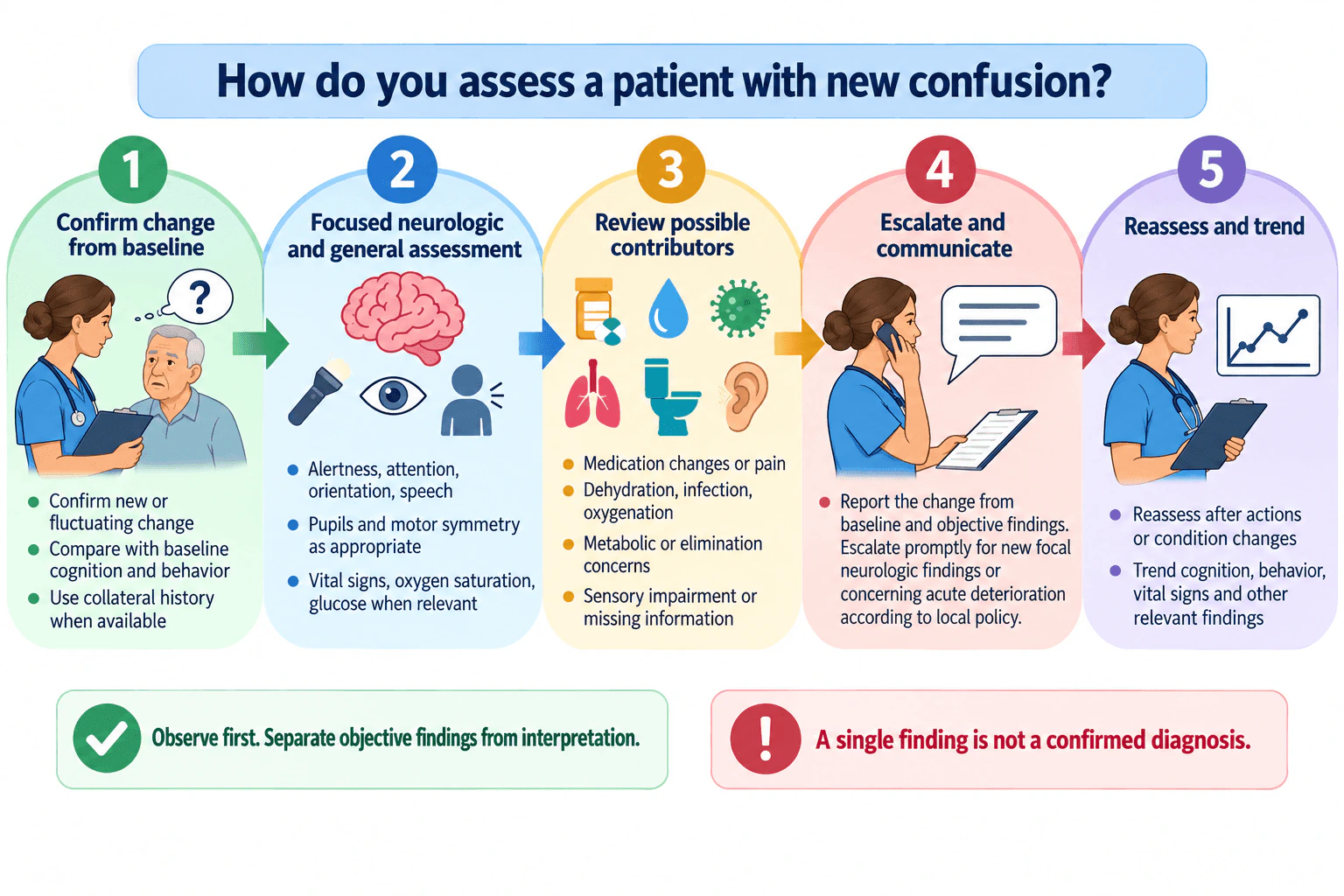
I would first confirm whether the confusion is new or fluctuating and compare the patient with their usual cognition and behavior. I would obtain collateral history when available, then perform a focused neurologic and general assessment, including alertness, attention, orientation, speech, pupils and motor symmetry as appropriate, vital signs, oxygen saturation, and glucose when clinically relevant. I would review possible contributors such as medication changes, pain, dehydration, infection, oxygenation problems, metabolic or elimination concerns, and sensory impairment. I would communicate objective changes, escalate concerning findings according to local policy, and reassess trends.
Detailed Explanation
New confusion is an assessment finding, not a diagnosis. My goal is to establish what changed from the patient's baseline, identify significant objective cues, consider relevant contributing factors, communicate concerning changes, and reassess the patient over time.
Useful Questions to Ask the Interviewer
What is known about the patient's usual cognition and behavior?
Are there recent medication changes, illness, pain, intake changes, or other new clinical concerns?
What resources are available for collateral history, such as family, caregivers, or prior documentation?
How to Explain It in an Interview
Assessment Purpose
I would first determine whether the confusion is new or fluctuating. I would compare the patient's current cognition and behavior with the documented or reported baseline. If the patient cannot provide a reliable history, I would use available collateral information from family, caregivers, or the care team.
Assessment Findings
I would perform a focused neurologic and general assessment. I would assess alertness, attention, orientation, and speech, then assess pupils and motor symmetry when appropriate to the situation. I would obtain vital signs and oxygen saturation and assess glucose when clinically relevant and authorized by the care setting or protocol.
I would document what I actually observe rather than converting a single finding into a diagnosis. For example, I would document a change in attention, speech, behavior, or motor findings rather than state an unsupported cause.
Clinical Reasoning
I would review possible contributors suggested by the history and assessment, including medication changes, pain, dehydration, infection or other acute illness, oxygenation problems, metabolic or elimination concerns, and sensory impairment. I would also identify important information that is still missing.
The key is to prioritize significant cues without assuming one explanation. New confusion can have multiple causes, so a single observation should not be treated as a confirmed diagnosis.
Reassessment and Escalation
I would communicate the change from baseline and the objective findings clearly. New focal neurologic findings or concerning acute deterioration require timely escalation according to the clinical context and local policy. After actions are taken or the patient's condition changes, I would reassess cognition, behavior, vital signs, and other relevant findings and compare them with prior assessments to identify improvement, persistence, or worsening.
Why Interviewers Ask This
Interviewers are evaluating whether the nurse can recognize an acute change from baseline, collect focused objective data, distinguish findings from interpretations, consider several possible contributors without prematurely diagnosing the cause, communicate meaningful changes, and reassess the patient over time.
Common interview mistakes
Common mistakes include assuming confusion is simply part of aging, failing to compare with the patient's baseline, documenting an interpretation instead of objective findings, overlooking medication or physiologic contributors, treating one observation as a confirmed diagnosis, failing to obtain collateral history when needed, and not reassessing after the patient's condition or care changes.
Interview tip
Organize the answer around baseline, focused assessment, contributing factors, communication, and reassessment. State objective findings before interpretations and make clear that the nurse recognizes concerning changes without diagnosing beyond the Registered Nurse scope.
Interviewer may ask next
How would you verify that the confusion is truly a new change?
I would compare the current assessment with prior documentation and the patient's usual cognition and behavior. When the patient cannot reliably describe the baseline, I would seek collateral information from family, caregivers, or members of the care team who know the patient. I would also determine whether the change is persistent or fluctuating and document the objective differences I identify.
What changes if the patient also develops a new focal neurologic finding?
That finding increases the urgency of the situation. I would clearly document and communicate the new objective neurologic change and promptly escalate it according to the clinical context and local policy while continuing appropriate assessment and monitoring. I would avoid assigning a diagnosis based on the finding alone and would reassess for further changes.
30. How do you assess a patient with multiple comorbidities when several findings are abnormal?Patient Assessment And Clinical JudgmentHard
i Question Details
Explain how you identify the most urgent problem, compare with baseline, perform focused reassessment, and coordinate further evaluation.
Short Interview Answer (30-60 seconds)
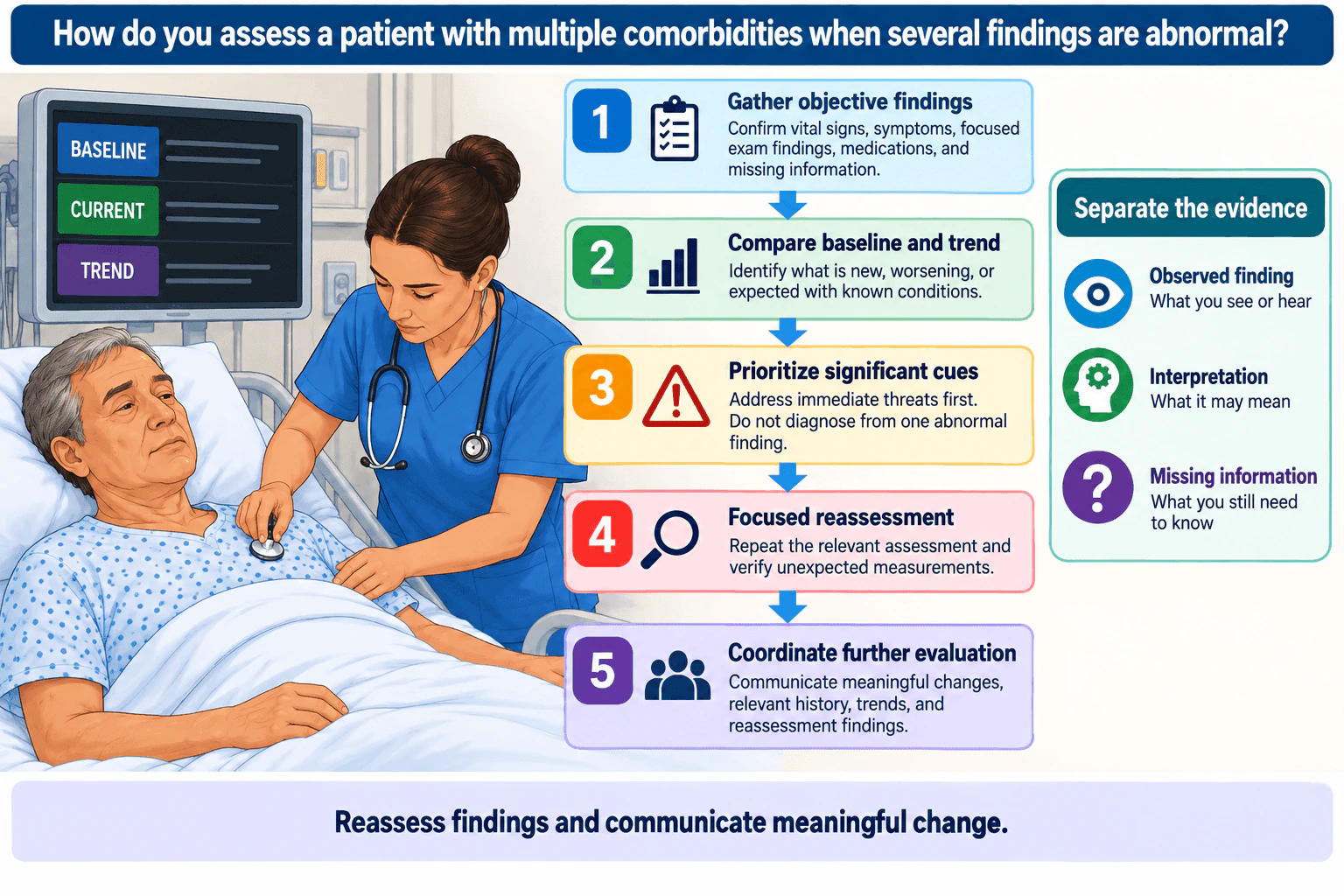
I start by gathering the current vital signs, symptoms, focused examination findings, medication information, and any important missing data. I compare those findings with the patient's baseline and recent trend to determine what is new, worsening, or expected with known conditions. I separate what I observe from what I think it may mean, prioritize the most significant cues, perform a focused reassessment, verify unexpected measurements, and communicate the meaningful changes, relevant history, trends, and reassessment findings so further evaluation can be coordinated.
Detailed Explanation
When several findings are abnormal, I do not assume that every abnormality has the same significance. I determine what is new, what is changing, what may be expected with the patient's known conditions, and what needs the most attention. I also keep observed findings separate from interpretation and identify information that is still missing.
Useful Questions to Ask the Interviewer
What baseline information and recent trends are available for this patient?
Are there specific comorbidities, medications, or recent changes that should shape the focused assessment?
What additional information is already available from the chart or care team?
How to Explain It in an Interview
Assessment Findings
I first gather the current vital signs, symptoms, focused examination findings, relevant medication information, and any other available assessment data. I identify missing information that could change how I interpret the findings.
Clinical Reasoning
Next, I compare the current assessment with the patient's baseline and recent trend. A value that is generally abnormal may be usual for this patient, while a smaller change from the patient's normal pattern may be clinically important. I group related cues and determine which findings deserve the highest priority based on urgency, potential harm, and the overall presentation.
I keep three categories separate: the observed finding, my interpretation of what it may mean, and the information I still need. This prevents me from treating one abnormal observation as a confirmed diagnosis.
Reassessment and Coordination
For the highest priority concern, I perform a focused reassessment and repeat or verify an unexpected measurement when appropriate. I look for whether the finding persists, changes, or is supported by other assessment data.
I then communicate the meaningful change, relevant baseline, trend, history, and reassessment findings so further evaluation can be coordinated. When appropriate, a structured format such as Situation, Background, Assessment, and Recommendation can organize that communication. I continue reassessment based on the patient's condition, care plan, and applicable local policy.
Why Interviewers Ask This
Interviewers are evaluating whether the nurse can organize several abnormal findings without treating every abnormal result as equally important. They want to hear clinical judgment that recognizes relevant cues, relates them to the patient's history and baseline, prioritizes the most significant concern, verifies uncertain information, reassesses the patient, and communicates meaningful changes while remaining within Registered Nurse scope.
Common interview mistakes
Common mistakes include reacting to every abnormal finding independently, ignoring the patient's baseline and trend, assuming that a chronic abnormality explains a new change, treating one observation as a confirmed diagnosis, failing to verify an unexpected measurement, overlooking missing information, and communicating isolated findings without relevant clinical context.
Interview tip
Explain your reasoning in the same sequence as the diagram: gather objective findings, compare baseline and trend, prioritize significant cues, perform focused reassessment, and coordinate further evaluation. Emphasize that you separate observed findings from interpretation and missing information rather than diagnosing from one abnormal finding.
Interviewer may ask next
How would you verify that an abnormal finding is real before acting on your interpretation?
I would confirm that the measurement or observation was obtained correctly and repeat it when appropriate. I would reassess the patient directly, compare the result with previous values and the documented baseline, review relevant available information, and look for supporting or conflicting cues. I would then communicate and coordinate further evaluation based on the verified finding and the overall clinical picture rather than one isolated result.
How would your approach change if the patient's abnormal findings were similar to their documented baseline?
I would still assess and verify the findings, but I would place greater emphasis on trend, symptoms, functional change, and whether anything differs from the established baseline. A chronic abnormal finding may be expected for that patient, while a new symptom or change in a related finding may increase its significance. I would prioritize meaningful deviations from baseline, perform focused reassessment, and communicate those changes rather than assuming that a familiar abnormal finding is automatically benign.
More questions load as you scroll
Disclaimer: This interview guide is for educational and informational purposes only. It is designed to help readers prepare, but it does not guarantee any interview result, hiring decision, offer, or outcome. Interview questions, hiring criteria, and preferred answers can vary by employer, interviewer, industry, location, and time. All answers, examples, and explanations in this guide are suggested examples for interview preparation, not definitive answers or instructions for professional practice. They are based on research and judgment, are provided without warranties of any kind, and should be adapted to the question, role, and applicable laws and professional requirements. Diagrams are simplified illustrations intended to highlight the main concepts and their relationships; actual situations, systems, and practices may be more complex. Alternative approaches may be equally valid or better suited to a particular question, context, or interviewer. To the fullest extent permitted by applicable law, the contributors and publisher are not liable for decisions made, actions taken, or losses incurred based on this guide.
State Laws and Professional Responsibilities: Laws and requirements governing an occupation vary by state and jurisdiction. You are responsible for checking the current laws, licensing requirements, and scope-of-practice rules that apply to your location and role, and for ensuring that your answers and actions comply with them. Adapt examples in this guide to those requirements. This guide is not legal advice.
Content Accuracy and Verification: To the fullest extent permitted by applicable law, we do not represent or warrant that interview guides, questions, answers, examples, or diagrams are accurate, complete, current, error-free, or suitable for any particular purpose. You are responsible for independently reviewing and verifying the information before relying on it.