This interview guide is for educational and informational purposes only. It is designed to help readers prepare, but it does not guarantee any interview result, hiring decision, offer, or outcome. Interview questions, hiring criteria, and preferred answers can vary by employer, interviewer, industry, location, and time. All answers, examples, and explanations in this guide are suggested examples for interview preparation, not definitive answers or instructions for professional practice. They are based on research and judgment, are provided without warranties of any kind, and should be adapted to the question, role, and applicable laws and professional requirements. Diagrams are simplified illustrations intended to highlight the main concepts and their relationships; actual situations, systems, and practices may be more complex. Alternative approaches may be equally valid or better suited to a particular question, context, or interviewer. To the fullest extent permitted by applicable law, the contributors and publisher are not liable for decisions made, actions taken, or losses incurred based on this guide.
State Laws and Professional Responsibilities
Laws and requirements governing an occupation vary by state and jurisdiction. You are responsible for checking the current laws, licensing requirements, and scope-of-practice rules that apply to your location and role, and for ensuring that your answers and actions comply with them. Adapt examples in this guide to those requirements. This guide is not legal advice.
Identity, Image, and Privacy Notice
To respect individual privacy, some names, profile photographs, avatars, biographical details, and other identifying information displayed in this guide may be replaced with pseudonyms, licensed stock images, illustrative avatars, composite images, or representative descriptions. Unless a person is expressly identified as an actual contributor, a displayed name, image, or profile should not be understood as depicting or identifying a specific candidate, interviewer, employee, or other real individual. These representations are provided for editorial and illustrative purposes only and do not imply endorsement, employment, participation, or affiliation with this guide or any company mentioned in it. Any resemblance to an actual person is coincidental.
Company Notice
This guide is an independent educational resource and is not affiliated with, endorsed by, sponsored by, or approved by the company named in this guide. Company names identify reported interview experiences or the employer context of clearly labeled original practice exercises. Interview practices can change without notice, and inclusion of company-specific content does not mean these questions are official, complete, or guaranteed to be asked. To the fullest extent permitted by law, the author, contributors, and publisher are not responsible for outcomes related to use of this material.
Content Accuracy and Verification
To the fullest extent permitted by applicable law, we do not represent or warrant that interview guides, questions, answers, examples, or diagrams are accurate, complete, current, error-free, or suitable for any particular purpose. You are responsible for independently reviewing and verifying the information before relying on it.
Questions or comments?
Contact us for general questions, or share feedback, technical corrections, and comments with the community.
1. What defines an intensive care unit and the bedside critical care nurse role?Critical Care FoundationsEasy
i Question Details
Describe the purpose of intensive care, continuous monitoring, rapid recognition of deterioration, organ support, and the bedside registered nurse role within an interdisciplinary team.
Short Interview Answer (30-60 seconds)
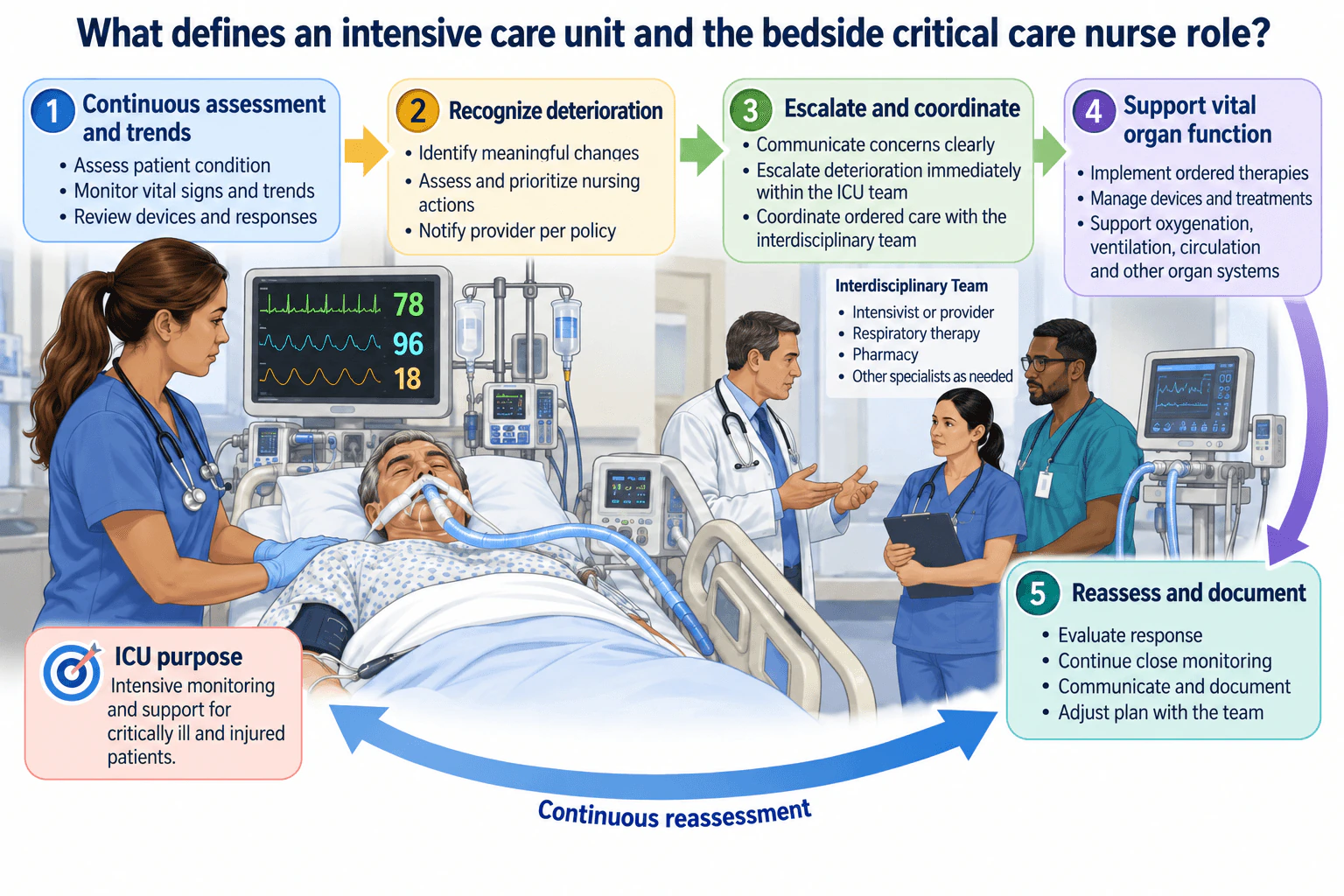
An ICU is designed for critically ill or injured patients who need continuous assessment, advanced monitoring, rapid recognition of deterioration, and support of vital organ function. At the bedside, the critical care RN assesses the whole patient and trends rather than isolated numbers, recognizes meaningful changes, prioritizes nursing actions, escalates concerns within the ICU team, coordinates ordered care, manages therapies and devices within scope and competency, and then reassesses and documents the response. The nurse works closely with providers, respiratory therapy, pharmacy, and other specialists. aacn.org
Detailed Explanation
An intensive care unit is a setting for critically ill or injured patients whose condition requires close surveillance, advanced monitoring, and support of vital organ function. The central idea is continuous reassessment. The bedside critical care RN repeatedly connects the physical assessment, monitored trends, device information, and response to therapy so deterioration can be recognized and addressed quickly. This work supports physiologic goals such as adequate oxygen delivery, perfusion, and homeostasis without turning those principles into independent diagnoses or treatment orders.
Useful Questions to Ask the Interviewer
How does your ICU validate role specific competency for nurses who are new to the unit?
How are bedside nurses expected to communicate and escalate a meaningful change in patient condition?
How does the interdisciplinary team coordinate daily care and reassessment?
How to Explain It in an Interview
Core Concept
I would describe the ICU as a setting for critically ill or injured patients who require continuous assessment, advanced monitoring, and support of vital organ function. AACN describes critical care nursing as registered nursing practice for critically ill and injured patients and emphasizes evidence based practice, professional accountability, and interdisciplinary collaboration. aacn.org
Bedside Nursing Reasoning
My first responsibility is continuous assessment and trend recognition. I assess the patient's condition, review vital signs and other monitored information, evaluate devices and responses to therapy, and look for meaningful change. A monitor value by itself is not a diagnosis. I interpret it in the context of the patient's overall condition.
If deterioration occurs, I assess and prioritize appropriate nursing actions, communicate the concern clearly, and escalate it immediately within the ICU team. I coordinate ordered care with the interdisciplinary team rather than assuming prescribing authority. Therapies, devices, and protocol authorized actions are managed only within my legal scope, demonstrated competency, applicable orders, and local policy.
Support And Reassessment
A major purpose of intensive care is supporting vital organ function while the underlying condition is evaluated and treated. The bedside nurse implements ordered therapies, manages appropriate devices and treatments, monitors the patient's response, and watches for complications. After an intervention or change in condition, I reassess, continue close monitoring, communicate relevant findings, and document the response. That continuous reassessment cycle links monitoring to safe clinical action.
Professional Scope
RN licensure provides the legal basis for registered nursing practice. ICU practice also requires role specific knowledge and validated competency. AACN has a framework specifically for validating nurses who are new to ICU and progressive care practice. Specialty certification is distinct from licensure and competency validation, and requirements may vary by position and employer. aacn.org
Why Interviewers Ask This
Interviewers are assessing whether the candidate understands that ICU nursing is more than watching monitors or carrying out treatments. The role requires continuous assessment, recognition of clinically meaningful change, prioritization, timely escalation, interdisciplinary communication, safe management of complex therapies, reassessment, and documentation while remaining within registered nursing scope and role specific competency.
Common interview mistakes
Common mistakes include defining ICU nursing only by equipment, treating one monitor value as a diagnosis, describing the nurse as independently prescribing treatment, failing to mention escalation and interdisciplinary coordination, forgetting reassessment and documentation, or treating specialty certification as identical to RN licensure or role specific competency.
Interview tip
Organize the answer as the same continuous bedside cycle shown in the diagram: assess and trend, recognize deterioration, escalate and coordinate, support vital organ function through appropriate ordered care, then reassess and document. This keeps the response focused on nursing judgment and makes the bedside RN role clear.
Interviewer may ask next
How would you verify that a change in monitored data represents true clinical deterioration?
I would assess the patient directly, confirm that the monitoring information is reliable, review the trend rather than relying on one isolated value, compare the finding with other relevant observations, and evaluate the patient's response to current therapies. If the change remains clinically concerning, I would communicate and escalate it within the ICU team according to my scope and local process. Verification should not delay escalation when the patient's condition is clearly worsening.
How would the role change if the patient were stable enough to transfer out of the ICU?
The immediate focus would shift from intensive surveillance and organ support toward confirming sustained stability, identifying remaining risks, communicating current status and recent trends, completing appropriate documentation, and giving a safe handoff to the receiving team. The receiving setting may have a different monitoring intensity and staffing model, so the handoff should make continuing care needs explicit.
2. What does homeostasis mean in critical illness?Critical Care FoundationsEasy
i Question Details
Explain homeostasis as dynamic physiologic balance and describe why critically ill patients can lose that balance quickly.
Short Interview Answer (30-60 seconds)
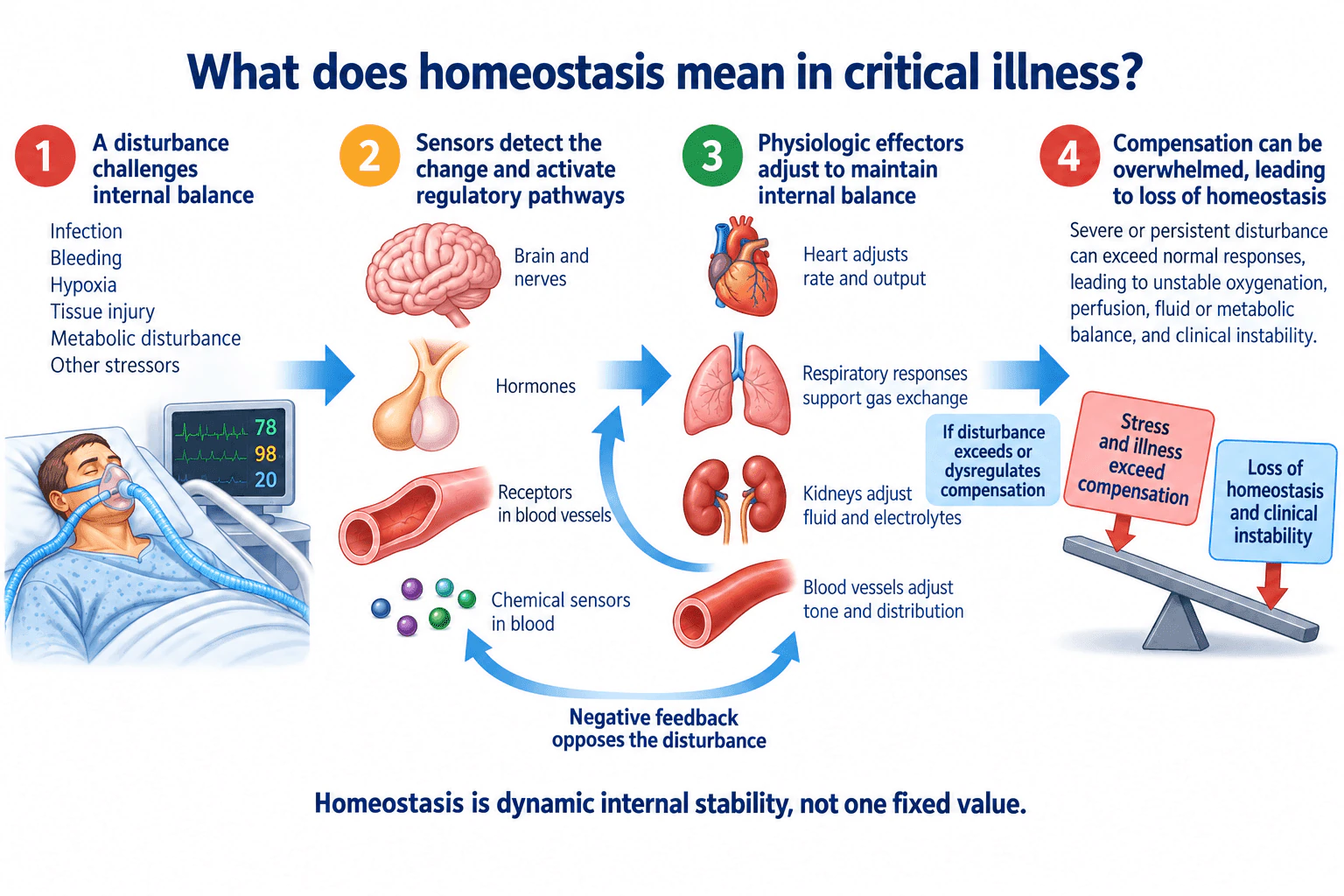
Homeostasis means dynamic internal stability. When a disturbance occurs, sensors and regulatory pathways detect the change and activate physiologic effectors that oppose it. The heart, respiratory system, kidneys, blood vessels, nervous system, and endocrine system can all contribute to maintaining balance. In critical illness, severe or persistent stress can exceed or dysregulate compensation, causing instability in oxygenation, perfusion, fluid balance, or metabolism. It is an ongoing regulatory process, not one fixed normal value. ncbi.nlm.nih.gov
Useful Questions to Ask the Interviewer
How does your ICU expect bedside nurses to communicate important changes in physiologic trends?
Which changes in patient condition require immediate escalation in this unit?
How are unit protocols and provider orders incorporated when physiologic stability is changing?
Detailed Explanation
How to Explain It in an Interview
Core Concept
Homeostasis is the body’s dynamic regulation of its internal environment. It does not mean that every physiologic value stays at one exact number. Regulatory systems detect changes and use feedback mechanisms to keep important variables within ranges compatible with normal function. ncbi.nlm.nih.gov
Physiological Meaning
A disturbance such as infection, bleeding, hypoxia, tissue injury, or metabolic stress can challenge internal balance. Sensors detect changes and regulatory pathways involving the brain, nerves, hormones, vascular receptors, and chemical sensing mechanisms coordinate a response. Physiologic effectors then alter function. The heart can change rate and output, respiratory responses can support gas exchange, the kidneys can contribute to fluid and electrolyte regulation, and blood vessels can alter tone and distribution.
Negative feedback means that the regulatory response opposes the disturbance. The system continues sensing the regulated variable and adjusting its response as conditions change. ncbi.nlm.nih.gov
Bedside Relevance
In critical illness, compensation may initially help maintain oxygenation, perfusion, fluid balance, and metabolic stability. If the disturbance is severe or persistent, or the regulatory response becomes dysregulated, compensatory capacity can be exceeded. The result can be loss of homeostasis and increasing clinical instability. Critical illness literature describes disruption of coordinated homeostatic regulation, including oxygen delivery and hemodynamic stability, as part of severe physiologic deterioration. pmc.ncbi.nlm.nih.gov
For the bedside critical care nurse, the practical implication is to assess the patient and interpret changing patterns rather than assuming that one isolated value proves stability or instability. Relevant bedside findings, monitor trends, laboratory results, and the overall clinical picture are reassessed together. Meaningful deterioration is communicated and escalated according to the patient’s condition, applicable protocols, and provider orders.
Limitation
Homeostasis is a physiologic principle, not a diagnosis or treatment order. An abnormal value can show that regulation may be disturbed, but it does not by itself establish the cause or determine a specific intervention.
Why Interviewers Ask This
Interviewers are assessing whether the nurse understands critical illness as disruption of dynamic physiologic regulation rather than simply a collection of abnormal numbers. A strong answer shows that the nurse can connect a disturbance, physiologic sensing, compensatory responses, negative feedback, and possible loss of stability without turning the concept itself into a diagnosis or treatment order.
Common interview mistakes
Common mistakes include defining homeostasis as a completely fixed normal state, assuming compensation always succeeds, treating one monitor value as proof of overall stability, describing negative feedback as though it amplifies deterioration, or jumping directly from the concept of homeostasis to a diagnosis or treatment order. Another mistake is giving detailed organ specific treatment steps when the question asks for the general physiologic concept.
Interview tip
Use a simple sequence. Start by defining homeostasis as dynamic internal stability. Then explain that a disturbance is detected by sensors and regulatory pathways, physiologic effectors respond, and negative feedback opposes the disturbance. Finish by explaining that severe or persistent critical illness can exceed or dysregulate compensation and lead to loss of homeostasis and clinical instability.
Interviewer may ask next
How would you verify whether a critically ill patient is maintaining or losing homeostatic stability?
I would combine repeated bedside assessment with trends in relevant physiologic and laboratory data rather than rely on one isolated value. I would evaluate findings related to oxygenation, perfusion, fluid and electrolyte balance, metabolic status, neurologic responsiveness, and other variables relevant to that patient. I would compare current findings with previous trends, reassess unexpected changes, and communicate clinically important deterioration according to the patient’s condition, applicable protocols, and provider orders.
How does the concept change when the physiologic disturbance becomes severe or persistent?
The principle of homeostasis remains the same, but the body’s compensatory capacity may no longer be sufficient. Severe or persistent stress can exceed or dysregulate regulatory responses, so oxygenation, perfusion, fluid balance, metabolism, or other physiologic functions may become unstable. The bedside nurse should recognize that changing pattern, reassess the patient, and escalate meaningful deterioration rather than assume that compensation will continue to maintain balance. pmc.ncbi.nlm.nih.gov
3. What is tissue perfusion and why does it matter in critical care?Critical Care FoundationsEasy
i Question Details
Explain perfusion as delivery of oxygenated blood to tissues and identify bedside findings that can suggest inadequate perfusion without relying on one isolated value.
Short Interview Answer (30-60 seconds)
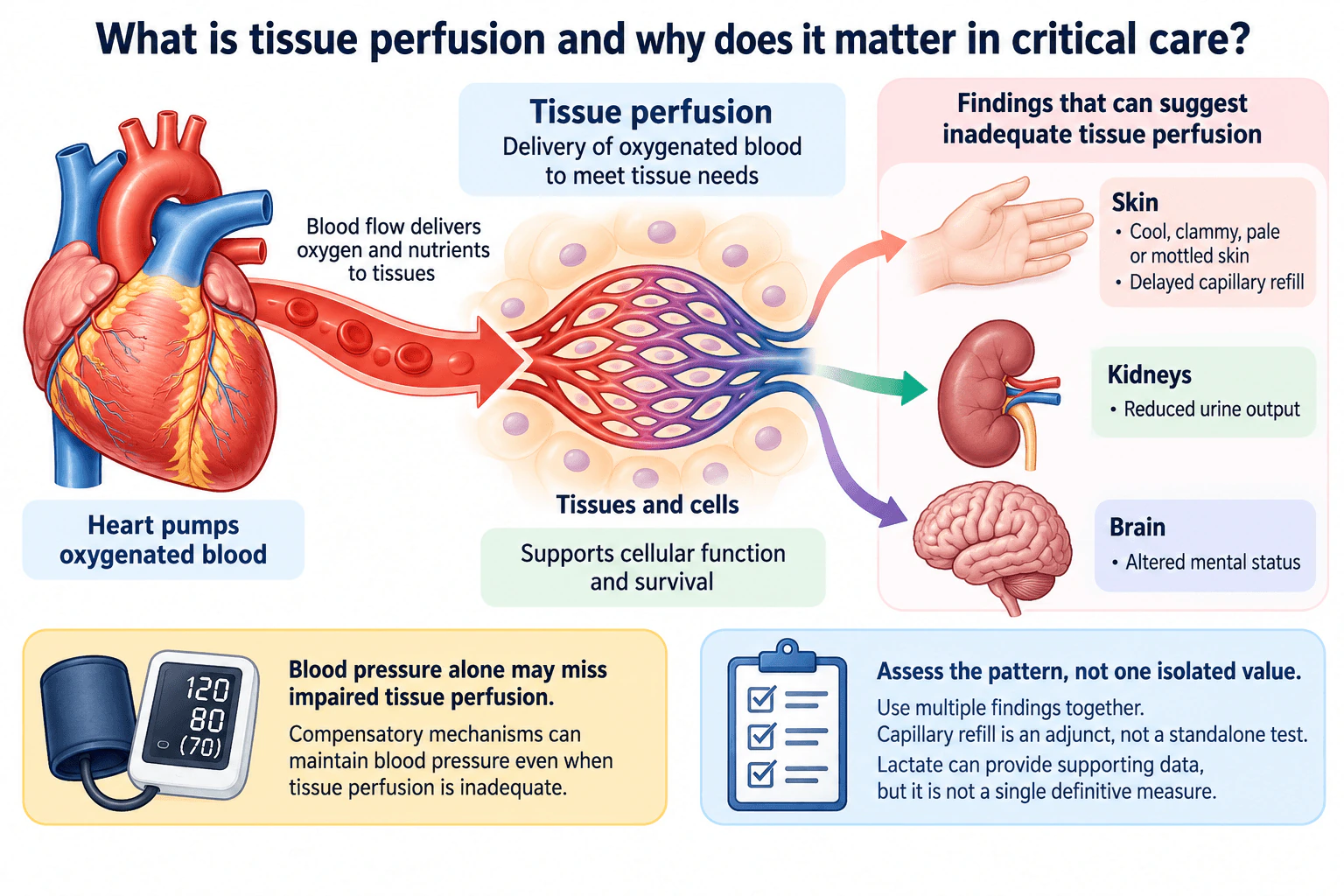
Tissue perfusion is the delivery of oxygenated blood to tissues so cells can function. In critical care, inadequate perfusion can threaten organ function. I would not judge perfusion from blood pressure alone. I would assess the pattern of findings, including skin temperature and color, capillary refill, urine output, mental status, hemodynamic trends, and supporting data such as lactate when clinically appropriate.
Useful Questions to Ask the Interviewer
Which bedside perfusion findings and hemodynamic trends does your ICU expect nurses to document routinely?
How are changes in urine output, mental status, skin findings, and capillary refill communicated and escalated in this unit?
What additional monitoring resources are commonly available when the team needs a more detailed assessment of perfusion?
Detailed Explanation
How to Explain It in an Interview
Core Concept
Tissue perfusion is the delivery of oxygenated blood to tissues so cells receive the oxygen and nutrients needed to support normal function. In systemic circulation, the left side of the heart pumps oxygenated blood through arteries toward the microcirculation, where blood reaches tissues and cells.
Bedside Relevance
In a critically ill adult, inadequate perfusion can be suggested by a pattern of bedside findings. I would look for cool, clammy, pale, or mottled skin, delayed capillary refill, reduced urine output, and altered mental status. These findings can indicate that blood flow to peripheral tissues or organs may be inadequate and should be interpreted together with the rest of the clinical picture.
Blood pressure is important, but blood pressure alone can miss impaired tissue perfusion. Compensatory physiologic responses can maintain arterial pressure even while tissue blood flow is inadequate. For that reason, I would assess multiple findings and trends instead of assuming that one acceptable blood pressure establishes adequate perfusion.
Supporting Data and Limitations
Capillary refill is useful as an adjunct to other perfusion measures rather than as a standalone test. Lactate can also provide supporting information, particularly when followed serially in an appropriate clinical context, but an elevated lactate can have causes other than inadequate tissue blood flow. It should not be treated as a single definitive measure of perfusion.
Nursing Reasoning
My bedside approach is to assess the pattern, compare current findings with previous observations, reassess when the patient's condition changes, and communicate significant deterioration promptly. I would integrate skin findings, capillary refill, urine output, mental status, blood pressure and other hemodynamic trends, and relevant laboratory information while following applicable orders, protocols, and local policy.
Why Interviewers Ask This
Interviewers want to know whether the nurse understands perfusion as a physiologic concept and can connect it to bedside observations without depending on one isolated number. The question also evaluates whether the nurse can combine findings, recognize a concerning change, reassess trends, communicate deterioration, and escalate concerns within the bedside RN role.
Common interview mistakes
Common mistakes include equating perfusion with blood pressure alone, assuming one normal value excludes impaired perfusion, treating lactate as a definitive standalone measurement, interpreting capillary refill without clinical context, or focusing on one finding instead of combining multiple bedside observations and trends.
Interview tip
Start by defining perfusion clearly, then connect the definition to the bedside findings shown in the clinical picture. Emphasize that you assess a pattern rather than one isolated value, and explain that concerning changes should prompt reassessment, communication, and escalation according to the patient's condition and local protocols.
Interviewer may ask next
How would you verify that a patient may have inadequate tissue perfusion?
I would verify the concern by repeating and trending the assessment rather than relying on one abnormal finding. I would reassess skin temperature and color, capillary refill when appropriate, urine output, mental status, blood pressure and other hemodynamic trends, and review relevant supporting information such as serial lactate when clinically indicated. I would compare the findings with the patient's previous status and communicate a concerning pattern promptly.
What changes if the patient has an acceptable blood pressure but develops cool mottled skin, reduced urine output, and altered mental status?
Those findings would still raise concern for inadequate tissue perfusion despite the acceptable blood pressure. I would reassess the patient, verify the findings and trends, review available hemodynamic and laboratory information, and promptly communicate the change to the appropriate clinician. The key point is that blood pressure alone does not establish adequate tissue perfusion.
4. What is the difference between oxygenation and ventilation?Critical Care FoundationsEasy
i Question Details
Define oxygenation and ventilation separately and explain why a patient can have a problem with one even when the other appears less impaired.
Short Interview Answer (30-60 seconds)
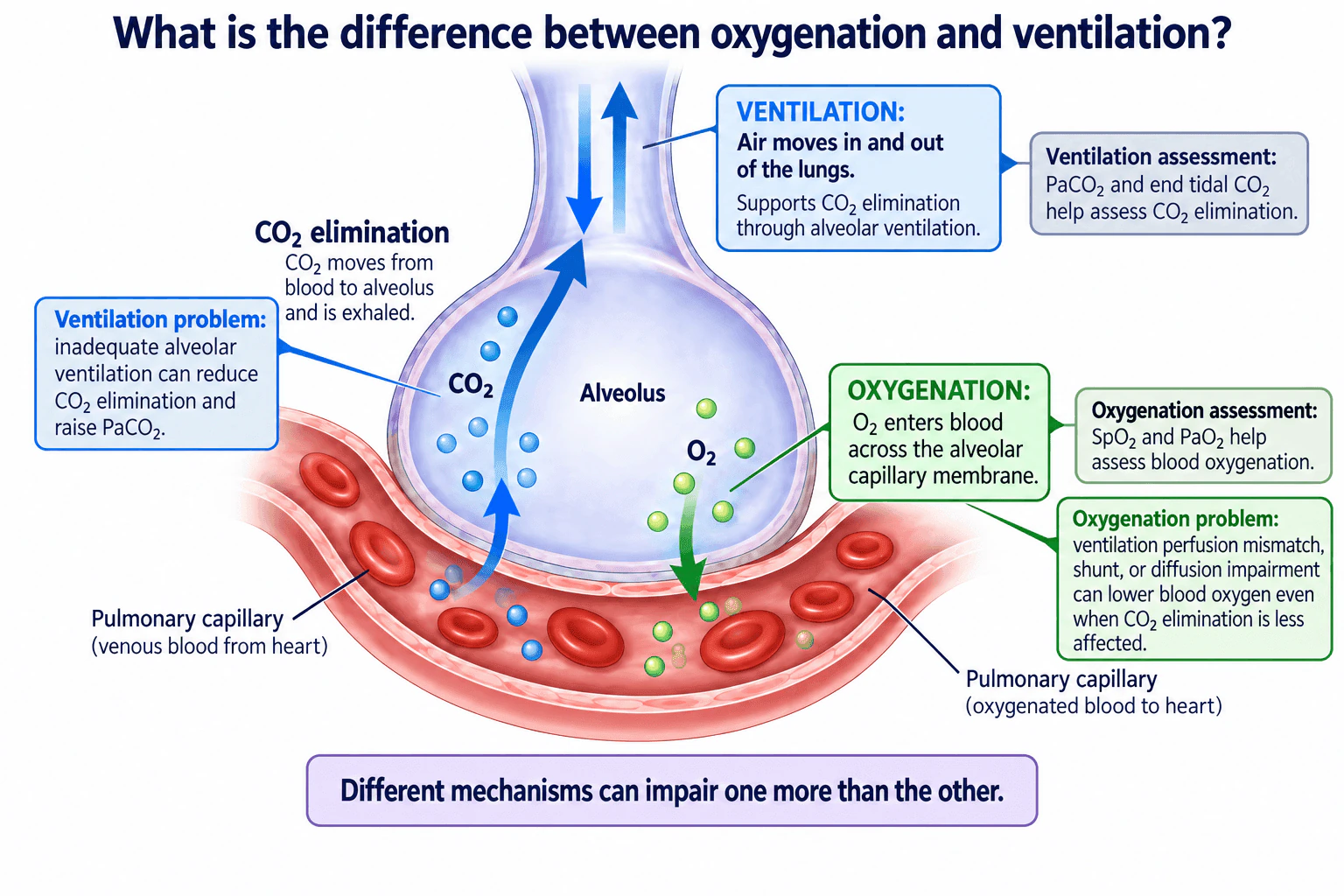
Ventilation is air moving into and out of the lungs, so inadequate alveolar ventilation can reduce carbon dioxide elimination and raise PaCO2. Oxygenation is oxygen moving from the alveoli into the blood. Ventilation perfusion mismatch, shunt, or diffusion impairment can reduce blood oxygen even when carbon dioxide elimination is less affected. PaCO2 and end tidal CO2 help assess ventilation, while SpO2 and PaO2 help assess oxygenation.
Detailed Explanation
Ventilation and oxygenation describe different parts of pulmonary gas exchange. Ventilation is the movement of air into and out of the lungs. Effective alveolar ventilation supports carbon dioxide elimination, so inadequate ventilation can cause PaCO2 to rise. Oxygenation is the transfer of oxygen from the alveoli across the alveolar capillary membrane into pulmonary capillary blood. SpO2 estimates arterial oxygen saturation, while PaO2 measures the partial pressure of oxygen in arterial blood.
Useful Questions to Ask the Interviewer
Which measures of ventilation and oxygenation do bedside nurses on this unit trend most often?
How do bedside nurses and respiratory therapists communicate changes in gas exchange on this unit?
What is the expected escalation process when a patient's respiratory status worsens?
How to Explain It in an Interview
Core Concept
I would explain that ventilation is air movement and carbon dioxide elimination, while oxygenation is oxygen transfer into the blood. They are connected, but they are not interchangeable.
Why One Can Be More Impaired
With inadequate alveolar ventilation, carbon dioxide elimination falls and PaCO2 can rise. Oxygenation may appear less impaired, particularly when supplemental oxygen is being provided. In contrast, ventilation perfusion mismatch, shunt, or diffusion impairment can reduce oxygen transfer and lower SpO2 or PaO2 even when carbon dioxide elimination is less affected.
Bedside Relevance
For ventilation, I assess the patient's respiratory pattern, effort, mental status, PaCO2, and end tidal CO2 when available. End tidal CO2 is useful for trending ventilation, but it does not always equal PaCO2 because the difference can change with dead space and perfusion. For oxygenation, I review SpO2, oxygen requirement, clinical appearance, and PaO2 when an arterial blood gas has been obtained.
Nursing Role
In adult bedside ICU practice in the United States, I would integrate these findings with the full clinical assessment, trend changes over time, reassess after interventions, support therapies within orders and local protocols, and promptly communicate deterioration to the appropriate clinician and respiratory therapist.
Why Interviewers Ask This
Interviewers want to know whether you can distinguish two related but different respiratory processes and connect each one to appropriate bedside assessment. For an adult bedside ICU nurse, that distinction supports accurate recognition, reassessment, communication, and escalation when respiratory status changes.
Common interview mistakes
Using oxygenation and ventilation as interchangeable terms. Assuming an acceptable SpO2 proves ventilation is adequate. Looking only at oxygen saturation while missing rising PaCO2. Treating end tidal CO2 as identical to PaCO2 in every patient. Forgetting that ventilation perfusion mismatch, shunt, and diffusion impairment can affect oxygenation more than carbon dioxide elimination.
Interview tip
Define each term first. Connect ventilation with air movement and carbon dioxide elimination, then connect oxygenation with oxygen transfer into blood. Finish by explaining that PaCO2 and end tidal CO2 help assess ventilation, while SpO2 and PaO2 help assess oxygenation.
Interviewer may ask next
How would you verify whether the main problem is ventilation or oxygenation at the bedside?
I would combine the clinical assessment with objective data. I would assess respiratory pattern, effort, mental status, and other relevant findings. For ventilation, I would review PaCO2 and end tidal CO2 when available, recognizing that end tidal CO2 may differ from PaCO2 when dead space or perfusion changes. For oxygenation, I would review SpO2, oxygen requirement, and PaO2 when an arterial blood gas is available. I would trend these findings rather than relying on a single measurement and promptly communicate clinically important deterioration.
How would your explanation change if the patient had pneumonia or pulmonary edema?
I would emphasize that these conditions can impair oxygenation through ventilation perfusion mismatch and, when alveoli are perfused but poorly ventilated, shunt physiology. SpO2 or PaO2 may therefore fall while carbon dioxide elimination remains less affected. If disease progresses, respiratory muscle fatigue or more severe ventilatory impairment can also reduce carbon dioxide elimination, so both processes must continue to be reassessed.
5. What is evidence based practice in nursing?Critical Care FoundationsEasy
Short Interview Answer (30-60 seconds)
Evidence based practice means combining the best current research with nursing expertise and the patient's values and circumstances to guide care. I would clarify the clinical question, find reliable evidence, assess its quality and relevance, apply it within my RN scope and authorized practice, and then reassess the patient to determine whether the plan is achieving the intended outcome. It is not simply following tradition or applying one study to every patient. nursingworld.org
Detailed Explanation
Evidence based practice is a method of making nursing decisions by combining the best available evidence with clinical expertise and the patient's values, preferences, and circumstances. The American Nurses Association describes a process of asking a clear question, acquiring evidence, appraising its quality and relevance, applying it to practice, and assessing the outcome. nursingworld.org
For an adult bedside ICU nurse, evidence supports clinical judgment rather than replacing it. A study or guideline may be scientifically sound but still require consideration of whether its population, setting, and recommendations fit the individual patient. The nurse also considers current assessment findings, patient goals, professional scope, competence, applicable policies, and whether an action is an independent nursing action, is authorized by a protocol, or requires an order or another professional. ANA states that RN practice depends on context that includes education, role, experience, certification, setting, population, and lawful authority. nursingworld.org
RN licensure, role specific competency, and specialty certification are related but different concepts. RN licensure provides legal authority to practice nursing within the applicable jurisdiction. Competence refers to the nurse's ability to perform the professional role safely and is a continuing responsibility shared among the nurse, regulators, employers, and other professional bodies. Specialty certification such as CCRN is a separate credential with its own eligibility requirements and should not be presented as something every ICU nurse automatically holds. Employer and role expectations can differ. nursingworld.org
Useful Questions to Ask the Interviewer
How does this ICU help bedside nurses access current clinical guidelines and research evidence?
How are bedside nurses involved when new evidence may support a change in nursing practice or a unit protocol?
What resources are available for maintaining role specific competency and continuing professional development?
How to Explain It in an Interview
Core Concept
I think of evidence based practice as bringing together strong current evidence, nursing expertise, and what is appropriate and meaningful for the individual patient. I would not change care simply because one article recommends something. I would first consider the quality of the evidence and whether the population and clinical context are relevant to my patient.
Bedside Relevance
At the bedside, I would use evidence to support assessment, planning, communication, and evaluation of care. I would compare new information with current authoritative guidance and approved clinical processes, consider the patient's condition and preferences, and determine whether an action is within independent RN practice, authorized through a protocol, or requires an order or another professional's involvement.
Reassessment
Evidence based practice continues after a decision is made. I would monitor the patient's response, compare the response with the intended outcome, communicate important changes, and document relevant findings. If the patient is not responding as expected, I would reassess the situation rather than assuming that an evidence supported approach must work the same way for every patient.
The key point is that evidence strengthens clinical judgment. It does not replace individualized assessment, professional accountability, patient preferences, or evaluation of outcomes. nursingworld.org
Why Interviewers Ask This
Interviewers want to know whether a nurse can distinguish evidence based care from habit, personal preference, or simply doing something because it has always been done that way. For an adult bedside critical care nurse, the question also tests whether the nurse can judge the quality and relevance of evidence, incorporate the patient's circumstances and preferences, stay within RN scope and authorized practice, and reassess outcomes after care is provided. nursingworld.org
Common interview mistakes
Common mistakes include treating tradition or personal experience as sufficient evidence, relying on one study without assessing its quality or relevance, assuming research findings apply equally to every patient, ignoring patient values and preferences, confusing evidence with an automatic treatment order, acting outside RN scope or competence, and assuming that specialty certification such as CCRN is the same as RN licensure or is universally required for every ICU nurse. nursingworld.org
Interview tip
Start with a clear definition, then explain how you would use evidence at the bedside. A strong answer connects research with clinical judgment, the individual patient, professional scope, competence, and reassessment. Avoid saying that evidence based practice simply means following research or following a guideline.
Interviewer may ask next
How would you verify that evidence is reliable before using it in nursing practice?
I would begin with current authoritative guidelines, systematic reviews, or well designed original research from credible sources. I would examine the publication date, study population, methods, outcomes, limitations, and relevance to the adult ICU context. I would compare important recommendations with other reliable sources and current professional guidance rather than relying on one article. Before applying the evidence, I would also confirm that the action fits my RN scope, competence, and authorized clinical processes. The evidence based practice process specifically includes acquiring and appraising evidence before applying it and assessing the outcome. nursingworld.org
How would your approach change if strong evidence supported a practice that was not part of your unit's current process?
I would not independently create a new unit practice solely because the evidence appeared convincing. I would verify the quality and relevance of the evidence, continue providing safe care within my RN scope and currently authorized processes, and bring the evidence to the appropriate nursing or clinical leadership pathway for review. If a practice change were approved, I would follow the authorized process and evaluate patient outcomes. This approach supports evidence based improvement while respecting professional accountability, competence, and organizational responsibilities. nursingworld.org
6. How would you explain organ support in the ICU without implying independent prescribing authority?Critical Care FoundationsHard
i Question Details
Describe respiratory, cardiovascular, renal, neurologic, and metabolic support and distinguish bedside monitoring and nursing actions from therapies that require orders or protocols.
Short Interview Answer (30-60 seconds)
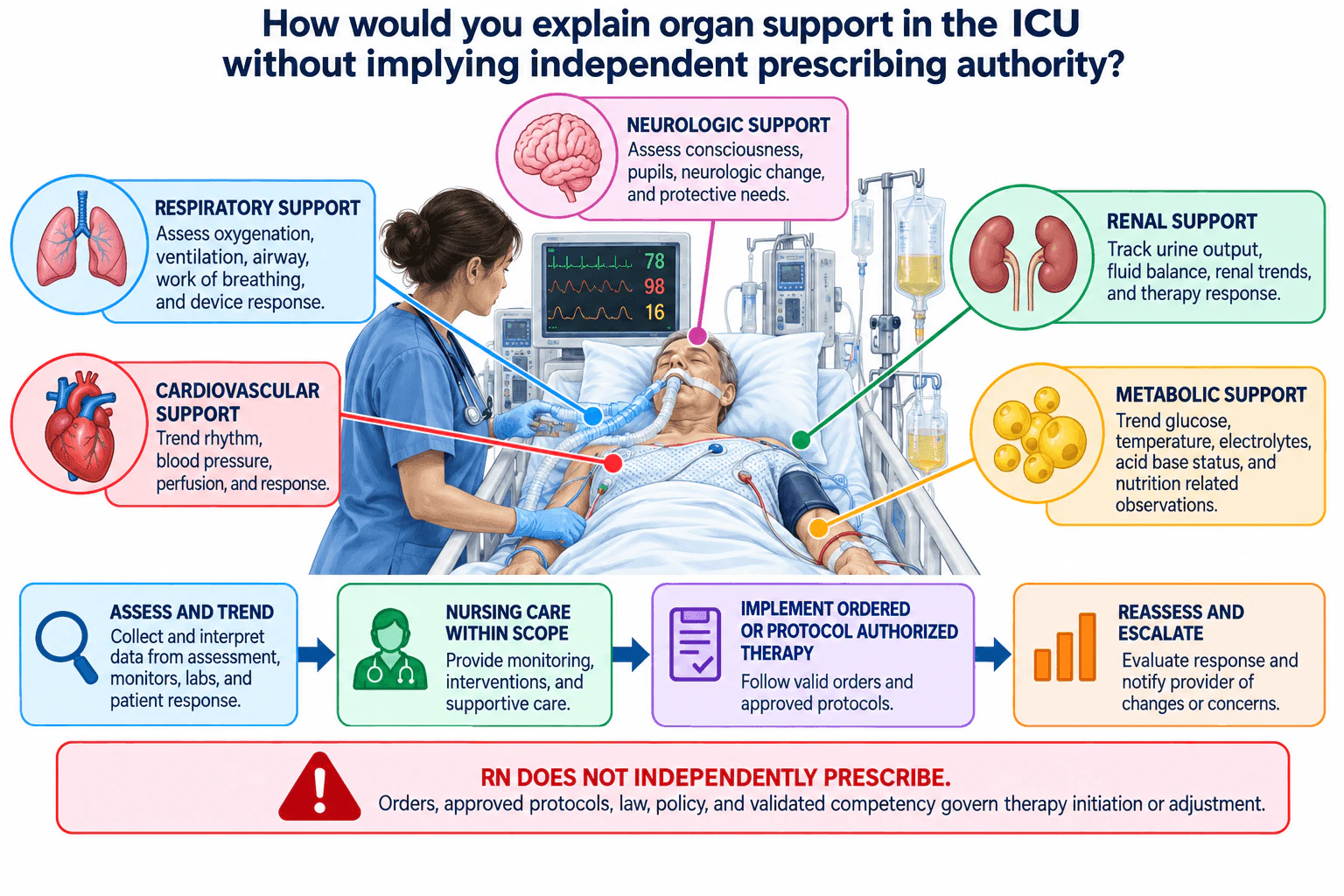
I explain organ support as continuous assessment, nursing care within scope, authorized therapy, reassessment, and escalation. I assess respiratory status through oxygenation, ventilation, airway, work of breathing, and device response; cardiovascular status through rhythm, blood pressure, perfusion, and response; renal status through urine output, fluid balance, renal trends, and therapy response; neurologic status through consciousness, pupils, neurologic change, and protective needs; and metabolic status through glucose, temperature, electrolytes, acid base status, and nutrition related observations. I can provide nursing care within my scope and implement therapies authorized by valid orders or approved protocols, but I do not independently prescribe.
Detailed Explanation
Organ support in the ICU means supporting essential body functions while continuously assessing whether the patient is improving, stable, or deteriorating. For the bedside RN, the key distinction is between nursing assessment and care within RN scope and therapies whose initiation or adjustment requires a valid order or an approved protocol.
Useful Questions to Ask the Interviewer
Which therapies in this ICU may nurses initiate or adjust under approved protocols?
How does the unit validate competency for high risk devices and organ support therapies?
What is the expected escalation process when a patient's response changes?
How to Explain It in an Interview
Core Concept
I would organize organ support around what I assess, what nursing care I can provide within scope, what therapy is authorized, and how I reassess the response.
Respiratory Support
I assess oxygenation, ventilation, airway status, work of breathing, and device response. I monitor for meaningful changes and communicate deterioration. Changes to prescribed respiratory therapy must follow a valid order or an approved protocol within my competency and local policy.
Cardiovascular Support
I trend rhythm, blood pressure, perfusion, and response over time. My role includes focused assessment, monitoring, supportive nursing care, recognition of deterioration, and escalation. Prescribed cardiovascular therapies are implemented according to authorized orders or protocols.
Renal Support
I track urine output, fluid balance, renal trends, and therapy response. These findings help me recognize changes in organ function and overall clinical status. Renal replacement therapy and other prescribed treatments are carried out according to orders, approved protocols where applicable, validated competency, and local policy.
Neurologic Support
I assess consciousness, pupils, neurologic change, and protective needs. New or worsening findings require reassessment and escalation according to the clinical situation rather than an assumption that I should independently prescribe treatment.
Metabolic Support
I trend glucose, temperature, electrolytes, acid base status, and nutrition related observations. I compare those trends with the overall clinical picture and implement authorized interventions while reassessing the patient's response.
Scope And Reassessment
The bedside RN does not independently prescribe. Nursing activities must be permitted by applicable law and regulation and supported by the nurse's education, licensure, competence, and local policy. Therapies that require authorization are carried out under valid orders or approved protocols. RN licensure, employer validated competency, and specialty certification are distinct concepts. Specialty certification such as CCRN validates specialty knowledge and experience, but it does not itself create prescribing authority. After nursing interventions or authorized therapies, I reassess the patient, evaluate the response, document relevant findings, and escalate meaningful changes.
Why Interviewers Ask This
Interviewers are assessing whether the nurse understands organ support as more than equipment or treatment. They want to hear organized bedside assessment, recognition of deterioration, appropriate nursing care, implementation of authorized therapies, reassessment, escalation, and a clear understanding of professional scope. A strong answer shows that the nurse can discuss complex ICU care without implying prescribing authority that belongs to another licensed professional or depends on an approved protocol.
Common interview mistakes
Common mistakes include describing organ support only as machines or medications, implying that the RN independently prescribes or changes therapies, treating local protocols as universal, listing treatment settings without patient context, failing to distinguish assessment from treatment authorization, confusing specialty certification with licensure or prescribing authority, and forgetting reassessment and escalation after an intervention.
Interview tip
Use the same structure for each organ system: what you assess, what nursing care you provide within scope, what therapy requires an order or approved protocol, and how you reassess and escalate. This keeps the answer clinically organized while making professional boundaries explicit.
Interviewer may ask next
How would you verify that a specific ICU intervention is within your nursing scope?
I would verify the applicable nurse practice act and regulations for the jurisdiction, professional standards, my education and documented competency, facility policies and procedures, and whether the intervention requires a valid order or approved protocol. If authority or competency remains unclear, I would stop and clarify with the appropriate clinical or nursing leadership rather than assume authorization.
How would your explanation change if the patient suddenly deteriorated?
The same scope boundaries still apply, but priorities become rapid focused assessment, recognition of the change, immediate nursing actions within scope, activation of applicable emergency or unit protocols, prompt communication with the appropriate clinician or response team, implementation of authorized therapies, and continuous reassessment. Urgency does not create independent prescribing authority.
7. How do you organize an initial approach to a newly admitted ICU patient?Critical Care FoundationsMedium
i Question Details
Describe a structured bedside approach that begins with immediate threats, verifies essential support and monitoring, establishes a baseline, and identifies urgent priorities.
Short Interview Answer (30-60 seconds)
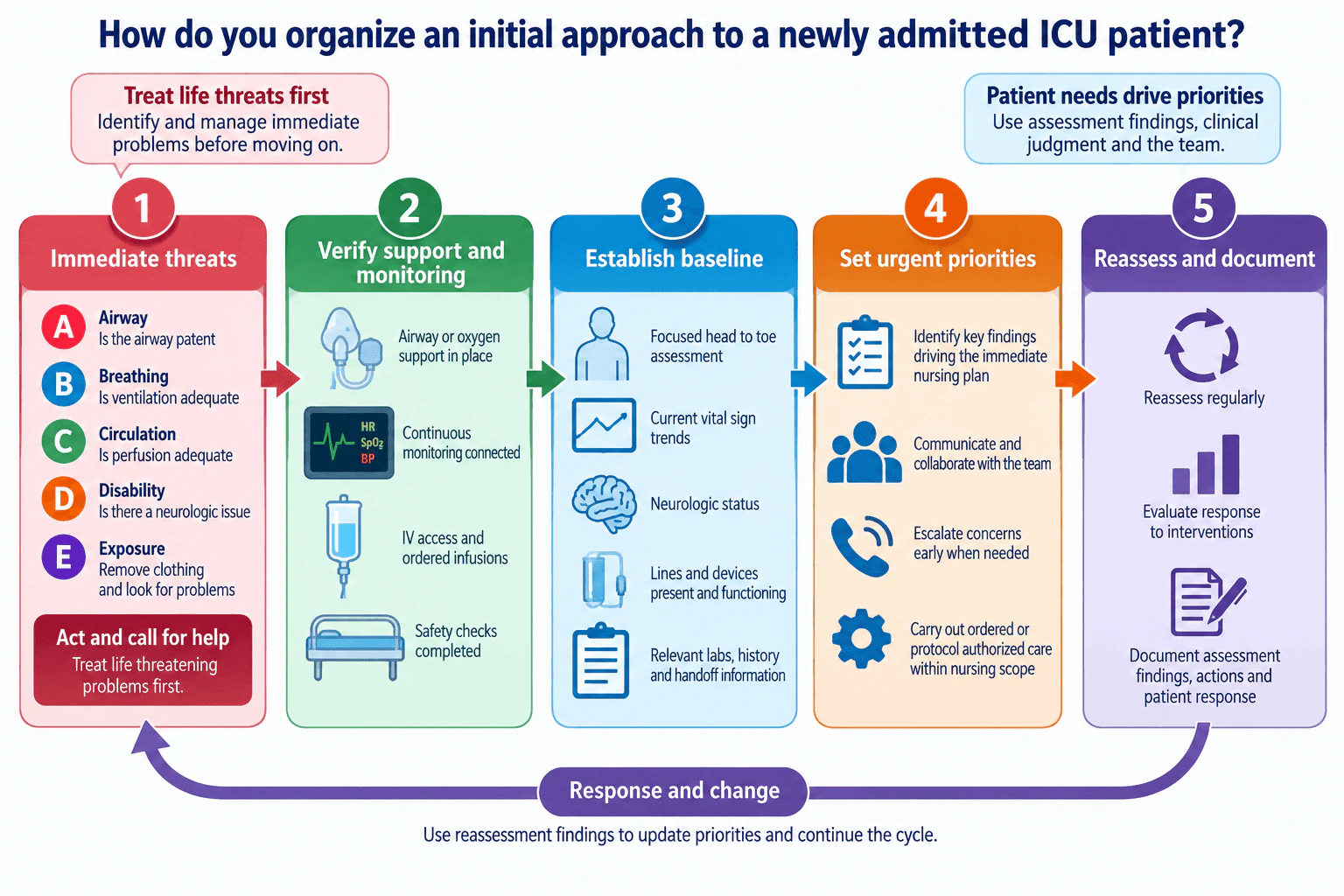
I start with immediate threats using Airway, Breathing, Circulation, Disability, and Exposure and address life threatening problems first. I call for appropriate help early, then verify essential support and monitoring, including airway or oxygen support, continuous monitoring, IV access, ordered infusions, and safety measures. Next I establish a baseline from a focused assessment, vital sign trends, neurologic status, lines and devices, relevant laboratory results, history, and handoff information. I use those findings to set urgent priorities, communicate and escalate concerns, carry out appropriate ordered or protocol authorized care, then reassess, document, and update priorities as the patient changes.
Detailed Explanation
A newly admitted adult ICU patient needs an organized first assessment because several problems may compete for attention at the same time. I use one continuous sequence: identify immediate threats, verify essential support and monitoring, establish a baseline, set urgent priorities, then reassess and document. This reflects bedside critical care nursing practice rather than a fixed treatment order for every patient.
Useful Questions to Ask the Interviewer
What standardized admission assessment and safety checks does this ICU use for newly admitted patients?
How does the unit expect nurses to escalate urgent concerns and communicate with the interdisciplinary team?
Which interventions are nurse initiated under local protocols, and which require a specific order?
How to Explain It in an Interview
Immediate threats
I first determine whether there is an immediate threat using Airway, Breathing, Circulation, Disability, and Exposure. I address life threatening problems before progressing through the rest of the assessment and call for appropriate help early. Exposure is performed only as clinically necessary while maintaining privacy, dignity, and protection from heat loss.
Verify support and monitoring
I confirm that required airway or oxygen support is present and functioning and that appropriate continuous monitoring is connected. I verify IV access, review ordered infusions, and complete immediate safety checks. The purpose is to confirm essential support directly rather than assuming that everything described during handoff is functioning as intended.
Establish the baseline
Once immediate threats are addressed, I perform a focused head to toe assessment and establish the patient's starting condition. I review current vital sign trends, neurologic status, lines and devices, relevant laboratory results, history, and handoff information. This baseline gives the team a reference for recognizing subsequent improvement or deterioration.
Set urgent priorities
I identify the findings that require the earliest nursing action, communication, or escalation. Patient needs, assessment findings, and clinical judgment determine priorities. I collaborate with the team, report concerning findings promptly, and carry out ordered care or protocol authorized actions that are within my role and competence.
Reassess and document
The process is cyclic rather than complete after one assessment. I reassess regularly and after important interventions or changes in condition, evaluate the patient's response, and document assessment findings, actions, communication, and response. New findings may change the priorities, so I continue the cycle from the most urgent current problem.
Why Interviewers Ask This
Interviewers are evaluating whether the nurse can bring structure to a complex ICU admission rather than completing tasks in an arbitrary order. A strong response demonstrates recognition of immediate threats, systematic assessment, verification of essential support and monitoring, establishment of a useful baseline, prioritization from patient findings, appropriate escalation, teamwork, reassessment, and documentation.
Common interview mistakes
Common mistakes include focusing on admission paperwork or handoff details before looking at the patient, continuing a detailed assessment while an immediate threat remains untreated, assuming monitoring or support devices are functioning without verification, treating every abnormal finding as equally urgent, overlooking trends and baseline information, carrying out actions beyond nursing scope or local authorization, failing to escalate a concerning change, and documenting care without reassessing the patient's response.
Interview tip
Describe the approach as a repeatable bedside cycle rather than a checklist that ends after admission. State that immediate threats come first, then explain how you verify essential support and monitoring, establish a baseline, prioritize from actual findings, communicate or escalate concerns, and reassess after interventions or clinical changes.
Interviewer may ask next
How do you verify that your initial ICU assessment is reliable?
I assess the patient directly and compare those findings with current vital sign trends, the status of monitors, lines, and support devices, relevant laboratory results, history, and handoff information. I confirm that essential equipment and monitoring are actually functioning. If information conflicts with the patient's presentation, I reassess the finding and clarify the discrepancy with the appropriate team member. A concerning discrepancy itself can justify early escalation.
How would your approach change if the newly admitted patient deteriorated while you were establishing the baseline?
I would stop the routine baseline assessment and return immediately to the most urgent physiologic problem. I would reassess Airway, Breathing, Circulation, Disability, and Exposure, address life threatening problems within my nursing scope and authorized protocols, call for appropriate help, and communicate the change clearly to the team. After immediate threats are addressed, I would reassess the patient's response, update priorities, complete the remaining assessment when appropriate, and document the change, actions, communication, and response.
8. How do you use trends rather than single values when caring for a critically ill patient?Critical Care FoundationsMedium
i Question Details
Describe how serial vital signs, mental status, urine output, laboratory results, and treatment response are interpreted together to recognize change.
Short Interview Answer (30-60 seconds)
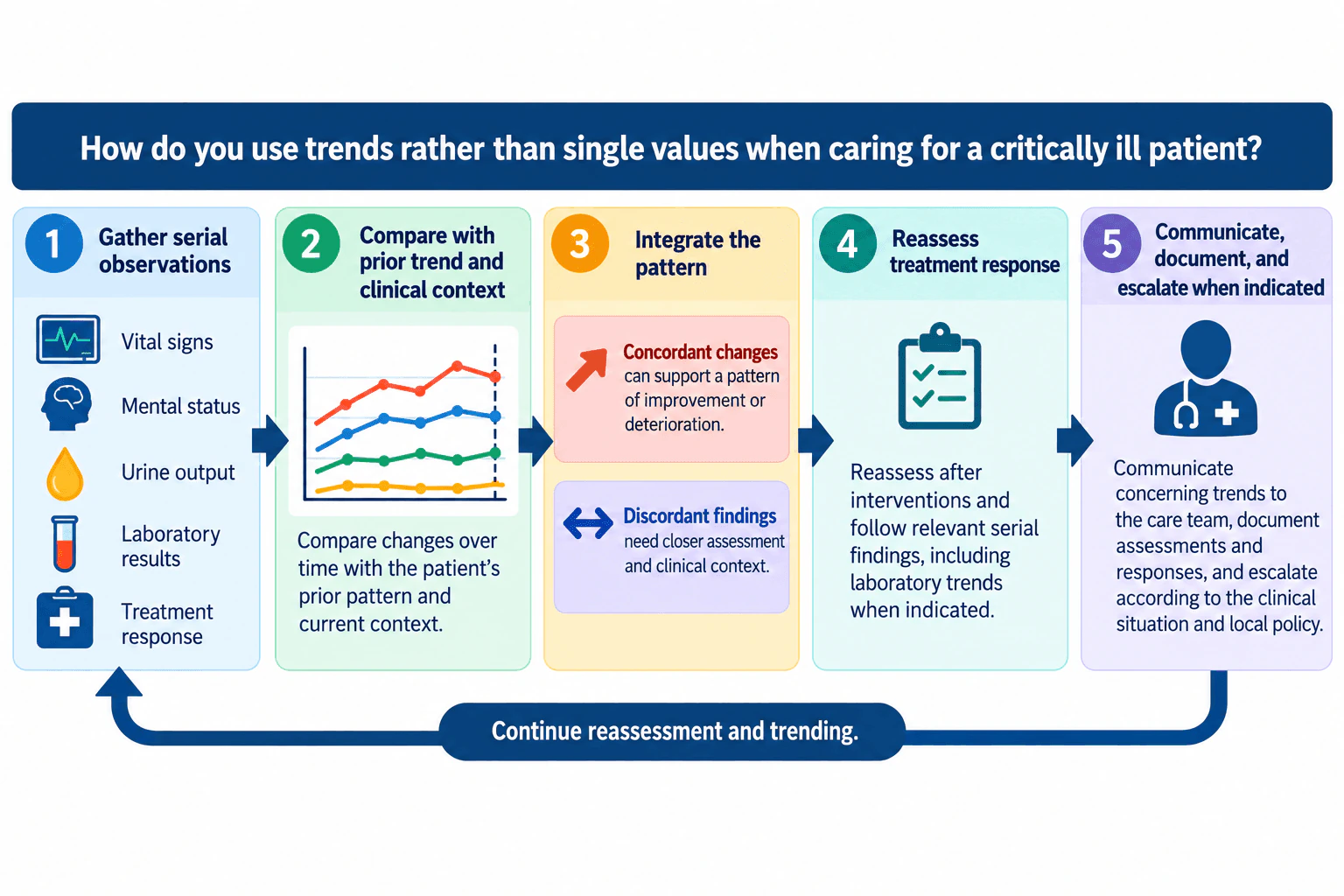
I look at the patient's trajectory rather than one isolated number. I trend vital signs, mental status, urine output, laboratory results, and treatment response, then compare them with the patient's previous findings and current context. If several findings change in the same direction, that can support a pattern of improvement or deterioration. If they disagree, I reassess and investigate the context. After interventions, I reassess, document the response, communicate concerning trends, escalate when indicated, and continue trending.
Detailed Explanation
A trend shows how a critically ill patient's condition is changing over time. I interpret serial observations together because one measurement may be affected by timing, technique, treatment, or the patient's individual baseline. Trend based reasoning does not mean ignoring a dangerous single finding. A new or severe change still requires prompt assessment and appropriate action while I evaluate the broader clinical picture.
Useful Questions to Ask the Interviewer
How does your ICU team communicate significant changes in patient trends during a shift?
What documentation tools are commonly used to review serial assessments and treatment response?
What is the usual escalation process when a bedside nurse identifies a concerning change?
How to Explain It in an Interview
I start by gathering serial observations, including vital signs, mental status, urine output, laboratory results, and the patient's response to treatment. I compare each new finding with the patient's prior pattern, baseline, recent events, and the timing of interventions.
Next, I integrate the findings rather than treating each one separately. Concordant changes can support a pattern of improvement or deterioration. For example, if several relevant observations worsen together, that is more concerning than an isolated value without supporting changes. If findings are discordant, I do not force them into one explanation. I repeat the bedside assessment, verify measurements when appropriate, and consider clinical context.
After an intervention, I reassess the patient and follow relevant serial findings, including laboratory trends when indicated. The important question is whether the patient's overall response is improving, unchanged, or worsening. Current adult critical care guidance also emphasizes frequent ongoing reassessment and clinical context during resuscitation rather than relying on a single static measure.
If the trajectory is concerning, I communicate the trend and supporting observations to the care team, document the assessment and response, and escalate according to the clinical situation and local policy. I then continue reassessment and trending because the next observations may confirm improvement, continued deterioration, or a different clinical pattern.
Why Interviewers Ask This
Interviewers are evaluating whether the nurse can recognize evolving critical illness by integrating multiple bedside findings over time rather than reacting mechanically to a single measurement. This demonstrates clinical judgment, reassessment, recognition of treatment response, communication, documentation, and appropriate escalation within the bedside RN role.
Common interview mistakes
Common mistakes include reacting to one value without comparing it with the prior pattern and clinical context, focusing only on monitor values while overlooking mental status or urine output, assuming discordant findings must fit one explanation, failing to reassess after an intervention, and communicating an isolated number without describing the direction of change and related bedside findings.
Interview tip
Explain your reasoning as a continuous loop: gather serial observations, compare them with the prior trend and clinical context, integrate whether findings agree or conflict, reassess treatment response, then communicate, document, escalate when indicated, and continue trending.
Interviewer may ask next
How do you verify that a concerning trend represents a real clinical change?
I repeat the bedside assessment, confirm the quality and timing of the measurements, check for technique or equipment issues when relevant, compare the findings with prior values and the patient's baseline, and review associated observations such as mental status, urine output, laboratory results, and treatment response. If the concerning pattern persists, I communicate and escalate it with the supporting clinical context.
How would your approach change if the patient's findings were moving in different directions?
Discordant findings would make me slow down the interpretation rather than assume one value represents the whole condition. I would reassess the patient, verify relevant measurements, review the timing of recent interventions, and consider which findings best reflect the current clinical situation. I would communicate unresolved or concerning discrepancies to the care team and continue serial reassessment until the pattern becomes clearer or the situation requires escalation.
9. A critically ill patient has several abnormal findings at once. How would you decide which problem needs attention first?Critical Care FoundationsHard
i Question Details
Use immediate threats to airway, breathing, circulation, neurologic function, and rapidly worsening perfusion to explain how you prioritize competing findings.
Short Interview Answer (30-60 seconds)
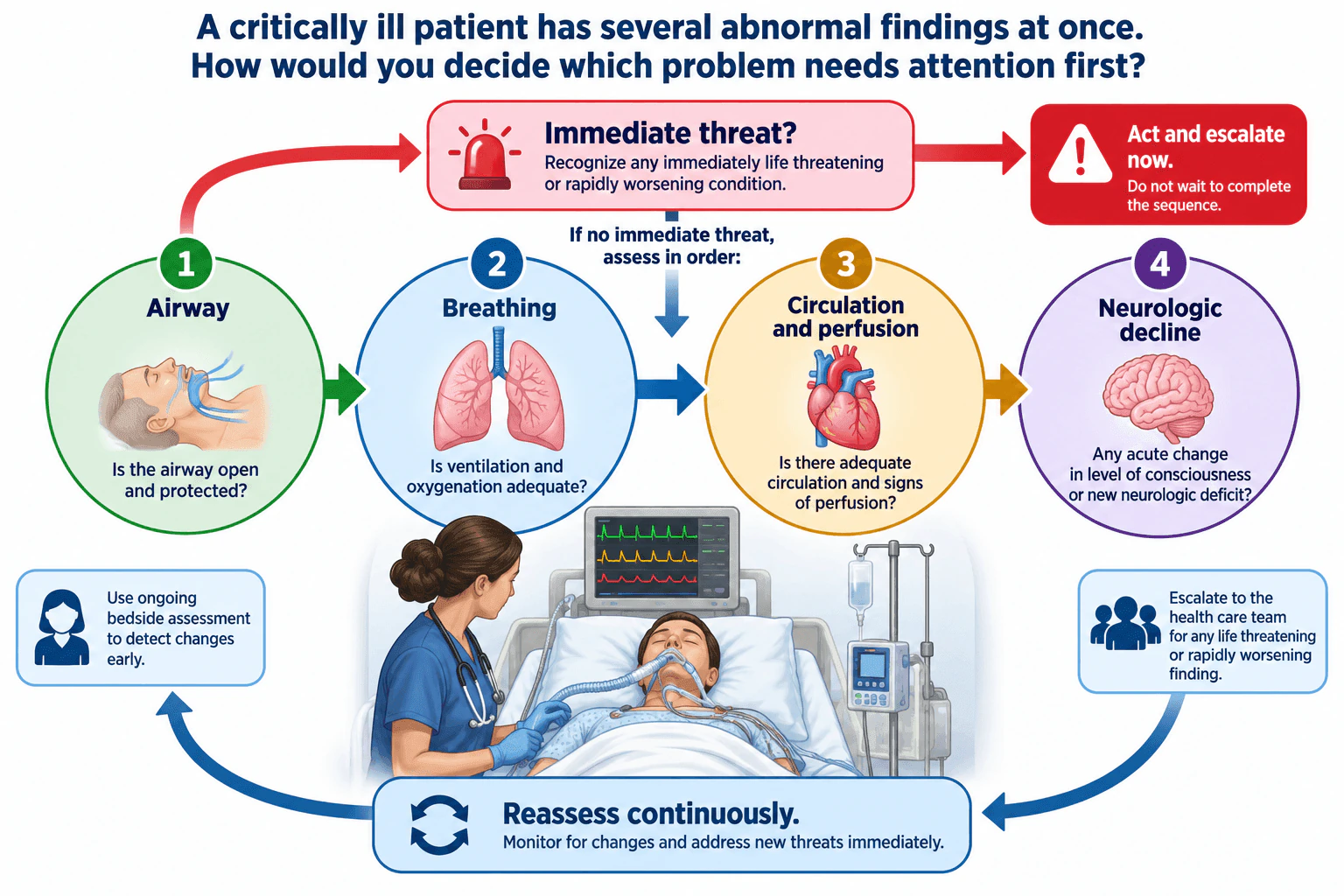
I prioritize the problem that poses the most immediate threat to life or is worsening most rapidly. If I identify an immediate threat, I intervene within my scope and escalate immediately rather than waiting to finish the whole assessment. If there is no immediate threat, I assess airway first, then breathing, circulation and perfusion, and neurologic function. I keep reassessing because the highest priority can change as the patient's condition changes.
Useful Questions to Ask the Interviewer
What escalation process does your ICU use when a bedside nurse identifies sudden deterioration?
How are bedside nurses expected to coordinate rapid assessment with the critical care team during an acute change?
What resources are immediately available when several urgent problems are identified at the same time?
Detailed Explanation
How to Explain It in an Interview
Core Concept
I would prioritize according to immediate threat to life and the speed of deterioration, not simply according to which monitor value or laboratory result looks most abnormal. A structured approach helps me identify the problem most likely to compromise the patient first. Current ABCDE guidance recommends treating life threatening problems before moving to the next assessment component, calling for appropriate help early, and reassessing regularly. resus.org.uk
Bedside Reasoning
First, I would rapidly look for any immediately life threatening or rapidly worsening condition. If one is present, I would begin appropriate nursing actions within my competence and local policy, summon help, and escalate without waiting to finish the sequence.
If there is no immediate threat, I would assess whether the airway is open and protected. Next, I would assess breathing, including ventilation, oxygenation, respiratory effort, and the overall respiratory picture. Then I would assess circulation and perfusion using available bedside findings and trends. After airway, breathing, and circulation priorities, I would assess for an acute change in consciousness or a new neurologic deficit.
Reassessment And Escalation
Prioritization is continuous. I would reassess the patient after interventions, monitor for new or worsening threats, and communicate significant deterioration promptly. Guidance for acutely ill adults supports monitoring physiological changes, responding to clinical concern, and escalating care when deterioration is identified. nice.org.uk
The key point is that I am not treating an isolated number. I am deciding which abnormality most urgently threatens airway, breathing, circulation, perfusion, or neurologic function, addressing that threat, and then reassessing the patient.
Why Interviewers Ask This
Interviewers are evaluating whether I can recognize immediate threats, prioritize competing findings according to physiologic risk, escalate deterioration appropriately, and reassess rather than focusing on an isolated abnormal value.
Common interview mistakes
Common mistakes include treating the most abnormal number instead of the most immediate physiologic threat, completing a full assessment before responding to a clearly life threatening problem, overlooking rapidly worsening perfusion or neurologic change, failing to escalate early, and not reassessing after an intervention.
Interview tip
Explain your priorities in sequence. State that an immediate threat interrupts the sequence, that you escalate early, and that you reassess continuously because the patient's highest priority problem can change.
Interviewer may ask next
How would you verify that your highest priority problem is actually improving?
I would repeat the focused bedside assessment and compare the current findings with the findings that triggered concern. I would assess the response in the relevant airway, breathing, circulation and perfusion, or neurologic domain, review trends rather than one isolated value, and escalate persistent or worsening abnormalities promptly.
What would change if a new airway or breathing problem appeared while you were addressing a circulation problem?
I would reprioritize immediately. A new immediate threat to airway or breathing would move ahead of the previous circulation problem. I would address the new threat within my scope, call for appropriate help, continue necessary monitoring, and then return to the remaining problems once the most urgent threat was being managed.
10. What does patient autonomy mean in critical care nursing?Ethics And Family CommunicationEasy
i Question Details
Explain how the nurse supports informed choices, respects expressed preferences, and communicates concerns while recognizing that decision making authority depends on capacity and applicable law.
Short Interview Answer (30-60 seconds)
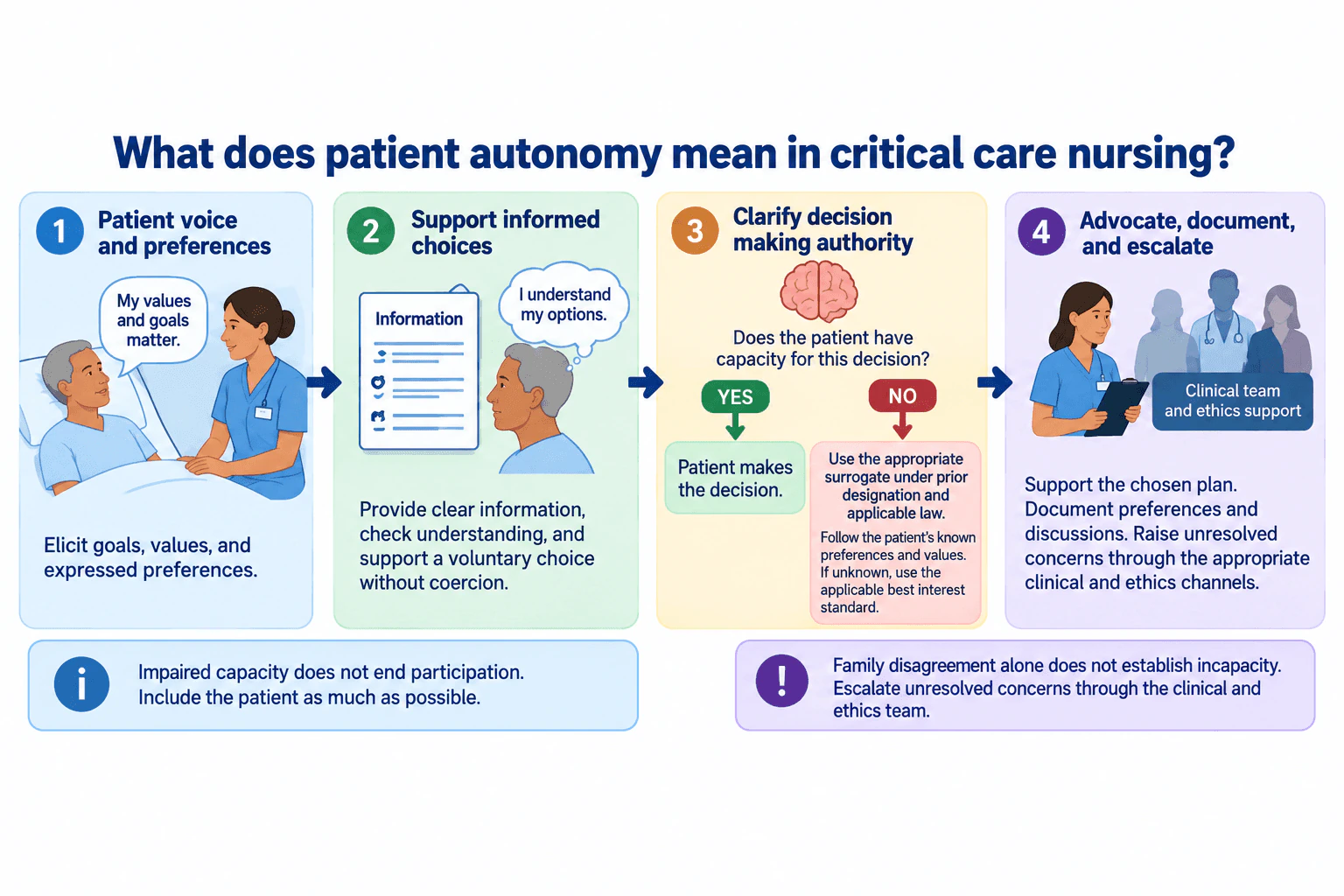
Patient autonomy in critical care nursing means respecting a patient’s right to make informed decisions about care when the patient has decision making capacity. My role is to identify the patient’s goals and preferences, provide clear information within my scope, check understanding, support a voluntary choice, and advocate for that choice. If capacity is impaired, I would help clarify the appropriate surrogate under applicable law, continue involving the patient as much as possible, document discussions, and escalate unresolved concerns through the clinical and ethics team.
Detailed Explanation
Patient autonomy means keeping the patient’s values, goals, and informed choices central to care. In adult bedside critical care in the United States, the exact rules for capacity, consent, and surrogate hierarchy depend on applicable state law and organizational policy. A patient who has decision making capacity for a specific decision generally makes that decision. When capacity is impaired, the patient should still participate as much as possible, and the appropriate surrogate should use the patient’s known preferences and values when they are available. If those preferences are unknown, decisions should follow the applicable best interest standard.
Useful Questions to Ask the Interviewer
How does your ICU document patient preferences, advance directives, and surrogate decision makers?
What process does the team use when decision making capacity is uncertain or changes during the admission?
When are ethics, palliative care, social work, or other consultation services involved in unresolved family concerns?
How to Explain It in an Interview
Patient preferences: I would begin by identifying the patient’s goals, values, expressed preferences, advance directives, and any previously designated surrogate. I would keep the patient’s voice central rather than assuming that critical illness automatically removes decision making authority.
Support informed choices: I would provide clear information within my nursing role, check understanding, support questions, and watch for coercion. If language is a barrier, I would use a qualified interpreter so the patient can participate meaningfully.
Decision making authority: Capacity is specific to the decision and can change. I would not independently declare a patient incapable. I would report concerns, share relevant observations, and collaborate with the responsible clinician and team according to applicable law and policy. If the patient has capacity, the patient makes the decision. If the patient lacks capacity, I would help verify the appropriate surrogate. The surrogate should follow the patient’s known preferences and values when possible. If those are unknown, the applicable best interest standard guides decisions.
Advocacy and communication: I would support the agreed care plan, document the patient’s preferences and important discussions, and continue involving the patient as much as possible even when capacity is impaired. This is especially important during goals of care and end of life discussions.
Escalation: Family disagreement by itself does not establish incapacity. If concerns remain unresolved, I would communicate them to the appropriate clinical team and use ethics or other institutional resources as indicated. I would not independently establish prognosis or authorize withdrawal of life sustaining treatment.
Why Interviewers Ask This
Interviewers want to know whether you can protect patient self determination while staying within the bedside nurse role. They are evaluating whether you understand informed consent, patient advocacy, decision making capacity, surrogate decision making, family communication, documentation, and appropriate escalation when ethical concerns remain unresolved.
Common interview mistakes
Common mistakes include treating autonomy as simple preference without considering decision making capacity, excluding a patient who can still participate, assuming family disagreement proves incapacity, using coercive communication, failing to verify the appropriate surrogate, ignoring the patient’s known values, and failing to document or escalate unresolved ethical concerns.
Interview tip
Organize your answer around the same bedside flow used in practice: identify the patient’s voice and preferences, support informed choices, clarify decision making authority, then advocate, document, and escalate unresolved concerns. Make clear that you support capacity assessment and surrogate identification through the appropriate clinical and legal process rather than independently determining incapacity.
Interviewer may ask next
How would you verify the correct surrogate decision maker?
I would review the record for an advance directive, health care proxy, or other documented designation and confirm what is known about the patient’s preferences. I would collaborate with the responsible clinician and follow applicable state law and organizational policy for surrogate identification. If the correct decision maker remained uncertain or there was significant conflict, I would escalate through the appropriate clinical, social work, legal, or ethics resources and document the clarification process.
How would your approach change if the patient was alert on admission but later developed delirium?
I would report the change in mental status and continue to assess and document the patient’s ability to understand and participate. Because decision making capacity can change and is specific to the decision, I would not assume that delirium automatically removes all participation. I would continue involving the patient as much as possible. If the responsible clinical assessment determined that the patient lacked capacity for a particular decision, I would help involve the appropriate surrogate under applicable law while continuing to advocate for the patient’s previously expressed goals, values, and preferences.
More questions load as you scroll
Critical Care Nurse Resume Examples
Explore the resume examples below to find the one that best matches your target Critical Care Nurse role.
New Graduate Critical Care Nurse0-1 years; supervised transition to critical care
Disclaimer: This interview guide is for educational and informational purposes only. It is designed to help readers prepare, but it does not guarantee any interview result, hiring decision, offer, or outcome. Interview questions, hiring criteria, and preferred answers can vary by employer, interviewer, industry, location, and time. All answers, examples, and explanations in this guide are suggested examples for interview preparation, not definitive answers or instructions for professional practice. They are based on research and judgment, are provided without warranties of any kind, and should be adapted to the question, role, and applicable laws and professional requirements. Diagrams are simplified illustrations intended to highlight the main concepts and their relationships; actual situations, systems, and practices may be more complex. Alternative approaches may be equally valid or better suited to a particular question, context, or interviewer. To the fullest extent permitted by applicable law, the contributors and publisher are not liable for decisions made, actions taken, or losses incurred based on this guide.
State Laws and Professional Responsibilities: Laws and requirements governing an occupation vary by state and jurisdiction. You are responsible for checking the current laws, licensing requirements, and scope-of-practice rules that apply to your location and role, and for ensuring that your answers and actions comply with them. Adapt examples in this guide to those requirements. This guide is not legal advice.
Content Accuracy and Verification: To the fullest extent permitted by applicable law, we do not represent or warrant that interview guides, questions, answers, examples, or diagrams are accurate, complete, current, error-free, or suitable for any particular purpose. You are responsible for independently reviewing and verifying the information before relying on it.