This interview guide is for educational and informational purposes only. It is designed to help readers prepare, but it does not guarantee any interview result, hiring decision, offer, or outcome. Interview questions, hiring criteria, and preferred answers can vary by employer, interviewer, industry, location, and time. All answers, examples, and explanations in this guide are suggested examples for interview preparation, not definitive answers or instructions for professional practice. They are based on research and judgment, are provided without warranties of any kind, and should be adapted to the question, role, and applicable laws and professional requirements. Diagrams are simplified illustrations intended to highlight the main concepts and their relationships; actual situations, systems, and practices may be more complex. Alternative approaches may be equally valid or better suited to a particular question, context, or interviewer. To the fullest extent permitted by applicable law, the contributors and publisher are not liable for decisions made, actions taken, or losses incurred based on this guide.
State Laws and Professional Responsibilities
Laws and requirements governing an occupation vary by state and jurisdiction. You are responsible for checking the current laws, licensing requirements, and scope-of-practice rules that apply to your location and role, and for ensuring that your answers and actions comply with them. Adapt examples in this guide to those requirements. This guide is not legal advice.
Identity, Image, and Privacy Notice
To respect individual privacy, some names, profile photographs, avatars, biographical details, and other identifying information displayed in this guide may be replaced with pseudonyms, licensed stock images, illustrative avatars, composite images, or representative descriptions. Unless a person is expressly identified as an actual contributor, a displayed name, image, or profile should not be understood as depicting or identifying a specific candidate, interviewer, employee, or other real individual. These representations are provided for editorial and illustrative purposes only and do not imply endorsement, employment, participation, or affiliation with this guide or any company mentioned in it. Any resemblance to an actual person is coincidental.
Company Notice
This guide is an independent educational resource and is not affiliated with, endorsed by, sponsored by, or approved by the company named in this guide. Company names identify reported interview experiences or the employer context of clearly labeled original practice exercises. Interview practices can change without notice, and inclusion of company-specific content does not mean these questions are official, complete, or guaranteed to be asked. To the fullest extent permitted by law, the author, contributors, and publisher are not responsible for outcomes related to use of this material.
Content Accuracy and Verification
To the fullest extent permitted by applicable law, we do not represent or warrant that interview guides, questions, answers, examples, or diagrams are accurate, complete, current, error-free, or suitable for any particular purpose. You are responsible for independently reviewing and verifying the information before relying on it.
Questions or comments?
Contact us for general questions, or share feedback, technical corrections, and comments with the community.
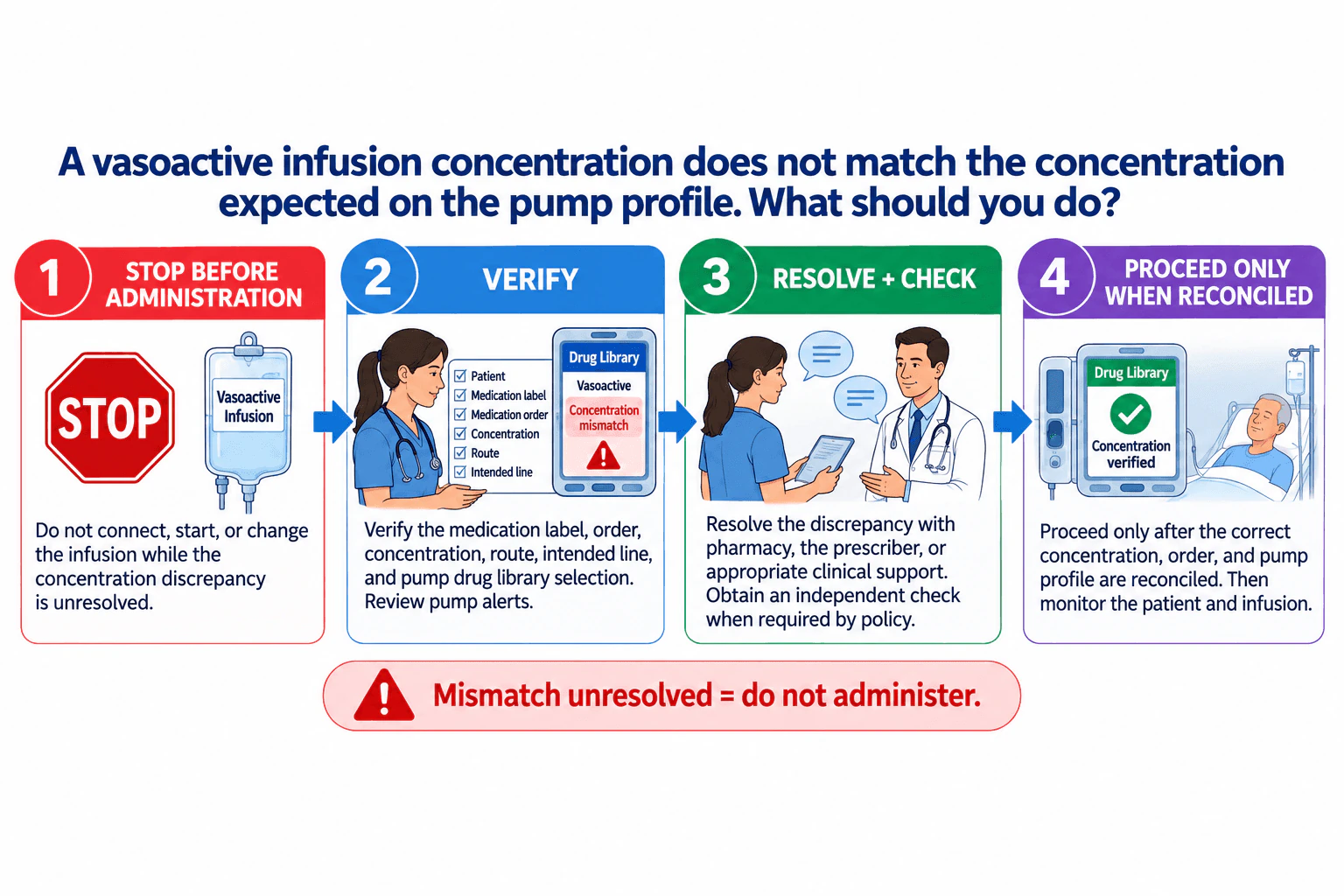
61. A vasoactive infusion concentration does not match the concentration expected on the pump profile. What should you do?Medication And ProceduresHard
i Question Details
Pause the process before connecting or changing the infusion, verify the medication label and order, obtain an independent check according to policy, and resolve the discrepancy before administration.
Short Interview Answer (30-60 seconds)
I would stop before connecting, starting, or changing the infusion. I would verify the patient, medication label, order, concentration, route, intended line, and pump drug library selection and review the pump alert. I would resolve the mismatch with pharmacy, the prescriber, or appropriate clinical support and obtain an independent check when required by policy. I would not administer the infusion while the discrepancy remains unresolved. Once the correct concentration, order, and pump profile are reconciled, I would proceed according to policy and monitor the patient and infusion.
Detailed Explanation
A concentration mismatch between a vasoactive infusion and the smart pump profile is a medication safety stop. In United States adult bedside ICU practice, I would not connect, start, or change the infusion until the discrepancy between the medication, order, and pump selection has been resolved.
Useful Questions to Ask the Interviewer
What is your unit process for resolving a concentration mismatch between a vasoactive infusion and the smart pump drug library?
Which vasoactive infusions require an independent check under your medication policy?
Who should the bedside nurse contact when the medication label, order, and pump library cannot be reconciled promptly?
How to Explain It in an Interview
Stop before administration
I would pause the process and avoid administering or changing the infusion while the discrepancy remains unresolved. I would not bypass the alert simply to continue therapy.
Verify the medication and pump selection
I would compare the patient identifiers, medication label, active order, concentration, route, intended line, and selected entry in the pump drug library. I would also review the pump alert. The purpose is to identify whether the discrepancy involves the prepared medication, the order, the selected pump entry, or another issue requiring clarification.
Resolve the discrepancy
I would involve pharmacy, the prescriber, or appropriate clinical support according to the situation and local policy. I would not independently change the prescribed concentration or select another concentration merely to make the pump accept the infusion. I would obtain an independent check when required by facility policy for that medication or infusion.
Proceed only after reconciliation
I would proceed only after the correct concentration, order, and pump profile are reconciled. I would then monitor the patient and infusion according to the ordered therapy and applicable unit policy.
The key point is that the mismatch is not simply a programming inconvenience. It is a medication safety discrepancy that must be resolved before administration.
Why Interviewers Ask This
This question tests whether the nurse recognizes a pump concentration mismatch as a medication safety problem rather than simply changing the programming to make the alert disappear. It evaluates verification, appropriate use of smart pump safeguards, escalation, policy based independent checking, and the judgment to withhold administration until the discrepancy is resolved.
Common interview mistakes
Common mistakes include bypassing the pump alert, selecting another drug library entry merely to make the concentration fit, changing the prescribed concentration without authorization, assuming an independent check is universally required rather than following medication specific facility policy, or beginning administration before the medication label, order, and pump profile have been reconciled.
Interview tip
State the sequence clearly: stop, verify, resolve, obtain an independent check when required, and proceed only after reconciliation. Make clear that you would not bypass the smart pump safety system or invent a concentration, dose, rate, or device setting.
Interviewer may ask next
What exactly would you verify before proceeding with the vasoactive infusion?
I would verify the patient identifiers, medication label, active order, concentration, route, intended line, and selected drug and concentration in the smart pump drug library. I would review any pump alerts and compare the information rather than assuming either the medication container or the pump profile is correct. If the information does not reconcile, I would keep the infusion from being administered and obtain clarification from pharmacy, the prescriber, or appropriate clinical support.
What would you do if the patient is already receiving the vasoactive infusion when you discover the concentration mismatch?
That changed context requires immediate bedside assessment and escalation rather than blindly applying the preadministration sequence. I would assess the patient, verify the medication label, order, concentration, pump programming, and line, and promptly involve the appropriate clinical team according to local policy. I would not make an unverified programming change or invent a new dose, concentration, rate, or setting. Any interruption or change to an actively running vasoactive infusion should follow the authorized clinical plan while the discrepancy is urgently resolved.
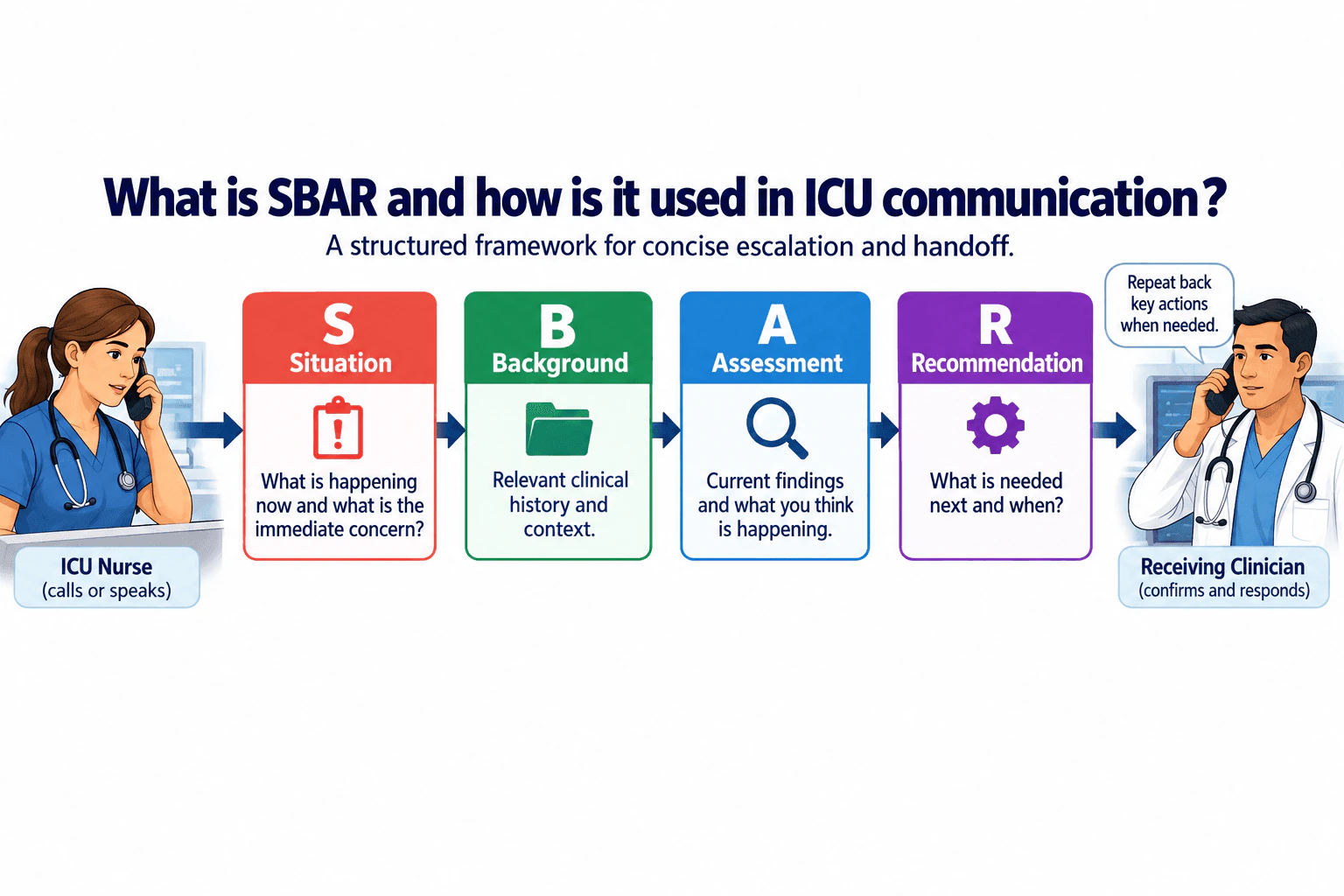
62. What is SBAR and how is it used in ICU communication?Documentation And Care CoordinationEasy
i Question Details
Define situation, background, assessment, and recommendation as a structured communication framework for concise escalation and handoff.
Short Interview Answer (30-60 seconds)
SBAR stands for Situation, Background, Assessment, and Recommendation. In the ICU, I use it to structure escalation or handoff. I state what is happening now and the immediate concern, provide the relevant clinical history and context, communicate the current findings and what I think is happening, and then state what is needed next and when. The receiving clinician confirms and responds, and I repeat back key actions when needed.
Detailed Explanation
SBAR is a structured framework for concise escalation and handoff. It gives the nurse and receiving clinician a shared sequence for communicating the information that matters most.
Situation answers what is happening now and what the immediate concern is.
Background provides the relevant clinical history and context needed to understand the concern.
Assessment communicates the current findings and what the nurse thinks is happening based on those findings.
Recommendation states what is needed next and when. The receiving clinician then confirms and responds. When needed, the nurse repeats back key actions to verify understanding.
Useful Questions to Ask the Interviewer
How is SBAR used for escalation and handoff in your ICU?
How does your team confirm important instructions during urgent communication?
What information does your unit expect nurses to prioritize when contacting a receiving clinician?
How to Explain It in an Interview
I would describe SBAR as a simple sequence that helps me keep ICU communication focused. I start with Situation so the receiving clinician immediately understands why I am communicating and what the immediate concern is. I then provide only the Background that is relevant to that concern.
For Assessment, I communicate the current findings and clearly state what I think may be happening without presenting an assumption as a confirmed fact. For Recommendation, I state what is needed next and when that response is needed.
For example, if I am escalating a change in condition, I would organize the communication around the current concern, the relevant clinical context, my current findings and assessment, and the response I am requesting. I would listen to the receiving clinician's response and repeat back key actions when needed so that we share the same understanding.
Why Interviewers Ask This
Interviewers want to know whether the nurse can organize important clinical information, identify the immediate concern, separate relevant background from unnecessary detail, communicate an assessment clearly, and state what response is needed. In critical care, SBAR demonstrates focused communication during escalation and handoff.
Common interview mistakes
Common mistakes include giving extensive background before stating the immediate concern, reporting findings without communicating an assessment, failing to state what is needed next, and assuming that important instructions were understood without appropriate confirmation.
Interview tip
Explain SBAR in the same order you would use it clinically: current concern, relevant context, current findings and assessment, then the needed response. Keep the example concise and show that important actions are confirmed when needed.
Interviewer may ask next
How do you verify that an important SBAR message was understood?
I listen to the receiving clinician's response, clarify anything that is ambiguous, and repeat back key actions when needed so both of us have the same understanding of the next steps.
How would your SBAR change if the patient's clinical context changed?
I would update the Situation to reflect the new immediate concern, include only Background relevant to that change, report the newest Assessment findings and what I think is happening, and revise the Recommendation to state what response is now needed and when.
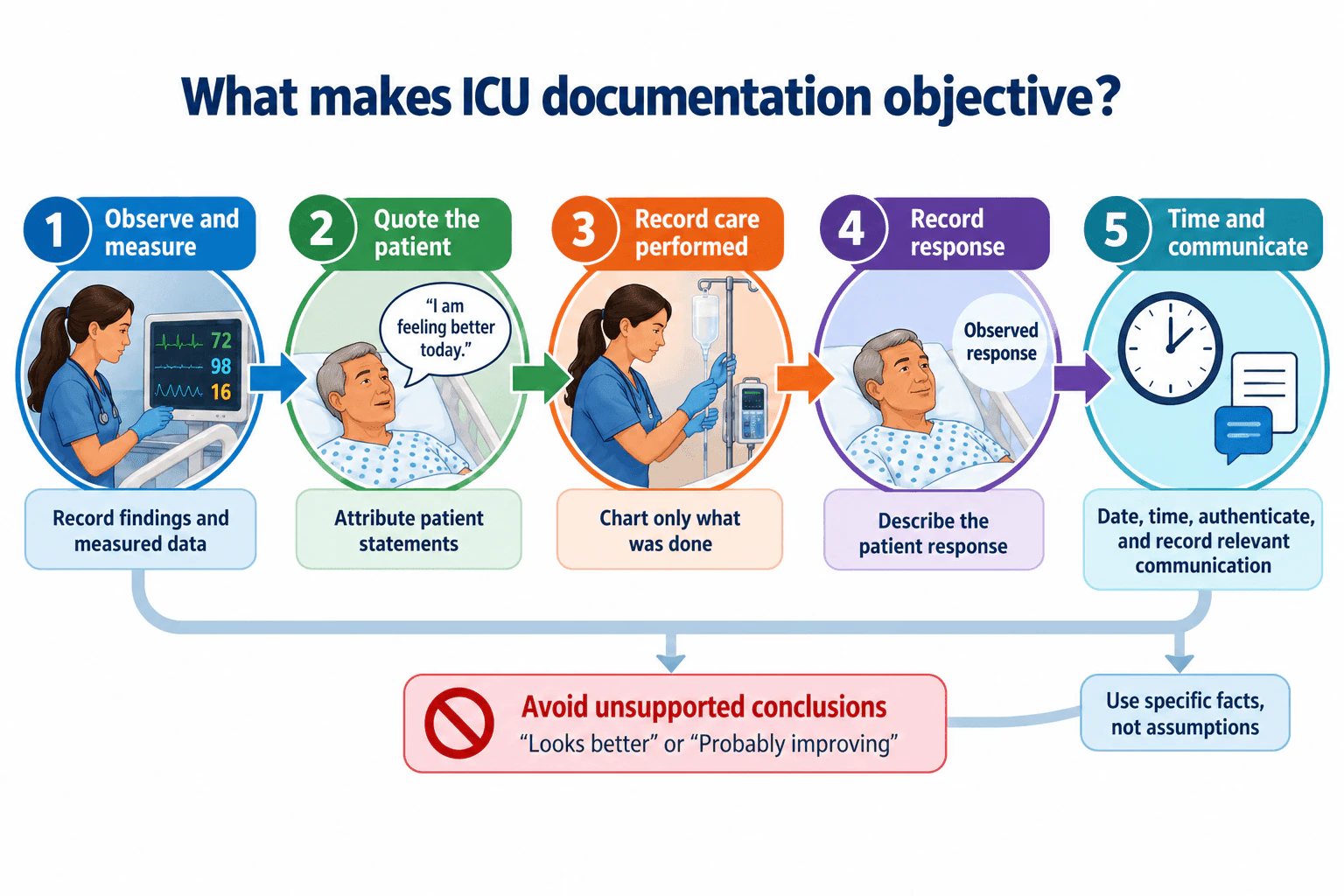
63. What makes ICU documentation objective?Documentation And Care CoordinationEasy
i Question Details
Describe charting observable findings, measured data, patient statements, care performed, response, communication, and time without unsupported conclusions.
Short Interview Answer (30-60 seconds)
Objective ICU documentation uses specific facts rather than assumptions. I chart observable findings and measured data, attribute patient statements, record only care that was actually performed, describe the observed response, and document relevant communication with the correct date, time, and authentication. I avoid vague conclusions such as the patient looks better unless I document the specific findings that support that statement.
Detailed Explanation
Objective documentation means another clinician can understand what happened from the record without having to guess what the nurse meant. I distinguish what I observed or measured from what the patient reported. I also record only care that was actually performed, the patient's observable response, relevant communication, and when the events occurred. Entries should be accurate, complete, timely, dated, timed, and authenticated according to applicable documentation requirements and organizational policy.
Useful Questions to Ask the Interviewer
What documentation practices are emphasized in this ICU?
How does the unit document important communication when a patient's condition changes?
What process does the organization use to correct a documentation error while preserving record integrity?
How to Explain It in an Interview
Observe and measure
I would begin with specific assessment findings and measured data. I would document what I actually observed or measured rather than substituting a conclusion. If a trend matters, I would include the relevant values or findings so another clinician can understand the change.
Attribute patient statements
A patient's statement represents information reported by the patient. I would clearly attribute it to the patient and use the patient's exact words when the wording is clinically important. That prevents a subjective statement from being presented as something I independently observed.
Record care performed
I would chart only care that was actually completed. I would not document an intervention in advance or imply that something occurred when it did not.
Describe the response
After care, I would record the observed response and relevant reassessment findings. I would avoid unsupported conclusions such as the patient looks better or is probably improving. Instead, I would document the specific facts that demonstrate the response.
Record time and communication
I would document relevant communication accurately and include the appropriate date, time, and authentication. This creates a clear sequence of events and helps the next clinician understand what information was communicated and when.
The central principle is to use specific facts rather than assumptions. The record should show what was observed, measured, reported, performed, reassessed, and communicated without adding conclusions that are not supported by the documented findings.
Why Interviewers Ask This
Interviewers are assessing whether the nurse can separate observed facts from assumptions, create an accurate clinical record, communicate clearly, and support continuity of care. In critical care, precise documentation of findings, interventions, responses, timing, and relevant communication helps other clinicians understand what occurred and how the patient responded.
Common interview mistakes
Common mistakes include using vague conclusions without supporting findings, presenting a patient statement as an independently observed fact, charting care before it is performed, omitting the observed response, failing to document relevant communication or timing, and changing an existing entry outside the approved correction process.
Interview tip
Use the same simple sequence shown in the diagram: what I observed or measured, what the patient reported, what care I actually performed, how the patient responded, and what relevant information I communicated and when. That keeps the answer focused on objective documentation.
Interviewer may ask next
How would you verify that your ICU documentation is objective before completing the entry?
I would reread the entry and check whether each statement is supported by something I observed, measured, heard directly from the patient, performed, reassessed, or communicated. I would verify measured information against the available record, clearly attribute patient statements, confirm that documented care was actually completed, and replace unsupported conclusions with specific findings.
How would your documentation change if the patient's condition changed after your initial entry?
I would make a new timely entry describing the new observable findings or measured data, the relevant assessment and care actually performed, the patient's observed response, and any relevant communication. I would not alter the earlier entry to make it appear that the later change was already known. If the earlier entry contained an error, I would use the approved correction process.
64. What is teach back in patient education?Documentation And Care CoordinationEasy
Short Interview Answer (30-60 seconds)
Teach back means asking a patient or family caregiver to explain important information or instructions in their own words after I have taught them. I use the response to check whether I explained the information clearly. If there is a misunderstanding, I explain it differently and ask again. Teach back is not a test of the patient. It is a way to verify the effectiveness of my communication.
Detailed Explanation
Teach back is a structured way to confirm understanding after patient education. Instead of asking only whether the patient understands, the nurse asks the patient or appropriate family caregiver to explain the important information or actions in their own words. If the response is incomplete or incorrect, the nurse explains the information differently and checks again.
Useful Questions to Ask the Interviewer
How does your ICU team coordinate patient and family education during transfers and discharge planning?
What resources are available when a patient needs language assistance or another form of communication support?
How does the team communicate important education needs across transitions of care?
How to Explain It in an Interview
Nursing Reasoning
I would explain that teach back checks whether my education was clear. Rather than asking only whether the patient understands, I provide a manageable amount of information and ask the patient to explain the important points or actions in their own words. This gives me direct information about what was understood and what needs clarification.
Patient Context And Checks
Before using teach back, I consider whether the patient can participate meaningfully. In an adult ICU, sedation, delirium, fatigue, illness severity, hearing or speech limitations, and language needs may affect communication. When appropriate, I involve a family caregiver and use qualified language assistance when the patient prefers another language.
I focus on information that matters to the current teaching goal, such as medication instructions, recovery needs, follow up, warning signs, or the plan for a transition of care. I ask the patient to explain the information in their own words rather than simply repeat my wording.
Rationale And Reassessment
If the patient cannot explain an important point correctly, I do not treat that as a failure by the patient. I clarify the information using simpler or different wording, address communication barriers when possible, and repeat teach back. This cycle continues until the necessary information is understood or the clinical situation limits further participation.
For example, after teaching about a recovery plan, I might ask the patient to explain what they will do after leaving the hospital and what changes should prompt them to seek help. Their response can reveal gaps that need clarification before the transition occurs.
The key idea is that teach back verifies the effectiveness of the education and gives the nurse an opportunity to correct misunderstandings before they affect care.
Why Interviewers Ask This
Interviewers want to know whether the nurse verifies understanding rather than assuming that a patient or family caregiver understood the teaching. In critical care, this demonstrates clear communication, patient centered education, recognition of barriers to learning, and attention to safe transitions of care.
Common interview mistakes
Common mistakes include asking only whether the patient understands, presenting teach back as a test, asking for simple repetition instead of explanation in the patient's own words, giving too much information before checking understanding, failing to clarify a misunderstanding, and documenting understanding that the patient has not demonstrated.
Interview tip
Describe teach back as a communication safety check. Explain that you teach a manageable amount of information, ask the patient to explain it in their own words, identify misunderstandings, clarify the teaching, and check again. For an ICU example, also mention assessing whether the patient can participate and using an appropriate caregiver or qualified language assistance when needed.
Interviewer may ask next
How do you verify that teach back was successful?
I listen for whether the patient can accurately explain the important information or actions in their own words. I do not rely only on agreement or a yes response. If an important point is missing or incorrect, I clarify it using different wording and ask for teach back again. I document the education and the patient's demonstrated response accurately according to the clinical record and local documentation requirements.
What changes if the ICU patient is sedated, delirious, or otherwise unable to participate meaningfully?
I recognize that reliable teach back may not be possible at that time and do not document understanding that has not been demonstrated. I continue appropriate communication, involve an appropriate family caregiver when suitable, use qualified language assistance when needed, and revisit education with the patient when the clinical condition allows meaningful participation.
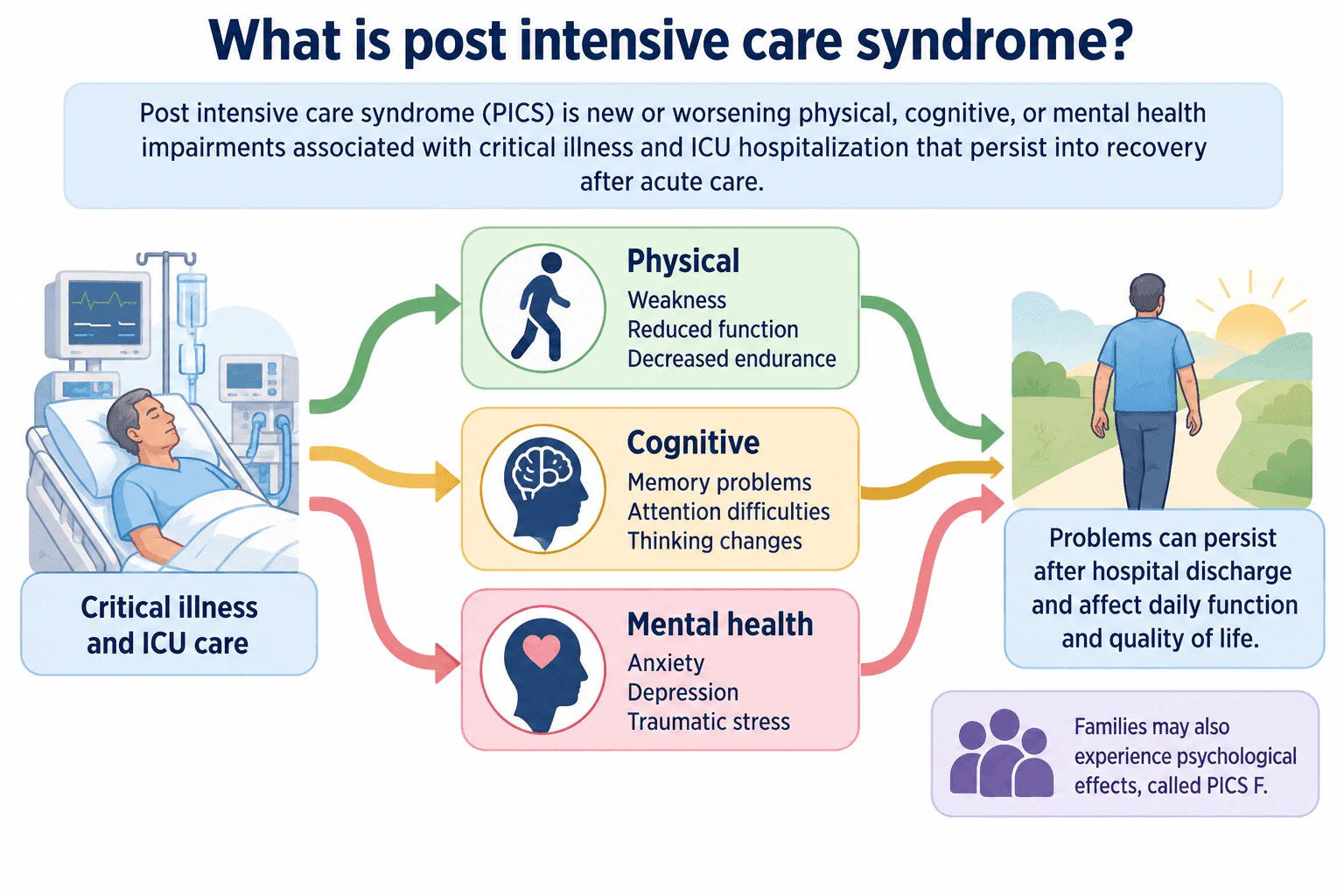
65. What is post intensive care syndrome?Documentation And Care CoordinationMedium
i Question Details
Describe new or worsening physical, cognitive, or mental health problems that can persist after critical illness and may affect patients and families during recovery.
Short Interview Answer (30-60 seconds)
Post intensive care syndrome, or PICS, is the development of new or worsening physical, cognitive, or mental health problems after critical illness. A patient may have weakness or reduced endurance, memory or attention problems, anxiety, depression, or traumatic stress. These effects can continue after discharge and interfere with daily function and quality of life. Families may also experience psychological effects, sometimes called PICS F.
Detailed Explanation
Post intensive care syndrome, or PICS, describes new or worsening problems in physical, cognitive, or mental health that arise after critical illness and may continue through recovery. It is an umbrella concept rather than a single symptom. A patient may experience one domain or several domains at the same time.
Useful Questions to Ask the Interviewer
How does your ICU identify patients who may need rehabilitation or post ICU follow up?
What resources are available for patients with physical, cognitive, or mental health recovery needs?
How are families included in education and recovery planning after critical illness?
How to Explain It in an Interview
I would explain PICS by grouping the effects into three main areas.
Physical problems can include weakness, reduced physical function, and decreased endurance. A patient who survived critical illness may therefore have difficulty returning immediately to previous activities or independence.
Cognitive problems can include impaired memory, attention, or thinking. These changes can affect activities such as managing medications, following instructions, returning to work, or completing daily tasks.
Mental health problems can include anxiety, depression, and traumatic stress. These symptoms can affect emotional recovery even when the original critical illness has improved.
An important point is that these problems can persist after hospital discharge and can reduce daily function and quality of life. Recovery may therefore require coordinated support from nursing, medical, rehabilitation, mental health, primary care, and other appropriate services based on the person's needs.
I would also recognize that critical illness can affect the family. Family members may experience anxiety, depression, traumatic stress, grief, or caregiver burden. These family effects are commonly described as PICS F.
As a bedside ICU nurse, my role includes recognizing recovery concerns within my scope, communicating relevant changes to the team, providing understandable education, involving the patient and family when appropriate, and supporting continuity of care. I would avoid assuming that every ICU survivor develops PICS because recovery patterns vary.
Why Interviewers Ask This
Interviewers want to know whether a critical care nurse understands that recovery does not end when a patient leaves the ICU. Recognizing PICS supports realistic education, interdisciplinary recovery planning, appropriate follow up, and communication with patients and families about possible physical, cognitive, and mental health needs.
Common interview mistakes
Common mistakes include treating PICS as only physical weakness, overlooking cognitive or mental health effects, assuming symptoms stop at hospital discharge, implying that every ICU survivor develops the syndrome, or forgetting that family members can experience significant psychological effects described as PICS F.
Interview tip
Give a simple definition first, then organize the explanation around the three domains shown in the diagram: physical, cognitive, and mental health. Finish by explaining that symptoms can persist into recovery, affect daily life and quality of life, and may also affect family members.
Interviewer may ask next
How would you verify whether a patient is experiencing problems consistent with post intensive care syndrome?
I would compare the patient's current physical function, cognition, and mental health with the previous baseline, gather relevant information from the patient and appropriate caregivers, document objective findings, and communicate concerns to the interdisciplinary team. Formal assessment should use appropriate clinical evaluation and validated tools when available rather than assuming that every new symptom is caused by PICS, because other medical, neurologic, psychiatric, or functional causes may need evaluation.
How would your approach change if the patient has left the ICU but still reports weakness, memory problems, and anxiety?
Those symptoms involve all three major PICS domains, so I would treat them as important recovery concerns rather than isolated complaints. In an appropriate clinical role, I would communicate the symptoms clearly, support assessment of their effect on daily function, reinforce follow up instructions, and help connect the patient with rehabilitation, medical, cognitive, or mental health resources as indicated by the care team and available services.
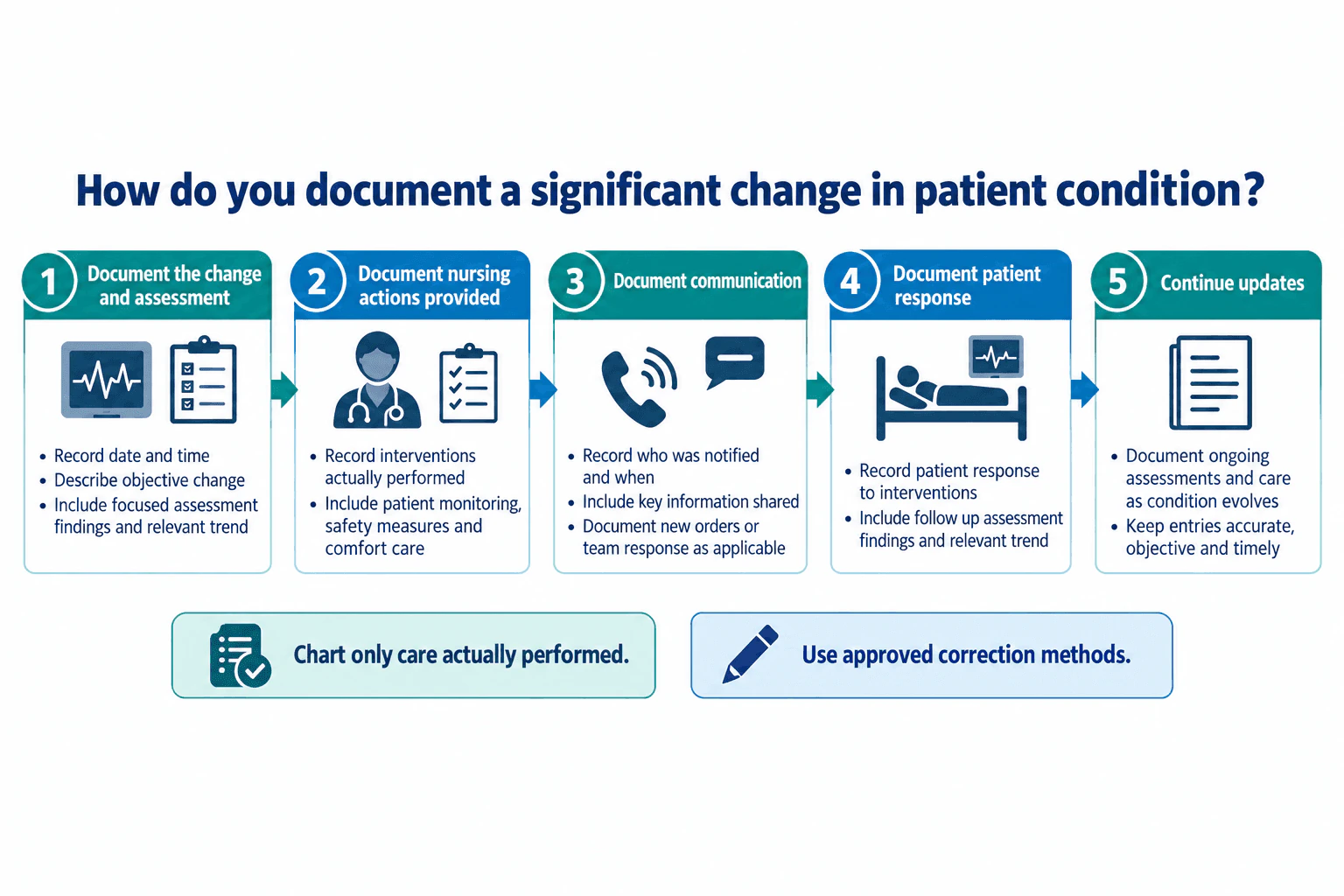
66. How do you document a significant change in patient condition?Documentation And Care CoordinationMedium
i Question Details
Record the objective change, time, assessment, nursing actions, notifications, orders or team response, and patient response without charting care that was not performed.
Short Interview Answer (30-60 seconds)
I document the date and time, the objective change from baseline, focused assessment findings and relevant trends, and the nursing actions I actually performed. I record who was notified and when, the key information communicated, any orders or team response, and the patient's response. Then I continue reassessment and update the chart as the condition evolves, keeping every entry accurate, objective, timely, and limited to care actually performed. I use the approved correction process if an entry needs to be amended.
Detailed Explanation
A significant change should be documented as a clear sequence of what changed, what I assessed, what I did, who I informed, what the team did next, and how the patient responded. The record should let another clinician understand the clinical course without guessing.
Useful Questions to Ask the Interviewer
What documentation and escalation process does this ICU use when a patient's condition changes significantly?
Which structured communication method does the unit use for urgent provider communication and handoff?
What is the approved process for correcting or amending an electronic health record entry?
How to Explain It in an Interview
Information to Record
I would first record the date and time and describe the objective change from the patient's prior condition. I would include focused assessment findings and relevant trends rather than vague statements. I would then document the nursing interventions I actually performed, such as monitoring, safety measures, or comfort care when applicable.
Communication and Team Response
I would document who I notified and when, along with the key information communicated. A structured method such as SBAR, meaning Situation, Background, Assessment, and Recommendation or Request, can help organize urgent communication. I would document new orders or another team response as applicable, while making clear that orders and medical decisions came from the appropriate authorized clinician rather than implying that I prescribed them.
Reassessment and Ongoing Documentation
After interventions or a team response, I would document the patient's response and relevant follow up assessment findings. I would continue updating the record as the patient's condition evolves so the documentation remains accurate, objective, and timely.
Documentation Boundaries
I would chart only care that was actually performed. I would not enter an intervention as completed simply because it was planned or expected. If documentation needs correction, I would use the organization's approved correction or amendment method so the record remains accurate and traceable. I would also protect patient privacy by limiting documentation and discussion to information needed for care.
Why Interviewers Ask This
Interviewers are assessing whether the nurse can recognize a meaningful change, create an accurate objective record, communicate the change promptly to the appropriate team member, distinguish nursing actions from orders or other team decisions, reassess the patient, and maintain continuity of care without documenting care that did not occur.
Common interview mistakes
Common mistakes include using vague language instead of objective findings, omitting the time of the change or notification, failing to document reassessment and patient response, recording an order or intervention without identifying the actual team response, charting care that was planned but not performed, delaying documentation unnecessarily, and changing an existing entry outside the approved correction process.
Interview tip
Answer in chronological order: objective change and focused assessment, nursing actions actually performed, communication and team response, patient response, then continued reassessment. This mirrors the clinical timeline and shows both safe documentation and care coordination.
Interviewer may ask next
How do you verify that your documentation accurately reflects what occurred?
I compare the entry with the assessment findings, monitoring data, interventions I actually performed, communication that occurred, orders or team response, and the patient's subsequent response. I verify times and relevant trends, avoid assumptions, and use the approved correction process if I discover an error rather than obscuring the original record.
What changes if the patient's condition is deteriorating rapidly?
Immediate assessment, bedside care, and escalation take priority. I communicate the urgent change promptly using the unit's established escalation pathway and a structured method such as SBAR when appropriate, then document the objective findings, nursing actions, notifications, team response, and patient response as soon as clinically feasible without delaying necessary care.
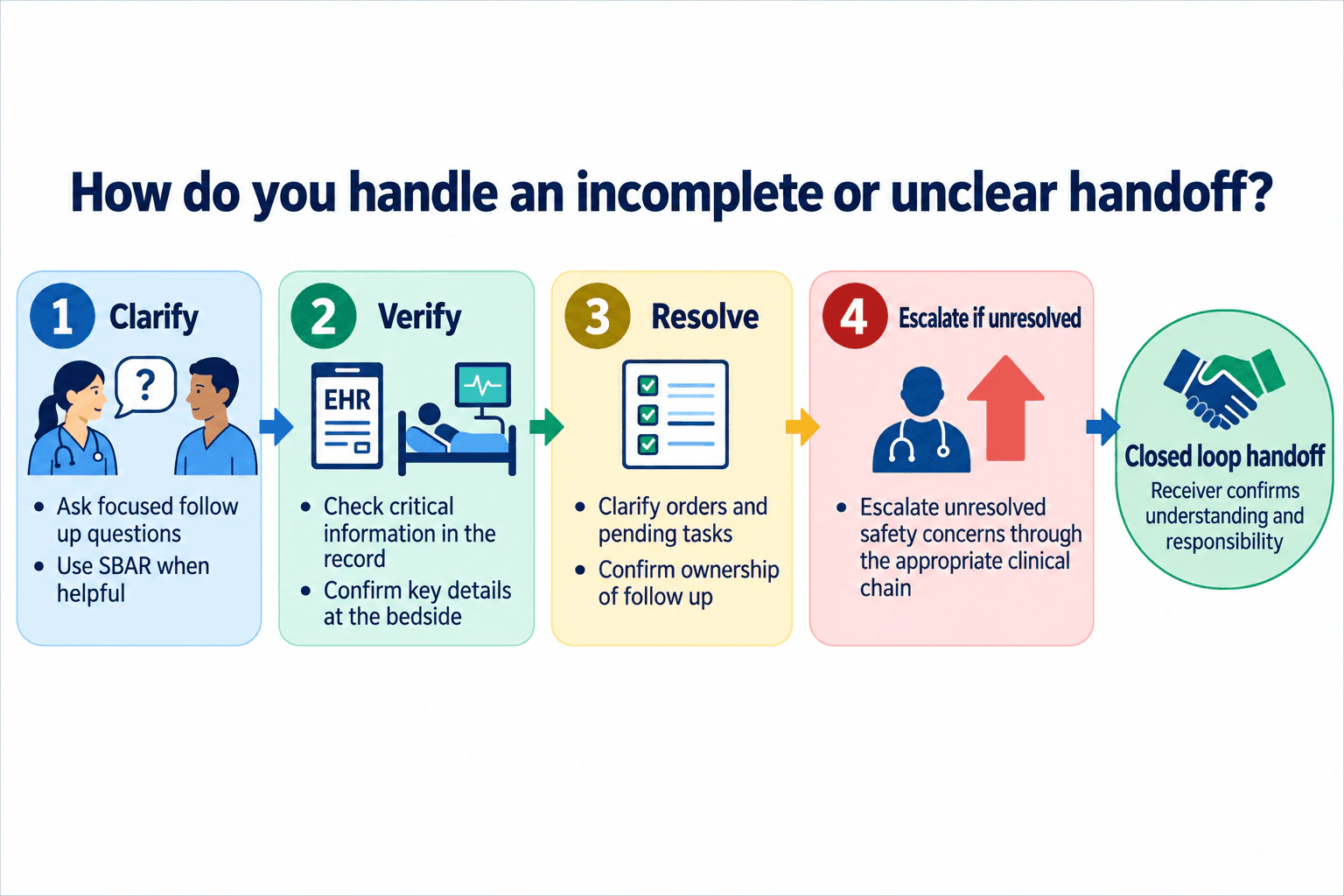
67. How do you handle an incomplete or unclear handoff?Documentation And Care CoordinationMedium
i Question Details
Ask focused follow up questions, verify critical information in the record and at the bedside, clarify orders and pending tasks, and escalate unresolved safety concerns.
Short Interview Answer (30-60 seconds)
I would clarify first rather than guess. I would ask focused follow up questions and use SBAR when helpful, verify critical information in the record and at the bedside, clarify orders and pending tasks, and confirm ownership of follow up. If an unresolved issue creates a safety concern, I would escalate it through the appropriate clinical chain. I would finish with closed loop communication so the receiver confirms understanding and responsibility. ahrq.gov
Detailed Explanation
An incomplete or unclear handoff can leave uncertainty about the patient's current status, pending work, the care plan, or who is responsible. I would actively resolve that uncertainty before treating the transfer of responsibility as complete. AHRQ describes effective handoff as including clear information, an opportunity for questions, clarification of ambiguity, transfer of responsibility, and acknowledgment by the receiver. ahrq.gov
Useful Questions to Ask the Interviewer
What structured handoff method does your ICU use?
How are unresolved handoff concerns escalated on this unit?
How does the team confirm ownership of pending tasks during transitions of care?
How to Explain It in an Interview
Clarify
I would start with focused follow up questions about anything missing, inconsistent, or unclear. I would use Situation, Background, Assessment, Recommendation, or SBAR, when it helps organize critical information and the needed response. AHRQ describes SBAR as a structured communication framework for sharing clinical information and concerns. ahrq.gov
Verify
I would compare the verbal handoff with critical information in the clinical record and with the patient's current bedside condition. If those sources do not agree, I would clarify the discrepancy with the appropriate clinician instead of choosing one source by assumption. AHRQ notes that electronic handoff information can support transitions but may be most effective when reinforced by direct communication. ahrq.gov
Resolve
I would clarify orders and pending tasks and establish who owns each follow up item. I would not independently create or change an order outside my nursing authority. Structured handoff methods also emphasize action lists, timelines, ownership, receiver synthesis, and questions. ahrq.gov
Escalate If Unresolved
If an unresolved issue creates a safety concern, I would escalate through the appropriate clinical chain while continuing necessary bedside care within my nursing scope. Escalation addresses the unresolved concern without substituting my judgment for an order or decision that requires another authorized professional.
Close the Loop
I would finish by confirming that the receiver understands the important information, pending responsibilities, and plan. AHRQ states that responsibility should not be considered transferred until the receiving party is aware of and acknowledges the handoff. ahrq.gov
Why Interviewers Ask This
Interviewers are evaluating whether the nurse recognizes ambiguity in a handoff as a patient safety risk and responds with disciplined communication rather than assumptions. The key judgment is whether the nurse can clarify missing information, verify important details, establish ownership of pending work, escalate unresolved safety concerns, and confirm that responsibility has actually transferred. These principles are consistent with AHRQ handoff guidance. ahrq.gov
Common interview mistakes
Common mistakes include guessing when information is missing, relying on an unclear handoff without verification, leaving ownership of pending tasks vague, failing to clarify discrepancies between the record and bedside findings, failing to escalate an unresolved safety concern, or ending the handoff without confirmation from the receiver. AHRQ handoff guidance emphasizes questions, clarification of ambiguity, responsibility transfer, and receiver acknowledgment. ahrq.gov
Interview tip
Present the response as the same clear sequence shown in the diagram: clarify, verify, resolve, escalate if unresolved, and close the loop. Emphasize that you do not guess about missing clinical information or task ownership and that you remain within bedside nursing scope.
Interviewer may ask next
How would you verify information if the verbal handoff does not match the clinical record?
I would compare the disputed information with the relevant clinical record and the patient's current bedside condition, then clarify the discrepancy directly with the appropriate clinician. I would not silently choose one source over another. If the discrepancy affects safety and remains unresolved, I would escalate it through the appropriate clinical chain. AHRQ handoff guidance supports direct clarification, opportunities for questions, and confirmation rather than assuming that information has been understood. ahrq.gov
What would you do if the patient's condition changed during the handoff?
I would prioritize the patient's immediate clinical needs, reassess within my nursing scope, and communicate the change promptly to the appropriate team members. I would then update the handoff so the receiver understands the current status, actions already taken, unresolved concerns, and remaining responsibilities. Before completing the transition, I would reconfirm understanding and ownership of follow up. SBAR can help organize communication when a patient's condition requires prompt attention. ahrq.gov
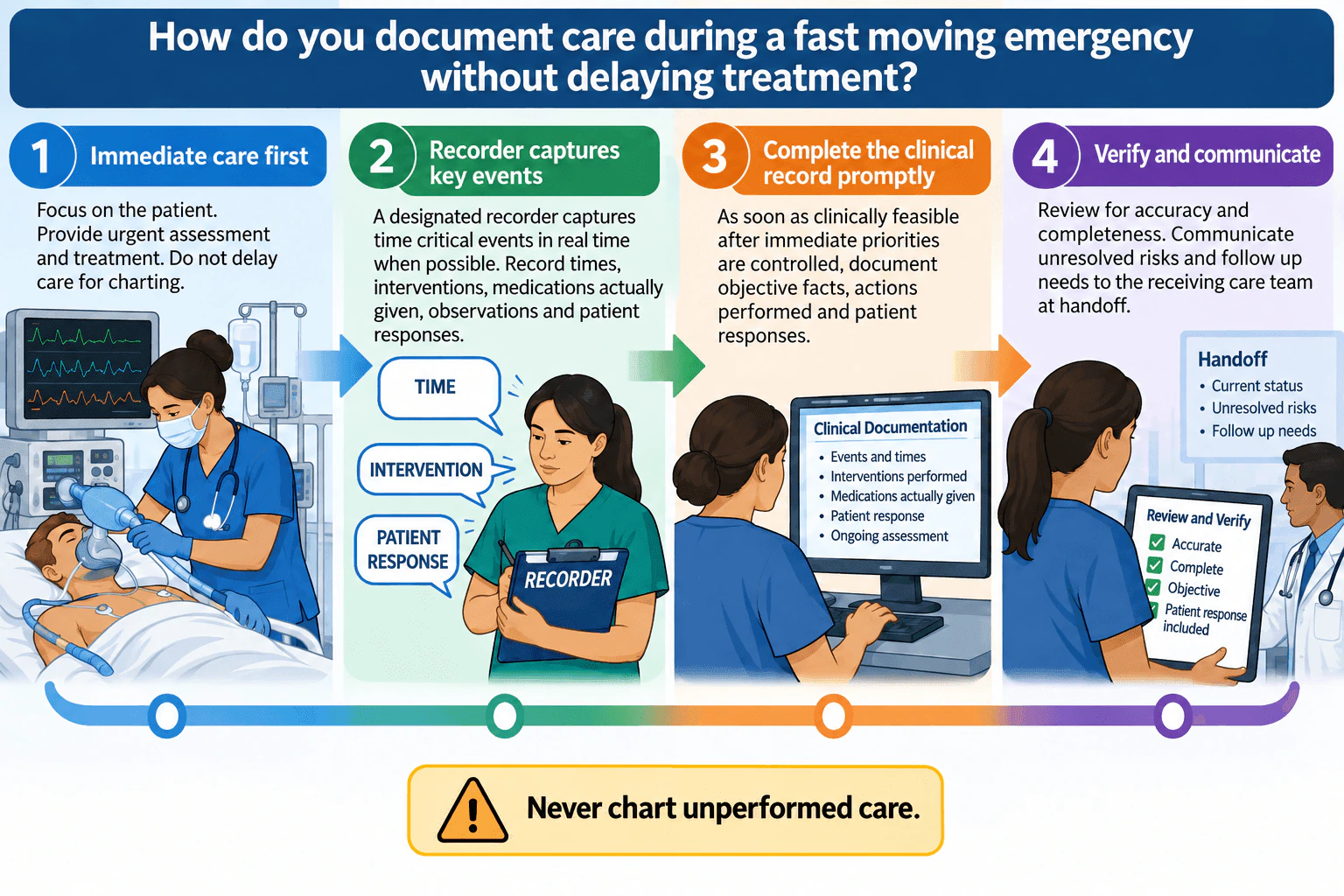
68. How do you document care during a fast moving emergency without delaying treatment?Documentation And Care CoordinationHard
i Question Details
Provide immediate care first, ensure time critical events are captured by the designated recorder when possible, then complete accurate objective documentation as soon as clinically feasible.
Short Interview Answer (30-60 seconds)
I treat the patient first and do not delay urgent care for documentation. When possible, a designated recorder captures event times, interventions, medications actually given, observations, and patient responses. As soon as clinically feasible, I complete accurate, objective documentation of what occurred. I review it for accuracy and completeness, then hand off the current status, unresolved risks, and follow up needs. I never chart care that was not performed.
Detailed Explanation
The central principle is that documentation must support emergency care rather than delay it. Clear and accurate nursing documentation is an essential part of safe practice, while organized emergency teams may assign a timer or recorder to capture the timing of interventions and medications. nursingworld.org
Useful Questions to Ask the Interviewer
What documentation process does your ICU use during rapidly evolving emergencies?
When is a designated recorder typically assigned during an emergency or resuscitation?
What handoff process does the unit use after an acute event?
How to Explain It in an Interview
Immediate care first
I would start by saying that immediate assessment and treatment take priority. I would not interrupt necessary bedside care simply to complete routine charting.
Capture key events
When possible, a designated recorder can document time critical events while care continues. I would want the record to capture event times, interventions performed, medications actually given, relevant observations, and the patient's response. American Heart Association team guidance includes a timer and recorder role that records the timing of interventions and medications, with roles adapted to local protocol. cpr.heart.org
Complete objective documentation
As soon as clinically feasible after the immediate priorities are controlled, I would complete the clinical record. I would document objective facts, actions actually performed, and patient responses. I would not chart an intervention or medication that did not occur. Clear and accurate documentation supports safe nursing practice. nursingworld.org
Verify and communicate
I would review the record for accuracy and completeness before the transition of responsibility. During handoff, I would communicate the patient's current status, important recent events, response to treatment, unresolved risks, and follow up needs. I would confirm that critical information was received and understood rather than assuming the written record alone is sufficient. AHRQ describes handoff as the transfer of information together with responsibility and emphasizes acknowledgment, clarification, and review. ahrq.gov
The sequence is simple: immediate care first, capture key events when possible, complete objective documentation as soon as clinically feasible, then verify and communicate.
Why Interviewers Ask This
Interviewers are evaluating whether I can protect patient safety during a rapidly changing emergency while maintaining an accurate clinical record and continuity of care. They want to hear that immediate treatment comes first, that a designated recorder can capture important events when available, that later documentation remains factual and objective, and that important information is verified and communicated during handoff.
Common interview mistakes
Common mistakes include delaying urgent treatment to complete charting, failing to capture key event times when a recorder is available, documenting medications or interventions that were planned but not actually performed, using vague or subjective wording instead of objective facts, omitting the patient's response, failing to review the record for accuracy and completeness, and handing off without communicating unresolved risks or follow up needs.
Interview tip
Use the same four step sequence shown in the emergency workflow: immediate care first, designated recording when possible, objective documentation as soon as clinically feasible, then verification and handoff. Emphasize that the clinical record contains only care that actually occurred.
Interviewer may ask next
How would you verify the documentation after the emergency?
I would review the available event record and my direct observations, confirm that documented times and interventions are consistent with the known sequence of events, verify that medications listed were actually given, and make sure patient responses are recorded accurately. If a correction or late entry is needed, I would use the organization's approved documentation process. I would also communicate unresolved risks and follow up responsibilities during handoff rather than assuming the record alone completes the transfer.
What changes if no designated recorder is available?
Immediate patient care still comes first. I would use any safe documentation support available without interrupting time critical treatment, then complete the objective clinical record as soon as clinically feasible. I would document only information I can support accurately and would not invent exact times, interventions, medications, or responses that I cannot verify. During handoff, I would communicate the current status, known recent events, unresolved risks, and follow up needs.
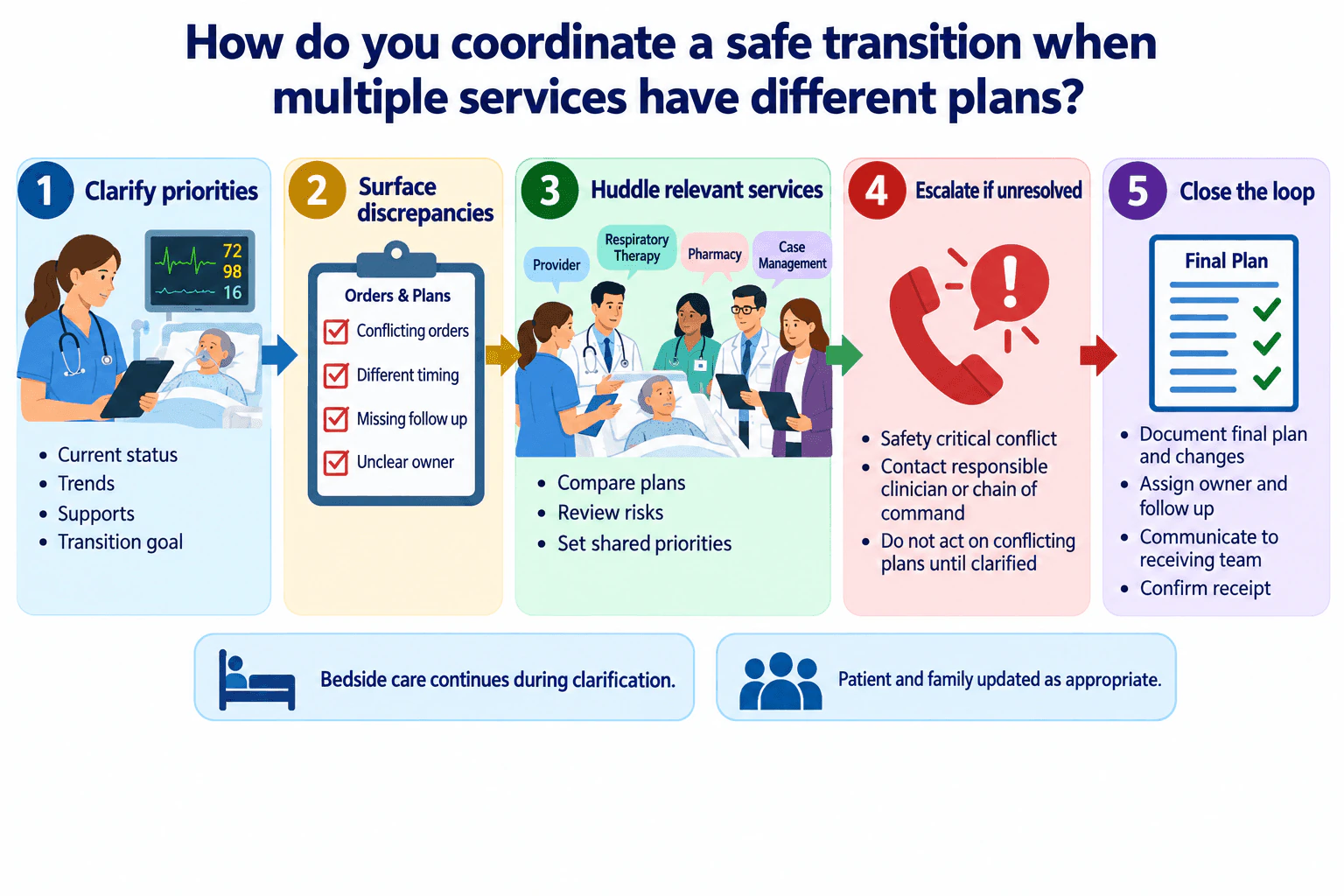
69. How do you coordinate a safe transition when multiple services have different plans?Documentation And Care CoordinationHard
i Question Details
Clarify the current agreed priorities, identify conflicting or incomplete orders, bring the relevant disciplines together, escalate unresolved discrepancies, and document the final plan and communication.
Short Interview Answer (30-60 seconds)
I first clarify the patient's current status, trends, supports, and transition goal. Then I identify the exact conflict, bring the relevant services together, and compare plans and risks so the team can set shared priorities. If the conflict remains safety critical, I escalate it to the responsible clinician or chain of command rather than independently choosing between conflicting plans. Necessary bedside care continues during clarification. Once the team agrees, I document the final plan and changes, assign follow up ownership, communicate the plan to the receiving team, confirm receipt, and update the patient and family as appropriate.
Detailed Explanation
A safe transition means turning several competing plans into one clearly understood plan without interrupting necessary bedside care. I would organize my approach around clarifying priorities, surfacing discrepancies, bringing the relevant services together, escalating unresolved safety conflicts, and closing the communication loop.
Useful Questions to Ask the Interviewer
What process does your ICU use when services disagree about a transition plan?
Which disciplines are usually included in transition huddles on this unit?
How does the receiving team confirm receipt of time sensitive transition information?
How to Explain It in an Interview
1. Clarify priorities
I first review the patient's current status, recent trends, supports, unresolved risks, and transition goal. This gives everyone the same starting point and helps distinguish immediate priorities from routine issues.
2. Surface discrepancies
Next, I identify the exact problem rather than simply saying that teams disagree. I look for conflicting orders, different timing, missing follow up, or unclear ownership. I keep the discussion objective and focused on what needs clarification.
3. Huddle relevant services
I bring together the services involved, such as the responsible provider, respiratory therapy, pharmacy, and case management when their plans affect the transition. I summarize the issue, compare the plans, review risks, and work toward shared priorities. When a structured handoff is helpful, I can use SBAR, meaning Situation, Background, Assessment, and Recommendation, to organize the communication.
4. Escalate if unresolved
If the disagreement remains safety critical, I contact the responsible clinician and use the appropriate chain of command when needed. I do not independently choose between conflicting plans when the decision requires another professional's direction. Necessary bedside care continues within nursing scope while clarification occurs.
5. Close the loop
Once the team agrees, I document the final plan and relevant changes accurately, identify who owns each follow up item, communicate the final plan to the receiving team, and confirm receipt. I also update the patient and family as appropriate so they understand the transition and next steps.
Why Interviewers Ask This
Interviewers ask this to assess whether you can protect patient safety when several disciplines have different plans. They want to see whether you can organize information, recognize conflicting or incomplete plans, involve the appropriate services, escalate unresolved safety concerns, maintain necessary bedside care during clarification, document objectively, assign follow up ownership, and close the communication loop without acting outside nursing scope.
Common interview mistakes
Common mistakes include giving a vague report instead of identifying the exact discrepancy, assuming another team member will resolve the conflict, independently choosing between conflicting plans, failing to escalate a safety critical disagreement, allowing clarification to interrupt necessary bedside care, failing to assign follow up ownership, documenting a plan that has not been agreed, assuming the receiving team understood without confirmation, and failing to update the patient and family when appropriate.
Interview tip
Give the answer as a controlled sequence: clarify priorities, surface discrepancies, huddle the relevant services, escalate unresolved safety conflicts, and close the loop. State that necessary bedside care continues during clarification and that you confirm receipt of the final plan rather than assuming communication was successful.
Interviewer may ask next
How do you verify that the receiving team understood the final transition plan?
I use closed loop communication. I state the agreed plan, pending actions, timing, and ownership, then ask the receiving team to confirm the key points, especially anything time sensitive or safety critical. If their understanding does not match the agreed plan, I clarify it immediately and document the final communication.
What would you do if the patient's condition changed while the services were still resolving their different plans?
The new clinical change becomes the immediate priority. I reassess the patient, continue appropriate nursing actions within scope, communicate the change promptly to the responsible clinician, and escalate urgent concerns as needed. I keep necessary bedside care moving, then return to the transition discussion so the revised plan, ownership, documentation, and receiving team communication reflect the patient's current condition.
70. What is delegation in nursing?Prioritization And DelegationEasy
Short Interview Answer (30-60 seconds)
Delegation means directing a qualified team member to perform a specific task or activity that is appropriate for that person and clinical situation. I would consider the patient's condition, the nature of the task, applicable scope and policy, and the person's demonstrated competence. I would give clear directions, explain what information must be reported, provide appropriate supervision, and evaluate the result. I would not delegate nursing assessment or nursing judgment to assistive personnel.
Detailed Explanation
Delegation in nursing means directing another qualified person to perform a specific nursing task or activity. It does not mean transferring the nurse's responsibility to assess the patient, use nursing judgment, or oversee the plan of care. In the United States, the exact authority to delegate depends on the applicable nurse practice act, regulations, organizational policy, patient circumstances, and competence of the person receiving the activity. Current ANA and NCSBN guidance describes delegation as a process that requires judgment about patient condition, team competence, and the degree of supervision needed.
Useful Questions to Ask the Interviewer
How are delegation responsibilities defined for registered nurses, licensed practical or vocational nurses, and unlicensed assistive personnel in this ICU?
What resource should nurses use when they are uncertain whether an activity may be delegated or whether a team member has demonstrated competence?
How does the unit support supervision and follow up when patient acuity or staffing needs change?
How to Explain It in an Interview
Nursing Reasoning
I think of delegation as a clinical judgment process rather than simply dividing the workload. I first consider the patient's acuity, stability, and predictability and identify the specific task or activity that needs to be completed. I then confirm that delegation is permitted and appropriate for the person who would perform it.
Patient Context And Checks
I use the five rights of delegation: right task, right circumstance, right person, right directions and communication, and right supervision and evaluation. I consider whether the delegatee has the knowledge and demonstrated competence for the activity and whether the required supervision is available.
For example, in an adult ICU, I may delegate an appropriate permitted support activity to competent unlicensed assistive personnel for a suitable patient. I would provide specific instructions about what to do, what information to collect, when to report it, and which changes require immediate communication. I would not delegate the nursing assessment or ask assistive personnel to interpret findings or make nursing decisions. If another patient requires a nursing assessment while resources are limited, I would seek an appropriately qualified licensed nurse to perform that assessment.
Rationale And Reassessment
Delegation does not end when I give the task. I remain available, supervise according to the patient and activity, review the information reported, and evaluate the outcome. If the patient's condition changes, I reassess whether the delegation remains appropriate and change the plan when necessary. This is especially important in critical care because stability and priorities can change quickly.
I would also follow the applicable nurse practice act, regulations, and organizational policy because delegation authority and permitted activities vary among jurisdictions.
Why Interviewers Ask This
Interviewers ask this question to evaluate whether a nurse understands delegation as a patient safety and nursing judgment process rather than simply distributing work. In critical care, safe delegation requires attention to patient acuity and stability, the predictability of the activity, staff competence, permitted scope, communication, supervision, and follow up. It also tests whether the candidate recognizes that nursing assessment and judgment should not be transferred to assistive personnel.
Common interview mistakes
Common mistakes include treating delegation as simply distributing unwanted work, delegating without considering patient stability or staff competence, giving vague directions, failing to identify what information must be reported, failing to supervise and evaluate the outcome, and asking assistive personnel to perform nursing assessment or judgment. Another mistake is assuming that an activity permitted in one jurisdiction or organization is automatically permitted everywhere.
Interview tip
Explain delegation as a complete safety process. Start with the patient and the activity, confirm that delegation is permitted and that the person is competent, give clear directions, identify what must be reported, and finish with supervision and evaluation. For an ICU example, make clear that you would obtain an appropriately qualified licensed nurse for another patient's nursing assessment rather than transferring that assessment to assistive personnel.
Interviewer may ask next
How would you verify that a task or activity is appropriate to delegate?
I would verify the applicable nurse practice act and regulations, organizational policy, the person's permitted role, and demonstrated competence. I would also assess the patient's current condition, the predictability and risk of the activity, and whether appropriate supervision is available. If any part is uncertain, I would use the appropriate nursing leadership or regulatory resource before delegating rather than assuming the activity is permitted.
What would you do if the patient's condition changed after you delegated an activity?
I would reassess the patient and the appropriateness of the delegation. An activity that was reasonable for a stable and predictable situation may no longer be appropriate after a clinical change. I would obtain any needed nursing assessment, communicate with the team, modify or stop the delegated activity when appropriate, escalate clinical concerns according to the situation, and provide follow up. The delegatee should promptly communicate changes so the licensed nurse can reassess the patient and delegation decision.
More questions load as you scroll
Disclaimer: This interview guide is for educational and informational purposes only. It is designed to help readers prepare, but it does not guarantee any interview result, hiring decision, offer, or outcome. Interview questions, hiring criteria, and preferred answers can vary by employer, interviewer, industry, location, and time. All answers, examples, and explanations in this guide are suggested examples for interview preparation, not definitive answers or instructions for professional practice. They are based on research and judgment, are provided without warranties of any kind, and should be adapted to the question, role, and applicable laws and professional requirements. Diagrams are simplified illustrations intended to highlight the main concepts and their relationships; actual situations, systems, and practices may be more complex. Alternative approaches may be equally valid or better suited to a particular question, context, or interviewer. To the fullest extent permitted by applicable law, the contributors and publisher are not liable for decisions made, actions taken, or losses incurred based on this guide.
State Laws and Professional Responsibilities: Laws and requirements governing an occupation vary by state and jurisdiction. You are responsible for checking the current laws, licensing requirements, and scope-of-practice rules that apply to your location and role, and for ensuring that your answers and actions comply with them. Adapt examples in this guide to those requirements. This guide is not legal advice.
Content Accuracy and Verification: To the fullest extent permitted by applicable law, we do not represent or warrant that interview guides, questions, answers, examples, or diagrams are accurate, complete, current, error-free, or suitable for any particular purpose. You are responsible for independently reviewing and verifying the information before relying on it.