This interview guide is for educational and informational purposes only. It is designed to help readers prepare, but it does not guarantee any interview result, hiring decision, offer, or outcome. Interview questions, hiring criteria, and preferred answers can vary by employer, interviewer, industry, location, and time. All answers, examples, and explanations in this guide are suggested examples for interview preparation, not definitive answers or instructions for professional practice. They are based on research and judgment, are provided without warranties of any kind, and should be adapted to the question, role, and applicable laws and professional requirements. Diagrams are simplified illustrations intended to highlight the main concepts and their relationships; actual situations, systems, and practices may be more complex. Alternative approaches may be equally valid or better suited to a particular question, context, or interviewer. To the fullest extent permitted by applicable law, the contributors and publisher are not liable for decisions made, actions taken, or losses incurred based on this guide.
State Laws and Professional Responsibilities
Laws and requirements governing an occupation vary by state and jurisdiction. You are responsible for checking the current laws, licensing requirements, and scope-of-practice rules that apply to your location and role, and for ensuring that your answers and actions comply with them. Adapt examples in this guide to those requirements. This guide is not legal advice.
Identity, Image, and Privacy Notice
To respect individual privacy, some names, profile photographs, avatars, biographical details, and other identifying information displayed in this guide may be replaced with pseudonyms, licensed stock images, illustrative avatars, composite images, or representative descriptions. Unless a person is expressly identified as an actual contributor, a displayed name, image, or profile should not be understood as depicting or identifying a specific candidate, interviewer, employee, or other real individual. These representations are provided for editorial and illustrative purposes only and do not imply endorsement, employment, participation, or affiliation with this guide or any company mentioned in it. Any resemblance to an actual person is coincidental.
Company Notice
This guide is an independent educational resource and is not affiliated with, endorsed by, sponsored by, or approved by the company named in this guide. Company names identify reported interview experiences or the employer context of clearly labeled original practice exercises. Interview practices can change without notice, and inclusion of company-specific content does not mean these questions are official, complete, or guaranteed to be asked. To the fullest extent permitted by law, the author, contributors, and publisher are not responsible for outcomes related to use of this material.
Content Accuracy and Verification
To the fullest extent permitted by applicable law, we do not represent or warrant that interview guides, questions, answers, examples, or diagrams are accurate, complete, current, error-free, or suitable for any particular purpose. You are responsible for independently reviewing and verifying the information before relying on it.
Questions or comments?
Contact us for general questions, or share feedback, technical corrections, and comments with the community.
11. What is informed consent and what is the bedside nurse role in the process?Ethics And Family CommunicationEasy
i Question Details
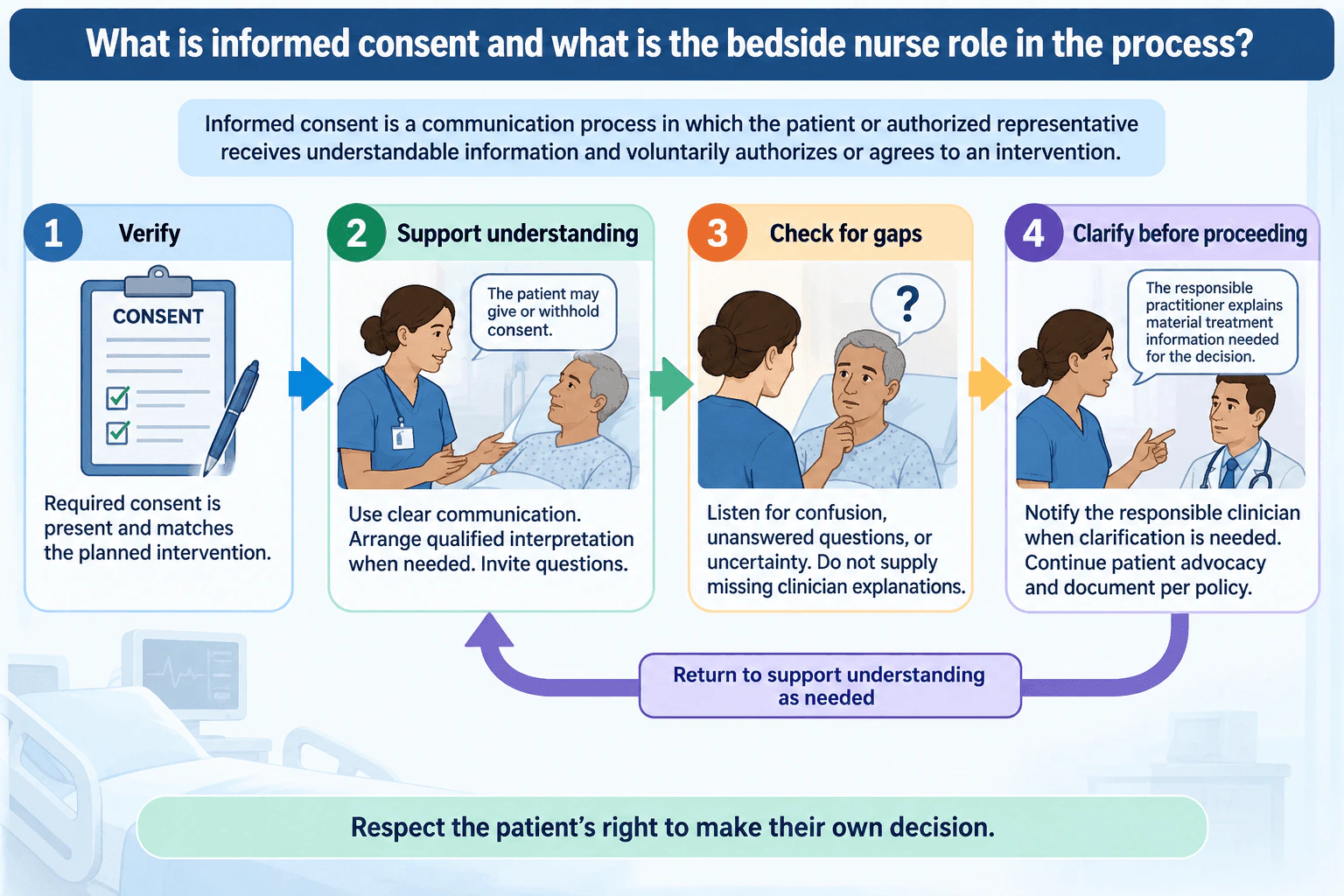
Describe verifying that required consent is present, supporting understanding, identifying unanswered questions, and notifying the responsible clinician when clarification is needed.
Short Interview Answer (30-60 seconds)
Informed consent means the patient or authorized representative receives understandable information and voluntarily agrees to or refuses an intervention. My bedside nurse role is to verify that required consent is present and matches the planned intervention, support understanding with clear communication, arrange qualified interpretation when needed, invite questions, and listen for confusion or unanswered questions. If clarification is needed, I notify the responsible clinician instead of supplying missing clinician explanations myself. I continue patient advocacy, return to support understanding as needed, and document according to policy.
Detailed Explanation
Informed consent is an ongoing communication process, not just a signed form. The patient, or an authorized representative when applicable, receives understandable information and makes a voluntary decision about the proposed intervention. In an adult ICU, the bedside nurse supports this process while the responsible clinician provides the material treatment information needed for the decision.
Useful Questions to Ask the Interviewer
How does your unit expect the bedside nurse to verify consent before a procedure?
What is the process for obtaining qualified interpretation when communication barriers are present?
How should the nurse escalate if the patient still has unanswered questions before the intervention?
How to Explain It in an Interview
Verify
I confirm that required consent is present and matches the planned intervention. I also follow the required patient and procedure verification process before care proceeds.
Support understanding
I use clear communication, invite questions, and arrange qualified interpretation when needed. The patient may give or withhold consent. My role is to support understanding, not to replace the responsible clinician's explanation of material treatment information.
Check for gaps
I listen for confusion, uncertainty, or unanswered questions. A signed form does not by itself establish that the patient understands. If the patient seems unsure or says important information is missing, I identify that gap and seek clarification.
Clarify before proceeding
I notify the responsible clinician when clarification is needed. The responsible clinician explains the material treatment information needed for the decision. I do not supply missing clinician explanations myself. I continue patient advocacy and document according to applicable law and organizational policy.
Return to support understanding
After clarification, I return to supporting the patient's understanding as needed. The central principle is respect for the patient's right to make their own decision.
If the patient cannot make the decision personally, the appropriate authorized representative and applicable jurisdictional requirements must be identified. Communication difficulty, family disagreement, delirium, or mechanical ventilation alone should not be treated as automatic proof that the patient lacks decision making capacity. The bedside nurse does not independently establish prognosis, authorize withdrawal of support, or independently determine legal decision making authority.
Why Interviewers Ask This
Interviewers want to see whether you understand informed consent as a communication process rather than only a signature. They are assessing whether you can protect patient autonomy, recognize the limits of the bedside nurse role, support understanding, identify gaps, and appropriately involve the responsible clinician when clarification is needed.
Common interview mistakes
Common mistakes include treating a signature as the whole consent process, failing to verify that the consent matches the planned intervention, using unclear communication, not arranging qualified interpretation when needed, supplying explanations that should come from the responsible clinician, overlooking confusion or unanswered questions, assuming a communication barrier proves incapacity, and ignoring a patient's decision to withhold consent.
Interview tip
Describe the bedside role as a simple sequence that matches clinical workflow: verify, support understanding, check for gaps, and clarify before proceeding. Emphasize the patient's right to give or withhold consent, continued patient advocacy, and the distinction between supporting the consent process and replacing the responsible clinician's explanation.
Interviewer may ask next
How would you verify informed consent before a procedure?
I would confirm that the required consent is present and matches the planned intervention, then complete the required patient and procedure verification steps. I would also listen for any new confusion, uncertainty, unanswered questions, or indication that the patient no longer wants to proceed. If clarification is needed, I would notify the responsible clinician and support the patient rather than relying on the signed form alone.
What changes if the patient has delirium, mechanical ventilation, or another new communication challenge?
I would first identify the communication barrier and support communication with appropriate methods, such as simple language, communication aids, or qualified interpretation when relevant. I would not assume that delirium, mechanical ventilation, or difficulty speaking automatically proves loss of decision making capacity. If the patient cannot make the decision personally after the appropriate clinical assessment, the team must identify the authorized representative under applicable law, advance directives, and organizational policy. My bedside role remains to advocate for known patient preferences, identify unanswered questions, notify the responsible clinician when clarification is needed, and document the process.
12. What is palliative care?Ethics And Family CommunicationEasy
Short Interview Answer (30-60 seconds)
Palliative care is specialized care for a person with a serious illness that focuses on improving quality of life and relieving symptoms and suffering. It can address physical, psychological, social, spiritual, communication, and family needs. It can be provided at the same time as disease directed or potentially curative treatment, so it is not the same as hospice or automatically limited to the end of life. In the ICU, the nurse supports symptom assessment, patient preferences, communication, advocacy, family engagement, and coordination with the appropriate clinical team.
Detailed Explanation
Palliative care focuses on helping a person with serious illness live as comfortably and meaningfully as possible. It addresses symptoms and suffering while also supporting psychological, social, spiritual, communication, and family needs. It can begin while disease directed or potentially curative treatment continues and may remain appropriate through the end of life.
For an adult bedside ICU nurse in the United States, the nursing role includes assessing and reporting symptoms and distress, providing nursing comfort measures within scope and the care plan, advocating for the patient's expressed preferences, supporting communication, and coordinating with the appropriate clinicians and palliative care professionals. The nurse does not independently establish prognosis or authorize withdrawal of life sustaining treatment.
Useful Questions to Ask the Interviewer
How is the palliative care team involved with ICU patients and families in this organization?
What resources are available when patients, families, and clinicians need additional support with goals of care discussions?
How should nurses escalate unresolved concerns about symptoms, patient preferences, consent, or family communication?
How to Explain It in an Interview
Patient Preferences and Consent
Palliative care should remain centered on the patient's goals, values, and preferences. When the patient has decision making capacity, the patient's informed choices guide decisions about care. Capacity is decision specific and should not be assumed absent simply because family members disagree with the patient or with each other. If capacity is uncertain, I would report the concern so the appropriate clinician can evaluate it. If a surrogate decision maker is needed, the appropriate person should be identified according to applicable law and organizational policy.
Communication and Advocacy
I would explain what I know in clear language, use qualified interpretation when language assistance is needed, and avoid promises about prognosis or outcomes. I would communicate the patient's stated preferences and concerns to the interdisciplinary team. If there is unresolved conflict about goals, consent, or the decision maker, I would escalate through the responsible clinical team and appropriate palliative care or ethics resources.
End of Life Support
Palliative care is not the same as hospice and does not automatically mean treatment is stopping. It can accompany intensive treatment. If care later shifts toward the end of life, palliative care can continue to support symptom relief, dignity, communication, emotional and spiritual needs, and the patient's family. Decisions about limiting or withdrawing life sustaining treatment require the appropriate clinical, consent, legal, and organizational processes rather than an independent nursing decision.
Why Interviewers Ask This
Interviewers want to know whether a critical care nurse understands that palliative care is broader than end of life care and can support a patient while disease directed treatment continues. They are also assessing whether the nurse can recognize symptoms and distress, advocate for patient preferences, support informed communication, involve family appropriately, and escalate concerns through the interdisciplinary team without making decisions outside the nursing role.
Common interview mistakes
Common mistakes include describing palliative care as only end of life care, assuming that it requires stopping disease directed treatment, confusing palliative care with hospice, assuming that family disagreement establishes incapacity, or implying that the bedside nurse independently determines prognosis or authorizes withdrawal of life sustaining treatment.
Interview tip
Start with a clear definition and emphasize that palliative care can occur alongside active treatment. Then connect it to the ICU nursing role through symptom assessment, patient advocacy, informed communication, family support, and appropriate interdisciplinary consultation.
Interviewer may ask next
How would you verify that the plan of care reflects the patient's preferences?
I would speak with the patient when possible, verify the patient's expressed goals and preferences, review relevant advance care planning documentation available in the clinical record, and confirm who is authorized to make decisions if the patient cannot do so. I would compare that information with the current plan of care and communicate any discrepancy to the responsible clinical team. I would not assume that family disagreement means the patient lacks capacity. If capacity, consent, or the appropriate decision maker remains uncertain, I would escalate the concern through the responsible clinicians and appropriate ethics or palliative care resources according to applicable law and organizational policy.
How does your approach change if the patient is approaching the end of life?
The emphasis may increasingly focus on comfort, symptom relief, dignity, communication, emotional and spiritual support, and care that reflects the patient's goals and preferences. I would continue assessment, appropriate nursing comfort measures, advocacy, family communication, reassessment, and documentation. I would also communicate uncertainty without guarantees. Prognosis and decisions about limiting or withdrawing life sustaining treatment require the appropriate clinicians, informed consent process, authorized decision maker when needed, and applicable legal and organizational requirements rather than an independent nursing decision.
13. What is the nurse role in goals of care discussions?Ethics And Family CommunicationEasy
i Question Details
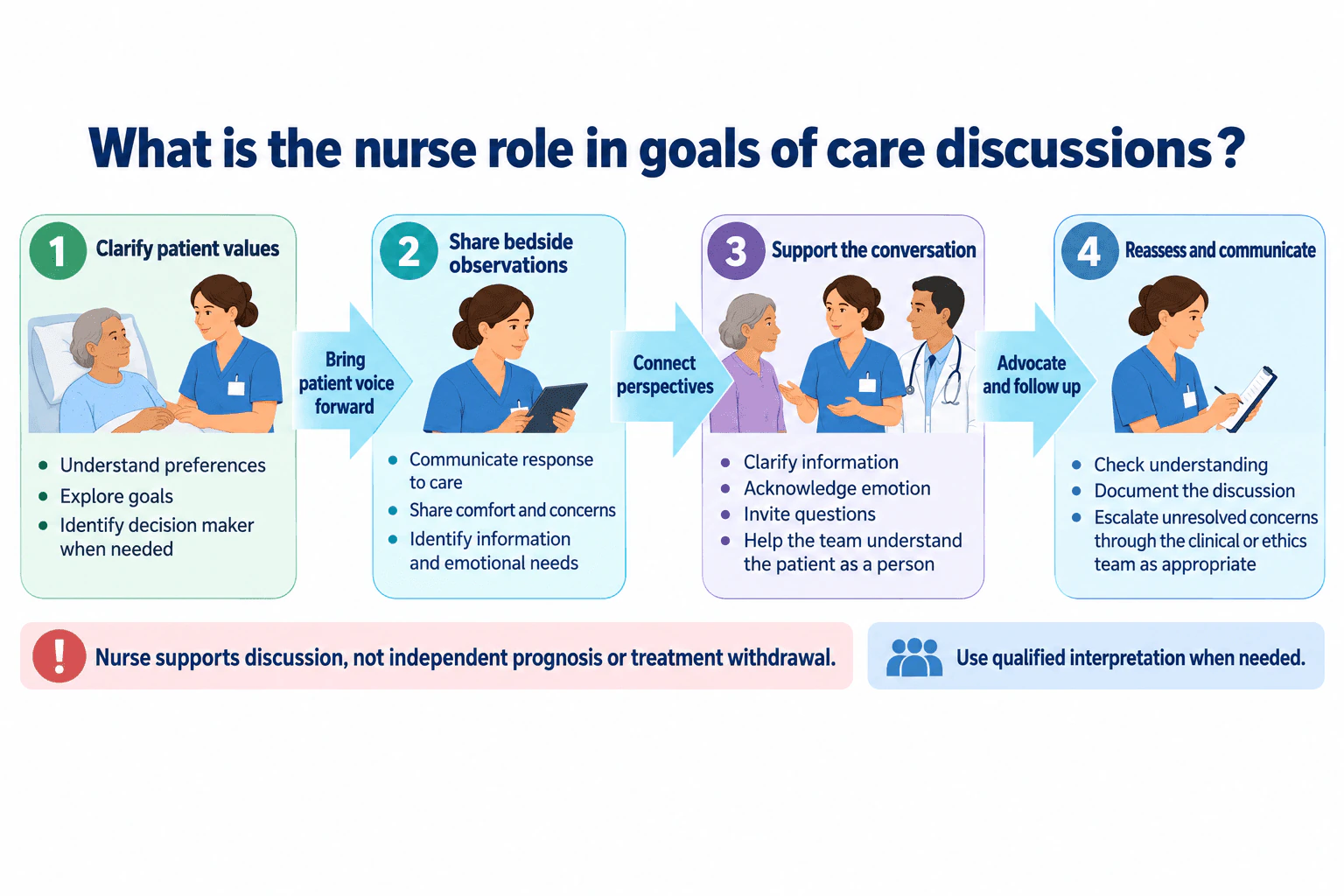
Explain how the nurse can clarify patient values, share bedside observations, support communication, and advocate for questions without independently determining prognosis or treatment withdrawal.
Short Interview Answer (30-60 seconds)
My role is to keep the discussion connected to the patient's values and what I am observing at the bedside. I clarify preferences and goals, communicate response to care, comfort, concerns, and information or emotional needs, help clarify information already provided, acknowledge emotion, invite questions, and help the team understand the patient as a person. I then check understanding, document the discussion, use qualified interpretation when needed, and escalate unresolved concerns through the clinical or ethics team as appropriate. I advocate for the patient, but I do not independently determine prognosis or authorize withdrawal of treatment.
Detailed Explanation
Goals of care discussions connect treatment decisions with what matters to the patient. The bedside nurse contributes a continuous view of the patient's preferences, response to care, comfort, concerns, questions, and communication needs while helping the patient, family, and clinical team understand one another.
Useful Questions to Ask the Interviewer
How are goals of care discussions usually coordinated among bedside nurses, physicians, and other team members in your ICU?
What resources are available when the appropriate decision maker is uncertain or an ethical concern remains unresolved?
How does the unit provide qualified interpretation when patients or families need language assistance?
How to Explain It in an Interview
Clarify patient values
I would begin by understanding the patient's preferences and goals and by identifying the appropriate decision maker when one is needed. Decision making capacity relates to the particular decision and should not be assumed absent simply because family members disagree with the patient. If the patient cannot make the relevant decision, I would help the team verify the designated or legally appropriate decision maker according to applicable law and policy. Consent for treatment must come through the appropriate patient or authorized decision maker and clinical process.
Share bedside observations
I would communicate what I am seeing at the bedside, including the patient's response to care, comfort, concerns, and information or emotional needs. These observations can help the team understand how the patient is experiencing care, but I would not present my own opinion as the patient's prognosis.
Support the conversation
I would clarify information already provided by the clinical team, acknowledge emotion, invite questions, and help the team understand the patient as a person. When language assistance is needed, I would use qualified interpretation according to available services and policy. I would explain uncertainty without making guarantees.
Reassess and communicate
After the discussion, I would check understanding, document relevant communication, and bring unresolved questions or concerns back to the appropriate clinician. If concerns remain unresolved, I would escalate through the clinical chain and ethics resources as appropriate.
The nurse's role is to bring the patient's voice forward, connect perspectives, advocate, and follow up. The nurse supports goals of care discussions but does not independently establish prognosis or authorize withdrawal of treatment.
Why Interviewers Ask This
Interviewers want to assess whether the nurse understands patient advocacy, goals of care, communication, consent, decision making capacity, professional scope, and collaboration in difficult conversations. A strong answer shows that the nurse can bring the patient's values and bedside observations into the discussion while recognizing that prognosis, formal capacity determinations, consent authority, and treatment decisions must be handled by the appropriate patient, decision maker, and clinicians within applicable law and policy.
Common interview mistakes
Common mistakes include speaking as though the nurse independently establishes prognosis, implying that the nurse can authorize withdrawal of treatment, assuming family disagreement proves that the patient lacks decision making capacity, treating any relative as the automatic decision maker, giving guarantees about outcomes, failing to use qualified interpretation when needed, or failing to escalate unresolved clinical or ethical concerns.
Interview tip
Organize your answer around the same four nursing actions shown in practice: clarify patient values, share bedside observations, support the conversation, and reassess and communicate. Emphasize that the nurse brings the patient's voice forward, connects perspectives, advocates, and follows up while remaining within nursing scope.
Interviewer may ask next
How would you verify who should make decisions if the patient cannot make a particular medical decision?
I would first check whether the patient previously designated a surrogate or other authorized decision maker and review available advance care planning documentation. If no designated person is available, I would work with the appropriate clinical team members to identify the legally appropriate decision maker under the applicable jurisdiction and organizational policy. If authority remains unclear or disagreement cannot be resolved, I would escalate through the appropriate clinical and ethics channels rather than deciding independently.
How would your approach change if the patient participated in the goals of care discussion but later lost decision making capacity?
I would continue to include the patient to the extent they can participate and communicate the preferences and goals they previously expressed. I would notify the appropriate clinician of the change and help verify the authorized decision maker according to applicable law and policy. The discussion would remain grounded in the patient's known values and preferences while I continue bedside observation, communication, documentation, family support, qualified interpretation when needed, and escalation of unresolved concerns.
14. How do you respond when a family asks for information that is outside your scope to interpret?Ethics And Family CommunicationMedium
i Question Details
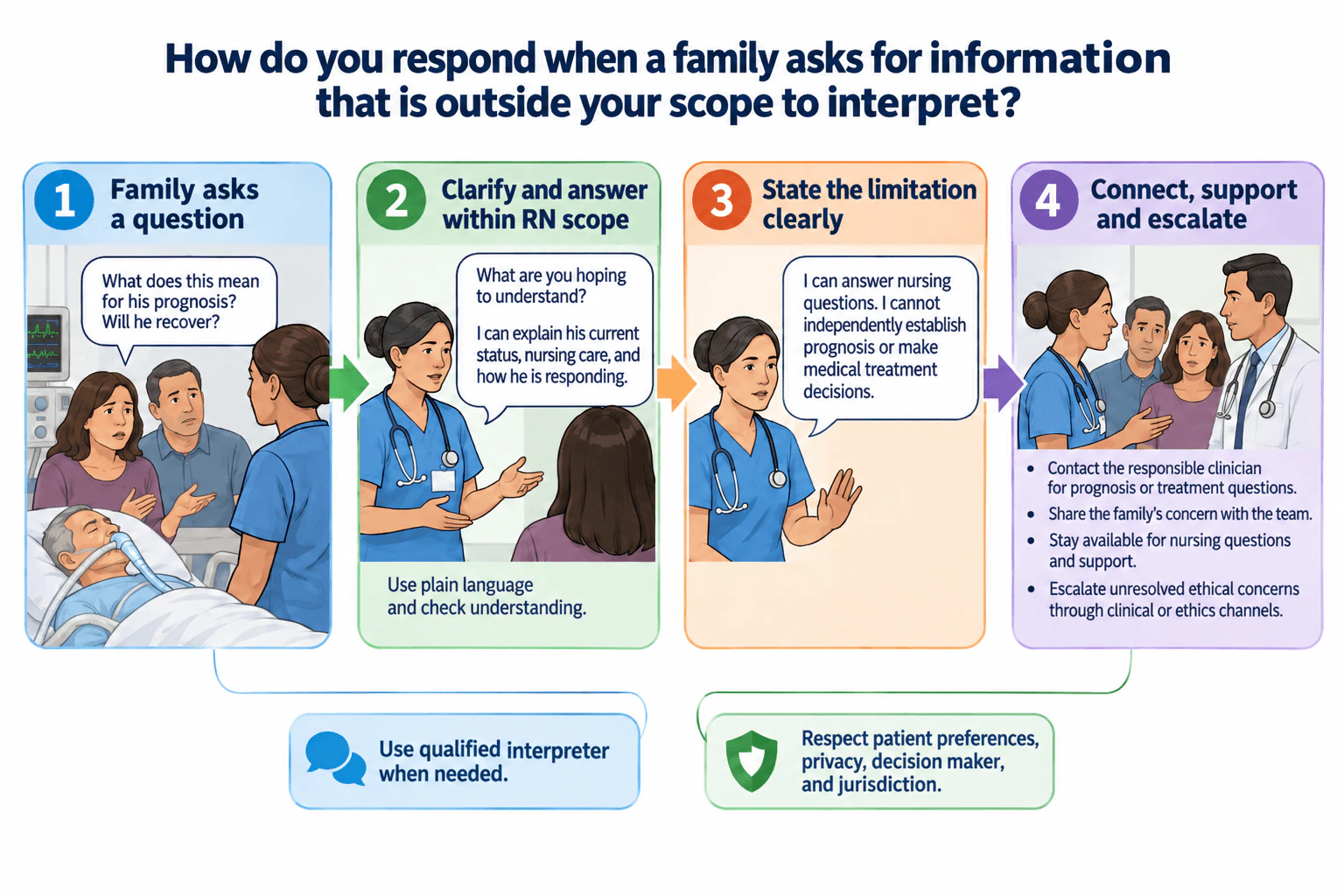
Explain how you answer nursing questions you can address, acknowledge the limitation, and arrange communication with the clinician responsible for prognosis or treatment decisions.
Short Interview Answer (30-60 seconds)
I clarify what the family is hoping to understand, then answer the nursing questions that are within my role, such as the patient's current status, nursing care, and response. If they ask me to independently establish prognosis or make a medical treatment decision, I explain that limitation clearly and do not guess. I contact the responsible clinician for those questions, share the concern with the team, and stay available for nursing questions and support. I also respect patient preferences, privacy, the appropriate decision maker, and use a qualified interpreter when needed.
Detailed Explanation
The key is to be helpful without interpreting information beyond the bedside nurse's role. I would clarify what the family is hoping to understand, answer nursing questions I can address, clearly state when a question requires the responsible clinician, and stay involved so the family is supported rather than simply redirected.
Useful Questions to Ask the Interviewer
How does your ICU coordinate family communication when prognosis or major treatment decisions need to be discussed?
What resources are available for qualified interpretation and ethics consultation?
How are the responsible clinician and appropriate decision maker identified for the bedside team?
How to Explain It in an Interview
Clarify the question
I would begin by asking what the family is hoping to understand. This helps identify what I can appropriately explain and what needs the responsible clinician.
Answer within nursing responsibilities
I can explain the patient's current status, nursing care, and how the patient is responding. I would use plain language, check understanding, and protect the patient's privacy and preferences.
State the limitation clearly
If the family asks whether the patient will recover, requests an independent prognosis, or asks me to make a medical treatment decision, I would explain that I can answer nursing questions but cannot independently establish prognosis or make that treatment decision. I would not guess or offer guarantees.
Connect the family with the responsible clinician
I would contact the responsible clinician for prognosis or treatment questions and share the family's concern with the care team. I would remain available for nursing questions, clarification within my role, and emotional support.
Respect communication and decision making needs
I would consider the patient's preferences, privacy, the appropriate decision maker, and the applicable jurisdiction. If language assistance is needed, I would use a qualified interpreter.
Escalate unresolved concerns
If an ethical concern remains unresolved, I would use the appropriate clinical or ethics channels. Family disagreement by itself does not establish that a patient lacks decision making capacity, and I would not independently authorize withdrawal of support or other major treatment decisions.
Why Interviewers Ask This
Interviewers are assessing whether the nurse can communicate honestly and compassionately while recognizing professional scope. They want to see that the nurse can clarify what the family needs, answer appropriate nursing questions, avoid independently establishing prognosis or making medical treatment decisions, protect patient preferences and privacy, involve the responsible clinician, support the family, and escalate unresolved ethical concerns appropriately.
Common interview mistakes
Common mistakes include guessing about prognosis, giving guarantees about recovery, presenting a personal interpretation as the treatment plan, answering beyond nursing responsibilities, simply dismissing the family instead of arranging communication with the responsible clinician, overlooking patient privacy or the appropriate decision maker, failing to use a qualified interpreter when needed, assuming family disagreement means the patient lacks capacity, or attempting to authorize withdrawal of support independently.
Interview tip
Use the same sequence you would use at the bedside: clarify what the family is hoping to understand, answer nursing questions within your role, state the limitation clearly, contact the responsible clinician for prognosis or treatment questions, share the concern with the team, and remain available for support. Mention patient preferences, privacy, the appropriate decision maker, qualified interpretation when needed, and escalation of unresolved ethical concerns.
Interviewer may ask next
How would you verify that the family understood the information you were able to provide?
I would use plain language, pause for questions, and ask the family to explain in their own words what they understand about the patient's current status and nursing care. I would correct misunderstandings that fall within my nursing role. If the remaining questions involve prognosis or treatment decisions, I would communicate those questions to the responsible clinician and help arrange that conversation.
What changes if the family is asking during an end of life discussion and there is disagreement about the plan?
I would continue to provide nursing information and emotional support while respecting the patient's preferences, privacy, and appropriate decision maker. I would communicate the disagreement to the responsible clinician and care team, use a qualified interpreter when needed, and avoid independently establishing prognosis or making treatment decisions. I would not assume that disagreement itself proves incapacity. If the concern remains unresolved, I would escalate through the appropriate clinical or ethics channels.
15. How would you respond when family members disagree about a patient care decision?Ethics And Family CommunicationMedium
i Question Details
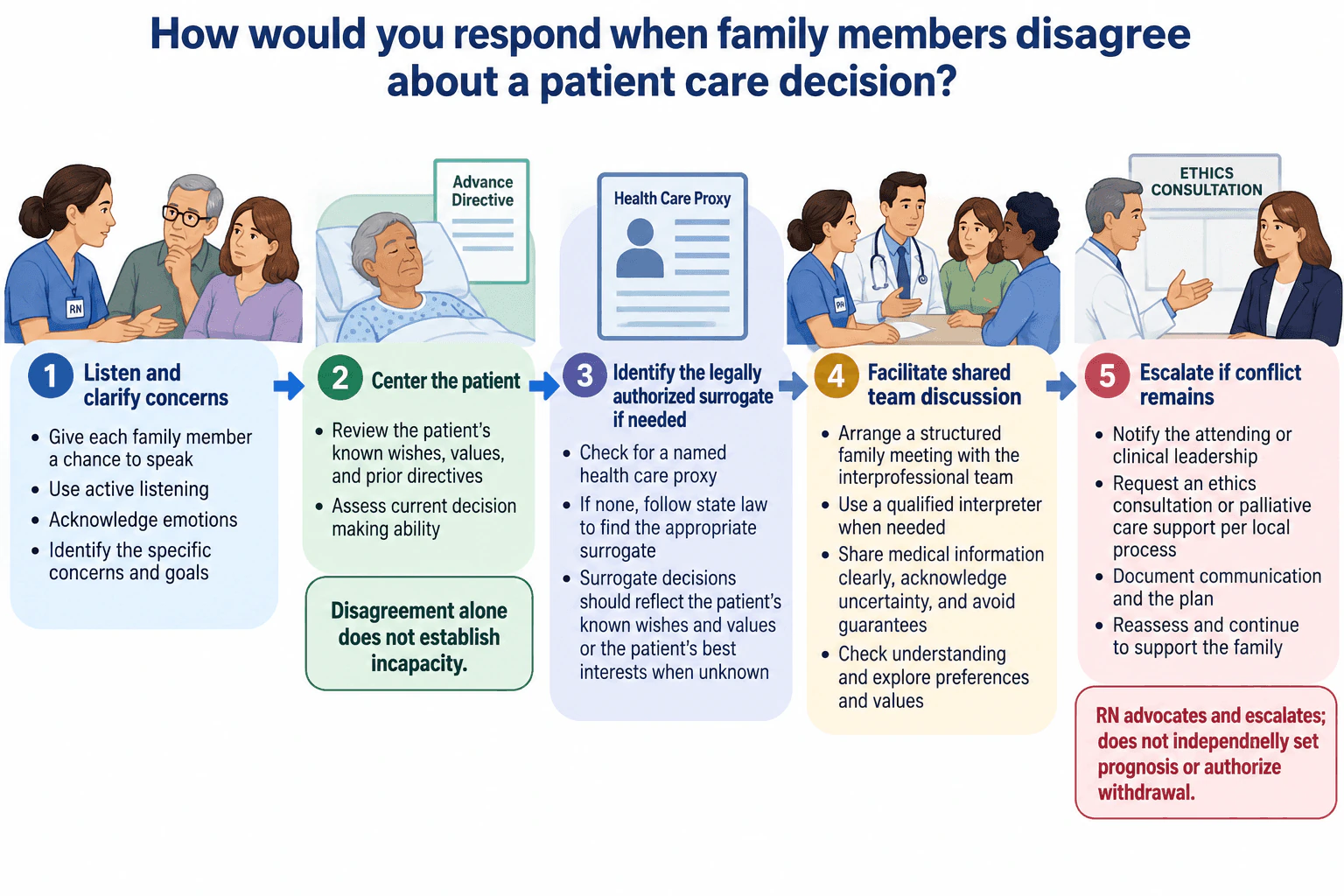
Describe listening to concerns, identifying the legally authorized decision maker when needed, clarifying known patient wishes, and escalating unresolved conflict to the appropriate team resources.
Short Interview Answer (30-60 seconds)
I would listen to each family member, clarify the disagreement, and bring the conversation back to the patient's known wishes, values, and goals. I would review any advance directive or health care proxy and, if needed, help identify the legally authorized surrogate according to the applicable jurisdiction and clarify who can participate in consent decisions. I would facilitate a structured discussion with the interdisciplinary team, use a qualified interpreter when needed, explain uncertainty clearly, and check understanding. If the disagreement remained unresolved, I would escalate to the attending clinician, clinical leadership, ethics, or palliative care support, document the plan, reassess, and continue supporting the family.
Detailed Explanation
My approach is to keep the decision centered on the patient while using clear communication, appropriate consent processes, patient advocacy, and timely escalation.
Useful Questions to Ask the Interviewer
How does this ICU identify the legally authorized surrogate when there is family disagreement?
When do nurses typically involve ethics or palliative care in difficult family discussions?
What interpreter resources are available for urgent goals of care conversations?
How to Explain It in an Interview
Listen and clarify concerns
I would start by giving each family member a chance to speak. I would use active listening, acknowledge emotions, and identify the exact point of disagreement and the goals each person is expressing.
Center the patient
Next, I would review the patient's known wishes, values, goals of care, and prior directives. I would assess for signs that the patient's current decision making ability may be impaired and communicate concerns to the responsible clinician. Family disagreement alone does not establish incapacity.
Identify the decision maker when needed
If the patient cannot make the decision, I would check for a named health care proxy or other legally authorized surrogate. If there is no named proxy, I would follow the applicable jurisdiction and organizational process to identify the appropriate surrogate. I would clarify who is authorized to participate in consent decisions. The surrogate should reflect the patient's known wishes and values, or the patient's best interests when those wishes are not known.
Facilitate a shared team discussion
I would help arrange a structured family meeting with the interdisciplinary team. I would communicate clearly, explain uncertainty without guarantees, check understanding, and use a qualified interpreter when needed. I would keep the conversation respectful and focused on the patient's preferences and goals of care.
Escalate and document
If conflict remains unresolved, I would notify the attending clinician or clinical leadership and request ethics or palliative care support through the local process. If the disagreement involves life sustaining treatment or end of life care, I would continue supporting the family while the responsible clinicians and authorized decision maker address the treatment decision. I would document the communication and agreed plan, reassess as the situation changes, and continue to support the family. As the RN, I advocate and escalate. I do not independently establish prognosis or authorize withdrawal of support.
Why Interviewers Ask This
Interviewers ask this to see whether you can manage conflict while protecting patient autonomy and maintaining professional boundaries. They want evidence that you can listen well, identify the appropriate decision maker, keep the discussion anchored to the patient's known wishes, support appropriate consent and goals of care discussions, communicate clearly with families and the team, and escalate unresolved conflict through the proper channels.
Common interview mistakes
Common mistakes include taking sides, focusing on the loudest family member instead of the patient, assuming disagreement means the patient lacks capacity, failing to check for a health care proxy or prior directive, treating an unauthorized relative as the decision maker, using unclear language, making guarantees about prognosis, skipping qualified interpreter support when needed, delaying escalation, or implying that the bedside nurse can independently establish prognosis or authorize withdrawal of support.
Interview tip
Answer this question as a five step sequence: listen and clarify concerns, center the patient, identify the legally authorized surrogate if needed, facilitate a shared team discussion, and escalate unresolved conflict. State clearly that your role is to advocate, communicate, support appropriate consent and goals of care discussions, document, reassess, and escalate while staying within RN scope.
Interviewer may ask next
What would you verify before accepting one family member as the decision maker?
I would verify whether the patient currently has decision making ability, whether a valid advance directive or health care proxy exists, who is recognized as the legally authorized surrogate under the applicable jurisdiction and organizational process, and whether that person is authorized to participate in the relevant consent decision. I would also review the patient's known wishes, values, and goals so the decision remains patient centered.
How would your approach change if the patient regained decision making ability during the disagreement?
If the patient regained decision making ability, I would shift the conversation back to the patient directly. I would make sure the patient received clear information, had the opportunity to express current wishes and goals, and that the team and family understood those wishes. I would continue supporting the family, but the patient's current informed decisions would guide the plan.
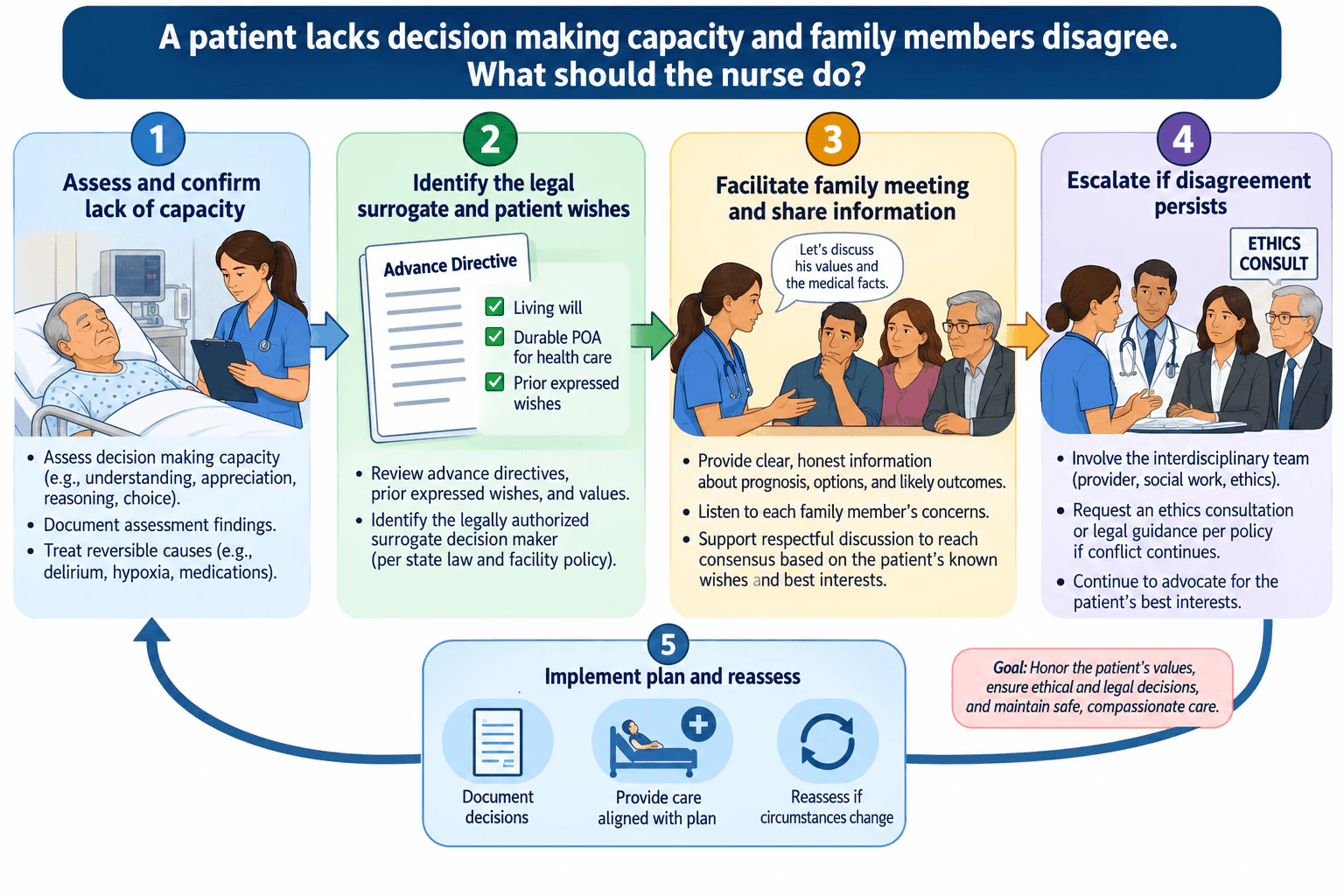
16. A patient lacks decision making capacity and family members disagree. What should the nurse do?Ethics And Family CommunicationHard
i Question Details
Explain how the nurse supports immediate care, identifies the authorized surrogate process, communicates known patient wishes, and involves leadership, ethics, or legal resources according to policy.
Short Interview Answer (30-60 seconds)
I would first maintain safe care and verify that the appropriate clinician has assessed and documented the patient's lack of decision making capacity. I would document my bedside observations and report reversible contributors such as delirium, hypoxia, or medication effects. I would then review the record for an advance directive, prior expressed wishes, and the legally authorized surrogate under applicable law and policy. I would support a structured family meeting focused on the patient's values and medically appropriate options, with the responsible clinician explaining prognosis and treatment choices. If disagreement continues, I would escalate through charge leadership, the interdisciplinary team, ethics consultation, and legal resources as appropriate. I would document the process, follow the authorized care plan, and support reassessment if circumstances change.
Detailed Explanation
The central nursing goal is to protect the patient while helping the team move from family disagreement toward an authorized decision that reflects the patient's values and interests. Family disagreement does not itself determine capacity and does not make every family member an authorized decision maker.
Useful Questions to Ask the Interviewer
What is the unit process for verifying the legally authorized surrogate when family members disagree?
How does the ICU access ethics consultation and legal support when conflict cannot be resolved?
What documentation is expected after a surrogate dispute or family meeting?
How to Explain It in an Interview
Assess and confirm the capacity process
I would continue immediate care within current orders and policy while confirming that the appropriate clinician has assessed and documented decision making capacity. At the bedside, I would document cognition, communication, and relevant observations. I would also report potentially reversible contributors such as delirium, hypoxia, or medication effects so the treating team can address them within appropriate orders or protocols.
Identify the surrogate and patient wishes
I would review the medical record for an advance directive, living will, durable power of attorney for health care, prior expressed wishes, and documented values. I would verify the legally authorized surrogate through applicable law and facility policy rather than assuming that the loudest or closest relative automatically has authority. Even with impaired capacity, I would include the patient in discussion to the extent the patient can participate.
Facilitate family communication
I would help bring the authorized surrogate, appropriate family members, and the interdisciplinary team together. I would listen to concerns, restate the patient's known values, and support clear communication. The responsible clinician should explain prognosis, treatment options, likely outcomes, benefits, and burdens. The goal is shared understanding centered on what the patient would have wanted. If the patient's preferences cannot reasonably be known or inferred, the surrogate and clinical team use the patient's best interest as the decision standard.
Escalate persistent disagreement
If disagreement continues, I would involve the charge nurse and treating team and request ethics consultation or legal guidance according to policy. I would not independently determine who has legal authority or make decisions to withdraw life sustaining treatment.
Implement, document, and reassess
After an authorized plan is established, I would provide nursing care aligned with that plan, document assessments, discussions, decisions, and consultations, and support reassessment if the patient's clinical condition or decision making capacity changes. Throughout the process, I would continue advocating for the patient's values, safety, dignity, and compassionate care.
Why Interviewers Ask This
Interviewers are evaluating whether the nurse can protect patient autonomy and safety while staying within bedside nursing scope during a difficult family conflict. A strong answer shows that the nurse recognizes the importance of decision making capacity, identifies the authorized surrogate process, brings the patient's known wishes and values into the discussion, supports respectful family communication, uses appropriate interdisciplinary and ethics resources, documents clearly, and continues reassessment rather than allowing family disagreement alone to determine the plan.
Common interview mistakes
Common mistakes include assuming that family disagreement proves incapacity, treating every relative as an equal legal decision maker, accepting a surrogate without verifying authority, ignoring an advance directive or prior expressed wishes, excluding the patient from all discussion despite remaining ability to participate, having the nurse independently state prognosis, treating family consensus as a substitute for authorized consent, promising that ethics consultation will produce a specific outcome, independently authorizing withdrawal of life sustaining treatment, or failing to document discussions and escalation.
Interview tip
Use the same sequence shown in the clinical workflow: protect immediate care and confirm the capacity process, identify the authorized surrogate and patient wishes, facilitate respectful family communication, escalate persistent disagreement, then implement the authorized plan, document, and reassess. Clearly state that the nurse advocates, communicates, documents, and escalates while decisions about prognosis, legal authority, and withdrawal of life sustaining treatment remain with the appropriate clinicians and authorized decision makers.
Interviewer may ask next
How would you verify that the correct person is acting as the surrogate?
I would review the record for a durable power of attorney for health care, health care proxy, advance directive, guardianship documentation, or another previously designated surrogate. If no surrogate was designated, I would involve the treating team and follow applicable state law and facility policy for identifying the authorized surrogate. If relatives disagree about who has authority, I would escalate to charge leadership, ethics consultation, or legal resources rather than choosing the surrogate myself.
What would change if the patient's condition improves and decision making capacity returns?
I would notify the treating team and support reassessment of decision making capacity. If the patient has capacity for the decision at hand, the patient again becomes the primary decision maker for that decision. I would communicate directly with the patient, clarify current preferences and goals, update documentation, and make sure the care discussion reflects the patient's present wishes rather than relying only on surrogate decisions made while capacity was impaired.
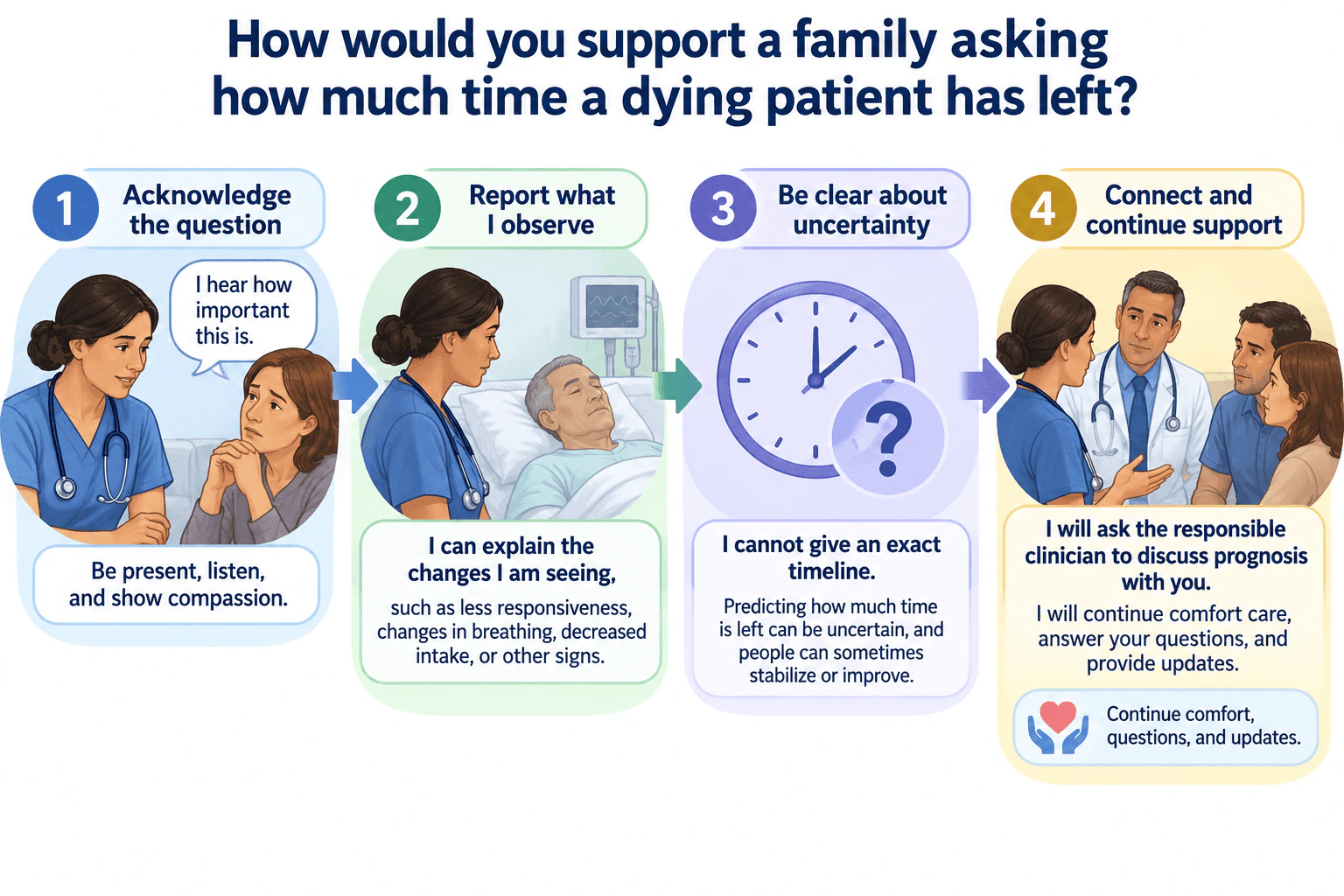
17. How would you support a family asking how much time a dying patient has left?Ethics And Family CommunicationHard
i Question Details
Describe acknowledging the question, reporting observed nursing changes, avoiding independent prognostication, and connecting the family with the responsible clinician while continuing comfort support.
Short Interview Answer (30-60 seconds)
I would first acknowledge how difficult and important the question is, listen to the family, and be present. Then I would explain the changes I am observing, such as less responsiveness, changes in breathing, or decreased intake, if those findings are present. I would clearly say that I cannot give an exact timeline because predicting time left can be uncertain, and some patients can sometimes stabilize or improve. I would ask the responsible clinician to discuss prognosis with the family, and I would continue comfort care, answer questions within my nursing scope, and provide updates.
Detailed Explanation
My approach is to be compassionate, honest, and clear about my role. I would acknowledge the family’s concern, explain what I am directly observing, avoid giving my own prognosis, and connect them with the responsible clinician while continuing comfort support.
Useful Questions to Ask the Interviewer
How does your ICU handle prognosis conversations with families during end of life care?
Which clinician usually leads the formal prognosis discussion in your unit?
What support services are available for families who need more guidance, such as palliative care or ethics support?
How to Explain It in an Interview
Acknowledge the question
I would start by recognizing the emotion behind the question. I might say, "I can hear how important this is to you." I would be present, listen, and show compassion before moving into clinical information.
Report what I observe
I would describe only what I am directly seeing. If present, that could include less responsiveness, changes in breathing, decreased intake, or other signs of decline. I would explain these changes in plain language and avoid overstating what they mean.
Be clear about uncertainty
I would say that I cannot give an exact timeline. Predicting how much time a dying patient has left can be uncertain, and some patients can sometimes stabilize or improve. I would avoid independently establishing prognosis or giving a promise about time.
Connect and continue support
I would tell the family that I will ask the responsible clinician to discuss prognosis with them. At the same time, I would continue comfort care, answer questions within my scope, provide updates, and support communication that respects the patient’s known preferences, goals of care, and decision maker.
Why Interviewers Ask This
Interviewers want to see whether the nurse can communicate compassionately during end of life care while staying within scope. This question evaluates whether I can recognize and explain observed changes, avoid unsupported prognostication, advocate for the patient and family, involve the responsible clinician, and continue comfort support.
Common interview mistakes
Common mistakes include giving a specific time estimate, presenting observed signs as proof of an exact timeline, avoiding the question instead of acknowledging it, speaking beyond the nursing role, or handing the issue off without continuing bedside support. Another mistake is ignoring the patient’s known preferences, goals of care, or decision maker.
Interview tip
Use a clear four step structure that matches the bedside conversation: acknowledge the question, report what you observe, be clear about uncertainty, and connect the family with the responsible clinician while continuing comfort care and updates.
Interviewer may ask next
How would you verify that the information you are giving the family is accurate?
I would base my explanation on my current assessment and on the patient’s documented clinical picture. I would describe only what I have actually observed, review the goals of care and recent team communication, and confirm any prognosis discussion with the responsible clinician rather than giving my own timeline.
What would you do if the patient’s condition changed while the family was waiting to speak with the clinician?
I would reassess the patient, continue comfort focused nursing care, and promptly notify the responsible clinician of the change. I would update the family using clear descriptions of what I am observing without independently predicting the exact time of death, and I would remain present to answer questions within my scope and provide support.
18. What is clinical judgment in nursing?Assessment And Clinical JudgmentEasy
Short Interview Answer (30-60 seconds)
Clinical judgment is the process of using nursing knowledge, patient assessment, clinical cues, and critical thinking to decide what matters most and what to do next. In the ICU, I compare current findings with the patient's baseline and trends, recognize patterns and competing cues, prioritize the most urgent concern, take appropriate nursing action or escalate as needed, and then reassess to determine whether the patient is improving or the plan needs to change.
Detailed Explanation
Clinical judgment is how a nurse turns patient information into safe clinical decisions. The nurse recognizes relevant cues, analyzes what they may mean, identifies the priority concern, chooses an appropriate response, takes action within scope, and evaluates the patient's response. Because patient conditions change, clinical judgment is an ongoing cycle rather than a single decision.
Useful Questions to Ask the Interviewer
How does the ICU team support nurses when a patient's condition changes rapidly?
What resources are available when a nurse needs another assessment or immediate clinical support?
How are significant changes in patient condition communicated within the interdisciplinary team?
How to Explain It in an Interview
Nursing Reasoning
I think of clinical judgment as connecting assessment findings with the patient's overall condition instead of reacting to one finding in isolation. I first identify what I am actually observing. Then I compare those observations with the patient's baseline, recent trends, diagnosis, treatment, and other available information. I separate observations from my interpretation and identify information that is still missing.
For example, if a monitor displays a new abnormal value, I would assess the patient and correlate that reading with other clinical evidence. I would also check whether the equipment and connections appear to be functioning correctly. If the patient appears unstable, patient assessment, appropriate immediate support, and calling for help take priority while verification continues.
Patient Context And Checks
In critical care, several cues may compete for attention. I would use a focused assessment and, when appropriate, an ABCDE assessment involving airway, breathing, circulation, disability, and exposure to identify immediate threats. I would compare current findings with baseline findings and trends because a developing pattern may be more informative than one isolated measurement.
I would distinguish independent nursing actions from actions authorized by protocol and actions that require an order or another clinician. If the patient is unstable, I would not delay appropriate support or escalation while waiting to complete the history, documentation, equipment verification, or a formal SBAR communication.
Rationale And Reassessment
Clinical judgment continues after the initial action. I would reassess the patient, compare the response with the expected result, look for new or conflicting cues, and revise the plan or escalate further when needed. This repeated process of assessment, interpretation, action, and reassessment keeps care responsive to the patient's changing condition.
Why Interviewers Ask This
Interviewers ask this question to determine whether the nurse understands that clinical judgment goes beyond collecting data. They are evaluating whether the nurse can recognize meaningful cues, interpret them in context, prioritize concerns, choose safe actions within nursing scope, escalate when needed, and reassess the patient's response.
Common interview mistakes
Common mistakes include treating one monitor value as the entire clinical picture, failing to compare findings with baseline and trends, confusing an observation with an interpretation, overlooking competing or conflicting cues, waiting for complete information before responding to obvious instability, failing to verify whether an unexpected equipment reading matches the patient's condition, and not reassessing after an intervention.
Interview tip
Explain clinical judgment as an ongoing nursing process rather than simply calling it critical thinking. Show how you recognize and analyze cues, compare findings with baseline and trends, prioritize the most important concern, act within your scope, escalate when necessary, and reassess the patient's response.
Interviewer may ask next
How would you verify that an abnormal ICU reading represents a real patient change?
I would assess the patient directly and compare the reading with the patient's symptoms, physical assessment, baseline, recent trends, and other available clinical evidence. I would also check whether the monitoring equipment and connections appear to be functioning correctly. If the patient appears unstable, I would begin appropriate nursing support and call for help while verification continues rather than delaying care until every possible source of error has been excluded.
How would your clinical judgment change if the patient's condition suddenly became unstable?
The priority would shift from routine information gathering to rapid assessment and immediate support. I would identify urgent threats using a focused assessment such as airway, breathing, circulation, disability, and exposure when appropriate, initiate nursing actions within my scope, and obtain additional help promptly. I would continue gathering and verifying information while care proceeds, communicate significant findings, and repeatedly reassess the patient's response so the plan can be adjusted as the situation changes.
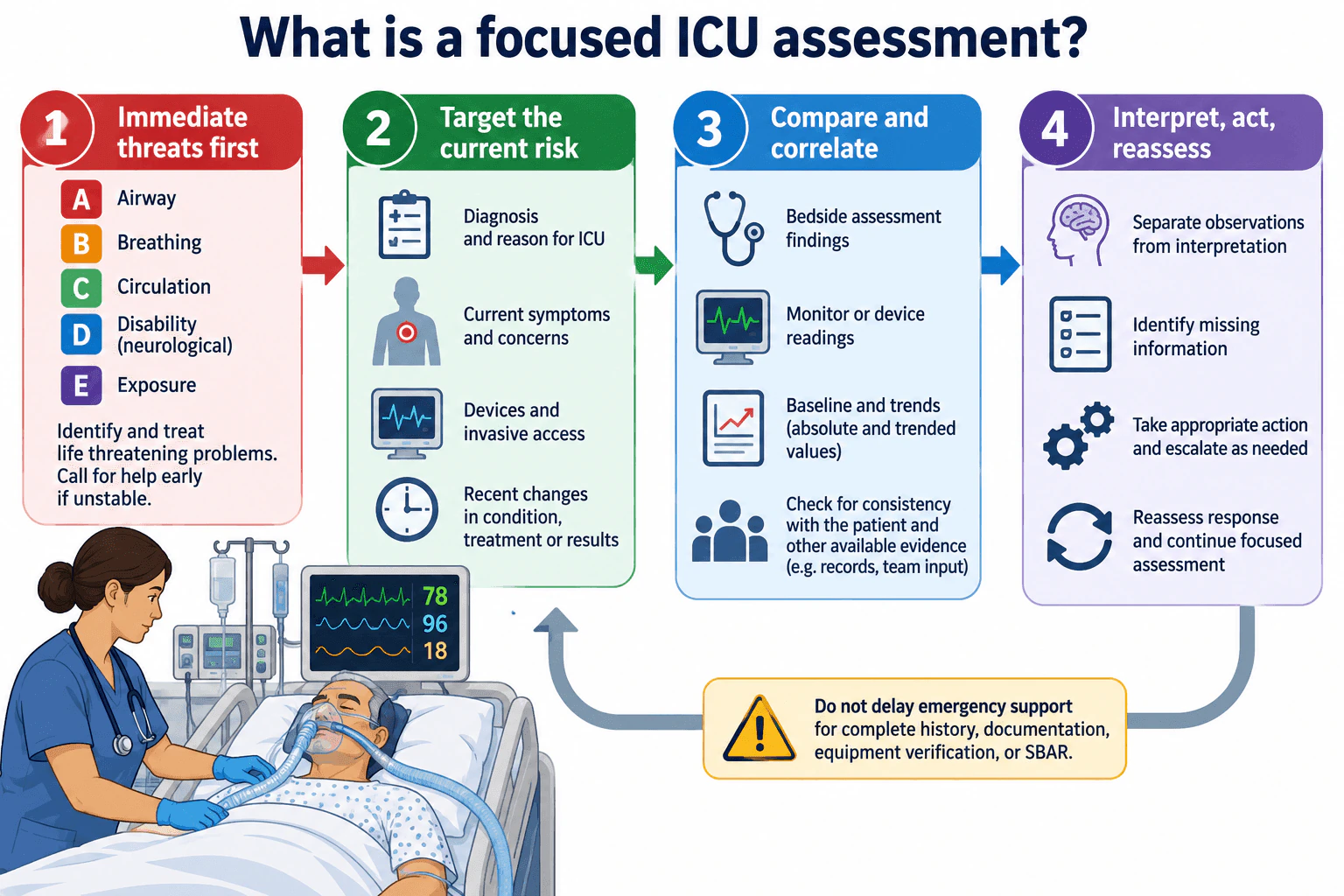
19. What is a focused ICU assessment?Assessment And Clinical JudgmentEasy
i Question Details
Explain a focused assessment as targeted data collection driven by the patient current risks, diagnosis, devices, symptoms, and recent changes, while still checking immediate threats first.
Short Interview Answer (30-60 seconds)
A focused ICU assessment is a targeted assessment driven by the patient's current risks, diagnosis, reason for ICU care, symptoms, devices, and recent changes. I check immediate threats first with ABCDE, then target the current concern. I compare bedside findings and monitor or device readings with baseline and trends, check them against the patient and other evidence, separate observations from interpretation, and identify missing information. I take appropriate action, escalate as needed, and reassess. If the patient is unstable, emergency support and calling for help come before completing history, documentation, equipment verification, or SBAR.
Detailed Explanation
A focused ICU assessment is targeted rather than simply repeating a complete examination. The nurse concentrates on the patient's current risks, diagnosis, reason for ICU care, symptoms, devices, invasive access, and recent changes while still checking immediate threats first.
Useful Questions to Ask the Interviewer
How does your ICU structure focused reassessment when a patient's condition changes?
What unit protocols guide escalation when an ICU patient becomes unstable?
How are device data and clinical trends reviewed during bedside handoff or rounds?
How to Explain It in an Interview
Immediate Threats First
I begin with the patient. If there may be an immediate threat, I assess Airway, Breathing, Circulation, Disability, and Exposure. I address life threatening problems within my nursing scope and call for appropriate help early. I would not delay emergency support to complete history, documentation, equipment verification, or SBAR.
Target the Current Risk
Once immediate threats are being addressed, I focus the assessment on the patient's current risk. I consider the diagnosis and reason for ICU care, current symptoms and concerns, devices and invasive access, and recent changes in condition, treatment, or results.
Compare and Correlate
I compare bedside assessment findings and monitor or device readings with the patient's baseline and trends, including both current and trended information. I check whether those findings are consistent with the patient and with other available evidence such as records, results, and team input. If a reading conflicts with the patient's presentation or other evidence, I continue assessment and verification without delaying help for an unstable patient.
Interpret, Act, and Reassess
I separate what I directly observed from my interpretation and identify important information that is still missing. I then take appropriate nursing action, follow applicable protocols or orders, escalate as needed, and reassess the patient's response. Focused assessment continues as new findings appear because the patient's priorities can change quickly in the ICU.
Why Interviewers Ask This
Interviewers are evaluating whether the nurse can recognize immediate threats, target assessment to the patient's current risk, compare findings with baseline and trends, interpret competing clinical cues, correlate monitor or device readings with the patient and other evidence, identify missing information, escalate appropriately, and reassess after action.
Common interview mistakes
Common mistakes include performing a broad checklist without focusing on the current risk, relying on a monitor or device reading without checking the patient, interpreting one value without comparing it with baseline and trends, mixing observations with interpretation, overlooking missing information, delaying escalation while gathering complete history or documentation, and failing to reassess after action.
Interview tip
Explain the sequence clearly: immediate threats first, target the current risk, compare and correlate bedside findings with monitor or device readings, baseline, trends, and other evidence, separate observations from interpretation, identify missing information, take appropriate action or escalate, and reassess. Make it clear that instability triggers immediate help and support while verification continues.
Interviewer may ask next
How would you verify a monitor or device reading that does not match the patient's clinical appearance?
I would assess the patient first and compare the reading with bedside findings, the patient's baseline, recent trends, and other available evidence such as records, results, and team input. I would inspect the relevant monitoring setup or device connection within my competence and local practice and involve the appropriate team member if the discrepancy remains. If the patient is unstable, I would call for help and provide appropriate emergency support while verification continues rather than delaying care until the equipment question is resolved.
How does a focused assessment change when the patient's condition suddenly deteriorates?
The priority shifts immediately to identifying and addressing life threatening problems. I would use ABCDE, call for appropriate help early, initiate actions within my nursing scope and applicable protocols or orders, and reassess the response. Complete history, documentation, full equipment verification, and structured communication remain important, but they should not delay emergency support. After immediate threats are addressed, I would refocus the assessment on the new clinical problem and compare findings with the patient's previous baseline and trends.
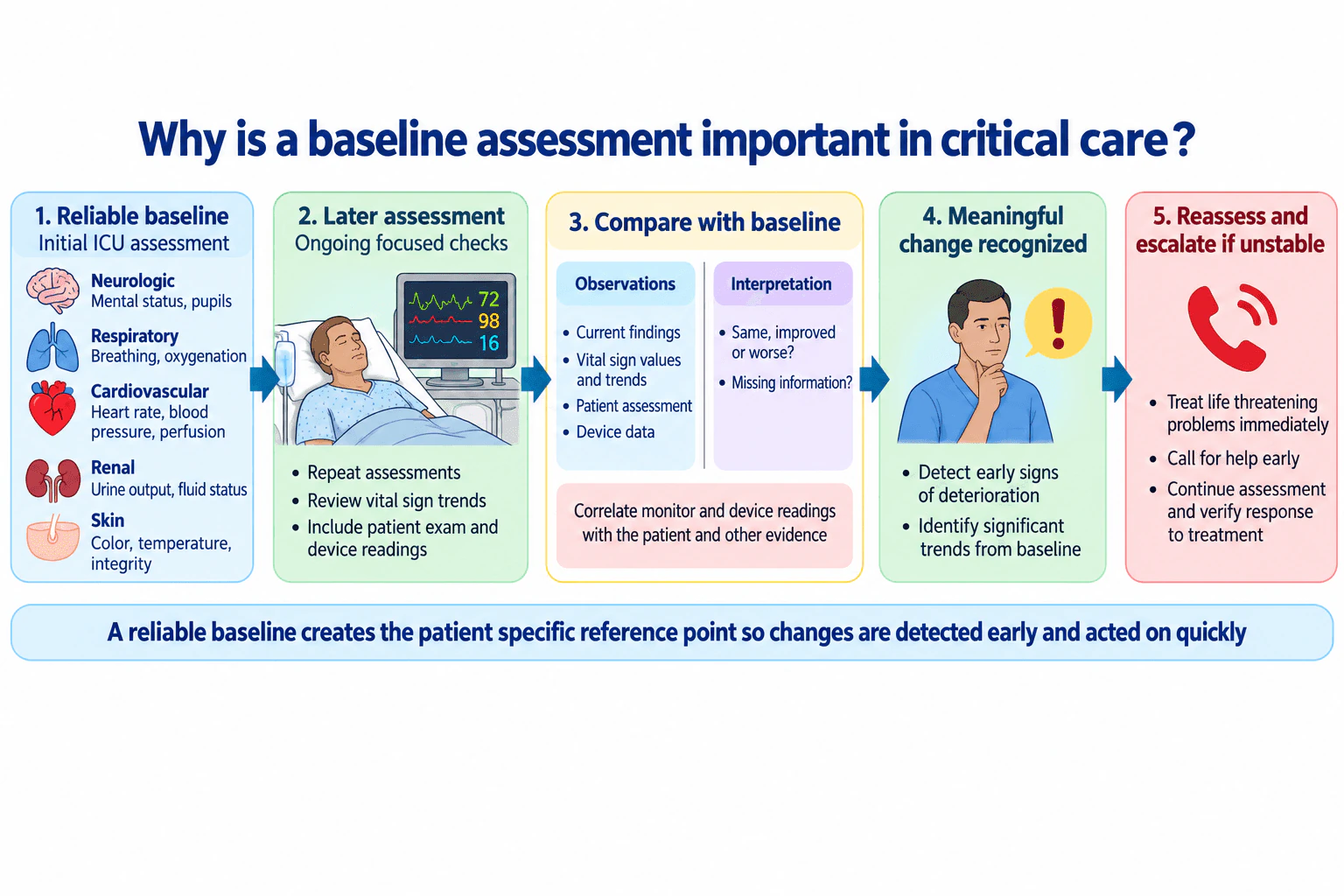
20. Why is a baseline assessment important in critical care?Assessment And Clinical JudgmentEasy
i Question Details
Describe how a reliable baseline allows later findings to be compared for meaningful change in neurologic, respiratory, cardiovascular, renal, and skin status.
Short Interview Answer (30-60 seconds)
A baseline assessment creates the patient's reference point. Once I know the initial neurologic, respiratory, cardiovascular, renal, and skin status, I can compare later findings with that baseline, recognize important trends or deterioration early, correlate monitor readings with the bedside assessment, and decide when reassessment, immediate support, or escalation is needed.
Detailed Explanation
A baseline assessment is the first reliable picture of the patient's condition. In critical care, later findings become more meaningful when they can be compared with that starting point. A change in mental status, breathing, oxygenation, heart rate, blood pressure, perfusion, urine output, skin color, temperature, or integrity may represent improvement, deterioration, or an expected difference from the patient's usual condition.
The nurse should separate observations from interpretation and identify missing information. Monitor and device readings should be checked against the patient's examination, trends, and other evidence rather than accepted in isolation. If the patient becomes unstable, emergency assessment and support take priority while verification continues.
Useful Questions to Ask the Interviewer
How does this ICU document and communicate a patient's baseline assessment during handoff?
Which changes or trends on this unit usually require immediate escalation?
How does the team expect nurses to communicate competing clinical cues when monitor data and the bedside assessment do not agree?
How to Explain It in an Interview
Clinical Principle
A reliable baseline gives me a patient specific reference point. I use it to decide whether later findings are unchanged, improving, or worsening rather than judging one value by itself.
Assessment Findings
I establish the patient's neurologic, respiratory, cardiovascular, renal, and skin status. During later focused assessments, I review the patient, vital sign trends, and relevant device data. I separate what I directly observe from my interpretation and identify information that is still missing.
Nursing Priorities
I compare current findings with the baseline and look for meaningful trends. I also correlate monitor and device readings with the patient's examination and other evidence. If those sources conflict, I reassess rather than assuming either one is automatically correct.
Reassessment and Escalation
If the patient is unstable, I use an Airway, Breathing, Circulation, Disability, Exposure assessment, address life threatening problems, and call for appropriate help early. I do not delay urgent support to complete a full history, documentation, equipment verification, or Situation, Background, Assessment, Recommendation communication. After interventions, I reassess the patient and verify the response.
Why Interviewers Ask This
Interviewers are evaluating whether you understand how baseline findings support clinical judgment in adult bedside critical care. They want to hear that you compare later findings with the patient's own starting condition, interpret trends rather than isolated values, reconcile competing clinical cues, verify device data against the patient, reassess after interventions, and escalate promptly when instability is present.
Common interview mistakes
Common mistakes include treating one monitor value as more important than the patient, failing to compare new findings with the baseline, overlooking trends, mixing observations with interpretation, ignoring missing or conflicting information, and delaying emergency support while trying to finish history taking, documentation, equipment checks, or structured communication.
Interview tip
Structure the answer around five ideas: establish the baseline, reassess over time, compare current findings with the baseline, recognize meaningful change, and reassess or escalate when the patient is unstable. Mention that device readings must agree with the patient and other clinical evidence.
Interviewer may ask next
How would you verify an abnormal monitor or device reading?
I would first assess the patient and compare the reading with the patient's baseline, current examination, vital sign trends, and other available evidence. I would then evaluate signal quality and obvious equipment factors such as sensor, lead, cuff, or connection placement as appropriate to the device. If the patient's condition suggests instability, I would call for help and address immediate clinical threats while equipment verification continues.
How would your assessment change if the patient had chronic abnormalities at baseline?
I would compare current findings with that patient's documented baseline rather than relying only on generic reference ranges. Chronic neurologic, respiratory, cardiovascular, renal, or other abnormalities may make an apparently unusual finding normal for that individual. I would focus on meaningful change from the established baseline, overall trends, the bedside examination, and any new signs of deterioration.
More questions load as you scroll
Disclaimer: This interview guide is for educational and informational purposes only. It is designed to help readers prepare, but it does not guarantee any interview result, hiring decision, offer, or outcome. Interview questions, hiring criteria, and preferred answers can vary by employer, interviewer, industry, location, and time. All answers, examples, and explanations in this guide are suggested examples for interview preparation, not definitive answers or instructions for professional practice. They are based on research and judgment, are provided without warranties of any kind, and should be adapted to the question, role, and applicable laws and professional requirements. Diagrams are simplified illustrations intended to highlight the main concepts and their relationships; actual situations, systems, and practices may be more complex. Alternative approaches may be equally valid or better suited to a particular question, context, or interviewer. To the fullest extent permitted by applicable law, the contributors and publisher are not liable for decisions made, actions taken, or losses incurred based on this guide.
State Laws and Professional Responsibilities: Laws and requirements governing an occupation vary by state and jurisdiction. You are responsible for checking the current laws, licensing requirements, and scope-of-practice rules that apply to your location and role, and for ensuring that your answers and actions comply with them. Adapt examples in this guide to those requirements. This guide is not legal advice.
Content Accuracy and Verification: To the fullest extent permitted by applicable law, we do not represent or warrant that interview guides, questions, answers, examples, or diagrams are accurate, complete, current, error-free, or suitable for any particular purpose. You are responsible for independently reviewing and verifying the information before relying on it.