This interview guide is for educational and informational purposes only. It is designed to help readers prepare, but it does not guarantee any interview result, hiring decision, offer, or outcome. Interview questions, hiring criteria, and preferred answers can vary by employer, interviewer, industry, location, and time. All answers, examples, and explanations in this guide are suggested examples for interview preparation, not definitive answers or instructions for professional practice. They are based on research and judgment, are provided without warranties of any kind, and should be adapted to the question, role, and applicable laws and professional requirements. Diagrams are simplified illustrations intended to highlight the main concepts and their relationships; actual situations, systems, and practices may be more complex. Alternative approaches may be equally valid or better suited to a particular question, context, or interviewer. To the fullest extent permitted by applicable law, the contributors and publisher are not liable for decisions made, actions taken, or losses incurred based on this guide.
State Laws and Professional Responsibilities
Laws and requirements governing an occupation vary by state and jurisdiction. You are responsible for checking the current laws, licensing requirements, and scope-of-practice rules that apply to your location and role, and for ensuring that your answers and actions comply with them. Adapt examples in this guide to those requirements. This guide is not legal advice.
Identity, Image, and Privacy Notice
To respect individual privacy, some names, profile photographs, avatars, biographical details, and other identifying information displayed in this guide may be replaced with pseudonyms, licensed stock images, illustrative avatars, composite images, or representative descriptions. Unless a person is expressly identified as an actual contributor, a displayed name, image, or profile should not be understood as depicting or identifying a specific candidate, interviewer, employee, or other real individual. These representations are provided for editorial and illustrative purposes only and do not imply endorsement, employment, participation, or affiliation with this guide or any company mentioned in it. Any resemblance to an actual person is coincidental.
Company Notice
This guide is an independent educational resource and is not affiliated with, endorsed by, sponsored by, or approved by the company named in this guide. Company names identify reported interview experiences or the employer context of clearly labeled original practice exercises. Interview practices can change without notice, and inclusion of company-specific content does not mean these questions are official, complete, or guaranteed to be asked. To the fullest extent permitted by law, the author, contributors, and publisher are not responsible for outcomes related to use of this material.
Content Accuracy and Verification
To the fullest extent permitted by applicable law, we do not represent or warrant that interview guides, questions, answers, examples, or diagrams are accurate, complete, current, error-free, or suitable for any particular purpose. You are responsible for independently reviewing and verifying the information before relying on it.
Questions or comments?
Contact us for general questions, or share feedback, technical corrections, and comments with the community.
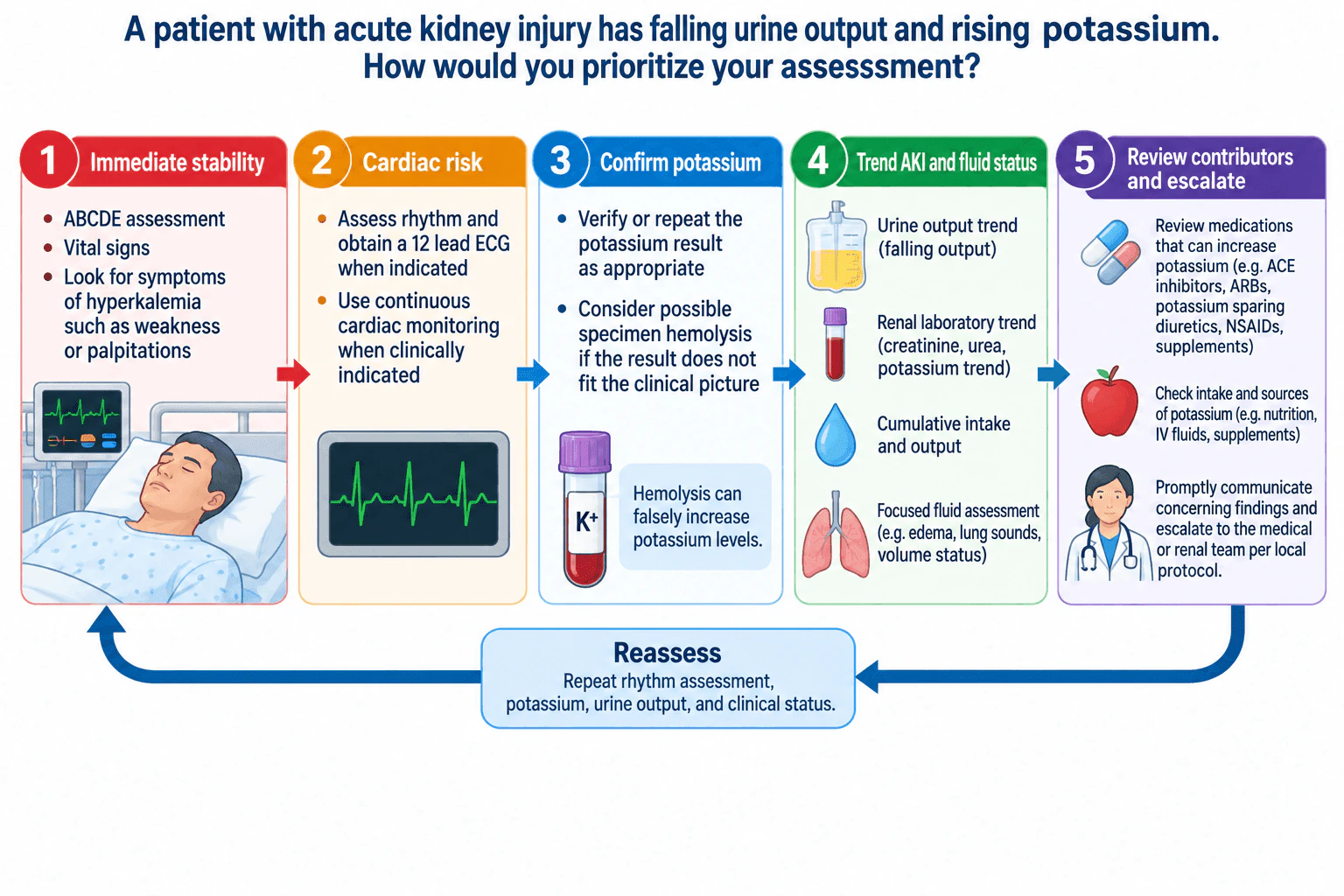
51. A patient with acute kidney injury has falling urine output and rising potassium. How would you prioritize your assessment?Renal Metabolic And Nutrition SupportHard
i Question Details
Assess cardiac rhythm and symptoms, confirm the laboratory result, review renal and fluid trends, medications and intake, and escalate promptly because dangerous electrolyte complications can develop.
Short Interview Answer (30-60 seconds)
I would start with immediate stability and cardiac risk by assessing ABCDE, vital signs, symptoms such as weakness or palpitations, rhythm, and a 12 lead electrocardiogram when indicated. I would use continuous cardiac monitoring when clinically indicated, verify or repeat the potassium result if needed, and consider hemolysis if the value does not fit the clinical picture. Then I would review urine output, renal laboratory trends, cumulative intake and output, fluid status, medications, supplements, nutrition, and IV fluid potassium sources. I would promptly escalate concerning findings and continue reassessing rhythm, potassium, urine output, and overall clinical status.
Detailed Explanation
The priority is to identify immediate instability and cardiac risk from rising potassium while confirming the result and determining whether worsening acute kidney injury and fluid imbalance are contributing. For an adult ICU patient in the United States, I would keep treatment decisions within authorized orders, protocols, and bedside RN scope.
Useful Questions to Ask the Interviewer
What is the unit process for escalating rising potassium in a patient with acute kidney injury?
When does your local protocol call for continuous cardiac monitoring or a 12 lead electrocardiogram in this situation?
How is cumulative intake and output trended and communicated on your ICU?
How to Explain It in an Interview
Patient Context: I would first assess ABCDE, vital signs, and symptoms such as weakness or palpitations. My immediate concern is whether the patient is unstable or showing evidence of clinically important hyperkalemia.
Cardiac Risk: I would assess the rhythm and obtain a 12 lead electrocardiogram when indicated. I would use continuous cardiac monitoring when clinically indicated according to the patient condition and local protocol because rising potassium can cause dangerous rhythm disturbances.
Verification: I would verify or repeat the potassium result as appropriate. If the result does not fit the clinical picture, I would consider specimen hemolysis or another collection problem because hemolysis can falsely elevate potassium.
Fluid and Laboratory Trends: I would review the urine output trend, creatinine, urea, and potassium trend. I would assess cumulative intake and output rather than one isolated measurement and perform a focused fluid assessment for edema, lung sounds, and overall volume status.
Contributors and Escalation: I would review medications that can increase potassium, including ACE inhibitors, ARBs, potassium sparing diuretics, and NSAIDs, along with supplements, nutrition, and IV fluid sources of potassium. I would promptly communicate concerning findings to the responsible medical or renal team according to local protocol. I would not independently prescribe potassium replacement, dialysis settings, or other treatment outside RN scope.
Reassessment: I would continue reassessing rhythm, potassium, urine output, and overall clinical status so that deterioration or response to ordered care is recognized quickly.
Why Interviewers Ask This
Interviewers are assessing whether you can recognize that falling urine output with rising potassium may create urgent cardiac risk, prioritize bedside stability before completing a broader renal assessment, verify a potentially inaccurate laboratory result, interpret trends rather than isolated values, identify contributing medications and intake, escalate appropriately, and continue reassessment within bedside ICU RN scope.
Common interview mistakes
Common mistakes are focusing only on the potassium number, delaying cardiac assessment, accepting an unexpected potassium result without considering hemolysis, looking at one urine output measurement instead of the trend, ignoring cumulative intake and output, overlooking medication or intake sources of potassium, and delaying escalation when the patient is clinically worsening.
Interview tip
Present your reasoning in the same clinical order you would use at the bedside: immediate stability, cardiac risk, potassium verification, renal and fluid trends, contributors, escalation, and reassessment. This demonstrates organized ICU nursing judgment while keeping treatment decisions within authorized orders and protocols.
Interviewer may ask next
What would you do if the potassium result seemed inconsistent with the rest of the assessment?
I would not dismiss the result, but I would verify it. I would review the specimen for reported hemolysis, compare the result with previous potassium values and the current clinical picture, and obtain or request a repeat sample according to local process. I would continue assessing rhythm, symptoms, and stability while confirmation is pending because laboratory verification should not delay recognition of clinical deterioration.
How would your priorities change if the patient developed new rhythm changes or became unstable?
Immediate stabilization and escalation would take priority. I would continue ABCDE assessment, obtain urgent assistance, maintain continuous cardiac monitoring, obtain a 12 lead electrocardiogram when indicated, and promptly notify the responsible medical team because the combination of rising potassium and new rhythm changes may represent a dangerous deterioration. I would continue monitoring potassium, urine output, and clinical status while ordered or protocol authorized treatment is initiated.
52. What are standard precautions in nursing care?Patient Safety And Infection PreventionEasy
i Question Details
Explain standard precautions as routine infection prevention practices applied according to exposure risk, including hand hygiene and appropriate personal protective equipment.
Short Interview Answer (30-60 seconds)
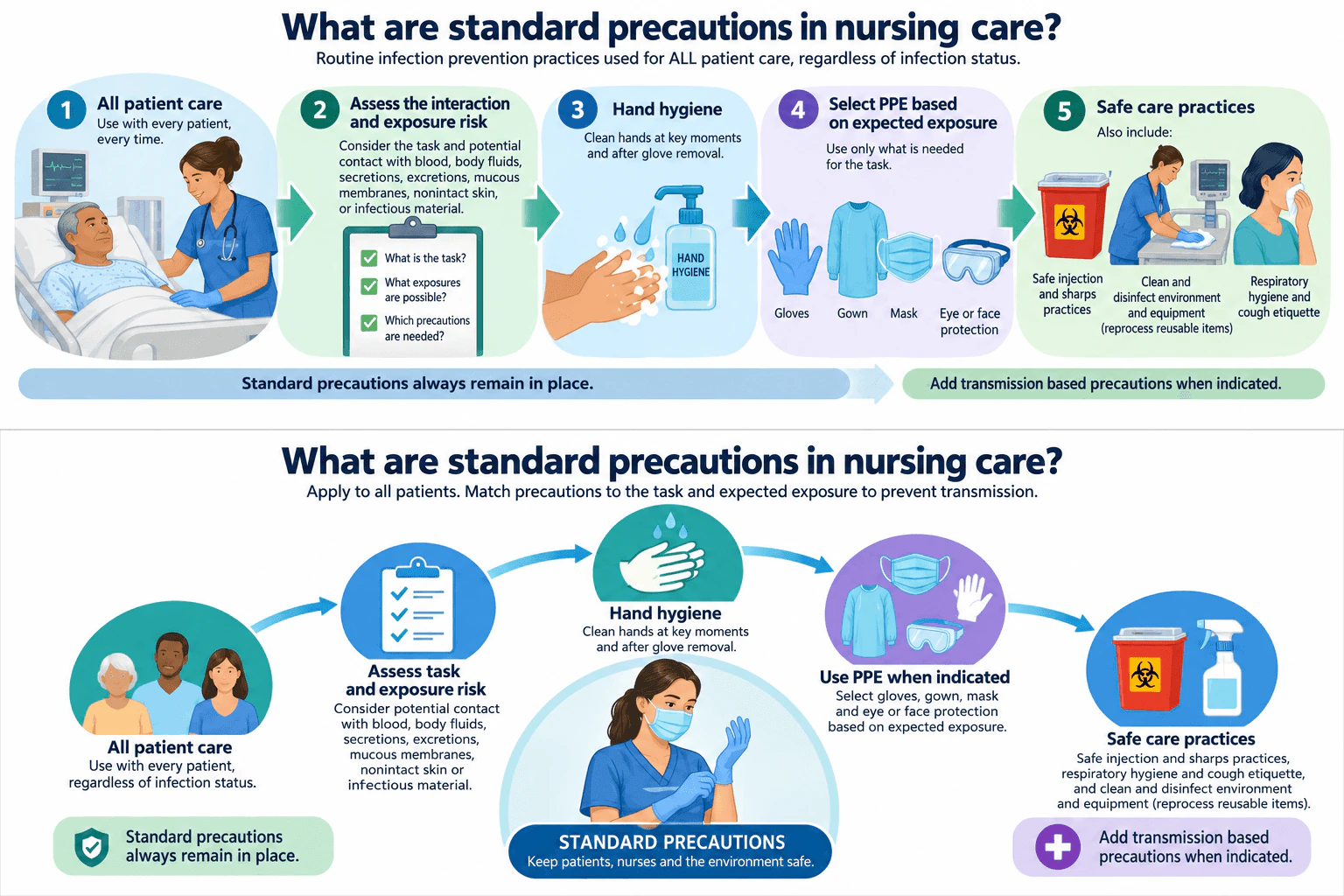
Standard precautions are infection prevention practices used for every patient. I first assess the task and expected exposure, perform hand hygiene, and select personal protective equipment such as gloves, a gown, a mask, or eye or face protection when indicated by the exposure risk. I also use safe injection and sharps practices, respiratory hygiene and cough etiquette, and proper cleaning and disinfection of equipment and the environment. If additional precautions are indicated, I add Transmission Based Precautions while continuing standard precautions.
Detailed Explanation
Standard precautions are routine infection prevention practices used during all patient care. The key idea is to use them for every patient while matching specific protective measures to the interaction and expected exposure. The sequence is straightforward: provide care using standard precautions, assess the exposure risk, perform hand hygiene, select appropriate personal protective equipment, and use safe care practices.
Useful Questions to Ask the Interviewer
How does your unit reinforce hand hygiene and appropriate personal protective equipment use in daily practice?
What process does the team use when a patient needs additional isolation precautions?
How are infection prevention concerns or exposure events communicated to bedside staff?
How to Explain It in an Interview
Clinical Principle
I would explain that standard precautions apply to every patient, not only to patients with a known infection. They are the routine foundation for reducing transmission during patient care.
Assess the Interaction and Exposure Risk
Before care, I consider the task and whether I may contact blood, body fluids, secretions, excretions, mucous membranes, nonintact skin, or other potentially infectious material. That assessment determines which protective measures are appropriate.
Hand Hygiene
I perform hand hygiene at the appropriate moments during care and after removing gloves. Wearing gloves does not replace hand hygiene.
Select Personal Protective Equipment
I choose personal protective equipment according to the expected exposure. Gloves protect the hands when contact with potentially infectious material is anticipated. A gown protects skin and clothing when exposure is expected. A mask and eye or face protection are used when splashes or sprays may occur. I would not assume that every patient or every interaction requires the same equipment.
Safe Care Practices
Standard precautions also include safe injection and sharps practices, respiratory hygiene and cough etiquette, and appropriate cleaning and disinfection of the environment and reusable patient care equipment.
Additional Precautions
Standard precautions remain in place. If a patient has a known or suspected infection that requires extra measures, I add the appropriate Transmission Based Precautions and communicate those precautions clearly to the care team.
Why Interviewers Ask This
Interviewers ask this to confirm that I understand the basic infection prevention approach used with every patient. They want to hear that I can assess the actual task and exposure risk, perform hand hygiene, select personal protective equipment appropriately, use safe care practices, and recognize when additional precautions are needed.
Common interview mistakes
Common mistakes include treating standard precautions as necessary only for patients with known infections, skipping the exposure risk assessment, using the same personal protective equipment for every task, forgetting hand hygiene after glove removal, and overlooking safe sharps handling, respiratory hygiene, environmental cleaning, or proper handling of reusable equipment.
Interview tip
Use a clear sequence in your answer: all patient care, exposure risk assessment, hand hygiene, personal protective equipment selection, and safe care practices. Finish by explaining that standard precautions remain in place and that Transmission Based Precautions are added only when indicated.
Interviewer may ask next
How do you verify that your personal protective equipment choice is appropriate?
I review the planned task and the expected exposure before beginning care. If hand contact with potentially infectious material is anticipated, I use gloves. If skin or clothing exposure is possible, I add a gown. If splashes or sprays may reach the face, I use a mask with eye or face protection as appropriate. I also follow current infection prevention guidance and facility procedures for the specific clinical situation.
What changes if the patient is suspected of having an infection that requires additional precautions?
I continue standard precautions and add the appropriate Transmission Based Precautions for the suspected route of transmission and clinical situation. Depending on the infection concern, these may include Contact, Droplet, or Airborne Precautions.
53. What is the purpose of isolation precautions?Patient Safety And Infection PreventionEasy
i Question Details
Explain how transmission based precautions add measures for specific routes of spread and why the required precautions depend on the suspected or confirmed organism.
Short Interview Answer (30-60 seconds)
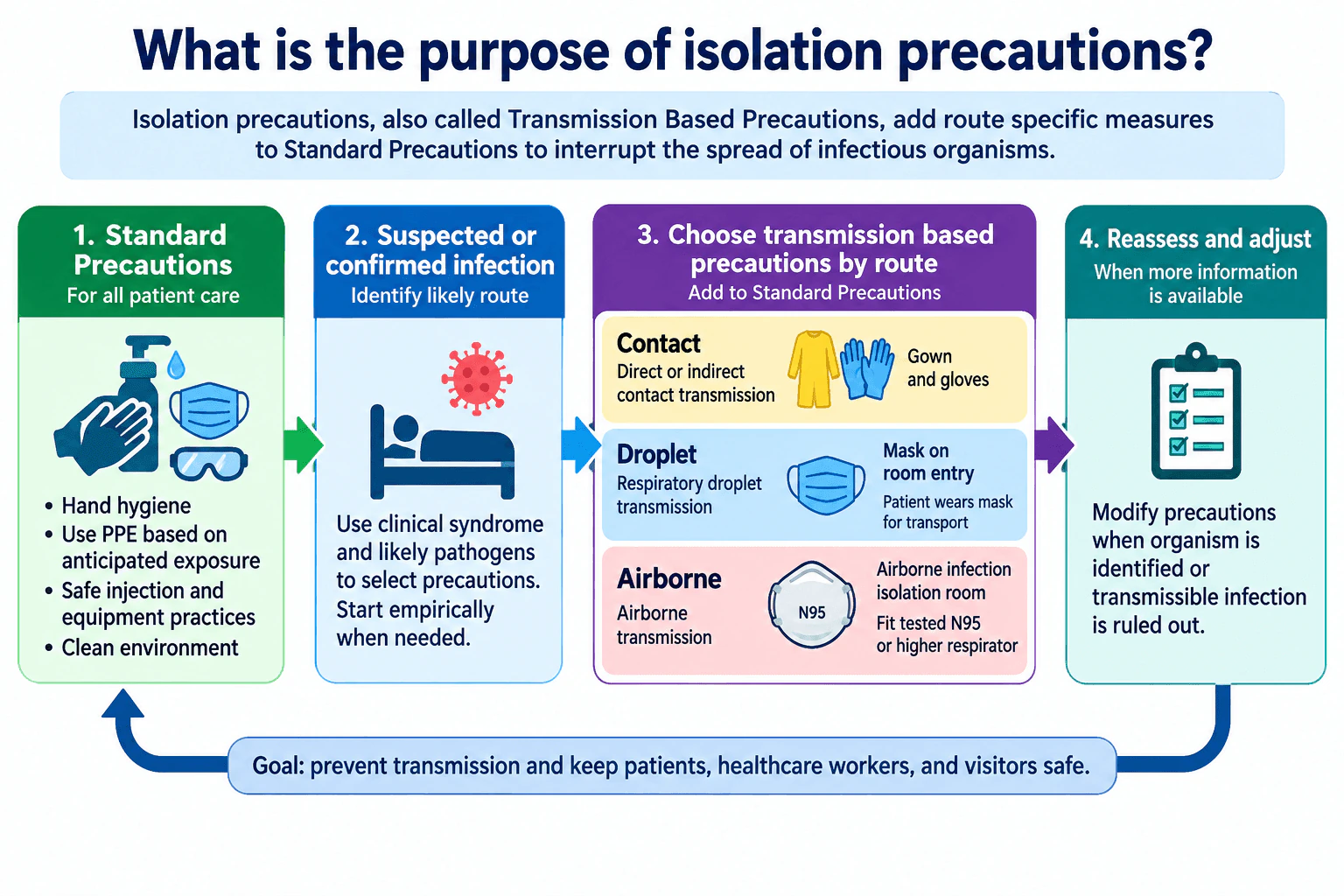
The purpose of isolation precautions is to interrupt the spread of infectious organisms and protect patients, healthcare workers, and visitors. Standard Precautions apply to every patient. When an infection is suspected or confirmed, Transmission Based Precautions add measures for the likely route of spread, such as Contact, Droplet, or Airborne Precautions. The nurse uses the clinical syndrome and likely pathogen to start appropriate precautions when needed, then adjusts them as the organism is identified or a transmissible infection is ruled out.
Detailed Explanation
Isolation precautions reduce opportunities for infectious organisms to spread in healthcare. Standard Precautions are the baseline for all patient care. They include hand hygiene, personal protective equipment based on anticipated exposure, safe injection and equipment practices, and environmental cleaning. When a suspected or confirmed infection requires additional measures, Transmission Based Precautions are added according to the route of spread.
Useful Questions to Ask the Interviewer
Which infection prevention policies and isolation resources does this ICU use?
How are nurses notified when isolation precautions are started, changed, or discontinued?
What support is available when the organism or route of transmission is still uncertain?
How to Explain It in an Interview
Clinical Principle
I would explain that Standard Precautions apply to all patients. If a patient has a suspected or confirmed transmissible infection, I would add the appropriate Transmission Based Precautions based on the clinical syndrome, likely pathogen, and expected route of spread.
Match Precautions to the Route
For Contact Precautions, the goal is to prevent direct or indirect contact transmission. Gown and gloves are used as recommended for patient and environmental contact. For Droplet Precautions, healthcare personnel wear a mask on room entry, and the patient wears a mask during necessary transport when possible. For Airborne Precautions, the patient should be placed in an airborne infection isolation room when available, and healthcare personnel use a fit tested N95 or higher level respirator as recommended.
Nursing Reasoning
The same precautions are not appropriate for every infection because organisms spread in different ways. When the organism is not yet known, precautions may be started empirically from the clinical syndrome and likely pathogens while diagnostic information is pending.
Reassessment
I would reassess when more information becomes available. Precautions may need to change when the organism is identified or when a transmissible infection is ruled out. I would communicate the updated precautions to the care team and follow the facility infection prevention process so the measures remain consistent.
Why Interviewers Ask This
Interviewers are assessing whether the nurse understands that infection prevention is based on the organism and route of transmission rather than applying the same isolation measures to every patient. They also want to hear safe nursing judgment about Standard Precautions, early use of appropriate Transmission Based Precautions when infection is suspected, and reassessment when diagnostic information changes.
Common interview mistakes
Common mistakes include treating isolation as one universal set of precautions, forgetting that Standard Precautions continue when Transmission Based Precautions are added, choosing precautions without considering the likely organism or route of spread, and failing to reassess when new diagnostic information becomes available.
Interview tip
Organize the answer around three points: Standard Precautions for all patients, added precautions matched to the suspected route of spread, and reassessment as the organism or diagnosis becomes clearer. Do not imply that every infection requires the same personal protective equipment or room setup.
Interviewer may ask next
How would you verify which isolation precautions are required for a patient?
I would review the patient's clinical syndrome, suspected or confirmed infection, and expected route of transmission, then check current infection prevention guidance and facility procedures. If the organism is not yet known, appropriate precautions can be started empirically based on the likely pathogens while testing is pending. If there is uncertainty, I would clarify with the infection prevention team or responsible clinician rather than guessing.
What would you do if new results identified a different organism or ruled out a transmissible infection?
I would reassess the required precautions using the new information and current guidance. If the identified organism requires different precautions, I would update them and communicate the change to the care team. If a transmissible infection is ruled out and no other indication remains, I would follow facility procedure for discontinuing the additional precautions while continuing Standard Precautions.
54. What is a pressure injury?Patient Safety And Infection PreventionEasy
Short Interview Answer (30-60 seconds)
A pressure injury is localized damage to the skin or underlying soft tissue caused by intense or prolonged pressure, or pressure combined with shear. It commonly develops over a bony prominence such as the sacrum or heel, but it can also occur beneath a medical device. As an ICU nurse, I would assess the skin and individual risk factors, use appropriate prevention measures, and communicate concerning skin changes promptly.
Detailed Explanation
A pressure injury is localized damage to the skin or underlying soft tissue caused by intense or prolonged pressure, or pressure combined with shear. It often develops over a bony prominence or where a medical device places sustained pressure on tissue. The skin may remain intact or tissue damage may become visible as the injury develops.
Useful Questions to Ask the Interviewer
What pressure injury risk assessment and skin assessment practices are used in your ICU?
How does the unit coordinate prevention for patients with limited mobility or multiple medical devices?
What resources are available when a nurse identifies concerning skin changes?
How to Explain It in an Interview
Clinical Principle
Pressure can reduce the ability of tissue to tolerate normal blood flow demands, and shear can add tissue stress. This is why areas over bony prominences and areas beneath medical devices deserve close attention.
Nursing Priorities
For an adult bedside ICU nurse in the United States, I would assess the patient's skin and individual pressure injury risk, with attention to bony prominences and areas beneath medical devices. Prevention should match the patient's actual risks rather than assuming every patient needs identical interventions.
Depending on the patient's condition and local policy, nursing measures can include reducing prolonged pressure, supporting safe repositioning or mobility when clinically appropriate, using appropriate pressure redistribution strategies, managing excess moisture, and checking skin beneath or around medical devices. I would also communicate important risks during handoff and collaborate with the care team when the patient's condition limits routine mobility or positioning.
Reassessment and Communication
Pressure injury risk can change as a patient's condition, mobility, perfusion, devices, or treatment needs change. I would reassess the skin and risk factors, document relevant findings, address modifiable causes within nursing scope, and communicate or escalate new or worsening skin changes according to the clinical situation and local policy.
Why Interviewers Ask This
Interviewers want to know whether the nurse understands the basic cause of pressure injury and can connect that knowledge with prevention, assessment, and early communication. In critical care, patients may have limited mobility, altered sensation, moisture exposure, impaired tissue tolerance, or medical devices, so prevention should be based on the individual patient's assessed risks.
Common interview mistakes
Common mistakes include describing a pressure injury as only an open wound, overlooking pressure from medical devices, confusing moisture related skin damage with pressure injury, failing to reassess risk when the patient's condition changes, and assuming every patient requires the same prevention plan.
Interview tip
Start with a clear definition, then briefly connect it to bedside nursing practice. Explain that you assess the skin and individual risk, reduce avoidable pressure when clinically appropriate, reassess for changes, document findings, and communicate concerns.
Interviewer may ask next
How would you verify that a suspected skin injury is actually a pressure injury?
I would assess the location, appearance of the skin and tissue, exposure to pressure or shear, and whether a medical device is involved. I would also consider whether another cause, such as moisture related skin damage, better explains the finding. I would use the organization's approved assessment and classification process and seek wound care or other appropriate clinical expertise when the cause or classification is uncertain.
How would your approach change for an unstable ICU patient who cannot be repositioned normally?
I would still assess pressure injury risk and the skin, but prevention would need to fit the patient's current physiologic and treatment limitations. I would reduce avoidable pressure using clinically appropriate measures, inspect accessible skin and device contact areas, collaborate with the interdisciplinary team on safe positioning or mobility options, and reassess as the patient's condition changes. I would not assume that a routine repositioning approach is appropriate for every critically ill patient.
55. How do you respond to frequent monitor or ventilator alarms without becoming desensitized?Patient Safety And Infection PreventionMedium
i Question Details
Describe assessing the patient first, identifying the alarm source, distinguishing urgent from nonurgent alarms, correcting causes within scope, and escalating when needed.
Short Interview Answer (30-60 seconds)
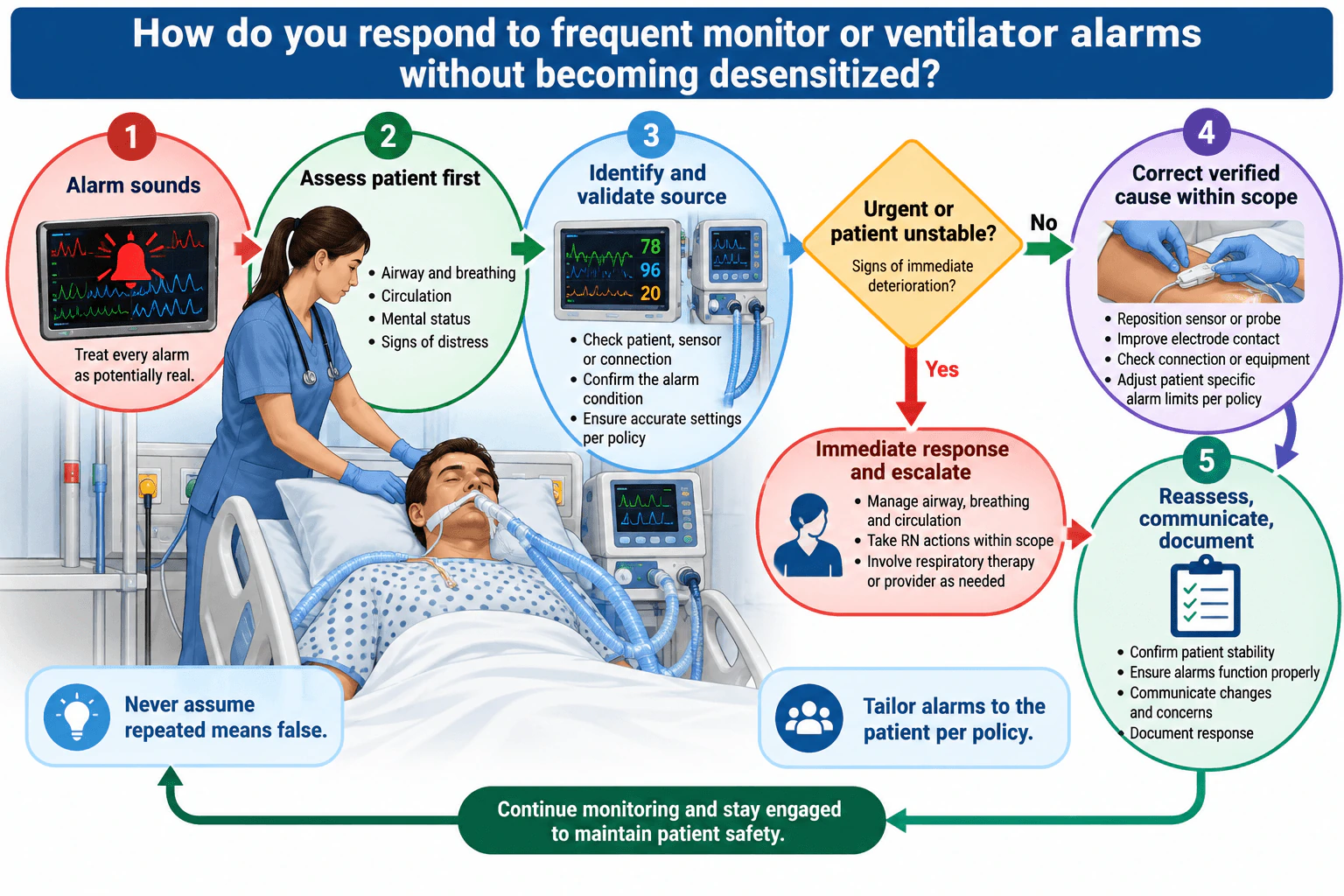
I respond to the patient first, not the sound alone. I assess for immediate instability, then identify the alarm source and decide whether it is urgent or nonurgent. If the patient is unstable, I intervene within scope and escalate immediately. If the patient is stable, I correct the verified cause within scope, such as a loose sensor or poor connection, and make sure alarm settings remain appropriate for that patient according to policy. After that, I reassess, communicate, document, and stay engaged so I do not become desensitized to repeated alarms.
Detailed Explanation
Frequent alarms can lead to alarm fatigue, but I do not assume a repeated alarm is false. My approach is to treat each alarm as potentially meaningful, assess the patient first, identify the source, decide whether the situation is urgent, correct verified causes within scope, and then reassess.
Useful Questions to Ask the Interviewer
How are alarm limits individualized for ICU patients on this unit?
What is the usual escalation pathway for persistent monitor or ventilator alarms?
How do nurses and respiratory therapists coordinate ventilator alarm management here?
How to Explain It in an Interview
Clinical Principle
I treat every alarm as potentially real. Repetition does not mean the alarm is harmless, so I stay engaged rather than letting it fade into the background.
Assessment Findings
My first step is always the patient. I assess airway, breathing, circulation, mental status, and visible signs of distress. At the same time, I identify and validate the alarm source by checking the patient and the related sensor, probe, monitor lead, ventilator circuit, or equipment connection.
Nursing Priorities
If the patient is unstable or there are signs of immediate deterioration, I respond right away within my nursing scope. That means supporting airway, breathing, and circulation as needed, calling for help, and involving respiratory therapy or the provider when appropriate.
If the patient is stable and the alarm appears nonurgent, I correct the verified cause within scope. Examples include repositioning a sensor or probe, improving electrode contact, checking a disconnected or loose connection, or confirming that alarm settings are appropriate for that patient according to policy. I do not simply silence an alarm without understanding why it happened.
Reassessment and Escalation
After any intervention, I reassess the patient and confirm that the alarm is functioning properly. I communicate important changes or unresolved concerns, document the response, and continue monitoring. That process helps prevent desensitization while keeping clinically important alarms actionable and tied to patient safety.
Why Interviewers Ask This
Interviewers want to know whether you can stay alert around frequent alarms, prioritize the patient over the device, separate urgent deterioration from nonurgent technical causes, act within scope, escalate appropriately, and reduce alarm fatigue without missing a real safety event.
Common interview mistakes
Common mistakes include looking at the monitor before assessing the patient, assuming a repeated alarm is false, silencing an alarm without identifying the cause, missing a loose lead or circuit problem, changing alarm limits just to reduce noise, failing to escalate when the patient is unstable, and not reassessing after the intervention.
Interview tip
Answer this question as a clear sequence: patient first, identify the source, decide whether it is urgent, correct the verified cause within scope or escalate, then reassess, communicate, and document. That structure shows sound ICU judgment and a safe response to alarm fatigue.
Interviewer may ask next
How do you verify that an alarm is caused by artifact or equipment rather than a real patient change?
I compare the alarm with the patient’s actual condition. I assess the patient directly, inspect the relevant lead, probe, sensor, circuit, or connection, and check whether the displayed signal fits the clinical picture. If I find a technical cause, I correct it within scope and confirm that the alarm resolves while the patient remains stable. If the cause is still unclear or the alarm continues, I treat it as unresolved and escalate.
How would your response change if the patient became unstable during repeated ventilator alarms?
If the patient becomes unstable, the situation becomes an immediate clinical priority. I focus on airway, breathing, and circulation, call for help, take appropriate nursing actions within scope, and involve respiratory therapy and the provider right away. Troubleshooting the ventilator still matters, but patient stabilization comes first. After the immediate response, I reassess the patient, confirm the alarm source, communicate the event, and document the response.
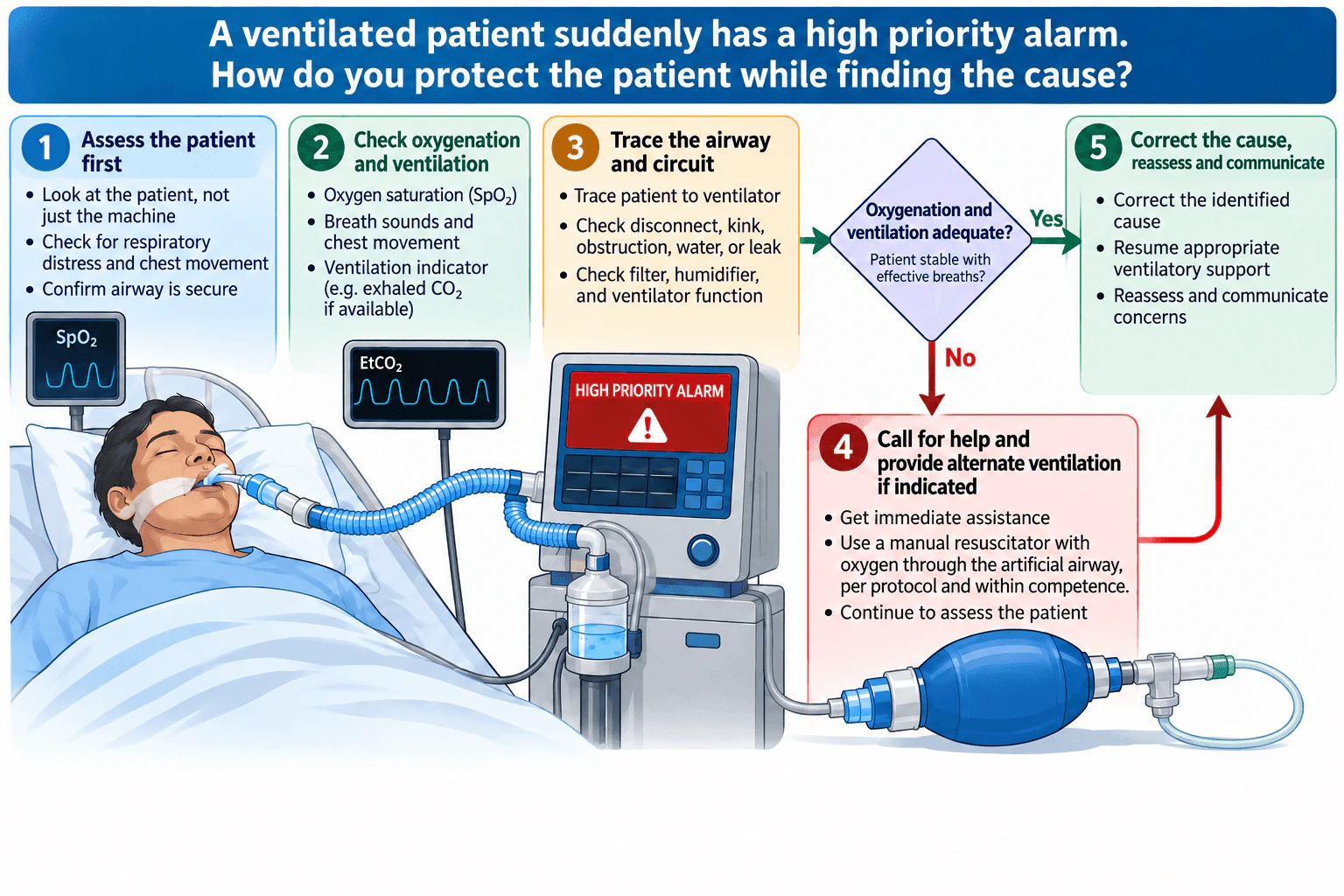
56. A ventilated patient suddenly has a high priority alarm. How do you protect the patient while finding the cause?Patient Safety And Infection PreventionHard
i Question Details
Describe immediate patient assessment, checking oxygenation and ventilation, inspecting the airway and circuit, calling for help when needed, and using manual support if clinically indicated and within protocol.
Short Interview Answer (30-60 seconds)
I assess the patient first, checking respiratory status, chest movement, airway security, oxygenation, breath sounds, and available ventilation indicators. Then I trace the airway and circuit from the patient to the ventilator for a disconnect, kink, obstruction, water, leak, filter problem, humidifier problem, or ventilator malfunction. If oxygenation or ventilation is inadequate, I call for help and provide alternate ventilation with oxygen through the artificial airway when clinically indicated and allowed by protocol. I then correct the cause, resume appropriate ventilatory support, reassess, and communicate concerns.
Detailed Explanation
For an adult bedside ICU nurse in the United States, the immediate priority is the patient, not the alarm source. I look for respiratory distress and chest movement, confirm that the artificial airway remains secure, and assess oxygenation and ventilation using bedside findings, oxygen saturation, breath sounds, and available exhaled carbon dioxide information. Current patient ventilator assessment guidance emphasizes direct patient assessment and evaluation of the artificial airway, ventilator, and humidification system. pmc.ncbi.nlm.nih.gov
Next, I trace the airway and breathing circuit from the patient toward the ventilator. I look for disconnection, kinking, obstruction, accumulated water, leaks, blocked filters, humidifier problems, or ventilator dysfunction. Manufacturer troubleshooting guidance for high priority circuit alarms similarly directs clinicians to check the patient and circuit and to use alternative ventilation if the problem cannot be promptly resolved. documents.philips.com
If oxygenation or ventilation is inadequate, I call for immediate assistance. When clinically indicated, within my competence, and consistent with local protocol, I provide alternate ventilation with oxygen using a manual resuscitator through the artificial airway while the cause is identified. Backup manual ventilation equipment is specifically recommended for ventilator dependent patients. fda.gov
Useful Questions to Ask the Interviewer
What is your unit protocol for responding to high priority ventilator alarms?
How are nurses and respiratory therapists expected to divide responsibilities during acute ventilator troubleshooting?
Where is emergency manual ventilation equipment kept and how is readiness checked?
How to Explain It in an Interview
Nursing Priorities
I would say that I start with the patient because an alarm may reflect a patient problem, an airway problem, a circuit problem, or equipment failure. I rapidly assess breathing and oxygenation while confirming that the artificial airway is secure.
Airway and Circuit Check
I trace the system from the patient to the ventilator rather than checking components randomly. I look for a disconnect, kink, obstruction, water, leak, blocked filter, humidifier problem, or ventilator malfunction.
Escalation and Alternate Ventilation
If the patient is not being adequately oxygenated or ventilated, troubleshooting cannot delay respiratory support. I call for help and, when clinically indicated and authorized by protocol, use a manual resuscitator with oxygen through the artificial airway. Manual resuscitators are recognized backup devices when mechanical ventilation is unavailable or fails. accessdata.fda.gov
Reassessment
After the cause is corrected, I resume appropriate ventilatory support, reassess the patient's respiratory response and monitoring, and communicate any ongoing safety concern to the appropriate team members.
Why Interviewers Ask This
This question tests whether the nurse puts the patient before the equipment, rapidly distinguishes patient and airway problems from circuit or ventilator problems, maintains oxygenation and ventilation during troubleshooting, escalates appropriately, and reassesses after intervention.
Common interview mistakes
Common mistakes include focusing on the ventilator before assessing the patient, troubleshooting components in a scattered order instead of tracing the airway and circuit, overlooking airway displacement or circuit obstruction, delaying a call for assistance when ventilation is inadequate, and continuing troubleshooting without providing alternate ventilation when clinically indicated.
Interview tip
Describe the sequence clearly: patient assessment first, oxygenation and ventilation check, airway and circuit inspection, immediate escalation and alternate ventilation if support is inadequate, then correction of the cause followed by reassessment and communication.
Interviewer may ask next
How would you verify that your intervention worked?
I would reassess respiratory distress, chest movement, airway security, oxygen saturation, breath sounds, and available ventilation indicators such as exhaled carbon dioxide. I would also confirm that the circuit is intact, appropriate ventilatory support has resumed, and the patient's clinical response is improving rather than assuming that disappearance of the alarm alone proves resolution.
What changes if the patient remains unstable after you identify and correct a circuit problem?
I would continue supporting oxygenation and ventilation, obtain immediate assistance, and escalate to the appropriate critical care and respiratory team members. I would reassess the artificial airway and patient for another cause rather than assuming the circuit problem was the only issue, while continuing alternate ventilation when clinically indicated and permitted by protocol.
57. What is medication reconciliation?Medication And ProceduresEasy
Short Interview Answer (30-60 seconds)
Medication reconciliation means obtaining and verifying the most accurate medication information possible, comparing it with the medications currently ordered, and identifying unintended discrepancies so they can be clarified and resolved. In the ICU, I would help verify the medication history from appropriate sources, compare it with current orders, identify concerns such as omissions, unintended duplications, or conflicting information, communicate discrepancies to the appropriate prescriber or pharmacist, and document the updated information according to the organization process. ahrq.gov
Detailed Explanation
Medication reconciliation is a structured medication safety process. It starts with obtaining and confirming the most accurate medication history available. That information is then compared with medication orders at relevant transitions of care so unintended differences can be identified, clarified, and documented. Agency for Healthcare Research and Quality guidance describes these steps at admission, transfer, and discharge. ahrq.gov
Useful Questions to Ask the Interviewer
What sources does your ICU use to verify a medication history when the patient cannot provide complete information?
How are medication discrepancies communicated to prescribers and pharmacists in this ICU?
How is medication reconciliation documented during admission, transfer, and discharge?
How to Explain It in an Interview
Nursing Reasoning
For an adult bedside ICU nurse in the United States, I would begin by helping establish the most accurate medication information available rather than assuming an existing list is correct. Appropriate sources can include the patient when possible, a family member or caregiver when appropriate, prior medical records, and other available medication information according to local policy. Agency for Healthcare Research and Quality guidance specifically recognizes the need to use additional resources when the patient cannot provide a complete history. ahrq.gov
Patient Context And Checks
I would compare the verified medication information with current orders and look for unintended differences. Examples include an omitted medication, an unintended duplication, an unexplained addition or change, or incomplete information that requires clarification. A difference is not automatically an error because some changes are intentional and appropriate for the current clinical condition. The important step is determining whether the difference is intended and making sure unresolved discrepancies reach the appropriate clinician. ahrq.gov
Rationale And Reassessment
If I identify a possible discrepancy, I would communicate it to the appropriate prescriber or pharmacist and follow the organization process for clarification and documentation. I would not independently alter a medication order unless that action were specifically authorized within applicable scope and protocol. After clarification, I would verify that the updated medication information is accurately reflected and communicated at the relevant transition of care. This supports the goal of preventing medication errors caused by incomplete or inconsistent medication information. digital.ahrq.gov
Why Interviewers Ask This
Interviewers want to know whether the nurse understands medication reconciliation as an active medication safety process rather than simply copying a medication list. They are assessing whether the nurse can obtain reliable information, recognize discrepancies, communicate concerns within nursing scope, and support accurate medication information during transitions of care. The Joint Commission National Performance Goals effective January 1, 2026 include maintaining and communicating accurate patient medication information as part of medication safety. jointcommission.org
Common interview mistakes
Common mistakes include assuming that an existing medication list is automatically accurate, relying on only one source when important information remains uncertain, failing to compare the verified history with current orders, treating every difference as an error without checking whether it was intentional, failing to communicate unresolved discrepancies, and independently changing an order without appropriate authority. Agency for Healthcare Research and Quality guidance emphasizes obtaining, confirming, comparing, resolving, and documenting medication information throughout the reconciliation process. ahrq.gov
Interview tip
Give a simple sequence: obtain and verify the best medication history available, compare it with current orders, identify unintended discrepancies, communicate them to the appropriate clinician, and confirm that clarified information is documented. Also state that an intentional medication change is not the same as a medication reconciliation error. That shows both medication safety judgment and appropriate nursing scope. ahrq.gov
Interviewer may ask next
How would you verify a medication list if you were unsure it was accurate?
I would not assume that a single existing list is correct. I would compare the available information with other appropriate sources, such as the patient when possible, a family member or caregiver when appropriate, prior medical records, or other accessible medication information according to the organization process. I would identify conflicting or missing information, document uncertainty rather than guessing, and communicate unresolved discrepancies to the appropriate prescriber or pharmacist. Agency for Healthcare Research and Quality guidance specifically recommends confirmation with the patient or additional resources when needed to improve accuracy and completeness. ahrq.gov
What changes if an ICU patient cannot provide their medication history?
The goal does not change, but I would rely more heavily on appropriate alternative sources. I would seek available information from a family member or caregiver when appropriate, prior medical records, and other permitted medication information sources. I would clearly identify what has and has not been verified, communicate clinically important uncertainties, and update the medication history when more reliable information becomes available. I would never invent missing medication details. Agency for Healthcare Research and Quality guidance recognizes family members, caregivers, community pharmacies, past medical records, and primary care clinicians as possible additional sources when needed. ahrq.gov
58. What is a high alert medication in critical care nursing?Medication And ProceduresEasy
i Question Details
Explain that certain medications carry increased risk of serious harm if used incorrectly and therefore require strict verification, monitoring, and adherence to local safety procedures.
Short Interview Answer (30-60 seconds)
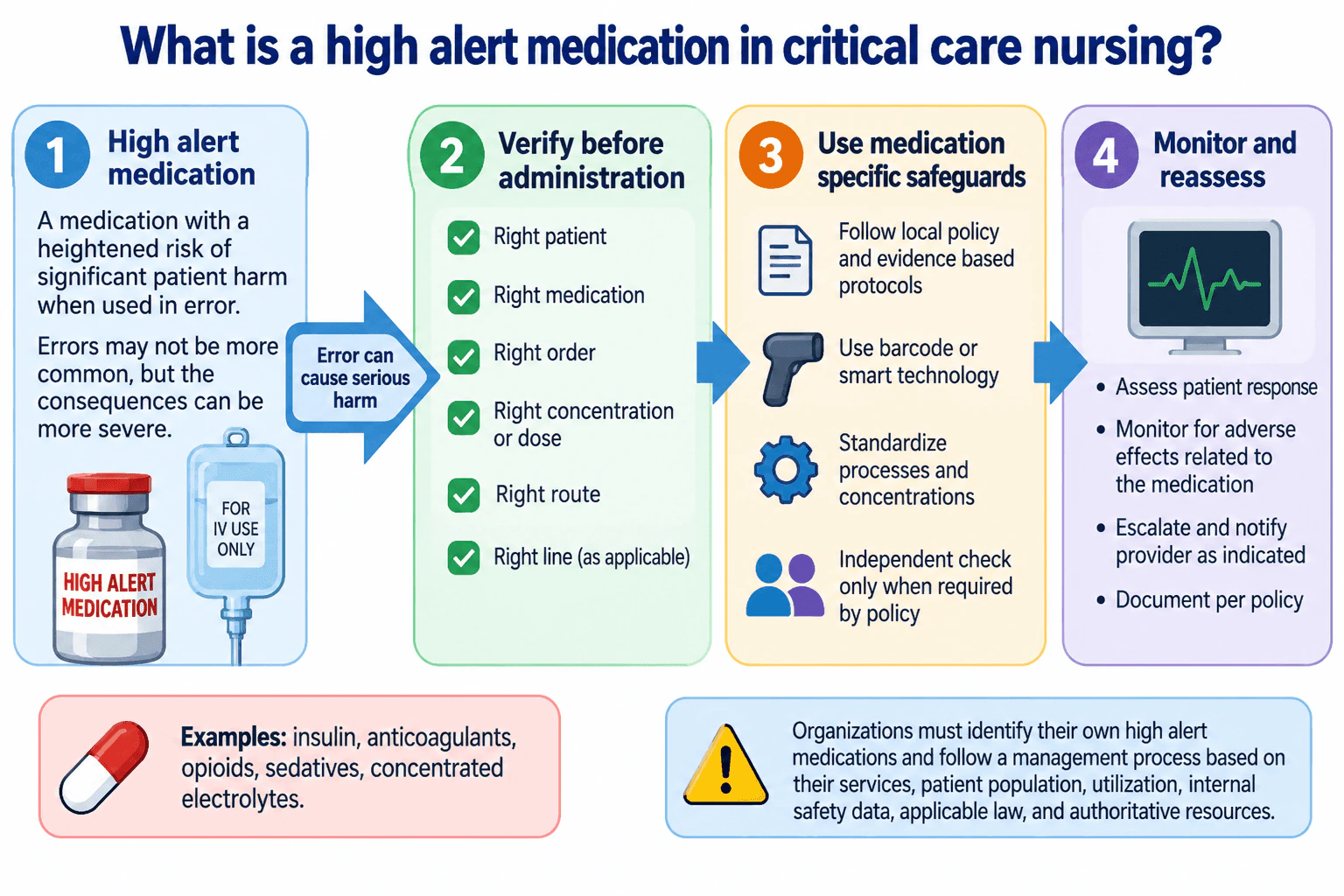
A high alert medication is one that can cause significant patient harm if an error occurs. The error itself may not be more common, but the consequences can be more serious. I would verify the patient, medication, order, concentration or dose, route, and line when applicable, follow medication specific safeguards and local policy, use available safety technology appropriately, and closely monitor and reassess the patient. An independent double check should be used when medication specific policy requires it, not automatically for every high alert medication.
Detailed Explanation
A high alert medication carries a heightened risk of significant patient harm when it is used in error. The key point is not that mistakes necessarily happen more often with these medications. It is that the consequences of a mistake can be especially serious.
Useful Questions to Ask the Interviewer
Which medications does this organization classify as high alert in the ICU?
What medication specific verification processes are required for those medications?
Which barcode, smart infusion, or other medication safety systems are used here?
How to Explain It in an Interview
Verification
Before administration, I would verify the correct patient, medication, order, concentration or dose, route, and appropriate line when applicable. Barcode medication administration can support verification of the patient and medication, while smart infusion technology can provide additional safeguards for intravenous therapy. Technology supports nursing verification rather than replacing it.
Medication Specific Safeguards
High alert medications require safeguards matched to the medication and the organization. These can include standardized ordering, preparation, administration, and concentrations, as well as barcode medication administration, smart infusion technology, and an independent double check when required by medication specific policy. An independent double check should not be presented as a universal requirement for every high alert medication.
Monitoring and Reassessment
After administration, I would assess the patient's response, monitor for medication related adverse effects, respond to clinically meaningful changes, communicate and escalate concerns to the appropriate clinician when indicated, and document the administration and patient response according to policy.
Examples and Local Policy
Examples include insulin, anticoagulants, opioids, sedatives, and concentrated electrolytes. The organization should identify the high alert medications relevant to its services and patient population and use a management process based on medication use, internal safety information, applicable law, and authoritative resources.
Why Interviewers Ask This
Interviewers are assessing whether the nurse understands that high alert status reflects the potential severity of harm from an error and whether the nurse responds with deliberate verification, medication specific safeguards, appropriate monitoring, escalation, and adherence to organizational procedures rather than treating every medication identically.
Common interview mistakes
Common mistakes include assuming that high alert means errors occur more frequently, treating every high alert medication as requiring the same safeguards, performing an independent double check as though it were universally required, relying on barcode or smart infusion technology without completing nursing verification, or using an external high alert list without following the organization's own medication specific process.
Interview tip
Define the term first, then connect it to nursing practice: verify the patient and medication details, use medication specific safeguards, monitor and reassess the patient, escalate concerns when indicated, and follow local policy. Mention that independent double checks are used when required for that medication rather than presenting them as a universal rule.
Interviewer may ask next
What would you verify before administering a high alert medication?
I would verify the correct patient, medication, order, concentration or dose, route, and appropriate line when applicable. I would also review the medication specific requirements in local policy and use available safety systems such as barcode medication administration or smart infusion technology appropriately. If the medication specific policy requires an independent double check, I would complete that check before administration.
What changes if you move to another ICU or hospital?
The principle stays the same, but the exact list of high alert medications and required safeguards may change. I would review the new organization's approved list and procedures because organizations should identify the medications relevant to their services, patient population, medication use, internal safety information, applicable law, and authoritative resources.
59. What is medication compatibility and why does it matter in the ICU?Medication And ProceduresEasy
i Question Details
Explain that compatibility determines whether medications or solutions can share a line or be mixed safely and must be verified with an authoritative reference before administration.
Short Interview Answer (30-60 seconds)
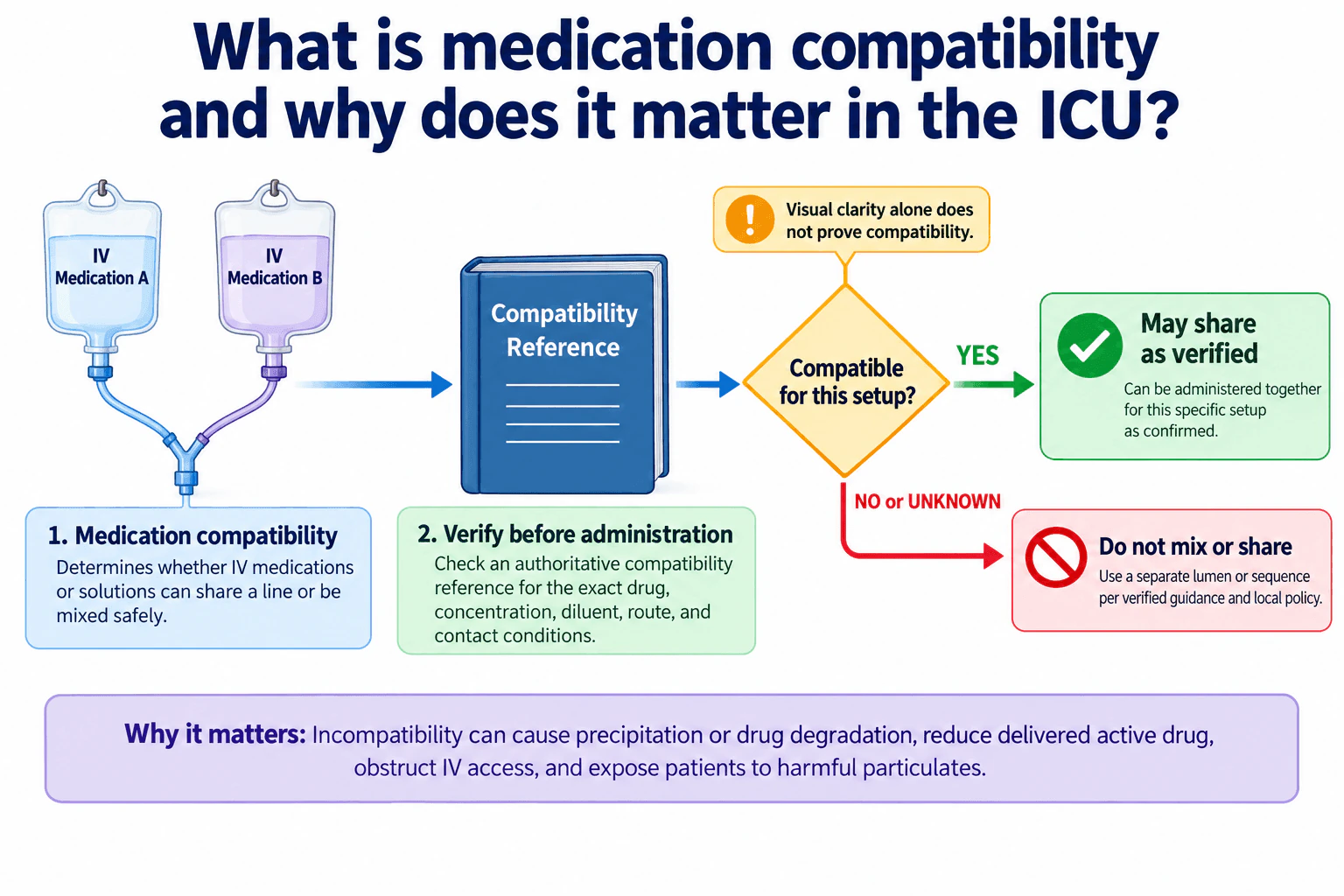
Medication compatibility tells me whether medications or solutions can safely share a line or be mixed in the intended setup. Before administration, I verify the exact drugs, concentrations, diluents, route, and contact conditions using an authoritative compatibility reference. If compatibility is confirmed, the therapies may share the line as verified. If they are incompatible or compatibility is unknown, I keep them separate or use a verified sequential approach. This matters because incompatibility can cause precipitation, drug degradation, reduced delivery of active medication, IV access obstruction, and harmful particulate exposure.
Detailed Explanation
Medication compatibility means determining whether medications or solutions can safely come into contact in the exact administration setup being considered. Compatibility is not established by visual appearance alone. It depends on factors such as the specific drugs, concentrations, diluents, route, and contact conditions.
Useful Questions to Ask the Interviewer
Which authoritative compatibility reference does the unit use at the bedside?
What resources are available when compatibility information is unavailable or conflicting?
How does the unit manage limited venous access when medications cannot share a lumen?
How to Explain It in an Interview
In the ICU, patients may receive several IV therapies while vascular access is limited. Before allowing two medications or solutions to meet in a shared line, I verify compatibility using an authoritative reference rather than relying on appearance or memory.
I check the exact medications, concentrations, diluents, route, and intended contact conditions. Compatibility must match the actual administration setup. For example, evidence that two medications are compatible during brief contact at a Y site does not automatically mean they can be mixed together in the same container for a longer period.
If compatibility is confirmed for the intended setup, the therapies may share the line as verified. If the combination is documented as incompatible, or if reliable compatibility information is unavailable, I treat compatibility as not established. I do not mix the therapies or allow them to share the same contact point. I use a separate lumen when available or follow verified drug specific guidance and local policy for sequential administration.
This matters because incompatibility can cause precipitation or drug degradation, decrease delivery of active medication, obstruct IV tubing or vascular access, and expose the patient to harmful particulates. The key nursing principle is to verify compatibility before administration and separate therapies whenever compatibility is incompatible or unknown.
Why Interviewers Ask This
Interviewers are evaluating whether the nurse recognizes medication compatibility as a patient safety decision rather than a visual judgment. They want to hear that the nurse verifies the exact administration conditions with an authoritative reference, understands that compatibility depends on the specific setup, and chooses a safe alternative when compatibility is not established.
Common interview mistakes
Common mistakes include assuming that clear solutions are compatible, relying on memory instead of an authoritative reference, checking only the drug names without verifying concentration or diluent, treating compatibility for one administration setup as proof of compatibility for another, and allowing medications to share a line when compatibility is unknown. Another mistake is applying one medication's sequential administration instructions universally instead of checking drug specific guidance.
Interview tip
Keep the answer centered on one safety decision: verify the exact compatibility conditions before two therapies meet. State clearly that confirmed compatibility permits the verified setup, while incompatible or unknown combinations require separation or another verified administration method.
Interviewer may ask next
How would you verify whether two IV medications are compatible?
I would use the authoritative compatibility resource available to the clinical team and verify the exact medications, concentrations, diluents, route, and intended contact conditions. I would confirm that the evidence applies to the actual setup, such as brief Y site contact versus mixing medications in one container. I would not use visual appearance alone as evidence of compatibility. If reliable information is unavailable or conflicting, I would treat compatibility as not established and use a separate lumen or seek pharmacy guidance before allowing the therapies to meet.
What would you do if a second urgent medication is needed but compatibility with the current infusion cannot be confirmed?
I would treat the compatibility as unknown rather than assuming the medications can share the line. I would look for a separate available lumen and promptly check the authoritative compatibility resource or consult pharmacy. If sequential use of the same line is considered, I would follow drug specific guidance and local policy rather than applying a universal flushing rule.
60. How do you safely manage a continuous high risk infusion?Medication And ProceduresMedium
i Question Details
Verify medication, concentration, route, pump programming, line tracing, patient specific target or order, monitoring parameters, and required double checks, then reassess after changes.
Short Interview Answer (30-60 seconds)
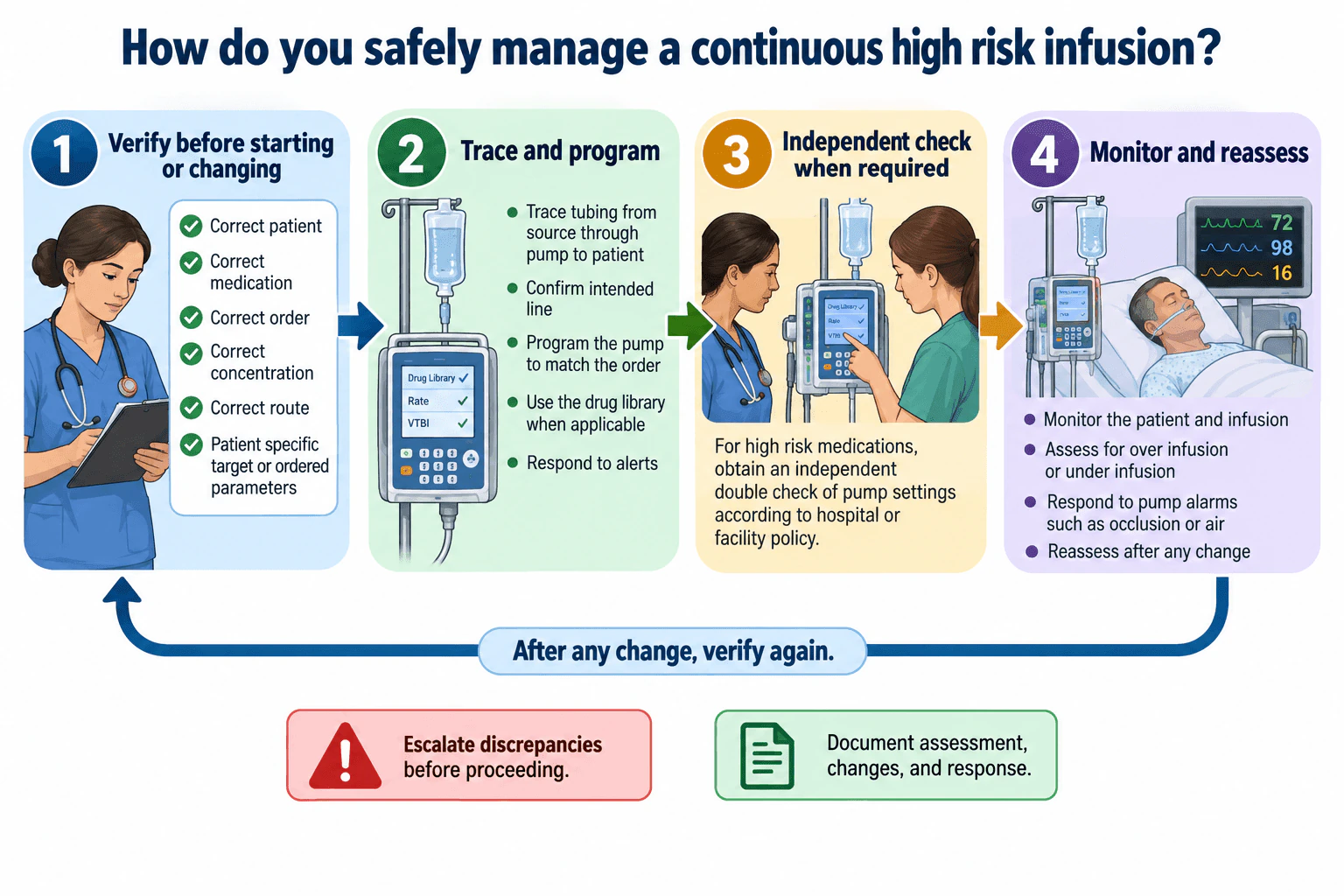
I use a verify, trace, check, monitor, and reassess approach. I verify the patient, medication, order, concentration, route, intended line, pump settings, and patient specific target or ordered parameters. I trace the tubing from the source through the pump to the patient, program the pump to match the verified order, use the drug library when applicable, and respond to alerts. If policy requires an independent double check for that medication, a second clinician independently verifies the relevant settings. Once the infusion is running, I monitor the patient and infusion, assess for over infusion or under infusion, respond to pump alarms, reassess after every change, escalate discrepancies before proceeding, and document the assessment, changes, and response.
Detailed Explanation
A continuous high risk infusion is safest when it is managed as a repeating verification and reassessment process rather than a one time pump setup. The core sequence is to verify before starting or changing, trace and program correctly, use an independent double check when required, monitor the patient and infusion, then verify again after any change.
Useful Questions to Ask the Interviewer
Which continuous high risk infusions in this ICU require an independent double check under facility policy?
How does your unit use the smart pump drug library and alert workflow?
What is the expected escalation process for an unresolved order, pump, or line discrepancy?
How to Explain It in an Interview
Verify before starting or changing
I first confirm the correct patient, medication, order, concentration, route, intended line, pump settings, and patient specific target or ordered parameters. If any part does not match, I stop and escalate the discrepancy before proceeding.
Trace and program
I trace the tubing from the medication source through the pump to the patient so I know the correct infusion is connected to the intended line. I program the pump to match the verified order, use the drug library when applicable, and respond to displayed alerts and cautions. FDA clinician guidance specifically recommends verifying pump dosage, rate, and volume when settings change, using the drug library when applicable, and promptly addressing alerts. fda.gov
Independent check when required
For medications that require an independent double check under facility policy, a second clinician independently verifies the relevant infusion settings against the order. This is not treated as a universal requirement for every medication. FDA guidance ties independent double checks for high risk infusion settings to hospital or facility policy, and ISMP guidance supports selective independent checks for facility defined high alert infusions. fda.gov
Monitor and reassess
After the infusion starts or changes, I monitor both the patient and the infusion. I assess the clinical response, watch for adverse effects, assess for over infusion or under infusion, and respond to pump alarms such as occlusion or air alerts according to device instructions and facility policy. FDA notes that infusion pump problems can result in over infusion, under infusion, or delays in therapy and recommends monitoring both the patient and infusion. fda.gov
After any change, I verify the setup again and reassess the patient. I confirm that the infusion remains aligned with the current order and patient specific target or ordered parameters.
Escalate and document
If I identify a discrepancy, unsafe condition, or unresolved concern, I escalate before proceeding. I document the assessment, changes made, and the patient's response.
Why Interviewers Ask This
Interviewers are evaluating whether the nurse manages a continuous high risk infusion as an active clinical safety process rather than a one time pump task. They want to hear systematic verification, accurate tubing and line tracing, correct pump programming, appropriate medication specific double checks, ongoing patient and infusion monitoring, recognition of alarm or infusion problems, reassessment after changes, escalation of discrepancies, and clear documentation.
Common interview mistakes
Common mistakes include starting or changing the infusion without fully verifying the patient, medication, order, concentration, route, and intended line; assuming the displayed pump channel is connected to the intended line without tracing the tubing; programming the pump without comparing the settings with the verified order; bypassing a drug library alert without understanding why it appeared; treating independent double checks as universal rather than medication specific; failing to reassess after a change; focusing only on the pump instead of the patient's response; overlooking signs of over infusion or under infusion; and failing to escalate or document a discrepancy.
Interview tip
Give your answer as a closed safety loop. Move in order from verification, to tubing and line tracing, to pump programming, to any required independent double check, to patient and infusion monitoring, and then to reassessment after every change. Make it clear that you escalate discrepancies before proceeding and document the patient's response.
Interviewer may ask next
What exactly would you verify before starting or changing the infusion?
I would verify the correct patient, medication, order, concentration, route, intended line, pump settings, and patient specific target or ordered parameters. I would trace the tubing from the source through the pump to the patient and compare the programmed settings with the verified order. I would use the drug library when applicable and complete an independent double check if that medication requires one under facility policy. If anything does not match, I would resolve or escalate the discrepancy before proceeding.
What would you do if the patient's condition changed after the infusion was already running?
I would reassess the patient, review the current authorized order or protocol, and make only changes permitted by that order or protocol and within nursing scope. After any change, I would reverify the medication, concentration, route, intended line, pump programming, and patient specific target or ordered parameters, complete any required independent double check, and reassess the patient and infusion. I would respond to relevant pump alarms or signs of over infusion or under infusion, escalate unresolved concerns before proceeding further, and document the assessment, changes, and response.
More questions load as you scroll
Disclaimer: This interview guide is for educational and informational purposes only. It is designed to help readers prepare, but it does not guarantee any interview result, hiring decision, offer, or outcome. Interview questions, hiring criteria, and preferred answers can vary by employer, interviewer, industry, location, and time. All answers, examples, and explanations in this guide are suggested examples for interview preparation, not definitive answers or instructions for professional practice. They are based on research and judgment, are provided without warranties of any kind, and should be adapted to the question, role, and applicable laws and professional requirements. Diagrams are simplified illustrations intended to highlight the main concepts and their relationships; actual situations, systems, and practices may be more complex. Alternative approaches may be equally valid or better suited to a particular question, context, or interviewer. To the fullest extent permitted by applicable law, the contributors and publisher are not liable for decisions made, actions taken, or losses incurred based on this guide.
State Laws and Professional Responsibilities: Laws and requirements governing an occupation vary by state and jurisdiction. You are responsible for checking the current laws, licensing requirements, and scope-of-practice rules that apply to your location and role, and for ensuring that your answers and actions comply with them. Adapt examples in this guide to those requirements. This guide is not legal advice.
Content Accuracy and Verification: To the fullest extent permitted by applicable law, we do not represent or warrant that interview guides, questions, answers, examples, or diagrams are accurate, complete, current, error-free, or suitable for any particular purpose. You are responsible for independently reviewing and verifying the information before relying on it.