This interview guide is for educational and informational purposes only. It is designed to help readers prepare, but it does not guarantee any interview result, hiring decision, offer, or outcome. Interview questions, hiring criteria, and preferred answers can vary by employer, interviewer, industry, location, and time. All answers, examples, and explanations in this guide are suggested examples for interview preparation, not definitive answers or instructions for professional practice. They are based on research and judgment, are provided without warranties of any kind, and should be adapted to the question, role, and applicable laws and professional requirements. Diagrams are simplified illustrations intended to highlight the main concepts and their relationships; actual situations, systems, and practices may be more complex. Alternative approaches may be equally valid or better suited to a particular question, context, or interviewer. To the fullest extent permitted by applicable law, the contributors and publisher are not liable for decisions made, actions taken, or losses incurred based on this guide.
State Laws and Professional Responsibilities
Laws and requirements governing an occupation vary by state and jurisdiction. You are responsible for checking the current laws, licensing requirements, and scope-of-practice rules that apply to your location and role, and for ensuring that your answers and actions comply with them. Adapt examples in this guide to those requirements. This guide is not legal advice.
Identity, Image, and Privacy Notice
To respect individual privacy, some names, profile photographs, avatars, biographical details, and other identifying information displayed in this guide may be replaced with pseudonyms, licensed stock images, illustrative avatars, composite images, or representative descriptions. Unless a person is expressly identified as an actual contributor, a displayed name, image, or profile should not be understood as depicting or identifying a specific candidate, interviewer, employee, or other real individual. These representations are provided for editorial and illustrative purposes only and do not imply endorsement, employment, participation, or affiliation with this guide or any company mentioned in it. Any resemblance to an actual person is coincidental.
Company Notice
This guide is an independent educational resource and is not affiliated with, endorsed by, sponsored by, or approved by the company named in this guide. Company names identify reported interview experiences or the employer context of clearly labeled original practice exercises. Interview practices can change without notice, and inclusion of company-specific content does not mean these questions are official, complete, or guaranteed to be asked. To the fullest extent permitted by law, the author, contributors, and publisher are not responsible for outcomes related to use of this material.
Content Accuracy and Verification
To the fullest extent permitted by applicable law, we do not represent or warrant that interview guides, questions, answers, examples, or diagrams are accurate, complete, current, error-free, or suitable for any particular purpose. You are responsible for independently reviewing and verifying the information before relying on it.
Questions or comments?
Contact us for general questions, or share feedback, technical corrections, and comments with the community.
71. What are the five rights of delegation?Prioritization And DelegationEasy
i Question Details
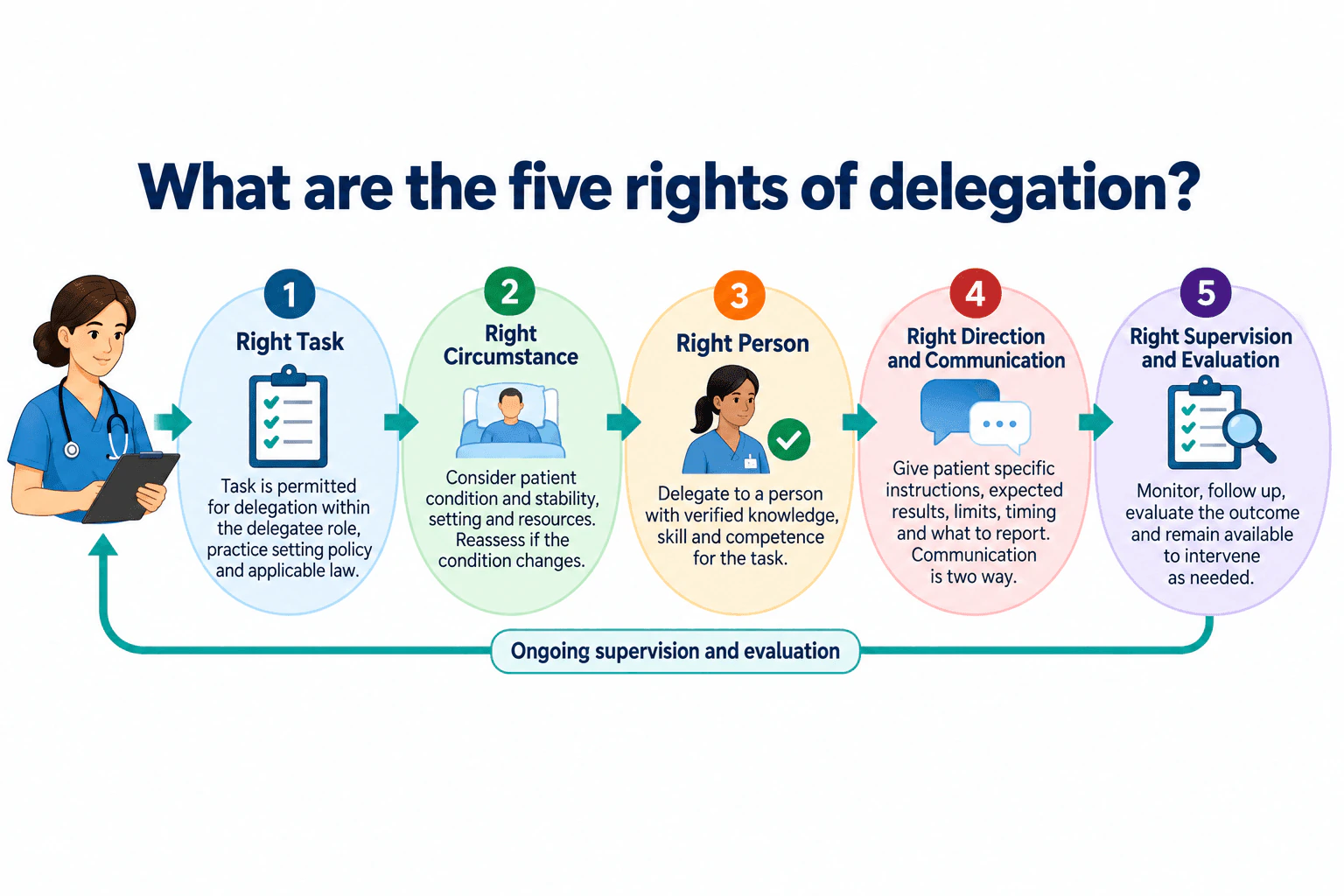
Identify the right task, circumstance, person, direction or communication, and supervision or evaluation as core delegation principles.
Short Interview Answer (30-60 seconds)
The five rights are right task, right circumstance, right person, right direction and communication, and right supervision and evaluation. I confirm that the task is permitted for delegation, consider the patient condition and available resources, choose someone with the appropriate knowledge and skill, give patient specific instructions and reporting expectations, and then monitor, follow up, evaluate the outcome, and remain available to intervene if needed.
Detailed Explanation
The five rights provide a practical safety check for delegation. They help the registered nurse match an appropriate task with the right patient situation and the right team member while maintaining clear communication and ongoing supervision.
Useful Questions to Ask the Interviewer
How does your unit define delegation responsibilities for registered nurses and assistive personnel?
How are staff competencies for delegated activities verified on this unit?
What communication process does the team use when a patient condition changes during a delegated activity?
How to Explain It in an Interview
Right Task
I confirm that the activity is permitted for delegation within the delegatee role, applicable law, and practice setting policies. I do not delegate activities that require nursing judgment, clinical reasoning, or critical decision making.
Right Circumstance
I consider the patient condition and stability, the care setting, and available resources. If the patient condition changes, the delegatee should report the change and I reassess the patient and whether the delegation remains appropriate.
Right Person
I choose a delegatee whose verified knowledge, skill, and competence match the activity. A task that is appropriate for one team member may not be appropriate for another.
Right Direction and Communication
I give patient specific instructions, expected results, limits, timing, and what findings must be reported. Communication is two way so the delegatee can ask questions and clarify anything that is uncertain.
Right Supervision and Evaluation
Delegation does not end when the task is assigned. I monitor the delegated activity as appropriate, follow up with the delegatee, evaluate the patient outcome, and remain available to intervene when necessary. This continuing supervision is especially important in critical care because patient conditions can change quickly.
Why Interviewers Ask This
Interviewers want to know whether you understand that delegation is more than assigning work. In critical care, safe delegation requires nursing judgment about the task, patient condition, available resources, staff competence, communication, and continuing supervision. The registered nurse remains accountable for appropriate delegation, supervision, and evaluation while the delegatee is responsible for performing the delegated activity correctly.
Common interview mistakes
Common mistakes include delegating a task without checking whether it is permitted, overlooking a change in patient stability, assuming a team member is competent without verification, giving vague instructions, failing to define what must be reported, and treating delegation as complete once the task is assigned. Another important error is delegating nursing assessment, clinical reasoning, or nursing judgment to assistive personnel.
Interview tip
Name all five rights first, then briefly explain how you apply each one. Emphasize that the registered nurse considers patient stability and staff competence, communicates clear expectations, and maintains supervision and evaluation rather than simply handing off a task.
Interviewer may ask next
How would you verify that delegation is appropriate before assigning a task?
I would verify that the task is permitted for delegation under applicable law and practice setting policy, consider the patient condition and stability, confirm that the delegatee has the required knowledge and skill, and provide clear patient specific directions. I would also establish what must be reported and how I will supervise and evaluate the outcome.
What would you do if the patient condition changed after you delegated the task?
I would reassess the patient and the appropriateness of the delegation. A change in condition can make a previously appropriate delegation unsafe. I would have the delegatee report the change, intervene within my nursing role, and modify or stop the delegated activity as appropriate to the new clinical situation.
72. What is the registered nurse accountability after delegating a task?Prioritization And DelegationEasy
i Question Details
Explain that the registered nurse remains accountable for appropriate delegation, communication, supervision, follow up, and evaluation even when another qualified team member performs the task.
Short Interview Answer (30-60 seconds)
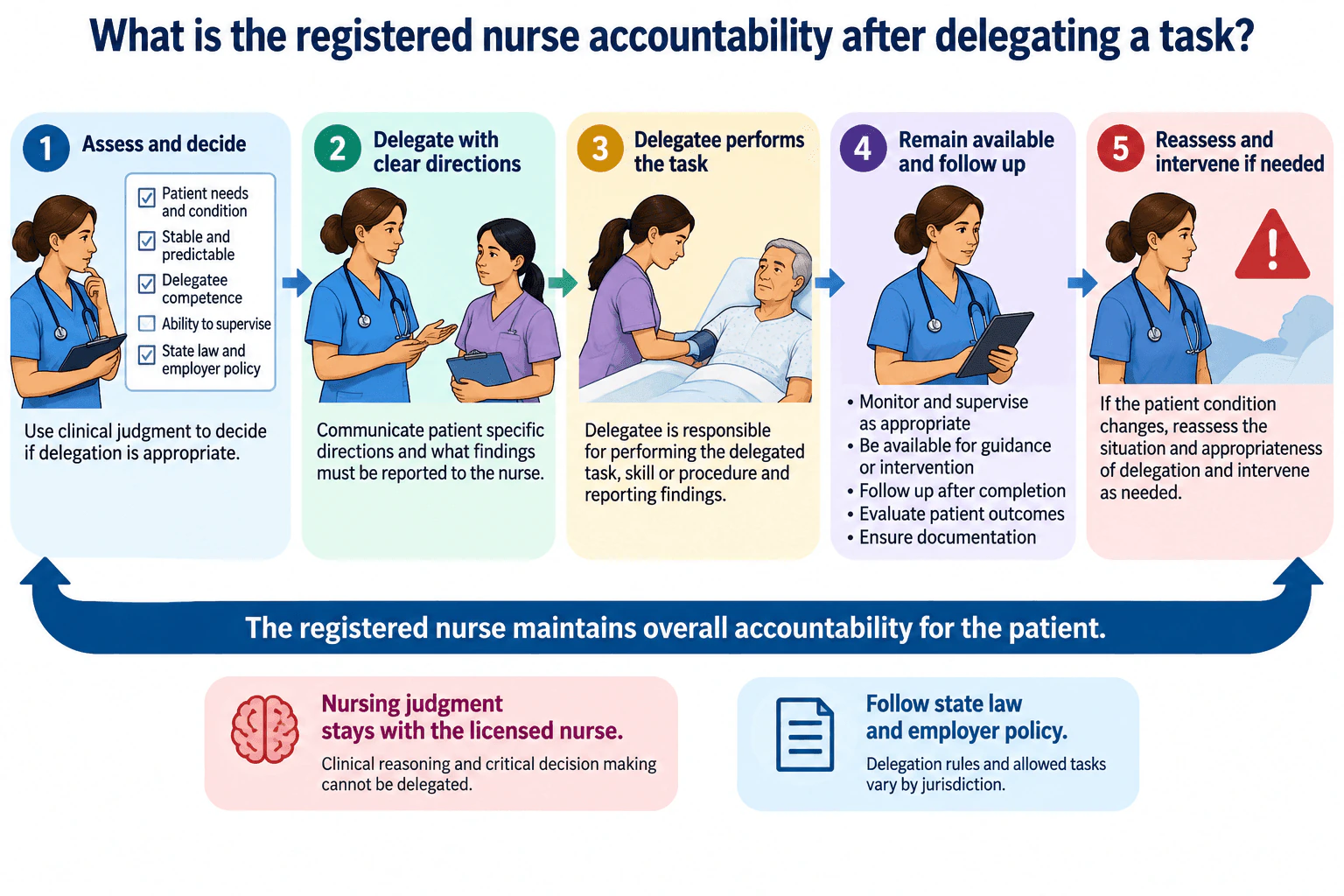
After I delegate a task, I still remain accountable for the patient and for the appropriateness of the delegation. I confirm that the task, patient situation, and delegatee are appropriate, give clear patient specific directions and reporting expectations, remain available, supervise and follow up as needed, and evaluate the outcome. The delegatee is responsible for performing the delegated activity correctly and reporting findings. If the patient's condition changes, I reassess the situation and intervene rather than assuming the original delegation is still appropriate. ncsbn.org
Detailed Explanation
Delegation allows another qualified team member to perform an appropriate activity, but it does not transfer the RN's nursing judgment or accountability for the patient. The delegatee is responsible for performing the delegated activity correctly and reporting findings, while the RN remains responsible for deciding whether delegation is appropriate, communicating clearly, supervising, following up, evaluating the outcome, and responding when the situation changes. ncsbn.org
Useful Questions to Ask the Interviewer
How does this ICU validate competence for activities that may be delegated?
What are the unit expectations for supervision and follow up after delegation?
How should changes in patient condition be communicated when a delegated activity is underway?
How to Explain It in an Interview
Assess and Decide
Before delegating, I consider the patient's needs and condition, whether the situation is stable and predictable, the delegatee's documented competence, my ability to supervise, applicable state requirements, and employer policy. If the activity requires nursing judgment, clinical reasoning, or critical decision making, I do not delegate that judgment. ncsbn.org
Give Clear Directions
I communicate the patient specific task, relevant patient information, what findings must be reported, and when communication should occur. Delegation should involve clear communication between the RN and the delegatee rather than simply handing off a task. ncsbn.org
Delegatee Performs the Task
The qualified delegatee is responsible for correctly performing the delegated activity, skill, or procedure and for reporting the requested findings. The RN's accountability for the patient remains in place while the delegatee carries out that responsibility. ncsbn.org
Supervise and Follow Up
I remain available for questions, guidance, or intervention. I provide supervision appropriate to the patient, activity, and delegatee, follow up after completion, evaluate the patient outcome, and confirm that required documentation is completed. ncsbn.org
Reassess When Conditions Change
If the patient's condition or other circumstances change, I reassess the situation and whether delegation remains appropriate. I intervene or resume the activity when needed. Delegation rules vary by jurisdiction, so I also follow the applicable nurse practice requirements and employer policies. ncsbn.org
Why Interviewers Ask This
Interviewers are assessing whether the nurse understands that delegation transfers performance of an appropriate activity, not the RN's professional accountability or nursing judgment. A safe answer shows that the RN considers the patient's needs and condition, stability and predictability, delegatee competence, ability to supervise, communication, follow up, evaluation, and applicable delegation rules. ncsbn.org
Common interview mistakes
Common mistakes include assuming accountability ends when another team member accepts the task, delegating without considering the patient's condition or the delegatee's competence, giving unclear directions, failing to identify findings that must be reported, failing to remain available or follow up, and treating nursing assessment, clinical reasoning, or critical decision making as delegable. Another mistake is assuming that a task permitted in one jurisdiction or organization is automatically permitted everywhere. ncsbn.org
Interview tip
Use the same sequence shown in the diagram: assess and decide, give clear directions, have the qualified delegatee perform and report the task, remain available and follow up, then reassess and intervene when needed. State clearly that the RN maintains accountability for the patient while the delegatee remains responsible for the delegated activity.
Interviewer may ask next
How would you verify that the delegated task was completed safely?
I would follow up with the delegatee, review the findings that were supposed to be reported, evaluate the patient's response and outcome, and confirm that required documentation is completed. If the findings are unexpected or the patient's condition has changed, I would reassess and intervene as appropriate. ncsbn.org
What would you do if the patient's condition changed after you delegated the task?
I would reassess the patient and reconsider whether the delegation remains appropriate. I would remain available to guide the delegatee, intervene, or resume the activity if the changed condition requires nursing judgment or makes continued delegation inappropriate. I would also escalate care as clinically indicated and follow applicable state requirements and employer policy. ncsbn.org
73. How do you prioritize two patients who both need attention?Prioritization And DelegationMedium
i Question Details
Compare physiologic instability, immediacy of harm, time sensitive treatments, available assistance, and what can safely wait or be delegated.
Short Interview Answer (30-60 seconds)
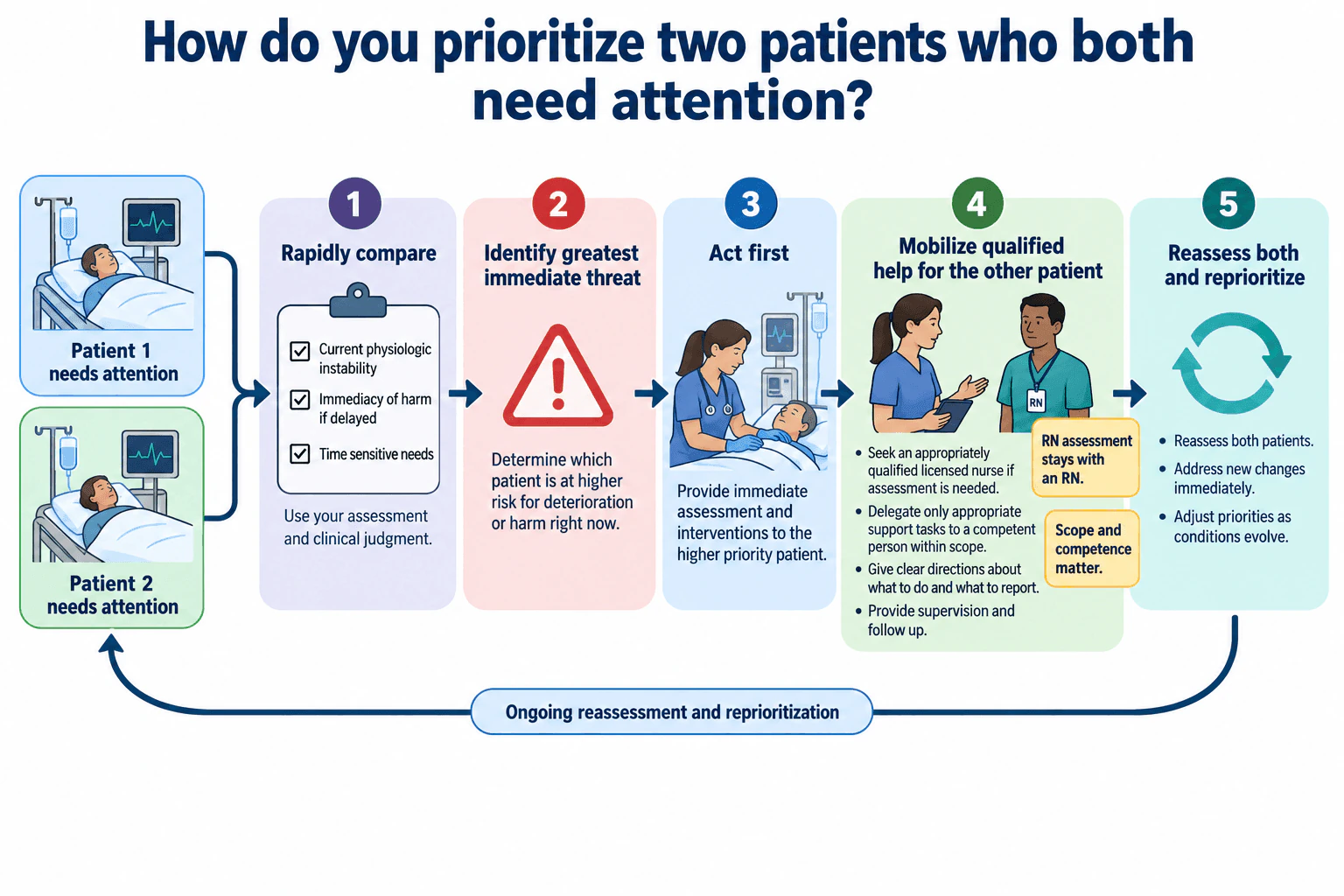
I would rapidly compare both patients for physiologic instability, immediate risk of harm if care is delayed, and time sensitive needs. I would act first for the patient with the greatest immediate threat while arranging qualified help for the other patient. If assessment is needed, I would use an appropriately qualified licensed nurse rather than delegate nursing assessment to assistive personnel. I would delegate only permitted support tasks to competent staff with clear directions, supervision, and follow up, then reassess both patients and reprioritize if either condition changes.
Detailed Explanation
The priority is not simply which patient called first, has pain, or has scheduled care due. I compare what is happening with each patient right now: current physiologic instability, how quickly harm could occur if care is delayed, and whether there is a time sensitive need. I then act first for the patient with the greatest immediate threat while organizing safe care for the other patient.
Useful Questions to Ask the Interviewer
What qualified resources are available when two ICU patients need attention at the same time?
How does the unit define delegation responsibilities among RNs, other licensed nurses, and assistive personnel?
What escalation process is used when patient acuity exceeds the resources immediately available?
How to Explain It in an Interview
Priority Decision
I would rapidly assess the competing needs and compare current physiologic instability, immediacy of harm if I delay care, and time sensitive needs. I would identify which patient is at greater risk of deterioration or harm right now and provide immediate assessment and appropriate interventions to that patient first.
Staff Competence
I would also mobilize qualified help for the other patient. If that patient needs nursing assessment or clinical judgment, I would ask an appropriately qualified licensed nurse to assess the patient. I would delegate only permitted support tasks to someone whose role and demonstrated competence match the task. Delegation requirements vary by jurisdiction and organization, so I would follow the applicable nurse practice act and facility policy. ncsbn.org
Directions and Communication
For a task that can safely be delegated, I would apply the Five Rights of Delegation: right task, right circumstance, right person, right directions and communication, and right supervision and evaluation. I would state exactly what needs to be done, what findings must be reported, and when I need an update. ncsbn.org
Supervision and Evaluation
I would supervise and follow up on delegated care rather than assuming the task is complete. I would then reassess both patients, address new changes promptly, and adjust priorities as conditions evolve. The priority decision is dynamic because either patient's clinical status can change.
Why Interviewers Ask This
Interviewers want to know whether I can compare competing ICU needs using actual urgency rather than a fixed task order, recognize which patient is at greatest immediate risk, use available staff appropriately, delegate within scope and competence, communicate clearly, supervise delegated work, and continually reassess. These decisions demonstrate clinical judgment, safe assignment, and responsible delegation when resources are limited.
Common interview mistakes
Common mistakes include ranking patients only by pain, scheduled treatments, or task order without considering physiologic instability and immediate risk; trying to manage both patients alone when qualified help is available; delegating nursing assessment or clinical judgment to assistive personnel; assigning work without checking scope or staff competence; giving unclear directions; and failing to supervise, follow up, reassess both patients, and reprioritize when conditions change.
Interview tip
Explain the sequence clearly: rapidly compare instability, immediate risk, and time sensitive needs; identify the greatest immediate threat; act for that patient first; mobilize qualified help for the other patient; delegate only appropriate support tasks with clear directions and supervision; then reassess both patients and reprioritize as conditions evolve.
Interviewer may ask next
How do you verify that a delegated task was completed safely?
I give specific directions about the task, what observations must be reported, and when I expect an update. I verify that the person has the appropriate role and competence, remain available for supervision, follow up when the task is completed, evaluate the relevant patient response, and intervene or reassess if the situation changes. These steps reflect the right directions and communication and the right supervision and evaluation in the Five Rights of Delegation. ncsbn.org
What would you do if the patient who initially seemed lower priority suddenly deteriorated?
I would immediately reassess both patients and reprioritize based on their current physiologic instability, immediacy of harm, and time sensitive needs. If the previously lower priority patient now has the greater immediate threat, that patient becomes the higher priority. I would mobilize qualified assistance for the other patient, communicate the change, provide appropriate care within my scope and applicable orders or protocols, and continue reassessing both patients.
74. Three critical patients need attention at once. How do you set priorities and use the team?Prioritization And DelegationHard
i Question Details
Identify the most immediate airway, breathing, circulation, or neurologic threat, start urgent care, delegate predictable tasks, communicate with charge staff, and reassess all three patients as resources arrive.
Short Interview Answer (30-60 seconds)
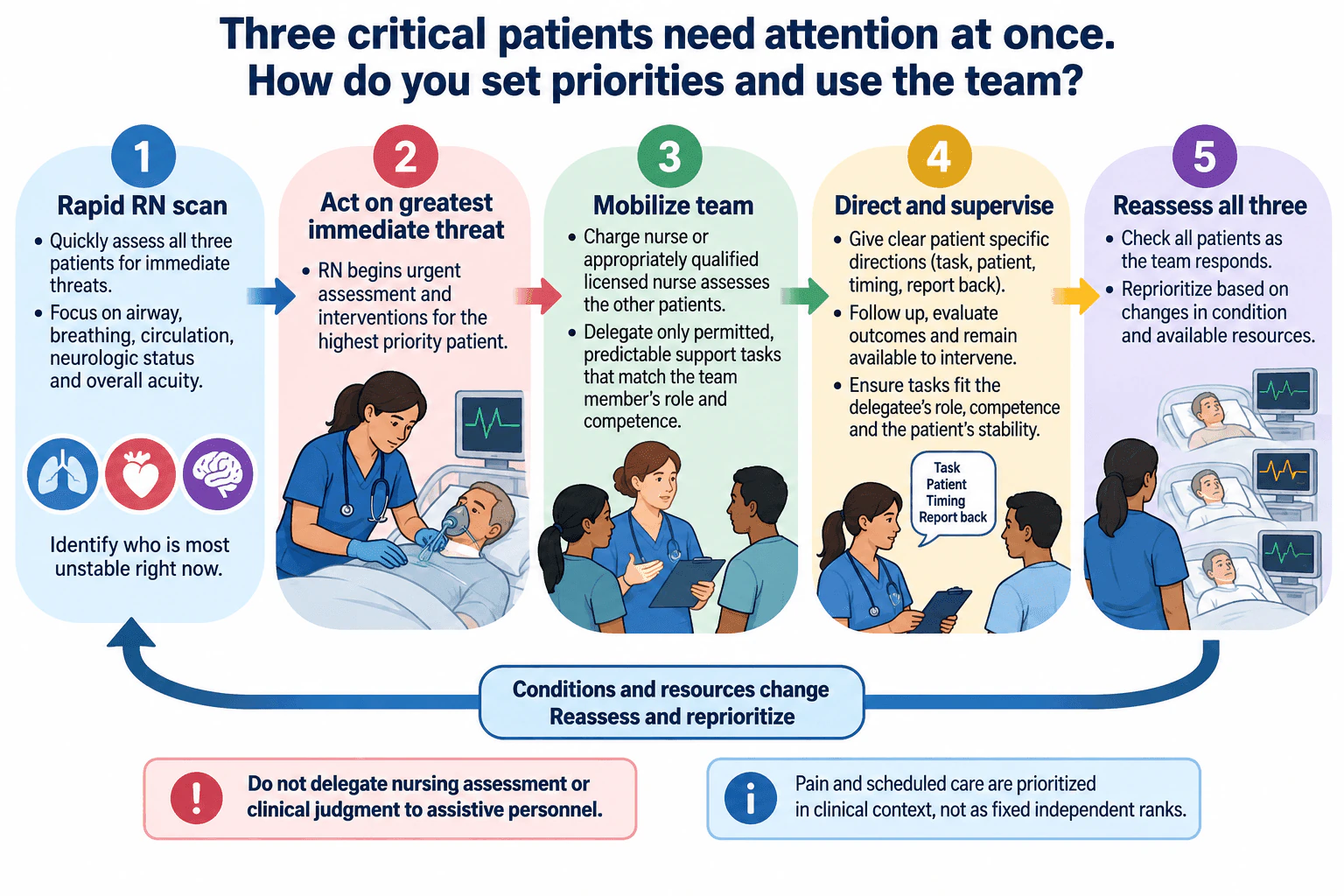
I first perform a rapid RN scan of all three patients and identify who has the greatest immediate airway, breathing, circulation, neurologic, or other acuity threat. I begin urgent assessment and appropriate care for that patient while communicating with the charge nurse and mobilizing qualified staff. An appropriately qualified licensed nurse can assess another patient, while permitted predictable support tasks can be delegated to competent staff with clear directions and follow up. I then reassess all three patients and reprioritize as their conditions and available resources change.
Detailed Explanation
The key is to treat prioritization as a continuous clinical decision rather than a fixed ranking. I rapidly assess all three patients, identify the most immediate threat, act on that threat, use the team according to competence and scope, and keep reassessing as conditions and resources change.
Useful Questions to Ask the Interviewer
How are charge nurse and resource nurse responsibilities structured when several ICU patients need urgent attention at the same time?
What additional nursing resources are normally available when multiple patients require assessment or intervention simultaneously?
How does the organization define delegation and supervision responsibilities for assistive personnel?
How to Explain It in an Interview
I would start with a rapid RN scan of all three patients rather than assuming that pain, scheduled care, or any other single task automatically comes first. I would compare actual urgency, airway, breathing, circulation, neurologic status, overall acuity, stability, and risk of deterioration. The patient with the greatest immediate threat receives my immediate attention.
I would begin the nursing assessment and appropriate urgent actions that are within my scope and authorized by applicable orders, protocols, and local policy. If additional medical evaluation or treatment is needed, I would escalate through the appropriate clinical pathway rather than acting outside my authority.
At the same time, I would communicate with the charge nurse and mobilize available staff. An appropriately qualified licensed nurse can assess another patient within that nurse's scope and assignment. For assistive personnel, I would delegate only permitted, predictable support tasks when the patient's condition, circumstances, and staff competence make delegation appropriate. Nursing assessment, clinical reasoning, and nursing judgment remain with the licensed nurse.
I would apply the five rights of delegation: right task, right circumstance, right person, right directions and communication, and right supervision and evaluation. My directions would be patient specific and would state the task, timing, expected observations, and what must be reported back. I would remain available, follow up, and evaluate the patient's response rather than assuming that delegation ends my responsibility.
Finally, I would reassess all three patients as the team responds. ICU priorities can change quickly, so I would reprioritize whenever patient condition or available resources change. This creates one continuous cycle of rapid assessment, urgent action, team mobilization, clear direction, supervision, and reassessment.
Why Interviewers Ask This
Interviewers are evaluating whether I can recognize the most urgent threat, organize competing ICU needs, use licensed and assistive team members within their roles, communicate with charge staff, delegate safely, supervise delegated care, and continually reassess rather than treating priorities as fixed. Safe delegation requires consideration of the patient's condition, stability and predictability, staff competence, available supervision, applicable nursing law, and facility policy.
Common interview mistakes
Common mistakes include treating priorities as a fixed task list, ranking pain or scheduled care without considering the full clinical context, focusing on only one patient without reassessing the others, delegating nursing assessment or clinical judgment to assistive personnel, assigning support tasks without considering patient stability and staff competence, giving vague directions, failing to specify what must be reported back, and failing to supervise and evaluate delegated care.
Interview tip
Describe the sequence clearly: rapidly assess all three patients, act on the greatest immediate threat, communicate with charge staff, mobilize qualified staff, delegate only appropriate predictable support tasks with specific directions, supervise the work, and reassess everyone. Make it explicit that changes in patient condition or available resources can change the priority at any time.
Interviewer may ask next
How do you verify that a delegated task was completed safely?
I give clear patient specific directions before delegation, including the task, timing, expected observations, and what findings must be reported. I remain available for questions, follow up with the delegatee, review the patient's response or other relevant result, and determine whether further nursing assessment or intervention is needed. Delegation does not remove the RN's responsibility for appropriate supervision and evaluation.
What would you do if a previously stable patient suddenly deteriorated while you were caring for the highest priority patient?
I would immediately reassess priorities because the clinical context has changed. I would compare the new threat with the needs of the patient I am already treating, call for additional qualified help, communicate the change to charge staff, and direct available licensed staff according to acuity, competence, scope, and available resources. I would continue appropriate urgent care and escalation while making sure all three patients remain under active surveillance and are reassessed as resources arrive.
75. What is sepsis?Sepsis And Multiorgan DysfunctionEasy
i Question Details
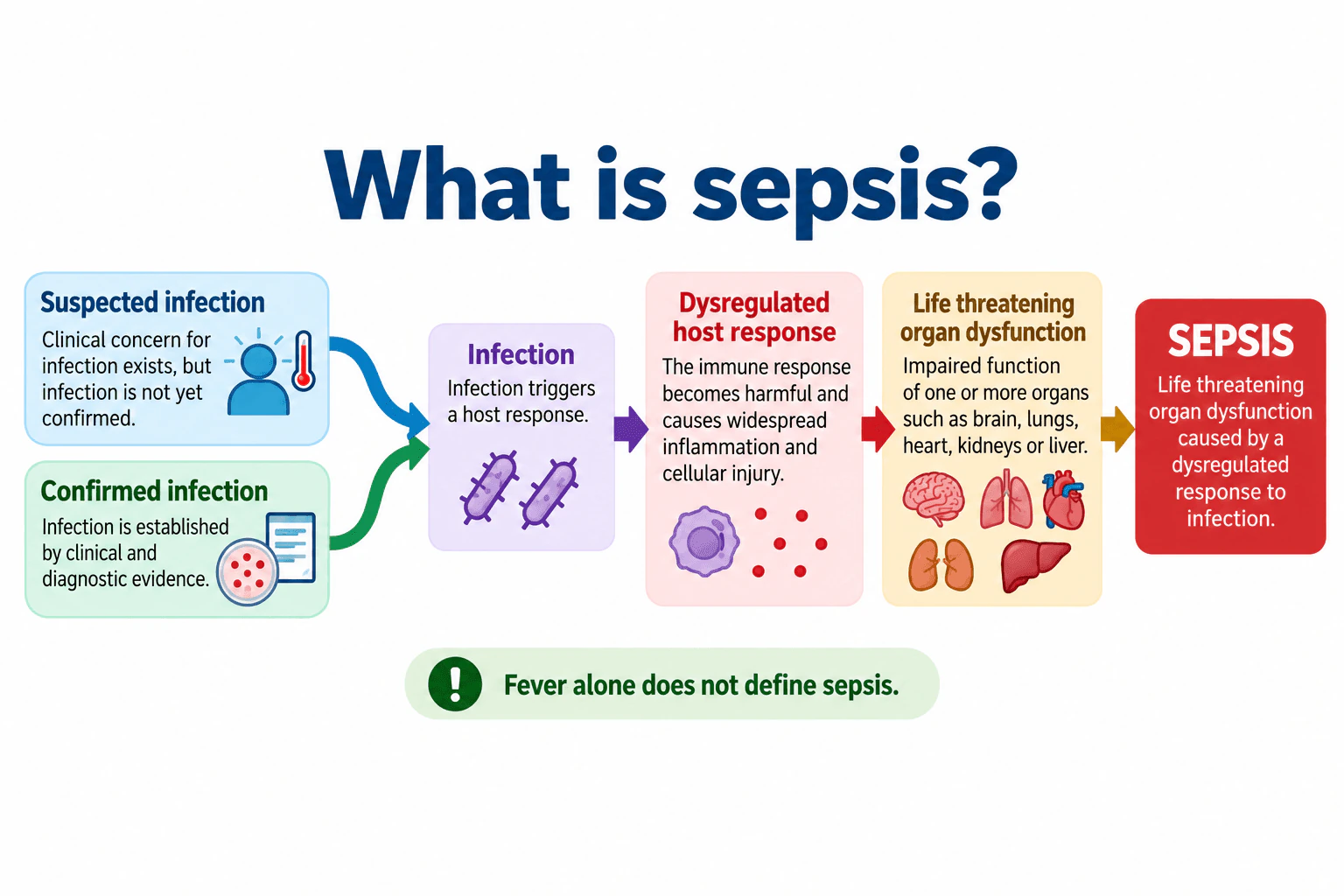
Explain sepsis as life threatening organ dysfunction caused by a dysregulated response to infection and distinguish suspected infection from confirmed infection.
Short Interview Answer (30-60 seconds)
Sepsis is life threatening organ dysfunction caused by a dysregulated host response to infection. The infection may initially be suspected clinically or may be established through clinical and diagnostic evidence. The key distinction is that sepsis involves harmful host response and resulting organ dysfunction, not infection or fever alone.
Detailed Explanation
Sepsis is life threatening organ dysfunction caused by a dysregulated host response to infection. A patient may initially have suspected infection when the clinical picture raises concern but infection is not yet established. As clinical and diagnostic evidence accumulates, the infection may become established. A positive culture is not required in every case because the diagnosis of infection depends on the total clinical and diagnostic evidence.
The important distinction is that infection alone is not sepsis. In sepsis, the host response becomes dysregulated and harmful, contributing to cellular injury and impaired function of one or more organs. Findings may involve the brain, lungs, heart, kidneys, liver, or other organs depending on the patient. Fever can accompany infection, but fever alone does not define sepsis.
Useful Questions to Ask the Interviewer
How does your ICU communicate concern when infection is suspected but not yet established?
What assessment and documentation expectations do bedside nurses follow when new organ dysfunction develops with suspected infection?
How does the team reassess patients when the cause of organ dysfunction remains uncertain?
How to Explain It in an Interview
I would define sepsis as life threatening organ dysfunction caused by a dysregulated host response to infection. I think of the concept as a progression from infection to an abnormal host response and then clinically important organ dysfunction.
The infection can initially be suspected based on the clinical picture. It may later become established through clinical and diagnostic evidence. I would not require a positive culture before recognizing concern because not every clinically established infection has culture confirmation.
What separates sepsis from uncomplicated infection is organ dysfunction caused by the harmful host response. The response to infection becomes dysregulated and can contribute to inflammatory and cellular injury, with impaired function in organs such as the brain, lungs, heart, kidneys, or liver.
As a bedside ICU nurse, I would recognize and communicate new deterioration promptly, support ordered evaluation and therapy within nursing scope, and reassess the patient's response. I would not diagnose sepsis from fever alone or assume that every case of organ dysfunction is infectious. Screening tools can support recognition, but they do not replace clinical assessment and diagnostic evaluation.
Why Interviewers Ask This
Interviewers are assessing whether the nurse can distinguish infection from sepsis, recognize organ dysfunction as central to the definition, distinguish suspected infection from infection supported by clinical and diagnostic evidence, and avoid treating fever or a screening score as definitive proof of sepsis.
Common interview mistakes
Common mistakes include defining sepsis as infection alone, treating fever as diagnostic of sepsis, waiting for a positive culture before recognizing possible sepsis, assuming every case of organ dysfunction is caused by infection, and treating a screening score as a definitive diagnosis.
Interview tip
Start with the definition, then distinguish suspected infection from infection established by clinical and diagnostic evidence. Explain that sepsis requires life threatening organ dysfunction from a dysregulated host response to infection, and state that fever alone does not define sepsis.
Interviewer may ask next
How would you verify whether a patient with suspected infection may have sepsis?
I would assess for new or worsening organ dysfunction in the context of suspected infection, review the available clinical and diagnostic evidence, trend the patient's condition, and communicate concerning deterioration promptly. I would not rely on fever, a positive culture, or a screening score alone. The diagnosis depends on the overall clinical picture of infection with life threatening organ dysfunction caused by a dysregulated host response.
What changes if the patient has multiorgan dysfunction but there is no evidence of infection?
I would not automatically call the deterioration sepsis. Multiorgan dysfunction can have infectious or noninfectious causes. I would continue focused assessment, communicate the deterioration promptly, support the ordered evaluation, and reassess as new information becomes available. Sepsis specifically requires organ dysfunction caused by a dysregulated host response to infection.
76. What is septic shock?Sepsis And Multiorgan DysfunctionEasy
i Question Details
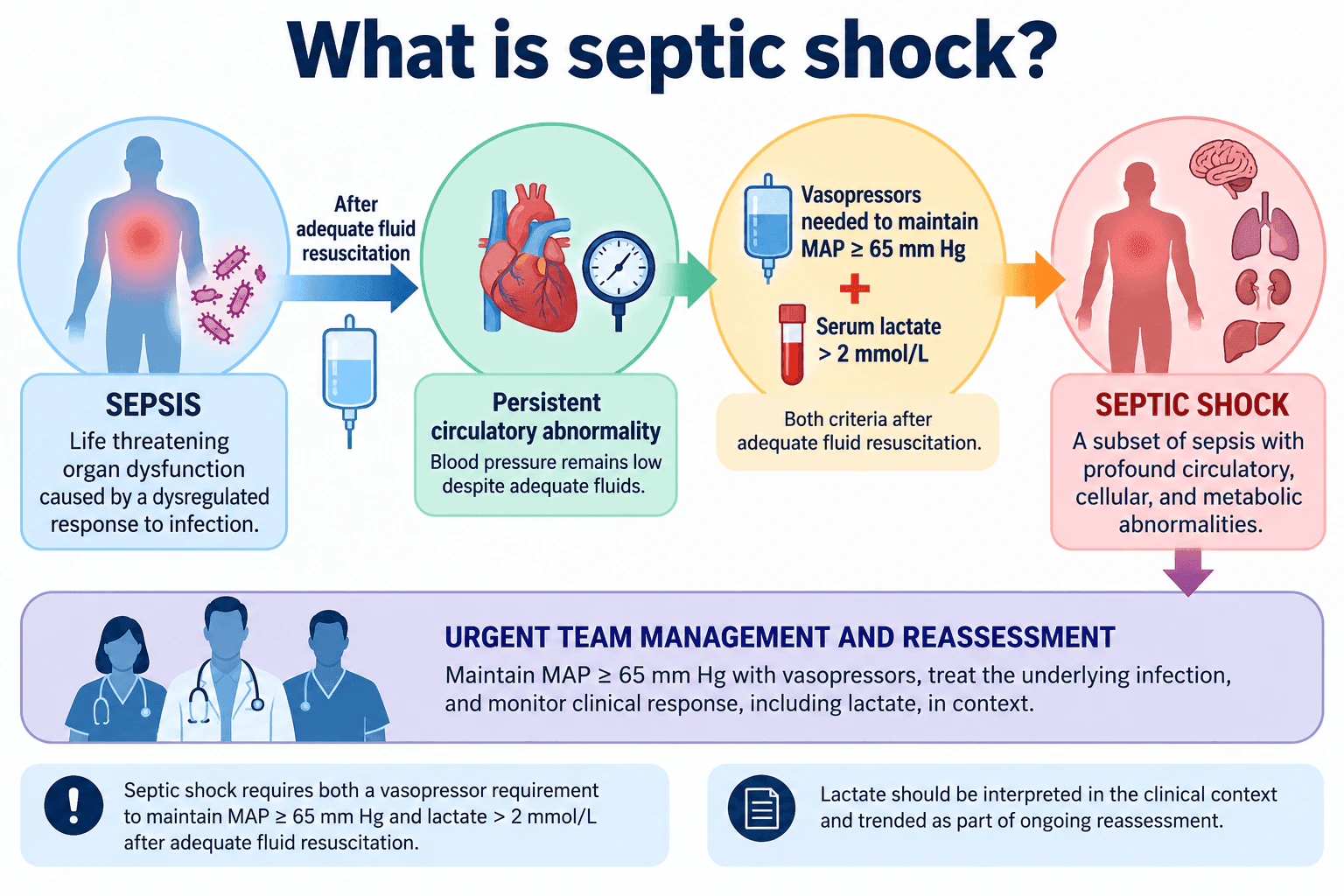
Describe septic shock as a severe subset of sepsis with persistent circulatory and metabolic abnormalities requiring urgent team based management.
Short Interview Answer (30-60 seconds)
Septic shock is a severe subset of sepsis with profound circulatory, cellular, and metabolic abnormalities. In adults, the Sepsis 3 clinical criteria are a vasopressor requirement to maintain mean arterial pressure at 65 mm Hg or greater plus a serum lactate greater than 2 mmol/L despite adequate fluid resuscitation. It requires urgent team based management, treatment of the underlying infection, and close reassessment of perfusion and clinical response.
Detailed Explanation
Septic shock is more than infection with low blood pressure. It is a severe subset of sepsis in which profound circulatory, cellular, and metabolic abnormalities persist despite adequate fluid resuscitation. For adults, the Sepsis 3 clinical criteria are a need for vasopressors to maintain mean arterial pressure, or MAP, at 65 mm Hg or greater together with a serum lactate greater than 2 mmol/L despite adequate fluid resuscitation.
Useful Questions to Ask the Interviewer
What sepsis escalation pathway does this ICU use when septic shock is suspected?
How are nurses expected to communicate changes in perfusion and lactate trends to the critical care team?
What reassessment practices are used after fluid and vasopressor therapy begins?
How to Explain It in an Interview
Clinical Principle
I would explain that sepsis is life threatening organ dysfunction caused by a dysregulated response to infection. Septic shock is a more severe subset in which profound circulatory, cellular, and metabolic abnormalities persist despite adequate fluid resuscitation.
Recognition
In an adult patient with sepsis, I would recognize the Sepsis 3 clinical criteria for septic shock when vasopressors are required to maintain MAP at 65 mm Hg or greater and serum lactate remains greater than 2 mmol/L despite adequate fluid resuscitation. Lactate should be interpreted in the clinical context because other conditions can elevate it, so a single lactate value should not be treated as a diagnosis by itself.
Nursing Priorities
I would escalate suspected septic shock promptly and coordinate ordered evaluation and treatment with the critical care team. Nursing support includes frequent assessment of blood pressure, perfusion, mental status, urine output, respiratory status, and evidence of worsening organ dysfunction. I would administer prescribed therapies within nursing scope and applicable protocol, including fluids, antimicrobials, and vasopressors when ordered or protocol authorized.
Reassessment and Escalation
I would repeatedly assess the patient's response rather than treating one MAP or lactate result as the endpoint. I would trend perfusion findings, blood pressure response, lactate when ordered, and evidence of evolving organ dysfunction, then promptly communicate deterioration or inadequate response. The key point is that septic shock requires urgent team based management because the infection and the persistent circulatory and metabolic abnormalities must be addressed together.
Why Interviewers Ask This
Interviewers want to know whether the nurse can distinguish septic shock from sepsis alone, recognize persistent circulatory and metabolic abnormalities after adequate fluid resuscitation, escalate promptly, coordinate ordered treatment, and reassess the patient's response.
Common interview mistakes
Common mistakes include calling any infection with hypotension septic shock, diagnosing sepsis from fever alone, treating an elevated lactate as diagnostic by itself, forgetting that the Sepsis 3 septic shock criteria require both vasopressor support to maintain MAP at 65 mm Hg or greater and lactate greater than 2 mmol/L despite adequate fluid resuscitation, or failing to reassess the patient after treatment begins.
Interview tip
State the definition first, then give the two adult clinical criteria shown in the diagram: vasopressors are required to maintain MAP at 65 mm Hg or greater and serum lactate is greater than 2 mmol/L despite adequate fluid resuscitation. Finish by emphasizing urgent team based management, treatment of the infection, and repeated reassessment of clinical response.
Interviewer may ask next
How would you verify that an adult patient meets the clinical criteria for septic shock?
I would confirm that the patient has sepsis and that, despite adequate fluid resuscitation, vasopressors are required to maintain MAP at 65 mm Hg or greater while serum lactate remains greater than 2 mmol/L. I would interpret those findings within the complete clinical picture and continue reassessing perfusion and organ function.
What if an adult patient with sepsis has lactate greater than 2 mmol/L after fluids but does not require vasopressors?
That patient does not meet the Sepsis 3 clinical criteria for septic shock based on lactate alone. I would continue urgent assessment and treatment of sepsis, consider other causes of lactate elevation, monitor for worsening perfusion or organ dysfunction, and escalate any deterioration promptly.
77. What is multiorgan dysfunction?Sepsis And Multiorgan DysfunctionEasy
i Question Details
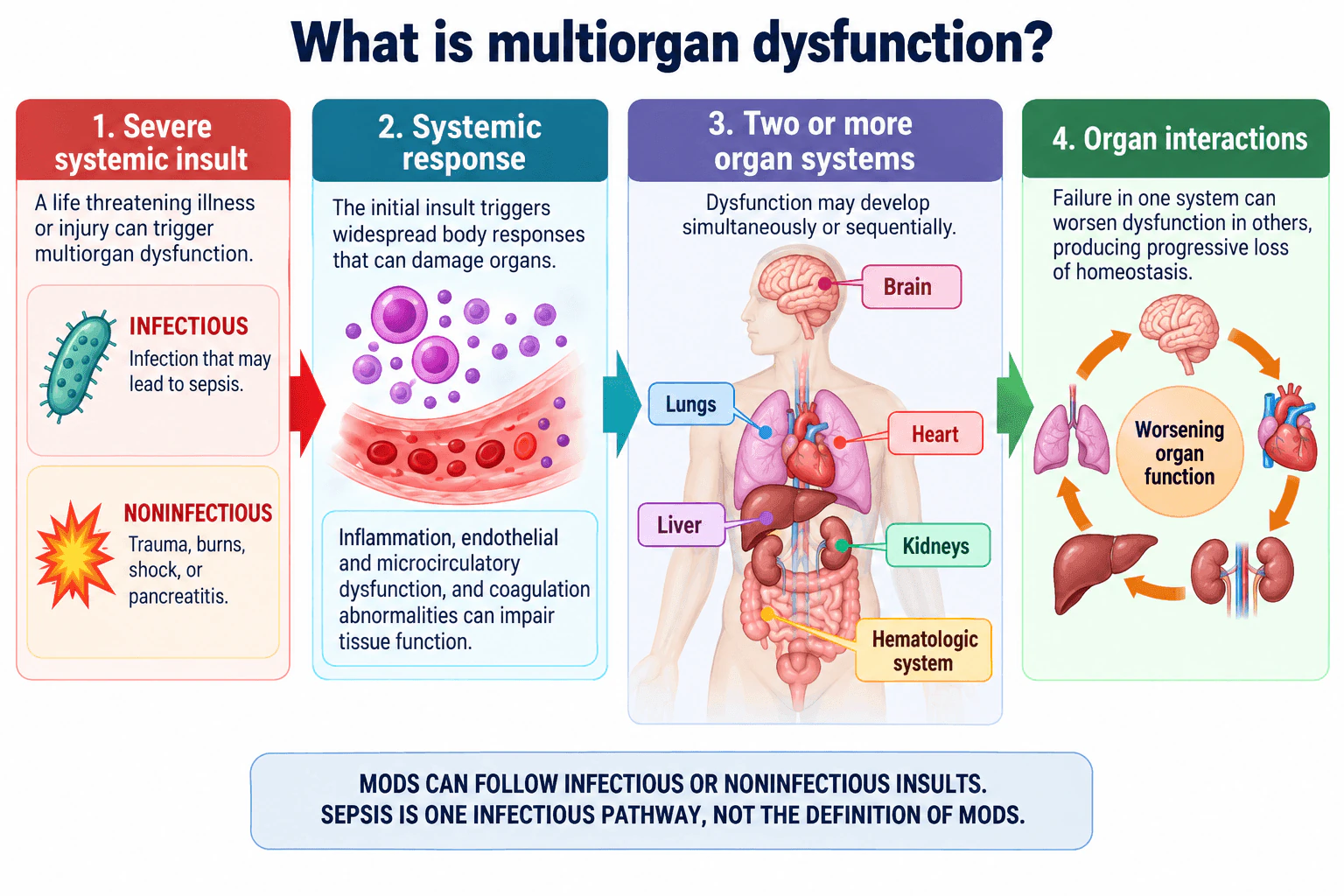
Explain multiorgan dysfunction as progressive impairment of two or more organ systems from a severe systemic insult that may be infectious or noninfectious.
Short Interview Answer (30-60 seconds)
Multiorgan dysfunction is progressive impairment of two or more organ systems after a severe systemic insult. The insult may be infectious, including sepsis, or noninfectious, such as trauma, burns, shock, or pancreatitis. Inflammation, endothelial and microcirculatory dysfunction, and coagulation abnormalities can contribute to tissue dysfunction. Organ systems may deteriorate simultaneously or sequentially, and failure in one system can worsen dysfunction in others. Sepsis is one infectious pathway to multiorgan dysfunction, not the definition of multiorgan dysfunction.
Detailed Explanation
Multiorgan dysfunction means that two or more organ systems are becoming impaired after a severe systemic illness or injury. The initiating insult may be infectious or noninfectious, so multiorgan dysfunction alone does not establish that a patient has sepsis.
Useful Questions to Ask the Interviewer
Does your ICU use a standardized process for trending changes across multiple organ systems?
How are new or worsening multiorgan changes communicated and escalated within the ICU team?
Which bedside and laboratory trends are emphasized when following neurologic, respiratory, cardiovascular, hepatic, renal, and hematologic function?
How to Explain It in an Interview
A severe systemic insult can trigger widespread physiologic responses that affect tissues throughout the body. The insult may be infectious, including infection that progresses to sepsis, or noninfectious, such as major trauma, burns, shock, or pancreatitis.
Inflammation, endothelial dysfunction, impaired microcirculation, and coagulation abnormalities can interfere with normal tissue function. As the process progresses, two or more organ systems may become dysfunctional. Systems that can be involved include the brain, lungs, heart, liver, kidneys, and hematologic system.
The dysfunction may develop simultaneously or sequentially. Organ interactions are important because deterioration in one system can place additional stress on other systems and contribute to progressive loss of homeostasis.
For example, a critically ill patient may develop worsening renal function together with respiratory, neurologic, hepatic, cardiovascular, or hematologic abnormalities. As a bedside ICU nurse, I would view those changes as an integrated pattern, trend the relevant assessment and laboratory findings, communicate significant deterioration promptly, and reassess the patient as the clinical plan is carried out.
I would also distinguish multiorgan dysfunction from sepsis. Sepsis is life threatening organ dysfunction caused by a dysregulated host response to infection. Sepsis can lead to multiorgan dysfunction, but severe noninfectious insults can also produce multiorgan dysfunction.
Why Interviewers Ask This
Interviewers want to know whether a critical care nurse understands that multiorgan dysfunction involves at least two organ systems, recognizes that the initiating insult may be infectious or noninfectious, and understands how dysfunction in one organ can contribute to deterioration in others. They are also assessing whether the nurse can distinguish multiorgan dysfunction from sepsis rather than treating the terms as interchangeable.
Common interview mistakes
Common mistakes include assuming that all multiorgan dysfunction is caused by infection, using sepsis and multiorgan dysfunction as interchangeable terms, focusing on one impaired organ without considering effects on other systems, and overlooking hematologic or coagulation abnormalities as part of the overall pattern.
Interview tip
Start with the definition: progressive impairment of two or more organ systems after a severe systemic insult. Then explain that the cause may be infectious or noninfectious, that dysfunction can develop simultaneously or sequentially, and that failure in one organ can worsen dysfunction in others. Finish by distinguishing sepsis as one infectious pathway rather than the definition of multiorgan dysfunction.
Interviewer may ask next
How would you verify that a patient is developing multiorgan dysfunction?
I would look for clinical and objective evidence that at least two organ systems are becoming dysfunctional and trend those changes over time rather than relying on one isolated finding. I would integrate bedside assessment with relevant laboratory and monitoring data, compare findings with the patient's prior status and current illness, and communicate significant deterioration to the appropriate clinical team. If infection is suspected, I would evaluate that possibility without assuming that multiorgan dysfunction by itself proves sepsis.
How would your reasoning change if the patient had severe trauma without evidence of infection?
I would still recognize progressive dysfunction of two or more organ systems as multiorgan dysfunction. Severe trauma is a noninfectious systemic insult that can produce inflammation, endothelial and microcirculatory dysfunction, coagulation abnormalities, and interacting organ injury. I would follow the pattern of organ deterioration and escalate meaningful changes without labeling the condition sepsis unless an infectious process and sepsis criteria were supported.
78. What is disseminated intravascular coagulation?Sepsis And Multiorgan DysfunctionEasy
Short Interview Answer (30-60 seconds)
Disseminated intravascular coagulation, or DIC, is a serious acquired disorder in which coagulation becomes abnormally activated throughout the circulation. Small clots can reduce blood flow and contribute to organ dysfunction, while continued coagulation consumes platelets and clotting factors and can lead to significant bleeding. DIC is secondary to another condition, such as severe infection, major tissue injury, malignancy, or an obstetric complication. As an ICU nurse, I would watch closely for bleeding, worsening organ function, changing laboratory trends, and clinical deterioration, then escalate promptly and support treatment of the underlying cause and ordered therapies.
Detailed Explanation
DIC is an acquired coagulation disorder in which the body's clotting system becomes abnormally activated throughout the circulation rather than remaining limited to an injured area. This process can produce widespread small clots that reduce blood flow and contribute to organ dysfunction. At the same time, continued coagulation consumes platelets and clotting factors, which can increase the risk of serious bleeding.
Useful Questions to Ask the Interviewer
What monitoring and escalation protocols does your ICU use when DIC is suspected?
Which coagulation laboratory trends are routinely followed in patients at risk for DIC?
How does the bedside nurse coordinate with the multidisciplinary team when bleeding and organ dysfunction are progressing?
How to Explain It in an Interview
Clinical Principle
DIC is not a primary disease by itself. It develops because of an underlying problem such as severe infection, major tissue injury, malignancy, or an obstetric complication. Systemic coagulation activation can produce microthrombi that reduce tissue blood flow and contribute to organ dysfunction. At the same time, consumption of platelets and clotting factors can contribute to bleeding.
Assessment Findings
At the bedside, I would assess for new or increasing bleeding from vascular access sites, wounds, mucous membranes, urine, stool, or other sites. I would also watch for bruising and evidence of worsening organ function. Laboratory results must be interpreted together with the clinical picture and trended over time. Findings that can support DIC include a falling platelet count, prolonged coagulation times, increased fibrin degradation markers such as D dimer, and reduced fibrinogen, although individual results can vary and no single test confirms DIC by itself.
Nursing Priorities
My priorities are frequent assessment, trending clinical and laboratory changes, reducing avoidable bleeding risk within nursing scope, promptly communicating deterioration, and carrying out ordered diagnostic and supportive measures. Management also requires identifying and treating the underlying cause. Specific therapies, including blood products, depend on the patient's clinical condition, clinician orders, and applicable protocols.
Reassessment and Escalation
I would reassess for increasing bleeding, worsening perfusion, neurologic changes, respiratory deterioration, reduced urine output, and other evidence of evolving organ dysfunction. I would promptly escalate significant changes because DIC can progress rapidly and can involve both coagulation abnormalities and bleeding while contributing to multiorgan deterioration.
Why Interviewers Ask This
Interviewers want to know whether the nurse understands that DIC can involve both abnormal clot formation and bleeding, recognizes its relationship to serious underlying illness, and can identify appropriate monitoring, escalation, and reassessment priorities without treating one laboratory value as a definitive diagnosis.
Common interview mistakes
Common mistakes include describing DIC only as a bleeding disorder, overlooking simultaneous abnormal clot formation, assuming that infection is the only possible cause, diagnosing DIC from one abnormal laboratory result, or focusing on laboratory values without assessing bleeding and organ function.
Interview tip
Give the definition first, then connect the two key processes: widespread coagulation can reduce organ blood flow, while consumption of platelets and clotting factors can cause bleeding. Finish with bedside nursing priorities such as assessment, trend monitoring, timely escalation, treatment of the underlying cause, and reassessment.
Interviewer may ask next
How would you verify suspected DIC?
I would combine the clinical context with serial assessment and laboratory trends rather than rely on one test. Findings that can support DIC include thrombocytopenia, prolonged coagulation times, increased fibrin degradation markers such as D dimer, and reduced fibrinogen, although the pattern can vary. I would also assess for bleeding and worsening organ function while considering the underlying illness. Diagnostic criteria and interpretation belong within the multidisciplinary evaluation, and concerning deterioration should be escalated promptly.
How would your thinking change if the patient had multiorgan deterioration without evidence of infection?
I would not assume that multiorgan deterioration or DIC must be caused by infection. DIC can occur with noninfectious conditions such as major tissue injury, malignancy, and obstetric complications. I would continue assessing bleeding, coagulation abnormalities, perfusion, and organ function while communicating deterioration and supporting evaluation of the underlying cause. The clinical context determines the treatment plan.
79. How do you distinguish sepsis screening from a confirmed diagnosis?Sepsis And Multiorgan DysfunctionMedium
i Question Details
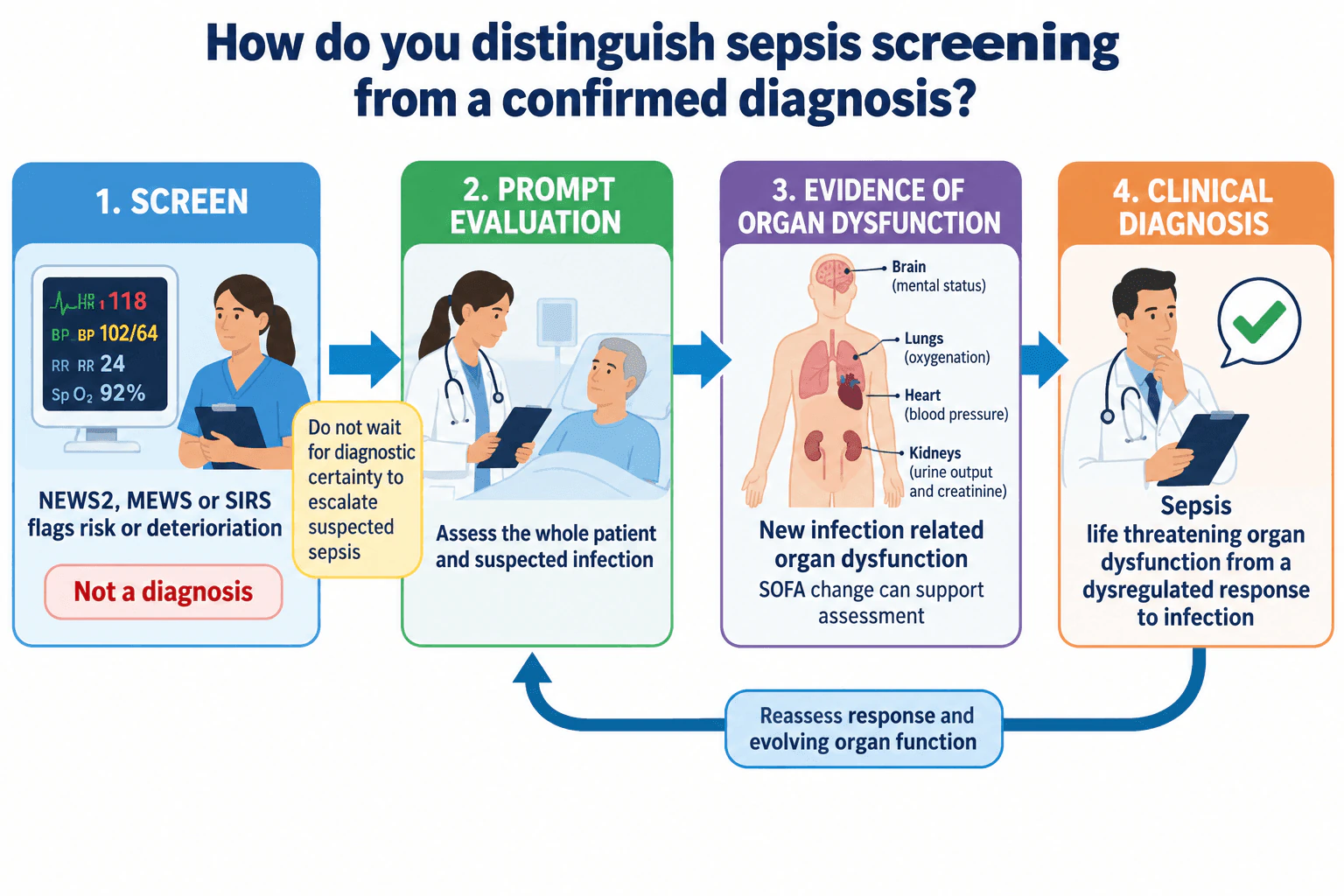
Explain that screening tools identify risk or deterioration and prompt evaluation, while diagnosis requires clinical assessment and evidence of infection related organ dysfunction.
Short Interview Answer (30-60 seconds)
I treat sepsis screening as an early warning step, not a diagnosis. NEWS2, MEWS, or SIRS can identify risk or deterioration and prompt evaluation. I then assess the whole patient for suspected infection and new organ dysfunction and escalate concern without waiting for diagnostic certainty. Sepsis itself is a clinical diagnosis of life threatening organ dysfunction caused by a dysregulated response to infection. A change in SOFA can support assessment, but no screening score or single test independently confirms sepsis.
Useful Questions to Ask the Interviewer
Which sepsis screening tool does your adult ICU use, and how is an abnormal screen escalated?
What is the bedside nurse's role when suspected sepsis triggers further evaluation?
How does your unit document reassessment while a patient is being evaluated for possible sepsis?
Detailed Explanation
How to Explain It in an Interview
I distinguish screening from diagnosis by asking what each step is designed to do. Screening is an early warning process. Tools such as NEWS2, MEWS, or SIRS can identify physiologic risk or deterioration and prompt further evaluation, but a positive screen does not establish sepsis.
If a screen or bedside change raises concern, I assess the whole patient and look for a plausible infection together with evidence of new organ dysfunction. Relevant changes can include altered mental status, impaired oxygenation, worsening blood pressure, reduced urine output, or changes in renal function. I interpret those findings in the patient's clinical context rather than treating any single abnormal value as diagnostic.
The diagnostic concept is different. Sepsis is life threatening organ dysfunction caused by a dysregulated response to infection. An acute change in SOFA can support assessment of organ dysfunction in a patient with suspected infection, but SOFA is not a stand alone diagnostic test. Likewise, a screening score should not independently rule sepsis in or out.
From a bedside nursing perspective, I would promptly communicate and escalate suspected sepsis rather than wait for complete diagnostic certainty. I would support evaluation and therapy that are ordered or authorized by protocol, then continue reassessing the patient's response and evolving organ function.
The key distinction is that screening asks whether a patient may be at risk or deteriorating and needs evaluation. Clinical diagnosis asks whether the complete assessment supports infection related life threatening organ dysfunction.
Why Interviewers Ask This
Interviewers want to know whether I can use sepsis screening as an early warning process without treating a score as a diagnosis. They are evaluating whether I recognize deterioration, connect suspected infection with new organ dysfunction, escalate concerns promptly, support appropriate evaluation, and continue reassessment while the clinical team determines whether sepsis is present.
Common interview mistakes
Common mistakes include treating an abnormal screening score as a confirmed diagnosis, diagnosing sepsis from fever alone, waiting for a single laboratory result before escalating concern, assuming all organ dysfunction is caused by infection, treating SOFA as a definitive diagnostic test, or failing to reassess because organ dysfunction can evolve over time.
Interview tip
State the distinction first: screening identifies risk or deterioration and triggers evaluation, while sepsis diagnosis requires clinical assessment of suspected infection and organ dysfunction. Then describe the nursing role as recognition, timely escalation, support of ordered or protocol authorized evaluation and therapy, and repeated reassessment.
Interviewer may ask next
How would you verify that an abnormal sepsis screen represents meaningful clinical deterioration rather than relying on the score alone?
I would validate the abnormal observations, compare them with the patient's baseline and recent trends, perform a focused assessment, review available information for suspected infection and new organ dysfunction, and promptly communicate concerning changes. I would use the screening result to trigger evaluation rather than treating the score itself as the diagnosis.
What changes if the patient has multiorgan deterioration but there is no clear evidence of infection?
I would still treat the deterioration as urgent and escalate it, but I would not automatically label it sepsis. I would communicate the organ changes, support evaluation for both infectious and noninfectious causes, monitor interactions between failing organs, and continue reassessing trends while the clinical team determines the underlying cause.
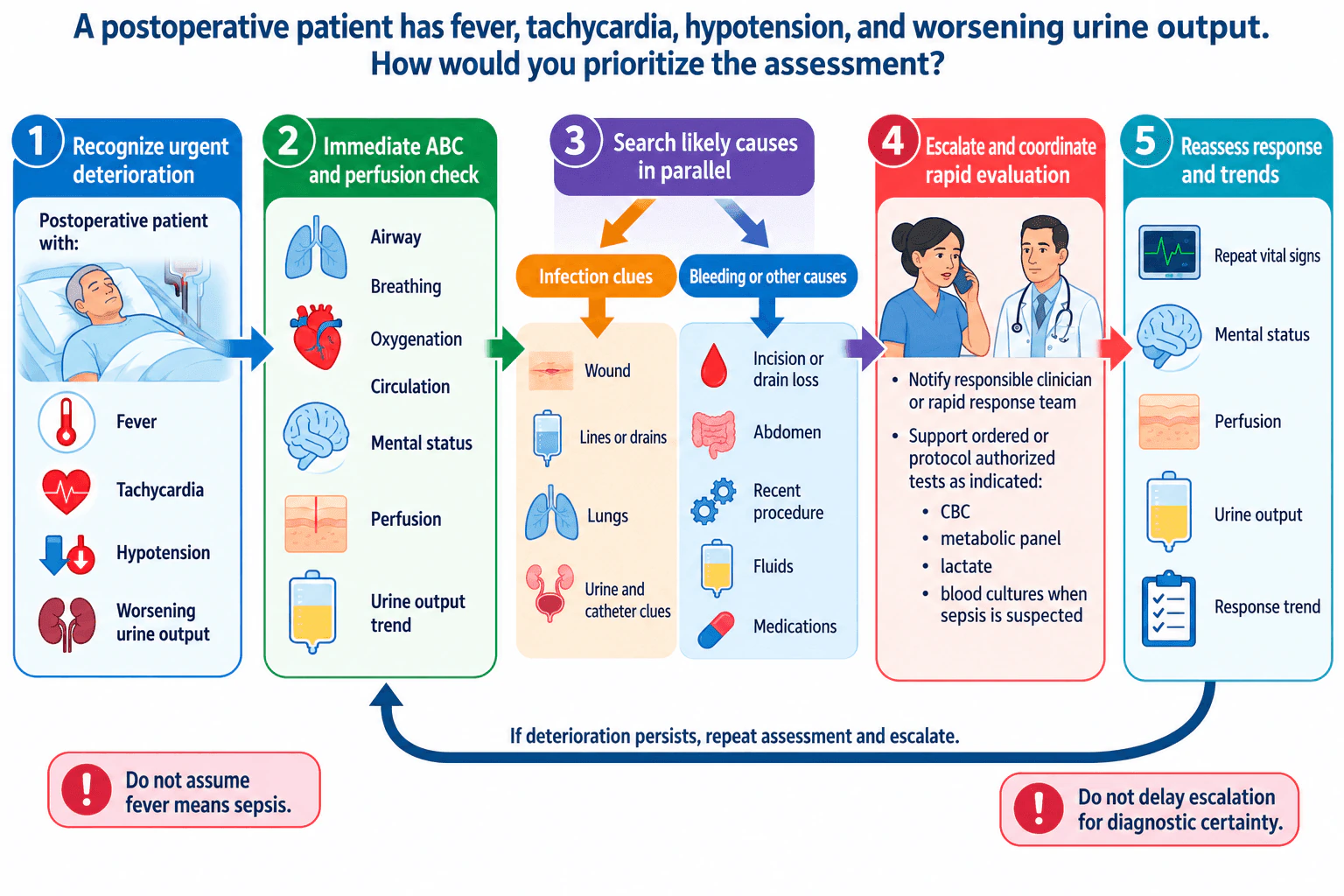
80. A postoperative patient has fever, tachycardia, hypotension, and worsening urine output. How would you prioritize the assessment?Sepsis And Multiorgan DysfunctionHard
i Question Details
Treat the pattern as urgent deterioration, assess airway breathing circulation and perfusion, evaluate infection and bleeding clues, review recent procedures and fluids, and activate rapid evaluation without assuming one cause.
Short Interview Answer (30-60 seconds)
I would treat the pattern as urgent deterioration. First I would assess airway, breathing, oxygenation, circulation, mental status, perfusion, and the urine output trend. At the same time, I would look for infection clues and for bleeding or other postoperative causes. I would promptly notify the responsible clinician or rapid response team according to local policy, support indicated ordered or protocol authorized testing, and repeatedly reassess vital signs, mental status, perfusion, urine output, and the overall response.
Detailed Explanation
The key is to recognize that fever, tachycardia, hypotension, and worsening urine output together represent urgent postoperative deterioration. Fever alone does not establish sepsis. Sepsis is life threatening organ dysfunction caused by a dysregulated response to infection, so the nurse should assess immediate physiologic stability while evaluating infectious and noninfectious causes in parallel. jamanetwork.com
Useful Questions to Ask the Interviewer
What rapid response or escalation process does your ICU use for an acutely deteriorating postoperative patient?
Which sepsis evaluations can the bedside nurse initiate under protocol in this unit?
How does your team coordinate postoperative assessment when infection and bleeding are both possible?
How to Explain It in an Interview
Nursing Priorities
I would begin with airway, breathing, oxygenation, and circulation, then rapidly assess mental status, perfusion, and the urine output trend. Hypotension with worsening urine output makes this an urgent deterioration pattern that requires prompt assessment and escalation rather than waiting for diagnostic certainty.
Patient Context And Checks
I would assess infection clues by examining the wound, reviewing lines or drains, assessing the lungs, and checking urine and catheter related findings. At the same time, I would evaluate bleeding and other postoperative causes by checking incision or drain loss, abdominal findings, the recent procedure, fluid balance, and medications. This avoids assuming infection is the only possible cause.
Escalation And Evaluation
I would promptly notify the responsible clinician or activate the rapid response team according to local policy. I would support ordered or protocol authorized tests as indicated, such as a complete blood count, metabolic panel, lactate, and blood cultures when sepsis is suspected. Current sepsis guidance supports lactate measurement in suspected sepsis, early blood cultures when sepsis is possible, and continued evaluation for alternative diagnoses when infection is unconfirmed. sccm.org
Reassessment
I would repeat vital signs and reassess mental status, perfusion, urine output, and the overall response. If deterioration persists, I would repeat the assessment and escalate again. The priority is continuous recognition, communication, evaluation, and response monitoring rather than relying on fever, a single laboratory result, or one screening score.
Why Interviewers Ask This
This question evaluates whether the nurse recognizes a dangerous pattern of postoperative deterioration, prioritizes immediate physiologic assessment, considers infectious and noninfectious causes in parallel, escalates promptly, and reassesses the response rather than anchoring on one diagnosis.
Common interview mistakes
Common mistakes include assuming fever confirms sepsis, focusing only on infection while overlooking postoperative bleeding or other causes, delaying escalation until the diagnosis is certain, failing to assess perfusion and urine output trends, treating a screening score as a definitive diagnosis, or failing to reassess after the initial evaluation.
Interview tip
Organize the response as one continuous sequence: recognize urgent deterioration, assess airway, breathing, circulation, and perfusion, investigate infection and postoperative alternatives in parallel, escalate promptly, then reassess trends and response.
Interviewer may ask next
How would you verify whether your initial concern for sepsis is supported?
I would combine the clinical assessment with evolving evidence rather than relying on fever, one laboratory result, or a single screening score. I would review the suspected infection source, organ dysfunction findings, vital sign and perfusion trends, urine output, mental status, and ordered laboratory or microbiology results. I would continue reassessing for alternative causes because sepsis is a clinical diagnosis and no single biomarker or test can confirm or exclude it by itself. sccm.org
How would your assessment change if the patient also had increasing bloody drain output?
Increasing bloody drain output would increase concern for postoperative bleeding and make circulation and perfusion assessment even more urgent. I would quantify and trend the drain output, assess the incision and abdomen, review vital signs, mental status, perfusion, urine output, the recent procedure, fluids, and medications, and promptly escalate to the responsible clinician or rapid response process. I would continue evaluating infection in parallel rather than assuming bleeding excludes another simultaneous cause.
More questions load as you scroll
Disclaimer: This interview guide is for educational and informational purposes only. It is designed to help readers prepare, but it does not guarantee any interview result, hiring decision, offer, or outcome. Interview questions, hiring criteria, and preferred answers can vary by employer, interviewer, industry, location, and time. All answers, examples, and explanations in this guide are suggested examples for interview preparation, not definitive answers or instructions for professional practice. They are based on research and judgment, are provided without warranties of any kind, and should be adapted to the question, role, and applicable laws and professional requirements. Diagrams are simplified illustrations intended to highlight the main concepts and their relationships; actual situations, systems, and practices may be more complex. Alternative approaches may be equally valid or better suited to a particular question, context, or interviewer. To the fullest extent permitted by applicable law, the contributors and publisher are not liable for decisions made, actions taken, or losses incurred based on this guide.
State Laws and Professional Responsibilities: Laws and requirements governing an occupation vary by state and jurisdiction. You are responsible for checking the current laws, licensing requirements, and scope-of-practice rules that apply to your location and role, and for ensuring that your answers and actions comply with them. Adapt examples in this guide to those requirements. This guide is not legal advice.
Content Accuracy and Verification: To the fullest extent permitted by applicable law, we do not represent or warrant that interview guides, questions, answers, examples, or diagrams are accurate, complete, current, error-free, or suitable for any particular purpose. You are responsible for independently reviewing and verifying the information before relying on it.