This interview guide is for educational and informational purposes only. It is designed to help readers prepare, but it does not guarantee any interview result, hiring decision, offer, or outcome. Interview questions, hiring criteria, and preferred answers can vary by employer, interviewer, industry, location, and time. All answers, examples, and explanations in this guide are suggested examples for interview preparation, not definitive answers or instructions for professional practice. They are based on research and judgment, are provided without warranties of any kind, and should be adapted to the question, role, and applicable laws and professional requirements. Diagrams are simplified illustrations intended to highlight the main concepts and their relationships; actual situations, systems, and practices may be more complex. Alternative approaches may be equally valid or better suited to a particular question, context, or interviewer. To the fullest extent permitted by applicable law, the contributors and publisher are not liable for decisions made, actions taken, or losses incurred based on this guide.
State Laws and Professional Responsibilities
Laws and requirements governing an occupation vary by state and jurisdiction. You are responsible for checking the current laws, licensing requirements, and scope-of-practice rules that apply to your location and role, and for ensuring that your answers and actions comply with them. Adapt examples in this guide to those requirements. This guide is not legal advice.
Identity, Image, and Privacy Notice
To respect individual privacy, some names, profile photographs, avatars, biographical details, and other identifying information displayed in this guide may be replaced with pseudonyms, licensed stock images, illustrative avatars, composite images, or representative descriptions. Unless a person is expressly identified as an actual contributor, a displayed name, image, or profile should not be understood as depicting or identifying a specific candidate, interviewer, employee, or other real individual. These representations are provided for editorial and illustrative purposes only and do not imply endorsement, employment, participation, or affiliation with this guide or any company mentioned in it. Any resemblance to an actual person is coincidental.
Company Notice
This guide is an independent educational resource and is not affiliated with, endorsed by, sponsored by, or approved by the company named in this guide. Company names identify reported interview experiences or the employer context of clearly labeled original practice exercises. Interview practices can change without notice, and inclusion of company-specific content does not mean these questions are official, complete, or guaranteed to be asked. To the fullest extent permitted by law, the author, contributors, and publisher are not responsible for outcomes related to use of this material.
Content Accuracy and Verification
To the fullest extent permitted by applicable law, we do not represent or warrant that interview guides, questions, answers, examples, or diagrams are accurate, complete, current, error-free, or suitable for any particular purpose. You are responsible for independently reviewing and verifying the information before relying on it.
Questions or comments?
Contact us for general questions, or share feedback, technical corrections, and comments with the community.
81. What is cardiac arrest?Emergency Recognition And ResuscitationEasy
Short Interview Answer (30-60 seconds)
Cardiac arrest is the sudden loss of effective heart pumping, which stops adequate blood flow to the brain and other vital organs. The patient is unresponsive and is not breathing normally. For an adult, a healthcare professional assesses breathing and pulse simultaneously for no more than 10 seconds. If no definite pulse is felt, the patient is treated as being in cardiac arrest and cardiopulmonary resuscitation is started. cpr.heart.org
Detailed Explanation
Cardiac arrest means that the heart has suddenly stopped pumping effectively enough to maintain circulation. Blood flow to the brain and other vital organs therefore stops or becomes critically inadequate. It is a medical emergency that requires immediate recognition and treatment. nhlbi.nih.gov
Useful Questions to Ask the Interviewer
Which current resuscitation guidelines does the unit follow for adult cardiac arrest?
How are nursing roles typically assigned during an in hospital resuscitation?
How to Explain It in an Interview
Clinical Principle
I would explain that cardiac arrest is the sudden loss of effective cardiac pumping and circulation. The patient is unresponsive and is not breathing normally, which can include only gasping. For an adult healthcare professional assessment, breathing and pulse are checked simultaneously. If a definite pulse is not felt within 10 seconds, the patient should be treated as being in cardiac arrest. cpr.heart.org
Nursing Priorities
In a suspected arrest, emergency help should be activated while authorized lifesaving actions begin. Cardiopulmonary resuscitation should not be delayed by prolonged pulse assessment or routine communication. An automated external defibrillator or defibrillator should be obtained and used as soon as available, with rhythm appropriate shock delivery when indicated. cpr.heart.org
Important Distinction
Cardiac arrest is not the same as a heart attack. A heart attack results from impaired blood flow to heart muscle and can occur while the patient still has a pulse. A heart attack can lead to cardiac arrest, but the terms are not interchangeable. nhlbi.nih.gov
A patient who has a definite pulse but is not breathing normally is also different from a patient in cardiac arrest. Current adult basic life support guidance calls for ventilatory support, with 1 breath every 6 seconds, and pulse reassessment every 2 minutes. If the pulse is subsequently lost, cardiopulmonary resuscitation is started. cpr.heart.org
For an interview, I would define cardiac arrest clearly, identify unresponsiveness and abnormal or absent breathing as key recognition findings, explain the brief pulse assessment used by healthcare professionals, and emphasize immediate emergency activation and resuscitation.
Why Interviewers Ask This
Interviewers want to confirm that a critical care nurse understands what cardiac arrest means, recognizes its key clinical features, distinguishes it from respiratory arrest or a heart attack, and understands why rapid recognition and resuscitation matter.
Common interview mistakes
Common mistakes include confusing cardiac arrest with a heart attack, treating gasping as normal breathing, spending more than 10 seconds trying to identify a pulse, delaying cardiopulmonary resuscitation or emergency activation, and treating a patient who has a definite pulse but inadequate breathing as though the patient has no pulse.
Interview tip
Start with a clear definition, then connect it to recognition. State that an adult in cardiac arrest is unresponsive, is not breathing normally, and has no definite pulse identified during the brief healthcare professional assessment. Emphasize rapid emergency activation and resuscitation without adding unnecessary detail.
Interviewer may ask next
How would you verify current cardiac arrest recognition guidance?
I would use the current age appropriate resuscitation guidance adopted for the clinical setting. For adult care, the 2025 American Heart Association basic life support algorithm states that a healthcare professional should assess breathing and pulse simultaneously and determine whether a pulse is definitely felt within 10 seconds. If there is no breathing or only gasping and no pulse is felt, cardiopulmonary resuscitation is started. Verification should support practice but should not delay emergency treatment when cardiac arrest is suspected. cpr.heart.org
What changes if the patient is unresponsive and not breathing adequately but has a definite pulse?
A definite pulse means the patient is not currently in cardiac arrest. This is a respiratory emergency requiring immediate ventilatory support and continued reassessment. Current adult basic life support guidance calls for 1 breath every 6 seconds, or 10 breaths per minute, with a pulse check every 2 minutes. If the pulse is lost, cardiopulmonary resuscitation is started. These actions should follow current guidance, the nurse's scope, and authorized clinical protocols. cpr.heart.org
82. What is the purpose of high quality chest compressions during cardiac arrest?Emergency Recognition And ResuscitationEasy
i Question Details
Explain that chest compressions provide temporary blood flow to the heart and brain while definitive resuscitation is organized.
Short Interview Answer (30-60 seconds)
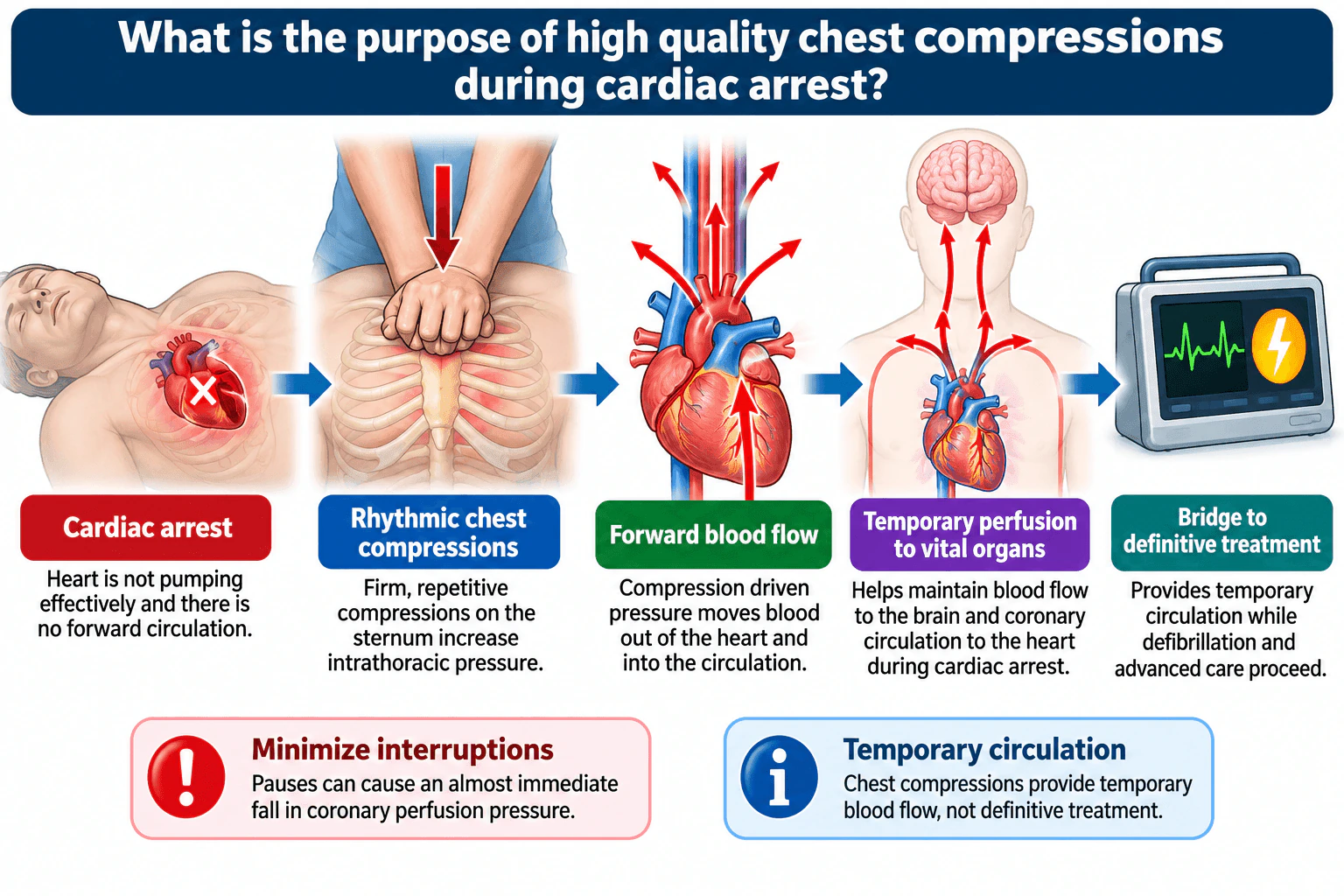
High quality chest compressions temporarily replace part of the heart's pumping function during cardiac arrest. They generate forward blood flow that helps maintain perfusion to the heart and brain while the team organizes definitive resuscitation, including defibrillation when indicated and advanced care. Because coronary perfusion pressure falls rapidly when compressions stop, interruptions should be kept as short as possible.
Detailed Explanation
High quality chest compressions provide temporary circulation during cardiac arrest. When the heart is no longer producing effective forward blood flow, rhythmic chest compression generates pressure that moves blood through the circulation. This helps maintain blood flow to the heart and brain while definitive resuscitation is underway.
Useful Questions to Ask the Interviewer
What tools does your ICU use to provide real time feedback on CPR quality during a cardiac arrest?
How does the unit organize compressor rotation and closed loop communication during resuscitation?
What process does the team use to minimize interruptions around rhythm checks and defibrillation?
How to Explain It in an Interview
I would explain that the central purpose of high quality chest compressions is to create temporary forward blood flow when the heart cannot pump effectively during cardiac arrest. The pressure generated by rhythmic chest compression moves blood through the circulation and helps maintain perfusion of vital organs, especially the brain, while also supporting coronary perfusion of the heart.
Compressions are a bridge, not definitive treatment. They help preserve circulation while the resuscitation team identifies the rhythm, prepares defibrillation when indicated, supports ventilation, and performs other appropriate resuscitation interventions.
For an average adult in cardiac arrest, current American Heart Association guidance recommends a compression rate of 100 to 120 per minute, a depth of at least 5 cm while avoiding depths greater than 6 cm, complete chest recoil, and minimal interruptions. These features support effective forward blood flow during CPR.
I would also emphasize minimizing pauses. Coronary perfusion pressure falls almost immediately when chest compressions stop, so necessary interruptions should be as brief as possible and compressions should resume promptly.
The key point is that high quality chest compressions temporarily maintain circulation to the heart and brain and buy time for interventions that can restore spontaneous circulation.
Why Interviewers Ask This
Interviewers want to confirm that the nurse understands why chest compressions are an immediate priority during cardiac arrest, not simply how to perform them. A strong answer connects compressions with temporary blood flow to the heart and brain, preservation of perfusion during resuscitation, and the need to minimize interruptions while definitive treatment is organized.
Common interview mistakes
Common mistakes include describing chest compressions as definitive treatment rather than temporary circulatory support, focusing only on hand technique without explaining perfusion, allowing unnecessary interruptions, or failing to connect compressions with blood flow to the heart and brain while definitive resuscitation is organized.
Interview tip
State the purpose first: chest compressions create temporary forward blood flow to the heart and brain. Then connect that purpose to maintaining perfusion, minimizing interruptions, and buying time for defibrillation and other definitive resuscitation measures.
Interviewer may ask next
How would you verify that adult chest compressions are being delivered with high quality?
I would assess whether compressions are being delivered at 100 to 120 per minute, with a depth of at least 5 cm while avoiding depths greater than 6 cm, allowing complete chest recoil and keeping interruptions as brief as possible. When available, real time CPR feedback can help the team assess performance. When two or more rescuers are available, changing compressors approximately every 2 minutes can help maintain compression quality.
Would the same compression approach apply to an infant or child in cardiac arrest?
The physiologic purpose remains the same: chest compressions provide temporary blood flow to vital organs during cardiac arrest. However, compression technique, depth, ventilation strategy, and other resuscitation details vary with age and patient size. For an infant or child, I would follow current pediatric resuscitation guidance rather than automatically applying adult technique.
83. What does rapid response activation accomplish?Emergency Recognition And ResuscitationEasy
i Question Details
Explain that rapid response brings additional expertise to a deteriorating patient before or during severe instability and should not be delayed when criteria or clinical concern are met.
Short Interview Answer (30-60 seconds)
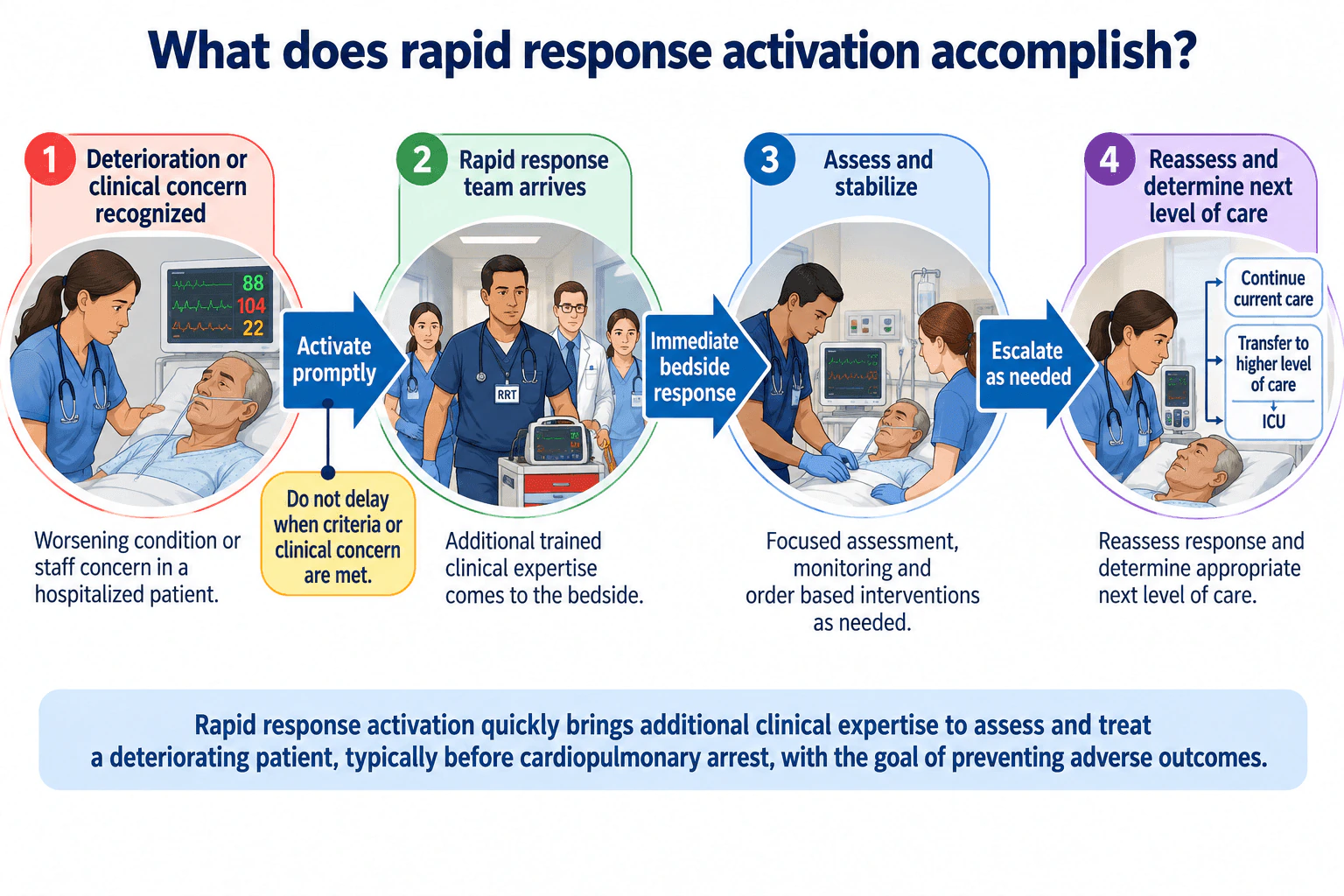
Rapid response activation quickly brings additional trained clinical expertise to a deteriorating patient. It allows the team to assess and stabilize the patient at the bedside, increase monitoring, support needed interventions, and decide whether the patient can remain on the current unit or needs escalation such as ICU transfer. It should not be delayed when criteria are met or staff are seriously concerned.
Detailed Explanation
Rapid response activation is meant to bring extra help to a patient whose condition is worsening before the situation becomes a cardiac arrest. It gives the bedside team quick access to additional clinical expertise so the patient can be assessed, stabilized, and triaged to the safest level of care.
Useful Questions to Ask the Interviewer
What findings or concerns usually trigger rapid response activation here?
Who responds to a rapid response call in this hospital?
What is the bedside nurse expected to do during and after the call?
How to Explain It in an Interview
Clinical Principle
I would say that rapid response activation is an early rescue system for a deteriorating hospitalized patient. It brings additional trained clinicians to the bedside quickly so the patient can be evaluated before severe instability progresses further.
Nursing Priorities
My first priority is to recognize worsening condition or serious clinical concern and activate the rapid response process promptly. I would not wait for the patient to arrest or delay the call while gathering every detail.
Bedside Response
Once the team arrives, the patient receives focused bedside assessment and stabilization. That can include closer monitoring, review of vital signs and trends, and support for appropriate interventions based on protocol or provider orders. The bedside nurse continues to communicate key changes and participate in care.
Reassessment and Escalation
After the immediate response, the team reassesses the patient and decides the next level of care. If the patient improves, care may continue on the current unit with a plan for ongoing monitoring. If the patient remains unstable, care is escalated, including transfer to a higher level of care such as the ICU. The overall goal is to prevent adverse outcomes, often before cardiopulmonary arrest.
Why Interviewers Ask This
Interviewers want to know whether you understand rapid response as an early escalation tool for a deteriorating patient, not just a step taken during cardiac arrest. They are evaluating whether you can recognize clinical concern, activate help promptly, communicate clearly, support bedside stabilization, and reassess whether escalation to a higher level of care is needed.
Common interview mistakes
Common mistakes include waiting until the patient is crashing before calling, treating rapid response as the same as a code response, delaying activation to complete routine communication, assuming the bedside nurse no longer has an active role after the team arrives, or forgetting that the response should end with reassessment and a clear decision about the next level of care.
Interview tip
Answer in the same sequence shown in practice: recognize deterioration, activate promptly, bring extra expertise to the bedside, assess and stabilize, then reassess and decide whether to continue current care or transfer to a higher level of care.
Interviewer may ask next
How would you verify that a patient meets rapid response criteria?
I would compare the patient’s current condition with the facility’s rapid response criteria, review recent vital sign trends and changes in clinical status, and use nursing judgment when there is serious concern even if one exact trigger is not obvious. I would verify the local process during orientation and policy review, but in a real deterioration I would not delay activation just to look up the policy.
How would your response change if the patient became unresponsive and had no pulse?
If the patient became unresponsive with no pulse, I would treat that as cardiac arrest rather than a routine rapid response situation. I would activate the cardiac arrest emergency response, begin immediate resuscitation according to my role and current adult guidance, and continue coordinated team communication while lifesaving care is underway.
84. What is your nursing role during a code response?Emergency Recognition And ResuscitationEasy
i Question Details
Describe recognizing arrest, calling for help, providing compressions or airway support within training, using closed loop communication, preparing equipment, and carrying out authorized resuscitation actions.
Short Interview Answer (30-60 seconds)
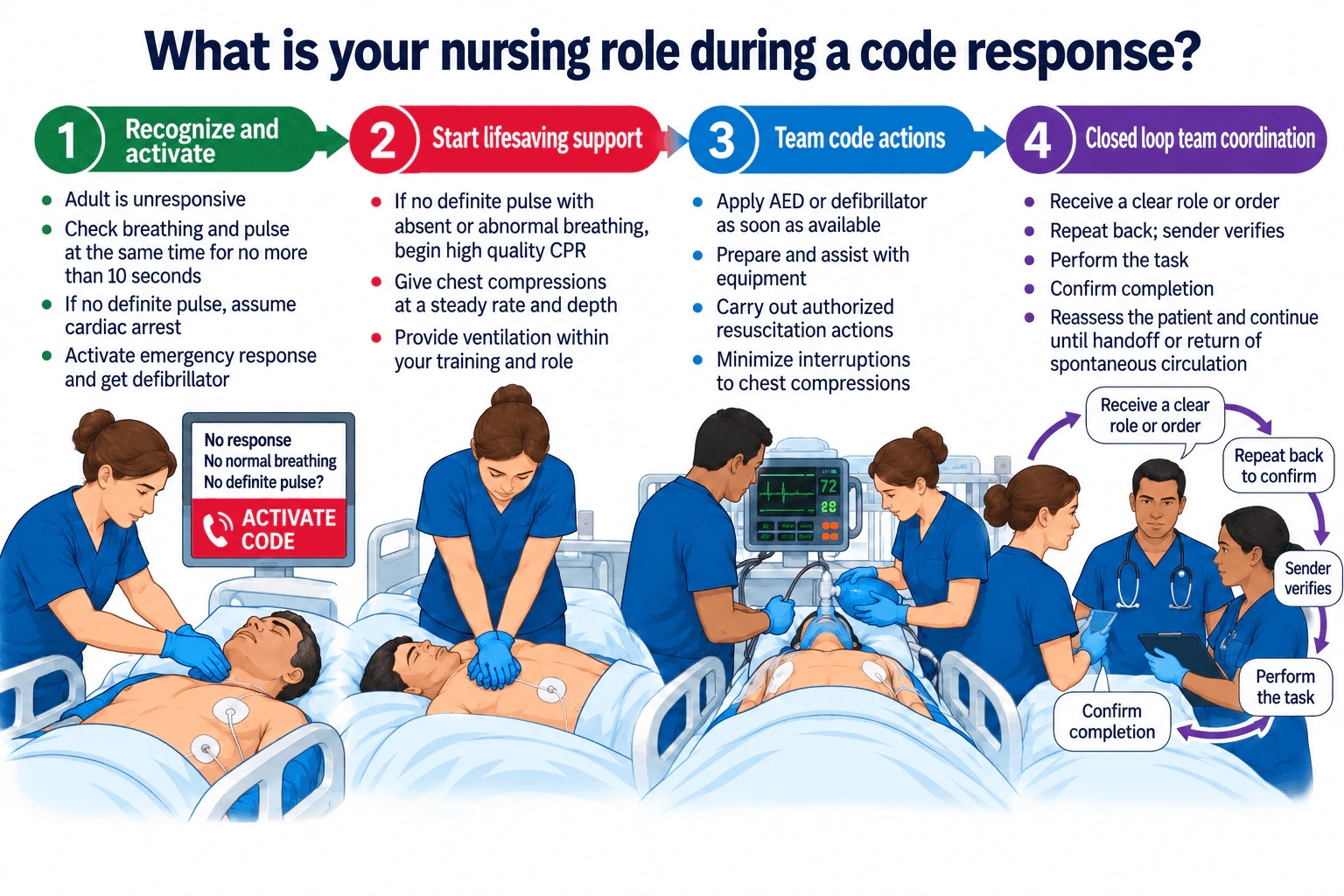
During a code, I quickly recognize arrest, activate emergency help, and start appropriate lifesaving care within my training and scope. For an unresponsive adult, I check breathing and pulse simultaneously for no more than 10 seconds. If there is no definite pulse and no normal breathing or only gasping, I begin high quality CPR while the AED or defibrillator is obtained. I provide ventilation within my training, prepare equipment, carry out authorized resuscitation actions, minimize interruptions in compressions, and use closed loop communication by repeating instructions back, having the sender verify them, performing the task, and confirming completion. I continue reassessing the patient until handoff or return of spontaneous circulation.
Detailed Explanation
A critical care nurse during a code helps the team recognize cardiac arrest rapidly, activate the emergency response system, provide immediate resuscitation care within scope, prepare equipment, perform assigned interventions, and maintain clear closed loop communication.
Useful Questions to Ask the Interviewer
How are nursing roles typically assigned during a code on this unit?
What resuscitation equipment and emergency activation process does the unit use?
How are code events reviewed or debriefed afterward?
How to Explain It in an Interview
Clinical Principle
I would first recognize the emergency and activate help without delaying lifesaving care. For an unresponsive adult, I would assess breathing and pulse simultaneously for no more than 10 seconds. If there is no definite pulse and the patient has no normal breathing or is only gasping, I would begin high quality CPR while the AED or defibrillator is being obtained. If a definite pulse is present but breathing is inadequate, I would provide appropriate ventilatory support within my training rather than treating the patient as pulseless.
Nursing Priorities
I would provide chest compressions when indicated, assist with ventilation within my competency, apply the AED or defibrillator as soon as available, prepare needed equipment, and carry out resuscitation actions authorized by protocol, orders, and my scope of practice. I would minimize unnecessary interruptions in chest compressions and remain ready to change tasks as the team leader directs.
Team Communication
I would use closed loop communication. When I receive a clear role or order, I repeat it back so the sender can verify that I understood correctly. I then perform the task and confirm completion. This reduces misunderstandings and helps the team stay coordinated during a rapidly changing event.
Reassessment and Escalation
Throughout the code, I continue reassessing the patient and communicating important changes. I support ongoing resuscitation until return of spontaneous circulation, transfer of responsibility, or another appropriate endpoint determined by the resuscitation team.
Why Interviewers Ask This
Interviewers want to know whether I can recognize cardiac arrest promptly, prioritize immediate lifesaving actions, work within nursing scope and local protocols, support effective resuscitation, prepare needed equipment, and communicate reliably during a high pressure emergency. They are also evaluating whether I understand that emergency activation and lifesaving care may need to occur concurrently.
Common interview mistakes
Common mistakes include delaying emergency activation, spending too long checking for a pulse, treating inadequate breathing with a definite pulse as cardiac arrest, delaying CPR while waiting for equipment, interrupting compressions unnecessarily, failing to prepare or apply the AED or defibrillator promptly, performing actions outside training or authorization, and using incomplete communication without repeat back, sender verification, task completion, and confirmation.
Interview tip
Describe your role as part of a coordinated resuscitation team rather than implying that you independently direct every intervention. Emphasize rapid recognition, concurrent activation and lifesaving care, nursing scope, equipment readiness, minimal interruption of compressions, closed loop communication, and continuous reassessment.
Interviewer may ask next
How do you verify that you correctly understood an instruction during a code?
I use closed loop communication. I repeat the instruction back to the sender, the sender verifies that my understanding is correct, I perform the task, and I confirm when it is completed. If an instruction is unclear, I clarify it promptly without allowing communication routines to delay an urgent lifesaving action.
What changes if the unresponsive patient has a definite pulse but is not breathing adequately?
A definite pulse with inadequate breathing is not treated as pulseless cardiac arrest. I provide ventilatory support within my training, continue monitoring the patient and pulse, maintain emergency support as appropriate, and remain ready to begin CPR immediately if the pulse is lost.
85. What is the first nursing priority when a patient becomes suddenly unresponsive?Emergency Recognition And ResuscitationEasy
i Question Details
Assess responsiveness and breathing, activate emergency help, and begin the appropriate age specific resuscitation sequence without delaying for a complete history.
Short Interview Answer (30-60 seconds)
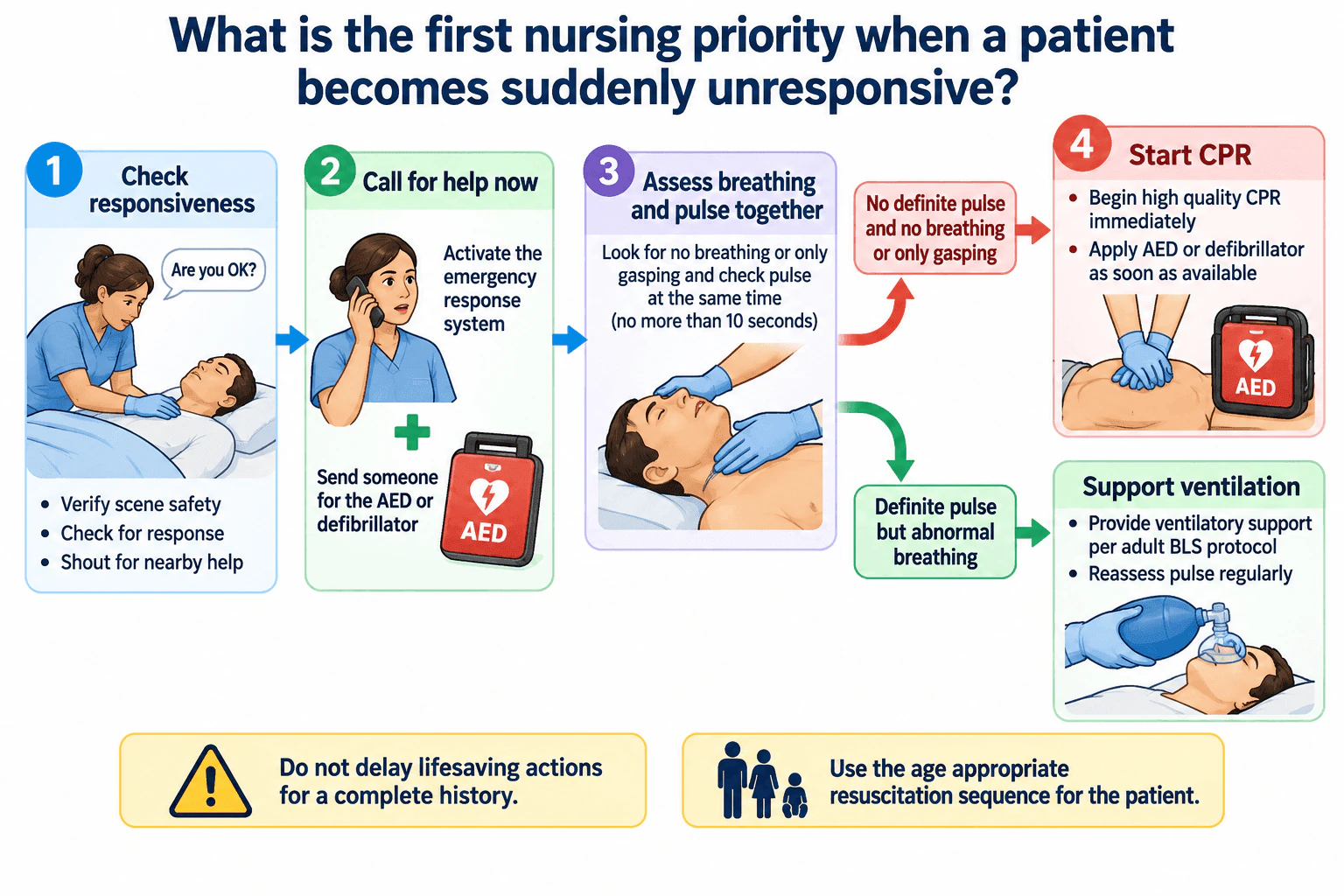
My first priority is immediate assessment and activation of help while beginning lifesaving care. I would verify scene safety, check responsiveness, shout for help, activate the emergency response system, and send someone for an AED or defibrillator. For an adult, I would assess breathing and pulse simultaneously for no more than 10 seconds. If there is no definite pulse and the patient is not breathing or is only gasping, I would start CPR immediately. If there is a definite pulse but abnormal breathing, I would provide ventilatory support and reassess the pulse. I would not delay emergency treatment for a complete history.
Detailed Explanation
The key idea is rapid recognition followed by immediate action. When a patient suddenly becomes unresponsive, the nurse should not pause to obtain a complete history. The priority is to check responsiveness, activate emergency help, and begin the appropriate resuscitation pathway.
Useful Questions to Ask the Interviewer
How is the emergency response or code system activated on this unit?
Where are the AED or defibrillator and airway support supplies located?
How are bedside nursing roles assigned during a resuscitation event?
How to Explain It in an Interview
Clinical Principle
I would treat sudden unresponsiveness as a potential arrest until the initial assessment shows otherwise. I first verify scene safety, check responsiveness, shout for nearby help, activate the emergency response system, and send someone to obtain the AED or defibrillator.
Assessment Findings
For an adult patient, I look for no breathing or only gasping while checking the pulse at the same time. I limit that assessment to no more than 10 seconds.
Nursing Priorities
If there is no definite pulse and the patient is not breathing or is only gasping, I begin high quality CPR immediately and use the AED or defibrillator as soon as it is available.
If there is a definite pulse but breathing is abnormal, I provide ventilatory support according to adult basic life support guidance. Current adult guidance uses 1 breath every 6 seconds, or 10 breaths per minute, and the pulse is checked every 2 minutes. If the pulse is lost, I begin CPR.
Reassessment and Escalation
I continue the appropriate resuscitation pathway until advanced care takes over or the patient's condition changes. I use the appropriate age specific resuscitation sequence for the patient and do not delay lifesaving actions for a complete history or nonessential communication.
Why Interviewers Ask This
Interviewers ask this to assess whether the nurse can recognize a time critical emergency, activate help promptly, distinguish cardiac arrest from inadequate breathing with a pulse, and begin the correct resuscitation pathway without unnecessary delay. The response demonstrates prioritization, situational awareness, basic life support knowledge, and appropriate bedside nursing action.
Common interview mistakes
Common mistakes include delaying emergency activation while gathering a complete history, spending longer than 10 seconds assessing breathing and pulse, checking breathing and pulse separately instead of simultaneously in an adult, treating gasping as normal breathing, delaying CPR when no definite pulse is present, failing to obtain an AED or defibrillator promptly, or beginning chest compressions when a definite pulse is present and the immediate problem is abnormal breathing.
Interview tip
Describe the response in bedside order: scene safety, responsiveness, nearby help, emergency activation, AED or defibrillator retrieval, simultaneous breathing and pulse assessment within 10 seconds, then the correct branch. Start CPR for no definite pulse with no breathing or only gasping, or provide ventilatory support when a definite pulse remains but breathing is abnormal.
Interviewer may ask next
How do you verify whether an unresponsive adult is in cardiac arrest?
I look for no breathing or only gasping while checking the pulse simultaneously for no more than 10 seconds. If there is no definite pulse and the patient is not breathing or is only gasping, I treat the situation as cardiac arrest and begin CPR immediately while the AED or defibrillator is being obtained.
What changes if the patient has a definite pulse but abnormal breathing?
That follows the ventilatory support pathway rather than the cardiac arrest pathway. For an adult, I provide breaths according to basic life support guidance, currently 1 breath every 6 seconds or 10 breaths per minute, and check the pulse every 2 minutes. If the pulse is lost, I begin CPR. For a patient in another age group, I use the appropriate age specific resuscitation sequence.
86. How do you prioritize care when a patient has severe hypotension and signs of poor perfusion?Emergency Recognition And ResuscitationMedium
i Question Details
Address airway and breathing, confirm circulation and monitoring, obtain rapid help, establish or verify vascular access, identify obvious bleeding or reversible causes, and carry out ordered or protocol authorized resuscitation.
Short Interview Answer (30-60 seconds)
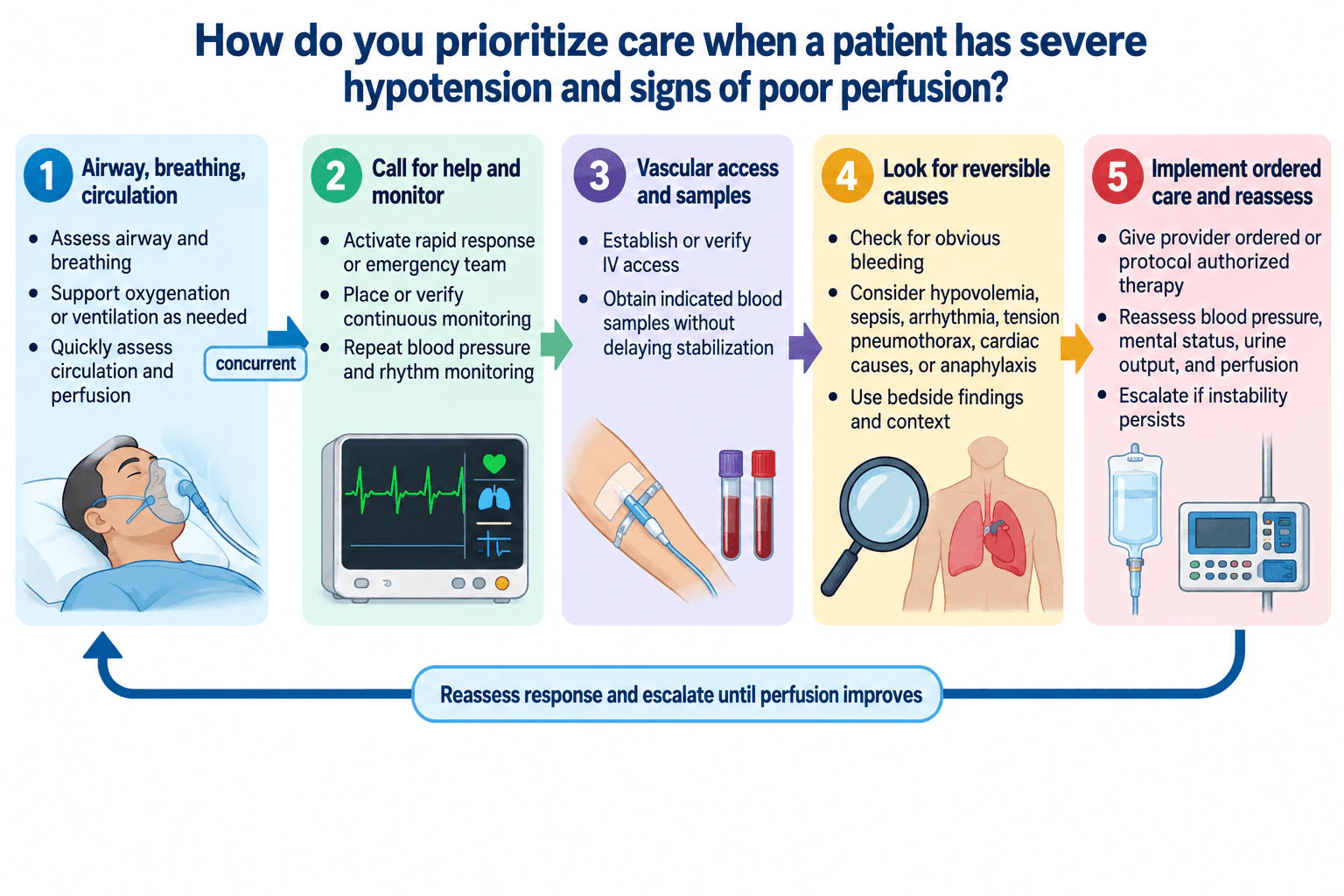
I would assess airway, breathing, and circulation immediately while activating rapid response or emergency help concurrently. I would support oxygenation or ventilation as needed, place or verify continuous monitoring, repeat blood pressure and rhythm assessment, establish or verify IV access, and obtain indicated blood samples without delaying stabilization. I would check for obvious bleeding and reversible causes, carry out provider ordered or protocol authorized resuscitation, then reassess blood pressure, mental status, urine output, and perfusion. If instability persists, I would escalate promptly.
Detailed Explanation
Severe hypotension with signs of poor perfusion means circulation is not adequately supporting organ function. My priority is rapid stabilization while help, monitoring, vascular access, cause identification, and treatment proceed in a coordinated way. Current guidance supports an ABCDE assessment, early escalation, simultaneous team actions, early monitoring, IV access, treatment of immediate threats, and repeated reassessment. resus.org.uk
Useful Questions to Ask the Interviewer
What emergency response pathway does your ICU use when a patient develops sudden severe hypotension?
Which resuscitation interventions may the bedside nurse initiate under protocol while additional orders are being obtained?
How are roles divided among team members during acute hemodynamic deterioration?
How to Explain It in an Interview
Clinical Principle
I would treat severe hypotension with poor perfusion as an immediate circulation emergency while rapidly checking airway and breathing. I would activate rapid response or emergency help concurrently rather than waiting to finish the entire assessment.
Immediate Nursing Priorities
I would assess airway and breathing and support oxygenation or ventilation as needed. I would quickly assess circulation and perfusion, place or verify continuous monitoring, and repeat blood pressure and rhythm assessment. I would establish or verify IV access and obtain indicated blood samples without delaying stabilization.
Identify and Treat the Cause
I would check immediately for obvious bleeding and use bedside findings and context to consider reversible causes such as hypovolemia, sepsis, arrhythmia, tension pneumothorax, cardiac causes, or anaphylaxis. I would then carry out provider ordered or protocol authorized resuscitation appropriate to the suspected cause and the patient's response.
Reassessment and Escalation
After each intervention, I would reassess blood pressure, mental status, urine output, and overall perfusion. If instability persists or perfusion worsens, I would escalate immediately and continue reassessment until the patient improves.
If the patient becomes unresponsive with absent or abnormal breathing, I would transition immediately to cardiac arrest assessment. For an adult healthcare professional response, breathing and pulse are checked simultaneously, and if a pulse is not definitely felt within 10 seconds, CPR is started. cpr.heart.org
Why Interviewers Ask This
Interviewers are evaluating whether I can recognize impaired perfusion, prioritize immediate threats, activate help without delaying stabilization, coordinate simultaneous nursing actions, distinguish independent nursing assessment from protocol authorized or provider ordered treatment, identify reversible causes, and reassess whether resuscitation is working.
Common interview mistakes
Common mistakes include delaying emergency activation until the assessment is complete, focusing only on the blood pressure value instead of the patient's perfusion, delaying stabilization to obtain laboratory samples, failing to look for obvious bleeding or another reversible cause, giving treatment outside authorized scope, and failing to reassess the response after interventions.
Interview tip
Describe the response as coordinated concurrent priorities rather than a slow checklist. Emphasize immediate airway, breathing, and circulation assessment, early emergency activation, monitoring, IV access, reversible cause identification, authorized treatment, and repeated reassessment with escalation when perfusion does not improve.
Interviewer may ask next
How would you verify severe hypotension without delaying treatment?
I would quickly repeat or confirm the blood pressure with an appropriate technique while assessing the patient clinically for poor perfusion. I would correlate the reading with mental status, pulse quality, skin perfusion, rhythm, urine output when available, and the overall clinical picture. I would also check the monitoring setup for an obvious technical problem. Verification should occur alongside emergency assessment and stabilization rather than delaying them. Current guidance supports early monitoring and simultaneous assessment, vascular access, and other interventions in critically ill patients. resus.org.uk
What changes if the patient becomes unresponsive and you cannot definitely feel a pulse?
The priority changes from management of severe hypotension with a pulse to possible cardiac arrest. I would activate the emergency response system if that has not already occurred, assess breathing and pulse simultaneously, and if a pulse is not definitely felt within 10 seconds, begin CPR and use an AED or defibrillator as soon as available. If a definite pulse is present but breathing is abnormal, I would provide ventilatory support according to current adult resuscitation guidance and continue reassessment. cpr.heart.org
87. A patient becomes pulseless while you are at the bedside. What sequence of actions do you take?Emergency Recognition And ResuscitationHard
i Question Details
Recognize arrest, activate the emergency response, begin high quality chest compressions, attach the defibrillator or monitor as soon as available, follow current resuscitation guidance, and use closed loop communication.
Short Interview Answer (30-60 seconds)
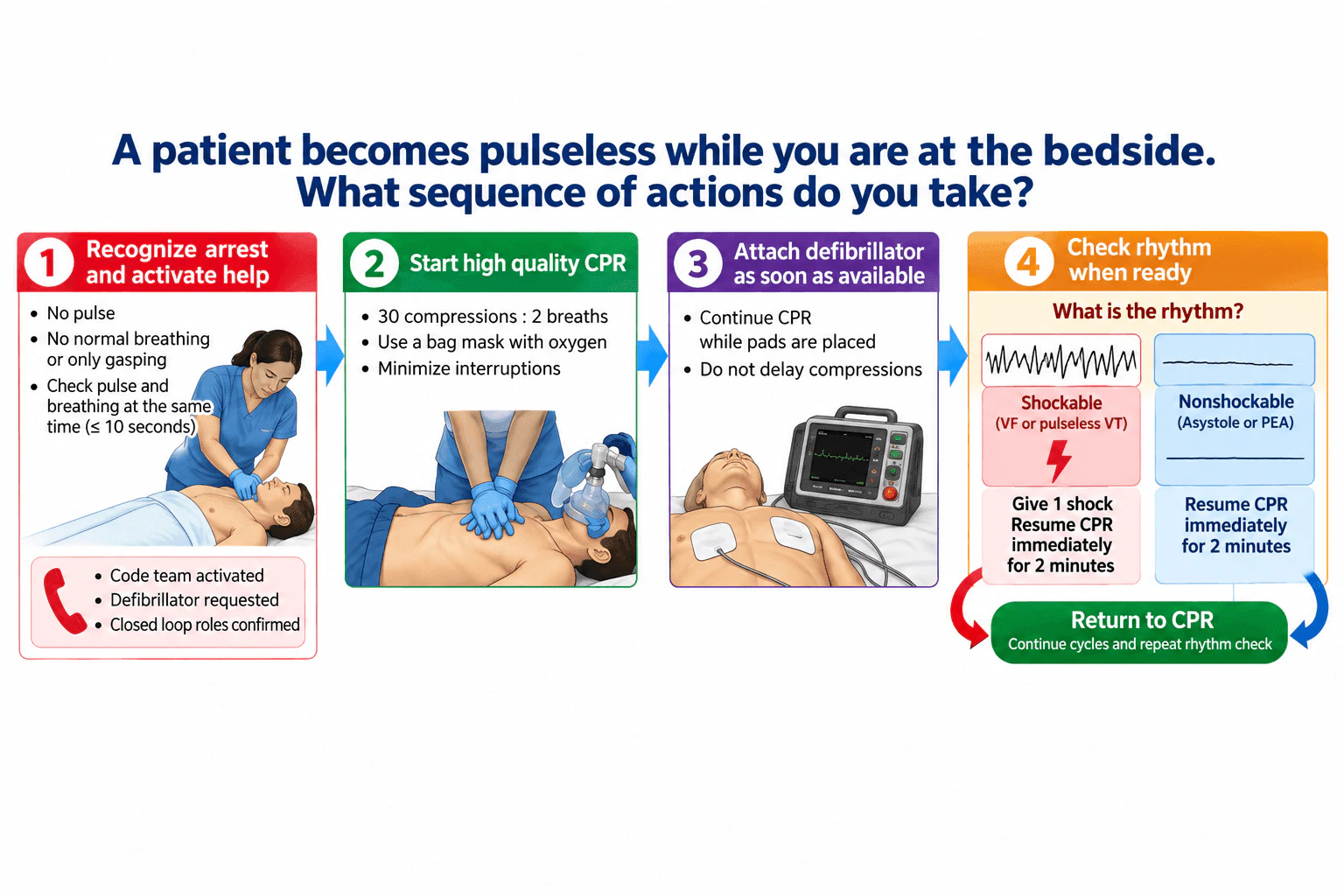
I would activate the emergency response and confirm cardiac arrest by assessing breathing and pulse simultaneously for no more than 10 seconds. If there is no definite pulse and no normal breathing, I would start high quality CPR with 30 compressions to 2 breaths, provide bag mask ventilation with oxygen, and minimize interruptions. I would continue CPR while the defibrillator pads are applied. Once the defibrillator is ready, I would check the rhythm. For ventricular fibrillation or pulseless ventricular tachycardia, I would give one shock and immediately resume CPR for 2 minutes. For asystole or pulseless electrical activity, I would not shock and would immediately resume CPR for 2 minutes. I would continue the cycle with repeat rhythm checks and closed loop communication.
Detailed Explanation
The priority is to recognize cardiac arrest quickly, activate help, and begin CPR without allowing communication or equipment setup to delay lifesaving care.
Useful Questions to Ask the Interviewer
How are code roles assigned in your ICU during an arrest?
What defibrillator and emergency activation process does the unit use?
How does the team practice closed loop communication during mock codes?
How to Explain It in an Interview
Recognition and activation
Assuming an adult ICU patient, I would assess breathing and pulse simultaneously for no more than 10 seconds. If there is no definite pulse and the patient has no normal breathing or is only gasping, I would treat this as cardiac arrest. I would activate the emergency response, request the defibrillator, and use closed loop communication to confirm roles while treatment begins.
Immediate CPR
I would begin high quality CPR immediately. Before an advanced airway is placed, I would use 30 compressions to 2 breaths, provide bag mask ventilation with oxygen, and minimize interruptions in compressions.
Defibrillator and rhythm decision
I would continue CPR while another team member applies the defibrillator pads so equipment preparation does not cause an unnecessary pause. Once the defibrillator is ready, I would pause only as required for rhythm analysis. If the rhythm is ventricular fibrillation or pulseless ventricular tachycardia, I would deliver one shock according to the device and current resuscitation protocol, then immediately resume CPR for 2 minutes. If the rhythm is asystole or pulseless electrical activity, I would not shock and would immediately resume CPR for 2 minutes.
Reassessment and teamwork
After each 2 minute CPR interval, I would repeat the rhythm assessment as directed by the current resuscitation algorithm and continue the appropriate pathway. Throughout the resuscitation, I would use closed loop communication, confirm assigned actions, minimize pauses, and continue CPR and rhythm reassessment until return of spontaneous circulation or another authorized resuscitation decision is made.
Why Interviewers Ask This
Interviewers are evaluating whether I can recognize cardiac arrest rapidly, activate emergency help without delaying treatment, prioritize CPR and defibrillation, distinguish shockable from nonshockable rhythms, minimize interruptions in compressions, and coordinate the team using closed loop communication.
Common interview mistakes
Common mistakes include delaying CPR while waiting for the code team, spending more than 10 seconds assessing breathing and pulse, interrupting compressions unnecessarily while defibrillator pads are applied, shocking asystole or pulseless electrical activity, failing to resume CPR immediately after a shock, and using unclear communication instead of closed loop confirmation.
Interview tip
Describe the sequence in the same order you would act at the bedside: recognize arrest and activate help, start CPR, attach the defibrillator without unnecessary interruption, determine whether the rhythm is shockable, immediately resume CPR after the rhythm decision, and communicate using closed loop confirmation.
Interviewer may ask next
How would you verify that you are following the correct resuscitation sequence during an actual code?
I would use the current age appropriate resuscitation algorithm, the facility's authorized code process, and the defibrillator prompts while continuing immediate lifesaving care. Verification and communication should support the resuscitation rather than delay CPR or defibrillation.
What changes if the patient has a definite pulse but is not breathing normally?
That is not treated as cardiac arrest. For an adult with a definite pulse but abnormal or absent breathing, I would provide rescue breathing at 1 breath every 6 seconds, or 10 breaths per minute, and reassess the pulse every 2 minutes. If the pulse is subsequently lost, I would begin CPR and transition to the cardiac arrest pathway.
88. A patient with a possible allergic exposure develops stridor and hypotension. What should the nurse do first?Emergency Recognition And ResuscitationHard
i Question Details
Recognize a life threatening airway and circulation emergency, call for immediate help, support airway and breathing, and initiate authorized anaphylaxis treatment without delaying for extensive history taking.
Short Interview Answer (30-60 seconds)
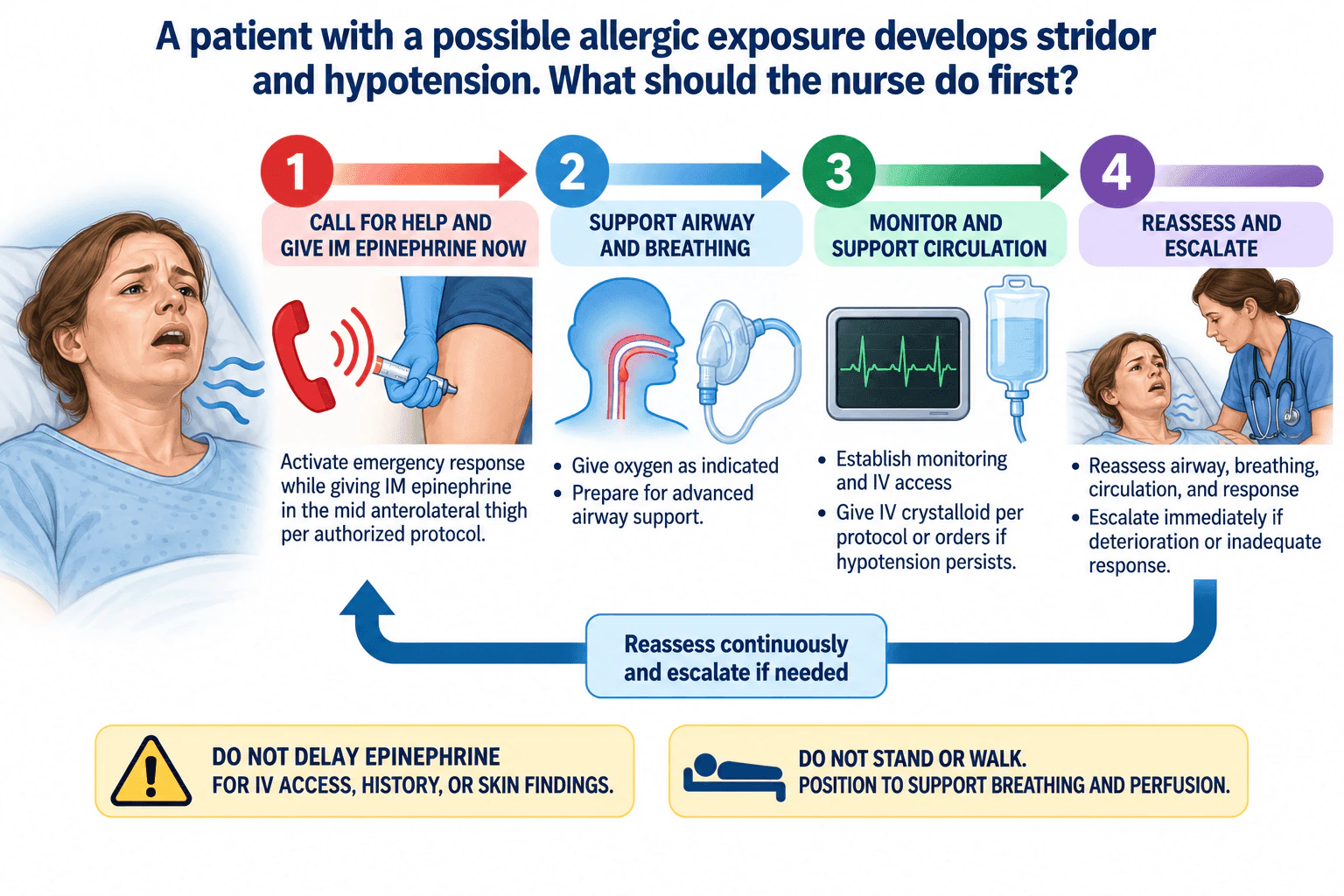
I would treat this as life threatening anaphylaxis. I would activate emergency help while promptly giving authorized intramuscular epinephrine in the mid anterolateral thigh. I would not wait for IV access, a complete history, or skin findings. I would support airway and breathing, give oxygen as indicated, prepare for advanced airway support, establish monitoring and IV access, support circulation with IV crystalloid according to protocol or orders if hypotension persists, keep the patient from standing or walking, and reassess continuously.
Detailed Explanation
Stridor and hypotension after a possible allergic exposure indicate severe airway and circulation compromise consistent with anaphylaxis. The immediate priority is emergency activation plus prompt intramuscular epinephrine, not completion of a history or placement of an IV before treatment. Current guidance identifies intramuscular epinephrine as first line treatment for anaphylaxis and supports early airway, breathing, and circulation management. aaaai.org
Useful Questions to Ask the Interviewer
What anaphylaxis emergency protocol is authorized for bedside nurses in this ICU?
What resources are immediately available for advanced airway support and emergency response activation?
How does the unit use closed loop communication during anaphylaxis emergencies?
How to Explain It in an Interview
Clinical Principle
I would recognize stridor and hypotension after a possible allergic exposure as life threatening airway and circulation compromise. I would activate emergency help while giving authorized intramuscular epinephrine promptly in the mid anterolateral thigh. I would not wait for skin findings, a full history, or IV access before treating. Intramuscular epinephrine is first line treatment for anaphylaxis and should be given early for airway, breathing, or circulation problems. aaaai.org
Airway and Breathing
I would support the airway and breathing, give oxygen as indicated, and prepare for advanced airway support because stridor suggests significant upper airway involvement. These actions occur alongside the initial emergency treatment rather than replacing epinephrine.
Circulation and Positioning
I would establish monitoring and IV access and, if hypotension persists, give IV crystalloid according to the authorized protocol or orders. I would not allow the patient to stand or walk. I would position the patient to support both breathing and perfusion. Current resuscitation guidance emphasizes avoiding sudden upright positioning during anaphylaxis and using a position appropriate to breathing difficulty and circulatory status. citeturn410256view0turn410256view1
Reassessment and Escalation
I would continuously reassess airway, breathing, circulation, mental status, vital signs, and response to treatment. If airway compromise, hypotension, or other deterioration continues, I would escalate immediately to the resuscitation and advanced airway team while continuing authorized treatment. Because the question does not supply an age, I would confirm the applicable age appropriate protocol without delaying emergency care. The depicted scenario represents adult bedside ICU practice.
Why Interviewers Ask This
Interviewers are evaluating whether the nurse recognizes stridor plus hypotension after a possible allergic exposure as an immediate airway and circulation emergency. They are looking for rapid prioritization, concurrent emergency activation and authorized epinephrine treatment, appropriate airway and circulation support, safe positioning, and continuous reassessment rather than delaying treatment for routine history taking, IV placement, or skin findings.
Common interview mistakes
Common mistakes include delaying intramuscular epinephrine while obtaining IV access or a detailed history, waiting for hives or other skin findings before treating severe anaphylaxis, focusing on oxygen or airway support while delaying epinephrine, allowing a hypotensive patient to stand or walk, delaying circulation support, and failing to reassess and escalate when the initial response is inadequate.
Interview tip
State the first priority clearly: activate emergency help while giving authorized intramuscular epinephrine promptly. Then explain airway and breathing support, circulation support, safe positioning, continuous reassessment, and escalation in the same sequence shown in the diagram.
Interviewer may ask next
How would you verify that this is the correct emergency response without delaying treatment?
I would rapidly confirm that the patient has acute airway and circulation compromise after a possible allergic exposure. Stridor and hypotension are sufficient to treat this as suspected anaphylaxis while emergency help is activated. I would verify the applicable age appropriate protocol, available epinephrine preparation, and my authorized scope while treatment proceeds concurrently. I would not delay intramuscular epinephrine for a complete history, IV access, or skin findings.
What would change if the patient had severe breathing difficulty after the exposure but no hypotension?
Severe breathing difficulty after a possible allergic exposure can still represent anaphylaxis and still requires prompt emergency activation and authorized intramuscular epinephrine. I would support airway and breathing, give oxygen as indicated, prepare for advanced airway support, position the patient to support breathing, avoid having the patient stand or walk, and monitor circulation closely because cardiovascular compromise can develop rapidly.
89. Describe a conflict you had with a colleague and how you resolved it.BehavioralMedium
i Question Details
Explain the source of disagreement, how you addressed it privately and respectfully, how patient care remained central, and what the outcome was.
Interview tip:
Use STAR to structure your answer: briefly explain the Situation and Task, make Action the most detailed part, and finish with the Result. For example, describe a disagreement with a colleague about how to organize patient care, explain how you addressed the concern privately and respectfully, kept the patient at the center of the discussion, listened to the colleague's reasoning, agreed on a safe plan, and maintained a productive working relationship.
Situation
In my last role, I had a disagreement with another nurse about how we should organize care for a critically ill patient during a busy shift. We both wanted the patient to receive safe and timely care, but we had different views about which tasks needed attention first.
Task
My responsibility was to address the disagreement without allowing it to interfere with communication or patient care. I also wanted to understand my colleague's reasoning instead of assuming that my approach was the only correct one.
Action
I asked my colleague if we could speak privately for a moment rather than continuing the disagreement in front of the team. I explained my concern calmly and focused on the patient's immediate needs instead of making the discussion personal. I then asked my colleague to explain what they were seeing and why they preferred a different approach. After listening, I realized that we were emphasizing different parts of the same problem. We reviewed the patient's current priorities together and agreed on which nursing actions needed to happen first. We also divided the remaining work clearly so there was no confusion about responsibility. During the rest of the shift, I kept communication open and checked that we were still aligned as the patient's condition and care needs changed.
Result
We resolved the disagreement without disrupting the patient's care, and our communication for the rest of the shift was much more effective. The experience reminded me that conflict is easier to resolve when I address it early, speak privately and respectfully, listen before responding, and keep the shared goal of safe patient care at the center of the conversation.
Why Interviewers Ask This
Interviewers ask this question to understand how a nurse handles disagreement in a high pressure clinical environment. They are looking for respectful communication, listening, professional judgment, collaboration, and the ability to keep patient care central when opinions differ.
Interviewer may ask next
Why did you choose to speak with your colleague privately?
I wanted to keep the conversation respectful and avoid creating unnecessary tension in front of the rest of the team. A private discussion also gave both of us space to explain our concerns openly and focus on the patient rather than defending our positions.
What would you do if you and the colleague still could not agree?
If we still could not reach agreement and the issue could affect patient care, I would clearly state the unresolved concern and use the appropriate clinical escalation process for the situation. My goal would be to obtain timely guidance while continuing to communicate professionally with my colleague and keeping the patient's needs first.
90. Tell me about a time you disagreed with a provider about a patient plan.BehavioralHard
i Question Details
Describe the patient safety concern, how you communicated your assessment, whether you escalated through appropriate channels, and what you learned from the interaction.
Interview tip:
Use STAR to structure your answer: briefly explain the Situation and Task, make Action the most detailed part, and finish with the Result. For example, describe a patient safety concern where your nursing assessment did not match the planned approach, explain the specific changes you observed, show how you communicated those findings respectfully, describe how you used the appropriate chain of communication when the concern remained unresolved, and explain what you learned about advocacy and collaboration.
Situation
In a United States adult ICU scenario, I was caring for a patient whose condition was becoming less stable. During repeated assessments, I noticed increased work of breathing, a growing need for oxygen support, and a change in alertness. I contacted the provider and shared these changes. The initial plan was to continue the current approach and observe the patient.
Task
My responsibility was to continue close nursing assessment while advocating for timely reassessment because the patient's condition was changing. I wanted to raise the concern clearly without turning the disagreement into a personal conflict. I also needed to stay within my nursing role and avoid making treatment decisions that required a provider order.
Action
I first reassessed the patient so I could communicate current findings rather than only saying that I was worried. I reviewed the recent trend in respiratory status, oxygen support, mental status, and other available bedside information. I then contacted the provider again and gave a concise update. I explained what had changed, why the trend concerned me, and that I believed the patient needed prompt bedside reassessment. I asked the provider to reevaluate the plan rather than telling the provider which treatment to order. When my concern remained unresolved and the patient continued to show concerning changes, I used the appropriate clinical escalation process and communicated the same objective findings to the next responsible clinician. I continued the nursing interventions that were within my role, maintained close observation, prepared to support any ordered care, and documented the assessments, communication, responses, and changes in the patient's condition. Throughout the discussion, I kept the focus on the patient and used respectful language. I treated the disagreement as a shared patient safety problem rather than a conflict between professions.
Result
The patient received another clinical assessment and the care plan was reconsidered based on the changing condition. The experience reinforced that respectful disagreement can be necessary in critical care. I learned to make escalation stronger by using specific assessment findings and trends, clearly stating my safety concern, and following the appropriate communication pathway when an important concern remains unresolved.
Why Interviewers Ask This
Interviewers ask this question to understand how a nurse handles professional disagreement when patient safety may be involved. They are looking for evidence of sound assessment, respectful communication, appropriate escalation, clear role boundaries, patient advocacy, and the ability to work collaboratively even when the nurse and provider initially view the plan differently.
Interviewer may ask next
How did you keep the disagreement from becoming confrontational?
I focused on the patient's changing assessment findings instead of criticizing the provider's decision. I explained what I was seeing, described why the trend concerned me, and asked for reassessment. That kept the conversation centered on shared clinical information and the patient's safety.
What would you do if the provider still disagreed after you raised the concern?
I would continue reassessing the patient and communicate any new changes promptly. If I still believed there was an unresolved safety concern, I would follow the appropriate clinical escalation process and provide the next responsible clinician with the same objective findings. I would continue care within my nursing role and document the assessment, communication, and response.
More questions load as you scroll
Disclaimer: This interview guide is for educational and informational purposes only. It is designed to help readers prepare, but it does not guarantee any interview result, hiring decision, offer, or outcome. Interview questions, hiring criteria, and preferred answers can vary by employer, interviewer, industry, location, and time. All answers, examples, and explanations in this guide are suggested examples for interview preparation, not definitive answers or instructions for professional practice. They are based on research and judgment, are provided without warranties of any kind, and should be adapted to the question, role, and applicable laws and professional requirements. Diagrams are simplified illustrations intended to highlight the main concepts and their relationships; actual situations, systems, and practices may be more complex. Alternative approaches may be equally valid or better suited to a particular question, context, or interviewer. To the fullest extent permitted by applicable law, the contributors and publisher are not liable for decisions made, actions taken, or losses incurred based on this guide.
State Laws and Professional Responsibilities: Laws and requirements governing an occupation vary by state and jurisdiction. You are responsible for checking the current laws, licensing requirements, and scope-of-practice rules that apply to your location and role, and for ensuring that your answers and actions comply with them. Adapt examples in this guide to those requirements. This guide is not legal advice.
Content Accuracy and Verification: To the fullest extent permitted by applicable law, we do not represent or warrant that interview guides, questions, answers, examples, or diagrams are accurate, complete, current, error-free, or suitable for any particular purpose. You are responsible for independently reviewing and verifying the information before relying on it.