This interview guide is for educational and informational purposes only. It is designed to help readers prepare, but it does not guarantee any interview result, hiring decision, offer, or outcome. Interview questions, hiring criteria, and preferred answers can vary by employer, interviewer, industry, location, and time. All answers, examples, and explanations in this guide are suggested examples for interview preparation, not definitive answers or instructions for professional practice. They are based on research and judgment, are provided without warranties of any kind, and should be adapted to the question, role, and applicable laws and professional requirements. Diagrams are simplified illustrations intended to highlight the main concepts and their relationships; actual situations, systems, and practices may be more complex. Alternative approaches may be equally valid or better suited to a particular question, context, or interviewer. To the fullest extent permitted by applicable law, the contributors and publisher are not liable for decisions made, actions taken, or losses incurred based on this guide.
State Laws and Professional Responsibilities
Laws and requirements governing an occupation vary by state and jurisdiction. You are responsible for checking the current laws, licensing requirements, and scope-of-practice rules that apply to your location and role, and for ensuring that your answers and actions comply with them. Adapt examples in this guide to those requirements. This guide is not legal advice.
Identity, Image, and Privacy Notice
To respect individual privacy, some names, profile photographs, avatars, biographical details, and other identifying information displayed in this guide may be replaced with pseudonyms, licensed stock images, illustrative avatars, composite images, or representative descriptions. Unless a person is expressly identified as an actual contributor, a displayed name, image, or profile should not be understood as depicting or identifying a specific candidate, interviewer, employee, or other real individual. These representations are provided for editorial and illustrative purposes only and do not imply endorsement, employment, participation, or affiliation with this guide or any company mentioned in it. Any resemblance to an actual person is coincidental.
Company Notice
This guide is an independent educational resource and is not affiliated with, endorsed by, sponsored by, or approved by the company named in this guide. Company names identify reported interview experiences or the employer context of clearly labeled original practice exercises. Interview practices can change without notice, and inclusion of company-specific content does not mean these questions are official, complete, or guaranteed to be asked. To the fullest extent permitted by law, the author, contributors, and publisher are not responsible for outcomes related to use of this material.
Content Accuracy and Verification
To the fullest extent permitted by applicable law, we do not represent or warrant that interview guides, questions, answers, examples, or diagrams are accurate, complete, current, error-free, or suitable for any particular purpose. You are responsible for independently reviewing and verifying the information before relying on it.
Questions or comments?
Contact us for general questions, or share feedback, technical corrections, and comments with the community.
21. What is the difference between a trend and a single abnormal value?Assessment And Clinical JudgmentEasy
i Question Details
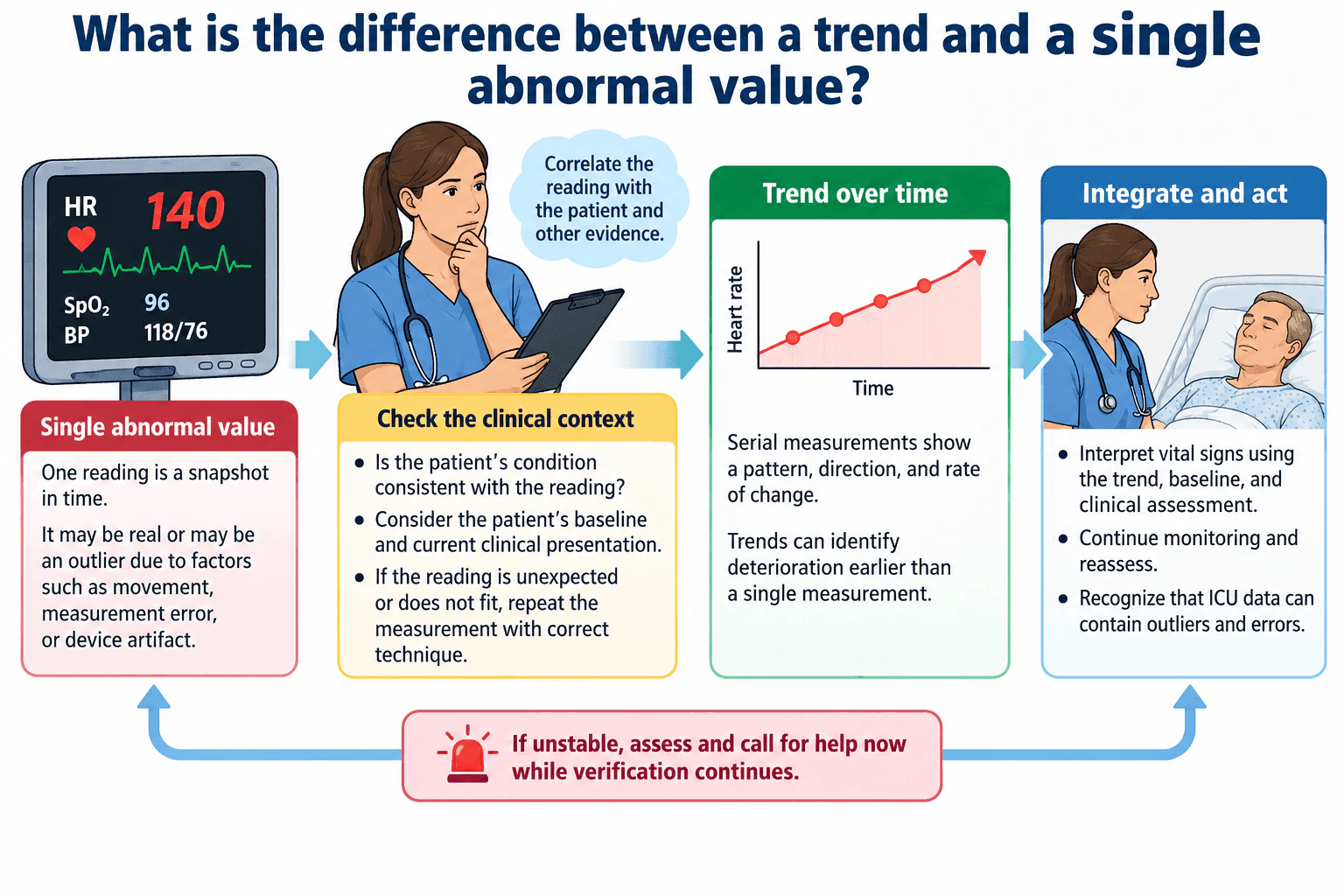
Explain how serial measurements establish direction and rate of change, while one value may require confirmation and clinical context before conclusions are drawn.
Short Interview Answer (30-60 seconds)
A single abnormal value is a snapshot, while a trend is a series of measurements that shows direction and rate of change over time. I compare an abnormal value with the patient's baseline, current condition, and other clinical evidence. If the reading is unexpected or does not fit the patient, I repeat or verify it using appropriate technique. Serial measurements help show whether the abnormality is persistent, improving, or worsening. If the patient appears unstable, I assess and call for appropriate help immediately while verification continues.
Detailed Explanation
A single abnormal value tells me what was measured at one moment. A trend uses serial measurements to show how that value is changing over time. In a critically ill patient, both absolute and trended vital sign values are useful, and reassessment should occur regularly. resus.org.uk
Useful Questions to Ask the Interviewer
How does your ICU display and review serial vital signs and other bedside trends?
What unit processes are used when a monitor value does not match the patient's clinical presentation?
How are concerning trends communicated and escalated within the ICU team?
How to Explain It in an Interview
Clinical Principle
A single abnormal value is a snapshot. It may represent a genuine physiologic change, but one isolated measurement does not establish direction or rate of change. A trend uses repeated measurements to show whether a value is rising, falling, or remaining stable and how quickly it is changing.
Assessment Findings
I first look at the patient and ask whether the reading fits the current clinical presentation. I compare it with the patient's baseline and previous measurements and look for supporting or competing clinical cues. For example, an elevated heart rate is more informative when I know whether it is new, persistent, increasing, and accompanied by other changes in the patient.
I also separate observation from interpretation. A monitor may display an abnormal number, but I still need to determine whether that number accurately reflects the patient. If a reading is unexpected or inconsistent with the bedside assessment, I repeat or verify the measurement with appropriate technique and correlate it with other evidence.
Nursing Priorities
Serial measurements establish direction and rate of change. A persistent or worsening pattern may reveal developing deterioration more clearly than one isolated measurement. Current guidance for deteriorating or critically ill patients recommends regular reassessment and review of both absolute and trended vital signs. resus.org.uk
Reassessment and Escalation
Verification must not delay urgent support. If the patient appears unstable, I continue focused assessment, address immediate threats within nursing scope and local protocols, and call for appropriate help while verification continues. Guidance for critically ill patients emphasizes treating life threatening problems promptly, reassessing regularly, and calling for help early. resus.org.uk
My overall approach is to interpret the individual value, the trend, the patient's baseline, and the current clinical assessment together rather than drawing a conclusion from one isolated number.
Why Interviewers Ask This
Interviewers are assessing whether the nurse can distinguish an isolated data point from a developing clinical pattern. They want to hear that the nurse compares monitor values with the patient's baseline, serial measurements, bedside assessment, and other clinical cues rather than drawing conclusions from one number alone. They are also evaluating whether the nurse can verify questionable data without delaying urgent assessment or escalation when the patient is unstable.
Common interview mistakes
Common mistakes include treating one abnormal value as proof of deterioration without assessing the patient, ignoring a persistent or worsening trend because one later value looks better, failing to compare findings with the patient's baseline, relying on a monitor without correlating the reading with other clinical evidence, and delaying urgent support while completing equipment checks, history, documentation, or communication steps.
Interview tip
Start with the core distinction: a single value is a snapshot, while a trend shows direction and rate of change. Then explain that you compare the value with baseline findings, assess the patient, correlate other clinical cues, verify an unexpected reading, continue reassessment, and escalate immediately if instability is present.
Interviewer may ask next
How would you verify a single abnormal value that does not match the patient's clinical presentation?
I would assess the patient first, compare the value with the patient's baseline and recent measurements, and look for other findings that support or contradict the reading. I would then repeat or verify the measurement using appropriate technique and check relevant monitoring factors or equipment as appropriate. If the patient is unstable, I would call for appropriate help and address immediate threats while verification continues rather than waiting for every check to be completed.
What changes if the patient becomes clinically unstable while you are evaluating an abnormal value?
The priority shifts from confirming an isolated number to immediate focused assessment and support. I would assess for life threatening problems using an organized approach such as Airway, Breathing, Circulation, Disability, and Exposure, call for appropriate help early, and take actions within nursing scope and local protocols while the team evaluates the cause. I would continue monitoring and reassessment because subsequent measurements and the patient's response become part of the developing trend. I would not delay emergency support to complete history, documentation, equipment verification, or a formal handoff first. resus.org.uk
22. How do you reassess after an ICU intervention?Assessment And Clinical JudgmentMedium
i Question Details
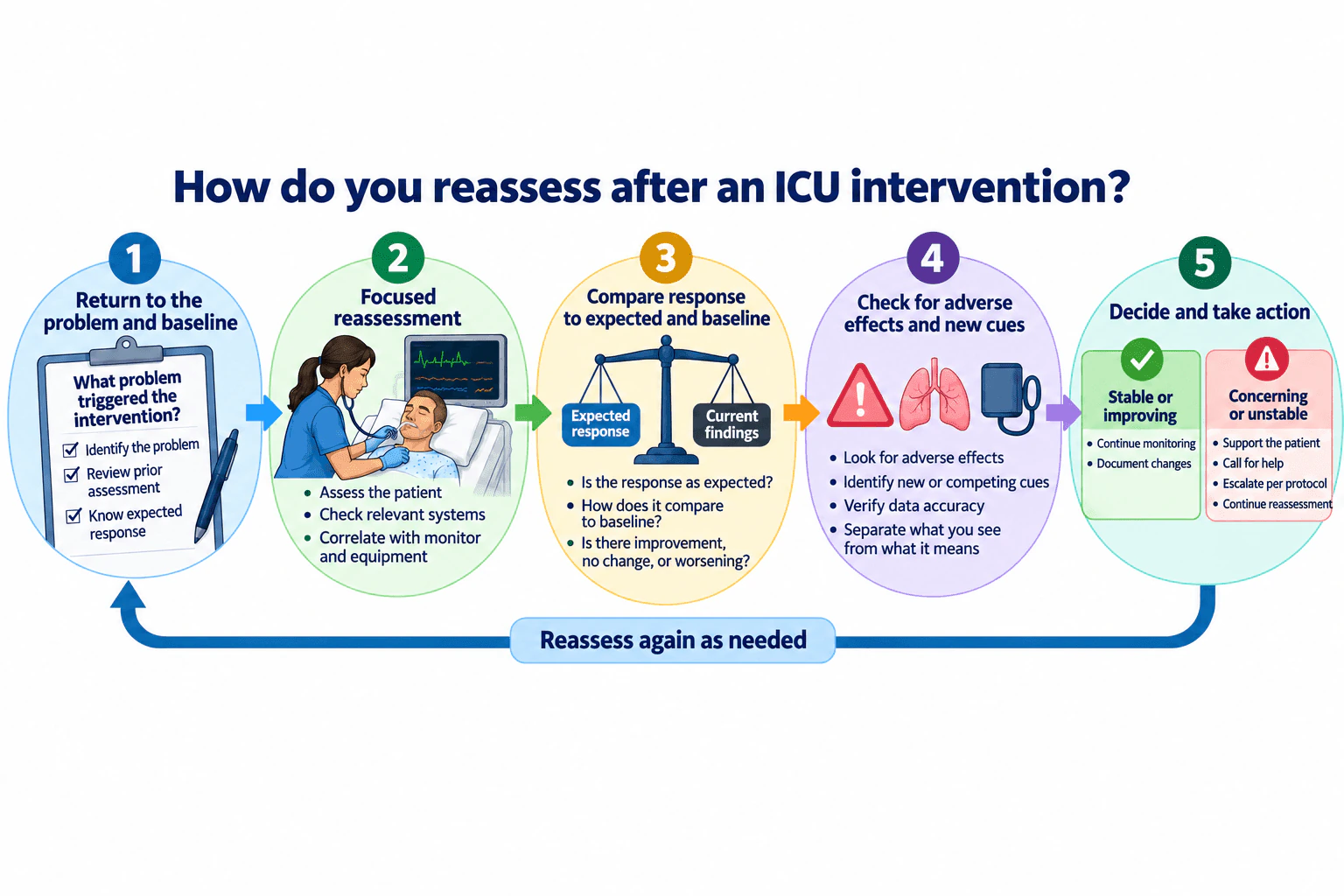
Describe returning to the problem that triggered the intervention, checking expected physiologic response and adverse effects, and comparing with the prior baseline.
Short Interview Answer (30-60 seconds)
After an ICU intervention, I return to the problem that prompted it and perform a focused reassessment. I compare the patient's current findings with the prior baseline and the response I expected, looking for improvement, no change, or worsening. I also check for adverse effects and new or competing cues and correlate monitor and equipment information with the patient. If the patient is stable or improving, I continue monitoring and document the response. If the patient is concerning or unstable, I support the patient, call for help, escalate as appropriate, and continue reassessment.
Detailed Explanation
Reassessment means returning to the problem that triggered the intervention and determining whether the patient actually responded as expected. I use the patient's prior baseline, focused bedside findings, trends, and relevant monitor or equipment information to decide whether the patient is improving, unchanged, or worsening. I also look for adverse effects and new or competing clinical cues before deciding what needs to happen next.
Useful Questions to Ask the Interviewer
How does your ICU expect nurses to document the patient's response after common bedside interventions?
What escalation resources are available when a patient does not respond as expected?
How are concerning reassessment findings usually communicated within the ICU team?
How to Explain It in an Interview
Return to the Problem and Baseline
I would start with the reason for the intervention. I identify the problem that triggered it, review the prior assessment, and clarify what response I expected. That gives me a meaningful comparison point instead of judging a single new finding in isolation.
Perform a Focused Reassessment
I reassess the patient and the systems most relevant to the original problem. I correlate monitor and equipment information with what I see at the bedside and with other available evidence. If a reading does not fit the clinical picture, I verify the data rather than treating the device value as automatically correct.
Compare the Response
I compare current findings with both the prior baseline and the expected response. I ask whether the patient is improving, unchanged, or worsening. Trends are often more useful than one isolated value because they show the direction of the patient's response.
Check for Adverse Effects and New Cues
I also look for adverse effects from the intervention and for new or competing clinical cues. I separate direct observations from my interpretation so that I do not prematurely assume one explanation for a change in condition.
Decide and Continue Reassessment
If the patient is stable or improving, I continue appropriate monitoring and document the response. If the patient is concerning or unstable, I support the patient, call for appropriate help, escalate according to the situation and local protocol, and continue reassessment. If the patient is deteriorating, I use a structured assessment such as Airway, Breathing, Circulation, Disability, and Exposure to identify and address immediate threats while help is being mobilized. I do not delay urgent support in order to complete documentation, a full history, equipment verification, or structured communication.
Why Interviewers Ask This
Interviewers are evaluating whether I close the loop after an intervention instead of assuming that completing the intervention means it worked. They want to hear that I return to the original problem, perform a focused reassessment, compare the current findings with the prior baseline and expected response, recognize adverse effects or competing cues, verify questionable information, and respond appropriately if the patient is not improving.
Common interview mistakes
Common mistakes include checking only the monitor instead of reassessing the patient, failing to return to the original problem, not comparing current findings with the prior baseline and expected response, overlooking adverse effects or competing cues, accepting an inconsistent equipment reading without verification, assuming the intervention worked because it was completed, and delaying support or escalation while trying to finish documentation or gather nonessential information.
Interview tip
Organize the answer as a reassessment loop: return to the original problem and baseline, perform a focused reassessment, compare the current response with the expected response and prior baseline, check for adverse effects and new cues, then decide whether to continue monitoring or escalate. Make it clear that a concerning or unstable patient receives immediate support and appropriate help while reassessment continues.
Interviewer may ask next
What do you do if a monitor or equipment reading does not match the patient's clinical appearance?
I reassess the patient first and compare the reading with the bedside findings and other available evidence. I verify the sensor, connection, waveform, line, or equipment as appropriate and obtain another reliable measurement when possible. I keep the observation separate from my interpretation until I have enough evidence to explain the discrepancy. If the patient appears unstable, I support the patient and call for appropriate help while verification continues rather than delaying care to troubleshoot equipment.
How does your reassessment change if the patient becomes unstable after the intervention?
I shift immediately to a structured assessment of life threatening problems, commonly using Airway, Breathing, Circulation, Disability, and Exposure. I address urgent problems within my role and applicable protocols, call for appropriate help early, and reassess the effect of each action. I do not wait to complete documentation, obtain a full history, finish equipment verification, or prepare structured communication before providing urgent support.
23. How do you decide which abnormal finding deserves immediate escalation?Assessment And Clinical JudgmentMedium
i Question Details
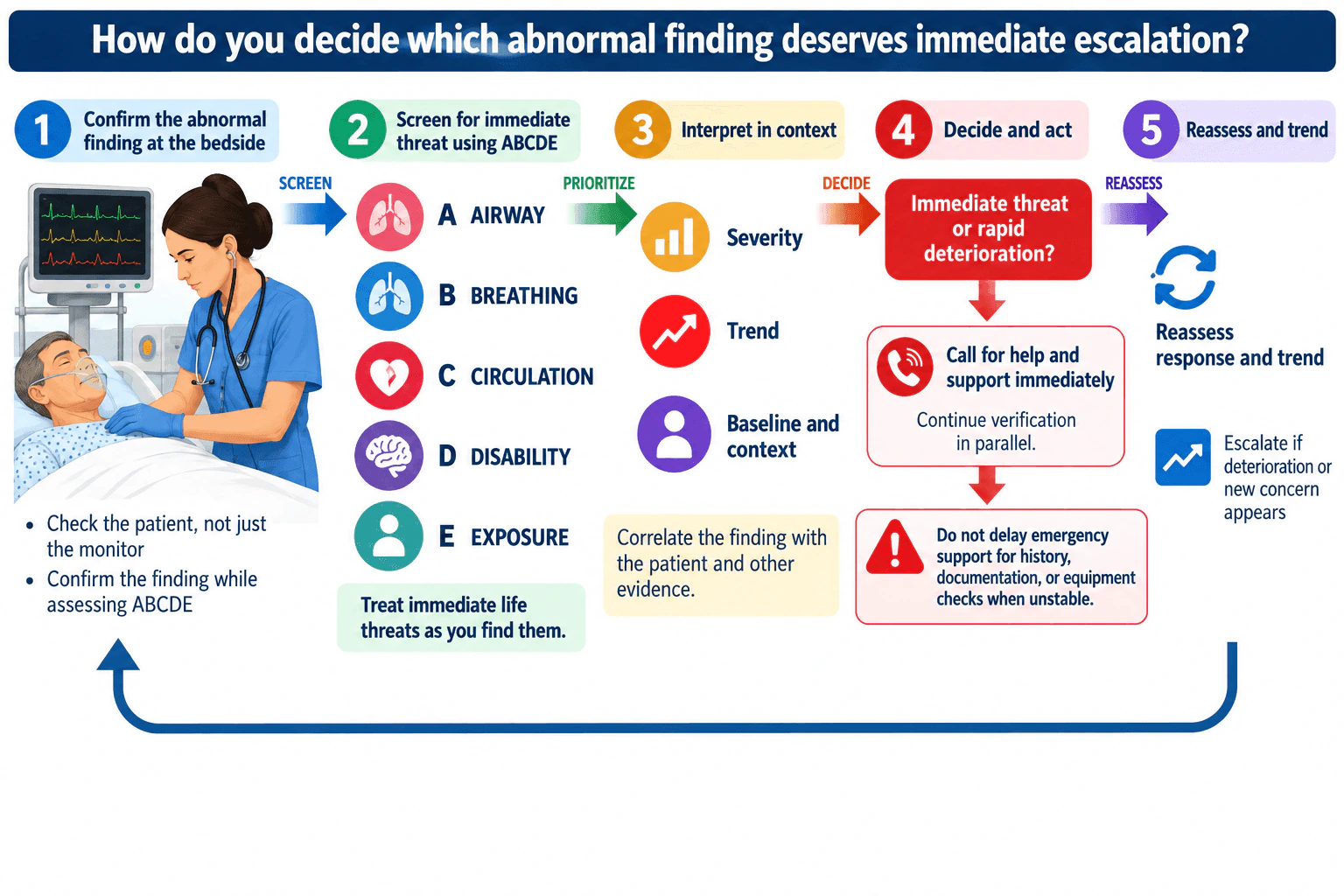
Explain prioritizing findings that threaten airway, breathing, circulation, neurologic function, or rapidly worsening perfusion while integrating severity, trend, and patient context.
Short Interview Answer (30-60 seconds)
I prioritize the patient rather than the isolated number. I confirm the abnormal finding at the bedside, assess Airway, Breathing, Circulation, Disability, and Exposure, and then consider severity, trend, baseline, and clinical context. If the finding represents an immediate threat or rapid deterioration, especially involving airway, breathing, circulation, neurologic function, or perfusion, I call for appropriate help and begin support within my nursing scope while verification continues. I then reassess the response and trend and escalate again if the patient worsens.
Detailed Explanation
The key decision is whether the abnormal finding represents an immediate threat or rapid deterioration. I do not rank findings only by how far a monitor value is from normal. I confirm what I am seeing at the bedside, assess the patient systematically, interpret the finding in context, act when instability is present, and reassess the response.
Useful Questions to Ask the Interviewer
What escalation pathway does your ICU use when a bedside nurse identifies acute deterioration?
How are bedside nurses expected to activate rapid response or other emergency support in this unit?
What resources are immediately available when a patient develops a sudden change in condition?
How to Explain It in an Interview
Clinical Principle
For an adult bedside ICU nurse in the United States, I would start with the patient rather than the monitor. I would confirm the abnormal finding while immediately assessing Airway, Breathing, Circulation, Disability, and Exposure. Life threatening problems take priority over completing the rest of the assessment.
Nursing Priorities
I would ask whether there is an immediate threat to airway, breathing, circulation, neurologic function, or perfusion. I would also consider severity and whether the patient is deteriorating rapidly. A worsening trend can be more concerning than a single isolated value.
Next, I would compare the finding with the patient's baseline and clinical context. I would correlate monitor information with the patient's appearance, examination, other available observations, and relevant information. This helps distinguish a true clinical change from an artifact or incomplete information without allowing verification to delay urgent support.
Escalation
If the patient is unstable or the finding represents an immediate threat, I would call for appropriate help and begin actions that are within my nursing scope, standing protocols, and local emergency procedures. Verification can continue in parallel. I would not wait for a complete history, finished documentation, exhaustive equipment checks, or a formal SBAR before obtaining emergency support.
Reassessment
After escalation or intervention, I would reassess the patient's response and trend. I would continue monitoring for improvement, deterioration, or new concerns and escalate again when the clinical condition requires it. This keeps the decision focused on changing patient risk rather than on one abnormal number.
Why Interviewers Ask This
Interviewers want to know whether I can distinguish a meaningful threat from an isolated abnormal value, recognize deterioration early, prioritize immediate threats, use clinical context rather than relying on a monitor alone, escalate appropriately, and reassess after action.
Common interview mistakes
Common mistakes include reacting to an isolated monitor value without assessing the patient, delaying escalation while gathering a complete history or finishing documentation, spending too long verifying equipment when the patient is visibly unstable, ignoring a worsening trend because a single value is not extreme, failing to compare findings with the patient's baseline, and failing to reassess after escalation or intervention.
Interview tip
Describe the decision in a clear sequence: confirm the finding at the bedside, screen for immediate threats using ABCDE, interpret severity and trend against the patient's baseline and context, escalate immediately when instability or rapid deterioration is present, and reassess the response. Emphasize that emergency support and verification can occur in parallel.
Interviewer may ask next
What if you think the abnormal finding may be caused by the monitor or equipment?
I would correlate the reading with the patient and other available evidence. If the patient appears stable, I can verify the sensor, lead, connection, waveform, or measurement while continuing focused assessment. If the patient appears unstable or has an immediate airway, breathing, circulation, neurologic, or perfusion threat, I would call for appropriate help and support the patient first while equipment verification continues in parallel.
What changes if the abnormal value is only mildly abnormal but has been worsening over time?
The trend increases my concern. I would compare the current finding with prior values and the patient's baseline, reassess the patient for associated clinical changes, and consider whether the pattern suggests developing deterioration. A rapidly worsening trend can justify earlier escalation even when the current value is not the most extreme abnormality, particularly when it is accompanied by changes in airway, breathing, circulation, neurologic status, or perfusion.
24. A sedated patient develops subtle deterioration. How would you structure the assessment?Assessment And Clinical JudgmentHard
i Question Details
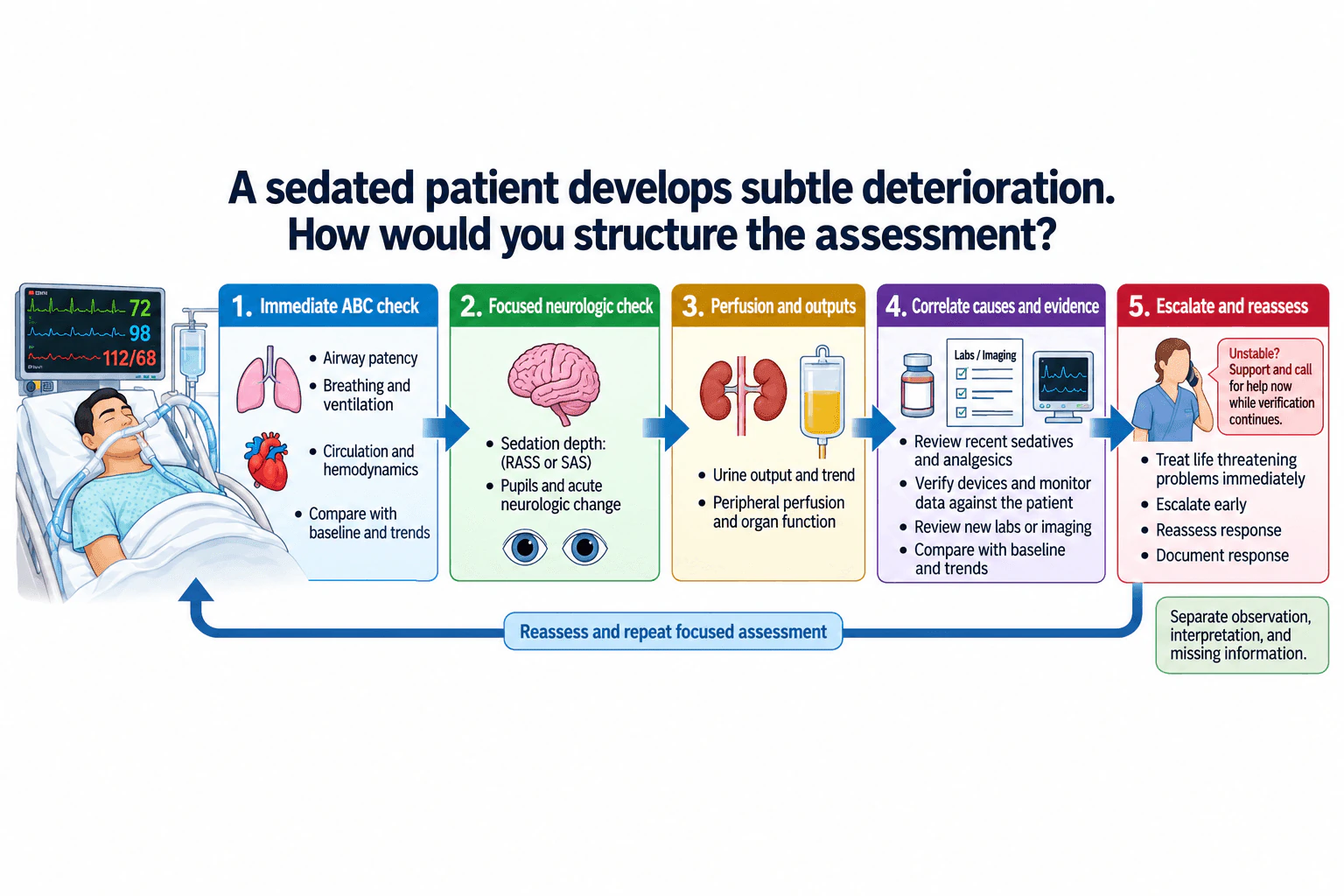
Describe checking airway and ventilation, hemodynamic trends, sedation depth, pupils and neurologic findings, urine output, recent medications, devices, and new laboratory data while escalating urgent concerns.
Short Interview Answer (30-60 seconds)
I would start with a focused ABCDE framework, checking airway, breathing and ventilation, then circulation and hemodynamics while comparing findings with baseline and trends. I would assess sedation depth with RASS or SAS, pupils and acute neurologic change, then urine output and peripheral perfusion. I would correlate those findings with recent sedatives and analgesics, devices, monitor data, and new laboratory or imaging results. If the patient is unstable, I would support life threatening problems and call for help immediately while verification continues, then reassess and document the response.
Detailed Explanation
For an adult bedside ICU nurse in the United States, the central principle is to assess the patient first, identify immediate threats, and use trends and supporting evidence to explain the change. A sedated patient may not report symptoms, so subtle deterioration requires a structured bedside assessment rather than reliance on one monitor value.
Useful Questions to Ask the Interviewer
Does your ICU use RASS, SAS, or another validated sedation scale for adult patients?
What escalation pathway does the unit use when an ICU nurse identifies unexpected deterioration?
How are bedside trends, device data, laboratory results, and imaging typically reviewed during reassessment?
How to Explain It in an Interview
Clinical Principle
I would use the ABCDE framework to organize my priorities and treat any life threatening problem as I find it. I would not delay urgent support while trying to complete the history, verify every device, document, or prepare a formal handoff.
Assessment Findings
I would first assess airway patency, breathing and ventilation, then circulation and hemodynamics. I would compare current findings with the patient's baseline and recent trends rather than treating one value in isolation.
Next I would perform a focused neurologic assessment. I would assess sedation depth with a validated adult ICU scale such as the Richmond Agitation Sedation Scale, or RASS, or the Riker Sedation Agitation Scale, or SAS. I would also assess pupils and look for an acute neurologic change.
I would then assess urine output and its trend, peripheral perfusion, and other evidence of organ function.
Correlating Causes and Evidence
I would review recent sedatives and analgesics, new laboratory or imaging results, and relevant device and monitor data. I would verify equipment readings against the patient and other clinical evidence instead of assuming a displayed value is correct. I would keep three categories separate: what I directly observed, what I think those findings mean, and what information is still missing.
Reassessment and Escalation
If the patient appears unstable, I would support immediate life threatening problems and call for appropriate help while further verification continues. I would communicate the important change, relevant trends, assessment findings, and immediate concerns to the team. After any intervention or escalation, I would repeat the focused assessment, evaluate the patient's response, compare it with prior findings, and document that response.
Why Interviewers Ask This
Interviewers are assessing whether the nurse can recognize subtle deterioration in a patient who may not be able to report symptoms, prioritize immediate threats, integrate bedside findings with baseline and trends, question potentially misleading monitor or device information, escalate promptly, and reassess the patient's response rather than relying on a single isolated value.
Common interview mistakes
Common mistakes include focusing on one monitor value instead of the patient and the trend, delaying emergency support while completing a full history or device check, overlooking sedation depth or pupils, failing to review recent sedatives and analgesics, accepting device data without bedside correlation, and escalating without reassessing the patient's response afterward.
Interview tip
Present the assessment in the same order you would act at the bedside: immediate ABCDE priorities, focused neurologic findings, perfusion and output, correlation with medications and supporting data, then escalation and reassessment. Make it clear that verification continues in parallel and never delays support for an unstable patient.
Interviewer may ask next
How would you verify whether an abnormal monitor or device reading reflects true patient deterioration?
I would assess the patient directly and compare the displayed value with other clinical evidence and recent trends. I would check whether the reading is physiologically consistent with the bedside assessment and review the relevant device, connections, waveform or signal quality when appropriate to my nursing role. I would seek another reliable measurement or supporting finding when available. If the patient is unstable, I would call for help and support immediate threats while verification occurs rather than delaying care until the equipment question is completely resolved.
How would your approach change if the patient suddenly became profoundly unstable rather than showing subtle deterioration?
The same structured reasoning applies, but immediate stabilization and escalation take priority over completing the full focused review. I would rapidly assess airway, breathing and circulation, call for appropriate help, begin interventions within my scope and established protocols, and communicate the critical findings to the team. Medication review, equipment verification, laboratory review, documentation, and other diagnostic details would continue in parallel when possible, but none should delay treatment of an immediate life threatening problem. I would then reassess repeatedly to determine the response.
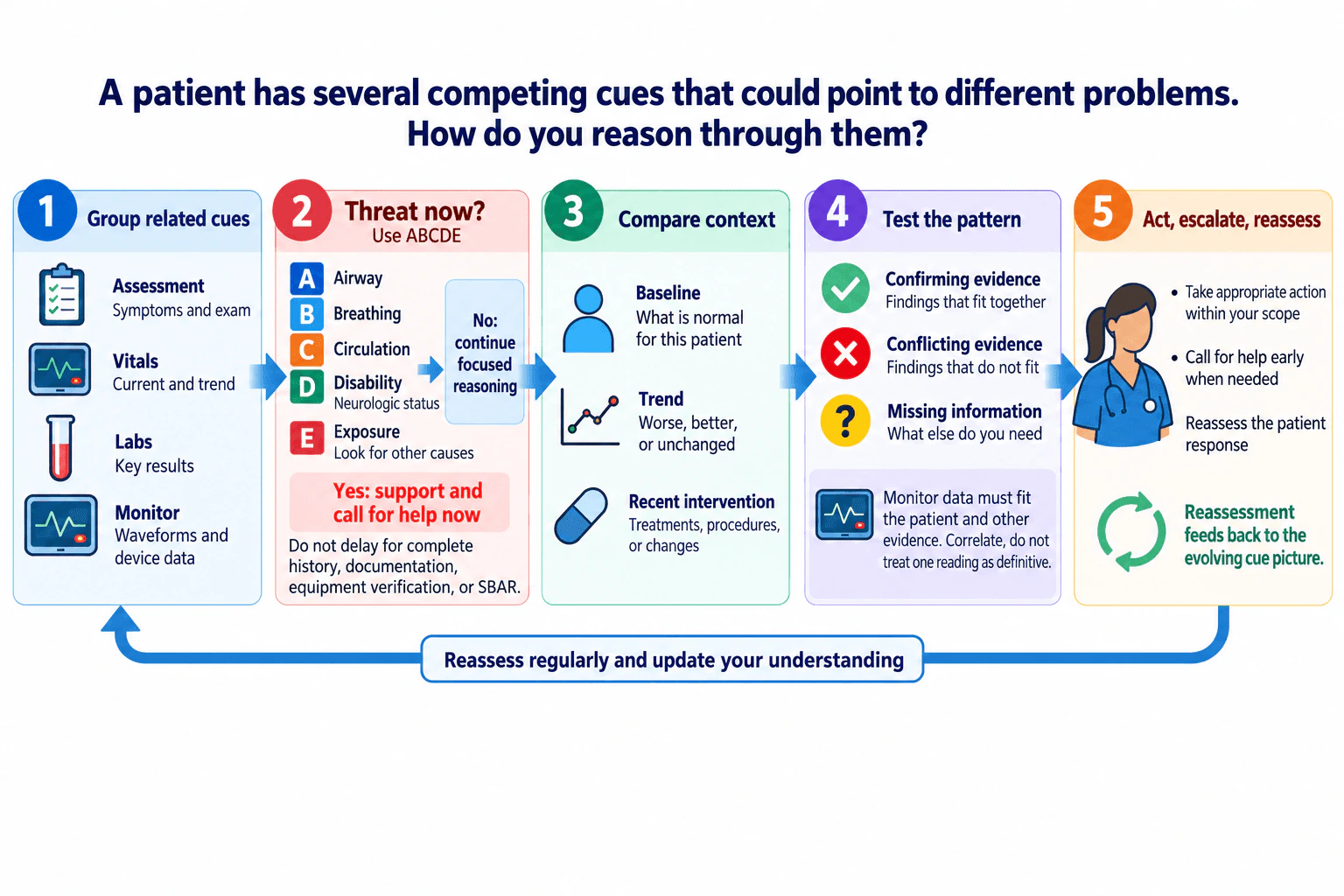
25. A patient has several competing cues that could point to different problems. How do you reason through them?Assessment And Clinical JudgmentHard
i Question Details
Group related findings, identify immediate threats, compare with baseline and recent interventions, look for confirming or conflicting evidence, and reassess after action.
Short Interview Answer (30-60 seconds)
I first group related cues from the assessment, vital signs, laboratory results, and monitor data. Then I check for an immediate threat using ABCDE. If the patient is unstable, I support the patient and call for help without waiting to complete every verification step. If there is no immediate threat, I compare the findings with baseline, trends, and recent interventions. I test the pattern by looking for confirming evidence, conflicting evidence, and missing information, and I make sure monitor readings fit the patient and other evidence. After acting within my scope and applicable orders or protocols, I reassess the response and update the clinical picture.
Detailed Explanation
Competing cues are easier to reason through when I organize them instead of anchoring on one abnormal finding. I separate what I can directly observe from what I think it may mean and from what information is still missing.
Useful Questions to Ask the Interviewer
How does your ICU expect nurses to escalate a concerning change in condition?
What resources are available when bedside findings and monitor data do not agree?
How are important changes from a patient's baseline communicated during handoff?
How to Explain It in an Interview
Clinical Principle
I organize the cues before choosing an explanation. I group related assessment findings, vital signs, laboratory results, and monitor data, then immediately ask whether there is a threat using ABCDE: Airway, Breathing, Circulation, Disability, and Exposure. If the patient is unstable, I support the patient and call for help while verification continues. I do not wait for a complete history, documentation, equipment verification, or SBAR before providing needed emergency support.
Patient Context And Checks
If there is no immediate threat, I continue focused reasoning. I compare the current findings with the patient's baseline, whether the trend is worse, better, or unchanged, and any recent treatment, procedure, or other change.
Next, I test the pattern. I separate findings that confirm the leading concern from findings that conflict with it, and I identify what information is still missing. I also make sure monitor data fit the patient and other evidence rather than treating one reading as definitive.
Nursing Priorities
I take appropriate nursing action within my scope and applicable orders or protocols, and I call for help early when the situation requires escalation. The goal is to act on the whole clinical picture while remaining open to a different explanation when the evidence does not fit.
Reassessment and Escalation
After action, I reassess the patient's response and update the cue picture. Reassessment may strengthen the original interpretation, reveal a competing problem, or show that the current plan is not working. That feedback keeps the reasoning process continuous instead of ending with the first conclusion.
Why Interviewers Ask This
Interviewers are evaluating whether I can organize competing clinical cues, identify immediate threats, compare current findings with baseline and trends, recognize the effect of recent interventions, distinguish confirming from conflicting evidence, identify missing information, correlate monitor data with the patient, escalate deterioration promptly, and reassess after action.
Common interview mistakes
Common mistakes include anchoring on one abnormal value, treating monitor data as definitive without correlating it with the patient, ignoring baseline and recent trends, overlooking a recent intervention that could explain the change, forcing conflicting findings into one diagnosis, failing to identify missing information, delaying support for an unstable patient while completing history or verification, and failing to reassess after action.
Interview tip
Describe the reasoning in the same sequence shown at the bedside: group related cues, identify immediate threats with ABCDE, compare baseline and trends, consider recent interventions, test the pattern with confirming and conflicting evidence, identify missing information, act and escalate appropriately, then reassess the patient's response.
Interviewer may ask next
What would you do if a monitor reading did not match the patient's clinical appearance?
I would assess the patient first and correlate the monitor value with the rest of the clinical picture. I would review the waveform or signal quality when applicable, inspect the sensor or equipment connection, compare the value with other available findings, and obtain additional assessment data as appropriate. I would not treat one reading as definitive. If the patient appeared unstable, I would support the patient and call for help while verification continued.
How would your reasoning change if the patient suddenly became unstable while you were still sorting through the competing cues?
I would immediately shift from completing the full reasoning process to identifying and addressing threats using ABCDE. I would support the patient, call for appropriate help, and perform nursing actions that are within my scope and authorized by applicable orders or protocols. I would not wait for a complete history, documentation, equipment verification, or SBAR before providing needed emergency support. Once the immediate threat was addressed, I would return to baseline comparison, trends, recent interventions, confirming and conflicting evidence, missing information, and reassessment.
26. What is cardiac output?Hemodynamics And MonitoringEasy
Short Interview Answer (30-60 seconds)
Cardiac output is the amount of blood the heart pumps each minute. It equals heart rate multiplied by stroke volume. In critical care, I would interpret cardiac output as part of the overall perfusion assessment rather than rely on it alone. I would also consider rhythm, mentation, urine output, peripheral perfusion, blood pressure trends, and whether the cardiac output measurement is technically reliable.
Detailed Explanation
Cardiac output describes how much blood the heart pumps into the circulation in one minute. The basic relationship is cardiac output = heart rate × stroke volume. Heart rate is the number of heartbeats per minute, and stroke volume is the amount of blood ejected with each heartbeat. Cardiac output therefore changes when either component changes.
Useful Questions to Ask the Interviewer
Which cardiac output monitoring methods are commonly used in your ICU?
What bedside findings do you expect nurses to integrate with hemodynamic measurements?
What is the unit process for checking questionable invasive monitoring values?
How to Explain It in an Interview
For an adult bedside ICU nurse in the United States, I would explain cardiac output as one measure of the heart's ability to provide blood flow to the body. It is commonly expressed in liters per minute and is determined by heart rate and stroke volume.
The number becomes meaningful only when I connect it with the patient's condition. Reduced cardiac output can contribute to inadequate organ perfusion, but I would not determine perfusion from cardiac output or blood pressure alone. I would assess trends in mental status, urine output, skin temperature, peripheral perfusion, rhythm, blood pressure, and other available clinical findings.
I would also consider why cardiac output may have changed. Heart rate and rhythm can affect ventricular filling and effective ejection. Stroke volume is influenced by ventricular filling, myocardial contractility, and the resistance against which the ventricle ejects. These relationships help explain why different forms of shock or cardiac dysfunction can produce different hemodynamic patterns.
If cardiac output is obtained through advanced hemodynamic monitoring, I would consider whether the measurement is technically reliable before acting on it. For invasive pressure monitoring, I would check the system setup, transducer level, zeroing, connections, and waveform quality according to the device instructions and local protocol. I would review trends rather than react to one isolated value and communicate unexpected changes with the relevant clinical findings.
A finding that suggests fluid responsiveness does not automatically mean that the patient needs fluid. Fluid responsiveness describes the likelihood that stroke volume or cardiac output will increase after additional preload. The clinical need for fluid depends on the patient's overall assessment, risks, treatment plan, and authorized orders or protocols. After ordered support, I would reassess both the hemodynamic trend and evidence of tissue perfusion.
Why Interviewers Ask This
Interviewers ask this question to confirm that a critical care nurse understands a basic hemodynamic concept and can connect it to bedside assessment. They are looking for recognition that cardiac output depends on both heart rate and stroke volume and that its clinical meaning must be considered alongside perfusion findings, rhythm, blood pressure trends, and the reliability of any measurement being used.
Common interview mistakes
Common mistakes include confusing cardiac output with blood pressure, interpreting one cardiac output value without considering perfusion findings, using one static pressure to diagnose volume status, treating fluid responsiveness as an automatic indication for fluid, and accepting an invasive monitoring value without checking measurement quality.
Interview tip
Give the definition first, state cardiac output = heart rate × stroke volume, and then connect the measurement to bedside perfusion assessment. Showing that you verify measurement quality and interpret trends in clinical context demonstrates stronger critical care reasoning than simply quoting a reference range.
Interviewer may ask next
How would you verify that a cardiac output or related invasive hemodynamic value is reliable?
I would first review how the value was obtained and look for technical factors that could make it unreliable. For an invasive pressure monitoring system, I would check the setup, transducer level, zeroing, connections, and waveform quality according to the device instructions and local protocol. I would compare the value with previous trends and the patient's bedside assessment. If it remained inconsistent with the clinical picture, I would communicate the discrepancy and seek appropriate verification rather than treating an unverified number as accurate.
How would your interpretation change if cardiac output decreased but the patient's blood pressure remained relatively unchanged?
I would not assume that an unchanged blood pressure means perfusion is adequate. Arterial pressure is influenced by cardiac output and vascular resistance, so compensatory vasoconstriction can help maintain pressure despite reduced flow. I would reassess mental status, urine output, peripheral perfusion, rhythm, blood pressure trends, and other available findings, review the cardiac output trend and measurement quality, and communicate a clinically important change. The response would depend on the suspected cause, the full hemodynamic picture, and ordered or protocol authorized support.
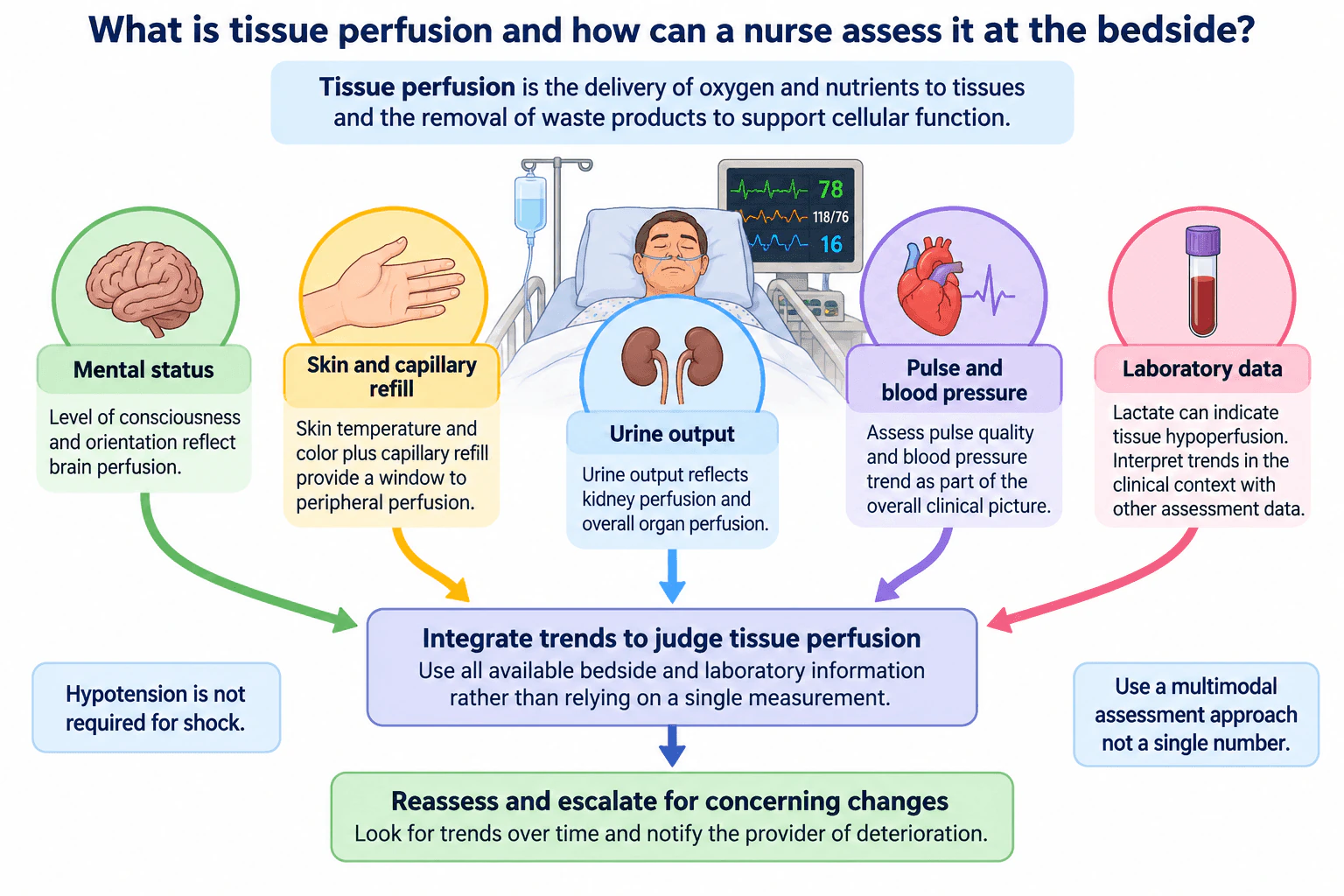
27. What is tissue perfusion and how can a nurse assess it at the bedside?Hemodynamics And MonitoringEasy
i Question Details
Describe mental status, skin temperature and color, capillary refill, urine output, pulse quality, blood pressure trend, and laboratory data as complementary indicators.
Short Interview Answer (30-60 seconds)
Tissue perfusion is blood flow that delivers oxygen and nutrients to tissues and supports removal of waste products. At the bedside, I assess it using complementary findings including mental status, skin temperature and color, capillary refill, urine output, pulse quality, blood pressure trends, and laboratory data such as lactate when available. I compare these findings with baseline and trend them over time. I would not use one blood pressure or one laboratory value alone to decide whether perfusion is adequate.
Detailed Explanation
Tissue perfusion means that organs and tissues receive blood flow that supports oxygen and nutrient delivery, waste removal, and normal cellular function. At the bedside, I build a perfusion picture from several complementary findings rather than treating any single measurement as definitive.
Useful Questions to Ask the Interviewer
What bedside findings does your unit emphasize when trending perfusion changes?
How are concerning perfusion trends communicated and escalated on the unit?
What laboratory and hemodynamic information is routinely available to bedside nurses?
How to Explain It in an Interview
Mental Status
I assess level of consciousness, orientation, and changes from baseline. New confusion or reduced responsiveness can be a sign that cerebral perfusion is worsening, although neurologic changes can have other causes and must be interpreted in context.
Skin And Capillary Refill
I assess skin temperature and color and use capillary refill as an additional peripheral perfusion finding. Cool, pale, mottled, or poorly refilling skin can increase concern when it occurs with other signs of impaired circulation.
Urine Output
I trend urine output because it can reflect renal perfusion and overall organ perfusion. A decline is important, but I also consider other possible causes rather than assuming that low urine output proves hypoperfusion by itself.
Pulse And Blood Pressure
I assess pulse quality and follow blood pressure trends. Blood pressure contributes to the overall assessment, but one isolated pressure does not determine whether tissue perfusion is adequate. Shock and impaired perfusion can be present before marked hypotension develops.
Laboratory Context
Laboratory data can add information. Lactate can increase with tissue hypoperfusion, but elevated lactate has other causes, so I interpret it with the clinical examination, hemodynamic findings, diagnosis, and trend rather than using it alone.
Integrate And Reassess
I combine the bedside and laboratory findings, compare them with prior values and baseline, and reassess for trends. If mental status, peripheral perfusion, urine output, pulse quality, blood pressure, or laboratory trends suggest deterioration, I communicate the change and escalate according to the patient's condition, orders, protocols, and local scope of practice.
Why Interviewers Ask This
Interviewers want to know whether the nurse can recognize impaired tissue perfusion by integrating neurologic, peripheral, renal, circulatory, and laboratory findings. The key judgment is avoiding reliance on a single number, recognizing meaningful trends, reassessing changes, and escalating deterioration appropriately.
Common interview mistakes
Common mistakes include judging perfusion from blood pressure alone, treating one lactate result as proof of hypoperfusion, ignoring changes from baseline, overlooking mental status or urine output trends, and interpreting capillary refill without considering the rest of the clinical picture.
Interview tip
Organize the answer around mental status, peripheral skin findings, urine output, pulse and blood pressure trends, and laboratory context. Then emphasize that the nurse integrates and trends all findings, reassesses concerning changes, and escalates deterioration rather than relying on one number.
Interviewer may ask next
How would you verify that a concerning perfusion finding is real before escalating it?
I would repeat the relevant assessment and verify the measurement that raised concern. I would reassess mental status, skin findings, capillary refill, pulse quality, blood pressure trend, and urine output as appropriate, confirm that available monitoring data are technically reliable, compare with prior values and baseline, and review available laboratory trends. If the overall picture remains concerning, I would communicate and escalate promptly rather than dismissing the change because one individual finding is uncertain.
How would your assessment change if the patient's blood pressure remained near baseline but urine output fell and the skin became cool?
I would still be concerned about possible impaired perfusion because a near baseline blood pressure does not guarantee adequate tissue blood flow. I would reassess mental status, skin temperature and color, capillary refill, pulse quality, urine output trend, blood pressure trend, and available laboratory data. I would integrate those findings, look for continued deterioration, and communicate and escalate the combined changes rather than waiting for hypotension to appear.
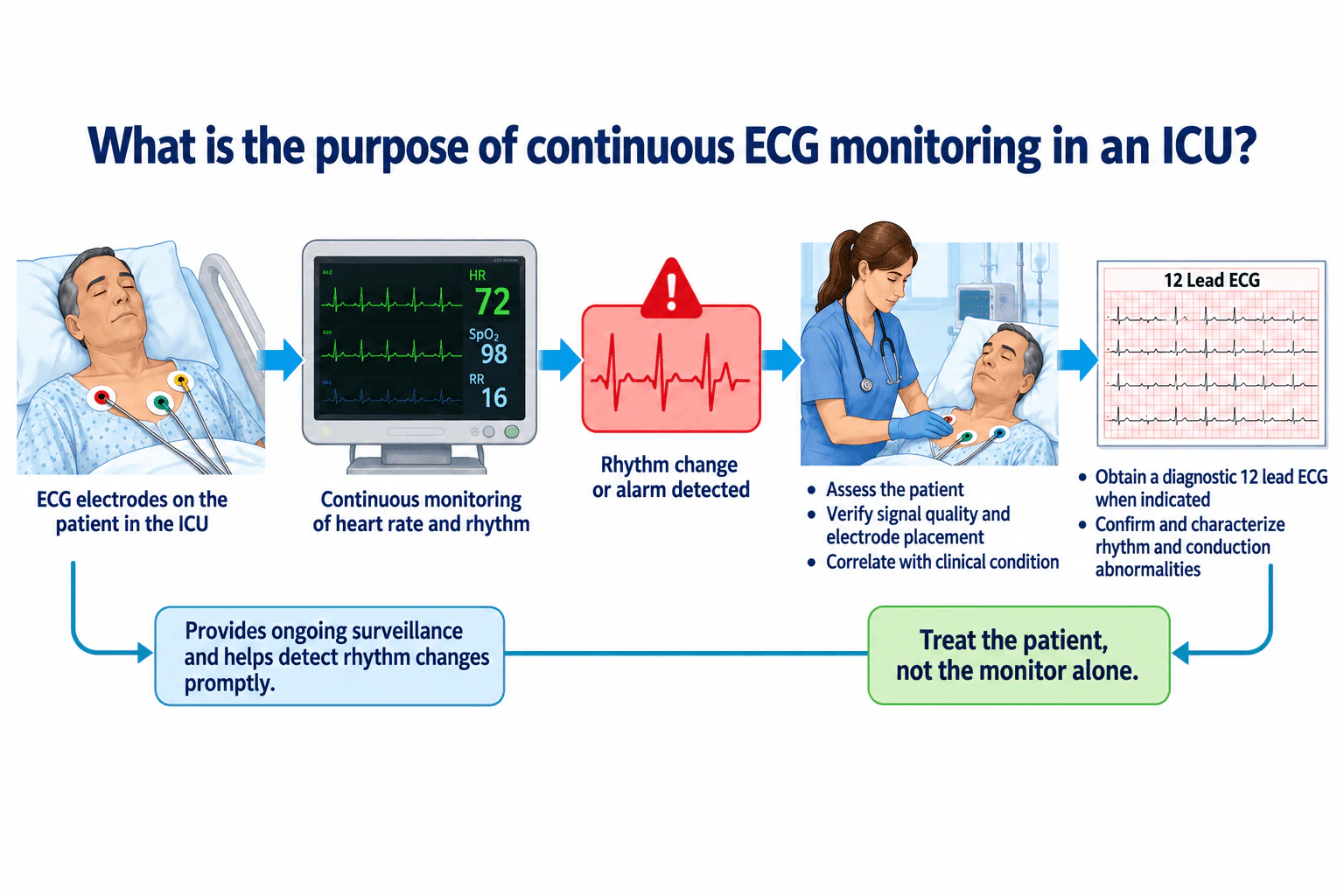
28. What is the purpose of continuous ECG monitoring in an ICU?Hemodynamics And MonitoringEasy
i Question Details
Explain surveillance for heart rate and rhythm changes and the need to correlate monitor findings with patient assessment and a diagnostic ECG when indicated.
Short Interview Answer (30-60 seconds)
Continuous ECG monitoring provides ongoing surveillance of heart rate and rhythm so important changes can be detected early. If I see a new rhythm change or alarm, I assess the patient, verify signal quality and electrode placement, and correlate the tracing with the clinical condition. If the finding appears significant, I obtain or escalate for a diagnostic 12 lead ECG when indicated.
Detailed Explanation
Continuous ECG monitoring gives the ICU team ongoing information about heart rate and rhythm. Its main purpose is to identify meaningful changes early while remembering that the monitor is only one part of the assessment. The tracing should always be interpreted together with the patient's clinical condition.
Useful Questions to Ask the Interviewer
In your ICU, can the bedside nurse initiate a 12 lead ECG under protocol, or does it require another order or notification?
Who initially reviews rhythm alarms in your unit, the bedside nurse, a monitor technician, or both?
Which rhythm changes require immediate notification or escalation in your ICU?
How to Explain It in an Interview
I would say that continuous ECG monitoring provides ongoing surveillance of heart rate and rhythm so the team can recognize important changes promptly.
If a rhythm change or alarm occurs, I first assess the patient rather than treating the monitor alone. I correlate the tracing with symptoms, vital signs, mental status, and overall clinical condition.
I also verify that the signal is reliable. I check electrode placement, connections, and signal quality because movement or poor electrode contact can create artifact that resembles an abnormal rhythm.
If the change appears real or clinically important, I obtain or escalate for a diagnostic 12 lead ECG when indicated according to local protocol and provider involvement. The diagnostic ECG can help confirm and better characterize the rhythm or conduction abnormality.
For an interview, I would summarize my reasoning as monitor, assess, verify, and confirm. Continuous monitoring helps detect changes early. Bedside assessment determines how the patient is tolerating the change. Signal verification reduces the risk of responding to artifact. A diagnostic ECG provides additional information when further evaluation is needed.
Why Interviewers Ask This
Interviewers want to know whether you understand both the value and the limitations of continuous ECG monitoring. They are evaluating whether you can recognize rhythm changes promptly, assess the patient rather than relying only on the monitor, verify that the signal is reliable, and understand when a diagnostic 12 lead ECG may be needed for further evaluation.
Common interview mistakes
Common mistakes include relying on the monitor without assessing the patient, assuming every alarm represents a true arrhythmia, failing to check signal quality or electrode placement, and treating continuous monitoring as a substitute for a diagnostic 12 lead ECG when further evaluation is indicated.
Interview tip
Use a simple sequence in your answer: continuous surveillance, patient assessment, signal verification, and diagnostic confirmation when indicated. Emphasize that the monitor helps detect changes early, but the patient's clinical condition guides the response.
Interviewer may ask next
How would you verify that an abnormal rhythm displayed on the monitor is real?
I would assess the patient and correlate the displayed rhythm with the clinical condition. I would then check signal quality, electrode placement, and lead connections and look for possible movement or contact artifact. If the change persists or appears clinically significant, I would obtain or escalate for a diagnostic 12 lead ECG when indicated and communicate the finding according to unit protocol.
How would your response change if the patient developed chest pain with a new monitor change?
The new symptom makes the monitor change more clinically significant. I would assess the patient immediately, review vital signs and overall stability, verify that the tracing is reliable, and promptly escalate the finding. I would obtain or escalate for a diagnostic 12 lead ECG when indicated and follow the unit's protocol and ordered plan while continuing close monitoring.
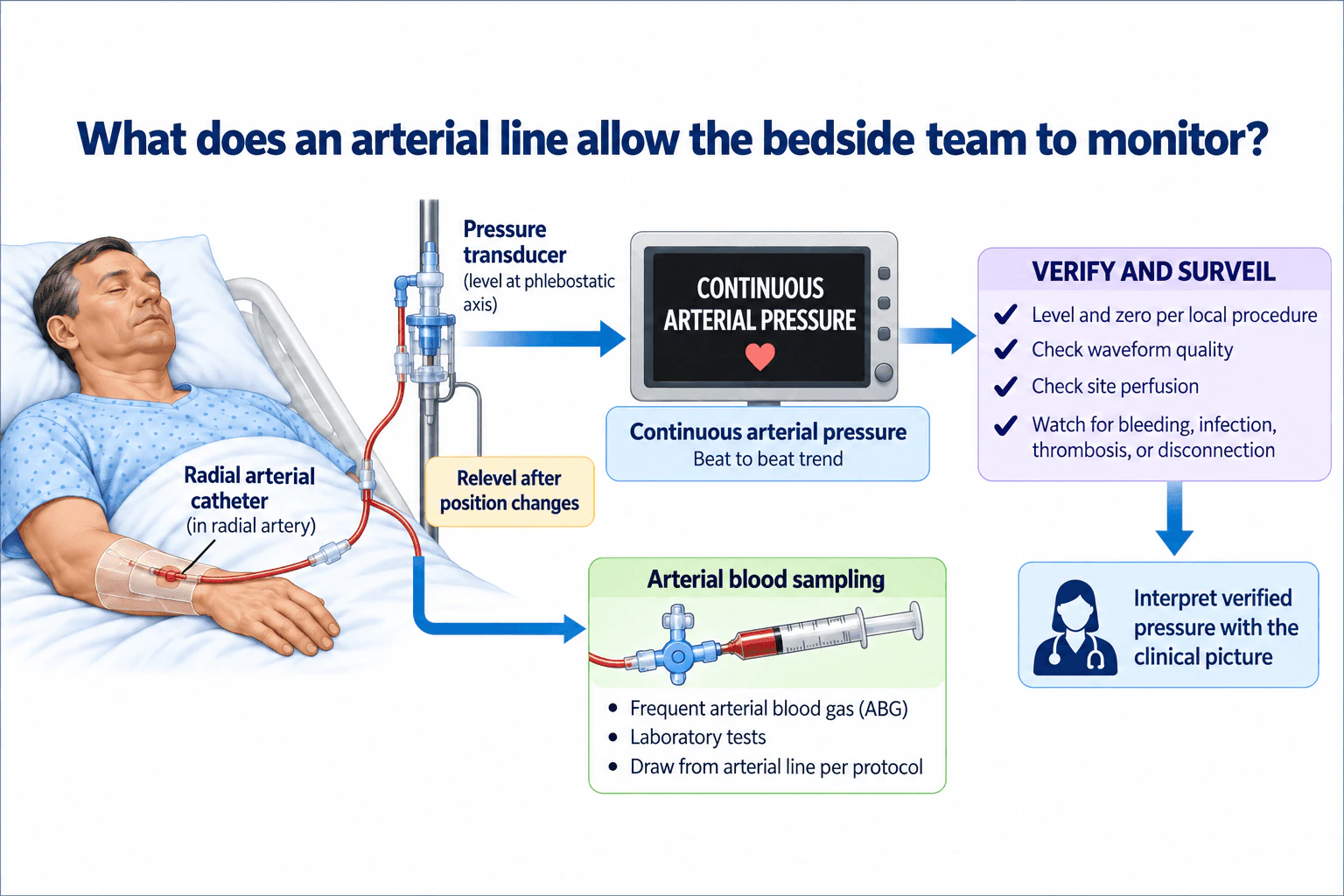
29. What does an arterial line allow the bedside team to monitor?Hemodynamics And MonitoringEasy
i Question Details
Describe continuous arterial pressure measurement and blood sampling uses, along with the need to verify waveform quality, leveling, zeroing, site perfusion, and complications according to local procedure.
Short Interview Answer (30-60 seconds)
An arterial line gives the bedside team continuous direct arterial pressure monitoring and access for arterial blood sampling, such as an arterial blood gas. Before trusting the pressure, I would check waveform quality and confirm that the transducer is leveled and zeroed according to the monitoring system and local procedure. I would also assess the insertion site and distal perfusion, watch for bleeding, infection, thrombosis, or disconnection, recheck the transducer level after position changes, and interpret the verified pressure trend with the patient's clinical picture.
Detailed Explanation
An arterial line has two main bedside functions. It provides continuous invasive arterial pressure monitoring and provides arterial access for blood sampling. These are separate uses of the same arterial catheter system. The pressure transducer converts pressure from the fluid filled monitoring system into an electrical signal that the bedside monitor displays. The arterial catheter can also be used for arterial blood gas sampling and other ordered laboratory testing according to local procedure.
Useful Questions to Ask the Interviewer
What procedure does this ICU use for leveling, zeroing, and checking arterial waveform quality?
What is the unit procedure for drawing blood from an arterial line and maintaining the system?
Which arterial line findings require immediate escalation in this unit?
How to Explain It in an Interview
Continuous Arterial Pressure
I would explain that an arterial line provides continuous direct arterial pressure information, so the bedside team can follow pressure trends without waiting for intermittent cuff measurements. I would avoid interpreting a single pressure value in isolation.
Measurement Quality
Before relying on the displayed pressure, I would verify the monitoring system. The transducer must be leveled to the intended reference point and zeroed according to the device and local procedure. For standard adult arterial pressure monitoring, the phlebostatic axis is commonly used as the right atrial reference level. I would also assess waveform quality because damping, air, tubing problems, disconnection, or incorrect transducer position can make the displayed pressure inaccurate. If the patient moves relative to the transducer, I would recheck the level.
Arterial Blood Sampling
The arterial catheter also allows arterial blood sampling, including an arterial blood gas and other ordered laboratory tests according to local procedure. Blood sampling is a separate use of arterial access and does not result from the pressure measurement itself.
Site And Perfusion Surveillance
I would inspect the insertion site and assess distal perfusion. I would watch for bleeding, infection, thrombosis, impaired distal circulation, and system disconnection. A concerning change would prompt immediate patient assessment and escalation according to the clinical situation and local procedure.
Clinical Interpretation
Finally, I would interpret the verified arterial pressure trend together with the patient's overall clinical picture. The important nursing principle is to verify the measurement system, assess the patient and arterial site, recognize complications, and communicate meaningful changes promptly.
Why Interviewers Ask This
Interviewers are assessing whether the nurse understands both what an arterial line provides and what must be checked before its information is trusted. A strong answer connects continuous arterial pressure monitoring and arterial blood sampling with correct leveling, zeroing, waveform assessment, site and distal perfusion checks, recognition of complications, and interpretation of the verified pressure trend in the context of the patient.
Common interview mistakes
Common mistakes include trusting the displayed pressure without checking leveling, zeroing, and waveform quality; forgetting to recheck the transducer level after the patient changes position; implying that arterial blood sampling comes from the pressure measurement rather than from the arterial access itself; overlooking the insertion site and distal perfusion; failing to recognize bleeding, infection, thrombosis, or disconnection; and treating one pressure value or one universal pressure target as sufficient for clinical interpretation.
Interview tip
Organize the answer around four ideas: continuous arterial pressure, arterial blood sampling, measurement verification, and patient and site surveillance. Emphasize that you verify the system before trusting the displayed pressure and interpret the verified trend together with the patient's clinical picture.
Interviewer may ask next
How would you verify that an arterial pressure reading is trustworthy?
I would confirm that the transducer is leveled to the intended reference point and that the system has been zeroed according to the device and local procedure. I would assess waveform quality and inspect the tubing and connections for air, kinking, disconnection, or other problems that could distort the measurement. I would also compare the verified pressure trend with the patient's clinical assessment rather than relying on the monitor value alone.
What would you do if the arterial pressure changed suddenly after the patient was repositioned?
I would assess the patient first, then determine whether the change could be related to the monitoring system. Because moving the patient relative to the transducer can alter the measured pressure, I would recheck the transducer level, waveform quality, tubing, connections, arterial site, and distal perfusion according to local procedure. If the pressure change persisted after verification or the patient had concerning findings, I would escalate promptly and communicate the verified trend and assessment findings.
30. How do you monitor a patient receiving ordered vasoactive support?Hemodynamics And MonitoringMedium
i Question Details
Describe frequent assessment of blood pressure and perfusion, rhythm, urine output, mental status, infusion integrity, access site, adverse effects, and response to protocol authorized titration.
Short Interview Answer (30-60 seconds)
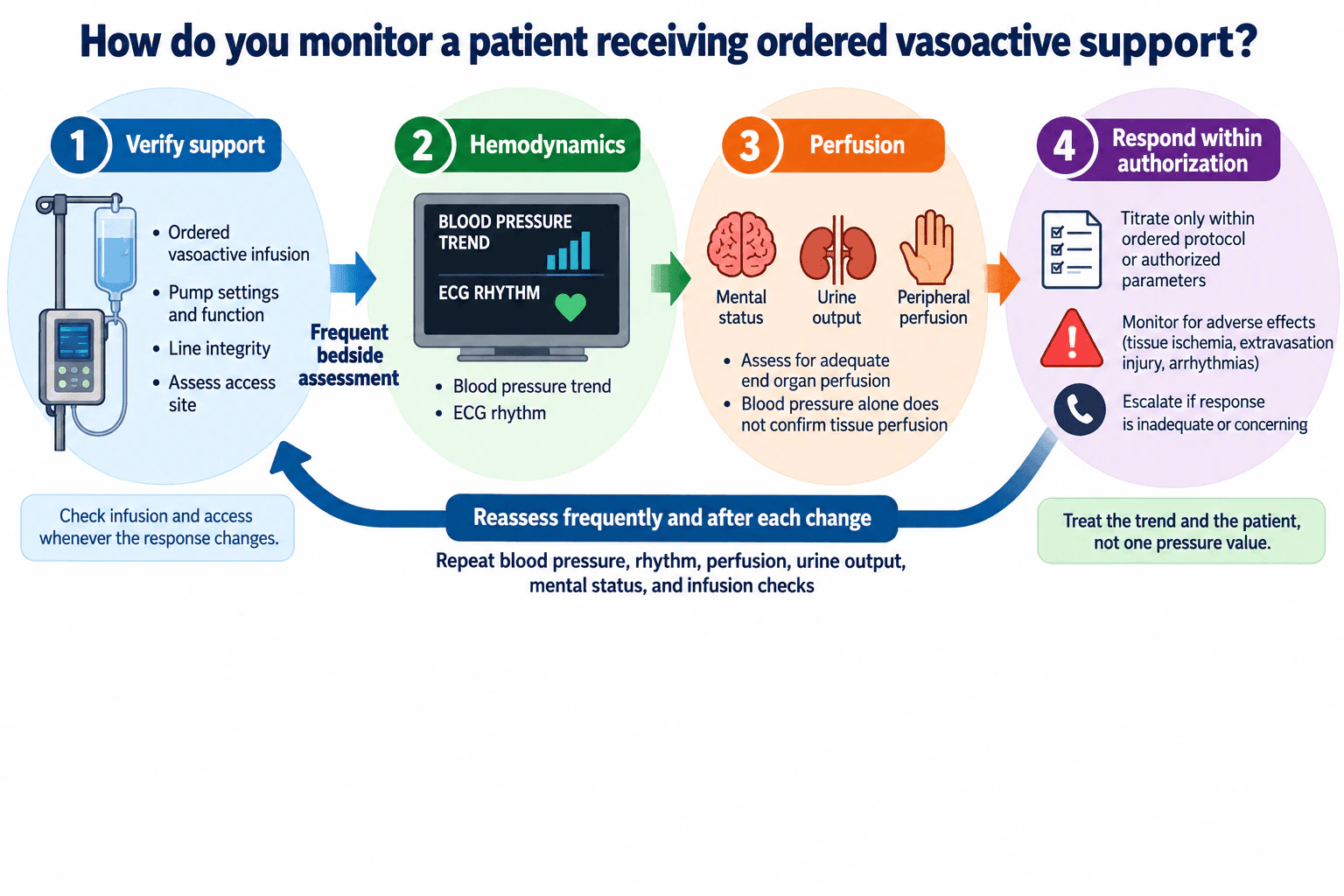
I first verify the ordered vasoactive infusion, pump settings and function, line integrity, and access site. Then I frequently trend blood pressure and ECG rhythm and assess actual perfusion through mental status, urine output, and peripheral perfusion. I monitor for adverse effects such as arrhythmia, tissue ischemia, and extravasation. I titrate only within the ordered protocol or authorized parameters, escalate if the response is inadequate or concerning, and reassess the hemodynamics, perfusion, and infusion after each change.
Useful Questions to Ask the Interviewer
What monitoring and documentation expectations does your ICU use for patients receiving vasoactive infusions?
Which vasoactive titrations may bedside nurses perform under approved protocols or ordered parameters in this unit?
What is the unit process for escalating an inadequate response or suspected infusion complication?
Detailed Explanation
How to Explain It in an Interview
I would describe vasoactive monitoring as a repeated bedside cycle rather than focusing on one blood pressure reading.
First, I verify the support itself. I confirm the ordered vasoactive infusion, pump settings and function, tubing and line integrity, and the vascular access site. I continue checking the site because extravasation of vasoactive medication can cause serious local tissue injury.
Second, I assess hemodynamics frequently. I follow the blood pressure trend and ECG rhythm and look for changes over time. I do not use one static pressure value by itself to decide whether circulation is adequate.
Third, I assess perfusion at the patient level. I evaluate mental status, urine output, and peripheral perfusion and relate those findings to the hemodynamic trend. A pressure reading that appears acceptable does not by itself confirm adequate tissue perfusion.
Fourth, I respond within my authorization. If the order or approved protocol permits nurse titration, I adjust the infusion only within those parameters. I monitor for adverse effects such as arrhythmia, tissue ischemia, and extravasation. If the patient has an inadequate response, concerning rhythm change, worsening perfusion, or an infusion complication, I escalate promptly according to the clinical situation and local process.
I then reassess frequently and after each change. I repeat blood pressure and rhythm assessment, mental status, urine output, peripheral perfusion, and infusion checks. The key is to treat the patient's trend and overall perfusion, not one pressure value.
Why Interviewers Ask This
Interviewers are evaluating whether the nurse can safely manage a high risk continuous vasoactive infusion while integrating monitor data with bedside perfusion findings. They also want to hear that the nurse verifies the infusion and vascular access, recognizes adverse effects, stays within authorized titration parameters, escalates concerns appropriately, and reassesses after changes rather than treating a single pressure value in isolation.
Common interview mistakes
Common mistakes include focusing on a single blood pressure value, failing to assess mental status, urine output, and peripheral perfusion, overlooking pump or line problems, neglecting the access site, failing to watch for arrhythmia or tissue ischemia, titrating outside authorized parameters, and changing the infusion without reassessing the patient's response.
Interview tip
Organize your answer as four linked steps: verify the infusion and access, trend blood pressure and rhythm, assess tissue perfusion, then respond within authorized parameters and reassess. Explicitly say that one pressure value does not replace assessment of the patient.
Interviewer may ask next
How would you verify that an unexpected blood pressure change reflects the patient rather than a monitoring or infusion problem?
I would assess the patient first, repeat or confirm the blood pressure using the available validated monitoring method, review the blood pressure trend and ECG rhythm, and check the infusion pump, tubing, line integrity, and access site. I would then compare the pressure change with mental status, urine output, and peripheral perfusion before deciding whether the vasoactive response is truly inadequate. If the findings remain concerning or inconsistent, I would escalate promptly while continuing close reassessment.
What changes if the blood pressure improves after titration but urine output, mental status, or peripheral perfusion worsens?
I would not assume perfusion is adequate just because the blood pressure improved. I would reassess the full clinical picture, review the ECG rhythm and infusion, look for adverse effects or another cause of worsening perfusion, and escalate the discordant findings promptly. Further vasoactive changes would remain limited to the existing order or authorized protocol while the team evaluates why tissue perfusion is not improving with the pressure trend.
More questions load as you scroll
Disclaimer: This interview guide is for educational and informational purposes only. It is designed to help readers prepare, but it does not guarantee any interview result, hiring decision, offer, or outcome. Interview questions, hiring criteria, and preferred answers can vary by employer, interviewer, industry, location, and time. All answers, examples, and explanations in this guide are suggested examples for interview preparation, not definitive answers or instructions for professional practice. They are based on research and judgment, are provided without warranties of any kind, and should be adapted to the question, role, and applicable laws and professional requirements. Diagrams are simplified illustrations intended to highlight the main concepts and their relationships; actual situations, systems, and practices may be more complex. Alternative approaches may be equally valid or better suited to a particular question, context, or interviewer. To the fullest extent permitted by applicable law, the contributors and publisher are not liable for decisions made, actions taken, or losses incurred based on this guide.
State Laws and Professional Responsibilities: Laws and requirements governing an occupation vary by state and jurisdiction. You are responsible for checking the current laws, licensing requirements, and scope-of-practice rules that apply to your location and role, and for ensuring that your answers and actions comply with them. Adapt examples in this guide to those requirements. This guide is not legal advice.
Content Accuracy and Verification: To the fullest extent permitted by applicable law, we do not represent or warrant that interview guides, questions, answers, examples, or diagrams are accurate, complete, current, error-free, or suitable for any particular purpose. You are responsible for independently reviewing and verifying the information before relying on it.