This interview guide is for educational and informational purposes only. It is designed to help readers prepare, but it does not guarantee any interview result, hiring decision, offer, or outcome. Interview questions, hiring criteria, and preferred answers can vary by employer, interviewer, industry, location, and time. All answers, examples, and explanations in this guide are suggested examples for interview preparation, not definitive answers or instructions for professional practice. They are based on research and judgment, are provided without warranties of any kind, and should be adapted to the question, role, and applicable laws and professional requirements. Diagrams are simplified illustrations intended to highlight the main concepts and their relationships; actual situations, systems, and practices may be more complex. Alternative approaches may be equally valid or better suited to a particular question, context, or interviewer. To the fullest extent permitted by applicable law, the contributors and publisher are not liable for decisions made, actions taken, or losses incurred based on this guide.
State Laws and Professional Responsibilities
Laws and requirements governing an occupation vary by state and jurisdiction. You are responsible for checking the current laws, licensing requirements, and scope-of-practice rules that apply to your location and role, and for ensuring that your answers and actions comply with them. Adapt examples in this guide to those requirements. This guide is not legal advice.
Identity, Image, and Privacy Notice
To respect individual privacy, some names, profile photographs, avatars, biographical details, and other identifying information displayed in this guide may be replaced with pseudonyms, licensed stock images, illustrative avatars, composite images, or representative descriptions. Unless a person is expressly identified as an actual contributor, a displayed name, image, or profile should not be understood as depicting or identifying a specific candidate, interviewer, employee, or other real individual. These representations are provided for editorial and illustrative purposes only and do not imply endorsement, employment, participation, or affiliation with this guide or any company mentioned in it. Any resemblance to an actual person is coincidental.
Company Notice
This guide is an independent educational resource and is not affiliated with, endorsed by, sponsored by, or approved by the company named in this guide. Company names identify reported interview experiences or the employer context of clearly labeled original practice exercises. Interview practices can change without notice, and inclusion of company-specific content does not mean these questions are official, complete, or guaranteed to be asked. To the fullest extent permitted by law, the author, contributors, and publisher are not responsible for outcomes related to use of this material.
Content Accuracy and Verification
To the fullest extent permitted by applicable law, we do not represent or warrant that interview guides, questions, answers, examples, or diagrams are accurate, complete, current, error-free, or suitable for any particular purpose. You are responsible for independently reviewing and verifying the information before relying on it.
Questions or comments?
Contact us for general questions, or share feedback, technical corrections, and comments with the community.
31. A patient remains hypotensive after an ordered fluid bolus. How would you reassess before the next step?Hemodynamics And MonitoringHard
i Question Details
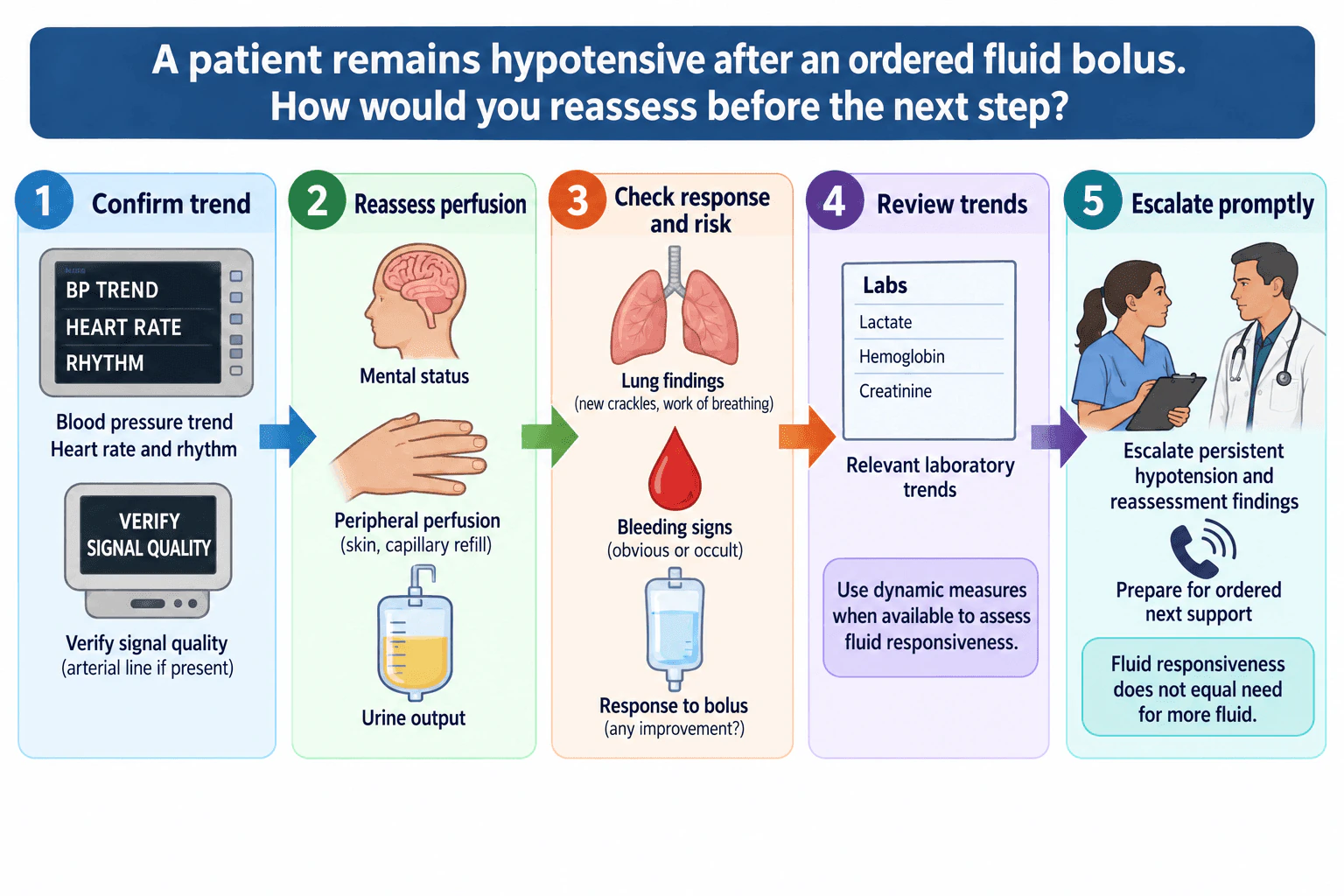
Reassess perfusion, blood pressure trend, heart rate and rhythm, lung findings, bleeding signs, urine output, mental status, laboratory trends, and response to the bolus, then escalate promptly.
Short Interview Answer (30-60 seconds)
I would confirm the blood pressure trend and heart rate and rhythm, verify arterial line signal quality if present, and then reassess mental status, peripheral perfusion and capillary refill, urine output, lung findings, bleeding signs, and the response to the bolus. I would review relevant laboratory trends such as lactate when indicated, hemoglobin, and creatinine. If appropriate dynamic measures are available, I would use them to assess fluid responsiveness rather than relying on one static number. If hypotension persists, I would promptly escalate the reassessment findings and prepare for the next ordered support. Fluid responsiveness does not automatically mean the patient needs more fluid.
Detailed Explanation
Persistent hypotension after an ordered fluid bolus means I need to reassess the whole perfusion picture before assuming the patient needs additional fluid. For adult bedside ICU practice in the United States, I would combine measurement verification, clinical perfusion findings, response to the bolus, relevant laboratory trends, and prompt escalation.
Useful Questions to Ask the Interviewer
Does this ICU commonly use arterial lines or dynamic measures when reassessing fluid responsiveness?
What escalation process is expected when hypotension persists after an ordered bolus?
How to Explain It in an Interview
Confirm the trend and measurement quality
I would first confirm that the hypotension is persistent by reviewing the blood pressure trend together with heart rate and rhythm. If the patient has an arterial line, I would inspect signal quality and check that the system is leveled and zeroed according to the device instructions and local protocol before relying on the value.
Reassess perfusion
I would reassess mental status, peripheral skin perfusion and capillary refill, and urine output. These findings help show whether organ perfusion is improving or worsening instead of relying on blood pressure alone.
Check response and risk
I would determine whether the bolus produced any clinical improvement. I would reassess lung findings, including new crackles or increased work of breathing, because they may suggest that additional fluid could be poorly tolerated. I would also look for obvious or occult bleeding as a possible contributor to persistent hypotension.
Review relevant trends
I would review clinically relevant laboratory trends such as lactate when indicated, hemoglobin, and creatinine. Laboratory values should be interpreted with the bedside assessment and their direction over time rather than used as isolated triggers for treatment.
Interpret fluid responsiveness carefully
If appropriate monitoring is available, I would use dynamic measures to help assess fluid responsiveness rather than relying on a static measurement alone. A patient may appear fluid responsive yet still have reasons that additional fluid is not appropriate, so the finding must be interpreted with lung findings, perfusion, bleeding risk, and the response already observed.
Escalate and prepare
If hypotension persists, I would promptly communicate the blood pressure trend, rhythm, perfusion findings, lung assessment, bleeding assessment, urine output, laboratory trends, and response to the bolus. I would then prepare for the next ordered support rather than independently selecting or prescribing treatment.
Why Interviewers Ask This
Interviewers are evaluating whether the nurse can verify measurement quality, recognize persistent circulatory instability, reassess organ perfusion and possible causes of hypotension, evaluate the response to an intervention, recognize signs that additional fluid may be poorly tolerated, and communicate deterioration without automatically assuming another fluid bolus is appropriate.
Common interview mistakes
Common mistakes include reacting to one blood pressure value without checking the trend, trusting an arterial pressure reading without verifying signal quality, focusing only on blood pressure while overlooking mental status, urine output, and peripheral perfusion, assuming persistent hypotension automatically requires more fluid, ignoring new lung findings or bleeding, treating fluid responsiveness as proof that fluid is needed, and delaying escalation while waiting for one laboratory value to change.
Interview tip
Present the reassessment in the same sequence as the clinical reasoning: confirm the trend and measurement quality, reassess perfusion, check the response to the bolus and new risks, review relevant trends, interpret fluid responsiveness in context, then escalate persistent hypotension with a concise report of what changed and what did not.
Interviewer may ask next
How would you verify that an arterial line blood pressure is reliable before using it for reassessment?
I would inspect the signal and waveform quality, confirm that the transducer is leveled at the correct reference point and zeroed according to the device instructions and local protocol, inspect the pressure tubing and system for problems that could distort the signal, and compare the reading with the patient's overall clinical picture. I would not base the next clinical decision on an obviously unreliable arterial signal.
What would change if the patient developed new crackles and increased work of breathing after the bolus?
That would increase concern that additional fluid may be poorly tolerated. I would reassess respiratory effort, oxygenation, lung findings, perfusion, urine output, blood pressure trend, and the response to the bolus, then escalate promptly. I would not assume that fluid responsiveness means another bolus should be given. I would prepare for whatever additional evaluation or treatment is ordered based on the complete clinical picture.
32. What is respiratory failure?Airway And VentilationEasy
Short Interview Answer (30-60 seconds)
Respiratory failure means the respiratory system cannot adequately oxygenate the blood, eliminate carbon dioxide, or both. Oxygenation describes getting oxygen into the blood, while ventilation describes moving air and removing carbon dioxide. As a critical care nurse, I would assess airway patency, respiratory effort, mental status, oxygenation data, available blood gas results, and the likely cause. If the patient is mechanically ventilated, I would also assess the patient, airway, ventilator, and alarms, collaborate with respiratory therapy, use prescribed support, and reassess the response.
Detailed Explanation
Respiratory failure is a serious condition in which the respiratory system cannot maintain adequate gas exchange. The problem may primarily affect oxygenation, ventilation, or both. Oxygenation means transferring oxygen from the lungs into the blood. Ventilation means moving air and eliminating carbon dioxide.
Useful Questions to Ask the Interviewer
What respiratory findings would prompt immediate escalation in this ICU?
How do nurses and respiratory therapists coordinate ventilator assessment and alarm response in this unit?
What protocol does the unit use to assess readiness for liberation from mechanical ventilation?
How to Explain It in an Interview
Airway and Breathing Assessment
I would start with the patient. I would assess airway patency, respiratory rate and pattern, work of breathing, chest movement, breath sounds, mental status, oxygen saturation, and other vital signs. I would compare current findings with the patient's known baseline and review available blood gas results in clinical context.
Oxygenation and Ventilation
I would distinguish the two problems. Inadequate oxygenation means insufficient oxygen is reaching the blood. Inadequate ventilation means carbon dioxide is not being removed effectively. Arterial blood gas testing can provide information about oxygen, carbon dioxide, pH, and bicarbonate, but I would interpret those results together with the bedside assessment rather than using one value alone.
Mechanical Ventilation and Alarms
If the patient is mechanically ventilated and an alarm occurs, I would immediately assess the patient and airway, then evaluate the ventilator system and monitoring data. I would look for problems such as obstruction, secretions, disconnection, changes in respiratory effort, or patient ventilator interaction. I would collaborate with respiratory therapy and the medical team and would not independently invent or prescribe ventilator settings.
Liberation Readiness
Respiratory failure may improve enough for ventilator liberation to be considered. Readiness is assessed using the patient's overall clinical condition and the local interprofessional protocol. In appropriate adults, a spontaneous breathing trial can be used to evaluate whether the patient can tolerate reduced ventilatory support. I would participate in assessment, monitoring, communication, and reassessment according to protocol and prescribed care.
Reassessment
After an intervention or change in support, I would reassess respiratory effort, airway status, mental status, oxygenation, ventilation data when available, and the patient's overall response. I would promptly communicate deterioration and document relevant findings, actions, escalation, and response.
Why Interviewers Ask This
Interviewers want to know whether the nurse understands the difference between oxygenation and ventilation, recognizes respiratory deterioration, assesses the patient before focusing on equipment, communicates significant changes, and works within the nursing role when respiratory support or mechanical ventilation is required.
Common interview mistakes
Common mistakes include treating low oxygen as the only form of respiratory failure, confusing oxygenation with ventilation, relying on oxygen saturation alone, overlooking changes in mental status or work of breathing, interpreting blood gas results without clinical context, responding to a ventilator alarm without first assessing the patient and airway, silencing alarms without identifying the cause, and independently changing prescribed ventilator support outside an authorized protocol or order.
Interview tip
Start with a simple definition, then distinguish oxygenation from ventilation. Explain how you assess the airway and breathing, interpret objective data in context, respond to ventilator alarms by assessing the patient first, collaborate with respiratory therapy and the medical team, and reassess after interventions. If mechanical ventilation is involved, mention liberation readiness without assuming independent authority to change treatment.
Interviewer may ask next
How would you verify that a patient may be developing respiratory failure?
I would verify the concern by combining bedside assessment with objective data. I would assess airway patency, respiratory rate and pattern, work of breathing, breath sounds, mental status, oxygen saturation, and other vital signs. I would confirm that monitoring equipment is functioning appropriately and review available arterial blood gas results, which can provide information about oxygen, carbon dioxide, pH, and bicarbonate. I would compare the findings with prior values and the patient's baseline and promptly escalate concerning deterioration.
How would your assessment change if the patient has chronic lung disease?
I would determine the patient's documented baseline because chronic lung disease can be associated with longstanding abnormalities in oxygenation or carbon dioxide levels. I would focus on changes from that baseline, including worsening respiratory effort, altered mental status, new symptoms, changes in gas exchange, and overall clinical deterioration. I would continue prescribed respiratory support, communicate significant changes, and reassess the response rather than assuming that an abnormal value is either acute or normal for that patient.
33. What is acute respiratory distress syndrome?Airway And VentilationEasy
i Question Details
Describe acute respiratory distress syndrome as severe inflammatory lung injury with impaired oxygenation and explain why close respiratory monitoring is required.
Short Interview Answer (30-60 seconds)
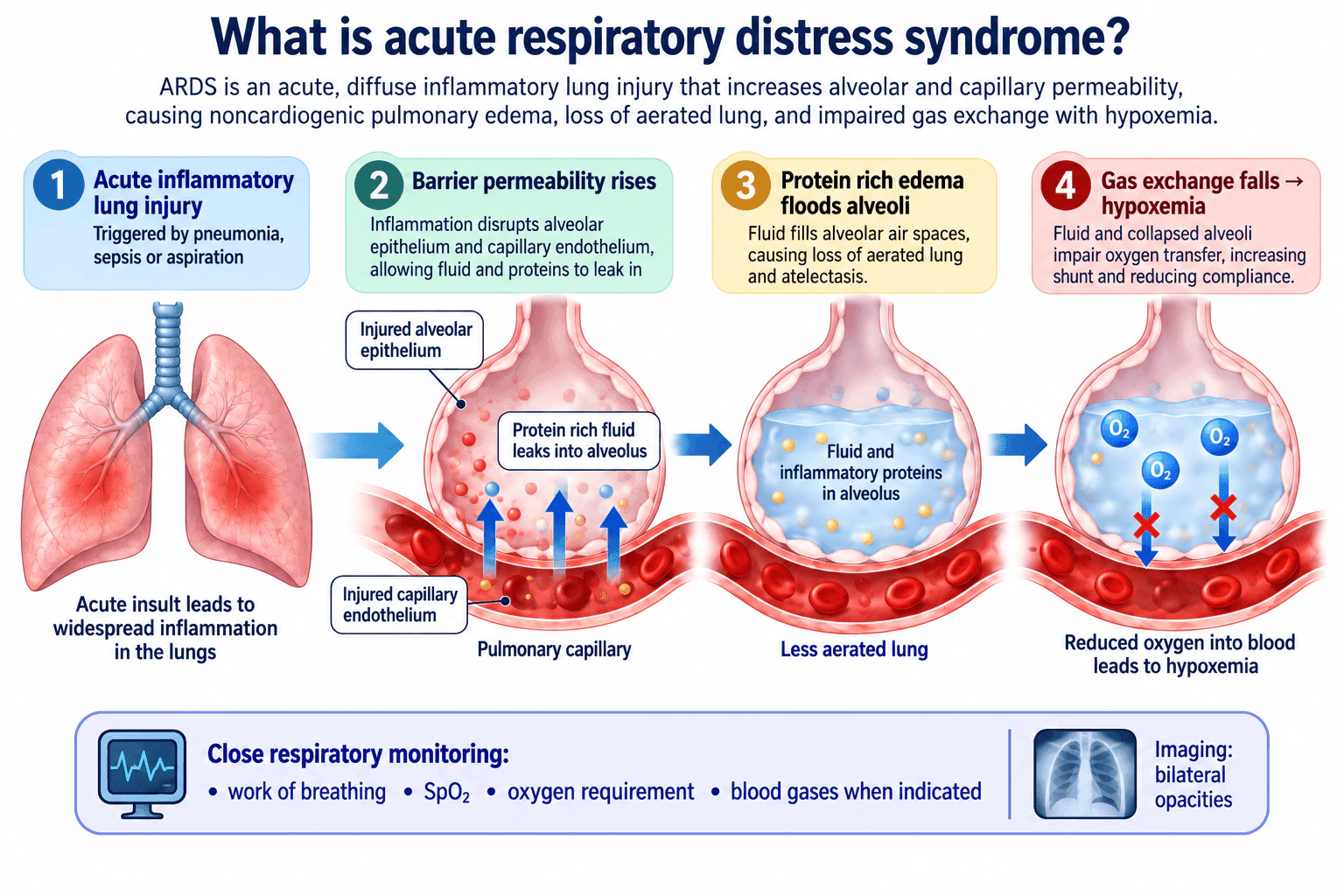
ARDS is an acute diffuse inflammatory lung injury that damages the alveolar capillary barrier. Increased permeability allows protein rich fluid to enter the alveoli, causing noncardiogenic pulmonary edema, loss of aerated lung, alveolar collapse, and impaired oxygen transfer. The result is hypoxemia. Because respiratory status can deteriorate, the nurse closely monitors work of breathing, SpO₂, oxygen requirement, blood gases when indicated, and the overall clinical response.
Detailed Explanation
ARDS is a severe inflammatory lung injury that disrupts the barrier between the pulmonary capillaries and the alveoli. Fluid and inflammatory proteins move from the vascular space into the alveoli. As alveoli become fluid filled or collapse, less lung remains aerated and available for effective gas exchange. Blood can continue flowing past poorly ventilated alveoli, increasing shunt and reducing oxygen transfer into the bloodstream. The result is hypoxemia, and lung compliance can also decrease. Common triggers include pneumonia, sepsis, and aspiration. Imaging commonly shows bilateral pulmonary opacities in the appropriate clinical context.
Useful Questions to Ask the Interviewer
What respiratory assessment findings would you expect the bedside nurse to escalate promptly in a patient with suspected or established ARDS?
How does your ICU coordinate respiratory reassessment between nursing, respiratory therapy, and the medical team?
What monitoring trends are most important for nurses to communicate during changes in oxygenation?
How to Explain It in an Interview
I would explain ARDS as an acute inflammatory injury involving the alveolar epithelium and pulmonary capillary endothelium. Damage to this barrier increases permeability, allowing protein rich fluid to leak from the pulmonary capillaries into the interstitium and alveolar airspaces.
As the alveoli fill with fluid and some collapse, the amount of aerated lung decreases. Blood can continue passing through affected lung regions even though those alveoli are poorly ventilated. This increases shunt, reduces effective oxygen transfer, and produces hypoxemia. The lungs may also become less compliant.
At the bedside, I would focus on the patient's respiratory status rather than one isolated value. I would assess work of breathing, respiratory pattern, SpO₂, mental status, oxygen requirement, and other clinical findings. I would review blood gases when obtained and follow chest imaging and other diagnostic information in context. Bilateral pulmonary opacities can support the diagnosis when the overall clinical picture is consistent with ARDS.
Close monitoring matters because worsening inflammation, edema, or alveolar collapse can further reduce gas exchange and increase oxygen needs. I would trend changes, reassess after interventions within my nursing role, promptly communicate deterioration, and collaborate with respiratory therapy and the prescribing clinical team. I would not independently invent or change ventilator settings outside an order, protocol, or defined scope of practice.
Why Interviewers Ask This
Interviewers want to know whether the nurse understands the basic pathophysiology of ARDS, can connect alveolar capillary injury to impaired oxygenation, and recognizes why changes in work of breathing, oxygen saturation, oxygen requirement, blood gases, and imaging require close reassessment and communication.
Common interview mistakes
Common mistakes include describing ARDS only as low oxygen without explaining the inflammatory alveolar capillary injury, reversing the direction of fluid movement, confusing oxygenation failure with ventilation failure, assuming all pulmonary edema is caused by heart failure, or focusing on ventilator settings instead of patient assessment and reassessment. Another mistake is treating one SpO₂ value in isolation rather than considering work of breathing, oxygen requirement, blood gases when indicated, imaging, and the overall clinical trend.
Interview tip
Link the mechanism to the bedside consequence in a simple sequence: inflammatory injury increases alveolar capillary permeability, protein rich fluid enters the alveoli, noncardiogenic pulmonary edema develops, aerated lung decreases, oxygen transfer worsens, and hypoxemia develops. Then describe what you would assess, trend, communicate, and reassess without claiming independent authority to prescribe respiratory support.
Interviewer may ask next
How would you verify that a patient with suspected ARDS has impaired oxygenation?
I would combine bedside assessment with objective data. I would review SpO₂ trends, oxygen requirement, work of breathing, respiratory pattern, mental status, and arterial blood gas results when obtained. I would also review chest imaging and the broader clinical context rather than relying on one measurement alone. Worsening oxygen needs or clinical respiratory distress would prompt reassessment and timely communication with respiratory therapy and the medical team.
What changes if a patient with ARDS develops worsening oxygenation?
The priority becomes rapid reassessment of the patient and confirmation that the worsening oxygenation is real and not caused by a simple equipment or monitoring problem. I would reassess airway and breathing, SpO₂, work of breathing, oxygen delivery, mental status, and other relevant findings, then promptly escalate the change and collaborate with respiratory therapy and the prescribing team. I would continue close reassessment after interventions and would not independently invent or prescribe ventilator settings.
34. What does a ventilator alarm tell you?Airway And VentilationEasy
i Question Details
Explain that an alarm signals a detected condition or limit and requires patient assessment and cause identification rather than an automatic setting change.
Short Interview Answer (30-60 seconds)
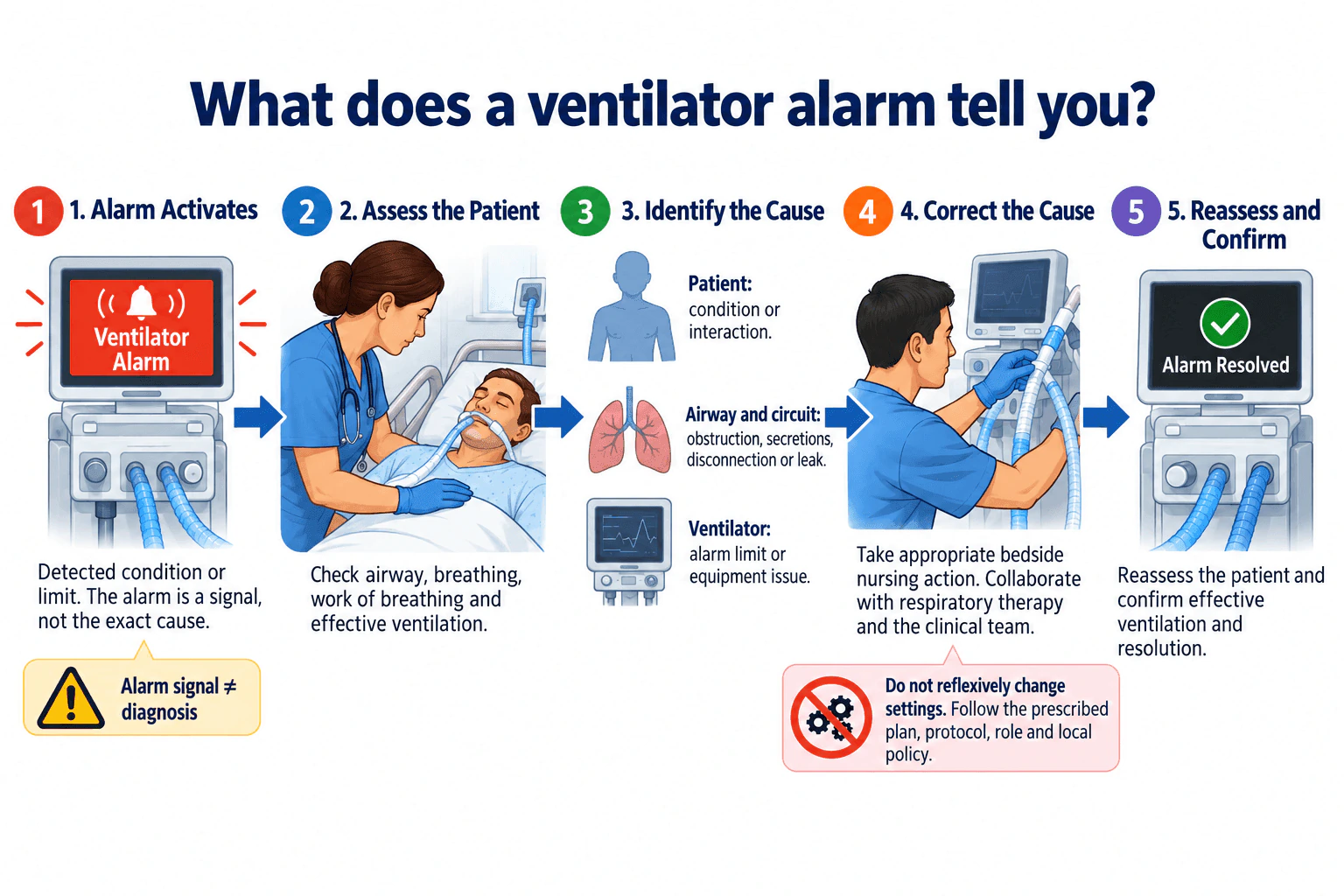
A ventilator alarm means the ventilator detected a condition or limit that needs attention. It does not automatically identify the exact cause. I assess the patient and airway first, then use the alarm information and bedside findings to determine whether the issue is related to the patient, airway or circuit, or ventilator. I take appropriate nursing action, collaborate with respiratory therapy and the clinical team, and reassess. I would not reflexively change ventilator settings just because an alarm sounds.
Detailed Explanation
A ventilator alarm is a signal that the ventilator detected a condition or limit requiring attention. It does not tell me the exact diagnosis or automatically mean that a setting should be changed.
Useful Questions to Ask the Interviewer
How are bedside nurses and respiratory therapists expected to coordinate ventilator alarm troubleshooting in this ICU?
What unit protocols guide escalation when a patient appears unstable during a ventilator alarm?
How are prescribed ventilator goals and alarm parameters communicated during handoff?
How to Explain It in an Interview
I would explain my response as a five step clinical reasoning sequence.
First, I recognize what the alarm tells me. The ventilator has detected a condition or limit that requires attention. The alarm is a signal, not a diagnosis, so I do not assume it identifies the exact cause.
Second, I assess the patient. I check the airway, breathing, work of breathing, and whether ventilation appears effective. I focus on the patient rather than responding only to the ventilator screen.
Third, I identify the likely cause by combining the alarm information with bedside assessment. I consider three broad sources. A patient related cause could involve a change in condition or patient ventilator interaction. An airway or circuit cause could involve obstruction, secretions, disconnection, or leak. A ventilator related cause could involve an alarm limit or equipment issue.
Fourth, I address the identified cause with appropriate bedside nursing actions and collaborate with respiratory therapy and the clinical team. I do not reflexively change ventilator settings. Any adjustment must follow the prescribed plan, applicable protocol, my professional role, and local policy.
Finally, I reassess the patient and confirm that ventilation is effective and the problem has resolved. The key point is that the alarm prompts assessment and cause identification rather than an automatic setting change.
Why Interviewers Ask This
Interviewers want to know whether I understand that a ventilator alarm is a warning signal rather than a diagnosis. They are evaluating whether I prioritize patient assessment, identify whether the likely cause is related to the patient, airway or circuit, or ventilator, act within nursing scope, collaborate appropriately, and reassess after the cause is addressed.
Common interview mistakes
Common mistakes include treating the alarm as the diagnosis, focusing on the ventilator before assessing the patient, assuming every alarm requires a setting change, overlooking patient, airway, circuit, or equipment causes, and failing to reassess after the suspected cause is addressed.
Interview tip
State the priority clearly: the alarm is a signal, not the diagnosis. Then walk through the same sequence as the diagram: assess the patient, identify whether the cause is related to the patient, airway or circuit, or ventilator, take appropriate action with respiratory therapy and the clinical team, and reassess. Explicitly state that you would not reflexively change ventilator settings.
Interviewer may ask next
How would you verify that the ventilator alarm problem has actually been resolved?
I would reassess the patient rather than relying only on the alarm becoming silent. I would confirm that the airway and breathing remain adequate for the clinical situation, ventilation appears effective, the identified patient, airway, circuit, or ventilator issue has been addressed when applicable, and the alarm condition does not recur. I would communicate or escalate any persistent concern.
What changes if the patient appears unstable when the ventilator alarm sounds?
The patient becomes the immediate priority. I would rapidly assess the airway, breathing, and effectiveness of ventilation, call for appropriate help, and take bedside nursing actions within my competence and local protocol while respiratory therapy and the clinical team respond. I would not spend time making an unverified ventilator setting change while an unstable patient requires direct assessment and support.
35. What is the purpose of prone positioning in selected patients with severe respiratory failure?Airway And VentilationEasy
i Question Details
Explain that prone positioning can improve ventilation and oxygenation in selected patients and requires careful protection of the airway, eyes, nerves, skin, and lines.
Short Interview Answer (30-60 seconds)
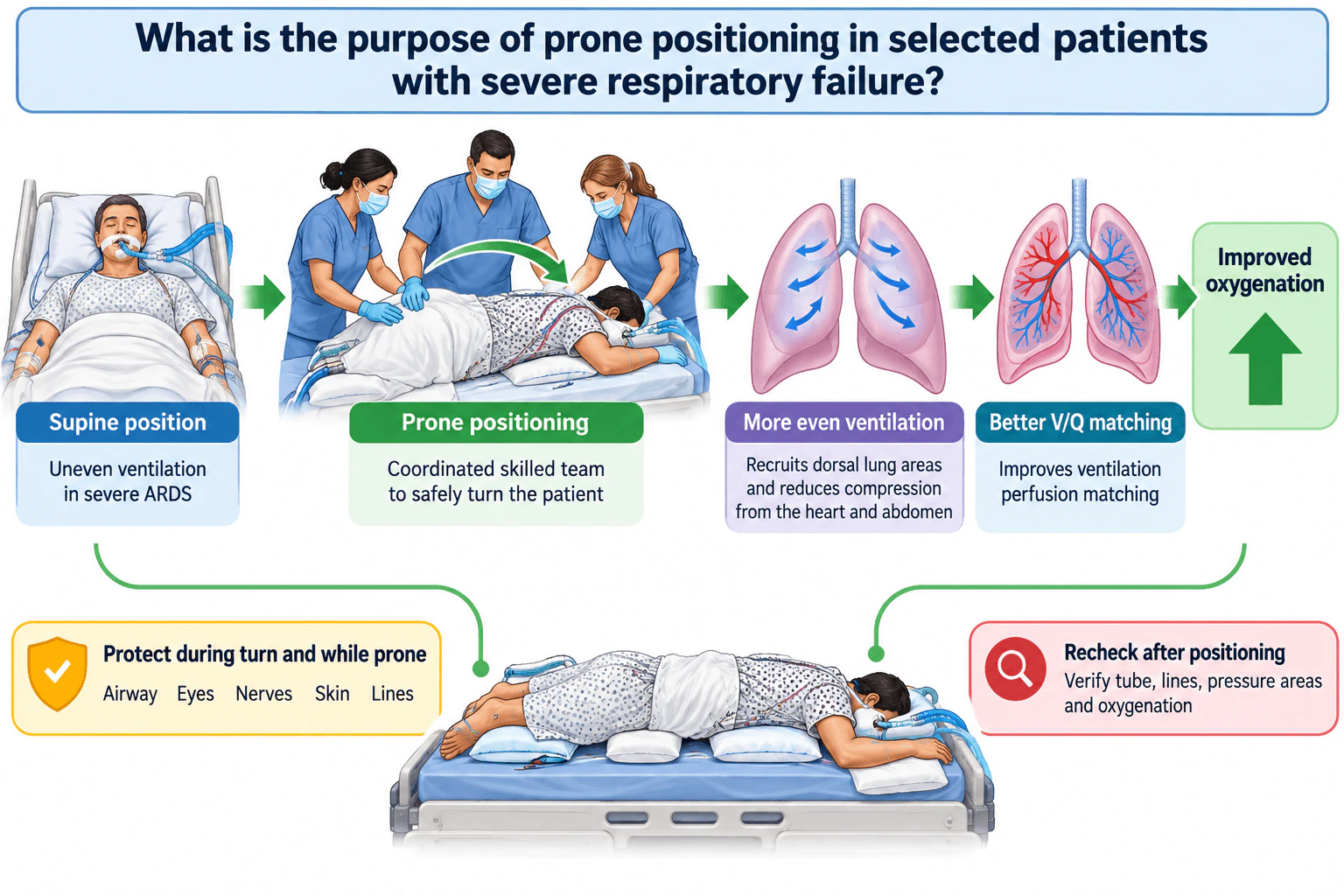
Prone positioning can improve oxygenation in selected patients with severe respiratory failure, especially severe ARDS, by making ventilation more even, improving aeration of dorsal lung regions, and improving ventilation perfusion matching. It requires a coordinated skilled team because the airway, eyes, nerves, skin, and lines must be protected during the turn and while the patient remains prone. After positioning, I would reassess the airway and tube security, lines, pressure areas, oxygenation, and the patient's overall response.
Detailed Explanation
Prone positioning means carefully turning a selected patient with severe respiratory failure onto the abdomen. In severe ARDS, the supine position can contribute to uneven ventilation of dependent dorsal lung regions. Turning the patient prone can make ventilation more homogeneous, improve aeration of dorsal lung regions by reducing dependent compression, improve ventilation perfusion matching, and improve oxygenation.
Useful Questions to Ask the Interviewer
How does your ICU organize team roles for prone positioning and airway management?
What process does your unit use to protect the eyes, nerves, skin, airway, and medical devices during prone positioning?
How are patients reassessed after the turn and while they remain prone?
How to Explain It in an Interview
Respiratory Purpose
I would explain that prone positioning is used in selected patients with severe respiratory failure, particularly severe ARDS, to redistribute ventilation through the lungs. Dorsal lung regions that are relatively compressed while the patient is supine can become better aerated when prone. Ventilation becomes more even while perfusion remains substantial in dorsal regions, which improves ventilation perfusion matching and can improve oxygenation.
Safe Positioning
Proning is a coordinated team procedure rather than an isolated nursing action. During the turn, airway security is a priority. I would protect the eyes, nerves, skin, and all tubes and lines from pressure, displacement, traction, or obstruction while following the patient's prescribed plan and unit procedure.
Reassessment
After positioning, I would reassess the airway, verify that the endotracheal tube remains secure at the documented depth, confirm that lines and other devices remain secure and unobstructed, inspect pressure areas, and reassess oxygenation and the patient's overall response. Continued observation is important because airway or device problems and pressure related injury can develop while the patient remains prone.
The key interview point is that prone positioning is intended to create more even ventilation and improve ventilation perfusion matching and oxygenation while requiring careful protection of the airway, eyes, nerves, skin, and lines throughout the process.
Why Interviewers Ask This
Interviewers want to know whether the nurse understands both the respiratory purpose of prone positioning and the bedside safety responsibilities that accompany it. A strong answer connects more even ventilation and improved oxygenation with coordinated positioning, airway protection, pressure injury prevention, line protection, and reassessment rather than treating proning as a simple change in body position.
Common interview mistakes
Common mistakes include saying that prone positioning simply gives the patient more oxygen, overlooking its effect on ventilation distribution and ventilation perfusion matching, treating the turn as a one person task, failing to protect the airway and medical devices, or forgetting risks to the eyes, nerves, skin, and pressure areas. Another mistake is assuming that a bedside nurse independently changes ventilator treatment rather than working within the prescribed plan and multidisciplinary team.
Interview tip
Connect the physiologic purpose directly to bedside nursing safety. State that proning can create more even ventilation, improve ventilation perfusion matching, and improve oxygenation, then explain how you would protect the airway, eyes, nerves, skin, and lines and reassess the patient after positioning.
Interviewer may ask next
What would you verify immediately after turning an intubated patient prone?
I would reassess the airway, verify that the endotracheal tube remains secure at the documented depth, confirm that lines and other devices remain secure and unobstructed, inspect pressure areas and positioning, and reassess oxygenation and the patient's overall clinical response.
How would your response change if oxygenation worsened or another concerning change occurred after the patient was positioned prone?
I would promptly reassess the patient, beginning with the airway and breathing, verify endotracheal tube and line security, check for obstruction, displacement, or positioning problems, reassess oxygenation and other relevant clinical findings, and communicate the change to the appropriate critical care and respiratory therapy team members. Further positioning or treatment decisions would follow the patient's condition, prescribed plan, and applicable unit procedure.
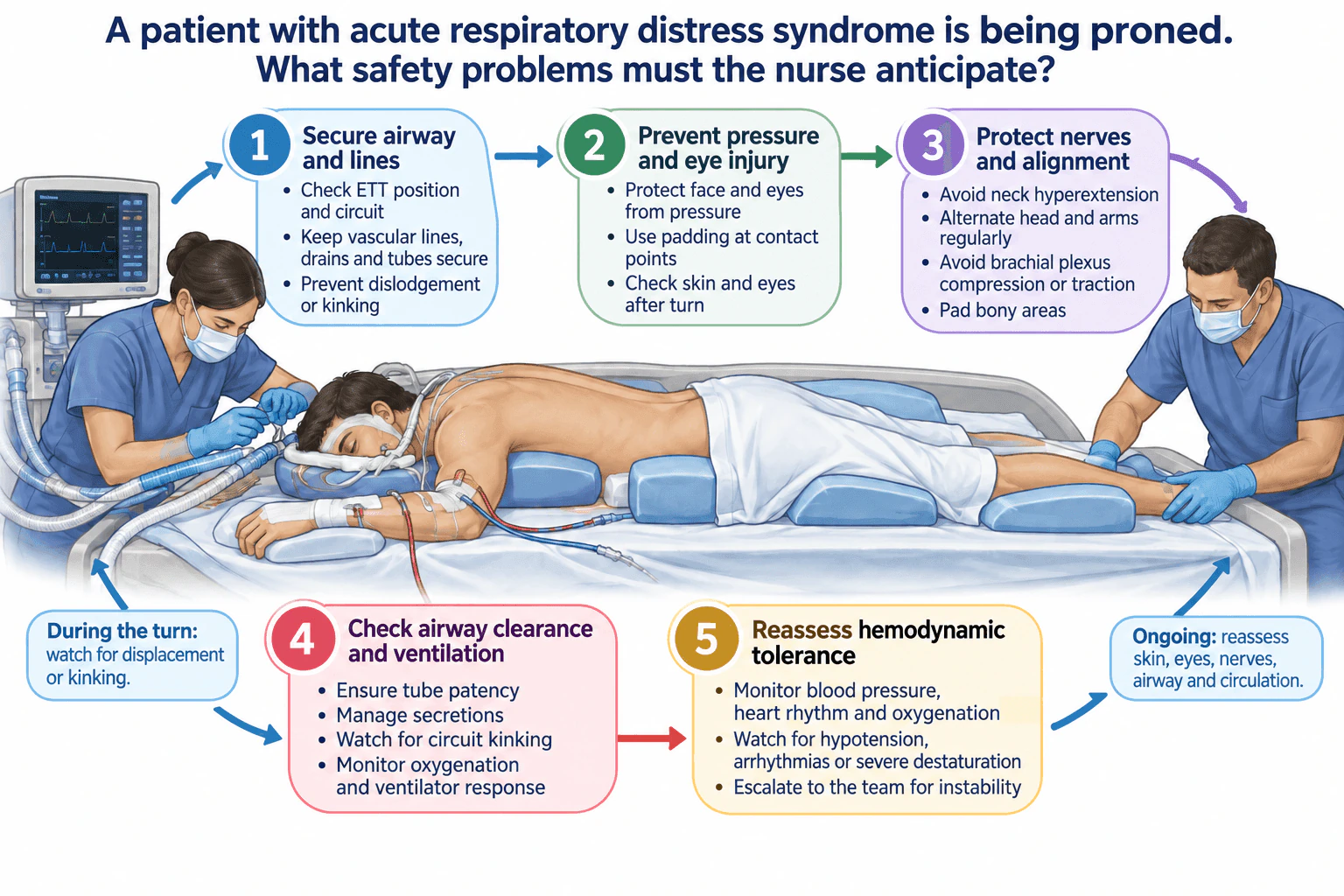
36. A patient with acute respiratory distress syndrome is being proned. What safety problems must the nurse anticipate?Airway And VentilationHard
i Question Details
Identify accidental tube or line displacement, pressure injury, eye injury, nerve injury, secretion issues, and hemodynamic intolerance during the maneuver and ongoing care.
Short Interview Answer (30-60 seconds)
I would anticipate tube or line displacement, pressure injury, eye injury, nerve injury, secretion and airway clearance problems, and hemodynamic intolerance. During the turn, I would watch for displacement or kinking. Once the patient is prone, I would reassess airway and line security, skin and eyes, head and arm positioning, secretion clearance, ventilation and oxygenation, blood pressure, heart rhythm, and overall circulation, then escalate quickly for instability or suspected device compromise.
Detailed Explanation
Proning can improve oxygenation in acute respiratory distress syndrome, but it creates several predictable safety risks during the maneuver and during ongoing care. My answer would focus on securing the airway and lines, preventing pressure and eye injury, protecting nerves and alignment, checking airway clearance and ventilation, and reassessing hemodynamic tolerance.
Useful Questions to Ask the Interviewer
What checklist or team roles does this ICU use during prone positioning?
How are endotracheal tube position and invasive lines verified before and after the turn?
What is the unit practice for ongoing skin, eye, and arm repositioning while the patient remains prone?
How to Explain It in an Interview
Secure airway and lines
My first concern is accidental displacement or kinking of the endotracheal tube, ventilator circuit, vascular lines, drains, and other tubing. Before and during the turn, I would confirm that devices are secure and watch closely for dislodgement or obstruction.
Prevent pressure and eye injury
Prone positioning increases pressure on the face and other contact points. I would use appropriate padding, protect the eyes from direct pressure, and reassess the skin and eyes after the turn and during ongoing care.
Protect nerves and alignment
Poor positioning can cause brachial plexus compression or traction and other nerve injury. I would avoid neck hyperextension, position the arms appropriately, pad bony areas, and continue regular repositioning according to the unit process.
Check airway clearance and ventilation
Secretions can become harder to manage, and the circuit can kink. I would reassess tube patency, secretion burden, ventilator response, ventilation, and oxygenation. Nursing actions would stay within orders, protocol, and collaboration with respiratory therapy.
Reassess hemodynamic tolerance
The patient may not tolerate proning and can develop hypotension, arrhythmias, or severe desaturation. I would monitor blood pressure, heart rhythm, oxygenation, and overall circulation. Any airway compromise, suspected device displacement, severe instability, or poor tolerance requires immediate team escalation and rapid reassessment.
Why Interviewers Ask This
Interviewers are assessing whether the nurse can anticipate the major preventable complications of prone positioning in an intubated patient with acute respiratory distress syndrome, protect the airway and invasive devices during a high risk maneuver, and recognize when the patient is not tolerating the position. They also want to hear clear nursing priorities, collaboration with respiratory therapy and the team, and prompt reassessment rather than unsupported independent ventilator changes.
Common interview mistakes
Common mistakes include focusing only on oxygenation and forgetting airway or line displacement, missing pressure or eye protection, overlooking brachial plexus or positioning related nerve risk, failing to reassess secretion clearance and ventilator response, and missing hypotension, arrhythmias, or severe desaturation after the turn. Another mistake is implying that the bedside nurse independently changes prescribed ventilator settings instead of assessing the patient, identifying problems, and collaborating with respiratory therapy and the ICU team.
Interview tip
A strong answer follows the same order as the bedside priorities. Start with airway and lines, then pressure and eyes, then nerves and alignment, then airway clearance and ventilation, and finish with hemodynamic tolerance and escalation. That structure shows organized ICU nursing reasoning.
Interviewer may ask next
How would you verify that the patient is safe immediately after proning?
I would recheck endotracheal tube position and ventilator circuit patency, confirm that vascular lines and drains are secure and functioning, inspect accessible skin and eye protection, review head and arm positioning, assess secretion clearance, and monitor oxygenation, blood pressure, heart rhythm, and circulation. If I suspect displacement, kinking, airway compromise, severe desaturation, or hemodynamic instability, I would escalate immediately and assist the team with rapid reassessment.
How would your priorities change if the patient became hypotensive and severely desaturated during the turn?
That would suggest poor tolerance or an acute complication. I would immediately call out the change, assess the airway, endotracheal tube, circuit, oxygenation, blood pressure, rhythm, and line integrity, and assist the team in stopping or reversing the maneuver if directed by the team and local process. I would address correctable nursing issues within scope, such as checking for kinking or dislodgement, while preparing for further respiratory and hemodynamic intervention by the appropriate clinicians.
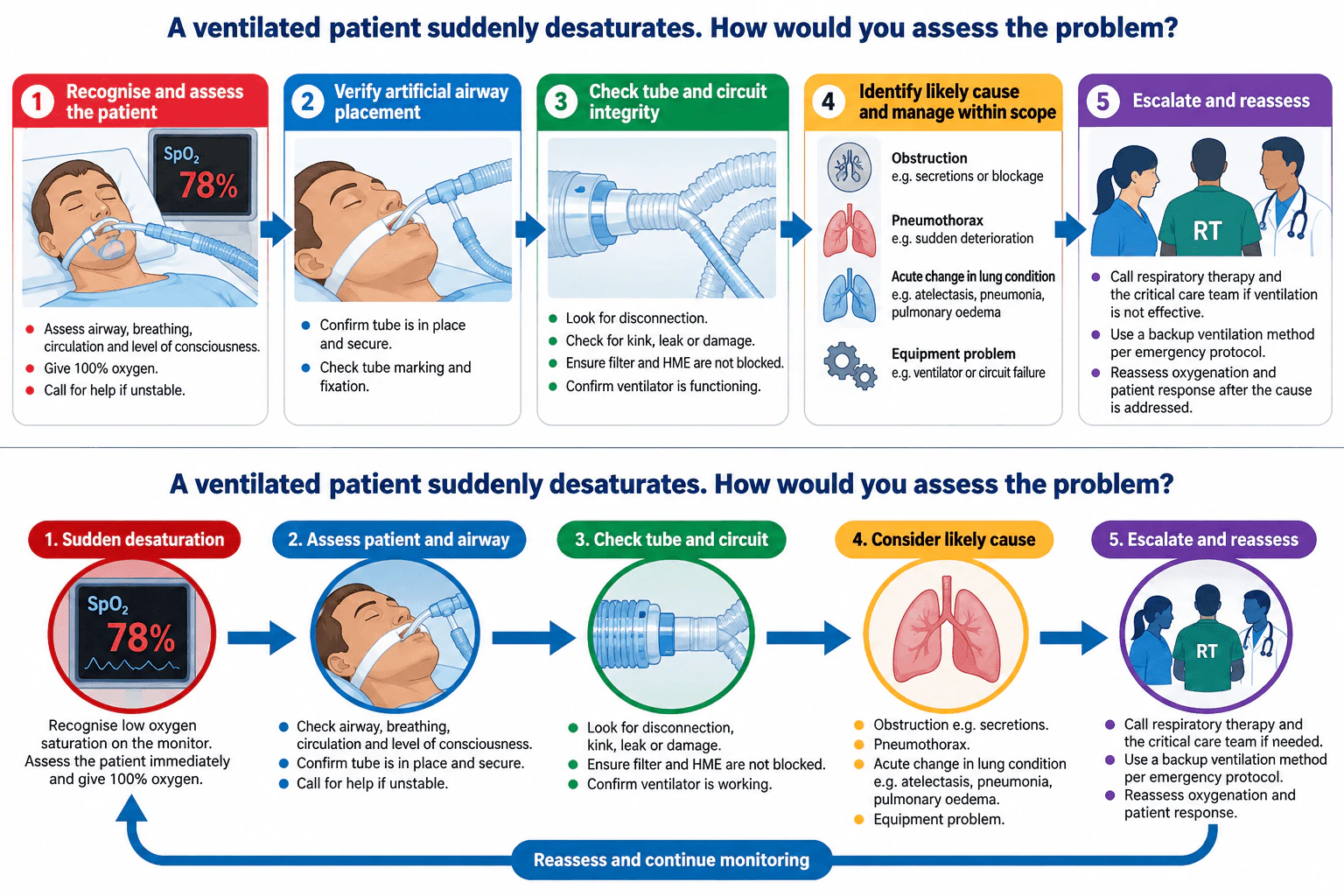
37. A ventilated patient suddenly desaturates. How would you assess the problem?Airway And VentilationHard
i Question Details
Assess the patient and airway immediately, verify tube position and circuit integrity, look for obstruction, pneumothorax, equipment failure, and changing lung condition, and call for emergency help when indicated.
Short Interview Answer (30-60 seconds)
I would go to the patient first and rapidly assess airway, breathing, circulation, level of consciousness, oxygenation, and overall stability. I would call for help if the patient is unstable, verify the endotracheal tube position and securement, and trace the circuit for disconnection, kinking, leaks, blockage, damage, or equipment failure. I would consider secretions or another airway obstruction, pneumothorax, and acute lung changes such as atelectasis, pneumonia, or pulmonary edema. I would support oxygenation according to the emergency protocol, involve respiratory therapy and the critical care team, use approved backup ventilation if needed, and reassess continuously.
Detailed Explanation
A sudden desaturation in a mechanically ventilated patient requires a patient first assessment followed by a focused check of the artificial airway, circuit, pulmonary causes, and equipment. The question does not provide a numeric oxygen saturation, ventilator settings, or other patient findings, so I would not assume them. Current guidance supports direct bedside assessment and assessment of artificial airway placement and securement. pmc.ncbi.nlm.nih.gov
Useful Questions to Ask the Interviewer
What is your unit's process for involving respiratory therapy during an acute ventilator problem?
What emergency backup ventilation equipment is kept immediately available at the bedside?
How are bedside nurses expected to escalate a rapidly deteriorating ventilated patient?
How to Explain It in an Interview
Assess the patient immediately
I would first assess airway, breathing, circulation, level of consciousness, oxygenation, chest movement, and overall stability. If the patient is unstable, I would call for emergency help immediately. I would support oxygenation according to the emergency protocol. If that protocol authorizes temporary use of 100% inspired oxygen during severe acute desaturation, I would use it while the cause is being identified rather than independently prescribing a new ventilator setting.
Verify the artificial airway
I would confirm that the endotracheal tube remains in the expected position and is securely fixed. I would assess for displacement or obstruction and correlate the tube findings with the patient's examination. Secretions or another blockage can interfere with ventilation and oxygenation.
Check the tube and circuit
I would trace the ventilator circuit and look for disconnection, kinking, leaks, damaged tubing, or blockage. I would check whether a heat and moisture exchanger or filter appears obstructed and confirm that the ventilator and circuit are functioning. I would review alarms and available ventilator information with respiratory therapy rather than making unauthorized setting changes.
Consider likely causes
If the airway and circuit are intact, I would rapidly consider pneumothorax, acute atelectasis, pneumonia, pulmonary edema, another acute lung change, and equipment failure. The bedside examination and available physiologic information determine which cause is most concerning.
Escalate and reassess
I would involve respiratory therapy and the critical care team promptly if effective ventilation is not restored or the patient continues to deteriorate. If the ventilator is not providing effective ventilation, I would use the approved backup ventilation method according to emergency protocol and trained scope. After every intervention, I would reassess oxygenation, ventilation, airway status, breathing, circulation, consciousness, ventilator alarms, and the overall clinical response, then continue monitoring for recurrence.
Why Interviewers Ask This
Interviewers are evaluating whether the nurse responds to sudden desaturation by prioritizing direct patient assessment rather than focusing only on the ventilator, verifies the artificial airway and circuit, recognizes important airway, pulmonary, and equipment causes, escalates appropriately, collaborates with respiratory therapy, and repeatedly reassesses the patient's response. Current patient ventilator assessment guidance emphasizes direct bedside assessment and evaluation of artificial airway placement and securement. pmc.ncbi.nlm.nih.gov
Common interview mistakes
Common mistakes include troubleshooting the ventilator before assessing the patient, assuming the ventilator alarm identifies the cause, failing to verify tube position and circuit integrity, overlooking secretions, pneumothorax, acute lung deterioration, or equipment failure, independently changing prescribed ventilator settings without appropriate authority, delaying respiratory therapy or critical care escalation, and failing to reassess after an intervention.
Interview tip
Present the response as the same five step sequence used at the bedside: assess the patient, verify the artificial airway, check the tube and circuit, consider obstruction, pneumothorax, acute lung change, or equipment failure, then escalate and reassess. Make clear that emergency oxygenation and backup ventilation follow protocol and trained scope rather than independent prescribing.
Interviewer may ask next
How would you verify that the patient has improved after an intervention?
I would reassess the patient rather than relying only on the oxygen saturation display. I would reevaluate oxygenation, airway patency, breathing, chest movement, breath sounds, circulation, level of consciousness, ventilator alarms, available waveforms, and the overall clinical response. I would also verify that the identified airway, circuit, equipment, or pulmonary problem has actually been corrected and continue monitoring for recurrence.
What would change if the patient continued to desaturate after you confirmed the tube and circuit were intact?
I would treat persistent desaturation as ongoing clinical deterioration and escalate immediately. I would reassess for pneumothorax and acute lung changes such as atelectasis, pneumonia, pulmonary edema, or another evolving process, while continuing emergency oxygenation and ventilation support according to protocol and nursing scope. I would involve respiratory therapy and the critical care team promptly, prepare to use the approved backup ventilation method if effective ventilation cannot be maintained, and continue repeated assessment while the cause is identified and treated.
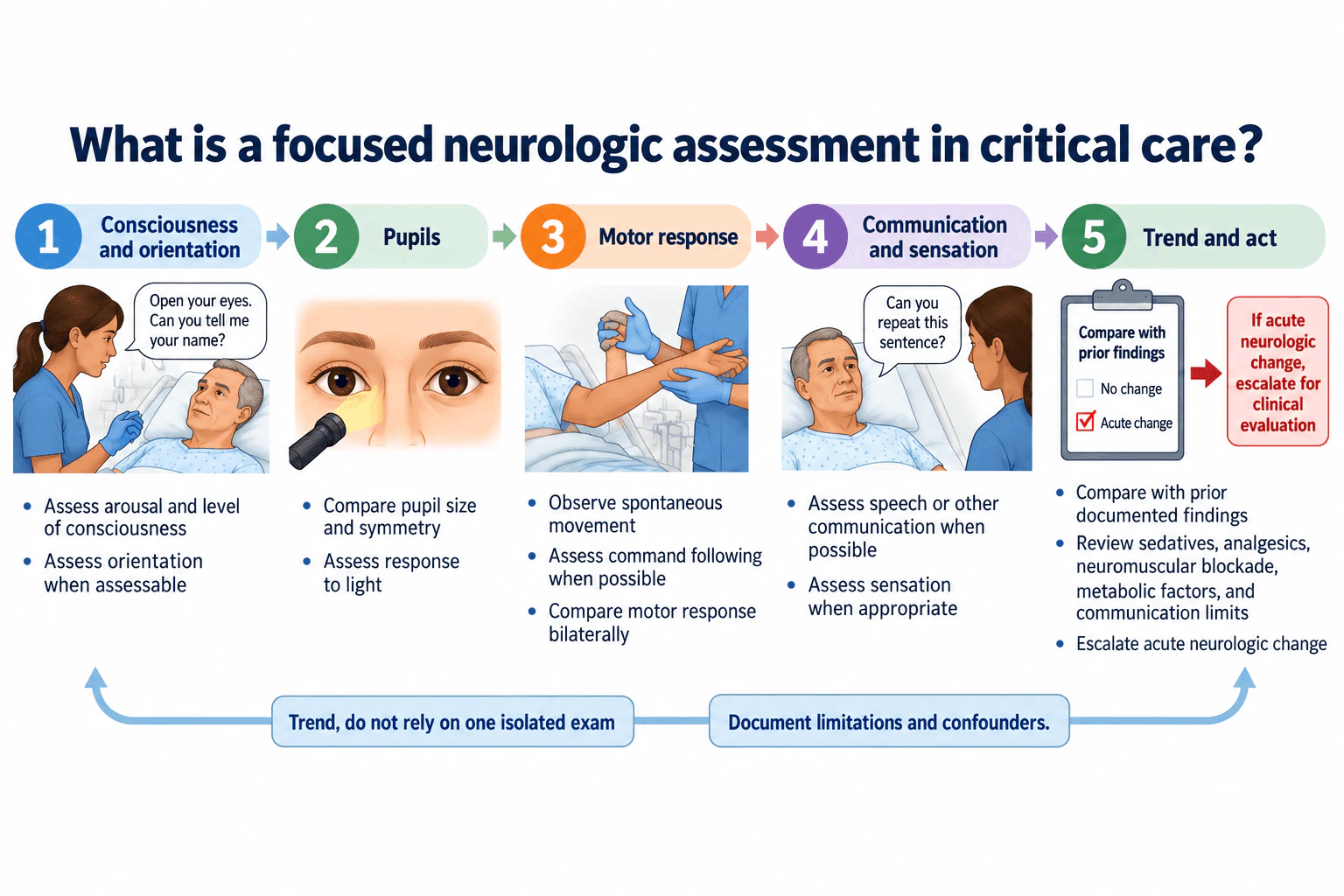
38. What is a focused neurologic assessment in critical care?Neurological Care Sedation And DeliriumEasy
i Question Details
Describe level of consciousness, orientation when assessable, pupils, motor response, speech or communication, sensation when appropriate, and comparison with prior findings.
Short Interview Answer (30-60 seconds)
I assess arousal and level of consciousness, orientation when assessable, pupil size, symmetry and response to light, spontaneous movement and bilateral motor response, speech or other communication when possible, and sensation when appropriate. I compare the findings with the prior documented assessment because trends are more useful than one isolated examination. I document limitations and confounders such as sedatives, analgesics, neuromuscular blockade, metabolic factors and communication barriers, and I promptly escalate an acute neurologic change for clinical evaluation.
Detailed Explanation
A focused neurologic assessment is a concise, repeatable bedside examination used to recognize neurologic change over time. I assess what can be evaluated reliably, compare the findings with the patient's prior documented neurologic status and document anything that limits interpretation.
Useful Questions to Ask the Interviewer
Which neurologic findings does your unit expect nurses to trend routinely?
How are acute neurologic changes communicated and escalated on this unit?
How does the unit document assessment limitations caused by sedation, paralysis or communication barriers?
How to Explain It in an Interview
Neurologic Findings
I start with arousal and level of consciousness, then assess orientation when the patient can participate. I check pupil size and symmetry and assess response to light. I observe spontaneous movement, assess command following when possible and compare motor responses bilaterally. I assess speech or another form of communication when possible and sensation when the response can be interpreted.
Trend and Comparison
I compare the current assessment with prior documented findings rather than relying on one isolated examination. Repeated neurologic examinations help identify whether the patient's neurologic status is stable, improving or worsening.
Patient Context and Checks
I document factors that may limit interpretation. Sedatives and analgesics can affect responsiveness. Neuromuscular blockade can prevent observable motor responses and does not provide sedation or analgesia. Metabolic abnormalities and communication limitations can also affect the examination. I interpret the findings in that clinical context rather than assuming every abnormal response represents a new neurologic deficit.
Escalation and Documentation
If I identify an acute neurologic change, I repeat the relevant assessment components as appropriate to verify the finding, compare them with the prior examination and review relevant confounders concurrently. I promptly escalate the change for clinical evaluation and document the new finding, the comparison with prior findings, any limitations and the communication that followed.
Why Interviewers Ask This
Interviewers want to know whether the nurse can perform a focused, repeatable neurologic assessment, recognize meaningful changes from prior findings, account for factors that can alter the examination and communicate deterioration promptly rather than treating one isolated finding as the whole picture.
Common interview mistakes
Common mistakes include relying on one isolated examination, failing to compare findings with the prior documented assessment, omitting pupil or bilateral motor assessment, testing orientation when the patient cannot meaningfully participate, overlooking communication or sensory limitations, failing to consider medication or metabolic confounders, assuming neuromuscular blockade provides sedation or analgesia, and failing to escalate a new acute neurologic change.
Interview tip
Describe the assessment in a consistent sequence and emphasize trending. Explain what you assess, how you compare it with prior findings, which confounders can limit interpretation and what you do when an acute change appears.
Interviewer may ask next
How would you verify that a suspected neurologic change is real?
I would promptly repeat the relevant parts of the focused assessment, compare the findings with the most recent documented status and review whether sedatives, analgesics, neuromuscular blockade, metabolic factors or communication limitations could affect the result. If the change remains concerning, I would promptly escalate it for clinical evaluation and document the finding and relevant limitations.
How does the assessment change if the patient is intubated or cannot communicate verbally?
I would not treat inability to speak as an abnormal speech finding when the airway or another communication barrier prevents verbal response. I would use assessable findings such as arousal, pupil size and response to light, spontaneous movement, command following when possible, bilateral motor response and sensation when interpretable. I would document why orientation, speech or other elements could not be assessed and continue comparing the available findings with prior examinations.
39. What is the Glasgow Coma Scale?Neurological Care Sedation And DeliriumEasy
Short Interview Answer (30-60 seconds)
The Glasgow Coma Scale, or GCS, is a standardized way to assess and communicate a patient's level of consciousness. It evaluates three responses: eye opening, verbal response, and motor response. Eye response ranges from 1 to 4, verbal response from 1 to 5, and motor response from 1 to 6. When every component is testable, the scores can be added for a total from 3 to 15. In critical care, I would document the individual components and follow their trends because a change in one component may be clinically important even when the total score does not tell the whole story. glasgowcomascale.org
Detailed Explanation
The Glasgow Coma Scale, or GCS, is a structured neurologic assessment used to describe a patient's level of consciousness and responsiveness. It evaluates eye opening, verbal response, and motor response. For an adult bedside ICU nurse in the United States, it is a useful way to assess and communicate neurologic findings, while recognizing that local documentation and escalation procedures still apply. The structured assessment is to check for factors that can interfere with testing, observe spontaneous responses, stimulate when necessary, and rate the best observed response. glasgowcomascale.org
Useful Questions to Ask the Interviewer
How does your unit document and trend the individual GCS components during neurologic assessments?
What is the expected escalation process when a patient's neurologic response changes acutely?
How does the unit document a GCS component that cannot be tested because of factors such as intubation or treatment effects?
How to Explain It in an Interview
The Three Components
Eye opening is scored from 1 to 4, verbal response from 1 to 5, and motor response from 1 to 6. When all three components are testable, the values can be added to produce a total score from 3 to 15. I would still report the individual responses because they describe the patient's neurologic status more clearly than the total alone. glasgowcomascale.org
Nursing Reasoning
I would first identify factors that could interfere with the assessment, such as an endotracheal tube, sedation, neuromuscular blockade, language or communication limitations, or an injury that prevents a particular response. I would then assess each component consistently and compare the findings with previous assessments. Neuromuscular blockade does not provide analgesia or sedation, so paralysis must not be interpreted as evidence that the patient is comfortable or adequately sedated. glasgowcomascale.org
Reassessment
The GCS is useful for following neurologic trends. An acute change in eye, verbal, or motor response should prompt reassessment, review of possible confounders, communication, and appropriate escalation based on the patient's condition and local protocol. If a component cannot be tested, I would document it as not testable rather than assigning a score of 1. I would not report a total GCS when one component is not testable because that total could be misleading. glasgowcomascale.org
Why Interviewers Ask This
Interviewers want to know whether a critical care nurse understands a basic neurologic assessment tool and can apply it safely rather than simply memorizing a number. A strong answer shows that the nurse knows the three components, recognizes the importance of trending each response, identifies factors that can interfere with testing, and communicates an acute change clearly.
Common interview mistakes
Common mistakes include reporting only the total GCS without the eye, verbal, and motor components, recording a score of 1 when a component is actually not testable, failing to recognize factors such as intubation, sedation, neuromuscular blockade, communication limitations, or physical injury that can affect testing, and relying on a single score instead of the patient's neurologic trend. glasgowcomascale.org
Interview tip
Start with a simple definition, name the three components, and then explain how you would use the GCS clinically. Emphasize consistent assessment, documentation of the separate eye, verbal, and motor responses, recognition of factors that interfere with testing, comparison with previous findings, and timely communication of an acute change.
Interviewer may ask next
How would you verify that a Glasgow Coma Scale assessment is accurate?
I would use the structured approach of checking for factors that could interfere with the assessment, observing spontaneous responses, providing appropriate verbal or physical stimulation when necessary, and rating the best observed eye, verbal, and motor responses. I would document each component separately and compare the findings with previous assessments. If a component cannot be tested, I would record it as not testable rather than assigning a false numeric score. glasgowcomascale.org
How does the assessment change if the patient is intubated and cannot provide a verbal response?
I would still assess the eye and motor components. If the endotracheal tube prevents valid verbal assessment, I would document the verbal component as not testable. I would not automatically assign a verbal score of 1, and I would not calculate a total GCS when that component is not testable. I would continue trending the components that can be assessed and consider other factors that may affect responsiveness. glasgowcomascale.org
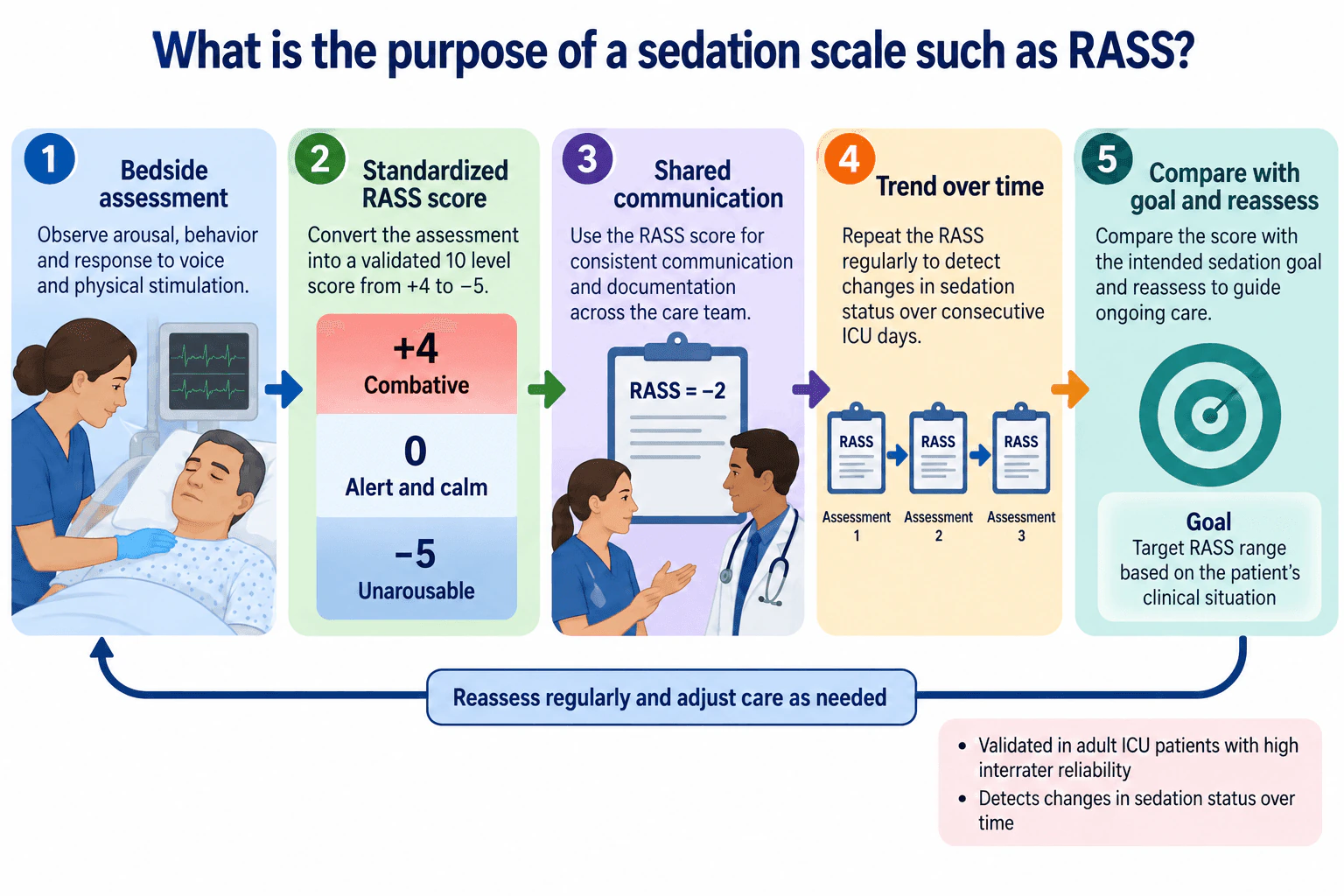
40. What is the purpose of a sedation scale such as RASS?Neurological Care Sedation And DeliriumEasy
i Question Details
Explain how a validated sedation scale standardizes assessment of arousal and helps the team compare sedation depth over time.
Short Interview Answer (30-60 seconds)
RASS standardizes how the team describes arousal and agitation. It assigns a validated score from +4, combative, to −5, unarousable, with 0 representing alert and calm. Repeating the same assessment lets the team communicate consistently, recognize changes in sedation depth over time, compare the current score with the intended goal, and reassess care.
Detailed Explanation
A sedation scale such as the Richmond Agitation Sedation Scale, or RASS, turns bedside observations into a consistent measurement of arousal and agitation. In adult ICU patients, RASS is a validated 10 level scale ranging from +4, combative, through 0, alert and calm, to −5, unarousable. The assessment considers observable behavior and, when appropriate, response to voice and physical stimulation.
Useful Questions to Ask the Interviewer
Which validated sedation scale does your ICU use routinely?
How are individualized sedation goals communicated among the bedside team?
How does your unit document and review changes in sedation scores over time?
How to Explain It in an Interview
Standardize the bedside assessment
The main purpose of RASS is to give clinicians a shared language for describing arousal and agitation. Instead of documenting only subjective terms, the nurse performs the defined bedside assessment and records the corresponding score.
Communicate consistently
Because the same validated scale can be used by different trained clinicians, a RASS score provides a concise way to communicate the patient's current sedation state during documentation, handoff, rounds, and reassessment. Validation studies in adult ICU patients demonstrated high interrater reliability and validity.
Follow the trend
One score is a snapshot. Repeating RASS allows the team to identify whether the patient's level of arousal is changing over time. Validation research in adult ICU patients demonstrated that RASS can identify fluctuations within patients over time.
Compare with the intended goal
The current RASS score can be compared with the sedation goal selected for the patient's clinical situation. If the observed level differs from that goal, the nurse reassesses the patient, reviews relevant causes and clinical context, communicates changes, and follows authorized orders or protocols as appropriate.
RASS measures arousal and agitation. It does not replace pain assessment or delirium assessment, and an abnormal score should be interpreted in the context of the complete clinical assessment.
Why Interviewers Ask This
Interviewers want to know whether the nurse understands that sedation assessment should be objective, repeatable, and communicated consistently rather than described only with vague terms such as sleepy or agitated. They are also assessing whether the nurse recognizes the value of trending the same validated measure over time and comparing it with an individualized clinical goal.
Common interview mistakes
Common mistakes include treating a single RASS score as sufficient without following the trend, describing sedation only with vague terms instead of a validated scale, assuming every patient should have the same target score, or using RASS as though it were a pain or delirium diagnostic tool. RASS assesses arousal and agitation and should be interpreted with the rest of the clinical assessment.
Interview tip
A strong answer should emphasize three ideas: standardization, trending, and communication. State that RASS converts bedside observations into a reproducible score, that repeated scores reveal changes over time, and that the current score is compared with the patient's intended sedation goal.
Interviewer may ask next
How would you verify that a change in RASS represents a real clinical change?
I would repeat the RASS using the validated assessment method, compare the result with prior documented scores, and reassess the patient's overall clinical condition. I would review relevant factors that could alter arousal, communicate an acute or unexplained change to the appropriate clinician, and document the reassessment and response.
How would your approach change if the patient became difficult to arouse compared with previous assessments?
I would treat the new change in arousal as clinically significant rather than simply recording a lower RASS. I would promptly reassess the patient, review the recent trend and relevant clinical context, evaluate potential contributors within nursing scope, communicate the acute change to the appropriate clinician, and continue reassessment while following authorized orders and local protocols.
More questions load as you scroll
Disclaimer: This interview guide is for educational and informational purposes only. It is designed to help readers prepare, but it does not guarantee any interview result, hiring decision, offer, or outcome. Interview questions, hiring criteria, and preferred answers can vary by employer, interviewer, industry, location, and time. All answers, examples, and explanations in this guide are suggested examples for interview preparation, not definitive answers or instructions for professional practice. They are based on research and judgment, are provided without warranties of any kind, and should be adapted to the question, role, and applicable laws and professional requirements. Diagrams are simplified illustrations intended to highlight the main concepts and their relationships; actual situations, systems, and practices may be more complex. Alternative approaches may be equally valid or better suited to a particular question, context, or interviewer. To the fullest extent permitted by applicable law, the contributors and publisher are not liable for decisions made, actions taken, or losses incurred based on this guide.
State Laws and Professional Responsibilities: Laws and requirements governing an occupation vary by state and jurisdiction. You are responsible for checking the current laws, licensing requirements, and scope-of-practice rules that apply to your location and role, and for ensuring that your answers and actions comply with them. Adapt examples in this guide to those requirements. This guide is not legal advice.
Content Accuracy and Verification: To the fullest extent permitted by applicable law, we do not represent or warrant that interview guides, questions, answers, examples, or diagrams are accurate, complete, current, error-free, or suitable for any particular purpose. You are responsible for independently reviewing and verifying the information before relying on it.