This interview guide is for educational and informational purposes only. It is designed to help readers prepare, but it does not guarantee any interview result, hiring decision, offer, or outcome. Interview questions, hiring criteria, and preferred answers can vary by employer, interviewer, industry, location, and time. All answers, examples, and explanations in this guide are suggested examples for interview preparation, not definitive answers or instructions for professional practice. They are based on research and judgment, are provided without warranties of any kind, and should be adapted to the question, role, and applicable laws and professional requirements. Diagrams are simplified illustrations intended to highlight the main concepts and their relationships; actual situations, systems, and practices may be more complex. Alternative approaches may be equally valid or better suited to a particular question, context, or interviewer. To the fullest extent permitted by applicable law, the contributors and publisher are not liable for decisions made, actions taken, or losses incurred based on this guide.
State Laws and Professional Responsibilities
Laws and requirements governing an occupation vary by state and jurisdiction. You are responsible for checking the current laws, licensing requirements, and scope-of-practice rules that apply to your location and role, and for ensuring that your answers and actions comply with them. Adapt examples in this guide to those requirements. This guide is not legal advice.
Identity, Image, and Privacy Notice
To respect individual privacy, some names, profile photographs, avatars, biographical details, and other identifying information displayed in this guide may be replaced with pseudonyms, licensed stock images, illustrative avatars, composite images, or representative descriptions. Unless a person is expressly identified as an actual contributor, a displayed name, image, or profile should not be understood as depicting or identifying a specific candidate, interviewer, employee, or other real individual. These representations are provided for editorial and illustrative purposes only and do not imply endorsement, employment, participation, or affiliation with this guide or any company mentioned in it. Any resemblance to an actual person is coincidental.
Company Notice
This guide is an independent educational resource and is not affiliated with, endorsed by, sponsored by, or approved by the company named in this guide. Company names identify reported interview experiences or the employer context of clearly labeled original practice exercises. Interview practices can change without notice, and inclusion of company-specific content does not mean these questions are official, complete, or guaranteed to be asked. To the fullest extent permitted by law, the author, contributors, and publisher are not responsible for outcomes related to use of this material.
Content Accuracy and Verification
To the fullest extent permitted by applicable law, we do not represent or warrant that interview guides, questions, answers, examples, or diagrams are accurate, complete, current, error-free, or suitable for any particular purpose. You are responsible for independently reviewing and verifying the information before relying on it.
Questions or comments?
Contact us for general questions, or share feedback, technical corrections, and comments with the community.
41. How do you care for a patient with several chronic conditions during an acute admission?Adult Health And Medical Surgical NursingMedium
i Question Details
Explain how you identify the acute priority while accounting for chronic conditions, medications, baseline function, and multidisciplinary needs.
Short Interview Answer (30-60 seconds)
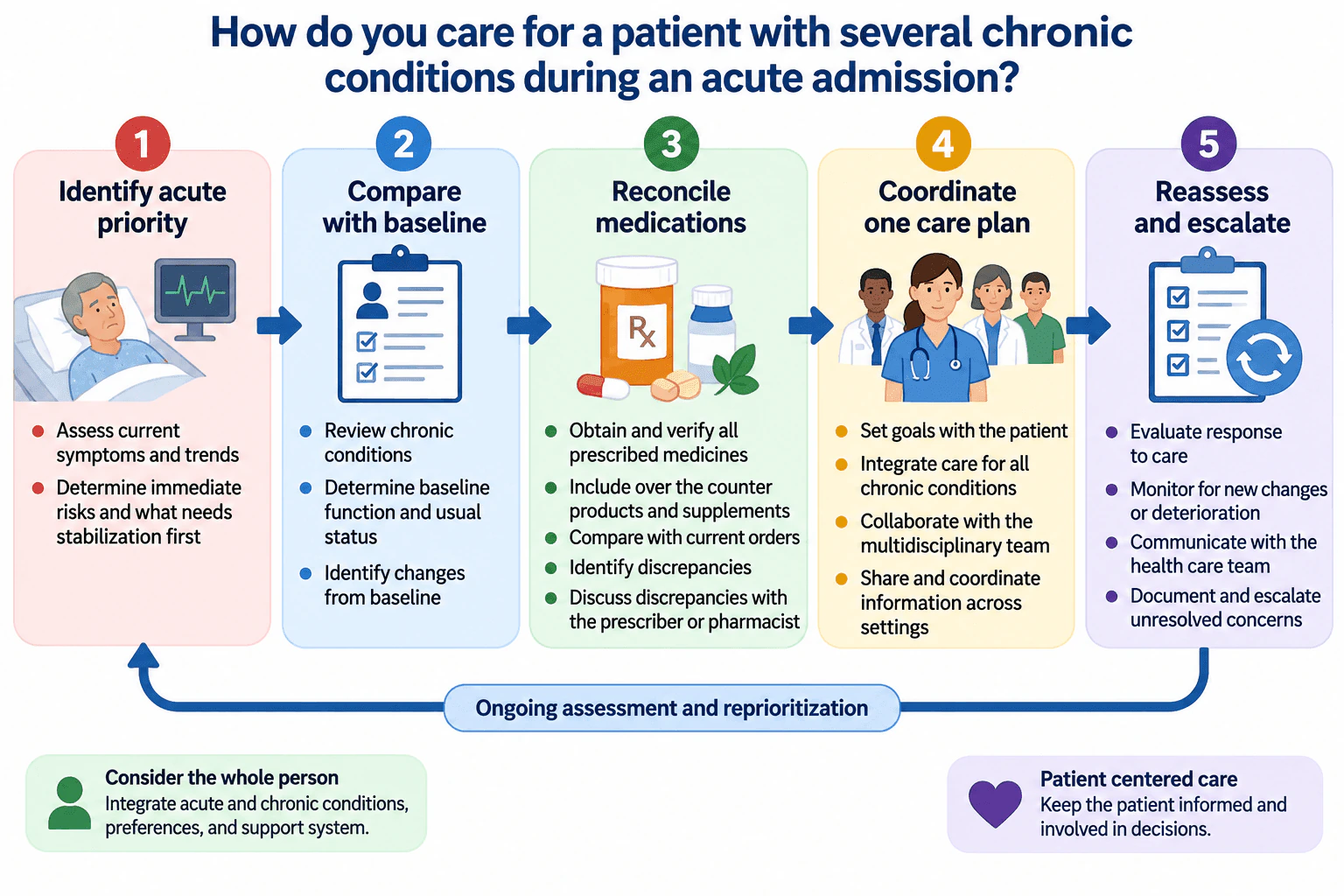
I start by identifying the most urgent acute problem and assessing current symptoms and trends. I compare the patient's condition with their usual baseline, including function and chronic disease status. I obtain and verify the complete medication history, compare it with current orders, and communicate unresolved discrepancies to the appropriate prescriber or pharmacist. Then I coordinate one patient centered care plan that accounts for all conditions, goals, preferences, and support needs. I continuously reassess the response to care, watch for new changes or deterioration, document important findings, and escalate unresolved concerns.
Detailed Explanation
The key is to address the acute priority while still treating the patient as one person with interacting chronic conditions, medications, functional needs, preferences, and support systems. I do not assume every abnormal finding is new. I compare the current presentation with the patient's usual baseline and identify which changes require immediate attention.
Useful Questions to Ask the Interviewer
What is the reason for the acute admission, and which findings are most concerning now?
What is the patient's usual clinical and functional baseline?
What chronic conditions, medications, preferences, and support needs are known at admission?
How to Explain It in an Interview
Assessment Findings
I begin with current symptoms, relevant observations, assessment findings, trends, and immediate risks. I identify what needs attention first while comparing the current condition with the patient's usual function and chronic disease status. I also clarify cognition, mobility, usual activities, preferences, and available support when relevant.
Nursing Priorities
Next, I consider the chronic conditions together rather than treating each diagnosis in isolation. I obtain and verify the medication history, including prescribed medicines, over the counter products, and supplements. I compare that history with current medication orders and identify possible omissions, duplications, or other discrepancies. I communicate unresolved discrepancies to the appropriate prescriber or pharmacist. Decisions to start, stop, or change prescribed therapy require the appropriate authorized clinician or applicable protocol.
I then help coordinate one integrated care plan. Goals should account for the acute problem, chronic conditions, patient priorities, safety, function, and anticipated care needs. I keep the patient informed and involved in decisions and communicate with the multidisciplinary team so everyone is working from the same clinical picture.
Response to Care
I continually evaluate whether the patient is improving, remaining stable, or developing new problems. I reassess symptoms, trends, function, and response to interventions. New deterioration, significant medication concerns, or unresolved problems are communicated and escalated according to the clinical situation and local process. I document important findings, actions, communication, and the patient's response.
The overall principle is ongoing assessment and reprioritization. The acute problem may be the immediate focus, but safe care also requires attention to baseline function, chronic conditions, medication safety, patient goals, and coordinated care.
Why Interviewers Ask This
This question evaluates whether the nurse can prioritize an acute problem without losing sight of chronic conditions, baseline function, medication safety, patient preferences, and multidisciplinary needs. It also tests whether the nurse can integrate assessment, medication reconciliation, communication, reassessment, documentation, and escalation into one patient centered plan while remaining within Registered Nurse scope.
Common interview mistakes
Common mistakes include focusing only on the admitting problem, failing to establish the patient's usual baseline, assuming every abnormal finding is new, overlooking medication reconciliation, considering chronic conditions separately without recognizing their combined effect, making prescribed medication changes outside nursing authority, excluding the patient from goal setting, failing to coordinate with the multidisciplinary team, and omitting reassessment or escalation when the patient's condition changes.
Interview tip
Organize the answer around the five connected actions shown in the care flow: identify the acute priority, compare with baseline, reconcile medications, coordinate one integrated care plan, and reassess or escalate. Mention ongoing assessment and reprioritization, and clearly distinguish nursing assessment and communication from prescribed treatment changes that require appropriate authorization.
Interviewer may ask next
How would you verify the medication history if the patient cannot provide a reliable list?
I would use available reliable sources according to the care setting, such as previous health records, pharmacy information, medication containers, and information from an appropriate family member or caregiver when available. I would compare the sources, document what has and has not been verified, and communicate unresolved discrepancies to the appropriate prescriber or pharmacist rather than assuming the medication list is complete.
How would your approach change if the patient's condition suddenly deteriorated?
The acute deterioration becomes the immediate priority. I would rapidly reassess the patient, obtain relevant observations within nursing scope, initiate appropriate actions authorized by current orders, protocols, and local process, and escalate promptly to the appropriate clinical response. After the immediate problem is addressed, I would reassess how the change and any ordered treatment affect the patient's chronic conditions, medications, baseline function, goals, and integrated care plan.
42. How do you respond when a postoperative patient's blood pressure falls and urine output decreases?Adult Health And Medical Surgical NursingHard
i Question Details
Describe immediate assessment, review of trends, recognition of possible deterioration, timely escalation, actions within scope, and close reassessment.
Short Interview Answer (30-60 seconds)
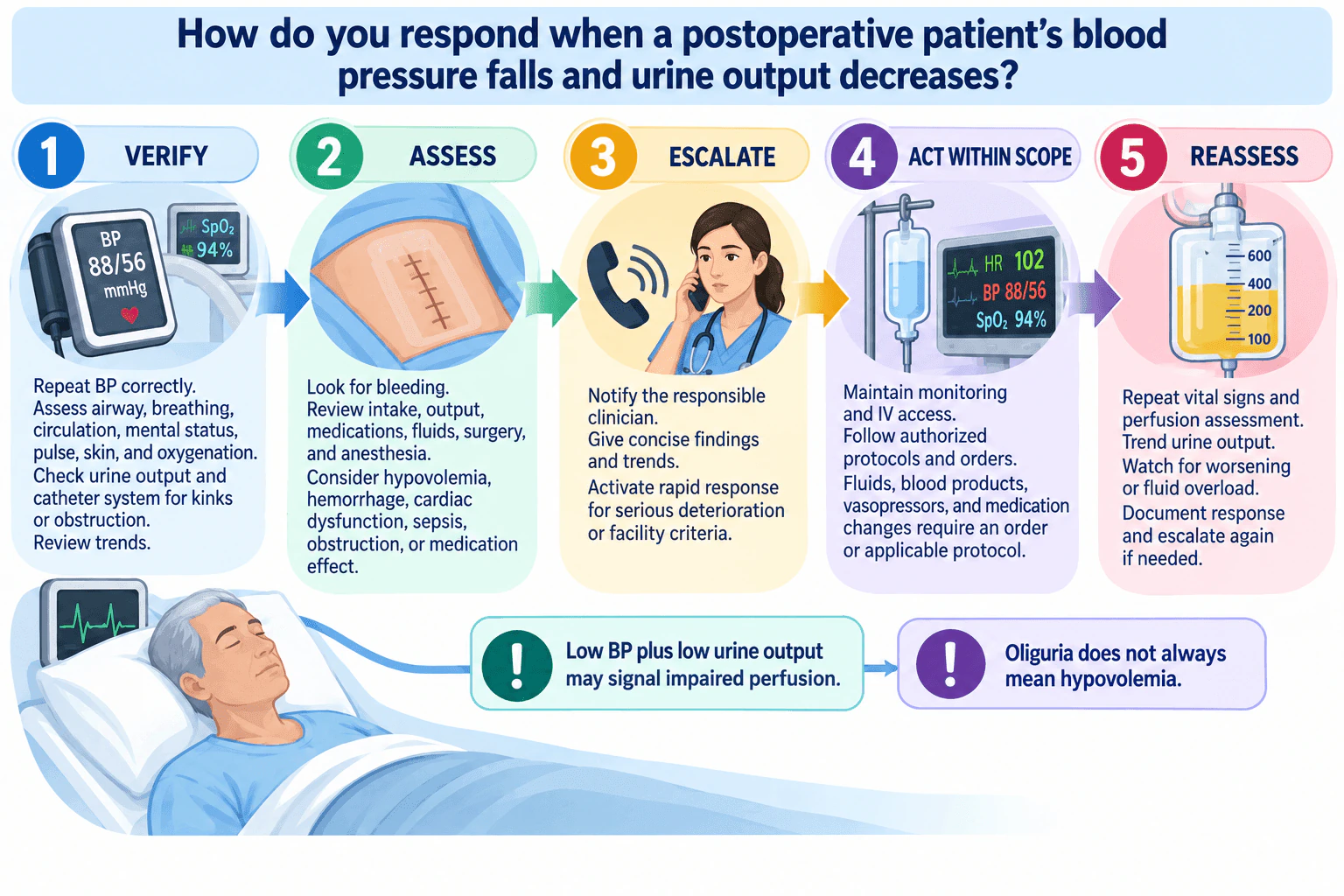
I would first verify the blood pressure and rapidly assess airway, breathing, circulation, mental status, pulse, skin, oxygenation, urine output, and the urinary drainage system. I would review trends, look for bleeding, and consider contributors such as hypovolemia, hemorrhage, cardiac dysfunction, sepsis, medication or anesthetic effects, and urinary obstruction as an explanation for reduced drainage. I would promptly notify the responsible clinician and activate rapid response if serious deterioration or local criteria are present. I would maintain monitoring and IV access, follow authorized protocols and orders, and repeatedly reassess vital signs, perfusion, urine output, response to care, and signs of fluid overload.
Detailed Explanation
A postoperative patient whose blood pressure is falling while urine output is decreasing may have worsening organ perfusion, but those findings do not identify the cause by themselves. My priorities are to verify the findings, assess the whole patient, recognize the trend, escalate promptly, act within nursing scope, and reassess closely. I would not assume that reduced urine output automatically means hypovolemia or that the patient simply needs more fluid.
Useful Questions to Ask the Interviewer
What postoperative setting is the patient in and what monitoring is currently available?
What recent vital sign, intake, output, medication, fluid, laboratory, drain, and blood loss trends are available?
What escalation and rapid response process does the facility use?
How to Explain It in an Interview
Assessment Findings
I would immediately repeat the blood pressure using correct technique and assess airway, breathing, circulation, mental status, pulse, skin, oxygenation, and overall appearance. I would verify the urine output and inspect the catheter and drainage tubing for kinking, obstruction, or another mechanical explanation. I would review recent vital signs, intake and output, medications, IV fluids, surgery, anesthesia, drains, dressings, and evidence of bleeding.
Nursing Priorities
I would consider hypovolemia or hemorrhage while also considering cardiac dysfunction, sepsis, medication or anesthetic effects, and urinary obstruction as an explanation for reduced drainage. Falling blood pressure with reduced urine output may indicate impaired perfusion, but oliguria alone does not prove hypovolemia.
I would promptly notify the responsible clinician with concise assessment findings and trends. If the patient is seriously deteriorating, meets local rapid response criteria, or I have significant concern about the patient's condition, I would activate the appropriate escalation pathway.
Within RN scope, I would maintain appropriate monitoring and IV access and perform actions authorized by local protocols. IV fluid boluses, blood products, vasopressors, medication changes, and other prescribed treatments require an appropriate order or applicable protocol.
Response to Care
After interventions, I would repeat vital signs and perfusion assessment, continue trending urine output, reassess mental status and oxygenation, watch for continued deterioration or signs of fluid overload, document findings and response, and escalate again if the patient does not improve.
Why Interviewers Ask This
This question tests whether the nurse recognizes a potentially important postoperative deterioration pattern, evaluates trends rather than reacting to one isolated value, considers several possible causes, distinguishes independent nursing actions from ordered treatment, escalates concerns promptly, and continues reassessment after interventions.
Common interview mistakes
Common mistakes include reacting to one blood pressure measurement without verifying it, assuming all reduced urine output is caused by hypovolemia, overlooking bleeding or a urinary drainage problem, failing to review trends, independently initiating treatment that requires an order or protocol, delaying escalation while waiting for more severe deterioration, and failing to reassess after interventions.
Interview tip
Organize the answer as verify, assess, escalate, act within scope, and reassess. Emphasize that the nurse recognizes possible impaired perfusion without diagnosing the cause from two findings alone, communicates trends clearly, distinguishes nursing actions from ordered treatment, and continues reassessment after care.
Interviewer may ask next
How would you verify that the decreased urine output is a true clinical finding?
I would confirm the recorded output and time interval, review the intake and output trend, inspect the collection system, check the tubing for kinking or obstruction, assess whether the catheter is draining, and reassess the patient for other evidence of deterioration. I would not assume the reduced recorded output represents renal hypoperfusion until the measurement and simple mechanical explanations have been checked.
What would change if the patient developed increasing oxygen needs, crackles, or other signs of fluid overload?
Those findings would raise concern that additional fluid could be harmful and that the patient may have abnormal fluid distribution or cardiac or pulmonary compromise. I would promptly communicate the new findings, continue close respiratory and hemodynamic assessment, follow ordered or protocol authorized treatment, and reassess frequently before and after further interventions.
43. How do you manage competing priorities in a high acuity medical surgical assignment?Adult Health And Medical Surgical NursingHard
i Question Details
Explain how changing acuity, airway and breathing concerns, circulation, neurologic changes, time sensitive therapies, delegation, and reassessment guide priorities.
Short Interview Answer (30-60 seconds)
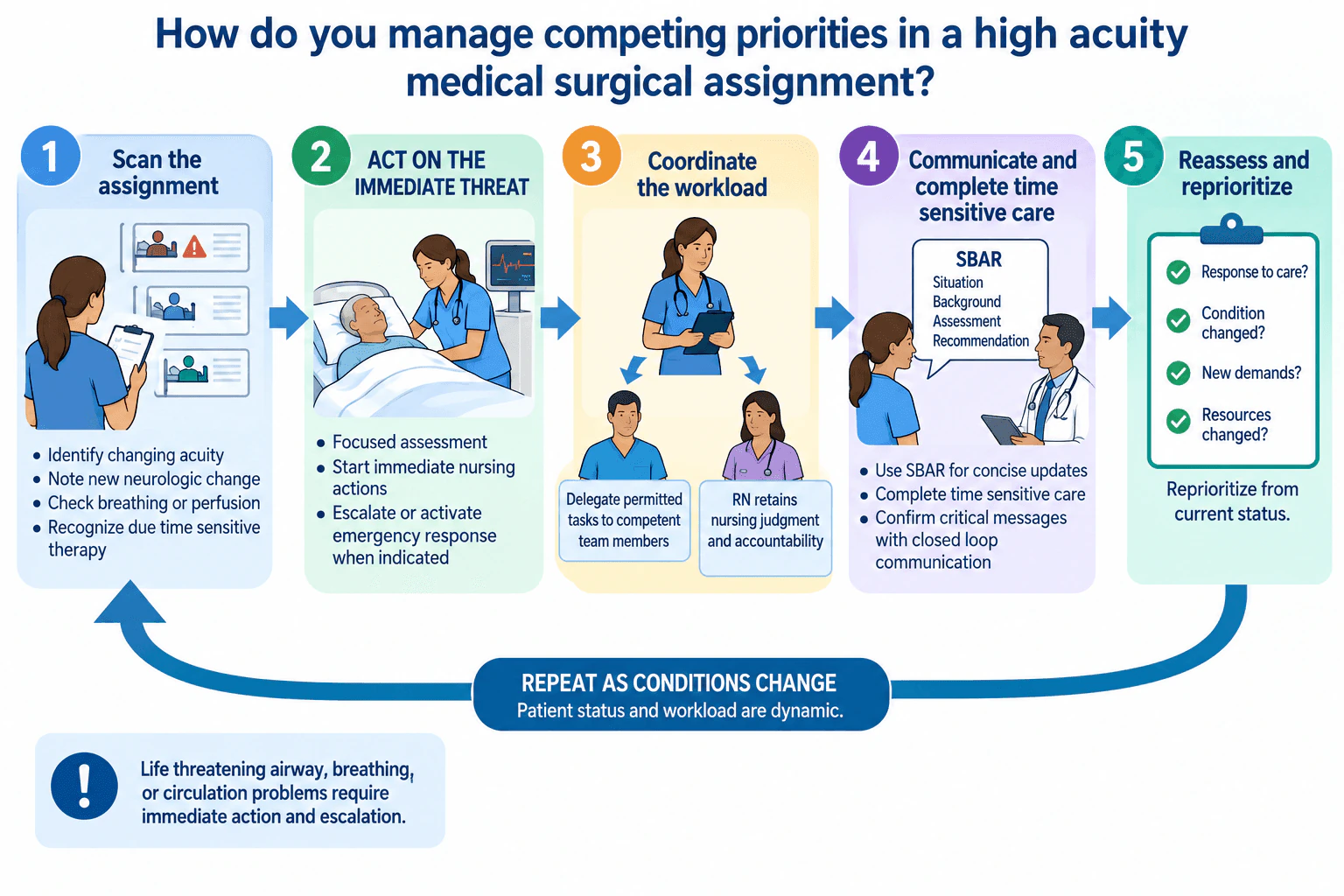
I use a repeating scan, act, coordinate, communicate, and reassess process. I first identify the patient with the greatest immediate risk, especially life threatening airway, breathing, or circulation problems, new neurologic changes, and other signs of increasing acuity. I perform a focused assessment, begin appropriate nursing actions within my scope, and escalate when indicated. I coordinate the remaining workload by delegating permitted tasks to competent team members while retaining nursing judgment and accountability. I communicate critical changes clearly, complete time sensitive care according to current orders or authorized protocols, reassess the response to care, and reprioritize as patient status, workload, or available resources change.
Detailed Explanation
I do not manage a high acuity assignment as a fixed task list. I continuously compare current patient risk, time sensitive needs, and available resources, then move the highest risk problem to the front. That approach matches the required focus on changing acuity, escalation, delegation, and reassessment.
Useful Questions to Ask the Interviewer
What resources are available when a patient deteriorates or needs urgent escalation?
How are delegation responsibilities typically divided among RNs and other team members on the unit?
What unit processes are used to coordinate time sensitive therapies when several patients need attention at once?
How to Explain It in an Interview
Assessment Findings
I begin by scanning the whole assignment rather than simply following the original task order. I look for changing acuity, airway or breathing concerns, signs of impaired circulation, new neurologic changes, worsening symptoms, concerning trends, and therapies that are time sensitive.
Nursing Priorities
If I identify an immediate threat, I perform a focused assessment and start appropriate nursing actions within my scope. Life threatening airway, breathing, or circulation problems require immediate action and escalation. For cardiac arrest, current American Heart Association guidance emphasizes rapid recognition, activation of the emergency response system, and immediate resuscitation actions. cpr.heart.org
Once the immediate threat is being addressed, I coordinate the rest of the assignment. I delegate permitted tasks to competent team members based on the patient, the task, staff competence, applicable nursing regulation, and facility policy. The RN retains nursing judgment, evaluation, follow up, and overall accountability for delegated care. NCSBN guidance states that nursing judgment and critical decision making cannot be delegated. ncsbn.org
Communication and Time Sensitive Care
I communicate important changes early. SBAR means Situation, Background, Assessment, and Recommendation or Request. It provides a concise structure for communicating concerns and is specifically useful when a patient is rapidly deteriorating. I confirm critical messages with closed loop communication and complete time sensitive therapies according to current orders, authorized protocols, and local policy. ahrq.gov
Response to Care
After each important intervention, I reassess. I ask whether the patient responded, whether the condition changed, whether new demands appeared, and whether staffing or resources changed. I then reprioritize from the current clinical picture. The key is that patient status and workload are dynamic, so the priority plan must remain dynamic too.
Why Interviewers Ask This
Interviewers are evaluating whether the nurse can recognize deterioration, place immediate patient risk ahead of routine task order, use clinical judgment under competing demands, delegate safely, communicate urgent information clearly, and reassess rather than treating priorities as fixed. Safe delegation depends on patient needs, the competence of the delegatee, applicable nursing regulation, and organizational policy, while nursing judgment and critical decision making remain with the licensed nurse. ncsbn.org
Common interview mistakes
Common mistakes include following the task list after a patient becomes unstable, overlooking new respiratory or neurologic changes, delaying escalation while finishing routine work, treating every scheduled therapy as equally urgent, delegating without considering competence or scope, failing to communicate critical changes clearly, and not reassessing after interventions.
Interview tip
Describe your reasoning as a repeating clinical cycle. Explain what makes you change priorities immediately, what actions you take first, what you can safely delegate, how you communicate urgent changes, how you protect time sensitive care for other patients, and how reassessment determines the next priority.
Interviewer may ask next
How do you verify that your priorities are still appropriate after you intervene?
I reassess the patient and compare the current findings with the earlier assessment. I review airway, breathing, circulation, neurologic status, symptoms, trends, and the response to the intervention. I also check whether another patient's condition changed, whether a new admission or transfer created an urgent need, whether a time sensitive therapy is approaching, and whether staffing or resources changed. If the risk picture changes, I reprioritize immediately rather than continuing the previous plan.
What changes if a previously stable patient suddenly develops significant breathing difficulty while you are preparing another patient for time sensitive care?
The new breathing problem becomes the immediate priority because the patient's acuity has changed. I perform a focused assessment, begin appropriate nursing actions within scope, obtain help, and escalate according to the patient's condition and local response process. At the same time, I coordinate the other patient's time sensitive care by determining what can safely wait and what permitted tasks can be delegated to a competent team member. After the acute problem is addressed, I reassess both patients and reset the assignment priorities.
44. What is your experience providing care in a medical surgical setting?Adult Health And Medical Surgical NursingEasy
i Question Details
Discuss the adult patient populations, common care needs, monitoring, treatments within scope, and collaboration relevant to medical surgical nursing.
Short Interview Answer (30-60 seconds)
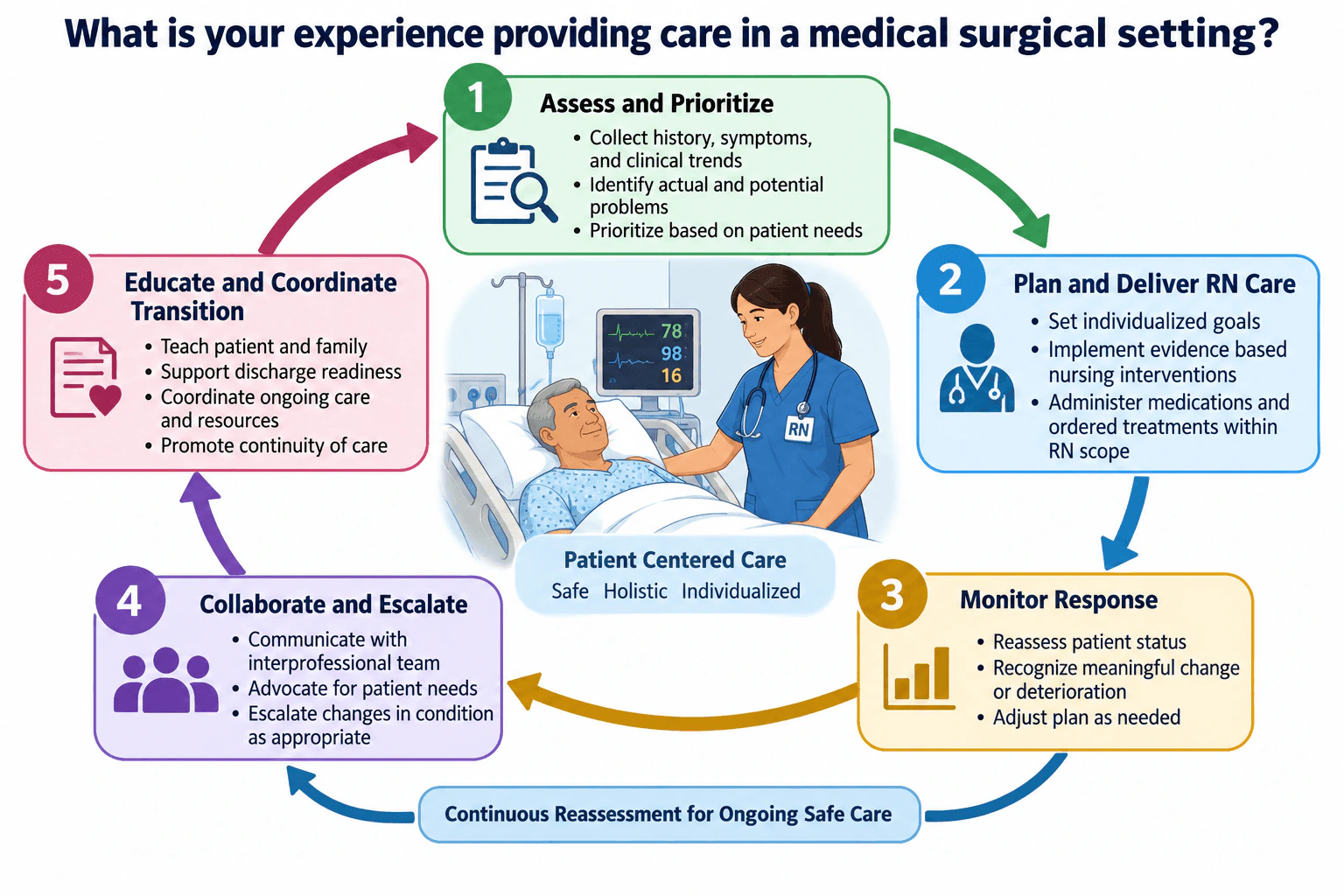
In a medical surgical setting, I focus on caring for adults with acute conditions, chronic illness needs, and postoperative recovery through an organized nursing process. I assess symptoms, history, and clinical trends, prioritize patient needs, and provide individualized nursing interventions. I then monitor the patient's response, recognize meaningful changes or deterioration, communicate and escalate concerns to the appropriate team member, and adjust the nursing plan as needed. I also emphasize patient and family education, discharge readiness, and continuity of care. Medications and ordered treatments are completed within RN scope, applicable orders, and local policy.
Detailed Explanation
Medical surgical nursing involves caring for adults whose needs can change throughout a shift. A clear approach is the same continuous cycle shown in the diagram: assess and prioritize, plan and deliver RN care, monitor the response, collaborate and escalate when needed, and educate and coordinate the transition of care. Reassessment closes the loop because new findings or a change in response can alter priorities and the nursing plan. This aligns with the nursing process of assessment, planning, implementation, and evaluation. ojin.nursingworld.org
Useful Questions to Ask the Interviewer
What adult patient populations and common care needs are most frequent on this unit?
How does the unit support communication and escalation when a patient's condition changes?
What resources are available for patient education, discharge planning, and care coordination?
How to Explain It in an Interview
Condition and Patient Context
I would explain that medical surgical nursing can involve adults with acute illness, chronic conditions requiring inpatient care, and postoperative recovery. I would describe only the patient populations and responsibilities that match my actual background rather than claiming experience I do not have.
Assessment Findings
I begin with an organized nursing assessment by gathering relevant history, symptoms, clinical observations, and trends. I identify actual and potential nursing problems, determine which needs require attention first, and continue reassessing as the patient's condition changes.
Nursing Priorities
After identifying priorities, I set individualized goals and provide appropriate nursing interventions within RN scope. Independent nursing actions can include assessment, monitoring, education, communication, documentation, safety measures, and reassessment. Medications and other ordered treatments are performed only when supported by the appropriate order, authorization, scope, and local policy.
Response to Care
I reassess the patient after interventions and compare current findings with previous findings and expected goals. If I recognize a meaningful change or deterioration, I communicate promptly with the appropriate interprofessional team member and escalate according to the patient's needs and local process. Structured communication such as SBAR can support concise transfer of critical patient information. ahrq.gov
I also educate the patient and family, assess discharge readiness, coordinate needed resources, and communicate important information during care transitions. Effective teamwork and handoff communication support continuity of care as the patient moves between clinicians or settings. ahrq.gov
Why Interviewers Ask This
Interviewers are evaluating whether the nurse can organize care for varied adult patients while using sound nursing judgment. They are listening for assessment and prioritization, safe implementation of the care plan, ongoing monitoring, recognition of deterioration, communication with the interprofessional team, patient education, transition planning, and reassessment. These concepts are consistent with the nursing process of assessment, diagnosis, planning, implementation, and evaluation. ojin.nursingworld.org
Common interview mistakes
Common mistakes are listing tasks without explaining nursing judgment, describing medications or treatments as independently prescribed by the RN, focusing on only one condition, failing to reassess after interventions, or omitting communication and escalation when the patient's condition changes. Another mistake is treating patient education and discharge coordination as separate from ongoing nursing care rather than part of continuity and transition planning.
Interview tip
Organize the response around the five connected stages in the diagram: assess and prioritize, plan and deliver RN care, monitor response, collaborate and escalate, and educate and coordinate transition. Briefly describe only the adult patient populations you have actually cared for, then explain how continuous reassessment guides changes in priorities and the nursing plan.
Interviewer may ask next
How do you verify that your nursing care is working?
I reassess the patient's symptoms, clinical findings, trends, functional response, and progress toward the goals in the nursing plan. I compare the new findings with the previous assessment and document the response. If the patient is not improving, develops a new concern, or shows deterioration, I reassess priorities, communicate the change, and escalate to the appropriate team member. Evaluation and reassessment are part of the ongoing nursing process. ojin.nursingworld.org
How would your approach change if a stable medical surgical patient suddenly deteriorated?
I would shift from routine care to focused reassessment and immediate prioritization. I would identify the change, obtain relevant assessment findings within my scope, address immediate nursing safety needs, and promptly communicate and escalate the concern to the appropriate clinician or response team according to local policy. I would carry out authorized or ordered interventions, continue monitoring, document the change and response, and reassess after each intervention. Structured communication such as SBAR can help organize critical information during escalation. ahrq.gov
45. What is trauma-informed care?Mental Health And Psychosocial CareEasy
Short Interview Answer (30-60 seconds)
Trauma informed care means providing care that recognizes the possible impact of trauma while avoiding assumptions about a patient's experiences. A nurse promotes safety and trust through respectful communication, patient involvement, appropriate boundaries, safety assessment, and collaboration with the healthcare team when additional support is needed.
Detailed Explanation
Trauma informed care is an approach that recognizes a patient may have experienced trauma and considers how those experiences can affect comfort, communication, and participation in healthcare. The nurse does not diagnose trauma related conditions or assume a patient's history, but provides supportive care that promotes safety, trust, dignity, and collaboration.
Useful Questions to Ask the Interviewer
How does your organization support trauma informed communication in daily nursing practice?
What resources are available when patients have psychosocial needs beyond nursing support?
How does the care team coordinate support for patients experiencing distress?
How to Explain It in an Interview
Psychosocial Needs
I explain trauma informed care as recognizing that patients may have different responses to healthcare based on their experiences. The nurse focuses on understanding patient concerns, reducing unnecessary distress, and supporting the patient's sense of control when possible.
Therapeutic Communication
The nurse uses calm, respectful communication and active listening. The nurse explains care clearly, validates concerns, offers appropriate choices, and maintains therapeutic boundaries. The nurse should not promise confidentiality beyond professional responsibilities and safety requirements.
Support and Safety
Trauma informed care includes recognizing distress, assessing safety concerns, and using appropriate de escalation approaches when needed. The nurse provides support within their competence and escalates concerns to appropriate members of the healthcare team when additional assessment or intervention is required.
Reassessment and Referral
The nurse reassesses the patient's response to care, documents relevant observations, and coordinates with the care team for additional psychosocial support when appropriate. This approach helps provide patient centered care while maintaining professional scope.
Why Interviewers Ask This
Interviewers ask this question to evaluate whether a nurse understands how trauma may affect a patient's response to healthcare and whether the nurse can provide respectful, safe, and supportive care. The question assesses therapeutic communication, psychosocial awareness, safety assessment, appropriate escalation, and professional boundaries.
Common interview mistakes
Common mistakes include dismissing patient distress, assuming every patient has the same trauma history, using judgmental communication, crossing therapeutic boundaries, promising confidentiality beyond professional duties, or suggesting nursing communication replaces specialist assessment.
Interview tip
In an interview, connect trauma informed care to practical nursing actions: respectful communication, safety awareness, patient involvement, supportive care, appropriate escalation, reassessment, and collaboration with the healthcare team.
Interviewer may ask next
How would you verify that your nursing approach is trauma informed?
I would verify my approach by assessing the patient's response, listening to their concerns, checking whether they understand the care plan, reassessing safety needs, and seeking appropriate team support when necessary. I would adjust my communication and care approach based on the patient's needs within my scope.
How would trauma informed care change if a patient becomes increasingly distressed during hospitalization?
I would focus on maintaining a calm and safe environment, using therapeutic communication, recognizing signs of distress, applying de escalation techniques within my competence, assessing safety concerns, and coordinating with the care team if additional support or assessment is needed.
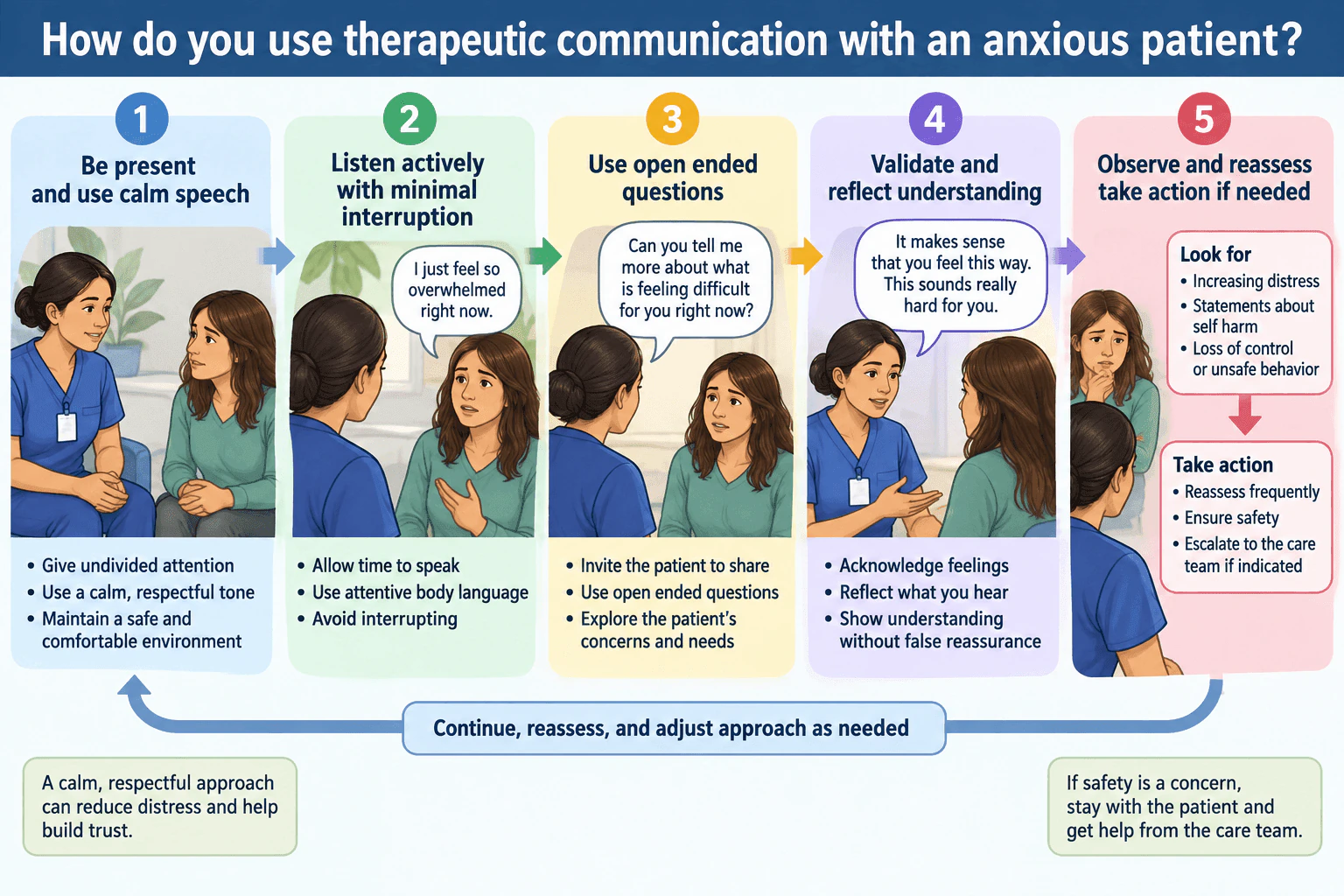
46. How do you use therapeutic communication with an anxious patient?Mental Health And Psychosocial CareEasy
i Question Details
Explain presence, active listening, calm speech, open ended questions, validation, and observation for worsening distress.
Short Interview Answer (30-60 seconds)
I would approach the patient calmly, stay present, and give them my full attention. I would listen actively without interrupting, ask open ended questions such as, "Can you tell me more about what is feeling difficult for you right now?", and validate what I hear without minimizing the concern or giving false reassurance. I would continue observing the patient's words, behavior, and level of distress, reassess safety, and involve the appropriate care team members if distress worsens or a safety concern emerges.
Detailed Explanation
Therapeutic communication with an anxious patient means creating enough calm and trust for the patient to express what they are experiencing. The nurse does not need to diagnose the cause of the anxiety during the conversation. The immediate goals are to be present, listen carefully, understand the patient's concerns, provide supportive communication, and recognize when additional assessment or help is needed.
Useful Questions to Ask the Interviewer
Is the patient medically stable, or are there physical symptoms that also require assessment?
Is there any known immediate safety concern or recent change in the patient's behavior?
What support resources or mental health services are available in this care setting?
How to Explain It in an Interview
Therapeutic Communication
I would start by being physically and emotionally present, reducing distractions when possible, and using a calm, respectful tone. I would give the patient my full attention, use attentive body language, allow time to speak, and avoid unnecessary interruption.
I would then use an open ended question such as, "Can you tell me more about what is feeling difficult for you right now?" This gives the patient space to describe concerns in their own words instead of limiting the response to yes or no.
Psychosocial Needs
I would acknowledge and reflect the patient's feelings without dismissing them or giving false reassurance. For example, I might say, "It sounds like this has been overwhelming for you." Validation shows that I heard the patient while maintaining appropriate therapeutic boundaries.
Support and Safety
While listening, I would observe for increasing distress, statements about self harm, loss of behavioral control, or other unsafe behavior. If a safety concern develops, I would continue calm communication, assess the immediate situation, remain with the patient when appropriate, and obtain help from the care team according to my role and local policy.
Reassessment and Referral
I would reassess the patient's response and adjust my approach rather than assuming one conversation resolved the distress. If concerns persist, worsen, or require specialized assessment, I would coordinate with the appropriate care team. Therapeutic communication supports nursing assessment and care, but it does not replace specialist evaluation when that is indicated.
Why Interviewers Ask This
Interviewers want to know whether the nurse can build trust while remaining observant and safety focused. The question evaluates respectful communication, active listening, psychosocial assessment, supportive care, recognition of worsening distress, appropriate therapeutic boundaries, reassessment, and escalation within the Registered Nurse role.
Common interview mistakes
Common mistakes include rushing the patient, interrupting, asking only closed questions, telling the patient to calm down, minimizing distress, giving false reassurance such as saying everything will be fine, offering advice before understanding the concern, promising confidentiality beyond applicable duties, overlooking nonverbal signs of worsening distress, or failing to reassess safety when the patient's condition changes.
Interview tip
Describe therapeutic communication as an active nursing process. Walk through calm presence, active listening, an open ended question, validation, observation for worsening distress, safety reassessment, and appropriate care team escalation. A brief example of what you would actually say demonstrates practical communication skills.
Interviewer may ask next
How would you verify that your therapeutic communication is helping the patient?
I would reassess the patient's response rather than assuming the approach worked. I would observe whether the patient can communicate concerns more clearly, whether visible distress is changing, and whether new needs or safety concerns emerge. I would reflect back my understanding and allow the patient to clarify it. If distress continues or worsens, I would adjust my approach and coordinate additional assessment or support with the care team.
What would you do differently if the anxious patient became increasingly distressed or expressed a safety concern?
I would keep my communication calm, respectful, and nonconfrontational while shifting priority toward immediate safety assessment. I would reduce unnecessary stimulation when feasible, maintain appropriate personal space, continue observing changes in behavior and communication, and seek assistance from the appropriate care team according to the situation and local policy. I would not rely on conversation alone when there is a significant safety concern, and I would continue reassessing the patient as the situation evolves.
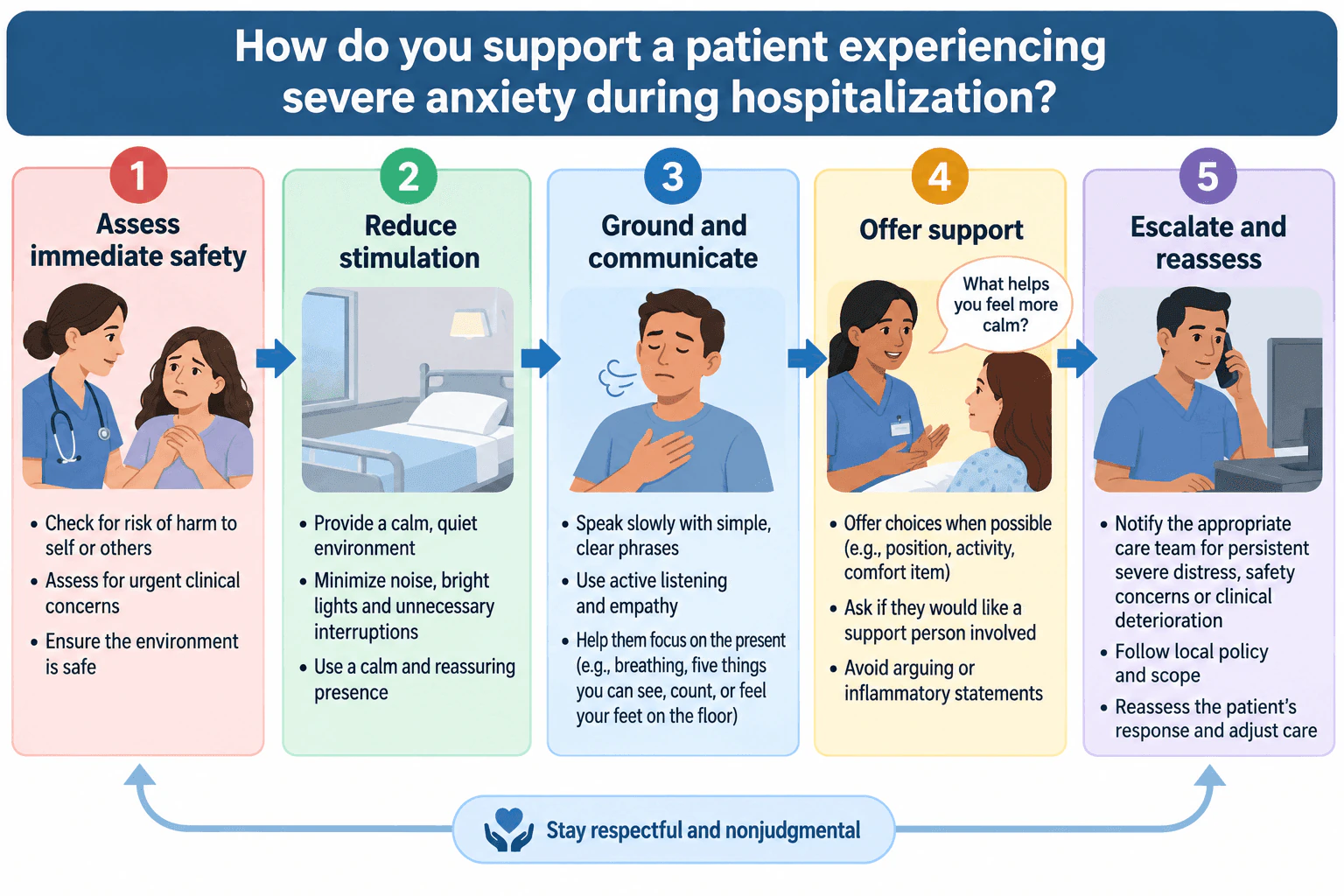
47. How do you support a patient experiencing severe anxiety during hospitalization?Mental Health And Psychosocial CareMedium
i Question Details
Describe immediate safety assessment, reduction of stimulation when appropriate, grounding communication, support person involvement if desired, and escalation for further assessment.
Short Interview Answer (30-60 seconds)
I would start by checking immediate safety, including risk of harm to self or others and any urgent clinical concerns. I would reduce unnecessary noise, bright light, and interruptions when appropriate, then speak slowly using simple, clear language, active listening, empathy, and grounding techniques. I would offer reasonable choices and ask whether the patient would like a support person involved. If severe distress persists, safety concerns arise, or the patient clinically deteriorates, I would involve the appropriate care team according to local policy and my nursing scope, then reassess the patient's response and adjust care.
Detailed Explanation
Severe anxiety during hospitalization can make it harder for a patient to process information, communicate needs, or feel in control. My nursing approach is to protect immediate safety, reduce unnecessary stimulation, provide calm grounding communication, support the patient's preferences, and escalate when further assessment is needed.
Useful Questions to Ask the Interviewer
Is there any immediate safety concern or acute clinical change contributing to the patient's distress?
What resources are available for additional medical or behavioral health assessment in this setting?
Does the patient want a trusted support person involved in their care?
How to Explain It in an Interview
Support and Safety
I would begin with an immediate safety assessment. I would check for risk of harm to self or others, urgent clinical concerns, and whether the environment is safe. I would not assume that severe anxiety establishes a psychiatric diagnosis or that all distress has a psychiatric cause. Concerning physical or behavioral changes require appropriate clinical assessment.
Therapeutic Communication
When appropriate, I would reduce stimulation by creating a calm, quiet environment and minimizing unnecessary noise, bright light, and interruptions. I would remain calm, speak slowly, and use simple, clear phrases. I would use active listening and empathy, avoid arguing or inflammatory statements, and avoid dismissing the patient's distress.
I would use grounding communication to help the patient focus on the present moment. For example, I might guide slow breathing or ask the patient to notice things they can see, count, or physically feel, such as their feet on the floor. I would give one clear instruction or choice at a time rather than overwhelming the patient with information.
Psychosocial Needs
I would ask what helps the patient feel calmer and offer reasonable choices about position, activity, or a comfort item when possible. I would also ask whether the patient would like a trusted support person involved, while respecting consent, privacy, and applicable duties.
Reassessment and Referral
I would reassess the patient's distress, safety, ability to engage, and overall clinical condition. If severe distress persists, safety concerns emerge, or clinical deterioration occurs, I would notify the appropriate care team and obtain further assessment according to local policy and my nursing scope. I would continue supportive care and adjust the plan based on the patient's response.
Why Interviewers Ask This
Interviewers are evaluating whether the nurse can recognize distress, prioritize safety, communicate therapeutically, reduce environmental stressors, support patient preferences, recognize the limits of nursing support, escalate appropriately, and reassess the patient's response.
Common interview mistakes
Common mistakes include dismissing the patient's anxiety, speaking too quickly, giving too much information at once, arguing with the patient, using inflammatory language, creating additional stimulation, overlooking immediate safety or urgent clinical concerns, forcing support person involvement, promising confidentiality beyond applicable duties, or failing to reassess after supportive interventions.
Interview tip
Present the answer as a clear sequence: assess immediate safety, reduce stimulation, use calm grounding communication, offer choices and desired support, then escalate and reassess. Emphasize that you remain within nursing scope and do not assume that severe anxiety alone establishes a psychiatric diagnosis.
Interviewer may ask next
How would you verify that your interventions are helping?
I would reassess the patient's reported distress, behavior, ability to communicate and follow simple directions, immediate safety, and overall clinical condition. I would compare the response with the initial assessment, ask the patient what is helping, and adjust the environment or communication approach as needed. If distress remains severe or new safety or clinical concerns appear, I would escalate for further assessment.
What would you change if the patient became increasingly agitated and could no longer engage with grounding techniques?
I would prioritize immediate safety, reduce additional stimulation, maintain calm and simple communication, give appropriate personal space, and avoid confrontation. I would promptly involve the appropriate care team according to the patient's condition, local policy, and my nursing scope. I would continue observing for clinical deterioration or risk of harm and reassess as the situation changes.
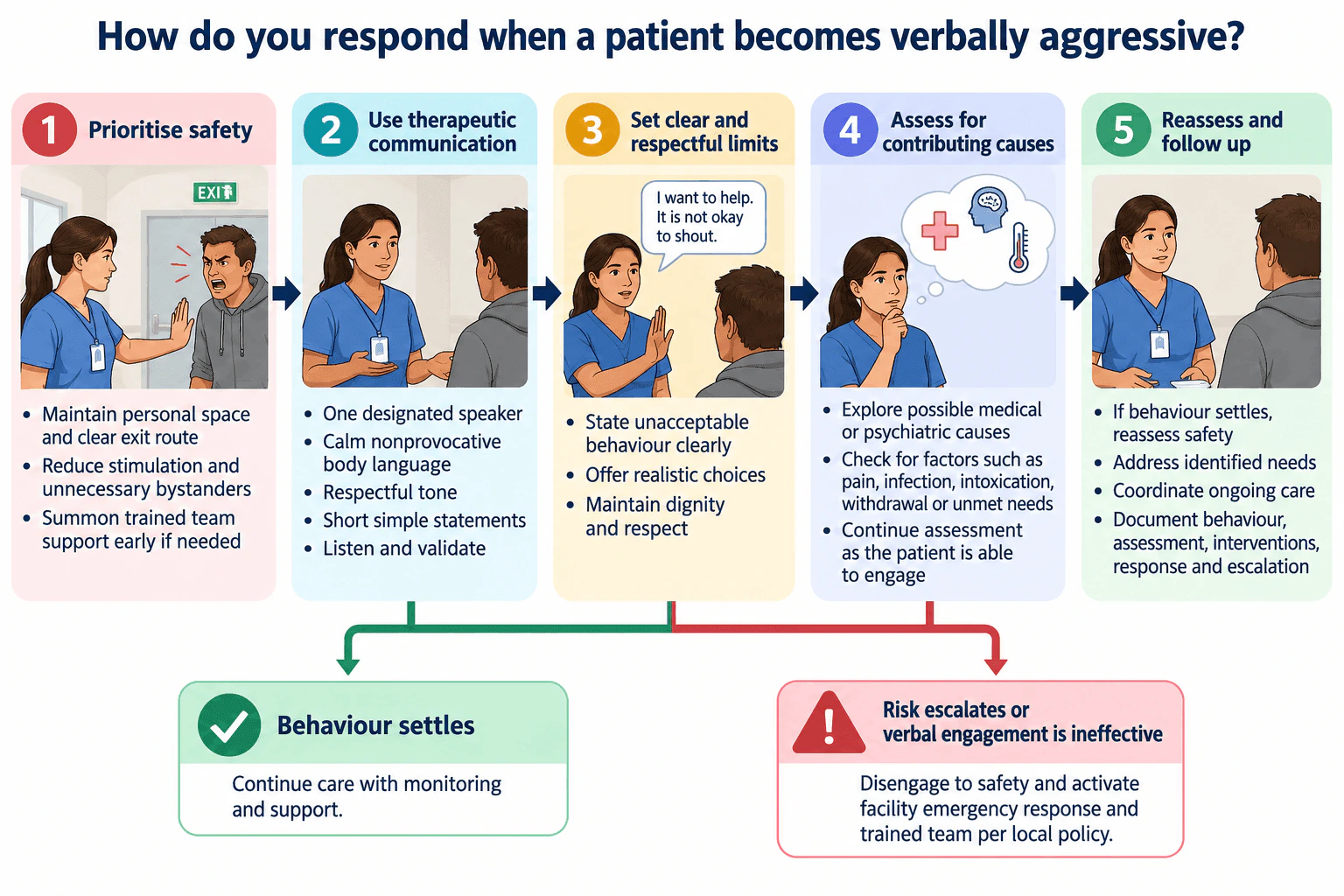
48. How do you respond when a patient becomes verbally aggressive?Mental Health And Psychosocial CareMedium
i Question Details
Explain personal and environmental safety, calm de escalation, clear limits, assessment for contributing distress, team support, and documentation.
Short Interview Answer (30-60 seconds)
I would prioritize safety by maintaining personal space, keeping a clear exit route, reducing stimulation, and calling trained support early when needed. If it is safe to continue, I would have one person speak calmly, use short respectful statements, listen and validate the patient's concerns, set clear behavioral limits, and offer realistic choices. I would assess for contributing factors such as pain, infection, intoxication, withdrawal, or unmet needs. I would reassess continuously. If the patient settles, I continue supportive care and monitoring. If risk increases or verbal engagement is ineffective, I move to safety and activate the appropriate facility response. I would document the behavior, assessment, interventions, response, and escalation.
Detailed Explanation
A verbally aggressive patient requires a response that protects safety while avoiding unnecessary escalation. The nurse should combine environmental safety, therapeutic communication, respectful limits, assessment for contributing distress, team support, reassessment, and documentation. Current guidance on violence and aggression supports calm de escalation, a primary communicator, attention to environmental safety, and escalation to trained support when verbal strategies are no longer safe or effective.
Useful Questions to Ask the Interviewer
Is the patient making threats or showing behavior that suggests an immediate risk of physical harm?
What trained staff or emergency response resources are available in this setting?
Are there known medical, substance related, environmental, or psychosocial factors that may be contributing to the behavior?
How to Explain It in an Interview
Support and Safety
I would first assess immediate safety for the patient, staff, and others. I would maintain personal space, keep a clear exit route, reduce unnecessary stimulation and bystanders, and request trained team support early when needed. I would avoid positioning myself where the patient blocks my exit. If there is an immediate danger, I would disengage to safety and activate the facility emergency response according to local policy.
Therapeutic Communication
If verbal engagement is safe, I would have one designated person take the lead in communicating. I would use a calm respectful tone, nonprovocative body language, short simple statements, active listening, and validation. I would not argue, shame, crowd, threaten, or match the patient's intensity.
I would set clear limits while preserving dignity. For example, I might say, "I want to help. It is not okay to shout at staff. We can talk about what you need when we can do that safely." When appropriate, I would offer realistic choices so the patient retains some control without compromising safety.
Psychosocial Needs
As the patient becomes able to engage, I would assess for contributing distress rather than assuming a psychiatric diagnosis. Possible factors include pain, infection, intoxication, withdrawal, unmet needs, acute illness, environmental stress, or mental health concerns. Concerning findings would be communicated to the appropriate clinician and care team for further assessment.
Reassessment and Referral
I would continually reassess behavior, safety, and the patient's response. If the behavior settles, I would address identified needs, continue supportive care and monitoring, and coordinate ongoing care. If risk escalates or verbal engagement becomes ineffective, I would stop attempting to manage the situation alone, disengage to safety, and activate trained support or the appropriate emergency response. I would document the observed behavior, assessment findings, interventions, patient response, team involvement, and any escalation.
Why Interviewers Ask This
Interviewers are assessing whether the nurse can balance immediate safety with respectful, noncoercive care. They want to see prioritization of personal and environmental safety, calm de escalation, therapeutic communication, clear boundaries, assessment for contributing distress or illness, timely team support, reassessment, escalation when necessary, and objective documentation. They are also checking that the nurse stays within scope and does not assume a psychiatric diagnosis from aggressive behavior alone.
Common interview mistakes
Common mistakes include arguing with the patient, matching an aggressive tone, crowding the patient, blocking the exit, allowing several staff members to speak at once, dismissing distress, threatening the patient, setting limits disrespectfully, assuming the behavior is purely psychiatric, overlooking medical or substance related contributors, waiting too long to request support, continuing verbal engagement when safety is deteriorating, and failing to document the behavior and response.
Interview tip
Present the response in a clear safety first sequence: protect personal and environmental safety, communicate calmly, set respectful limits, assess contributing distress, reassess continuously, escalate when verbal engagement is unsafe or ineffective, and document. Make clear that supportive care does not mean accepting threatening behavior and that emergency actions follow local policy and nursing scope.
Interviewer may ask next
How would you verify that your de escalation approach is working?
I would reassess observable behavior and immediate safety throughout the interaction. Improvement may include a quieter voice, less threatening language or posture, greater ability to listen, willingness to discuss concerns, or acceptance of realistic choices. I would also reassess any identified contributing factors and confirm that the environment remains safe. If behavior becomes more threatening, the patient cannot engage, or risk to anyone increases, I would stop relying on verbal techniques alone, move to safety, and activate trained support or the appropriate emergency response.
What changes if the verbally aggressive patient also appears acutely confused or medically unwell?
Safety and calm communication remain priorities, but I would increase attention to possible medical contributors. Within nursing scope, I would assess for acute changes and relevant findings, including possible pain, infection, intoxication, withdrawal, or other illness, and promptly communicate concerning findings to the appropriate clinician and care team. I would not assume the behavior represents a psychiatric disorder. If the patient's condition or behavior creates an immediate safety risk, I would activate the appropriate emergency response while supporting timely medical evaluation.
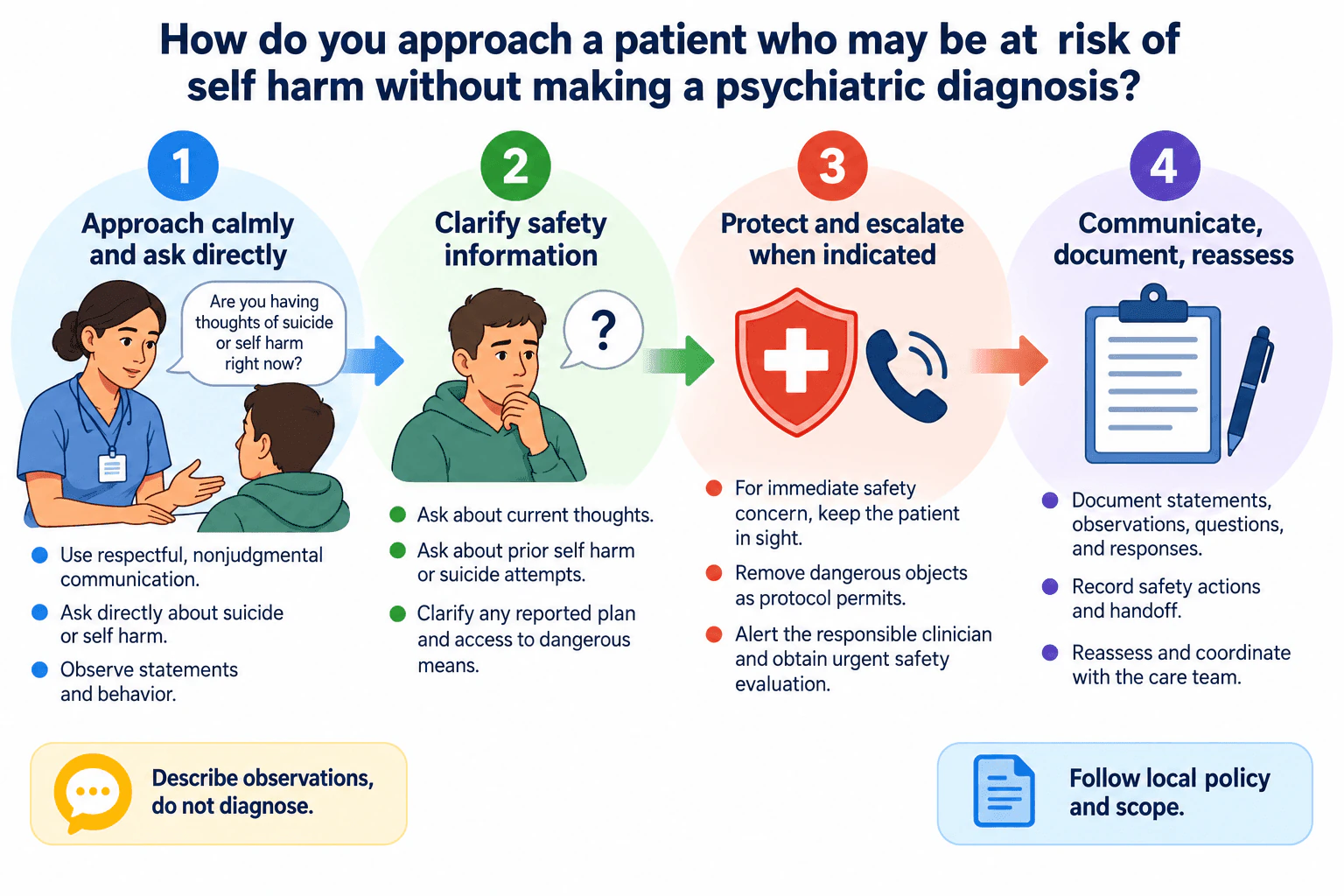
49. How do you approach a patient who may be at risk of self harm without making a psychiatric diagnosis?Mental Health And Psychosocial CareHard
i Question Details
Describe direct safety focused questions, observation of behavior and statements, immediate protective actions within protocol, urgent escalation, and documentation.
Short Interview Answer (30-60 seconds)
I would approach the patient calmly and without judgment, ask directly about suicide or self harm, and observe what the patient says and does. I would clarify current thoughts, previous self harm or suicide attempts, and any reported plan or access to dangerous means as allowed by local protocol. If there is an immediate safety concern, I would keep the patient in sight, reduce access to dangerous objects as protocol permits, alert the responsible clinician, and obtain urgent safety evaluation. I would document statements, observations, questions, responses, safety actions, and handoff, then continue reassessing with the care team. I would describe observations and safety concerns rather than make a psychiatric diagnosis.
Detailed Explanation
The nursing priority is to recognize and respond to a safety concern without making a psychiatric diagnosis. I would use respectful communication, ask direct safety questions, observe the patient's statements and behavior, take protective action when indicated, escalate promptly, and document objectively.
Useful Questions to Ask the Interviewer
What care setting and local suicide safety protocol should I assume?
Is the patient currently reporting thoughts of suicide or self harm, or are there concerning statements or behaviors only?
Has the patient reported a plan or access to dangerous means?
How to Explain It in an Interview
Therapeutic Communication
I would begin with a calm, respectful, nonjudgmental approach and ask directly whether the patient is having thoughts of suicide or self harm. I would observe the patient's words and behavior rather than assign a psychiatric label. Direct suicide screening is appropriate, and NIMH provides specific nursing scripts for this purpose. nimh.nih.gov
Support and Safety
I would clarify whether thoughts are current, ask about prior self harm or suicide attempts, and clarify any reported plan or access to dangerous means when permitted by the nursing protocol. NIMH guidance identifies current suicidal thoughts as requiring urgent evaluation and states that the patient should be kept in sight. It also supports securing or removing dangerous items when access to means creates concern. nimh.nih.gov
If there is an immediate safety concern, I would keep the patient in sight, reduce access to dangerous objects as protocol permits, alert the responsible clinician, and obtain urgent safety evaluation. I would not independently make a psychiatric diagnosis or exceed local nursing scope.
Reassessment and Referral
I would document the patient's statements, observed behavior, questions and responses, safety actions, notifications, and handoff. I would then reassess safety and coordinate with the care team. A negative response or reassurance from the patient does not replace clinical judgment or any required follow up assessment. NIMH notes that clinical judgment can override a negative screen and that positive screens require appropriate further evaluation. nimh.nih.gov
Why Interviewers Ask This
Interviewers are assessing whether the nurse can recognize a potentially serious safety concern, communicate therapeutically, gather relevant information without assigning a psychiatric diagnosis, take immediate protective action within scope and protocol, escalate appropriately, document objectively, and reassess with the care team.
Common interview mistakes
Common mistakes include avoiding direct questions about suicide, making an unsupported psychiatric diagnosis, relying only on reassurance that the patient is safe, failing to observe statements and behavior, leaving a patient with an immediate safety concern out of sight, failing to address dangerous objects according to protocol, delaying escalation, using judgmental language, and documenting conclusions instead of objective findings and actions.
Interview tip
Present the response as one safety sequence: communicate respectfully, ask directly, clarify current thoughts and relevant history, protect and escalate when indicated, then document and reassess. State clearly that the nurse describes observable findings and safety concerns rather than assigning a psychiatric diagnosis.
Interviewer may ask next
How would you verify that your assessment and immediate response are appropriate?
I would verify the patient's current safety status using direct questions and objective observations, compare the findings with the facility's approved suicide screening and safety pathway, confirm any reported current thoughts, previous attempts, plan, or access to dangerous means as allowed by protocol, and communicate the findings to the responsible clinician. I would also verify that required observation, environmental precautions, documentation, handoff, and reassessment are being carried out. NIMH provides nursing screening scripts and setting specific pathways that distinguish screening from the more detailed safety assessment performed by an appropriately trained clinician. nimh.nih.gov
What changes if the patient says they are thinking about killing themselves right now?
That becomes an immediate safety priority. I would keep the patient in sight, alert the responsible clinician or medical team immediately, follow local protocol to remove or secure dangerous objects, and obtain urgent safety evaluation. I would document the patient's statement, my observations, protective actions, notifications, and subsequent reassessment. NIMH states that current suicidal thoughts require urgent evaluation and that the patient cannot be left alone. nimh.nih.gov
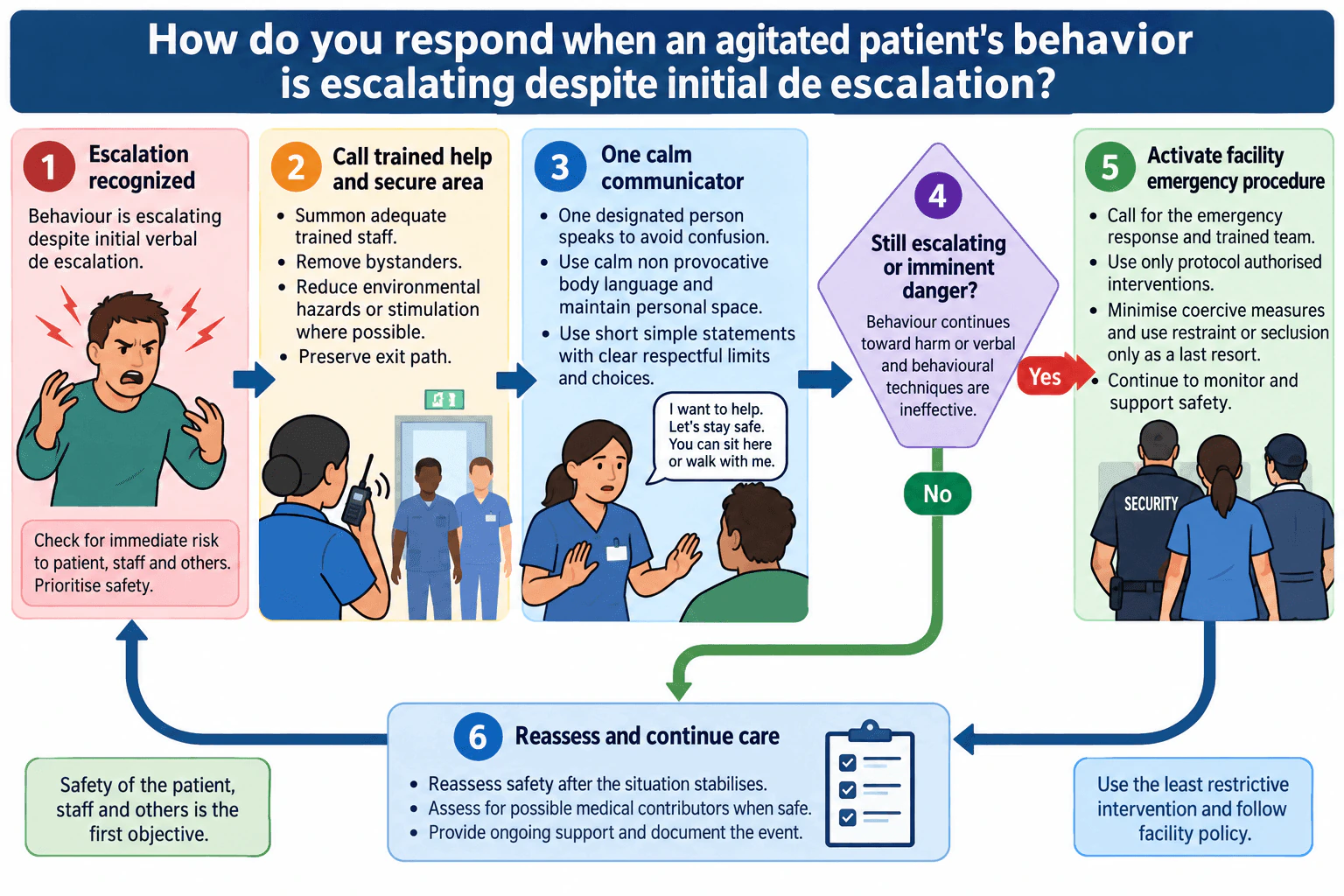
50. How do you respond when an agitated patient's behavior is escalating despite initial de escalation?Mental Health And Psychosocial CareHard
i Question Details
Describe immediate safety assessment, additional staff support, environmental risk reduction, clear communication, and escalation according to facility emergency procedures.
Short Interview Answer (30-60 seconds)
I would immediately reassess risk to the patient, staff, and others, summon trained support, remove bystanders and hazards when possible, reduce stimulation, and maintain a safe exit path. I would have one calm communicator use simple respectful statements, personal space, realistic choices, and clear limits. If serious danger persists, I would activate the facility emergency response and follow policy for the least restrictive appropriate intervention. After stabilization, I would reassess safety, consider possible medical contributors, continue support, coordinate with the care team, and document what occurred.
Detailed Explanation
When initial de escalation is no longer controlling the situation, the priority is preventing harm while continuing respectful, nonprovocative communication. I would not assume the cause is psychiatric because agitation can have medical, substance related, environmental, psychological, or other contributors. The response should move from immediate safety assessment to trained support, environmental risk reduction, clear communication, appropriate escalation, and reassessment.
Useful Questions to Ask the Interviewer
What emergency response process and trained support resources are available in this setting?
What facility procedures govern restraint, seclusion, and other emergency interventions?
Are there known medical, medication, substance related, communication, or environmental factors affecting this patient?
How to Explain It in an Interview
Support and Safety
I would immediately reassess whether the patient's behavior poses an immediate risk to the patient, staff, or others. I would summon adequate trained staff, move unnecessary bystanders away, reduce avoidable stimulation and environmental hazards when possible, and preserve a safe exit path. Safety remains the first objective while de escalation continues when feasible.
Therapeutic Communication
I would designate one person to communicate so the patient is not receiving competing messages. That person should maintain appropriate personal space, use calm nonprovocative body language, speak in short simple statements, acknowledge concerns, offer realistic choices when possible, and set clear respectful limits. I would avoid arguing, threatening, crowding, or making promises that cannot be kept.
Escalation Within Scope
If the patient's behavior continues toward serious harm or presents imminent danger, I would activate the facility emergency response and follow established procedures. Any restrictive intervention must be performed only by appropriately trained staff and according to applicable orders, authorization, monitoring requirements, law, and facility policy. Restraint or seclusion should be used only when less restrictive measures are ineffective or not feasible for protecting immediate physical safety, with the least restrictive appropriate intervention selected.
Reassessment and Referral
After the situation stabilizes, I would reassess the patient, staff, and others for safety or injury. When safe, I would assess for possible medical contributors to the behavior and communicate concerning findings to the responsible clinician. I would continue supportive care, coordinate with the care team, follow required monitoring, document the event and the patient's response, and update the care plan based on what helped or worsened the escalation.
Why Interviewers Ask This
Interviewers are evaluating whether the nurse can recognize worsening agitation, prioritize immediate safety, mobilize trained assistance, reduce environmental risk, communicate therapeutically under pressure, escalate within nursing scope and facility procedures, and reassess the patient after stabilization.
Common interview mistakes
Common mistakes include arguing with the patient, allowing several staff members to give competing instructions, crowding the patient, blocking a safe exit unnecessarily, ignoring environmental hazards, delaying the call for trained support, using provocative language, assuming agitation is purely psychiatric, using restrictive interventions before less restrictive measures have been considered when feasible, or failing to reassess and document after stabilization.
Interview tip
Present the response in the same sequence as the diagram: recognize escalation and reassess immediate danger, call trained help and reduce environmental risk, use one calm communicator, determine whether serious danger persists, activate facility emergency procedures when required, then reassess and continue care. Make clear that restrictive interventions depend on authorization, training, facility policy, and the patient's immediate safety needs.
Interviewer may ask next
How would you verify that your response remains appropriate as the situation changes?
I would repeatedly reassess the patient's behavior, risk to the patient and others, response to communication, environmental hazards, and staff safety. I would verify that any escalation follows current facility procedures and required authorization. If a restrictive intervention is used, I would confirm that the situation continues to justify it, complete required monitoring and reassessment, communicate changes promptly, and support discontinuation as soon as the applicable release criteria are met.
What changes if the agitation may be caused by an acute medical problem?
Immediate safety still comes first, but I would increase attention to possible medical contributors such as hypoxia, pain, medication effects, intoxication, withdrawal, infection, metabolic disturbance, neurologic change, or delirium based on the clinical context. Once immediate safety permits, I would obtain appropriate nursing assessment data, communicate concerning findings promptly to the responsible clinician, and support urgent medical evaluation rather than assuming the behavior represents a psychiatric disorder.
More questions load as you scroll
Disclaimer: This interview guide is for educational and informational purposes only. It is designed to help readers prepare, but it does not guarantee any interview result, hiring decision, offer, or outcome. Interview questions, hiring criteria, and preferred answers can vary by employer, interviewer, industry, location, and time. All answers, examples, and explanations in this guide are suggested examples for interview preparation, not definitive answers or instructions for professional practice. They are based on research and judgment, are provided without warranties of any kind, and should be adapted to the question, role, and applicable laws and professional requirements. Diagrams are simplified illustrations intended to highlight the main concepts and their relationships; actual situations, systems, and practices may be more complex. Alternative approaches may be equally valid or better suited to a particular question, context, or interviewer. To the fullest extent permitted by applicable law, the contributors and publisher are not liable for decisions made, actions taken, or losses incurred based on this guide.
State Laws and Professional Responsibilities: Laws and requirements governing an occupation vary by state and jurisdiction. You are responsible for checking the current laws, licensing requirements, and scope-of-practice rules that apply to your location and role, and for ensuring that your answers and actions comply with them. Adapt examples in this guide to those requirements. This guide is not legal advice.
Content Accuracy and Verification: To the fullest extent permitted by applicable law, we do not represent or warrant that interview guides, questions, answers, examples, or diagrams are accurate, complete, current, error-free, or suitable for any particular purpose. You are responsible for independently reviewing and verifying the information before relying on it.