This interview guide is for educational and informational purposes only. It is designed to help readers prepare, but it does not guarantee any interview result, hiring decision, offer, or outcome. Interview questions, hiring criteria, and preferred answers can vary by employer, interviewer, industry, location, and time. All answers, examples, and explanations in this guide are suggested examples for interview preparation, not definitive answers or instructions for professional practice. They are based on research and judgment, are provided without warranties of any kind, and should be adapted to the question, role, and applicable laws and professional requirements. Diagrams are simplified illustrations intended to highlight the main concepts and their relationships; actual situations, systems, and practices may be more complex. Alternative approaches may be equally valid or better suited to a particular question, context, or interviewer. To the fullest extent permitted by applicable law, the contributors and publisher are not liable for decisions made, actions taken, or losses incurred based on this guide.
State Laws and Professional Responsibilities
Laws and requirements governing an occupation vary by state and jurisdiction. You are responsible for checking the current laws, licensing requirements, and scope-of-practice rules that apply to your location and role, and for ensuring that your answers and actions comply with them. Adapt examples in this guide to those requirements. This guide is not legal advice.
Identity, Image, and Privacy Notice
To respect individual privacy, some names, profile photographs, avatars, biographical details, and other identifying information displayed in this guide may be replaced with pseudonyms, licensed stock images, illustrative avatars, composite images, or representative descriptions. Unless a person is expressly identified as an actual contributor, a displayed name, image, or profile should not be understood as depicting or identifying a specific candidate, interviewer, employee, or other real individual. These representations are provided for editorial and illustrative purposes only and do not imply endorsement, employment, participation, or affiliation with this guide or any company mentioned in it. Any resemblance to an actual person is coincidental.
Company Notice
This guide is an independent educational resource and is not affiliated with, endorsed by, sponsored by, or approved by the company named in this guide. Company names identify reported interview experiences or the employer context of clearly labeled original practice exercises. Interview practices can change without notice, and inclusion of company-specific content does not mean these questions are official, complete, or guaranteed to be asked. To the fullest extent permitted by law, the author, contributors, and publisher are not responsible for outcomes related to use of this material.
Content Accuracy and Verification
To the fullest extent permitted by applicable law, we do not represent or warrant that interview guides, questions, answers, examples, or diagrams are accurate, complete, current, error-free, or suitable for any particular purpose. You are responsible for independently reviewing and verifying the information before relying on it.
Questions or comments?
Contact us for general questions, or share feedback, technical corrections, and comments with the community.
71. How do you respond when a patient becomes acutely confused and less responsive?Emergency Recognition And EscalationMedium
i Question Details
Describe rapid neurologic and physiologic assessment, comparison with baseline, immediate safety actions, review of vital signs and glucose when indicated by protocol, and urgent escalation.
Short Interview Answer (30-60 seconds)
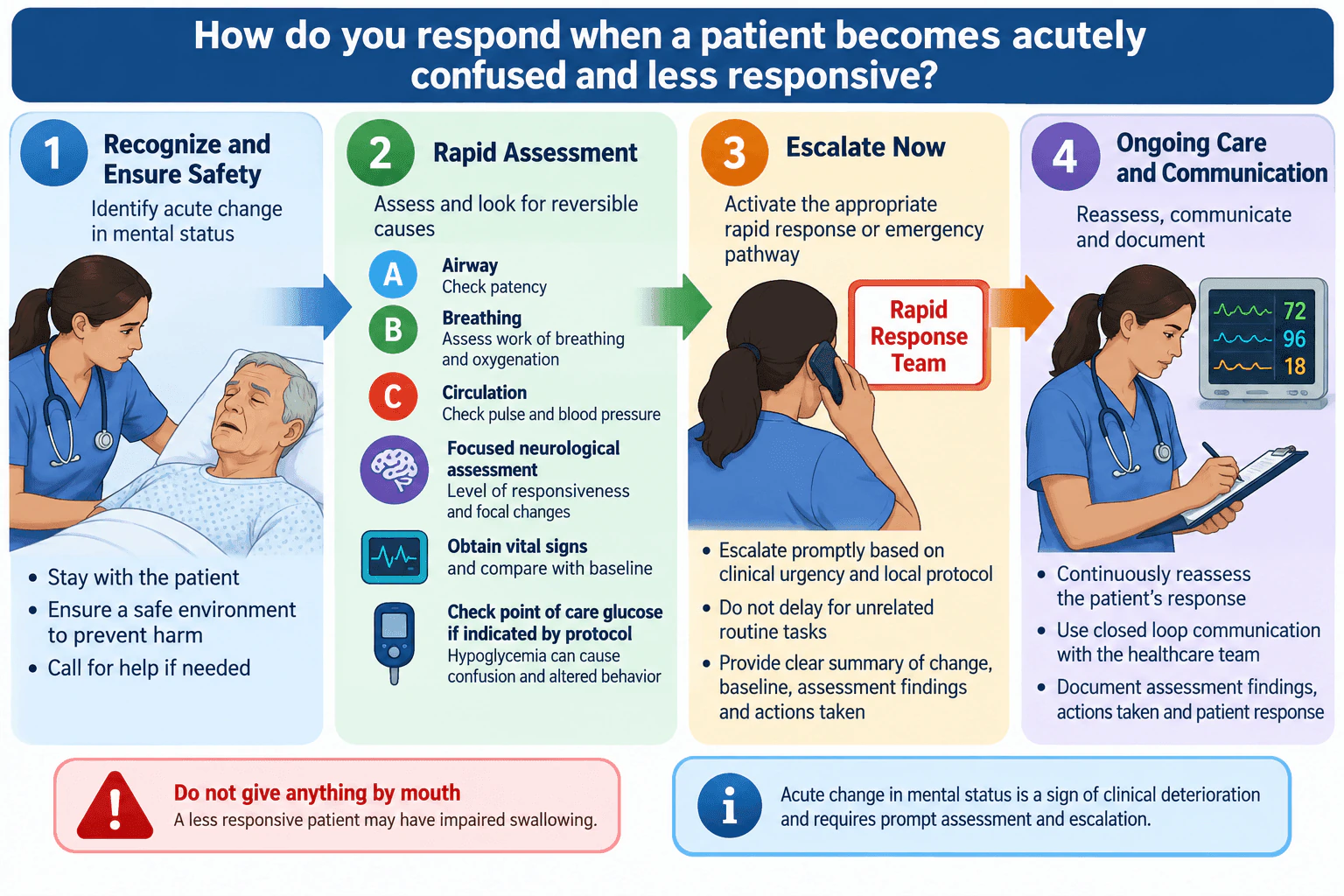
I would stay with the patient and immediately treat the change as possible clinical deterioration. I would protect the patient from harm and rapidly assess airway, breathing, circulation, level of responsiveness, focal neurologic changes, vital signs, and change from baseline. I would check point of care glucose when indicated by protocol. I would not delay urgent help for unrelated routine tasks. Based on clinical urgency and local criteria, I would activate the appropriate rapid response or emergency pathway, give a clear summary of the change and assessment findings, use closed loop communication, continue reassessment, and document the patient's response.
Detailed Explanation
An acutely confused and less responsive patient may be deteriorating, so the immediate priorities are safety, rapid physiologic and neurologic assessment, recognition of potentially reversible causes, and timely escalation. A structured assessment of airway, breathing, circulation, neurologic status, vital signs, and response to interventions is appropriate, and help should be requested early when serious deterioration is suspected. resus.org.uk
Useful Questions to Ask the Interviewer
What rapid response and emergency activation pathways does your organization use?
What point of care testing can nurses initiate under local protocol for acute changes in responsiveness?
How does your unit structure escalation communication and closed loop confirmation?
How to Explain It in an Interview
Recognizing Deterioration
I would first recognize that new confusion and reduced responsiveness are acute changes from baseline that can indicate clinical deterioration. Acute change in mental status is also a commonly used reason for rapid response activation in hospital systems. psnet.ahrq.gov
Immediate Nursing Priorities
I would stay with the patient, maintain a safe environment, and call for assistance as needed. I would rapidly assess airway patency, breathing and oxygenation, circulation including pulse and blood pressure, and neurologic status including level of responsiveness and any focal change. I would obtain current vital signs and compare them with previous values and trends. I would check point of care glucose when indicated by protocol because hypoglycemia is an important reversible cause of altered consciousness. resus.org.uk
Because the patient is less responsive and swallowing safety may be impaired, I would not give anything by mouth until swallowing safety and the clinical situation are appropriately assessed.
Escalation and Team Communication
I would activate the appropriate rapid response or emergency pathway according to the patient's clinical urgency and local criteria. I would not delay urgent help while completing unrelated routine tasks. I would clearly communicate the acute change, relevant baseline, assessment findings, current vital signs, glucose result if obtained, and actions already taken. I would use closed loop communication so requests and responsibilities are acknowledged.
Reassessment
I would continue reassessing airway, breathing, circulation, neurologic responsiveness, vital signs, and the patient's response while help is arriving and after interventions. If the patient continued to worsen or appropriate help was delayed, I would escalate again. I would document the assessment findings, escalation, actions, and patient response.
Why Interviewers Ask This
Interviewers are evaluating whether the nurse recognizes acute confusion and reduced responsiveness as potentially serious deterioration, prioritizes immediate safety and physiologic assessment, considers reversible causes without delaying urgent help, escalates appropriately, communicates clearly with the team, and continues reassessment and documentation.
Common interview mistakes
Common mistakes include assuming the confusion is the patient's usual baseline without verifying it, focusing only on neurologic findings while missing airway, breathing, circulation, vital sign, or glucose abnormalities, leaving the patient unattended when safety is uncertain, delaying escalation to complete routine tasks, inventing a universal activation threshold instead of following clinical urgency and local criteria, giving something by mouth while the patient remains less responsive and swallowing safety is uncertain, communicating without stating the change from baseline, and failing to reassess or document the patient's response.
Interview tip
Present the response in the same sequence you would act clinically: recognize the acute change, protect the patient, perform a rapid physiologic and neurologic assessment, compare findings with baseline, check glucose when indicated by protocol, escalate without unnecessary delay, communicate clearly, then reassess and document. Emphasize that clinical urgency and local escalation criteria determine how help is activated rather than inventing a universal threshold.
Interviewer may ask next
How would you verify that the confusion and decreased responsiveness are truly an acute change?
I would compare the patient's current responsiveness, cognition, vital signs, and behavior with documented baseline information, previous observations and trends, handoff information, and reliable reports from staff or family when available. I would review recent medications, procedures, laboratory information, and other relevant clinical changes while continuing the immediate assessment. Verification should not delay urgent escalation when the patient appears unstable.
What would change if the patient became completely unresponsive and was not breathing normally?
That would become an immediate resuscitation emergency rather than a routine deterioration assessment. I would activate the emergency response system and begin cardiopulmonary resuscitation according to current resuscitation guidance and my training while additional help and emergency equipment are obtained. Current resuscitation guidance directs immediate cardiopulmonary resuscitation when a patient is unresponsive and not breathing normally. resus.org.uk
72. How do you respond to a patient who may be experiencing anaphylaxis?Emergency Recognition And EscalationMedium
i Question Details
Describe recognition of airway, breathing, circulation, skin, and gastrointestinal findings, emergency activation, immediate protocol based actions, and close monitoring.
Short Interview Answer (30-60 seconds)
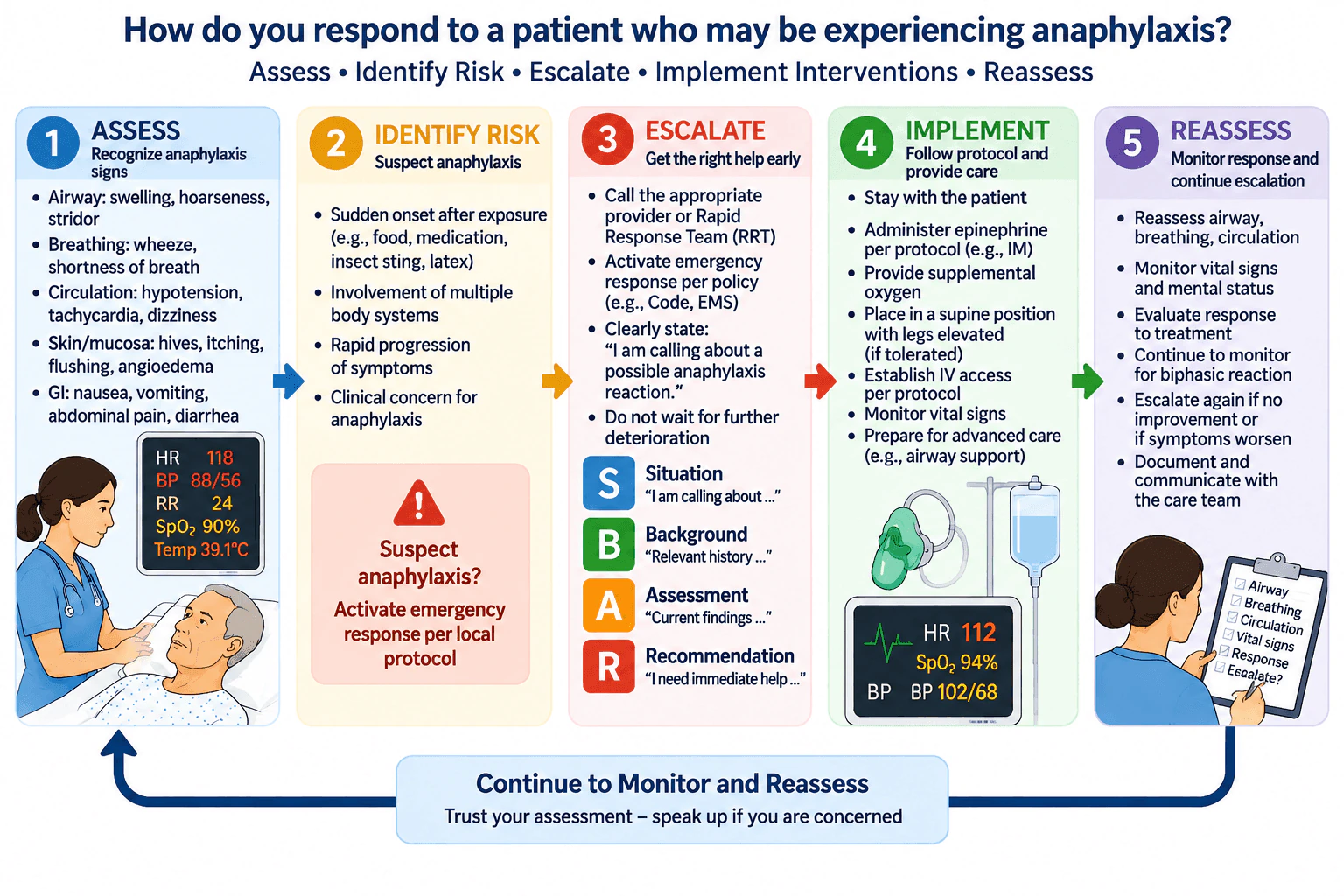
For a patient who may be experiencing anaphylaxis, I would first assess airway, breathing, circulation, skin or mucosal findings, and gastrointestinal symptoms. I would recognize clinical urgency, activate emergency support according to the appropriate pathway, communicate findings using SBAR, support protocol based interventions within my scope, and continue monitoring and reassessment for improvement or worsening.
Detailed Explanation
A patient with possible anaphylaxis requires rapid recognition of concerning findings and timely escalation. The nurse should focus on airway, breathing, circulation, skin or mucosal changes, gastrointestinal symptoms, emergency communication, protocol based actions, and ongoing reassessment.
Useful Questions to Ask the Interviewer
What emergency response process or escalation pathway is used for suspected anaphylaxis in this setting?
How does the team prefer urgent clinical concerns to be communicated?
What documentation expectations apply after an emergency response?
How to Explain It in an Interview
Recognizing Deterioration
I would assess for signs of possible anaphylaxis, including airway concerns such as swelling or voice changes, breathing concerns such as wheezing or shortness of breath, circulation concerns such as hypotension or dizziness, skin or mucosal findings such as hives or flushing, and gastrointestinal symptoms such as nausea or vomiting. I would recognize rapid changes as clinically urgent.
Immediate Nursing Priorities
My priorities would be patient safety, focused assessment, and rapid activation of appropriate help. I would follow applicable emergency protocols within my nursing scope, support ordered or protocol authorized care, monitor vital signs, and prepare for additional support if the patient's condition worsens.
Escalation and Team Communication
I would communicate using SBAR, which means Situation, Background, Assessment, and Recommendation. I would clearly state that I am concerned about possible anaphylaxis, provide relevant findings, and request appropriate assistance without delaying urgent escalation.
Reassessment
After escalation, I would continue monitoring airway, breathing, circulation, vital signs, mental status, and response to care. I would document findings and actions, communicate changes to the team, and escalate again if symptoms worsen or the patient does not improve.
Why Interviewers Ask This
Interviewers ask this question to evaluate nursing judgment during a rapidly changing emergency. They want to understand whether the nurse can identify urgent findings, prioritize immediate safety, escalate concerns appropriately, communicate effectively with the care team, and reassess the patient's condition.
Common interview mistakes
Common mistakes include delaying emergency escalation while completing unrelated tasks, waiting for severe deterioration before asking for help, applying one emergency mnemonic to every situation, inventing universal activation thresholds, or failing to reassess after initial actions.
Interview tip
Explain your clinical reasoning in sequence: recognize concerning findings, prioritize airway and patient safety, activate help, communicate clearly, support appropriate care, and reassess the response.
Interviewer may ask next
How would you verify that your response was appropriate?
I would verify that I completed the focused assessment, communicated the relevant findings, followed the applicable emergency response pathway, documented the response, and confirmed continued monitoring and reassessment of the patient.
How would your response change if the patient developed worsening airway symptoms?
I would treat worsening airway symptoms as an increased emergency concern, immediately escalate through the appropriate emergency process, communicate the change clearly, support airway related care within my scope, and continue close monitoring while additional help responds.
73. How do you respond when a patient's clinical trend concerns you but no single value meets an escalation threshold?Emergency Recognition And EscalationHard
i Question Details
Describe trusting the complete assessment, repeating key observations, documenting the trend, communicating concern clearly, and escalating through the appropriate chain when needed.
Short Interview Answer (30-60 seconds)
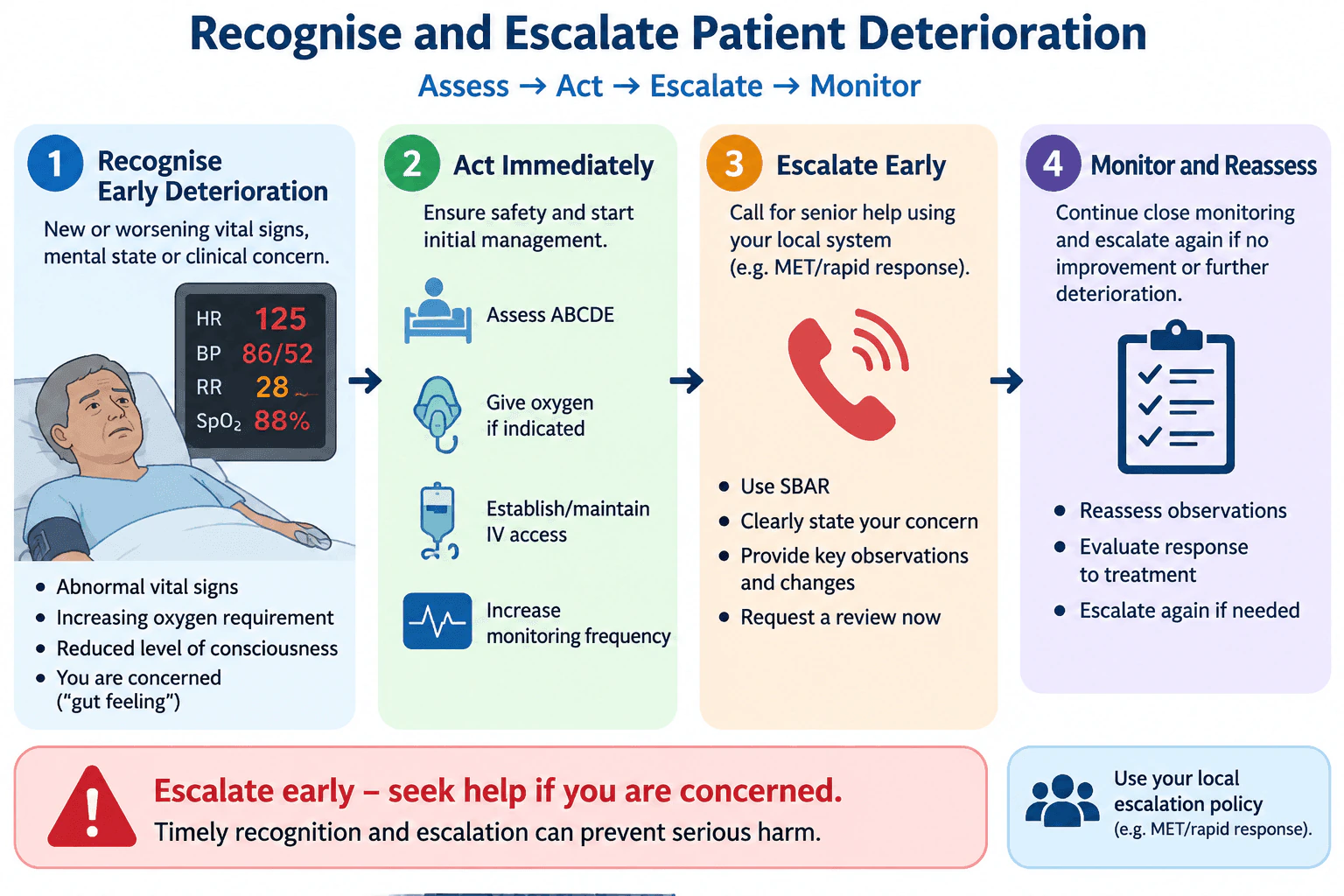
I would recognize that a concerning trend can indicate deterioration even when no single value meets an escalation threshold. I would complete a focused assessment, repeat important observations, compare findings with the patient's baseline, document the changes, communicate my concern clearly using SBAR, and escalate through the appropriate clinical pathway. I would continue monitoring and reassess the patient's response after escalation.
Detailed Explanation
A concerning clinical trend means the patient's overall condition is changing in a way that requires clinical attention, even when one individual measurement does not meet a predefined escalation point. Nursing judgment requires looking at the complete assessment, recognizing changes from baseline, and acting on clinical concern while following applicable guidance and local policy.
Useful Questions to Ask the Interviewer
What escalation pathway is used in this setting when a nurse has concerns about patient deterioration?
How are changes in patient condition communicated and documented within the team?
What resources are available for urgent clinical review?
How to Explain It in an Interview
Recognizing Deterioration
I would start by assessing the patient and identifying changes such as worsening observations, altered mental status, increased respiratory concern, or other findings that differ from baseline. I would consider the pattern of findings rather than waiting for one isolated value to become abnormal.
Immediate Nursing Priorities
I would repeat key observations, perform appropriate reassessment, maintain patient safety, and provide nursing care within my scope. I would avoid delaying help while completing unrelated tasks if the overall clinical picture is concerning.
Escalation and Team Communication
I would communicate the concern clearly using SBAR, which means Situation, Background, Assessment, and Recommendation. I would describe what has changed, relevant assessment findings, why I am concerned, and what support or review is needed. I would activate the appropriate escalation pathway when additional clinical support is required.
Reassessment
After escalation, I would continue monitoring the patient, document observations and actions, and evaluate whether the patient's condition improves or requires further escalation.
Why Interviewers Ask This
This question evaluates nursing judgment in recognizing deterioration when the complete clinical picture is concerning even without one isolated escalation trigger. It tests assessment skills, prioritization, communication, escalation decisions, and reassessment.
Common interview mistakes
Common mistakes include waiting for one abnormal value before responding to a concerning trend, failing to compare findings with the patient's baseline, escalating without communicating relevant assessment information, or not reassessing after action is taken.
Interview tip
Emphasize that effective nursing escalation combines clinical assessment, recognition of trends, clear communication, appropriate activation of help, documentation, and continued reassessment.
Interviewer may ask next
How would you verify that your concern about a patient's deterioration is accurate?
I would repeat relevant observations, perform a focused reassessment, compare findings with the patient's baseline, review available clinical information, and communicate the confirmed concern using the appropriate clinical communication process.
How would your response change if the patient suddenly became unstable?
If the patient became immediately unstable, I would prioritize urgent assessment, call for appropriate assistance according to the clinical setting, communicate critical findings clearly, follow the emergency escalation process, and continue reassessing the patient's condition.
74. How do you prioritize care when more than one patient is deteriorating at the same time?Emergency Recognition And EscalationHard
i Question Details
Explain recognition of the most immediate life threat, activation of additional resources, delegation of parallel actions, communication, and repeated reprioritization.
Short Interview Answer (30-60 seconds)
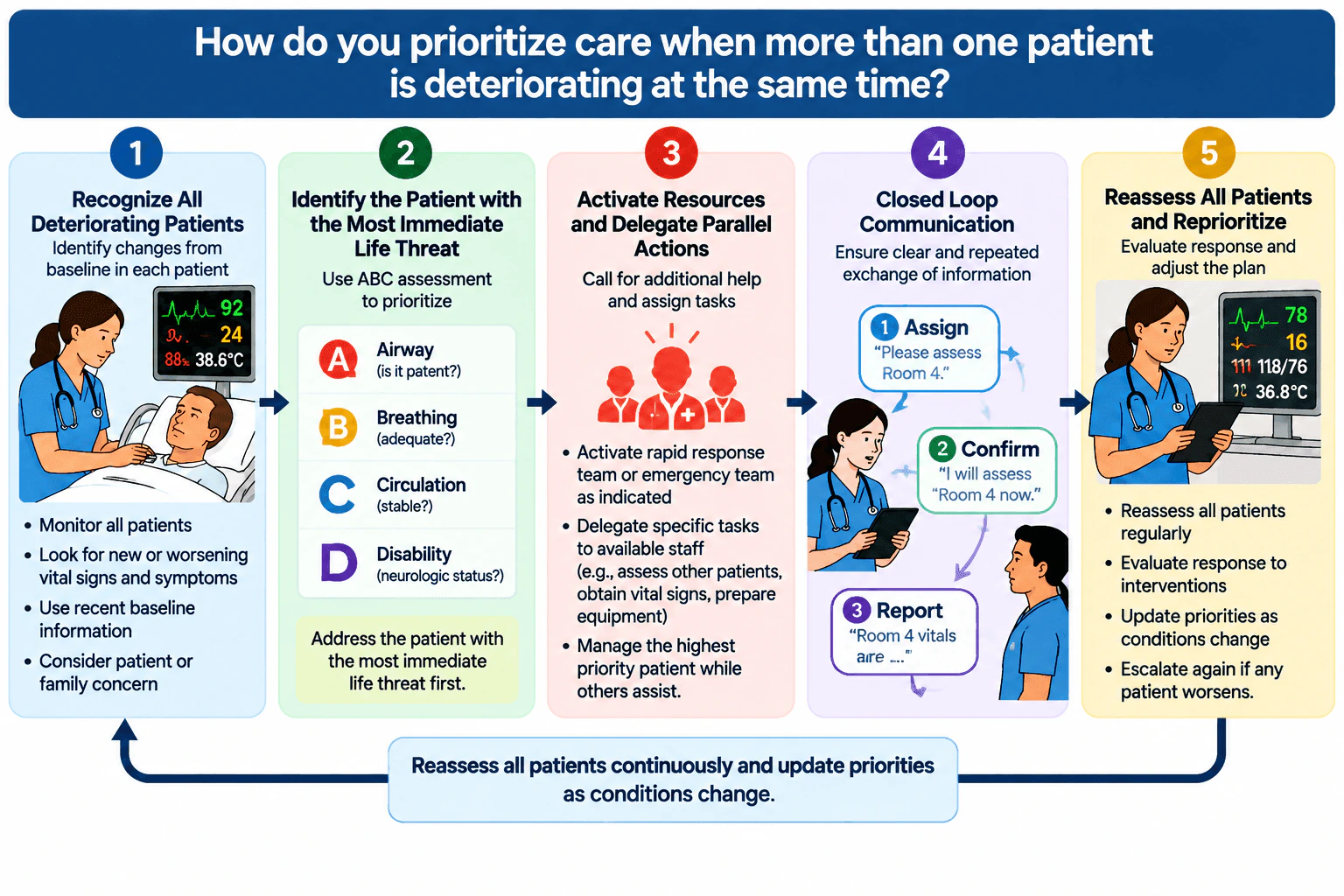
When multiple patients are deteriorating, I first identify which patient has the most immediate life threat. I assess changes from baseline using a structured approach focused on airway, breathing, circulation, and disability, then activate resources, delegate appropriate tasks, communicate clearly with the team using closed loop communication, and reassess all patients because priorities may change.
Detailed Explanation
When more than one patient is deteriorating, I prioritize based on clinical urgency rather than the order in which problems are noticed. I first recognize changes from baseline in each patient and determine which patient has the most immediate threat to life. I then coordinate care so urgent needs are addressed while maintaining awareness of all patients.
Useful Questions to Ask the Interviewer
What escalation resources are available when multiple patients require urgent attention at the same time?
How does the nursing team coordinate delegation during simultaneous patient deterioration?
What communication process is commonly used for urgent team updates in this setting?
How to Explain It in an Interview
Recognizing Deterioration
I begin by assessing all affected patients for meaningful changes from their baseline condition. I identify the patient with the greatest immediate risk by looking at urgent clinical concerns and using a structured approach that considers airway, breathing, circulation, and disability. I avoid applying one rule to every emergency because the correct priority depends on the patient's specific condition.
Immediate Nursing Priorities
After identifying the highest priority patient, I provide appropriate nursing actions within my scope and activate additional resources when the situation requires more support. I delegate appropriate parallel tasks to available team members, such as reassessing another patient, collecting information, or preparing needed resources, while continuing to manage the most urgent concern.
Escalation and Team Communication
I communicate important findings, changes from baseline, and concerns clearly. Using closed loop communication means assigning tasks, confirming that information was understood, and sharing updates so the team can coordinate effectively.
Reassessment
I continuously reassess all patients because conditions can change quickly. If another patient becomes more unstable, I reprioritize, communicate the change, and adjust resources based on the updated clinical situation.
Why Interviewers Ask This
This question evaluates nursing judgment during competing urgent situations. The interviewer wants to understand whether the nurse can identify the highest priority threat, coordinate team support, communicate clearly, delegate safely, and continuously update priorities as patient conditions change.
Common interview mistakes
Common mistakes include treating patients in the order they were noticed, delaying escalation while completing unrelated tasks, failing to delegate available work, giving incomplete team updates, and not reassessing after priorities change.
Interview tip
Focus on your clinical reasoning. Explain how you identify the greatest immediate threat, involve additional resources, coordinate the team, and continue monitoring every deteriorating patient.
Interviewer may ask next
How do you verify that your prioritization decision was appropriate?
I verify my decision by reviewing assessment findings, comparing them with baseline information, confirming that the most urgent threat was addressed, evaluating patient response, and reassessing whether another patient has become the higher priority.
How would you change your approach if a second patient became more unstable after you started caring for the first patient?
I would reassess all available information, recognize the new change in urgency, reprioritize based on the current life threat, activate additional support if needed, delegate appropriate tasks, and communicate the updated priorities to the team.
Disclaimer: This interview guide is for educational and informational purposes only. It is designed to help readers prepare, but it does not guarantee any interview result, hiring decision, offer, or outcome. Interview questions, hiring criteria, and preferred answers can vary by employer, interviewer, industry, location, and time. All answers, examples, and explanations in this guide are suggested examples for interview preparation, not definitive answers or instructions for professional practice. They are based on research and judgment, are provided without warranties of any kind, and should be adapted to the question, role, and applicable laws and professional requirements. Diagrams are simplified illustrations intended to highlight the main concepts and their relationships; actual situations, systems, and practices may be more complex. Alternative approaches may be equally valid or better suited to a particular question, context, or interviewer. To the fullest extent permitted by applicable law, the contributors and publisher are not liable for decisions made, actions taken, or losses incurred based on this guide.
State Laws and Professional Responsibilities: Laws and requirements governing an occupation vary by state and jurisdiction. You are responsible for checking the current laws, licensing requirements, and scope-of-practice rules that apply to your location and role, and for ensuring that your answers and actions comply with them. Adapt examples in this guide to those requirements. This guide is not legal advice.
Content Accuracy and Verification: To the fullest extent permitted by applicable law, we do not represent or warrant that interview guides, questions, answers, examples, or diagrams are accurate, complete, current, error-free, or suitable for any particular purpose. You are responsible for independently reviewing and verifying the information before relying on it.