This interview guide is for educational and informational purposes only. It is designed to help readers prepare, but it does not guarantee any interview result, hiring decision, offer, or outcome. Interview questions, hiring criteria, and preferred answers can vary by employer, interviewer, industry, location, and time. All answers, examples, and explanations in this guide are suggested examples for interview preparation, not definitive answers or instructions for professional practice. They are based on research and judgment, are provided without warranties of any kind, and should be adapted to the question, role, and applicable laws and professional requirements. Diagrams are simplified illustrations intended to highlight the main concepts and their relationships; actual situations, systems, and practices may be more complex. Alternative approaches may be equally valid or better suited to a particular question, context, or interviewer. To the fullest extent permitted by applicable law, the contributors and publisher are not liable for decisions made, actions taken, or losses incurred based on this guide.
State Laws and Professional Responsibilities
Laws and requirements governing an occupation vary by state and jurisdiction. You are responsible for checking the current laws, licensing requirements, and scope-of-practice rules that apply to your location and role, and for ensuring that your answers and actions comply with them. Adapt examples in this guide to those requirements. This guide is not legal advice.
Identity, Image, and Privacy Notice
To respect individual privacy, some names, profile photographs, avatars, biographical details, and other identifying information displayed in this guide may be replaced with pseudonyms, licensed stock images, illustrative avatars, composite images, or representative descriptions. Unless a person is expressly identified as an actual contributor, a displayed name, image, or profile should not be understood as depicting or identifying a specific candidate, interviewer, employee, or other real individual. These representations are provided for editorial and illustrative purposes only and do not imply endorsement, employment, participation, or affiliation with this guide or any company mentioned in it. Any resemblance to an actual person is coincidental.
Company Notice
This guide is an independent educational resource and is not affiliated with, endorsed by, sponsored by, or approved by the company named in this guide. Company names identify reported interview experiences or the employer context of clearly labeled original practice exercises. Interview practices can change without notice, and inclusion of company-specific content does not mean these questions are official, complete, or guaranteed to be asked. To the fullest extent permitted by law, the author, contributors, and publisher are not responsible for outcomes related to use of this material.
Content Accuracy and Verification
To the fullest extent permitted by applicable law, we do not represent or warrant that interview guides, questions, answers, examples, or diagrams are accurate, complete, current, error-free, or suitable for any particular purpose. You are responsible for independently reviewing and verifying the information before relying on it.
Questions or comments?
Contact us for general questions, or share feedback, technical corrections, and comments with the community.
51. What is medication reconciliation?Medication Administration And SafetyEasy
Short Interview Answer (30-60 seconds)
Medication reconciliation means obtaining and verifying an accurate list of the medications a patient is taking and comparing that information with current or newly ordered medications. The purpose is to identify unintended omissions, duplications, unclear information, or other discrepancies so they can be clarified and resolved appropriately. It is commonly performed during admission, transfer, discharge, and other transitions in care. ahrq.gov
Detailed Explanation
Medication reconciliation is a medication safety process used to make sure the care team is working from accurate medication information. It includes gathering the medications the patient is actually taking, confirming the information as accurately as possible, and comparing it with the medications ordered or planned for the current setting. This helps identify unintended differences before they contribute to medication error or patient harm. ahrq.gov
Useful Questions to Ask the Interviewer
How is medication reconciliation divided among nurses, pharmacists, and prescribers in this setting?
What sources are used when a patient cannot provide a reliable medication list?
How are unresolved medication discrepancies communicated and documented here?
How to Explain It in an Interview
Medication Safety Principle
I would explain that medication reconciliation is more than copying a medication list. It means obtaining the best available medication history, confirming its accuracy, and comparing it with current or newly ordered medications. The goal is to identify unintended discrepancies and make sure changes are purposeful. ahrq.gov
Checks Before Administration
I would verify medication information with the patient when possible and use other reliable sources when needed, such as a caregiver, pharmacy information, previous records, or other members of the care team. I would confirm relevant medication details available for the setting, including the medication name, dose, route, frequency, and purpose when required by the reconciliation process. I would also verify allergies and documented reactions as a separate medication safety check. ahrq.gov
Nursing Actions
If I identify an omission, duplication, contraindication, unclear information, or unexplained difference, I would not assume that the change is intentional. I would follow the organizational process to clarify the discrepancy with the appropriate prescriber or pharmacist and document the resulting information. The nurse should not independently prescribe, discontinue, or change a medication unless authorized within applicable scope, orders, protocols, and local policy. digitalassets.jointcommission.org
Monitoring and Communication
After reconciliation, I would make sure the updated medication information is documented and communicated as required during the transition of care. At discharge, the patient should receive current medication information and appropriate education about managing that information according to the care plan and local process. ahrq.gov
Why Interviewers Ask This
Interviewers ask this question to assess whether the nurse understands a core medication safety process. They want to hear that the nurse can gather and verify medication information, recognize discrepancies, communicate concerns to the appropriate prescriber or pharmacist, and document according to the care setting and organizational process. The nurse does not independently change prescribed therapy unless authorized by an applicable order, protocol, scope of practice, and local policy.
Common interview mistakes
Common mistakes include treating medication reconciliation as simple list copying, relying on incomplete information without identifying uncertainty, overlooking over the counter products or supplements, failing to recognize discrepancies, assuming an unexplained medication change was intentional, and failing to communicate or document clarification. Another mistake is confusing medication reconciliation with independent prescribing authority.
Interview tip
Start with a clear definition, then explain the nursing role: obtain and verify the medication history, compare it with current or newly ordered medications, identify discrepancies, clarify unexplained differences with the appropriate clinician, and document and communicate the updated information. Keep medication reconciliation distinct from prescribing decisions.
Interviewer may ask next
How would you verify a medication list if the patient is unsure what they take?
I would obtain as much information as possible from the patient and then use appropriate additional sources, such as a caregiver, medication containers, pharmacy information, previous medical records, or other members of the care team according to the setting and organizational process. I would clearly identify information that remains uncertain rather than guessing and would communicate unresolved discrepancies to the appropriate prescriber or pharmacist. ahrq.gov
What changes about medication reconciliation when a patient is being discharged?
At discharge, the medication information should reflect the intended regimen for the next setting of care. The current medications are compared with previous medication information, unexplained discrepancies are clarified, and the updated medication list is communicated to the patient and appropriate next care providers according to the organizational process. The nurse reinforces understanding within the nursing role rather than independently deciding which prescribed medications should be started, stopped, or changed. ahrq.gov
52. How do you verify medication orders before administration?Medication Administration And SafetyEasy
i Question Details
Explain verification of the order, patient identifiers, allergies, medication details, route, timing, and any required clinical checks.
Short Interview Answer (30-60 seconds)
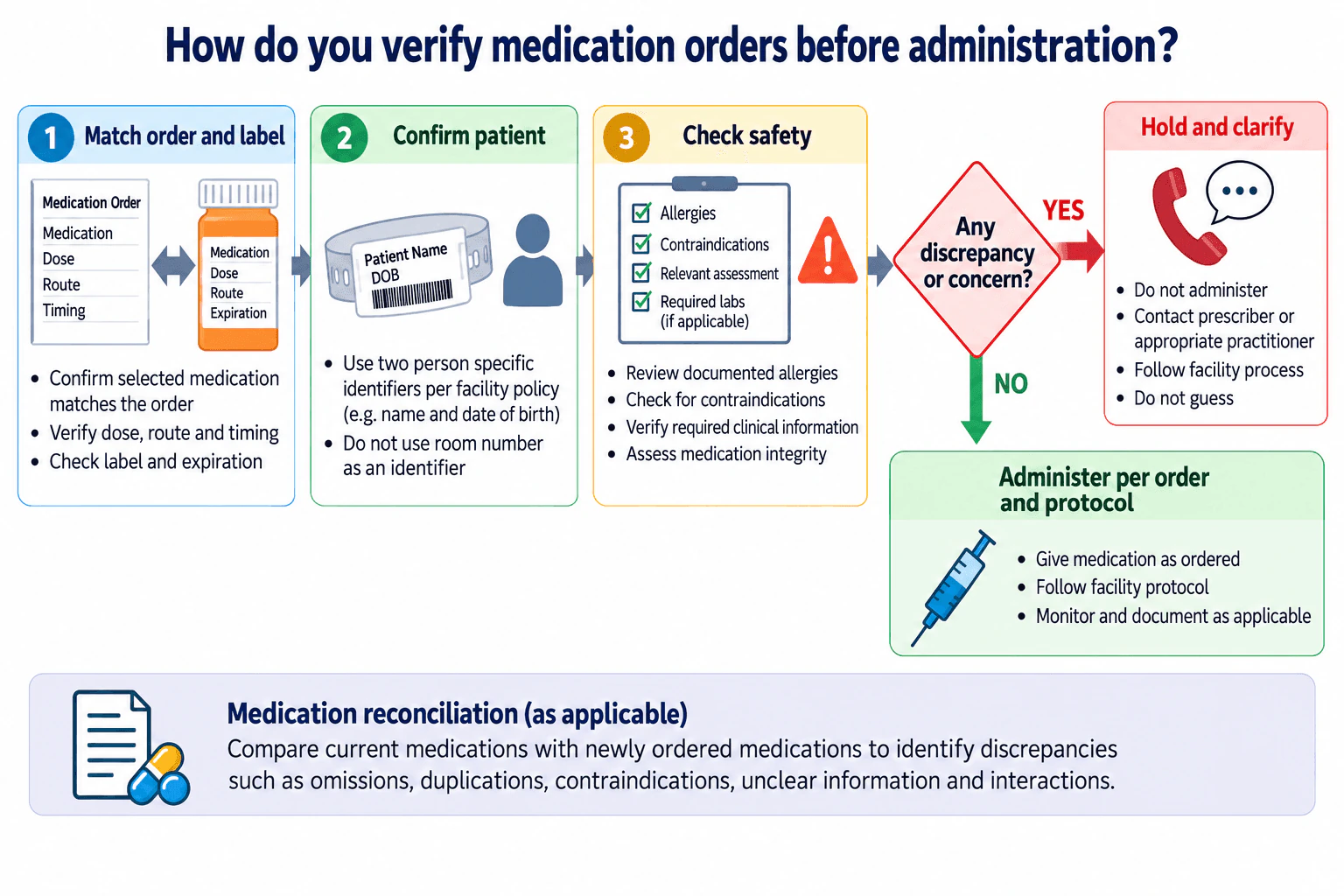
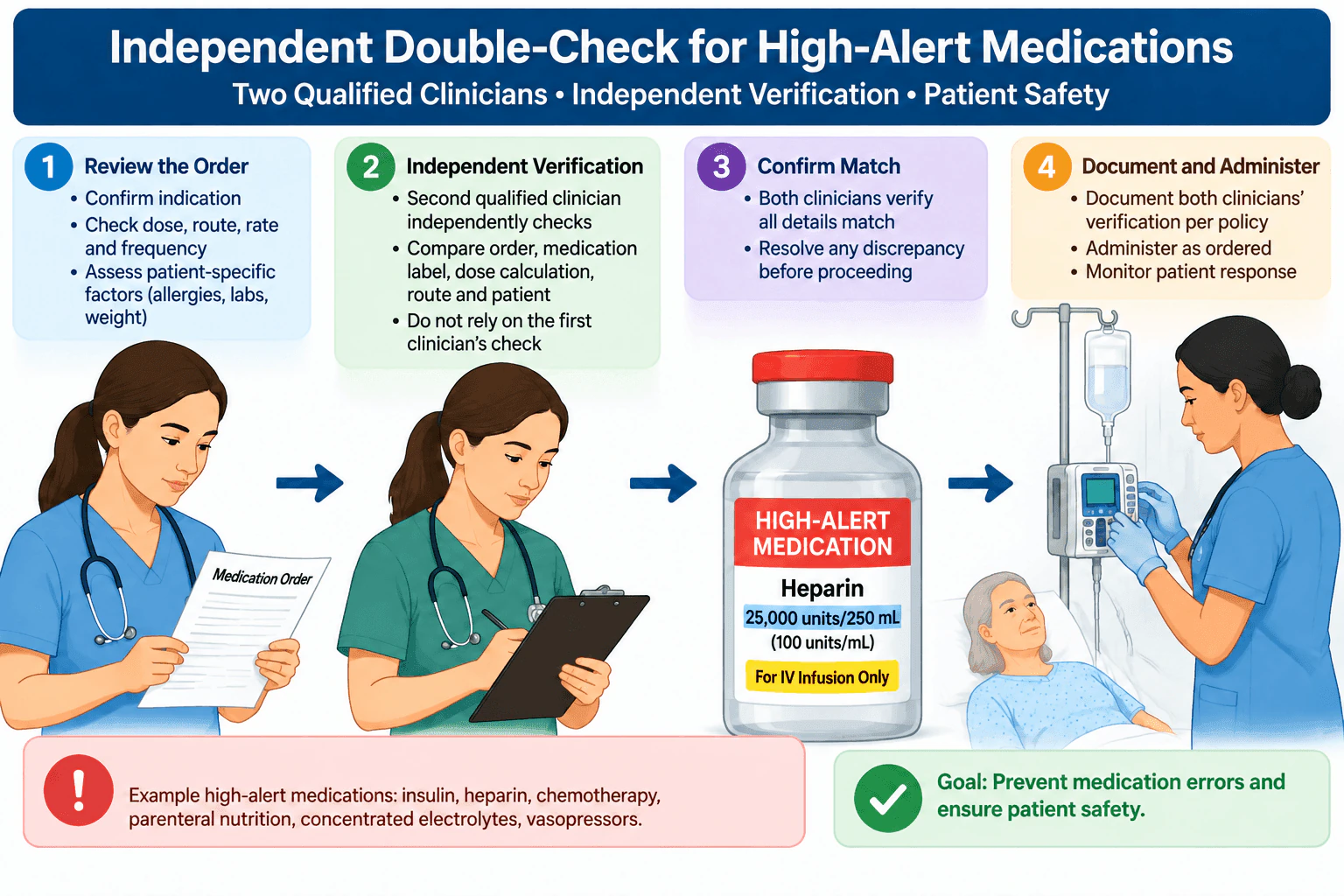
I first compare the active order with the medication label and verify the medication, dose, route, timing, formulation when relevant, expiration, and integrity. I confirm the patient using at least two approved person specific identifiers and never use the room number as an identifier. I review documented allergies, contraindications, relevant assessment findings, and any required clinical information or laboratory results. If anything is incomplete, inconsistent, or concerning, I hold the medication and clarify the issue with the prescriber or appropriate practitioner according to facility process. If everything is appropriate, I administer according to the order and protocol, then monitor and document as required.
Detailed Explanation
Medication order verification is the nurse's safety check before administration. The goal is to confirm that the order, medication, patient, and current clinical information agree before the medication reaches the patient. The nurse does not guess about incomplete or inconsistent information.
Useful Questions to Ask the Interviewer
What medication verification and barcode processes does the organization use?
How are incomplete orders or medication discrepancies escalated?
What clinical checks require documentation before administration?
How to Explain It in an Interview
Medication Safety Principle
I begin by comparing the active order with the medication in hand. I verify the medication, ordered dose, route, timing, formulation when relevant, expiration, and product integrity. If information needed to verify the order is missing, I stop rather than infer what was intended.
Checks Before Administration
I identify the patient using at least two approved person specific identifiers. A room number or physical location is not an acceptable patient identifier. I then review documented allergies and contraindications and check any relevant assessment findings, laboratory information, or other clinical information required for safe administration under the order, approved labeling, and facility protocol.
Medication reconciliation is also relevant when applicable. It compares the patient's current medication regimen with new or changed orders so that omissions, duplications, interactions, contraindications, dose changes, and other discrepancies can be identified and clarified.
Nursing Actions
If the order and medication match, the patient is correctly identified, and no unresolved safety concern is present, I administer the medication according to the order and facility protocol. If I find a discrepancy or concern, I hold the medication and contact the prescriber or appropriate practitioner through the facility process. I do not independently change the order or invent a dose.
Monitoring and Escalation
After administration, I perform any required reassessment or monitoring and document as applicable. If an unexpected or adverse response occurs, I assess the patient, follow applicable protocol, communicate the change promptly, and escalate to the appropriate clinician.
Why Interviewers Ask This
Interviewers are evaluating whether the nurse follows a deliberate medication safety process rather than relying on memory or assumptions. They want to hear that the nurse verifies the order and medication, correctly identifies the patient, reviews allergies and relevant clinical information, recognizes discrepancies, stops when clarification is needed, and completes appropriate monitoring and documentation.
Common interview mistakes
Common mistakes include relying on one patient identifier, using a room number as identification, checking only the medication name while overlooking dose, route, or timing, failing to review documented allergies or relevant clinical information, overlooking medication integrity or expiration, assuming an incomplete order is correct, confusing dose with administration volume, performing a calculation without all required inputs, overlooking reconciliation discrepancies, and administering before an unresolved concern has been clarified.
Interview tip
Describe the process in the same sequence shown in practice: match the order and medication, confirm the patient, check allergies and relevant clinical information, stop and clarify any discrepancy, then administer, monitor, and document. Emphasize that you do not guess about an unclear order or independently change the prescribed medication plan.
Interviewer may ask next
What would you do if the medication label did not match the active order?
I would stop before administration and recheck the active order, medication label, formulation, dose, route, and timing. I would not resolve the mismatch by assumption. I would follow the facility process to clarify the discrepancy with the appropriate pharmacist, prescriber, or practitioner and would administer only after the discrepancy was resolved and the correct medication and order were confirmed.
What changes if the patient has a newly documented allergy or a new clinical finding before administration?
I would treat the new information as a potential safety concern and reassess whether the medication can be administered under the existing order, approved labeling, and facility protocol. If the allergy or clinical finding creates an unresolved concern, I would hold the medication, notify the appropriate clinician, and obtain clarification or a revised order when required. I would document the new information and communication according to facility policy and continue appropriate monitoring.
53. How do you reconcile medications during admission or transfer?Medication Administration And SafetyMedium
i Question Details
Describe obtaining the best possible medication history, comparing lists, identifying discrepancies, clarifying uncertainties, and documenting the reconciled information.
Short Interview Answer (30-60 seconds)
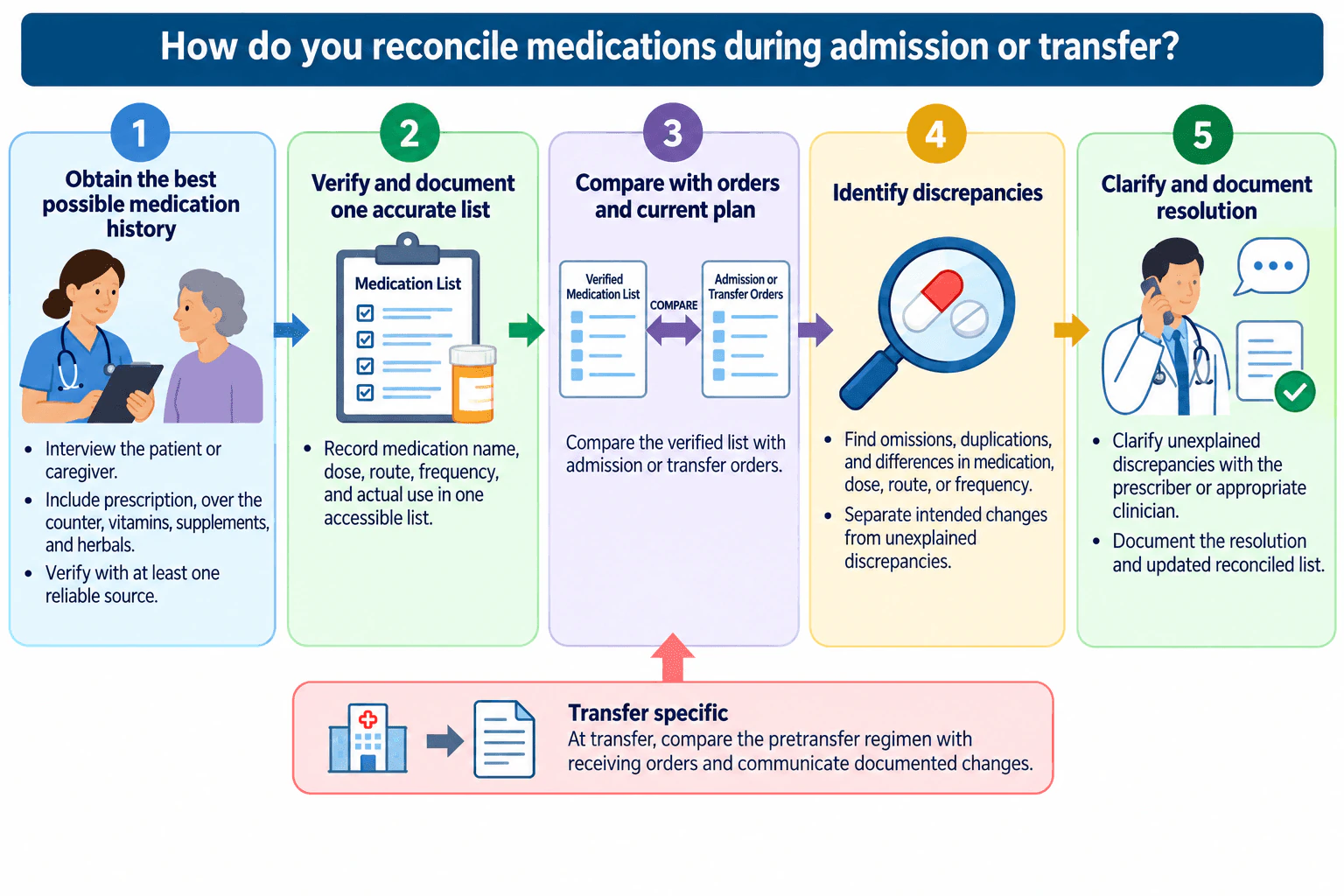
Medication reconciliation starts with obtaining the best possible medication history from the patient or caregiver and verifying it with at least one reliable source. I document medication name, dose, route, frequency, and actual use in one accessible list. I then compare that verified list with admission or transfer orders, identify discrepancies, clarify unexplained differences with the appropriate clinician, and document the resolved medication information.
Detailed Explanation
Medication reconciliation is the process of creating an accurate medication list and comparing it with new medication orders during admission or transfer. The goal is to identify unexplained differences and communicate them so the medication information is accurate for the next stage of care.
Useful Questions to Ask the Interviewer
Is the situation an admission or a transfer between care areas?
What medication information sources are available for verification?
Which clinicians are involved in resolving medication discrepancies?
How to Explain It in an Interview
Medication Safety Principle
I would begin by obtaining the best possible medication history. I would ask the patient or caregiver about prescription medications, over the counter medications, vitamins, supplements, and herbals. I would verify the information with at least one reliable source when available.
Nursing Actions
I would document one accessible medication list that includes medication name, dose, route, frequency, and actual use. I would compare the verified list with admission or transfer orders and look for omissions, duplications, and differences in medication information.
I would separate intended medication changes from unexplained discrepancies. I would not guess or independently change medication orders. I would communicate unresolved discrepancies with the prescriber or appropriate clinician according to the clinical workflow and document the resolution and updated reconciled list.
Monitoring and Documentation
During transfer, I would compare the pretransfer medication regimen with receiving orders and communicate documented changes. Clear documentation supports continuity of care and helps the receiving team understand the current medication plan.
Why Interviewers Ask This
Interviewers ask this question to evaluate nursing judgment during transitions of care. They want to know whether the nurse can collect reliable medication information, recognize discrepancies, communicate concerns appropriately, and maintain accurate documentation without independently prescribing or changing medication orders.
Common interview mistakes
Common mistakes include using only one incomplete medication source, forgetting over the counter products or supplements, documenting incomplete medication details, assuming every difference is intentional, guessing when information is uncertain, and failing to document discrepancy resolution.
Interview tip
Explain medication reconciliation as a sequence of safe nursing actions: obtain the medication history, verify information, document one accurate list, compare lists, identify discrepancies, clarify uncertainties, and document the final reconciled information.
Interviewer may ask next
How would you verify a medication history when a patient cannot remember all medications?
I would use available information from the patient or caregiver and compare it with reliable sources such as medication containers, pharmacy records, prior clinical records, or other available documentation. I would document uncertainty and clarify important discrepancies with the appropriate clinician.
How does medication reconciliation change during a transfer to another care area?
I would compare the medication regimen before transfer with the receiving orders, identify differences, communicate documented changes, clarify unexplained discrepancies with the appropriate clinician, and update the reconciled medication information.
54. How do you respond when a patient reports a new symptom after receiving a medication?Medication Administration And SafetyMedium
i Question Details
Explain assessment of severity, review of timing and medication exposure, monitoring, appropriate escalation, and documentation.
Short Interview Answer (30-60 seconds)
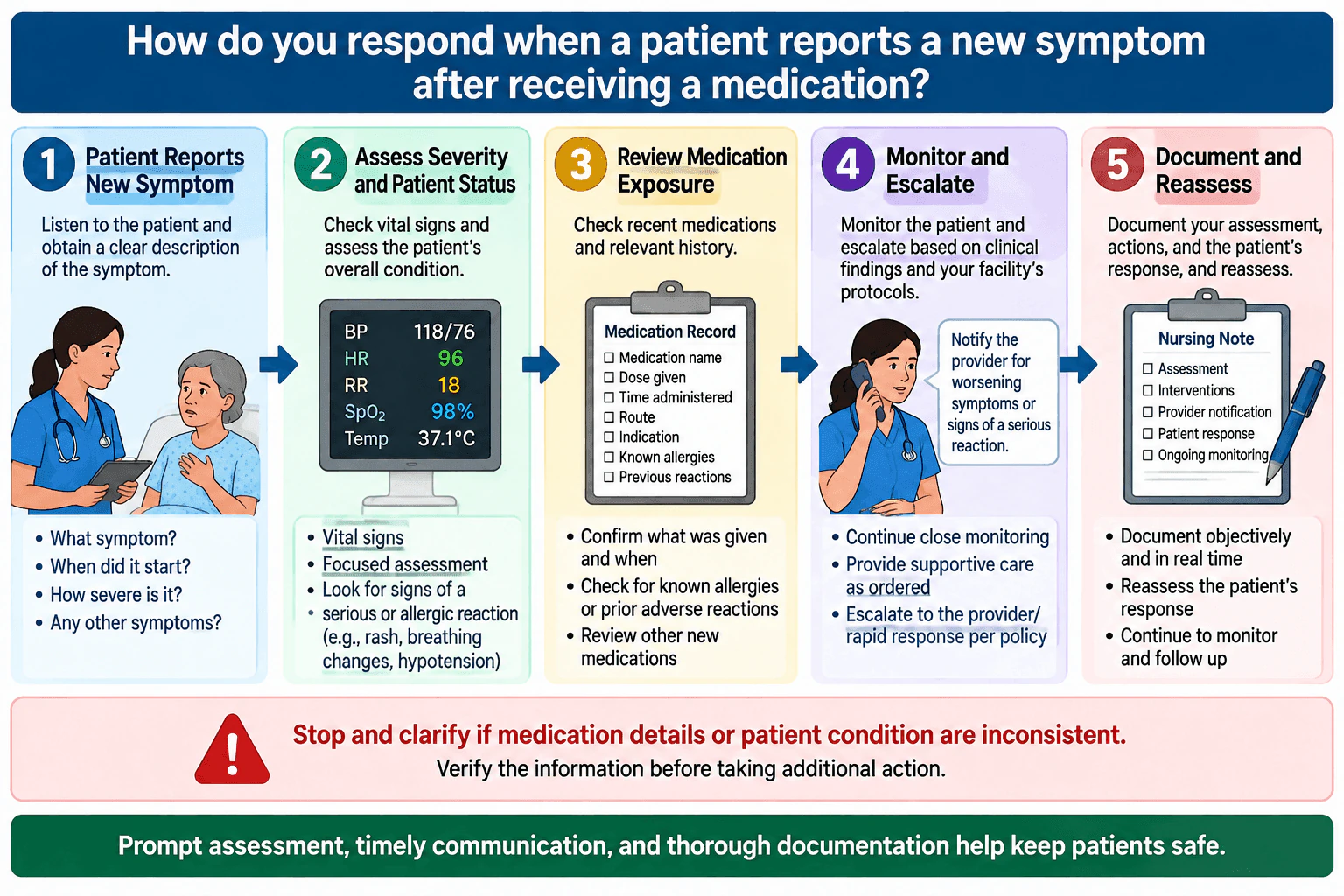
I first assess the patient's condition and determine the severity of the new symptom. I review the medication exposure, including what was given and when, along with allergies and relevant patient information. I continue monitoring, communicate and escalate concerns according to clinical findings and authorized processes, and document the assessment, actions taken, communication, and patient response.
Detailed Explanation
When a patient reports a new symptom after receiving a medication, the nurse should respond with a structured safety approach. The priority is to assess the patient, verify relevant medication information, identify concerns, monitor the response, communicate appropriately, and document findings. The nurse should not prescribe or independently replace medication orders but should follow approved medication processes and scope of practice.
Useful Questions to Ask the Interviewer
What patient population or care setting should this medication safety response focus on?
What escalation process is expected when a patient develops a possible medication related symptom?
Are there specific documentation expectations for medication related events in this setting?
How to Explain It in an Interview
Medication Safety Principle
I would treat a new symptom after medication administration as a patient safety concern. I would listen to the patient, clarify the symptom, determine when it started, and assess whether the timing may relate to medication exposure.
Nursing Actions
I would assess the patient's current condition and severity of symptoms. I would review the medication information, including the medication given, timing, route, allergies, and relevant history. I would verify information from available records and patient information rather than assuming the medication caused the symptom.
Monitoring and Escalation
I would monitor the patient's response and communicate concerning findings through the appropriate clinical process. If medication details or patient condition are inconsistent, I would stop and clarify the information before additional action. Escalation decisions would be based on assessment findings, authorized processes, and scope of practice.
Documentation
I would document the reported symptom, assessment findings, medication information reviewed, actions taken, communication, and patient response. Clear documentation supports safe ongoing care and future medication safety decisions.
Why Interviewers Ask This
Interviewers ask this question to evaluate nursing judgment after medication administration, including symptom assessment, medication review, prioritization, escalation, monitoring, communication, and documentation. The nurse must demonstrate safe clinical reasoning while working within nursing scope.
Common interview mistakes
Common mistakes include ignoring a new symptom, assuming the medication caused the symptom without assessment, failing to verify medication timing and patient information, overlooking allergies or prior reactions when relevant, delaying communication of concerning findings, and documenting incomplete information.
Interview tip
Use a structured response: assess the patient first, review medication exposure and relevant information, monitor and escalate based on findings, then document clearly. Emphasize patient safety, communication, and staying within nursing scope.
Interviewer may ask next
How would you verify that the medication information is correct before taking further action?
I would review available medication information, including what medication was given, timing, route, patient information, allergies, and relevant history. If information is incomplete or inconsistent, I would clarify it through the appropriate clinical process before proceeding.
How would your response change if the patient developed a more serious symptom after the medication?
I would prioritize assessment of the patient's condition, perform appropriate nursing actions within my scope, communicate concerning findings through the correct escalation pathway, continue monitoring, and document the patient's status and response.
55. How do you manage a medication with a narrow therapeutic index safely?Medication Administration And SafetyHard
i Question Details
Explain verification, relevant laboratory or clinical monitoring, interaction review, patient education, and communication of out of range findings according to the order and protocol.
Short Interview Answer (30-60 seconds)
I manage a medication with a narrow therapeutic index by using a careful verification and monitoring process. I confirm the medication order, patient information, allergies, formulation, concentration, route, and dose details before administration. I review relevant laboratory or clinical monitoring information, check for possible interactions, educate the patient, document administration, and monitor for therapeutic effects or adverse reactions. If findings are unclear or outside expected parameters, I clarify and communicate the concern according to the order and protocol before proceeding.
Detailed Explanation
A medication with a narrow therapeutic index requires careful nursing judgment because there is a smaller difference between effective and harmful levels. Safe management focuses on verification, patient specific checks, appropriate monitoring, and communication while following the prescribed order and protocol.
Useful Questions to Ask the Interviewer
Which narrow therapeutic index medications are commonly managed in this clinical setting?
What laboratory or clinical monitoring requirements are typically used for these medications?
How does the team communicate and document findings that require follow up?
How to Explain It in an Interview
Medication Safety Principle
I would begin by verifying the medication order and confirming the patient's identity, allergies, medication history, and available clinical information. I would make sure the medication, formulation, concentration, route, and dose information match the supplied order.
Checks Before Administration
Before administration, I would review relevant laboratory or clinical monitoring information, assess for possible medication interactions, and confirm that required information is complete. If the order or patient information is unclear or inconsistent, I would clarify the concern according to the order and protocol before proceeding.
Nursing Actions
My responsibility is to safely administer the medication as ordered, provide patient education about medication safety, and document administration and assessments. I would not prescribe, independently change doses, or replace approved medication labeling or facility protocols.
Monitoring and Escalation
After administration, I would monitor for the expected therapeutic response and possible adverse reactions. If findings are concerning or outside expected parameters, I would communicate the information to the appropriate healthcare professional and follow the required escalation process.
Why Interviewers Ask This
Interviewers ask this question to evaluate whether the nurse understands safe medication management when a medication has a narrow margin between therapeutic and harmful effects. They want to assess verification, monitoring, interaction review, patient education, documentation, and communication of concerns according to the order and protocol.
Common interview mistakes
Common mistakes include administering a medication without confirming the complete order, overlooking allergies or interactions, confusing dose with volume, ignoring required monitoring information, making medication changes outside nursing scope, or failing to communicate abnormal findings.
Interview tip
Focus on nursing judgment by explaining verification, monitoring, documentation, patient education, and communication. Show that medication safety involves more than simply giving the medication.
Interviewer may ask next
How would you verify a narrow therapeutic index medication before administration?
I would verify the medication order, patient identifiers, medication details, allergies, relevant patient information, and required monitoring data. I would confirm that the information is complete and consistent before administration and clarify concerns according to the order and protocol.
How would your approach change if the patient had a new clinical finding or abnormal monitoring result?
I would reassess the available information, review the finding in relation to the medication and order, avoid unauthorized medication changes, and communicate the concern to the appropriate healthcare professional while following the applicable protocol.
56. How do you respond to a suspected drug interaction in a patient's medication regimen?Medication Administration And SafetyHard
i Question Details
Describe recognition of the possible interaction, patient assessment, use of approved references, pharmacist or prescriber collaboration, monitoring, and documentation.
Short Interview Answer (30-60 seconds)
When I suspect a drug interaction, I first pause and verify the concern before administering the medication. I review the medication order, medication information, patient factors, allergies, and relevant assessment findings. For medications requiring additional verification, I follow the approved checking process and collaborate with the pharmacist or prescriber when indicated. After clarification, I administer only as authorized, monitor the patient for response or adverse reactions, and document the concern, communication, and follow up.
Detailed Explanation
A suspected drug interaction is a medication safety concern where medications in a patient's regimen may affect each other or increase the risk of harm. The nurse's responsibility is to recognize the concern, verify accurate information, communicate appropriately, and protect the patient through monitoring and documentation.
Useful Questions to Ask the Interviewer
What approved medication reference resources are available for nurses in this setting?
How are pharmacist or prescriber consultations handled when a medication interaction is suspected?
What documentation process is expected for medication verification concerns?
How to Explain It in an Interview
Medication Safety Principle
I begin by recognizing the possible interaction and avoiding administration when important medication information has not been verified. Safe medication practice requires confirming the order, medication details, patient information, and relevant safety checks.
Checks Before Administration
I review the medication regimen, allergies, patient information, and available clinical findings. For medications that require additional verification, I confirm the medication details, dose information supplied in the order, route, and other relevant factors using approved references. I clarify incomplete or inconsistent information before proceeding.
Nursing Actions
I collaborate with the pharmacist or prescriber when the concern requires additional expertise or clarification. I follow approved processes and do not independently prescribe, change, or discontinue medications outside my authorized scope.
Monitoring and Escalation
After the concern is addressed, I monitor the patient for therapeutic response and adverse reactions. I document the concern, verification steps, communication, administration details when applicable, and patient response to support safe ongoing care.
Why Interviewers Ask This
Interviewers ask this question to evaluate medication safety judgment, recognition of possible medication related risks, verification practices, communication with the healthcare team, and appropriate monitoring and documentation.
Common interview mistakes
Common mistakes include administering a medication before resolving a suspected interaction, relying only on memory instead of approved references, failing to communicate concerns, changing medications without appropriate authorization, and incomplete documentation.
Interview tip
Demonstrate a safety focused approach by explaining recognition of the concern, verification, collaboration, monitoring, and documentation in that order.
Interviewer may ask next
How would you verify a suspected drug interaction before administration?
I would review the medication regimen, patient information, allergies, and available clinical findings. I would use approved medication references and collaborate with the appropriate healthcare professionals before proceeding when clarification is needed.
How would your response change if the patient showed signs of an adverse reaction after receiving medications?
I would assess the patient, monitor relevant findings, communicate with the appropriate healthcare team members, follow approved escalation procedures, and document the patient's condition, actions taken, and response.
57. What is a pulse oximeter?Clinical Procedures And MonitoringEasy
Short Interview Answer (30-60 seconds)
A pulse oximeter is a noninvasive monitoring device that estimates the percentage of hemoglobin carrying oxygen in the blood and displays pulse rate. The oxygen saturation value, commonly called SpO2, is one part of a nursing assessment. A nurse should verify patient identity, appropriate device use, and whether the reading matches the patient’s clinical condition.
Detailed Explanation
A pulse oximeter is a device that uses light based technology to estimate peripheral oxygen saturation and pulse rate. It provides information about oxygenation status but does not replace a complete nursing assessment. Nurses interpret the reading along with respiratory assessment, vital signs, symptoms, and other relevant clinical information.
Useful Questions to Ask the Interviewer
What patient population or clinical setting is this question focused on?
Are there specific procedure guidelines or documentation expectations for pulse oximeter use in this setting?
Are there common patient factors in this setting that may affect pulse oximeter accuracy?
How to Explain It in an Interview
Purpose and Preparation
I would explain that a pulse oximeter is used to obtain a noninvasive estimate of oxygen saturation and pulse rate. Before use, I would verify the indication, identify the patient correctly, confirm appropriate equipment use, and follow current procedure guidance and device instructions.
Monitoring Findings
I would interpret the reading with the patient’s overall condition rather than using the number alone. I would consider factors that can affect accuracy, including device placement, patient movement, circulation concerns, and other relevant clinical factors. I would compare the reading with assessment findings and reassess when needed.
Aftercare and Escalation
I would document relevant findings according to applicable requirements and communicate significant changes through the appropriate clinical process. If the reading does not match the patient’s condition or there are concerns about the patient’s status, I would reassess and seek assistance according to scope of practice, orders, and local policy.
A pulse oximeter is a monitoring tool that supports nursing assessment. Safe practice requires understanding what it measures, recognizing limitations, and using clinical judgment when responding to findings.
Why Interviewers Ask This
Interviewers ask this question to evaluate whether the nurse understands the purpose and limitations of a common monitoring device. The question assesses whether the nurse can explain what the device measures, verify appropriate use, and apply clinical judgment rather than relying only on a displayed value.
Common interview mistakes
Common mistakes include treating the pulse oximeter value as the only indicator of patient status, ignoring device instructions, failing to verify patient identity and indication, and overlooking factors that may affect accuracy.
Interview tip
A strong interview answer explains both the purpose and limitations of a pulse oximeter. Emphasize that the reading is combined with patient assessment, verification, documentation, and appropriate follow up.
Interviewer may ask next
How would you verify a pulse oximeter reading before acting on it?
I would verify the patient identity, check correct device placement, review the patient’s clinical condition, consider factors that may affect accuracy, and reassess if the value does not match the patient presentation.
How would your approach change if the pulse oximeter reading did not match the patient’s appearance?
I would not rely on the reading alone. I would reassess the patient, verify equipment placement and function according to device instructions, review other assessment findings, and communicate concerns according to scope, orders, and local policy.
58. How do you prepare a patient for a common bedside procedure?Clinical Procedures And MonitoringEasy
i Question Details
Explain identity verification, order review, consent status when applicable, patient education, equipment preparation, infection prevention, and baseline assessment.
Short Interview Answer (30-60 seconds)
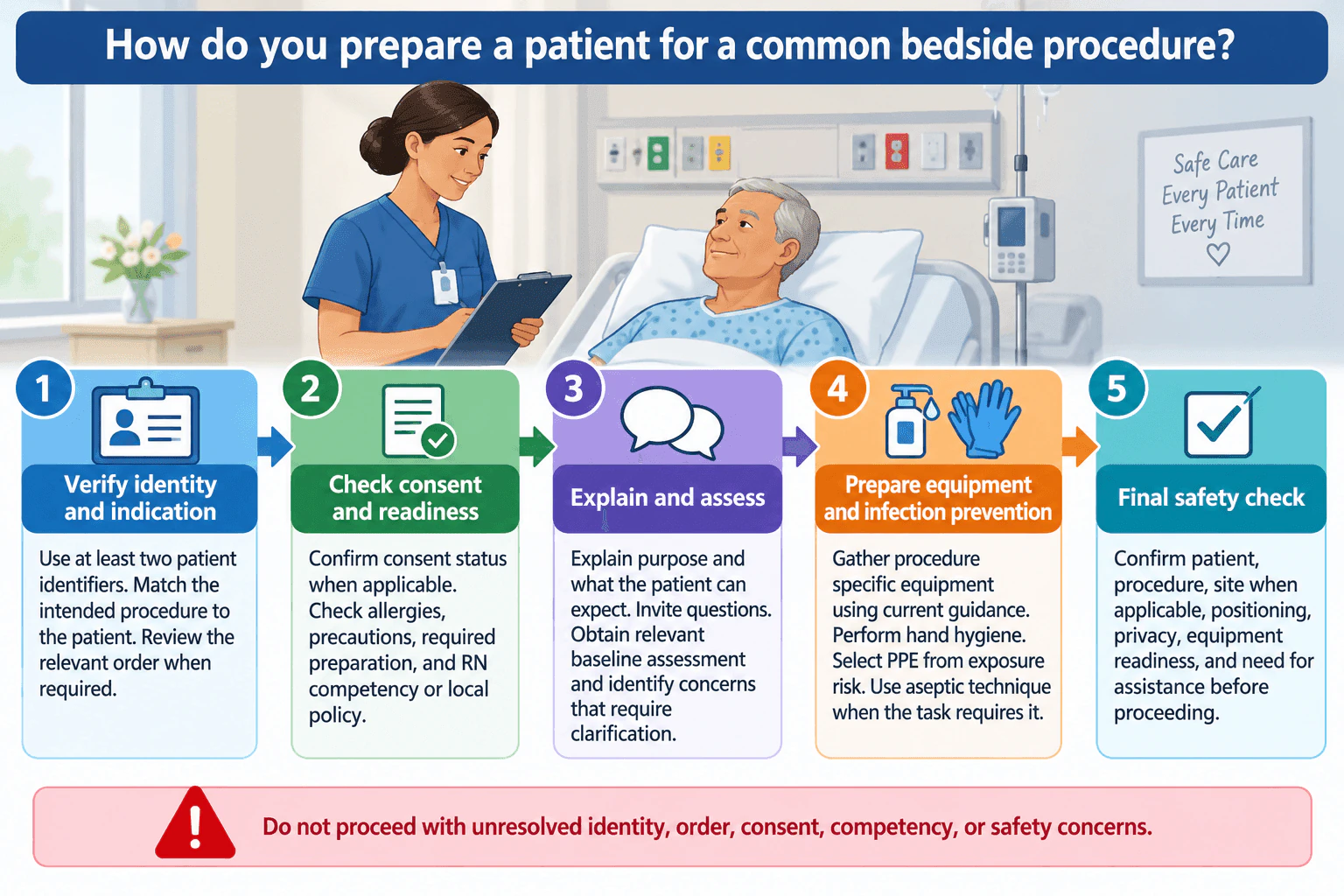
I start by confirming the patient with at least two identifiers, then verify the indication and any relevant order. I check consent status when applicable, allergies, precautions, required preparation, competency, and local policy. I explain what will happen, answer questions, and obtain the relevant baseline assessment. Next I gather the correct procedure specific equipment, perform hand hygiene, select personal protective equipment based on exposure risk, and use aseptic technique when required. Before starting, I complete a final check of the patient, procedure, site when applicable, positioning, privacy, equipment readiness, and need for assistance. If an identity, order, consent, competency, or safety concern remains unresolved, I stop and clarify it before proceeding.
Detailed Explanation
Preparation is a sequence of safety checks that confirms the right patient is ready for the intended procedure before the procedure begins. The exact equipment, technique, assessment, consent requirements, monitoring, and aftercare depend on the specific procedure, the patient, current procedure guidance, applicable orders, and local policy.
Useful Questions to Ask the Interviewer
Which bedside procedures are most common on this unit?
What competency validation and procedure guidance does the unit use for those procedures?
How are procedure specific safety checks and documentation handled on the unit?
How to Explain It in an Interview
Purpose and Preparation
I first verify the patient's identity using at least two patient identifiers and match the intended procedure to the correct patient. I confirm the indication and review any relevant order. I check consent status when applicable, allergies, precautions, required preparation, and whether I am competent and authorized to perform the procedure under current policy.
Patient Education and Baseline Assessment
I explain the purpose of the procedure, what the patient can expect, and what participation may be needed. I invite questions and assess for concerns that require clarification. I obtain baseline findings relevant to that procedure so later changes can be recognized and interpreted in context.
Equipment and Infection Prevention
I gather procedure specific equipment using current procedure guidance rather than inventing settings or substituting a generic technique. I perform hand hygiene and select personal protective equipment according to anticipated exposure risk. I use aseptic technique when the procedure requires it and follow the specific clean or sterile technique required by current procedure guidance.
Final Safety Check and Aftercare
Immediately before proceeding, I confirm the patient, procedure, site when applicable, positioning, privacy, equipment readiness, and whether assistance is needed. I do not proceed with unresolved identity, order, consent, competency, or safety concerns. After the procedure, I reassess findings relevant to the intervention, monitor for expected response and complications appropriate to that procedure, provide necessary comfort and safety measures, escalate unexpected findings through the appropriate clinical pathway, and document the procedure, patient response, and relevant reassessment.
Why Interviewers Ask This
Interviewers are evaluating whether the nurse can organize a bedside procedure around patient identification, clinical indication, authorization, informed participation, infection prevention, baseline assessment, equipment readiness, and a final safety check rather than focusing only on the technical task. They also want to hear that the nurse recognizes limits of competency and pauses when a required safety condition has not been resolved.
Common interview mistakes
Common mistakes include relying on room location instead of proper patient identifiers, beginning before confirming the indication or relevant order, assuming consent is complete when it is required, failing to check allergies or procedure specific precautions, giving inadequate patient education, skipping a relevant baseline assessment, preparing generic rather than procedure specific equipment, overlooking hand hygiene or exposure based personal protective equipment, using the wrong infection prevention technique for the procedure, or proceeding despite an unresolved competency or safety concern.
Interview tip
Describe preparation as the same deliberate sequence shown in the diagram: verify identity and indication, check consent and readiness, explain and assess, prepare equipment and infection prevention measures, then complete the final safety check. State clearly that exact equipment and technique come from procedure specific guidance and that unresolved identity, order, consent, competency, or safety concerns are clarified before proceeding.
Interviewer may ask next
How do you verify that you have the correct patient before the procedure?
I use at least two patient identifiers and match them to the intended care before beginning. I do not use the patient's room number or physical location as an identifier. I also confirm that the intended procedure and any relevant order belong to that patient. If information does not match, I stop and resolve the discrepancy before proceeding.
What changes if the patient's condition is different from the expected baseline just before the procedure?
I pause and reassess the finding in the context of the planned procedure. I determine whether the change affects readiness or creates a safety concern that requires clarification or escalation. I communicate through the appropriate clinical pathway according to the patient's condition, relevant orders, and local policy rather than automatically proceeding. I continue only after the concern has been addressed and it remains appropriate and safe to proceed.
59. How do you recognize complications at an intravenous access site?Clinical Procedures And MonitoringMedium
i Question Details
Explain assessment for pain, redness, swelling, leakage, resistance, changes in flow, and other local findings, followed by appropriate action and documentation.
Short Interview Answer (30-60 seconds)
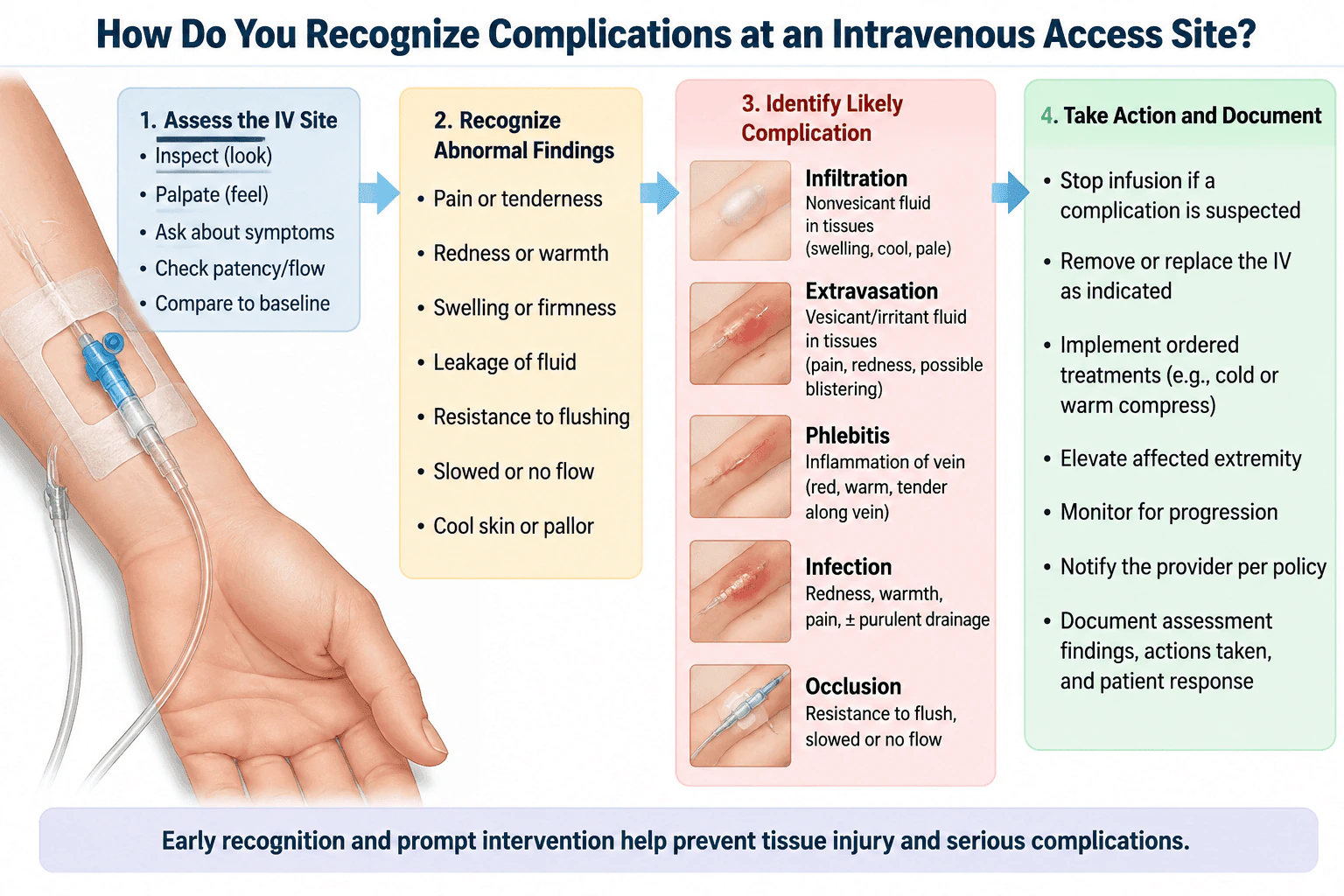
I recognize IV access site complications by assessing the site and comparing findings with the expected baseline. I look for pain, tenderness, redness, warmth, swelling, leakage, coolness, resistance, and changes in flow. These findings can indicate complications such as infiltration, extravasation, phlebitis, infection, or occlusion. I follow current procedure guidance, act within my scope, communicate concerns, reassess the patient, and document the assessment and response.
Detailed Explanation
I recognize IV access site complications by combining patient assessment with observation of the insertion site and infusion status. The goal is to identify abnormal findings early, determine the likely concern, and respond using appropriate procedure guidance, orders, and local policy.
Useful Questions to Ask the Interviewer
What type of intravenous access device and infusion therapy is being discussed?
Are there specific guidelines for escalation and documentation in this clinical setting?
What patient population should I consider for this assessment?
How to Explain It in an Interview
Purpose and Preparation
I begin by verifying the reason for the IV, patient identity, relevant orders, and my competency for the assessment. I use appropriate technique and follow current guidance for the specific device and therapy.
Monitoring Findings
I assess for pain, tenderness, redness, warmth, swelling, firmness, leakage, coolness, changes in flow, and resistance. I also ask the patient about discomfort because patient reported symptoms can be an early indication of a problem.
Interpretation of Findings
Swelling, coolness, and leakage may indicate infiltration when fluid enters surrounding tissue. Pain, swelling, redness, and tissue changes may indicate extravasation when an irritating or vesicant medication enters surrounding tissue. Redness, warmth, and tenderness along the vein may indicate phlebitis. Redness, warmth, pain, or drainage may indicate infection. Resistance and reduced flow may indicate occlusion or another patency concern.
Aftercare and Escalation
If a complication is suspected, I follow applicable guidance, manage the infusion according to authorized instructions, communicate concerns when needed, reassess the patient, and document findings, actions taken, and patient response. I do not assume device settings or treatments that are not provided by current instructions or authorized guidance.
Why Interviewers Ask This
Interviewers ask this question to evaluate nursing assessment skills, recognition of early IV complications, patient safety judgment, escalation decisions, and documentation practices.
Common interview mistakes
Common mistakes include focusing only on infusion flow, missing patient reported symptoms, failing to compare findings with baseline, overlooking early local changes, skipping documentation, or taking actions outside competency, orders, or procedure guidance.
Interview tip
Explain the process in order: assess the IV site, recognize abnormal findings, identify the possible complication, take appropriate action, communicate concerns, reassess, and document.
Interviewer may ask next
How would you verify that an IV site finding represents a complication rather than a normal variation?
I would verify by reviewing the IV indication, assessing objective site findings, asking about symptoms, comparing with baseline findings, checking available device and infusion information, and following current procedure guidance. I would document findings and escalate concerns when appropriate.
How would your assessment change for a patient receiving a vesicant medication through an IV?
For a patient receiving a vesicant medication, I would pay close attention to signs of extravasation such as pain, swelling, redness, leakage, or tissue changes. I would follow medication specific guidance, communicate concerns promptly, avoid unsupported treatment assumptions, and document the assessment and actions taken.
60. How do you respond when a monitoring device gives a reading that does not match the patient's condition?Clinical Procedures And MonitoringMedium
i Question Details
Describe checking the patient first, verifying sensor placement and equipment function, obtaining an independent measurement when possible, and escalating clinical concerns.
Short Interview Answer (30-60 seconds)
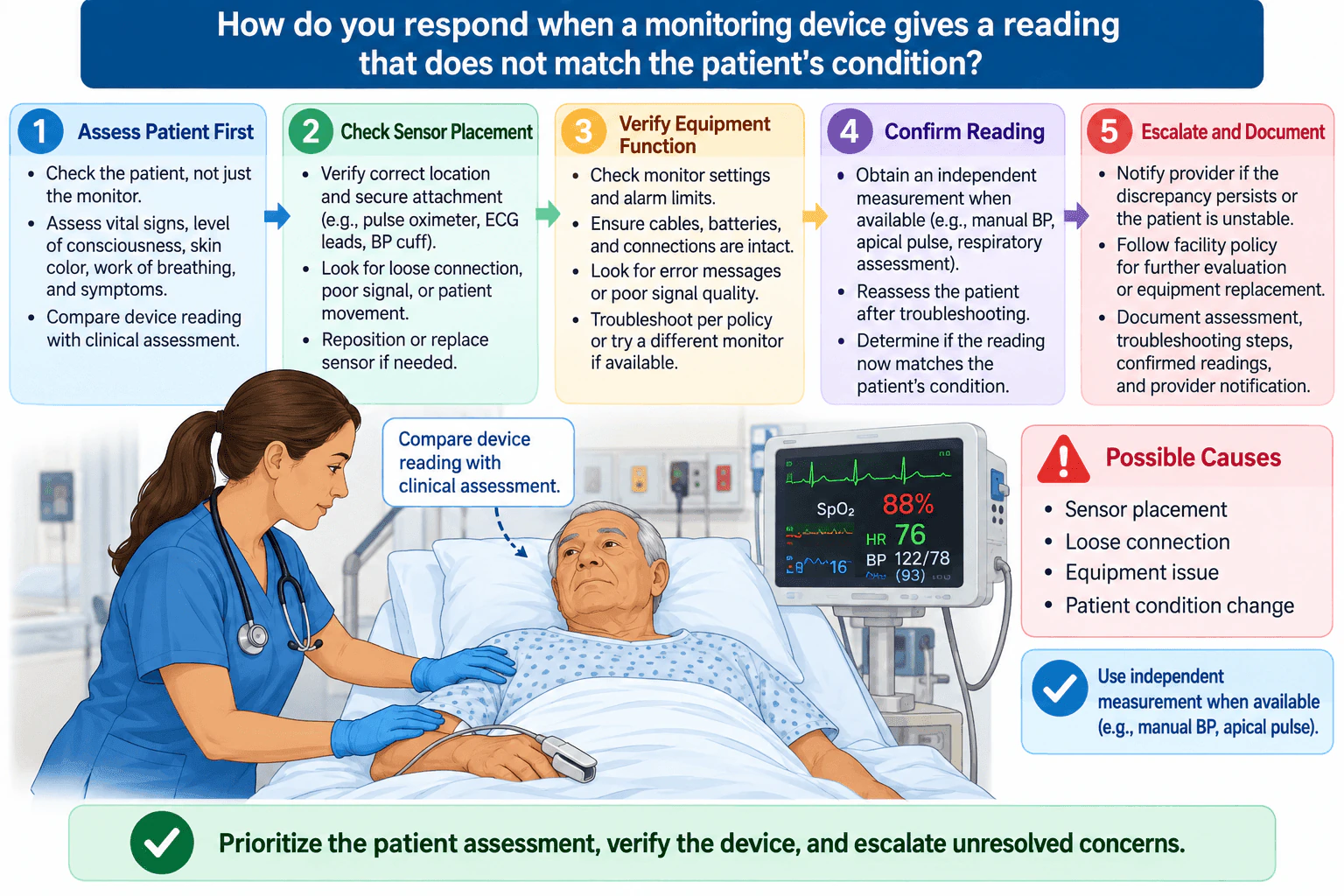
I assess the patient first instead of relying only on the monitoring device. I compare the reading with the patient's clinical condition, verify sensor placement and equipment function, and obtain an independent measurement when available. If the discrepancy remains or the patient condition is concerning, I escalate appropriately and document the assessment, verification steps, communication, and reassessment.
Detailed Explanation
A monitoring device provides information, but the patient's clinical condition guides nursing decisions. When a device reading does not match the patient, I first assess the patient and then determine whether the difference may be related to the sensor, equipment, or a change in the patient's condition.
Useful Questions to Ask the Interviewer
Which monitoring devices and patient populations are most common in this role?
What procedures or resources are available for verifying unexpected readings?
How does the team prefer nurses to communicate and document unresolved monitoring concerns?
How to Explain It in an Interview
Purpose and Preparation
I would begin by assessing the patient rather than assuming the monitor is correct. I would compare the device reading with the patient's observed condition, symptoms, and relevant assessment findings. I would also verify that the monitoring method is appropriate and that I am following current procedure guidance and my nursing scope.
Nursing Procedure
My next step would be to verify the monitoring device. I would check sensor placement, attachment, and connections because incorrect placement or poor contact can affect readings. I would review the equipment condition according to device instructions and available clinical guidance without inventing settings or actions that are not verified.
Monitoring Findings
If the discrepancy continues, I would confirm the information when possible using an independent measurement or additional assessment appropriate to the clinical situation. I would interpret the device value together with the patient's condition rather than relying on a single reading alone.
Aftercare and Escalation
If the patient appears unstable or the concern remains after verification, I would communicate the findings through the appropriate clinical escalation process. I would document the patient's assessment, device verification steps, confirmed findings, communication, and reassessment.
Why Interviewers Ask This
Interviewers ask this question to evaluate nursing judgment, prioritization, and patient safety when technology and clinical assessment do not agree. The nurse should demonstrate that patient assessment comes first, followed by checking sensor placement, verifying equipment function, confirming the reading when possible, escalating concerns, and documenting the response.
Common interview mistakes
Common mistakes include focusing only on the device reading, failing to assess the patient first, accepting an unexpected measurement without verification, skipping checks of sensor placement or equipment function, failing to confirm the reading when possible, and not documenting reassessment or communication.
Interview tip
Use a patient first framework: assess the patient, verify the sensor and equipment, confirm the reading, escalate concerns when needed, and document the complete response.
Interviewer may ask next
What would you do if the sensor placement was correct but the device reading still did not match the patient?
I would reassess the patient, verify equipment function according to applicable instructions, obtain an independent measurement when available, and communicate the concern if the discrepancy continues or the patient condition requires escalation. I would document the findings and reassessment.
How would your response change if the patient showed signs of deterioration while the device reading was abnormal?
I would prioritize assessment of the patient and address the clinical concern while continuing to verify the device information. I would communicate the patient's condition and findings through the appropriate escalation process and document the assessment, actions, and reassessment.
More questions load as you scroll
Disclaimer: This interview guide is for educational and informational purposes only. It is designed to help readers prepare, but it does not guarantee any interview result, hiring decision, offer, or outcome. Interview questions, hiring criteria, and preferred answers can vary by employer, interviewer, industry, location, and time. All answers, examples, and explanations in this guide are suggested examples for interview preparation, not definitive answers or instructions for professional practice. They are based on research and judgment, are provided without warranties of any kind, and should be adapted to the question, role, and applicable laws and professional requirements. Diagrams are simplified illustrations intended to highlight the main concepts and their relationships; actual situations, systems, and practices may be more complex. Alternative approaches may be equally valid or better suited to a particular question, context, or interviewer. To the fullest extent permitted by applicable law, the contributors and publisher are not liable for decisions made, actions taken, or losses incurred based on this guide.
State Laws and Professional Responsibilities: Laws and requirements governing an occupation vary by state and jurisdiction. You are responsible for checking the current laws, licensing requirements, and scope-of-practice rules that apply to your location and role, and for ensuring that your answers and actions comply with them. Adapt examples in this guide to those requirements. This guide is not legal advice.
Content Accuracy and Verification: To the fullest extent permitted by applicable law, we do not represent or warrant that interview guides, questions, answers, examples, or diagrams are accurate, complete, current, error-free, or suitable for any particular purpose. You are responsible for independently reviewing and verifying the information before relying on it.