This interview guide is for educational and informational purposes only. It is designed to help readers prepare, but it does not guarantee any interview result, hiring decision, offer, or outcome. Interview questions, hiring criteria, and preferred answers can vary by employer, interviewer, industry, location, and time. All answers, examples, and explanations in this guide are suggested examples for interview preparation, not definitive answers or instructions for professional practice. They are based on research and judgment, are provided without warranties of any kind, and should be adapted to the question, role, and applicable laws and professional requirements. Diagrams are simplified illustrations intended to highlight the main concepts and their relationships; actual situations, systems, and practices may be more complex. Alternative approaches may be equally valid or better suited to a particular question, context, or interviewer. To the fullest extent permitted by applicable law, the contributors and publisher are not liable for decisions made, actions taken, or losses incurred based on this guide.
State Laws and Professional Responsibilities
Laws and requirements governing an occupation vary by state and jurisdiction. You are responsible for checking the current laws, licensing requirements, and scope-of-practice rules that apply to your location and role, and for ensuring that your answers and actions comply with them. Adapt examples in this guide to those requirements. This guide is not legal advice.
Identity, Image, and Privacy Notice
To respect individual privacy, some names, profile photographs, avatars, biographical details, and other identifying information displayed in this guide may be replaced with pseudonyms, licensed stock images, illustrative avatars, composite images, or representative descriptions. Unless a person is expressly identified as an actual contributor, a displayed name, image, or profile should not be understood as depicting or identifying a specific candidate, interviewer, employee, or other real individual. These representations are provided for editorial and illustrative purposes only and do not imply endorsement, employment, participation, or affiliation with this guide or any company mentioned in it. Any resemblance to an actual person is coincidental.
Company Notice
This guide is an independent educational resource and is not affiliated with, endorsed by, sponsored by, or approved by the company named in this guide. Company names identify reported interview experiences or the employer context of clearly labeled original practice exercises. Interview practices can change without notice, and inclusion of company-specific content does not mean these questions are official, complete, or guaranteed to be asked. To the fullest extent permitted by law, the author, contributors, and publisher are not responsible for outcomes related to use of this material.
Content Accuracy and Verification
To the fullest extent permitted by applicable law, we do not represent or warrant that interview guides, questions, answers, examples, or diagrams are accurate, complete, current, error-free, or suitable for any particular purpose. You are responsible for independently reviewing and verifying the information before relying on it.
Questions or comments?
Contact us for general questions, or share feedback, technical corrections, and comments with the community.
1. If a team member is caught by you stealing drugs/meds, what would you do?Ethics And Professional PracticeMediumCleveland Clinic
Short Interview Answer (30-60 seconds)
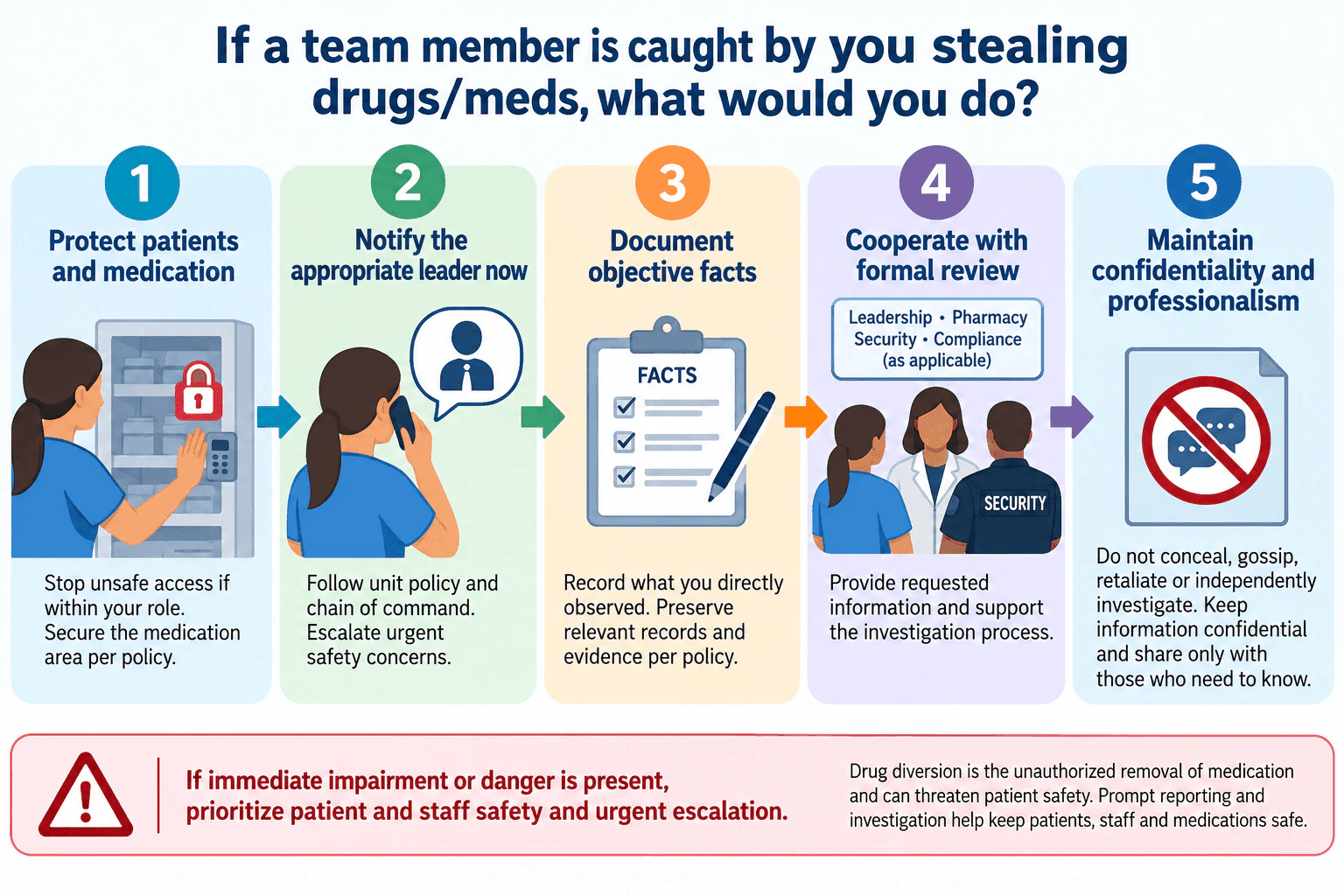
I would prioritize patient and staff safety first. If it were safe and within my role, I would stop unsafe medication access and secure the medication area according to policy. I would notify the appropriate leader immediately, document only what I directly observed, preserve relevant records or evidence according to policy, and cooperate with the formal review. I would maintain confidentiality and would not conceal the event, gossip, retaliate, or investigate independently. If impairment or immediate danger were present, I would escalate urgently.
Detailed Explanation
Drug diversion by a health care worker can threaten patient safety, including through impaired care, loss of needed medication, or medication tampering. Current CDC guidance identifies drug diversion as a patient safety risk and recommends an appropriate facility response when diversion is suspected. cdc.gov
My role as the nurse who directly observes the event is to protect patients, report the concern promptly through the appropriate chain of command, document objective facts, preserve relevant information according to policy, cooperate with the authorized investigation, and maintain confidentiality. The exact internal and external reporting process depends on the setting, jurisdiction, medication involved, and organizational policy. For controlled substances, certain federal reporting duties apply to the registered organization or other DEA registrant rather than automatically to the bedside nurse personally. dea.gov
Useful Questions to Ask the Interviewer
What is the facility's reporting pathway for suspected medication diversion?
Which authorized departments participate in the formal review, such as nursing leadership, pharmacy, security, or compliance?
What documentation and evidence preservation process should the nurse follow after directly observing suspected diversion?
How to Explain It in an Interview
Professional Principle
My first priority is patient and staff safety. I would not ignore or conceal observed medication theft, but I would also avoid making conclusions about motive, impairment, or guilt beyond what I directly witnessed.
Nursing Responsibilities
If it were safe and within my role, I would stop unsafe medication access and secure the medication area according to local policy. I would promptly notify the appropriate nursing leader and follow the chain of command. If the person appeared impaired or there were an immediate danger to patients or staff, I would escalate urgently.
I would document objective facts about what I directly observed. I would preserve relevant records or evidence according to policy rather than altering, removing, or independently analyzing them.
Consultation and Follow Up
I would cooperate with the authorized formal review and provide requested factual information. Depending on the setting, that review may involve nursing leadership, pharmacy, security, compliance, risk management, or other authorized personnel.
I would maintain confidentiality and share information only with people who have a legitimate role in the response. I would not gossip, retaliate, conceal the event, or conduct my own investigation. This follows the same sequence shown in the diagram: protect patients and medication, notify the appropriate leader, document objective facts, cooperate with formal review, and maintain confidentiality and professionalism.
Why Interviewers Ask This
This question evaluates patient advocacy, professional accountability, medication security, judgment under pressure, appropriate escalation, objective documentation, confidentiality, and professional boundaries. A strong answer shows that the nurse acts promptly on an observed safety concern while staying within scope and allowing authorized leaders and investigators to determine the formal findings.
Common interview mistakes
Common mistakes include ignoring or concealing the event, confronting the person in a way that increases immediate risk, making accusations beyond what was directly observed, gossiping, retaliating, delaying escalation, altering or removing evidence, independently searching records without authorization, or assuming that the bedside nurse personally performs every external regulatory report.
Interview tip
Keep the response organized around the five actions in the diagram: protect patients and medication, notify the appropriate leader, document objective facts, cooperate with the formal review, and maintain confidentiality and professionalism. Add that immediate impairment or danger requires urgent escalation.
Interviewer may ask next
How would you verify what you observed before reporting it?
I would verify only facts that are directly available to me without starting my own investigation. I would distinguish what I personally observed from assumptions or secondhand information, document those objective observations according to policy, and report the concern promptly. Review of dispensing records, surveillance information, interviews, or other investigative evidence should be handled by authorized personnel.
What would you do differently if the team member appeared impaired while providing patient care?
I would treat that as an immediate patient and staff safety concern. I would seek urgent assistance from the appropriate leader and take only those immediate protective actions that are within my role and local policy. I would continue to document objective observations, maintain confidentiality, and cooperate with the authorized response rather than independently determining the cause of the apparent impairment.
2. Tell me about yourself and elaborate on your resumeBehavioralMediumCleveland Clinic
Interview tip:
Use STAR to structure your answer: briefly explain the Situation and Task, make Action the most detailed part, and finish with the Result. For example, describe how your nursing experience developed over time, the responsibilities you took on, how you cared for patients and worked with the care team, the decisions that shaped your growth, and what those experiences prepared you to contribute in your next nursing role.
Situation
I am a Registered Nurse who has built my experience around safe patient care, clear communication, and dependable teamwork. In my last role, I cared for patients with different levels of illness or care needs and learned how important it is to combine checking the patient's condition with calm communication. That experience helped shape the main themes you see throughout my resume.
Task
My responsibility was not only to complete nursing tasks, but also to understand each patient's condition, recognize changes early, communicate concerns, and help coordinate care with the wider clinical team. As I gained experience, I also wanted to become more organized and confident when several patients needed attention at the same time.
Action
I developed a consistent approach to my work. At the start of a shift, I reviewed each patient's history, current orders, medications, recent results, and immediate risks so I could set priorities. During assessments, I paid attention to both measurable or observable signs and what the patient was telling me. When I noticed a change, I reassessed the patient, gathered the relevant information, and communicated clearly with the appropriate clinician rather than waiting for the problem to become more serious. I also explained care in simple language so patients and families understood what was happening and what they needed to watch for. My resume also reflects how I became more comfortable coordinating with other nurses, providers, pharmacy, therapy, and support staff. I learned to ask for help early when a situation required additional support and to give concise updates so the team could make timely decisions. These experiences strengthened my ability to make safe care decisions based on the patient's condition and available information, organization, communication, and sense of ownership.
Result
Over time, I became a more confident and thoughtful nurse. I learned that strong nursing care depends on noticing changes early, setting clear priorities, communicating well, and following through. Those lessons connect the different experiences on my resume, and they are the strengths I would bring to my next nursing role.
Why Interviewers Ask This
Interviewers ask this question to understand how the candidate connects the experiences on the resume into a clear professional story. A strong answer shows self awareness, communication skill, clinical priorities, growth, and an understanding of how previous nursing responsibilities prepare the candidate for the role being discussed.
Interviewer may ask next
Which experience on your resume had the biggest impact on how you practice as a nurse?
My experience caring for patients whose conditions could change during a shift had the biggest impact on me. It taught me to compare current findings with the patient's earlier condition, reassess when something did not seem right, and communicate concerns early. That experience made me more deliberate about assessment, prioritization, and follow through.
How has your nursing approach changed as you gained more experience?
I have become more proactive and organized. Earlier in my experience, I focused mainly on completing the immediate tasks in front of me. With more practice, I learned to look ahead, identify possible risks, organize care by clinical priority, and communicate earlier with the team. I still stay flexible because patient needs can change quickly, but I now approach each shift with a clearer plan and stronger ability to make safe care decisions based on the patient's condition and available information.
3. Background experience in my fieldBehavioralEasyCleveland Clinic
Interview tip:
Use STAR to structure your answer: briefly explain the Situation and Task, make Action the most detailed part, and finish with the Result. For example, describe a nursing experience where you cared for patients with different needs, set priorities, completed clinical responsibilities safely, communicated with the care team, and supported patients and families.
Situation
In my last nursing role, I cared for adult patients with a range of medical needs. My work included patient assessments, medication administration, monitoring for changes in condition, patient education, and coordination with other members of the care team.
Task
My responsibility was to provide safe and organized care while making sure important changes were recognized early. I also needed to communicate clearly with patients, families, and the clinical team so everyone understood the care plan.
Action
At the start of each shift, I reviewed each patient's condition, recent results, medications, and current care plan. I then completed focused assessments and decided which needs required attention first. During the shift, I monitored vital signs, symptoms, pain, mental status, and other changes that could show a patient was becoming less stable. When I noticed a concerning change, I reassessed the patient, gathered the relevant information, and communicated the change promptly to the appropriate clinician. I followed through on new orders and continued monitoring the patient. I also explained medications, procedures, and discharge instructions in simple language and checked that the patient understood. I documented my assessments and interventions clearly so the next member of the care team had an accurate picture of the patient's condition. When several needs occurred at the same time, I focused first on safety and the most urgent clinical concern while communicating with the team about the remaining work.
Result
This experience helped me build a strong foundation in direct patient care, clinical judgment, communication, and teamwork. I became more confident in recognizing changes, setting priorities, and keeping patients informed. I also learned that safe nursing care depends on careful assessment, clear communication, and consistent follow through.
Why Interviewers Ask This
Interviewers ask about nursing background to understand the candidate's direct patient care experience, clinical responsibilities, judgment, communication skills, and ability to work with a care team. A strong answer shows that the candidate understands the daily responsibilities of a Registered Nurse and can explain how previous experience prepared them to provide safe patient care.
Interviewer may ask next
How did you decide which patient needs required your attention first?
I looked first for immediate safety concerns and signs that a patient's condition might be changing. I used my assessment findings, vital signs, symptoms, and the care plan to decide what needed prompt attention. I then communicated with the team when I needed additional support and continued to reassess patients as priorities changed.
What did you learn from that nursing experience that you would bring to this role?
I learned to stay organized without becoming fixed on a plan when a patient's condition changes. I would bring careful assessment, clear communication, patient education, and consistent follow through. I also learned the importance of working closely with the care team while taking ownership of my own nursing responsibilities.
4. Experience prior to this interviewBehavioralMediumCleveland Clinic
Interview tip:
Use STAR to structure your answer: briefly explain the Situation and Task, make Action the most detailed part, and finish with the Result. For example, describe a meaningful nursing experience from a previous role, the responsibilities you held, how you cared for patients, communicated with the care team, made safe decisions, and what you learned from the experience.
Situation
In my last nursing role, I cared for adult patients with different medical needs. One experience that shaped me involved a patient whose condition began to change during my shift. The patient had been stable earlier, but I noticed increasing weakness, confusion, and a change from the patient's usual behavior.
Task
My responsibility was to assess the patient, recognize whether the change could signal a safety concern, communicate clearly with the care team, and make sure the patient received timely attention while I continued to support the patient's comfort and dignity.
Action
I first completed a focused assessment and compared my findings with the patient's earlier condition. I reviewed the available vital signs, recent medications, intake and output, and other relevant information so I could understand the change instead of reacting to one symptom alone. I stayed with the patient, explained what I was doing in simple language, and made sure basic safety needs were addressed. I then contacted the appropriate clinician and gave a clear report about what had changed, what I had assessed, and why I was concerned. When additional evaluation and interventions were ordered, I carried them out promptly and continued to reassess the patient. I also kept the rest of the care team informed so everyone understood the plan. Throughout the situation, I documented the changes, my assessments, the communication, and the patient's response. My goal was to combine careful observation with early communication because small changes can become more serious if they are not recognized and shared quickly.
Result
The patient received further evaluation and treatment without unnecessary delay, and the care plan was adjusted based on the patient's changing condition. The experience strengthened my ability to notice subtle changes, organize clinical information, and speak up clearly when I have a patient safety concern. It also reinforced that good nursing depends on both clinical judgment and consistent communication with the patient and the care team.
Why Interviewers Ask This
Interviewers ask about prior experience to understand how a candidate has applied nursing knowledge in real patient care. A strong answer shows clinical judgment, patient safety awareness, communication, responsibility, teamwork, and the ability to learn from previous nursing experiences.
Interviewer may ask next
What helped you recognize that the patient's condition was changing?
I noticed that the patient's behavior and level of weakness were different from earlier in the shift. I did not rely on one finding. I compared the patient's current condition with the earlier assessment, reviewed relevant clinical information, and completed a focused reassessment. That comparison helped me recognize that the change needed further attention.
What did you learn from that experience that you still use in your nursing practice?
I learned to pay close attention to changes from a patient's normal condition and to communicate concerns early. I also learned that a clear report is more useful when I explain what changed, what I assessed, and why I am concerned. I continue to use that approach because it supports safer and more coordinated patient care.
5. How did you become interested in nursing?BehavioralMediumCleveland Clinic
Interview tip:
Use STAR to structure your answer: briefly explain the Situation and Task, make Action the most detailed part, and finish with the Result. For example, describe an experience that first showed you the value of nursing, the responsibility you took during that experience, the actions that helped you understand the nursing role, how you communicated with and supported others, and how the experience confirmed your interest in becoming a nurse.
Situation
My interest in nursing became much stronger when I had an opportunity to support patients in a health care setting before becoming a nurse. I saw that patients often remembered not only the treatment they received, but also whether someone listened to them, explained what was happening, and helped them feel safe.
Task
I wanted to understand whether nursing was the right career for me. My responsibility was to support patients within my role, observe how the clinical team worked, and learn how nurses combined medical knowledge with communication and compassion.
Action
I paid close attention to how nurses assessed patients, noticed changes in their condition, explained care, and communicated concerns to the rest of the team. I also learned from my own interactions with patients. I found that I enjoyed listening carefully, helping people understand what was happening, and staying calm when they were worried. When I did not understand something, I asked appropriate questions so I could learn why certain actions were important. What stood out to me most was the responsibility nurses had for seeing the whole patient. They were watching clinical details while also thinking about comfort, safety, education, and communication. That combination matched the kind of work I wanted to do.
Result
That experience confirmed that nursing was the right path for me. I wanted a career where I could use clinical knowledge while building trust with patients and supporting them during difficult moments. As I continued my nursing education and clinical experiences, that interest became a strong commitment to providing safe, thoughtful, and compassionate care.
Why Interviewers Ask This
Interviewers ask this question to understand the candidate's motivation for choosing nursing and whether that motivation reflects a realistic understanding of the profession. A strong answer shows genuine interest in patient care, awareness of the nurse's clinical and communication responsibilities, and a thoughtful reason for pursuing the role.
Interviewer may ask next
What part of that experience had the biggest influence on your decision to become a nurse?
The biggest influence was seeing how nurses combined clinical judgment with personal support. I saw that they were responsible for noticing changes, communicating important information, and helping patients understand their care. That showed me that nursing would allow me to use both problem solving skills and compassion in a meaningful way.
How has your understanding of nursing changed since that early experience?
At first, I was mainly drawn to the direct connection nurses have with patients. Through my education and clinical experiences, I came to understand how much judgment, prioritization, communication, and teamwork the role also requires. That deeper understanding has made me even more interested in nursing because I value both the clinical responsibility and the opportunity to support patients.
6. Why did you choose the Cleveland Clinic?BehavioralMediumCleveland Clinic
Interview tip:
Use STAR to structure your answer: briefly explain the Situation and Task, make Action the most detailed part, and finish with the Result. For example, describe how you evaluated what you wanted in your next nursing role, connected those priorities to Cleveland Clinic, considered how you could contribute through safe patient care and teamwork, and decided the opportunity matched your professional goals.
Situation
In my last nursing role, I learned that I do my best work in an environment where patient safety, clear communication, teamwork, and continuous learning are part of daily practice. As I considered my next step, I wanted to be thoughtful about where I applied rather than choosing a role only because it was available.
Task
My goal was to find a nursing position where I could provide strong bedside care, work closely with the care team, keep developing my clinical judgment, and build a long term nursing career. I also wanted a workplace where I could take responsibility for my patients while still asking questions and learning from others when needed.
Action
I looked carefully at what matters most to me as a nurse and compared those priorities with the opportunity at Cleveland Clinic. I focused on whether the role would allow me to give safe and compassionate care, communicate closely with patients and families, and work as part of a coordinated clinical team. I also thought about what I could bring to the role. In my previous work, I learned to stay organized, notice changes in a patient condition, communicate concerns clearly, and follow through on care plans. Those are habits I want to continue strengthening. I chose Cleveland Clinic because this opportunity fits the kind of nurse I want to be and the kind of responsibilities I want to take on next. I am not only looking for a new job. I am looking for a place where I can contribute consistently, learn from experienced colleagues, and continue growing in my nursing practice.
Result
That decision is why I was genuinely interested in interviewing with Cleveland Clinic. I feel that the role fits both what I can contribute now and how I want to grow as a nurse. The process also reminded me that choosing an employer should be based on a clear match between the responsibilities of the role, the care I want to provide, and my long term professional goals.
Why Interviewers Ask This
Interviewers ask this question to understand whether the candidate has a clear and thoughtful reason for choosing Cleveland Clinic instead of applying without a specific purpose. A strong answer shows professional motivation, realistic expectations about nursing work, awareness of personal career goals, and a clear connection between those goals and the current opportunity.
Interviewer may ask next
What matters most to you when deciding whether a nursing organization is the right fit?
The most important things for me are patient safety, good communication, teamwork, and the chance to keep learning. I want to work somewhere I can take ownership of my patients while also working closely with other nurses and the wider care team. Those priorities were central to my decision to pursue this opportunity.
How would you contribute to Cleveland Clinic if you joined the nursing team?
I would contribute by being dependable, organized, and attentive to changes in my patients. I would communicate concerns early, follow through on care plans, support my teammates, and ask for guidance when a situation is outside my experience. I would also stay open to feedback because I see continuous learning as part of providing safe nursing care.
7. What do you think will be difficult for you in this environment?BehavioralMediumCleveland Clinic
Interview tip:
Use STAR to structure your answer: briefly explain the Situation and Task, make Action the most detailed part, and finish with the Result. For example, describe a time when you entered a busy clinical environment, had to learn new workflows while protecting patient safety, asked focused questions, used available resources, communicated with the care team, and became more comfortable with the pace and expectations.
Situation
In my last role, I moved into a clinical area where the pace was faster and patient needs could change quickly. I had solid nursing skills, but I needed time to learn the unit routines, communication patterns, and local processes. I think a similar adjustment would be the most difficult part for me in a new environment.
Task
My responsibility was to become effective in the new setting without letting the learning curve affect patient safety or communication. I needed to understand how the team worked, recognize which tasks were most urgent, and know when to ask for help.
Action
I approached the transition in a structured way. At the start of each shift, I reviewed my patients and identified the highest priority concerns first. I asked focused questions when I was unsure about a process instead of making assumptions. I also watched how experienced nurses organized their work and communicated changes in patient condition. When a patient's needs changed, I reassessed the patient, updated my priorities, and shared important information with the appropriate team members. I kept notes on workflows that were new to me so I could review them later and avoid asking the same question repeatedly. I also asked for feedback about my communication and organization. This helped me improve while still taking responsibility for my own learning.
Result
I became more comfortable with the pace and the unit processes while continuing to provide safe care. The experience taught me that the hardest part of a new environment is often learning how the team and systems work together. I also learned that I adapt best when I stay organized, ask questions early, and actively seek feedback.
Why Interviewers Ask This
Interviewers ask this question to understand whether the candidate can recognize a realistic challenge without presenting it as a barrier to safe practice. A strong answer shows self awareness, adaptability, sound nursing judgment, willingness to learn, and the ability to ask for support while remaining accountable for patient care.
Interviewer may ask next
What did you do when you were unsure about a process in that new environment?
I asked a focused question before acting, especially when the process could affect patient safety. I also used the available unit resources and confirmed my understanding with an experienced team member when needed. That helped me learn the correct process instead of relying on assumptions.
How would you handle a similar transition now?
I would use the same structured approach, but I would seek feedback even earlier. I would learn the main workflows, understand escalation expectations, organize my priorities at the start of each shift, and ask questions as soon as I identify a gap in my knowledge. That would help me adapt while keeping patient safety and communication at the center of my work.
8. Tell me about a time you resolved a conflict between two people. What was the conflict?BehavioralEasyCleveland Clinic
Interview tip:
Use STAR to structure your answer: briefly explain the Situation and Task, make Action the most detailed part, and finish with the Result. For example, describe a conflict between two coworkers about patient care responsibilities, your role in helping them communicate calmly, the steps you took to clarify the concern and patient priorities, and how the team reached a workable resolution.
Situation
In my last role, two nurses became frustrated with each other during a busy shift because each believed the other was responsible for completing an important patient care task. Their disagreement became tense at the nurses station, and I could see that the conflict was starting to affect communication.
Task
I was not their supervisor, but I was working closely with both nurses. I felt responsible for helping keep the team focused on safe patient care and preventing the disagreement from becoming more disruptive.
Action
I first asked both nurses to move the discussion away from the patient care area so we could speak calmly and maintain professionalism. I let each person explain what had happened without interrupting. It became clear that they had different understandings of how the task had been assigned during the earlier handoff. I summarized what I heard from each nurse so they both knew their concerns had been understood. Then I brought the conversation back to the immediate patient need. I suggested that we confirm the current responsibilities and decide who could complete the task safely without delaying care. One nurse agreed to handle the immediate task, while the other completed another responsibility that also needed attention. After the urgent work was finished, I encouraged them to review the handoff together and clarify how they would communicate assignments for the rest of the shift. I stayed neutral throughout the discussion and focused on the facts, the patient's needs, and a solution that both nurses could support.
Result
The nurses agreed on the responsibilities and returned to working together without further conflict during the shift. The patient received the needed care, and communication between the two nurses improved. I learned that when conflict develops, listening to both sides and bringing the discussion back to a shared patient care goal can help people move from frustration toward a practical solution.
Why Interviewers Ask This
Interviewers ask this question to understand how a nurse handles disagreement while protecting teamwork and patient care. A strong answer shows calm communication, active listening, fairness, practical judgment, and the ability to help others reach a professional resolution.
Interviewer may ask next
Why did you choose to speak with both nurses together instead of taking one person's side?
I wanted both nurses to feel heard and to understand the same facts at the same time. Taking sides could have made the conflict worse. By staying neutral, I was able to focus the conversation on the misunderstanding, the patient care need, and a solution they could both accept.
What would you do if the two nurses had refused to resolve the conflict?
If the disagreement continued or started to affect patient safety, I would involve the charge nurse or appropriate leader. In this situation, the nurses were willing to talk and agree on responsibilities, so we resolved it directly. I would still escalate if the conflict could not be managed safely or professionally.
Registered Nurse Resume Examples
Explore the resume examples below to find the one that best matches your target Registered Nurse role.
Disclaimer: This interview guide is for educational and informational purposes only. It is designed to help readers prepare, but it does not guarantee any interview result, hiring decision, offer, or outcome. Interview questions, hiring criteria, and preferred answers can vary by employer, interviewer, industry, location, and time. All answers, examples, and explanations in this guide are suggested examples for interview preparation, not definitive answers or instructions for professional practice. They are based on research and judgment, are provided without warranties of any kind, and should be adapted to the question, role, and applicable laws and professional requirements. Diagrams are simplified illustrations intended to highlight the main concepts and their relationships; actual situations, systems, and practices may be more complex. Alternative approaches may be equally valid or better suited to a particular question, context, or interviewer. To the fullest extent permitted by applicable law, the contributors and publisher are not liable for decisions made, actions taken, or losses incurred based on this guide.
State Laws and Professional Responsibilities: Laws and requirements governing an occupation vary by state and jurisdiction. You are responsible for checking the current laws, licensing requirements, and scope-of-practice rules that apply to your location and role, and for ensuring that your answers and actions comply with them. Adapt examples in this guide to those requirements. This guide is not legal advice.
Company Notice: This guide is an independent educational resource and is not affiliated with, endorsed by, sponsored by, or approved by the company named in this guide. Company names identify reported interview experiences or the employer context of clearly labeled original practice exercises. Interview practices can change without notice, and inclusion of company-specific content does not mean these questions are official, complete, or guaranteed to be asked. To the fullest extent permitted by law, the author, contributors, and publisher are not responsible for outcomes related to use of this material.
Content Accuracy and Verification: To the fullest extent permitted by applicable law, we do not represent or warrant that interview guides, questions, answers, examples, or diagrams are accurate, complete, current, error-free, or suitable for any particular purpose. You are responsible for independently reviewing and verifying the information before relying on it.