This interview guide is for educational and informational purposes only. It is designed to help readers prepare, but it does not guarantee any interview result, hiring decision, offer, or outcome. Interview questions, hiring criteria, and preferred answers can vary by employer, interviewer, industry, location, and time. All answers, examples, and explanations in this guide are suggested examples for interview preparation, not definitive answers or instructions for professional practice. They are based on research and judgment, are provided without warranties of any kind, and should be adapted to the question, role, and applicable laws and professional requirements. Diagrams are simplified illustrations intended to highlight the main concepts and their relationships; actual situations, systems, and practices may be more complex. Alternative approaches may be equally valid or better suited to a particular question, context, or interviewer. To the fullest extent permitted by applicable law, the contributors and publisher are not liable for decisions made, actions taken, or losses incurred based on this guide.
State Laws and Professional Responsibilities
Laws and requirements governing an occupation vary by state and jurisdiction. You are responsible for checking the current laws, licensing requirements, and scope-of-practice rules that apply to your location and role, and for ensuring that your answers and actions comply with them. Adapt examples in this guide to those requirements. This guide is not legal advice.
Identity, Image, and Privacy Notice
To respect individual privacy, some names, profile photographs, avatars, biographical details, and other identifying information displayed in this guide may be replaced with pseudonyms, licensed stock images, illustrative avatars, composite images, or representative descriptions. Unless a person is expressly identified as an actual contributor, a displayed name, image, or profile should not be understood as depicting or identifying a specific candidate, interviewer, employee, or other real individual. These representations are provided for editorial and illustrative purposes only and do not imply endorsement, employment, participation, or affiliation with this guide or any company mentioned in it. Any resemblance to an actual person is coincidental.
Company Notice
This guide is an independent educational resource and is not affiliated with, endorsed by, sponsored by, or approved by the company named in this guide. Company names identify reported interview experiences or the employer context of clearly labeled original practice exercises. Interview practices can change without notice, and inclusion of company-specific content does not mean these questions are official, complete, or guaranteed to be asked. To the fullest extent permitted by law, the author, contributors, and publisher are not responsible for outcomes related to use of this material.
Content Accuracy and Verification
To the fullest extent permitted by applicable law, we do not represent or warrant that interview guides, questions, answers, examples, or diagrams are accurate, complete, current, error-free, or suitable for any particular purpose. You are responsible for independently reviewing and verifying the information before relying on it.
Questions or comments?
Contact us for general questions, or share feedback, technical corrections, and comments with the community.
1. How do you decide which nursing tasks to address first?Prioritization And DelegationMediumAscension
Short Interview Answer (30-60 seconds)
I decide what to address first by looking at urgency, patient stability, changes from baseline, time sensitivity, and the potential harm from delay. I address the need requiring the most immediate nursing attention, reassess the patient's response, and reprioritize because conditions can change. I also identify work that may be safely delegated, but only after considering the task, patient circumstances, the team member's demonstrated competence, applicable scope rules and policy, and whether I can provide clear direction, supervision, and follow up.
Detailed Explanation
I prioritize nursing work by asking which patient need carries the greatest urgency or risk if care is delayed. I do not simply work down a task list. I compare current patient information, changes from baseline, stability, time sensitive needs, and the possible consequences of waiting. The NCSBN 2026 RN Test Plan describes clinical judgment as an iterative process that includes recognizing cues, analyzing cues, prioritizing hypotheses using factors such as urgency, risk, and time constraints, taking action, and evaluating outcomes. ncsbn.org
Useful Questions to Ask the Interviewer
How does the unit communicate changes in patient priorities during a shift?
What resources are available when several patients develop competing urgent needs?
How are delegation expectations and staff competencies communicated on this unit?
How to Explain It in an Interview
Priority Setting
I first identify new or worsening findings, urgent patient needs, important timing requirements, and the potential consequences of delay. I address the highest priority nursing need rather than completing tasks only in the order they appear. After acting, I reassess the patient and update my priorities because new information can change what needs attention next.
Patient and Team Assessment
I also consider the overall workload and available resources. I identify work that requires nursing assessment, clinical reasoning, or nursing judgment and distinguish it from work that may be appropriate for another qualified team member. I do not assume registered nurses, licensed practical or vocational nurses, and assistive personnel have identical responsibilities because delegation rules vary by jurisdiction. NCSBN states that licensed nurses are responsible for knowing what delegation is permitted where they practice. ncsbn.org
Delegation Decision
Before delegating, I consider the task, patient condition, stability and predictability, the team member's documented competence, applicable jurisdictional requirements, employer policy, and whether appropriate supervision is possible. NCSBN guidance states that activities requiring clinical reasoning, nursing judgment, or critical decision making cannot be delegated. ncsbn.org I would never delegate simply because another person has free time.
Supervision and Reassessment
I give clear directions about what is expected, relevant patient information, what must be reported, and when it should be reported. I remain available for questions and intervention, follow up on completion, evaluate the patient's response, and reprioritize the remaining work. NCSBN identifies communication, supervision, monitoring, follow up, and evaluation as responsibilities within safe delegation. ncsbn.org
Why Interviewers Ask This
Interviewers are evaluating whether I can recognize competing patient needs, use clinical judgment to set priorities, adapt when conditions change, and coordinate the nursing team's workload safely. They also want to know whether I understand that delegation requires consideration of patient stability, task appropriateness, team competence, communication, supervision, and applicable scope rules rather than convenience alone.
Common interview mistakes
Common mistakes include treating the task list as a fixed sequence, overlooking a change in patient stability, failing to reassess after an intervention, delegating solely because another person is available, assuming every team member has the same permitted responsibilities, giving unclear directions, and failing to supervise or evaluate delegated care.
Interview tip
Explain prioritization as a continuous clinical judgment process rather than a one time ranking exercise. Describe what patient information determines urgency, what would cause you to change priorities, how you decide whether delegation is appropriate, what you communicate to the team member, and how you reassess both the patient and the completed work.
Interviewer may ask next
How would you verify that a task is appropriate to delegate?
I would verify the applicable jurisdictional requirements, employer policy, the nature of the task, the patient's condition and stability, and the specific team member's documented competence. I would confirm that the activity does not require clinical reasoning, nursing judgment, or critical decision making and that I can provide the necessary direction, supervision, follow up, and evaluation. NCSBN guidance identifies patient needs, stability and predictability, delegatee competence, jurisdictional requirements, employer policy, and the licensed nurse's ability to supervise as key delegation considerations. ncsbn.org
What would you do if a previously stable patient developed a concerning change while you were completing another planned task?
I would immediately reassess priorities based on the new clinical information. I would assess the patient with the concerning change, perform nursing actions that are independently within my RN scope, use protocol authorized actions when applicable, and obtain an order or another professional's involvement when the required action is outside my independent authority. I would seek additional help or activate the appropriate response process when indicated, make sure other patient needs remain safely covered, reassess the patient's response, and reorganize the remaining workload. I would also reconsider any related delegation because a change in patient condition can change whether delegation remains appropriate. NCSBN guidance states that a change in condition requires reassessment of the situation and the appropriateness of delegation. ncsbn.org
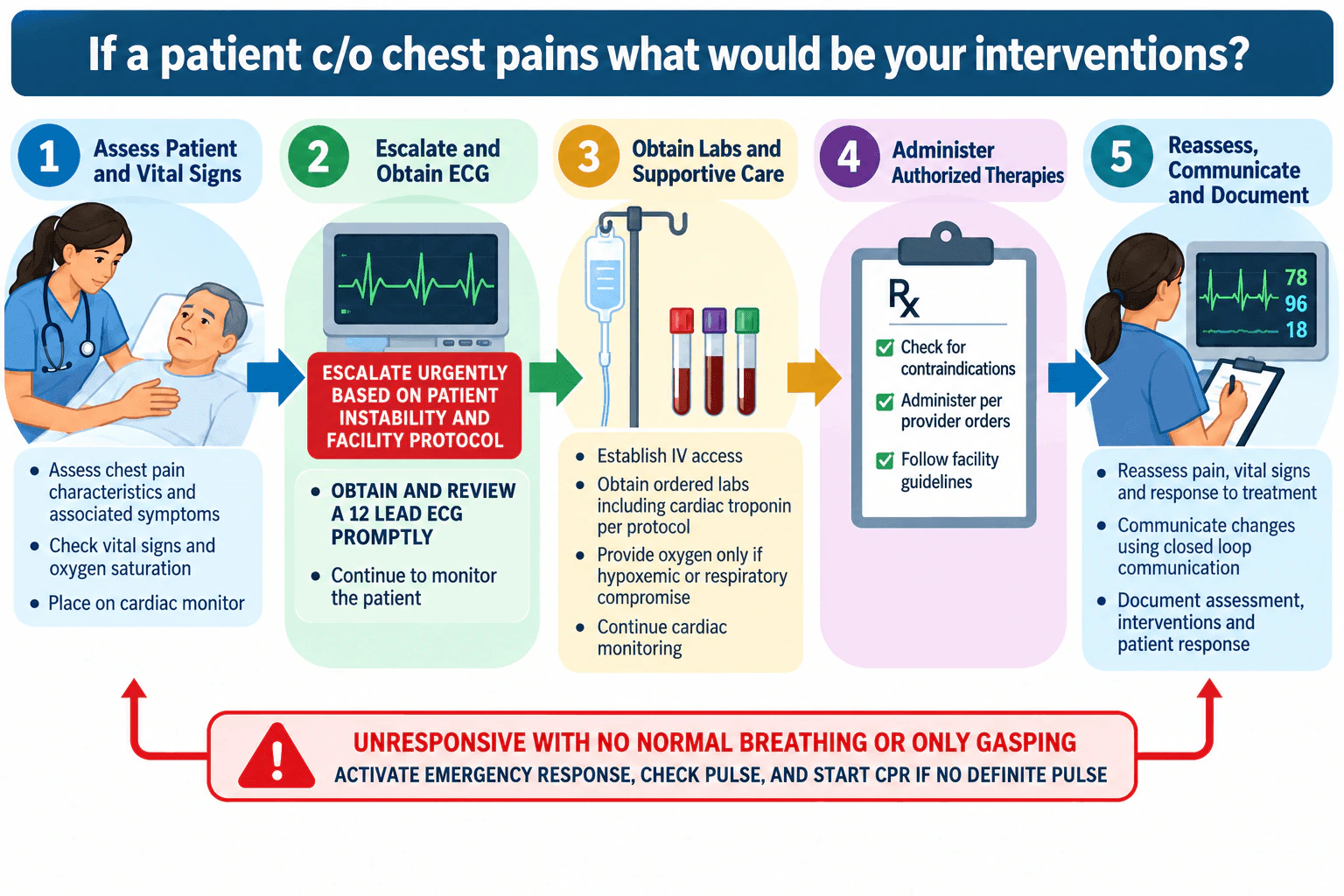
2. If a patient c/o chest pains what would be your interventions?Emergency Recognition And EscalationHardAscension
Short Interview Answer (30-60 seconds)
I would stay with the patient and immediately assess stability, chest pain characteristics, associated symptoms, vital signs, and oxygen saturation while placing the patient on cardiac monitoring. I would escalate urgently based on the patient's condition and facility protocol, obtain a 12 lead ECG and ensure prompt review, establish IV access when appropriate, and obtain ordered labs such as cardiac troponin. I would provide oxygen only when clinically indicated and give protocol authorized or provider ordered therapies after checking contraindications. Then I would reassess the patient, communicate changes using closed loop communication, and document the response.
Detailed Explanation
Chest pain requires prompt assessment because it can reflect acute coronary syndrome or another serious condition, but the nurse should not assume a diagnosis from the symptom alone. The priority is to identify instability, escalate according to clinical urgency, support rapid evaluation, provide authorized care, and repeatedly reassess the response.
Useful Questions to Ask the Interviewer
What rapid response or emergency escalation process does this unit use?
Does the unit have a nurse initiated chest pain protocol?
How is a 12 lead ECG obtained and routed for prompt clinical review on this unit?
How to Explain It in an Interview
Immediate Nursing Priorities
I would stay with the patient and determine whether the patient is stable. I would assess the onset, location, quality, severity, duration, and associated symptoms of the chest pain, obtain vital signs and oxygen saturation, and place the patient on cardiac monitoring. I would watch for worsening symptoms, altered level of consciousness, abnormal breathing, or hemodynamic deterioration.
Escalation and Rapid Evaluation
I would escalate urgently according to the patient's condition and facility protocol rather than applying one universal activation threshold to every patient with chest pain. I would obtain a 12 lead ECG and ensure prompt review because ECG assessment is central to evaluating possible acute coronary syndrome. If the first ECG is nondiagnostic but symptoms persist or the clinical condition deteriorates, further ECG assessment may be required.
I would establish IV access when appropriate and obtain ordered laboratory studies, including cardiac troponin when acute coronary syndrome is suspected. High sensitivity cardiac troponin is the preferred biomarker for detecting myocardial injury.
Authorized Treatment and Reassessment
I would provide supplemental oxygen when clinically indicated for hypoxemia or respiratory compromise rather than routinely giving oxygen to every patient with chest pain. I would administer only protocol authorized or provider ordered therapies and check relevant contraindications before administration.
I would reassess pain, vital signs, oxygenation, cardiac rhythm, and the response to interventions. I would communicate significant changes using closed loop communication and document the assessment, escalation, interventions, and patient response.
If the patient became unresponsive with no normal breathing or only gasping, I would activate the emergency response system, check for a definite pulse, and start CPR if no definite pulse is felt.
Why Interviewers Ask This
The interviewer is evaluating whether the nurse recognizes chest pain as a potentially serious change in condition, prioritizes immediate assessment, escalates according to clinical urgency, supports prompt evaluation for acute coronary syndrome and other life threatening causes, stays within nursing scope, communicates effectively, and reassesses the patient's response.
Common interview mistakes
Common mistakes include leaving the patient alone to complete routine tasks, delaying escalation while gathering nonessential information, assuming every episode of chest pain has the same cause, applying a universal rapid response threshold, giving oxygen routinely without a clinical indication, administering treatment without protocol authority or an appropriate order, failing to obtain or communicate ECG findings promptly, and failing to reassess or document the patient's response.
Interview tip
Present the response in priority order: stay with and assess the patient, determine stability, escalate according to urgency, support prompt ECG and laboratory evaluation, provide only authorized treatment, then reassess, communicate, and document. Make clear that escalation depends on the patient's clinical condition and local protocol rather than an invented universal threshold.
Interviewer may ask next
How would you verify that your interventions and escalation were effective?
I would reassess the patient's chest pain and associated symptoms, repeat vital signs and oxygen saturation as clinically appropriate, review the cardiac rhythm and available ECG findings, follow ordered laboratory results such as cardiac troponin, and evaluate the response to authorized treatment. I would promptly communicate persistent symptoms, deterioration, or significant new findings and document the patient's response and subsequent actions.
What would change if the patient became unresponsive with no normal breathing or only gasping?
I would immediately activate the emergency response system, check breathing and a definite pulse simultaneously, and start CPR if no definite pulse is felt. I would have an AED or defibrillator brought to the bedside and continue the appropriate resuscitation pathway until advanced care takes over or the patient's condition changes.
3. What are you looking for in this position?BehavioralEasyAscension
Interview tip:
Use STAR to structure your answer: briefly explain the Situation and Task, make Action the most detailed part, and finish with the Result. For example, describe a nursing experience that helped you understand the kind of position you want, the responsibilities and team environment you value, how you supported safe patient care, and how that experience shaped what you are looking for in your next role.
Situation
In my last nursing role, I learned that I do my best work in an environment where patient safety, teamwork, and clear communication are treated as daily priorities. I especially valued working with nurses and other clinical team members who shared concerns early and helped each other respond when a patient's condition changed.
Task
As I consider my next position, I am looking for a role where I can provide direct patient care, continue building my clinical judgment, and be part of a team that supports safe and compassionate nursing practice. I also want clear expectations and opportunities to learn from experienced colleagues.
Action
In my previous role, I paid close attention to the parts of nursing that helped me provide my best care. I found that I was most effective when I could complete careful assessments, communicate changes promptly, explain the care plan to patients and families, and coordinate closely with the rest of the care team. I also valued an environment where nurses could ask questions and raise safety concerns without hesitation. Those experiences helped me become more intentional about what I want in my next position. I am looking for meaningful patient contact, strong teamwork, professional support, and a workplace where I can keep improving my skills while taking ownership of my responsibilities.
Result
That experience gave me a clear understanding of the kind of nursing position where I can contribute and continue to grow. I am looking for a role where I can provide dependable care, support my team, keep learning, and help patients feel safe and informed throughout their care.
Why Interviewers Ask This
Interviewers ask this question to understand whether the candidate's goals match the responsibilities and environment of the position. A strong answer shows that the nurse has thought carefully about patient care, teamwork, professional growth, and the kind of setting where they can contribute effectively.
Interviewer may ask next
What part of the nursing environment is most important to you?
A supportive team environment is especially important to me because safe nursing care depends on clear communication and timely collaboration. I want to work with people who share concerns early, help each other when priorities change, and keep the patient's needs at the center of decisions.
How would this position help you continue growing as a nurse?
I want to keep strengthening my clinical judgment, communication, and ability to manage changing patient needs. A position with direct patient care, clear standards, and opportunities to learn from experienced team members would help me build those skills while still contributing fully to the team.
4. What makes you the right fit for this role?BehavioralEasyAscension
Interview tip:
Use STAR to structure your answer: briefly explain the Situation and Task, make Action the most detailed part, and finish with the Result. For example, describe a patient care situation where you showed safe clinical judgment, clear communication, teamwork, compassion, and ownership while responding to changing patient needs.
Situation
In my last nursing role, I cared for an adult patient whose condition began to change during my shift. The patient became more tired than earlier, reported increasing discomfort, and needed closer observation. At the same time, I needed to keep the patient informed and coordinate with the rest of the care team.
Task
My responsibility was to recognize the change early, protect the patient's safety, communicate clearly, and make sure the care plan was updated without losing sight of the patient's comfort and concerns.
Action
I first completed a focused assessment and compared the findings with the patient's earlier condition so I could identify what had changed. I reviewed the available vital signs, symptoms, medications, and recent care information. I then communicated the change promptly to the appropriate clinician using clear and organized information about what I observed and why I was concerned. While waiting for further direction, I continued appropriate monitoring and stayed with the patient when reassurance was needed. I explained what we were watching for in simple language so the patient understood what was happening. I also kept the other members of the nursing team informed because safe care depends on everyone having the same current information. When new care instructions were given, I carried them out, reassessed the patient, documented the response, and continued to communicate any meaningful change. I believe these actions show the qualities I would bring to this role: careful assessment, patient safety, calm communication, compassion, teamwork, and personal accountability.
Result
The patient's change was addressed promptly, the care team remained informed, and the patient understood the plan and felt supported. The experience reinforced that I am at my best when I combine sound nursing judgment with clear communication and respectful patient care. Those are the same strengths I would bring consistently to this role.
Why Interviewers Ask This
Interviewers ask this question to understand whether the candidate's nursing strengths match the needs of the role. A strong answer shows safe clinical judgment, dependable communication, teamwork, compassion, accountability, and a clear understanding of how those qualities support consistent patient care.
Interviewer may ask next
Which quality from that situation do you think is most important for this role?
I would choose patient safety supported by clear communication. In that situation, recognizing the patient's change was important, but it also mattered that I communicated what I saw promptly and clearly. That helped the team respond with the same understanding of the patient's condition.
What did you learn from that experience that you would bring to this role?
I learned that strong nursing care depends on noticing changes early, communicating concerns without delay, and keeping the patient involved in the plan. I would bring that same approach to this role by staying observant, taking ownership of concerns, working closely with the team, and making sure patients understand what is happening.
5. What are your strengths?BehavioralEasyAscension
Interview tip:
Use STAR to structure your answer: briefly explain the Situation and Task, make Action the most detailed part, and finish with the Result. For example, describe a situation where your strengths in observation, communication, and organization helped you notice a patient concern, coordinate the right response, keep care priorities clear, and support a safe outcome.
Situation
In my last role, I was caring for a patient whose condition appeared stable at the start of my shift. During routine care, I noticed subtle changes in the patient's behavior and overall appearance that were different from the earlier assessment.
Task
My responsibility was to determine whether the changes were significant, keep the patient safe, and communicate any important findings to the care team. This situation showed several of my main strengths as a nurse, especially careful observation, clear communication, and staying organized when priorities change.
Action
I first reassessed the patient instead of assuming the change was minor. I reviewed the patient's recent vital signs, symptoms, medications, and previous nursing notes so I could compare the current condition with the earlier baseline. I asked the patient focused questions and listened closely to the answers because small changes can provide important clues. When I confirmed that the patient's condition had changed, I organized the key information before contacting the appropriate clinician. I explained what I had observed, what had changed from the earlier assessment, and why I was concerned. I also continued monitoring the patient and kept the rest of my assigned care organized so that other patients still received timely attention. I communicated updates with the team and made sure new instructions were understood and carried out. My strength is not only noticing a concern. I also stay calm, gather useful information, communicate clearly, and follow the issue until the patient has an appropriate plan of care.
Result
The patient received a timely reassessment and the care plan was adjusted based on the change in condition. The situation reinforced that my strongest qualities are careful observation, clear communication, organization, and follow through. I learned that these strengths work best together because recognizing a problem is only useful when I also communicate it clearly and take responsibility for the next steps.
Why Interviewers Ask This
Interviewers ask this question to understand which professional qualities the candidate relies on in real nursing practice. A strong answer shows self awareness and connects specific strengths, such as observation, communication, organization, and ownership, to safe and effective patient care.
Interviewer may ask next
Which of those strengths was most important in this situation?
Careful observation was the starting point because I noticed that the patient's condition was different from the earlier assessment. Clear communication was just as important after that because I needed to explain the change in a useful way so the care team could respond appropriately.
How do you continue developing your strengths as a nurse?
I reflect on situations like this and think about what helped the care go well and what I could improve. I also ask for feedback, review clinical information when I encounter something unfamiliar, and keep practicing clear communication so I can recognize concerns and respond more effectively in future situations.
6. What is a weakness you have?BehavioralEasyAscension
Interview tip:
Use STAR to structure your answer: briefly explain the Situation and Task, make Action the most detailed part, and finish with the Result. For example, describe a real weakness that affected how you worked, how you recognized it, the specific steps you took to improve, how you communicated or asked for support when needed, and what changed as a result.
Situation
In my last role, I noticed that I sometimes tried to handle too many routine tasks myself before asking another available team member for help. I wanted to be dependable, but I realized that waiting too long to ask for support could make my workflow less efficient during a busy shift.
Task
I needed to improve how I managed my workload while still keeping patient safety and timely care as my first priorities. I also wanted to become more comfortable recognizing when teamwork was the better choice instead of trying to complete everything independently.
Action
I started reviewing my patient priorities earlier in the shift and separating urgent care needs from tasks that could safely be coordinated with another team member. When the workload increased, I communicated sooner with the charge nurse and other members of the care team instead of waiting until I felt overwhelmed. I became more specific when asking for help by explaining what needed to be done, why it mattered, and what I was continuing to manage myself. I also paid closer attention to how experienced nurses balanced independence with teamwork. This helped me understand that asking for appropriate support is not a sign that I cannot manage my work. It is part of protecting patient care and using the team responsibly.
Result
I became more comfortable asking for help at the right time and more organized in how I prioritized my responsibilities. My workflow became smoother during busy periods, and I learned that being dependable also means communicating early and using available resources appropriately.
Why Interviewers Ask This
Interviewers ask this question to see whether a candidate can recognize a genuine area for improvement, take responsibility for it, and show clear steps toward growth. A strong answer demonstrates self awareness, professional judgment, openness to feedback, and a commitment to improving without presenting a weakness that places patient safety at risk.
Interviewer may ask next
How do you decide when it is appropriate to ask another team member for help?
I look first at patient safety, urgency, and the overall workload. If several important needs are happening at the same time, I identify what requires my direct attention and communicate early about tasks that another qualified team member can safely support. I still remain responsible for making sure the care is completed and that important information is communicated.
What did you learn from working on this weakness?
I learned that good nursing is not about doing everything alone. It requires knowing my priorities, communicating clearly, and using the team appropriately. I also learned that asking for help early can prevent delays and allows me to stay focused on the patient needs that require my direct attention.
7. Goals in 5 years, goals in 10BehavioralEasyAscension
Interview tip:
Use STAR to structure your answer: briefly explain the Situation and Task, make Action the most detailed part, and finish with the Result. For example, describe how your current nursing experience is helping you build toward clear five year and ten year professional goals, the steps you are taking to strengthen your clinical skills and leadership, how you communicate those goals with your team, and how you will measure meaningful growth over time.
Situation
In my nursing career, I have learned that I grow best when I set clear goals while staying focused on giving safe and compassionate care today. In my current stage, I am building a strong clinical foundation and thinking carefully about how I want to develop over the next five and ten years.
Task
My responsibility is to become a dependable and skilled nurse first, then gradually take on more responsibility as my experience grows. I want my future goals to support patient care, teamwork, and continued learning rather than simply pursuing a title.
Action
Over the next five years, I plan to strengthen my bedside judgment, communication, and ability to care for patients with more complex needs. I will ask experienced nurses for feedback, learn from difficult cases, stay current with evidence based nursing practices, and pursue education or specialty training that fits the patient population I serve. I also want to become someone newer nurses can approach for help because teaching others requires me to understand my own practice well. Looking toward ten years, I would like to take on greater leadership or clinical responsibility while remaining connected to patient care. That could include serving as a resource nurse, preceptor, or moving into another role that allows me to improve care across the team. I would make those decisions based on my experience, the needs of my patients, and where I can contribute most effectively.
Result
My goal is to build a career where my responsibilities grow because my skills, judgment, and ability to support others have grown. I have learned that long term goals are most useful when they guide daily choices but still leave room to learn and adjust. In five years, I want to be a highly trusted nurse. In ten years, I want to use that experience to help both patients and other nurses succeed.
Why Interviewers Ask This
Interviewers ask this question to understand whether a candidate has realistic professional goals, values continued growth, and sees nursing as a career that requires ongoing learning. A strong answer shows ambition while also demonstrating commitment to patient care, clinical development, teamwork, and flexibility as experience grows.
Interviewer may ask next
What steps are you taking now to reach your five year goal?
I am focusing first on becoming stronger in my daily nursing practice. I ask for feedback, reflect on challenging patient situations, learn from experienced nurses, and continue building my clinical knowledge. I also look for opportunities to improve my communication and help coworkers because those skills will prepare me for greater responsibility later.
How would you respond if your ten year career goal changed?
I would be comfortable adjusting it. My ten year goal gives me direction, but nursing can expose me to new specialties and responsibilities that I may not fully understand yet. I would keep the same priorities of strong patient care, continued learning, and supporting the team, then choose the role where my experience can provide the most value.
8. Is their a reason we should not hire you?BehavioralHardAscension
Interview tip:
Use STAR to structure your answer: briefly explain the Situation and Task, make Action the most detailed part, and finish with the Result. For example, describe a real weakness that could concern an employer, explain a situation where it affected your nursing practice, show the steps you took to improve, and explain how you now protect patient care through better judgment, communication, and teamwork.
Situation
Earlier in my nursing practice, I sometimes tried to solve too many problems on my own before asking another nurse for help. During one busy shift, I was caring for several patients with competing needs, and I realized that this habit could slow my response when priorities changed quickly.
Task
My responsibility was to keep each patient safe while managing my workload well. I also needed to recognize when asking for support was the safer choice instead of treating independence as a sign that I should handle everything myself.
Action
I first reassessed my patients and identified which needs were most urgent. I completed the time sensitive care that was within my responsibility and then communicated clearly with the charge nurse about the remaining demands. I explained what I had already completed, what still needed attention, and where I needed support. I also asked an available team member for appropriate help rather than waiting until I felt overwhelmed. After the shift, I reflected on what had happened and changed my approach. I began checking my workload earlier, speaking up sooner when several priorities competed, and asking for help before a delay could affect patient care. I still take ownership of my assignments, but I no longer confuse ownership with doing everything alone.
Result
The experience helped me become more proactive about communication and teamwork. I learned that one reason not to hire me would be if you needed a nurse who never asks for help, because I now believe asking for appropriate support is part of safe nursing practice. I continue to work on balancing independence with early communication so that patient needs remain the priority.
Why Interviewers Ask This
Interviewers ask this question to see whether a candidate can discuss a genuine weakness with self awareness and professional judgment. A strong answer shows that the candidate understands the risk, takes responsibility, improves through specific actions, and does not identify a weakness that would prevent safe and reliable nursing care.
Interviewer may ask next
What helped you realize that you needed to ask for help earlier?
I realized that trying to manage every competing need alone could create unnecessary delays. Once I looked at the situation from a patient safety perspective, asking for help became an appropriate clinical decision rather than something I viewed as a weakness.
How do you handle a similar situation now?
I reassess priorities early, identify which patient needs are most urgent, and communicate before the workload becomes difficult to manage. I complete the care that requires my direct attention and ask the appropriate team member for support when another task can be safely shared.
9. How would you manage working in a highly stressful environment?BehavioralMediumAscension
Interview tip:
Use STAR to structure your answer: briefly explain the Situation and Task, make Action the most detailed part, and finish with the Result. For example, describe a demanding nursing shift where several patients needed attention at the same time, explain how you set priorities, stayed calm, communicated with the care team, protected patient safety, and maintained control of your workload.
Situation
In my last nursing role, I had a shift where several patients needed attention at the same time. One patient had a change in condition, another needed scheduled medication, and another patient and family were anxious and asking for updates. The unit was busy, so I needed to stay calm and organized.
Task
My responsibility was to protect patient safety, identify what needed immediate attention, complete time sensitive care, and keep patients and the care team informed. I also needed to manage my own stress so that I could think clearly and avoid rushing through important decisions.
Action
I first paused briefly to organize the situation and identify the highest clinical priority. I assessed the patient with the change in condition first because a new clinical change could become urgent. I checked the patient's vital signs, symptoms, and overall status, then communicated the relevant findings to the appropriate provider and team members. I followed the care plan and continued monitoring for further changes. Once the immediate concern was being addressed, I reviewed the remaining tasks by urgency and patient need. I completed time sensitive medications and care while making sure required safety checks were not skipped. I also kept patients informed when there was a delay so they understood that I had not forgotten them. When appropriate, I asked other team members for help with tasks that could safely be shared. Throughout the shift, I focused on one priority at a time, used clear communication, and avoided letting the number of tasks push me into working too quickly. That approach helped me stay focused instead of becoming overwhelmed.
Result
The urgent patient concern was addressed promptly, the rest of the required care was completed safely, and communication helped reduce confusion for both patients and the team. The experience reinforced that I handle stressful environments best by staying calm, setting clinical priorities, communicating early, and asking for appropriate support rather than trying to manage every task alone.
Why Interviewers Ask This
Interviewers ask this question to understand how a nurse responds when workload, urgency, and emotional pressure increase at the same time. A strong answer shows that the candidate can remain calm, protect patient safety, prioritize based on clinical need, communicate clearly, and use teamwork without losing accountability for their own responsibilities.
Interviewer may ask next
How did you decide which patient needed your attention first?
I focused first on the patient with the new change in condition because a change from the patient's expected status could signal a developing clinical problem. I used the patient's current symptoms, vital signs, and overall condition to guide that decision. After the immediate concern was assessed and communicated, I returned to the other time sensitive responsibilities in order of urgency.
What did you learn about managing your own stress during that shift?
I learned that stress becomes more manageable when I slow my thinking down even if the environment is moving quickly. I focus on the most important patient need first, communicate what is happening, and break the workload into clear priorities. I also learned that asking for appropriate help early is safer and more effective than trying to handle every task by myself.
Registered Nurse Resume Examples
Explore the resume examples below to find the one that best matches your target Registered Nurse role.
Disclaimer: This interview guide is for educational and informational purposes only. It is designed to help readers prepare, but it does not guarantee any interview result, hiring decision, offer, or outcome. Interview questions, hiring criteria, and preferred answers can vary by employer, interviewer, industry, location, and time. All answers, examples, and explanations in this guide are suggested examples for interview preparation, not definitive answers or instructions for professional practice. They are based on research and judgment, are provided without warranties of any kind, and should be adapted to the question, role, and applicable laws and professional requirements. Diagrams are simplified illustrations intended to highlight the main concepts and their relationships; actual situations, systems, and practices may be more complex. Alternative approaches may be equally valid or better suited to a particular question, context, or interviewer. To the fullest extent permitted by applicable law, the contributors and publisher are not liable for decisions made, actions taken, or losses incurred based on this guide.
State Laws and Professional Responsibilities: Laws and requirements governing an occupation vary by state and jurisdiction. You are responsible for checking the current laws, licensing requirements, and scope-of-practice rules that apply to your location and role, and for ensuring that your answers and actions comply with them. Adapt examples in this guide to those requirements. This guide is not legal advice.
Company Notice: This guide is an independent educational resource and is not affiliated with, endorsed by, sponsored by, or approved by the company named in this guide. Company names identify reported interview experiences or the employer context of clearly labeled original practice exercises. Interview practices can change without notice, and inclusion of company-specific content does not mean these questions are official, complete, or guaranteed to be asked. To the fullest extent permitted by law, the author, contributors, and publisher are not responsible for outcomes related to use of this material.
Content Accuracy and Verification: To the fullest extent permitted by applicable law, we do not represent or warrant that interview guides, questions, answers, examples, or diagrams are accurate, complete, current, error-free, or suitable for any particular purpose. You are responsible for independently reviewing and verifying the information before relying on it.