This interview guide is for educational and informational purposes only. It is designed to help readers prepare, but it does not guarantee any interview result, hiring decision, offer, or outcome. Interview questions, hiring criteria, and preferred answers can vary by employer, interviewer, industry, location, and time. All answers, examples, and explanations in this guide are suggested examples for interview preparation, not definitive answers or instructions for professional practice. They are based on research and judgment, are provided without warranties of any kind, and should be adapted to the question, role, and applicable laws and professional requirements. Diagrams are simplified illustrations intended to highlight the main concepts and their relationships; actual situations, systems, and practices may be more complex. Alternative approaches may be equally valid or better suited to a particular question, context, or interviewer. To the fullest extent permitted by applicable law, the contributors and publisher are not liable for decisions made, actions taken, or losses incurred based on this guide.
State Laws and Professional Responsibilities
Laws and requirements governing an occupation vary by state and jurisdiction. You are responsible for checking the current laws, licensing requirements, and scope-of-practice rules that apply to your location and role, and for ensuring that your answers and actions comply with them. Adapt examples in this guide to those requirements. This guide is not legal advice.
Identity, Image, and Privacy Notice
To respect individual privacy, some names, profile photographs, avatars, biographical details, and other identifying information displayed in this guide may be replaced with pseudonyms, licensed stock images, illustrative avatars, composite images, or representative descriptions. Unless a person is expressly identified as an actual contributor, a displayed name, image, or profile should not be understood as depicting or identifying a specific candidate, interviewer, employee, or other real individual. These representations are provided for editorial and illustrative purposes only and do not imply endorsement, employment, participation, or affiliation with this guide or any company mentioned in it. Any resemblance to an actual person is coincidental.
Company Notice
This guide is an independent educational resource and is not affiliated with, endorsed by, sponsored by, or approved by the company named in this guide. Company names identify reported interview experiences or the employer context of clearly labeled original practice exercises. Interview practices can change without notice, and inclusion of company-specific content does not mean these questions are official, complete, or guaranteed to be asked. To the fullest extent permitted by law, the author, contributors, and publisher are not responsible for outcomes related to use of this material.
Content Accuracy and Verification
To the fullest extent permitted by applicable law, we do not represent or warrant that interview guides, questions, answers, examples, or diagrams are accurate, complete, current, error-free, or suitable for any particular purpose. You are responsible for independently reviewing and verifying the information before relying on it.
Questions or comments?
Contact us for general questions, or share feedback, technical corrections, and comments with the community.
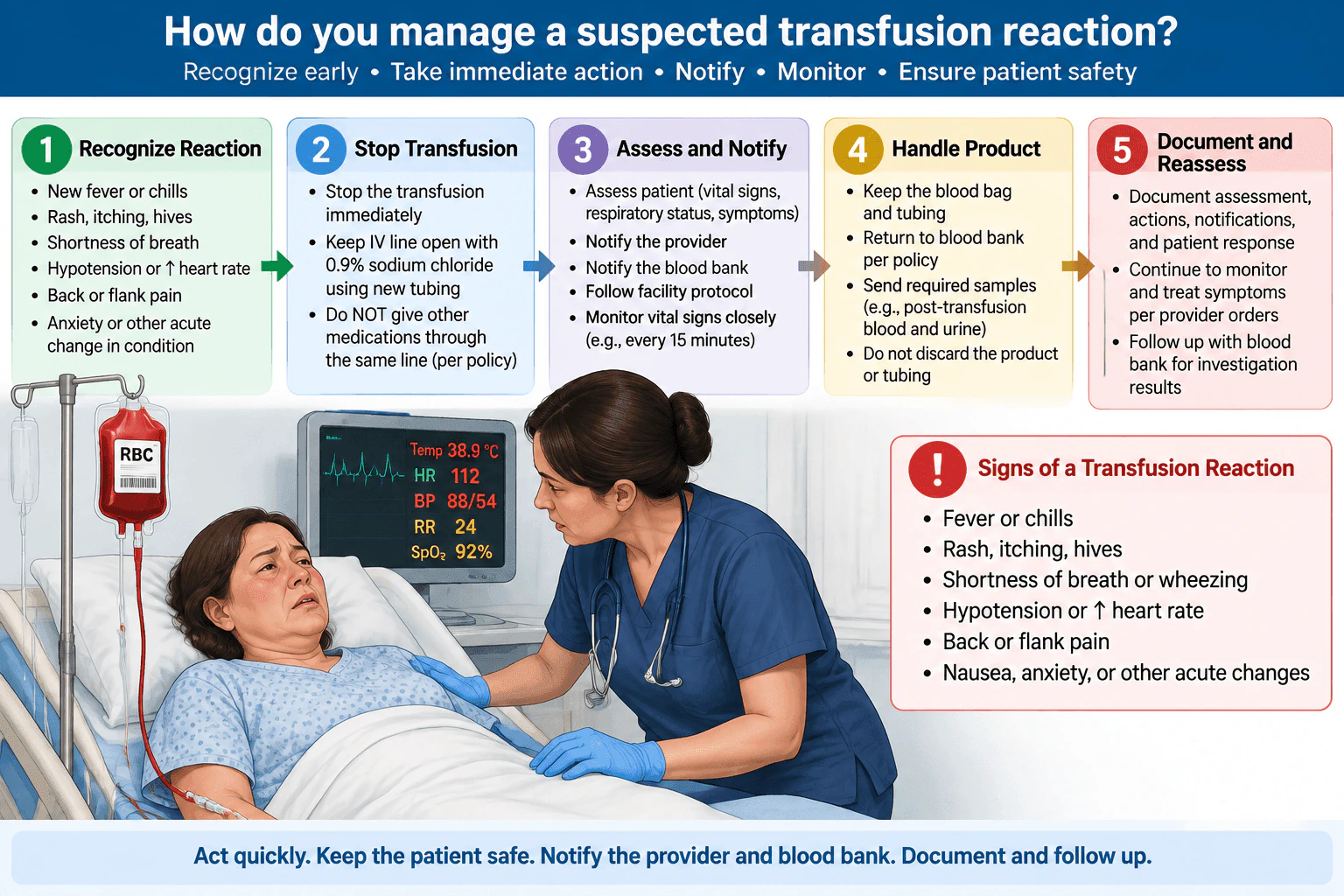
61. How do you manage a suspected transfusion reaction?Clinical Procedures And MonitoringHard
i Question Details
Describe recognition, immediate safety actions according to policy, notification, monitoring, product handling requirements, documentation, and follow up.
Short Interview Answer (30-60 seconds)
If I suspect a transfusion reaction, I first recognize the patient's symptoms and stop the transfusion according to policy. I assess the patient, monitor vital signs and respiratory status, notify the responsible provider and blood bank, follow required blood product handling procedures, document the event and actions taken, and continue reassessment to monitor the patient's response.
Detailed Explanation
A suspected transfusion reaction is managed by recognizing early changes in the patient and following a structured safety response. The main priority is protecting the patient while ensuring the reaction is evaluated and communicated appropriately.
Useful Questions to Ask the Interviewer
What transfusion reaction escalation process is followed in this clinical setting?
What documentation requirements are expected after a suspected transfusion reaction?
Which team members participate in blood product investigation and follow up?
How to Explain It in an Interview
Purpose and Preparation
I would first verify the patient's identity, transfusion status, indication, and relevant orders. I would recognize possible reaction findings such as fever, chills, rash, itching, breathing difficulty, blood pressure changes, pain, anxiety, or other acute changes.
Nursing Procedure
My immediate action would be to stop the transfusion according to policy and assess the patient. I would notify the responsible provider and blood bank, follow local procedures for maintaining appropriate access, and avoid actions outside my nursing scope or facility guidance.
Monitoring Findings
I would monitor vital signs, respiratory status, symptoms, and the patient's response. Continuous reassessment helps identify whether the patient is improving or requires additional escalation.
Aftercare and Escalation
I would handle the blood bag and tubing according to required procedures, including returning or preserving materials for investigation when required. I would document assessment findings, actions taken, notifications, and patient response. Follow up includes continued monitoring and communication with the appropriate teams.
Why Interviewers Ask This
Interviewers want to evaluate whether the nurse can recognize transfusion reaction signs, prioritize patient safety, follow appropriate escalation steps, communicate with the care team, and complete required monitoring and documentation.
Common interview mistakes
Common mistakes include continuing the transfusion after recognizing concerning symptoms, delaying notification, failing to reassess the patient, not documenting the timeline and actions taken, or ignoring facility policy and competency requirements.
Interview tip
Explain the response in priority order: recognize the reaction, protect the patient, stop the transfusion according to policy, notify the appropriate teams, handle the product correctly, document, and reassess.
Interviewer may ask next
How do you verify that a suspected transfusion reaction was managed correctly?
I verify that symptoms were recognized, safety actions were completed according to policy, the provider and blood bank were notified, patient monitoring occurred, documentation was completed, and follow up requirements were addressed.
How would your approach change if the patient developed severe respiratory symptoms during the reaction?
I would prioritize rapid patient assessment, emergency escalation according to clinical policy, close monitoring, communication with the appropriate response team, and completion of transfusion reaction procedures.
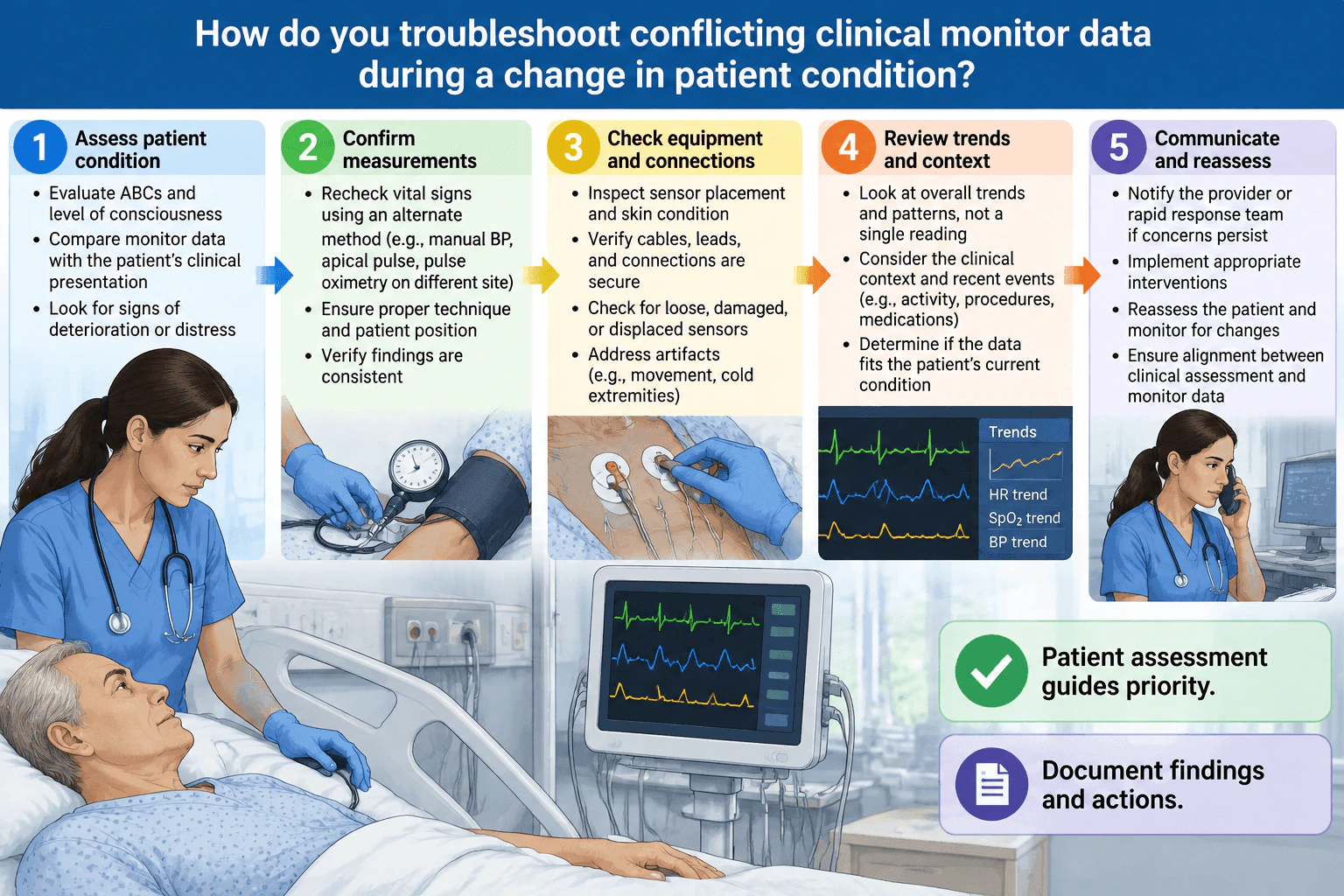
62. How do you troubleshoot conflicting clinical monitor data during a change in patient condition?Clinical Procedures And MonitoringHard
i Question Details
Explain immediate patient assessment, confirmation with alternate measurements, equipment checks, trend review, communication, and escalation based on the clinical picture.
Short Interview Answer (30-60 seconds)
When monitor data conflicts with a patient's condition, I assess the patient first rather than relying on a single monitor value. I confirm the measurement using appropriate alternate methods, check the equipment and connections, review trends and clinical context, communicate concerns, escalate when needed, reassess the patient, and document the findings and actions taken.
Detailed Explanation
Conflicting clinical monitor data requires nursing judgment to determine whether the patient is experiencing a true change or whether the information may be affected by measurement issues. The nurse should combine direct assessment with verified monitor information before making decisions.
Useful Questions to Ask the Interviewer
Which clinical monitoring devices and patient populations are most relevant for this role?
What process is used when patient assessment and monitor data do not match?
What documentation expectations apply when monitor concerns are identified?
How to Explain It in an Interview
Purpose and Preparation
I begin by assessing the patient. I evaluate the patient's appearance, symptoms, level of consciousness, and overall condition. I confirm that the monitoring method is appropriate and that I understand the relevant orders and guidance.
Monitoring Findings
If monitor data conflicts with the patient's presentation, I confirm the information using appropriate alternate measurements when available. I inspect sensor placement, connections, and equipment condition according to approved instructions. I also review trends and patterns instead of focusing only on one reading.
Interpretation of Findings
I compare the monitor information with the patient's clinical assessment and context. If concerns continue, I communicate the findings to the appropriate healthcare team members and escalate based on the patient's condition and applicable policy.
Aftercare and Escalation
After troubleshooting, I reassess the patient and document the findings, actions taken, communication, and patient response. The goal is to use technology as a support tool while maintaining safe patient centered nursing care.
Why Interviewers Ask This
This question evaluates nursing judgment during changes in patient condition. Interviewers want to know whether the nurse can combine direct patient assessment with monitor information, identify possible data errors or artifacts, communicate concerns appropriately, and make safe decisions based on the overall clinical picture.
Common interview mistakes
Common mistakes include trusting a monitor value without assessing the patient, ignoring possible sensor or equipment problems, focusing on a single reading instead of trends, delaying communication when concerns persist, and documenting only monitor values without recording assessment findings and actions.
Interview tip
Explain the sequence clearly: assess the patient, verify the data, check equipment, review trends, communicate concerns, escalate when needed, reassess, and document. This demonstrates safe nursing prioritization.
Interviewer may ask next
How do you verify conflicting monitor data?
I assess the patient, compare the monitor reading with the patient's clinical condition, confirm measurements using appropriate alternate methods when available, inspect equipment and connections, and review trends before deciding on further action.
How would your approach change if the patient's condition became unstable?
I would prioritize immediate patient assessment and response based on the clinical condition. I would obtain help when needed, communicate changes clearly, follow applicable escalation processes, continue reassessment, and document the patient's status and actions taken.
63. What is delegation in nursing?Prioritization And DelegationEasy
Short Interview Answer (30-60 seconds)
Delegation in nursing means assigning the right task to the right person while considering patient stability, the task requirements, and the team member's competence. The nurse communicates expectations, provides appropriate supervision, and evaluates the result. Delegation does not remove the nurse's responsibility for safe patient care.
Detailed Explanation
Delegation in nursing is a way to organize care by assigning selected tasks to appropriate members of the healthcare team. The nurse must first consider whether the patient is stable, whether the task is predictable, and whether the team member has the required competence. The exact tasks that may be delegated depend on applicable regulations and policy.
Useful Questions to Ask the Interviewer
How does your organization define delegation responsibilities among different members of the nursing team?
What resources are available for nurses when they need to clarify delegation expectations?
How are delegation outcomes communicated and evaluated within the team?
How to Explain It in an Interview
Delegation Decision
I would explain that safe delegation starts with assessing the patient and the task. I would not delegate a task only because another person has time available. I would consider patient stability, task predictability, and the team member's competence before making an assignment.
Patient and Team Assessment
I would verify that the delegated activity is appropriate for the person's role and permitted by applicable rules and policy. Roles for registered nurses, licensed practical nurses, and assistants can vary by jurisdiction, so I would follow local requirements.
Supervision and Reassessment
After delegation, I would communicate clear instructions, confirm understanding, remain available for questions, and evaluate whether the care was completed safely. The nurse remains responsible for coordinating care and responding if the patient's condition changes.
Why Interviewers Ask This
Interviewers ask this question to evaluate whether the nurse understands that delegation is a clinical judgment decision, not simply giving away tasks. They want to hear how the nurse matches patient needs with team member abilities and maintains safe supervision.
Common interview mistakes
Common mistakes include delegating tasks based only on workload, failing to verify team member competence, assuming roles are identical across locations, and not following up on delegated care.
Interview tip
Give an example that shows your reasoning process. Explain how you assess the patient, select an appropriate team member, communicate expectations, and evaluate the result.
Interviewer may ask next
How would you verify that a delegated task was appropriate?
I would verify the patient's stability, the requirements of the task, the team member's demonstrated competence, and the applicable rules or policy before delegation. I would also confirm expectations and reassess the outcome after completion.
How would delegation change if a patient's condition became unstable?
If a patient's condition changed and became less stable, I would reassess priorities, provide appropriate nursing care based on my role and available guidance, communicate the change, and adjust assignments to support patient safety.
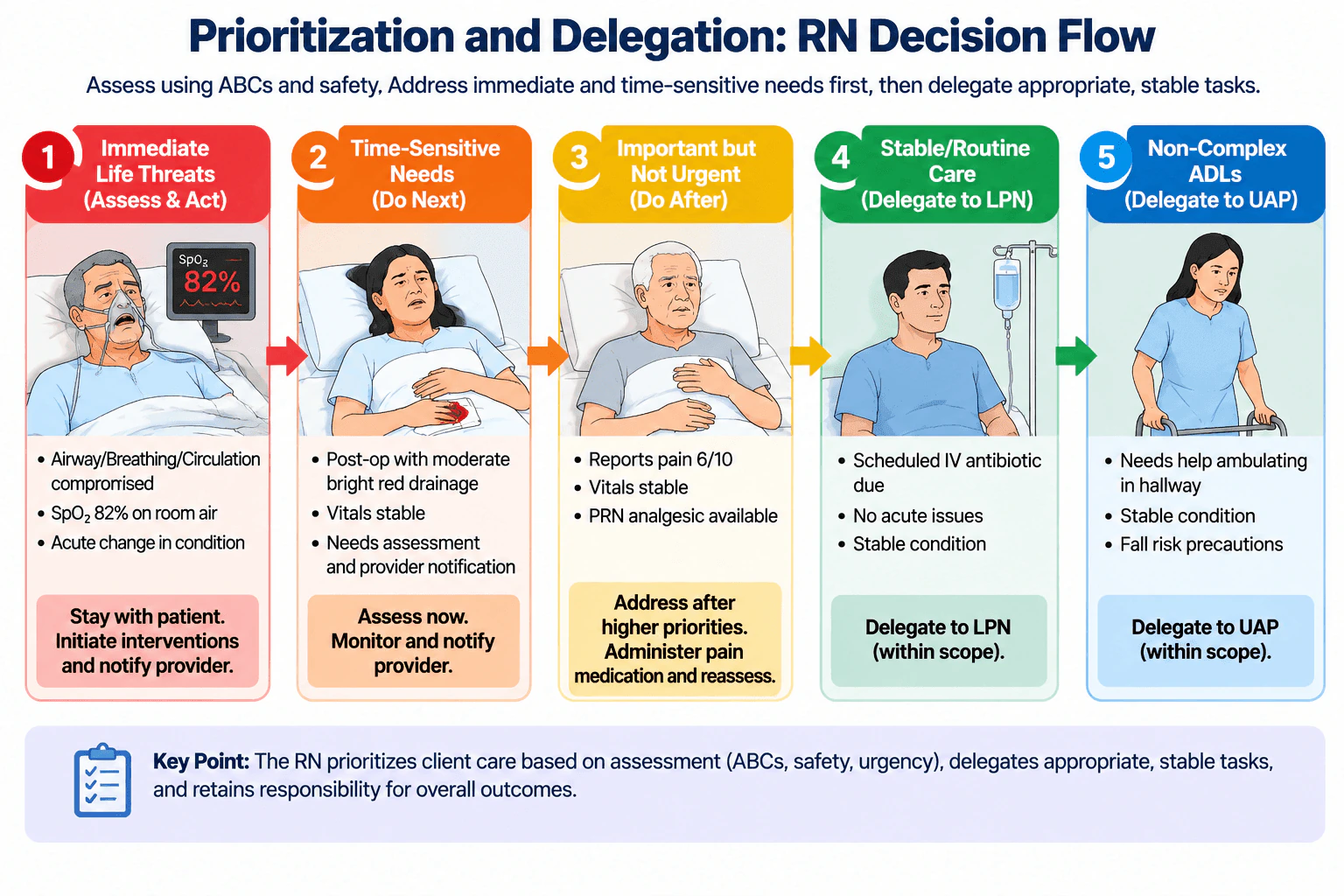
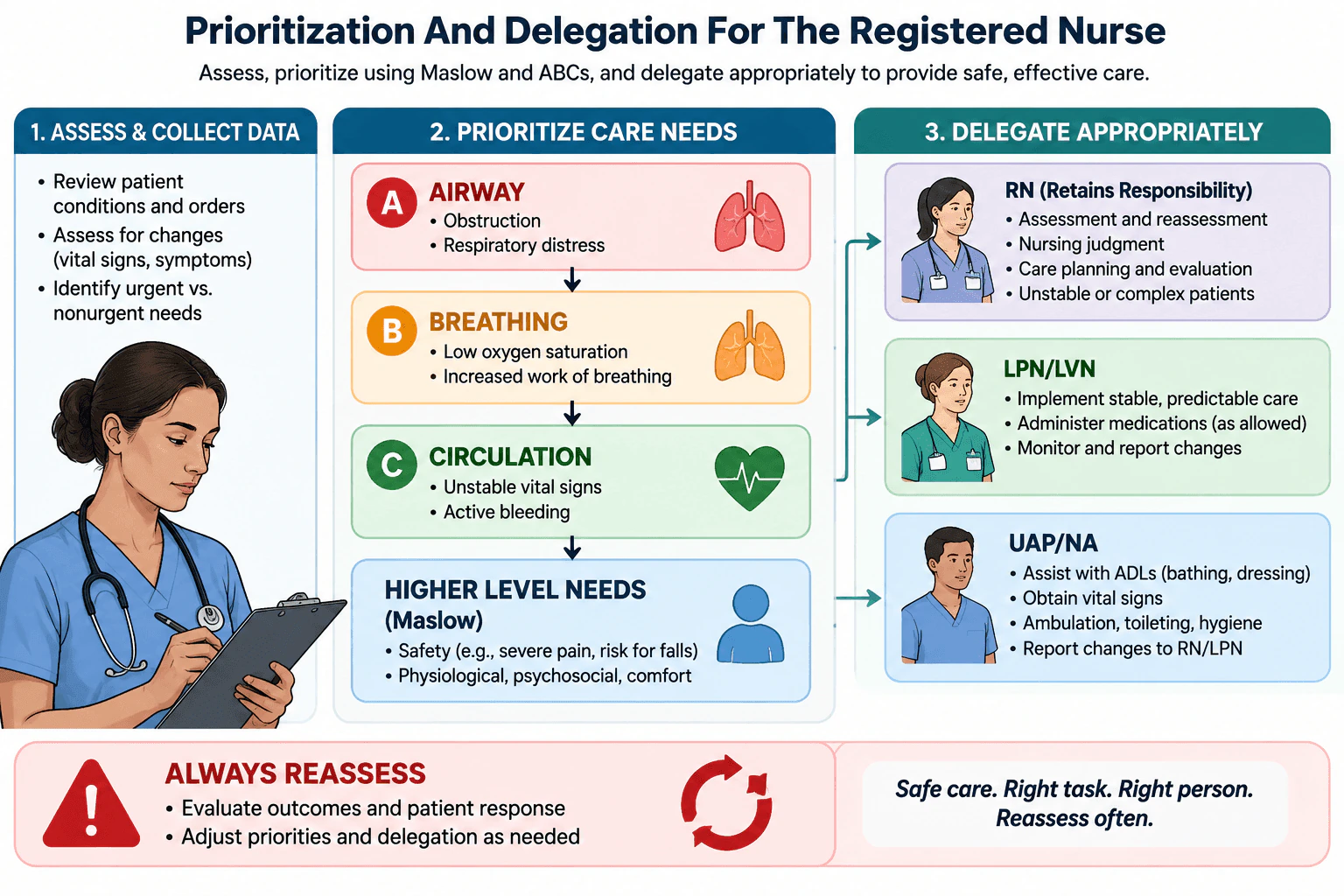
64. How do you prioritize tasks during a busy nursing shift?Prioritization And DelegationEasy
i Question Details
Explain how acuity, immediate safety, time sensitive care, scheduled treatments, patient needs, and reassessment shape your sequence.
Short Interview Answer (30-60 seconds)
During a busy nursing shift, I prioritize by first assessing patient stability, safety, and urgency. I address immediate threats, then manage time sensitive care, scheduled treatments, and routine needs. I delegate appropriate stable tasks based on patient condition and team competence while maintaining supervision and reassessment.
Detailed Explanation
Prioritizing during a busy nursing shift means making decisions based on patient risk and care needs rather than completing tasks in the order they appear. I first identify patients who require immediate attention because of safety concerns or changes in stability. I then organize remaining care by urgency, timing, patient needs, and available resources.
Useful Questions to Ask the Interviewer
How are assignments and delegation typically organized on this unit?
Which team members are commonly available during a shift?
What communication process is used when patient conditions change?
How to Explain It in an Interview
Priority Setting
I begin with the highest risk patient. I assess airway, breathing, circulation, safety concerns, and changes from the expected condition. Immediate threats are addressed before lower priority needs.
Patient and Team Assessment
I consider patient stability, the urgency of the task, whether the task is predictable, and whether the available team member has appropriate competence and authorization under applicable rules.
Delegation Decision
I delegate appropriate stable and routine tasks when permitted by local policy and scope requirements. Delegation is based on patient needs and team competence, not simply because another person has available time.
Supervision and Reassessment
After delegation, I communicate expectations, verify completion, evaluate results, and reassess patients. If a patient condition changes, I update priorities and escalate concerns appropriately.
Why Interviewers Ask This
Interviewers evaluate whether a nurse can organize competing priorities, recognize changes in patient condition, make safe delegation decisions, and maintain accountability for patient care.
Interview tip
Use a clear structure: assess stability, identify the highest priority need, take appropriate action, delegate safely, and reassess outcomes.
Interviewer may ask next
How do you verify that your prioritization decisions are correct?
I verify decisions by reassessing patient status, confirming completion of time sensitive care, communicating with the team, reviewing outcomes, and changing priorities when new information appears.
How would your priorities change if a stable patient developed a new safety concern?
I would reassess the new concern, determine the level of urgency, address the patient with the greatest immediate risk, communicate changes, and reorganize lower priority tasks.
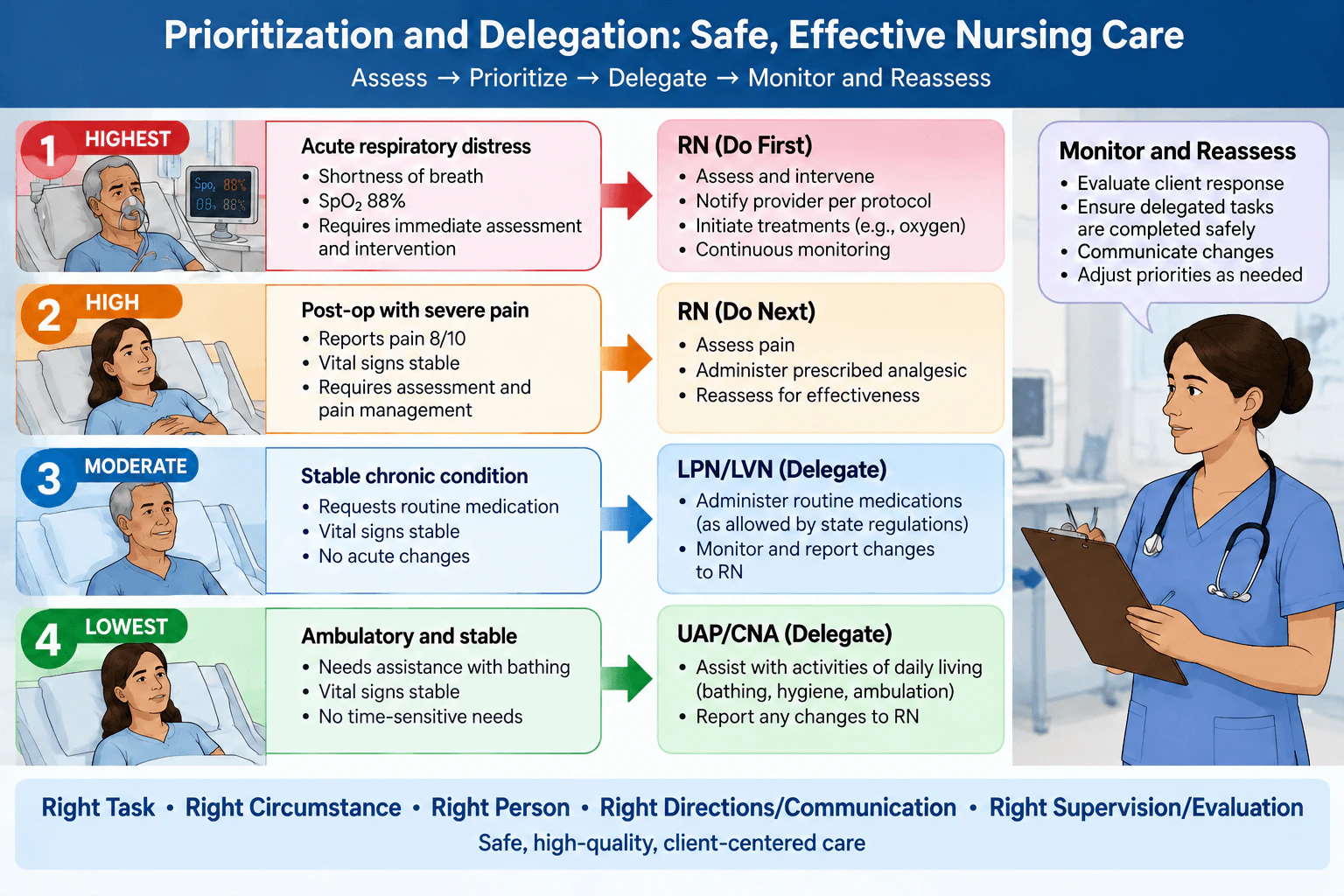
65. You have several patients needing attention at once. How do you decide whom to see first?Prioritization And DelegationMedium
i Question Details
Explain rapid review of airway, breathing, circulation, acute neurologic changes, other immediate threats, time sensitive needs, and available help.
Short Interview Answer (30-60 seconds)
I first identify the patient with the most immediate threat to life or risk of deterioration. I use a rapid review of airway, breathing, circulation, acute neurologic changes, other immediate threats, and time sensitive needs. After addressing the highest priority patient, I organize the remaining care based on stability, urgency, available resources, and appropriate delegation. I delegate only tasks that match the team member's competence and applicable scope, then supervise and reassess outcomes.
Detailed Explanation
When several patients need attention at the same time, I decide priorities by focusing on patient safety and clinical urgency rather than who asks first. I first identify immediate threats such as airway, breathing, circulation problems, acute neurologic changes, or signs of rapid deterioration. A patient with unstable needs receives attention before patients with stable conditions or routine needs.
Useful Questions to Ask the Interviewer
What patient population and care setting should I consider for this prioritization example?
How are delegation responsibilities defined for RN, LPN/LVN, and assistive personnel in this setting?
Are there specific policies or escalation pathways used by this organization?
How to Explain It in an Interview
Priority Setting
I begin with a rapid review of each patient's stability. A patient with acute respiratory distress or another immediate threat receives attention before patients with stable chronic conditions or routine needs.
Patient and Team Assessment
I consider severity of condition, changes from baseline, time sensitivity, and available resources. I also evaluate task predictability and team competence before assigning care.
Delegation Decision
Delegation is based on selecting the right task, patient circumstances, qualified team member, clear communication, and appropriate supervision. I do not delegate a task only because someone is available. Assessment, nursing judgment, and evaluation remain RN responsibilities.
Supervision and Reassessment
After delegation, I confirm tasks are completed safely, review reported findings, reassess patient conditions, communicate changes, and adjust priorities when needed. For example, a patient with acute respiratory distress would be addressed before a stable patient needing routine assistance.
Why Interviewers Ask This
Interviewers are evaluating nursing judgment, prioritization skills, ability to recognize patient instability, safe delegation decisions, and understanding that the RN remains accountable for assessment, clinical judgment, supervision, and evaluation after delegation.
Common interview mistakes
Common mistakes include prioritizing based on task order instead of patient risk, delegating without considering competency or scope, delegating unstable patient care tasks, failing to reassess after delegation, and assuming RN, LPN/LVN, and assistive personnel responsibilities are identical in every jurisdiction.
Interview tip
Use a structured explanation: identify the most unstable patient first, explain the clinical reasoning, describe safe delegation decisions, and emphasize supervision, communication, and reassessment.
Interviewer may ask next
How do you verify that your prioritization decision was correct?
I verify my decision by reassessing patient responses, reviewing new assessment findings, monitoring for changes in condition, communicating important updates, and adjusting priorities when new information becomes available.
How would your approach change if one patient became newly unstable while you were caring for another patient?
I would immediately reassess all patient needs, identify the new level of risk, and reprioritize care. A newly unstable patient with an immediate threat would move ahead of less urgent needs while I communicate with the team and delegate appropriate predictable tasks when allowed.
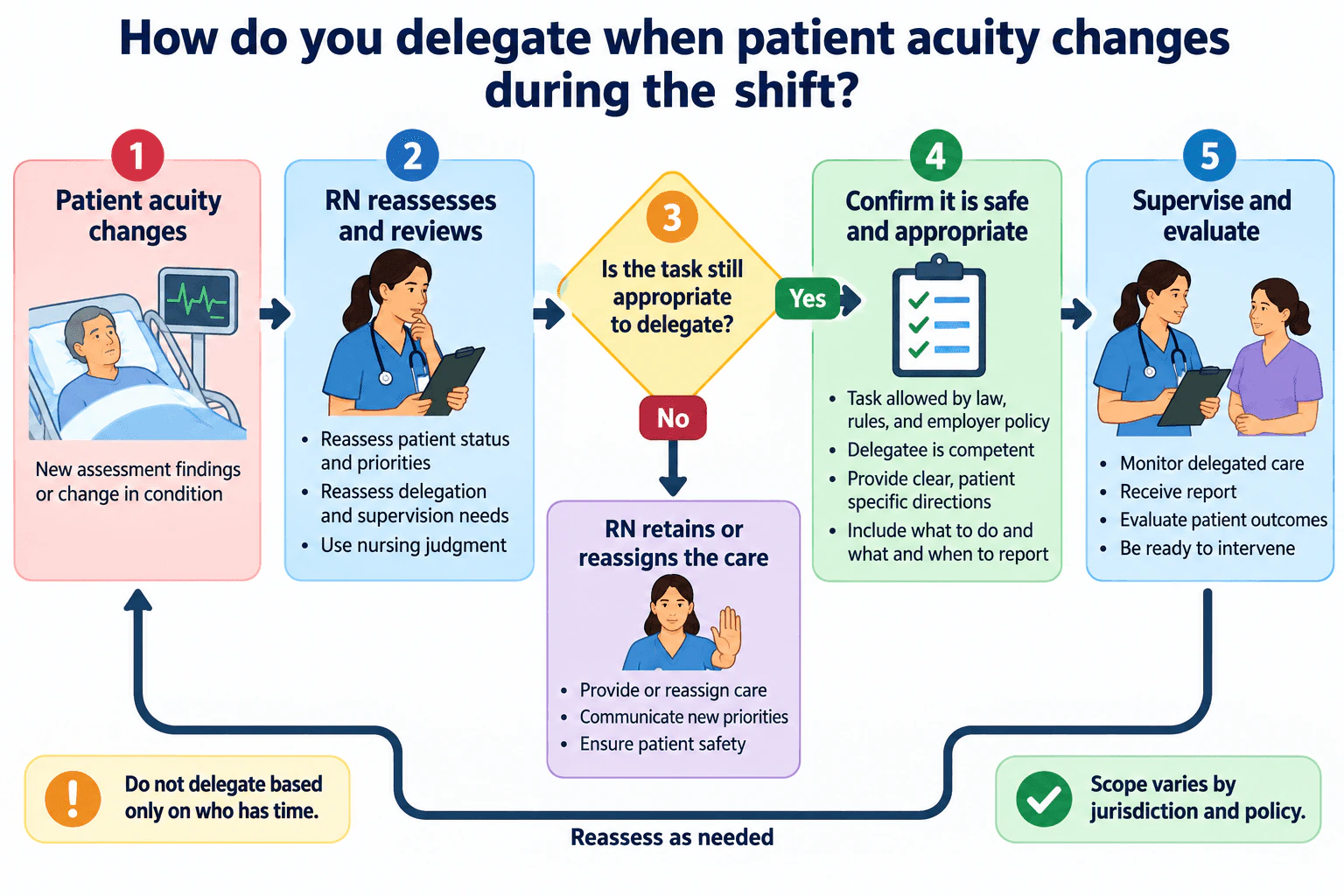
66. How do you delegate when patient acuity changes during the shift?Prioritization And DelegationMedium
i Question Details
Describe reassessing the patient, reconsidering which tasks remain appropriate for delegation, communicating new priorities, and verifying outcomes.
Short Interview Answer (30-60 seconds)
If patient acuity changes, I first reassess the patient and reset priorities. Then I reconsider whether each delegated task is still appropriate based on the patient's current stability, task predictability, the delegatee's competence, the supervision required, applicable rules, and employer policy. If it is no longer appropriate, I retain or reassign the care and communicate the new priorities. If it remains appropriate, I give clear patient specific directions and reporting expectations. I supervise the care, receive the report, evaluate the patient's outcomes, and reassess again as needed.
Detailed Explanation
A change in patient acuity can change both care priorities and whether a previously delegated task remains appropriate. The RN should reassess the patient rather than assuming the original delegation plan is still safe. The decision should reflect the patient's current condition, task predictability, the delegatee's competence, the supervision required, and the applicable jurisdictional rules and employer policy.
Useful Questions to Ask the Interviewer
How does your organization communicate changes in patient acuity and revised assignments during a shift?
What resources do nurses use to confirm delegation expectations and team member competencies?
How are changes in delegated care and follow up typically documented here?
How to Explain It in an Interview
Priority Setting
I would start by reassessing the patient and identifying what has changed. I would update priorities based on the current clinical picture rather than continuing the original assignment automatically. A change in acuity can make a previously predictable task less appropriate for delegation.
Patient and Team Assessment
I would review the patient's current stability and the predictability of the care required. I would also confirm that the person receiving the task has the demonstrated competence to perform it and that I can provide the level of supervision the situation requires. I would follow applicable law, nursing rules, and employer policy because RN, LPN, and assistive personnel responsibilities are not identical across jurisdictions.
Delegation Decision
If the task is no longer appropriate to delegate, I would retain it or reassign the care to an appropriate qualified team member and communicate the revised priorities. If delegation remains appropriate, I would provide clear patient specific directions, including what needs to be done, relevant expectations, and what findings or changes must be reported and when. I would never delegate simply because another team member has available time.
Supervision and Reassessment
Delegation does not end when I give the task. I would monitor the delegated care, remain available to intervene, receive the delegatee's report, and evaluate both task completion and the patient's response. If the patient's condition changes again or the expected outcome is not achieved, I would reassess the patient and reconsider the delegation plan. This keeps delegation responsive to acuity throughout the shift rather than treating it as a fixed decision.
Why Interviewers Ask This
Interviewers are evaluating whether the nurse recognizes that delegation is a continuing clinical judgment rather than a one time staffing decision. They want to hear that a change in patient acuity triggers reassessment of the patient, priorities, task appropriateness, team competence, supervision needs, communication, and outcomes. They also want the candidate to recognize that delegation authority varies by jurisdiction and employer policy.
Common interview mistakes
Common mistakes include continuing a delegation plan after the patient's condition changes without reassessment, delegating solely because someone has available time, assuming all team members have identical authority across jurisdictions, failing to confirm competence, giving vague directions, omitting what and when to report, and failing to supervise or evaluate the patient's response after the delegated care is completed.
Interview tip
Describe delegation as a continuous cycle: reassess the patient, reconsider whether the task remains appropriate, communicate revised priorities, supervise the delegated care, evaluate the outcome, and reassess again if the condition changes. Make it clear that patient stability, task predictability, team competence, jurisdictional rules, and employer policy all influence the decision.
Interviewer may ask next
How do you verify that delegated care was completed safely after an acuity change?
I receive the delegatee's report, verify the relevant patient findings and task completion, and evaluate the patient's response rather than assuming task completion means the outcome was acceptable. I compare the result with the expected outcome, reassess the patient when indicated, and remain ready to intervene or revise the plan. I also follow applicable documentation requirements and employer policy.
What would you do if the patient's condition became less stable after you had already delegated a task?
I would reassess the patient promptly and reconsider whether the task remains appropriate for delegation. If the new condition makes the task inappropriate or requires nursing judgment beyond the delegatee's role or competence, I would retain the care or reassign it to an appropriate qualified team member and communicate the new priorities. I would continue appropriate supervision, evaluate the patient's response, and update the delegation plan again if the clinical situation changes.
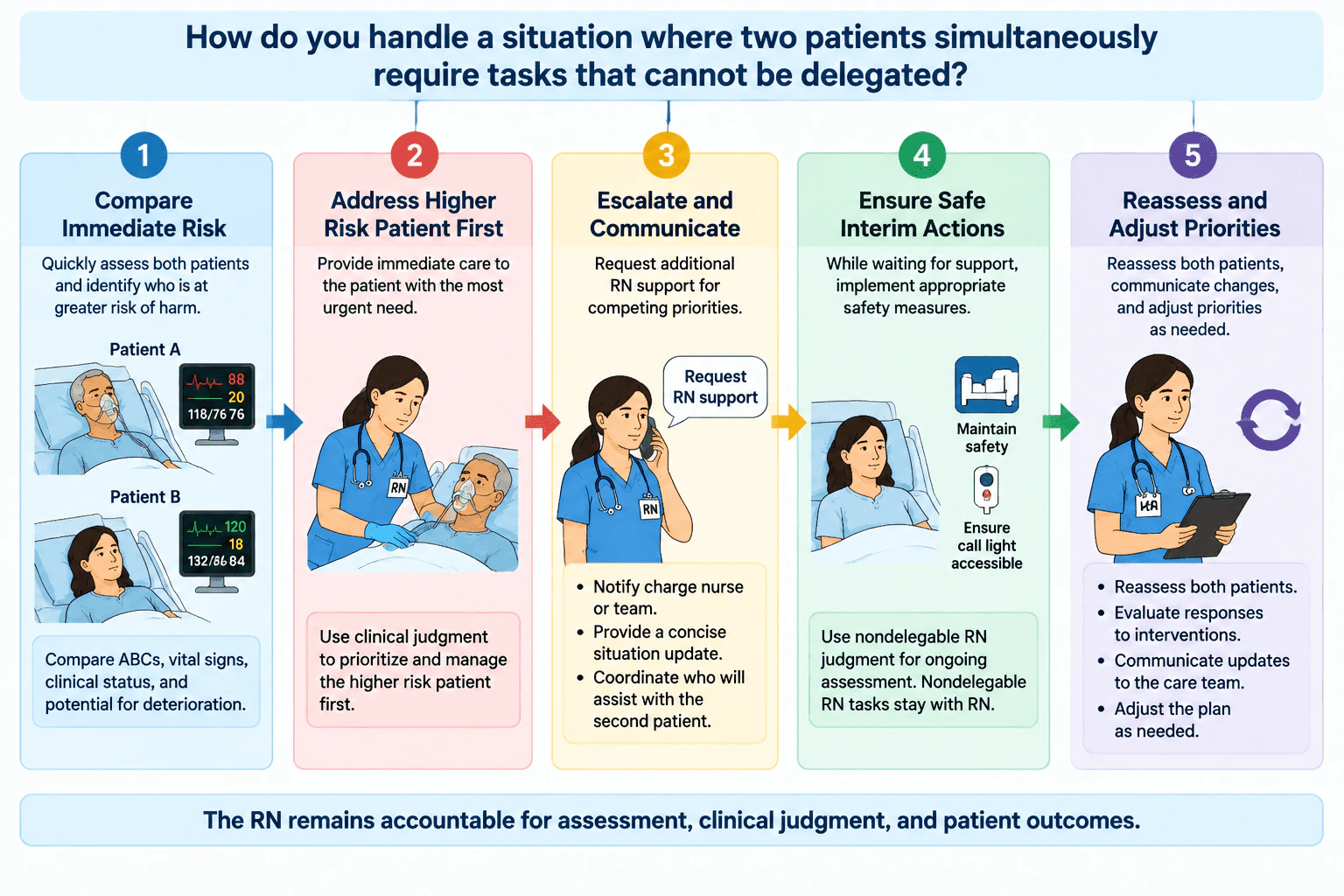
67. How do you handle a situation where two patients simultaneously require tasks that cannot be delegated?Prioritization And DelegationHard
i Question Details
Describe immediate risk comparison, activation of additional RN support, clear communication, interim safety measures, and reassessment.
Short Interview Answer (30-60 seconds)
I would first compare the immediate risks of both patients and determine which patient requires priority attention based on clinical status and potential for harm. I would address the higher risk patient first while maintaining safety for the other patient. Since the tasks cannot be delegated, I would communicate the conflict, request additional RN support or appropriate resources, and continue reassessing both patients as conditions change.
Detailed Explanation
When two patients require tasks that cannot be delegated, I would use clinical judgment to compare their immediate risks instead of prioritizing based only on timing or convenience. I would assess each patient's stability, identify the patient with the greatest immediate risk, and address that need first while maintaining safety for the other patient.
Useful Questions to Ask the Interviewer
What resources are available when multiple patients require simultaneous RN level care?
How does the unit communicate urgent changes in patient priorities?
What escalation process is used when additional RN support is needed?
How to Explain It in an Interview
Priority Setting
I would compare the patients using factors such as airway, breathing, circulation, current stability, changes in condition, and risk of deterioration. The patient with the greatest immediate risk receives priority.
Patient and Team Assessment
I would gather relevant information, communicate the competing priorities, and identify whether additional RN support is needed. Clear communication helps maintain safety while the situation is managed.
Delegation Decision
I would not delegate a task simply because someone is available. Delegation depends on patient stability, task predictability, team competence, and applicable scope and policy. Tasks requiring RN assessment, clinical judgment, or RN responsibility remain with the RN.
Supervision and Reassessment
After addressing the highest priority patient need, I would maintain interim safety measures for the other patient, communicate updates, and reassess both patients. Priorities may change as patient conditions change, so ongoing evaluation is required.
Why Interviewers Ask This
Interviewers ask this question to evaluate how the nurse manages competing priorities, applies clinical judgment, recognizes delegation limits, requests support, communicates clearly, and reassesses patients while maintaining accountability for outcomes.
Common interview mistakes
Common mistakes include choosing tasks based on convenience, delegating responsibilities that require RN judgment, failing to request help when competing priorities occur, and not reassessing patients after the initial decision.
Interview tip
Emphasize patient safety, risk comparison, communication, escalation, appropriate delegation limits, and continued RN accountability.
Interviewer may ask next
How would you verify that your priority decision was appropriate?
I would verify the decision by reassessing both patients, reviewing changes in condition, confirming safety measures, and communicating with the care team when additional evaluation or support is needed.
How would your approach change if the second patient became unstable while you were caring for the first patient?
I would reassess the updated risks, communicate the change, request additional RN support, and adjust priorities based on the current condition of both patients.
68. How do you triage a heavy patient load when multiple patients need urgent attention at once?Prioritization And DelegationHard
i Question Details
Explain rapid acuity assessment, immediate threats, calling for additional help, delegation within scope, sequencing, and continuous reassessment.
Short Interview Answer (30-60 seconds)
I begin by rapidly assessing all patients for immediate threats involving airway, breathing, circulation, unstable vital signs, or significant changes in condition. I prioritize the most unstable patients first, then address other care needs based on urgency and risk. I delegate only appropriate predictable tasks within team member scope, communicate expectations clearly, supervise the results, and continuously reassess because priorities can change.
Detailed Explanation
I triage a heavy patient load by focusing on patient stability and safety rather than simply completing tasks in order. I first identify which patients have immediate threats or rapidly changing conditions, then organize remaining care based on urgency, patient needs, and available team support.
Useful Questions to Ask the Interviewer
What team members are available for delegation in this care setting?
What escalation resources are available when multiple patients require urgent attention?
How does this unit define the scope of care for RN, LPN or LVN, and assistant roles?
How to Explain It in an Interview
Priority Setting
I start with rapid assessment using clinical judgment and prioritize patients with immediate safety concerns such as airway, breathing, circulation problems, unstable vital signs, active bleeding, or acute changes in condition. Stable patients with routine needs are addressed after higher risk concerns are managed.
Patient and Team Assessment
I evaluate patient stability, task predictability, and team competence before assigning care activities. RN, LPN or LVN, and assistant responsibilities can vary by jurisdiction and local policy, so I confirm that any delegated task is appropriate for that person and situation.
Delegation Decision
I delegate appropriate stable and predictable tasks when permitted, but I retain responsibility for assessment, nursing judgment, care planning, and evaluation. Delegation is based on patient needs and team member capability, not simply who is available.
Supervision and Reassessment
After assigning tasks, I provide clear instructions, confirm understanding, monitor outcomes, and communicate changes. I continue reassessing all patients because a previously stable patient can become a higher priority as conditions change.
Why Interviewers Ask This
Interviewers ask this question to evaluate nursing judgment during competing priorities. They want to understand how a nurse assesses patient stability, identifies urgent needs, uses delegation safely, communicates with the team, and remains accountable for patient care.
Common interview mistakes
Common mistakes include prioritizing based on convenience, delegating because someone has available time rather than appropriate competence, failing to assess patient stability first, assuming team responsibilities are identical across settings, and not supervising delegated care.
Interview tip
Explain a structured approach: assess patients, identify immediate threats, prioritize needs, delegate safely within scope, communicate clearly, and reassess continuously. Emphasize that delegation transfers tasks but does not transfer RN accountability.
Interviewer may ask next
How would you verify that your prioritization decisions were correct after patient conditions changed?
I would reassess each patient's condition, review responses to care, communicate new findings with the team, and adjust priorities based on current assessment data and safety needs.
How would your approach change if one patient became unstable while another patient needed routine scheduled care?
I would immediately reprioritize the unstable patient, address urgent safety concerns first, communicate the change to the team, delegate appropriate routine tasks when allowed, and continue monitoring all patients.
69. What is sepsis?Emergency Recognition And EscalationEasy
Short Interview Answer (30-60 seconds)
Sepsis is a serious condition where an infection triggers a harmful body response that can cause organ dysfunction. A nurse should recognize concerning changes, perform focused assessments, communicate urgency, activate appropriate support when needed, and continue reassessment and documentation while the team evaluates and treats the patient.
Detailed Explanation
Sepsis is a life threatening response to infection that can result in organ dysfunction. The nursing focus is recognizing when a patient is worsening, identifying changes from their expected condition, and ensuring timely escalation rather than waiting for further decline.
Useful Questions to Ask the Interviewer
What escalation process does this facility use when a nurse identifies possible sepsis or rapid deterioration?
How does the team communicate urgent changes in patient condition?
What reassessment and documentation practices are expected after escalation?
How to Explain It in an Interview
Recognizing Deterioration
I would explain that sepsis recognition begins with noticing concerning changes and comparing findings with the patient's baseline. This includes reviewing assessment findings, vital signs, mental status, urine output when relevant, and other available clinical information. A nurse should recognize patterns of deterioration and communicate concerns promptly.
Immediate Nursing Priorities
The priority is to assess the patient, maintain patient safety, and seek appropriate help based on the level of concern. Nursing actions should follow current applicable emergency guidance, clinical protocols, and the nurse's scope of practice. The nurse should not delay urgent escalation while completing unrelated routine tasks.
Escalation and Team Communication
When sepsis is suspected, the nurse communicates the concern clearly using structured communication and provides relevant findings, changes from baseline, and the reason for concern. Closed loop communication helps confirm that the message was received and understood. Emergency activation or rapid response support is used according to the patient's condition and applicable facility process.
Reassessment
After escalation, the nurse continues monitoring, documents assessments and actions, and evaluates the patient's response. Ongoing reassessment helps the team identify whether the patient's condition is improving or requires additional intervention.
Why Interviewers Ask This
Interviewers ask this to evaluate whether the nurse understands sepsis as an emergency condition, can recognize clinical urgency, knows when to escalate concerns, communicates effectively, and reassesses the patient's response.
Common interview mistakes
Common mistakes include treating sepsis as only an infection, delaying escalation while gathering unrelated information, using a single mnemonic for every emergency situation, or failing to reassess and document changes after concerns are communicated.
Interview tip
A strong answer connects recognition with nursing judgment. Explain how you identify changes from baseline, communicate urgency, involve the appropriate team, and continue evaluating the patient's response.
Interviewer may ask next
How would you verify that a patient may be developing sepsis?
I would verify the concern by reviewing the patient's current findings, comparing them with baseline information, assessing for signs of infection and deterioration, reviewing available clinical data, and communicating concerns through the appropriate escalation process. I would avoid relying on one isolated finding and would use current applicable guidance and local policy.
How would your response change if the patient suddenly became less responsive?
A sudden change in responsiveness would increase clinical urgency. I would immediately assess the patient, call for appropriate assistance based on the situation, communicate the change clearly, support emergency evaluation within my scope, and continue monitoring and documenting the patient's condition and response.
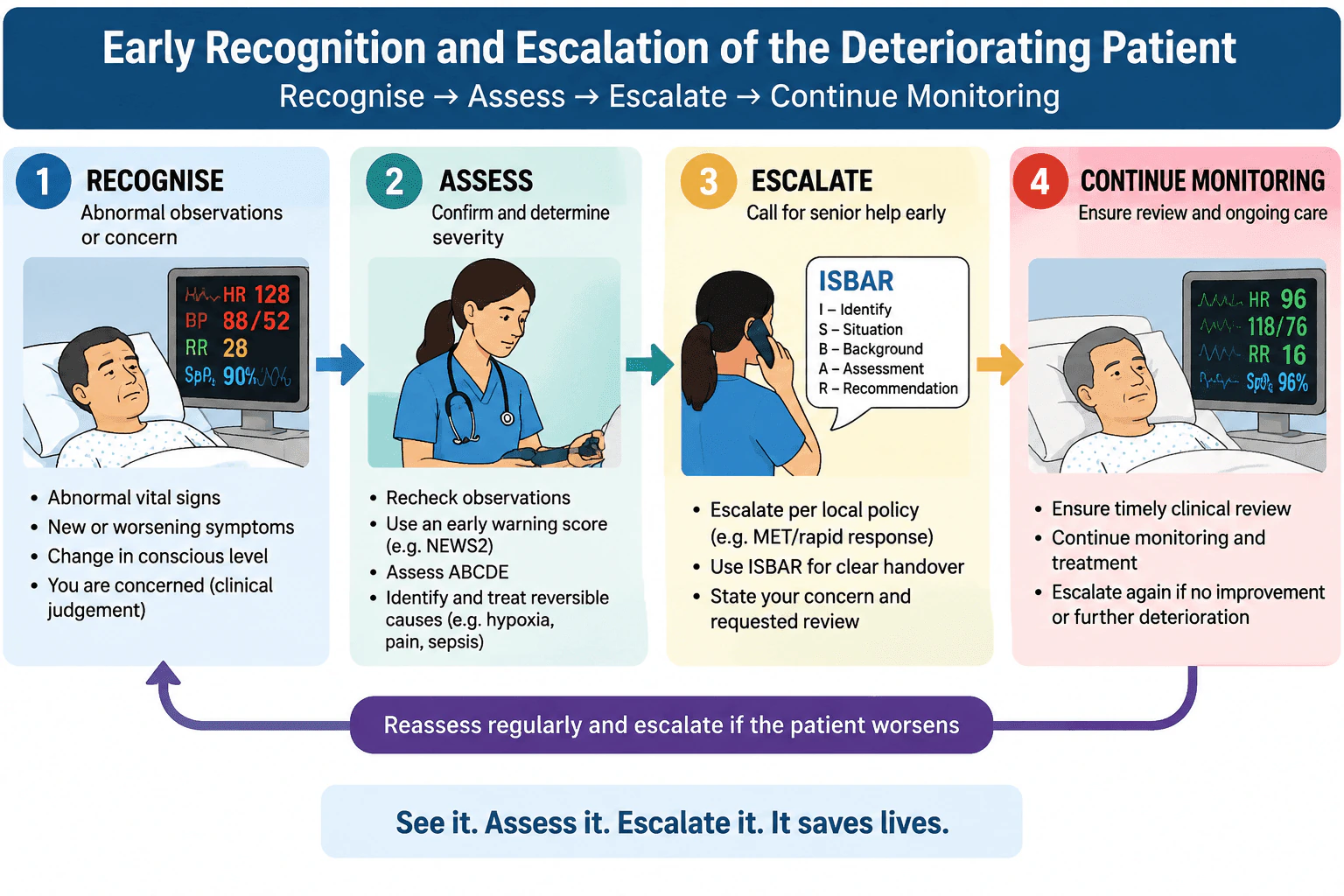
70. How do you communicate urgent patient information to the care team?Emergency Recognition And EscalationEasy
i Question Details
Explain concise identification of the problem, relevant background, current assessment, immediate concerns, and the action or response needed.
Short Interview Answer (30-60 seconds)
I communicate urgent patient information by identifying the immediate concern, sharing relevant background, describing my current assessment findings, and stating the action or response needed. I use ISBAR to organize the message, escalate concerns promptly through the appropriate pathway, confirm that the information was understood, reassess the patient, and document the communication and response.
Detailed Explanation
Communicating urgent patient information means providing concise and organized information so the care team understands the problem, the current patient condition, and the response needed. I focus on the important change from baseline, relevant assessment findings, clinical concerns, and the next action instead of unrelated details.
Useful Questions to Ask the Interviewer
What communication framework does your facility use for urgent patient escalation?
How does the team activate emergency review or rapid response support?
What documentation process is expected after urgent communication?
How to Explain It in an Interview
Recognizing Deterioration
I first identify why I am concerned about the patient. This may include abnormal observations, new symptoms, a change in consciousness, or another significant change from the patient's usual condition. I use clinical assessment findings and current guidance rather than applying one emergency approach to every situation.
Immediate Nursing Priorities
I collect the most relevant information and organize the communication around the patient's identification, current situation, background information, assessment findings, and recommended action. I prioritize urgent concerns and avoid delaying escalation while completing unrelated tasks.
Escalation and Team Communication
I use ISBAR: Identify, Situation, Background, Assessment, and Recommendation. I clearly explain my concern, provide the key assessment information, and state what response is needed. I follow the appropriate emergency activation or escalation process when the patient's condition requires urgent review.
Reassessment
After escalation, I continue monitoring the patient, evaluate whether the response addressed the concern, communicate further changes, and document relevant findings, notifications, and actions.
Why Interviewers Ask This
Interviewers ask this question to evaluate nursing judgment during urgent situations. They want to understand whether the nurse can recognize deterioration, prioritize relevant information, communicate clearly with the care team, escalate concerns appropriately, and support patient safety through reassessment and documentation.
Common interview mistakes
Common mistakes include giving an unfocused report, leaving out the current assessment, delaying escalation for unrelated tasks, failing to state the requested response, and not confirming follow up after communicating the concern.
Interview tip
Use an example that demonstrates recognition of the concern, structured communication, appropriate escalation, and reassessment. Focus on patient safety and nursing reasoning.
Interviewer may ask next
How do you verify that the care team understood your urgent communication?
I verify understanding through closed loop communication. I confirm that the receiving team member heard the concern, clarify questions, confirm the planned response, continue monitoring the patient, and document the communication and outcome.
How would your communication change if the patient's condition continued to worsen after escalation?
If the patient's condition worsened, I would reassess the patient, communicate the updated findings and increased concern, activate additional support through the appropriate escalation pathway, and provide the care team with the new information needed for further decisions.
More questions load as you scroll
Disclaimer: This interview guide is for educational and informational purposes only. It is designed to help readers prepare, but it does not guarantee any interview result, hiring decision, offer, or outcome. Interview questions, hiring criteria, and preferred answers can vary by employer, interviewer, industry, location, and time. All answers, examples, and explanations in this guide are suggested examples for interview preparation, not definitive answers or instructions for professional practice. They are based on research and judgment, are provided without warranties of any kind, and should be adapted to the question, role, and applicable laws and professional requirements. Diagrams are simplified illustrations intended to highlight the main concepts and their relationships; actual situations, systems, and practices may be more complex. Alternative approaches may be equally valid or better suited to a particular question, context, or interviewer. To the fullest extent permitted by applicable law, the contributors and publisher are not liable for decisions made, actions taken, or losses incurred based on this guide.
State Laws and Professional Responsibilities: Laws and requirements governing an occupation vary by state and jurisdiction. You are responsible for checking the current laws, licensing requirements, and scope-of-practice rules that apply to your location and role, and for ensuring that your answers and actions comply with them. Adapt examples in this guide to those requirements. This guide is not legal advice.
Content Accuracy and Verification: To the fullest extent permitted by applicable law, we do not represent or warrant that interview guides, questions, answers, examples, or diagrams are accurate, complete, current, error-free, or suitable for any particular purpose. You are responsible for independently reviewing and verifying the information before relying on it.