This interview guide is for educational and informational purposes only. It is designed to help readers prepare, but it does not guarantee any interview result, hiring decision, offer, or outcome. Interview questions, hiring criteria, and preferred answers can vary by employer, interviewer, industry, location, and time. All answers, examples, and explanations in this guide are suggested examples for interview preparation, not definitive answers or instructions for professional practice. They are based on research and judgment, are provided without warranties of any kind, and should be adapted to the question, role, and applicable laws and professional requirements. Diagrams are simplified illustrations intended to highlight the main concepts and their relationships; actual situations, systems, and practices may be more complex. Alternative approaches may be equally valid or better suited to a particular question, context, or interviewer. To the fullest extent permitted by applicable law, the contributors and publisher are not liable for decisions made, actions taken, or losses incurred based on this guide.
State Laws and Professional Responsibilities
Laws and requirements governing an occupation vary by state and jurisdiction. You are responsible for checking the current laws, licensing requirements, and scope-of-practice rules that apply to your location and role, and for ensuring that your answers and actions comply with them. Adapt examples in this guide to those requirements. This guide is not legal advice.
Identity, Image, and Privacy Notice
To respect individual privacy, some names, profile photographs, avatars, biographical details, and other identifying information displayed in this guide may be replaced with pseudonyms, licensed stock images, illustrative avatars, composite images, or representative descriptions. Unless a person is expressly identified as an actual contributor, a displayed name, image, or profile should not be understood as depicting or identifying a specific candidate, interviewer, employee, or other real individual. These representations are provided for editorial and illustrative purposes only and do not imply endorsement, employment, participation, or affiliation with this guide or any company mentioned in it. Any resemblance to an actual person is coincidental.
Company Notice
This guide is an independent educational resource and is not affiliated with, endorsed by, sponsored by, or approved by the company named in this guide. Company names identify reported interview experiences or the employer context of clearly labeled original practice exercises. Interview practices can change without notice, and inclusion of company-specific content does not mean these questions are official, complete, or guaranteed to be asked. To the fullest extent permitted by law, the author, contributors, and publisher are not responsible for outcomes related to use of this material.
Content Accuracy and Verification
To the fullest extent permitted by applicable law, we do not represent or warrant that interview guides, questions, answers, examples, or diagrams are accurate, complete, current, error-free, or suitable for any particular purpose. You are responsible for independently reviewing and verifying the information before relying on it.
Questions or comments?
Contact us for general questions, or share feedback, technical corrections, and comments with the community.
31. How do you interpret a declining Glasgow Coma Scale trend after head trauma?Patient Assessment And Clinical JudgmentHard
i Question Details
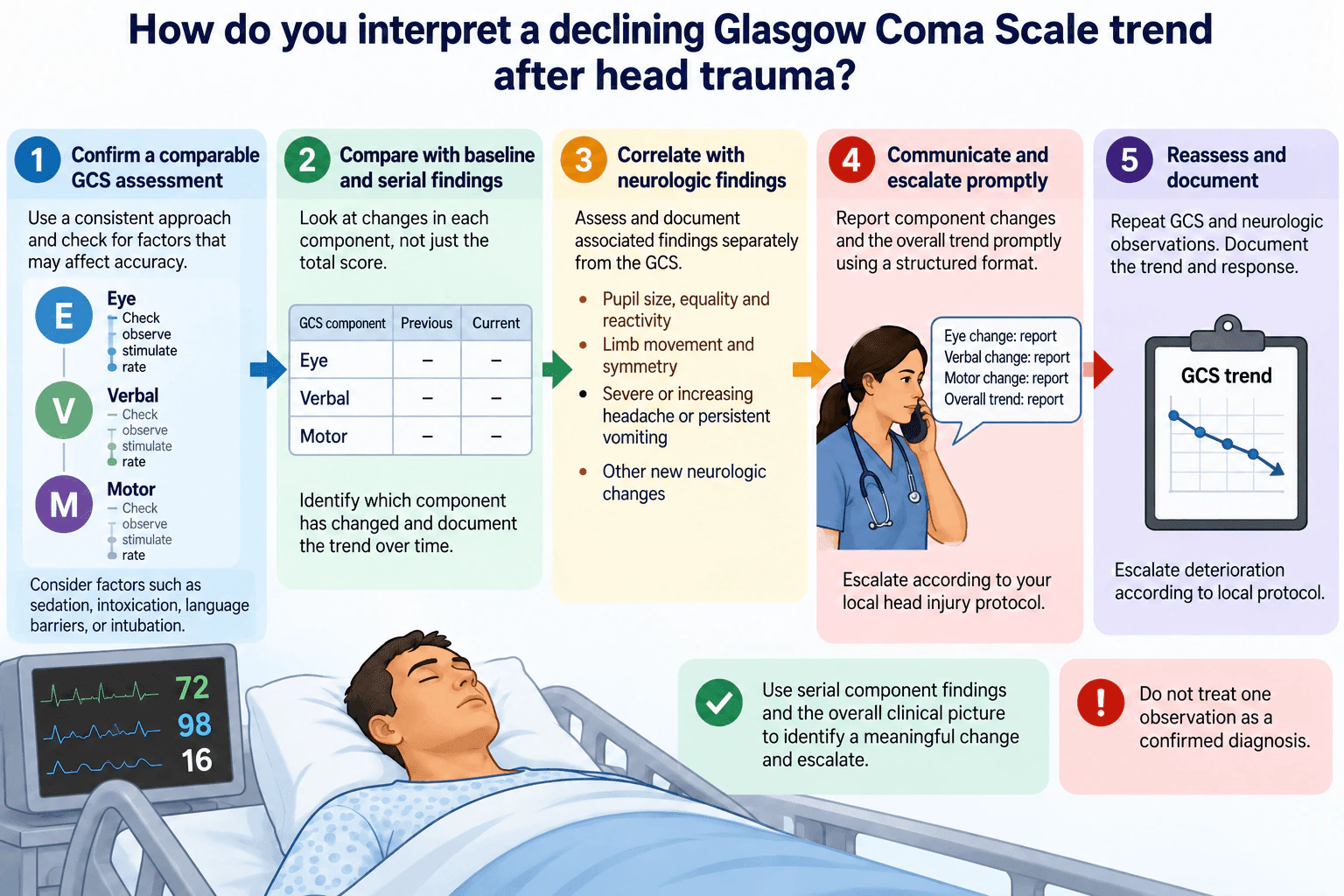
Explain consistent scoring, comparison over time, associated neurologic findings, immediate communication, and escalation according to protocol.
Short Interview Answer (30-60 seconds)
I interpret a declining Glasgow Coma Scale trend as a potentially significant change in neurologic responsiveness, not as a diagnosis by itself. I first confirm that the assessments are comparable and check for factors such as sedation, intoxication, intubation, language barriers, or other limitations that could affect scoring. I compare the eye, verbal, and motor components with the patient's baseline and previous findings, correlate the change with pupils, limb movement, headache, vomiting, and other neurologic findings, then promptly communicate the specific component changes and overall trend. I continue reassessment, documentation, and escalation according to the local head injury protocol.
Detailed Explanation
A declining Glasgow Coma Scale, or GCS, trend after head trauma means the patient's level of responsiveness is changing over time. The key is to interpret the pattern using consistent serial assessments rather than treating one total score as a diagnosis. GCS evaluates eye opening, verbal response, and motor response, and the individual component findings show exactly what has changed.
Useful Questions to Ask the Interviewer
What was the patient's baseline GCS, and how have the eye, verbal, and motor components changed over time?
Are sedation, intoxication, intubation, language barriers, associated injuries, or other factors interfering with the assessment?
What neurologic findings accompany the change, such as pupil abnormalities, asymmetric limb movement, severe or increasing headache, persistent vomiting, or other new findings?
How to Explain It in an Interview
Assessment Purpose
I would first confirm that the assessments are comparable and were performed using a consistent GCS technique. I would check for factors that could interfere with the assessment, observe spontaneous responses, use appropriate stimulation when necessary, and rate the observed response using the defined GCS criteria. A lower score is important, but I would not treat it as a diagnosis by itself.
Assessment Findings
I would compare the current eye, verbal, and motor responses with the documented baseline and previous assessments. I would identify exactly which component changed because component trends preserve information that can be lost when looking only at the total score.
I would correlate the GCS trend with other neurologic observations, including pupil size, equality and reactivity, limb movement and symmetry, severe or increasing headache, persistent vomiting, and other new neurologic findings. These are observed findings that help establish whether the patient's neurologic status is changing.
Clinical Reasoning
If the decline is confirmed, I would promptly communicate the current findings, previous findings, specific GCS component changes, associated neurologic observations, and any factors limiting the assessment using the facility's structured communication process. I would escalate the deterioration according to the applicable head injury protocol and responsible clinician pathway.
Reassessment and Escalation
I would repeat GCS and neurologic observations at the frequency required for the patient's condition and local protocol, document the ongoing trend and response, and communicate further meaningful changes. My role is to recognize and report deterioration accurately, continue reassessment, and support timely escalation rather than diagnose the underlying intracranial condition.
Why Interviewers Ask This
Interviewers are evaluating whether the nurse can recognize a clinically important neurologic trend, obtain consistent assessment findings, distinguish observations from interpretation, recognize factors that can interfere with GCS assessment, communicate specific changes promptly, and escalate deterioration without diagnosing beyond the Registered Nurse scope.
Common interview mistakes
Common mistakes include focusing only on the total GCS instead of the eye, verbal, and motor components; comparing assessments performed inconsistently; overlooking sedation, intoxication, intubation, language barriers, or injuries that can affect assessment; assigning a numeric response when a component cannot validly be tested; treating one observation as a confirmed diagnosis; failing to correlate the GCS trend with associated neurologic findings; and delaying communication or protocol based escalation of meaningful deterioration.
Interview tip
Explain the sequence clearly: verify that the assessment is comparable, compare each GCS component with baseline and previous findings, correlate the change with the neurologic assessment, communicate the exact component changes and overall trend promptly, then reassess, document, and escalate according to protocol. This demonstrates clinical judgment while staying within the Registered Nurse scope.
Interviewer may ask next
How would you verify that an apparent decline in GCS represents a true change?
I would repeat the assessment using the same structured technique and compare each eye, verbal, and motor response with the previous documented findings. I would check for interfering factors such as sedation, intoxication, intubation, language or communication barriers, and injuries that affect testing. I would document any component that cannot validly be tested rather than substituting a misleading numeric response. I would also compare associated neurologic findings and follow the applicable local process for confirmation and escalation.
How would your interpretation change if the patient were intubated?
Intubation can make the verbal component not testable, so I would document that limitation rather than assign a false verbal response or rely on a misleading total score. I would continue to assess and trend the eye and motor components, correlate them with pupils, limb findings, and the rest of the neurologic assessment, and promptly communicate and escalate any meaningful deterioration according to protocol.
32. What is an electronic health record (EHR)?Documentation And Care CoordinationEasy
Short Interview Answer (30-60 seconds)
An electronic health record, or EHR, is a digital record of a patient's health information that authorized members of the health care team can use to document and coordinate care. It may include diagnoses, medications, laboratory results, clinical notes, and care plans. For nurses, the EHR supports objective documentation, handover, continuity of care, and communication while patient information is protected according to privacy and security requirements. healthit.gov
Detailed Explanation
An electronic health record, or EHR, is a digital record of health information that can support care over time and across health care settings. Authorized clinicians use it to document and review information needed for patient care. Electronic health information can also support secure exchange of information and coordination among members of the care team. healthit.gov
Useful Questions to Ask the Interviewer
How are nurses trained on your documentation and record correction procedures?
How is important follow up information communicated during handover and transitions of care?
What privacy and access practices are emphasized when nurses use the EHR?
How to Explain It in an Interview
Documentation Purpose
I would explain that an EHR is the electronic clinical record used to document and communicate information needed for patient care. It can include diagnoses, medications, laboratory results, clinical notes, and other relevant health information. Its value is not simply that information is stored electronically. It also helps authorized clinicians access information that supports continuity and coordination of care. healthit.gov
Information to Record
As a nurse, I would document objective information and clearly distinguish what I observed, what the patient reported, and what actions I performed. I would not chart care before it occurred or copy forward findings that I had not verified. If an entry needed correction, I would follow the approved correction process rather than hiding or informally replacing the original documentation. I would also document relevant reassessment accurately.
Handover and Coordination
The EHR supports continuity by helping the care team communicate current findings, completed care, outstanding risks, and follow up responsibilities. During handover, I would use the EHR together with clear communication. One common framework is SBAR, which means Situation, Background, Assessment, and Recommendation.
Privacy
Patient information in an EHR must be protected. In the United States, the HIPAA Security Rule requires appropriate safeguards for electronic protected health information. Nurses should access and use patient information only as appropriate for their role and responsibilities and should follow applicable organizational privacy and security procedures. hhs.gov
Why Interviewers Ask This
Interviewers ask this question to confirm that a nurse understands both the purpose of an EHR and the responsibility that comes with using it. They are assessing whether the nurse connects electronic documentation with objective charting, privacy, accurate handover, continuity of care, appropriate corrections, and communication of outstanding follow up responsibilities.
Common interview mistakes
Common mistakes include describing the EHR as only a digital filing system, documenting an interpretation as though it were an observed fact, recording care before it occurs, copying forward unverified findings, failing to communicate outstanding follow up needs, using an incident report as a substitute for the clinical record, or accessing patient information without an appropriate purpose.
Interview tip
Start with a simple definition, then connect the EHR to accurate nursing documentation, communication, continuity of care, and privacy. Emphasize that nurses still need to verify information, document only what was assessed or performed, and use the approved process when a record requires correction.
Interviewer may ask next
How should a nurse verify information found in an EHR before relying on it?
The nurse should review the relevant current record and compare important information with the present assessment and other appropriate clinical sources. Historical or copied information should not automatically be treated as a current finding. If a discrepancy could affect care, the nurse should clarify it through the appropriate clinical team, communicate the concern, and document according to applicable policy and scope.
How does use of the EHR change when a patient transfers to another care setting?
During a transfer, the EHR helps communicate information needed for continuity of care, including the current condition, relevant history, completed care, outstanding risks, and follow up responsibilities. Electronic availability does not replace an appropriate handover. The nurse should communicate important information clearly and follow the applicable process for the transition of care.
33. What is SBAR?Documentation And Care CoordinationEasy
Short Interview Answer (30-60 seconds)
SBAR is a structured communication framework that stands for Situation, Background, Assessment, and Recommendation or Request. Situation explains what is happening now. Background gives the relevant clinical context. Assessment communicates the nurse's findings and clinical interpretation based on available information. Recommendation or Request states what action, response, clarification, or follow up is needed. It helps healthcare team members communicate important information clearly and concisely. ahrq.gov
Detailed Explanation
SBAR stands for Situation, Background, Assessment, and Recommendation or Request. It is a structured way to organize clinical communication so the person receiving the message can quickly understand the current concern, the relevant context, the assessment, and what is needed next. AHRQ describes SBAR as a framework for sharing information clearly and concisely among healthcare team members. ahrq.gov
Useful Questions to Ask the Interviewer
Does your organization use SBAR as its standard structure for nursing handover or clinical escalation?
How are follow up responsibilities confirmed after an SBAR communication?
Are there specific documentation expectations after an important SBAR communication?
How to Explain It in an Interview
Handover and Coordination
I would explain SBAR as a four part structure for communicating essential clinical information.
Situation states what is happening now. I would identify the immediate concern and provide only the information needed to understand why I am communicating.
Background provides the relevant clinical context, such as pertinent history, recent events, findings, treatments, or results that help explain the current situation.
Assessment communicates what I have found and what I think the problem may be based on the available information. I would distinguish objective findings from patient statements and avoid presenting an unsupported interpretation as a confirmed fact.
Recommendation or Request states what I need from the receiving clinician or what next step I am recommending within my nursing role and applicable policy. This may include requesting an assessment, clarifying the plan, communicating an unresolved concern, or confirming follow up responsibility. AHRQ also emphasizes stating what is needed and when, followed by confirmation of the response to support accurate communication. ahrq.gov
For example, if a patient's condition changes, I would briefly state the change, give only the relevant background, report my current assessment findings, and clearly communicate what response is needed. SBAR organizes communication, but it does not replace clinical judgment, required escalation procedures, or accurate documentation in the clinical record.
Why Interviewers Ask This
Interviewers ask this to assess whether a nurse understands a standard framework for organizing important clinical communication. A strong answer shows that the nurse can identify the current concern, provide relevant context, communicate assessment findings, and clearly state what response or follow up is needed while supporting safe handover and continuity of care.
Common interview mistakes
Common mistakes include giving excessive unrelated background, omitting important current findings, mixing objective observations with unsupported conclusions, failing to state what response or follow up is needed, documenting care as completed before it occurs, copying forward findings that were not verified, disclosing unnecessary identifying information, and treating an incident report as though it were the clinical record.
Interview tip
State the four SBAR components in order and briefly explain the purpose of each. Emphasize concise objective communication, clear assessment findings, and an explicit Recommendation or Request. A short anonymous example can show how SBAR supports safe handover and continuity of care without disclosing identifying patient information.
Interviewer may ask next
How do you verify that an SBAR communication was understood correctly?
I would confirm the receiving clinician's response, clarify any unclear instructions or responsibilities, and verify the agreed next steps before ending the communication. When appropriate, repeating back the response supports closed loop communication and helps confirm accuracy. I would then document clinically relevant communication and follow up according to applicable documentation requirements. AHRQ includes repeating back the response as part of effective SBAR communication. ahrq.gov
How would your SBAR change if the patient's condition suddenly worsened?
I would make the Situation immediately clear, limit the Background to information relevant to the deterioration, communicate the newest verified assessment findings, and clearly state what timely response is needed. I would follow applicable escalation procedures and local policy while continuing appropriate nursing assessment, reassessment, communication, and documentation within my scope. AHRQ identifies SBAR as particularly useful for critical communication when a patient's condition is rapidly deteriorating. ahrq.gov
34. How do you keep nursing documentation accurate and timely?Documentation And Care CoordinationEasy
i Question Details
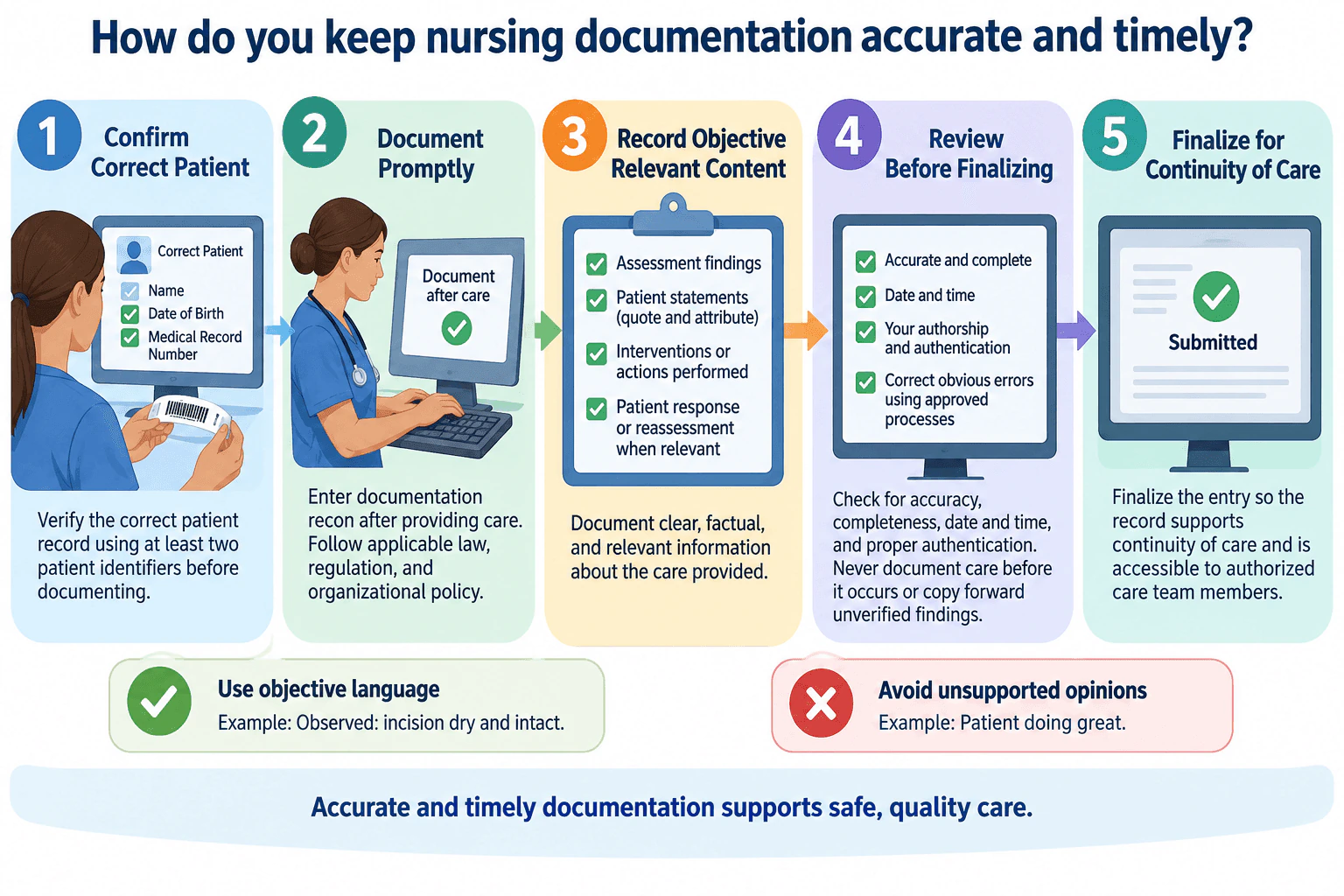
Explain objective charting, timely entries, correct patient record, relevant assessment and intervention details, and review before finalizing.
Short Interview Answer (30-60 seconds)
I first confirm that I am in the correct patient record and use the required patient identifiers. I document promptly after providing care, using clear and objective language. I separate assessment findings, patient statements, interventions or actions performed, and the patient's response or reassessment. Before finalizing, I review the entry for accuracy, completeness, date and time, authorship, and authentication. I never document care before it occurs or copy forward unverified findings. If something needs correction, I follow the approved correction process. This creates a reliable record that supports continuity of care.
Detailed Explanation
Accurate and timely nursing documentation means creating a factual record of what was assessed, what the patient reported, what care was provided, and how the patient responded. My sequence is to confirm the correct patient record, document promptly, record objective and relevant content, review the entry, and then finalize it so the care team has reliable information for continuity of care. Current Joint Commission patient identification guidance continues to require at least two patient identifiers when providing care, treatment, or services. digitalassets.jointcommission.org CMS guidance also requires hospital medical record entries to be complete, dated, timed, and authenticated and describes prompt filing of assessments, interventions, and patient responses so information is available for ongoing care. cms.gov
Useful Questions to Ask the Interviewer
What documentation system does the organization use?
What process does the organization use for correcting or adding information to a finalized entry?
What structured method does the team use for handover communication?
How to Explain It in an Interview
Documentation Purpose
I begin by confirming that I am documenting in the correct patient record. I then document as soon as practical after the care occurs so the record reflects the clinical sequence accurately and remains useful to the next caregiver.
Information to Record
I separate objective assessment findings, relevant patient statements, interventions or actions I actually performed, and the patient's response or reassessment. For example, I would document a directly observed wound finding rather than an unsupported statement that the patient is doing great. I use quotation and attribution when a patient's exact words are clinically relevant.
Before finalizing, I review the entry for accuracy, completeness, date and time, authorship, authentication, and obvious errors. I do not document an intervention as completed before it occurs, and I do not copy forward a finding unless I have verified that it remains accurate. If an entry requires correction, I use the approved correction or amendment process rather than obscuring the original record.
Handover and Coordination
The finalized record should support continuity of care. During handover, I communicate relevant current findings, outstanding risks, and follow up responsibilities using objective information from the record. When the setting uses Situation, Background, Assessment, Recommendation, or SBAR, it provides a structured way to organize that communication. AHRQ describes SBAR as a framework for sharing patient information among team members. ahrq.gov
Follow Up Responsibilities
If the patient's condition changes or an intervention requires reassessment, I document the new findings and response rather than altering the earlier entry to make it appear that the later information was known sooner. I protect patient information and use authorized clinical channels for documentation and communication. HIPAA requires safeguards and role based access policies for protected health information while allowing information exchange needed for treatment. hhs.gov
Why Interviewers Ask This
Interviewers are assessing whether the nurse understands that accurate documentation supports safe care, communication, accountability, and continuity. They want to hear a reliable process for selecting the correct patient record, documenting promptly and objectively, recording relevant assessments and interventions, reviewing entries carefully, correcting errors appropriately, protecting patient information, and communicating outstanding follow up responsibilities.
Common interview mistakes
Common mistakes include documenting in the wrong patient record, delaying an entry until important details may be forgotten, recording unsupported opinions instead of objective findings, failing to distinguish patient statements from observed findings, documenting care before it occurs, copying forward findings without verifying them, omitting the patient's response or reassessment, failing to review the entry before finalizing it, using an improper correction method, and failing to communicate outstanding risks or follow up responsibilities.
Interview tip
Explain your process in the same five step sequence shown in the diagram: confirm the correct patient, document promptly, record objective and relevant content, review before finalizing, and finalize the entry so it supports continuity of care. Add one brief example showing the difference between an objective observation and an unsupported interpretation.
Interviewer may ask next
How do you verify that a nursing entry is accurate before finalizing it?
I confirm that I am in the correct patient record and compare the entry with what I actually assessed and performed. I check that relevant assessment findings, patient statements, interventions, responses or reassessments, date and time, authorship, and authentication are accurate and complete. I remove unsupported interpretations and verify anything that may have been carried forward. If I discover an error after finalization, I use the approved correction or amendment process.
What changes if the patient's condition changes after you have documented the initial assessment?
I perform the appropriate reassessment, document the new objective findings and the patient's response, and communicate the change and any outstanding follow up responsibility to the appropriate team member. I do not rewrite the earlier entry to make it appear that the later information was known at the original time. The record should accurately show the sequence of assessment, change, actions, communication, and reassessment.
35. How do you ensure continuity of care during shift handoff?Documentation And Care CoordinationMedium
i Question Details
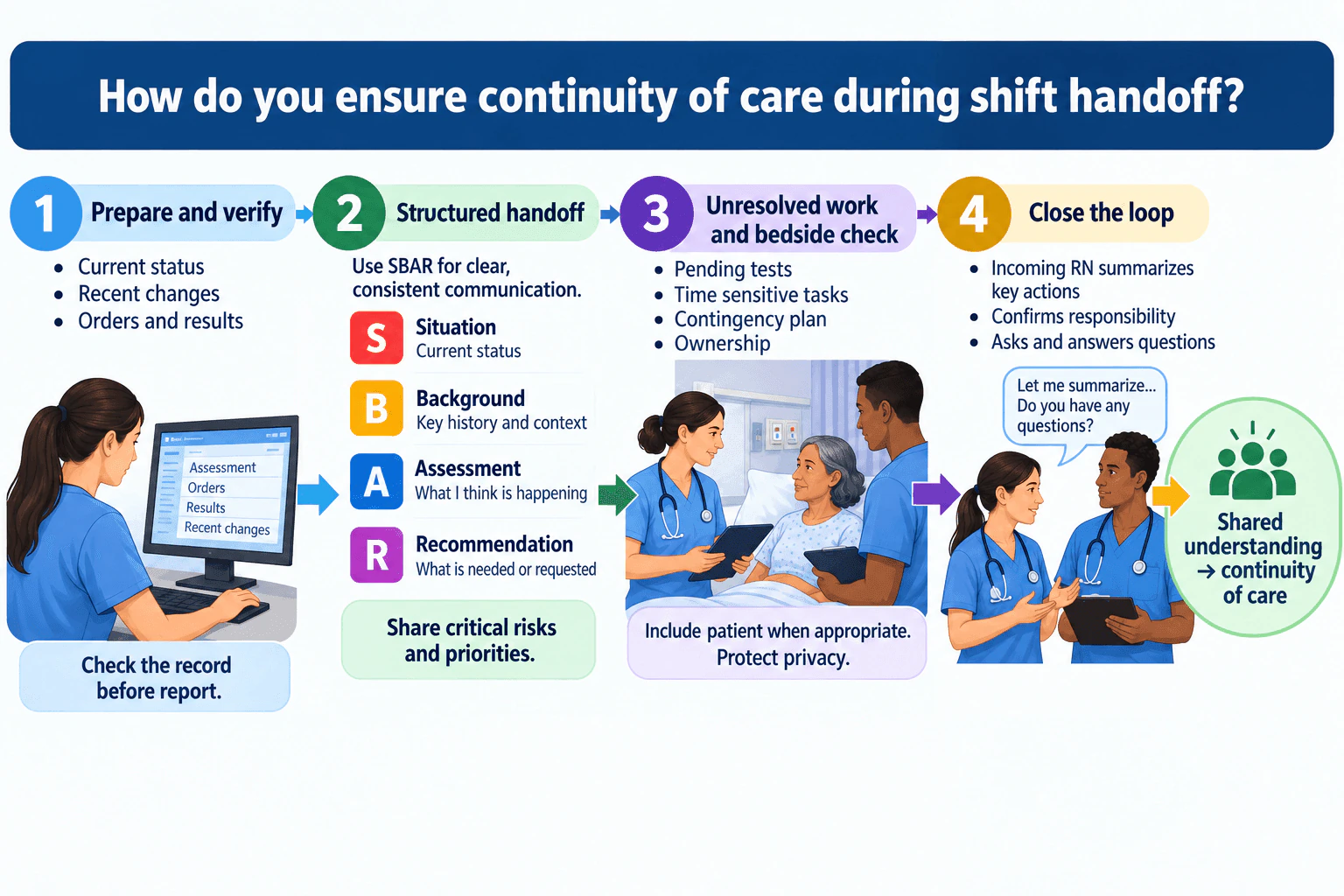
Explain structured communication, verification of critical information, unresolved priorities, bedside involvement when appropriate, and opportunity for questions.
Short Interview Answer (30-60 seconds)
I prepare before handoff by reviewing the current clinical record and verifying the patient's status, recent changes, relevant orders, results, and outstanding priorities. I use a structured format such as SBAR, meaning Situation, Background, Assessment, and Recommendation, to communicate clearly. I identify pending tests, time sensitive tasks, contingency plans, and who is responsible for follow up. When appropriate, I involve the patient at the bedside while protecting privacy. I finish by having the incoming nurse summarize key actions, confirm responsibility, and ask questions so we have shared understanding before the transfer is complete.
Detailed Explanation
Continuity of care during shift handoff depends on transferring accurate information, unresolved responsibilities, and a shared understanding of what must happen next. I prepare before report rather than relying on memory. I verify the current record and my current assessment, separate objective findings from patient statements and nursing actions, and identify recent changes, relevant orders and results, pending work, risks, and follow up responsibilities.
Useful Questions to Ask the Interviewer
What structured handoff method does your nursing team use?
How is bedside involvement incorporated when it is appropriate for the patient and setting?
How are outstanding tasks and transfer of responsibility documented or confirmed?
How to Explain It in an Interview
Preparation and Verification
Before handoff, I review the current clinical record and verify the patient's current status, recent changes, relevant orders, results, and care priorities. I do not rely on copied information that has not been verified or document care as completed before it occurs.
Structured Communication
I use the organization's structured handoff method. SBAR is one example. Situation states what is happening now, Background gives the relevant context, Assessment communicates my current nursing assessment, and Recommendation communicates what is needed next. The goal is concise communication without omitting information that affects ongoing care.
Unresolved Priorities and Bedside Involvement
I explicitly identify pending tests, time sensitive tasks, current risks, contingency plans, and who is responsible for follow up. When bedside handoff is appropriate, I involve the patient so the incoming nurse can confirm current needs and the patient can contribute or clarify information. I also use reasonable privacy safeguards so protected information is not unnecessarily disclosed.
Closing the Loop
I do not assume that giving report means the message was understood. I give the incoming nurse an opportunity to summarize critical actions, confirm responsibility, clarify information, and ask questions. If something does not match the record or the patient's current condition, I resolve the discrepancy before relying on it. The handoff is complete when the receiving nurse understands and accepts the relevant information and responsibilities. This creates shared understanding and supports continuity of care.
Why Interviewers Ask This
Interviewers want to know whether the nurse can transfer accurate, prioritized information and responsibility without creating gaps in care. The question evaluates communication, verification, prioritization, accountability, privacy awareness, appropriate patient involvement, and the ability to use confirmation and questions to identify misunderstandings before the handoff is complete.
Common interview mistakes
Common mistakes include giving report from memory without checking the current record, omitting pending tests or time sensitive tasks, failing to identify who owns follow up responsibilities, presenting unsupported interpretations as objective facts, copying forward unverified findings, documenting care before it occurs, assuming the receiving nurse understood without confirmation, overlooking patient questions when bedside participation is appropriate, and discussing protected information without reasonable privacy safeguards.
Interview tip
Describe handoff as a transfer of both information and responsibility. A strong answer follows the same flow as the diagram: prepare and verify, communicate with a structured method such as SBAR, identify unresolved work and involve the patient when appropriate, then close the loop through confirmation and questions. Emphasize that you verify rather than assume.
Interviewer may ask next
How do you verify that the information you are handing off is accurate?
I compare the handoff information with the current clinical record and my most recent assessment. I verify recent changes, relevant orders and results, pending work, documented responses to care, and follow up responsibilities rather than relying on memory or copied information. If the record, verbal report, and current patient condition do not agree, I clarify the discrepancy before presenting it as established information.
What would you do if the patient's condition changed during the handoff?
I would shift attention to the patient's current clinical needs, perform the nursing assessment and actions appropriate to my scope and the situation, and communicate the change promptly through the appropriate clinical pathway. I would then update the receiving nurse with the new status, actions already taken, unresolved concerns, contingency needs, and revised priorities. Before completing the transfer, I would confirm that the receiving nurse understands the changed plan and responsibility for follow up.
36. How do you hand off a complex patient with multiple unresolved issues?Documentation And Care CoordinationHard
i Question Details
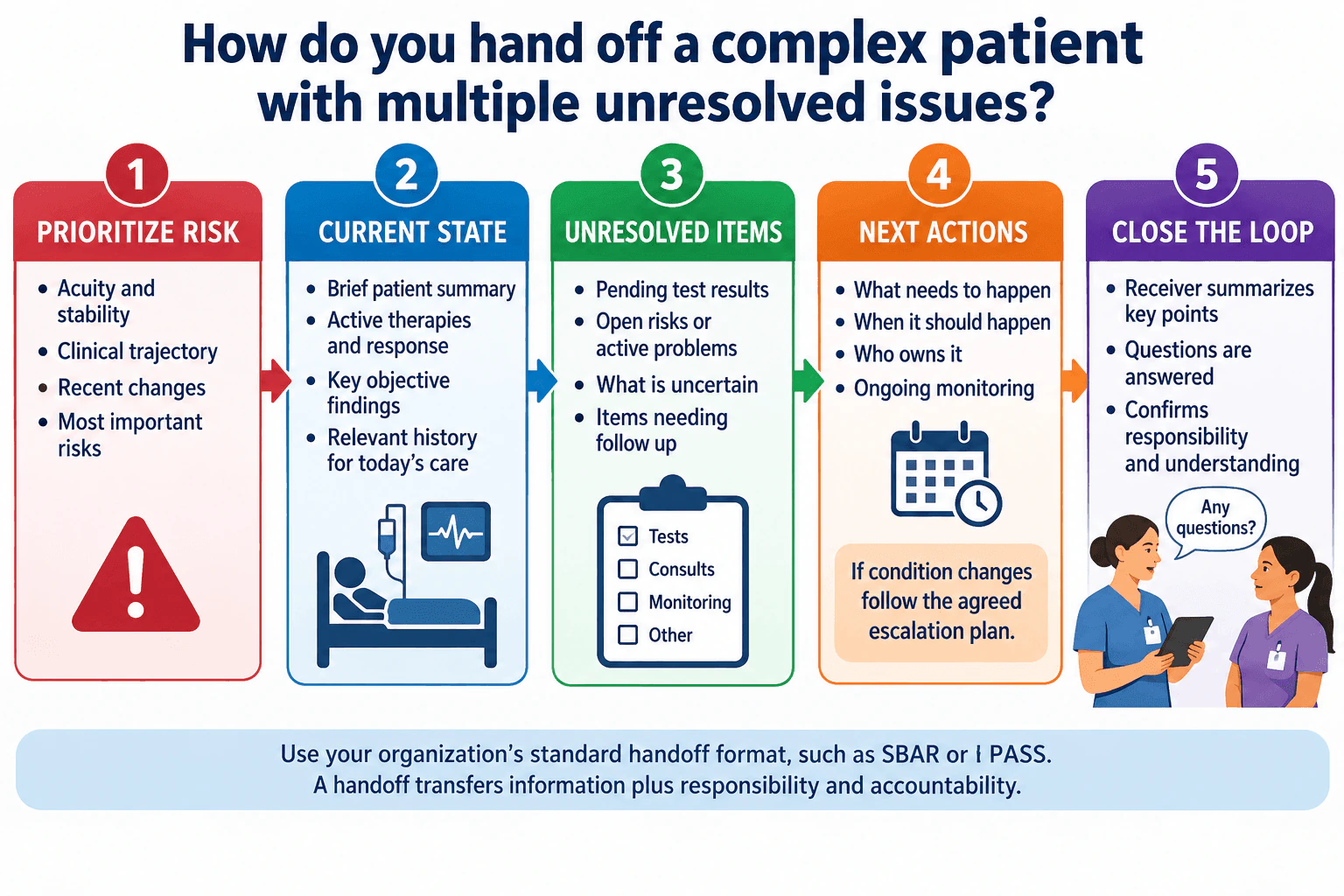
Explain concise prioritization of current risks, clinical trajectory, active therapies, pending results, contingency plans, and specific next actions.
Short Interview Answer (30-60 seconds)
I prioritize the most important current risks first, including acuity, stability, clinical trajectory, and recent changes. Then I summarize the current state, active therapies and response, and key objective findings. Next I identify unresolved problems, pending results, uncertainty, and items needing follow up. For each item, I state what needs to happen, when it should happen, who owns it, what monitoring is required, and what the contingency plan is if the condition changes. I finish with closed loop communication so the receiver summarizes the key points, asks questions, restates important actions, and confirms responsibility.
Detailed Explanation
A complex handoff should not be a complete retelling of the chart. The goal is to transfer the information and responsibility the next nurse or clinician needs to continue care safely. I organize the handoff around five ideas: prioritize risk, describe the current state, identify unresolved items, define the next actions, and close the loop.
Useful Questions to Ask the Interviewer
Which standardized handoff framework does your organization use?
How are pending results and outstanding tasks tracked across shift changes?
What is the expected escalation process when a patient's condition changes during a transition of care?
How to Explain It in an Interview
Handover and Coordination
I start with the highest priority risks. I state the patient's current acuity and stability, clinical trajectory, important recent changes, and the risks that matter most for the next period of care.
Then I give a concise current state. I include a brief patient summary, active therapies and the response to them, key objective findings, and only the history that is relevant to today's care. I separate observed findings, patient statements, and actions actually performed so I do not present assumptions as facts.
Next I identify every important unresolved item. That includes pending test results, active problems, uncertainty, consultations or monitoring still needed, and anything requiring follow up. I do not describe care as completed before it occurs or rely on unverified copied forward information.
Follow Up Responsibilities
For each unresolved issue, I state what must happen next, when it should happen, and who is responsible. I include ongoing monitoring and a contingency plan describing what should happen if the patient's condition changes. This prevents vague instructions such as simply saying to keep an eye on the patient.
I finish with closed loop communication. The receiving nurse or clinician summarizes the key points, restates the important actions, asks questions, and confirms responsibility and understanding. I do not assume that responsibility transferred merely because information was sent or documented.
I use the organization's approved handoff method, such as SBAR or I PASS when applicable, and communicate patient information only through appropriate clinical channels to people involved in the patient's care.
Why Interviewers Ask This
Interviewers are evaluating whether the nurse can prioritize a large amount of clinical information, distinguish immediate risk from background detail, communicate uncertainty, maintain continuity of care, and transfer outstanding responsibilities without allowing pending results or follow up tasks to be missed.
Common interview mistakes
Common mistakes include giving a long chronological report without prioritizing risk, omitting the clinical trajectory or response to therapy, failing to identify pending results, presenting uncertainty as confirmed information, leaving follow up tasks without clear timing or ownership, omitting contingency plans, documenting actions before they occur, copying forward unverified findings, and ending the handoff without confirming that the receiver understands and accepts responsibility.
Interview tip
Use the same sequence as the diagram: prioritize risk, describe the current state, identify unresolved items, define the next actions, and close the loop. Explicitly state what needs to happen, when it should happen, and who owns it. That demonstrates prioritization, continuity of care, and accountability.
Interviewer may ask next
How do you verify that unresolved information is accurate before handing it off?
I verify pending results, current therapies, recent objective findings, and outstanding actions against the current clinical record and applicable orders or care plan. I distinguish observed findings from patient statements and from information that remains uncertain. If documentation needs correction, I use the approved correction process and document reassessment accurately rather than overwriting or silently changing the record.
How would your handoff change if the patient's condition became unstable just before shift change?
I would prioritize the new instability immediately, complete the nursing assessment and escalation appropriate to the situation and local protocol, and communicate the updated risk and actions already taken. The handoff would begin with the current instability and recent change, followed by active therapies and response, unresolved issues, the contingency or escalation plan, and the specific monitoring and next actions. I would close the loop by confirming that the receiving nurse or clinician understands the updated plan and has accepted responsibility.
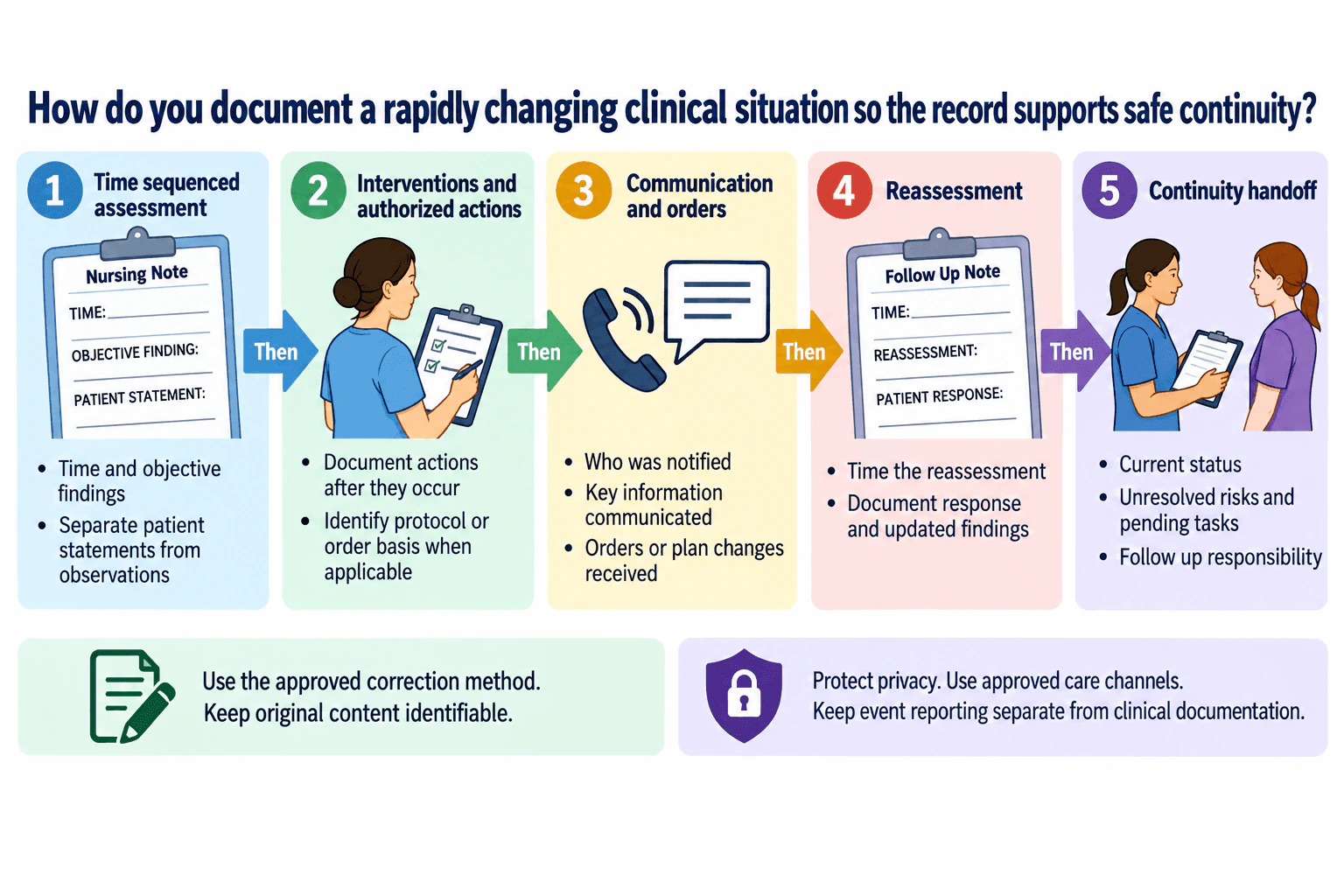
37. How do you document a rapidly changing clinical situation so the record supports safe continuity?Documentation And Care CoordinationHard
i Question Details
Describe time sequenced assessment findings, interventions, communication, orders or protocol actions, reassessment, and unresolved risks.
Short Interview Answer (30-60 seconds)
I document the situation in time sequence. I record objective findings and clearly separate them from the patient’s statements, then document interventions or authorized actions after they occur. I record who was notified, the important information communicated, and relevant orders or protocol actions. I then document reassessment, updated findings, and the patient response. At handoff, I communicate the current status, unresolved risks, pending tasks, and who is responsible for follow up. I use approved correction methods, protect privacy, and keep event reporting separate from clinical documentation.
Detailed Explanation
A rapidly changing situation should read as a clear clinical timeline. Another qualified clinician should be able to understand what changed, what actions occurred, what was communicated, how the patient responded, and what still requires attention. Documentation should remain objective and distinguish observed findings, patient statements, and actions actually performed.
Useful Questions to Ask the Interviewer
What documentation and handoff standards does this organization use for rapidly changing clinical situations?
Which structured communication method, such as SBAR, is expected for escalation and handoff?
What is the approved process for correcting or adding information to the clinical record?
How to Explain It in an Interview
Documentation Purpose
I would create a time sequenced record that allows the next clinician to understand the changing situation. I would document objective findings and clearly identify information reported by the patient rather than presenting an unsupported interpretation as fact.
Information to Record
I would record the time and relevant assessment findings, then document interventions or authorized actions after they occur. When relevant, I would identify whether an action was based on an order or an approved protocol. I would not document care as completed before it happened or copy forward findings that I had not verified.
When I communicate a significant change, I would document who was notified, the important clinical information communicated, and relevant orders or plan changes received. When appropriate, SBAR, meaning Situation, Background, Assessment, and Recommendation or Request, provides a structured way to communicate important information.
Reassessment
After an intervention or change in plan, I would document the time of reassessment, updated objective findings, and the patient response. This gives the next clinician current information rather than only the initial assessment.
Handover and Coordination
At handoff, I would communicate the current status, unresolved risks, pending tasks, and who is responsible for follow up. The receiving clinician should have an opportunity to clarify information so important work is not lost during transition.
I would protect patient information by using approved care channels and following applicable privacy requirements and organizational policy. If I discovered a documentation error, I would use the approved correction process so the original content and correction remain identifiable. If event reporting is required, I would complete it through the appropriate reporting process while still documenting clinically relevant facts and care in the clinical record.
Why Interviewers Ask This
Interviewers are evaluating whether the nurse can create an accurate, objective, time sequenced record during a changing clinical situation while supporting safe continuity. They want to see that the nurse distinguishes observations from patient statements, records care after it occurs, documents important communication and authorized actions, reassesses the patient, transfers unresolved risks and responsibilities during handoff, protects privacy, and corrects documentation appropriately.
Common interview mistakes
Common mistakes include documenting an interpretation as though it were an objective finding, failing to distinguish patient statements from observations, charting care before it occurs, omitting reassessment, failing to document who was notified or what was communicated, leaving unresolved risks or pending tasks out of handoff, copying forward unverified findings, altering the record outside the approved correction process, sharing patient information through inappropriate channels, or using an event report as a substitute for clinical documentation.
Interview tip
Describe the documentation as a timeline that another nurse could safely continue from. Walk through assessment findings, completed actions, communication and orders or protocol actions, reassessment, and continuity handoff in that order. Emphasize objective language, clear ownership of pending work, privacy, and accurate record correction.
Interviewer may ask next
How would you verify that your documentation and handoff accurately reflect what happened?
I would compare the record with my contemporaneous assessment, the actions actually completed, communication that occurred, applicable orders or authorized protocol actions, and the documented reassessment. Before handoff, I would confirm that the current status, unresolved risks, pending tasks, and follow up responsibility are represented accurately. If I later identify an error, I would use the approved correction process rather than deleting or obscuring the original content.
How would your documentation change if the patient’s condition changed again after the initial intervention?
I would add a new time sequenced entry rather than altering the earlier assessment. I would document the new objective findings and relevant patient statements, any additional completed actions or escalation, who was notified and what was communicated, new orders or protocol actions when applicable, and another reassessment. I would then update the handoff so the current status, unresolved risks, pending tasks, and follow up responsibility reflect the latest clinical context.
38. What is diabetes?Adult Health And Medical Surgical NursingEasy
Short Interview Answer (30-60 seconds)
Diabetes is a chronic disease in which blood glucose becomes too high. Normally, insulin made by the pancreas helps glucose enter cells for energy. In diabetes, the body may make little or no insulin, may not use insulin properly, or may have both problems. The main types are type 1 diabetes, type 2 diabetes, and gestational diabetes. Over time, high blood glucose can contribute to damage involving the heart, kidneys, eyes, nerves, and other body systems.
Detailed Explanation
Diabetes is a chronic disease in which blood glucose, also called blood sugar, is too high. Glucose is an important source of energy. Insulin is a hormone made by the pancreas that helps glucose move from the bloodstream into cells. Diabetes occurs when the body does not make enough insulin, makes no insulin, or does not use insulin properly. The most common types are type 1 diabetes, type 2 diabetes, and gestational diabetes.
Useful Questions to Ask the Interviewer
Would you like me to focus only on the definition or also explain the major types of diabetes?
Would you like me to include the main nursing considerations for an adult with diabetes?
How to Explain It in an Interview
Condition and Patient Context
I would explain that diabetes is a disorder of glucose regulation. Normally, insulin helps glucose enter cells so it can be used for energy. In diabetes, that process is impaired and glucose remains elevated in the bloodstream. In type 1 diabetes, the immune system destroys the pancreatic cells that make insulin, so the body makes little or no insulin. In type 2 diabetes, the body does not use insulin properly and may also fail to make enough insulin. Gestational diabetes develops during pregnancy.
Assessment Findings
Possible symptoms include increased thirst, frequent urination, fatigue, blurred vision, increased hunger, sores that heal slowly, and sometimes unexplained weight loss. Some people, particularly those with type 2 diabetes, may have few or no noticeable symptoms. A nurse relates symptoms and glucose findings to the full clinical picture rather than diagnosing diabetes from symptoms alone.
Nursing Priorities
For a patient with known diabetes, nursing care includes assessing the patient, monitoring glucose information as ordered or authorized by protocol, recognizing signs of abnormal glucose levels, supporting appropriate nutrition and self care education, administering ordered treatment within nursing scope, and communicating concerning findings. Long term glucose management is important because diabetes can contribute to heart disease, kidney disease, eye disease, nerve damage, and other complications.
Response to Care
The nurse reassesses symptoms and relevant glucose trends, evaluates the patient's response to the established care plan, documents findings, and communicates or escalates unexpected or concerning changes according to the clinical situation, orders, protocol, and local policy.
Why Interviewers Ask This
Interviewers may ask this question to confirm that a Registered Nurse can explain a common chronic condition accurately in simple language, distinguish the major types, connect the condition with relevant assessment and monitoring, and remain within nursing scope.
Common interview mistakes
Common mistakes include describing diabetes as simply eating too much sugar, treating every type of diabetes as the same condition, assuming symptoms alone establish the diagnosis, overlooking patients who have few or no symptoms, or discussing medication changes as though a Registered Nurse independently prescribes treatment.
Interview tip
Start with the relationship among glucose, insulin, and the body's cells. Then briefly distinguish the major types and explain why persistent high blood glucose matters. Keep the answer within Registered Nurse scope by emphasizing assessment, monitoring, ordered or protocol authorized care, education, reassessment, communication, and appropriate escalation.
Interviewer may ask next
How is diabetes verified instead of being diagnosed from symptoms alone?
Symptoms may raise concern, but diabetes is diagnosed using appropriate blood testing interpreted by a qualified health care professional. The Registered Nurse may obtain or review ordered test results, assess the patient, recognize relevant trends, communicate abnormal findings, and follow the established plan of care without independently making a medical diagnosis.
How would the nursing focus change if an adult with diabetes were recovering from surgery?
The nurse would combine routine postoperative assessment with diabetes related monitoring. Relevant priorities can include monitoring the patient's condition and glucose information according to orders or authorized protocols, assessing the surgical site and signs of infection, supporting nutrition and activity as appropriate, administering ordered therapy, reassessing the response, documenting findings, and escalating concerning changes. Surgery, illness, changes in food intake, and prescribed treatment can affect glucose control, so trends and the overall clinical picture are important.
39. What is heart failure?Adult Health And Medical Surgical NursingEasy
Short Interview Answer (30-60 seconds)
Heart failure is a clinical syndrome in which a structural or functional problem with the heart interferes with ventricular filling or the ejection of blood. It does not mean the heart has stopped. Common findings can include shortness of breath, fatigue, reduced activity tolerance, swelling, and fluid related weight gain. As a nurse, I would recognize relevant findings, monitor trends, carry out authorized or ordered care, reassess the patient's response, communicate important changes, and escalate deterioration appropriately.
Detailed Explanation
Heart failure is a complex clinical syndrome caused by structural or functional impairment of ventricular filling or the ejection of blood. The 2022 American Heart Association, American College of Cardiology, and Heart Failure Society of America guideline uses this definition. Heart failure does not mean that the heart has stopped. Patients can experience symptoms such as shortness of breath, fatigue, weakness, difficulty breathing while lying flat, swelling, and fluid related weight gain.
Useful Questions to Ask the Interviewer
Would you like me to focus on the basic definition or also discuss common nursing assessments?
Would you like me to explain how nursing priorities change when chronic heart failure worsens?
How to Explain It in an Interview
Condition and Patient Context
Heart failure occurs when abnormal heart structure or function interferes with ventricular filling or blood ejection and produces symptoms or signs. It is important to clarify that the heart has not stopped. Heart failure can occur with reduced or preserved ejection fraction, so I would not describe every patient as simply having a weak pump.
Assessment Findings
I would connect the condition with findings that may reflect congestion or reduced functional capacity, such as shortness of breath, fatigue, reduced activity tolerance, difficulty breathing while lying flat, swelling, and changes in weight related to fluid accumulation. I would assess the patient's current symptoms and compare them with previous findings. Depending on the clinical context and care plan, relevant monitoring may include respiratory status, edema, weight, intake and output, vital signs, oxygen saturation, mental status, and overall activity tolerance.
Nursing Priorities
Independent nursing responsibilities include focused assessment, appropriate positioning for comfort and breathing, monitoring, education within the plan of care, communication, documentation, and reassessment. Medications, diagnostic tests, oxygen therapy when an order or protocol is required, and other treatments are carried out according to authorized orders, protocols, and local policy. I would not independently prescribe treatment or diagnose heart failure.
Response to Care
I would evaluate whether symptoms and objective findings are improving, unchanged, or worsening. New or significant respiratory distress, worsening congestion, altered mental status, signs of poor perfusion, or another important clinical decline would require prompt escalation according to the patient's condition and local process. After interventions, I would reassess and communicate the patient's response.
Why Interviewers Ask This
Interviewers ask this question to confirm that the nurse understands the basic meaning of heart failure and can connect the condition with common symptoms, congestion, reduced functional capacity, nursing assessment, reassessment, communication, and appropriate escalation while remaining within the Registered Nurse scope.
Common interview mistakes
Common mistakes include saying that heart failure means the heart has stopped, assuming that every patient has reduced ejection fraction, describing the condition only as a weak heart muscle, relying on one finding instead of trends, omitting reassessment, confusing nursing assessment with medical diagnosis, and discussing medications or treatment decisions as though the Registered Nurse independently prescribes them.
Interview tip
Start with a simple definition, clarify that the heart has not stopped, connect the condition with common symptoms and nursing assessment, distinguish independent nursing actions from ordered or protocol authorized treatment, and finish with reassessment and escalation of meaningful deterioration.
Interviewer may ask next
How would you verify that a patient with symptoms suggestive of heart failure actually has heart failure?
Symptoms alone do not establish the diagnosis. The diagnosing clinician uses the medical history, physical examination, and appropriate testing. Testing may include blood studies such as B type natriuretic peptide, an electrocardiogram, and cardiac imaging. Echocardiography can evaluate cardiac structure, function, and left ventricular ejection fraction. For heart failure with preserved or mildly reduced ejection fraction, evidence of increased filling pressures may also be needed to support classification. The nurse contributes by collecting accurate assessment data, carrying out ordered testing, monitoring the patient, communicating relevant findings, and documenting the response rather than independently making the medical diagnosis.
How would your nursing approach change if a patient with known heart failure suddenly became much more short of breath?
I would treat the change as potential clinical deterioration rather than assuming it is the patient's usual condition. I would promptly reassess respiratory status, oxygen saturation, vital signs, symptoms, mental status, circulation, and other relevant findings. I would position the patient appropriately for breathing and safety, initiate actions authorized by applicable orders or protocols, and promptly escalate according to the severity of the findings and local process. I would then reassess the response, communicate changes clearly, and document the assessment, actions, and patient response.
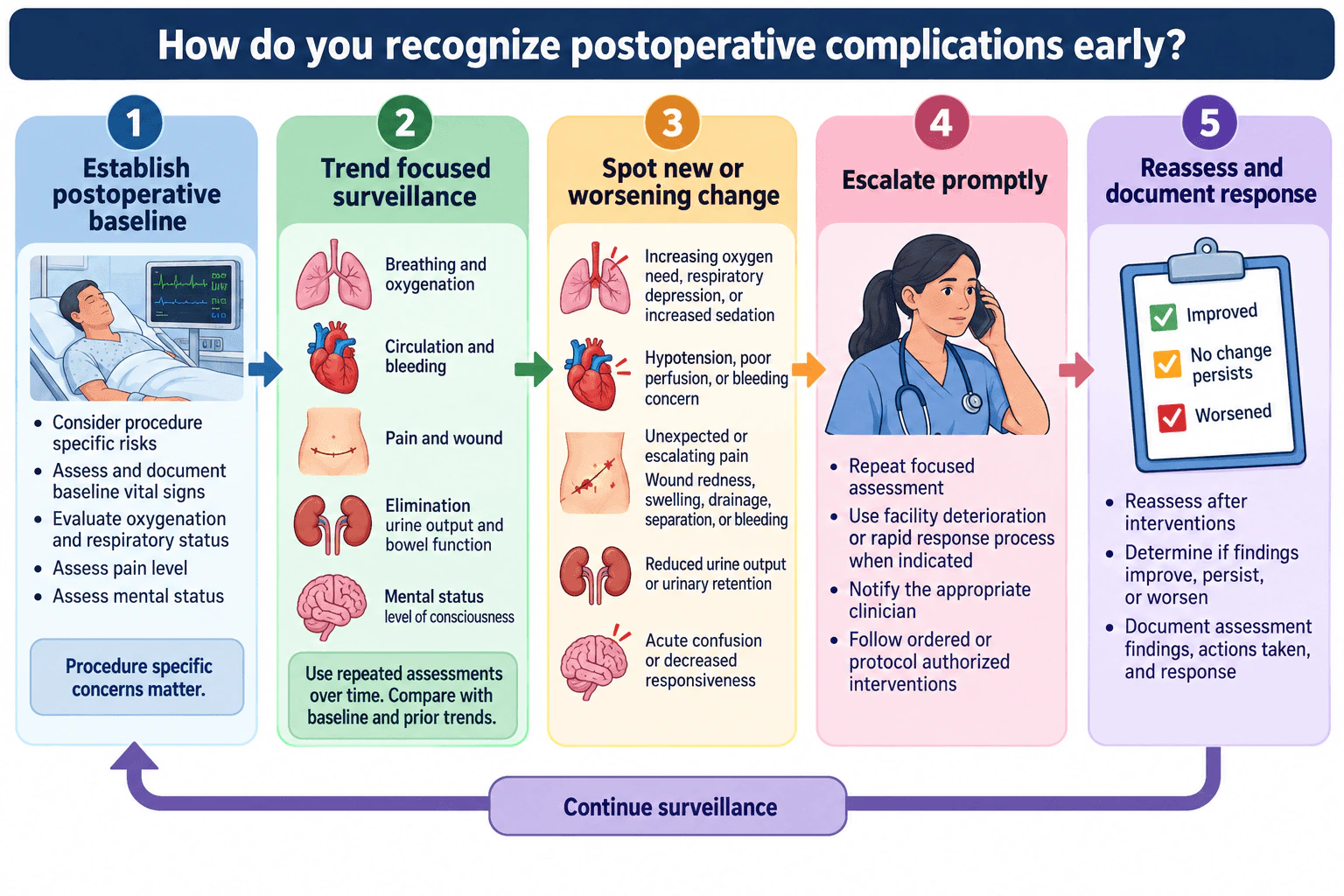
40. How do you recognize postoperative complications early?Adult Health And Medical Surgical NursingMedium
i Question Details
Describe surveillance for changes in respiratory status, circulation, pain, bleeding, wound findings, elimination, mental status, and other procedure specific concerns.
Short Interview Answer (30-60 seconds)
I start with the patient's postoperative baseline and procedure specific risks. Then I trend breathing and oxygenation, circulation and bleeding, pain and wound findings, urine output and bowel function, and mental status. I look for new or worsening changes such as increasing oxygen need, respiratory depression, hypotension, poor perfusion, bleeding, unexpected or escalating pain, worsening wound findings, reduced urine output or urinary retention, or acute confusion. I repeat a focused assessment, escalate through the appropriate clinician or facility deterioration process, follow ordered or protocol authorized interventions, then reassess and document whether the patient improves, remains unchanged, or worsens.
Detailed Explanation
Early recognition is a cycle of establishing a postoperative baseline, trending focused findings, spotting new or worsening changes, escalating when indicated, and reassessing the response. Postanesthetic guidance supports periodic assessment of respiratory and cardiovascular function, mental status, pain, fluid status, urine output, drainage, and bleeding. asahq.org Guidance for acutely ill adults also supports trending respiratory rate, oxygen saturation, blood pressure, heart rate, level of consciousness, and temperature, with added monitoring such as urine output and pain when clinically appropriate. nice.org.uk
Useful Questions to Ask the Interviewer
What procedure and anesthesia did the patient receive?
What was the immediate postoperative baseline, and what has changed since then?
What procedure specific complications or monitoring requirements are most relevant?
How to Explain It in an Interview
Condition and Patient Context
I first establish what is expected after the specific procedure and compare current findings with the postoperative baseline. Procedure specific risks matter because the priorities vary with the operation, anesthesia, comorbidities, and stage of recovery.
Assessment Findings
I trend breathing and oxygenation, circulation and bleeding, pain and wound findings, urine output and bowel function, and mental status. I focus on new or worsening patterns. Concerning examples include increasing oxygen need, respiratory depression or increasing sedation, hypotension or poor perfusion, bleeding, unexpected or escalating pain, worsening redness, swelling, drainage or wound separation, reduced urine output or urinary retention, and acute confusion or decreased responsiveness.
Nursing Priorities
I repeat a focused assessment and compare the findings with prior trends. If deterioration is suspected, I communicate the change and use the facility escalation or rapid response process when indicated. I notify the appropriate clinician and carry out interventions that are already ordered or authorized by protocol rather than independently prescribing treatment.
Response to Care
After an intervention, I reassess the same abnormal findings and determine whether the patient improved, remained unchanged, or worsened. I document the assessment, actions, communication, interventions, and response. I then continue surveillance because postoperative complications can evolve over time.
Why Interviewers Ask This
Interviewers want to see whether the nurse can recognize deterioration from trends, connect findings with postoperative risks, prioritize assessment, escalate appropriately, distinguish independent nursing surveillance from ordered or protocol authorized treatment, and evaluate the patient's response.
Common interview mistakes
Common mistakes include focusing on one isolated vital sign, failing to compare findings with the patient's baseline and trend, overlooking mental status or elimination changes, assuming unexpected pain is routine without reassessment, ignoring procedure specific risks, delaying escalation despite clinical concern, performing treatment outside nursing authority, and failing to reassess and document the patient's response.
Interview tip
Explain postoperative surveillance as a continuous cycle: establish the baseline, trend focused findings, recognize new or worsening changes, reassess and escalate, then evaluate and document the response. Make clear that treatment beyond independent nursing measures follows orders, protocols, and local policy.
Interviewer may ask next
How would you verify that a suspected postoperative complication reflects true deterioration rather than an isolated abnormal reading?
I would repeat the focused assessment, verify the abnormal measurement with appropriate technique and equipment, compare it with the patient's baseline and prior trend, and assess related clinical findings. I would also consider the procedure and recovery stage. If the patient appears clinically unstable, I would not delay escalation simply to obtain repeated measurements. I would communicate the verified findings and trend through the appropriate escalation process.
How would your surveillance change if the procedure carried a higher risk of postoperative bleeding?
I would keep the same systematic surveillance cycle but give greater attention to circulation, perfusion, bleeding, wound or drain findings, pain changes, and other procedure specific signs. I would compare these findings with the postoperative baseline and prior trend. A concerning new or worsening pattern would prompt focused reassessment and timely escalation according to the patient's condition and facility process, followed by reassessment and documentation after interventions.
More questions load as you scroll
Disclaimer: This interview guide is for educational and informational purposes only. It is designed to help readers prepare, but it does not guarantee any interview result, hiring decision, offer, or outcome. Interview questions, hiring criteria, and preferred answers can vary by employer, interviewer, industry, location, and time. All answers, examples, and explanations in this guide are suggested examples for interview preparation, not definitive answers or instructions for professional practice. They are based on research and judgment, are provided without warranties of any kind, and should be adapted to the question, role, and applicable laws and professional requirements. Diagrams are simplified illustrations intended to highlight the main concepts and their relationships; actual situations, systems, and practices may be more complex. Alternative approaches may be equally valid or better suited to a particular question, context, or interviewer. To the fullest extent permitted by applicable law, the contributors and publisher are not liable for decisions made, actions taken, or losses incurred based on this guide.
State Laws and Professional Responsibilities: Laws and requirements governing an occupation vary by state and jurisdiction. You are responsible for checking the current laws, licensing requirements, and scope-of-practice rules that apply to your location and role, and for ensuring that your answers and actions comply with them. Adapt examples in this guide to those requirements. This guide is not legal advice.
Content Accuracy and Verification: To the fullest extent permitted by applicable law, we do not represent or warrant that interview guides, questions, answers, examples, or diagrams are accurate, complete, current, error-free, or suitable for any particular purpose. You are responsible for independently reviewing and verifying the information before relying on it.