227 Php Developer Interview Questions & Answers

116 top • 13 Amazon • 21 Google • 10 Netflix • 7 Meta • 18 NVIDIA • 21 Apple • 21 Microsoft

Php Developer icon

Questions with Detailed ExplanationsWith Detailed Explanations

(Last Updated: September 3, 2026)

61. How should a PHP application handle database schema migrations?Sql / DatabaseMedium

Question Details

Explain version-controlled migration files, forward and rollback behavior, deployment ordering, backward-compatible changes, data migrations, locking, and recovery from partial failure.

Short Interview Answer (30-60 seconds)

I use ordered, version-controlled migrations run once by the deployment pipeline, not by web requests. I record completed versions, lock the runner, use expand-and-contract changes for compatibility, batch large data updates, and recover with safe retries, corrective migrations, or a tested restore plan.

Detailed Explanation

This question asks how a PHP team should safely change the way stored information is organized while the application continues to serve users. Each change must be saved, reviewed, applied in the correct order, and recorded so it is not repeated. The answer should also explain how an older and a newer application release can both keep working during an update, how existing information is moved safely, how two update jobs are prevented from running together, and how the team recovers when only part of a change finishes.

Useful clarifying questions:

Useful Questions to Ask the Interviewer
  • Which database system and migration tool are being used?
  • Must the deployment avoid application downtime?
  • Can old and new PHP versions run at the same time during deployment?
  • How large are the affected tables and data sets?
  • Which schema operations can the database execute transactionally?
  • What backup, restore, and deployment rollback procedures are available?
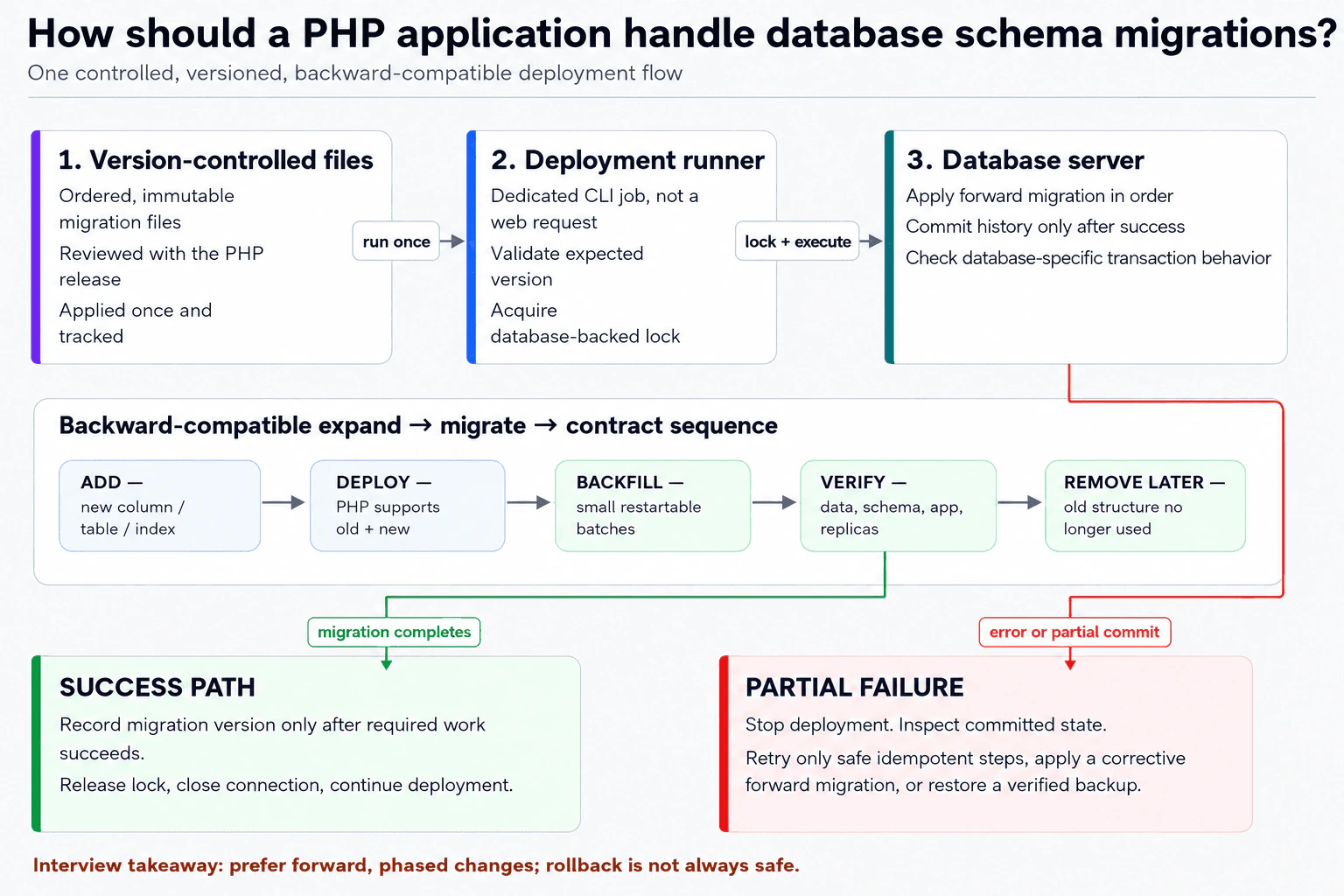
How should a PHP application handle database schema migrations? diagram
How to Explain It in an Interview

I treat migrations as production code. Each database change belongs in an ordered, immutable, version-controlled migration file. It should be reviewed with the PHP code that depends on it, tested against a production-like copy of the previous schema, and executed through a dedicated deployment or command-line process.

I would not run migrations automatically from a normal PHP web request or from every application instance during startup. That can create duplicate execution, long request times, lock contention, and unpredictable failures. One controlled deployment job should run the migrations before or during the application rollout according to the compatibility plan.

The migration tool should maintain a history table containing a unique migration identifier and the fact that it completed. Before applying a migration, the runner reads this history and validates the expected current version. It records completion only after the required work has succeeded. Applied migration files should not later be edited because different environments may already have executed the original contents. A correction should be a new migration.

The normal strategy is to move forward. A rollback function can be useful for a simple, reversible change, such as removing a newly added unused object. However, rollback is unsafe when a migration drops columns, deletes rows, changes values irreversibly, or has already been used by a newer PHP release. For these cases, I prefer a corrective forward migration or restoration from a verified backup rather than claiming that every change can be reversed.

Deployment ordering matters because the schema and PHP code may not change at the same instant. For zero-downtime or rolling deployments, I use an expand-and-contract sequence:

  1. Add the new table, column, index, or other structure without removing the old one.
  2. Deploy PHP code that remains compatible with the old and new database states.
  3. When necessary, temporarily write to both representations or read from the new representation with a controlled fallback.
  4. Backfill existing rows in restartable batches.
  5. Verify completeness and switch all reads and writes to the new structure.
  6. Confirm that no deployed PHP version still depends on the old structure.
  7. Remove the old structure in a later release.

For example, directly renaming a column can break older PHP workers that still query its original name. A safer process is to add the replacement column, deploy compatible PHP code, copy the existing values, switch application access, verify the result, and remove the old column only after every running version has stopped using it.

Schema migrations and data migrations should usually be separated when the data operation is large. A schema migration changes database objects such as tables, columns, constraints, or indexes. A data migration changes existing rows. Combining a long backfill with a deployment-critical schema change can extend locks, increase database load, enlarge transaction or replication logs, delay replicas, and make recovery harder.

A large data migration should process a limited number of rows per batch using a stable key, such as a primary key, to mark progress. Each batch should be safe to retry. The job should commit between batches when appropriate, pause or reduce its rate if database load becomes unsafe, and verify the result with checks such as remaining-row counts, invalid-value counts, or application-specific invariants. It should not load the entire table into PHP memory.

Transaction behavior must be checked for the selected database and operation. Some databases support transactional schema changes for many statements. Other databases implicitly commit certain schema statements or cannot roll them back. Therefore, calling beginTransaction() in a PHP migration runner does not by itself guarantee that an entire schema migration is atomic. The migration design and recovery plan must match the actual database behavior.

When a migration is fully transactional, the schema or data changes and the migration-history record should be committed together where the tool and database permit it. When operations are not transactional, the migration should use small, explicit, observable steps. Each step should either be idempotent or check the current database state before continuing. Idempotent means safely repeating the step reaches the same correct result instead of creating duplicates or corruption.

Only one migration runner should operate on the same database at a time. I would use the migration tool's database-backed locking feature, a database advisory lock, or a dedicated lock row with safe atomic acquisition. A lock stored only in one PHP process or on one application server is insufficient when several servers or deployment jobs exist. The lock should have a bounded wait policy, clear failure reporting, and release behavior when the migration connection ends or the runner exits.

The migration runner should use a dedicated database connection with migration-specific credentials. Those credentials should have only the permissions required for the approved migration process. The runner should fail on database errors, log the migration identifier and failed step without exposing secrets, release its lock, close the connection, and return a nonzero command-line status so the deployment pipeline stops.

Before deployment, I would test both a clean installation and an upgrade from the exact previous production version. I would also estimate table size, expected lock behavior, index build cost, replication impact, available disk space, backup readiness, and whether the PHP release can operate in every intermediate state.

If a migration fails after some operations have succeeded, I would stop the remaining deployment and inspect the actual database state. I would not blindly rerun the complete file, blindly execute a rollback, or manually mark the history record as complete. Recovery depends on what committed:

  • Retry the failed step when it is safe and idempotent.
  • Apply a new corrective forward migration when the partial state needs repair.
  • Restore from a tested backup or snapshot when destructive damage cannot be repaired safely.

After recovery, I would verify the schema, constraints, indexes, affected data, migration history, application health, and replica health before resuming deployment. The central principle is that every migration must have a defined forward path, compatibility window, concurrency policy, verification method, and recovery plan.

Technical Approach
  1. Define the target schema and identify every PHP version that may run during deployment.
  2. Create a new ordered migration file and never modify an already-applied migration.
  3. Separate quick schema changes from long-running data backfills.
  4. Design destructive or incompatible changes with expand-and-contract phases.
  5. Test a clean installation and an upgrade from the exact previous production schema.
  6. Check database-specific transaction, locking, index-build, and rollback behavior.
  7. Prepare backups, verification queries, observability, and a recovery decision before deployment.
  8. Run the migration once through a dedicated command-line or deployment job.
  9. Acquire a database-backed lock and validate the current migration history.
  10. Apply each change in order and record completion only after its required work succeeds.
  11. Run large data changes in bounded, restartable, rate-controlled batches.
  12. Verify schema objects, constraints, indexes, affected data, application compatibility, and replica health.
  13. Release the lock, close the migration connection, and allow the deployment to continue only after success.
  14. Remove obsolete structures in a later deployment after no running PHP version uses them.
  15. On partial failure, stop, inspect committed state, and choose a safe retry, corrective migration, or tested restore.
Practical Insights

The cost depends on the database, table size, operation, and available online-change features. A small metadata change may finish quickly, while adding an index, validating a constraint, changing a column type, or rebuilding a table may read or rewrite many rows and use substantial temporary disk space. A data backfill normally takes work proportional to the number of rows it examines or changes. Small batches keep PHP memory use bounded because only one batch is held at a time, but they add repeated query and commit overhead. Temporary old-and-new structures require extra storage, code, monitoring, and cleanup. Long transactions can retain locks and old row versions, grow logs, delay replicas, and make rollback expensive, so production migrations should be measured and rate-controlled.

Why Interviewers Ask This

Interviewers want to know whether the candidate can change a production database without breaking running PHP application versions or losing data. The question evaluates migration versioning, deployment ordering, backward compatibility, schema and data migration design, concurrency control, transaction limitations, operational risk, and recovery judgment. It also tests whether the candidate understands that a database deployment and an application deployment may complete at different times.

Common interview mistakes

Common mistakes include running untracked SQL manually in production; executing migrations from normal web requests; allowing every PHP instance to migrate during startup; editing a migration after it has been applied; assuming a PHP transaction makes every schema statement reversible; recording migration completion before all required steps succeed; deploying PHP code before its required schema exists; dropping or renaming objects while older PHP versions still use them; combining a long backfill with a deployment-critical schema change; processing an entire table in PHP memory; using offset pagination for a changing backfill instead of stable key-based progress; holding one very large transaction unnecessarily; ignoring table locks, disk usage, replicas, and transaction-log growth; relying on a process-local lock in a multi-server deployment; blindly retrying a partially committed migration; treating every rollback method as safe; manually changing the migration-history table without repairing the database; and removing the old structure before compatibility and data verification are complete.

Interview tip

Present the answer in this order: version-controlled migrations, one controlled runner, migration history, expand-and-contract deployment, separate batched data migrations, database-specific transaction limits, database-backed locking, and partial-failure recovery. State clearly that rollback is not always safe and every intermediate schema must support the PHP versions that can still be running.
Interviewer may ask next
How would you safely rename a database column without downtime?

I would use expand-and-contract rather than a one-step rename. First, I would add the new column. Next, I would deploy PHP code that can work with both columns and, when necessary, temporarily write to both. I would backfill old rows in restartable batches, verify that the new column is complete, switch all reads and writes to it, confirm that no running PHP version uses the old column, and remove the old column in a later migration.

What should happen if a migration fails after some statements have already committed?

The deployment should stop and preserve the exact error, migration identifier, and completed-step information. I would inspect the real schema and data state instead of blindly rerunning or rolling back the file. If the next operation is idempotent, I would correct the cause and retry safely. Otherwise, I would apply a new corrective forward migration or restore from a verified backup when destructive damage cannot be repaired. I would update migration history only after the database reaches a confirmed consistent state.

62. How do you prevent lost updates when two PHP requests modify the same row?Sql / DatabaseMedium

Question Details

Compare optimistic locking with a version column, pessimistic row locks, transaction isolation, retries, and how to return a conflict to the client.

Short Interview Answer (30-60 seconds)

I prefer an atomic UPDATE when possible. Otherwise, I use optimistic locking with a version column and return HTTP 409 when the version changed. For short, high-contention read-modify-write work, I use SELECT FOR UPDATE in a transaction and retry only recognized transient failures.

Detailed Explanation

See the Code while reading this explanation.

This question asks how to stop one person's saved change from silently replacing another person's change when both work on the same record at nearly the same time. The answer should explain whether the program detects the clash when saving or temporarily makes the other request wait. It should also cover what happens after a clash, whether trying again is safe, and what response the user or calling system receives.

Useful Questions to Ask the Interviewer
  1. Are clashes rare or frequent?
  2. Is the new value based on an earlier read?
  3. Can the change be safely repeated?
  4. Must users review competing edits?
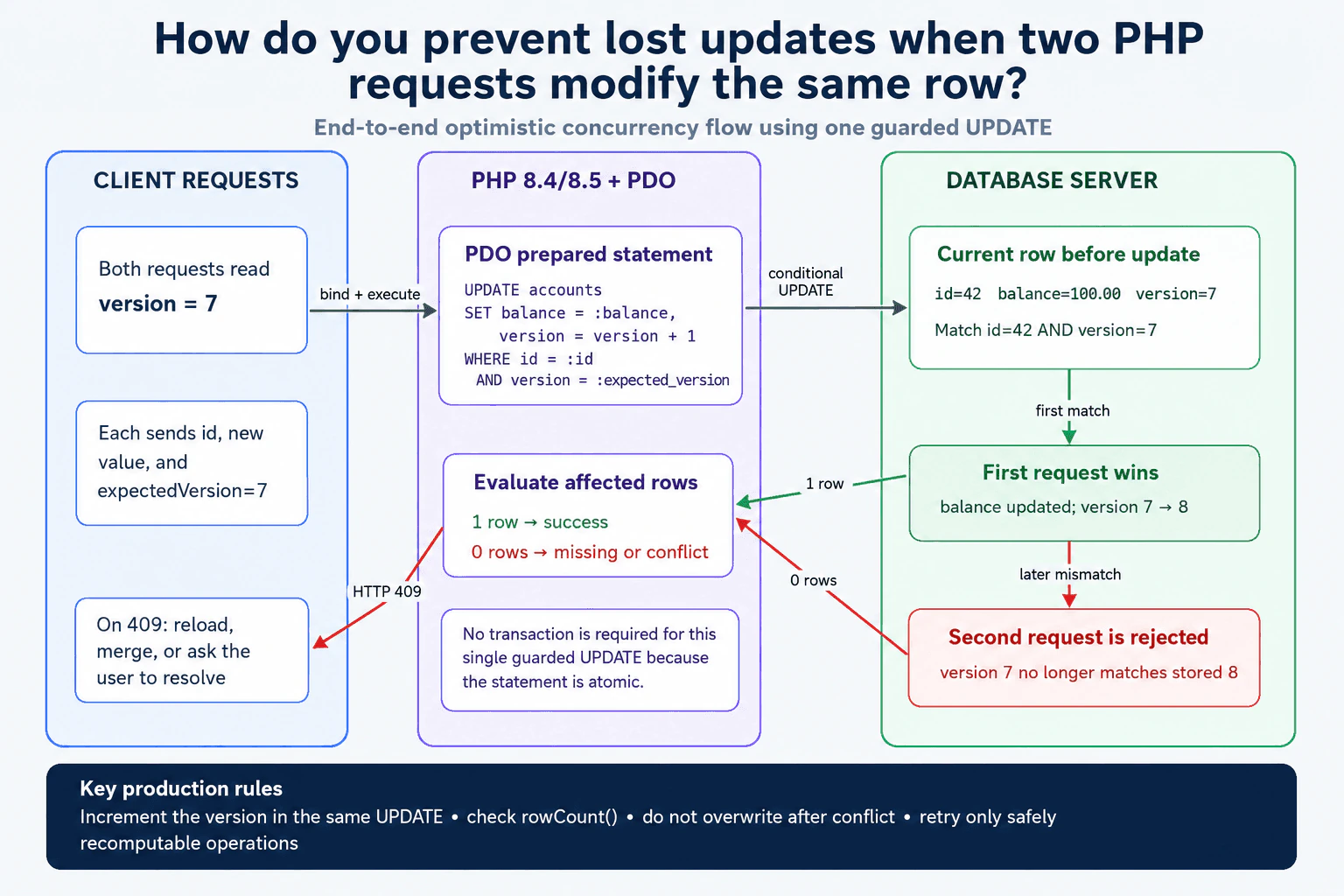
How do you prevent lost updates when two PHP requests modify the same row? diagram
How to Explain It in an Interview

A lost update occurs when two PHP requests read the same row, both calculate a new value from that old state, and then both write. The second write can silently replace the first.

My first choice is an atomic SQL statement when the change can be expressed entirely in the database. For example, this avoids a PHP-side read followed by a replacement write:

UPDATE counters SET value = value + :amount WHERE id = :id;

The database applies the increment as one statement, so concurrent increments are not lost. This is usually simpler and safer than reading the value into PHP, adding to it, and writing the result back.

For editable resources such as profiles, tickets, or product records, I normally use optimistic locking when conflicts are expected to be uncommon. The table contains a version column such as an integer declared NOT NULL with an initial value. The client receives that version when it reads the row. The update succeeds only if the stored version still equals the version the client originally read:

UPDATE accounts SET balance = :balance, version = version + 1 WHERE id = :id AND version = :expected_version;

The version comparison and increment happen in the same statement. If the statement affects one row, the update succeeded. If it affects zero rows, the row may not exist or its version may have changed. Because the version is incremented on every successful match, PDO::rowCount() is suitable here for determining whether the guarded update matched under the expected MySQL behavior. If the application must distinguish a missing row from a version conflict, it can perform a separate read after the failed update, while accepting that the row may change again between those statements.

For a version conflict, the API should normally return HTTP 409 Conflict. It can include the current version and current representation so the client can reload, merge changes, or ask the user to choose. The server must not silently issue an unconditional UPDATE because that would recreate the lost-update problem.

Optimistic locking does not keep a database lock while a user is viewing or editing data. That makes it a good default for web applications. Its cost is that conflicts must be handled explicitly. A retry is safe only when the operation can be recomputed from the newest state without hiding another user's meaningful change.

For short operations that must read the current row, make a decision, and write while excluding competing writers, I use pessimistic locking. The PHP request starts a transaction, reads the row with SELECT ... FOR UPDATE, performs the validation and update, and commits. Competing transactions requesting an incompatible lock on that row wait until the first transaction commits or rolls back.

The locked transaction must remain short. It should not wait for user input, make a slow network call, send an email, or perform unrelated work while holding the lock. Long transactions increase lock waiting, reduce throughput, and increase the chance of deadlocks. The lookup should use a primary key or another suitable index so the database can locate the intended row efficiently and avoid locking more data than necessary.

Transaction isolation must be discussed carefully. Starting a transaction does not automatically make a plain SELECT followed by an unconditional UPDATE safe. Under commonly used isolation levels, both transactions may still read the same old value and later overwrite each other. A conditional update, an atomic SQL expression, or an explicit locking read is still needed. Serializable isolation can prevent more concurrency anomalies, but it can reduce concurrency and may abort transactions with serialization failures, so retry handling is still required.

Isolation behavior and locking details vary by database engine. For example, SELECT FOR UPDATE syntax, lock scope, timeout behavior, and serialization error codes are database-specific. The application should test against the actual production database rather than assume identical behavior across MySQL, PostgreSQL, SQL Server, or another system.

Retries should be bounded and limited to recognized transient failures such as deadlocks, serialization failures, or lock timeouts when retrying is appropriate. Each attempt must begin a new transaction because a failed or rolled-back transaction cannot simply continue. A small retry limit with randomized backoff helps prevent all competing requests from retrying at the same moment.

The operation must also be safe to repeat. If a transaction charges a card, sends a message, publishes an event, or calls another service, blindly retrying may duplicate the side effect. The design should use an idempotency key, an outbox pattern, or another deduplication mechanism when external effects are involved.

In PDO, all statements in one transaction must use the same PDO connection. I enable exception-based error handling, bind untrusted values through prepared statements, commit only after every required statement succeeds, and roll back when an exception occurs and a transaction remains active. Prepared statements protect values, but they do not provide concurrency control and do not make untrusted table or column names safe.

Key Insight / Why This Solution Works
  1. Determine whether the change can be expressed as one atomic SQL statement.
  2. Use that atomic statement when possible instead of reading and replacing the value in PHP.
  3. For low-contention editing, return a version value with the row and require it in a conditional UPDATE.
  4. Increment the version in the same successful UPDATE.
  5. Check the affected-row count.
  6. If no row matched, distinguish not-found from conflict when required and return HTTP 409 for a version conflict.
  7. For short, contention-sensitive read-modify-write operations, begin a transaction and read the indexed row with SELECT FOR UPDATE.
  8. Validate and update on the same connection, then commit promptly.
  9. Roll back on failure.
  10. Retry only recognized transient database failures with a small limit and backoff.
  11. Ensure retries cannot duplicate external side effects.
Code
<?php

declare(strict_types=1);

final class ConflictException extends RuntimeException
{
    /** @param array{id: int, balance: string, version: int} $current */
    public function __construct(public readonly array $current)
    {
        parent::__construct('The row was changed by another request.');
    }
}

final class NotFoundException extends RuntimeException
{
}

/**
 * @return array{id: int, balance: string, version: int}
 */
function updateAccountBalance(
    PDO $pdo,
    int $accountId,
    string $newBalance,
    int $expectedVersion
): array {
    $statement = $pdo->prepare(
        'UPDATE accounts
         SET balance = :balance,
             version = version + 1
         WHERE id = :id
           AND version = :expected_version'
    );

    $statement->bindValue(':balance', $newBalance, PDO::PARAM_STR);
    $statement->bindValue(':id', $accountId, PDO::PARAM_INT);
    $statement->bindValue(':expected_version', $expectedVersion, PDO::PARAM_INT);
    $statement->execute();

    if ($statement->rowCount() === 1) {
        return [
            'id' => $accountId,
            'balance' => $newBalance,
            'version' => $expectedVersion + 1,
        ];
    }

    $currentStatement = $pdo->prepare(
        'SELECT id, balance, version
         FROM accounts
         WHERE id = :id'
    );
    $currentStatement->bindValue(':id', $accountId, PDO::PARAM_INT);
    $currentStatement->execute();

    $current = $currentStatement->fetch(PDO::FETCH_ASSOC);

    if ($current === false) {
        throw new NotFoundException('Account not found.');
    }

    throw new ConflictException([
        'id' => (int) $current['id'],
        'balance' => (string) $current['balance'],
        'version' => (int) $current['version'],
    ]);
}

$pdo = new PDO(
    'mysql:host=127.0.0.1;dbname=app;charset=utf8mb4',
    'app_user',
    'app_password',
    [
        PDO::ATTR_ERRMODE => PDO::ERRMODE_EXCEPTION,
        PDO::ATTR_DEFAULT_FETCH_MODE => PDO::FETCH_ASSOC,
        PDO::ATTR_EMULATE_PREPARES => false,
    ]
);

header('Content-Type: application/json');

try {
    $result = updateAccountBalance(
        $pdo,
        accountId: 42,
        newBalance: '125.00',
        expectedVersion: 7
    );

    http_response_code(200);
    echo json_encode($result, JSON_THROW_ON_ERROR);
} catch (ConflictException $exception) {
    http_response_code(409);
    echo json_encode([
        'error' => 'conflict',
        'message' => $exception->getMessage(),
        'current' => $exception->current,
    ], JSON_THROW_ON_ERROR);
} catch (NotFoundException $exception) {
    http_response_code(404);
    echo json_encode([
        'error' => 'not_found',
        'message' => $exception->getMessage(),
    ], JSON_THROW_ON_ERROR);
} catch (Throwable $exception) {
    http_response_code(500);
    echo json_encode([
        'error' => 'internal_error',
        'message' => 'The update could not be completed.',
    ], JSON_THROW_ON_ERROR);
}
Why Interviewers Ask This

Interviewers use this question to test whether the candidate understands concurrent requests, lost updates, atomic SQL statements, optimistic and pessimistic locking, transaction isolation, database error handling, and client-visible conflict behavior. A strong candidate should choose an approach based on contention and business rules instead of assuming that a transaction or prepared statement alone prevents overwrites.

Common interview mistakes

Common mistakes include reading a value and later issuing an unconditional replacement UPDATE, assuming BEGIN automatically prevents lost updates, and assuming prepared statements provide concurrency protection. Other errors are ignoring the affected-row count, automatically overwriting after a version conflict, holding SELECT FOR UPDATE locks during network calls or user interaction, using different connections within one transaction, retrying a failed transaction without starting a new one, retrying every database exception, and duplicating payments, messages, or events during retries.

Interview tip

Begin with the decision order: atomic SQL first, optimistic locking for uncommon edit conflicts, and pessimistic locking for short contention-sensitive workflows. Then explain affected-row checks, HTTP 409, isolation limitations, short transactions, and bounded idempotent retries.

Interviewer may ask next
When would you choose SELECT FOR UPDATE instead of a version column?

I would choose SELECT FOR UPDATE when the operation must use the latest stored values to validate a rule and complete a write while preventing a competing transaction from changing the same row. It is suitable for short, contention-sensitive workflows. I would access the row through an appropriate index, keep the transaction brief, use one connection, and handle deadlocks or lock timeouts with bounded retries.

Should the server automatically retry every optimistic-lock conflict?

No. It should retry only when it can safely reload the newest state and recompute the operation without hiding another user's meaningful edit. An increment may be safely recomputed, but replacing an edited document usually requires the client or user to review the conflict. In that case, return HTTP 409 with the current version. Any retry involving external effects must also be idempotent.

63. How do you store and query JSON data from PHP without turning the database into an unstructured store?Sql / DatabaseMedium

Question Details

Explain when JSON columns are appropriate, validation, generated or expression indexes, querying nested values, migration concerns, and when normalized tables are better.

Short Interview Answer (30-60 seconds)

I use JSON only for controlled, record-owned attributes that may vary. I keep important and relational values in typed columns, validate the document, index frequently queried paths, use PDO parameters for values, version shape changes, and normalize data when it needs relationships or independent queries.

Detailed Explanation

This question asks how to save information whose shape can vary without letting important business data become disorganized. The main choice is which values may stay together and which need their own clearly defined places. Values used often for searching, sorting, reporting, rules, or links to other records should remain easy to find and check. Flexible details may stay grouped when they belong to one item. A good answer also explains how PHP checks incoming values, how searches stay fast, and how older saved records are handled when the expected shape changes.

Useful clarifying questions:

Useful Questions to Ask the Interviewer
  • Which database engine and version are being used?
  • Which nested values must be filtered, sorted, joined, grouped, or reported on?
  • Is the document shape controlled by the application or supplied by users or external services?
  • Which values are required, unique, or related to records in other tables?
  • Must old and new document shapes work at the same time during deployment?
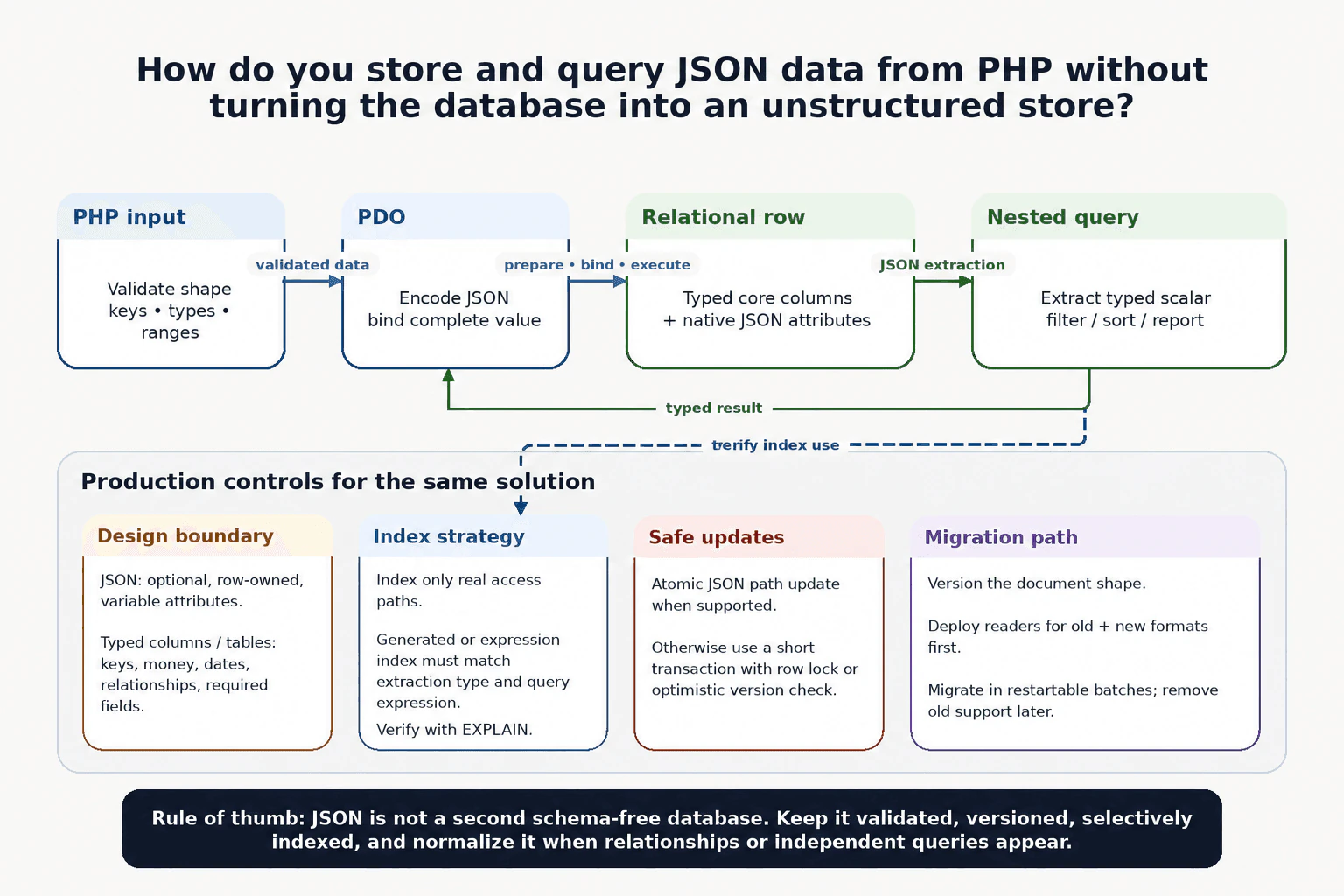
How do you store and query JSON data from PHP without turning the database into an unstructured store? diagram
How to Explain It in an Interview

Start with the design boundary. JSON is suitable for optional or variable attributes that belong to one parent row and are normally read or updated as one unit. Examples include user preferences, integration metadata, controlled form answers, or product attributes that differ by product type. JSON should not become a container for every field in the record.

Keep stable business data in typed relational columns. This normally includes primary and foreign keys, ownership, status, timestamps, monetary values, quantities, and fields with strong validation rules. Use a separate normalized table when an item can occur many times, is shared by multiple records, has its own lifecycle, requires a foreign key, or must be queried and updated independently. Normalization means storing each important entity in an appropriate table and connecting it with keys.

The exact JSON type and operators depend on the database engine. PostgreSQL distinguishes json and jsonb, MySQL has a native JSON type, and other engines may provide different JSON support. The application should therefore choose one supported engine and write queries, indexes, and constraints for that engine rather than pretending JSON SQL is fully portable.

In PHP 8.4 or PHP 8.5, validate the application-level document before saving it. Check that the top-level value has the expected form, required keys are present, values have the correct PHP types, allowed values and ranges are respected, and unexpected keys are rejected or handled deliberately. Use json_encode() and json_decode() with JSON_THROW_ON_ERROR so malformed or unencodable data causes an exception instead of being silently treated as a valid result.

PHP validation provides clear application errors, but important rules should also be protected by the database when possible. A native JSON column normally rejects invalid JSON syntax. Engine-specific check constraints or JSON-schema functions may enforce selected document rules. However, values that require NOT NULL, UNIQUE, FOREIGN KEY, precise numeric, or strong date constraints are usually clearer and safer as normal typed columns.

Query nested values with the JSON extraction functions or operators provided by the selected database. Always distinguish a JSON value from its text or scalar form. For example, a quoted JSON string may not compare the same way as extracted text, and a number extracted as text can sort lexicographically rather than numerically. Cast or extract to the intended database type before comparison, sorting, or indexing.

Do not scan a large JSON column for every request. Identify the exact paths used by real filters, joins, sorting, grouping, or uniqueness checks. Then create an engine-supported generated-column index or expression index for those paths. A generated column derives a typed relational value from a JSON path and can be indexed where the engine supports it. An expression index stores the result of a particular extraction expression. Some engines also provide JSON-specific indexes that can support containment or key-existence queries.

The indexed type and expression must match the query. A numeric identifier should be indexed as a numeric type, not as text. A date should be converted consistently to an appropriate date or timestamp type. If the query uses a different operator, cast, collation, or path expression from the index definition, the optimizer may not use that index. Confirm the behavior with the database's EXPLAIN or equivalent query-plan command instead of assuming the index is active.

Indexes are not free. They consume storage and memory when active index pages are cached, and they add work to inserts, updates, deletes, backups, replication, and migrations. Index only important access paths and measure them with realistic data. JSON extraction may also use CPU and temporary working memory during scans, sorting, grouping, or expression evaluation. The exact memory cost depends on the engine, query plan, document size, result size, and configured work-memory limits, so it should not be described as a fixed amount.

From PHP, encode the validated value as JSON and pass it as a bound PDO value. Prepared-statement placeholders represent complete data values only. They cannot safely replace a table name, column name, SQL keyword, sort direction, operator, or arbitrary JSON path expression. Structural SQL choices must come from fixed application code or a strict allowlist. Never place untrusted input directly into SQL.

Use PDO in exception mode and handle database errors at the application boundary. Create connections according to the application's request or worker lifecycle rather than opening a new connection for every small operation. A normal web request may use one connection for its database work, while a long-running worker must detect broken or expired connections and avoid leaving transactions open across unrelated jobs.

For a single JSON insert or update, a transaction may not be necessary beyond the statement's own atomic behavior. Use an explicit transaction when a JSON change must remain consistent with updates to other rows or tables. Keep the transaction as short as practical. Know the selected database's isolation behavior rather than assuming every transaction prevents concurrent overwrites.

Avoid an unsafe read-modify-write sequence when two requests may edit the same document. Reading the whole document into PHP, changing one key, and writing it back can overwrite another request's change. Prefer an atomic database JSON-update function for one path when supported. Otherwise use row locking inside a short transaction or optimistic concurrency, such as checking a version number in the UPDATE condition and retrying when another writer has already changed the row.

Treat the JSON shape as a versioned contract. Add a schema-version field when more than one shape may exist. Deploy readers that understand both old and new shapes before changing writers. Migrate existing rows in controlled batches and monitor lock time, transaction-log growth, replication delay, failures, and application behavior. Remove old-shape support only after the migration is complete and rollback is no longer required.

Consider whether the database can update only part of the stored representation or must rewrite more data internally. This is engine-specific and can change the write, log, storage, and replication cost of large documents. Do not make universal claims that every partial JSON update rewrites either the whole document or only the changed bytes. Measure the behavior on the chosen engine and version.

Move a JSON value into a normal column when it becomes required, frequently filtered or sorted, used in joins, constrained as unique, referenced by other rows, or important to reporting. Move a nested collection into a related table when its elements have their own identity, lifecycle, relationships, or independent updates. This keeps JSON as controlled flexibility rather than an unstructured replacement for the relational model.

Technical Approach
  1. Identify the selected database engine and its JSON, constraint, and indexing capabilities.
  2. Classify each value as stable relational data, flexible parent-owned data, or an independent related entity.
  3. Store stable, required, relational, monetary, date, and constrained values in typed columns.
  4. Store only suitable flexible attributes in a native JSON column.
  5. Define and document the accepted document shape and schema version.
  6. Validate keys, value types, ranges, allowed values, and unknown fields in PHP.
  7. Add database constraints for critical rules where the selected engine supports them.
  8. List the nested paths used by actual filters, joins, sorting, grouping, reporting, or uniqueness checks.
  9. Add only the generated-column, expression, or JSON-specific indexes required by those access patterns.
  10. Match extraction types and query expressions to the index definitions.
  11. Verify index use and estimated row access with EXPLAIN or the engine's equivalent command.
  12. Encode and decode JSON with exceptions enabled and bind complete data values through PDO.
  13. Select identifiers, sort directions, operators, and path expressions from fixed application allowlists rather than user input.
  14. Use atomic path updates, row locks, or optimistic concurrency to prevent lost updates.
  15. Use short explicit transactions when JSON changes must stay consistent with other database changes.
  16. Deploy backward-compatible readers before writers and migrate old document shapes in controlled batches.
  17. Normalize values when they gain strong constraints, frequent independent queries, relationships, or their own lifecycle.
Practical Insights

Looking up a row through its primary key is normally efficient, but extracting values from its JSON still requires processing that document. Filtering an unindexed nested value may make the database inspect many or all candidate rows, so the work can grow roughly with the number of rows examined and the amount of JSON processed. A suitable index can avoid most of that scanning, but the exact speed depends on selectivity, statistics, caching, and the query plan. Every index uses additional disk space, may occupy database cache memory, and increases write and maintenance work. Large documents also increase transfer, parsing, logging, backup, replication, and migration costs. Query memory is not fixed: sorting, grouping, scans, extracted values, result size, engine settings, and the chosen plan determine how much working memory is needed. PHP also uses memory while holding the encoded string and decoded array or object, so applications should avoid loading unnecessarily large documents or result sets at once.

Why Interviewers Ask This

Interviewers want to evaluate whether the candidate can use JSON flexibility without abandoning relational design. The question tests schema judgment, validation, constraints, nested-value querying, generated or expression indexes, query-plan analysis, safe PDO parameter binding, concurrency control, migrations, performance tradeoffs, and the ability to recognize when a normal column or related table is the better design.

Common interview mistakes

Common mistakes include storing the whole record in one JSON document; putting foreign keys, money, dates, status values, or frequently queried fields only inside JSON; using a text column when the database has a suitable native JSON type; accepting arbitrary keys and types; relying only on PHP validation; assuming every database supports the same JSON syntax; confusing a JSON string with extracted text; comparing numbers or dates as strings; indexing every possible path; using an index expression that does not match the query; failing to inspect the query plan; claiming an index guarantees a fast query; interpolating untrusted values, identifiers, sort directions, or paths into SQL; claiming prepared statements protect dynamic identifiers; reading and rewriting the whole document without concurrency control; keeping transactions open too long; assuming transactions automatically prevent lost updates; making universal claims about partial-update storage behavior; changing the document shape without versioning; running one large blocking migration; and leaving data in JSON after it has become relational or independently queried.

Interview tip

Lead with the boundary between flexible record-owned attributes and relational data. Then explain validation, typed extraction, selective indexing, query-plan verification, PDO value binding, concurrent updates, versioned migrations, and the exact signals that tell you to move data into columns or related tables.

Interviewer may ask next
When should a value inside a JSON document be moved to a normal column or related table?

Move it to a typed column when it becomes required, frequently filtered or sorted, used in joins or reports, subject to uniqueness, or important enough to need clear database constraints and statistics. Move it to a related table when it represents repeated entities with their own identity, lifecycle, relationships, foreign keys, or independent updates.

How would you safely change the JSON document shape in production?

Add a schema version and first deploy code that can read both the old and new shapes. Then change writers to produce the new shape and migrate existing rows in controlled, restartable batches. Monitor errors, locks, transaction-log growth, replication delay, and query behavior. Keep rollback compatibility until all rows are converted, then remove the old reader and obsolete indexes or fields in a later deployment.

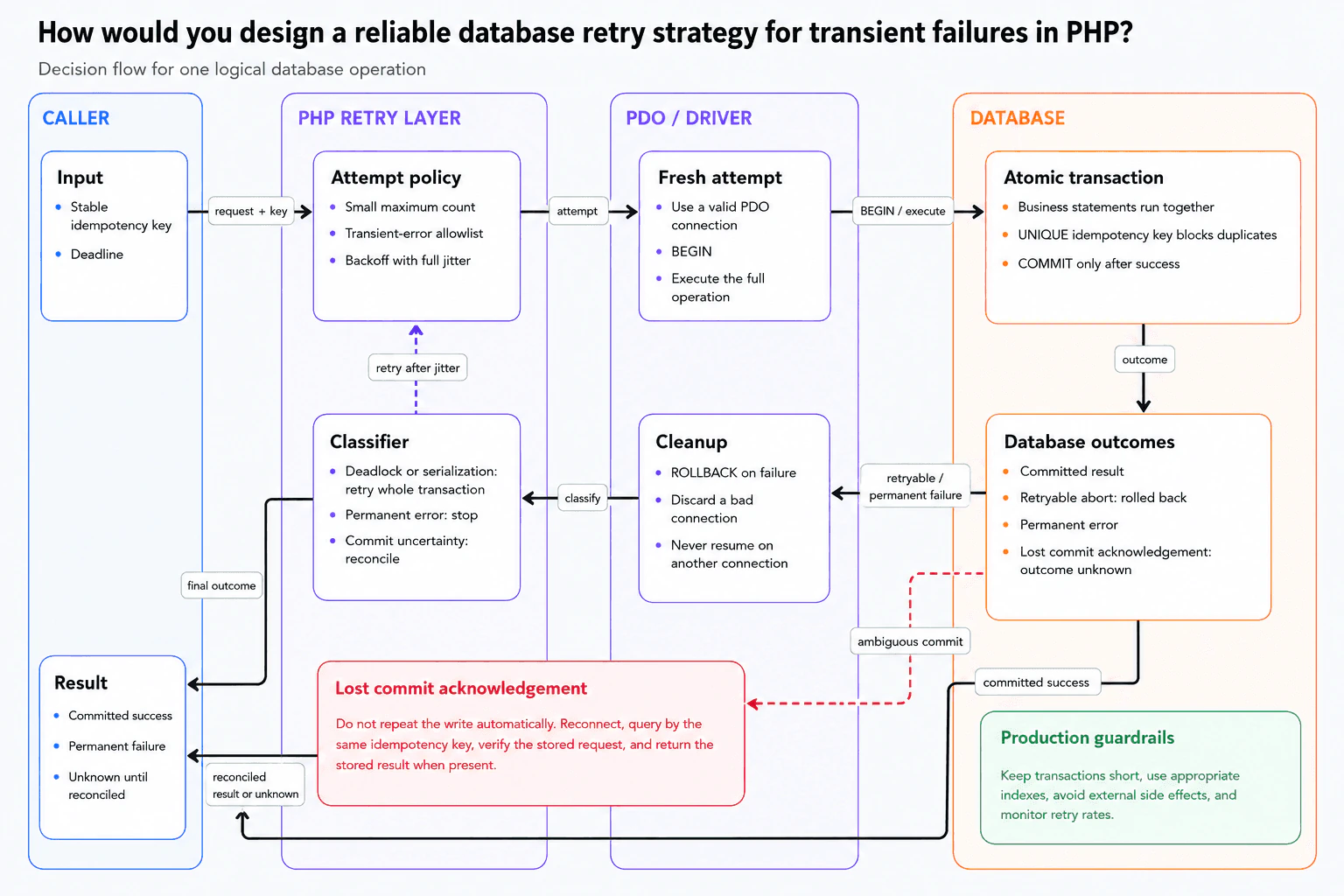
64. How would you design a reliable database retry strategy for transient failures in PHP?Sql / DatabaseHard

Question Details

Explain which failures are retryable, transaction boundaries, idempotency, exponential backoff with jitter, retry limits, deadlocks, connection loss, and how to avoid duplicating writes.

Short Interview Answer (30-60 seconds)

I retry only known temporary errors and retry the entire transaction, not an individual statement. I use capped exponential backoff with jitter, a small attempt and time limit, fresh connections when needed, and idempotency keys with unique constraints. An uncertain commit result is reconciled instead of blindly retried.

Detailed Explanation

See the Code while reading this explanation.

The question asks how a PHP program should react when saving or reading information fails for a short time. A good design should try again only when the problem may disappear, stop after a small number of attempts, and avoid creating the same record twice. It should also keep related changes together, pause between attempts, and handle cases where the program cannot tell whether the last save succeeded. The main goal is to recover from brief problems without hiding real errors, overloading the service, losing changes, or charging or updating someone more than once.

Useful clarifying questions:

Useful Questions to Ask the Interviewer
  • Which database engine and PDO driver are being used?
  • Is the operation a read, a write, or a multi-statement transaction?
  • Which SQLSTATE and driver codes does that database document as retryable?
  • Can the caller provide a stable idempotency key for each logical operation?
  • What maximum latency and retry count are acceptable?
  • Are external services or messages involved in the operation?
How would you design a reliable database retry strategy for transient failures in PHP? diagram
How to Explain It in an Interview

I would place the retry loop around one complete logical database operation. For a multi-statement write, that means retrying the entire transaction from the beginning. A transaction is a group of statements that either all commit or all roll back. Retrying only one failed statement can use stale data, skip earlier validation, or leave the business operation logically inconsistent.

I would classify errors before retrying. Retryable failures are temporary conditions for which a new attempt may succeed. Depending on the selected database and PDO driver, these can include deadlock victims, serialization failures, selected lock timeouts, temporary server unavailability, failover, or a connection failure that definitely occurred before the transaction could commit. The application should use a small, tested, database-specific allowlist based on SQLSTATE and driver error codes.

I would not retry permanent failures such as invalid SQL, missing database objects, invalid input, authentication failures, permission failures, unsupported operations, or ordinary constraint violations caused by the request. These conditions normally require a code, configuration, or data correction. Repeating them only adds latency and database load.

The transaction boundary and retry boundary should match. Each attempt must create or obtain a usable PDO connection, begin a new transaction, read any required current state, perform every related statement, and commit. If an attempt fails before a successful commit, the application should roll back when possible and discard an unusable connection. A transaction cannot be resumed on a replacement connection.

Deadlocks are a normal concurrency possibility. A deadlock occurs when transactions wait on one another in a cycle. The database normally chooses one transaction as the victim and aborts it. When the selected database reports a documented deadlock or serialization failure, the application should rerun the whole transaction because values read during the failed attempt may no longer be current.

A lock timeout requires database-specific treatment. Some databases abort the transaction, while others may cancel only the current statement and leave the transaction active. The PHP retry layer should still roll back the whole logical transaction before retrying so the next attempt starts from a clean and predictable state.

Connection failures need careful classification. If connecting fails before a transaction begins, retrying with a new connection may be safe. If the connection is lost during an uncommitted transaction, the application must discard that connection and start a new transaction. It should not assume that a transaction can continue after reconnecting.

A connection failure during or immediately after commit creates an ambiguous result. PHP may not know whether the server committed the transaction before the acknowledgement was lost. Blindly running the write again can duplicate it. A generic retry helper should therefore stop automatic retries when the commit outcome may be unknown and return an explicit ambiguous-result error for reconciliation.

Idempotency means that repeating the same logical request does not create an additional business effect. For important writes, I would assign a stable idempotency key to the request or job. That same key must be reused across every retry. I would store it in the database within the same transaction as the business change and protect it with a UNIQUE constraint.

The UNIQUE constraint is important because an application-level check is not enough. Two concurrent requests can both check for the key before either inserts it. The database constraint resolves that race safely. After an ambiguous result or a duplicate-key response, the application can query the stored operation by its key and return the previously recorded result when the stored request represents the same logical operation.

The idempotency record should normally include enough information to detect accidental reuse of the same key for a different request, such as a hash of the normalized operation input, its status, and a stored result reference. Retention must match the period during which clients, queues, or workers may resend the operation. Deleting keys too early can allow a delayed duplicate to run again.

I would also make individual statements naturally idempotent where practical. Setting a column to a specific value is easier to repeat safely than incrementing it. An optimistic concurrency update can include an expected version in its WHERE clause. If zero rows are updated, the application knows that another transaction changed the record and can decide whether to reload, retry, or report a conflict.

Prepared statements and parameter binding should still be used for values. They reduce SQL injection risk and avoid manual quoting, but they do not make an operation idempotent. They also do not make untrusted table names, column names, sort directions, or other SQL identifiers safe. Dynamic identifiers must come from an application-controlled allowlist.

Between attempts, I would use capped exponential backoff with jitter. Exponential backoff increases the maximum delay after each failure. Jitter chooses a random delay within that limit so many PHP workers do not retry at the same instant. The delay should have a maximum cap because very long sleeps are not useful inside a web request or worker.

I would enforce both a maximum attempt count and an overall elapsed-time limit. For example, an application might permit only a few attempts within its request or job deadline. The exact values depend on the database, workload, service-level objective, and caller timeout. Retries must stop early if there is not enough remaining time for another useful attempt.

Read retries also require judgment. A read outside a transaction is often safe to repeat, but retrying it may observe newer data. A read inside a transaction must be retried as part of the whole transaction. Reads with side effects, locking clauses, temporary state, or session-dependent behavior should not be assumed safe without reviewing the database semantics.

The transaction callback must not perform irreversible external actions that could run more than once, such as charging a card, sending an email, or publishing a message directly. A database rollback cannot undo those effects. A common solution is the transactional outbox pattern: store the business change and an outbox event in the same database transaction, then let a separate worker deliver that event idempotently.

The isolation level also affects retries. An isolation level controls which concurrent database changes a transaction can observe. Stronger isolation may prevent some anomalies but may increase blocking or serialization failures. I would choose the weakest isolation level that still protects the business rule and retry documented serialization failures from the beginning of the transaction.

Long transactions increase lock duration and conflict probability. I would keep transactions short, access rows in a consistent order where practical, use appropriate indexes so statements find and lock fewer rows, and avoid waiting for network services while a transaction is open. Retries are a recovery mechanism, not a replacement for fixing slow queries, missing indexes, excessive contention, or poor transaction design.

In production, I would record the operation name, attempt number, elapsed time, selected delay, SQLSTATE, driver code, transaction phase, and final outcome. I would not log credentials, sensitive values, or full SQL containing private data. Metrics should separate first-attempt success, successful retry, exhausted retries, permanent failures, deadlocks, connection failures, and ambiguous commits. A rising retry rate should trigger investigation because retries can temporarily hide a database or contention problem.

Key Insight / Why This Solution Works
  1. Define the complete logical database operation and its transaction boundary.
  2. Decide whether the operation can be repeated safely and require a stable idempotency key for important writes.
  3. Protect the idempotency key with a UNIQUE constraint in the same database that stores the business change.
  4. Build a tested retryable-error allowlist for the selected database and PDO driver.
  5. Start an overall elapsed-time budget and attempt counter.
  6. Create a usable PDO connection and begin a new transaction for the attempt.
  7. Re-read required state and execute the complete logical operation using bound parameters.
  8. Commit once all statements succeed.
  9. If a failure occurs, record whether it happened before commit, during commit, or after commit returned.
  10. Roll back an active transaction when possible and discard an unusable connection.
  11. If the commit result may be ambiguous, stop automatic retries and reconcile by the stable operation key.
  12. If the error is permanent or not explicitly allowlisted, throw it immediately.
  13. If no attempt or time budget remains, throw the final failure.
  14. Calculate a capped exponential delay and select random jitter within that cap.
  15. Sleep for the selected delay, create a fresh attempt, and rerun the entire transaction.
  16. Log and measure every retry outcome without exposing sensitive data.
Code
<?php

declare(strict_types=1);

final class RetryPolicy
{
    public function __construct(
        public readonly int $maxAttempts = 4,
        public readonly int $baseDelayMs = 50,
        public readonly int $maxDelayMs = 1_000,
        public readonly int $maxElapsedMs = 5_000,
    ) {
        if ($maxAttempts < 1) {
            throw new InvalidArgumentException('maxAttempts must be at least 1.');
        }

        if ($baseDelayMs < 0) {
            throw new InvalidArgumentException('baseDelayMs cannot be negative.');
        }

        if ($maxDelayMs < $baseDelayMs) {
            throw new InvalidArgumentException(
                'maxDelayMs must be greater than or equal to baseDelayMs.'
            );
        }

        if ($maxElapsedMs < 1) {
            throw new InvalidArgumentException('maxElapsedMs must be positive.');
        }
    }
}

final class AmbiguousCommitException extends RuntimeException
{
    public function __construct(
        public readonly PDOException $databaseException,
    ) {
        parent::__construct(
            'The transaction commit result is unknown; reconcile by idempotency key.',
            0,
            $databaseException,
        );
    }
}

/**
 * Run one complete logical transaction with bounded retries.
 *
 * @template T
 * @param Closure(): PDO $connectionFactory
 * @param Closure(PDO): T $operation
 * @param Closure(PDOException): bool $isRetryable
 * @param Closure(PDOException): bool $isAmbiguousCommitFailure
 * @return T
 * @throws PDOException
 * @throws AmbiguousCommitException
 */
function runRetriedTransaction(
    Closure $connectionFactory,
    Closure $operation,
    Closure $isRetryable,
    Closure $isAmbiguousCommitFailure,
    RetryPolicy $policy = new RetryPolicy(),
): mixed {
    $startedAtNs = hrtime(true);

    for ($attempt = 1; $attempt <= $policy->maxAttempts; $attempt++) {
        $pdo = null;
        $commitStarted = false;

        try {
            $pdo = $connectionFactory();
            $pdo->beginTransaction();

            $result = $operation($pdo);

            $commitStarted = true;
            $pdo->commit();

            return $result;
        } catch (PDOException $exception) {
            if (
                $commitStarted
                && $isAmbiguousCommitFailure($exception)
            ) {
                $pdo = null;
                throw new AmbiguousCommitException($exception);
            }

            if ($pdo instanceof PDO) {
                try {
                    if ($pdo->inTransaction()) {
                        $pdo->rollBack();
                    }
                } catch (PDOException) {
                    // The failed connection is discarded below.
                }
            }

            $pdo = null;

            $elapsedMs = intdiv(
                hrtime(true) - $startedAtNs,
                1_000_000,
            );

            $hasAnotherAttempt = $attempt < $policy->maxAttempts;

            if (
                !$hasAnotherAttempt
                || $elapsedMs >= $policy->maxElapsedMs
                || !$isRetryable($exception)
            ) {
                throw $exception;
            }

            $exponent = min($attempt - 1, 20);
            $exponentialLimitMs = $policy->baseDelayMs * (2 ** $exponent);
            $delayCapMs = min(
                $policy->maxDelayMs,
                $exponentialLimitMs,
            );

            // Full jitter chooses a random delay between zero and the cap.
            $delayMs = $delayCapMs > 0
                ? random_int(0, $delayCapMs)
                : 0;

            $remainingMs = $policy->maxElapsedMs - $elapsedMs;

            if ($delayMs >= $remainingMs) {
                throw $exception;
            }

            usleep($delayMs * 1_000);
        } catch (AmbiguousCommitException $exception) {
            throw $exception;
        } catch (Throwable $exception) {
            if ($pdo instanceof PDO) {
                try {
                    if ($pdo->inTransaction()) {
                        $pdo->rollBack();
                    }
                } catch (PDOException) {
                    // Preserve the original non-database exception.
                }
            }

            throw $exception;
        }
    }

    throw new LogicException('The retry loop ended unexpectedly.');
}

/**
 * Create a non-persistent PDO connection for the current attempt.
 * Credentials should come from protected application configuration.
 */
$connectionFactory = static function (): PDO {
    $dsn = getenv('DATABASE_DSN');
    $username = getenv('DATABASE_USER');
    $password = getenv('DATABASE_PASSWORD');

    if ($dsn === false || $dsn === '') {
        throw new RuntimeException('DATABASE_DSN is required.');
    }

    return new PDO(
        $dsn,
        $username === false ? null : $username,
        $password === false ? null : $password,
        [
            PDO::ATTR_ERRMODE => PDO::ERRMODE_EXCEPTION,
            PDO::ATTR_EMULATE_PREPARES => false,
            PDO::ATTR_DEFAULT_FETCH_MODE => PDO::FETCH_ASSOC,
            PDO::ATTR_PERSISTENT => false,
        ],
    );
};

/**
 * These are examples only. Configure one tested allowlist for the actual
 * database and PDO driver rather than combining unrelated database rules.
 */
$isRetryable = static function (PDOException $exception): bool {
    $sqlState = is_string($exception->getCode())
        ? $exception->getCode()
        : '';

    $driverCode = $exception->errorInfo[1] ?? null;

    $configuredSqlStates = [
        // Add documented deadlock or serialization SQLSTATE values here.
    ];

    $configuredDriverCodes = [
        // Add documented driver-specific temporary error codes here.
    ];

    return in_array($sqlState, $configuredSqlStates, true)
        || in_array($driverCode, $configuredDriverCodes, true);
};

/**
 * Configure only errors that can lose the commit acknowledgement while the
 * server may still have committed. Deadlock or serialization-abort errors do
 * not belong here when the selected database guarantees transaction rollback.
 */
$isAmbiguousCommitFailure = static function (
    PDOException $exception,
): bool {
    $sqlState = is_string($exception->getCode())
        ? $exception->getCode()
        : '';

    $driverCode = $exception->errorInfo[1] ?? null;

    $configuredAmbiguousSqlStates = [
        // Add tested connection-loss SQLSTATE values for the actual driver.
    ];

    $configuredAmbiguousDriverCodes = [
        // Add tested driver codes that can make commit acknowledgement unknown.
    ];

    return in_array($sqlState, $configuredAmbiguousSqlStates, true)
        || in_array($driverCode, $configuredAmbiguousDriverCodes, true);
};

// The application supplies an operation callback that performs every related
// statement through the PDO instance passed to it. Important writes must store
// a stable idempotency key under a UNIQUE constraint in the same transaction.
// When AmbiguousCommitException is caught, reconnect and query by that key
// before deciding whether any new write is necessary.
Why Interviewers Ask This

This question tests whether the candidate can distinguish temporary database failures from permanent errors, choose the correct transaction and retry boundaries, handle PDO connections safely, prevent duplicate writes, and reason about deadlocks, lock conflicts, backoff, retry limits, ambiguous commit results, database constraints, external side effects, and production observability.

Common interview mistakes

Common mistakes include retrying every PDOException; treating permanent errors as temporary; using the same retry codes for every database driver; retrying only the failed statement instead of the whole logical transaction; trying to continue a transaction on a replacement connection; immediately retrying without backoff; omitting jitter so workers retry together; allowing unlimited attempts; ignoring the caller's time budget; blindly repeating a write after an uncertain commit; generating a new idempotency key for each attempt; checking for duplicates without a UNIQUE constraint; reusing one key for different request data; deleting idempotency records too early; performing external side effects inside a retried transaction; keeping transactions open during network calls; swallowing the final exception; assuming prepared statements provide idempotency; and using retries to hide missing indexes, long transactions, or excessive lock contention.

Interview tip

Start with the central rule: retry the complete transaction only for an explicit database-specific temporary-error allowlist. Then explain bounded backoff with jitter, fresh transaction state, idempotency keys with unique constraints, and why an uncertain commit must be reconciled instead of automatically retried. Finish with external-side-effect handling and observability.

Interviewer may ask next
What should the PHP application do if the connection is lost while PDO is committing the transaction?

It should treat the outcome as unknown because the server may have committed before the acknowledgement was lost. The generic retry loop must not automatically repeat the write. The application should reconnect, query by the stable idempotency key, verify that the stored request matches the original operation, and return the stored result if it exists. It should perform a new write only when reconciliation establishes that the original operation did not commit.

Why is an application-level duplicate check insufficient without a database UNIQUE constraint?

Two concurrent requests can both check for an idempotency key before either request inserts it, so both may conclude that the key is unused. A UNIQUE constraint makes the database resolve this race atomically. One transaction succeeds, while the other can read the existing operation and return the same logical result instead of creating another business effect.

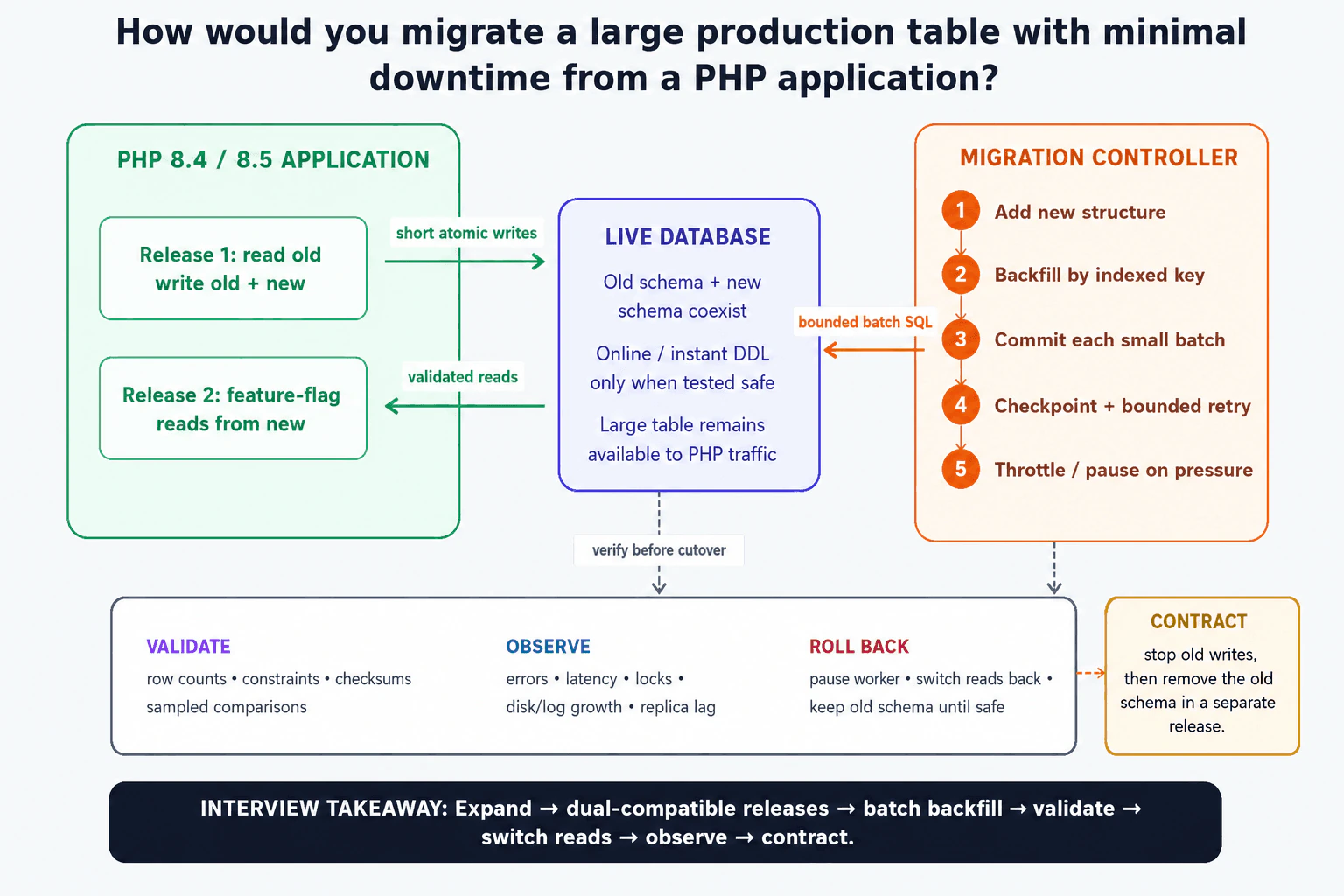
65. How would you migrate a large production table with minimal downtime from a PHP application?Sql / DatabaseHard

Question Details

Describe an expand-and-contract migration, dual-compatible application releases, online schema change options, backfilling in batches, validation, rollback, and observability.

Short Interview Answer (30-60 seconds)

I would use an expand-and-contract migration: add the new structure, deploy PHP code compatible with both schemas, backfill in small resumable batches, validate the data, switch reads gradually, monitor production, and remove the old structure only after the rollback window has passed.

Detailed Explanation

This question asks how to change a very large collection of live information without making the website unavailable for a long time. The safe approach is to make several small changes instead of replacing everything at once. The old and new forms should work together while existing information is copied gradually. The team should check that nothing is missing or changed incorrectly, watch the website for problems, and keep a safe way to return to the earlier version. The old form should be removed only after the new one has worked reliably.

Useful clarifying questions:

Useful Questions to Ask the Interviewer
  • Which database engine and version are used?
  • How large is the table, and what are its normal read and write rates?
  • What maximum lock time or downtime is acceptable?
  • Is the change adding a column, changing a type, adding an index, splitting a table, or replacing a table?
  • Can the PHP application temporarily read and write both old and new structures?
  • Are replicas, online schema-change tools, backups, and point-in-time recovery available?
  • Are there foreign keys, triggers, generated columns, scheduled jobs, or external consumers that depend on the table?
How would you migrate a large production table with minimal downtime from a PHP application? diagram
How to Explain It in an Interview

I would use an expand-and-contract migration so that every intermediate database and application state remains compatible.

1. Understand the current workload

Before changing the table, I would inspect its row count, physical size, write rate, important queries, indexes, constraints, foreign keys, triggers, long-running transactions, replication topology, storage headroom, and database-engine capabilities. I would define acceptable limits for lock time, query latency, replication lag, error rate, and migration duration.

The exact database engine and version matter because the same ALTER TABLE operation may be metadata-only in one version but may rebuild or lock the table in another.

2. Test the migration safely

I would test the proposed change against production-like data and workload. The test should measure execution time, lock behavior, temporary storage, transaction-log or binary-log growth, replica lag, and the effect on important query plans.

Testing with a tiny development table is not enough because many locking and storage problems appear only at production scale.

3. Expand the schema

I would first add the new column, index, table, or relationship without renaming or removing the existing structure. This is the expand phase.

The change must be backward compatible because old and new PHP processes can run at the same time during a rolling deployment. For example, when replacing a column, I could add the replacement column as nullable, or with a safe default when that is appropriate, instead of immediately dropping or renaming the original column.

Adding a default is not automatically safe on every database version. I would verify whether it is metadata-only or requires rewriting existing rows.

4. Select the schema-change mechanism

If the database supports the required change through native online or instant DDL with acceptable locking and resource use, I would prefer that simpler option. However, I would not assume that an operation described as online takes no locks. A brief metadata lock may still be required, and a long-running transaction can delay that lock and cause queued requests.

If native DDL would rebuild or block the large table for too long, I would evaluate a proven online schema-change tool. Such a tool commonly creates a shadow table, copies rows incrementally, captures concurrent changes, and performs a short final rename or swap.

Before using it, I would verify its compatibility with the exact database version, primary keys, foreign keys, triggers, generated columns, replication, storage capacity, and failure-recovery procedure. A shadow-table approach can temporarily require storage close to the size of the original table plus indexes and logs.

5. Deploy dual-compatible PHP code

The first PHP release must work with both the old and new schemas. Database access should be centralized in a repository, service, or other controlled data-access layer so that compatibility logic is not duplicated throughout the application.

For a column replacement, the application could initially continue reading the old column while writing both the old and new columns. For a table split, it could write the required records to both structures.

When both writes occur in the same database and must succeed together, I would place them in one transaction. The transaction should be short and should include only the statements that must be atomic. If the writes cross databases or external services, a normal database transaction cannot make them atomic; I would instead use a reliable outbox, event processing, reconciliation, or another explicit consistency design.

Retries must be idempotent. An idempotent operation can be repeated without creating duplicate or conflicting results. Unique constraints, stable operation identifiers, conditional updates, or upserts can help enforce that behavior.

6. Backfill existing rows in batches

After new writes are being captured correctly, I would copy or transform historical rows in small, restartable batches.

I would paginate using a stable indexed key, normally the primary key, rather than increasingly large OFFSET values. Keyset pagination such as selecting rows where the primary key is greater than the last processed key avoids repeatedly scanning and discarding earlier rows.

Each batch should:

  • Select a bounded primary-key range.
  • Update only rows that still require migration.
  • Commit after the batch.
  • Store a durable checkpoint.
  • Retry transient failures with a limit and backoff.
  • Record rows that require manual investigation.

I would avoid one transaction for the complete table because it can hold locks for too long, create large undo or transaction logs, delay cleanup, increase replica lag, and make failure recovery expensive.

Batch size should be adaptive. I would reduce or pause the backfill when query latency, lock waits, CPU, I/O, log growth, disk use, or replication lag exceeds an agreed threshold.

7. Prevent races with live writes

The backfill must not overwrite a newer value written by the PHP application.

For a simple additive column, the worker may update only rows where the new column is still null. For transformed or mutable data, I could use a version number, updated timestamp, source-value comparison, or optimistic conditional update. When a conditional update affects zero rows, the worker should reread or defer that record rather than overwrite it blindly.

The backfill should be idempotent so that restarting a completed batch produces the same final state.

8. Validate the result

I would validate throughout the migration and again before switching reads.

Useful checks include:

  • Number of rows eligible, processed, skipped, and failed.
  • Null, invalid, or out-of-range values.
  • Duplicate values before adding a unique constraint.
  • Foreign-key and other constraint violations.
  • Grouped counts and aggregates between old and new structures.
  • Checksums calculated over stable ranges.
  • Exact comparisons for sampled or high-value records.
  • Application-level comparisons between old and new read results.

Validation itself must not overload production. I would run checks in bounded indexed ranges, throttle them, or use a sufficiently current replica when the check does not require the primary database's latest state. Replica-based validation must account for replication lag.

9. Switch reads gradually

After the backfill is complete and validation passes, I would deploy PHP code that can read from the new structure. I would place the read switch behind a feature flag or controlled rollout when possible.

I could begin with internal traffic or a small percentage of requests and compare application errors, returned values, latency, query plans, database load, and important business results. If the new path fails, I can switch reads back to the old structure while the old data is still being maintained.

A fallback read from the old field can be useful during transition, but it should be temporary and observable. Otherwise, missing backfilled values may remain hidden indefinitely.

10. Stop old writes

Once the new read path is stable, I would deploy another release that stops writing to the old structure. Before doing so, I would verify that no older PHP instance, queue worker, scheduled command, report, maintenance script, or external integration still requires it.

I would then observe the system for an agreed rollback window. During that period, I would continue validation and keep the old structure available unless there is a strong reason not to.

11. Contract the schema

Only after the rollback window has passed would I remove the old column, table, index, trigger, compatibility code, fallback logic, and feature flags. This is the contract phase.

The destructive cleanup should be a separate deployment. Dropping a large column or index can still consume resources or require locks, depending on the database engine and version, so I would test and monitor the cleanup operation as carefully as the expansion.

12. Define rollback for every phase

Rollback is not one universal command. It depends on the migration phase:

  • Before backfilling, stop the rollout and leave the unused additive structure in place if removing it is risky.
  • During backfilling, pause the worker and continue reading from the old structure.
  • After switching reads, disable the feature flag or deploy the earlier compatible read path.
  • After stopping old writes, restore dual writes only if the old data is still sufficiently current or can be reconciled.
  • After deleting the old structure, rollback may require a reverse migration, backup restore, point-in-time recovery, and reconciliation of later writes.

A backup is essential, but restoring a very large table is not an instant rollback. The recovery time, recovery-point objective, and treatment of writes made after the backup must be understood before the migration starts.

13. Monitor and control the operation

I would create dashboards and alerts before starting the migration. Important signals include:

  • Application error rate and request latency.
  • Database query latency and connection usage.
  • Lock waits, deadlocks, and transaction duration.
  • CPU, memory, I/O, free disk space, and temporary-space use.
  • Transaction-log, redo-log, write-ahead-log, or binary-log growth as applicable.
  • Replica lag and replica errors.
  • Backfill throughput, remaining rows, retries, and failed records.
  • Validation mismatches.
  • Old-path and new-path usage.

The worker should have a safe pause control, rate limits, bounded retries, clear logs, and durable checkpoints. I would define automatic or manual stop conditions before the migration begins.

The main principle is to move the database and PHP application through reversible, compatible states. Minimal downtime comes from avoiding one large destructive cutover, not from assuming that every database operation is completely lock-free.

Technical Approach
  1. Identify the exact schema change, database engine and version, table size, traffic pattern, dependencies, and acceptable operational limits.
  2. Test the DDL, backfill, validation, and rollback procedures with production-like data and workload.
  3. Add the new structure without deleting or renaming the old structure.
  4. Use native online DDL when its measured locking and resource use are acceptable; otherwise evaluate a compatible online schema-change tool.
  5. Deploy PHP code that works with both schemas during rolling deployment.
  6. Begin atomic dual writes when both values are in the same database, or use explicit asynchronous consistency and reconciliation when they are not.
  7. Backfill historical rows in small, idempotent, resumable batches ordered by a stable indexed key.
  8. Protect live updates with conditional writes, versions, timestamps, or source-value comparisons.
  9. Throttle or pause work based on latency, locks, CPU, I/O, disk use, log growth, and replica lag.
  10. Validate row counts, constraints, aggregates, checksums, sampled records, and application-level results.
  11. Switch reads gradually behind a feature flag while preserving the old read path for rollback.
  12. Stop old writes only after all PHP processes, workers, jobs, and integrations are compatible.
  13. Observe the new path during a defined rollback window.
  14. Remove the old structure and compatibility code in a separate contract deployment.
Practical Insights

A migration that examines or rewrites every row performs roughly O(N) data work for N rows. Creating a replacement table or rebuilding indexes may also require O(N) reading and writing. This does not mean the elapsed time is predictable, because indexes, row size, storage speed, concurrent traffic, logging, replication, and throttling strongly affect it. A shadow-table migration may temporarily require space close to the original table size plus new indexes and database logs. Keyset batching uses a small bounded amount of application memory because the worker processes one batch at a time. A database engine may still use substantial cache, temporary space, undo, redo, or transaction-log storage. Smaller batches reduce lock duration and operational pressure but usually increase total migration time and coordination overhead. Dual-compatible code also adds temporary maintenance complexity.

Why Interviewers Ask This

This question evaluates whether the candidate can coordinate application deployments and database changes without causing a long outage or corrupting data. It tests backward-compatible schema design, online DDL, batched backfills, consistency during dual writes, validation, rollback planning, locking awareness, replication impact, and production observability. It also checks whether the candidate understands that a large migration should usually be divided across multiple reversible releases rather than performed as one destructive deployment.

Common interview mistakes

Common mistakes include running an untested blocking ALTER TABLE directly in production; assuming online DDL never takes locks; renaming or dropping a field before every PHP process is compatible; adding a default without checking whether it rewrites the table; using one transaction for the complete backfill; using large OFFSET pagination; scanning without an appropriate index; allowing the backfill to overwrite newer application writes; performing non-atomic dual writes without reconciliation; retrying non-idempotent operations; switching reads before validation is complete; hiding missing migrated values behind a permanent fallback; running expensive validation queries without throttling; ignoring long transactions, foreign keys, triggers, generated columns, replicas, log growth, and disk capacity; treating a backup restore as an immediate rollback; and combining expansion, cutover, and destructive cleanup in one deployment.

Interview tip

Explain the migration as a sequence of compatible states: measure and test, expand, deploy dual-compatible PHP code, backfill, validate, switch reads gradually, observe, stop old writes, and contract. Mention race prevention, rollback by phase, locking, replication lag, disk use, and pause controls. Say minimal downtime rather than guaranteed zero downtime because a metadata lock or final table swap may still be required.

Interviewer may ask next
How would you prevent the backfill from overwriting a newer value written by the PHP application?

I would make each update conditional and idempotent. For example, the worker could update only when the new column is null and the source version or updated timestamp still matches the value it originally read. If the condition fails, the worker should reread or defer the row rather than overwrite it. When related writes are in the same database, I would keep them in one short transaction. Stable checkpoints and safe retries would allow the worker to resume without duplicating or corrupting data.

When would you choose native online DDL instead of an online schema-change tool?

I would choose native online or instant DDL when the exact database version supports the required operation and testing shows acceptable lock time, runtime, storage use, log growth, and replication impact. I would consider an online schema-change tool when native DDL would rebuild or block the table for too long. Before using the tool, I would verify support for the table's primary key, foreign keys, triggers, generated columns, replication setup, available disk space, final swap behavior, failure recovery, and rollback procedure.

66. How would you investigate database connection exhaustion in PHP-FPM?Sql / DatabaseHard

Question Details

Explain how PHP-FPM worker counts, persistent connections, connection pools or proxies, long transactions, leaked work, timeouts, and database limits interact, and define a measurement-led remediation plan.

Short Interview Answer (30-60 seconds)

I would correlate PHP-FPM workers and queues with database session states, transaction age, query latency, locks, connection churn, and configured limits. Then I would fix slow or long-held work, persistent-connection misuse, retries, and capacity mismatches before changing limits or introducing a connection proxy.

Detailed Explanation

This question asks how I would find why a PHP service has used all the available paths to its data store. When that happens, new requests may wait, fail, or become very slow. I need to compare how many PHP tasks can run at once with how many data-store sessions are allowed. I must also find tasks that keep a session too long, fail to finish work, or repeatedly open new sessions. The goal is to use measurements to locate the real cause, make a safe correction, and prevent the same failure from returning.

Useful clarifying questions:

Useful Questions to Ask the Interviewer
  • Which database engine and version are in use?
  • Is PHP-FPM running on one host or across multiple replicas?
  • Which PHP-FPM process-management mode is configured, and what are the worker limits?
  • Are PDO persistent connections enabled?
  • Is there a database proxy or pooler between PHP and the database?
  • Which exact errors occur: too many connections, connection timeout, refused connection, or PHP-FPM queue growth?
  • Which background workers, scheduled jobs, administration tools, or other services share the database?
How would you investigate database connection exhaustion in PHP-FPM? diagram
How to Explain It in an Interview

I would start with a practical rule: I would not immediately raise the database connection limit. First, I would determine which clients own the connections, what those connections are doing, and why they remain occupied.

1. Confirm that the failure is connection exhaustion

I would collect the exact application exception, SQLSTATE or driver error, proxy error, and database log entry. A request can fail to obtain a connection because the database limit is reached, a proxy pool is full, the connection-acquisition timeout expires, networking is unhealthy, authentication fails, or the database is unavailable. These cases need different remedies.

I would place all PHP-FPM, application, proxy, and database events on the same timeline. This prevents me from treating a slow-query incident or network failure as a connection-limit problem.

2. Establish the real connection budget

PHP-FPM serves requests through worker processes. One worker handles one request at a time. A request may use no database connection, one connection, or more than one connection if the application talks to multiple databases or creates duplicate handles.

I would inventory:

  • Every PHP-FPM pool and application replica.
  • The configured and observed worker counts.
  • Queue consumers and long-running CLI processes.
  • Scheduled jobs, migrations, reporting tools, monitoring, and administration clients.
  • Read and write database endpoints if they are separate.
  • Connection-proxy client limits and backend-pool limits.
  • The database connection limit and any connections reserved for administrators or system processes.

A useful planning model is:

safe application budget = database connection limit - reserved operational capacity - other clients - safety margin

The PHP application must be designed against the safe application budget, not the database's full advertised maximum. I would also reserve enough access for diagnosis and recovery during an incident.

3. Measure PHP-FPM and database behavior together

On PHP-FPM, I would measure:

  • Active, idle, and total workers.
  • Whether the pool repeatedly reaches pm.max_children.
  • Listen-queue length and rejected or delayed requests.
  • Request throughput, duration, and error rate.
  • Slow-request traces.
  • Worker restarts and worker memory usage.
  • The number of application replicas over time.

On the database or proxy, I would measure:

  • Current and peak client connections.
  • Current and peak backend database sessions.
  • Connection acquisition time and acquisition failures.
  • New connections and disconnections per second.
  • Sessions grouped by application name, user, host, database, and state.
  • Active query age and transaction age.
  • Idle sessions and sessions idle while a transaction remains open.
  • Lock waits, blocking sessions, slow queries, CPU, memory, and storage latency.

The categories matter. A high number of active sessions may represent real concurrency, blocked work, or slow SQL. A high number of ordinary idle sessions may be expected when persistent connections or a proxy pool are used. An idle session with an open transaction is more serious because it can retain locks, snapshots, old row versions, or other transactional resources depending on the database.

4. Understand the PHP-FPM and PDO connection lifecycle

PHP-FPM workers normally survive across many requests. A non-persistent PDO connection is associated with its PDO object and is normally closed when PHP destroys the object or completes request cleanup, provided no remaining reference keeps it alive.

A PDO persistent connection can survive request completion and be reused by a later request in the same PHP-FPM worker process. It is not one shared PHP-level pool used by every worker. Therefore, many workers across many replicas can retain many separate persistent database sessions.

Persistent connections may reduce repeated connection setup cost, especially when connection establishment is expensive. However, they can also:

  • Keep a large number of idle sessions open.
  • Make retained session count scale with the number of worker processes.
  • Preserve connection-level state unless the driver and application reset it correctly.
  • Interact badly with session variables, temporary objects, advisory locks, or unfinished transactions.
  • Provide little benefit when a database proxy already manages backend connections efficiently.

I would inspect the actual PDO options, framework configuration, and driver behavior rather than assume persistence is enabled or safe.

5. Find work that occupies a connection for too long

Connection exhaustion does not require a permanent leak. If each request holds a connection for longer, the same traffic creates more simultaneous connection demand.

I would trace requests that:

  • Connect much earlier than the first database operation.
  • Keep a connection while calling an external API.
  • Perform file, network, sleep, or heavy computation inside a transaction.
  • Stream or iterate through a large result while doing unrelated work.
  • Wait on a database lock.
  • Execute slow or badly planned queries.
  • Produce an N+1 query pattern.
  • Retry immediately and repeatedly after transient failures.
  • Open multiple handles to the same database within one request.
  • Wait for user interaction or another service while a transaction remains open.

The safest transaction scope is usually narrow: acquire the connection when needed, start the transaction immediately before the related database work, execute only the required statements, commit promptly, and roll back on every failure path.

6. Separate connection retention from ordinary long-running work

In request-based PHP-FPM code, request cleanup normally releases non-persistent PDO objects. Therefore, a rising connection count is often caused by long requests, long transactions, blocked queries, persistent connections, additional replicas, or high connection churn rather than a classic permanent memory leak.

I would still inspect for incorrect lifecycle management, including:

  • Static or global registries that create and retain multiple connection objects.
  • Dependency-injection configuration that constructs duplicate connection services.
  • Reconnection logic that creates a replacement without releasing the prior handle.
  • Exception paths that leave a transaction open until request shutdown.
  • Long-running CLI consumers that never close, refresh, or validate stale connections.
  • ORM or framework workers that retain database state between jobs.
  • Separate read and write connections created even when only one is needed.

Setting pm.max_requests can recycle PHP-FPM workers and limit the lifetime of per-process state or gradual memory growth. It is a containment measure, not proof that the connection-lifecycle defect has been fixed.

7. Inspect transactions, locks, queries, and indexes

A slow query increases the time a request occupies its connection. A blocked query can hold both a worker and a connection while making no progress. A long transaction may also hold locks or prevent cleanup of old row versions.

I would identify:

  • The oldest active transactions.
  • Sessions idle inside a transaction.
  • Blocking and blocked sessions.
  • Queries with increased execution time or rows examined.
  • Query-plan changes after a deployment or data-growth event.
  • Missing, unused, or inappropriate indexes.
  • Large scans, sorts, temporary results, and lock-heavy updates.
  • Application changes that widened transaction boundaries.

I would use the database's native activity, lock, slow-query, and query-plan tools. Exact commands depend on the database engine, so I would not present MySQL, PostgreSQL, or another engine's session-state behavior as universal.

Improving a query or shortening a transaction can reduce occupied-connection time and therefore reduce required concurrency without increasing connection capacity.

8. Review retries and timeout behavior

Retries can turn a partial slowdown into connection exhaustion. If failed requests retry immediately, each layer may create more demand while the database is already unhealthy.

I would verify that retries are:

  • Limited to genuinely transient and safe-to-retry failures.
  • Bounded by a small maximum attempt count.
  • Delayed with backoff and jitter.
  • Constrained by an overall request deadline.
  • Safe for the transaction and operation's idempotency rules.

I would review timeouts at every layer:

  • Database connection or proxy-acquisition timeout.
  • Statement or query timeout where supported.
  • Lock-wait timeout.
  • Idle-transaction timeout where supported.
  • PHP execution and application request deadlines.
  • PHP-FPM request termination settings.
  • Web-server, load-balancer, and reverse-proxy timeouts.
  • Database-proxy client, queue, idle, and backend timeouts.

The timeouts must be coordinated. A client-facing request should not time out while PHP continues holding a database connection for substantially longer. However, timeouts that are too aggressive can cancel valid work and cause retry storms, so I would choose them from observed latency and service objectives.

9. Align PHP-FPM concurrency with database capacity

pm.max_children limits simultaneous PHP-FPM requests in a pool. Memory capacity is a major input because each worker is a separate process with its own memory footprint. Database capacity is another input because active workers may create database demand.

I would not assume one worker always equals one database connection. Instead, I would measure:

  • The percentage of requests that use the database.
  • Connections used per database-using request.
  • Average and high-percentile connection hold time.
  • Peak active workers and peak database sessions.
  • The effect of background jobs and autoscaling.

I would set or cap total concurrency across all replicas so expected demand remains below the safe connection budget. Configuring each replica safely in isolation is insufficient if autoscaling can multiply the total worker count beyond database capacity.

Lowering worker concurrency can protect the database, but it may increase the PHP-FPM request queue and user latency. The correct value balances worker memory, request throughput, database throughput, and acceptable queueing.

10. Decide whether persistent connections should remain enabled

I would keep PDO persistent connections only when measurements show that connection-establishment overhead is material and the retained-session count and connection-state behavior are controlled.

I would disable or avoid them when:

  • Worker count makes the retained connection total unsafe.
  • Session state cannot be reliably reset.
  • A proxy already provides effective pooling.
  • Connection setup is not an important part of latency.
  • Persistent idle sessions consume scarce database capacity.

Disabling persistence may increase connection creation rate, authentication work, TLS setup, or network overhead. I would therefore compare connection latency, database load, and total session count before and after the change rather than assuming either mode is universally better.

11. Evaluate a database connection proxy or pooler

A connection proxy can accept many application-side connections while maintaining a controlled backend pool, depending on the database, proxy, and pooling mode. It can be useful when many PHP-FPM workers or replicas create excessive connection churn or when the database handles a smaller number of backend sessions more efficiently.

I would verify:

  • Client connection limits and backend pool limits.
  • Queue size and connection-acquisition timeout.
  • Transaction pooling versus session pooling.
  • Transaction pinning and backend-session reuse rules.
  • Compatibility with session variables, temporary tables, advisory locks, prepared statements, and other connection-local state.
  • Failure handling, observability, and high availability.

A proxy does not repair slow SQL, wide transactions, lock contention, or retry storms. An unlimited proxy queue can merely replace fast connection errors with extreme latency and memory pressure. Its limits must therefore be explicit and observable.

12. Apply remediation in a safe order

My remediation plan would be:

  1. Confirm the failure type and preserve evidence from all layers.
  2. Stop or limit runaway traffic, retry storms, or unhealthy consumers if the database is at immediate risk.
  3. Preserve reserved administrative access for diagnosis and recovery.
  4. Identify and handle clearly abandoned, blocked, or harmful sessions using an approved operational procedure.
  5. Fix slow queries, missing or ineffective indexes, lock chains, and unnecessarily wide transactions.
  6. Move network calls, file work, and unrelated computation outside transactions.
  7. Ensure every transaction commits or rolls back on all code paths.
  8. Remove duplicate connections and correct persistent-connection misuse.
  9. Add bounded acquisition, query, lock, transaction, request, and retry deadlines.
  10. Right-size PHP-FPM and background-worker concurrency across all replicas.
  11. Introduce or tune a proxy when measured connection churn or backend-session pressure justifies it.
  12. Increase the database connection limit only after confirming the database has enough per-connection memory, process or thread capacity, CPU, storage throughput, and lock-management capacity.

Increasing the limit alone can worsen performance. More simultaneous queries may increase context switching, memory use, cache pressure, lock contention, and storage contention even though connection-refusal errors temporarily disappear.

13. Validate the corrected system

I would test with representative traffic, including normal peaks, background jobs, autoscaling, slow dependencies, and partial database degradation.

I would verify:

  • Peak client connections and backend sessions stay below their budgets.
  • Connection acquisition latency remains stable.
  • PHP-FPM queue length and worker saturation remain acceptable.
  • Query latency, lock waits, and database resource use do not regress.
  • Long transactions and idle-in-transaction sessions are absent or within an approved threshold.
  • Retry volume remains bounded during failures.
  • Administrative headroom is preserved.
  • Scaling an application replica does not unexpectedly exceed the shared budget.

I would add alerts for connection-budget utilization, acquisition failures, acquisition latency, oldest transaction age, idle-in-transaction sessions, connection churn, PHP-FPM queue growth, active-worker saturation, and abnormal retry rates. This turns the fix into a measurable capacity policy rather than a one-time configuration change.

Technical Approach
  1. Capture the exact driver, proxy, and database errors for the incident window.
  2. Inventory every PHP-FPM pool, replica, background process, scheduled job, proxy, and other database client.
  3. Calculate a safe application connection budget with operational headroom.
  4. Correlate PHP-FPM workers, queues, request duration, and retries with database client connections, backend sessions, query age, transaction age, and locks.
  5. Group sessions by client identity, user, host, database, state, query age, and transaction age.
  6. Classify the cause as excessive concurrency, persistent idle sessions, connection churn, slow SQL, blocked work, long transactions, retries, or duplicate connection creation.
  7. Trace the responsible requests and inspect their connection and transaction boundaries.
  8. Fix slow, blocked, duplicate, or long-held work before increasing limits.
  9. Add reliable rollback, cleanup, bounded retries, and coordinated timeouts.
  10. Right-size total PHP-FPM and background-worker concurrency across all replicas.
  11. Evaluate a proxy only when measured pooling or connection-churn needs justify it.
  12. Validate under representative and degraded load, then alert on budget utilization, acquisition time, transaction age, queues, and retry volume.
Practical Insights

This is mainly an operational capacity problem rather than an algorithm with Big O complexity. Collecting connection counts and worker metrics is usually inexpensive, but detailed tracing, slow-query logging, and high-cardinality labels can consume CPU, storage, memory, and network capacity. Each PHP-FPM worker uses process memory even while waiting, and each database connection may use database-side memory and process or thread resources. Lowering worker counts can protect the database but increase queueing. Raising connection limits can increase memory use, context switching, lock contention, and storage pressure. Persistent connections reduce setup work but may reserve idle sessions. A proxy can reduce backend connections but adds queueing, memory use, operational complexity, and another failure point.

Why Interviewers Ask This

Interviewers ask this question to test whether the candidate understands how PHP-FPM process concurrency interacts with finite database capacity. A strong answer distinguishes connection exhaustion from database CPU or query saturation and separates active queries, idle sessions, idle sessions with open transactions, persistent PDO connections, connection churn, slow requests, blocked work, and genuine connection-retention defects. It also demonstrates production judgment by measuring before changing limits, preserving administrative access, controlling retries and timeouts, considering all application replicas and background clients, and validating that a proposed fix improves both reliability and latency.

Common interview mistakes

Common mistakes include raising the database connection limit before proving the cause; treating every connection failure as a max-connections error; calculating capacity from only one PHP-FPM host; ignoring queue consumers, jobs, and other services; assuming every worker uses exactly one connection; assuming PDO persistent connections form one shared pool; calling every idle session a leak; ignoring sessions idle inside a transaction; performing network or file work inside transactions; failing to roll back after exceptions; retrying immediately without limits or jitter; using pm.max_requests as the permanent fix; setting contradictory timeouts across layers; adding a proxy without checking session-state compatibility; allowing an unlimited proxy queue; and declaring success after connection errors disappear while latency, memory use, lock contention, or database saturation becomes worse.

Interview tip

Present the answer as a measurement-led sequence: confirm the failure, establish the shared connection budget, correlate PHP-FPM and database metrics, classify session states, inspect transaction and connection lifecycles, correct the cause, and validate under load. Emphasize that increasing limits or adding a proxy is a capacity decision made after measurement, not the default first response.

Interviewer may ask next
How do PDO persistent connections behave under PHP-FPM?

A persistent PDO connection can remain available inside the PHP-FPM worker process after a request ends and may be reused by a later request handled by that same worker. It is not one shared PHP connection pool across all workers. Therefore, many workers and replicas can retain many separate database sessions. Persistence may reduce connection setup cost, but the application must account for retained capacity, unfinished transactions, and connection-local state.

Would you lower PHP-FPM worker counts or add a database connection proxy?

I would choose from measurements. I would lower or cap worker concurrency when the application can submit more simultaneous database work than the database can safely process. I would consider a proxy when many processes create excessive connection churn or backend sessions. A proxy does not fix slow queries, locks, long transactions, or retries, so those causes must still be corrected. Its backend pool, queue, acquisition timeout, pooling mode, and session-state compatibility must also be explicitly configured.

67. What is a stack trace in PHP?DebuggingEasy

Question Details

Define a stack trace as the sequence of active function and method calls recorded when PHP creates a Throwable or when code requests a backtrace. Explain frames, files, line numbers, classes, functions, arguments, exception chaining, and a simple method for locating the first relevant application frame without assuming the top frame is always the root cause.

Short Interview Answer (30-60 seconds)

A PHP stack trace shows the sequence of function and method calls that led to a particular execution point. I inspect its frames, files, line numbers, classes, and functions to understand the call path and find the first relevant application frame without assuming the top frame is the root cause.

Detailed Explanation

A stack trace is like a history of the steps a program followed before reaching a certain point. It helps a developer see which parts of the program called other parts and in what order. When a problem occurs, the developer first tries to make the same problem happen again, checks how widely it happens, collects useful evidence, and follows this history back through the program. The goal is to find the part of the application's own code most closely connected to the problem. The first item shown can be useful, but it does not always reveal the real cause.

Useful Questions to Ask the Interviewer
  1. Do you want me to explain both traces stored on a Throwable and backtraces requested directly by PHP code?
  2. Should I also explain how chained exceptions can help identify an earlier failure?
What is a stack trace in PHP? diagram
How to Explain It in an Interview

A stack trace in PHP is an ordered record of function and method calls associated with a particular point in program execution. When an object implementing Throwable, such as an Exception or Error, is created, PHP records trace information that can be inspected with methods such as getTrace() or getTraceAsString(). Code can also request the current call stack directly with debug_backtrace().

Each entry in the trace is called a frame. A frame represents one level of the call stack. Depending on how the trace was produced and which call is represented, a frame may include fields such as file, line, function, class, type, object, and args. The type value can show how a method was called, such as -> for an instance method or :: for a static method.

For debugging, I begin by reproducing the problem when possible and confirming its scope. I determine whether it affects one request, one input, one environment, or a wider part of the system. Then I collect the relevant Throwable, application logs, and trace. I keep production traces private because paths, arguments, and surrounding diagnostic data can reveal sensitive information.

Next, I inspect the call path and look for the first frame that is relevant to my application code. A trace may also contain framework, Composer package, or PHP runtime calls. Those frames explain how execution moved through the system, but their presence does not prove that the framework or package caused the defect.

I inspect the relevant application's file, line, class, function, inputs, and nearby caller frames. I then compare that evidence with the exception message, logs, configuration, database results, or environment differences when those sources are relevant to the failure.

I do not assume that the first displayed frame is always the root cause. A frame may show where a Throwable was created or where one call led into another, while the real defect could be an earlier decision, invalid input, incorrect state, or data supplied by a caller. The trace describes the execution path; it does not automatically identify the defective statement.

Exception chaining is also important. A Throwable can reference a previous Throwable through getPrevious(). For example, application code may catch a lower-level exception and throw a new exception with additional context while preserving the original as the previous exception. I inspect the complete chain because an outer exception may explain the high-level operation while an earlier Throwable contains the original failure details.

Arguments can be useful because they may show what values were passed to a function, but they also create a security and privacy risk. Passwords, tokens, personal data, and other secrets must not be exposed to users or written carelessly to production logs. PHP also allows backtraces to omit argument values, such as by using the DEBUG_BACKTRACE_IGNORE_ARGS option with debug_backtrace().

A stack trace is only one source of evidence. Warnings, application logs, profiler data, database evidence, and environment differences answer different debugging questions. I use the smallest useful diagnostic step needed to test my current hypothesis rather than collecting unrelated information.

After identifying the cause, I fix the root problem instead of merely suppressing the error or hiding the symptom. A temporary workaround may reduce impact, but it is separate from the root-cause fix. Finally, I reproduce the original case again, verify that the fix works, check important related behavior, and add an automated regression test when practical.

Key Insight / Why This Solution Works
  1. Reproduce the failure when possible.
  2. Confirm its scope, such as one request, one input, one environment, or many users.
  3. Capture the relevant Throwable, logs, and stack trace without exposing sensitive information.
  4. Read the trace frames and identify their files, lines, classes, and functions.
  5. Locate the first frame relevant to the application instead of assuming the first displayed frame is the cause.
  6. Inspect nearby caller frames to understand how execution reached that code.
  7. Follow getPrevious() when the Throwable is part of an exception chain.
  8. Compare the trace with other relevant evidence such as inputs, configuration, logs, database results, or environment differences.
  9. Test the suspected cause with the smallest useful diagnostic step.
  10. Fix the root cause rather than suppressing the symptom.
  11. Reproduce the original case and verify the fix.
  12. Add regression coverage when practical.
Why Interviewers Ask This

Interviewers want to know whether the candidate understands what a PHP stack trace represents and can use it correctly during root-cause analysis. A strong answer explains trace frames, files, line numbers, classes, functions, arguments, Throwable chaining, and how to identify relevant application code without assuming that the first displayed frame proves the root cause.

Common interview mistakes

Common mistakes include assuming the first displayed frame is automatically the root cause, reading only the exception message and ignoring the call path, blaming framework or vendor code merely because it appears in the trace, ignoring a previous chained Throwable, confusing a stack trace with logs or profiler output, exposing raw traces to end users, logging sensitive argument values, suppressing errors instead of finding their cause, treating a workaround as the permanent fix, and changing code without reproducing and verifying the original failure.

Interview tip

Start with a one-sentence definition. Then explain what a frame contains and how you use the trace in practice. Emphasize reproduction, evidence, the first relevant application frame, Throwable chaining, safe handling of arguments, root-cause verification, and regression prevention. Do not claim that the first displayed frame automatically identifies the defect.

Interviewer may ask next
What information can a PHP stack trace frame contain?

Depending on the trace and the call represented, a frame may contain the file and line associated with the call, the function name, class name, call type such as -> or ::, an object, and function arguments. Not every frame contains every field. Arguments can help debugging, but they must be handled carefully because they may contain sensitive information.

Why should you not assume the first displayed stack-trace frame is the root cause?

A stack trace records the call path, not a guaranteed root-cause diagnosis. The first displayed frame may identify where the Throwable was created or a nearby call, while the bad input, incorrect state, or faulty decision originated elsewhere. I inspect the first relevant application frame, nearby callers, supporting logs or data, and any previous chained Throwable before deciding on the root cause.

68. What is Xdebug?DebuggingEasy

Question Details

Define Xdebug as a PHP extension for development diagnostics. Explain step debugging with an IDE, breakpoints, stack and variable inspection, improved diagnostics, tracing, profiling, and code-coverage support. Explain that Xdebug modes have overhead, should be configured deliberately, and normally should not remain broadly enabled in production.

Short Interview Answer (30-60 seconds)

Xdebug is a PHP extension for development diagnostics. It supports IDE step debugging, breakpoints, stack and variable inspection, richer diagnostics, tracing, profiling, and code coverage. Its modes add overhead, so I enable only what I need and normally keep Xdebug broadly disabled in production.

Detailed Explanation

Xdebug is a development helper for PHP. It helps a developer understand what a program is doing when something goes wrong or behaves differently from what was expected. Instead of guessing, the developer can pause the program, look at its current values, follow how it reached that point, and collect information about what happened during a run. It can also help show which parts take more work and which parts were exercised by tests. These abilities are useful during development, but they can make a running application use more resources.

Useful Questions to Ask the Interviewer
  1. Would you like me to focus mainly on step debugging, or also explain tracing, profiling, and code coverage?
  2. Should I also explain why Xdebug is usually restricted or disabled in production?
What is Xdebug? diagram
How to Explain It in an Interview

Xdebug is a PHP extension for development diagnostics. When investigating a problem, I first reproduce it, determine its scope, review the available evidence, and choose the smallest useful diagnostic step instead of enabling every Xdebug feature.

For interactive debugging, Xdebug supports step debugging with an IDE such as PhpStorm or VS Code with a compatible debugger integration. I can set a breakpoint, which is a selected location where execution pauses. When PHP reaches that breakpoint, I can inspect variable values, review the call stack, and step through the code. The call stack shows the sequence of function or method calls that led to the current execution point. This is useful when an error message or application log does not provide enough context.

Xdebug also provides richer development diagnostics. I still distinguish different kinds of evidence. An exception represents an exceptional condition thrown by code. Error objects represent serious PHP runtime problems that are throwable in modern PHP. Warnings are diagnostic messages that normally do not stop execution by themselves. Application logs are records produced by the application or runtime. Stack traces show the chain of calls that led to a particular point or failure. Xdebug traces and profiler output provide other kinds of execution evidence.

Function tracing records execution activity so I can study which function calls occurred and, depending on configuration, additional information about those calls. Profiling collects performance evidence that helps identify where execution time is spent and how functions call one another. Code coverage records which executable parts of the code were exercised during a run, commonly while automated tests execute. Coverage shows execution, not whether the tests are logically correct.

Xdebug controls major capabilities through modes such as debug, develop, trace, profile, and coverage. Step debugging uses debug mode. Development helpers use develop mode. Function tracing uses trace mode. Profiling uses profile mode. Coverage uses coverage mode. Multiple modes can be enabled, but that does not mean they should all be active at the same time. Each enabled capability performs extra work, so I configure only what the investigation requires. ([xdebug.org](https://xdebug.org/docs/step_debug))

The costs depend on the feature. Step debugging adds debugging work and can pause a request while I inspect it. Tracing can collect substantial execution data and create output files. Profiling collects call and timing information. Coverage tracks executed code and can noticeably slow test runs. These features can therefore increase execution time, CPU work, memory use, disk activity, or generated diagnostic data. Xdebug also provides an off mode for situations where its functionality is not needed. ([xdebug.org](https://xdebug.org/docs/step_debug))

In production, I normally do not leave Xdebug broadly enabled. The overhead is usually unnecessary, and detailed development diagnostics can reveal internal implementation information if exposed incorrectly. Production troubleshooting should normally rely on controlled logs, monitoring, tracing, and other production-safe evidence. If Xdebug is required for a tightly controlled diagnostic session, I would limit the enabled mode, access, output, and duration and make sure sensitive values are not exposed.

Enabling Xdebug temporarily is only a diagnostic technique, not the root-cause fix. After the evidence identifies the real cause, I fix the underlying code or configuration problem. Then I reproduce the original scenario again, verify the expected result, and add or improve a regression test when appropriate. Finally, I disable diagnostic modes that are no longer required.

Technical Approach
  1. Reproduce the PHP problem consistently.
  2. Determine the scope, including the affected request, code path, environment, and conditions.
  3. Review existing evidence such as exceptions, Error objects, warnings, logs, stack traces, and environment differences.
  4. Choose the smallest useful Xdebug capability instead of enabling everything.
  5. Use step debugging when live program state is important, tracing when execution history is important, profiling when performance evidence is needed, or coverage when test execution evidence is needed.
  6. For step debugging, connect Xdebug to the IDE, set a breakpoint near the suspected code, reproduce the problem, and inspect variables and the call stack.
  7. Form and verify a root-cause hypothesis from the evidence.
  8. Fix the underlying code or configuration problem rather than treating Xdebug as the fix.
  9. Reproduce the original scenario and verify the correction.
  10. Add or improve a regression test when appropriate and disable Xdebug modes that are no longer needed.
Practical Insights

Xdebug does not normally change the algorithmic Big-O complexity of the application code, but its diagnostic features add operational cost. Step debugging adds debugger work and can intentionally pause execution. Tracing may collect large amounts of execution data and write files. Profiling gathers call and timing information. Code coverage tracks which code executes and can make test runs slower. Depending on the enabled feature and workload, these modes can increase execution time, CPU use, memory use, disk activity, or diagnostic-data volume. The practical rule is to enable only the capability needed for the investigation.

Why Interviewers Ask This

Interviewers want to know whether the candidate understands what Xdebug is, which debugging and diagnostic problems it solves, how it works with an IDE, and when tracing, profiling, and code coverage are useful. They also want to see sound operational judgment because Xdebug's diagnostic modes add overhead and should be enabled only when their evidence is needed.

Common interview mistakes

Common mistakes include describing Xdebug only as an error-display tool and ignoring step debugging, tracing, profiling, and coverage; enabling every mode instead of choosing the smallest useful one; confusing a stack trace with a function trace or profiler output; assuming code coverage proves that tests are correct instead of only showing which code executed; treating Xdebug as the root-cause fix instead of using it to collect evidence; suppressing errors instead of investigating them; leaving expensive modes broadly enabled in production; and exposing detailed diagnostics or sensitive variable values to users.

Interview tip

Start by defining Xdebug as a PHP extension for development diagnostics. Then name its main capabilities: IDE step debugging, breakpoints, stack and variable inspection, richer diagnostics, tracing, profiling, and code coverage. Finish with the tradeoff: these modes add overhead, so enable only what you need and normally keep Xdebug broadly disabled in production.

Interviewer may ask next
How does step debugging with Xdebug work?

Xdebug communicates with a compatible IDE debugger integration. I reproduce the problem, set a breakpoint at a useful location, and start a debugging session. When PHP execution reaches that breakpoint, Xdebug pauses execution and the IDE lets me inspect variables, examine the call stack, and step through the code. This gives direct evidence about program state instead of relying on guesses. Step debugging is provided by Xdebug's debug mode. ([xdebug.org](https://xdebug.org/docs/step_debug))

Why should Xdebug normally not remain broadly enabled in production?

Xdebug's diagnostic capabilities perform extra work. Step debugging, tracing, profiling, and coverage can add execution, CPU, memory, disk, or data-collection costs depending on how they are configured and used. Detailed diagnostics can also expose internal information if they are shown or stored carelessly. Production systems should normally use production-safe logging and monitoring instead. If Xdebug is temporarily required for a controlled investigation, only the necessary capability should be enabled, access and output should be restricted, sensitive information should be protected, and the capability should be disabled afterward. ([xdebug.org](https://xdebug.org/docs/step_debug))

69. What is the difference between a notice, warning, exception, parse error, and fatal error in PHP?DebuggingEasy

Question Details

Describe when each occurs, whether execution continues, how modern PHP represents many errors, and how each should be investigated.

Short Interview Answer (30-60 seconds)

Notices and warnings normally report non-fatal conditions and let execution continue. Exceptions interrupt normal flow until caught. Parse errors prevent invalid code from compiling. Fatal errors stop the current execution. In modern PHP, many engine failures are Error objects, while Error and Exception both implement Throwable.

Detailed Explanation

This question asks you to explain the different ways a PHP program shows that something has gone wrong. Some messages point out a small concern but allow the current work to continue. Others report a more serious problem while still moving forward. Another kind immediately changes the normal path and must be handled. A writing mistake can prevent part or all of the program from starting. The most serious failures stop the current work. You should also explain how to find the real cause safely by checking the exact message, location, surrounding events, and environment instead of guessing.

Useful clarifying questions:

Useful Questions to Ask the Interviewer
  • Should I use PHP 8.4 and PHP 8.5 as the baseline?
  • Should I include behavior changed by custom error handlers?
  • Should I distinguish catchable Error objects from traditional fatal error levels?
What is the difference between a notice, warning, exception, parse error, and fatal error in PHP? diagram
How to Explain It in an Interview

I would begin by reproducing the issue with the smallest useful input in the same PHP version, SAPI, configuration, extensions, dependencies, and environment. I would establish whether it affects one request, one command, one host, or every environment. Then I would capture the exact error level or Throwable class, message, file, line, stack trace when available, relevant logs, and recent changes. The first reported failure is usually more useful than later failures caused by it.

A notice is a low-severity diagnostic, commonly represented by E_NOTICE or E_USER_NOTICE. It indicates suspicious behavior that may reveal a defect but does not normally stop execution. The exact PHP version matters because conditions may be promoted to another severity in newer releases. I would inspect the referenced value, input, and control path, then fix the incorrect assumption rather than hide the notice.

A warning is a non-fatal problem, commonly represented by E_WARNING or E_USER_WARNING. PHP normally reports it and continues with the next statement. However, the failed operation may return an unusable value, so later code can still fail or produce incorrect output. For example, an include of a missing file normally raises a warning and continues, while require causes a terminating Error. I would check the operation's return value, inputs, permissions, paths, configuration, dependencies, and environment differences.

A custom handler registered with set_error_handler() can process supported notice and warning levels and may throw an ErrorException. This changes the effective behavior from reporting and continuing to exception-style control flow. The handler itself is invoked for its selected supported levels even when the current error_reporting() mask excludes that level, so a production handler that wants to honor the mask should explicitly check error_reporting() & $errno. Traditional levels such as E_ERROR, E_PARSE, E_CORE_ERROR, and E_COMPILE_ERROR cannot be handled by set_error_handler().

An exception is an object in the Exception branch of PHP's throwable hierarchy. Application code, extensions, frameworks, or Composer packages may throw one when an operation cannot complete normally. Throwing it skips the remaining statements in the current try path and unwinds the call stack until PHP finds a matching catch block. If caught, execution can recover or translate the failure. If it remains uncaught, the current execution terminates after the configured global exception handling is considered. I would inspect its concrete class, message, trace, previous exception chain, inputs, and the operation that threw it.

A parse error occurs when PHP cannot understand the source code's syntax. Traditional parser failures have the E_PARSE level. Modern PHP also has ParseError, which extends CompileError, which extends Error. Invalid code cannot run because it cannot be compiled. A syntax error in the initially requested script occurs before that script can install a local handler or enter a try block. A ParseError caused while already-running code parses separately loaded or evaluated code can be caught when it arises inside an appropriate try block. The practical diagnostic steps are to read the first parser message, inspect the reported line and nearby lines, and run php -l on the affected file.

A fatal error is a general description for a failure that terminates the current execution; it is not one single exception class. Traditional fatal levels include E_ERROR, E_CORE_ERROR, E_COMPILE_ERROR, and E_USER_ERROR. Modern PHP also represents many engine failures as Error objects, such as TypeError, ValueError, ArgumentCountError, and ParseError. Error does not extend Exception, but both Error and Exception implement Throwable. Therefore, catch (Exception $e) does not catch Error objects, while catch (Throwable $e) can catch both branches when the failure occurs in a catchable context.

An uncaught Exception or Error ultimately terminates the current execution and is reported as a fatal failure. However, catch (Throwable $e) is not a guarantee that every terminating condition can be recovered from. Startup failures, compilation failures that occur before the handler is installed, and resource exhaustion such as an out-of-memory condition may prevent ordinary application-level handling or reliable cleanup.

The practical comparison is:

  • Notice: suspicious low-severity condition; execution normally continues.
  • Warning: non-fatal failed or risky operation; execution normally continues, but its result may be invalid.
  • Exception: a thrown Exception object; normal flow stops until a matching catch handles it.
  • Parse error: invalid PHP syntax; the affected code cannot be compiled or executed.
  • Fatal error: a terminating failure; execution stops unless the underlying modern Error or Exception is caught in a context where catching is possible.

A temporary workaround might skip the affected input or disable the failing feature. That is separate from the root-cause fix. The root-cause fix corrects the invalid syntax, unsafe assumption, bad input, incorrect path, dependency mismatch, configuration difference, or unhandled failure boundary. I would verify it with the smallest reproduction, the original failing case, related edge cases, and a production-like environment. Regression prevention should include automated tests, php -l or equivalent linting, static analysis, consistent configuration, centralized private logging, and monitoring. Detailed errors should be logged securely and not displayed to production users.

Technical Approach
  1. Reproduce the issue with the smallest useful input in the same PHP version, SAPI, configuration, extensions, dependencies, and environment.
  2. Establish scope: one request, one command, one worker, one host, or all environments.
  3. Capture the exact E_* level or Throwable class, message, file, line, trace when available, logs, and recent changes.
  4. Determine when it occurs: startup, parsing or compilation, runtime operation, thrown control flow, or shutdown.
  5. Determine the default result: continue, jump to a catch block, or terminate execution.
  6. Check whether set_error_handler(), set_exception_handler(), framework handlers, or SAPI configuration changes the observed behavior.
  7. Isolate and fix the first root cause rather than secondary messages.
  8. Keep any temporary workaround separate from the permanent fix.
  9. Re-run the original reproduction and related edge cases in a production-like environment.
  10. Add linting, tests, static analysis, secure logging, monitoring, or configuration checks to prevent regression.
Practical Insights

There is no meaningful algorithmic time or memory complexity for classifying these error types. Reading an already captured message is constant work, but reproducing an environment-specific failure may take significant operational time. Stack traces and detailed logs add CPU, storage, and input/output costs, especially in high-traffic systems, so logs should be structured, rate-limited when appropriate, retained for a defined period, and protected from sensitive-data leakage. Catching Throwable adds little direct runtime cost unless failures occur frequently. Exceptions and errors should not be used as normal high-volume control flow because creating traces and handling repeated failures is slower and harder to maintain than validating expected conditions directly.

Why Interviewers Ask This

Interviewers ask this to check whether the candidate can classify PHP failures, predict whether execution continues, and investigate each failure using appropriate evidence. It also tests whether the candidate understands the difference between traditional E_* error levels and modern Throwable objects, including the separate Error and Exception branches, and whether they can avoid unsafe practices such as suppressing errors or exposing production diagnostics.

Common interview mistakes

Common mistakes include saying that every warning stops execution, treating a fatal error as one PHP class, claiming that Exception is the parent of Error, or assuming catch (Exception $e) catches TypeError and other Error objects. Other mistakes are saying all parse errors are always catchable or never catchable, ignoring that ParseError extends CompileError in modern PHP, assuming error severities are unchanged across PHP versions, and forgetting that a custom error handler can convert supported notices or warnings into ErrorException. Production mistakes include using the @ operator to suppress evidence, catching Throwable without meaningful recovery, continuing after an operation returned an invalid value, debugging secondary errors before the first failure, and displaying stack traces, paths, queries, credentials, or user data publicly.

Interview tip

Present the answer using three checks for each type: when it occurs, whether execution normally continues, and whether it is a Throwable. Clearly separate traditional E_* levels from the modern Error and Exception hierarchy. Finish with a practical process: reproduce, collect evidence, isolate the first failure, fix the root cause, verify the result, and prevent regression.

Interviewer may ask next
Can PHP notices and warnings be converted into exceptions?

Yes. A handler registered with set_error_handler() can receive supported notice and warning levels and throw an ErrorException. That changes control flow, so code that previously continued may terminate if the ErrorException is not caught. The handler should explicitly check error_reporting() & $errno when it must honor the active reporting mask. It cannot convert levels that set_error_handler() does not handle, including E_ERROR, E_PARSE, E_CORE_ERROR, and E_COMPILE_ERROR.

Can catch (Throwable $e) handle every fatal failure in PHP?

No. It can catch Exception objects and catchable Error objects, including TypeError, ValueError, and ParseError when they arise inside a catchable execution context. It cannot reliably recover from failures that happen before the relevant try block or handler exists, and severe engine or resource failures may prevent normal handling or cleanup. Production systems therefore also need private logs, shutdown diagnostics where appropriate, monitoring, and process-level supervision.

70. How do you enable useful error reporting in a PHP development environment?DebuggingEasy

Question Details

Explain error_reporting, display_errors, log_errors, environment-specific configuration, and why detailed errors must not be shown to production users.

Short Interview Answer (30-60 seconds)

In development, I set error_reporting to E_ALL, enable display_errors and display_startup_errors, and enable log_errors with a protected writable log destination. In production, I keep reporting and logging enabled but disable error display so users never see sensitive diagnostic details.

Detailed Explanation

This question asks how to make software problems visible while a website or service is being built and tested. A useful setup should immediately show the developer what failed and should also keep a record that can be reviewed later. Small warning signs should not be hidden because they may reveal a real defect. The setup must change when the system becomes public. Detailed failure information is helpful to the development team, but showing it to visitors may reveal private file locations, settings, stored information, or other clues that could create a security risk.

Useful clarifying questions:

Useful Questions to Ask the Interviewer
  • Which PHP SAPI is running: CLI, PHP-FPM, CGI, or an Apache module?
  • Can I change php.ini or the server configuration, or only application-level settings?
  • Where are PHP errors currently sent, and how are those logs protected and monitored?
How do you enable useful error reporting in a PHP development environment? diagram
How to Explain It in an Interview

I first reproduce the problem, confirm whether it affects one request or the whole environment, and collect the existing response and log evidence. The smallest useful diagnostic step is to check the effective PHP error settings and the active configuration file before changing anything.

For a controlled development environment, I normally configure:

error_reporting = E_ALL display_errors = On display_startup_errors = On log_errors = On error_log = /protected/path/php-error.log

error_reporting selects which PHP diagnostic levels are reported. E_ALL is the normal development choice because it includes all error levels defined by the running PHP version, including warnings, notices, and deprecation messages.

display_errors determines whether reported diagnostics are added to the program output. I enable it during controlled development so the developer receives immediate evidence. For command-line debugging, PHP may display diagnostics through standard output or standard error depending on the SAPI and configuration.

display_startup_errors controls diagnostics produced during PHP startup. I enable it temporarily in development when investigating startup or configuration failures. Application code cannot reliably enable it for a failure that occurs before that code executes, so it should be configured outside the failing script.

log_errors tells PHP to send reportable diagnostics to the configured error destination. I normally enable it in development and production because logs preserve evidence when no response is visible, output is interrupted, or a worker, scheduled command, or background process fails.

error_log can identify a writable protected file, syslog, or another destination supported by the environment. If it is not explicitly set, PHP normally uses the error logger provided by its SAPI, such as the web server log or standard error for CLI. I verify the actual destination instead of assuming that a particular file is used.

I prefer environment-specific configuration in php.ini, an additional INI file, a PHP-FPM pool, the web-server configuration, container settings, or deployment configuration. CLI, PHP-FPM, CGI, and an Apache module can load different configuration files and values. I therefore check the active SAPI and loaded configuration with an appropriate diagnostic command or a temporary protected diagnostic page, then remove any public diagnostic page after use. Long-running services such as PHP-FPM may need a reload or restart before configuration changes take effect.

Runtime calls such as error_reporting(E_ALL) and ini_set('display_errors', '1') can help isolate a problem in code that successfully starts executing. They are not a complete replacement for environment configuration because they cannot reveal a parse, compile, or startup failure that prevents the same script from running. Server-level or INI configuration is therefore the safer baseline for development diagnostics.

In production, I normally keep error_reporting = E_ALL and log_errors = On, but set display_errors = Off and display_startup_errors = Off. Reporting should not be disabled merely to hide errors. Detailed output may expose absolute paths, stack traces, source structure, query details, configuration data, or request values. The application should return a generic user-safe error response while authorized developers investigate protected logs and monitoring data.

After enabling useful reporting, I reproduce the failure and classify the evidence correctly. A warning may allow execution to continue. An Error or an uncaught exception is a throwable failure and may terminate the current execution. A startup or parse failure may occur before application handlers are installed. Logs and traces show PHP execution evidence, while profiler or database evidence must come from the relevant profiler, database, framework, extension, or external service rather than from error_reporting alone.

I fix the root cause instead of using the @ error-control operator, lowering the reporting level, or hiding the output as a workaround. If a temporary workaround is required, I identify it clearly and still track the real correction.

Finally, I repeat the original reproduction steps, verify that the error is gone, confirm that no new diagnostics were introduced, and test that production responses remain generic. When practical, I add an automated regression test. I also verify log permissions, access controls, rotation, retention, disk monitoring, and sensitive-data filtering so logging remains useful and safe.

Technical Approach
  1. Reproduce the failure and determine its scope.
  2. Capture the current response, logs, timestamp, and request or command context.
  3. Identify the active PHP SAPI and loaded configuration files.
  4. Check the effective values of error_reporting, display_errors, display_startup_errors, log_errors, and error_log.
  5. In controlled development, use E_ALL, enable display, and enable protected logging.
  6. Reload or restart the relevant long-running service when required.
  7. Reproduce the failure and classify the evidence as a warning, Error, exception, parse or startup failure, or environment difference.
  8. Fix the root cause instead of suppressing the diagnostic.
  9. Repeat the original test and check for additional diagnostics.
  10. Verify that production logs details securely while displaying only a generic response.
  11. Add regression coverage and maintain log access, rotation, retention, and monitoring.
Practical Insights

Checking or enabling these settings has constant time and memory cost for each configuration lookup and does not change the algorithmic complexity of the application. When no errors occur, the runtime overhead is usually small. When many errors occur, formatting and writing messages can add CPU work, input and output activity, latency, and storage use. A repeated warning inside a large loop can create a large log quickly. Error messages and stack traces also use some temporary memory, but there is no reliable fixed amount because trace depth and message size vary. Operational and maintenance costs include securing logs, filtering sensitive data, rotating files, setting retention limits, monitoring disk space, and investigating noisy or duplicate events.

Why Interviewers Ask This

Interviewers want to confirm that the candidate can collect useful debugging evidence without exposing sensitive production information. This evaluates practical knowledge of error_reporting, display_errors, display_startup_errors, log_errors, error_log, environment-specific configuration, PHP SAPIs, verification, and safe production behavior.

Common interview mistakes

Mistakes include enabling display_errors or display_startup_errors on a public production system; setting error_reporting to 0 to hide defects; using the @ operator to suppress evidence; assuming E_ALL makes every framework, database, or external-service problem appear in PHP's error log; assuming CLI and PHP-FPM load the same configuration; editing the wrong php.ini; forgetting to reload PHP-FPM or another long-running process; relying only on ini_set inside a script that cannot parse or start; assuming error_log always means a specific file; using an unwritable or publicly accessible log path; logging credentials, tokens, personal data, request bodies, or session values; allowing repeated errors to fill storage; confusing a generic error page with a root-cause fix; and failing to repeat the original test after the change.

Interview tip

Explain the environment split first: development displays and logs full diagnostics, while production logs them but never displays them. Then mention E_ALL, startup errors, the active SAPI and configuration file, protected log destinations, root-cause correction, verification, and regression prevention.

Interviewer may ask next
Why should error_reporting remain enabled in production when display_errors is disabled?

error_reporting selects which PHP diagnostic levels are reported, while display_errors controls whether those diagnostics are included in output. Keeping E_ALL and log_errors enabled preserves evidence for authorized developers. Disabling display_errors protects users from file paths, stack traces, query details, configuration information, and other sensitive internal data.

Why might changing error settings inside a PHP script fail to reveal the original problem?

The script must begin executing before error_reporting or ini_set calls can run. A parse, compile, or startup failure may happen earlier, so the runtime change is never applied. I would configure the active php.ini, PHP-FPM pool, web server, container, or CLI environment, verify the effective settings, reload the relevant service when needed, and then reproduce the failure again.

More questions load as you scroll

Disclaimer: This interview guide is for educational and informational purposes only. It is designed to help readers prepare, but it does not guarantee any interview result, hiring decision, offer, or outcome. Interview questions, hiring criteria, and preferred answers can vary by employer, interviewer, industry, location, and time. The examples and explanations reflect the authors' research and judgment, are provided without warranties of any kind, and should not be treated as the only correct approach. Diagrams are simplified illustrations intended to highlight the main components and their interactions; actual systems and implementations may be more complex. Alternative approaches may be equally valid or better suited to a particular question, context, or interviewer. To the fullest extent permitted by applicable law, the author, contributors, and publisher are not liable for decisions made, actions taken, or losses incurred based on this guide.

Content Accuracy and Verification: To the fullest extent permitted by applicable law, we do not represent or warrant that interview guides, questions, answers, examples, or diagrams are accurate, complete, current, error-free, or suitable for any particular purpose. You are responsible for independently reviewing and verifying the information before relying on it.