This interview guide is for educational and informational purposes only. It is designed to help readers prepare, but it does not guarantee any interview result, hiring decision, offer, or outcome. Interview questions, hiring criteria, and preferred answers can vary by employer, interviewer, industry, location, and time. All answers, examples, and explanations in this guide are suggested examples for interview preparation, not definitive answers or instructions for professional practice. They are based on research and judgment, are provided without warranties of any kind, and should be adapted to the question, role, and applicable laws and professional requirements. Diagrams are simplified illustrations intended to highlight the main concepts and their relationships; actual situations, systems, and practices may be more complex. Alternative approaches may be equally valid or better suited to a particular question, context, or interviewer. To the fullest extent permitted by applicable law, the contributors and publisher are not liable for decisions made, actions taken, or losses incurred based on this guide.
State Laws and Professional Responsibilities
Laws and requirements governing an occupation vary by state and jurisdiction. You are responsible for checking the current laws, licensing requirements, and scope-of-practice rules that apply to your location and role, and for ensuring that your answers and actions comply with them. Adapt examples in this guide to those requirements. This guide is not legal advice.
Identity, Image, and Privacy Notice
To respect individual privacy, some names, profile photographs, avatars, biographical details, and other identifying information displayed in this guide may be replaced with pseudonyms, licensed stock images, illustrative avatars, composite images, or representative descriptions. Unless a person is expressly identified as an actual contributor, a displayed name, image, or profile should not be understood as depicting or identifying a specific candidate, interviewer, employee, or other real individual. These representations are provided for editorial and illustrative purposes only and do not imply endorsement, employment, participation, or affiliation with this guide or any company mentioned in it. Any resemblance to an actual person is coincidental.
Company Notice
This guide is an independent educational resource and is not affiliated with, endorsed by, sponsored by, or approved by the company named in this guide. Company names identify reported interview experiences or the employer context of clearly labeled original practice exercises. Interview practices can change without notice, and inclusion of company-specific content does not mean these questions are official, complete, or guaranteed to be asked. To the fullest extent permitted by law, the author, contributors, and publisher are not responsible for outcomes related to use of this material.
Content Accuracy and Verification
To the fullest extent permitted by applicable law, we do not represent or warrant that interview guides, questions, answers, examples, or diagrams are accurate, complete, current, error-free, or suitable for any particular purpose. You are responsible for independently reviewing and verifying the information before relying on it.
Questions or comments?
Contact us for general questions, or share feedback, technical corrections, and comments with the community.
1. What is your knowledge of Revit and Navisworks?Bim Coordination And Design DocumentationMediumAecom
Short Interview Answer (30-60 seconds)
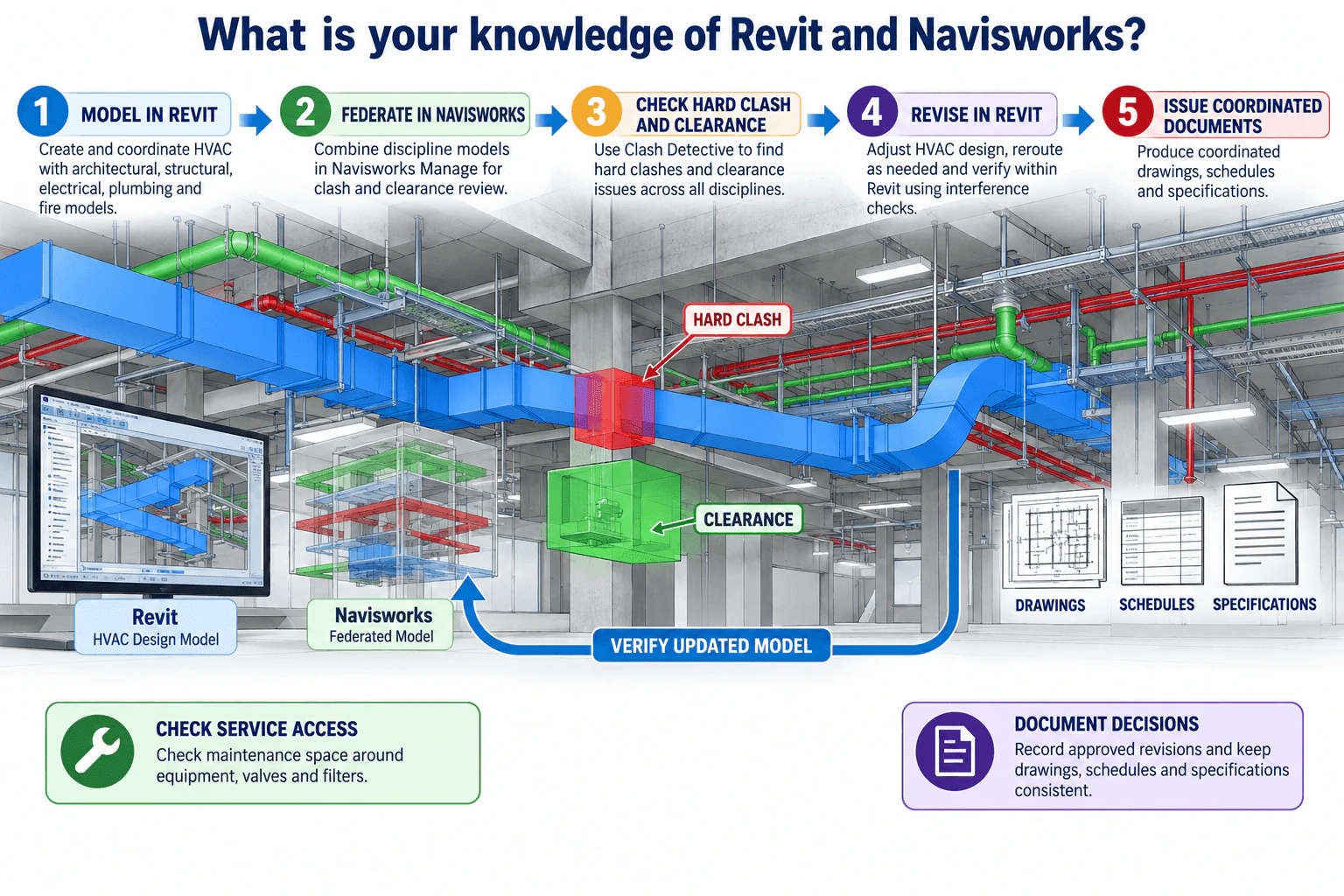
I use Revit primarily to develop and revise the HVAC design model, coordinate it with architectural, structural, electrical, plumbing, and fire information, and support coordinated drawings, schedules, and specifications. I use Navisworks Manage to federate discipline models and review hard clashes and clearance issues. After a conflict is resolved in Revit, I refresh the coordinated model and verify the updated condition. I also check maintenance access and constructability because a model can be free of hard clashes and still be difficult to build or service.
Detailed Explanation
My knowledge of Revit and Navisworks is centered on using them together as an HVAC coordination and documentation workflow. Revit is the main authoring environment for the HVAC model and design revisions. Navisworks Manage is useful for combining discipline models so the team can review coordination conditions in one place. I look for both hard clashes, where physical geometry conflicts, and clearance issues, where required access or working space is obstructed. After coordination decisions are made, I revise the HVAC design in Revit, refresh the coordinated model, verify the issue again, and keep drawings, schedules, and specifications aligned with the approved design.
Useful Questions to Ask the Interviewer
At what design stage would I be joining the coordination process, and which models and documents would I be responsible for?
How are clash decisions, RFIs, substitutions, and design revisions normally documented and approved on the project?
What level of responsibility would I have for checking service access and constructability in addition to physical clashes?
How to Explain It in an Interview
I would describe the workflow as five connected steps.
First, I develop or review the HVAC design in Revit and coordinate it against the architectural, structural, electrical, plumbing, and fire information available for the project. The goal is not only to place ductwork and equipment correctly, but also to communicate the intended system clearly.
Second, I federate the relevant discipline models in Navisworks Manage so the combined building can be reviewed as one coordination environment.
Third, I review hard clashes and clearance issues. A hard clash is a physical interference, such as ductwork intersecting structure or another service. A clearance issue may not contain a physical intersection, but it can still block maintenance access around equipment, valves, or filters. I also review constructability rather than assuming that clash free geometry means the design is complete.
Fourth, I document the coordination decision and revise the HVAC design in Revit. If a duct route changes, I check whether that revision affects connected equipment, access, drawings, schedules, specifications, or other disciplines.
Fifth, I refresh the coordinated model and verify the updated condition. Once the design is agreed, the coordinated information should be reflected consistently in drawings, schedules, and specifications.
The key point is that Revit and Navisworks support the engineering process. I use Revit to author and revise the HVAC design, Navisworks Manage to coordinate the combined models, and engineering judgment to decide whether the result is practical, accessible, constructible, and correctly documented.
Why Interviewers Ask This
Interviewers want to know whether I can use BIM tools to communicate HVAC design intent, coordinate with other disciplines, identify physical clashes and service access problems, manage revisions, and keep the final model and construction documents consistent. They are evaluating engineering judgment and coordination discipline rather than software button memorization.
Common interview mistakes
Common mistakes include treating a clash free model as proof that the HVAC design is valid, checking only physical intersections while ignoring service clearance, moving ductwork without considering the effect on other disciplines, making a model revision without updating related drawings or schedules, and closing an issue without verifying the revised coordinated model.
Interview tip
Explain Revit and Navisworks as parts of one engineering coordination process. Emphasize design intent, multidisciplinary interfaces, service access, documented decisions, revision control, and verification. This shows stronger HVAC judgment than simply listing software features.
Interviewer may ask next
How would you verify that a resolved clash is actually complete?
I would confirm that the approved change has been made in the HVAC model, refresh or replace the relevant coordinated model in Navisworks Manage, and review the affected area again for hard clashes, clearance, access, and constructability. I would also confirm that related drawings, schedules, specifications, and documented coordination decisions reflect the same revision before considering the issue closed.
What would you do if eliminating a clash created a maintenance access problem?
I would not accept the change solely because the physical clash disappeared. I would review the service space required around the affected equipment or component, consider alternative routing or placement with the relevant disciplines, document the agreed solution, revise the HVAC model, and verify both geometry and access again before issuing the coordinated documents.
2. What do you know about AECOM's project portfolio?BehavioralEasyAecom
Interview tip:
Use STAR to structure your answer: briefly explain the Situation and Task, make Action the most detailed part, and finish with the Result. For example, describe how you researched AECOM's project portfolio, identified the types of complex and multidisciplinary work that relate to HVAC engineering, connected that research to your own experience, and prepared to explain why that work interests you.
Situation
When preparing for this interview, I wanted to understand the type of work AECOM delivers and how an HVAC Engineer contributes within that environment.
Task
My goal was to understand the portfolio at a practical level instead of simply memorizing project names. I wanted to see how HVAC design fits into larger projects that require coordination across several engineering disciplines.
Action
I reviewed AECOM's work with a focus on the types of complex building and infrastructure projects where mechanical systems are an important part of the overall design. I paid particular attention to the multidisciplinary nature of the work because HVAC design rarely operates alone. Mechanical layouts must work with architectural space, electrical systems, plumbing, structural requirements, controls, energy goals, and construction needs. I also thought about how my own HVAC experience would apply in that setting. For example, I would expect to contribute by developing practical system designs, coordinating equipment and ductwork with other disciplines, checking performance requirements, and helping resolve design conflicts before they reach construction. What interests me most is the opportunity to work on projects where good HVAC engineering supports comfort, reliability, energy performance, and the wider project goals.
Result
That research gave me a clearer understanding of why AECOM interests me. The portfolio appears to offer the kind of multidisciplinary environment where an HVAC Engineer needs strong technical judgment, coordination skills, and awareness of the complete project rather than only the mechanical scope. It also helped me prepare to discuss how I could contribute effectively in that type of team.
Why Interviewers Ask This
Interviewers ask this question to see whether the candidate has taken time to understand AECOM and can connect the company's work to the HVAC Engineer role. A strong answer shows preparation, genuine interest, awareness of multidisciplinary project delivery, and an ability to explain how HVAC engineering supports wider project goals.
Interviewer may ask next
What part of AECOM's project work interests you most as an HVAC Engineer?
I am most interested in multidisciplinary projects where HVAC decisions have to be coordinated closely with architecture, electrical systems, plumbing, structures, controls, and energy requirements. I enjoy that kind of work because it requires both technical HVAC knowledge and practical coordination to create a design that can actually be built and operated successfully.
How would your previous HVAC experience help you contribute to projects like these?
My previous experience has taught me to look beyond an isolated HVAC calculation or layout. I consider equipment performance, space constraints, coordination with other disciplines, constructability, controls, and the needs of the people who will operate the system. I would bring that same approach to a multidisciplinary AECOM project and communicate issues early so the team can resolve them before they become larger design or construction problems.
3. Walk through your previous projects in detail.BehavioralMediumAecom
Interview tip:
Use STAR to structure your answer: briefly explain the Situation and Task, make Action the most detailed part, and finish with the Result. For example, describe a representative HVAC project from initial requirements through design, coordination, review, and final delivery, explaining your responsibilities, technical decisions, communication with other disciplines, problems you solved, and the final outcome.
Situation
On one of my previous projects, I worked on the HVAC design for an existing commercial building that was being renovated. The project included changes to occupied spaces, new room layouts, and updated mechanical requirements. Existing drawings were available, but some field conditions did not fully match the documents, so the design needed careful verification and coordination.
Task
I was responsible for developing the HVAC design for my assigned areas and helping move it from early planning through detailed design. My work included reviewing existing conditions, estimating cooling and heating needs, selecting an appropriate system approach, preparing equipment and ductwork layouts, checking coordination with other disciplines, and responding to design comments. I also needed to make sure the solution could be installed within the available ceiling and equipment space.
Action
I started by reviewing the architectural plans, existing mechanical information, and the requirements for each space. I identified areas where the existing information was uncertain and worked with the project team to confirm important field conditions before relying on them in the design. I then reviewed the expected loads and airflow needs so I could understand how much cooling, heating, and ventilation each area required. Based on those needs and the existing building constraints, I developed the HVAC layout and checked that equipment, ductwork, piping, diffusers, and return air paths could fit within the available space. I coordinated closely with architectural, structural, electrical, and plumbing team members because several ceiling areas were congested. When conflicts appeared, I did not simply move the mechanical system without checking the impact. I reviewed access requirements, pressure loss, maintenance space, and the effect on airflow before recommending a change. I also reviewed equipment information to confirm capacity, electrical needs, connections, and service clearances. As the design developed, I updated the drawings, responded to review comments, and explained the reasons behind important mechanical decisions so the rest of the team could coordinate around them. Before final delivery, I performed another review of my assigned areas to check that the drawings, equipment information, airflow requirements, and coordination decisions were consistent.
Result
The project progressed to a coordinated HVAC design that addressed the known building constraints and could be clearly understood by the wider design team. Resolving field questions and coordination issues early reduced the chance of carrying avoidable conflicts into later stages. The project also reinforced for me that a strong HVAC design is not only about calculations. It also requires clear communication, practical installation thinking, careful coordination, and checking assumptions before they become design decisions.
Why Interviewers Ask This
Interviewers ask this question to understand the candidate's actual level of project experience and ownership. They want to hear whether the candidate can explain how an HVAC project moves from requirements and existing conditions through design, coordination, review, and delivery, while clearly describing personal responsibilities, technical judgment, communication, and problem solving.
Interviewer may ask next
What was the most difficult coordination issue you faced on that project, and how did you resolve it?
One of the more difficult issues was fitting ductwork and other services through congested ceiling areas. I first identified which mechanical dimensions and access requirements could not be reduced without affecting performance or maintenance. I then reviewed possible routing changes with the other disciplines. We compared the impact of each option instead of moving systems independently. I adjusted the HVAC routing where it was practical and kept the required airflow path, access, and clearances in mind. That approach helped us reach a coordinated solution without creating another problem elsewhere.
What would you do differently if you handled a similar project again?
I would try to confirm uncertain existing conditions even earlier. On this project, some design decisions depended on information from older drawings that later required additional verification. I learned that identifying those assumptions at the beginning and tracking them clearly can make coordination more efficient. On a similar project now, I would create an early list of critical field conditions that need confirmation and review that list regularly with the project team.
4. Work passion and work accuracy.BehavioralEasyAecom
Interview tip:
Use STAR to structure your answer: briefly explain the Situation and Task, make Action the most detailed part, and finish with the Result. For example, describe a HVAC project where you stayed interested in the work while carefully checking calculations, drawings, equipment information, and design details so that your enthusiasm supported accurate and reliable results.
Situation
In my last role, I worked on a HVAC design package that required several calculations, equipment selections, and drawing updates. I enjoy this kind of work because I like understanding how each design choice affects comfort, energy use, and system performance. At the same time, I knew that small errors could create problems later during coordination or installation.
Task
My responsibility was to complete my assigned design work accurately while keeping the project moving. I needed to stay focused on the technical details, coordinate changes with the team, and make sure my enthusiasm for completing the work did not cause me to rush important checks.
Action
I first organized the work into clear steps so I could give each part proper attention. I reviewed the design criteria before starting calculations and kept the same assumptions consistent across the load calculations, equipment selections, and drawings. After completing each major section, I checked the inputs and outputs instead of waiting until the end. I compared equipment data with the design requirements and verified that airflow, capacity, and other important values matched what was shown on the drawings. When I made a change, I checked the related schedules and notes so that one update did not create a conflict somewhere else. I also asked another team member to review important items when a second check was useful. I stayed interested by connecting the detailed work to the final goal, which was a system that would be clear to build and reliable to operate. This approach helped me work carefully without losing momentum.
Result
The design package moved forward with the key information consistent across the calculations, selections, and drawings. The review process also helped me catch details before they became coordination issues. I learned that passion for HVAC work is most useful when it is combined with discipline. I try to show that passion through curiosity, careful checking, and ownership of the accuracy of my work.
Why Interviewers Ask This
Interviewers ask this question to understand whether the candidate can stay genuinely engaged in HVAC work while maintaining strong attention to detail. A strong answer shows that the candidate values both technical interest and accuracy, uses a reliable checking process, takes ownership of mistakes, and understands that careful work affects design quality, coordination, installation, and system performance.
Interviewer may ask next
How do you make sure your HVAC work stays accurate when you are under time pressure?
I protect the checks that have the highest impact. I confirm the design criteria first, then verify important calculations, equipment selections, and drawing values before I move on. If something changes, I trace that change through the related schedules and notes. Under time pressure, I may simplify how I organize the review, but I do not skip the checks that could affect system performance or coordination.
What did you learn from balancing passion for the work with attention to detail?
I learned that being enthusiastic is not only about working quickly or taking on more tasks. For me, it means caring enough about the result to understand the system and check the details carefully. On this project, that mindset helped me stay interested in the technical work while also being disciplined about accuracy and consistency.
Hvac Engineer Resume Examples
Explore the resume examples below to find the one that best matches your target Hvac Engineer role.
Disclaimer: This interview guide is for educational and informational purposes only. It is designed to help readers prepare, but it does not guarantee any interview result, hiring decision, offer, or outcome. Interview questions, hiring criteria, and preferred answers can vary by employer, interviewer, industry, location, and time. All answers, examples, and explanations in this guide are suggested examples for interview preparation, not definitive answers or instructions for professional practice. They are based on research and judgment, are provided without warranties of any kind, and should be adapted to the question, role, and applicable laws and professional requirements. Diagrams are simplified illustrations intended to highlight the main concepts and their relationships; actual situations, systems, and practices may be more complex. Alternative approaches may be equally valid or better suited to a particular question, context, or interviewer. To the fullest extent permitted by applicable law, the contributors and publisher are not liable for decisions made, actions taken, or losses incurred based on this guide.
State Laws and Professional Responsibilities: Laws and requirements governing an occupation vary by state and jurisdiction. You are responsible for checking the current laws, licensing requirements, and scope-of-practice rules that apply to your location and role, and for ensuring that your answers and actions comply with them. Adapt examples in this guide to those requirements. This guide is not legal advice.
Company Notice: This guide is an independent educational resource and is not affiliated with, endorsed by, sponsored by, or approved by the company named in this guide. Company names identify reported interview experiences or the employer context of clearly labeled original practice exercises. Interview practices can change without notice, and inclusion of company-specific content does not mean these questions are official, complete, or guaranteed to be asked. To the fullest extent permitted by law, the author, contributors, and publisher are not responsible for outcomes related to use of this material.
Content Accuracy and Verification: To the fullest extent permitted by applicable law, we do not represent or warrant that interview guides, questions, answers, examples, or diagrams are accurate, complete, current, error-free, or suitable for any particular purpose. You are responsible for independently reviewing and verifying the information before relying on it.