This interview guide is for educational and informational purposes only. It is designed to help readers prepare, but it does not guarantee any interview result, hiring decision, offer, or outcome. Interview questions, hiring criteria, and preferred answers can vary by employer, interviewer, industry, location, and time. All answers, examples, and explanations in this guide are suggested examples for interview preparation, not definitive answers or instructions for professional practice. They are based on research and judgment, are provided without warranties of any kind, and should be adapted to the question, role, and applicable laws and professional requirements. Diagrams are simplified illustrations intended to highlight the main concepts and their relationships; actual situations, systems, and practices may be more complex. Alternative approaches may be equally valid or better suited to a particular question, context, or interviewer. To the fullest extent permitted by applicable law, the contributors and publisher are not liable for decisions made, actions taken, or losses incurred based on this guide.
State Laws and Professional Responsibilities
Laws and requirements governing an occupation vary by state and jurisdiction. You are responsible for checking the current laws, licensing requirements, and scope-of-practice rules that apply to your location and role, and for ensuring that your answers and actions comply with them. Adapt examples in this guide to those requirements. This guide is not legal advice.
Identity, Image, and Privacy Notice
To respect individual privacy, some names, profile photographs, avatars, biographical details, and other identifying information displayed in this guide may be replaced with pseudonyms, licensed stock images, illustrative avatars, composite images, or representative descriptions. Unless a person is expressly identified as an actual contributor, a displayed name, image, or profile should not be understood as depicting or identifying a specific candidate, interviewer, employee, or other real individual. These representations are provided for editorial and illustrative purposes only and do not imply endorsement, employment, participation, or affiliation with this guide or any company mentioned in it. Any resemblance to an actual person is coincidental.
Company Notice
This guide is an independent educational resource and is not affiliated with, endorsed by, sponsored by, or approved by the company named in this guide. Company names identify reported interview experiences or the employer context of clearly labeled original practice exercises. Interview practices can change without notice, and inclusion of company-specific content does not mean these questions are official, complete, or guaranteed to be asked. To the fullest extent permitted by law, the author, contributors, and publisher are not responsible for outcomes related to use of this material.
Content Accuracy and Verification
To the fullest extent permitted by applicable law, we do not represent or warrant that interview guides, questions, answers, examples, or diagrams are accurate, complete, current, error-free, or suitable for any particular purpose. You are responsible for independently reviewing and verifying the information before relying on it.
Questions or comments?
Contact us for general questions, or share feedback, technical corrections, and comments with the community.
1. Explain the Carnot cycle for cooling-only chillers and reversible air-to-water heat pumps.Hvac FundamentalsHardDaikin
Short Interview Answer (30-60 seconds)
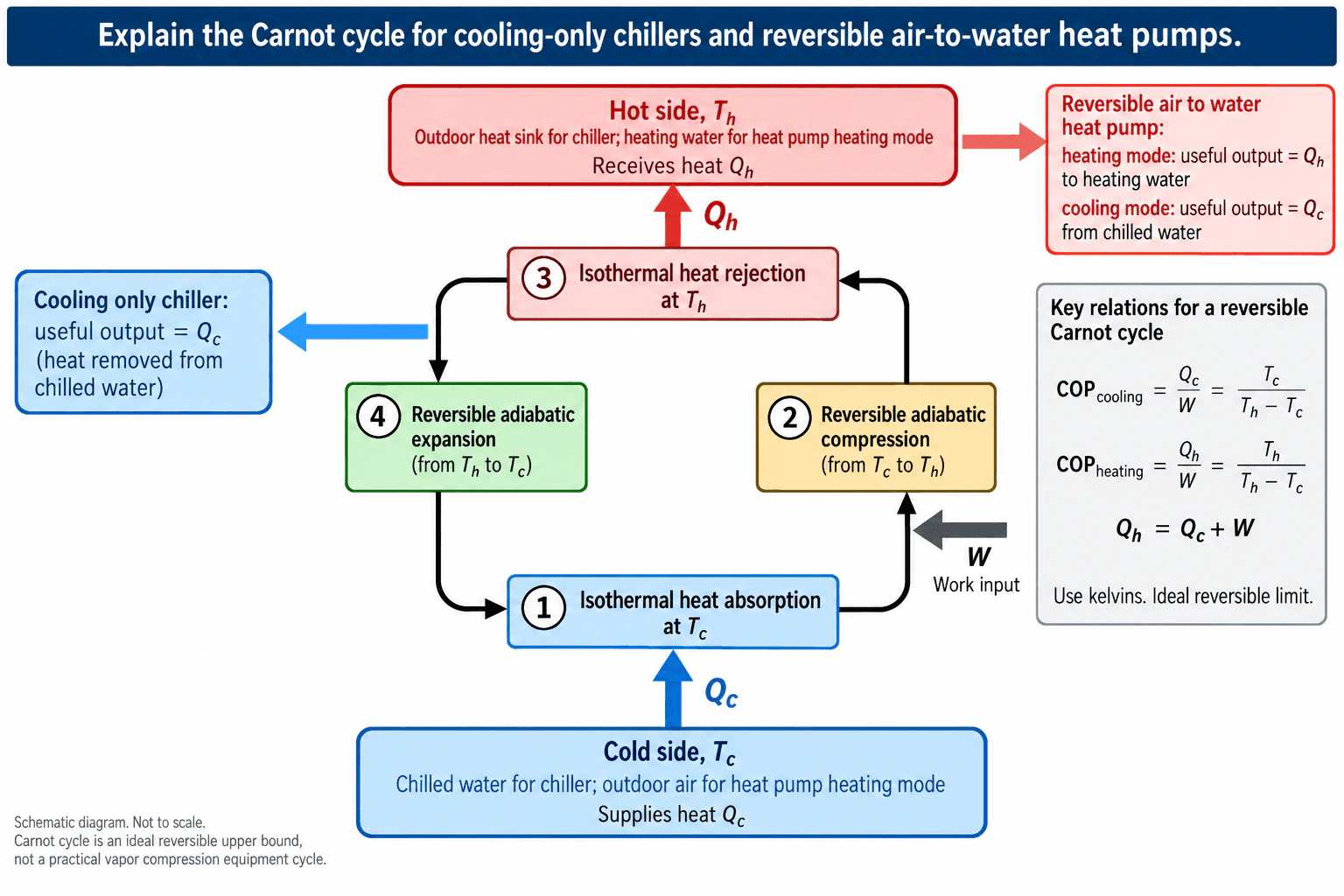
The reversed Carnot cycle is the ideal upper limit for a refrigerator or heat pump operating between a cold temperature Tc and a hot temperature Th. It absorbs Qc isothermally at Tc, receives work W during reversible adiabatic compression, rejects Qh isothermally at Th, then returns to Tc through reversible adiabatic expansion. For a cooling only chiller, useful output is Qc. For a reversible air to water heat pump, useful output is Qh in heating mode and Qc in cooling mode. The ideal COP values are COPcooling = Tc divided by (Th minus Tc) and COPheating = Th divided by (Th minus Tc), with temperatures in kelvins.
Useful Questions to Ask the Interviewer
Should I explain only the ideal reversed Carnot cycle, or also contrast it with a practical vapor compression system?
For the reversible air to water heat pump, should I discuss both heating mode and cooling mode?
Should I derive the COP equations from the energy balance and reversible heat transfer relation?
Detailed Explanation
How to Explain It in an Interview
Start by defining the two thermal reservoirs. Tc is the absolute temperature of the cold side and Th is the absolute temperature of the hot side, with Th greater than Tc. For a cooling only chiller, chilled water is the cold side and an outdoor heat sink is the hot side. For an air to water heat pump in heating mode, outdoor air is the cold source and heating water is the hot sink.
The reversed Carnot cycle has four reversible processes. First, the working fluid absorbs heat Qc isothermally at Tc. Second, reversible adiabatic compression raises its temperature from Tc to Th while work W enters the cycle. Third, the working fluid rejects heat Qh isothermally at Th. Fourth, reversible adiabatic expansion lowers its temperature from Th back to Tc. The first law energy balance is Qh = Qc + W.
The useful effect depends on the operating purpose. For a cooling only chiller, useful output is the cooling effect Qc, so COPcooling = Qc divided by W. For a heat pump in heating mode, useful output is Qh, so COPheating = Qh divided by W. For a reversible Carnot cycle, COPcooling = Tc divided by (Th minus Tc) and COPheating = Th divided by (Th minus Tc). Tc and Th must be absolute temperatures in kelvins.
A reversible air to water heat pump can also operate in cooling mode. In that case, chilled water is the cold side, outdoor air is the hot sink, and the useful effect is Qc.
The main engineering insight is that COP decreases as the required temperature lift, Th minus Tc, increases. The Carnot values are theoretical upper bounds because real equipment has compressor losses, finite temperature differences in heat exchangers, pressure losses, throttling losses, motor losses, and other irreversibilities. Therefore, the Carnot cycle is a benchmark for understanding maximum possible performance, not a prediction of actual equipment COP.
Why Interviewers Ask This
This tests whether the candidate understands the thermodynamic limit behind refrigeration and heat pump performance, can distinguish cooling output from heating output, can apply the correct COP definition, and understands why absolute temperature is required for Carnot performance equations.
Common interview mistakes
Common mistakes are using Celsius directly in the Carnot COP equations, confusing Qc with Qh, forgetting that Qh = Qc + W, describing the cycle in the wrong process direction, treating reversible adiabatic processes as heat transfer processes, or presenting Carnot COP as the expected COP of real equipment.
Interview tip
State the four processes in the same order as the cycle, define Tc, Th, Qc, Qh, and W before using equations, then clearly separate the useful effect for cooling from the useful effect for heating. Finish by explaining that Carnot performance is an ideal upper bound and that a larger temperature lift reduces COP.
Interviewer may ask next
Why must Tc and Th be expressed in kelvins in the Carnot COP equations?
The Carnot relations are derived from reversible thermodynamics using absolute temperature ratios. Celsius has an arbitrary zero, so substituting Celsius values would give physically incorrect ratios and COP values. A temperature difference has the same numerical size in kelvins and degrees Celsius, but the absolute Tc and Th terms in the COP equations must use kelvins.
What happens to ideal heat pump performance if outdoor air becomes colder while the required heating water temperature stays the same?
Tc decreases while Th remains approximately fixed, so the temperature lift Th minus Tc increases. Because COPheating = Th divided by (Th minus Tc), the ideal heating COP decreases. Real heat pumps generally show the same qualitative trend, with additional effects from equipment characteristics and operating conditions.
2. What have you learned about Daikin as a company?BehavioralEasyDaikin
Interview tip:
Use STAR to structure your answer: briefly explain the Situation and Task, make Action the most detailed part, and finish with the Result. For example, describe how you researched Daikin before the interview, identified the parts of the company and its HVAC work that connect with your engineering interests, considered what those findings mean for the role, and used that research to explain why the company interests you.
Situation
While preparing for this interview, I wanted to understand Daikin beyond simply knowing that it works in the HVAC industry. I wanted to learn what the company focuses on and how that connects with the type of engineering work I want to do.
Task
My goal was to build a clear picture of Daikin as a company so I could explain why I am interested in the role and ask better questions during the interview.
Action
I focused my research on the parts of Daikin that are most relevant to an HVAC Engineer. I learned that the company has a strong focus on heating, ventilation, air conditioning, and related climate solutions. I also looked at how an HVAC Engineer can contribute through equipment selection, system design, controls, energy performance, commissioning, troubleshooting, and continuous improvement. What stood out to me was the connection between engineering decisions and the final customer experience. A design has to provide comfort, operate reliably, use energy carefully, and be practical to install and maintain. That matches how I approach HVAC work. I also thought about the importance of working across engineering, manufacturing, field service, contractors, and customers because good HVAC performance depends on more than one team. This research helped me connect my technical interests with the type of work I would expect to support at Daikin.
Result
I came away with a clearer understanding of why Daikin interests me. I see it as a company where HVAC engineering is central to the business, and where practical engineering decisions can directly affect comfort, reliability, energy use, and system performance. It also helped me prepare more focused questions about the role, the team, and how engineering work moves from design into real installations.
Why Interviewers Ask This
Interviewers ask this question to see whether the candidate prepared seriously for the conversation and understands why the company is relevant to their career. A strong answer shows research, genuine interest, and the ability to connect what the company does with the responsibilities and priorities of an HVAC Engineer.
Interviewer may ask next
What part of what you learned about Daikin interested you most?
The part that interested me most was that HVAC engineering is closely connected to the company itself rather than being a supporting function. That means decisions about system performance, reliability, controls, installation, and energy use can have a direct effect on the product and customer experience. That is the kind of environment where I believe an HVAC Engineer can keep learning while also making a practical contribution.
How would what you learned about Daikin affect the way you approach this role?
It would make me focus on the full life of the HVAC system, not only the initial design. I would think about performance, controls, installation, commissioning, service access, reliability, and how the system behaves for the customer after it is operating. I would also communicate closely with the other teams involved because the research reminded me that strong HVAC results depend on coordination from design through field operation.
3. What attracts you to working at Daikin?BehavioralEasyDaikin
Interview tip:
Use STAR to structure your answer: briefly explain the Situation and Task, make Action the most detailed part, and finish with the Result. For example, describe a previous HVAC project that helped you understand the type of engineering work you enjoy, explain the responsibilities and technical problems that motivated you, connect those experiences to what attracts you to Daikin, and show how you want to contribute while continuing to grow as an HVAC Engineer.
Situation
On one of my previous HVAC projects, I worked on a system where comfort, equipment performance, controls, and energy use all had to be considered together. I enjoyed seeing how engineering decisions affected the way the complete HVAC system operated in the building.
Task
My responsibility was to support the technical work, understand the operating requirements, and help identify practical ways to improve system performance while keeping reliability and occupant comfort in mind.
Action
I reviewed the HVAC design and operating information, checked how the major components interacted, and worked with the team to understand issues that could affect performance. I paid close attention to equipment selection, temperature control, airflow, and the way the control sequence affected the system during different operating conditions. When I found an issue, I tried to understand the cause before suggesting a change. I also discussed my findings clearly with other team members so that technical decisions could be made with a shared understanding of the system. That experience showed me that I am most engaged when I can combine HVAC fundamentals with practical problem solving and continuous learning. That is what attracts me to Daikin. I am interested in an environment where HVAC engineering is central to the work and where I can contribute to real heating and cooling systems while continuing to strengthen my technical knowledge.
Result
The project strengthened my interest in HVAC engineering and confirmed the kind of work I want to continue doing. It taught me that I enjoy understanding complete systems, solving practical performance problems, and working with others to reach reliable engineering decisions. I see those interests as a strong connection to why I want to work at Daikin.
Why Interviewers Ask This
Interviewers ask this question to understand whether the candidate has a clear and genuine reason for choosing Daikin and whether that interest connects to the work of an HVAC Engineer. A strong answer shows that the candidate understands what type of engineering work motivates them, can connect past experience to the opportunity, and has a thoughtful reason for wanting to contribute and grow in the role.
Interviewer may ask next
What part of HVAC engineering interests you most?
I am most interested in understanding how the complete HVAC system works together. I enjoy looking at equipment, airflow, temperature control, and control sequences as connected parts of one system. On the project I described, that system level view helped me understand problems more clearly and make better technical decisions.
How would you like to grow if you joined Daikin?
I would like to deepen my knowledge of HVAC equipment, system operation, controls, and practical performance troubleshooting. I would also like to keep improving how I communicate technical findings with other engineers and project teams. My previous project showed me that I learn best when I can connect engineering principles directly to real system behavior.
4. Walk through the experience presented in your resume.BehavioralEasyDaikin
Interview tip:
Use STAR to structure your answer: briefly explain the Situation and Task, make Action the most detailed part, and finish with the Result. For example, describe a representative HVAC project from your recent experience, explain your responsibilities, the technical and communication steps you personally handled, how you worked with the wider team, and what the experience taught you about delivering reliable HVAC systems.
Situation
In my last role, much of my experience involved supporting HVAC design, equipment selection, installation coordination, and commissioning. One project that represents this experience well involved replacing an existing rooftop HVAC system serving an occupied building. The work had to improve system reliability while limiting disruption to normal building operations.
Task
I was responsible for reviewing the existing conditions, helping confirm the equipment requirements, coordinating technical details with the project team, and supporting installation and commissioning. My goal was to make sure the replacement system matched the building load, could be installed correctly, and performed as intended after startup.
Action
I first reviewed the existing drawings, equipment information, operating conditions, and available site measurements so I understood how the current system served the building. I then checked the heating and cooling requirements and compared them with the proposed equipment capacity. I paid attention to airflow, duct connections, electrical requirements, controls, service clearances, and how the new equipment would connect to the existing system. When I found questions or differences between the drawings and field conditions, I raised them early with the appropriate team members instead of allowing assumptions to reach installation. I also coordinated with the installation team so they understood important requirements such as equipment orientation, access, sensor locations, and control connections. During startup, I reviewed operating data, checked airflow and temperature response, confirmed control sequences, and helped investigate items that did not behave as expected. I documented the findings and worked with the team until the main issues were addressed. This project reflects the way my resume experience developed from technical analysis into broader responsibility for coordination, troubleshooting, and system performance.
Result
The system was placed into operation with the key design and control requirements verified, and the project gave me stronger practical experience connecting design decisions with real field conditions. I learned that good HVAC engineering is not only about selecting equipment. It also requires clear communication, careful field verification, and ownership through installation and commissioning.
Why Interviewers Ask This
Interviewers ask this question to understand how the experience listed on the resume connects into a clear professional story. They are evaluating whether the candidate can explain personal responsibilities, technical growth, project involvement, communication, and lessons learned in a structured and credible way.
Interviewer may ask next
Which part of that project was most important to your development as an HVAC Engineer?
The commissioning work was especially important because it showed me how design decisions appear in the real system. Reviewing airflow, temperature response, controls, and field conditions helped me connect calculations and drawings with actual equipment behavior. It also improved the way I communicate with installation and controls teams when a system does not perform as expected.
What would you do differently if you handled a similar project today?
I would spend even more time verifying existing field conditions before final equipment and installation decisions are made. On this project, early field checks helped us resolve several questions before startup. I learned that confirming access, connections, controls, and operating conditions as early as possible reduces uncertainty later and makes coordination more effective.
Hvac Engineer Resume Examples
Explore the resume examples below to find the one that best matches your target Hvac Engineer role.
Disclaimer: This interview guide is for educational and informational purposes only. It is designed to help readers prepare, but it does not guarantee any interview result, hiring decision, offer, or outcome. Interview questions, hiring criteria, and preferred answers can vary by employer, interviewer, industry, location, and time. All answers, examples, and explanations in this guide are suggested examples for interview preparation, not definitive answers or instructions for professional practice. They are based on research and judgment, are provided without warranties of any kind, and should be adapted to the question, role, and applicable laws and professional requirements. Diagrams are simplified illustrations intended to highlight the main concepts and their relationships; actual situations, systems, and practices may be more complex. Alternative approaches may be equally valid or better suited to a particular question, context, or interviewer. To the fullest extent permitted by applicable law, the contributors and publisher are not liable for decisions made, actions taken, or losses incurred based on this guide.
State Laws and Professional Responsibilities: Laws and requirements governing an occupation vary by state and jurisdiction. You are responsible for checking the current laws, licensing requirements, and scope-of-practice rules that apply to your location and role, and for ensuring that your answers and actions comply with them. Adapt examples in this guide to those requirements. This guide is not legal advice.
Company Notice: This guide is an independent educational resource and is not affiliated with, endorsed by, sponsored by, or approved by the company named in this guide. Company names identify reported interview experiences or the employer context of clearly labeled original practice exercises. Interview practices can change without notice, and inclusion of company-specific content does not mean these questions are official, complete, or guaranteed to be asked. To the fullest extent permitted by law, the author, contributors, and publisher are not responsible for outcomes related to use of this material.
Content Accuracy and Verification: To the fullest extent permitted by applicable law, we do not represent or warrant that interview guides, questions, answers, examples, or diagrams are accurate, complete, current, error-free, or suitable for any particular purpose. You are responsible for independently reviewing and verifying the information before relying on it.