This interview guide is for educational and informational purposes only. It is designed to help readers prepare, but it does not guarantee any interview result, hiring decision, offer, or outcome. Interview questions, hiring criteria, and preferred answers can vary by employer, interviewer, industry, location, and time. All answers, examples, and explanations in this guide are suggested examples for interview preparation, not definitive answers or instructions for professional practice. They are based on research and judgment, are provided without warranties of any kind, and should be adapted to the question, role, and applicable laws and professional requirements. Diagrams are simplified illustrations intended to highlight the main concepts and their relationships; actual situations, systems, and practices may be more complex. Alternative approaches may be equally valid or better suited to a particular question, context, or interviewer. To the fullest extent permitted by applicable law, the contributors and publisher are not liable for decisions made, actions taken, or losses incurred based on this guide.
State Laws and Professional Responsibilities
Laws and requirements governing an occupation vary by state and jurisdiction. You are responsible for checking the current laws, licensing requirements, and scope-of-practice rules that apply to your location and role, and for ensuring that your answers and actions comply with them. Adapt examples in this guide to those requirements. This guide is not legal advice.
Identity, Image, and Privacy Notice
To respect individual privacy, some names, profile photographs, avatars, biographical details, and other identifying information displayed in this guide may be replaced with pseudonyms, licensed stock images, illustrative avatars, composite images, or representative descriptions. Unless a person is expressly identified as an actual contributor, a displayed name, image, or profile should not be understood as depicting or identifying a specific candidate, interviewer, employee, or other real individual. These representations are provided for editorial and illustrative purposes only and do not imply endorsement, employment, participation, or affiliation with this guide or any company mentioned in it. Any resemblance to an actual person is coincidental.
Company Notice
This guide is an independent educational resource and is not affiliated with, endorsed by, sponsored by, or approved by the company named in this guide. Company names identify reported interview experiences or the employer context of clearly labeled original practice exercises. Interview practices can change without notice, and inclusion of company-specific content does not mean these questions are official, complete, or guaranteed to be asked. To the fullest extent permitted by law, the author, contributors, and publisher are not responsible for outcomes related to use of this material.
Content Accuracy and Verification
To the fullest extent permitted by applicable law, we do not represent or warrant that interview guides, questions, answers, examples, or diagrams are accurate, complete, current, error-free, or suitable for any particular purpose. You are responsible for independently reviewing and verifying the information before relying on it.
Questions or comments?
Contact us for general questions, or share feedback, technical corrections, and comments with the community.
1. How does a chiller plant management system work?Controls And Building AutomationMediumJohnson Controls
Short Interview Answer (30-60 seconds)
A chiller plant management system uses the BAS or BMS to coordinate the entire chilled water plant so the required cooling load is met efficiently and safely. It monitors values such as chilled water supply and return temperature, differential pressure, equipment status, and sometimes cooling load. Based on the sequence of operations, it starts the required pumps and cooling tower equipment, enables a chiller after its interlocks are satisfied, stages additional chillers as load increases, and removes capacity when demand falls. It can also reset temperature or pressure setpoints, control VFD speeds, rotate lead equipment, generate alarms, and use trend logs to verify that commanded and actual operation agree.
Detailed Explanation
A chiller plant management system is the supervisory control layer that coordinates the equipment producing and distributing chilled water. The exact sequence depends on the plant arrangement and the approved sequence of operations.
Useful Questions to Ask the Interviewer
Is the plant constant primary flow, variable primary flow, or primary secondary flow?
What variables are used for chiller staging, such as calculated load, temperature difference, flow, or chiller capacity?
Are chilled water temperature and differential pressure reset strategies part of the intended sequence?
How to Explain It in an Interview
I would start by defining the controlled objective. The plant must maintain the required chilled water conditions while keeping equipment within its operating limits.
The BAS reads sensors such as chilled water supply temperature, return temperature, differential pressure, flow where available, condenser water temperatures, and equipment status. DDC controllers then command actuators such as control valves, pump VFDs, cooling tower fans, and equipment enable signals.
During startup, the BAS follows the sequence of operations. It establishes the required water path, enables the appropriate pumps, confirms required proof signals and interlocks, and then enables the lead chiller. Protective controls remain with the equipment and are not bypassed by the BAS.
As cooling demand changes, the plant manager decides whether existing capacity is sufficient. Depending on the approved sequence, it may use calculated load, sustained temperature deviation, flow, equipment loading, or another defined signal. Deadbands and time delays help prevent rapid staging. When demand stays above the staging threshold, another chiller and its required supporting equipment can be enabled. When demand remains low enough, capacity can be removed in the reverse sequence.
The BAS can also optimize distribution. Pump VFD speed may be adjusted to maintain differential pressure, and the differential pressure setpoint may be reset according to valve demand. A chilled water supply temperature reset may also be used when permitted by the design and equipment requirements.
Lead equipment can rotate according to runtime or another defined strategy so operating hours are distributed appropriately. Alarms identify conditions such as sensor failure, loss of proof, abnormal temperatures, or disagreement between commanded and actual status.
I would validate the sequence with trend logs. I would compare sensor values, commands, feedback, staging points, and timing. If performance is wrong, I would first confirm sensor location and calibration and compare commanded versus actual actuator states before assuming the plant lacks mechanical capacity.
Why Interviewers Ask This
Interviewers want to know whether I understand how a BAS or BMS coordinates chillers, pumps, cooling towers, sensors, valves, VFDs, setpoints, alarms, and equipment interlocks as one plant rather than treating each component as an independent controller. They are also evaluating whether I can explain sequencing, load based staging, reset strategies, protection logic, and verification with trend data.
Common interview mistakes
Common mistakes include staging chillers from a single instantaneous temperature reading, ignoring deadbands and time delays, enabling a chiller before required flow or other interlocks are proven, bypassing equipment protection logic, assuming every plant uses the same staging method, and diagnosing poor plant performance without first checking sensor calibration, sensor location, commanded states, actual feedback, and trend data.
Interview tip
Explain the plant as a sequence from sensing to decision to actuation to verification. Make it clear that the BAS coordinates equipment but does not replace manufacturer protection controls. Mention staging logic, interlocks, reset strategies, VFD control, alarms, and trend verification, while noting that the exact sequence must match the specific plant design and approved sequence of operations.
Interviewer may ask next
How would you verify that the chiller staging sequence is working correctly?
I would review trend logs for chilled water supply and return temperatures, flow or load signals where available, equipment loading, enable commands, proof signals, and relevant setpoints. I would confirm that each staging condition remains satisfied for the required time before another chiller starts, that deadbands prevent rapid cycling, and that required pumps and other interlocks are proven before enable. I would also check sensor location and calibration and compare every important command with its actual status. If the BAS sequence is correct but temperatures still cannot be maintained, I would then investigate mechanical capacity, heat transfer, flow, and equipment performance.
What changes when the plant has variable primary flow?
With variable primary flow, pump speed and minimum chiller flow become especially important because the same distribution flow passes through the operating chillers. The BAS must coordinate pump VFD control, differential pressure control, chiller staging, valve positions, and required minimum flow limits. When another chiller is started or stopped, the sequence must manage the hydraulic transition without violating equipment flow requirements. The exact limits and staging logic should come from the plant design, approved sequence of operations, and equipment requirements rather than from a generic control rule.
2. What troubleshooting methods do you use?Troubleshooting And CommissioningMediumJohnson Controls
i Question Details
Explain the troubleshooting methods you use on engineering or controls problems, including how you narrow the fault, gather evidence, test likely causes, and verify the correction.
Short Interview Answer (30-60 seconds)
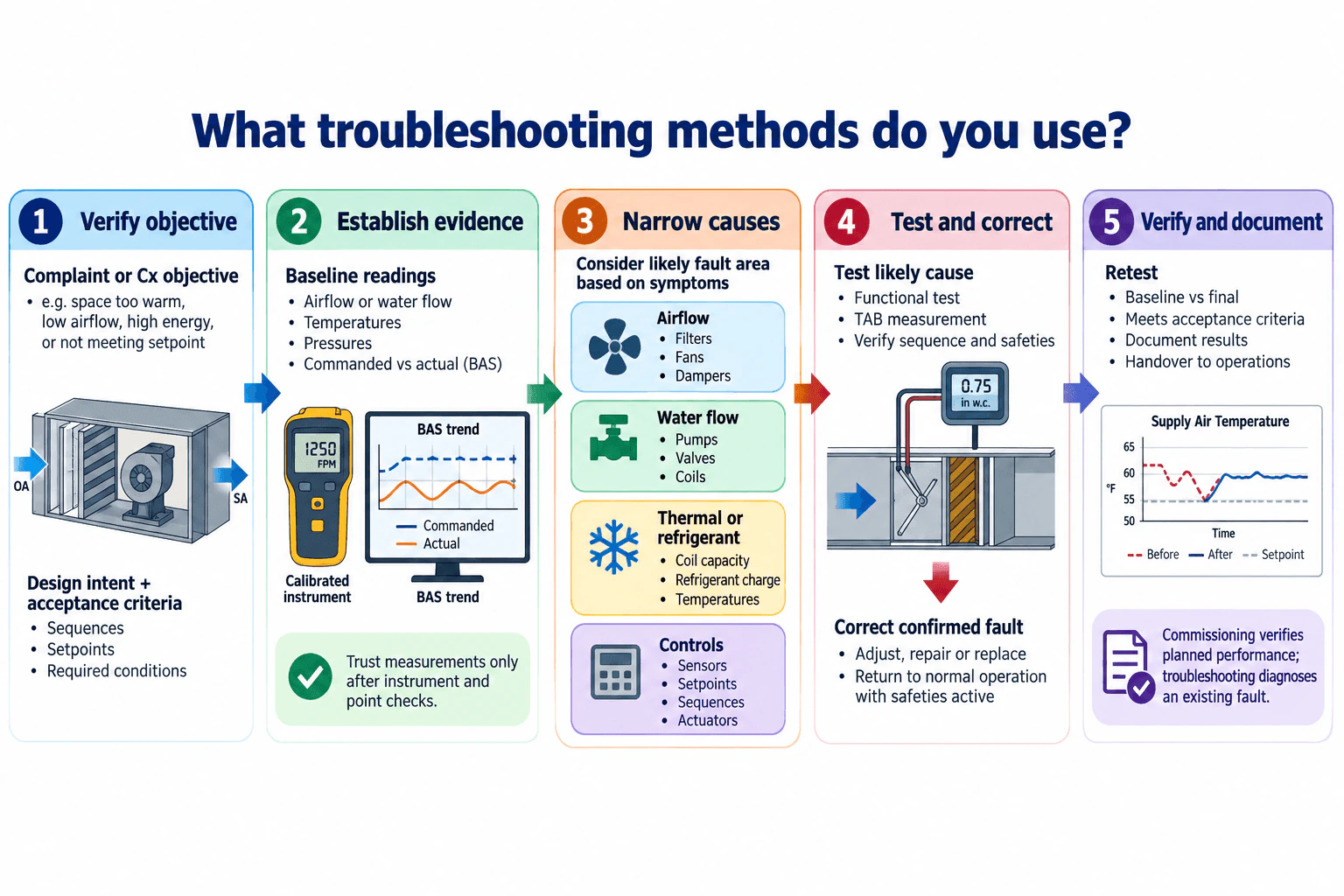
I start by confirming the complaint or commissioning objective and the expected design intent. Then I establish trustworthy baseline data after checking instrument calibration and BAS points, comparing commanded states with actual equipment behavior. I narrow the problem into likely airflow, water flow, thermal, refrigerant, or controls causes and test the most likely hypotheses in a safe order. After correcting the confirmed fault, I retest against the original acceptance criteria, document the before and after condition, and hand the system back only after performance is verified.
Detailed Explanation
I use an evidence driven troubleshooting process. I first verify what the system is supposed to do and what problem is actually occurring. I avoid changing setpoints or components until I have a reliable baseline. I then compare measured conditions, BAS commands, actual equipment states, and known good operation to narrow the fault. The objective is to prove the cause, correct it safely, and verify the result rather than simply making the symptom disappear.
Useful Questions to Ask the Interviewer
Is this an existing fault diagnosis or a planned commissioning test?
What design intent, sequence of operation, and acceptance criteria are available?
What BAS trends, TAB data, and field measurements are available before troubleshooting begins?
How to Explain It in an Interview
I follow five steps.
First, I verify the objective. For an existing problem, I confirm the complaint and operating conditions. For commissioning, I confirm the approved sequence, setpoints, required conditions, and acceptance criteria.
Second, I establish evidence. I check instrument calibration and BAS point credibility, then record baseline temperatures, pressures, airflow or water flow where appropriate, and commanded versus actual equipment states. This prevents me from diagnosing a bad sensor or unreliable point as a mechanical problem.
Third, I narrow the possible causes. I separate the problem into airflow, water flow, thermal or refrigerant, and controls paths. For example, before blaming cooling capacity, I check whether filters, fans, dampers, pumps, valves, coils, or control sequences are limiting flow. I use trend data, functional tests, TAB information, temperature differences, static pressure, and equipment status as appropriate.
Fourth, I test the most likely cause without defeating safeties. I change one verified condition at a time when practical, compare the response with the expected sequence, and correct only the confirmed fault. Corrective action might involve adjustment, repair, replacement, balancing, sensor correction, or sequence correction depending on the evidence.
Finally, I retest the system under the relevant operating condition. I compare the final readings with the baseline and acceptance criteria, verify that commanded and actual states agree, document the correction, and communicate any remaining limitations before handover. Troubleshooting diagnoses an existing fault, while commissioning uses planned functional testing to prove that the installed system performs according to the design intent.
Why Interviewers Ask This
Interviewers want to see whether I troubleshoot systematically, use measured evidence instead of assumptions, separate symptoms from root causes, protect equipment safeties, and verify that a correction actually restores the required HVAC performance.
Common interview mistakes
Common mistakes include changing setpoints before confirming the complaint, trusting an unverified sensor or BAS point, assuming a capacity problem before checking airflow or water flow, replacing components without proving the cause, changing several variables at once, bypassing safeties during testing, and stopping after the symptom disappears without retesting against the original acceptance criteria.
Interview tip
Describe the process as evidence to hypothesis to test to correction to verification. Mention concrete HVAC checks such as BAS commanded versus actual states, airflow, water flow, temperature, pressure, TAB data, and functional testing. Emphasize that you document baseline and final readings and distinguish fault diagnosis from planned commissioning.
Interviewer may ask next
How do you know that the correction solved the root cause rather than only hiding the symptom?
I repeat the relevant functional test under comparable operating conditions and compare the final measurements with the original baseline, expected sequence, and acceptance criteria. I also confirm that commanded and actual equipment states agree and that the original symptom does not return. If the evidence does not match the expected behavior, I continue the root cause investigation rather than declaring the problem resolved.
What changes if the problem only appears under seasonal or high load conditions?
I document the conditions that cannot be reproduced immediately and use available trend data to narrow the likely causes. I verify everything that can be tested safely under current conditions, then plan a seasonal or load dependent functional test for the required operating state. I would not claim full verification until the system has been tested under conditions that can demonstrate the required performance.
3. Tell me about yourself and the projects you have worked on.BehavioralMediumJohnson Controls
i Question Details
Introduce your background, then discuss the projects you have worked on that are most relevant to the controls-engineering role, focusing on your own responsibilities and technical contribution.
Interview tip:
Use STAR to structure your answer: briefly explain the Situation and Task, make Action the most detailed part, and finish with the Result. For example, describe your HVAC engineering background, a controls project that represents your experience, your personal responsibility, how you checked the system design and sequences, how you coordinated with the project team, the technical decisions you made, and the final operating result.
Situation
I am an HVAC engineer with experience working on building systems where mechanical equipment, controls, and actual operating conditions all have to work together. One project that represents my experience well involved improving the control and commissioning of an air handling system. The system included supply and return fans, temperature sensors, dampers, valves, and a building automation system. During testing, the equipment was operating, but the space conditions were not consistently matching the intended sequence.
Task
My responsibility was to understand how the system was supposed to operate, identify why the actual behavior was different, and help bring the controls and mechanical operation into alignment. I needed to focus on my own technical checks while also coordinating with the controls technician and the wider project team so that any changes were based on evidence rather than assumptions.
Action
I started by reviewing the control sequence and the mechanical drawings so I understood the intended operation before changing anything. I then checked the major inputs and outputs in the building automation system. I compared sensor readings with actual field conditions because an incorrect input can make a correct control sequence behave incorrectly. I also observed the supply fan, dampers, and control valves through different operating conditions to see whether each command produced the expected physical response. When I found behavior that did not match the sequence, I separated the possible causes into control logic, sensor issues, actuator issues, and mechanical issues. This made troubleshooting more structured. I discussed each finding with the controls technician and explained what I had observed in the field. We then tested changes one at a time so we could see which adjustment actually corrected the problem. I also checked the system again after the changes instead of assuming that a successful command meant the complete sequence was working. That final verification was important because HVAC controls are connected, and changing one part of the sequence can affect another operating condition.
Result
The system operated more consistently with the intended control sequence, and the team had a clearer understanding of the issues that had caused the unstable behavior. The project strengthened my ability to connect HVAC design, control logic, and field operation instead of looking at them as separate topics. It also reinforced that careful verification and clear communication are just as important as making the technical adjustment itself.
Why Interviewers Ask This
Interviewers ask this question to understand the candidate's overall HVAC background, the type of projects they have handled, and how closely their experience matches a controls focused engineering role. A strong answer shows clear ownership of technical work, an ability to connect mechanical systems with building controls, practical troubleshooting judgment, and the communication skills needed to work with technicians and project teams.
Interviewer may ask next
How did you determine whether the problem was caused by the control logic or by the mechanical equipment?
I compared the commanded value in the building automation system with the actual field response. For example, if the system commanded a damper or valve to move, I checked whether the device physically responded as expected. I also checked whether the sensor values matched the real operating condition. That helped me separate a logic problem from a bad input, actuator problem, or mechanical issue before recommending a change.
What did you learn from that project that you would apply to a future controls project?
I learned to verify the complete sequence from the input through the control decision to the final equipment response. I would use that same approach again because checking only the software command can miss a field problem. I would also continue documenting observations and testing one change at a time so the team can clearly understand what caused the issue and why the correction worked.
4. What do you know about Johnson Controls?BehavioralMediumJohnson Controls
i Question Details
Explain what you know about Johnson Controls that is relevant to the role and why that context matters to your interest in the position.
Interview tip:
Use STAR to structure your answer: briefly explain the Situation and Task, make Action the most detailed part, and finish with the Result. For example, describe how you prepared for the Johnson Controls interview, connected what you learned about the HVAC Engineer role with your own experience, identified the parts of the work that interest you, and explained why that context makes the position a good professional fit.
Situation
When I prepared for this interview with Johnson Controls, I wanted to understand the company in the context of the HVAC Engineer role instead of giving a general company description. I learned that Johnson Controls works across HVAC equipment, building automation and controls, thermal management, energy efficiency, and building systems.
Task
My goal was to connect what the role requires with the type of HVAC engineering work I have handled before and explain why that makes me interested in the position.
Action
I reviewed the role carefully and focused on the areas that matter most to an HVAC Engineer. I also looked at how Johnson Controls brings HVAC equipment and building automation together to improve building performance, comfort, energy use, and reliable operation. I thought about how I approach system performance, controls, troubleshooting, commissioning, communication, and reliable operation in my previous work. I also considered how an engineer in this type of role needs to look beyond one piece of equipment and understand how the full HVAC system operates together. That is important to me because good engineering is not only about selecting or fixing equipment. It is also about understanding operating conditions, checking how controls affect performance, finding the real cause of problems, and communicating clearly with the people involved. When I compare that type of responsibility with my own experience and the position I am discussing with Johnson Controls, I see a strong connection with the way I like to work.
Result
This preparation gave me a clearer reason for my interest in Johnson Controls. I am interested in the role because the company works directly with HVAC systems, controls, building performance, and energy efficiency, which gives me an opportunity to apply practical HVAC engineering judgment, work through system level problems, and continue developing my knowledge while contributing to reliable building operation.
Why Interviewers Ask This
Interviewers ask this question to see whether the candidate prepared for the conversation, understands the role in the context of Johnson Controls, and can explain a genuine professional reason for being interested. A strong answer shows preparation, relevant HVAC judgment, and a clear connection between the candidate's experience and the position.
Interviewer may ask next
What part of the Johnson Controls HVAC Engineer role interests you most?
I am most interested in work that requires understanding the complete HVAC system rather than looking at one component in isolation. I enjoy reviewing system performance, checking controls, troubleshooting problems, and confirming that the final operation matches the intended result. That type of work fits the way I have approached HVAC problems in my previous experience.
How would your previous HVAC experience help you in this role?
My previous experience taught me to start with the actual operating condition, collect the right information, and work through the system logically before deciding on a solution. I also learned that communication matters because controls, equipment, installation, and operation can involve several people. I would bring that same practical and organized approach to this role.
5. What were your favorite subjects at university?BehavioralEasyJohnson Controls
i Question Details
Name the university subjects you found most engaging and explain which parts of those subjects connect most directly to HVAC, controls, or engineering work.
Interview tip:
Use STAR to structure your answer: briefly explain the Situation and Task, make Action the most detailed part, and finish with the Result. For example, describe the university subjects you enjoyed most, why they interested you, how you applied the ideas in practical coursework, and how those subjects prepared you for HVAC, controls, and engineering work.
Situation
At university, the subjects I enjoyed most were thermodynamics, heat transfer, fluid mechanics, and control systems. I liked them because they explained how energy, air, water, equipment, and automatic controls work together in real engineering systems.
Task
My goal was not only to understand the theory for exams. I wanted to understand how the principles could be used to solve practical building and HVAC problems, such as moving heat efficiently, selecting the right operating conditions, and controlling equipment safely.
Action
In thermodynamics and heat transfer, I focused on understanding how heating and cooling loads affect equipment performance. I enjoyed tracing how energy moves through a system instead of only using formulas. In fluid mechanics, I learned how pressure, flow rate, pipe or duct resistance, and equipment such as pumps and fans affect system operation. Control systems became especially interesting because they connected the mechanical side with sensors, controllers, setpoints, and equipment responses. During practical assignments, I tried to connect these subjects together. For example, I would first understand the required heating or cooling condition, then think about the air or water flow needed, and finally consider how a control sequence could keep the system stable as conditions changed. That approach helped me see HVAC as one connected system rather than separate components.
Result
Those subjects gave me a strong interest in HVAC engineering because they combined physical engineering with practical problem solving and controls. They also taught me to look at the complete system before making a decision. I still use that way of thinking when I evaluate HVAC performance, investigate operating problems, or consider how controls should respond to changing conditions.
Why Interviewers Ask This
Interviewers ask this question to understand which technical areas genuinely interest the candidate and whether those interests connect naturally to HVAC engineering. A strong answer shows curiosity, practical understanding, and the ability to connect university learning with real building systems, equipment, and controls.
Interviewer may ask next
Which of those subjects has been most useful for HVAC engineering?
Thermodynamics and heat transfer have been especially useful because they help me understand heating and cooling processes, equipment performance, and how energy moves through a building system. Control systems are also very important because they help turn those physical principles into stable and efficient equipment operation.
How did control systems change the way you looked at mechanical HVAC equipment?
Control systems helped me understand that good mechanical equipment still depends on the right sensing and control logic. I started looking at equipment as part of a complete system that includes sensors, setpoints, controllers, actuators, and operating sequences. That made me more interested in how HVAC systems respond when loads or operating conditions change.
6. What drew you to HVAC sales?BehavioralEasyJohnson Controls
i Question Details
Explain what interests you about HVAC sales and how your engineering background, communication style, or customer-facing interests fit that type of work.
Interview tip:
Use STAR to structure your answer: briefly explain the Situation and Task, make Action the most detailed part, and finish with the Result. For example, describe an HVAC project where you worked directly with a customer, understood both technical and business needs, explained suitable system options clearly, and discovered that you enjoyed helping customers make informed decisions.
Situation
During a previous HVAC project, I worked closely with a customer who needed to improve comfort and reliability in an existing building. The customer understood the problems they were experiencing but needed help connecting those problems to practical HVAC solutions.
Task
My responsibility was to understand the technical issues, identify suitable options, and explain them in a way that helped the customer make a confident decision. I also needed to consider factors such as system performance, operating needs, maintenance, and project constraints.
Action
I first listened carefully to the customer and asked questions about comfort complaints, equipment operation, maintenance concerns, and their priorities for the building. I then reviewed the HVAC conditions and considered several practical solutions. Instead of only discussing equipment specifications, I explained what each option would mean for the customer in simple terms. I connected technical features to outcomes such as better temperature control, easier maintenance, improved reliability, and more efficient operation. I also explained the tradeoffs between the options so the customer could understand why one solution might fit their needs better than another. I enjoyed the combination of engineering, communication, and problem solving. I realized that I liked understanding what a customer was trying to achieve and then using my HVAC knowledge to help them choose the right solution.
Result
The customer was able to understand the options and move forward with a solution that matched the building needs. The experience showed me that HVAC sales fits the parts of engineering I enjoy most. I can use technical knowledge, build trust through clear communication, and help customers solve real problems. That combination is what drew me toward HVAC sales.
Why Interviewers Ask This
Interviewers ask this question to understand whether the candidate has a genuine interest in the customer and commercial side of HVAC work, not only the technical side. A strong answer shows that the candidate can understand customer needs, communicate technical ideas clearly, build trust, and connect HVAC solutions to practical business and building outcomes.
Interviewer may ask next
What did you enjoy most about working directly with the customer?
I enjoyed turning a technical problem into information the customer could use to make a decision. I liked asking questions, understanding what mattered most to them, and then explaining the HVAC options in clear language. That interaction showed me that I enjoy being the connection between the technical solution and the customer.
How would your engineering background help you succeed in HVAC sales?
My engineering background helps me understand how HVAC systems operate and why a particular solution may or may not fit a building. In the project I described, that knowledge helped me evaluate the options and explain the tradeoffs clearly. In HVAC sales, I would use the same approach to ask good questions, understand the application, and recommend solutions that make technical and practical sense.
7. Tell me about an achievement.BehavioralMediumJohnson Controls
i Question Details
Describe one achievement from your engineering or project work, what you personally did, and the outcome that made it significant.
Interview tip:
Use STAR to structure your answer: briefly explain the Situation and Task, make Action the most detailed part, and finish with the Result. For example, describe an HVAC project where you identified an important performance problem, took ownership of the technical investigation, worked with others to implement a practical solution, verified the improvement, and explain why the outcome was meaningful.
Situation
During a previous HVAC project, I noticed that a commercial air handling system was struggling to maintain stable comfort conditions during periods of changing load. The equipment was operating, but the control response was inconsistent and the operations team was spending extra time making manual adjustments.
Task
I was responsible for finding the cause and helping improve the system without creating unnecessary disruption for the building. My goal was to understand whether the issue came from the equipment, the sensors, or the control sequence, then recommend a practical correction that the team could maintain after the project was complete.
Action
I first reviewed the control sequence and trend data so I could see how supply air temperature, valve position, fan operation, and zone conditions changed over time. I then checked the field sensors because incorrect sensor readings can make a good control sequence respond badly. I found that the main equipment was generally working as expected, but the control sequence was reacting too aggressively to small changes in demand. I discussed the findings with the controls and operations teams and explained why simply changing equipment setpoints would not address the underlying behavior. I helped adjust the sequence so the system responded more gradually, and I made sure the operating limits still protected the equipment. After the change, I monitored the trends through different load conditions and compared the system response with the earlier behavior. I also documented what had changed and explained the new sequence to the operations team so they understood what normal operation should look like.
Result
The system became more stable and required fewer manual adjustments from the operations team. Comfort conditions were more consistent, and the team had a clearer understanding of how the system should respond. I considered it an important achievement because I did not only fix the immediate symptom. I helped identify the underlying control issue, worked with the right people to correct it, and left the team with a solution they could understand and maintain. I learned that a strong HVAC solution depends on verifying the full system response instead of assuming that the first visible symptom is the real cause.
Why Interviewers Ask This
Interviewers ask this question to understand what the candidate considers meaningful work and how they personally create value. A strong answer shows ownership, practical judgment, technical problem solving, collaboration, and the ability to explain why an outcome mattered rather than only describing completed tasks.
Interviewer may ask next
Why did you focus on the control sequence instead of replacing or adjusting the HVAC equipment first?
I wanted to identify the actual cause before making a larger change. The equipment appeared to be operating correctly, while the trend data showed that the control response was creating unnecessary movement as the load changed. By checking sensors, equipment behavior, and the sequence in that order, I could support the recommendation with evidence. That reduced the risk of changing equipment that was not causing the problem.
What did you learn from that achievement that you would apply to a similar project now?
I learned to use trend data and field checks together instead of relying on only one source of information. Trend data helped me see the system behavior over time, while field verification confirmed that the sensors and equipment were giving reliable information. I would use the same approach again and involve the operations team early because their experience with the building can help identify when and how a problem normally appears.
8. Tell me about a challenging situation you faced.BehavioralMediumJohnson Controls
i Question Details
Describe a specific challenging situation from your project or engineering work, the constraint or problem you faced, the actions you took, and the outcome.
Interview tip:
Use STAR to structure your answer: briefly explain the Situation and Task, make Action the most detailed part, and finish with the Result. For example, describe a difficult HVAC problem where the cause was not obvious, explain your responsibility, show how you checked the system step by step, communicated with the team, made a practical decision, and reached a reliable result.
Situation
During a previous project, I was supporting the commissioning of an air handling system that could not maintain the required supply air temperature. The controls showed that the cooling command was active, but the space conditions were still unstable. Several possible causes existed, including airflow, valve operation, sensor accuracy, and control logic.
Task
I was responsible for finding the cause without making unnecessary changes to equipment that was already installed. I also needed to keep the controls team and field team informed so that we could correct the issue safely and avoid delaying the rest of the commissioning work.
Action
I started by checking the basic operating conditions instead of assuming that the control sequence was wrong. I compared the temperature readings on the control system with independent field measurements to confirm that the sensors were reasonable. I then reviewed fan status, airflow, cooling valve command, and the actual mechanical response of the valve. I noticed that the control system was sending a strong cooling command, but the valve position in the field did not appear to match that command. I asked the technician to verify the actuator movement while I watched the control signal. We found that the actuator linkage was not transferring the full movement to the valve. I explained the finding to the controls and mechanical teams before any change was made. After the linkage was corrected, I asked the team to operate the unit through different cooling demands. I watched the valve response, supply air temperature, and control sequence together to make sure the original problem was solved and that we had not created another issue.
Result
The air handling system responded normally after the linkage was corrected, and the supply air temperature became stable under changing cooling demand. The team was able to continue commissioning with confidence in both the mechanical operation and the control sequence. I learned that a difficult HVAC problem is easier to solve when I verify the physical equipment and the control signals together instead of focusing on only one side of the system.
Why Interviewers Ask This
Interviewers ask this question to understand how a candidate responds when a problem is difficult or unclear. A strong answer shows calm problem solving, ownership, practical judgment, clear communication, and the ability to work through a challenge in a structured way.
Interviewer may ask next
Why did you check the physical valve operation before changing the control sequence?
I wanted to confirm that the equipment was actually responding to the command before changing the logic. The control system was already asking for cooling, so changing the sequence without checking the valve could have hidden the real problem. Verifying the physical response helped us correct the actual fault instead of adding unnecessary control changes.
What would you do differently if you faced a similar situation again?
I would use the same structured approach, but I would involve both the controls technician and the mechanical technician earlier in the first inspection. That would make it easier to compare the command, actuator movement, and valve response at the same time and could help us identify the cause more quickly.
9. How would you deal with an angry customer who felt they had not been properly informed of inclusions and exclusions?BehavioralEasyJohnson Controls
i Question Details
Describe how you would respond when a customer is angry because they believe the scope, inclusions, or exclusions were not communicated clearly, including how you would clarify the facts, acknowledge the concern, and work toward a resolution.
Interview tip:
Use STAR to structure your answer: briefly explain the Situation and Task, make Action the most detailed part, and finish with the Result. For example, describe a situation where a customer was upset about HVAC work they believed was included, how you clarified the agreed scope, acknowledged the communication problem, explained the options clearly, and worked with the customer and your team to reach a practical resolution.
Situation
In my last role, I was supporting an HVAC project where a customer became angry because they believed some additional work was included in the original scope. The work involved an existing system issue that became clear during the project, but the customer felt the exclusion had not been explained clearly before the work started.
Task
My responsibility was to understand exactly what had been agreed, calm the situation, and make sure the customer received a clear explanation. I also needed to find a practical way forward without promising work that was outside the approved scope.
Action
I first let the customer explain the concern without interrupting. I acknowledged that the situation was frustrating and told them I would review the details with them carefully. I then checked the proposal, scope notes, and relevant project records so I could separate the included work from the excluded work based on facts. I explained the scope in simple language and showed where the additional issue differed from the original work. I avoided blaming the customer or another team member because that would not help resolve the problem. I also acknowledged that even if the written scope was correct, we could have communicated the exclusion more clearly. I then explained the available options, including what could be completed under the existing scope and what would require additional approval. I coordinated with the project team so that everyone gave the customer the same information. Before ending the conversation, I confirmed the agreed next steps and made sure the customer understood what would happen next.
Result
The customer became calmer once the facts and options were explained clearly. We were able to move forward with a shared understanding of the scope and the next steps. I learned that written exclusions are not enough by themselves. Important scope limits should also be discussed clearly before work begins so the customer understands them and there is less chance of conflict later.
Why Interviewers Ask This
Interviewers ask this question to understand how a candidate handles customer conflict, unclear scope expectations, and difficult conversations. A strong answer shows that the candidate can stay professional, verify the facts, listen to the customer, explain technical and commercial limits clearly, take ownership of communication, and work toward a practical resolution without making promises outside the approved scope.
Interviewer may ask next
Why did you acknowledge the communication problem if the exclusion was already written in the scope?
I wanted to separate contractual accuracy from customer understanding. The exclusion could be written correctly and still not have been explained clearly enough. Acknowledging that helped reduce tension and showed the customer that I was listening instead of simply defending the paperwork. I could then explain the facts without accepting responsibility for work that was outside the approved scope.
What would you do differently to prevent the same situation from happening again?
I would review important inclusions and exclusions with the customer before the work starts instead of relying only on written documents. I would use simple language, call out any existing conditions that could lead to additional work, and confirm the main scope limits in writing after the discussion. That would give both the customer and the project team a clearer shared understanding before work begins.
Hvac Engineer Resume Examples
Explore the resume examples below to find the one that best matches your target Hvac Engineer role.
Disclaimer: This interview guide is for educational and informational purposes only. It is designed to help readers prepare, but it does not guarantee any interview result, hiring decision, offer, or outcome. Interview questions, hiring criteria, and preferred answers can vary by employer, interviewer, industry, location, and time. All answers, examples, and explanations in this guide are suggested examples for interview preparation, not definitive answers or instructions for professional practice. They are based on research and judgment, are provided without warranties of any kind, and should be adapted to the question, role, and applicable laws and professional requirements. Diagrams are simplified illustrations intended to highlight the main concepts and their relationships; actual situations, systems, and practices may be more complex. Alternative approaches may be equally valid or better suited to a particular question, context, or interviewer. To the fullest extent permitted by applicable law, the contributors and publisher are not liable for decisions made, actions taken, or losses incurred based on this guide.
State Laws and Professional Responsibilities: Laws and requirements governing an occupation vary by state and jurisdiction. You are responsible for checking the current laws, licensing requirements, and scope-of-practice rules that apply to your location and role, and for ensuring that your answers and actions comply with them. Adapt examples in this guide to those requirements. This guide is not legal advice.
Company Notice: This guide is an independent educational resource and is not affiliated with, endorsed by, sponsored by, or approved by the company named in this guide. Company names identify reported interview experiences or the employer context of clearly labeled original practice exercises. Interview practices can change without notice, and inclusion of company-specific content does not mean these questions are official, complete, or guaranteed to be asked. To the fullest extent permitted by law, the author, contributors, and publisher are not responsible for outcomes related to use of this material.
Content Accuracy and Verification: To the fullest extent permitted by applicable law, we do not represent or warrant that interview guides, questions, answers, examples, or diagrams are accurate, complete, current, error-free, or suitable for any particular purpose. You are responsible for independently reviewing and verifying the information before relying on it.