This interview guide is for educational and informational purposes only. It is designed to help readers prepare, but it does not guarantee any interview result, hiring decision, offer, or outcome. Interview questions, hiring criteria, and preferred answers can vary by employer, interviewer, industry, location, and time. All answers, examples, and explanations in this guide are suggested examples for interview preparation, not definitive answers or instructions for professional practice. They are based on research and judgment, are provided without warranties of any kind, and should be adapted to the question, role, and applicable laws and professional requirements. Diagrams are simplified illustrations intended to highlight the main concepts and their relationships; actual situations, systems, and practices may be more complex. Alternative approaches may be equally valid or better suited to a particular question, context, or interviewer. To the fullest extent permitted by applicable law, the contributors and publisher are not liable for decisions made, actions taken, or losses incurred based on this guide.
State Laws and Professional Responsibilities
Laws and requirements governing an occupation vary by state and jurisdiction. You are responsible for checking the current laws, licensing requirements, and scope-of-practice rules that apply to your location and role, and for ensuring that your answers and actions comply with them. Adapt examples in this guide to those requirements. This guide is not legal advice.
Identity, Image, and Privacy Notice
To respect individual privacy, some names, profile photographs, avatars, biographical details, and other identifying information displayed in this guide may be replaced with pseudonyms, licensed stock images, illustrative avatars, composite images, or representative descriptions. Unless a person is expressly identified as an actual contributor, a displayed name, image, or profile should not be understood as depicting or identifying a specific candidate, interviewer, employee, or other real individual. These representations are provided for editorial and illustrative purposes only and do not imply endorsement, employment, participation, or affiliation with this guide or any company mentioned in it. Any resemblance to an actual person is coincidental.
Company Notice
This guide is an independent educational resource and is not affiliated with, endorsed by, sponsored by, or approved by the company named in this guide. Company names identify reported interview experiences or the employer context of clearly labeled original practice exercises. Interview practices can change without notice, and inclusion of company-specific content does not mean these questions are official, complete, or guaranteed to be asked. To the fullest extent permitted by law, the author, contributors, and publisher are not responsible for outcomes related to use of this material.
Content Accuracy and Verification
To the fullest extent permitted by applicable law, we do not represent or warrant that interview guides, questions, answers, examples, or diagrams are accurate, complete, current, error-free, or suitable for any particular purpose. You are responsible for independently reviewing and verifying the information before relying on it.
Questions or comments?
Contact us for general questions, or share feedback, technical corrections, and comments with the community.
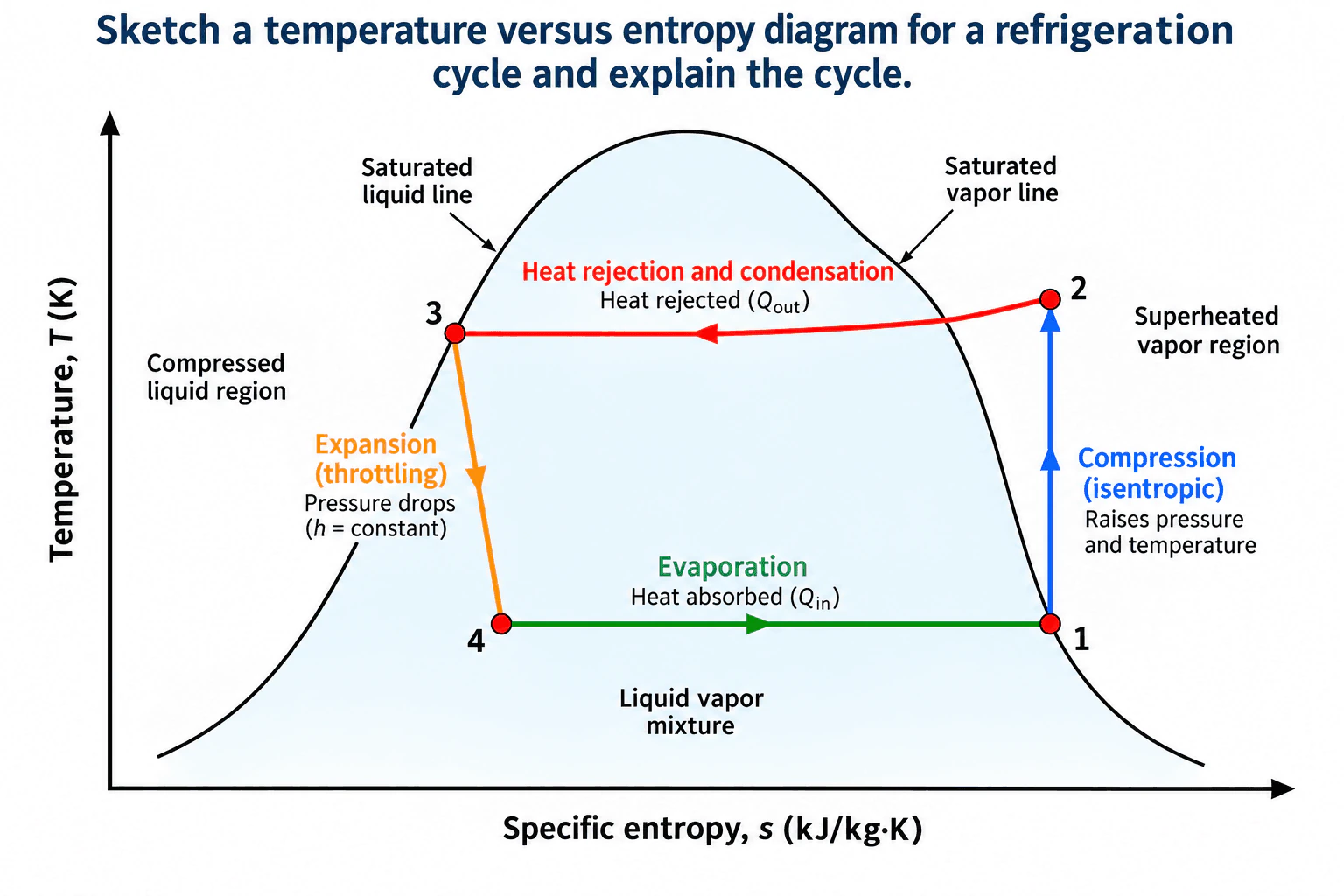
1. Sketch a temperature versus entropy diagram for a refrigeration cycle and explain the cycle.Hvac FundamentalsMediumTrane Technologies
Short Interview Answer (30-60 seconds)
I would draw temperature on the vertical axis and specific entropy on the horizontal axis with the saturation dome in the center. State 1 is low pressure saturated vapor. The compressor takes 1 to 2 through ideal constant entropy compression into the superheated region. The condenser rejects heat from 2 to 3, first removing superheat and then condensing the refrigerant to saturated liquid. The expansion device takes 3 to 4 by approximately constant enthalpy throttling, and the evaporator absorbs heat from 4 to 1 until saturated vapor is restored.
Detailed Explanation
A temperature versus entropy diagram shows how refrigerant temperature and specific entropy change through the vapor compression refrigeration cycle. Temperature, T, is on the vertical axis in K, and specific entropy, s, is on the horizontal axis in kJ/kg·K. The saturation dome separates the compressed liquid region on the left, the liquid vapor mixture region inside the dome, and the superheated vapor region on the right.
Useful Questions to Ask the Interviewer
Should I explain the ideal vapor compression cycle or include real compressor inefficiency and pressure losses?
Should I assume state 1 is saturated vapor and state 3 is saturated liquid?
Do you want the process described qualitatively, or should I also discuss COP and enthalpy relationships?
How to Explain It in an Interview
State 1 is low pressure saturated vapor at the evaporator outlet and compressor inlet. In the ideal cycle, process 1 to 2 is isentropic compression, so specific entropy remains constant while pressure and temperature increase. On the temperature versus entropy diagram, this appears as a vertical rise to state 2 in the superheated vapor region.
Process 2 to 3 is heat rejection in the condenser. The superheated refrigerant first cools toward the saturated vapor line. It then condenses at high pressure while continuing to reject heat until it reaches state 3 as saturated liquid. The diagram therefore shows a sloping desuperheating segment followed by condensation through the saturation dome.
Process 3 to 4 is throttling through the expansion device. For the ideal throttling process, enthalpy is approximately constant, so h3 = h4. The pressure and temperature decrease, and part of the liquid flashes into vapor. State 4 is a low pressure liquid vapor mixture inside the saturation dome.
Process 4 to 1 is evaporation. The refrigerant absorbs heat at low pressure and approximately constant saturation temperature while the remaining liquid evaporates. It reaches state 1 as saturated vapor.
A physical check is that the compressor requires work, the condenser rejects heat, the expansion device reduces pressure without producing useful work, and the evaporator absorbs the refrigeration load. Real systems can also include compressor inefficiency, superheat, subcooling, and pressure losses, which shift the state points from these idealized locations.
Why Interviewers Ask This
Interviewers are checking whether the candidate understands how the four basic refrigeration processes map onto thermodynamic properties, whether they can distinguish compression, condensation, throttling, and evaporation, and whether they can interpret the saturation dome and state points without confusing temperature, entropy, pressure, and enthalpy.
Common interview mistakes
Common mistakes include placing compressor discharge on the saturated vapor line instead of in the superheated region, treating throttling as an isentropic process instead of approximately constant enthalpy, showing the entire condenser process as constant temperature when desuperheating occurs before condensation, reversing the direction of heat transfer, or confusing entropy with enthalpy.
Interview tip
Draw the saturation dome first, label states 1 through 4, and explain each process in cycle order. State the property that is approximately constant during each idealized process where appropriate, especially constant entropy for ideal compression and constant enthalpy for throttling. Then connect each process to its physical component and heat or work interaction.
Interviewer may ask next
How would the temperature versus entropy diagram change for a real compressor instead of an ideal compressor?
A real compressor is not perfectly isentropic. Entropy increases during compression, so state 2 would move to the right of the ideal constant entropy compression line. For the same inlet state and discharge pressure, the real compressor generally requires more work and produces a higher discharge enthalpy than the ideal compressor.
What changes if the refrigerant leaves the condenser as a subcooled liquid instead of saturated liquid?
State 3 would move farther into the compressed liquid region to the left of the saturated liquid line. Subcooling reduces the refrigerant enthalpy entering the expansion device. Because throttling is approximately constant enthalpy, the lower inlet enthalpy usually produces less flash vapor after expansion and can increase the refrigeration effect per unit mass.
2. Asked about something on my resume and how it can translate to the job.BehavioralMediumTrane Technologies
Interview tip:
Use STAR to structure your answer: briefly explain the Situation and Task, make Action the most detailed part, and finish with the Result. For example, describe an HVAC project from your resume, explain your specific responsibility, show how you used technical analysis and communication to solve the problem, and connect those skills to the work you would perform in this role.
Situation
In my last role, I worked on an HVAC project where a building was not maintaining comfortable indoor conditions even though the main equipment was operating. That experience is listed on my resume because it required both technical troubleshooting and coordination with other people involved in the system.
Task
My responsibility was to identify what was causing the performance problem and help develop a practical solution. I also needed to explain my findings clearly so the team could understand what should be corrected and why.
Action
I first reviewed the system operation instead of assuming the equipment itself was the problem. I checked the air handling unit sequence, supply air conditions, airflow information, control points, and the behavior of the affected zones. I compared what the system was supposed to do with what it was actually doing. That helped me narrow the issue to the way airflow and controls were responding under changing building conditions. I then discussed the findings with the people responsible for controls and field work so we could verify the problem together. I explained the issue in simple terms, identified the checks that mattered most, and helped confirm the corrective steps before changes were made. This experience translates well to this job because it taught me to look at the complete HVAC system, use data to find the actual cause, communicate clearly with different teams, and make decisions based on how the building is performing rather than focusing on only one piece of equipment.
Result
The team was able to correct the system behavior and improve comfort in the affected areas. I learned that strong HVAC engineering requires both technical knowledge and the ability to connect equipment, controls, airflow, and building needs. Those are skills I would bring to this role when evaluating systems, solving performance problems, and working with other technical teams.
Why Interviewers Ask This
Interviewers ask this question to understand whether the candidate can connect past experience to the actual responsibilities of the role. A strong answer shows that the candidate understands the skills demonstrated by a resume example and can explain how those skills would be useful in HVAC engineering work.
Interviewer may ask next
What part of that experience would be most useful in this role?
The most useful part would be the way I approached the system as a whole. I did not focus only on one piece of equipment. I reviewed controls, airflow, operating conditions, and zone behavior together. That approach would help me evaluate HVAC performance and find the real cause of problems in this role.
What did you learn from that project that you would apply differently now?
I learned to verify the intended control sequence and actual operating data early in the troubleshooting process. Doing that sooner can reduce unnecessary checks and help the team focus on the most likely causes. I would also continue involving the relevant field and controls teams early so technical findings can be confirmed efficiently.
3. Why would you be a good fit at Trane?BehavioralMediumTrane Technologies
Interview tip:
Use STAR to structure your answer: briefly explain the Situation and Task, make Action the most detailed part, and finish with the Result. For example, describe a previous HVAC project where you combined technical problem solving, careful system analysis, clear communication, and teamwork to improve system performance, then connect those strengths to why you would be a good fit at Trane Technologies.
Situation
In my last role, I worked on an HVAC project where a newly commissioned air handling system was not maintaining stable space temperature during changing load conditions. The mechanical equipment was operating, but the overall system response showed that the design intent, controls, and field operation needed to be reviewed together.
Task
I was responsible for helping identify the cause, coordinating with the people involved, and making sure any recommendation improved comfort without creating unnecessary energy use or equipment stress. I also needed to explain the issue clearly so the team could make a practical decision.
Action
I first reviewed the design documents, equipment selections, control sequence, and available operating data so I could understand how the system was expected to work. I then compared that intent with actual field conditions. I checked airflow, temperature readings, valve and damper response, and the relationship between the equipment operation and the control sequence. Instead of assuming that one component was faulty, I looked at the HVAC system as a connected system. I found that the control response was not matching the way the system needed to react as the load changed. I discussed my findings with the controls and commissioning teams, explained why the sequence was affecting comfort, and listened to their field observations before recommending changes. We adjusted the sequence and verified the system again under operating conditions. I stayed involved during testing so I could confirm that the change solved the original issue without causing a new problem elsewhere in the system. This approach reflects how I like to work. I combine engineering fundamentals with field data, communicate clearly with different teams, and focus on solutions that are reliable and practical. Those strengths are also why I believe I would be a good fit at Trane Technologies.
Result
The system operated more consistently after the control changes, and the team had a clearer understanding of how the design and controls needed to work together. I learned that strong HVAC engineering is not only about selecting equipment or doing calculations. It also requires understanding the complete system, working closely with other disciplines, and verifying that the final operation matches the design intent. I would bring that same technical curiosity, ownership, and collaborative approach to Trane Technologies.
Why Interviewers Ask This
Interviewers ask this question to understand whether the candidate can connect their HVAC engineering experience, working style, and professional strengths to the needs of the role. A strong answer demonstrates technical judgment, ownership, collaboration, communication, and a clear reason the candidate believes those qualities would contribute at Trane Technologies.
Interviewer may ask next
What was the most important thing you did to identify the cause of the HVAC performance issue?
The most important step was comparing the intended system operation with the actual field behavior instead of looking at each component separately. Reviewing the design, control sequence, operating data, airflow, temperatures, and equipment response together helped me see that the main issue was how the controls reacted as the load changed.
What did that experience teach you about working with other HVAC project teams?
It taught me to involve the relevant teams early and explain technical findings in simple terms. The controls and commissioning teams had field information that helped confirm what I was seeing in the data. By combining that input with my engineering review, we were able to reach a practical solution and verify it together.
4. What is your personal understanding of sustainability?BehavioralEasyTrane Technologies
Interview tip:
Use STAR to structure your answer: briefly explain the Situation and Task, make Action the most detailed part, and finish with the Result. For example, describe a project where you considered energy use, equipment life, occupant comfort, maintenance needs, and environmental impact together, then explain the practical decisions you made and what sustainability means to you as an HVAC Engineer.
Situation
During a previous HVAC project, I was involved in reviewing a system that needed to provide reliable comfort while also avoiding unnecessary energy use and long term operating problems. That experience helped shape my understanding of sustainability in engineering.
Task
My responsibility was to support a design that met the building needs without focusing only on the lowest first cost. I needed to consider how the system would use energy, how easily it could be maintained, and how long the equipment and design choices could remain effective.
Action
I looked at sustainability as a balance between environmental responsibility, practical operation, and long term value. I reviewed the expected heating and cooling demand so the equipment would not be unnecessarily oversized. I considered efficient equipment and controls that could reduce energy use when full capacity was not required. I also paid attention to access for maintenance because an efficient system can lose performance if filters, coils, sensors, or other components are difficult to inspect and service. I discussed these considerations with the project team so that energy efficiency, occupant comfort, reliability, and maintainability were considered together instead of as separate goals. For me, sustainability means making engineering decisions that meet today's needs while reducing wasted energy, avoiding unnecessary material and equipment use, and supporting reliable performance over the life of the system.
Result
The final approach supported the required comfort while giving the team a clearer basis for making efficient and maintainable design choices. I learned that sustainability is not one product or one efficiency rating. It is a way of thinking about the full life of an HVAC system and making practical choices that reduce waste while still meeting the needs of the people who use the building.
Why Interviewers Ask This
Interviewers ask this question to understand how the candidate defines sustainability and whether that definition connects to practical HVAC engineering decisions. A strong answer shows awareness of energy efficiency, equipment life, maintainability, occupant needs, responsible use of resources, and the long term impact of design choices.
Interviewer may ask next
How do you balance sustainability with cost and project requirements?
I try to look beyond first cost and compare choices based on energy use, reliability, maintenance, and expected service life. I would not select a more complex solution only because it appears more sustainable. I would explain the benefits and tradeoffs to the team and support the option that meets the project requirements while reducing unnecessary energy and long term operating burden.
What did that project teach you about sustainable HVAC design?
It taught me that sustainable HVAC design depends on many connected decisions. Correct equipment sizing, efficient controls, good maintenance access, and reliable operation all matter. I also learned that a system should be practical for the people who will operate and maintain it, because long term performance is part of sustainability.
5. Describe a problem you solved with your peers when you had little guidance from management.BehavioralMediumTrane Technologies
Interview tip:
Use STAR to structure your answer: briefly explain the Situation and Task, make Action the most detailed part, and finish with the Result. For example, describe a situation where you and your peers had to diagnose an HVAC problem with limited management guidance, agree on priorities, divide the investigation clearly, share findings, make a safe technical decision, and confirm that the solution worked.
Situation
During a previous project, our team received repeated comfort complaints from an occupied area served by an air handling unit. The manager who normally guided troubleshooting was unavailable, so several engineers and technicians had to work together and decide how to investigate the issue without waiting for detailed instructions.
Task
I needed to help the group identify the cause, keep the investigation organized, and make sure any change we made was based on evidence rather than guesswork. We also needed to avoid creating new comfort or control problems in other zones served by the same system.
Action
I suggested that we first agree on what information we needed before changing any settings. I reviewed the building automation system trends for supply air temperature, duct static pressure, fan operation, and zone conditions. I then worked with my peers to compare those trends with field observations from the affected VAV boxes. We divided the work so one person checked sensors, another checked damper operation, and I focused on how the air handling unit controls were responding to zone demand. When we shared our findings, we saw that the equipment itself was operating, but the control response was not matching the actual demand from the occupied zones. I explained the pattern I saw and asked the team to challenge my conclusion before we changed anything. After we agreed on the likely cause, we made a controlled adjustment to the relevant control setting and watched the system response. We then checked the affected zones again and confirmed that the change did not create problems elsewhere. I documented what we observed, what we changed, and why, so management could review the decision later.
Result
The comfort issue improved and the system responded more consistently to actual zone demand. We solved the problem without waiting for detailed management direction because we used a clear process, divided responsibilities, and checked each other's conclusions. I learned that when guidance is limited, good teamwork depends on creating structure, using evidence, and making decisions that the whole team understands.
Why Interviewers Ask This
Interviewers ask this question to understand how a candidate works when direction is limited. They want to see whether the candidate can collaborate with peers, create a practical plan, use sound judgment, communicate technical reasoning, take ownership, and reach a safe decision without depending on constant management guidance.
Interviewer may ask next
How did you make sure the team agreed before changing the HVAC controls?
I shared the trend data and field observations with the group and explained why I thought the control response was the main issue. I asked my peers to compare that conclusion with what they had found at the sensors and VAV boxes. We only made the adjustment after the evidence supported the same conclusion and everyone understood what we expected the system to do.
What would you do differently if you faced a similar situation again?
I would use the same evidence based approach, but I would define the investigation steps and responsibilities even earlier. That would make it easier for everyone to know what information they own, reduce repeated work, and help the team compare findings more quickly before making a change.
Hvac Engineer Resume Examples
Explore the resume examples below to find the one that best matches your target Hvac Engineer role.
Disclaimer: This interview guide is for educational and informational purposes only. It is designed to help readers prepare, but it does not guarantee any interview result, hiring decision, offer, or outcome. Interview questions, hiring criteria, and preferred answers can vary by employer, interviewer, industry, location, and time. All answers, examples, and explanations in this guide are suggested examples for interview preparation, not definitive answers or instructions for professional practice. They are based on research and judgment, are provided without warranties of any kind, and should be adapted to the question, role, and applicable laws and professional requirements. Diagrams are simplified illustrations intended to highlight the main concepts and their relationships; actual situations, systems, and practices may be more complex. Alternative approaches may be equally valid or better suited to a particular question, context, or interviewer. To the fullest extent permitted by applicable law, the contributors and publisher are not liable for decisions made, actions taken, or losses incurred based on this guide.
State Laws and Professional Responsibilities: Laws and requirements governing an occupation vary by state and jurisdiction. You are responsible for checking the current laws, licensing requirements, and scope-of-practice rules that apply to your location and role, and for ensuring that your answers and actions comply with them. Adapt examples in this guide to those requirements. This guide is not legal advice.
Company Notice: This guide is an independent educational resource and is not affiliated with, endorsed by, sponsored by, or approved by the company named in this guide. Company names identify reported interview experiences or the employer context of clearly labeled original practice exercises. Interview practices can change without notice, and inclusion of company-specific content does not mean these questions are official, complete, or guaranteed to be asked. To the fullest extent permitted by law, the author, contributors, and publisher are not responsible for outcomes related to use of this material.
Content Accuracy and Verification: To the fullest extent permitted by applicable law, we do not represent or warrant that interview guides, questions, answers, examples, or diagrams are accurate, complete, current, error-free, or suitable for any particular purpose. You are responsible for independently reviewing and verifying the information before relying on it.