This interview guide is for educational and informational purposes only. It is designed to help readers prepare, but it does not guarantee any interview result, hiring decision, offer, or outcome. Interview questions, hiring criteria, and preferred answers can vary by employer, interviewer, industry, location, and time. All answers, examples, and explanations in this guide are suggested examples for interview preparation, not definitive answers or instructions for professional practice. They are based on research and judgment, are provided without warranties of any kind, and should be adapted to the question, role, and applicable laws and professional requirements. Diagrams are simplified illustrations intended to highlight the main concepts and their relationships; actual situations, systems, and practices may be more complex. Alternative approaches may be equally valid or better suited to a particular question, context, or interviewer. To the fullest extent permitted by applicable law, the contributors and publisher are not liable for decisions made, actions taken, or losses incurred based on this guide.
State Laws and Professional Responsibilities
Laws and requirements governing an occupation vary by state and jurisdiction. You are responsible for checking the current laws, licensing requirements, and scope-of-practice rules that apply to your location and role, and for ensuring that your answers and actions comply with them. Adapt examples in this guide to those requirements. This guide is not legal advice.
Identity, Image, and Privacy Notice
To respect individual privacy, some names, profile photographs, avatars, biographical details, and other identifying information displayed in this guide may be replaced with pseudonyms, licensed stock images, illustrative avatars, composite images, or representative descriptions. Unless a person is expressly identified as an actual contributor, a displayed name, image, or profile should not be understood as depicting or identifying a specific candidate, interviewer, employee, or other real individual. These representations are provided for editorial and illustrative purposes only and do not imply endorsement, employment, participation, or affiliation with this guide or any company mentioned in it. Any resemblance to an actual person is coincidental.
Company Notice
This guide is an independent educational resource and is not affiliated with, endorsed by, sponsored by, or approved by the company named in this guide. Company names identify reported interview experiences or the employer context of clearly labeled original practice exercises. Interview practices can change without notice, and inclusion of company-specific content does not mean these questions are official, complete, or guaranteed to be asked. To the fullest extent permitted by law, the author, contributors, and publisher are not responsible for outcomes related to use of this material.
Content Accuracy and Verification
To the fullest extent permitted by applicable law, we do not represent or warrant that interview guides, questions, answers, examples, or diagrams are accurate, complete, current, error-free, or suitable for any particular purpose. You are responsible for independently reviewing and verifying the information before relying on it.
Questions or comments?
Contact us for general questions, or share feedback, technical corrections, and comments with the community.
1. Explain the principles of mechanical engineering as they apply to HVAC systems and equipment selection.Hvac FundamentalsMediumBurns & Mcdonnell
i Question Details
Explain the mechanical-engineering principles relevant to HVAC design and operation, including thermodynamics, heat transfer, fluid mechanics, and heat exchange, and relate those principles to selecting equipment for performance, efficiency, and cost-effectiveness.
Short Interview Answer (30-60 seconds)
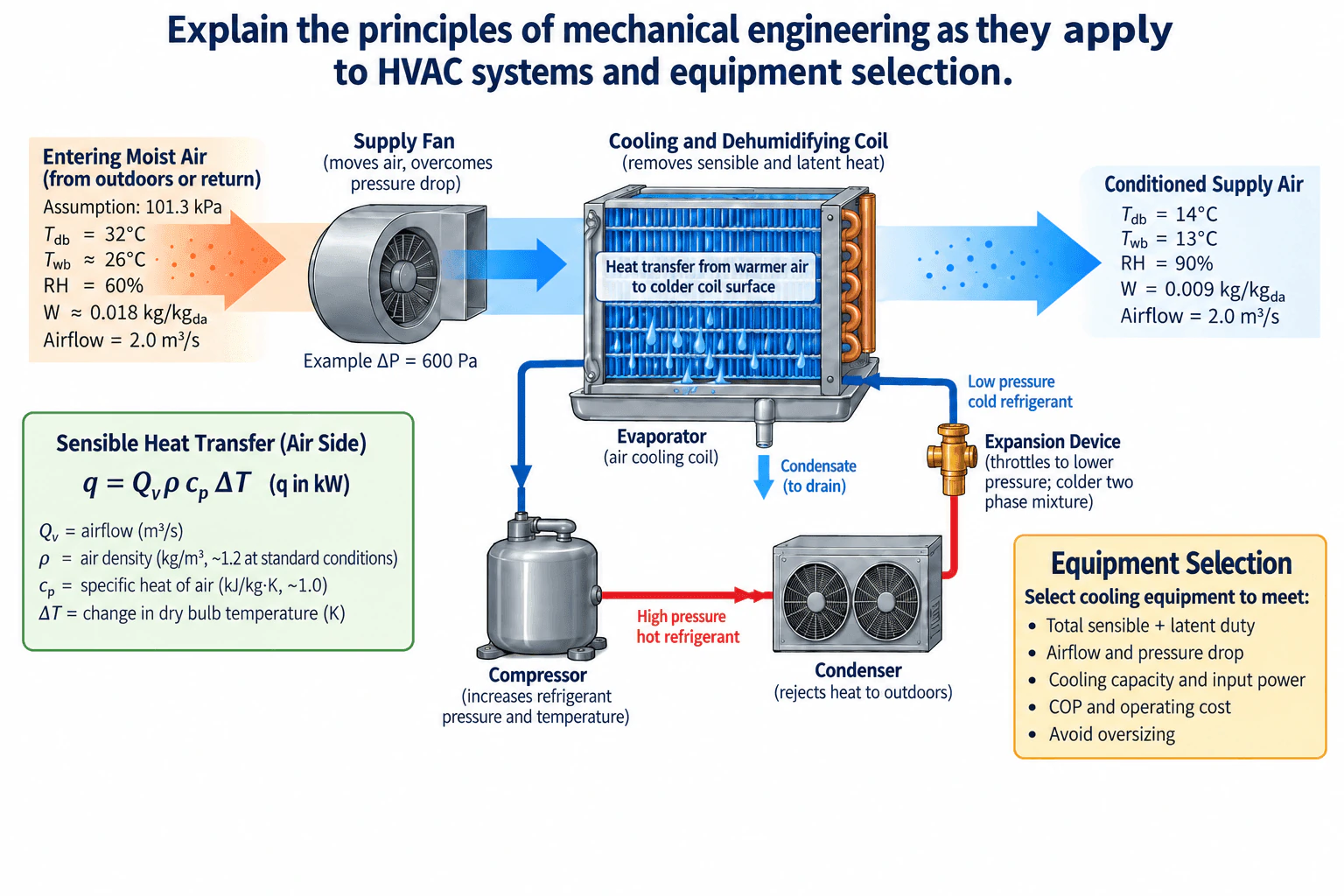
HVAC design applies thermodynamics, heat transfer, fluid mechanics, and psychrometrics to move heat and moisture while maintaining indoor conditions. I first define the entering and leaving air states, airflow, and pressure losses. Sensible heat can be estimated from q = Qv ρ cp ΔT, while latent heat must also be included when moisture is removed. The refrigeration cycle then transfers heat through the evaporator, compressor, condenser, and expansion device. Equipment should be selected for the required sensible and latent duty, airflow, pressure drop, refrigeration capacity, input power, COP, and operating cost, while avoiding unnecessary oversizing.
Detailed Explanation
Mechanical engineering principles provide the physical basis for understanding how HVAC equipment moves heat, moisture, air, and refrigerant. Thermodynamics establishes the energy balance. Heat transfer explains conduction and convection at coils and heat exchangers. Fluid mechanics explains airflow, pressure drop, and fan requirements. Psychrometrics describes moist air using dry bulb temperature, wet bulb temperature, relative humidity, humidity ratio, dew point, and enthalpy.
Useful Questions to Ask the Interviewer
Are the entering and leaving air conditions already defined, including temperature and humidity?
Should I assume a specific airflow, pressure drop, or design pressure?
Is the selection being optimized mainly for first cost, efficiency, operating cost, or a combination?
How to Explain It in an Interview
I would start by defining the system boundary and design assumptions. For the illustrated example, assume air at 101.3 kPa enters at 32°C dry bulb, about 26°C wet bulb, 60% relative humidity, and a humidity ratio of about 0.018 kg water per kg dry air. Airflow is 2.0 m³/s. The conditioned air leaves at 14°C dry bulb, 13°C wet bulb, about 90% relative humidity, and a humidity ratio near 0.009 kg water per kg dry air.
The cooling coil removes both sensible and latent heat. For the sensible portion, q = Qv ρ cp ΔT. Using an illustrative air density of 1.2 kg/m³, cp of about 1.0 kJ/(kg·K), Qv = 2.0 m³/s, and ΔT = 18 K gives about 43.2 kW of sensible cooling. The total coil duty is greater because moisture also condenses, so latent heat must be included.
The refrigerant cycle provides that cooling. Low pressure refrigerant absorbs heat in the evaporator. The compressor raises refrigerant pressure and temperature. The condenser rejects heat to the surroundings. The expansion device throttles the refrigerant to a lower pressure, producing a colder two phase mixture before it returns to the evaporator.
Fluid mechanics matters because the fan must move the required airflow while overcoming system pressure drop. An example pressure drop of 600 Pa is only an assumed design point, not a universal value.
For equipment selection, I would check total sensible plus latent duty, airflow, pressure drop, refrigeration capacity, electrical input power, and COP. COP is cooling capacity divided by input power, so capacity and electrical consumption must not be confused. I would then compare efficiency, operating cost, controllability, and part load behavior rather than simply choosing the largest unit.
Finally, I would validate the selected equipment against manufacturer performance data at the actual entering and leaving conditions. I would verify that the coil can meet the required sensible and latent performance, that the fan can deliver the design airflow at the required pressure, and that the selected capacity does not create excessive cycling or poor humidity control.
Why Interviewers Ask This
Interviewers want to see whether the candidate can connect thermodynamics, heat transfer, psychrometrics, fluid mechanics, and refrigeration principles to practical HVAC equipment selection. The key judgment is whether the candidate can distinguish sensible and latent loads, interpret air and refrigerant states, relate airflow and pressure drop to equipment performance, and balance capacity, efficiency, and operating cost without oversizing.
Common interview mistakes
Common mistakes include considering only sensible heat and ignoring latent load, treating relative humidity and humidity ratio as the same property, using airflow without stating the assumed air density, confusing cooling capacity with compressor input power, ignoring pressure drop when selecting a fan, assuming an expansion device directly controls temperature rather than primarily throttling pressure, and oversizing equipment without considering cycling, humidity control, and operating efficiency.
Interview tip
Organize the answer around energy, moisture, airflow, and refrigeration. State the entering and leaving conditions first, distinguish sensible from latent heat, explain the refrigerant sequence from evaporator to compressor to condenser to expansion device, and finish by connecting those principles to capacity, airflow, pressure drop, COP, cost, and validation against actual equipment performance data.
Interviewer may ask next
How would you validate that the selected cooling coil can meet the required air conditions?
I would confirm the entering air dry bulb temperature, wet bulb temperature or humidity ratio, airflow, and leaving air target. I would calculate or obtain the required sensible and latent duty, then compare those requirements with manufacturer coil performance at the same operating conditions. I would also check condensate removal, air pressure drop, refrigerant or water conditions as applicable, and verify that the leaving temperature and moisture level remain achievable across expected operating conditions.
How would your equipment selection change if energy cost became more important than first cost?
I would still require the equipment to meet the same thermal, moisture, airflow, and pressure requirements, but I would place more weight on COP, part load efficiency, fan power, control range, and expected operating hours. A unit with a higher initial cost could be preferable if its lower electrical demand and better part load performance reduce life cycle operating cost. I would compare alternatives using the same design conditions rather than comparing nominal ratings alone.
2. How do you ensure that project designs meet all applicable codes, regulations, and client requirements?Codes Safety And ComplianceMediumBurns & Mcdonnell
i Question Details
Explain how you identify the governing requirements at the start of a project, keep the design aligned with applicable codes and regulations, incorporate client requirements, coordinate clarifications, and use design reviews to catch compliance issues before issue or construction.
Short Interview Answer (30-60 seconds)
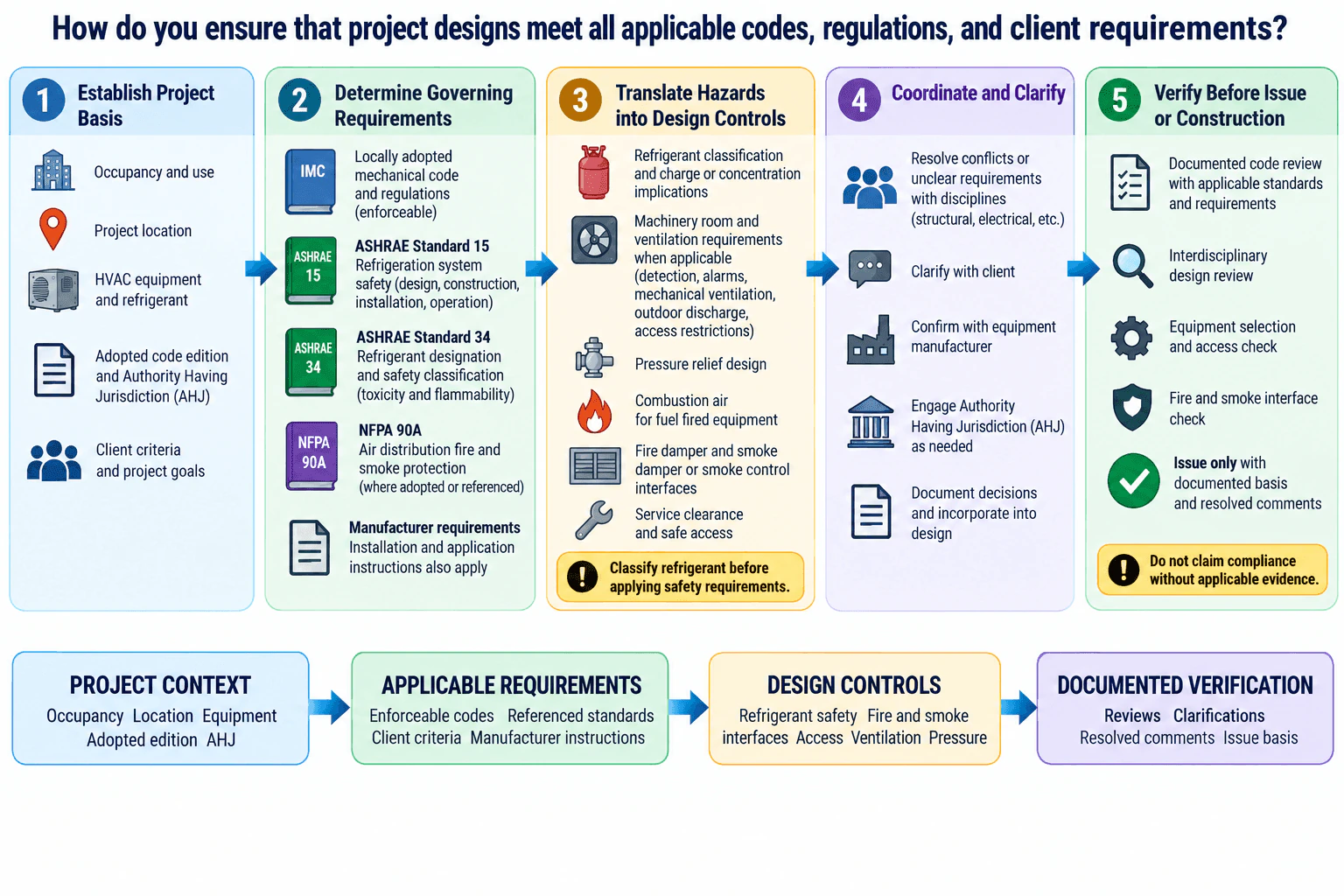
I start by defining the project context, including occupancy, location, equipment, refrigerant, adopted code edition, authority having jurisdiction, and client criteria. I then identify the locally enforceable mechanical code, referenced standards such as ASHRAE Standard 15, ASHRAE Standard 34, and NFPA 90A when applicable, plus manufacturer instructions. I translate those requirements into design controls for refrigerant safety, machinery room implications, ventilation, pressure relief, combustion air, fire and smoke interfaces, service access, and other applicable hazards. I coordinate unclear requirements with the client, other disciplines, manufacturers, and the authority having jurisdiction when needed. Before issue or construction, I complete documented interdisciplinary reviews and resolve compliance comments rather than claiming compliance without applicable evidence.
Detailed Explanation
I treat compliance as a traceable process from project context to applicable requirements, design controls, coordination, and documented verification. I do not begin by selecting an isolated requirement. I first determine which requirements actually govern the project.
Useful Questions to Ask the Interviewer
What jurisdiction, adopted code edition, occupancy, and project type should I assume?
Is there a specific refrigerant system, fuel fired equipment, or fire and smoke interface that should be considered?
Are there client design criteria or manufacturer requirements beyond the adopted codes?
How to Explain It in an Interview
Compliance Basis
I first establish the project basis: occupancy and use, location, HVAC equipment, refrigerant, adopted code edition, authority having jurisdiction, and client criteria. This prevents applying requirements from the wrong jurisdiction or edition.
Next, I identify the requirement hierarchy. The locally adopted International Mechanical Code or other applicable mechanical code provides enforceable requirements. Referenced standards can include ASHRAE Standard 15 for refrigeration system safety, ASHRAE Standard 34 for refrigerant designation and safety classification, and NFPA 90A for applicable air distribution fire and smoke protection. Manufacturer installation and application instructions also need to be incorporated where applicable. Client criteria are tracked separately so they are not confused with statutory requirements.
Safety Checks
I translate the governing requirements into physical design controls. For refrigeration systems, I identify the refrigerant classification and assess charge and concentration implications before determining whether machinery room provisions, ventilation, detection, pressure relief, discharge arrangements, or access restrictions apply. I also review combustion air for fuel fired equipment, electrical and stored energy hazards, service clearance, safe access, condensate disposal where applicable, and authorized isolation procedures such as lockout tagout during servicing or commissioning.
For air distribution systems, I coordinate fire damper, smoke damper, duct smoke detector, and smoke control interfaces with architectural, electrical, controls, and fire protection disciplines as applicable.
Code Reasoning
When a requirement is unclear or conflicting, I document the question and coordinate it with the appropriate discipline, client, equipment manufacturer, or authority having jurisdiction instead of making an unsupported assumption. Important decisions are incorporated into the design documents so the reasoning remains traceable.
Before issue or construction, I perform a documented code review and interdisciplinary design review. I confirm equipment selection, service access, fire and smoke interfaces, safety controls, and applicable requirements, then resolve comments. I only state that the design meets a requirement when the applicable basis and supporting design evidence are documented.
Why Interviewers Ask This
Interviewers want to know whether I can establish the correct compliance basis before designing, distinguish enforceable requirements from referenced standards, client criteria, and manufacturer instructions, recognize HVAC safety risks, coordinate unresolved requirements, and document enough evidence to support a design review before issue or construction.
Common interview mistakes
Common mistakes include selecting a requirement before confirming the jurisdiction and adopted edition, treating every standard as automatically enforceable, ignoring client criteria or manufacturer instructions, checking refrigerant charge without first identifying the refrigerant safety classification, overlooking machinery room or ventilation implications, missing fire and smoke interfaces between disciplines, failing to provide service clearance and safe access, and declaring compliance without documented evidence or resolved review comments.
Interview tip
Describe compliance as a traceable sequence: establish the project context, identify applicable requirements, convert them into design controls, coordinate unclear items, and document verification. Mention specific HVAC examples such as refrigerant classification, machinery room implications, fire and smoke interfaces, pressure relief, combustion air, ventilation, and service access, but avoid inventing numerical limits unless the jurisdiction, code edition, system, and refrigerant are known.
Interviewer may ask next
How would you verify a refrigerant system before deciding whether special machinery room or ventilation requirements apply?
I would first confirm the refrigerant designation and safety classification, system type, equipment arrangement, refrigerant charge, occupied spaces that could be affected by a release, adopted code edition, and applicable refrigeration safety standard. I would then evaluate the relevant charge and concentration provisions and determine whether machinery room, ventilation, detection, pressure relief, discharge, or access provisions apply. I would document the assumptions and calculations and verify any jurisdiction specific interpretation with the authority having jurisdiction when necessary.
What would you do if a client requirement conflicts with an adopted code requirement?
I would identify the conflict explicitly and determine which requirement is legally enforceable. An adopted code requirement cannot simply be replaced by a less restrictive client preference. I would explain the issue to the client, coordinate with the affected disciplines, and develop a design that satisfies the governing requirement while meeting the client objective where possible. If interpretation is uncertain, I would obtain clarification from the authority having jurisdiction and document the final decision in the project requirements and design review record.
3. What steps do you take to mitigate potential risks associated with electrical or mechanical system failures?Codes Safety And ComplianceHardBurns & Mcdonnell
i Question Details
Describe how you identify and prioritize failure risks in mechanical or electrical systems, use inspection and preventive measures, establish contingency or backup provisions, prepare for emergency response, and use root-cause findings after an incident to reduce recurrence.
Short Interview Answer (30-60 seconds)
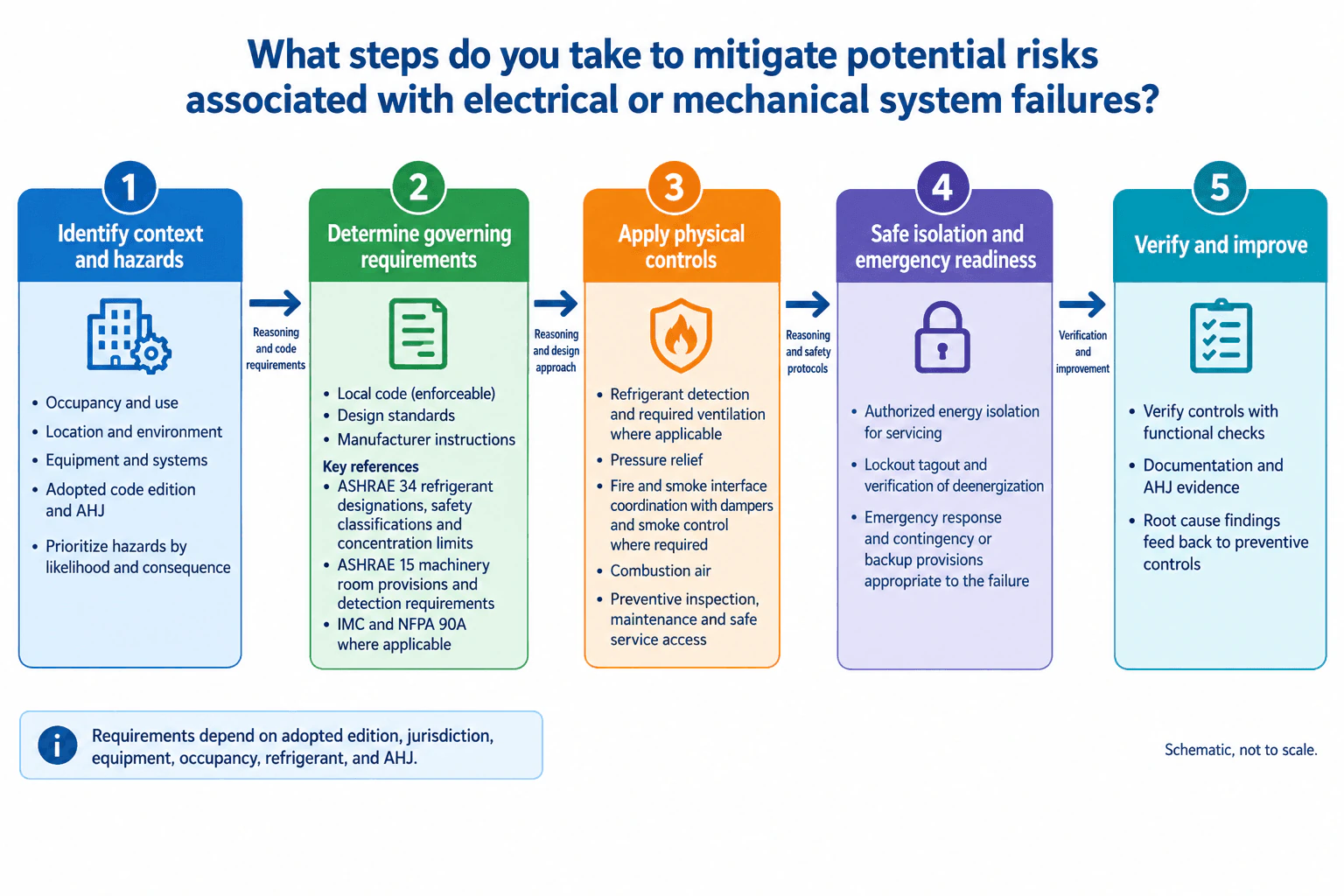
I start by defining the occupancy, location, equipment, adopted code edition, and authority having jurisdiction, then identify hazards and prioritize them by likelihood and consequence. Next, I determine the enforceable local code, applicable design standards, and manufacturer instructions. I apply preventive controls such as refrigerant detection and ventilation where applicable, pressure relief, fire and smoke coordination, combustion air provisions, preventive inspection, maintenance, and safe service access. I also plan authorized energy isolation, lockout tagout, emergency response, and appropriate contingency or backup provisions. Finally, I verify the controls with functional checks, document the evidence, and use root cause findings to strengthen preventive controls.
Detailed Explanation
The process should move from understanding the risk to proving that the selected controls work. I would not start by assuming a specific code requirement or declaring a system compliant. I would first establish the application and jurisdiction, prioritize credible hazards, determine the governing requirements, apply preventive controls, prepare for failure response, and then verify and improve the system.
Useful Questions to Ask the Interviewer
What type of HVAC equipment, occupancy, location, and operating environment should I assume?
Which adopted code edition and authority having jurisdiction apply?
Is the main concern refrigerant, combustion, pressure, electrical, stored energy, or a combination of these hazards?
How to Explain It in an Interview
Compliance Basis: First, I identify the occupancy and use, location and environment, equipment and systems, adopted code edition, and authority having jurisdiction. I identify credible failure hazards and prioritize them by likelihood and consequence. I then separate enforceable local code requirements from design standards and manufacturer instructions. Relevant references can include ASHRAE 34 for refrigerant designations, safety classifications, and concentration limits, ASHRAE 15 for refrigeration system safety provisions, including applicable machinery room and detection requirements, the International Mechanical Code, and NFPA 90A where applicable.
Safety Checks: Next, I apply controls appropriate to the identified hazards and governing requirements. Depending on the application, these can include refrigerant detection and required ventilation, pressure relief, fire and smoke interface coordination with dampers and smoke control where required, combustion air provisions, preventive inspection and maintenance, and safe service access. I also verify that access and clearances support safe servicing.
For servicing or a failure event, I use authorized energy isolation, lockout tagout, and verification of deenergization where applicable. I also establish emergency response actions and contingency or backup provisions that are appropriate to the consequence of the failure.
Code Reasoning: Finally, I verify the controls with functional checks and document the evidence needed for review by the responsible parties and authority having jurisdiction. If an incident occurs, I investigate the root cause and feed those findings back into inspection, maintenance, design controls, procedures, or contingency planning. I would only describe the system as compliant after the applicable requirements and supporting evidence have been confirmed.
Why Interviewers Ask This
Interviewers want to see whether I can identify and prioritize credible failure risks, establish the correct compliance basis before selecting requirements, apply preventive controls, prepare for safe isolation and emergency response, verify that the controls work, and use root cause findings to reduce recurrence.
Common interview mistakes
Common mistakes include selecting a requirement before identifying the governing code and jurisdiction, treating a design standard as automatically enforceable, failing to prioritize hazards by likelihood and consequence, overlooking manufacturer instructions, ignoring stored energy or service access hazards, omitting contingency planning, bypassing or defeating safety controls, assuming inspection alone proves compliance, and correcting an incident without feeding root cause findings back into preventive controls.
Interview tip
Present the answer as a five step flow: identify the context and prioritize hazards, determine governing requirements, apply preventive controls, prepare safe isolation and emergency response, then verify and improve. Mention ASHRAE 15, ASHRAE 34, the International Mechanical Code, and NFPA 90A as applicable references, while making clear that the adopted edition, jurisdiction, equipment, occupancy, refrigerant, manufacturer instructions, and authority having jurisdiction determine the actual requirements.
Interviewer may ask next
How would you validate that the selected risk controls are adequate before the system is placed into service?
I would trace each prioritized hazard to its applicable requirement or control, confirm the adopted code edition, relevant design standards, manufacturer instructions, and authority having jurisdiction expectations, then review installation evidence and perform the required inspections or functional checks. I would verify applicable items such as refrigerant detection, ventilation, pressure relief, fire and smoke interfaces, combustion air, safe service access, energy isolation, emergency provisions, and contingency measures. Any unresolved requirement or failed check would remain open until it is corrected and documented.
How would your approach change if the consequence of a single equipment failure became much more severe?
I would raise that hazard's priority and reassess whether the existing preventive and contingency controls are sufficient. The higher consequence could justify stronger inspection and maintenance controls, additional detection or isolation provisions, more robust emergency procedures, or an appropriate backup strategy. I would then repeat the governing requirement review and functional verification because the acceptable control strategy depends on the actual consequence, application, jurisdiction, and equipment configuration.
4. What approaches have you used to optimize energy consumption and minimize environmental impacts for building projects?Energy Efficiency And SustainabilityHardBurns & Mcdonnell
i Question Details
Discuss building-project approaches you have used to reduce energy consumption and environmental impact, including design choices, energy modeling, high-efficiency systems, renewable-energy options, and how you evaluate practical benefits for the client and the project.
Short Interview Answer (30-60 seconds)
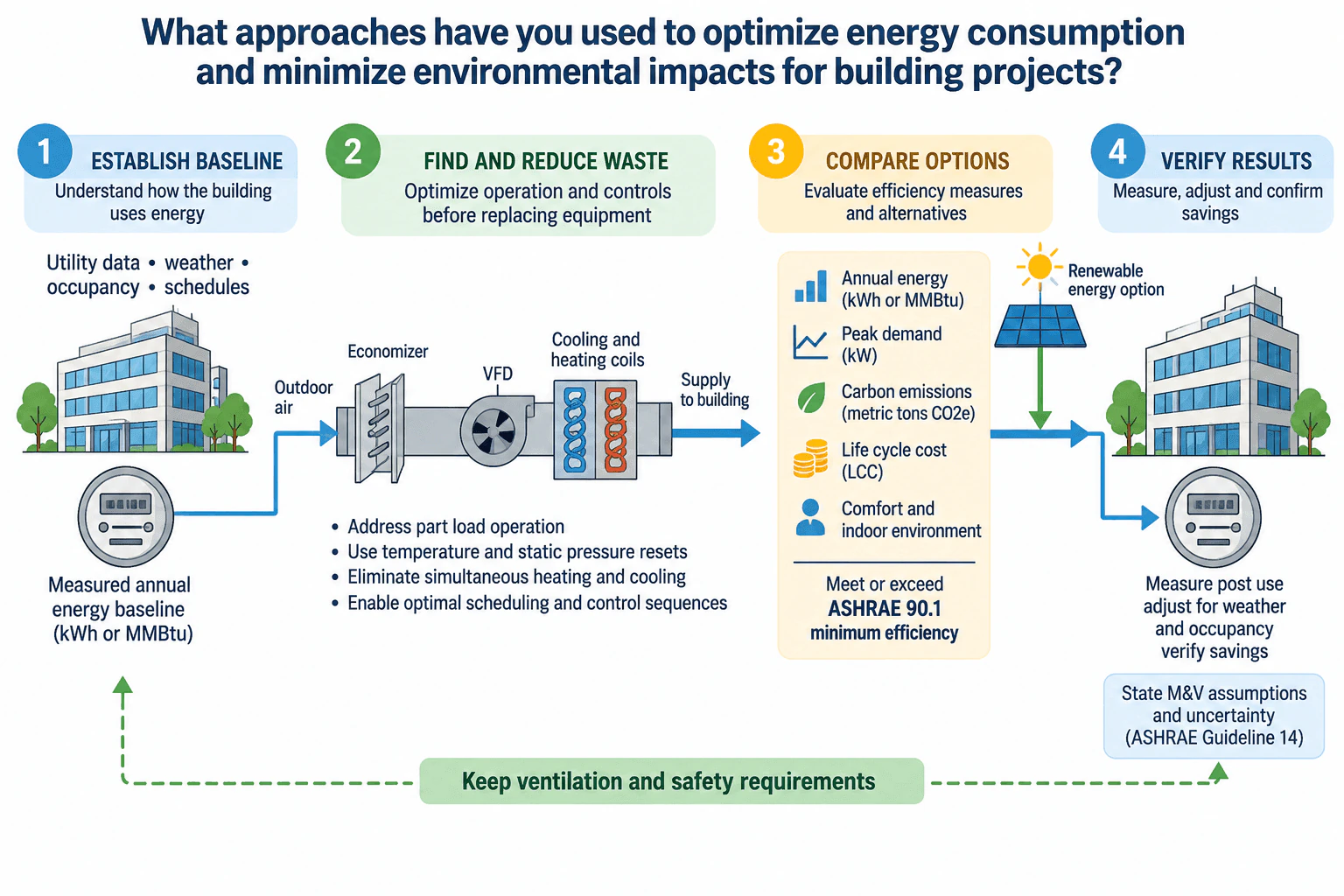
I begin with a measured annual energy baseline using utility data, weather, occupancy, and schedules. Then I look for operational waste such as poor scheduling, inefficient part load operation, economizer issues, excessive fan energy, weak temperature or static pressure reset strategies, and simultaneous heating and cooling. I evaluate controls improvements before equipment replacement. For each major option, I compare annual energy, peak demand, carbon emissions, life cycle cost, comfort, equipment limits, applicable ASHRAE 90.1 requirements, and renewable energy opportunities. I keep ventilation and safety requirements intact, then use measurement and verification with stated assumptions, weather and occupancy adjustments, and uncertainty to confirm actual performance.
Detailed Explanation
My approach is to treat energy optimization as a measured engineering process. I establish how the building currently uses energy, identify avoidable HVAC waste, compare practical improvement options, and then verify the result. I do not use design peak load as a substitute for annual consumption, and I do not assume that nameplate efficiency represents actual part load performance.
Useful Questions to Ask the Interviewer
Is the project an existing building optimization effort, a new design, or both?
What utility, interval, BAS, occupancy, schedule, and weather data are available for establishing the baseline?
Is the main client objective lower annual energy, lower peak demand, lower carbon emissions, lower life cycle cost, improved comfort, or a combination?
How to Explain It in an Interview
I start by defining a measured annual energy baseline from utility data and relating it to weather, occupancy, and operating schedules. That gives me a defensible reference before estimating savings.
Next, I investigate actual HVAC operation, especially at part load. I review economizer behavior, VFD operation, temperature and static pressure reset strategies, operating schedules, equipment staging, and signs of simultaneous heating and cooling. I normally examine controls changes before recommending equipment replacement because operational corrections can reduce waste with less capital cost and disruption.
For proposed energy conservation measures, I use an appropriate energy model or engineering analysis to compare annual energy and peak demand rather than relying only on design load. I evaluate equipment performance under expected operating conditions and consider renewable energy options where practical.
I compare alternatives using annual energy, peak demand, applicable utility tariffs, carbon factors, life cycle cost, equipment limits, and comfort consequences. Simple payback can help with screening, but I do not use it as the only economic measure because it does not represent the full life of an investment.
I also check the applicable jurisdiction and the relevant ASHRAE 90.1 requirements. Throughout optimization, I retain required ventilation, indoor environmental quality, equipment protection, and safety functions.
Finally, I define measurement and verification before implementation. I document the baseline, expected operating conditions, adjustment methods for weather or occupancy changes, metering needs, uncertainty, and the evidence required to confirm performance. After implementation, I compare measured post use performance with the adjusted baseline and investigate meaningful differences between predicted and measured results. Where appropriate, ASHRAE Guideline 14 can inform the measurement and verification approach.
Why Interviewers Ask This
The interviewer is evaluating whether I can reduce energy and environmental impact through a disciplined HVAC engineering process instead of simply selecting efficient equipment. They want to see whether I establish a defensible baseline, understand part load behavior, investigate controls and operating waste, compare conservation and renewable options using technical and economic criteria, protect comfort and ventilation, and verify actual performance after implementation.
Common interview mistakes
Common mistakes include estimating savings before establishing a measured baseline, treating design peak load as annual energy use, comparing equipment only by nameplate efficiency, ignoring part load behavior, overlooking schedules and simultaneous heating and cooling, replacing equipment before investigating controls, evaluating renewable energy without project specific technical and economic context, using simple payback as the only financial test, ignoring tariff and carbon assumptions, and reducing airflow or operating hours without checking ventilation, comfort, equipment protection, and safety requirements.
Interview tip
Describe the work as a sequence from measured baseline to waste reduction to option comparison to verification. Mention specific operational checks such as economizer behavior, VFD operation, temperature and static pressure resets, schedules, and simultaneous heating and cooling. Then show professional judgment by explaining how you compare annual energy, peak demand, carbon emissions, life cycle cost, comfort, equipment limits, applicable ASHRAE 90.1 requirements, renewable energy options, and measurement and verification assumptions.
Interviewer may ask next
How would you validate that an energy conservation measure actually delivered the expected savings?
I would define the measurement and verification approach before implementation. I would preserve the original measured baseline, document weather, occupancy, schedules, tariff assumptions, and operating conditions, and identify the meters or BAS points needed for verification. After implementation, I would compare measured post use performance with an appropriately adjusted baseline, account for material weather or occupancy changes, quantify uncertainty, and investigate differences between predicted and measured results. I would not claim savings that the available data cannot support.
What would you do if the option with the lowest annual energy use had a high initial cost or affected comfort?
I would compare alternatives rather than selecting the option with the lowest modeled annual energy use alone. I would evaluate annual energy, peak demand, carbon emissions, life cycle cost, utility tariffs, equipment limits, maintenance implications, comfort, ventilation, and operational risk. I might prioritize lower cost controls and scheduling improvements first, then evaluate equipment or renewable measures as separate investments. If an option compromises required ventilation, comfort, equipment protection, or safety, I would modify or reject that option even if its predicted energy savings were attractive.
5. Share your experience working with renewable energy sources, such as solar or wind, and how they can be integrated into a project’s design.Energy Efficiency And SustainabilityMediumBurns & Mcdonnell
i Question Details
Discuss direct project experience with renewable energy and explain how site conditions, project requirements, functional integration, efficiency, sustainability, and cost-effectiveness affect incorporating sources such as solar or wind into a building or engineering design.
Short Interview Answer (30-60 seconds)
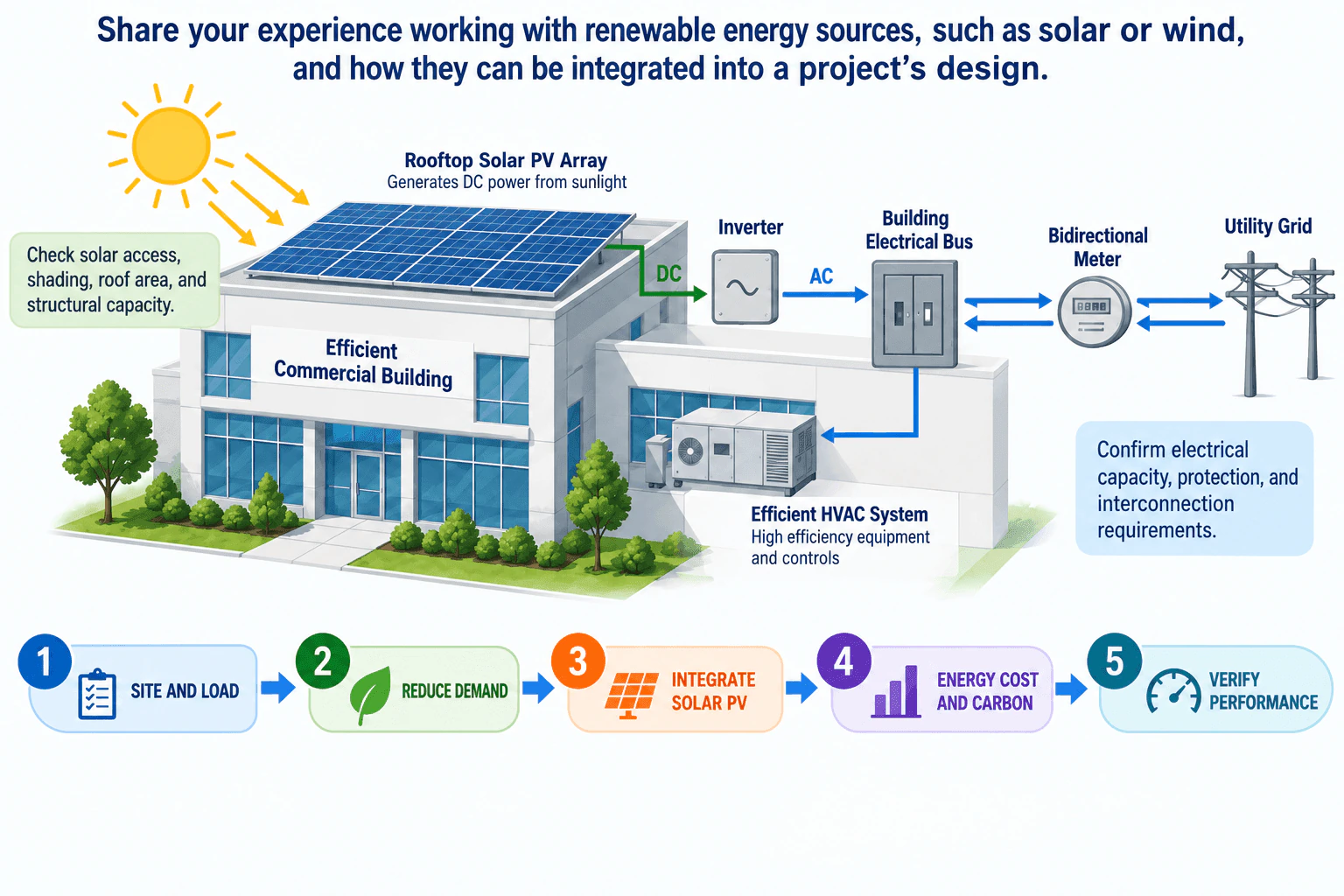
My approach is to start with the building load, operating schedule, utility data, and site conditions, then reduce unnecessary demand before sizing renewable generation. For rooftop solar PV, I would confirm solar access, shading, roof and structural capacity, electrical capacity, protection, and utility interconnection requirements. The PV array produces DC power, the inverter converts it to AC, and the building electrical bus serves loads such as HVAC while the bidirectional meter connects the building with the utility grid. I would compare annual energy, peak demand, carbon impact, and life cycle cost, then verify actual building use and PV production after installation.
Detailed Explanation
Renewable energy should be integrated as part of the building energy strategy, not treated as a separate addition. I would first understand the measured energy baseline, weather, occupancy, operating schedules, HVAC performance, and the project objective. I would also look for efficiency opportunities such as controls improvements, better scheduling, reset strategies, reduced simultaneous heating and cooling, and stronger part load performance before increasing renewable capacity.
Useful Questions to Ask the Interviewer
Is the goal mainly lower annual energy use, lower peak demand, lower carbon emissions, lower operating cost, or a combination of these?
What site constraints apply, such as roof area, shading, structural capacity, electrical service capacity, or utility interconnection limits?
Is there existing utility interval data or an energy model that can be used to establish the baseline and evaluate renewable production?
How to Explain It in an Interview
I would describe the process as five connected decisions.
First, I establish the site and load conditions. I review utility data, occupancy, schedules, weather context, and annual energy use. I do not use design peak load as a substitute for annual consumption.
Second, I reduce demand where practical. For HVAC, that can include controls optimization, reset strategies, VFD operation, economizer performance, heat recovery, demand control ventilation where appropriate, and correcting simultaneous heating and cooling. Ventilation, comfort, and safety requirements remain in place.
Third, I integrate the renewable source. For rooftop solar PV, I check solar access, shading, usable roof area, and structural capability. Electrically, the PV array produces DC power. An inverter converts that power to AC, which connects to the building electrical bus. The building can use the solar power for loads such as HVAC, while a bidirectional meter supports energy exchange with the utility grid. I also confirm electrical capacity, protection, and interconnection requirements.
Fourth, I compare alternatives using annual energy, peak demand, carbon factors, installed cost, life cycle cost, equipment limits, and expected operating conditions. I would not claim savings without a measured or modeled baseline and documented assumptions. ASHRAE Standard 90.1 can inform the building efficiency context when the applicable jurisdiction and edition are confirmed.
Fifth, I verify performance. I compare actual building energy use and PV production with the baseline and design assumptions through measurement and verification. I document weather, occupancy, tariff assumptions, uncertainty, and any operational changes that affect the comparison.
The key point is that renewable generation works best when site feasibility, building efficiency, electrical integration, economics, and verification are considered together.
Why Interviewers Ask This
Interviewers are evaluating whether the candidate can integrate renewable energy into an HVAC focused building design using sound engineering judgment. They want to see whether the candidate considers site feasibility, building demand, electrical integration, energy performance, sustainability, economics, code requirements, and measurement and verification rather than treating renewable generation as an isolated equipment selection.
Common interview mistakes
Common mistakes include sizing renewable generation before understanding annual building energy use, using design peak load as annual consumption, ignoring shading or roof limitations, overlooking electrical capacity and utility interconnection requirements, assuming nameplate HVAC efficiency represents part load performance, ignoring simultaneous heating and cooling, estimating savings without a defensible baseline, and relying only on simple payback without considering life cycle cost, carbon impact, equipment limits, comfort, ventilation, and measurement uncertainty.
Interview tip
Keep the answer focused on engineering decisions rather than only naming renewable technologies. Walk through site and load assessment, reducing demand, renewable integration, energy and cost evaluation, and performance verification. If you do not have a specific completed renewable project to discuss, do not invent one. Explain the method you would use and clearly separate known facts, assumptions, and information you would need from the project team.
Interviewer may ask next
How would you verify that the solar PV system actually delivered the expected benefit?
I would establish a documented baseline using utility data, operating schedules, occupancy, and relevant weather information, then meter actual PV production and building energy use after installation. I would compare measured performance with the baseline and design assumptions while accounting for changes in weather, occupancy, schedules, tariffs, and operating conditions. I would also investigate discrepancies such as inverter downtime, shading, controls changes, or unexpected HVAC loads before concluding whether expected savings were achieved.
What would you do if the roof could support only a small solar array?
I would first confirm whether limited roof area, shading, structural capacity, or another constraint is driving the limit. I would then prioritize demand reduction and controls improvements so the available renewable generation offsets a larger share of the remaining load. I would compare the smaller PV option using annual energy, peak demand, carbon impact, cost, and life cycle value. If the project still requires more renewable contribution, I would evaluate other technically and economically suitable options without compromising ventilation, comfort, safety, or electrical requirements.
6. How do you balance competing priorities, such as cost, schedule, and performance, when making decisions related to engineering design?Hvac DesignHardBurns & Mcdonnell
i Question Details
Explain how you evaluate design alternatives when cost, schedule, and performance pull in different directions, including how you identify constraints, assess tradeoffs and risks, account for stakeholder priorities, and preserve required engineering quality while making a decision.
Short Interview Answer (30-60 seconds)
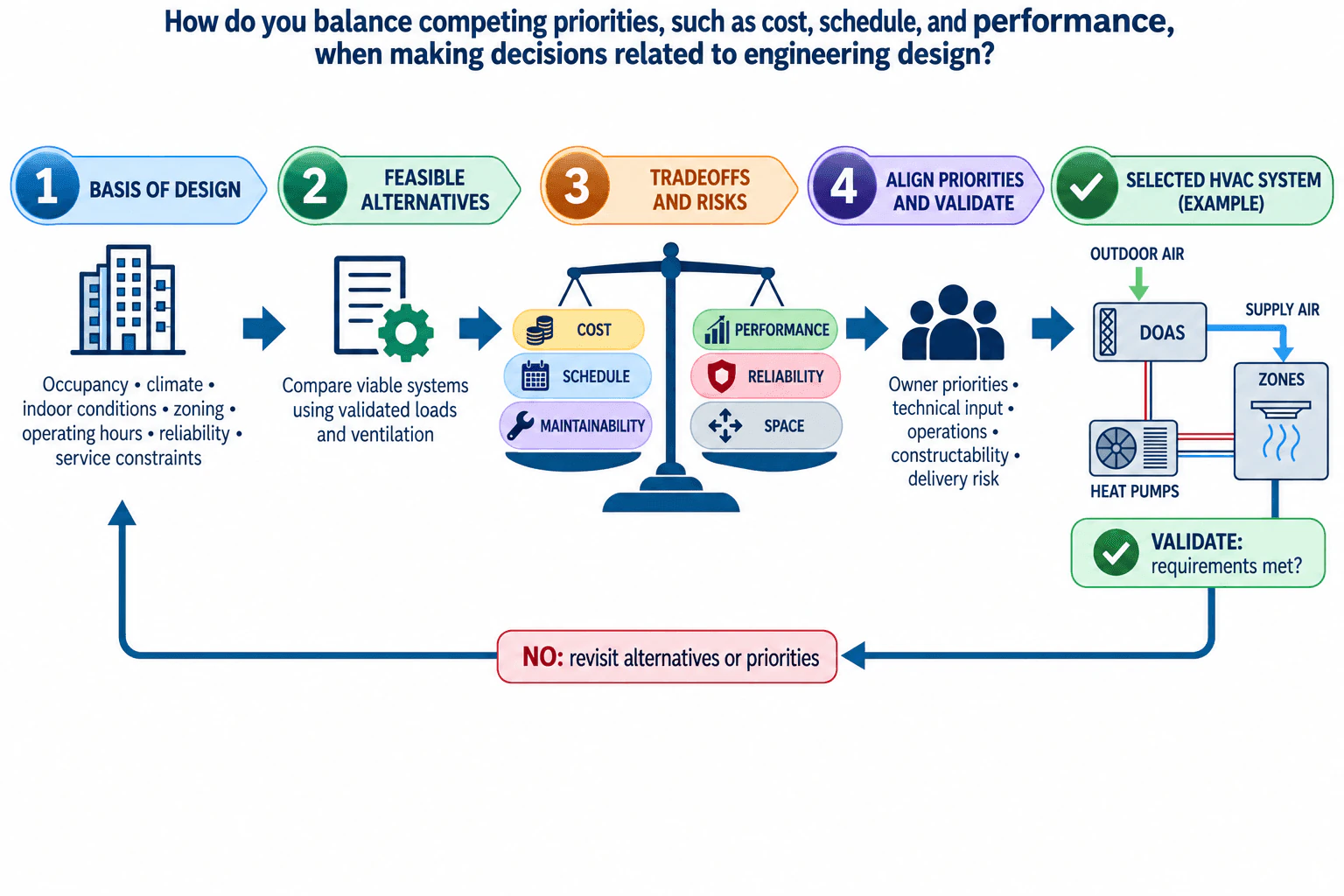
I start by defining the basis of design, including occupancy, climate, indoor conditions, zoning, operating hours, reliability, and service constraints. I then compare only feasible HVAC alternatives using validated load and ventilation results. I evaluate cost, schedule, performance, maintainability, reliability, and space together, then align the tradeoffs with owner and stakeholder priorities. I select the option that best satisfies the required criteria and validate it against the design requirements. If validation fails, I revisit the alternatives or priorities rather than forcing the original choice.
Detailed Explanation
I treat cost, schedule, and performance as competing design criteria rather than allowing one of them to control the decision automatically. The process starts with the basis of design because an option that cannot satisfy required conditions is not a valid alternative, even if it is cheaper or faster.
Useful Questions to Ask the Interviewer
Which requirements are mandatory, and which priorities can be traded against each other?
Are first cost, operating cost, schedule, reliability, maintainability, or space the strongest owner priorities?
Are there known site, equipment availability, service, or construction constraints that could remove an option from consideration?
How to Explain It in an Interview
Design Basis
First, I define the project constraints before selecting equipment. I confirm occupancy, climate, indoor conditions, outdoor design conditions, operating hours, zoning, reliability expectations, service access, space limitations, and applicable ventilation requirements. I also use validated zone and block load information so the system comparison starts from credible demand data.
System Decisions
Next, I screen feasible alternatives. Depending on the project, that could include air systems, heat pumps, VRF, DOAS, or a central plant. I compare each viable option using the same criteria rather than choosing a preferred technology first.
The main tradeoff criteria are first cost, schedule, performance, maintainability, reliability, and space. I also consider operating efficiency, humidity control, acoustics, redundancy, refrigerant implications, equipment access, and constructability when they materially affect the project. For cost, I look beyond initial price and consider expected operating implications over the useful life of the design.
For example, a DOAS with heat pumps could be a viable integrated solution when dedicated outdoor air and zone heating and cooling fit the project requirements. That example is not automatically the best system. It still has to be compared with the other feasible choices.
Design Rationale
I then review the tradeoffs with the owner, design team, operations staff, and other key stakeholders. A lower first cost may create higher operating cost. A faster delivery option may reduce equipment flexibility. A higher performance option may require more space or maintenance. I make those consequences explicit so the decision reflects both engineering requirements and stakeholder priorities.
Finally, I validate the selected integrated HVAC system against the basis of design and current equipment performance data. I check that the selected airside and equipment approach can satisfy required conditions, ventilation, reliability, maintainability, space, constructability, and project constraints. If the requirements are not met, I return to the alternatives or reconsider the priority weighting. The goal is a traceable decision that protects required engineering quality while balancing cost, schedule, and performance.
Why Interviewers Ask This
Interviewers want to see whether I can make disciplined engineering decisions when several valid priorities compete. They are evaluating whether I establish requirements first, compare feasible alternatives consistently, involve the right stakeholders, recognize risk, and protect required engineering performance instead of optimizing only for cost or schedule.
Interviewer may ask next
How would you validate that the selected HVAC alternative is still the right choice before final design?
I would compare the selected option back to the basis of design and confirm that the assumptions used during selection are still valid. I would verify the validated loads and ventilation inputs, equipment capability, zoning approach, space and service access, reliability requirements, constructability, and stakeholder priorities. I would also review current equipment data and delivery constraints. If a key assumption changes or the selected system no longer satisfies a mandatory requirement, I would reopen the comparison instead of carrying the decision forward unchanged.
What would you do if schedule suddenly became more important than first cost?
I would update the decision criteria and reassess the same feasible alternatives rather than selecting the fastest option automatically. I would identify which systems or equipment choices can meet the required delivery date, then compare their performance, maintainability, reliability, space needs, and cost consequences. Mandatory engineering requirements would remain constraints. If a faster alternative satisfies those requirements and the owner accepts the associated cost or operating tradeoffs, I would document the revised rationale and validate that option before proceeding.
7. How do you approach coordinating with other disciplines, such as civil or structural engineers, during the design process?Bim Coordination And Design DocumentationMediumBurns & Mcdonnell
i Question Details
Describe how you coordinate design goals, constraints, responsibilities, shared project information, interdisciplinary reviews, and design changes with civil, structural, and other disciplines so conflicts and rework are identified before construction.
Short Interview Answer (30-60 seconds)
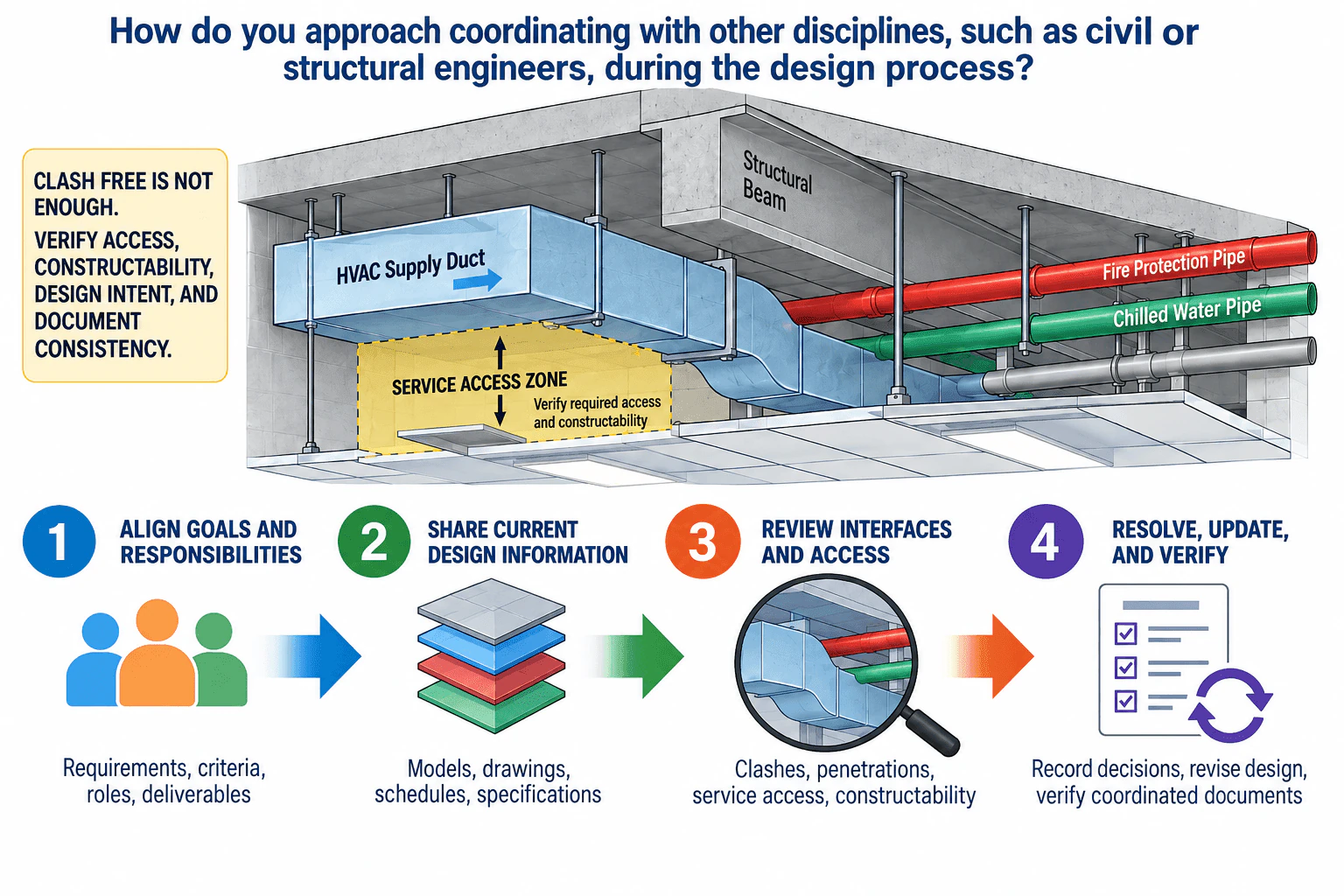
I start by aligning project requirements, design criteria, responsibilities, deliverables, and revision status with the other disciplines. Then I share current models and documents, review physical interfaces such as structural framing, HVAC ductwork, chilled water piping, fire protection piping, penetrations, and service access, and resolve issues with documented decisions. After changes are made, I verify that the model, drawings, schedules, specifications, and related documents remain consistent. My goal is not only to remove clashes, but also to protect HVAC design intent, maintenance access, and constructability before construction.
Detailed Explanation
I treat interdisciplinary coordination as a controlled design process rather than only a clash detection exercise. The main objective is to identify conflicts, responsibilities, and document inconsistencies while changes are still inexpensive to resolve.
Useful Questions to Ask the Interviewer
What design stage and deliverables are being coordinated?
Which disciplines and interfaces create the greatest coordination risk on this project?
What process is used to document decisions, revisions, RFIs, submittals, and approvals?
How to Explain It in an Interview
I use four main steps.
First, I align goals and responsibilities. I confirm project requirements, HVAC design criteria, discipline boundaries, expected deliverables, coordination responsibilities, and the current revision status. This establishes who owns each interface and what information everyone should be using.
Second, I share current design information. The coordination set should include the applicable models, drawings, schedules, specifications, and other design information. Everyone needs to work from compatible revisions so that an old structural layout or outdated mechanical routing does not create unnecessary rework.
Third, I review interfaces and access. I check HVAC ductwork and piping against structural framing, fire protection, chilled water piping, electrical, plumbing, architectural constraints, penetrations, and other affected systems. I also check service access and constructability. For example, an HVAC supply duct can be geometrically clear of a structural beam, fire protection pipe, and chilled water pipe but still create a problem if the arrangement blocks the service access zone needed for maintenance. For civil coordination, I apply the same principle to site connection points, routing constraints, elevations, and other interfaces that affect the HVAC scope.
Fourth, I resolve, update, and verify. Each significant issue should have a documented decision and responsible party. After revisions, I verify that affected models, drawings, schedules, specifications, calculations, and control information remain consistent. RFIs, submittals, substitutions, and shop drawings should be reviewed against the approved HVAC design intent rather than accepted simply because they fit geometrically.
A useful rule is that clash free is not enough. The final coordinated design should also support service access, constructability, design intent, and document consistency. Before issuing documents for construction, I confirm that identified issues have been addressed and that the coordinated information tells the same engineering story across the project documents.
Why Interviewers Ask This
Interviewers want to know whether I can coordinate HVAC design intent across disciplines, identify interface risks before construction, communicate changes clearly, and keep models, drawings, schedules, specifications, and engineering decisions consistent. They are also testing whether I understand that clash free geometry alone does not prove that a design is accessible, constructible, or coordinated.
Common interview mistakes
Common mistakes include treating clash detection as the complete coordination process, using outdated discipline information, checking physical interference without checking service access, failing to define responsibility for an interface, changing a model without updating related drawings or schedules, and accepting a substitution or shop drawing without verifying the original HVAC design intent.
Interview tip
Explain coordination as a repeatable engineering process: align requirements, share current information, review interfaces and access, then resolve and verify. Give one practical example, such as coordinating an HVAC supply duct around a structural beam, fire protection pipe, and chilled water pipe while maintaining the required service access zone.
Interviewer may ask next
How do you verify that a coordination issue is actually resolved?
I review the revised condition against the original design requirement and the affected discipline information. I check the geometry, penetrations, service access, constructability, and HVAC design intent, then confirm that the related model, drawings, schedules, specifications, and other affected documents reflect the same approved decision. Closing a clash marker alone is not enough.
What would you do if resolving a structural conflict forces a major HVAC routing change?
I would first confirm the structural constraint and the HVAC requirements that cannot be compromised. Then I would evaluate practical routing alternatives with the affected disciplines, considering pressure loss, available space, service access, penetrations, constructability, and impacts on other systems. Once the preferred solution is agreed upon, I would document the decision, revise the affected design information, communicate the change, and verify consistency across the coordinated documents.
8. Discuss your experience with construction administration, including reviewing submittals, addressing RFIs, and conducting site visits.Bim Coordination And Design DocumentationMediumBurns & Mcdonnell
i Question Details
Describe your construction-administration responsibilities for technical submittal review, responses to requests for information, and site observations, including how you check design intent, specifications, field conditions, workmanship, safety, and schedule impacts.
Short Interview Answer (30-60 seconds)
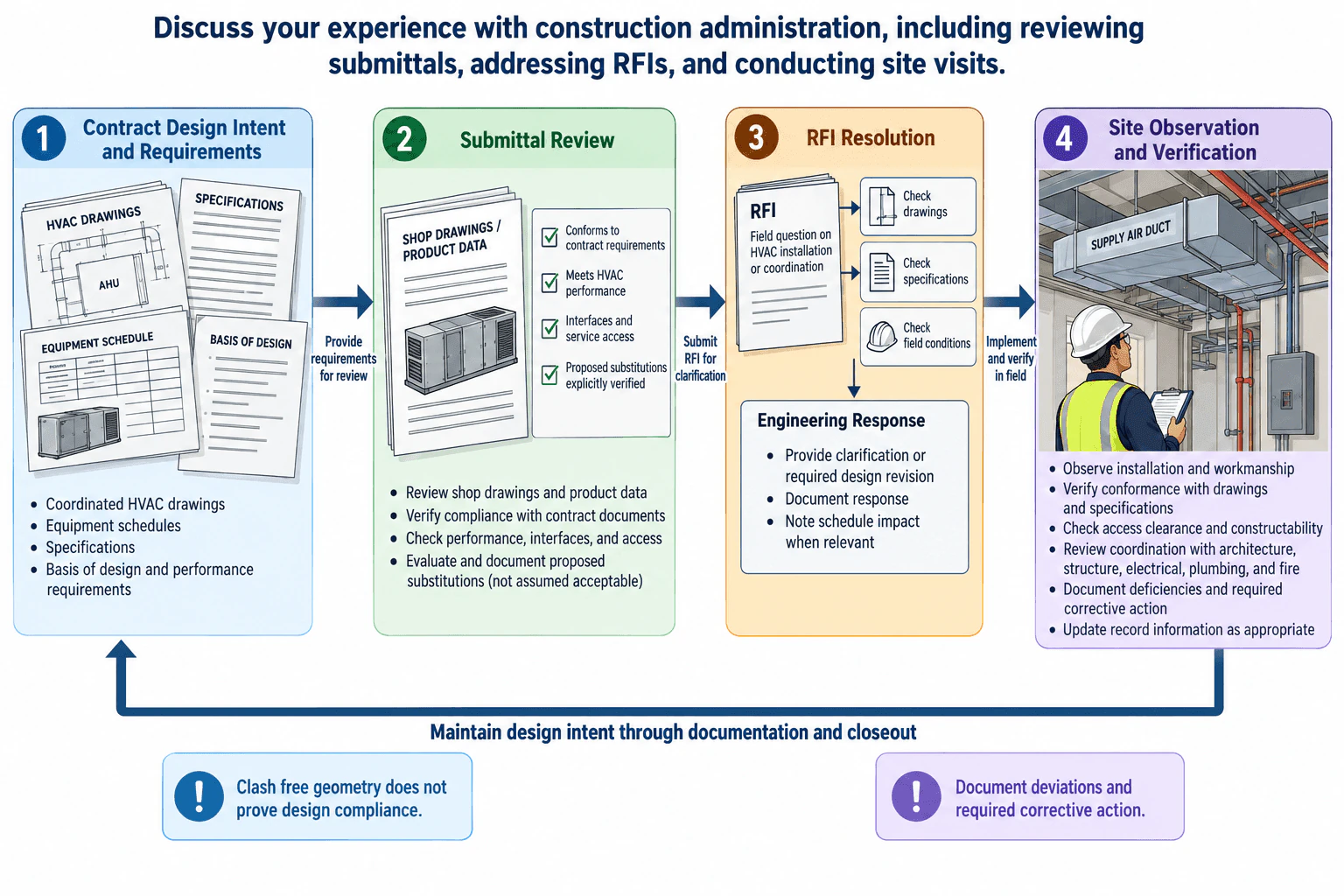
My construction administration approach starts with the contract drawings, equipment schedules, specifications, and basis of design. For submittals, I compare shop drawings and product data against those requirements, including performance, interfaces, service access, and proposed substitutions. For RFIs, I check the drawings, specifications, and actual field condition, then provide a documented clarification or design revision when needed and identify schedule implications when relevant. During site visits, I observe installation and workmanship, compare the work with the design documents, check access and coordination with other disciplines, and document deficiencies or required corrective action. I also keep the record information current so the final documentation reflects approved decisions.
Detailed Explanation
Construction administration is the process of maintaining HVAC design intent as the project moves from issued documents into procurement and construction. I treat drawings, equipment schedules, specifications, calculations, and approved decisions as one coordinated set. A model that is free of geometric clashes is useful, but it does not by itself prove that performance, accessibility, constructability, or contract requirements have been satisfied.
Useful Questions to Ask the Interviewer
What level of authority does the HVAC engineer have for submittal review, RFI responses, and approval of substitutions?
How are field observations, deficiencies, and design revisions documented and communicated on your projects?
Which disciplines and construction team members are normally involved when an HVAC issue affects access, safety, or schedule?
How to Explain It in an Interview
I use a four step construction administration workflow.
First, I establish the design intent and review basis. I check the coordinated HVAC drawings, equipment schedules, specifications, basis of design, and relevant revision status so I know what the contractor is required to provide.
Second, I review submittals such as shop drawings and product data against the contract requirements. I confirm required HVAC performance and key characteristics, then check interfaces with architectural, structural, electrical, plumbing, and fire systems. I also check service clearance and maintainability. If a substitution is proposed, I verify its technical impact rather than assuming that similar geometry makes it acceptable. Any exception or deviation should be clearly documented and handled through the proper approval process.
Third, I address RFIs by identifying the exact field question, then checking the drawings, specifications, and actual field condition that caused it. I determine whether the issue can be answered by clarification or whether a design revision is needed. I document the engineering response and note schedule impact when the issue could affect sequencing, procurement, or installation.
Fourth, during site visits I observe installed work and workmanship and compare what I see with the drawings, specifications, and approved submittals. I check equipment access, service clearances, constructability, and coordination with architectural, structural, electrical, plumbing, and fire systems. I also look for visible conditions that could create a safety concern and route those concerns through the appropriate project process. Site observation is not a substitute for the contractor's own quality control or responsibility for construction means and methods.
When I find a deficiency, I document the location, condition, applicable requirement, and required follow up. Approved changes are carried into the project records and final record information as appropriate. The goal is to maintain consistent design intent from the original documents through construction and closeout.
Why Interviewers Ask This
Interviewers want to see whether I can protect HVAC design intent after the drawings are issued. They are evaluating how I review technical submittals, resolve RFIs, recognize field coordination problems, document engineering decisions, communicate with other disciplines, and identify schedule or safety concerns without assuming responsibilities that belong to the contractor or another approval authority.
Common interview mistakes
Common mistakes include reviewing only equipment dimensions instead of performance and contract requirements, treating a clash free model as proof of a valid design, overlooking service clearance, accepting substitutions without checking system impacts, answering an RFI without confirming the governing drawings and specifications, failing to coordinate with other disciplines, and documenting field issues without a clear required action or follow up.
Interview tip
Describe construction administration as a continuous design intent and documentation process. Give a clear sequence from contract requirements to submittal review, RFI resolution, field observation, and final documentation. Emphasize engineering judgment, interdisciplinary coordination, service access, documented decisions, and verification rather than software commands.
Interviewer may ask next
How would you validate a proposed HVAC equipment substitution during submittal review?
I would compare the proposed equipment with the contract requirements and the design basis. I would check required capacity and performance, electrical and controls interfaces, physical connections, service clearance, weight and structural implications when relevant, acoustical or environmental requirements when specified, and coordination with surrounding systems. I would identify every deviation and determine whether it is acceptable, requires additional information, or requires a documented design change. I would not approve it simply because it fits in the available space.
What would you do if a site visit revealed an installed duct conflicting with another service and correcting it could affect the schedule?
I would first document the field condition and confirm the applicable drawings, specifications, approved submittals, access requirements, and surrounding interfaces. I would coordinate with the affected disciplines and construction team to evaluate technically acceptable options. If the resolution changes the design, I would document the engineering decision through the appropriate RFI or revision process. I would also identify the potential schedule impact so the project team can evaluate sequencing and implementation before the corrective work proceeds.
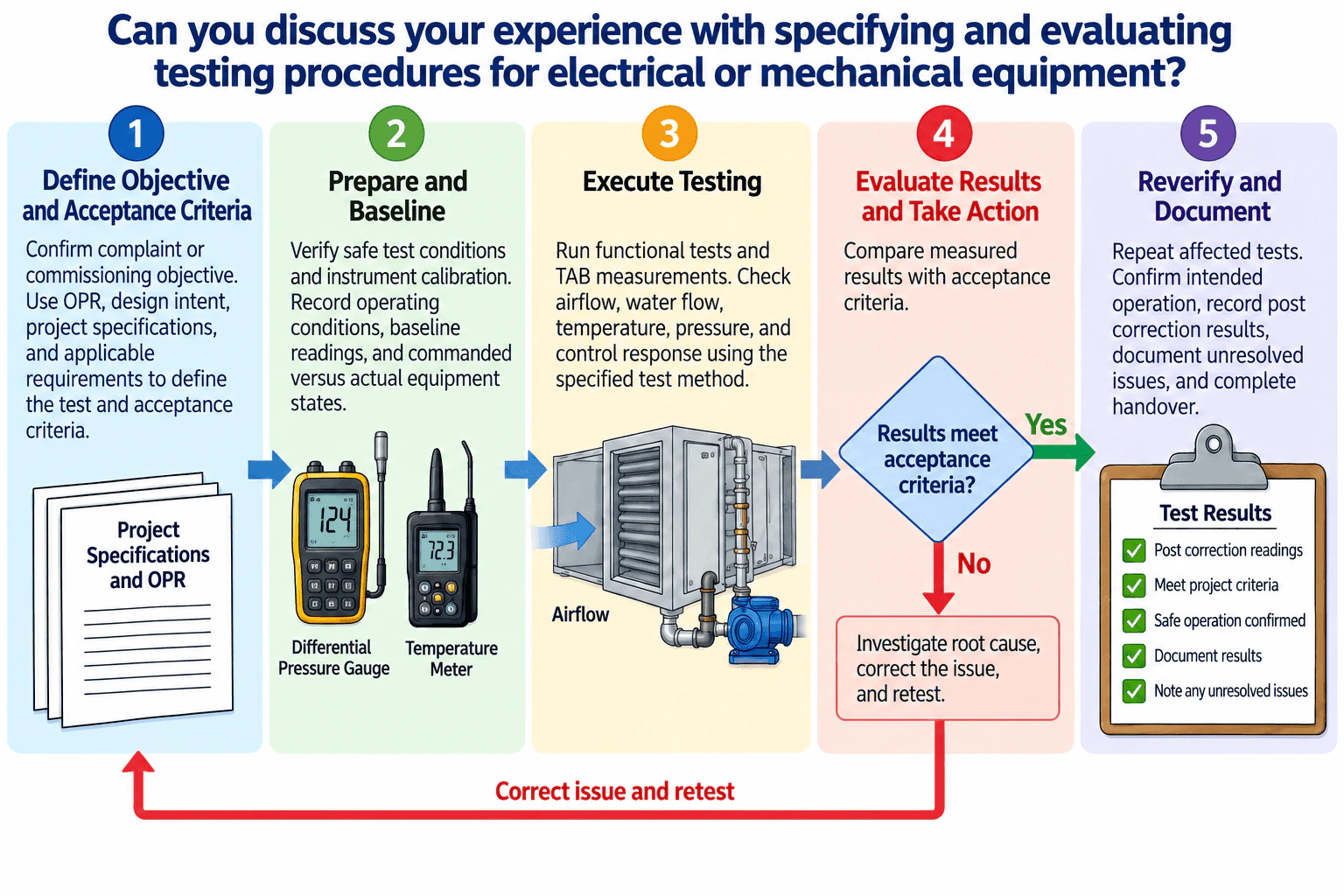
9. Can you discuss your experience with specifying and evaluating testing procedures for electrical or mechanical equipment?Troubleshooting And CommissioningMediumBurns & Mcdonnell
i Question Details
Discuss how you define equipment test procedures and acceptance criteria, select measurements and test methods, compare results with project specifications or industry requirements, investigate deviations, and determine whether the tested equipment is safe and performing as intended.
Short Interview Answer (30-60 seconds)
My approach is to first define the commissioning objective or confirm the reported problem, then establish the acceptance criteria from the OPR, design intent, project specifications, and applicable requirements. Before testing, I verify safe test conditions, instrument calibration, operating conditions, baseline readings, and commanded versus actual equipment states. I then run the appropriate functional tests and TAB measurements, such as airflow, water flow, temperature, pressure, and control response. I compare the results with the acceptance criteria. If something fails, I investigate the root cause, correct the issue, retest the affected function, confirm safe and intended operation, and document the final verified condition.
Detailed Explanation
I treat equipment testing as an evidence based process rather than simply taking readings. The test must begin with a clear objective, defined acceptance criteria, known operating conditions, and measurements that directly prove whether the equipment is safe and performing as intended. I also distinguish planned commissioning from troubleshooting an existing fault. Commissioning verifies performance against the required intent, while troubleshooting starts by confirming the complaint and then isolating the cause.
Useful Questions to Ask the Interviewer
Are we discussing planned commissioning of new equipment or troubleshooting an existing performance problem?
What project specifications, OPR, design intent, or acceptance requirements should govern the test?
Which equipment functions or operating conditions are most important to verify?
How to Explain It in an Interview
I would describe the work as a five stage process.
First, I define the objective and acceptance criteria. For planned commissioning, I review the OPR, design intent, project specifications, sequences, and applicable requirements. For an existing problem, I first confirm the complaint and define exactly what condition needs to be tested.
Second, I prepare and establish a baseline. I confirm that testing can be performed safely, verify instrument calibration, document operating conditions, and record baseline readings. I also compare commanded and actual equipment states so I know whether a control command is actually being carried out.
Third, I execute the test using measurements that match the function being evaluated. Depending on the equipment, that can include functional testing and TAB measurements for airflow, water flow, temperature, pressure, or control response. I check basic flow conditions before concluding that a capacity problem exists.
Fourth, I compare the measured results directly with the defined acceptance criteria. If the results do not meet the criteria, I investigate the root cause using measured evidence. For example, I might separate an airflow problem from a thermal or control problem rather than changing settings without confirming the cause.
Finally, after corrective action, I repeat the affected tests and record the post correction condition. I confirm safe and intended operation, document the results and any unresolved issues, and complete the required handover. This provides a traceable record from objective, to measurement, to acceptance decision, to correction, and finally to verified performance.
Why Interviewers Ask This
Interviewers want to know whether I can turn design intent and project requirements into a safe, repeatable test procedure, select meaningful measurements, judge results against defined acceptance criteria, investigate deviations using evidence, and document that equipment is safe and performs as intended.
Common interview mistakes
Common mistakes include starting adjustments before confirming the complaint, testing without defined acceptance criteria, using instruments without checking calibration, recording measurements without the operating conditions, relying only on commanded control values instead of checking actual equipment response, blaming equipment capacity before verifying airflow or water flow, changing several variables at once, and stopping after a correction without repeating the affected test and documenting the final condition.
Interview tip
Explain the sequence from objective to acceptance criteria, baseline, measurement, evaluation, corrective action, retest, and documentation. Mention specific HVAC measurements such as airflow, water flow, temperature, pressure, and control response, but avoid inventing test values or employer specific procedures. Emphasize that you compare measured evidence with defined criteria before deciding whether equipment is safe and performing as intended.
Interviewer may ask next
How would you validate a failed test result before concluding that the equipment itself is defective?
I would first verify the test conditions and measurement quality. I would confirm instrument calibration, repeat the measurement, check that the equipment is operating in the intended mode, and compare commanded and actual states. I would then verify supporting conditions such as airflow, water flow, temperature, pressure, and control response. If the deviation remains repeatable under the required operating conditions, I would investigate the most likely root causes and document the evidence before recommending corrective action.
What would you do if the required operating condition is not available when the equipment is tested?
I would document which functions were verified and which conditions could not be demonstrated. I would not claim full performance verification for an operating condition that was not tested. I would complete the available functional checks, record the current operating conditions and results, and identify the remaining verification for completion when the required condition becomes available.
10. Tell me about your previous work experience and how this relates to Burns and McDonnell.BehavioralMediumBurns & Mcdonnell
Interview tip:
Use STAR to structure your answer: briefly explain the Situation and Task, make Action the most detailed part, and finish with the Result. For example, describe a previous HVAC engineering role where you supported system design, coordinated with other disciplines, resolved design and field issues, communicated with the project team, and explain how that experience prepares you to contribute to HVAC projects at Burns & McDonnell.
Situation
In my last role, I worked on HVAC design and project support during a commercial building project. My work included reviewing project requirements, developing HVAC system layouts, coordinating with other engineering disciplines, and supporting the project through design and construction.
Task
My responsibility was to help develop the HVAC systems for that project so they met the building requirements while also being practical to install, operate, and maintain. I needed to complete my design work accurately, coordinate it with the architectural, structural, electrical, and plumbing teams, and respond when design or field conditions created conflicts.
Action
I started by reviewing the project requirements, drawings, equipment information, and applicable design criteria so I understood what each space needed. I performed heating and cooling load calculations and used those results to support equipment selection and airflow requirements. I developed ductwork and piping layouts while checking available space, access, and coordination with other building systems. When I found conflicts, I discussed them early with the appropriate team members instead of allowing them to continue into construction. I also reviewed equipment submittals and answered technical questions from the project team to confirm that proposed equipment and installation details were consistent with the design intent. When field conditions differed from the drawings, I worked with the team to understand the actual condition, evaluate practical options, and document a solution that maintained system performance and project requirements. This experience taught me that good HVAC engineering is not only about calculations. It also requires clear communication, careful coordination, practical judgment, and ownership of issues from design through construction.
Result
My work helped the team move the HVAC design from initial calculations and layouts through coordinated construction documents and field support with fewer unresolved issues. I also became more comfortable balancing technical requirements with constructability and communication. That experience relates directly to the type of HVAC engineering work I would bring to Burns & McDonnell because I can contribute both technical design skills and the coordination and problem solving needed to support a project from design through construction.
Why Interviewers Ask This
Interviewers ask this question to understand whether the candidate's previous HVAC experience is relevant to the role and whether the candidate can clearly connect technical design work, coordination, communication, problem solving, and project ownership to the responsibilities they would take on at Burns & McDonnell. A strong answer shows both relevant experience and a clear reason that experience would transfer to the new role.
Interviewer may ask next
Which part of your previous HVAC experience would help you most in this role?
The most useful part would be my experience taking HVAC work beyond calculations and coordinating it with the rest of the project. I learned to check space, equipment access, ductwork, piping, and other disciplines before issues reached construction. I also learned to communicate technical concerns clearly and work with the team to find practical solutions. I would bring that same approach to projects at Burns & McDonnell.
What did you learn from supporting projects during construction?
I learned that a design can look correct on drawings but still require adjustment when actual field conditions are different. I became more careful about constructability, equipment access, coordination, and documenting design intent. I also learned to understand the field condition before proposing a solution and to involve the right team members early so the final decision supports both system performance and the overall project.
More questions load as you scroll
Hvac Engineer Resume Examples
Explore the resume examples below to find the one that best matches your target Hvac Engineer role.
Disclaimer: This interview guide is for educational and informational purposes only. It is designed to help readers prepare, but it does not guarantee any interview result, hiring decision, offer, or outcome. Interview questions, hiring criteria, and preferred answers can vary by employer, interviewer, industry, location, and time. All answers, examples, and explanations in this guide are suggested examples for interview preparation, not definitive answers or instructions for professional practice. They are based on research and judgment, are provided without warranties of any kind, and should be adapted to the question, role, and applicable laws and professional requirements. Diagrams are simplified illustrations intended to highlight the main concepts and their relationships; actual situations, systems, and practices may be more complex. Alternative approaches may be equally valid or better suited to a particular question, context, or interviewer. To the fullest extent permitted by applicable law, the contributors and publisher are not liable for decisions made, actions taken, or losses incurred based on this guide.
State Laws and Professional Responsibilities: Laws and requirements governing an occupation vary by state and jurisdiction. You are responsible for checking the current laws, licensing requirements, and scope-of-practice rules that apply to your location and role, and for ensuring that your answers and actions comply with them. Adapt examples in this guide to those requirements. This guide is not legal advice.
Company Notice: This guide is an independent educational resource and is not affiliated with, endorsed by, sponsored by, or approved by the company named in this guide. Company names identify reported interview experiences or the employer context of clearly labeled original practice exercises. Interview practices can change without notice, and inclusion of company-specific content does not mean these questions are official, complete, or guaranteed to be asked. To the fullest extent permitted by law, the author, contributors, and publisher are not responsible for outcomes related to use of this material.
Content Accuracy and Verification: To the fullest extent permitted by applicable law, we do not represent or warrant that interview guides, questions, answers, examples, or diagrams are accurate, complete, current, error-free, or suitable for any particular purpose. You are responsible for independently reviewing and verifying the information before relying on it.