This interview guide is for educational and informational purposes only. It is designed to help readers prepare, but it does not guarantee any interview result, hiring decision, offer, or outcome. Interview questions, hiring criteria, and preferred answers can vary by employer, interviewer, industry, location, and time. All answers, examples, and explanations in this guide are suggested examples for interview preparation, not definitive answers or instructions for professional practice. They are based on research and judgment, are provided without warranties of any kind, and should be adapted to the question, role, and applicable laws and professional requirements. Diagrams are simplified illustrations intended to highlight the main concepts and their relationships; actual situations, systems, and practices may be more complex. Alternative approaches may be equally valid or better suited to a particular question, context, or interviewer. To the fullest extent permitted by applicable law, the contributors and publisher are not liable for decisions made, actions taken, or losses incurred based on this guide.
State Laws and Professional Responsibilities
Laws and requirements governing an occupation vary by state and jurisdiction. You are responsible for checking the current laws, licensing requirements, and scope-of-practice rules that apply to your location and role, and for ensuring that your answers and actions comply with them. Adapt examples in this guide to those requirements. This guide is not legal advice.
Identity, Image, and Privacy Notice
To respect individual privacy, some names, profile photographs, avatars, biographical details, and other identifying information displayed in this guide may be replaced with pseudonyms, licensed stock images, illustrative avatars, composite images, or representative descriptions. Unless a person is expressly identified as an actual contributor, a displayed name, image, or profile should not be understood as depicting or identifying a specific candidate, interviewer, employee, or other real individual. These representations are provided for editorial and illustrative purposes only and do not imply endorsement, employment, participation, or affiliation with this guide or any company mentioned in it. Any resemblance to an actual person is coincidental.
Company Notice
This guide is an independent educational resource and is not affiliated with, endorsed by, sponsored by, or approved by the company named in this guide. Company names identify reported interview experiences or the employer context of clearly labeled original practice exercises. Interview practices can change without notice, and inclusion of company-specific content does not mean these questions are official, complete, or guaranteed to be asked. To the fullest extent permitted by law, the author, contributors, and publisher are not responsible for outcomes related to use of this material.
Content Accuracy and Verification
To the fullest extent permitted by applicable law, we do not represent or warrant that interview guides, questions, answers, examples, or diagrams are accurate, complete, current, error-free, or suitable for any particular purpose. You are responsible for independently reviewing and verifying the information before relying on it.
Questions or comments?
Contact us for general questions, or share feedback, technical corrections, and comments with the community.
1. How would you approach threat modeling for a project?Threat ModelingMediumApple
Short Interview Answer (30-60 seconds)
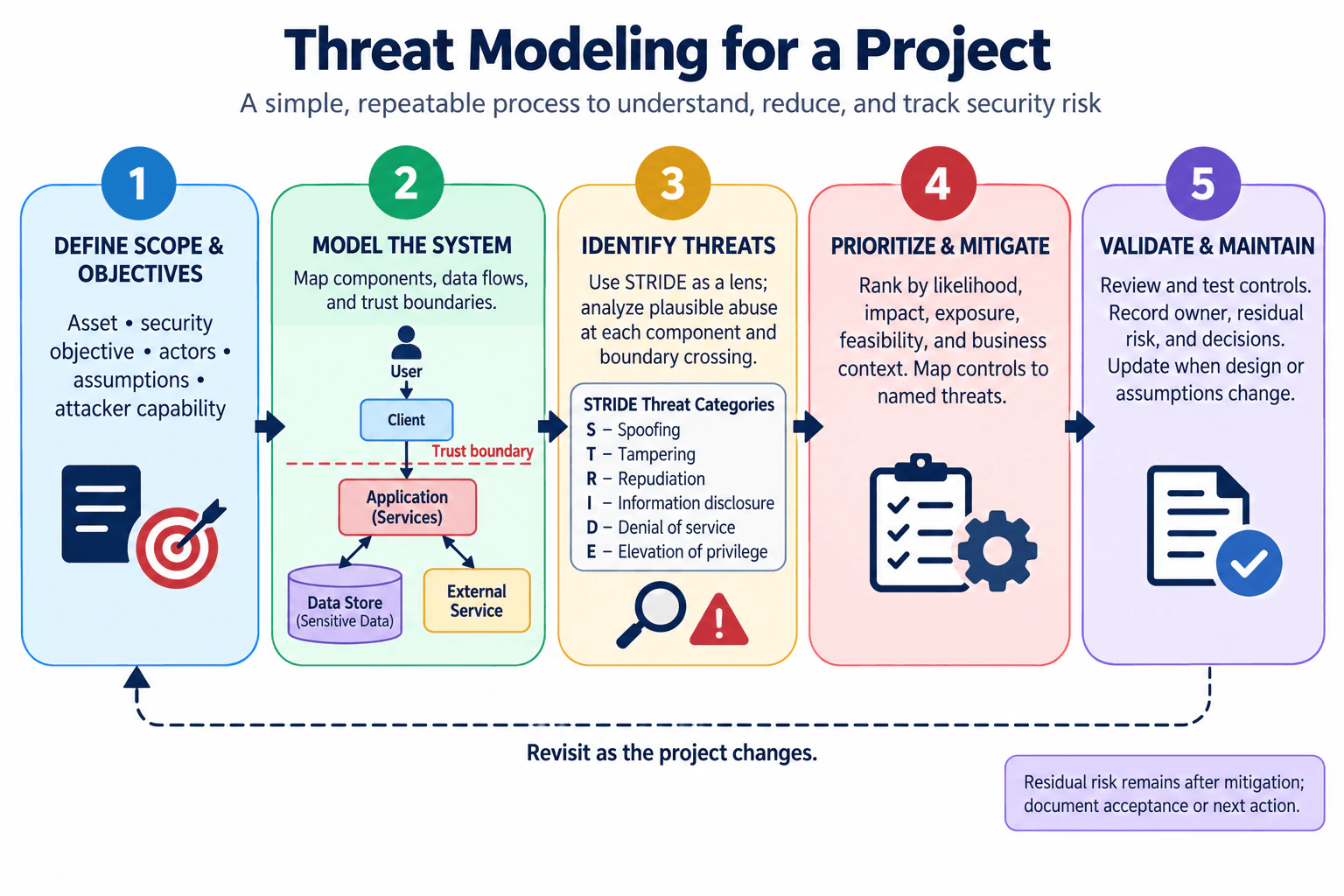
I start by defining assets, security objectives, actors, assumptions, and attacker capabilities. Then I map components, data flows, and trust boundaries, use STRIDE to identify plausible threats, prioritize them by risk and business context, map controls to each important threat, validate them, document residual risk, and revisit the model as the project changes.
Detailed Explanation
Threat modeling is a structured way to decide what could go wrong in a project and what security work matters most. I would not begin with a control checklist. I would first understand the protected assets, security objectives, actors, assumptions, realistic attacker capabilities, system components, data flows, and trust boundaries. From that model, I would identify plausible threats, prioritize them using risk and business context, choose mitigations that address specific threats, validate those mitigations, record the remaining risk and its owner, and update the model whenever the project or its assumptions change.
Useful Questions to Ask the Interviewer
What assets or capabilities are most important to protect?
What security objectives matter most, such as confidentiality, integrity, or availability?
Who are the expected users, services, administrators, third parties, and possible attackers?
What parts of the architecture or data flow are already known?
Where does trust change between users, clients, application services, data stores, or external services?
What assumptions or project constraints should I treat as fixed?
How to Explain It in an Interview
I would describe the approach as a five-step lifecycle.
First, I define scope and objectives. I identify the protected asset, the security objective for that asset, the relevant actors, important assumptions, and a realistic attacker capability. For example, I would distinguish an ordinary external attacker from an authenticated user or privileged operator instead of assuming every attacker has the same access. This gives the threat model a clear scope and prevents unsupported scenarios from dominating the analysis.
Second, I model the system. I draw the important components and real data flows between them. In the approved diagram, the user interacts with a client, the client crosses a trust boundary to an application service, and the application communicates with a sensitive data store and an external service. A trust boundary is a place where trust or responsibility changes. Those crossings deserve special attention because requests or data move between different trust contexts.
Third, I identify plausible threats. I can use STRIDE as a lens: spoofing, tampering, repudiation, information disclosure, denial of service, and elevation of privilege. STRIDE organizes the analysis, but it is not proof that every possible threat has been found. I apply it to the actual components and trust-boundary crossings and ask how a realistic attacker could misuse each one.
I keep the security terms separate. A threat is a potential harmful event. A vulnerability is a weakness that may enable a threat. An exploit is a method that takes advantage of a vulnerability. Risk is the assessed significance of a threat in context, considering factors such as likelihood, impact, exposure, feasibility, and business importance. A control is a measure intended to reduce that risk. Residual risk is what remains after the selected controls are applied.
Fourth, I prioritize and mitigate. I consider likelihood, impact, exposure, feasibility, and business context. I prefer qualitative judgments when the available evidence does not justify precise numbers. I then map controls to the important named threats instead of adding controls simply because they are common security practices. Each control should reduce the likelihood or impact of a specific threat or protect a specific trust-boundary crossing. If several controls are required, I can use defense in depth while still explaining the purpose of each control.
Fifth, I validate and maintain the model. I review and test the selected controls, document the decisions, assign an owner, and record residual risk. Residual risk may be accepted by the appropriate owner or may require another action. Threat modeling is not a one-time document, so I revisit it when the design, assumptions, components, data flows, attacker capabilities, or business context change.
For validation, I would look for evidence that the model and controls match the real design. Depending on the project, that evidence could come from architecture review, control testing, security testing, or another authorized review. The important point is to verify the mitigation instead of assuming that adding a control solved the threat.
A useful limitation to state is that threat modeling depends on the quality of the system model and assumptions. Missing components, incorrect data flows, or unrealistic attacker assumptions can cause threats to be missed. STRIDE also provides categories, not certainty or completeness. That is why review, testing, ownership, residual-risk decisions, and iteration matter.
The main tradeoff is depth versus effort. Modeling every possible scenario can slow a project without improving decisions. A good threat model stays focused on important assets, meaningful trust boundaries, plausible attacker capabilities, and threats with meaningful business impact. The goal is not to prove that the system is perfectly secure. The goal is to make defensible security decisions, reduce important risks, document what remains, and revisit the model as the project changes.
Technical Approach
Define the protected asset and its security objective.
Identify relevant actors, assumptions, project constraints, and realistic attacker capabilities.
Model the important system components and real data flows.
Mark trust boundaries where trust or responsibility changes.
Analyze each important component and trust-boundary crossing for plausible threats, using STRIDE as a lens when useful.
Keep threats, vulnerabilities, exploits, risks, controls, and residual risk distinct.
Prioritize threats using likelihood, impact, exposure, feasibility, uncertainty, and business context.
Map each important named threat to one or more specific mitigations.
Review and test the controls to obtain evidence that they address the intended threats.
Document decisions, ownership, and residual risk.
Revisit the threat model whenever the project design, assumptions, threats, attacker capabilities, or business context change.
Practical Insights
The main cost is engineering and review time. A small project may need only a focused model of a few assets, flows, and trust boundaries, while a larger or frequently changing project takes more effort to keep the model current. Deeper analysis can find more problems but also increases meeting time, documentation, testing, and maintenance work. Poor prioritization can waste money on low-value controls, while too little analysis can leave important risks untreated. The practical approach is to spend the most effort on high-value assets, important trust-boundary crossings, plausible attacker capabilities, and threats with meaningful business impact.
Why Interviewers Ask This
The interviewer wants to see whether I can turn an incomplete project description into a structured security analysis instead of jumping directly to controls. They are testing whether I can define scope, reason about trust boundaries and realistic attacker capabilities, distinguish threats, vulnerabilities, exploits, risks, controls, and residual risk, prioritize based on business context, map mitigations to specific threats, validate the result, communicate uncertainty, and maintain the model throughout the project lifecycle.
Common interview mistakes
Common mistakes are starting with a generic security-control checklist before defining assets and threats; treating STRIDE as a complete checklist instead of a thinking aid; failing to draw real data flows and trust boundaries; assuming attacker capabilities that were never established; confusing a threat with a vulnerability, exploit, risk, control, or residual risk; assigning precise risk numbers without evidence; listing controls without mapping them to named threats; assuming a control removes all risk; ignoring residual risk and ownership; and creating the model once without updating it when the project changes.
Interview tip
Present the answer as a clear lifecycle: define scope, model the system, identify threats, prioritize and mitigate, then validate and maintain. Spend extra time explaining trust boundaries, how you prioritize risk, and how each mitigation maps to a specific threat. Mention residual risk and iteration at the end because that shows mature security judgment rather than checklist thinking.
Interviewer may ask next
How would you prioritize threats if you do not have enough data to calculate an exact risk score?
I would avoid inventing precision. I would use a qualitative assessment based on likelihood, impact, exposure, feasibility, and business context. I would state the assumptions and uncertainty behind each judgment and compare threats consistently. The purpose is to decide what deserves attention first, not to create an artificial numerical score. If new evidence becomes available, I would update the prioritization.
What would you do if a mitigation reduces a threat but does not eliminate the risk?
I would document the residual risk, identify its owner, and explain what remains possible after the mitigation. The owner can decide whether that remaining risk is acceptable or whether another action is needed. I would also validate that the mitigation works as intended and revisit the decision when the system, assumptions, attacker capability, or business context changes.
2. What is TCP/IP?Network SecurityEasyApple
Short Interview Answer (30-60 seconds)
TCP/IP is a protocol suite used for communication across interconnected networks. IP handles addressing and packet delivery between hosts and networks, while TCP provides applications with a reliable, ordered byte stream using ports, sequence numbers, acknowledgments, checksums, and retransmission. ~~~~~~~~~~~~~~~~~~~~~~~~~~~~~~~~~~~~~~
Detailed Explanation
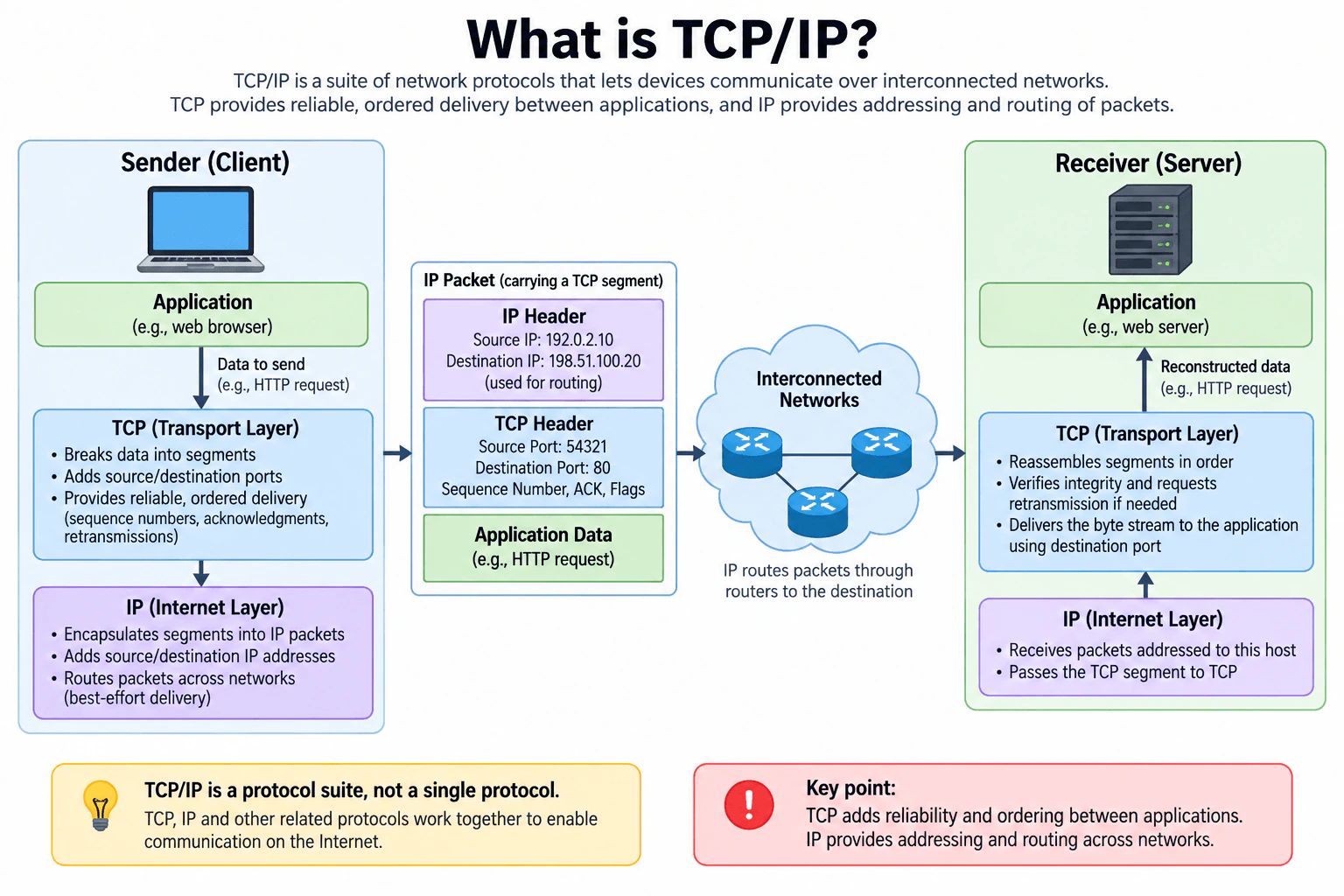
TCP/IP is the protocol suite that lets applications on different devices communicate across interconnected networks. In the diagram, a client application creates data, TCP provides a reliable, ordered byte stream and adds transport information such as ports and sequence numbers, and IP carries the TCP segment inside an IP packet with source and destination addresses. Routers forward the IP packet toward the destination. At the server, IP passes the TCP segment upward, and TCP reconstructs the application byte stream. The key idea is simple: TCP handles reliable transport, while IP handles addressing and routing. ~~~~~~~~~~~~~~~~~~~~~~~~~~~~~~~~~~~~~~
Useful Questions to Ask the Interviewer
Would you like a high-level explanation, or should I also walk through the client-to-server packet flow?
Should I explain the TCP and IP headers shown in the example?
How to Explain It in an Interview
Start with the main idea. TCP/IP is not one protocol. It is a suite of protocols that work together. In this diagram, the important path is application data moving from a client, through TCP and IP, across interconnected networks, and then back up TCP and IP at the server.
Explain TCP's job. TCP is a transport-layer protocol. It provides applications with a reliable, in-order byte-stream service. TCP uses source and destination port numbers to identify application services and distinguish flows. Its header includes fields such as source port, destination port, sequence number, acknowledgment number, flags, and checksum. TCP detects loss using sequence and acknowledgment behavior, detects segment errors with its checksum, and retransmits data when required. rfc-editor.org
Explain IP's job. Each TCP segment is carried inside an IP datagram. IP supplies source and destination host addresses and provides the packet-delivery mechanism used across interconnected networks. Routers use IP destination information to forward packets toward the destination. IP does not provide TCP's reliable, ordered byte-stream service. ~~~~~~~~~~~~~~~~~~~~~~~~~~~~~~~~~~~~~~
4. Walk through the diagram's client example. The web-browser application creates an example HTTP request. TCP prepares transport information. The diagram uses source port 54321 and destination port 80. IANA registers TCP port 80 for HTTP, so this is a valid teaching example. iana.org
Follow the packet across the network. IP adds the example source address 192.0.2.10 and destination address 198.51.100.20. Those addresses come from IPv4 blocks reserved for documentation, which makes them appropriate for a diagram rather than real production endpoints. The IP packet then travels through routers across interconnected networks toward the destination. rfc-editor.org
Explain what happens at the receiver. The destination host's IP layer processes the packet and passes the TCP segment upward to TCP. TCP uses its sequence and acknowledgment state, checksum, and retransmission mechanisms to maintain the reliable ordered byte stream. TCP then delivers the reconstructed application data to the application associated with the destination port. rfc-editor.org
State the responsibility boundary. IP is responsible for addressing and packet delivery across networks. TCP operates end to end between communicating applications and adds connection-oriented, reliable, ordered transport. Routers forward IP packets; they do not provide TCP's end-to-end reliability.
Explain failure behavior. Packets can be lost, duplicated, delayed, corrupted, or arrive out of order. IP does not guarantee that every packet will arrive successfully. TCP uses sequence information, acknowledgments, checksums, retransmission timers, and retransmissions to recover from relevant loss and errors. If the network remains unreachable, TCP cannot make communication succeed indefinitely. rfc-editor.org
Explain the security limitation. TCP/IP provides communication mechanics, not complete security. An IP address does not authenticate a user or application, and TCP does not by itself encrypt application data or prove endpoint trust. Authentication and encryption must be provided by appropriate higher-layer security mechanisms when required.
Finish with the diagram's key point. A simple way to remember it is: IP handles addressing and routing across networks, while TCP adds reliable and ordered delivery between applications.
Technical Approach
Identify the sending application and receiving application.
Identify TCP's transport information, including source and destination ports.
Identify the IP source and destination addresses.
Follow the IP packet through routers toward the destination.
At the receiving host, let IP pass the TCP segment upward.
Let TCP reconstruct the reliable ordered byte stream and deliver it to the destination application.
During troubleshooting, validate transport behavior and IP forwarding separately instead of treating them as the same function.
Practical Insights
TCP/IP is built into modern operating systems and network devices, so applications normally use the operating system's networking stack rather than implementing the protocols themselves. TCP adds connection state, headers, acknowledgments, checksums, retransmissions, and other processing to provide reliable ordered transport. IP forwarding depends on available network paths and routers. Packet loss, congestion, extra hops, or retransmissions can increase latency. Operationally, a working IP path does not guarantee that a TCP connection or application will succeed, and a successful TCP connection does not prove that application data is authenticated or encrypted.
Why Interviewers Ask This
Interviewers ask this to check whether you understand the basic network stack and can clearly separate TCP's transport responsibilities from IP's addressing and packet-delivery responsibilities. For a cybersecurity engineer, this distinction matters when analyzing packet flows, ports, routing behavior, connectivity failures, and network evidence.
Common interview mistakes
A common mistake is saying TCP/IP is one protocol; it is a protocol suite. Another is saying TCP performs routing; routing and packet forwarding are IP-layer functions, while TCP provides transport between applications. Do not say IP guarantees delivery, because TCP adds the reliable transport behavior shown in the diagram. Do not claim TCP automatically encrypts or authenticates traffic. Also avoid confusing IP addresses with TCP ports: IP addresses identify hosts or interfaces for packet delivery, while TCP ports identify application services and flows.
Interview tip
Lead with one sentence: IP handles addressing and routing, while TCP provides reliable, ordered transport between applications. Then walk through the diagram from the browser, to TCP, to IP, through the routers, and back up the stack at the server. Mention ports, sequence numbers, acknowledgments, and retransmissions only after the core distinction is clear.
Interviewer may ask next
How does TCP provide reliable and ordered delivery?
TCP provides a reliable, in-order byte stream by using sequence numbers, acknowledgments, checksums, and retransmission. Sequence information tracks bytes in the stream, acknowledgments report received progress, checksums detect segment corruption, and lost data can be retransmitted. These mechanisms operate above IP, because IP itself does not provide TCP-style reliable ordered delivery. rfc-editor.org
Does TCP/IP by itself make communication secure?
No. TCP/IP provides addressing, packet delivery, and transport behavior, but it does not by itself establish application identity, authorization, confidentiality, or endpoint trust. Basic TCP does not encrypt the application data shown in the diagram. Appropriate authentication and encryption mechanisms must be added separately when the application requires them.
3. What is incident response?Incident ResponseEasyApple
Short Interview Answer (30-60 seconds)
Incident response is the coordinated process for detecting, investigating, containing, eradicating, and recovering from a cybersecurity incident. The goal is to limit harm, preserve useful evidence, restore affected assets safely, communicate with authorized stakeholders throughout, and use lessons learned to improve future preparation and response.
Detailed Explanation
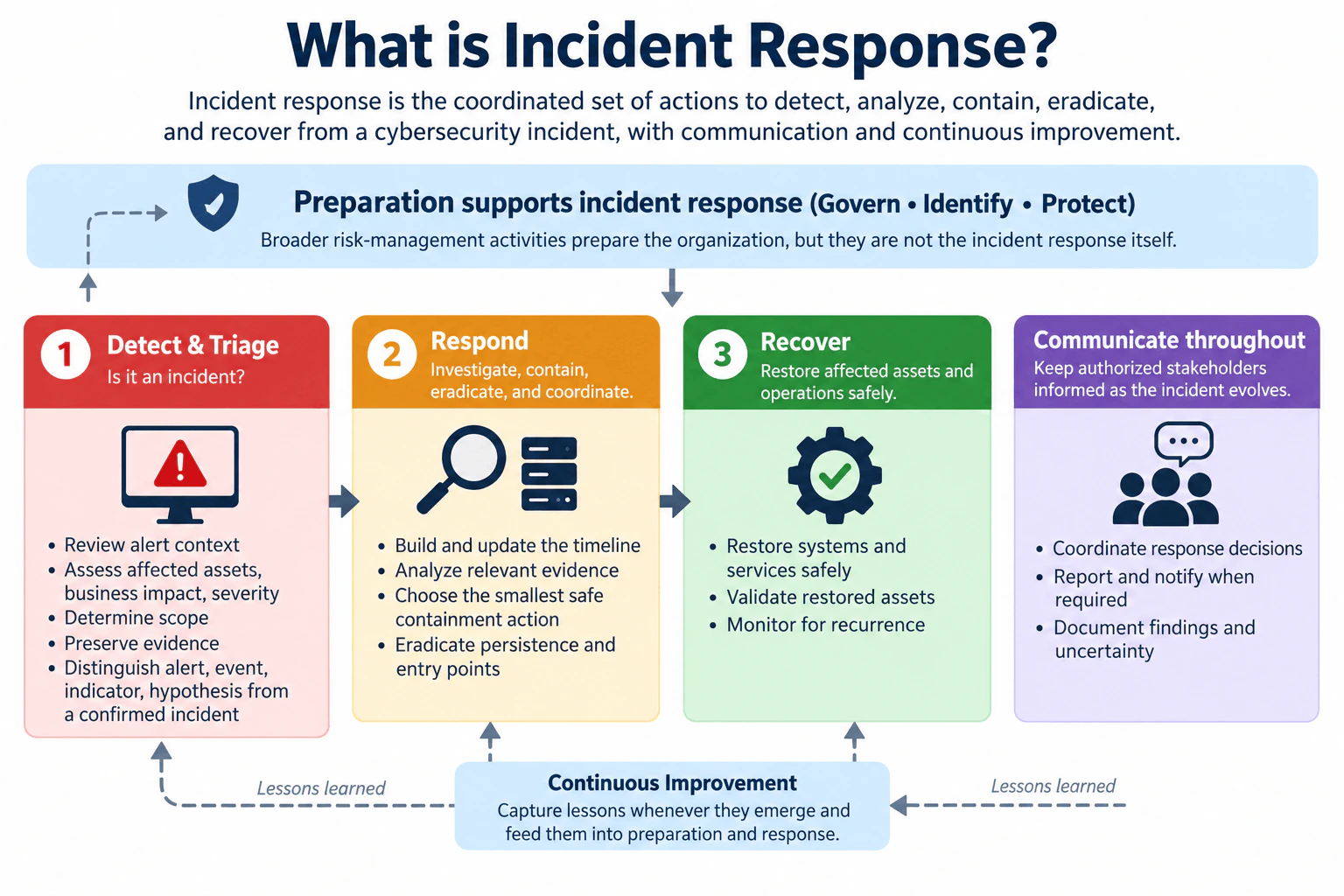
Incident response is the structured way a security team handles a suspected or confirmed cybersecurity incident. The practical goal is to limit harm while understanding what happened and restoring operations safely. Start with alert context, affected assets, business impact, severity, scope, and evidence preservation. An alert is not automatically proof of compromise. Build a timeline, investigate relevant evidence, and choose the smallest safe containment action. Then remove confirmed persistence or entry points, recover and validate affected assets, monitor for recurrence, communicate with authorized stakeholders throughout, and feed lessons learned back into preparation and response.
Useful Questions to Ask the Interviewer
Are you asking for the general incident-response lifecycle or how I would handle a specific incident?
Should I focus only on the technical response, or also include evidence handling and stakeholder communication?
Are there legal, privacy, regulatory, disciplinary, or law-enforcement considerations that could affect evidence preservation or notification?
How to Explain It in an Interview
The simplest explanation is that incident response is an evidence-driven cycle. Preparation supports the cycle, while the active response centers on detection, response, recovery, communication, and continuous improvement.
Detect and triage. Review the alert context first. Identify affected assets, business impact, severity, and initial scope. Preserve relevant evidence when practical before taking disruptive action. Distinguish an alert or event from a confirmed incident. An indicator is a clue, not proof by itself, and a hypothesis is an explanation that still needs evidence.
Investigate and respond. Build and continuously update a timeline. Analyze only evidence relevant to the questions being investigated, such as endpoint, identity, cloud, network, DNS, application, or security-event telemetry. Record where important evidence came from. Preserve chain of custody when evidence may be used for legal, regulatory, disciplinary, or law-enforcement purposes. Clearly separate verified facts from assumptions and uncertainty.
Contain safely. Choose the smallest safe action that meaningfully limits further harm. The correct action depends on the evidence and business impact. For example, an authorized responder might isolate a confirmed affected asset or revoke a compromised credential when justified. Containment limits damage; it is not the same as removing the root cause.
Eradicate. Remove confirmed malicious persistence, compromised access, or the identified entry point. A workaround or isolation step is not root-cause remediation. Revisit the timeline and evidence as new facts appear because the original hypothesis may change during investigation.
Recover and verify. Restore affected systems and services safely. Validate restored assets rather than assuming that service availability means the incident is resolved. Confirm that the conditions responsible for the incident have been addressed, then monitor for recurrence. Recovery is verified through evidence and observation, not merely by turning a service back on.
Communicate throughout. Keep authorized stakeholders informed as the incident evolves. Coordinate important response decisions, report or notify when required, and document findings and uncertainty. Protect secrets, personal data, and sensitive evidence by limiting access and disclosure to authorized people with a legitimate need.
Improve continuously. Capture lessons whenever they emerge rather than waiting only for a final meeting. Feed those lessons into preparation and response so policies, playbooks, controls, training, detection, and recovery practices can improve. Under NIST SP 800-61 Rev. 3, Detect, Respond, and Recover form the incident response lifecycle, while Govern, Identify, and Protect are broader cybersecurity risk-management activities that support preparation and improvement.
The key tradeoff is speed versus certainty and disruption. Waiting too long can allow more harm, but acting too aggressively can interrupt business operations, destroy evidence, or make investigation harder. A strong responder therefore acts proportionally: preserve what matters, contain only as much as needed, document uncertainty, and continuously reassess decisions as evidence changes.
Technical Approach
Review the alert context and separate known facts from assumptions.
Identify affected assets, business impact, severity, and initial scope.
Preserve relevant evidence and provenance before disruptive actions when practical.
Build and continuously update an incident timeline.
Analyze relevant evidence and determine whether the situation is a confirmed incident.
Choose the smallest safe containment action that limits further harm.
Investigate root cause, attacker actions, persistence, and entry points without treating hypotheses as facts.
Eradicate confirmed persistence, compromised access, or entry points.
Restore affected systems and services safely.
Validate restored assets and monitor for recurrence.
Communicate decisions, findings, uncertainty, and required reporting or notification to authorized stakeholders throughout the response.
Capture lessons whenever they emerge and feed them into preparation and future response.
Practical Insights
Incident response has technical, operational, human, financial, compliance, and maintenance costs. Technical work includes collecting and analyzing evidence, maintaining a timeline, containing the incident, and validating recovery. Operational cost comes from disrupted systems and recovery work. Human cost includes analyst time, incident leadership, communications, and specialist support. Financial cost can include downtime and external assistance. Legal, privacy, or compliance work may add evidence-handling and notification effort when applicable. Ongoing maintenance includes playbooks, tools, access, training, contacts, and recovery procedures. The main tradeoff is limiting harm quickly without taking unnecessarily disruptive actions or damaging useful evidence.
Why Interviewers Ask This
Interviewers want to know whether you understand incident response as an evidence-driven operational process rather than simply reacting to an alert. They evaluate whether you can distinguish signals from confirmed incidents, assess scope and impact, preserve evidence, make proportional containment decisions, remove the root cause, validate recovery, communicate appropriately, and learn from the incident. Current NIST SP 800-61 Rev. 3 organizes the incident response lifecycle around Detect, Respond, and Recover, while Govern, Identify, and Protect are broader cybersecurity risk-management activities that support preparation.
Common interview mistakes
Common mistakes include treating every alert as a confirmed incident, confusing an indicator with proof of compromise, acting before understanding enough context, destroying or overwriting evidence, failing to build a timeline, taking containment actions that are broader than necessary, confusing temporary isolation with root-cause remediation, restoring service without validating affected assets, failing to monitor for recurrence, sharing sensitive evidence too widely, waiting until the end to communicate, and treating lessons learned as a one-time post-incident activity instead of continuous improvement.
Interview tip
Start with the lifecycle in one sentence: detect and triage, respond by investigating and containing, eradicate the root cause, recover and validate, communicate throughout, and continuously feed lessons learned back into preparation and response. Emphasize three judgment points: an alert is not proof, containment should be the smallest safe action, and recovery is not complete until restored assets are validated and monitored for recurrence.
Interviewer may ask next
What is the difference between an alert and a confirmed security incident?
An alert is a signal that something may require investigation; it does not prove compromise by itself. A responder reviews context, affected assets, severity, scope, and supporting evidence. An event is an observable occurrence, an indicator is a clue, and a hypothesis is a possible explanation that still needs testing. A situation should be treated as a confirmed incident when the available evidence supports that a cybersecurity event requiring response has occurred. Keeping these concepts separate prevents unnecessary or overly disruptive actions based only on an unverified signal.
How do you balance fast containment with evidence preservation and business impact?
Use the smallest safe containment action supported by the current evidence. Preserve important evidence and context first when doing so does not create unacceptable additional risk. Then take the least disruptive authorized action that meaningfully limits further harm. Document what is known, what remains uncertain, why the action was chosen, and what evidence supports it. Reassess as new evidence appears. The tradeoff is that waiting too long can increase damage, while overly aggressive containment can create outages, destroy evidence, or make root-cause investigation harder.
4. How does malware achieve persistence on Unix machines?Incident ResponseMediumApple
Short Interview Answer (30-60 seconds)
Malware persists on Unix by configuring a durable hook that makes the operating system execute it again. Common hooks include services or daemons, cron jobs or systemd timers, and shell startup files. Boot, login, scheduled time, or shell startup can then trigger the malware again.
Detailed Explanation
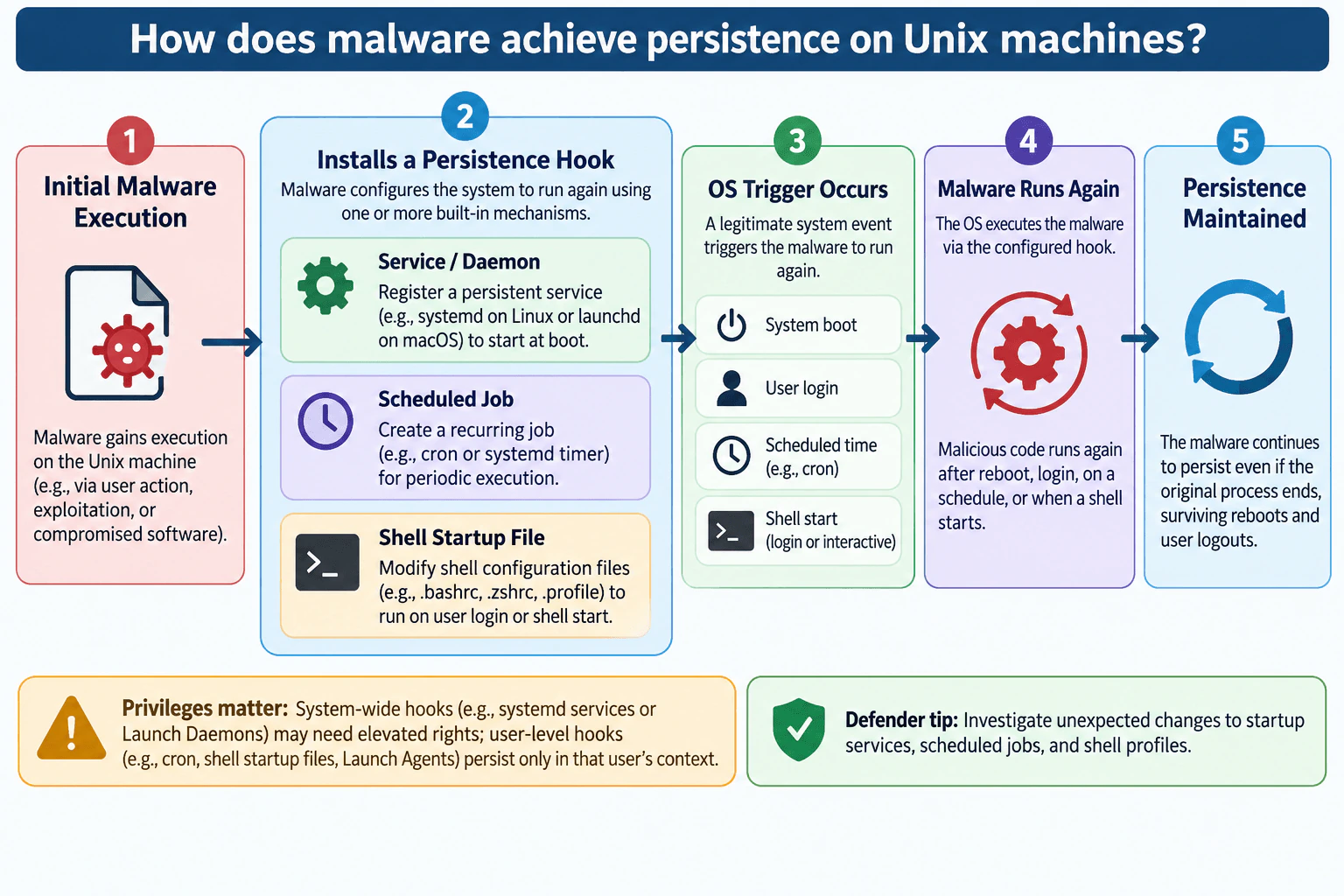
Persistence means malware does more than run once. It creates or modifies something that will cause future execution after the original process ends. On Unix-like systems, the diagram highlights three common mechanisms: services or daemons, scheduled jobs, and shell startup files. The operating system later triggers the configured mechanism during boot, at a scheduled time, or when the relevant user or shell starts. The important defensive questions are which persistence hook changed, what event triggers it, which user or privilege context it runs under, and whether the change is legitimate or malicious.
Useful Questions to Ask the Interviewer
Are we discussing Linux, macOS, or Unix-like systems generally?
Should I focus only on how persistence works, or also explain how I would investigate it during incident response?
Are we assuming the malware has only user privileges, or could it have elevated privileges?
How to Explain It in an Interview
I would explain the diagram as a simple chain: initial malware execution -> persistence hook -> operating-system trigger -> malware runs again -> persistence is maintained.
First, the malware must already have execution on the Unix machine. The initial execution could result from user action, exploitation, or compromised software. That first execution is not persistence by itself. Persistence begins when the malware creates or modifies a durable mechanism that can cause it to execute again later.
The first persistence mechanism is a service or daemon. On Linux systems that use systemd, an attacker with sufficient access can create or modify a service configuration so that malicious code is launched as a managed service, including at startup when the service is configured for that behavior. On macOS, launchd manages LaunchAgents and LaunchDaemons. Apple documents LaunchAgents as user-context processes and LaunchDaemons as system-wide processes, so they represent different privilege and responsibility boundaries. A LaunchAgent generally runs for a logged-in user, while a LaunchDaemon is system-wide and runs at a higher privilege level.
The second mechanism is a scheduled job. Malware can create or modify a recurring cron job or, on systems using systemd, a timer that invokes malicious code at a configured time or interval. The scheduler becomes the trusted trigger. The original malware process can terminate, but the scheduled mechanism can later start the malicious code again.
The third mechanism is a shell startup file. Malware can modify shell configuration files such as .bashrc, .zshrc, or .profile so malicious code executes when the corresponding shell reads that file. The exact trigger depends on the shell and configuration. For example, some files are associated with login shells while others are associated with interactive shells, so I would not claim that every shell startup file executes for every login or shell session.
The next stage in the diagram is the operating-system trigger. A persistent service may execute during boot or another service event. A scheduled job executes at its configured time. A user-level mechanism may activate when the user logs in, and a modified shell file executes when the relevant shell starts. These are legitimate operating-system behaviors being abused to launch malicious code.
When that trigger occurs, the malware runs again through the configured hook. This is the key persistence idea: the malicious process does not have to remain continuously alive. The attacker arranges for a trusted system mechanism to recreate execution later.
Persistence is then maintained as long as the malicious hook remains present and its trigger continues to occur. A boot-enabled service can survive a reboot. A scheduled task can execute repeatedly. A shell startup modification can keep reappearing whenever the relevant user starts the affected shell. A user-level mechanism may survive the original process ending without providing system-wide access.
Privileges matter. System-wide hooks, such as system services or macOS LaunchDaemons, normally require more authority to install or modify than user-scoped mechanisms. User-level cron jobs, shell startup files, and LaunchAgents normally operate within that user's context. Therefore, discovering persistence under one user does not automatically prove root compromise.
From an incident-response perspective, I would treat an unexpected service, scheduled job, or shell startup change as an indicator that needs validation, not as proof by itself. I would identify the affected asset, business impact, severity, and scope, then preserve relevant evidence such as configuration contents, timestamps, ownership, permissions, and associated process information. I would build a timeline showing when the persistence artifact appeared and what executed from it.
For containment, I would use the smallest safe action appropriate to the risk. If malicious activity is confirmed and the host presents ongoing risk, isolating the host may be safer than immediately deleting the persistence artifact. If I disable or remove a confirmed malicious hook, I would preserve the necessary evidence first. Containment is temporary risk reduction; it is not root-cause remediation.
Eradication means removing the confirmed malicious persistence hook and associated payload and addressing the original compromise that allowed the attacker to create it. Recovery means validating that legitimate startup, scheduling, and shell behavior still works and monitoring for the suspicious service, scheduled job, shell modification, or malicious process to return.
The limitation is that these are representative mechanisms, not an exhaustive list of Unix persistence techniques. Behavior differs by operating system, shell, service manager, scheduler, and privilege level. The interview-safe conclusion is that Unix persistence commonly works by modifying a durable configuration or registration point so a legitimate operating-system event causes malicious code to execute again.
Technical Approach
Confirm the affected Unix or Unix-like host, user context, business impact, severity, and scope.
Preserve the suspicious persistence artifact and related evidence before destructive changes when investigation or chain of custody matters.
Determine whether the mechanism is a service or daemon, scheduled job, or shell startup file.
Identify the exact trigger: boot, user login, scheduled time, or relevant shell startup.
Identify what executable, script, or command the hook launches and which account or privilege context it uses.
Correlate the artifact with process execution, file timestamps, ownership, permissions, and the incident timeline. Treat the artifact as an indicator until evidence supports a malicious conclusion.
Apply the smallest safe containment action, such as host isolation or disabling a confirmed malicious hook after evidence preservation.
Eradicate the malicious persistence mechanism and associated payload, then address the initial compromise or root cause.
Recover the host by validating legitimate startup and user behavior.
Monitor for recurrence of the service, scheduled job, shell modification, or associated malicious process.
Practical Insights
The technical cost is moderate because defenders may need visibility into startup services, scheduled jobs, shell configuration files, processes, users, ownership, and permissions across different Unix variants. Operational cost matters because disabling the wrong service or job can interrupt legitimate applications. Human investigation is needed to distinguish administrator changes from malicious changes and to reconstruct the timeline. Maintenance cost comes from keeping approved baselines and detections current. Sensitive evidence must be protected. The main tradeoff is speed versus evidence preservation: stopping a confirmed malicious hook quickly reduces risk, but deleting it too early can destroy information needed to determine scope and root cause.
Why Interviewers Ask This
The interviewer is testing whether I understand the difference between malware executing once and malware arranging for future execution. A strong answer should identify realistic Unix persistence mechanisms, explain what event triggers each mechanism, distinguish system-wide from user-level persistence, and describe how a defender would investigate unexpected persistence changes without treating a single indicator as automatic proof of compromise.
Common interview mistakes
A common mistake is saying that malware is persistent simply because its process is still running. Persistence requires a mechanism that can maintain or regain execution later. Another mistake is listing services, cron, or shell files without explaining the trigger that makes the malware run again. Do not claim every .bashrc, .zshrc, or .profile modification executes on every login because shell behavior differs. Do not assume user-level persistence proves root compromise. During incident response, do not treat one suspicious artifact as automatic proof of compromise, and do not destroy useful evidence before understanding its investigative value. Finally, disabling a service or scheduled job is containment, not necessarily eradication of the payload or root cause.
Interview tip
Use the diagram's five-stage flow: initial execution -> persistence hook -> OS trigger -> malware runs again -> persistence maintained. Name the three approved mechanisms: service or daemon, scheduled job, and shell startup file. Then explain the matching triggers and finish with the difference between system-wide and user-level privilege contexts.
Interviewer may ask next
How would you investigate a suspected Unix persistence mechanism during an incident?
I would first identify the affected host, user context, business impact, severity, and scope. I would preserve the suspicious service definition, scheduled-job entry, or shell configuration and collect relevant timestamps, ownership, permissions, and process evidence. Then I would determine its trigger and execution target and correlate those facts with the incident timeline. I would treat the artifact as an indicator until supporting evidence confirms malicious behavior. After preserving evidence, I would apply the smallest safe containment action, eradicate the malicious hook and payload, address the original compromise, validate recovery, and monitor for recurrence.
Does Unix persistence always survive a reboot or give malware root privileges?
No. The behavior depends on the persistence mechanism. A boot-enabled system service can execute after reboot, while a shell startup modification may execute only when the relevant user starts a matching shell. A user-level cron job, shell profile, or LaunchAgent normally runs within that user's context and does not by itself prove root access. System-wide mechanisms such as system services or LaunchDaemons generally have broader privilege requirements and execution context, so the responder must verify the actual owner, permissions, trigger, and runtime identity.
5. How would you implement a software bill of materials (SBOM)?Vulnerability ManagementMediumApple
Short Interview Answer (30-60 seconds)
I would generate the SBOM automatically from the resolved build in CI/CD, using a machine-readable standard such as CycloneDX 1.7 or SPDX 3.0. I would validate and store it with the release, use it for vulnerability and license analysis, and regenerate it whenever the software or dependencies change.
Detailed Explanation
The practical goal is to know exactly which software components ship in each release and keep that inventory trustworthy and current. I would not build an SBOM from memory or only from declared dependencies. I would derive it from the real build, including resolved direct and transitive dependencies, generate it automatically in CI/CD, validate it, and associate it with the released artifact. The SBOM then becomes evidence that security and engineering teams can use for vulnerability, license, and remediation decisions. It is inventory data, not proof that every component is secure.
Useful Questions to Ask the Interviewer
Which release artifacts must have an SBOM: applications, libraries, containers, or all shipped software?
Do downstream consumers require a specific format such as CycloneDX or SPDX?
Where should the SBOM be stored and who should be allowed to read or modify it?
Is the SBOM mainly intended for vulnerability management, license review, customer delivery, or several of these uses?
What should happen if SBOM generation or validation fails during a release?
How to Explain It in an Interview
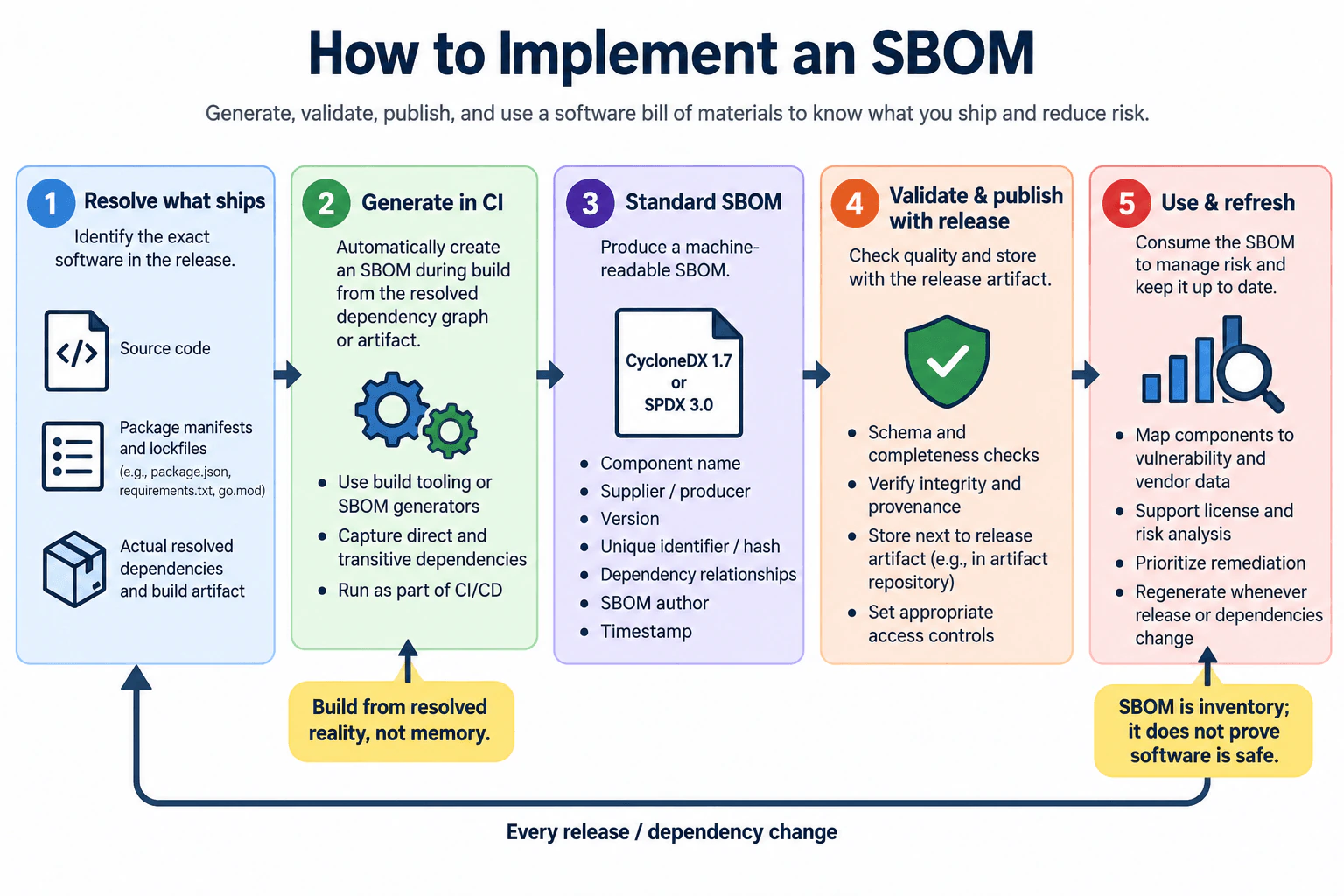
Resolve what actually ships. I start with the source code, package manifests and lockfiles, and the actual resolved dependencies and build artifact. The important point is to describe the release that really exists, not an expected dependency list. I include direct and transitive dependencies so the inventory reflects the dependency graph produced by the build.
Generate the SBOM automatically in CI/CD. I integrate an SBOM generator into the build pipeline. Automation makes the process repeatable and ties the SBOM to a specific build. The generator reads the resolved dependency graph or final artifact and creates the SBOM as part of the normal release process. This reduces drift between the inventory and what was actually shipped.
Produce a standard machine-readable SBOM. I use an interoperable format such as CycloneDX 1.7 or SPDX 3.0. In 2026, CycloneDX 1.7 is the current stable CycloneDX BOM specification and SPDX 3.0 is the current SPDX specification. The SBOM should identify components and useful metadata such as component name, supplier or producer where available, version, unique identifiers and hashes where applicable, dependency relationships, SBOM author or creator information, and timestamps. The exact required fields depend on the selected standard and organizational requirements.
Validate and publish it with the release. Before treating the SBOM as trusted evidence, I check that it conforms to the selected schema and that expected dependency information is present. I associate the validated SBOM with the same release artifact, for example in an artifact repository. I protect its integrity and provenance so an unauthorized party cannot silently replace it, and I apply appropriate access controls. The responsibility boundary is clear: the build system creates the inventory, the release or artifact system preserves it, and authorized engineering and security consumers use it.
Use the SBOM for risk management. Security tooling can map listed components and versions to vulnerability information and vendor advisories. Teams can also use the inventory for license and compliance analysis. A vulnerability match is a signal for investigation, not automatic proof that the released product is exploitable. I verify affected versions and vendor status, then prioritize remediation using exploitability, exposure, business impact, asset importance, available fixes or mitigations, and other relevant context.
Keep the SBOM current. I generate a new SBOM for each new build or release when the shipped software changes, including dependency updates. If later information shows that the existing SBOM was incomplete or incorrect, I issue a revised SBOM rather than silently relying on stale data. This matches the lifecycle shown in the diagram: resolve what ships, generate, standardize, validate and publish, use it, and repeat when releases or dependencies change.
For safe failure behavior, if the release process requires a valid SBOM, I would stop publication when SBOM generation or validation fails because releasing without the expected inventory breaks traceability. If organizational policy explicitly permits a temporary exception, I would record the exception, owner, reason, and follow-up rather than silently bypassing the control.
I would validate the implementation by comparing the SBOM with known manifests, lockfiles, the resolved dependency graph, and the final build artifact. I would also test that a dependency change produces a new SBOM, malformed output fails validation, the stored SBOM remains associated with the correct release, and unauthorized modification is prevented or detectable.
The main limitation is that an SBOM tells me which components are present; it does not prove those components are safe. Vulnerability information may be incomplete or newly disclosed, and component presence alone does not establish exploitability. The tradeoff is additional build time, storage, tooling, and maintenance, but automation keeps that cost manageable and gives security teams stronger software-supply-chain visibility.
Key Insight / Why This Solution Works
Identify the exact release artifact, source, manifests, lockfiles, and resolved dependency graph.
Generate an SBOM automatically during CI/CD from the resolved build or final artifact.
Encode it in an interoperable machine-readable format such as CycloneDX 1.7 or SPDX 3.0.
Validate schema, expected component coverage, integrity, and provenance.
Store the SBOM with the corresponding release artifact and restrict modification to authorized identities.
Feed the SBOM into vulnerability, vendor, license, and risk-analysis workflows.
Verify affected versions and contextual risk before prioritizing remediation.
Generate a new SBOM for each changed release or dependency update and revise incorrect or incomplete SBOM data when discovered.
Why Interviewers Ask This
Interviewers want to see whether I understand an SBOM as a maintained software inventory rather than a one-time document. They are evaluating whether I can connect build-time dependency discovery, standard machine-readable formats, validation, provenance, release management, vulnerability analysis, licensing, remediation, and lifecycle updates without overstating what an SBOM can prove.
Common interview mistakes
Common mistakes are generating the SBOM manually; using only manifest files while ignoring dependencies actually resolved by the build; omitting transitive dependencies; producing an SBOM once and never updating it; storing the SBOM separately from the release so its provenance is unclear; failing to validate the document; allowing uncontrolled modification; treating every vulnerability database match as a verified exploitable vulnerability; or assuming that having an SBOM proves the software is secure. Another mistake is making the process optional and discovering during an incident that recent releases have no usable inventory.
Interview tip
Present the answer as a lifecycle: resolve what ships, generate in CI/CD, use a standard format, validate and store it with the release, consume it for risk decisions, and regenerate it whenever the release changes. Emphasize that the SBOM comes from the resolved build and that it is trustworthy inventory evidence, not a security guarantee.
Interviewer may ask next
What would you do when a new vulnerability is announced for a component listed in the SBOM?
I would first use the SBOM to identify releases containing the component and version. I would then verify the vulnerability against authoritative vulnerability records and the vendor advisory, including the affected-version range, vendor status, and relevant prerequisites. Component presence is a useful signal but is not automatically proof of exploitability. I would assess exposure, exploitability, asset importance, compensating controls, threat activity, and remediation options. Confirmed affected releases would receive an owner and remediation priority, followed by a rebuild, a newly generated SBOM, and verification that the vulnerable component or condition is no longer present.
What happens if SBOM generation or validation fails during the release pipeline?
If a valid SBOM is required for the release, I would fail the release step rather than publish an artifact whose expected inventory cannot be trusted. The pipeline should retain diagnostic evidence showing whether generation failed, the SBOM is invalid, or dependency information is incomplete. After correcting the cause, I would rebuild and regenerate the SBOM. If organizational policy explicitly allows an exception, I would document its owner, reason, approval, and follow-up rather than silently bypassing the control. This preserves the relationship between the released artifact and its SBOM evidence.
6. Why do you want to work for Apple?NEWBehavioralEasyApple
Interview tip:
Use STAR to structure your answer: briefly explain the Situation and Task, make Action the most detailed part, and finish with the Result. For example, describe a previous security experience that shaped what you value in an engineering environment, the responsibilities you took on, how you worked with engineering teams to protect users, and why those lessons make Apple an appealing place for your next cybersecurity role.
Situation
In my last role, I worked on security reviews for systems that handled sensitive user information. That experience showed me how much stronger security becomes when it is treated as part of the product rather than something added at the end.
Task
My responsibility was to identify meaningful risks, explain them clearly to engineering teams, and help find solutions that protected users without making the product harder to use or maintain.
Action
I started by understanding how the system worked and where sensitive data moved. I reviewed access controls, authentication, logging, and the way services exchanged information. When I found a risk, I did not just report it. I explained why it mattered, what an attacker might try to do, and which parts of the system needed the most protection. I then worked with engineers to compare possible fixes and choose controls that reduced risk while fitting the product design. I also tried to make the guidance practical so teams could apply the same thinking in future work. That experience made me especially interested in Apple because security, privacy, hardware, software, and user experience all have to work together. I want to work in an environment where protecting users is closely connected to how products are designed and built.
Result
The teams were able to address the important security concerns while keeping the product usable and understandable. I learned that my best work happens when security is part of engineering decisions from the beginning. That is a major reason I want to work for Apple as a Cybersecurity Engineer.
Why Interviewers Ask This
Interviewers ask this question to understand whether the candidate has a clear and genuine reason for choosing Apple and whether that motivation connects to the cybersecurity role. A strong answer shows that the candidate understands the importance of protecting users, values collaboration with engineering teams, and can explain how their own professional interests fit the work they hope to do at Apple.
Interviewer may ask next
What part of cybersecurity work at Apple interests you most?
I am most interested in work where security is closely connected to product engineering. In my previous role, I enjoyed understanding how a system worked, finding the points where user data or access could be exposed, and then working with engineers on practical controls. I would like to continue doing that in an environment where security and privacy are important parts of the product.
What did that previous experience teach you about working with product engineers?
It taught me that security recommendations are more effective when I first understand the engineering problem. I learned to explain the risk in simple terms, listen to technical constraints, and work with the team on a solution that protects users without creating unnecessary complexity. That collaborative approach is something I would bring to a similar role at Apple.
7. Are you familiar with the Keychain APIs on Apple platforms?NEWBehavioralEasyApple
Interview tip:
Use STAR to structure your answer: briefly explain the Situation and Task, make Action the most detailed part, and finish with the Result. For example, describe a previous mobile security project where you used the Keychain APIs to protect sensitive credentials, selected appropriate access controls, reviewed how secrets were stored and retrieved, worked with developers to correct unsafe handling, and confirmed that the application could access the data only under the intended conditions.
Situation
In a previous project, I reviewed the security of an iOS application that needed to store authentication tokens on the device. The application had to keep those tokens available for normal use without placing them in application preferences, files, or other storage that was not designed for secrets.
Task
I was responsible for reviewing how the application stored and retrieved the tokens and for helping the development team use Keychain Services safely. My goal was to make sure the credentials were protected at rest and were available only under the conditions the application actually required.
Action
I reviewed the code that created, read, updated, and removed Keychain items. I checked the use of SecItemAdd, SecItemCopyMatching, SecItemUpdate, and SecItemDelete so I could understand the full life cycle of each stored secret. I also reviewed the Keychain query attributes because the security of an item depends on more than simply putting data into the Keychain. For sensitive tokens that did not need to move to another device, I recommended an accessibility setting such as kSecAttrAccessibleWhenUnlockedThisDeviceOnly. This kept the item tied to the device and limited access to periods when the device was unlocked. I checked that the application stored only the secret data it actually needed and did not write the same token into logs, preferences, or temporary files. I also reviewed access group settings to make sure another application could not receive access unless sharing was intentional. I explained these choices to the developers in simple terms, then reviewed the updated implementation and tested the main storage, retrieval, update, deletion, and failure paths.
Result
The team moved the sensitive token handling into a clearer and more controlled Keychain flow. The review also removed unnecessary exposure through other storage locations and made the intended access conditions easier to verify. I learned that using the Keychain correctly requires reviewing the item attributes, access rules, and complete secret life cycle rather than treating the Keychain as secure automatically.
Why Interviewers Ask This
Interviewers ask this question to confirm that a cybersecurity engineer understands how sensitive credentials should be protected on Apple platforms and can evaluate the practical security choices around Keychain Services. A strong answer shows familiarity with the APIs, access controls, secret life cycle, and the need to verify how an application actually uses protected data.
Interviewer may ask next
Why did you choose a device only accessibility setting for the authentication token?
The token did not need to move to another device, so I wanted to reduce unnecessary exposure. A device only setting kept the credential tied to the device, while the unlocked requirement matched the application's need to use the token only during active use.
What else would you check besides whether the application stores the token in the Keychain?
I would check the accessibility class, access group configuration, what data is stored with the item, and every place where the token is copied or logged. I would also test creation, retrieval, update, deletion, and error handling because a secure Keychain entry does not help if the same secret is exposed somewhere else in the application.
8. In a system you built, describe the key lifecycle involved when a piece of data was read.NEWBehavioralMediumApple
Interview tip:
Use STAR to structure your answer: briefly explain the Situation and Task, make Action the most detailed part, and finish with the Result. For example, describe a system you built where a user requested sensitive data, your responsibility for protecting the read path, the checks and processing that happened before the data was returned, how you handled access decisions and logging, and what you learned from making the lifecycle secure and understandable.
Situation
In a previous role, I helped build an internal security service that stored findings from automated scans. Analysts used the service to open a finding and review details such as the affected resource, evidence, severity, and remediation notes. Because some of that information was sensitive, I needed to make sure a read was treated as a security sensitive operation rather than a simple database lookup.
Task
I was responsible for designing and implementing the secure read path for a finding. My goal was to make sure the service returned data only to an authenticated user with the correct permission, exposed only the fields that user needed, and created enough audit information for us to understand who accessed sensitive records.
Action
I designed the read lifecycle as a clear sequence. First, the API received a request containing the finding identifier. I validated the request before using that identifier so malformed input could not reach the data layer. Next, I verified the user's authentication token and extracted the trusted identity information from it. I then performed an authorization check against the requested resource instead of assuming that any authenticated user could read every finding. Only after those checks passed did the service call the data access layer. That layer used a parameterized query to fetch the record, which prevented user controlled values from changing the query structure. The database returned the stored record to the service, and the service converted it into a response object containing only fields that the caller was allowed to see. I kept internal fields and sensitive implementation details out of the response. Before returning the result, the service recorded an audit event with the user identity, requested resource, access decision, and time of the request. I also made error handling deliberate. A failed permission check returned a controlled response and did not reveal whether additional sensitive data existed. I documented this complete path so the team could review each trust boundary and understand where security decisions were being made.
Result
The final design gave the team a predictable and reviewable lifecycle for every sensitive read. Authentication, authorization, data access, response filtering, and auditing each had a clear responsibility. That made security reviews easier and reduced the chance that a future feature would bypass an important check. I learned that protecting data during a read depends on the whole path from the incoming request to the returned response, not only on database permissions.
Why Interviewers Ask This
Interviewers ask this question to see whether a candidate can explain how data moves through a real system and identify the important decisions that happen during a read. For a Cybersecurity Engineer, a strong answer shows understanding of trust boundaries, authentication, authorization, safe data access, exposure control, auditing, and the ability to explain a technical lifecycle clearly.
Interviewer may ask next
Why did you perform authorization before reading the record from the database?
I wanted the service to reject an unauthorized request as early as possible. Authentication told me who the caller was, but authorization decided whether that caller should access the requested resource. Keeping that decision before the data access step also made the security boundary easier for the team to review and reduced unnecessary access to sensitive records.
What would you do differently if you were designing the same read lifecycle today?
I would keep the same basic sequence, but I would make the authorization and response filtering rules even more centralized so new API handlers could reuse them instead of implementing their own versions. I would also review the audit events as part of regular security testing to confirm that successful and denied reads were both recorded with enough context for investigation.
9. What do you reverse engineer in your day-to-day work, and what are you trying to learn?NEWBehavioralMediumApple
Interview tip:
Use STAR to structure your answer: briefly explain the Situation and Task, make Action the most detailed part, and finish with the Result. For example, describe a suspicious program or script you analyzed, what behavior you were trying to understand, how you examined its code and system activity, how you shared your findings, and what the analysis taught you about the threat and the controls needed to detect it.
Situation
In my last role, I regularly analyzed suspicious programs, scripts, and system activity when an alert did not provide enough context. In one case, we found a suspicious executable that started a PowerShell process and made an unexpected network connection. The alert showed that something unusual happened, but it did not explain what the program was actually trying to do.
Task
My responsibility was to reverse engineer the activity enough to understand its purpose, determine what evidence we could reliably detect, and give the response team clear information for their investigation. I was trying to learn how the executable reached PowerShell, what commands it created, what information it collected, and whether its network activity indicated a larger compromise.
Action
I first reviewed the process tree and command history so I could reconstruct the order of events without running the file. That gave me a safe starting point and helped me identify which behavior needed deeper analysis. I then inspected readable strings and imported functions in the executable to understand what operating system capabilities it might use. I compared those clues with the PowerShell command and the network connection we had observed. Next, I examined the program in an isolated analysis environment and watched the files, processes, registry activity, and network requests it created. I focused on behavior instead of trying to understand every instruction because the immediate goal was to learn what the program could do and how we could recognize it elsewhere. I found that the executable was mainly acting as a launcher. It created a PowerShell command that gathered basic host information and attempted to send that information to an external service. I documented the execution sequence, the important command patterns, and the network behavior. I then worked with the detection and response teams to turn those findings into practical search ideas and to check other systems for the same behavior.
Result
The investigation gave the team a much clearer picture of what the suspicious program was doing and what evidence mattered for detection. We were able to search for the same execution pattern with more confidence and respond based on observed behavior rather than the original alert alone. The main lesson I took from that work is that reverse engineering is not only about understanding code. I use it to answer practical questions such as what a program is trying to achieve, what evidence it leaves behind, and how that knowledge can improve detection and response.
Why Interviewers Ask This
Interviewers ask this question to understand how a cybersecurity engineer approaches unfamiliar software and behavior. They want to see whether the candidate can form useful questions, investigate methodically, connect technical findings to security decisions, and explain what they are trying to learn instead of reverse engineering without a clear purpose.
Interviewer may ask next
Why did you focus on the program's behavior instead of fully analyzing every instruction?
My immediate goal was to support an active investigation, so I focused first on the behavior that could tell us what the program was doing and how to find similar activity. A complete instruction level analysis can be useful, but it can also take much longer. In this case, understanding the process creation, PowerShell command, host information collection, and network activity gave the response team the information they needed while still leaving deeper analysis available if new questions appeared.
What did you learn from that reverse engineering work that changed how you approach similar investigations?
I learned to begin with a small set of questions before opening an analysis tool. I now define what I need to learn, such as how execution starts, what the program changes, what information it collects, and what evidence can support detection. That keeps the analysis focused and makes it easier to communicate useful findings to detection and response teams.
10. What was the most interesting feature you found through reverse engineering that could feed into static and dynamic analysis engines?NEWBehavioralMediumApple
Interview tip:
Use STAR to structure your answer: briefly explain the Situation and Task, make Action the most detailed part, and finish with the Result. For example, describe a reverse engineering investigation where you discovered a meaningful program feature, explained how it could be identified through static analysis and confirmed through dynamic analysis, communicated the finding clearly, and used it to improve future detection or analysis.
Situation
During a previous security analysis project, I was reverse engineering a suspicious executable that changed its behavior depending on the environment. Basic static inspection showed several possible code paths, but it was not clear which path would actually run or what condition selected it.
Task
My responsibility was to understand the behavior well enough to identify a reusable feature that our analysis systems could detect. I wanted the feature to be useful to both static analysis, which studies code without running it, and dynamic analysis, which observes the program while it executes.
Action
I first mapped the main control flow and traced the functions that gathered information about the running environment. I found that the program built an internal table of function pointers after checking system properties and then used that table to choose later behavior. I thought this was more useful than focusing on one suspicious function because the table creation described how the program organized several possible behaviors. I documented the instructions that created and populated the table so a static engine could look for the same relationship between environment checks, address selection, and indirect function calls. I then ran the sample in an isolated analysis environment and observed the table as it was populated in memory. I compared those runtime values with the functions I had identified during static analysis. That confirmed which entries were selected and showed that the same feature could also be captured dynamically by watching the table writes and later indirect calls. I shared the finding with the team as one behavioral concept rather than as separate static and runtime observations, because I wanted both analysis approaches to reinforce each other.
Result
The investigation produced a reusable feature that could connect static evidence with runtime behavior and make future analysis easier to explain. It also taught me that the most valuable reverse engineering findings are often not individual instructions. They are structural behaviors that can be observed in more than one way and turned into reliable analysis signals.
Why Interviewers Ask This
Interviewers ask this question to understand whether a candidate can move beyond simply reading assembly and identify features that are useful to security tooling. A strong answer shows practical reverse engineering skill, an understanding of how static and dynamic analysis complement each other, sound judgment about which findings are reusable, and the ability to communicate technical discoveries clearly.
Interviewer may ask next
Why did you choose the function pointer table as the feature instead of one specific suspicious function?
I chose the table because it represented the decision structure behind several behaviors. A single function could change between samples, but the relationship between environment checks, table population, and indirect calls was more useful as a reusable signal. It also gave both static and dynamic analysis engines something concrete to observe.
How did you confirm that your static interpretation matched the actual runtime behavior?
I observed the table while the program ran in an isolated environment and compared the addresses written into memory with the functions I had already mapped statically. I then followed the later indirect calls to confirm that those selected entries were actually used. That comparison helped me verify that the static model described the real execution path.
More questions load as you scroll
Cybersecurity Engineer Resume Examples
Explore the resume examples below to find the one that best matches your target Cybersecurity Engineer role.
Disclaimer: This interview guide is for educational and informational purposes only. It is designed to help readers prepare, but it does not guarantee any interview result, hiring decision, offer, or outcome. Interview questions, hiring criteria, and preferred answers can vary by employer, interviewer, industry, location, and time. All answers, examples, and explanations in this guide are suggested examples for interview preparation, not definitive answers or instructions for professional practice. They are based on research and judgment, are provided without warranties of any kind, and should be adapted to the question, role, and applicable laws and professional requirements. Diagrams are simplified illustrations intended to highlight the main concepts and their relationships; actual situations, systems, and practices may be more complex. Alternative approaches may be equally valid or better suited to a particular question, context, or interviewer. To the fullest extent permitted by applicable law, the contributors and publisher are not liable for decisions made, actions taken, or losses incurred based on this guide.
State Laws and Professional Responsibilities: Laws and requirements governing an occupation vary by state and jurisdiction. You are responsible for checking the current laws, licensing requirements, and scope-of-practice rules that apply to your location and role, and for ensuring that your answers and actions comply with them. Adapt examples in this guide to those requirements. This guide is not legal advice.
Company Notice: This guide is an independent educational resource and is not affiliated with, endorsed by, sponsored by, or approved by the company named in this guide. Company names identify reported interview experiences or the employer context of clearly labeled original practice exercises. Interview practices can change without notice, and inclusion of company-specific content does not mean these questions are official, complete, or guaranteed to be asked. To the fullest extent permitted by law, the author, contributors, and publisher are not responsible for outcomes related to use of this material.
Content Accuracy and Verification: To the fullest extent permitted by applicable law, we do not represent or warrant that interview guides, questions, answers, examples, or diagrams are accurate, complete, current, error-free, or suitable for any particular purpose. You are responsible for independently reviewing and verifying the information before relying on it.