This interview guide is for educational and informational purposes only. It is designed to help readers prepare, but it does not guarantee any interview result, hiring decision, offer, or outcome. Interview questions, hiring criteria, and preferred answers can vary by employer, interviewer, industry, location, and time. All answers, examples, and explanations in this guide are suggested examples for interview preparation, not definitive answers or instructions for professional practice. They are based on research and judgment, are provided without warranties of any kind, and should be adapted to the question, role, and applicable laws and professional requirements. Diagrams are simplified illustrations intended to highlight the main concepts and their relationships; actual situations, systems, and practices may be more complex. Alternative approaches may be equally valid or better suited to a particular question, context, or interviewer. To the fullest extent permitted by applicable law, the contributors and publisher are not liable for decisions made, actions taken, or losses incurred based on this guide.
State Laws and Professional Responsibilities
Laws and requirements governing an occupation vary by state and jurisdiction. You are responsible for checking the current laws, licensing requirements, and scope-of-practice rules that apply to your location and role, and for ensuring that your answers and actions comply with them. Adapt examples in this guide to those requirements. This guide is not legal advice.
Identity, Image, and Privacy Notice
To respect individual privacy, some names, profile photographs, avatars, biographical details, and other identifying information displayed in this guide may be replaced with pseudonyms, licensed stock images, illustrative avatars, composite images, or representative descriptions. Unless a person is expressly identified as an actual contributor, a displayed name, image, or profile should not be understood as depicting or identifying a specific candidate, interviewer, employee, or other real individual. These representations are provided for editorial and illustrative purposes only and do not imply endorsement, employment, participation, or affiliation with this guide or any company mentioned in it. Any resemblance to an actual person is coincidental.
Company Notice
This guide is an independent educational resource and is not affiliated with, endorsed by, sponsored by, or approved by the company named in this guide. Company names identify reported interview experiences or the employer context of clearly labeled original practice exercises. Interview practices can change without notice, and inclusion of company-specific content does not mean these questions are official, complete, or guaranteed to be asked. To the fullest extent permitted by law, the author, contributors, and publisher are not responsible for outcomes related to use of this material.
Content Accuracy and Verification
To the fullest extent permitted by applicable law, we do not represent or warrant that interview guides, questions, answers, examples, or diagrams are accurate, complete, current, error-free, or suitable for any particular purpose. You are responsible for independently reviewing and verifying the information before relying on it.
Questions or comments?
Contact us for general questions, or share feedback, technical corrections, and comments with the community.
1. What are some of the most common cyber attacks we see today, and can you explain one to me?Threat ModelingEasyGoogle
Short Interview Answer (30-60 seconds)
Common attacks include phishing, ransomware, credential theft or account takeover, and DDoS. For phishing, an attacker impersonates a trusted sender, leads a user to a fake sign-in page, captures credentials, and may use them against the real service. Phishing-resistant authentication and layered email and user controls reduce that risk.
Detailed Explanation
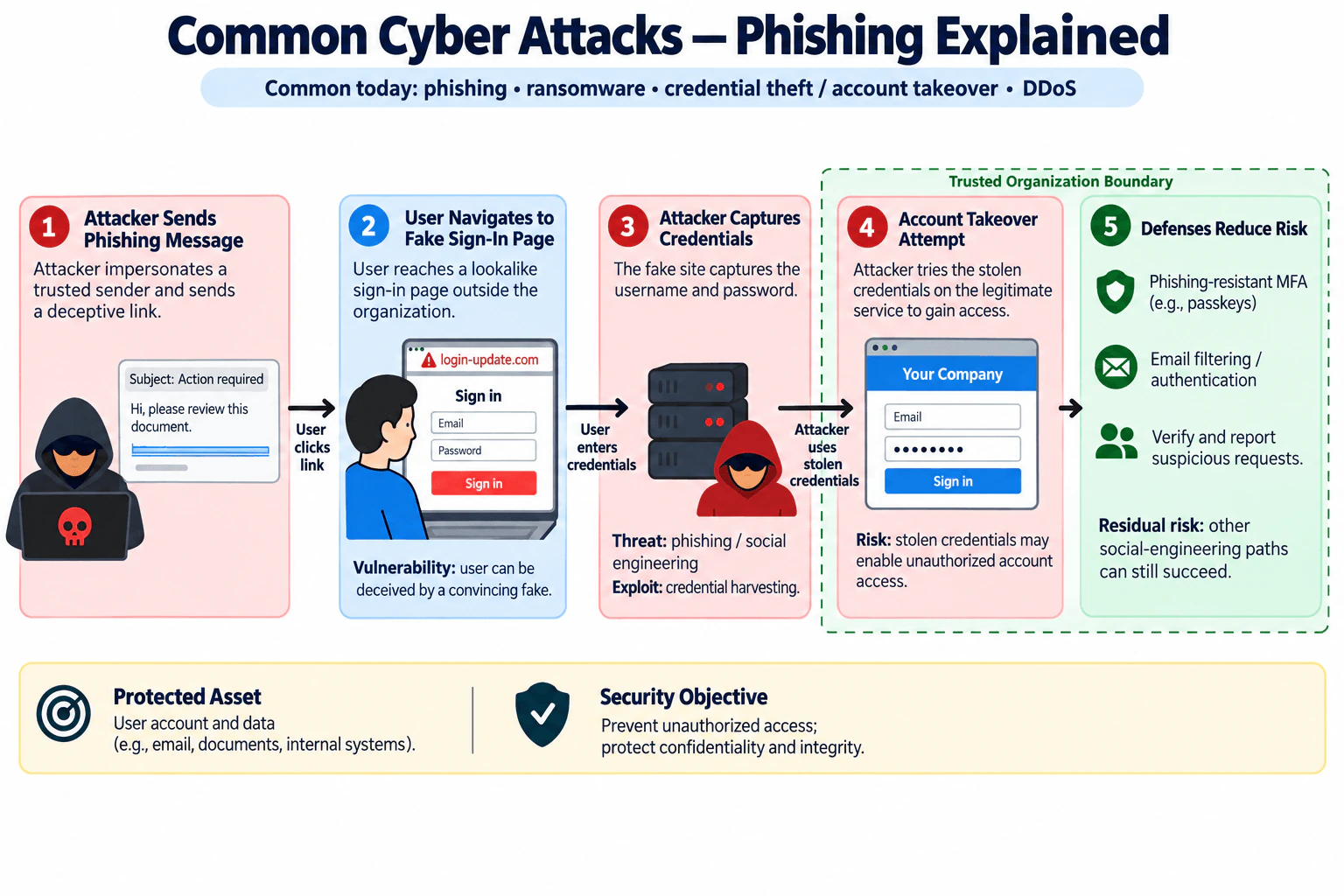
This question asks me to show that I understand common attack patterns and can explain one clearly from start to finish. Common examples include phishing, ransomware, credential theft or account takeover, and distributed denial-of-service, or DDoS. I would choose phishing because it shows how a social-engineering threat can cross a trust boundary and affect a protected account. The important distinction is that phishing is the threat, a user's susceptibility to a convincing fake is the vulnerability, credential harvesting is the exploit, unauthorized account access is the risk, and controls reduce rather than eliminate that risk.
Useful Questions to Ask the Interviewer
Would you like me to explain the attack mainly from the user, attacker, or defensive-control perspective?
Should I focus on a credential-phishing example, or another phishing variant?
How to Explain It in an Interview
I would start by defining the small threat model. The protected asset is the user's account and the data accessible through it, such as email, documents, or internal systems. The security objective is to prevent unauthorized access and protect confidentiality and integrity. The legitimate user is the authorized actor. The adversary is an attacker who can send a deceptive message and operate a lookalike sign-in page. I am assuming the attacker does not already control the legitimate service.
The important trust boundary is between the legitimate organization or service and attacker-controlled content outside that trusted environment. In the diagram, the fake sign-in page is outside the organization, while the legitimate account and defensive controls are inside the trusted organization boundary.
The attack flow is straightforward. First, the attacker impersonates a trusted sender and sends a deceptive link. Second, the user follows the link to a lookalike sign-in page outside the organization. Third, the fake site captures the username and password. This is credential harvesting. Fourth, the attacker may try the stolen credentials against the legitimate service. If authentication succeeds, the risk is unauthorized account access and possible exposure or modification of protected data.
I would keep the terminology precise. The threat is phishing or social engineering. The vulnerability in this example is that a user can be deceived by a convincing fake. The exploit is the credential-harvesting interaction that captures the credentials. The risk is the possible harm from stolen credentials, such as unauthorized account access. These terms describe different parts of the model and should not be used interchangeably.
For controls, I would use defense in depth. Phishing-resistant authentication, including properly implemented WebAuthn-based passkeys, uses cryptographic binding to the legitimate verifier rather than depending on a reusable secret entered into an arbitrary page. That means a captured password alone should not be enough to complete a phishing-resistant authentication flow. NIST identifies WebAuthn as an example of phishing-resistant authentication through verifier-name binding. nvlpubs.nist.gov Email filtering and email-authentication mechanisms can reduce exposure to deceptive messages, but they do not prove that every delivered message is safe. Users should also verify unexpected requests and report suspicious messages so defenders can investigate and respond.
The safe response to suspected credential phishing is not to continue using the suspicious page. The user should stop the interaction and report it through the organization's approved process. If credentials are believed to have been exposed, defenders can follow the organization's authorized account-recovery and incident-response procedures rather than assuming the account is safe.
For evidence, I would look for defensive signals such as the reported message, authentication records, and other authorized security telemetry relevant to the suspected account. Those signals help determine whether the phishing attempt only reached the user or whether an unauthorized sign-in was attempted or completed.
The main limitation is residual risk. Even strong controls do not eliminate all social-engineering paths. Phishing-resistant authenticators specifically reduce attacks that depend on stealing or relaying authentication secrets or outputs, but they are not a complete defense against every form of social engineering. nist.gov Attackers may change their pretext or target a different human or process weakness. Phishing-resistant authentication also has deployment, compatibility, recovery, and user-experience tradeoffs. The goal is therefore to reduce both the likelihood and impact of successful phishing while retaining detection and response paths when prevention fails.
Technical Approach
Identify the protected asset: the user account and accessible data.
Define the security objective: prevent unauthorized access and protect confidentiality and integrity.
Identify the actors and assumption: a legitimate user and an external attacker who can send deceptive messages and host a lookalike page, but does not already control the legitimate service.
Mark the trust boundary between the legitimate organization or service and attacker-controlled content.
Trace the phishing flow: deceptive message -> fake sign-in page -> credential capture -> attempted use of the stolen credentials against the legitimate service.
Separate the terms: threat = phishing/social engineering; vulnerability = user can be deceived; exploit = credential harvesting; risk = unauthorized account access.
Map controls to the threat: phishing-resistant authentication reduces the usefulness of captured passwords, email filtering/authentication reduces exposure to deceptive messages, and verification/reporting supports prevention and response.
Validate suspected compromise using authorized reports and authentication telemetry.
State residual risk: other social-engineering paths can still succeed even when these controls are present.
Practical Insights
The technical cost is deploying and supporting stronger authentication and email defenses. The operational cost is managing enrollment, account recovery, monitoring, and incident response. The human cost is helping users adopt the controls without making normal work unnecessarily difficult. There can also be compatibility and support costs when older applications do not work well with newer authentication methods. Financial cost depends on the organization's tools and scale, so I would not invent a number. Maintenance is ongoing because attackers change their social-engineering methods and controls need testing and review.
Why Interviewers Ask This
Interviewers want to see whether I can name realistic attack categories, explain one attack clearly from attacker action to business risk, distinguish threat-modeling terms, and connect practical controls to the specific threat without claiming that any single control removes all risk.
Common interview mistakes
Common mistakes are using threat, vulnerability, exploit, and risk as if they mean the same thing; describing every phishing attempt as a successful compromise; saying email filtering blocks all phishing; treating ordinary password plus one-time-code authentication as automatically phishing-resistant; forgetting the trust boundary between the legitimate service and attacker-controlled page; and claiming controls eliminate social engineering instead of stating the residual risk.
Interview tip
Name a few common attacks, then spend most of the answer explaining one attack cleanly. For phishing, walk through attacker -> deceptive message -> fake sign-in page -> credential capture -> attempted account access, then map each defense to that flow and finish with the residual risk.
Interviewer may ask next
Why is phishing-resistant authentication stronger against this credential-phishing flow?
Phishing-resistant authentication uses cryptographic authentication that binds the authenticator output to the legitimate verifier or authenticated channel rather than relying on a user manually entering a reusable authenticator output into whatever page is shown. NIST notes that manually entered OTP-style outputs are not phishing-resistant, while WebAuthn can provide phishing resistance through verifier-name binding. nvlpubs.nist.gov A fake site therefore cannot simply capture and reuse a WebAuthn authentication result in the same way it can capture and reuse a password.
What risk remains even after deploying phishing-resistant authentication?
Residual social-engineering risk remains because an attacker can change the target or objective. They may try to persuade a user to disclose information, approve an unsafe action, or interact with another process that is not protected by the same authentication control. Email filtering can also miss deceptive messages. That is why the diagram uses layered controls: stronger authentication, email defenses, user verification and reporting, plus investigation and response when prevention fails.
2. Explain the difference between UDP and TCP?Network SecurityEasyGoogle
Short Interview Answer (30-60 seconds)
TCP is connection-oriented and provides reliable, in-order byte-stream delivery using acknowledgments and retransmissions. UDP is connectionless and sends independent datagrams without guaranteed delivery or ordering. Use TCP when reliability matters; use UDP when lightweight transport matters and the application can tolerate loss or handle reliability itself.
Detailed Explanation
TCP and UDP are transport-layer protocols that let applications communicate over IP. The main difference is responsibility for reliable delivery. TCP establishes a connection and gives the application a reliable, ordered byte stream. It detects loss and errors and retransmits missing data when recovery is possible. UDP sends independent datagrams without establishing a TCP-style connection and does not guarantee that they arrive, arrive once, or arrive in order. The practical choice is therefore between TCP's built-in reliability and additional protocol work versus UDP's simpler transport and application-managed reliability and congestion handling when needed.
Useful Questions to Ask the Interviewer
Are you asking mainly about protocol behavior, or should I also explain security and firewall implications?
Should I compare how TCP and UDP handle packet loss and ordering?
Would you like an example of when an application would choose TCP versus UDP?
How to Explain It in an Interview
Start with the practical decision. Use TCP when the application needs reliable, in-order delivery. Use UDP when it needs lightweight, connectionless datagram transport and can tolerate loss or implement any required reliability itself.
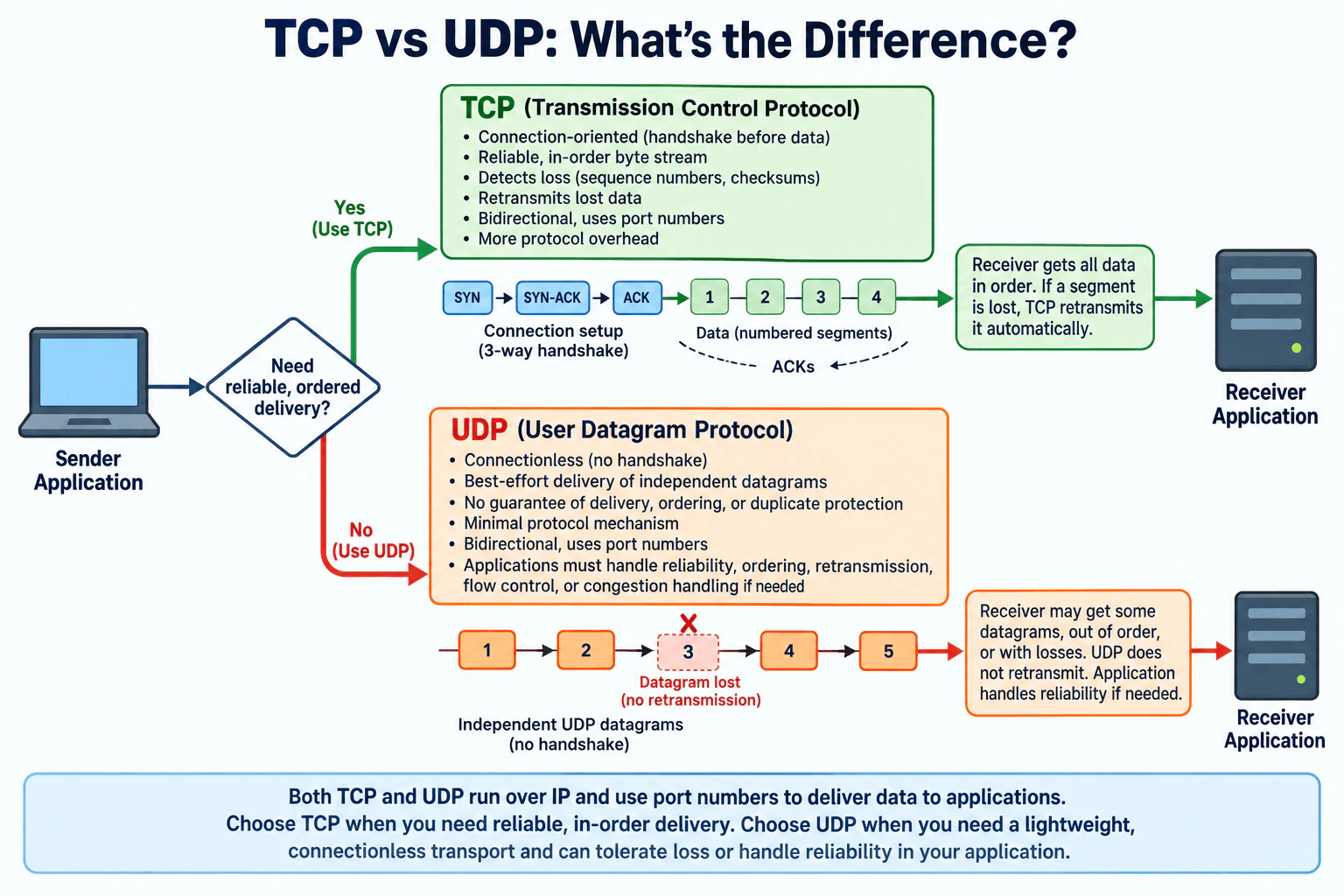
Explain TCP connection setup. TCP is connection-oriented. In the normal connection setup shown in the diagram, the endpoints use a three-way handshake: SYN, SYN-ACK, then ACK. This establishes TCP state and synchronizes sequence numbers before ordinary data transfer.
Explain TCP reliability. TCP provides a reliable, in-order byte stream to applications. Sequence numbers track positions in the byte stream, acknowledgments report received sequence space, per-segment checksums detect errors, and retransmission repairs detected loss. In the diagram, numbered TCP segments move toward the receiver and acknowledgments return toward the sender. If a segment is lost and recovery is possible, TCP retransmits the missing data rather than exposing a gap to the receiving application.
Explain TCP failure behavior accurately. Reliable does not mean that TCP can guarantee that every application byte will eventually arrive under every failure. If the network or peer remains unavailable and TCP cannot recover, the connection can fail. The important property is that TCP presents an ordered byte stream and does not silently deliver missing bytes as though the stream were complete.
Explain UDP behavior. UDP is connectionless and sends independent datagrams. There is no TCP-style handshake before sending them. UDP itself does not guarantee delivery, ordering, or duplicate protection, and it does not retransmit a missing datagram. In the diagram, datagram 3 is lost and the UDP transport does not automatically send it again.
Define the responsibility boundary. With TCP, reliability and ordering are built into the transport. With UDP, an application or protocol above UDP must add reliability, ordering, retransmission, flow behavior, or other recovery mechanisms when those properties are required. Not every UDP application needs them because some applications intentionally tolerate loss. For Internet use, UDP-based applications also need suitable congestion-control behavior because UDP itself has no inherent congestion control.
Compare overhead and tradeoffs. TCP performs connection management, sequencing, acknowledgments, retransmissions, flow control, and congestion control, so it maintains more transport state and performs more protocol work. UDP has a smaller transport mechanism and no connection establishment. However, UDP should not be described as always faster because actual performance depends on network conditions, application behavior, and any reliability or congestion mechanisms implemented above UDP.
Keep the shared properties clear. Both TCP and UDP operate over IP and use port numbers to identify application endpoints. Both can support bidirectional application communication, although their transport semantics are different.
Explain the diagram's decision flow. The sender first asks whether reliable, ordered delivery is needed. If yes, the TCP path establishes a connection and uses sequencing, acknowledgments, and retransmission to provide the ordered byte stream. If no, the UDP path can send independent datagrams without a handshake, accepting that a datagram may be lost or arrive out of order unless the application adds its own handling.
Mention the cybersecurity relevance. Network controls and packet analysis must distinguish TCP from UDP because their state models differ. TCP exposes connection-establishment flags, sequence numbers, acknowledgments, and explicit connection state. UDP has no TCP-style connection state, so stateful devices commonly track UDP traffic using observed flow information and timeouts rather than a TCP state machine.
State the security limitation. Neither TCP nor UDP by itself provides application authentication, authorization, or confidentiality. TCP reliability is not encryption, and UDP's simpler transport does not automatically make it insecure. Applications must use appropriate higher-layer security mechanisms when those properties are required.
Technical Approach
Identify whether the application requires reliable, in-order delivery.
If yes, choose TCP's connection-oriented byte-stream service.
If loss or reordering is acceptable, consider UDP's connectionless datagram service.
If UDP is chosen but reliability, ordering, retransmission, or congestion handling is required, define those mechanisms at the application or higher protocol layer.
Validate the behavior with authorized packet capture or service telemetry by observing the TCP handshake, sequence and acknowledgment behavior, retransmissions, or independent UDP datagrams.
Treat transport selection separately from authentication, authorization, and encryption requirements.
Practical Insights
TCP usually uses more endpoint and network-processing work because it keeps connection state, tracks sequence numbers, processes acknowledgments, retransmits lost data, performs flow control, and participates in congestion control. This can add setup work, memory use, and delay during loss recovery. UDP has less built-in transport machinery, but an application that needs reliability or congestion handling may have to implement and maintain those functions itself. Operationally, TCP is often simpler when reliable ordered delivery is required, while UDP can be a better fit when independent datagrams and loss tolerance match the application.
Why Interviewers Ask This
The interviewer wants to confirm that you understand the fundamental transport-layer tradeoff between TCP and UDP. TCP provides connection-oriented, reliable, ordered byte-stream delivery with more protocol state and recovery behavior. UDP provides a simpler connectionless datagram service without built-in delivery or ordering guarantees. For a cybersecurity engineer, this also tests whether you understand how those differences affect packet analysis, stateful network controls, failure handling, and application responsibility.
Common interview mistakes
Common mistakes are saying TCP guarantees that every byte will eventually arrive under any failure; saying UDP is always faster; saying UDP cannot be bidirectional; saying UDP itself retransmits lost datagrams; confusing TCP's reliable byte stream with individual segment delivery; assuming UDP applications cannot add reliability; forgetting congestion-control responsibility for UDP-based Internet applications; and treating TCP reliability as encryption or authentication. Another mistake is forgetting that both protocols use IP and transport-layer port numbers.
Interview tip
Lead with the decision: TCP gives a reliable, ordered byte stream, while UDP gives lightweight, connectionless datagrams without built-in delivery or ordering guarantees. Then explain the TCP handshake and retransmission path, contrast it with the lost UDP datagram in the diagram, and finish by separating transport reliability from security properties such as encryption and authentication.
Interviewer may ask next
What happens if a packet is lost when using TCP versus UDP?
With TCP, sequence and acknowledgment information lets the endpoints detect missing byte ranges, and TCP retransmits lost data when recovery is possible so the application receives an ordered stream. If recovery ultimately fails, the connection can fail instead of silently presenting a complete stream with missing bytes. With UDP, the transport does not retransmit a missing datagram. If recovery is required, the application or a protocol above UDP must detect the loss and decide whether to retransmit or otherwise recover.
Is UDP always faster than TCP?
No. UDP has less built-in transport machinery because it does not establish a TCP connection or provide TCP's sequencing, acknowledgments, retransmission, flow control, and congestion-control behavior. That can reduce transport overhead, but actual performance depends on the network and application. A UDP-based application may also need to implement reliability and congestion handling above UDP, so UDP should not be described as universally faster.
3. Describe how a botnet works.Network SecurityEasyGoogle
Short Interview Answer (30-60 seconds)
A botnet is a network of compromised devices controlled by an attacker. The devices become bots, connect to command-and-control infrastructure, receive instructions, and may return results. The attacker can then coordinate many bots at once, for example to generate a distributed denial-of-service attack against a service.
Detailed Explanation
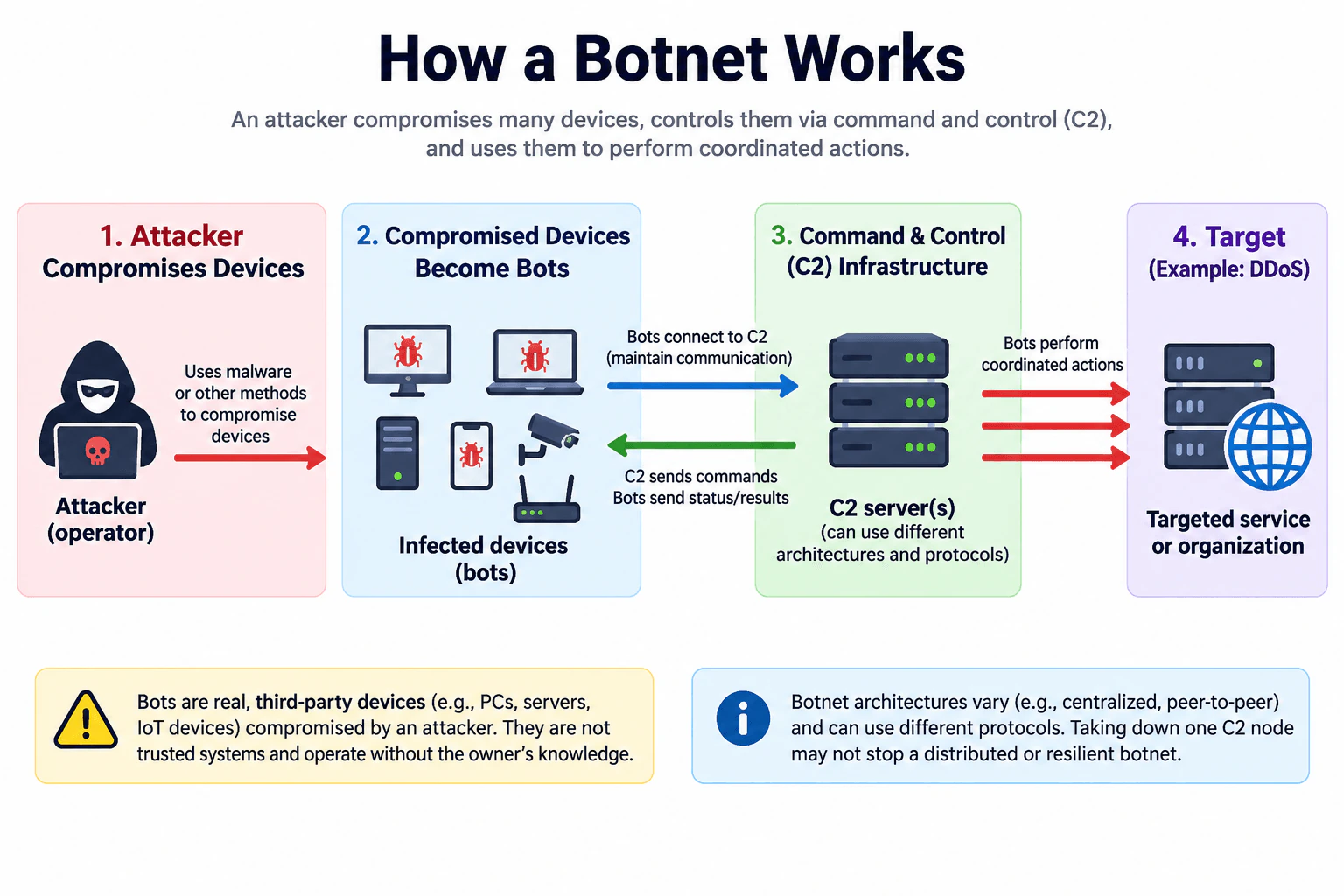
A botnet is a collection of compromised third-party devices that an attacker controls remotely. The attacker first compromises devices such as computers, servers, phones, routers, or other Internet-connected systems. Those infected devices become bots. They communicate with command-and-control, or C2, infrastructure to receive instructions and may send status or results back. The attacker can then coordinate many bots to perform the same action. In the diagram, the example is a distributed denial-of-service, or DDoS, attack against a targeted service or organization.
Useful Questions to Ask the Interviewer
Do you want the basic botnet lifecycle, or should I also explain different command-and-control architectures?
Should I use DDoS as the example of coordinated bot activity?
How to Explain It in an Interview
Start with compromise. The attacker compromises many third-party devices using malware or another compromise method. Once controlled by the attacker, those infected devices are called bots. Their owners may not know the devices are participating in the botnet.
Explain the main communication path. The bots connect to command-and-control infrastructure. This is the primary communication relationship shown in the diagram. The C2 infrastructure sends commands to the bots, while bots may send status information or results back.
Explain coordinated execution. The important feature of a botnet is scale. Instead of controlling only one compromised device, the attacker can direct many bots to perform an action together.
Use the diagram's DDoS example. Many bots can generate coordinated traffic or requests toward the same targeted service or organization. If enough traffic is generated, it can consume network or service capacity and reduce availability.
State the trust boundary. The bots are real third-party devices that have been compromised. They are not trusted systems simply because they are legitimate devices owned by real users or organizations. Their behavior is under unauthorized attacker control.
Explain the architectural limitation. Botnets do not always depend on one centralized C2 server. Their command-and-control architecture and communication methods can vary, including centralized and peer-to-peer designs. Therefore, taking down one C2 node may not stop a distributed or resilient botnet.
Explain failure behavior. If a bot cannot reach its current C2 path, it may be unable to receive new commands through that path. However, that does not prove the endpoint is clean, and a resilient botnet may have alternate C2 nodes or communication paths.
Explain defensive validation. During an authorized investigation, defenders can correlate endpoint evidence with network telemetry that shows suspicious communication to possible C2 infrastructure. One unusual connection alone should not be treated as proof that a device is part of a botnet.
The main tradeoff is architectural resilience. A centralized C2 design can be easier for an attacker to operate but creates infrastructure that defenders may be able to disrupt. Distributed designs can be harder to disable completely but may add complexity. From a defender's perspective, disrupting C2 can reduce attacker control, but compromised endpoints still need to be identified, isolated when appropriate, remediated, and returned to a verified safe state.
Technical Approach
Identify the attacker or bot operator in the model.
Show how third-party devices become compromised bots.
Trace bots connecting to command-and-control infrastructure.
Show C2 sending commands to bots and bots optionally returning status or results.
Trace coordinated bot activity toward the target, using DDoS as the example.
For defensive investigation, correlate endpoint and network evidence before concluding that a device is part of a botnet.
Disrupt malicious communication where authorized and remediate compromised endpoints rather than assuming that removing one C2 node eliminates the entire botnet.
Practical Insights
Botnets create operational cost because defenders may need to investigate many endpoints and network connections. Blocking known C2 infrastructure can reduce activity, but attackers may use multiple nodes or distributed architectures. Endpoint remediation also takes staff time and can interrupt normal use. A DDoS attack can create availability and capacity costs for the target. Detection must be careful because unusual network traffic by itself does not prove that a device is compromised.
Why Interviewers Ask This
Interviewers want to see whether you understand the basic botnet lifecycle: compromise, command and control, coordinated execution, and impact on a target. They also want you to recognize that bots are compromised third-party devices and that botnet command-and-control architectures can vary.
Common interview mistakes
Common mistakes are describing bots as attacker-owned machines instead of compromised third-party devices; forgetting the C2 relationship; reversing the command flow so that bots appear to issue commands to C2; assuming every botnet uses one centralized server; assuming one unusual network connection proves botnet membership; and claiming that taking down one C2 node always eliminates the entire botnet.
Interview tip
Explain the lifecycle in four simple stages: compromise devices, turn them into bots, communicate through C2, and coordinate actions against a target. Use DDoS as one clear example, then mention that C2 architectures can vary and that disabling one C2 node may not eliminate a resilient botnet.
Interviewer may ask next
What is the role of command-and-control infrastructure in a botnet?
Command-and-control, or C2, infrastructure provides the communication path used to coordinate compromised bots. Bots connect to C2 to maintain communication, C2 sends instructions to them, and bots may send status or results back. This lets the attacker control many compromised devices remotely.
Does taking down one command-and-control server always stop a botnet?
No. It may disrupt a botnet that depends on that server, but command-and-control architectures can vary. Some botnets use multiple servers or distributed designs such as peer-to-peer communication. Even after C2 is disrupted, the endpoints remain compromised until they are remediated, so removing one node does not necessarily eliminate the entire botnet.
4. What is the purpose of a firewall? How will you configure one?Network SecurityMediumGoogle
Short Interview Answer (30-60 seconds)
A firewall controls traffic crossing a network boundary according to policy. I would define required flows, explicitly allow only necessary source-destination-protocol-port combinations, use stateful handling for valid return traffic, deny everything else by default, log decisions, test the policy, and review rules regularly.
Detailed Explanation
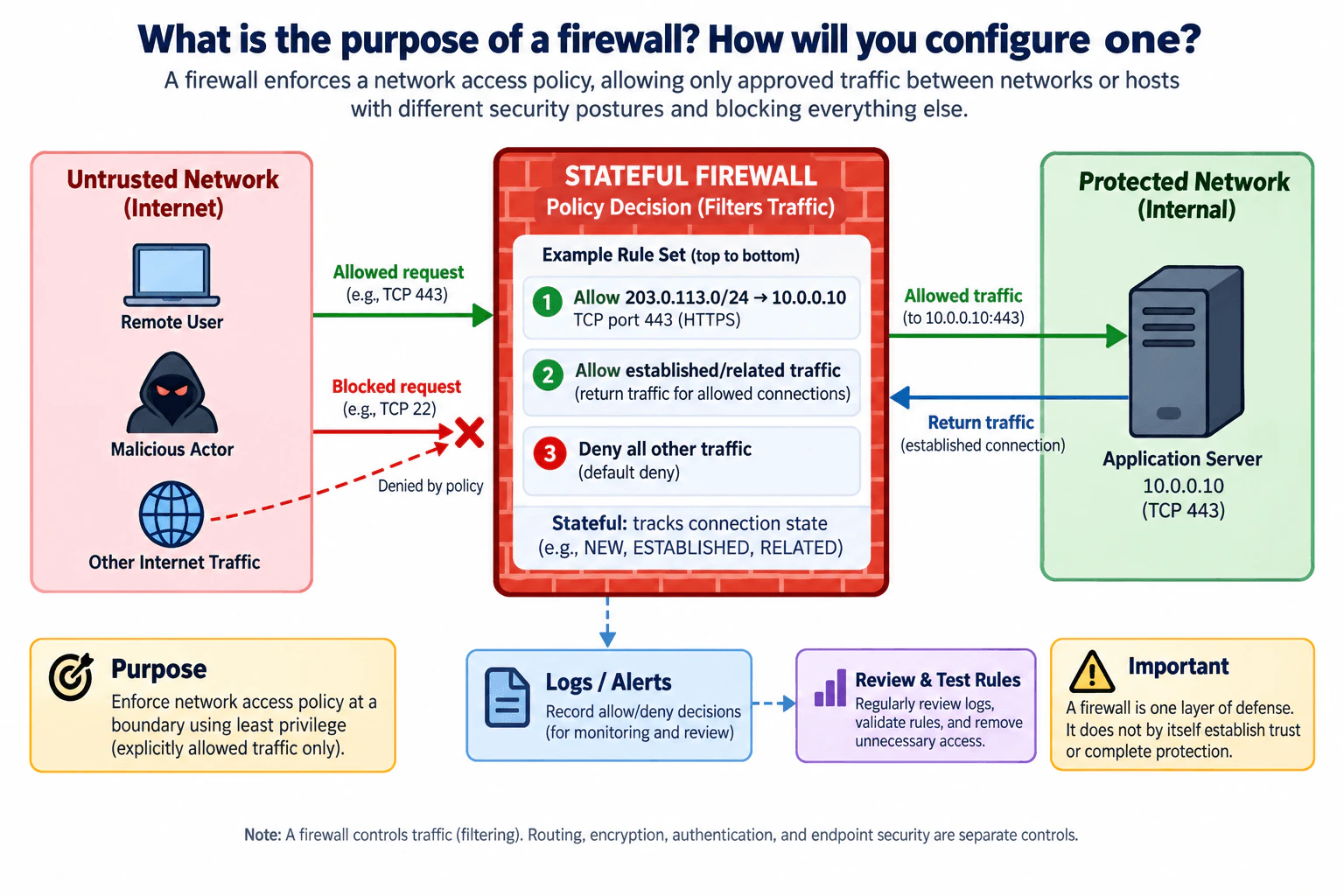
A firewall's purpose is to enforce a network access policy between systems or networks with different security postures. It decides which traffic may cross the boundary and which traffic must be blocked. To configure one safely, I first identify the exact required network flows, then allow only those flows using least privilege. In the diagram, a stateful firewall permits TCP 443 to application server 10.0.0.10, tracks the connection so legitimate return traffic can pass, denies other traffic by default, records allow and deny decisions, and supports regular rule review and testing.
Useful Questions to Ask the Interviewer
Which source networks or systems need access to the protected service?
Which destination systems, protocols, and ports are actually required?
Should the firewall be stateful, and are there any traffic patterns that need special handling?
What logging, alerting, change-review, and availability requirements apply?
How to Explain It in an Interview
I would start with the policy, not with individual firewall commands. The goal is to permit the smallest set of network flows needed for the application while rejecting everything else.
For the approved example, the protected asset is application server 10.0.0.10. The security boundary sits between the untrusted Internet side and the protected internal network. The intended inbound service shown in the diagram is HTTPS over TCP port 443. The diagram uses 203.0.113.0/24 as an illustrative allowed source network and 10.0.0.10 as the destination.
The first rule allows that approved source to reach 10.0.0.10 on TCP port 443. I would make the source as specific as the actual requirement permits rather than using a broad source unnecessarily. This applies least privilege by permitting only traffic with a justified purpose.
The firewall is stateful. Stateful inspection means it keeps connection-state information and can recognize traffic belonging to an approved connection. After an allowed TCP connection is established, legitimate return traffic from 10.0.0.10 can pass because it matches the tracked connection state. This is different from creating a broad reverse-direction rule for arbitrary inbound traffic.
The final rule is default deny. Traffic that does not match an explicit permitted flow is blocked. In the diagram, an inbound TCP port 22 request is blocked, and other unapproved Internet traffic is also denied. If no allow rule matches, the safe policy outcome is denial rather than an implicit allow.
I would also enable useful firewall logging for allow and deny decisions. These logs provide evidence of which policy decision was made and help identify unexpected denied traffic, suspicious patterns, and obsolete rules. Logging is detection and evidence; the filtering decision itself is the preventive control.
Before deployment, I would validate the rules with authorized connectivity tests. I would confirm that TCP 443 from the intended source reaches 10.0.0.10, that legitimate return traffic works, and that unapproved flows such as TCP 22 are denied. I would review the firewall logs at the same time to confirm that observed decisions match the intended policy.
After deployment, I would periodically review the rules and logs, validate that required access still works, and remove permissions that are no longer needed. Firewall policy is not a one-time configuration because application dependencies and access requirements change.
The main tradeoff is security versus operational complexity and availability. Broad rules are easier to operate but increase exposure. Narrow rules reduce exposure but require accurate dependency knowledge and disciplined change management. A mistaken deny can interrupt legitimate service, while a mistaken allow can expose an unnecessary path.
A firewall is only one security layer. It filters network traffic, but it does not by itself authenticate every user, establish endpoint trust, provide application security, or guarantee that allowed traffic is harmless. Routing, encryption, authentication, endpoint security, and other controls solve different problems. I would therefore state the residual risk instead of claiming that the firewall provides complete protection.
Technical Approach
Identify the protected asset and the trust boundary: the internal application server 10.0.0.10 is reached from an untrusted network through the firewall.
Enumerate required flows using source, destination, protocol, and port. In the diagram, the approved example is 203.0.113.0/24 to 10.0.0.10 on TCP 443.
Create the explicit least-privilege allow rule for that required flow.
Use stateful inspection so packets belonging to the approved connection, including legitimate return traffic, are handled according to connection state.
Apply a final default-deny rule so unmatched traffic, such as an unauthorized TCP 22 request, is blocked.
Enable appropriate firewall decision logging for allow and deny events.
Test both positive and negative cases: approved TCP 443 must work and unapproved flows must fail.
Review logs and rules regularly, validate changes, and remove permissions that are no longer required.
Practical Insights
The technical cost is maintaining accurate rules and enough firewall capacity to track active connections. The operational cost is testing changes without interrupting valid traffic and investigating denied connections. Human effort is needed to understand application dependencies and review exceptions. Financial cost depends on the firewall platform, redundancy, logging volume, and operations model. Maintenance grows as the number of applications and rules grows. Narrow rules provide better least-privilege control but require more careful change management. Broad rules are easier to manage but create more exposure. Excessive logging can also increase storage and investigation workload.
Why Interviewers Ask This
This question tests whether I understand both why a firewall exists and how to translate network access requirements into a safe, maintainable policy. A strong answer distinguishes filtering from routing, understands stateful connection tracking, uses least privilege and default deny, and includes logging, validation, review, and realistic limitations.
Common interview mistakes
Common mistakes are starting with broad allow rules instead of defining required flows; using any-source, any-destination, or any-port rules when narrower access is possible; forgetting a final default-deny rule; misunderstanding stateful return traffic and creating unnecessary broad reverse-direction rules; confusing firewall filtering with routing, authentication, encryption, or endpoint trust; disabling useful logs; deploying rules without positive and negative tests; leaving temporary exceptions permanently; and assuming that a firewall alone provides complete protection.
Interview tip
Lead with the decision: explicitly allow only required traffic and deny everything else. Then walk through one concrete flow using source, destination, protocol, port, stateful return traffic, logging, testing, and rule review. Finish by stating that a firewall reduces network exposure but is only one layer of defense.
Interviewer may ask next
What is the difference between a stateful and a stateless firewall?
A stateless firewall evaluates packets against rule fields such as source address, destination address, protocol, and port without using connection history. A stateful firewall also maintains connection-state information. For an approved TCP connection, it can recognize packets belonging to that connection and permit the corresponding return traffic without requiring an unrestricted reverse-direction rule. Stateful inspection gives the firewall more context, although it still does not prove that the application traffic itself is trustworthy.
What can go wrong with a default-deny firewall policy?
Default deny is safer because traffic that is not explicitly permitted is blocked, but an incomplete rule set can also block legitimate dependencies and cause an outage. I would reduce that risk by identifying required flows before deployment, testing approved and denied paths, reviewing firewall decisions in logs, using controlled change management, and keeping a rollback path. I would not weaken the design with a broad permanent allow rule simply to avoid troubleshooting.
5. Explain what the BSS section is in an ELF.Application SecurityEasyGoogle
Short Interview Answer (30-60 seconds)
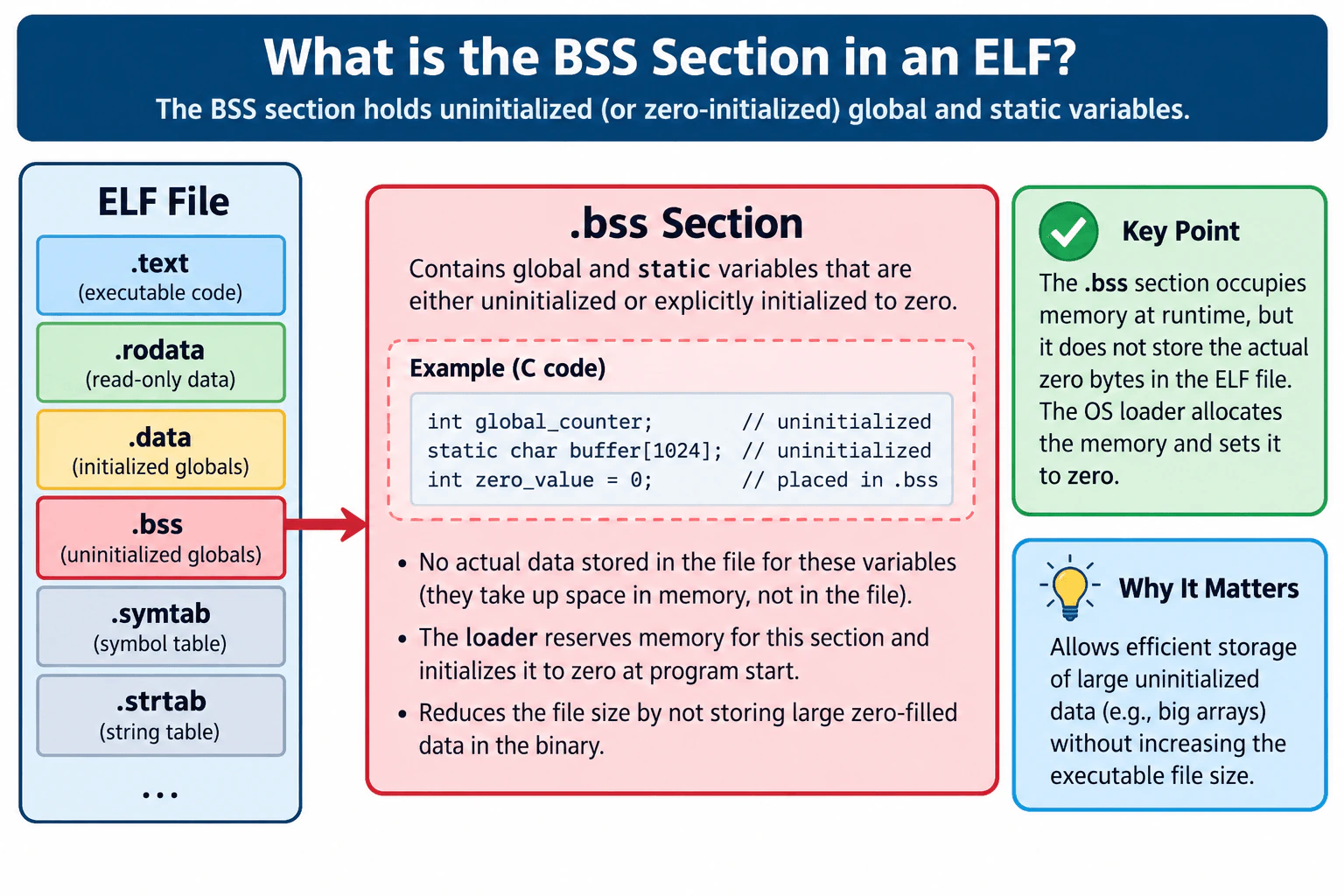
The .bss section holds zero-initialized static storage, commonly uninitialized global and static variables. It normally uses SHT_NOBITS, so it takes memory at runtime but stores no corresponding zero bytes in the ELF file. The loader provides that memory as zero-filled when the program starts.
Detailed Explanation
The question asks what the .bss section represents inside an ELF file and why it exists. The key idea is simple: some global and static variables must occupy memory when the program runs, but their initial value is zero. Instead of storing many zero bytes in the executable, ELF can describe that storage without placing those bytes in the file. The .bss section normally uses the SHT_NOBITS section type. It therefore has a logical size in memory while its contents take no file space. When the program is loaded, the required memory is provided with zero-initialized contents.
Useful Questions to Ask the Interviewer
Do you want only the conceptual difference between .bss and .data, or also the ELF section and program-header details?
Should I explain how .bss affects executable file size versus runtime memory size?
How to Explain It in an Interview
Start with the practical distinction. The .data section normally contains writable initialized data whose initial bytes are stored in the ELF file. The .bss section represents writable zero-initialized storage whose zero bytes do not need to be stored in the file.
For example, in C, int global_counter; and static char buffer[1024]; have static storage duration and start as zero. A variable such as int zero_value = 0; is also commonly placed in .bss by toolchains that optimize zero-initialized storage this way.
At the ELF level, .bss conventionally has section type SHT_NOBITS. That means the section can have a nonzero size but has no corresponding data bytes stored in the file. This is why a large uninitialized global array can require substantial runtime memory without increasing the executable by the same amount.
The important boundary is disk versus process memory. On disk, the ELF records metadata describing the storage. In process memory, the storage actually exists. For a loadable segment that contains file-backed data followed by BSS-style zero-filled storage, the segment's p_memsz can be larger than p_filesz. p_filesz describes the bytes supplied by the file, while p_memsz describes the bytes required in memory. The extra memory is initialized to zero.
The main tradeoff is beneficial: the executable stays smaller because it does not store large runs of zero bytes, but the process still consumes the full amount of memory at runtime.
One limitation is that the literal section name .bss and the exact placement of explicitly zero-initialized variables can depend on the compiler, linker, target, and build options. The reliable ELF concept is zero-initialized storage represented without file-backed contents, commonly through SHT_NOBITS.
Practical Insights
There is no algorithmic time complexity here. The main cost difference is between file storage and runtime memory. BSS avoids storing zero-filled contents in the executable, which reduces file size. The program still needs the full amount of memory while running. The compiler, linker, and loader normally manage this automatically, so there is little direct maintenance cost for application developers.
Why Interviewers Ask This
This question tests whether the candidate understands the difference between an ELF file's on-disk representation and the process memory created from it. A strong answer distinguishes .bss from .data, explains why .bss does not store its zero-filled contents in the file, and understands that the storage still consumes memory at runtime.
Common interview mistakes
A common mistake is saying that .bss uses no memory. It does use runtime memory; it simply avoids storing its zero-filled contents in the ELF file. Another mistake is confusing .bss with .data: .data normally contains initialized writable bytes that are present in the file. It is also too absolute to say every explicitly zero-initialized variable must always be placed in .bss, because exact compiler and linker behavior can vary. Finally, SHT_NOBITS does not mean the section has zero size; it can have a nonzero memory size while storing no section contents in the file.
Interview tip
Lead with the disk-versus-memory distinction: '.bss takes runtime memory but does not store its zero-filled contents in the ELF file.' Then contrast it with .data, mention SHT_NOBITS, and explain that the required memory starts as zero when the program is loaded.
Interviewer may ask next
What is the difference between .bss and .data in an ELF?
.data normally contains writable variables whose initial bytes are stored in the ELF file. .bss represents writable zero-initialized storage whose contents do not need corresponding bytes in the file. Both consume memory at runtime, but .bss avoids storing the initial zero-filled contents on disk.
How can .bss make p_memsz larger than p_filesz?
A loadable segment can contain file-backed initialized data followed by zero-filled storage represented without file contents. p_filesz counts the bytes supplied by the ELF file, while p_memsz counts the total bytes required in memory. The extra bytes between those sizes are provided as zero-initialized memory, so p_memsz can be larger than p_filesz.
6. There is a critical vulnerability on 2 servers, one inside the network and one in the DMZ. Which one would you address first?Vulnerability ManagementMediumGoogle
Short Interview Answer (30-60 seconds)
I would usually address the DMZ server first if it is Internet-exposed, because that normally creates greater exposure to attack. But I would compare exploitability, asset criticality, compensating controls, and business impact first. The server with the higher contextual risk gets patched or mitigated first.
Detailed Explanation
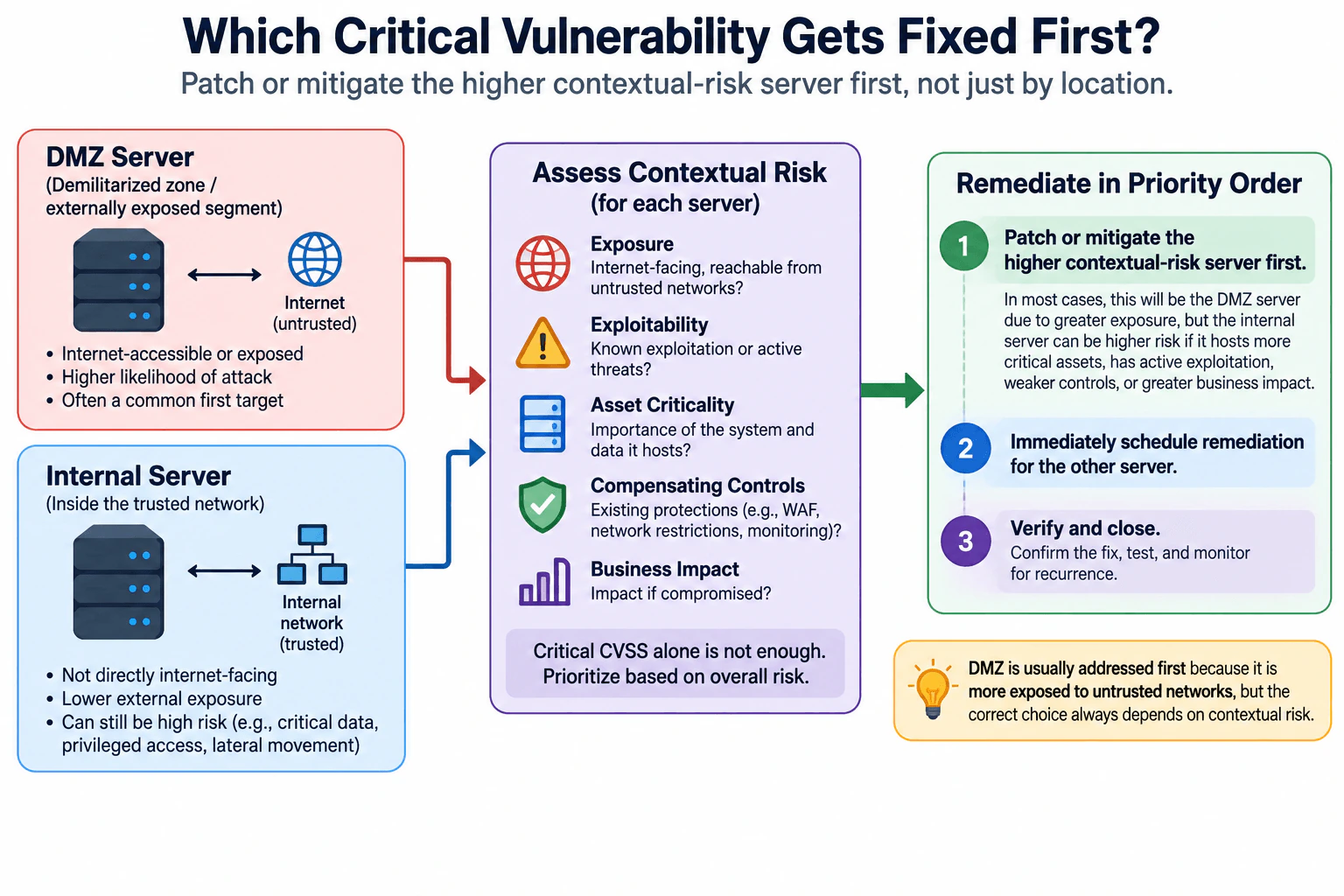
I would normally start with the DMZ server if it is Internet-accessible or exposed to untrusted networks, as shown in the diagram. That exposure usually increases the opportunity for exploitation. However, network location alone does not determine risk. I would compare both servers using exposure, exploitability, asset criticality, compensating controls, and business impact. If the internal server hosts a more critical asset, has weaker protections, or shows active exploitation, it could become the higher priority. The correct decision is therefore to remediate the server with the higher contextual risk first.
Useful Questions to Ask the Interviewer
Is the DMZ server actually reachable from the public Internet or another untrusted network?
What business functions and data does each server support?
Is there evidence of known or active exploitation against either server?
What compensating controls protect each server, such as a web application firewall, network restrictions, or monitoring?
Can either server be patched immediately, or would remediation create an unacceptable availability risk?
How to Explain It in an Interview
Start with the practical decision: I would usually remediate the DMZ server first if it is more exposed to untrusted networks. In the approved diagram, the DMZ server is Internet-accessible or exposed, while the internal server is not directly Internet-facing. That makes the DMZ server the normal first target for remediation when the other risk factors are similar.
Then explain that I would validate the full context instead of making the decision from location alone. I would compare five factors for each server.
Exposure: Is the vulnerable service Internet-facing or otherwise reachable from untrusted networks?
Exploitability: Is exploitation practical, and is there known exploitation or active threat activity relevant to the vulnerability?
Asset criticality: How important is the system and the data or services it supports?
Compensating controls: Are protections such as a web application firewall, network restrictions, or monitoring reducing the likelihood or impact of compromise?
Business impact: What would happen if the server were compromised?
If the term critical comes from a CVSS severity rating, that score is useful but does not by itself establish which server has the greater real-world risk. Context matters. If both vulnerabilities and business conditions are otherwise comparable, I would address the exposed DMZ server first. If the internal server has materially greater asset criticality, active exploitation, weaker controls, or greater business impact, I would address the internal server first instead.
After choosing the priority, I would patch or mitigate the higher-contextual-risk server first and immediately schedule remediation for the other critical server. If the preferred patch cannot be applied safely right away, I would use an approved temporary mitigation that reduces exposure or exploitability while keeping the permanent remediation scheduled. Temporary controls reduce risk; they do not prove the vulnerability is removed.
After remediation, I would verify and close the issue only after confirming that the vulnerable condition is removed or effectively mitigated. That can include confirming the deployed version or configuration, performing an authorized retest, reviewing relevant monitoring evidence, and watching for recurrence.
The main limitation is that the original question gives only severity and network location. Those facts alone do not prove which server has the greater overall risk. The diagram therefore uses DMZ-first as the usual starting point while making contextual risk the final decision rule.
Technical Approach
Confirm the two servers and the reported critical vulnerabilities are the items being prioritized.
Compare actual exposure, especially whether the DMZ server is reachable from untrusted networks and whether the internal server is not directly Internet-facing.
Compare exploitability, including known exploitation or active threat activity when evidence exists.
Compare asset criticality and business impact.
Review compensating controls such as a web application firewall, network restrictions, and monitoring.
Rank the servers by contextual risk rather than severity or location alone.
Patch or mitigate the higher-risk server first; when the remaining factors are similar, prioritize the more exposed DMZ server.
Immediately schedule remediation for the other critical server.
Retest the remediation, record closure evidence, and monitor for recurrence.
Practical Insights
The technical cost is the engineering and testing work needed to patch or mitigate each server safely. The operational cost can include downtime, service degradation, emergency change coordination, and monitoring. Human cost includes security and system-owner time. Financial cost can include emergency maintenance or temporary controls. Maintenance cost includes tracking the second vulnerability, retesting the fixes, documenting any temporary mitigation, and removing temporary controls later. The main tradeoff is speed versus availability: delaying a highly exposed vulnerability increases security risk, but an unsafe emergency change can also disrupt the service.
Why Interviewers Ask This
This question tests whether the candidate can separate vulnerability severity from contextual risk. A strong answer recognizes that an exposed DMZ server will often deserve priority because it has greater exposure to untrusted networks, while also checking whether the internal server has higher asset criticality, active exploitation, weaker compensating controls, or greater business impact.
Common interview mistakes
A common mistake is saying "DMZ first" only because of its location and stopping there. Another is treating a critical severity or CVSS score as the complete risk decision without checking exposure, exploitability, asset criticality, compensating controls, and business impact. It is also wrong to assume an internal server is safe merely because it is not directly Internet-facing. Other mistakes include ignoring evidence of active exploitation, treating a compensating control as complete protection, forgetting to remediate the second critical server, and closing the issue without retesting the fix.
Interview tip
Lead with: "I would usually address the DMZ server first if it is more exposed, but I would confirm contextual risk before making the final decision." Then briefly compare exposure, exploitability, asset criticality, compensating controls, and business impact. This directly matches the diagram and shows that you understand severity alone does not equal overall risk.
Interviewer may ask next
What would make you prioritize the internal server before the DMZ server?
I would prioritize the internal server first if verified context showed that its overall risk was higher. For example, it might support a much more critical business function, contain more sensitive data, have weaker compensating controls, show active exploitation, or create substantially greater business impact if compromised. I would compare those factors with the exposed DMZ server rather than assuming location alone determines priority.
What would you do if the higher-risk server could not be patched immediately?
I would apply an approved temporary mitigation that reduces exposure or exploitability, such as appropriate network restrictions or an existing web application firewall control when relevant, while keeping the permanent remediation scheduled. I would monitor the server, document the remaining risk and ownership, and retest after the permanent fix. The temporary control reduces risk but does not prove that the underlying vulnerability is gone.
7. Why are you interested in cybersecurity?NEWBehavioralEasyGoogle
Interview tip:
Use STAR to structure your answer: briefly explain the Situation and Task, make Action the most detailed part, and finish with the Result. For example, describe an experience that first made cybersecurity meaningful to you, the responsibility you took, how you investigated and reduced the risk, how you communicated with others, and how the experience shaped your interest in protecting systems and users.
Situation
During a previous project, I became involved in reviewing a security concern that could have exposed sensitive application data. I had already worked with systems and troubleshooting, but this was one of the first times I saw how a technical weakness could create a real risk for users and the business.
Task
My responsibility was to understand what was happening, help determine the risk, and work with the team on a safe way to address it. I also wanted to understand why the weakness existed instead of only fixing the immediate symptom.
Action
I reviewed the application behavior, logs, access controls, and the path the data followed through the system. I worked through the issue step by step so I could separate normal behavior from anything that could be abused. Once I understood the cause, I discussed the risk with the engineers in simple terms and explained why the issue mattered. We agreed on changes that reduced unnecessary access and improved how the system handled sensitive information. I then verified the changes and checked that the normal application flow still worked. What interested me most was the combination of investigation, technical problem solving, and prevention. I was not only fixing something that was broken. I was thinking about how someone might misuse the system and how we could design it so that misuse became harder.
Result
The issue was addressed, and the team had a clearer understanding of the security risk and how to avoid similar problems. That experience made cybersecurity especially interesting to me because it combines technical depth with practical responsibility. I enjoy understanding how systems work, finding where they can fail, and helping build protections that reduce risk before a problem becomes an incident.
Why Interviewers Ask This
Interviewers ask this question to understand whether the candidate has a genuine and practical reason for choosing cybersecurity. A strong answer shows curiosity about how systems can be abused, interest in protecting users and data, willingness to keep learning, and an understanding that security requires both technical judgment and responsibility.
Interviewer may ask next
What part of that experience made you want to continue working in cybersecurity?
The investigation was the part that interested me most. I liked tracing the system behavior, understanding how the weakness could be misused, and then turning that understanding into a practical fix. It showed me that cybersecurity requires both technical curiosity and careful judgment, which are areas I enjoy.
How has that experience influenced the way you approach security problems now?
I now try to understand both the immediate issue and the reason it became possible. I look at the technical cause, the potential impact, and the controls that could prevent the same type of problem in the future. I also explain the risk clearly to the people involved so that security decisions can be made with the right context.
8. What is your greatest weakness?NEWBehavioralEasyGoogle
Interview tip:
Use STAR to structure your answer: briefly explain the Situation and Task, make Action the most detailed part, and finish with the Result. For example, describe a weakness that affected how you handled security work, the situation where you recognized it, the steps you took to improve, how you communicated differently, and what you learned from the change.
Situation
In my last role, one weakness I noticed was that I sometimes spent too much time validating a security finding before sharing it with others. I wanted to be certain that my evidence was complete and that I was not creating unnecessary concern. During one investigation, I found suspicious activity that needed more analysis before I could confirm exactly what had happened.
Task
I was responsible for investigating the activity and helping the team understand whether it represented a real security risk. I also needed to balance careful validation with timely communication, because waiting too long to share an important concern could delay the response.
Action
I realized that my habit of trying to complete every part of the investigation before communicating was not always the best approach. I changed my process so that I separated what I knew from what I was still investigating. I shared the initial evidence with the appropriate team members early and clearly explained that the investigation was still in progress. I described what I had observed, why it might matter, and which questions still needed answers. I then continued reviewing the relevant logs and security data to confirm the scope and cause. I also started setting clear checkpoints for myself during investigations. At each checkpoint, I asked whether the information I already had was important enough for someone else to know. This helped me communicate earlier without presenting an unconfirmed conclusion as a fact.
Result
The team had useful information earlier while I still had enough time to complete a careful investigation. I learned that strong security work is not only about being accurate. It is also about communicating uncertainty clearly and giving the right people enough information to act when necessary. I still value careful validation, but I now balance it with earlier communication and clearer updates.
Why Interviewers Ask This
Interviewers ask this question to understand whether a candidate can recognize a genuine area for improvement, take responsibility for it, and make practical changes. A strong answer shows self awareness, professional judgment, and evidence that the weakness is being actively managed rather than ignored.
Interviewer may ask next
How do you decide when a security finding is ready to be shared if the investigation is not complete?
I separate confirmed facts from open questions. If the information could affect risk, response decisions, or another person's work, I share what I know early and clearly state what is still being investigated. That allows the team to prepare or act without treating an early observation as a final conclusion.
What would you do differently if you faced the same situation today?
I would establish communication checkpoints at the beginning of the investigation instead of deciding later when to provide an update. I would share significant confirmed observations as they become relevant, explain the remaining uncertainty, and continue the technical investigation in parallel. That approach keeps the work accurate while also keeping the team informed.
Cybersecurity Engineer Resume Examples
Explore the resume examples below to find the one that best matches your target Cybersecurity Engineer role.
Disclaimer: This interview guide is for educational and informational purposes only. It is designed to help readers prepare, but it does not guarantee any interview result, hiring decision, offer, or outcome. Interview questions, hiring criteria, and preferred answers can vary by employer, interviewer, industry, location, and time. All answers, examples, and explanations in this guide are suggested examples for interview preparation, not definitive answers or instructions for professional practice. They are based on research and judgment, are provided without warranties of any kind, and should be adapted to the question, role, and applicable laws and professional requirements. Diagrams are simplified illustrations intended to highlight the main concepts and their relationships; actual situations, systems, and practices may be more complex. Alternative approaches may be equally valid or better suited to a particular question, context, or interviewer. To the fullest extent permitted by applicable law, the contributors and publisher are not liable for decisions made, actions taken, or losses incurred based on this guide.
State Laws and Professional Responsibilities: Laws and requirements governing an occupation vary by state and jurisdiction. You are responsible for checking the current laws, licensing requirements, and scope-of-practice rules that apply to your location and role, and for ensuring that your answers and actions comply with them. Adapt examples in this guide to those requirements. This guide is not legal advice.
Company Notice: This guide is an independent educational resource and is not affiliated with, endorsed by, sponsored by, or approved by the company named in this guide. Company names identify reported interview experiences or the employer context of clearly labeled original practice exercises. Interview practices can change without notice, and inclusion of company-specific content does not mean these questions are official, complete, or guaranteed to be asked. To the fullest extent permitted by law, the author, contributors, and publisher are not responsible for outcomes related to use of this material.
Content Accuracy and Verification: To the fullest extent permitted by applicable law, we do not represent or warrant that interview guides, questions, answers, examples, or diagrams are accurate, complete, current, error-free, or suitable for any particular purpose. You are responsible for independently reviewing and verifying the information before relying on it.