This interview guide is for educational and informational purposes only. It is designed to help readers prepare, but it does not guarantee any interview result, hiring decision, offer, or outcome. Interview questions, hiring criteria, and preferred answers can vary by employer, interviewer, industry, location, and time. All answers, examples, and explanations in this guide are suggested examples for interview preparation, not definitive answers or instructions for professional practice. They are based on research and judgment, are provided without warranties of any kind, and should be adapted to the question, role, and applicable laws and professional requirements. Diagrams are simplified illustrations intended to highlight the main concepts and their relationships; actual situations, systems, and practices may be more complex. Alternative approaches may be equally valid or better suited to a particular question, context, or interviewer. To the fullest extent permitted by applicable law, the contributors and publisher are not liable for decisions made, actions taken, or losses incurred based on this guide.
State Laws and Professional Responsibilities
Laws and requirements governing an occupation vary by state and jurisdiction. You are responsible for checking the current laws, licensing requirements, and scope-of-practice rules that apply to your location and role, and for ensuring that your answers and actions comply with them. Adapt examples in this guide to those requirements. This guide is not legal advice.
Identity, Image, and Privacy Notice
To respect individual privacy, some names, profile photographs, avatars, biographical details, and other identifying information displayed in this guide may be replaced with pseudonyms, licensed stock images, illustrative avatars, composite images, or representative descriptions. Unless a person is expressly identified as an actual contributor, a displayed name, image, or profile should not be understood as depicting or identifying a specific candidate, interviewer, employee, or other real individual. These representations are provided for editorial and illustrative purposes only and do not imply endorsement, employment, participation, or affiliation with this guide or any company mentioned in it. Any resemblance to an actual person is coincidental.
Company Notice
This guide is an independent educational resource and is not affiliated with, endorsed by, sponsored by, or approved by the company named in this guide. Company names identify reported interview experiences or the employer context of clearly labeled original practice exercises. Interview practices can change without notice, and inclusion of company-specific content does not mean these questions are official, complete, or guaranteed to be asked. To the fullest extent permitted by law, the author, contributors, and publisher are not responsible for outcomes related to use of this material.
Content Accuracy and Verification
To the fullest extent permitted by applicable law, we do not represent or warrant that interview guides, questions, answers, examples, or diagrams are accurate, complete, current, error-free, or suitable for any particular purpose. You are responsible for independently reviewing and verifying the information before relying on it.
Questions or comments?
Contact us for general questions, or share feedback, technical corrections, and comments with the community.
51. How would you manage model updates and revisions when several disciplines are working concurrently?Bim Coordination And Design DocumentationHard
i Question Details
Define model exchange cadence, shared coordinates, responsibility boundaries, revision status, clash ownership, issue tracking, approval gates, and how approved changes propagate to sheets and schedules.
Short Interview Answer (30-60 seconds)
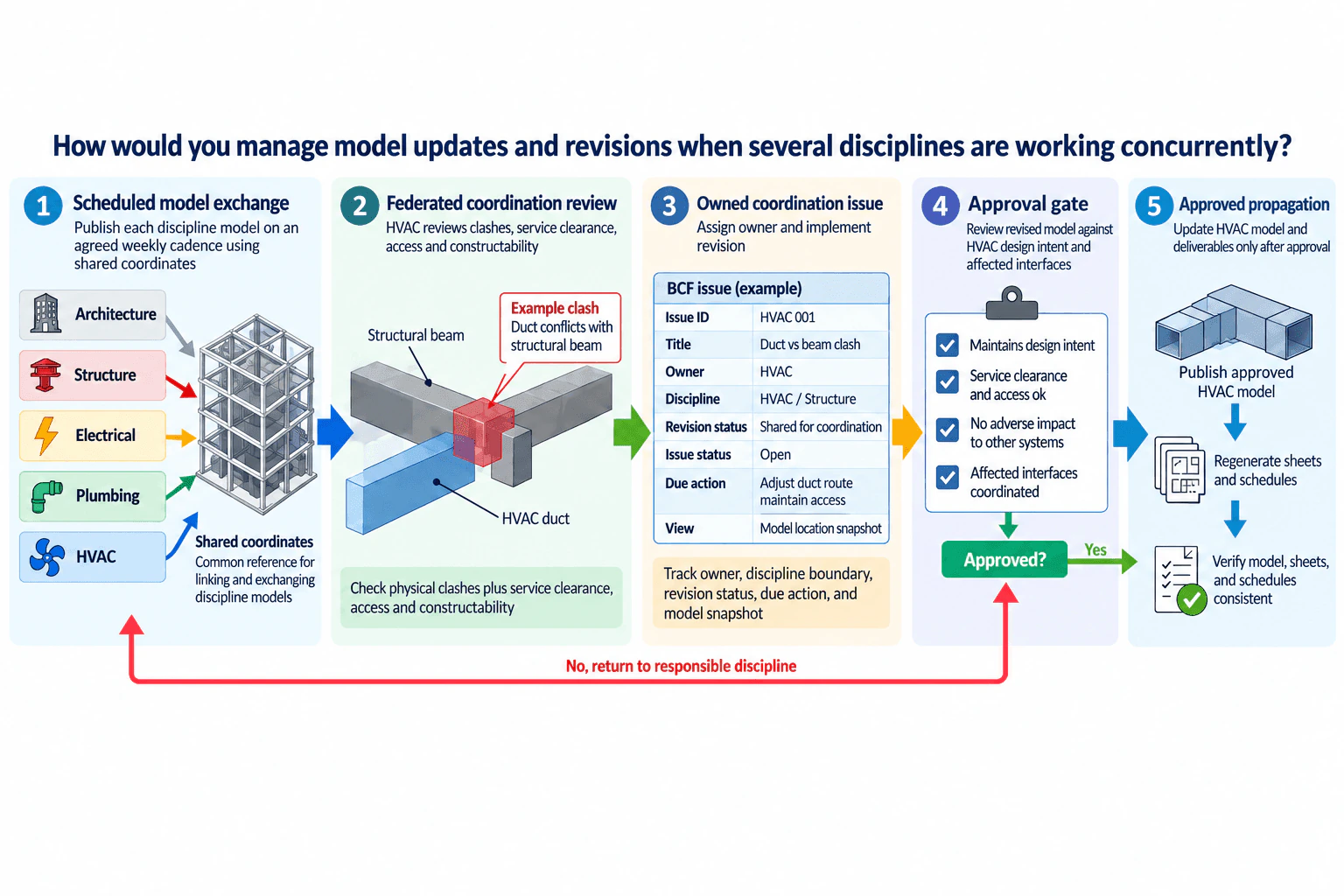
I would establish an agreed model exchange cadence and one shared coordinate reference for Architecture, Structure, Electrical, Plumbing, and HVAC. For the illustrated workflow, each discipline publishes its current model on an agreed weekly cadence. I would federate those models, review clashes plus service clearance, access, and constructability, then record each coordination issue with a clear owner, discipline boundary, revision status, issue status, due action, and model location. The responsible discipline implements the revision. The revised model then passes an approval gate against HVAC design intent and affected interfaces. Rejected changes return to the responsible discipline. Approved changes are published to the HVAC model, affected sheets and schedules are regenerated, and the final deliverables are checked for consistency.
Detailed Explanation
I would manage concurrent BIM work as a controlled revision workflow. The important point is that model exchange, issue ownership, revision implementation, approval, and document propagation are separate steps with clear responsibility.
Useful Questions to Ask the Interviewer
What model exchange cadence and revision status convention does the project require?
Who controls the shared coordinate reference and the coordination issue register?
What approval is required before a coordinated model revision can propagate to issued documentation?
How to Explain It in an Interview
First, I would establish the coordination boundary and exchange rules. Architecture, Structure, Electrical, Plumbing, and HVAC must use the same shared coordinate reference so the federated model represents the disciplines in the correct relative position. In the illustrated example, each discipline publishes its current model on an agreed weekly cadence.
Second, I would perform a federated coordination review. For HVAC, that means checking physical clashes as well as service clearance, maintenance access, constructability, and interfaces with the surrounding disciplines. A clash free model alone does not prove that the design is acceptable.
Third, I would create a tracked coordination issue for each required change. I would record the issue ID, affected disciplines, owner, revision status, issue status, due action, and model location or viewpoint. In the illustrated duct versus beam example, HVAC owns the revision because the agreed action is to adjust the duct route while maintaining access. The revision status is Shared for coordination and the issue status remains Open while the correction is being implemented.
Fourth, the responsible discipline implements the model revision. The revised model then passes an approval gate. I would confirm that HVAC design intent is maintained, service clearance and access remain acceptable, there is no adverse impact on other systems, and the affected interfaces are coordinated. If the revision is not accepted, it returns to the responsible discipline and remains tracked.
Finally, after approval, I would publish the approved HVAC model, regenerate or update the affected sheets and schedules, and verify that the model, sheets, and schedules are consistent. I would also review any affected specifications, calculations, and control information so that the construction documents do not contradict the approved model.
Why Interviewers Ask This
Interviewers want to see whether I can control concurrent multidisciplinary changes without losing HVAC design intent or document consistency. They are evaluating whether I understand model exchange cadence, shared coordinates, responsibility boundaries, revision status, clash ownership, issue tracking, approval gates, service access, constructability, and controlled propagation of approved changes into the model, sheets, and schedules.
Common interview mistakes
Common mistakes include exchanging models without an agreed cadence, using inconsistent coordinate references, assigning an issue without identifying who owns the actual model change, confusing revision status with issue status, treating clash free geometry as design approval, closing an issue before the revision is verified, allowing rejected changes to propagate, updating documentation before approval, ignoring maintenance access, and failing to reconcile affected sheets, schedules, specifications, calculations, or control information after a revision.
Interview tip
Explain the workflow as a clear chain of responsibility: exchange current models, federate and review them, assign the issue, implement the revision, approve the revised model, publish the approved HVAC model, update the affected sheets and schedules, and verify consistency. Emphasize that BIM coordination protects HVAC design intent and document quality, not just geometry.
Interviewer may ask next
How would you validate that an approved revision is ready to propagate to construction documentation?
I would confirm that the revised model matches the documented coordination decision, maintains HVAC design intent, preserves required service clearance and access, and does not create an adverse effect on affected interfaces. I would then verify that the approved HVAC model and the affected sheets and schedules are consistent, followed by a review of any affected specifications, calculations, and control information before issue.
What would you change if a congested area needed model exchanges more frequently than the rest of the project?
I would increase the exchange cadence for that area while keeping the same coordination controls. The more frequent exchanges would still use the shared coordinate reference, defined ownership, revision status, issue status, approval gate, and controlled propagation process. This reduces coordination delay without allowing unapproved changes to bypass the formal revision workflow.
52. What is HVAC commissioning?Troubleshooting And CommissioningEasy
i Question Details
Define commissioning as verifying that installed systems and controls operate according to the project requirements and design intent, including documented functional testing and handover evidence.
Short Interview Answer (30-60 seconds)
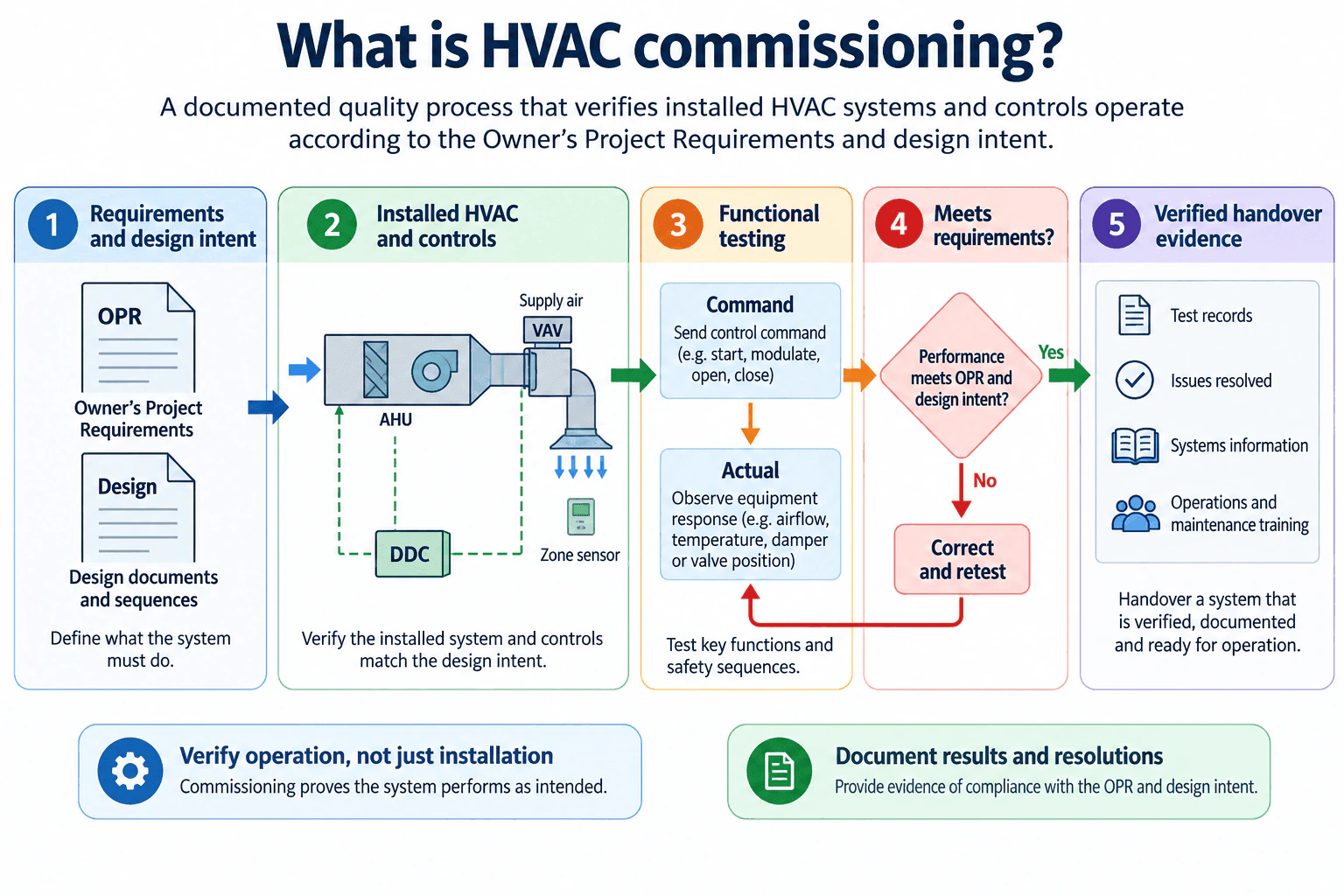
HVAC commissioning is a documented quality process used to verify that installed HVAC systems and controls operate according to the Owner’s Project Requirements and design intent. The process checks the installed equipment and controls, performs functional tests by comparing commanded actions with actual responses, corrects and retests problems when requirements are not met, and records evidence showing that the system is verified and ready for handover and operation.
Detailed Explanation
HVAC commissioning verifies that an installed system actually performs as intended. It goes beyond confirming that equipment is physically installed. The commissioning process starts with the Owner’s Project Requirements, design documents, and control sequences, verifies the installed HVAC equipment and controls, performs documented functional tests, resolves deficiencies, confirms the corrected operation, and records the final evidence for handover.
Useful Questions to Ask the Interviewer
Are we discussing commissioning of a new HVAC system or verification of an existing system?
What Owner’s Project Requirements, design documents, control sequences, and acceptance criteria are available?
Which HVAC equipment and control functions are included in the commissioning scope?
How to Explain It in an Interview
I would describe HVAC commissioning as a structured verification process with five main steps.
First, define the required performance. Review the Owner’s Project Requirements, design documents, sequences of operation, and acceptance criteria. These establish what the HVAC system is expected to do.
Second, verify the installed HVAC system and controls. Confirm that equipment and control components, such as the air handling unit, variable air volume device, direct digital controls, and zone sensor, are installed and configured consistently with the intended design.
Third, perform functional testing. Send defined control commands, such as starting equipment, modulating a damper or valve, or changing an operating condition. Then observe the actual response. Relevant evidence can include airflow, temperature, damper position, valve position, sensor readings, alarms, and equipment status. The important point is to compare the commanded state with the actual state.
Fourth, compare the observed performance with the Owner’s Project Requirements and design intent. If the system does not meet the acceptance criteria, document the issue, correct the cause, and repeat the affected functional test. Commissioning therefore verifies operation rather than simply changing settings until the system appears to work.
Fifth, document the verified condition for handover. Evidence can include completed test records, resolved issue documentation, system information, and operation and maintenance training information.
Troubleshooting and commissioning are related but different. Troubleshooting normally begins with an existing complaint or fault. Planned commissioning begins with defined requirements and systematically verifies that the installed system and controls perform as intended. Troubleshooting may occur during commissioning when a functional test identifies a deficiency, but commissioning also requires final verification and documented handover evidence.
Why Interviewers Ask This
Interviewers want to know whether the candidate understands commissioning as a documented verification process rather than simply equipment startup or installation. They are evaluating whether the candidate can connect project requirements and design intent to installed system verification, functional testing, corrective action, final verification, and handover evidence.
Common interview mistakes
Common mistakes include treating commissioning as equipment startup only, checking installation without testing actual operation, changing control settings before confirming the required sequence, failing to compare commanded and actual equipment states, accepting a correction without retesting it, and completing the work without documented test records and handover evidence.
Interview tip
Use a simple flow in your answer: requirements and design intent, installed system verification, functional testing, compare actual performance with requirements, correct and retest when needed, then document the verified system for handover. Emphasize that commissioning verifies operation, not just installation.
Interviewer may ask next
How do you verify that an HVAC functional test has passed?
Define the expected response and acceptance criteria before the test, place the system in the required operating condition, issue the specified control command, and observe the actual response. Compare equipment status, sensor readings, airflow, temperature, damper position, valve position, alarms, and other relevant evidence with the project requirements and sequence of operation. If the response does not meet the criteria, document the deficiency, correct the cause, and repeat the affected test. Record the final verified result as commissioning evidence.
What is the difference between HVAC commissioning and troubleshooting?
Troubleshooting usually begins with a known complaint, abnormal condition, or failed performance and focuses on finding and correcting the root cause. Commissioning is a planned verification process that begins with defined project requirements and systematically tests whether installed systems and controls perform according to those requirements and the design intent. Troubleshooting can occur during commissioning when a functional test identifies a problem, but commissioning also requires final verification, documentation, and handover evidence.
53. What does testing, adjusting, and balancing verify in an HVAC system?Troubleshooting And CommissioningEasy
i Question Details
Explain that TAB measures and adjusts air and water flows and records pressures, temperatures, and final settings so installed performance can be compared with design values.
Short Interview Answer (30-60 seconds)
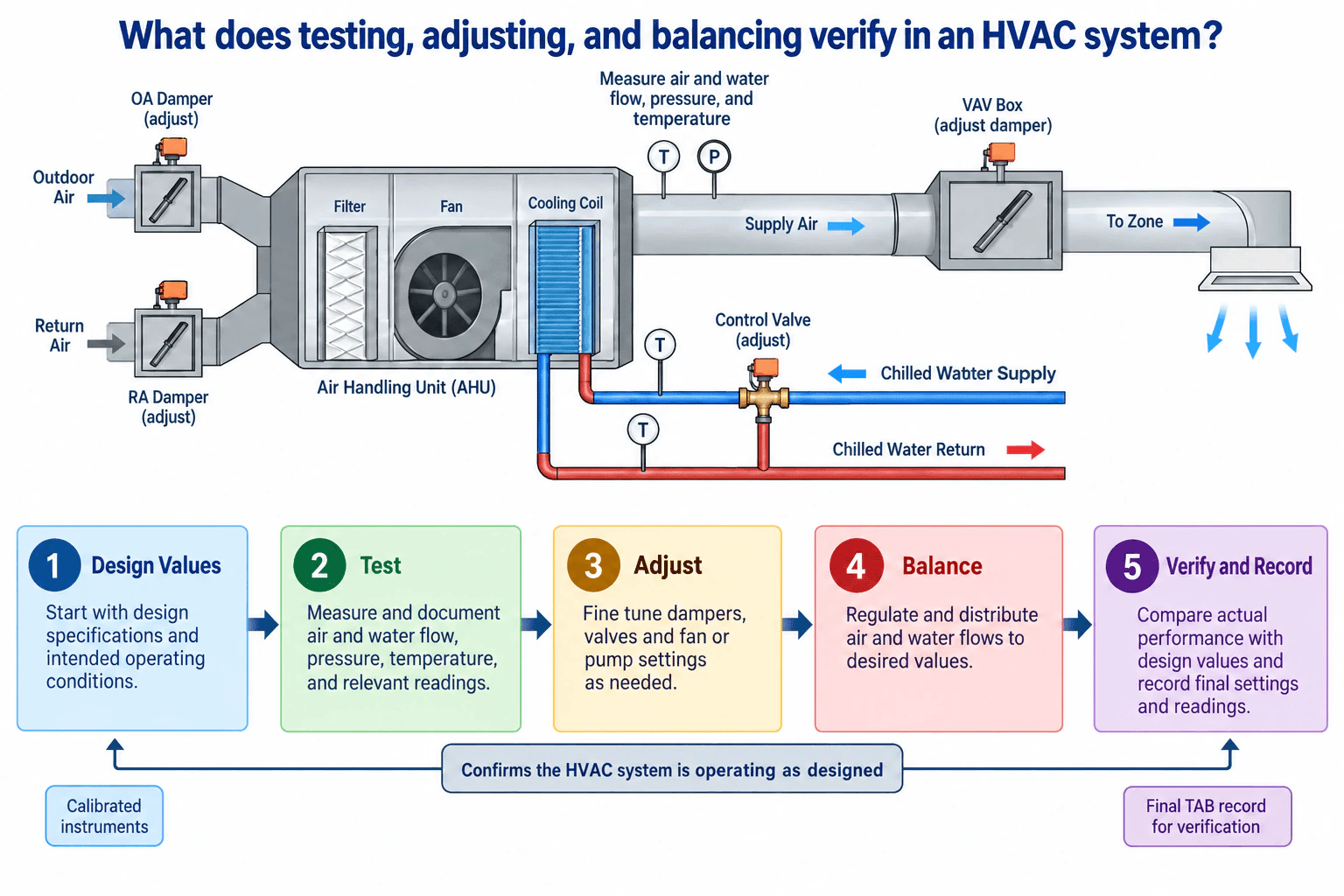
Testing, adjusting, and balancing verifies that the installed HVAC system delivers the intended air and water flows and performs according to the design requirements. TAB measures airflow, water flow, pressure, temperature, and relevant operating conditions, then adjusts dampers, control valves, fan settings, or pump settings as needed. The system is balanced so air and water are distributed to the required locations, and the final readings and settings are recorded and compared with the design values.
Detailed Explanation
Testing, adjusting, and balancing, or TAB, verifies whether the installed HVAC system is actually delivering the performance required by the design. The process starts with the approved design values and intended operating conditions. Using calibrated instruments, the technician measures relevant air flow, water flow, pressure, temperature, and equipment operating conditions.
In the air system shown, the technician can evaluate the outdoor air and return air paths, the air handling unit, filter, fan, cooling coil, supply duct, VAV box, and zone delivery. Airflow and pressure measurements help show whether the fan, dampers, and distribution system are producing the intended result.
For the hydronic side, chilled water supply flows toward the cooling coil through the control valve, and chilled water return flows away from the coil. Water flow, pressure, and temperature readings help verify whether the coil is receiving the required hydronic conditions.
Testing establishes the measured condition. Adjusting changes items such as outdoor air dampers, return air dampers, VAV dampers, control valves, fan settings, or pump settings where appropriate. Balancing distributes the available air and water so the required branches and zones receive their intended quantities. The final step is verification and documentation. Actual performance is compared with the design values and acceptance criteria, and the final settings and readings are recorded.
TAB therefore provides measured evidence that the installed system is operating as intended. It can also expose problems such as restricted airflow, incorrect damper position, inadequate water flow, incorrect valve position, or equipment settings that prevent the required operating condition from being achieved.
Useful Questions to Ask the Interviewer
Are we verifying both the air system and the hydronic system?
Are approved design flow values and acceptance criteria available?
Are the instruments calibrated and are measurements being taken under the intended operating conditions?
How to Explain It in an Interview
I would describe TAB as a measurement, adjustment, balancing, and verification process. First, I establish the design values and operating conditions that the installed system is expected to meet. Then I use calibrated instruments to measure air flow, water flow, pressure, temperature, and other relevant readings.
For the air side, I check whether the outdoor air, return air, fan, supply duct, VAV box, and zone delivery are producing the required airflow. For the chilled water side, I check flow and temperatures through the cooling coil and confirm that the control valve and associated settings are allowing the required water distribution.
If the measured values do not meet the required condition, I adjust the appropriate components. Air distribution may require damper or fan adjustment, while hydronic distribution may require valve or pump adjustment. I then rebalance the affected system because changing one branch or setting can influence other parts of the distribution system.
After the adjustments, I repeat the measurements and compare the actual readings with the design values and acceptance criteria. I document the final air flow, water flow, pressures, temperatures, and equipment settings. The key point is that TAB does not simply change settings. It verifies performance with measured evidence and produces a final record showing how the installed system compares with the intended design.
Why Interviewers Ask This
Interviewers want to know whether the candidate understands that TAB is a measured verification process rather than simply changing equipment settings. A strong answer connects calibrated measurements, air and water balancing, controlled adjustments, comparison with design values, and documentation of final readings and settings.
Common interview mistakes
Common mistakes include changing settings before establishing baseline readings, checking only air flow while ignoring hydronic flow, using instruments without confirming calibration, assuming that a changed setting proves the problem is solved, failing to rebalance affected branches after an adjustment, and failing to document final flows, pressures, temperatures, and settings.
Interview tip
Keep the answer centered on verification. State that TAB starts with design values, measures actual air and water performance with calibrated instruments, makes controlled adjustments, balances distribution, then records final readings and settings so installed performance can be compared with the design.
Interviewer may ask next
How would you verify that a TAB correction actually worked?
I would repeat the relevant measurements under the same intended operating conditions and compare the new readings with the approved design values and acceptance criteria. I would also check whether the adjustment affected other branches or zones. The baseline readings, corrected readings, and final settings should be documented so the improvement is supported by measured evidence.
What would you do if the required airflow could not be achieved even after balancing the dampers?
I would stop making further balancing changes and investigate the available system capacity and pressure. I would check filter condition, fan operation, duct restrictions, damper position, commanded and actual equipment states, and whether the intended operating condition is present. The goal is to identify the cause of insufficient airflow before making additional adjustments.
54. What are common HVAC commissioning checks for an air-handling system?Troubleshooting And CommissioningMedium
i Question Details
Cover fan rotation and airflow, filter and coil condition, damper operation, sensor calibration, temperature-control response, safeties, setpoints, terminal airflow, and trend verification.
Short Interview Answer (30-60 seconds)
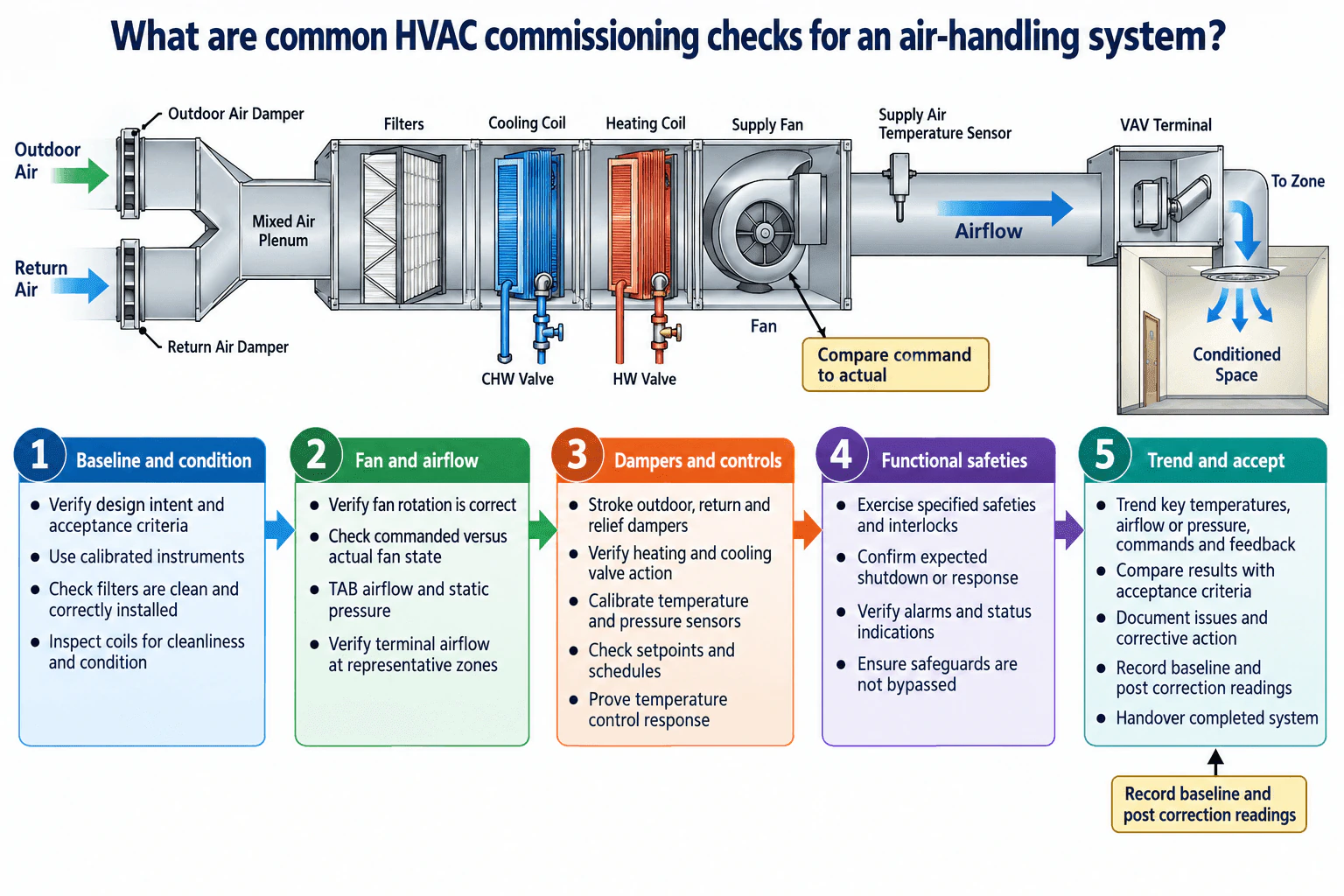
I would start by confirming the design intent, operating conditions, acceptance criteria, and instrument calibration. Then I would inspect the filters and coils, verify fan rotation and commanded versus actual fan operation, and use TAB results to confirm airflow and static pressure. I would stroke the outdoor, return, and relief dampers, verify heating and cooling valve action, calibrate temperature and pressure sensors, and prove the temperature control response. I would also test specified safeties and alarms. Finally, I would verify terminal airflow, trend key points, compare results with the acceptance criteria, correct deficiencies, retest, and document the final readings.
Detailed Explanation
Commissioning an air handling system is a planned verification process. The goal is not simply to make the equipment run. The goal is to demonstrate that the installed system responds as intended under the tested operating conditions and meets the approved acceptance criteria.
Useful Questions to Ask the Interviewer
What design airflow, temperature setpoints, control sequence, and acceptance criteria apply to this air handling system?
Is TAB complete, and are calibrated test instruments and trend data available?
Which specified safeties, alarms, terminal units, and operating modes must be demonstrated during the functional test?
How to Explain It in an Interview
I would follow the same five stage path shown in the commissioning diagram.
First, establish the baseline and condition. I would review the design intent, sequence of operation, setpoints, schedules, and acceptance criteria. I would confirm that the test instruments are calibrated. I would inspect the filters for cleanliness and correct installation and inspect the heating and cooling coils for fouling, damage, or other visible condition issues.
Second, verify the fan and airflow. I would confirm correct fan rotation and compare the commanded fan state with the actual fan state. I would review TAB airflow and static pressure readings and verify representative terminal airflow at the VAV system. Airflow should be checked before blaming heating or cooling capacity because low airflow can create misleading temperature symptoms.
Third, test dampers and controls. I would stroke the outdoor air, return air, and relief dampers and confirm that actual movement follows the command. I would verify the chilled water and hot water valve action at the cooling and heating coils. I would compare temperature and pressure sensors with calibrated reference instruments and correct sensor drift when readings are outside the project tolerance. I would then change the relevant setpoint or operating condition and verify that the supply air temperature responds according to the approved control sequence.
Fourth, perform the specified functional safety tests. I would exercise applicable safeties and interlocks, confirm the expected shutdown or control response, and verify alarm and status indications. Safeguards should remain active during testing.
Fifth, trend and accept the system. I would trend key temperatures, airflow or pressure where available, commands, and feedback. I would compare the results with the approved acceptance criteria and investigate any mismatch between commanded and actual states. Deficiencies should be documented, corrected, and retested. I would record baseline and post correction readings and complete handover only after the required checks demonstrate acceptable operation.
This method separates inspection, measurement, functional testing, corrective action, and final verification. It also prevents unnecessary setting changes before the evidence shows what is actually wrong.
Why Interviewers Ask This
Interviewers want to see whether the candidate can commission an air handling system systematically, compare actual equipment behavior with design intent, recognize airflow and control problems, test safeties, and document objective evidence before accepting the system.
Common interview mistakes
Common mistakes include changing setpoints before recording baseline conditions, checking temperatures without first verifying airflow, trusting a BAS command without confirming actual equipment movement, skipping fan rotation or terminal airflow checks, accepting sensor values without comparison to a calibrated reference, testing controls without exercising the specified safeties, and correcting a deficiency without retesting and documenting the final condition.
Interview tip
Present the checks in a clear sequence: establish the baseline and condition, verify fan and airflow, test dampers and controls, exercise functional safeties, then trend, correct, retest, and document. Emphasize comparison of commanded versus actual states and objective acceptance criteria rather than saying only that you would inspect the equipment.
Interviewer may ask next
What would you do if the supply air temperature is too warm during cooling operation?
I would not immediately assume that the cooling coil lacks capacity. I would first confirm the operating mode, setpoint, supply air temperature sensor accuracy, fan operation, and airflow. Then I would verify that the chilled water valve command matches actual valve action and that chilled water flow is available as required by the system. I would inspect the cooling coil for fouling or airflow blockage and compare entering and leaving conditions with the approved design and acceptance criteria. After identifying and correcting the cause, I would repeat the functional test and document the post correction readings.
How would the commissioning approach change if the system has VAV terminals?
I would extend the functional test through the air distribution system. In addition to commissioning the air handling unit, I would verify representative VAV terminal airflow, damper response, airflow sensor calibration where required, zone temperature response, and interaction with the supply fan pressure control. I would test conditions that cause terminal demand to change and confirm that the air handling system and terminals respond together without unstable control. Final acceptance would include trend evidence and documented results for the required operating modes.
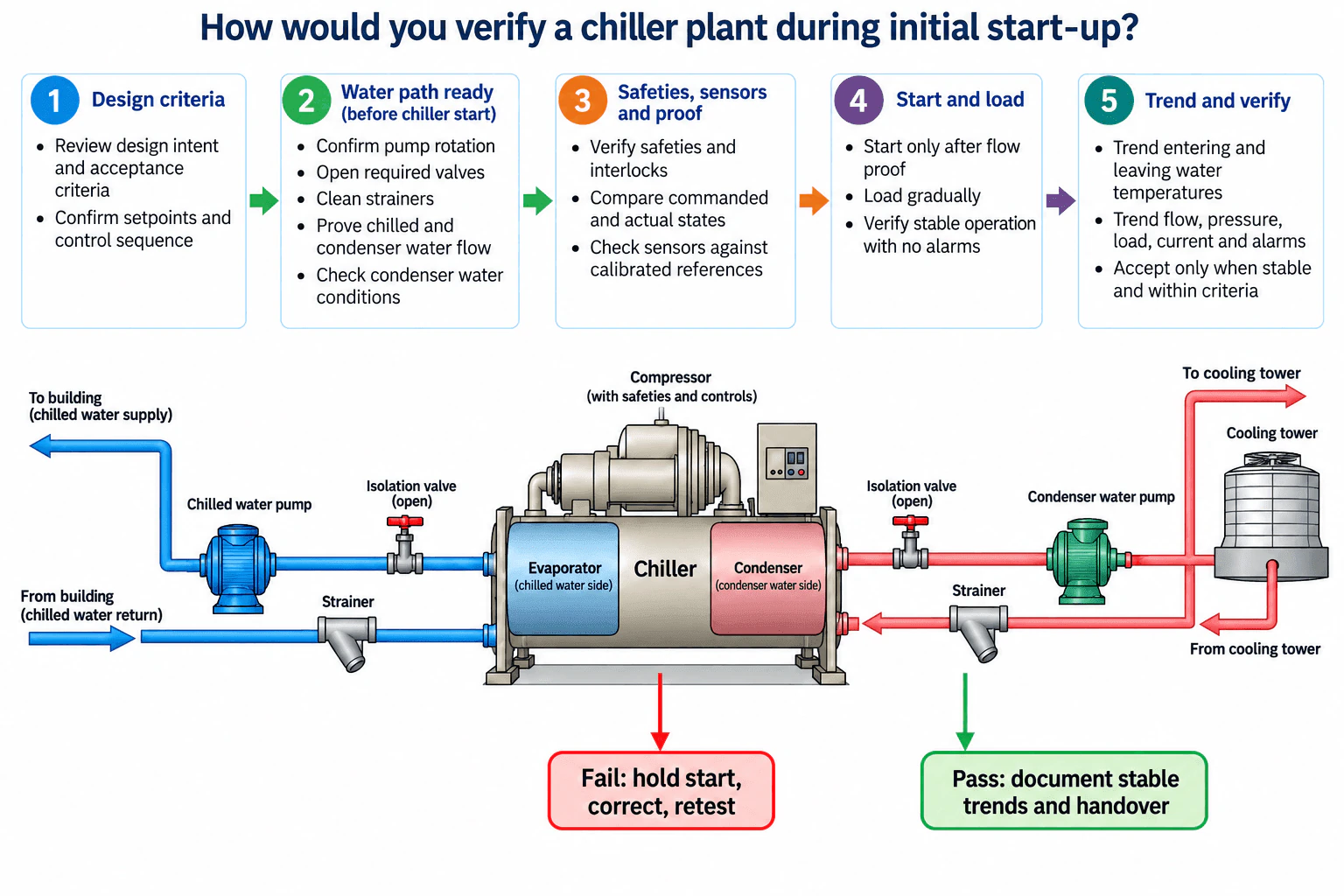
55. How would you verify a chiller plant during initial start-up?Troubleshooting And CommissioningMedium
i Question Details
Confirm water flows, valve positions, pump rotation, clean strainers, condenser-water conditions where applicable, safeties, sensor readings, stable loading, and key operating trends.
Short Interview Answer (30-60 seconds)
I would first review the design intent, acceptance criteria, setpoints, and control sequence. Before enabling the chiller, I would confirm pump rotation, required valve positions, clean strainers, and proven chilled water and condenser water flow. I would verify safeties, interlocks, commanded versus actual equipment states, and key sensors against calibrated references. Once all startup permissives are satisfied, I would enable the chiller and allow it to load progressively while checking for stable operation and alarms. Finally, I would trend entering and leaving water temperatures, flow, pressure, load, current, and alarms, then compare the stabilized results with the acceptance criteria and document the final condition before handover.
Detailed Explanation
Initial startup verification is a planned commissioning activity. The objective is to prove that the chiller plant is installed, controlled, protected, and operating as intended before it is accepted for normal service. I would move in a deliberate sequence from design criteria to water path readiness, then safeties and sensors, controlled startup, and final trend verification. If a required condition fails, I would hold the startup, correct the cause, and repeat the affected test rather than bypassing the problem.
Useful Questions to Ask the Interviewer
Is this a water cooled chiller with a cooling tower, or does the plant use another condenser arrangement?
What design flow rates, temperature conditions, setpoints, and acceptance criteria are available for comparison?
Are the chilled water and condenser water pumps constant flow or variable flow, and what sequence of operation should the controls follow?
How to Explain It in an Interview
I would begin by reviewing the approved design intent, control sequence, setpoints, and acceptance criteria so I know what successful startup should look like.
Before enabling the chiller, I would verify the water paths. I would confirm pump rotation, required valve positions, clean strainers, and proven chilled water flow. For a water cooled chiller, I would also prove condenser water flow and confirm that condenser water conditions are within the equipment requirements. The strainers should protect the heat exchangers from debris before water enters them.
Next, I would verify safeties and interlocks. I would compare commanded equipment states with actual states and confirm that required flow proof and other startup permissives operate correctly. I would also compare important temperature and pressure sensors with calibrated references so the controls are acting on trustworthy measurements.
Once those prerequisites are proven, I would enable the chiller and allow the controller to load it progressively. I would confirm that pumps remain operating, flow remains proven, the control sequence behaves as intended, and no abnormal alarms occur.
After the plant stabilizes, I would trend chilled water entering and leaving temperatures, condenser water entering and leaving temperatures where applicable, water flow, relevant pressures, compressor load or current, setpoints, and alarms. I would compare the stabilized readings with the approved acceptance criteria and equipment requirements rather than relying on one instantaneous value.
If a required condition is not met, I would hold or stop the startup as appropriate, correct the cause, and retest. If operation is stable and within the defined criteria, I would document the final readings and hand over the plant with a clear commissioning record.
Why Interviewers Ask This
Interviewers want to see whether you can commission a chiller methodically instead of simply enabling the machine and watching for alarms. They are evaluating whether you establish the design intent, prove the water systems, confirm safeties and sensor accuracy, verify commanded and actual equipment states, allow stable loading, and use trend data to decide whether the plant is ready for handover.
Common interview mistakes
Common mistakes include enabling the chiller before proving water flow, checking pump operation without verifying rotation, overlooking incorrect valve positions or dirty strainers, trusting unverified sensors, bypassing safeties to force a start, judging performance before the plant stabilizes, relying on a single reading, and failing to document baseline and final trend data.
Interview tip
Explain the sequence in a safe order: establish the expected condition, prove the water paths, verify safeties and sensors, enable the chiller and allow stable loading, then use trend data for acceptance. Emphasize that a failed prerequisite leads to correction and retesting rather than bypassing an interlock.
Interviewer may ask next
What would you do if the chiller starts but the leaving chilled water temperature does not reach the expected value?
I would not immediately assume that the chiller lacks capacity. I would first confirm that the temperature sensors are accurate, then verify chilled water flow, valve positions, pump operation, strainers, entering water temperature, actual load, setpoint, and commanded versus actual equipment states. On a water cooled system, I would also review condenser water flow and temperature conditions and check for active limits or alarms. After identifying and correcting the cause, I would repeat the test and compare the new stabilized readings with the acceptance criteria.
How would your startup verification change if the plant used variable flow pumping?
I would follow the same overall commissioning sequence, but I would also verify the variable flow control strategy. I would confirm pump rotation, minimum required chiller flow, differential pressure control, sensor accuracy, valve response, and the interaction between pump speed and chiller flow proof. During loading, I would trend flow, differential pressure, pump command, valve position, and chiller operation to confirm that the plant remains stable across the expected operating range.
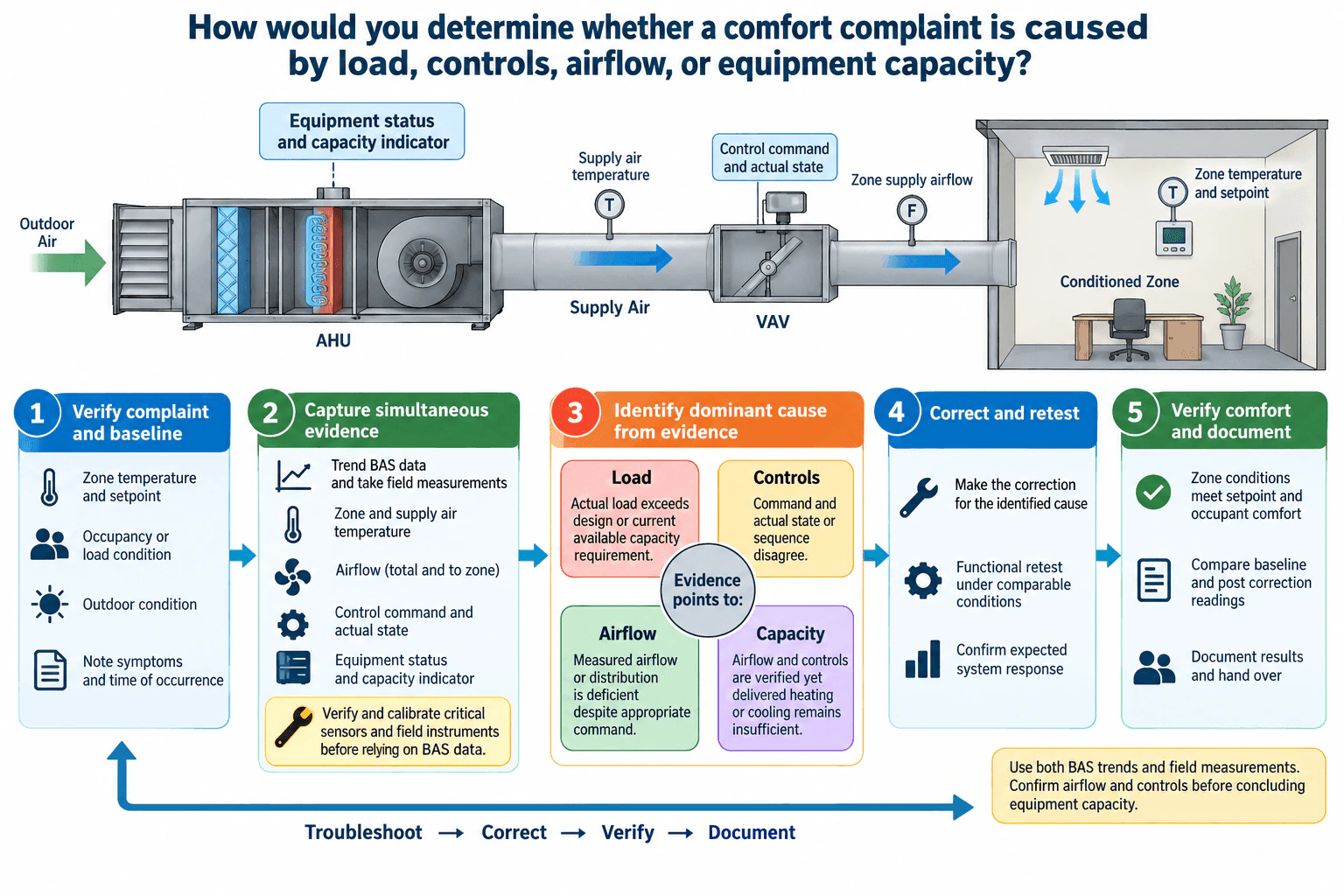
56. How would you determine whether a comfort complaint is caused by load, controls, airflow, or equipment capacity?Troubleshooting And CommissioningHard
i Question Details
Use simultaneous trend and field measurements for zone conditions, loads, airflow, supply temperature, control commands, equipment status, and capacity indicators to isolate the dominant failure mechanism.
Short Interview Answer (30-60 seconds)
I would first verify the comfort complaint and record a baseline under the conditions when it occurs. Then I would collect simultaneous BAS trends and field measurements for zone temperature and setpoint, occupancy or load condition, outdoor condition, supply air temperature, zone supply airflow, control command and actual state, and equipment status and capacity indicators. I would use that evidence to test four competing causes. Excessive actual load points toward load. A disagreement between command and actual state points toward controls. Deficient measured airflow despite an appropriate command points toward airflow. If airflow and controls are verified but delivered heating or cooling remains insufficient, I would investigate equipment capacity. After correcting the identified cause, I would functionally retest the system, compare baseline and post correction readings, verify comfort, and document the result.
Detailed Explanation
A comfort complaint should be treated as a root cause problem. I would avoid changing settings until I understand what the zone, controls, airflow, and equipment were doing when the complaint occurred.
Useful Questions to Ask the Interviewer
Is the complaint continuous, or does it occur only at certain times, loads, or outdoor conditions?
Do we have BAS trend data and recent TAB or commissioning measurements for this zone?
What are the intended zone setpoint, design airflow, supply temperature, and equipment operating sequence?
How to Explain It in an Interview
I would start by verifying the complaint and recording a baseline. I would note zone temperature and setpoint, occupancy or load condition, outdoor condition, symptoms, and time of occurrence. Before relying on the data, I would verify that critical sensors and field instruments are suitable and calibrated for the measurements being taken.
Next, I would capture simultaneous evidence. I would trend the BAS while taking field measurements for zone and supply air temperature, total and zone supply airflow, control command and actual state, and equipment status and capacity indicators. Taking these measurements at the same operating condition prevents a misleading comparison between unrelated points in time.
I would then test four competing hypotheses.
Load: If the actual thermal load is greater than the design basis or currently available capacity requirement, the system may be operating correctly but still unable to maintain the zone condition.
Controls: I would compare the required sequence, control command, and actual damper, valve, fan, or equipment state. A disagreement suggests a control, actuator, sensor, or sequence problem.
Airflow: I would verify measured airflow and distribution. If airflow is deficient despite an appropriate command, I would investigate restrictions, balance, damper operation, fan performance, filter pressure drop, or another distribution problem before blaming capacity.
Capacity: I would consider equipment capacity after airflow and controls are verified. If the correct airflow is delivered and commands are satisfied, but delivered heating or cooling remains insufficient, I would investigate equipment status and applicable capacity indicators such as coil performance.
After correcting the dominant cause, I would perform a functional retest under comparable conditions. I would confirm the expected system response, compare baseline and post correction readings, verify that the zone reaches its comfort objective, document the results, and hand over the verified correction.
Why Interviewers Ask This
Interviewers want to see whether I can separate competing HVAC failure mechanisms using measured evidence instead of changing settings or blaming equipment prematurely. They are evaluating whether I verify the complaint, compare simultaneous trend and field measurements, distinguish control command from actual state, verify airflow before concluding there is a capacity problem, and confirm the correction with documented readings.
Common interview mistakes
Common mistakes include changing setpoints before documenting the original condition, relying only on BAS values without checking field measurements, comparing readings taken under different operating conditions, assuming a damper command proves that airflow is adequate, treating a control command as proof of actual equipment response, blaming equipment capacity before verifying airflow and controls, overlooking sensor drift or calibration problems, and declaring success without a functional retest and post correction documentation.
Interview tip
Organize the answer as evidence, hypothesis, test, correction, and verification. Emphasize that load, controls, airflow, and equipment capacity can produce similar comfort symptoms, so the strongest diagnosis compares simultaneous measured conditions and control command versus actual state before selecting the dominant cause.
Interviewer may ask next
What would you do if BAS trends suggest low airflow but your field measurement shows normal airflow?
I would treat the disagreement as evidence that one measurement path may be unreliable. I would verify the BAS airflow sensor, calibration, scaling, location, and current reading against the field instrument. I would also confirm that both measurements represent the same location and operating time. I would not diagnose an airflow fault until the conflicting measurements are reconciled.
What changes if airflow and controls are correct but the zone still cannot maintain setpoint during peak conditions?
I would move the investigation toward load and available equipment capacity. I would compare the actual operating condition with the intended design condition and determine whether the load has increased or whether the equipment is failing to deliver the required heating or cooling effect. I would use equipment status, supply air temperature, coil performance, and other applicable capacity indicators to separate excessive load from degraded equipment performance, then verify the conclusion with a functional retest under comparable conditions.
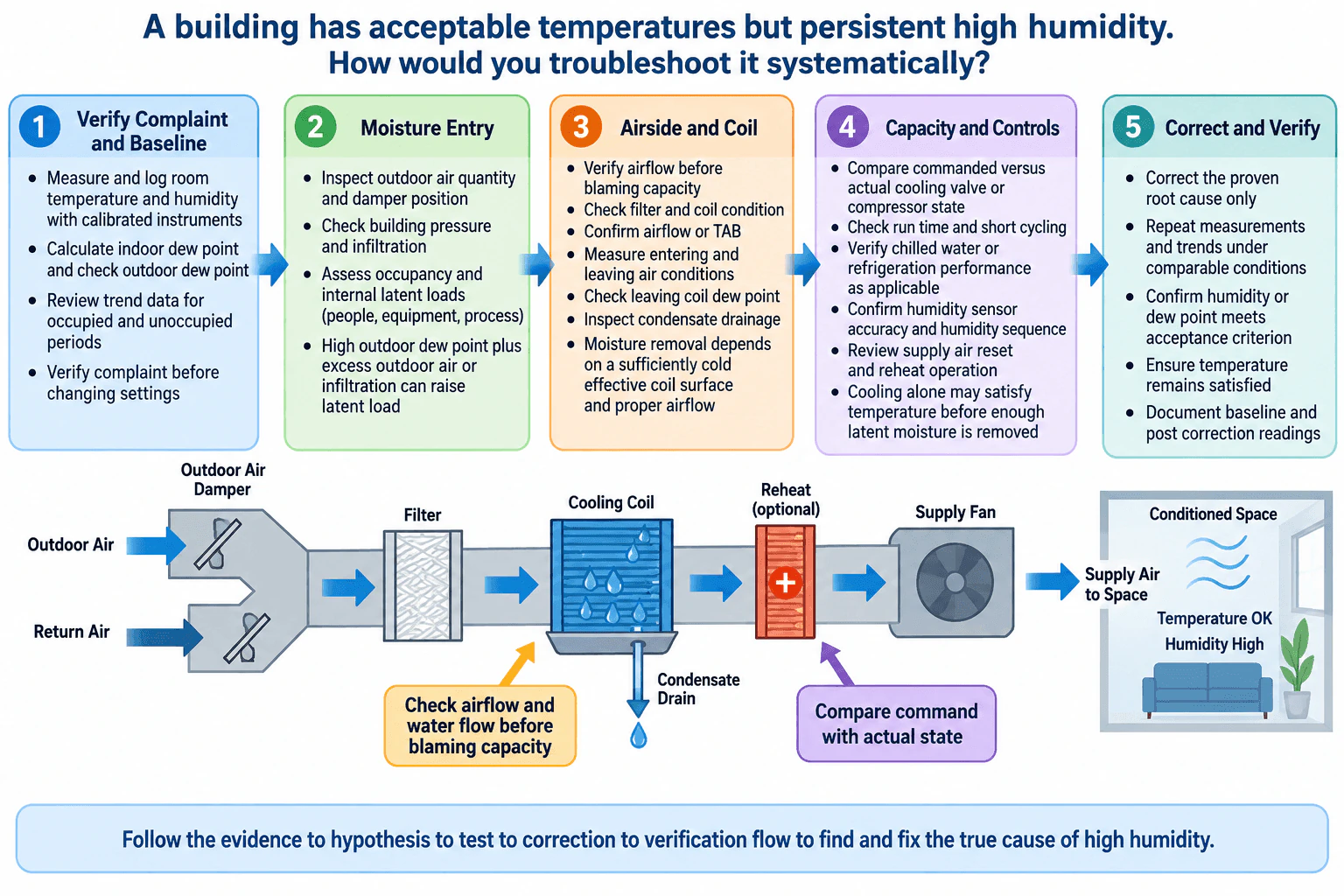
57. A building has acceptable temperatures but persistent high humidity. How would you troubleshoot it systematically?Troubleshooting And CommissioningHard
i Question Details
Separate load, airside, refrigeration, ventilation, and controls causes by checking outdoor-air moisture, infiltration, coil dew point, run time, airflow, reheat, sensor accuracy, and trend patterns.
Short Interview Answer (30-60 seconds)
I would first verify the humidity complaint with calibrated instruments and trend temperature, humidity, and equipment operation before changing settings. Then I would separate moisture load from HVAC causes by checking outdoor air moisture, damper position, building pressure, infiltration, occupancy, and other latent loads. Next I would verify airflow, filter and coil condition, entering and leaving air conditions, coil dew point, condensate drainage, run time, and short cycling. I would compare commanded and actual cooling, ventilation, reheat, and sensor states. Once the evidence identifies the root cause, I would correct only that cause and repeat measurements under comparable conditions to confirm that humidity is controlled while temperature remains acceptable.
Detailed Explanation
Persistent high humidity with acceptable temperature usually means the sensible load is being satisfied while moisture removal is insufficient, or moisture is entering the building faster than the HVAC system removes it. I would use an evidence to hypothesis to test to correction to verification process rather than changing setpoints immediately.
Useful Questions to Ask the Interviewer
Is the high humidity limited to certain zones, schedules, weather conditions, or occupied periods?
What type of cooling system serves the area, and does it use chilled water, direct expansion cooling, reheat, or a dedicated outdoor air system?
Are design airflow, outdoor air quantity, humidity criteria, and trend data available?
How to Explain It in an Interview
I would start by verifying the complaint. I would measure space temperature and humidity with calibrated instruments, calculate or review indoor dew point, compare the field readings with the building controls, and trend occupied and unoccupied periods. That establishes the baseline before I change anything.
Next I would investigate moisture entering the building. I would check outdoor air moisture, outdoor air damper position, ventilation quantity, building pressure, infiltration, occupancy, and other internal latent loads. High outdoor dew point combined with excessive outdoor air or infiltration can raise indoor moisture even when space temperature is acceptable.
Then I would inspect the airside and cooling process. I would verify airflow or TAB data before blaming capacity, inspect the filter and cooling coil, compare entering and leaving air conditions, determine whether the coil is cold enough to condense moisture, and confirm that condensate drains correctly. Where applicable, I would also verify chilled water flow and valve operation before concluding that cooling capacity is inadequate.
Next I would check capacity and controls. I would compare commanded and actual cooling valve or compressor states, review run time and short cycling, verify the humidity sensor, and inspect the humidity control sequence. I would also review supply air reset and reheat operation. A system can satisfy temperature quickly and stop cooling before enough latent moisture is removed.
I would test the most likely causes one at a time using measured evidence. Possible confirmed causes could include excessive outdoor air, infiltration, incorrect airflow, poor water flow, a fouled coil, poor condensate drainage, sensor drift, short cycling, or an incorrect dehumidification and reheat sequence.
Finally, I would correct only the proven root cause and repeat temperature, humidity, dew point, airflow, and equipment state checks under comparable operating conditions. I would confirm that the humidity or dew point meets the acceptance criterion while temperature remains satisfactory, then document the baseline and post correction readings.
Why Interviewers Ask This
This tests whether the candidate can diagnose a latent moisture problem systematically instead of assuming that acceptable space temperature means the HVAC system is operating correctly. The interviewer is looking for disciplined use of measurements, trend data, airflow checks, moisture source analysis, equipment state verification, controls knowledge, root cause testing, and post correction performance verification.
Common interview mistakes
Common mistakes include changing temperature or humidity setpoints before verifying the complaint, assuming cooling capacity is insufficient without checking airflow or water flow, ignoring outdoor air moisture and infiltration, overlooking short cycling, failing to inspect condensate drainage, relying on an unverified humidity sensor, failing to compare commanded and actual equipment states, and declaring the issue solved without post correction trending.
Interview tip
Organize the answer as evidence, hypothesis, test, correction, and verification. Emphasize that acceptable temperature does not prove adequate dehumidification. Mention calibrated measurements, outdoor moisture and infiltration, airflow and coil conditions, run time, commanded versus actual states, humidity sensor accuracy, reheat, and trend data. Finish by explaining how you would document baseline and post correction readings.
Interviewer may ask next
What would you do if the humidity sensor shows 65 percent relative humidity but a calibrated field instrument shows 52 percent?
I would treat the discrepancy as evidence of possible sensor drift, calibration error, or a poor sensor location before changing the HVAC sequence. I would verify both readings under comparable conditions, inspect the installed sensor location, compare it with nearby measurements and trends, and recalibrate or replace the sensor if needed. After correction, I would confirm that the building controls report values consistent with the reference instrument and verify that the humidity sequence responds correctly.
What changes if the building becomes humid mainly during mild rainy weather when the cooling load is low?
That pattern would make low sensible load operation, short cooling run time, humid outdoor air, infiltration, and the dehumidification sequence especially important. I would trend outdoor dew point, space humidity, cooling calls, compressor or valve operation, outdoor air damper position, supply air conditions, and reheat. The system may satisfy temperature before the cooling coil operates long enough to remove the required moisture. I would verify the intended humidity control sequence and whether cooling with appropriate reheat is available and operating as designed rather than simply lowering the space temperature setpoint.
58. Tell me about a project you are proud of and your specific contribution to it.BehavioralEasy
i Question Details
Choose one HVAC or MEP project and explain the objective, your responsibility, the actions you personally took, and the measurable or observable outcome.
Interview tip:
Use STAR to structure your answer: briefly explain the Situation and Task, make Action the most detailed part, and finish with the Result. For example, describe an HVAC project where you owned an important design or coordination issue, identified what needed to change, worked with other disciplines, explained your decisions clearly, verified the final solution, and delivered a result you were proud of.
Situation
On one of my previous projects, I was responsible for the HVAC design and coordination for an area where the available ceiling space was limited. During coordination, we found that the main supply duct route conflicted with structural elements and other building services. The issue could have affected installation and required changes late in the project if we did not resolve it early.
Task
My responsibility was to develop a practical HVAC solution that maintained the required airflow and equipment performance while fitting within the available space. I also needed to coordinate the change with the other disciplines so that we solved the conflict without creating a new problem elsewhere.
Action
I first reviewed the duct layout, airflow requirements, available ceiling space, and the locations of the surrounding services. I identified the sections where the conflict was most serious and checked which dimensions could be adjusted without creating excessive air velocity or pressure loss. I then developed an alternate routing that used the available space more effectively while keeping the duct system practical to install and maintain. I checked the revised path against the mechanical design requirements and made sure access to important components was still available. After that, I shared the proposed change with the coordination team and explained why I selected that route. I worked with the structural, electrical, and plumbing teams to confirm that the revised layout did not interfere with their systems. When comments came back, I updated the design and reviewed the coordinated model again before the drawings were finalized. I also made sure the final documents clearly reflected the agreed solution so the site team would not have to interpret conflicting information.
Result
The conflict was resolved before installation, and the coordinated layout gave the site team a clear and practical route to follow. I was proud of the project because my contribution was not only finding a duct route. I took ownership of the issue, checked the engineering impact, coordinated the solution with the team, and carried it through to the final documents. It reinforced for me that good HVAC design depends on both technical judgment and clear coordination.
Why Interviewers Ask This
Interviewers ask this question to understand what type of work the candidate values and how clearly they can explain their own contribution. A strong answer shows ownership, practical HVAC judgment, collaboration, communication, and the ability to connect personal actions to a meaningful project outcome.
Interviewer may ask next
Why did you choose to revise the duct route instead of asking another discipline to move its services?
I wanted to evaluate the option that gave the project the least overall disruption. After reviewing the available space, I saw that the duct route could be adjusted while still meeting the HVAC requirements. I discussed that option with the other disciplines rather than assuming they should move their systems. That helped us choose a coordinated solution based on the whole project instead of only protecting my own design.
What did you learn from that project that you would apply to a similar situation now?
I learned to look for coordination risks as early as possible and to verify the engineering effect of a change before presenting it as a solution. I would use the same approach now by reviewing space constraints early, checking airflow and pressure implications, involving the affected disciplines quickly, and making sure the final coordinated decision is clearly reflected in the design documents.
59. Tell me about a time you had to learn a new HVAC technology, standard, or tool.BehavioralEasy
i Question Details
Describe why the new knowledge was needed, how you learned it, how you applied it to your work, and what changed as a result.
Interview tip:
Use STAR to structure your answer: briefly explain the Situation and Task, make Action the most detailed part, and finish with the Result. For example, describe a project where you needed to learn a new HVAC standard or tool, explain how you identified the important requirements, used reliable learning resources, checked your understanding with experienced team members, applied the knowledge to the design, and confirmed that the final work met the project requirements.
Situation
During a previous HVAC design project, I needed to apply ventilation requirements from ASHRAE Standard 62.1 in more detail than I had on earlier projects. The project included several spaces with different occupancy and ventilation needs, so I needed to understand the standard well enough to apply it correctly instead of relying only on previous design habits.
Task
I was responsible for completing the ventilation calculations and making sure the outdoor air quantities used in the HVAC design were supported by the standard. I also needed to explain my calculations clearly so the rest of the design team could review them.
Action
I first identified the sections of ASHRAE Standard 62.1 that applied to the project and focused on the ventilation rate procedure. I reviewed how the required outdoor air depends on both the number of people and the floor area. I then worked through a simple sample space before applying the method to the full project. This helped me understand each input and catch mistakes early. When I was unsure about an interpretation, I checked the wording in the standard and discussed the specific point with a more experienced engineer instead of making an assumption. After that, I created a consistent calculation method for all spaces and documented the occupancy, area, ventilation rates, and final outdoor air requirement for each one. I also compared the calculated airflow with the system design to confirm that the equipment and controls could provide the required ventilation.
Result
I completed the ventilation calculations with a clear basis that the team could review and use in the design. The process also gave me a much stronger understanding of how ASHRAE Standard 62.1 affects actual HVAC airflow decisions. I learned that when I need to use a new standard or tool, I get better results by learning the basic method first, testing it on a small example, asking focused questions, and then applying it consistently to the full project.
Why Interviewers Ask This
Interviewers ask this question to understand how you adapt when HVAC practices, standards, and tools change. A strong answer shows that you can learn independently, verify your understanding, ask useful questions when needed, and apply new knowledge carefully to real engineering work.
Interviewer may ask next
How did you make sure you were interpreting ASHRAE Standard 62.1 correctly?
I checked the relevant requirements directly in the standard, worked through a simple example, and compared my interpretation with the actual project conditions. For points that were not clear to me, I asked an experienced engineer a focused question and explained how I had interpreted the requirement. That allowed me to confirm the method before applying it across the project.
What would you do differently the next time you need to learn a new HVAC standard or tool?
I would create a short reference note while I am learning that records the key requirements, inputs, assumptions, and checks I expect to use on the project. In this case, I learned the method successfully, but creating that reference earlier would make it easier to stay consistent and explain the approach to other team members.
60. Tell me about a time you resolved a coordination conflict with another engineering discipline.BehavioralMedium
i Question Details
Describe the competing technical requirements, how you used drawings or model information to understand the conflict, how you reached agreement, and the final project result.
Interview tip:
Use STAR to structure your answer: briefly explain the Situation and Task, make Action the most detailed part, and finish with the Result. For example, describe a project where an HVAC route conflicted with another discipline, explain how you reviewed drawings or model information to understand both requirements, discuss how you worked through practical options together, and show how you reached an agreed solution without harming system performance or the other discipline's design.
Situation
On one of my previous projects, I found that a main supply air duct was routed through an area needed for a structural beam. The HVAC route was important because the ceiling space was limited, while the structural engineer needed to keep the beam in that location to support the building design.
Task
I was responsible for resolving the conflict without creating a new coordination problem or reducing the performance of the HVAC system. I also needed to make sure the structural requirement was respected and that both disciplines agreed on the revised arrangement before the drawings were updated.
Action
I first reviewed the HVAC drawings, structural drawings, and model views together so I could understand the conflict in three dimensions instead of looking at each drawing separately. I checked the nearby ceiling space and traced the duct route before and after the beam location. I then identified a few possible routing changes and considered how each option would affect airflow, pressure loss, access, and space needed by other services. I discussed these options with the structural engineer rather than simply asking for the beam to be moved. We agreed that keeping the beam unchanged was the better approach because changing the structure would affect more parts of the design. I proposed shifting the duct route around the beam and adjusting its shape through the constrained area while keeping enough duct area for the required airflow. I showed the revised route in the model and reviewed the clearances with the structural engineer. After we agreed on the arrangement, I updated the HVAC information and made sure the coordinated location was clearly communicated to the rest of the design team.
Result
We resolved the conflict before installation, and both the structural design and HVAC airflow requirements were maintained. The agreed route also avoided creating another clash in the ceiling space. I learned that coordination conflicts are easier to solve when I first understand the other discipline's technical requirement, use the model to make the issue visible, and discuss several workable options instead of protecting only my own design.
Why Interviewers Ask This
Interviewers ask this question to understand how an HVAC Engineer handles technical disagreements that affect several disciplines. They are looking for practical judgment, clear communication, respect for other engineering requirements, and the ability to use drawings or model information to reach a solution that works for the overall project.
Interviewer may ask next
Why did you decide to move the duct instead of asking the structural engineer to change the beam?
After reviewing both designs, I saw that changing the beam could affect a larger part of the structural system. The duct had more routing flexibility, so I focused on finding an HVAC change that protected airflow while leaving the structural design intact. I wanted the solution to reduce the overall project impact, not just make the HVAC layout easier.
What would you do differently if you found a similar coordination conflict now?
I would review the shared model earlier and focus on the most congested areas before the design becomes difficult to change. I would also discuss key clearance needs with the other disciplines earlier. The same collaborative approach worked well, but earlier coordination could prevent some conflicts from developing in the first place.
More questions load as you scroll
Disclaimer: This interview guide is for educational and informational purposes only. It is designed to help readers prepare, but it does not guarantee any interview result, hiring decision, offer, or outcome. Interview questions, hiring criteria, and preferred answers can vary by employer, interviewer, industry, location, and time. All answers, examples, and explanations in this guide are suggested examples for interview preparation, not definitive answers or instructions for professional practice. They are based on research and judgment, are provided without warranties of any kind, and should be adapted to the question, role, and applicable laws and professional requirements. Diagrams are simplified illustrations intended to highlight the main concepts and their relationships; actual situations, systems, and practices may be more complex. Alternative approaches may be equally valid or better suited to a particular question, context, or interviewer. To the fullest extent permitted by applicable law, the contributors and publisher are not liable for decisions made, actions taken, or losses incurred based on this guide.
State Laws and Professional Responsibilities: Laws and requirements governing an occupation vary by state and jurisdiction. You are responsible for checking the current laws, licensing requirements, and scope-of-practice rules that apply to your location and role, and for ensuring that your answers and actions comply with them. Adapt examples in this guide to those requirements. This guide is not legal advice.
Content Accuracy and Verification: To the fullest extent permitted by applicable law, we do not represent or warrant that interview guides, questions, answers, examples, or diagrams are accurate, complete, current, error-free, or suitable for any particular purpose. You are responsible for independently reviewing and verifying the information before relying on it.