This interview guide is for educational and informational purposes only. It is designed to help readers prepare, but it does not guarantee any interview result, hiring decision, offer, or outcome. Interview questions, hiring criteria, and preferred answers can vary by employer, interviewer, industry, location, and time. All answers, examples, and explanations in this guide are suggested examples for interview preparation, not definitive answers or instructions for professional practice. They are based on research and judgment, are provided without warranties of any kind, and should be adapted to the question, role, and applicable laws and professional requirements. Diagrams are simplified illustrations intended to highlight the main concepts and their relationships; actual situations, systems, and practices may be more complex. Alternative approaches may be equally valid or better suited to a particular question, context, or interviewer. To the fullest extent permitted by applicable law, the contributors and publisher are not liable for decisions made, actions taken, or losses incurred based on this guide.
State Laws and Professional Responsibilities
Laws and requirements governing an occupation vary by state and jurisdiction. You are responsible for checking the current laws, licensing requirements, and scope-of-practice rules that apply to your location and role, and for ensuring that your answers and actions comply with them. Adapt examples in this guide to those requirements. This guide is not legal advice.
Identity, Image, and Privacy Notice
To respect individual privacy, some names, profile photographs, avatars, biographical details, and other identifying information displayed in this guide may be replaced with pseudonyms, licensed stock images, illustrative avatars, composite images, or representative descriptions. Unless a person is expressly identified as an actual contributor, a displayed name, image, or profile should not be understood as depicting or identifying a specific candidate, interviewer, employee, or other real individual. These representations are provided for editorial and illustrative purposes only and do not imply endorsement, employment, participation, or affiliation with this guide or any company mentioned in it. Any resemblance to an actual person is coincidental.
Company Notice
This guide is an independent educational resource and is not affiliated with, endorsed by, sponsored by, or approved by the company named in this guide. Company names identify reported interview experiences or the employer context of clearly labeled original practice exercises. Interview practices can change without notice, and inclusion of company-specific content does not mean these questions are official, complete, or guaranteed to be asked. To the fullest extent permitted by law, the author, contributors, and publisher are not responsible for outcomes related to use of this material.
Content Accuracy and Verification
To the fullest extent permitted by applicable law, we do not represent or warrant that interview guides, questions, answers, examples, or diagrams are accurate, complete, current, error-free, or suitable for any particular purpose. You are responsible for independently reviewing and verifying the information before relying on it.
Questions or comments?
Contact us for general questions, or share feedback, technical corrections, and comments with the community.
11. Return the number of trailing zeroes in n factorial without constructing the factorial.CodingMediumMicrosoft
i Question Details
Using Python 3.14, implement def factorial_trailing_zeroes(n: int) -> int. n is a nonnegative integer. Return the number of consecutive decimal zero digits at the end of n! by counting factors of five; do not compute n! itself. Use only the standard library, do not mutate caller-owned data, and target O(log_5 n) time with O(1) auxiliary space. Inputs outside the stated contract need not be handled. Examples: factorial_trailing_zeroes(5) returns 1, factorial_trailing_zeroes(10) returns 2, and factorial_trailing_zeroes(30) returns 7.
Short Interview Answer (30-60 seconds)
I would count factors of 5 instead of building the factorial. Every trailing zero needs a factor pair 2 × 5, and there are enough factors of 2 to pair with the factors of 5 in n!. I start with factor = 5 and repeatedly add n // factor to a running count. Then I multiply factor by 5 and continue until factor is greater than n. For n = 30, I get 6 + 1 = 7. This takes O(log_5 n) time and O(1) auxiliary space.
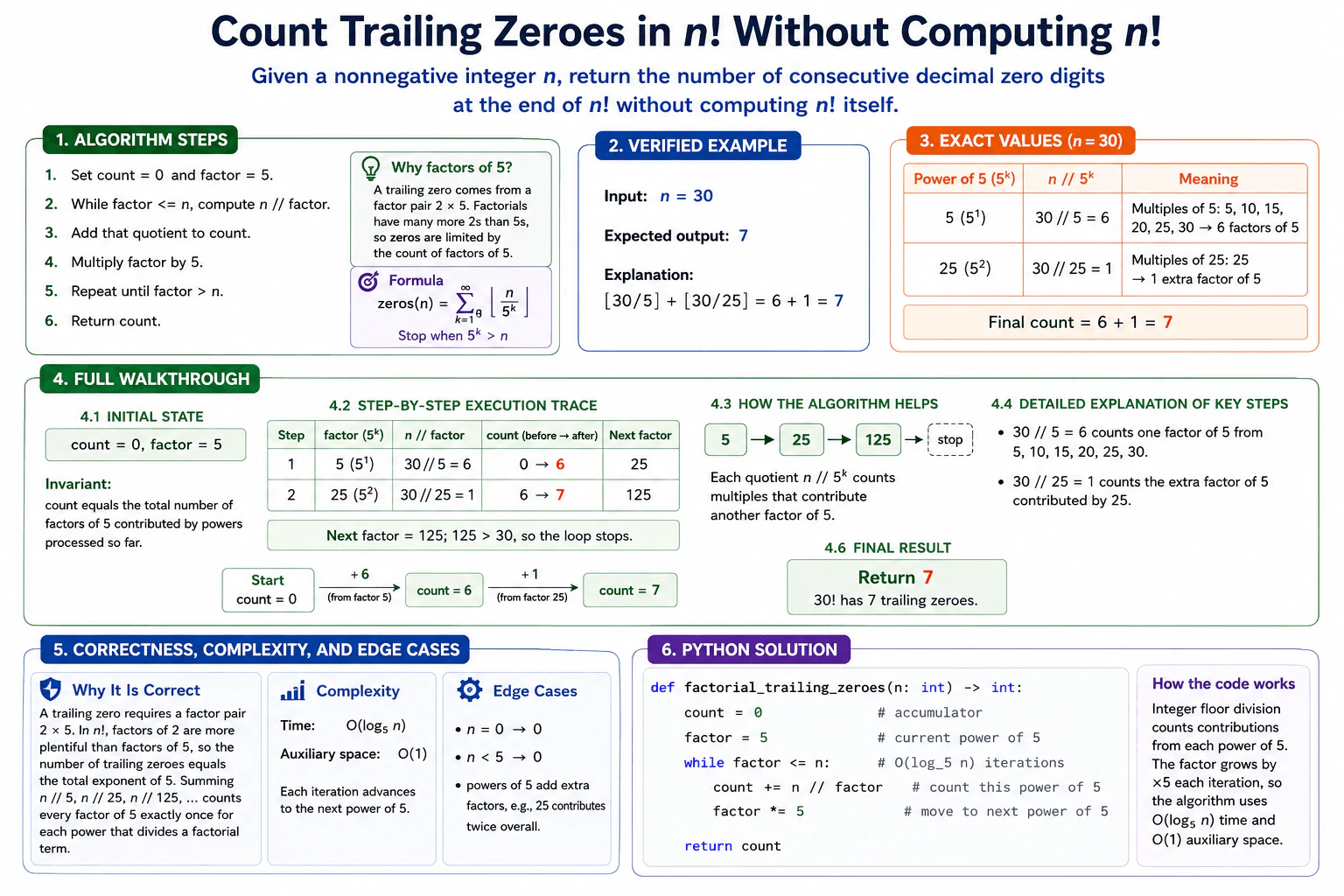
The input is one nonnegative integer n. We need to return how many zero digits appear continuously at the end of n!. We must not build n! because factorial values become extremely large. A trailing zero comes from a factor pair 2 × 5. In a factorial, there are enough factors of 2 to pair with every factor of 5, so the number of factors of 5 determines the answer. We count multiples of 5, then extra factors contributed by multiples of 25, 125, and higher powers of 5.
Useful Questions to Ask the Interviewer
Can I assume n is always a nonnegative integer, as stated?
Should inputs outside the stated contract be ignored, as the problem allows?
How to Explain It in an Interview
1. Understand the input and required output
The input is a nonnegative integer n. The output is one integer. It is the number of consecutive decimal zero digits at the end of n!. We do not need to handle values outside the stated input contract. We must not calculate n! itself. The function also does not mutate caller-owned data.
2. Choose the counting method
A decimal trailing zero comes from a factor of 10. A factor of 10 is 2 × 5. In n!, there are enough factors of 2 to pair with every factor of 5. Therefore, the number of trailing zeroes is determined by the total number of factors of 5.
We count n // 5 for the first factors of 5. We also count n // 25 because multiples of 25 contain an additional factor of 5. The same idea continues with 125, 625, and higher powers of 5.
3. Initialize the state
Set count = 0 and factor = 5. The variable count stores the number of factors of 5 found from the powers already processed. The variable factor stores the current power of 5. At the beginning, no power has been processed, so count = 0 is correct.
4. Walk through n = 30
Start with count = 0 and factor = 5.
For factor = 5, calculate 30 // 5 = 6. These six contributions come from 5, 10, 15, 20, 25, and 30. Add 6, so count changes from 0 to 6. Then multiply factor by 5, so factor becomes 25.
For factor = 25, calculate 30 // 25 = 1. The number 25 contributes one extra factor of 5. Add 1, so count changes from 6 to 7. Then factor becomes 125.
Now 125 > 30, so the loop stops. The factor 125 is not processed. We return 7.
5. Explain why the result is correct
The key invariant is that count equals the total number of factors of 5 contributed by every power of 5 processed so far. The first division counts one factor from every multiple of 5. The next division counts an additional factor from every multiple of 25. Higher powers work the same way. Because there are enough factors of 2 to pair with these factors of 5, this total is exactly the number of trailing zeroes.
6. Explain the Python implementation
The code starts count at 0 and factor at 5. While factor <= n, integer floor division n // factor tells us how many numbers contribute that power of 5. We add that value to count. Then factor *= 5 moves to the next power of 5. When factor becomes greater than n, there are no more contributing powers, so the function returns count.
7. Explain complexity and edge cases
The factor grows as 5, 25, 125, and so on. Therefore, the number of loop iterations is O(log_5 n). The function stores only two integer variables besides the input, so auxiliary space is O(1). For n = 0 or any n < 5, the loop never runs and the answer is 0. Powers of 5 need special attention because values such as 25 contribute more than one factor of 5 overall.
Key Insight / Why This Solution Works
The key idea is to count how many factors of 5 appear in n!. A trailing decimal zero needs one factor of 2 and one factor of 5. There are enough factors of 2 to pair with every factor of 5 in the factorial, so the factors of 5 determine the answer. We add n // 5, n // 25, n // 125, and so on while the current power of 5 is at most n. The invariant is that count always equals the number of factors of 5 contributed by all powers processed so far. This avoids constructing the huge factorial value.
Code
deffactorial_trailing_zeroes(n: int) -> int:
# No powers of 5 have been counted yet.
count = 0# Start with the first power of 5 that can contribute a trailing zero.
factor = 5# Process only powers of 5 that are at most n.while factor <= n:
# Count contributions from the current power of 5.
count += n // factor
# Move to the next power of 5: 5, 25, 125, ...
factor *= 5# Each counted factor of 5 can pair with a factor of 2.return count
# Run the same example shown in the diagram.print(factorial_trailing_zeroes(30)) # 7
Time & Space Complexity
The time complexity is O(log_5 n). The factor starts at 5 and is multiplied by 5 after each loop, so the number of iterations grows logarithmically with n. For example, the factors progress as 5, 25, 125, and so on. The auxiliary space complexity is O(1). Auxiliary space means extra memory used by the algorithm. We only keep the running count and the current power of 5, so the extra memory does not grow with n.
Where it is used
This pattern is useful when software needs information about a factorial without creating the factorial itself. It appears in combinatorics and number-theory calculations, especially when finding how many times a prime factor occurs inside n!. It is useful for large n because n! grows very quickly, while counting powers of a prime needs only a small number of iterations.
Why Interviewers Ask This
This problem checks whether you can avoid an unnecessary large computation and recognize a number-theory pattern. The interviewer is looking for the observation that trailing zeroes come from pairs of 2 and 5, with factors of 5 determining the count. It also tests whether you correctly count repeated factors from powers such as 25 and 125, translate that reasoning into a small Python loop, identify the stopping condition, and explain O(log_5 n) time with O(1) auxiliary space.
Common interview mistakes
1. Computing n! first and then counting its final zero digits. This does unnecessary work and ignores the required O(log_5 n) method. 2. Counting only n // 5 and forgetting extra factors from 25, 125, and higher powers of 5. 3. Treating factor = 125 as an executed iteration for n = 30. The loop has already stopped because 125 > 30. 4. Using normal division instead of integer floor division. 5. Claiming O(n) time even though the factor is multiplied by 5 after each iteration.
Interview tip
Explain why 25 must be counted twice overall before writing the loop. Once the interviewer sees that multiples of higher powers of 5 contribute extra factors, the repeated division by 5, 25, 125, and so on becomes easy to justify.
Interviewer may ask next
Why do we also divide by 25, 125, and higher powers instead of only dividing by 5?
Some numbers contain more than one factor of 5. For example, 25 = 5 × 5. The term n // 5 counts one factor of 5 from 25, and n // 25 counts its second factor. A multiple of 125 can contribute a third factor, so we continue with higher powers of 5 until the power is greater than n. This counts every factor of 5 in n! exactly once for each power that divides a factorial term.
What happens when n is smaller than 5?
The answer is 0. The function starts with factor = 5, so factor <= n is false immediately when n < 5. The loop does not run and count remains 0. For these small inputs, the function does constant work. For growing n, the overall time complexity is O(log_5 n), and the auxiliary space remains O(1).
12. Find a target's leftmost index in a rotated sorted array that may contain duplicates.NEWCodingHardMicrosoft
i Question Details
Using Python 3.14, implement def rotated_search(nums: list[int], target: int) -> tuple[int, int]. nums has 0 to 100,000 integers and is a rotation of a nondecreasing array; duplicates are allowed. Return (rotation_count, leftmost_target_index), where rotation_count is 0 for an already sorted array and otherwise is the smallest index r with nums[r] < nums[(r-1) % n]; the second value is the smallest index in the rotated input equal to target, or -1. Return (0,-1) for empty input. Do not mutate nums; use only the standard library; target O(log n) expected time and O(n) worst-case time caused by duplicates, with O(1) auxiliary space. Examples: rotated_search([4,5,5,6,6,1,2,3,3],3) returns (5,7), and rotated_search([1,2,3,4,5],3) returns (0,2).
Short Interview Answer (30-60 seconds)
I would first find the rotation point with a modified binary search that handles duplicates. The rotation point is the descent index, or 0 when there is no descent. This splits the array into two sorted runs. I then use leftmost binary search on the earlier run first, followed by the second run only if needed. That guarantees the smallest rotated-input index for the target. Expected time is O(log n), worst-case time is O(n) with duplicates, and auxiliary space is O(1).
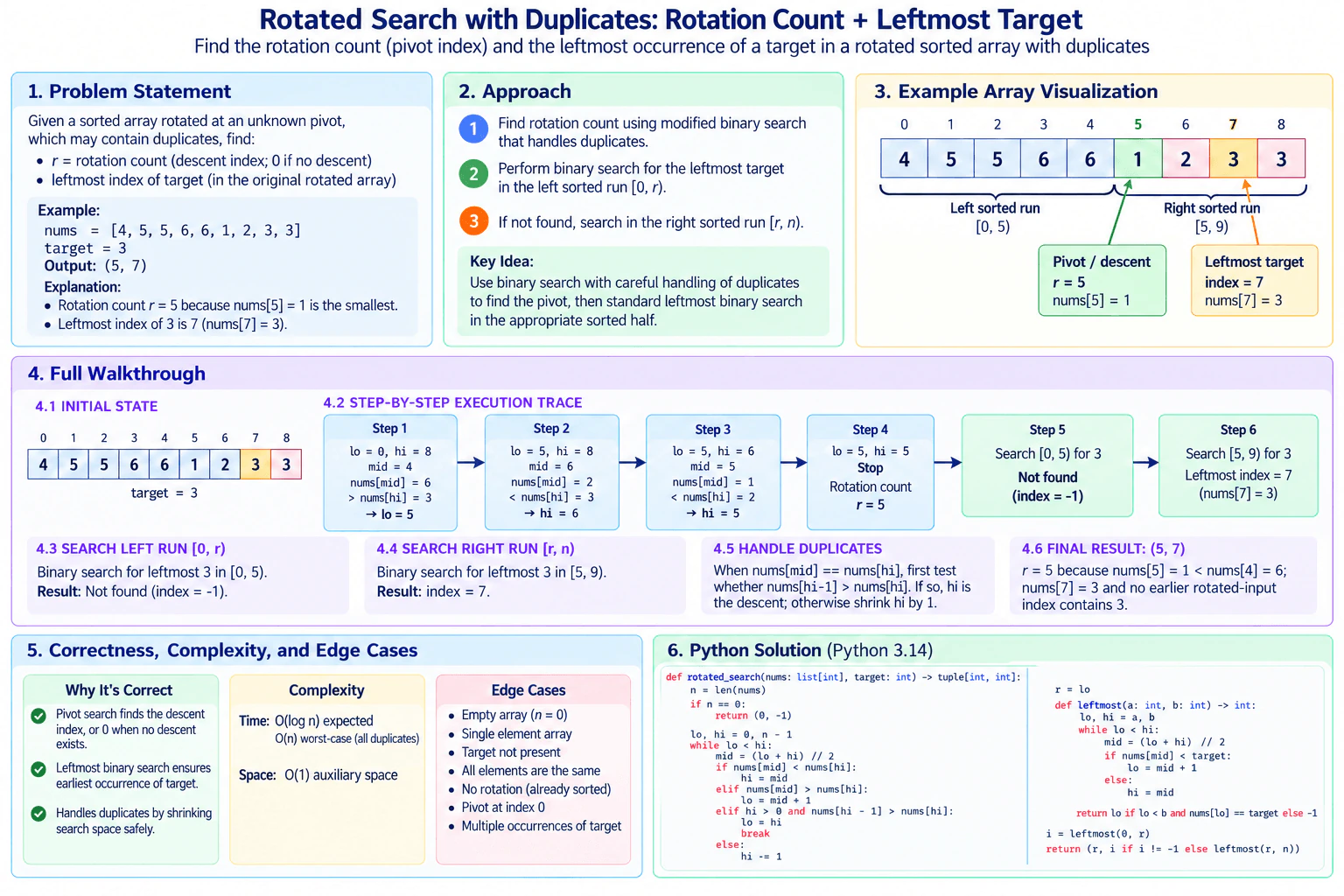
The array was originally sorted in nondecreasing order and may have been rotated. Duplicate values are allowed. We need to return two indices. The first is the rotation count: 0 when there is no descent, otherwise the smallest index r where nums[r] < nums[(r - 1) % n]. The second is the smallest index in the current rotated array whose value equals target, or -1 if the target is absent. The main idea is to find the rotation point first. That divides the array into two sorted runs, and each run can then be searched with binary search.
Useful Questions to Ask the Interviewer
Should an empty array return (0, -1)? Yes. That is the required behavior.
If target appears multiple times, should I return its smallest index in the rotated input? Yes.
Can duplicates appear around the rotation boundary? Yes. The pivot search must handle that ambiguity.
How to Explain It in an Interview
1. Understand the input and required output
nums contains 0 to 100,000 integers and is a rotation of a nondecreasing array. I must return (rotation_count, leftmost_target_index). For an empty input, I return (0, -1). For a nonempty array, the rotation count is 0 if no descent exists. Otherwise, it is the smallest index r where nums[r] < nums[(r - 1) % n]. The second result is the smallest rotated-input index containing target, or -1 if target is absent. I do not mutate nums and use only constant auxiliary space.
2. Find the rotation point
I keep an inclusive interval [lo, hi]. At each step, I compute mid = (lo + hi) // 2. If nums[mid] < nums[hi], the descent can be at mid or to its left, so I set hi = mid. If nums[mid] > nums[hi], the descent must be to the right of mid, so I set lo = mid + 1.
Duplicates need special handling. If nums[mid] == nums[hi], the comparison alone cannot tell which side contains the descent. Before shrinking the interval, I test whether nums[hi - 1] > nums[hi]. If so, hi itself is the descent, so I set lo = hi and stop the pivot search. Otherwise, hi is not the descent, so I safely shrink the interval with hi -= 1. Every update reduces the search interval or finishes the pivot search.
3. Walk through the diagram example
For nums = [4,5,5,6,6,1,2,3,3] and target = 3, start with lo = 0 and hi = 8.
Step 1: mid = 4. nums[4] = 6 and nums[8] = 3. Because 6 > 3, set lo = 5. The new state is lo = 5, hi = 8.
Step 2: mid = 6. nums[6] = 2 and nums[8] = 3. Because 2 < 3, set hi = 6. The new state is lo = 5, hi = 6.
Step 3: mid = 5. nums[5] = 1 and nums[6] = 2. Because 1 < 2, set hi = 5. The new state is lo = 5, hi = 5.
Now lo == hi, so the pivot search stops and r = 5. This is the descent because nums[5] = 1 < nums[4] = 6.
4. Search the two sorted runs
The pivot divides the array into the sorted runs [0, 5) and [5, 9). I use a lower-bound binary search to find the first target within a run.
I search [0, 5) first because every index there is smaller than every index in the second run. Target 3 is not present, so this search returns -1. I then search [5, 9). The first 3 in this run is at index 7, so the final result is (5, 7). This also verifies that nums[7] = 3 and no earlier rotated-input index contains 3.
5. Explain why the result is correct
During the pivot search, the true descent remains inside [lo, hi]. When nums[mid] is smaller or larger than nums[hi], sorted-order properties tell us which side cannot contain the descent. When the two values are equal, I first check whether hi itself is the descent. If it is not, removing that duplicate boundary position does not remove the true descent. After r is found, [0, r) and [r, n) are nondecreasing. Lower-bound search returns the first target in each run. Searching the lower-index run first guarantees the smallest rotated-input index overall.
6. Explain the Python implementation
The function first handles n ==
It then uses lo, hi, and mid to find r with the duplicate-aware pivot search. The nested leftmost(a, b) function performs lower-bound search on the half-open sorted interval [a, b). If nums[mid] < target, it moves lo to mid +
Otherwise, it keeps mid as a possible first target position by setting hi = mid. When the loop finishes, it verifies that the candidate really equals target. The main function searches [0, r) first and searches [r, n) only if the first run misses.
7. Explain complexity and edge cases
The expected running time is O(log n). The two target searches are binary searches, and the pivot search normally removes about half of the remaining interval. With many duplicates, however, nums[mid] may repeatedly equal nums[hi], forcing hi -= 1. Therefore the required worst-case running time is O(n). Auxiliary space is O(1).
Important edge cases are an empty array, a single-element array, an already sorted array, all-equal values, duplicates near the rotation boundary, an absent target, and multiple copies of target. For the question's already-sorted example nums = [1,2,3,4,5] with target = 3, there is no descent, so r = 0, and the leftmost target index is 2. The result is (0, 2).
Key Insight / Why This Solution Works
The key insight is that the rotation point divides the array into two nondecreasing runs. The pivot-search invariant is that the true descent index, or index 0 when no descent exists, remains inside the inclusive interval [lo, hi]. Comparing nums[mid] with nums[hi] normally removes one side. Equal values are ambiguous, so the algorithm first checks whether hi itself is the descent; otherwise it removes only that duplicate boundary position with hi -= 1. After finding r, lower-bound search finds the first target in each sorted run. Searching [0, r) before [r, n) guarantees the smallest index in the rotated input.
Code
defrotated_search(nums: list[int], target: int) -> tuple[int, int]:
n = len(nums)
# Empty input has no target position and uses rotation count 0.if n == 0:
return (0, -1)
# Keep the true descent inside the inclusive interval [lo, hi].
lo, hi = 0, n - 1while lo < hi:
mid = (lo + hi) // 2# If mid is below the right boundary value, the descent is at mid or left of it.if nums[mid] < nums[hi]:
hi = mid
# If mid is above the right boundary value, the descent is strictly right of mid.elif nums[mid] > nums[hi]:
lo = mid + 1# Equal values are ambiguous, so first check whether hi itself is the descent.elif hi > 0and nums[hi - 1] > nums[hi]:
lo = hi
break# hi is not the descent, so remove one duplicate boundary position.else:
hi -= 1# lo is the descent index, or 0 when no descent exists.
r = lo
defleftmost(a: int, b: int) -> int:
# Lower-bound search on the sorted half-open interval [a, b).
lo, hi = a, b
while lo < hi:
mid = (lo + hi) // 2# Values smaller than target cannot be the answer.if nums[mid] < target:
lo = mid + 1else:
# Keep mid because it may be the first target position.
hi = mid
# Verify the lower-bound candidate before returning it.return lo if lo < b and nums[lo] == target else -1# Search the smaller rotated-input indices first.
i = leftmost(0, r)
# Search the second sorted run only when the first run misses.return (r, i if i != -1else leftmost(r, n))
# Diagram example: rotation count 5 and leftmost target index 7.print(rotated_search([4, 5, 5, 6, 6, 1, 2, 3, 3], 3)) # (5, 7)
Time & Space Complexity
Let n be the number of elements. The expected running time is O(log n). The pivot search usually reduces the search range quickly, and each target search is a standard binary search. With many duplicates, nums[mid] can equal nums[hi] repeatedly, so the pivot search may shrink hi by only one position at a time. That makes the worst-case running time O(n). The algorithm uses O(1) auxiliary space because it keeps only a fixed number of index variables and does not copy or modify nums.
Where it is used
This pattern is useful when ordered data uses a wraparound boundary, such as circularly arranged sorted data or a sorted sequence whose logical starting position has moved. The duplicate-aware pivot technique is useful when repeated values make the normal rotated-array binary-search comparison ambiguous.
Why Interviewers Ask This
This problem tests whether you can adapt binary search when duplicates remove the usual ordering signal. It also tests careful index reasoning because the rotation count is a descent index and the target answer must be the smallest rotated-input index. An interviewer can evaluate whether you maintain a correct search invariant, guarantee progress in the equality case, implement lower-bound search correctly, handle edge cases, and explain expected versus worst-case complexity accurately.
Common interview mistakes
One common mistake is treating any occurrence of the minimum value as the rotation count. The required rotation count is the descent index, or 0 if no descent exists. Another mistake is using ordinary rotated-array binary search without handling nums[mid] == nums[hi]. A candidate may also shrink hi before checking whether hi itself is the descent. During target search, ordinary binary search may return a later duplicate instead of the leftmost one. Finally, searching [r, n) before [0, r) can return a valid target index that is not the smallest rotated-input index.
Interview tip
State two invariants before coding: the real pivot remains inside [lo, hi], and leftmost(a, b) is a lower-bound search on one sorted run. Then explain why [0, r) is searched before [r, n). Those points make the duplicate handling and the leftmost-index requirement easy to justify.
Interviewer may ask next
What changes if the target can appear many times and I need every matching index?
The pivot search does not change. After finding r, run a lower-bound search and an upper-bound search in each sorted run. The lower bound finds the first target and the upper bound finds the first value greater than target, so together they describe the complete target range in that run. Process [0, r) before [r, n) to preserve rotated-input order. Finding the boundaries takes expected O(log n) time after the pivot, while returning k indices costs O(k). Total expected time is O(log n + k), duplicate-heavy worst-case time is O(n + k), and auxiliary working space is O(1) apart from the O(k) returned output. The tradeoff is extra binary searches and output work.
Can we guarantee O(log n) time when duplicates are allowed?
No, not for arbitrary duplicate-heavy input with this comparison-based pivot search. When nums[mid] == nums[hi], the values may provide no information about which side contains the descent. After checking that hi itself is not the descent, the algorithm may only be able to do hi -= 1. That preserves correctness and guarantees progress, but an input with many duplicates can require O(n) such reductions. Expected time remains O(log n), worst-case time is O(n), auxiliary space is O(1), and the tradeoff is that allowing duplicates removes the strict ordering information needed for a guaranteed logarithmic pivot search.
13. What responsibilities do you expect to own in this Data Scientist role?BehavioralEasyMicrosoft
i Question Details
Base the answer on your understanding of the role and your real preparation rather than inventing team-specific facts. Explain the responsibilities you expect across problem definition, data quality, analysis, modeling, experimentation, communication, and production follow-through; identify which you can own immediately and which would require onboarding; and describe how you would clarify decision rights, success criteria, and collaboration boundaries with the manager.
Interview tip:
Use STAR to structure your answer: briefly explain the Situation and Task, make Action the most detailed part, and finish with the Result. For example, describe how you would take ownership across problem definition, data quality, analysis, modeling, experimentation, communication, and production follow through, while explaining what you can own immediately, what requires onboarding, and how you would clarify decision rights, success criteria, and collaboration boundaries with your manager.
Situation
In my preparation for this role, I have been thinking about the full responsibility of a Data Scientist rather than only the modeling work. I expect the role to start with understanding the business problem and continue through data quality, analysis, modeling, experimentation, communication, and follow through after a solution is used.
Task
I would expect to own the analytical work that turns an unclear question into a measurable problem and a useful decision. I would also be responsible for making sure the data is suitable, choosing an appropriate analytical or modeling approach, evaluating the result, explaining the findings clearly, and helping the team understand whether the solution is working as intended.
Action
I can immediately take ownership of clarifying the problem, defining useful success measures, exploring data, checking data quality, building and evaluating analytical approaches, and communicating results with stakeholders. I would begin by asking what decision the work needs to support, who will use the result, and how success will be judged. I would then inspect the available data for missing values, unusual patterns, inconsistent definitions, and possible bias because a strong model built on weak data would still lead to a weak decision. I would choose the simplest method that can answer the question reliably and explain why that method fits the problem. If experimentation is appropriate, I would help define the hypothesis, success measure, comparison approach, and interpretation of the result. I would also communicate uncertainty clearly instead of presenting every result as certain. For responsibilities that depend on internal systems, such as production pipelines, deployment tools, monitoring standards, privacy processes, or team specific model operations, I would expect some onboarding before owning them independently. Early with my manager, I would clarify which decisions I can make directly, which decisions need review, what success looks like, and where responsibilities are shared with engineering, product, analytics, or other partners. That would help me take ownership without creating gaps or duplicated work.
Result
My goal would be to become responsible for the full analytical outcome, not just for producing a model or report. By separating the areas I can own immediately from the areas that require context and onboarding, I can contribute early while learning the team's systems and expectations carefully. I have learned that clear ownership works best when success criteria, decision rights, and collaboration boundaries are discussed early rather than assumed.
Why Interviewers Ask This
Interviewers ask this question to understand whether the candidate sees Data Science as broader than model building. A strong answer shows ownership of the complete analytical process, good judgment about where onboarding is needed, and the ability to clarify responsibilities, success criteria, and collaboration with the manager and partner teams.
Interviewer may ask next
Which responsibilities would you want to clarify with your manager during your first few weeks?
I would clarify the decisions I can make independently, the results I am accountable for, the measures used to judge success, and where ownership is shared with engineering, product, analytics, or other partners. I would also ask which production, privacy, and monitoring processes I need to learn before taking full ownership of those areas.
How would you handle a situation where ownership between Data Science and another team is unclear?
I would first clarify the outcome we are trying to achieve and then identify the specific decisions and tasks that need an owner. I would discuss those responsibilities directly with the partner team and my manager, document the agreed boundaries, and make sure there is a clear owner for each important step. That reduces duplicated work and prevents important tasks from being missed.
14. Tell me about a substantial data-science project you completed independently.BehavioralMediumMicrosoft
i Question Details
Choose a real project in which you personally owned most of the execution. Define the user or decision, constraints, data, method, validation, and deliverable; distinguish independent ownership from working without feedback; and explain the checkpoints, reviews, or documentation you created to reduce blind spots. State the outcome, a limitation you discovered, and when you should have involved another person sooner.
Interview tip:
Use STAR to structure your answer: briefly explain the Situation and Task, make Action the most detailed part, and finish with the Result. For example, describe Choose a real project in which you personally owned most of the execution. Define the user or decision, constraints, data, method, validation, and deliverable; distinguish independent ownership from working without feedback; and explain the checkpoints, reviews, or documentation you created to reduce blind spots. State the outcome, a limitation you discovered, and when you should have involved another person sooner.
Situation
In my last role, I worked on a data science project where an operations team needed a better way to identify cases that were most likely to require attention. The existing process depended heavily on manual review, so people spent time examining many cases that did not need immediate action. I owned most of the project from understanding the decision through delivering the analysis and model output.
Task
My responsibility was to turn historical operational data into a reliable prioritization method that the team could actually use. I needed to understand what information was available, define a useful prediction target, choose an appropriate method, validate it carefully, and explain the result in simple terms. I was working independently on the execution, but I did not treat that as working without feedback. I planned checkpoints with the people who understood the process so I could confirm assumptions before making important decisions.
Action
I first met with the main users of the output to understand what decision they were trying to make. That helped me avoid starting with a model before I understood the real problem. I then reviewed the available historical data and documented the meaning, quality, and timing of the important fields. I checked for missing values, inconsistent definitions, and information that would only become available after the decision point. That last check mattered because using future information would make validation look stronger than the model would perform in real use. I created a simple baseline first so I would have a clear reference point for judging whether a more complex method added useful value. I then prepared features from information that would genuinely be available when a case was scored and tested a more flexible predictive model. For validation, I separated training and evaluation data based on time rather than using a random split because I wanted the test to better represent how the model would be used on future cases. I reviewed both overall model quality and the cases the model ranked incorrectly. I also showed intermediate results to an operations stakeholder and asked whether the patterns made sense from a process perspective. I documented the data assumptions, feature definitions, validation method, known limitations, and expected use of the output so another person could review my reasoning. One limitation I discovered was that some important operational context was not captured consistently in the historical data. I initially spent too long trying to solve that issue through data analysis alone. I should have involved the process owner sooner because that person could explain why the field was inconsistent and whether it could be improved at the source.
Result
I delivered a prioritization approach that gave the operations team a more consistent way to focus its review effort and made the reasoning behind the model understandable to the people using it. The project also taught me that independent ownership does not mean avoiding collaboration. I can own the analysis, decisions, validation, and delivery while still creating deliberate review points. I also learned to involve domain experts earlier when a limitation comes from how data is created rather than from the modeling method itself.
Why Interviewers Ask This
Interviewers ask this question to understand whether a candidate can take substantial data science work from an unclear problem to a useful and validated result with limited supervision. A strong answer shows analytical ownership, sound judgment, careful validation, communication with users, awareness of limitations, and the ability to seek feedback at the right points without giving away responsibility for the work.
Interviewer may ask next
How did you make sure you were not missing important issues while working independently?
I created specific review points instead of waiting until the end. I confirmed the decision and prediction target with the users before modeling, reviewed intermediate patterns with someone who understood the process, and documented my assumptions and validation choices so they could be challenged. That gave me independent ownership of the work while still reducing the risk of building around an incorrect assumption.
What would you do differently if you handled the same project again?
I would involve the process owner earlier when I found that an important field was recorded inconsistently. I first treated it mainly as a data quality problem that I could investigate myself. I later learned that the inconsistency came from the underlying operational process. Bringing in the right person sooner would have helped me understand the limitation faster and spend more time on the parts of the analysis I could meaningfully improve.
15. Tell me about a time unreliable email threatened time-critical coordination.BehavioralHardMicrosoft
i Question Details
Use a real high-stakes scheduling or delivery situation in which messages were delayed, rejected, or uncertain. Explain the deadline, parties, evidence that the channel was unreliable, and the actions you took during the first 72 hours. Describe alternate channels, confirmation and escalation rules, written records, privacy considerations, and contingency ownership. State the outcome and the durable communication control you established.
Interview tip:
Use STAR to structure your answer: briefly explain the Situation and Task, make Action the most detailed part, and finish with the Result. For example, describe Use a real high-stakes scheduling or delivery situation in which messages were delayed, rejected, or uncertain. Explain the deadline, parties, evidence that the channel was unreliable, and the actions you took during the first 72 hours. Describe alternate channels, confirmation and escalation rules, written records, privacy considerations, and contingency ownership. State the outcome and the durable communication control you established.
Situation
During a previous data science project, my team was preparing an analysis that several stakeholders needed before a time sensitive delivery decision. The work itself was on track, but coordination became risky because important email messages were arriving late or being rejected. Some people received updates while others did not, so I could no longer treat a sent email as proof that the right person had received the information.
Task
I was responsible for the analysis and for making sure the people who depended on it understood the latest status, remaining questions, and delivery plan. My priority was to protect the deadline without creating confusion or exposing information through inappropriate communication channels. I also needed a clear way to know when an important message had actually been acknowledged.
Action
During the first day, I confirmed that the problem was the communication channel rather than a lack of response from stakeholders. I compared sent messages with delivery notices and direct confirmations and found that email receipt was inconsistent. I then separated routine updates from messages that could affect the deadline. For critical items, I used an approved alternate channel to contact the responsible person and asked for a simple confirmation that the message had been received. I kept the detailed analysis and any sensitive information in the approved shared location rather than copying it into alternate messages. The alternate channel only pointed people to the information they were authorized to access. I also created a written coordination record with each open decision, its owner, the time it was communicated, whether it had been confirmed, and the next action. This gave everyone one reliable view of the situation. On the second day, I established an escalation rule. If a critical request was not confirmed within the time available for that decision, I contacted the backup owner instead of repeatedly sending email. I made the escalation visible in the written record so there was no confusion about responsibility. On the third day, I reviewed every remaining dependency with the team and assigned a contingency owner for anything that could still block delivery. I continued doing the analytical work myself, while the other owners handled the operational decisions that belonged to them. This approach mattered because I was not trying to solve unreliable email with more email. I was creating confirmation, ownership, and a second communication path around the unreliable channel.
Result
The required coordination was completed in time for the analysis to support the planned delivery, and we avoided relying on unconfirmed messages for critical decisions. The written record also reduced uncertainty because people could see the current owner and status without searching through email threads. Afterward, we kept the confirmation and escalation process for time sensitive work. I learned that sending information is not the same as communicating it. For important dependencies, I now define the confirmation path, backup channel, and owner before communication problems become urgent.
Why Interviewers Ask This
Interviewers ask this question to evaluate whether a candidate can stay organized and make sound decisions when a normal communication channel becomes unreliable. A strong answer shows ownership, careful escalation, respect for privacy, clear records, and the ability to protect a deadline without creating unnecessary confusion.
Interviewer may ask next
Why did you create a separate written coordination record instead of relying on messages in the alternate channel?
I wanted one clear source for decisions, owners, confirmations, and next actions. Messages in different channels could still become fragmented. The written record made the current state visible and gave us a reliable history without moving sensitive analytical content into channels where it did not belong.
What would you do differently if you faced the same situation again?
I would define the backup communication channel and confirmation rule at the start of any time sensitive project instead of introducing them after email became unreliable. I would also assign backup owners for critical dependencies earlier. That would make the response faster while keeping the same privacy and documentation controls.
Disclaimer: This interview guide is for educational and informational purposes only. It is designed to help readers prepare, but it does not guarantee any interview result, hiring decision, offer, or outcome. Interview questions, hiring criteria, and preferred answers can vary by employer, interviewer, industry, location, and time. All answers, examples, and explanations in this guide are suggested examples for interview preparation, not definitive answers or instructions for professional practice. They are based on research and judgment, are provided without warranties of any kind, and should be adapted to the question, role, and applicable laws and professional requirements. Diagrams are simplified illustrations intended to highlight the main concepts and their relationships; actual situations, systems, and practices may be more complex. Alternative approaches may be equally valid or better suited to a particular question, context, or interviewer. To the fullest extent permitted by applicable law, the contributors and publisher are not liable for decisions made, actions taken, or losses incurred based on this guide.
State Laws and Professional Responsibilities: Laws and requirements governing an occupation vary by state and jurisdiction. You are responsible for checking the current laws, licensing requirements, and scope-of-practice rules that apply to your location and role, and for ensuring that your answers and actions comply with them. Adapt examples in this guide to those requirements. This guide is not legal advice.
Company Notice: This guide is an independent educational resource and is not affiliated with, endorsed by, sponsored by, or approved by the company named in this guide. Company names identify reported interview experiences or the employer context of clearly labeled original practice exercises. Interview practices can change without notice, and inclusion of company-specific content does not mean these questions are official, complete, or guaranteed to be asked. To the fullest extent permitted by law, the author, contributors, and publisher are not responsible for outcomes related to use of this material.
Content Accuracy and Verification: To the fullest extent permitted by applicable law, we do not represent or warrant that interview guides, questions, answers, examples, or diagrams are accurate, complete, current, error-free, or suitable for any particular purpose. You are responsible for independently reviewing and verifying the information before relying on it.