This interview guide is for educational and informational purposes only. It is designed to help readers prepare, but it does not guarantee any interview result, hiring decision, offer, or outcome. Interview questions, hiring criteria, and preferred answers can vary by employer, interviewer, industry, location, and time. All answers, examples, and explanations in this guide are suggested examples for interview preparation, not definitive answers or instructions for professional practice. They are based on research and judgment, are provided without warranties of any kind, and should be adapted to the question, role, and applicable laws and professional requirements. Diagrams are simplified illustrations intended to highlight the main concepts and their relationships; actual situations, systems, and practices may be more complex. Alternative approaches may be equally valid or better suited to a particular question, context, or interviewer. To the fullest extent permitted by applicable law, the contributors and publisher are not liable for decisions made, actions taken, or losses incurred based on this guide.
State Laws and Professional Responsibilities
Laws and requirements governing an occupation vary by state and jurisdiction. You are responsible for checking the current laws, licensing requirements, and scope-of-practice rules that apply to your location and role, and for ensuring that your answers and actions comply with them. Adapt examples in this guide to those requirements. This guide is not legal advice.
Identity, Image, and Privacy Notice
To respect individual privacy, some names, profile photographs, avatars, biographical details, and other identifying information displayed in this guide may be replaced with pseudonyms, licensed stock images, illustrative avatars, composite images, or representative descriptions. Unless a person is expressly identified as an actual contributor, a displayed name, image, or profile should not be understood as depicting or identifying a specific candidate, interviewer, employee, or other real individual. These representations are provided for editorial and illustrative purposes only and do not imply endorsement, employment, participation, or affiliation with this guide or any company mentioned in it. Any resemblance to an actual person is coincidental.
Company Notice
This guide is an independent educational resource and is not affiliated with, endorsed by, sponsored by, or approved by the company named in this guide. Company names identify reported interview experiences or the employer context of clearly labeled original practice exercises. Interview practices can change without notice, and inclusion of company-specific content does not mean these questions are official, complete, or guaranteed to be asked. To the fullest extent permitted by law, the author, contributors, and publisher are not responsible for outcomes related to use of this material.
Content Accuracy and Verification
To the fullest extent permitted by applicable law, we do not represent or warrant that interview guides, questions, answers, examples, or diagrams are accurate, complete, current, error-free, or suitable for any particular purpose. You are responsible for independently reviewing and verifying the information before relying on it.
Questions or comments?
Contact us for general questions, or share feedback, technical corrections, and comments with the community.
11. Compute minimum broadcast latency from one city to every city.CodingMediumNetflix
i Question Details
Using Python 3.14, implement def minimum_broadcast_latencies(n: int, links: list[list[int]], source: int) -> list[int]. Cities are numbered 0 through n-1; 1 <= n <= 200_000; 0 <= len(links) <= 300_000; and each row [u,v,ping] is an undirected link between valid cities with positive integer latency at most 10^9. Parallel links are allowed. Return a length-n list whose entry is the minimum total latency from source, using -1 for an unreachable city. Do not mutate inputs, use only the standard library, and target O((n+m) log n) time and O(n+m) space. Valid input is guaranteed. Examples: minimum_broadcast_latencies(4, [[0,1,3],[0,2,2],[2,3,4],[1,3,5]], 0) returns [0,3,2,6], and minimum_broadcast_latencies(3, [], 1) returns [-1,0,-1].
Short Interview Answer (30-60 seconds)
I would use Dijkstra’s algorithm with a min-heap because every link has a positive latency. First, I build an undirected neighbor map and keep only the smallest ping for parallel links. I set the source distance to zero and repeatedly pop the city with the smallest current distance. I relax each neighbor when I find a shorter route. The overall target time is O((n + m) log n), with expected O(m) preprocessing, and the auxiliary space is O(n + m).
We have n cities connected by links. Each link has a positive travel delay called ping. We start from one source city. We need the smallest total delay needed to reach every city from that source. If a city cannot be reached, its answer must be -1. Links work in both directions. There can also be several links between the same two cities, so we keep the one with the smallest ping. We then find the shortest total delay to every reachable city without changing the input lists.
Useful Questions to Ask the Interviewer
Are all link latencies positive? Yes. This makes Dijkstra’s algorithm valid.
Can there be parallel links between the same two cities? Yes. We can keep only the smallest ping between each pair.
What should I return for a city that cannot be reached? Return -1 for that city.
Should the input lists remain unchanged? Yes. The solution builds its own graph and does not mutate them.
How to Explain It in an Interview
1. Understand the input and required output
The function receives n, links, and source. Cities are numbered from 0 through n - 1. Each link is [u, v, ping]. It is undirected, so we can travel from u to v or from v to u with the same ping. The result has one entry per city. Each entry is the minimum total latency from source. An unreachable city gets -1.
2. Choose the algorithm and data structure
All pings are positive, so Dijkstra’s shortest-path algorithm fits this problem. I use a min-heap. Each heap item is (distance, city), so the smallest candidate distance comes out first. I also build a neighbor dictionary for each city. It maps neighbor -> minimum ping. If several links connect the same pair, I store only the smallest ping. Each improving relaxation pushes a new heap entry. An older entry may remain in the heap, so the code skips it when it is later popped and no longer matches dist[u].
3. Initialize the state
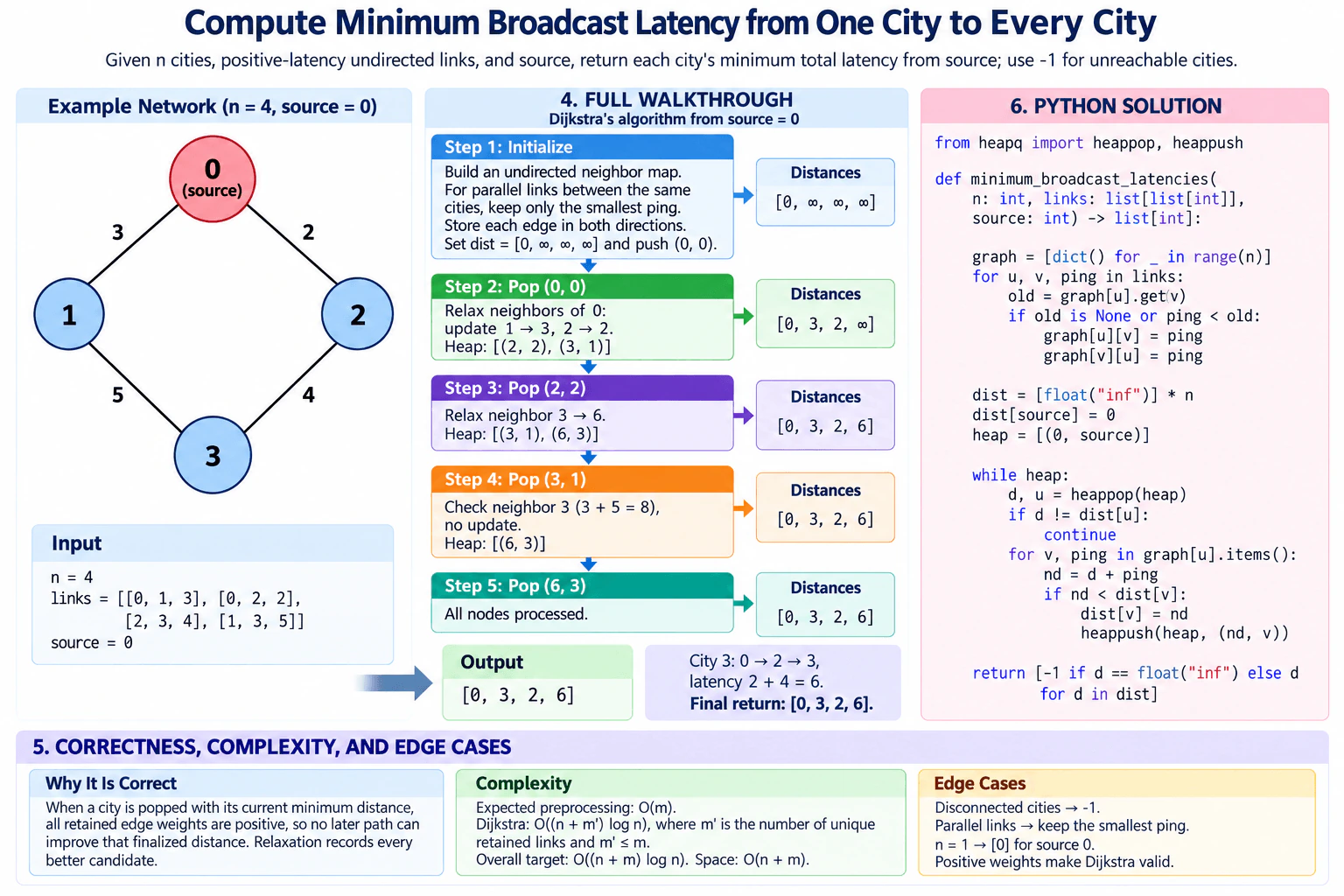
For the example, n = 4, links = [[0,1,3],[0,2,2],[2,3,4],[1,3,5]], and source = 0. After building the undirected neighbor maps, the distance list starts as [0, infinity, infinity, infinity]. The source has distance 0 because no travel is needed to reach itself. The heap starts with (0, 0).
4. Walk through the example
Step 1: The graph is ready. We keep one minimum-ping entry for each neighboring city. The distance state is [0, infinity, infinity, infinity], and the heap contains (0, 0).
Step 2: Pop (0, 0). City 0 has two neighbors. Reaching city 1 costs 0 + 3 = 3, so dist[1] becomes 3. Reaching city 2 costs 0 + 2 = 2, so dist[2] becomes 2. The distance list becomes [0, 3, 2, infinity]. The heap contains (2, 2) and (3, 1).
Step 3: Pop (2, 2). From city 2, the route to city 3 costs 2 + 4 = 6. This improves city 3 from infinity to 6. The distance list becomes [0, 3, 2, 6]. The heap contains (3, 1) and (6, 3).
Step 4: Pop (3, 1). Going from city 1 to city 3 would cost 3 + 5 = 8. The current distance to city 3 is already 6, so there is no update. The heap contains (6, 3).
Step 5: Pop (6, 3). There is no shorter route to any neighbor. The heap becomes empty, so processing ends. The final distances are [0, 3, 2, 6]. City 3 is reached by 0 -> 2 -> 3 with latency 2 + 4 = 6.
5. Explain why the result is correct
The min-heap always exposes the smallest candidate distance currently stored. When a city is popped with a distance equal to its current dist value, Dijkstra can safely process that distance because every retained edge weight is positive. Relaxation checks whether going through that city gives a neighbor a smaller distance and records every improvement. If an older heap entry is popped after a better route was already found, d != dist[u] identifies it as stale and the code skips it.
6. Explain the Python implementation
The code first creates one dictionary per city. Each dictionary maps a neighboring city to the smallest ping seen for that pair. Because links are undirected, the code writes the same ping in both directions. It then creates the distance list and starts a min-heap with the source. The main loop pops the smallest candidate. A stale entry is ignored. For every retained neighbor, the code calculates nd = d + ping. If nd is smaller, it updates dist[v] and pushes the new candidate. At the end, infinity is converted to -1.
7. Explain complexity and edge cases
Building the neighbor maps takes expected O(m) time because Python dictionary lookup and insertion are O(1) on average. Let m' be the number of unique retained undirected links after parallel links are collapsed. Dijkstra takes O((n + m') log n), and m' is at most m, so this satisfies the requested O((n + m) log n) target. Extra memory is O(n + m). Important cases are disconnected cities, parallel links, one city, and positive edge weights. For example, minimum_broadcast_latencies(3, [], 1) returns [-1, 0, -1].
Key Insight / Why This Solution Works
Treat the cities as a weighted undirected graph and run Dijkstra’s algorithm from source. Before the shortest-path search, each city uses a dictionary that maps neighbor -> minimum ping. If parallel links exist, only the smallest ping is retained. The min-heap stores (candidate distance, city), so the smallest known candidate is processed first. The central invariant is that dist[v] stores the smallest distance discovered so far for city v. A relaxation changes it only when a strictly shorter route is found. Each improvement can add a new heap entry, and stale older entries are skipped when popped. Positive edge weights make Dijkstra valid.
Code
from heapq import heappop, heappush
defminimum_broadcast_latencies(n: int, links: list[list[int]], source: int) -> list[int]:
# Build a new undirected neighbor map, so the input is not mutated.# For parallel links, keep only the smallest ping for that city pair.
graph = [dict() for _ inrange(n)]
for u, v, ping in links:
old = graph[u].get(v)
if old isNoneor ping < old:
graph[u][v] = ping
graph[v][u] = ping
# Infinity means that a city has not been reached yet.# The source starts at zero because reaching itself has no latency.
dist = [float("inf")] * n
dist[source] = 0# heapq is a min-heap. Each entry is (candidate distance, city).
heap = [(0, source)]
while heap:
d, u = heappop(heap)
# A shorter route may have created a newer heap entry for this city.# Ignore this entry if it no longer matches the current best distance.if d != dist[u]:
continue# Try every retained neighboring link from the current city.for v, ping in graph[u].items():
nd = d + ping
# Record and queue the route only when it is strictly shorter.if nd < dist[v]:
dist[v] = nd
heappush(heap, (nd, v))
# Convert every city that was never reached to the required -1 value.return [-1if d == float("inf") else d for d in dist]
Time & Space Complexity
Let n be the number of cities and m be the number of input links. Building the neighbor dictionaries takes expected O(m) time because Python dictionary lookup and insertion are O(1) on average. Let m' be the number of unique links left after parallel links are reduced to their smallest ping. Dijkstra takes O((n + m') log n). Since m' <= m, this meets the requested O((n + m) log n) target. The graph, distance list, and heap together use O(n + m) auxiliary space.
Where it is used
This pattern is useful when we need minimum total cost through a network with non-negative edge weights. Examples include network latency, route planning, service-to-service communication paths, and finding the cheapest accumulated cost from one starting node to many destinations.
Why Interviewers Ask This
This problem tests whether the candidate recognizes weighted single-source shortest paths and chooses Dijkstra instead of ordinary BFS. It also checks graph representation, min-heap usage, edge relaxation, stale-entry handling, and careful treatment of parallel undirected links. The large constraints test whether the candidate avoids a quadratic approach. The interviewer can also evaluate whether the candidate explains correctness, unreachable nodes, and the requested O((n + m) log n) time with O(n + m) extra space accurately.
Common interview mistakes
A common mistake is using ordinary BFS even though the links can have different weights. Another is forgetting that each link is undirected and must be represented in both directions. Candidates may mishandle parallel links instead of retaining the smallest ping for this design. Another mistake is failing to recognize stale heap entries, which can cause unnecessary repeated work. It is also easy to forget to convert unreachable infinity values to -1 or to state a complexity that ignores the heap, graph storage, or expected dictionary preprocessing.
Interview tip
State the invariant before coding: dist stores the best distance found so far, and the min-heap gives the next smallest candidate. Then show one exact relaxation, such as city 2 giving city 3 a distance of 2 + 4 = 6. This connects the reasoning, walkthrough, and code.
Interviewer may ask next
What would change if some undirected links could have negative latency?
Dijkstra would no longer be valid. In an undirected graph, a reachable negative edge also creates a reachable negative cycle because we can traverse that edge in both directions repeatedly and keep reducing the total cost. That means finite minimum latencies do not exist for vertices affected by that cycle. A negative-edge-capable method such as Bellman-Ford can be used to detect a reachable negative cycle. Its time complexity is O(nm), with O(n) distance storage in addition to the graph representation. The tradeoff is much slower processing in exchange for detecting negative-weight behavior safely.
How would you return one actual minimum-latency path to every reachable city?
Keep the same Dijkstra algorithm and add a parent array. Whenever nd < dist[v], set parent[v] = u at the same time that dist[v] is updated. After Dijkstra finishes, follow parent pointers backward from a destination to source and reverse that sequence. Correctness is preserved because each parent records the relaxation that produced the current best distance. The shortest-path search keeps the same O((n + m) log n) target time and O(n + m) space. Reconstructing one path takes O(k), where k is the number of cities on that path.
12. Simulate a TTL cache with least-recently-used eviction.CodingHardNetflix
i Question Details
Using Python 3.14, implement def run_cache(operations: list[list[object]], capacity: int) -> list[object]. 1 <= capacity <= 100,000 and there are at most 200,000 operations with nondecreasing integer times. Supported rows are ["put",time,key,value,ttl], ["get",time,key], ["delete",time,key], and ["size",time]; keys are strings, values are non-boolean integers, and ttl is a nonnegative integer. A positive TTL expires at put_time + ttl, and an entry is already expired when an operation time is equal to that deadline; TTL 0 never expires. Purge expired entries before each operation. Successful gets and puts make a key most recently used; deletes remove it; and after a put exceeding capacity, evict the least recently used live key. Return None for put/delete, value or None for get, and live count for size. Raise ValueError for malformed rows, use only the standard library, and target O(log n) or expected O(1) amortized operations. Example: capacity 2 with operations [["put",0,"a",10,5],["put",1,"b",20,0],["get",2,"a"],["get",5,"a"],["put",6,"c",30,0],["delete",7,"b"],["size",8]] returns [None,None,10,None,None,None,1].
Short Interview Answer (30-60 seconds)
I would use an OrderedDict to keep live keys in LRU-to-MRU order and a min-heap for expiration deadlines. Before every operation, I purge heap records whose deadline is at or before the current time and ignore stale records. Successful puts and gets move the key to MRU. After a put, I evict the LRU key if capacity is exceeded. Heap work gives O(log n) amortized time per operation, while cache lookup and reorder are expected O(1). Auxiliary space is O(n) plus the live cache.
The function simulates a cache where entries can disappear for two reasons. A key can expire after its TTL, or it can be removed because the cache is full and it is the least recently used key. Expired entries must be removed before every command. A successful get or put makes that key the most recently used. The function returns one result for every command. The solution uses one structure for usage order and another structure for expiration order.
Useful Questions to Ask the Interviewer
Should invalid capacity or more than 200,000 operations also raise ValueError, in addition to malformed operation rows?
When an existing key is updated, may its old expiration record remain in the heap and be ignored later as stale?
Does TTL 0 always mean that the key never expires? The stated contract says yes.
How to Explain It in an Interview
1. Understand the input and required output
The function is run_cache(operations, capacity). Capacity is between 1 and 100,000. There are at most 200,000 operations, and operation times are nondecreasing integers.
There are four supported row types. put stores or updates a key. get reads a live key. delete removes a key. size returns the number of live keys. A put or delete returns None. A get returns the stored value or None. A size operation returns the current live count.
A positive TTL expires at put_time + ttl. If an operation happens exactly at that deadline, the entry is already expired. TTL 0 means the entry never expires.
2. Choose the data structures
I use an OrderedDict for live cache entries. Its order is always LRU to MRU. The leftmost key is the least recently used key. The rightmost key is the most recently used key. Each key stores (value, deadline). A deadline of None means the key never expires.
I also use a heapq min-heap. Each finite-TTL put adds (deadline, key). The earliest deadline is at the top. Old heap records can remain after updates, deletes, or capacity eviction. When one is popped, I compare its deadline with the key's current stored deadline. If they do not match, the heap record is stale and I ignore it.
The main invariant is that after the purge step, every live cache entry has no deadline or has a deadline greater than the current operation time. The OrderedDict is also always ordered from LRU to MRU.
3. Process each operation in the required order
First, validate the row. Then purge every expired heap record whose deadline is less than or equal to the current time.
For put, compute the new deadline. Store or update the key. Move it to MRU. If the TTL is positive, push the finite deadline into the heap. If the cache now exceeds capacity, remove the LRU key. Append None.
For get, return None if the key is absent. Otherwise, move the key to MRU and return its value.
For delete, remove the key if it exists and append None.
For size, append len(cache).
4. Walk through the example
The capacity is 2.
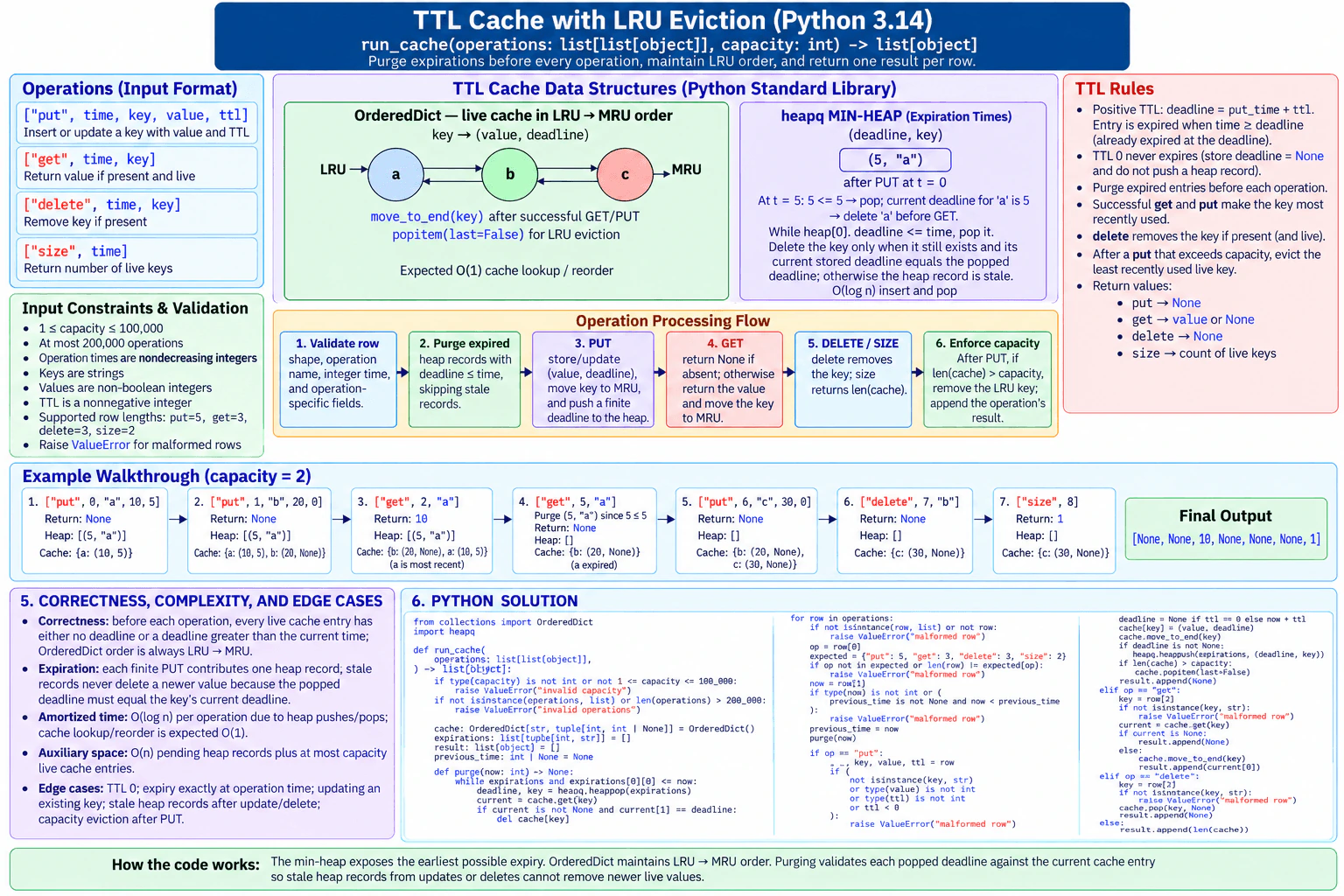
At time 0, put("a", 10, 5) stores a with deadline 5. The heap contains (5, "a"). The cache contains a. The result is None.
At time 1, put("b", 20, 0) stores b with no deadline. The cache order is [a, b], from LRU to MRU. The result is None.
At time 2, get("a") finds a alive. It returns 10 and moves a to MRU. The cache becomes [b, a].
At time 5, the heap record (5, "a") is due because 5 <= 5. The current deadline of a is also 5, so a is deleted before the get runs. get("a") returns None. The cache is [b].
At time 6, put("c", 30, 0) stores c with no deadline and makes it MRU. The cache becomes [b, c]. Capacity is not exceeded. The result is None.
At time 7, delete("b") removes b. The cache becomes [c]. The result is None.
At time 8, size returns 1. The final result is [None, None, 10, None, None, None, 1].
5. Explain why the result is correct
Expired entries are removed before every operation, so an expired key cannot be returned by get or counted by size. Comparing a popped heap deadline with the key's current deadline prevents an old heap record from deleting a newer version of that key. Successful gets and puts move their keys to MRU. Therefore the leftmost live key is always the correct LRU key to remove when a put exceeds capacity.
6. Explain the Python implementation
OrderedDict.move_to_end(key) moves a successful get or put to the MRU end. popitem(last=False) removes the LRU key. The min-heap stores finite expiration records. The purge helper repeatedly pops deadlines that are due and verifies that each popped record still matches the current cache entry before deleting anything.
The main loop validates each row, checks that time does not move backward, purges expired entries first, performs the requested operation, updates LRU order when required, enforces capacity after put, and appends exactly one result.
7. Explain complexity and edge cases
Let n be the number of expiration records that may be pending in the heap. Each finite-TTL put performs one heap push, and each heap record can be popped at most once. Heap push and pop operations cost O(log n), so the heap work is O(log n) amortized per operation. OrderedDict lookup, deletion, and reordering are expected O(1).
The heap can contain stale records, so its memory can grow to O(n) over the operation sequence. The live OrderedDict stores at most capacity keys. Important cases are TTL 0, expiry exactly at the operation time, updating an existing key, stale heap records after update or delete, and LRU eviction after a put.
Key Insight / Why This Solution Works
The key idea is to separate two different orderings. Expiration order is handled by a min-heap because we always need the earliest deadline first. Usage order is handled by an OrderedDict because successful gets and puts must move to the MRU end, while over-capacity puts must remove the LRU end. Each live key stores (value, deadline), and each finite TTL adds (deadline, key) to the heap. The invariant is that after purging, every live entry is unexpired and the OrderedDict is exactly LRU to MRU. Stale heap records are safe because a popped record deletes a key only when its deadline still matches the key's current stored deadline.
Code
from collections import OrderedDict
import heapq
defrun_cache(
operations: list[list[object]],
capacity: int,
) -> list[object]:
# Validate the top-level limits before processing operations.iftype(capacity) isnotintornot1 <= capacity <= 100_000:
raise ValueError("invalid capacity")
ifnotisinstance(operations, list) orlen(operations) > 200_000:
raise ValueError("invalid operations")
# Keep live keys from LRU on the left to MRU on the right.# Each entry stores (value, deadline). None means no expiration.
cache: OrderedDict[str, tuple[int, int | None]] = OrderedDict()
# Store finite expiration records in a min-heap.# Old records may remain after updates or deletes and become stale.
expirations: list[tuple[int, str]] = []
# Append exactly one output for every input operation.
result: list[object] = []
previous_time: int | None = Nonedefpurge(now: int) -> None:
# Entries are already expired when now equals their deadline.while expirations and expirations[0][0] <= now:
deadline, key = heapq.heappop(expirations)
current = cache.get(key)
# Delete only when this heap record still matches the live entry.# A different deadline means the record is stale after an update.if current isnotNoneand current[1] == deadline:
del cache[key]
for row in operations:
# Every operation must be a non-empty list with a supported length.ifnotisinstance(row, list) ornot row:
raise ValueError("malformed row")
op = row[0]
expected_lengths = {"put": 5, "get": 3, "delete": 3, "size": 2}
if op notin expected_lengths orlen(row) != expected_lengths[op]:
raise ValueError("malformed row")
now = row[1]
# Times must be integers and must never decrease.iftype(now) isnotintor (previous_time isnotNoneand now < previous_time):
raise ValueError("malformed row")
previous_time = now
# Purge expired entries before the current operation runs.
purge(now)
if op == "put":
_, _, key, value, ttl = row
# Reject bool values because bool is a subclass of int in Python.if (
notisinstance(key, str)
ortype(value) isnotintortype(ttl) isnotintor ttl < 0
):
raise ValueError("malformed row")
# TTL 0 means no expiration. Positive TTL expires at now + ttl.
deadline = Noneif ttl == 0else now + ttl
cache[key] = (value, deadline)
# A successful put makes this key the most recently used key.
cache.move_to_end(key)
# Only finite deadlines need expiration-heap records.if deadline isnotNone:
heapq.heappush(expirations, (deadline, key))
# Capacity is enforced after the put, using the current LRU key.iflen(cache) > capacity:
cache.popitem(last=False)
result.append(None)
elif op == "get":
key = row[2]
ifnotisinstance(key, str):
raise ValueError("malformed row")
current = cache.get(key)
if current isNone:
result.append(None)
else:
# A successful get makes this key the most recently used key.
cache.move_to_end(key)
result.append(current[0])
elif op == "delete":
key = row[2]
ifnotisinstance(key, str):
raise ValueError("malformed row")
# Deleting a missing key is allowed and still returns None.
cache.pop(key, None)
result.append(None)
else:
# Purging already happened, so this is the number of live keys.
result.append(len(cache))
return result
if __name__ == "__main__":
# Run the exact example used in the question and diagram.
example_operations = [
["put", 0, "a", 10, 5],
["put", 1, "b", 20, 0],
["get", 2, "a"],
["get", 5, "a"],
["put", 6, "c", 30, 0],
["delete", 7, "b"],
["size", 8],
]
# Expiration at t=5 makes the second get return None.print(run_cache(example_operations, 2))
# [None, None, 10, None, None, None, 1]
Time & Space Complexity
Let n be the number of pending expiration records. A finite-TTL put pushes one record into the min-heap, which costs O(log n). Purging may pop several records during one operation, but each heap record can be popped only once over the full run. This makes the heap work O(log n) amortized per operation. OrderedDict lookup, deletion, and reordering are expected O(1). The heap may keep stale records, so it can use O(n) extra space. The live cache itself stores at most capacity entries.
Where it is used
This pattern is useful in in-memory caches, session stores, temporary metadata stores, request deduplication caches, and similar systems where entries can expire by time but also need LRU eviction when memory is limited. The heap handles time-based expiration, while the OrderedDict handles recent-use order.
Why Interviewers Ask This
This problem tests whether you can combine two different ordering requirements without confusing them. You need expiration order by time and eviction order by recent use. It also checks whether you understand stale heap records, exact TTL boundary behavior, LRU updates, input validation, and Python data-structure costs. A strong answer keeps the processing order precise and explains why the heap and OrderedDict work together safely.
Common interview mistakes
A common mistake is purging after the operation instead of before it. That incorrectly allows a key to survive at its exact expiration deadline. Another mistake is treating TTL 0 as immediate expiration instead of never expiring. Candidates may forget that old heap records can become stale after updates, deletes, or capacity eviction. It is also easy to forget to move a key to MRU after a successful get or put. Another error is enforcing capacity before the put instead of after the put makes the cache too large. Finally, Python hash-based operations should be described as expected O(1), not guaranteed worst-case O(1).
Interview tip
State the two invariants before coding: after every purge, all remaining cache entries are live, and the OrderedDict is ordered from LRU to MRU. Then make every operation preserve those two facts.
Interviewer may ask next
How would you reduce memory growth from stale expiration records if the same keys are updated many times?
The current lazy-deletion design is simple, but the heap can keep stale records until their deadlines are reached. One option is to rebuild the heap periodically when the heap becomes much larger than the live cache. The rebuild keeps only current live keys with finite deadlines. Building the new heap is O(c), where c is the number of live cache entries. Normal operations still use the same OrderedDict and heap logic. The tradeoff is occasional rebuild work in exchange for lower memory use.
What changes if we need guaranteed worst-case lookup bounds instead of expected O(1) OrderedDict operations?
The shown Python solution depends on hash-table behavior inside OrderedDict, so lookup and updates are expected O(1), not guaranteed worst-case O(1). For deterministic worst-case bounds, we would need a different keyed structure such as a balanced search tree plus a separate recency list. Python's standard library does not provide a built-in balanced ordered map for this exact use. Key lookup and updates would become O(log c), where c is the number of live keys, while heap expiration remains O(log n). The tradeoff is stronger worst-case guarantees with more implementation complexity.
13. What do you like most about the culture memo, and what would you have done differently?BehavioralEasyNetflix
i Question Details
Ground the answer in your genuine reading of the public culture principles and your real working preferences. Identify one principle that matches how you have operated, give a concrete example of that behavior, and explain why it helped the work. Then identify one statement or implementation risk you would clarify or change, including the trade-off, boundary, or counterexample that concerns you. Avoid treating the memo as flawless branding or inventing internal practices you have not observed.
Interview tip:
Use STAR to structure your answer: briefly explain the Situation and Task, make Action the most detailed part, and finish with the Result. For example, describe a situation where you worked with a high level of freedom and responsibility, explain how you used judgment and shared context instead of waiting for detailed instructions, show how that helped the work, and then discuss one part of the culture principles you would clarify so that autonomy does not reduce healthy debate, support, or clear expectations.
Situation
What I like most about the culture memo is the emphasis on giving people context and expecting them to use good judgment. That matches how I prefer to work. In my last role, I was analyzing a business problem where the initial request was broad and there was no detailed instruction for exactly which analysis to run or how to present the recommendation.
Task
My responsibility was to turn that broad question into a useful analysis. I needed to decide what evidence mattered, make reasonable assumptions, communicate uncertainty, and give stakeholders enough information to make a decision without waiting for someone to approve every analytical step.
Action
I first clarified the decision the stakeholders were actually trying to make rather than immediately building a model. I then identified the smallest set of data and analyses that could answer that decision well. I checked the data quality, documented assumptions, and compared more than one interpretation of the results so I would not present uncertainty as certainty. I shared progress early and explained not only what I was finding, but also where the evidence was weak and what tradeoffs each option created. When I had enough evidence to make a recommendation, I made the recommendation clearly instead of pushing the decision back to my manager. That is why the culture principle around context and judgment stands out to me. I work best when I understand the goal and boundaries and then have room to decide how to reach the goal. The part I would clarify is the risk that freedom can be interpreted as needing to solve everything independently. I would make the boundary more explicit that strong autonomy should still include asking for help, challenging assumptions, and seeking review when a decision has high uncertainty or significant impact. I think that keeps the benefit of speed and ownership without turning independence into isolation.
Result
The stakeholders were able to use the analysis to move forward with a clearer understanding of the evidence, the uncertainty, and the tradeoffs. I also learned that autonomy works best when it is paired with transparency. I want enough freedom to exercise judgment, but I also want a culture where people openly share uncertainty and invite useful disagreement before an important decision is made.
Why Interviewers Ask This
Interviewers ask this question to see whether the candidate has thoughtfully examined the company's public culture principles instead of simply praising them. A strong answer shows self awareness, independent judgment, and the ability to connect a cultural principle to real working behavior. It also shows whether the candidate can respectfully question an idea, explain a tradeoff, and identify boundaries that make the principle work well in practice.
Interviewer may ask next
How did you decide when you had enough evidence to make the recommendation?
I focused on the decision that needed to be made and asked whether additional analysis was likely to change that decision. I checked the important assumptions, tested alternative explanations, and made the remaining uncertainty visible to the stakeholders. Once the evidence was strong enough to support a direction and the unresolved questions were unlikely to change the recommendation, I felt comfortable making the call.
How would you handle a situation where your independent judgment strongly disagreed with a stakeholder?
I would make the disagreement explicit but keep it focused on the decision and evidence. I would explain my reasoning, show the assumptions behind it, and ask what information the stakeholder was using that I might be missing. If we still disagreed, I would clarify the tradeoffs and decision owner rather than hiding the disagreement. That approach preserves autonomy while still using healthy debate and shared context.
14. What is your most important criticism of the culture memo, and how would you test whether the working environment fits you?BehavioralMediumNetflix
i Question Details
Choose one genuine concern or ambiguity in the public principles rather than manufacturing disagreement. Explain the benefit the principle is trying to create, the failure mode you worry about, the types of teams or decisions where it matters, and a real experience that shaped your view. Then give specific, non-leading questions you would ask interviewers and observable evidence you would seek about decision rights, feedback, performance expectations, inclusion, and escalation. Avoid claiming knowledge of internal practices you have not observed.
Interview tip:
Use STAR to structure your answer: briefly explain the Situation and Task, make Action the most detailed part, and finish with the Result. For example, describe a previous data science project where freedom to make decisions was valuable but unclear decision rights created a risk of duplicated work or late disagreement. Explain how you clarified ownership, invited direct feedback, made uncertainty visible, and learned what evidence helps you judge whether a team combines autonomy with clear expectations, inclusion, and safe escalation.
Situation
My main concern is not with giving people freedom and responsibility. I value that. My concern is that a culture built around high individual judgment can work very differently depending on how clearly a team defines decision rights and handles disagreement. I learned this during a previous data science project where several people had useful views on the analysis, but it was not initially clear who owned the final analytical decision.
Task
I was responsible for producing an analysis that other stakeholders would use to make a decision. I needed to keep the speed and independence that came from giving people room to work, while also making sure unclear ownership did not create repeated work, hidden disagreement, or a result that stakeholders did not trust.
Action
I first separated input from decision ownership. I asked the stakeholders who needed to provide evidence, who needed to be consulted, and who would make the final call when reasonable people disagreed. I then shared my assumptions, data limitations, and open questions early instead of presenting a finished analysis at the end. When people challenged my approach, I asked them to identify the assumption or evidence they disagreed with so we could discuss the actual issue rather than defend positions. I also made it easy for quieter participants to comment before the final discussion because direct debate is only useful when everyone has a realistic chance to contribute. When an important disagreement remained, I documented the options, the tradeoffs, and my recommendation, then asked the decision owner to make the choice explicitly. That experience shaped the concern I would bring to the culture memo. I would want to understand how autonomy works when ownership is unclear or when someone disagrees with a more senior person. In interviews, I would ask questions such as, "Can you walk me through a recent decision where two strong viewpoints remained after the data was reviewed?" I would also ask, "How does a Data Scientist know when they can decide independently and when they should seek broader alignment?" For performance expectations, I would ask, "How are strong performance and underperformance explained to people in practice?" For inclusion and escalation, I would ask, "What usually happens when someone believes a decision is moving too quickly or an important perspective is being missed?" I would listen for concrete examples, clear decision owners, evidence that feedback goes in more than one direction, and examples where raising a concern changed either the decision or the process. I would not assume the written principles tell me how every team behaves.
Result
The project became easier to move forward because people understood where they could contribute and who would make the final decision. The analysis also received useful criticism earlier, when I could still act on it. We were able to reach a final decision without reopening the same ownership questions or repeating the analysis after the review. I learned that autonomy works best for me when it is paired with clear ownership, direct but respectful feedback, visible expectations, and a credible way to raise concerns. That is the main thing I would test during the Netflix interview process rather than trying to manufacture disagreement with the public principles.
Why Interviewers Ask This
Interviewers ask this question to see whether the candidate can evaluate a company culture thoughtfully instead of simply agreeing with public principles. A strong answer shows independent judgment, self awareness, respect for the intended benefit of a principle, awareness of possible failure modes, and a practical method for testing culture through neutral questions and observable evidence.
Interviewer may ask next
What answer from an interviewer would make you concerned about the working environment?
I would be concerned if the answer stayed abstract and could not give a concrete example of how disagreement, ownership, or escalation works. I would also pay attention if decision rights seemed to depend mainly on seniority rather than clear responsibility, or if feedback was described as direct but there was no example of junior people safely challenging a decision. I would not treat one imperfect example as a final judgment, but I would compare answers across several interviewers for consistency.
What did that previous project teach you about handling disagreement as a Data Scientist?
It taught me to make disagreement specific. Instead of asking whether someone agrees with my conclusion, I try to find the assumption, data limitation, metric, or tradeoff behind the disagreement. I also clarify who owns the final decision before the discussion becomes difficult. That keeps healthy debate from turning into repeated analysis with no clear stopping point.
15. Tell me about a time expectations changed, a stakeholder pushed back, and the project outcome was uncertain.BehavioralHardNetflix
i Question Details
Choose one real project with a consequential change in scope, metric, deadline, evidence, or decision owner. Explain the original agreement, what changed, who raised the concern, what evidence supported each position, and the risks of continuing or resetting. Describe how you separated facts from preferences, proposed options, clarified decision rights, documented the revised plan, and maintained trust while challenging assumptions. State the outcome, what remained unresolved, and what intake, review, or escalation mechanism you changed afterward.
Interview tip:
Use STAR to structure your answer: briefly explain the Situation and Task, make Action the most detailed part, and finish with the Result. For example, describe a project where an agreed success measure or decision changed after analysis had started, a stakeholder challenged the new direction, and you had to compare evidence, explain tradeoffs, clarify who would make the final decision, document a revised plan, and keep the team aligned while the outcome was still uncertain.
Situation
During a previous project, I was analyzing whether a product change was improving user engagement. At the start, the team agreed on the main success measure and the analysis plan. After I had completed much of the work, a stakeholder asked us to use a different measure because they believed it better represented the business goal. Another stakeholder pushed back because changing the measure at that point could change the conclusion and delay the decision.
Task
I was responsible for the analysis and for helping the group understand what the data could and could not support. My goal was not to choose the measure based on preference. I needed to separate the evidence from the business opinions, explain the risk of continuing with the original plan or resetting the analysis, and help the correct decision owner make an informed choice.
Action
I first wrote down the original agreement, the proposed change, and the reason for the change so everyone was discussing the same issue. I then compared the two measures using the available data. The original measure was consistent with the plan we had already reviewed, while the proposed measure was closer to the stakeholder's updated business concern. I explained that neither point should automatically decide the issue. I showed what conclusion the existing analysis supported and where the evidence was still uncertain. I also explained the tradeoff. Continuing with the original measure would preserve consistency and allow a faster decision, but it might answer a question that was no longer the most important one. Resetting the analysis around the new measure would better match the updated goal, but it would require more work and could delay the decision. I proposed two options. We could finish the original analysis and clearly limit the decision it supported, or we could revise the analysis plan and accept the additional uncertainty and time. I asked the group to confirm who had final decision authority because the disagreement involved business priorities, not only statistical judgment. Once that was clear, I documented the chosen measure, the reason for the change, the remaining assumptions, and what additional analysis would be needed. During the discussion, I acknowledged the stakeholder's concern before challenging the assumption behind it. That helped me disagree with the idea without making the conversation personal.
Result
The group agreed on a revised plan and moved forward with a clearer understanding of what the analysis could support. The decision was more defensible because the change in expectations and its tradeoffs were documented instead of being hidden inside the analysis. Some uncertainty remained because the available evidence could not fully resolve which measure would best predict the longer term business outcome. I learned that changing a metric is often also a change in the decision being made. After that project, I added an explicit success measure, decision owner, review point, and change process to the analysis intake so major expectation changes could be discussed earlier.
Why Interviewers Ask This
Interviewers ask this question to see how a candidate responds when analytical work becomes ambiguous and stakeholder expectations change. A strong answer shows that the candidate can separate evidence from preference, challenge assumptions respectfully, explain tradeoffs, clarify decision rights, manage uncertainty, and preserve trust while still protecting the quality of the decision.
Interviewer may ask next
How did you handle the stakeholder who disagreed with changing the measure?
I focused on the decision rather than on who was right. I first acknowledged why the stakeholder wanted to protect the original agreement. Then I showed what each measure represented, what evidence supported each one, and what risk came with each option. That made the discussion about business meaning and evidence instead of personal preference.
What would you do differently if you faced the same situation now?
I would define the decision owner, primary success measure, and review point before starting the analysis. I would also document what kinds of new evidence could justify changing the plan. That would not prevent expectations from changing, but it would make the change easier to evaluate and reduce confusion about who should make the final call.
Disclaimer: This interview guide is for educational and informational purposes only. It is designed to help readers prepare, but it does not guarantee any interview result, hiring decision, offer, or outcome. Interview questions, hiring criteria, and preferred answers can vary by employer, interviewer, industry, location, and time. All answers, examples, and explanations in this guide are suggested examples for interview preparation, not definitive answers or instructions for professional practice. They are based on research and judgment, are provided without warranties of any kind, and should be adapted to the question, role, and applicable laws and professional requirements. Diagrams are simplified illustrations intended to highlight the main concepts and their relationships; actual situations, systems, and practices may be more complex. Alternative approaches may be equally valid or better suited to a particular question, context, or interviewer. To the fullest extent permitted by applicable law, the contributors and publisher are not liable for decisions made, actions taken, or losses incurred based on this guide.
State Laws and Professional Responsibilities: Laws and requirements governing an occupation vary by state and jurisdiction. You are responsible for checking the current laws, licensing requirements, and scope-of-practice rules that apply to your location and role, and for ensuring that your answers and actions comply with them. Adapt examples in this guide to those requirements. This guide is not legal advice.
Company Notice: This guide is an independent educational resource and is not affiliated with, endorsed by, sponsored by, or approved by the company named in this guide. Company names identify reported interview experiences or the employer context of clearly labeled original practice exercises. Interview practices can change without notice, and inclusion of company-specific content does not mean these questions are official, complete, or guaranteed to be asked. To the fullest extent permitted by law, the author, contributors, and publisher are not responsible for outcomes related to use of this material.
Content Accuracy and Verification: To the fullest extent permitted by applicable law, we do not represent or warrant that interview guides, questions, answers, examples, or diagrams are accurate, complete, current, error-free, or suitable for any particular purpose. You are responsible for independently reviewing and verifying the information before relying on it.