This interview guide is for educational and informational purposes only. It is designed to help readers prepare, but it does not guarantee any interview result, hiring decision, offer, or outcome. Interview questions, hiring criteria, and preferred answers can vary by employer, interviewer, industry, location, and time. All answers, examples, and explanations in this guide are suggested examples for interview preparation, not definitive answers or instructions for professional practice. They are based on research and judgment, are provided without warranties of any kind, and should be adapted to the question, role, and applicable laws and professional requirements. Diagrams are simplified illustrations intended to highlight the main concepts and their relationships; actual situations, systems, and practices may be more complex. Alternative approaches may be equally valid or better suited to a particular question, context, or interviewer. To the fullest extent permitted by applicable law, the contributors and publisher are not liable for decisions made, actions taken, or losses incurred based on this guide.
State Laws and Professional Responsibilities
Laws and requirements governing an occupation vary by state and jurisdiction. You are responsible for checking the current laws, licensing requirements, and scope-of-practice rules that apply to your location and role, and for ensuring that your answers and actions comply with them. Adapt examples in this guide to those requirements. This guide is not legal advice.
Identity, Image, and Privacy Notice
To respect individual privacy, some names, profile photographs, avatars, biographical details, and other identifying information displayed in this guide may be replaced with pseudonyms, licensed stock images, illustrative avatars, composite images, or representative descriptions. Unless a person is expressly identified as an actual contributor, a displayed name, image, or profile should not be understood as depicting or identifying a specific candidate, interviewer, employee, or other real individual. These representations are provided for editorial and illustrative purposes only and do not imply endorsement, employment, participation, or affiliation with this guide or any company mentioned in it. Any resemblance to an actual person is coincidental.
Company Notice
This guide is an independent educational resource and is not affiliated with, endorsed by, sponsored by, or approved by the company named in this guide. Company names identify reported interview experiences or the employer context of clearly labeled original practice exercises. Interview practices can change without notice, and inclusion of company-specific content does not mean these questions are official, complete, or guaranteed to be asked. To the fullest extent permitted by law, the author, contributors, and publisher are not responsible for outcomes related to use of this material.
Content Accuracy and Verification
To the fullest extent permitted by applicable law, we do not represent or warrant that interview guides, questions, answers, examples, or diagrams are accurate, complete, current, error-free, or suitable for any particular purpose. You are responsible for independently reviewing and verifying the information before relying on it.
Questions or comments?
Contact us for general questions, or share feedback, technical corrections, and comments with the community.
11. Determine whether all courses can be completed from their prerequisites.CodingMediumApple
i Question Details
Using Python 3.14, implement def can_finish(num_courses: int, prerequisites: list[list[int]]) -> bool. Courses are numbered 0 through num_courses-1; each row [a,b] means b must be completed before a. All references are valid and duplicate pairs are absent. Return True exactly when every course can be completed, including for zero courses. Do not mutate inputs, use only the standard library, and target O(V+E) time and space. Examples: can_finish(3, [[2,1],[1,0]]) is True; can_finish(4, [[3,2],[2,1],[1,0],[0,3]]) is False. Inputs outside the stated contract need not be handled.
Short Interview Answer (30-60 seconds)
I would model the courses as a directed graph and use Kahn’s topological sort. For each prerequisite pair [a, b], I add an edge from b to a and count how many prerequisites each course still has. I start a queue with courses whose count is zero. As I finish a course, I reduce the counts of courses that depend on it. If I process all courses, I return True. The time is O(V+E), with O(V+E) auxiliary space.
We have a number of courses and a list that tells us which course must come before another course. We need to decide whether there is some valid order in which every course can be finished. For example, with three courses and the pairs [[2,1],[1,0]], course 0 must come before 1, and 1 must come before 2. So all three can be finished. The main idea is to repeatedly take a course that currently has nothing left before it. If we eventually take every course, the answer is True.
Useful Questions to Ask the Interviewer
Should zero courses return True? The stated contract says yes.
Can I assume every course number is valid and duplicate prerequisite pairs are absent? The stated contract says yes.
Should I avoid changing the input lists? The stated contract says yes.
How to Explain It in an Interview
1. Understand the input and required output
The function receives num_courses and prerequisites. Courses are numbered from 0 to num_courses - 1. Each pair [a, b] means course b must be completed before course a. We return True only when every course can be completed. For zero courses, we also return True. The solution only reads the inputs and does not mutate them.
2. Choose the graph representation and algorithm
I represent each prerequisite as a directed edge from the prerequisite to the dependent course. So [a, b] becomes b → a. I store these edges in an adjacency list. I also keep an in-degree count for every course. In-degree means how many prerequisite edges are still pointing into that course.
I use Kahn’s topological-sort algorithm. The key rule is simple: a course can enter the queue only when its in-degree is 0. That means all of its prerequisites have already been handled.
3. Initialize the state
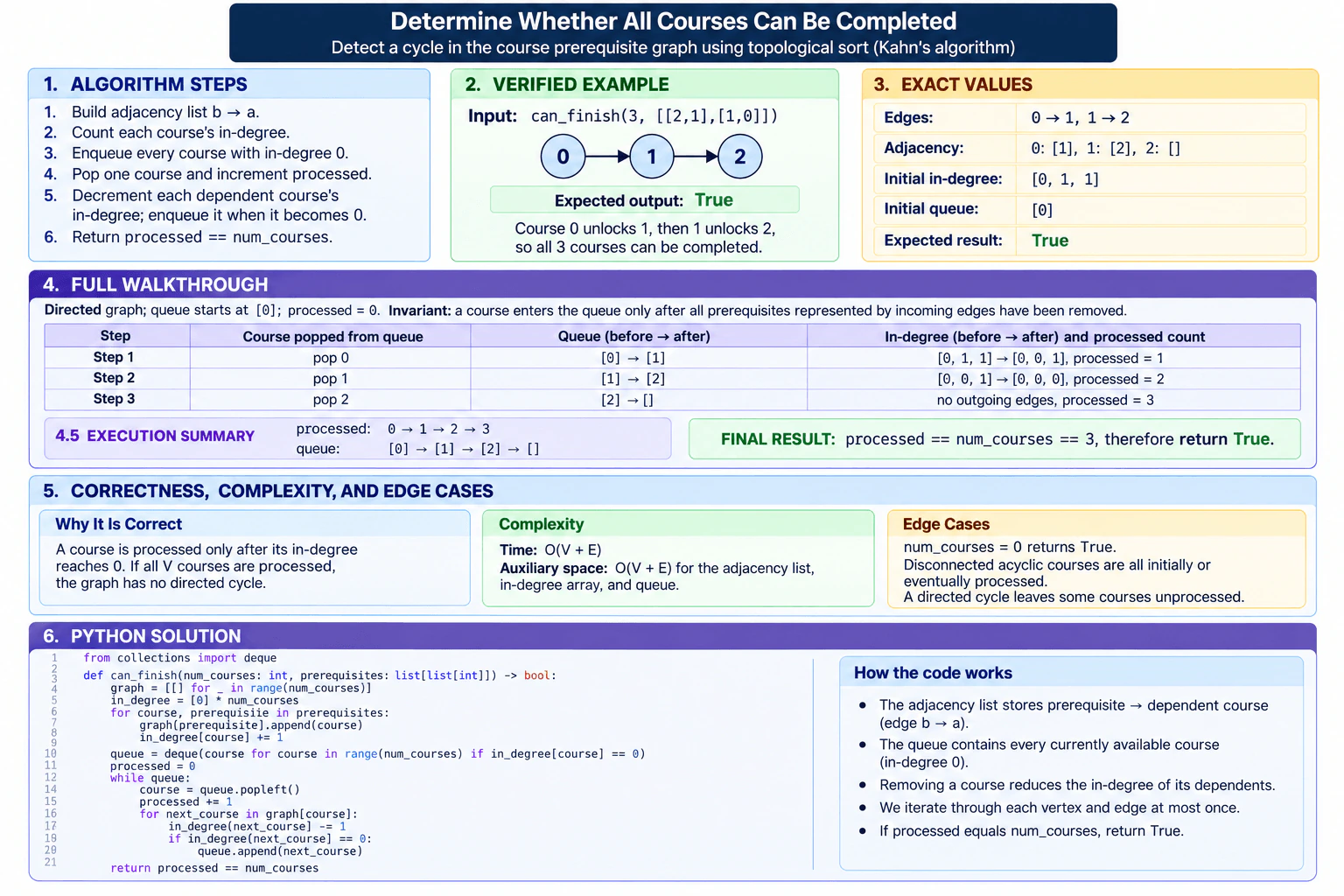
For the diagram example, num_courses = 3 and prerequisites = [[2,1],[1,0]]. The edges are 0 → 1 and 1 → 2. The adjacency list is 0:[1], 1:[2], 2:[]. The initial in-degree array is [0,1,1]. Only course 0 has in-degree 0, so the queue starts as [0]. The processed count starts at 0.
4. Walk through the example
Step 1: The queue is [0]. I remove course 0 and increase processed to 1. Course 0 points to course 1, so I reduce course 1's in-degree from 1 to 0. Course 1 is now available, so I add it to the queue. The queue becomes [1], and the in-degree array becomes [0,0,1].
Step 2: I remove course 1 and increase processed to 2. Course 1 points to course 2, so I reduce course 2's in-degree from 1 to 0. I add course 2 to the queue. The queue becomes [2], and the in-degree array becomes [0,0,0].
Step 3: I remove course 2 and increase processed to 3. Course 2 has no outgoing edges, so nothing else changes. The queue becomes empty.
The processed count changed from 0 to 1 to 2 to 3. Since processed == num_courses == 3, the function returns True.
5. Explain why the result is correct
A course is processed only after its in-degree reaches 0. So when we take a course from the queue, every prerequisite that must come before it has already been handled. If all V courses are processed, the graph has no directed cycle blocking progress. If a directed cycle exists, the courses in that cycle never become available, so some courses remain unprocessed.
6. Explain the Python implementation
The code first builds the adjacency list and the in-degree array. It then puts every course with in-degree 0 into a deque. The while loop removes available courses from the left side of the deque. For each dependent course, it decreases the in-degree by 1. When that value becomes 0, the dependent course is added to the queue. Finally, the code checks whether the number of processed courses equals num_courses.
7. Explain complexity and edge cases
Let V be the number of courses and E be the number of prerequisite pairs. Building the graph takes O(V+E) time. During processing, every course is removed from the queue at most once and every edge is examined once, so the total time is O(V+E). The adjacency list, in-degree array, and queue use O(V+E) auxiliary space. Important cases are zero courses, disconnected acyclic groups of courses, and directed cycles.
Key Insight / Why This Solution Works
The key insight is to keep track of which courses are currently available. A course is available when its in-degree is 0, meaning it has no remaining prerequisite edges pointing into it. We build a directed adjacency list from prerequisite to dependent course and an in-degree array. Kahn’s algorithm repeatedly removes an available course, decreases the in-degree of its dependents, and adds any dependent whose in-degree becomes 0. The central invariant is that a course enters the queue only after all of its prerequisites have been processed. If the processed count reaches V, every course can be completed.
Code
from collections import deque
defcan_finish(num_courses: int, prerequisites: list[list[int]]) -> bool:
# Store each prerequisite course and the courses that directly depend on it.
graph = [[] for _ inrange(num_courses)]
# in_degree[course] is the number of prerequisites still required by that course.
in_degree = [0] * num_courses
# Each pair [course, prerequisite] creates the directed edge prerequisite -> course.# This loop only reads prerequisites, so the input is not mutated.for course, prerequisite in prerequisites:
graph[prerequisite].append(course)
in_degree[course] += 1# Courses with in-degree 0 have no remaining prerequisites and can be processed now.
queue = deque(course for course inrange(num_courses) if in_degree[course] == 0)
# Count how many courses have been successfully processed.
processed = 0# Repeatedly take an available course and unlock its dependent courses.while queue:
course = queue.popleft()
processed += 1# Removing this course satisfies one prerequisite for each dependent course.for next_course in graph[course]:
in_degree[next_course] -= 1# A dependent course becomes available exactly when all prerequisites are done.if in_degree[next_course] == 0:
queue.append(next_course)
# If every course was processed, no directed cycle prevented completion.# For num_courses == 0, both values are 0, so this correctly returns True.return processed == num_courses
if __name__ == "__main__":
# Run the same verified example used in the diagram.print(can_finish(3, [[2, 1], [1, 0]])) # True
Time & Space Complexity
Let V be the number of courses and E be the number of prerequisite pairs. Building the adjacency list and in-degree array takes O(V+E) time. During the main loop, each course is removed from the queue at most once, and each prerequisite edge is examined once. So the total time is O(V+E). The adjacency list stores up to E edges. The in-degree array and queue can each hold up to V entries. Therefore the auxiliary space is O(V+E).
Where it is used
This pattern is useful for dependency scheduling. Examples include deciding whether jobs can run after their required jobs, ordering build tasks after their dependencies, planning course prerequisites, and checking whether a dependency graph contains a cycle that prevents all work from being completed.
Why Interviewers Ask This
This question tests whether you recognize a dependency problem as a directed-graph problem and choose a suitable topological-sort method. It also checks whether you model edge direction correctly, maintain in-degree counts without mistakes, use a queue appropriately, detect cycles through the processed count, handle cases such as zero or disconnected courses, write clean Python, and explain why both the time and auxiliary space are O(V+E).
Common interview mistakes
A common mistake is reversing the edge and storing course → prerequisite instead of prerequisite → dependent course. Another mistake is forgetting to increase the dependent course's in-degree when building the graph. Some candidates add a course to the queue before its in-degree actually reaches 0. Another mistake is using list.pop(0) for the queue, which can add unnecessary shifting cost in Python. It is also incorrect to return True only because the queue becomes empty. The correct final check is whether processed equals num_courses.
Interview tip
State the invariant before coding: a course enters the queue only when its in-degree is 0, so all of its prerequisites have already been handled. Then make the code follow that sentence directly.
Interviewer may ask next
How would you return one valid order of courses instead of only True or False?
Keep the same Kahn’s algorithm, but store each course in an output list when it is removed from the queue. If the output list contains all V courses, return that list as one valid topological order. If fewer than V courses are processed, a directed cycle prevents a complete order. The invariant stays the same because courses enter the queue only after all prerequisites are satisfied. Time remains O(V+E), and auxiliary space remains O(V+E), including the returned order.
How would you identify that a cycle exists with this same approach?
Run the same algorithm and count how many courses are processed. When the queue becomes empty, compare processed with num_courses. If processed is smaller, some courses still have positive in-degree and a directed cycle is preventing completion. No new algorithm is needed. The time stays O(V+E), and the auxiliary space stays O(V+E). The tradeoff is that this check tells us that a cycle exists, but it does not return the exact cycle.
12. Find the minimum number of one-letter changes in a word ladder.CodingHardApple
i Question Details
Using Python 3.14, implement def word_ladder_distance(begin_word: str, end_word: str, word_list: list[str]) -> int | None. All valid words have equal length. One operation changes exactly one character, and every intermediate word, including the destination, must be in word_list. Return the minimum operations, 0 if the words are equal, and None if no transformation exists. Do not mutate inputs and use only the standard library. Example: from 'hit' to 'cog' using ['hit','hot','dot','dog','cog'] returns 4; without 'cog' it returns None. Inputs outside the stated contract need not be handled.
Short Interview Answer (30-60 seconds)
I would model this as an unweighted graph and use breadth-first search because BFS visits words in increasing number of changes. I build pattern buckets from the words so I can find one-letter neighbors without assuming a fixed alphabet. The queue stores each word with its minimum distance, and I mark words visited before enqueueing them. I discard each processed bucket to avoid rescanning it. The expected time is O(N·L²), and auxiliary space is O(N·L²).
We need the smallest number of one-character changes from begin_word to end_word. Every word used after the start must come from word_list. If both words are already equal, the answer is 0. If the destination is missing from word_list, there is no valid transformation. I use breadth-first search because it explores transformations in increasing number of changes. Pattern buckets connect words that are equal everywhere except one position, so we can find valid next words without guessing which characters may appear.
Useful Questions to Ask the Interviewer
Can I rely on the guarantee that all valid words have the same length?
Do you only need the minimum number of operations, not the actual transformation path?
Should matching use Python's normal exact string comparison, including character case?
How to Explain It in an Interview
1. Understand the input and required output
The function receives begin_word, end_word, and word_list. One operation changes exactly one character. Every intermediate word and the destination must be in word_list. We return the minimum number of operations. We return 0 when begin_word equals end_word. We return None when no transformation exists. The function must not change its inputs.
2. Choose BFS and pattern buckets
Think of each valid word as a node in an unweighted graph. Two words are neighbors when they differ in exactly one position. BFS is a good fit because every change costs one operation. The queue therefore processes reachable words in nondecreasing distance order.
To find neighbors efficiently, I build pattern buckets. For a word and position i, the key is (i, word[:i], word[i + 1:]). Words with the same key differ only at position i, apart from the same word appearing in its own bucket. The visited set skips the current word and any word already discovered. For example, "hit" and "hot" share the key for position 1 because both have "h" before that position and "t" after it.
3. Initialize the state
First, if begin_word == end_word, return 0. Next, copy word_list into word_set. This does not mutate the input list. If end_word is not in the set, return None.
Then build the pattern dictionary from all words in word_set. Each key points to the words that match that pattern. Start the queue as deque([(begin_word, 0)]). The number is the minimum number of changes used to reach that word. Start visited as {begin_word}. Marking a word visited before enqueueing it prevents duplicate queue entries.
4. Walk through the example
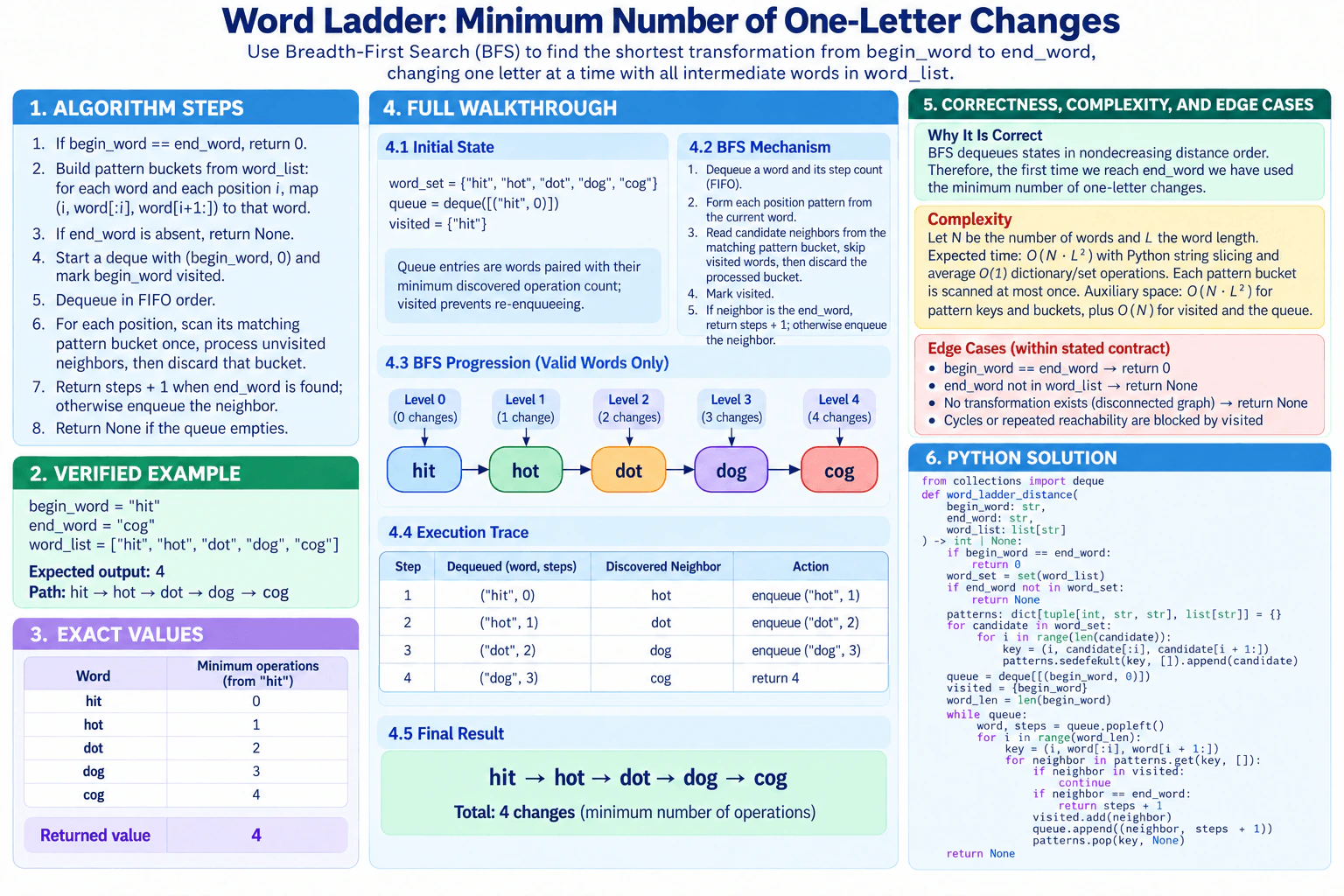
For begin_word = "hit", end_word = "cog", and word_list = ["hit", "hot", "dot", "dog", "cog"], the queue starts with ("hit", 0).
From "hit", the matching pattern bucket discovers "hot". Mark "hot" visited and enqueue ("hot", 1). After that bucket is processed, discard it.
Next, dequeue ("hot", 1). Its matching bucket discovers "dot". Mark "dot" visited and enqueue ("dot", 2).
Next, dequeue ("dot", 2). Its matching bucket discovers "dog". Mark "dog" visited and enqueue ("dog", 3).
Next, dequeue ("dog", 3). Its matching bucket discovers "cog". Because this is end_word, return steps + 1, which is 4. Processing stops immediately. The shown path is "hit" → "hot" → "dot" → "dog" → "cog".
5. Explain why the result is correct
The key invariant is that the BFS queue processes states in nondecreasing distance order. A word is marked visited when it is first discovered, so its first discovered distance is its minimum distance. Therefore, when "cog" is first discovered from "dog" at distance 3, the returned distance 4 is the minimum possible number of changes.
Discarding a processed pattern bucket does not remove a shorter future path. When a bucket is first processed, every unvisited word in that bucket is discovered from the earliest BFS level that can reach the bucket. A later scan of the same bucket cannot give any member a smaller distance.
6. Explain the Python implementation
The code uses collections.deque for FIFO queue behavior. It creates word_set as a copy for membership checks. It creates pattern keys with Python string slices and stores matching words in a dictionary. During BFS, it forms each pattern for the current word, reads candidates from that bucket, skips already visited words, returns immediately when end_word is found, and otherwise marks each new word visited before adding it to the queue. After scanning a bucket, patterns.pop(key, None) removes it so it is never scanned again.
7. Explain complexity and edge cases
Let N be the number of words and L be the word length. Building each pattern key uses string slicing, which costs O(L), and there are L patterns for each word. With average O(1) Python dictionary and set operations, the expected running time is O(N·L²). Each pattern bucket is scanned at most once. The pattern keys and buckets use O(N·L²) auxiliary space, with another O(N) for visited and the queue.
Important edge cases are begin_word == end_word, which returns 0, end_word missing from word_list, which returns None, and a disconnected transformation graph, which also returns None. The visited set prevents cycles or repeated reachability from causing duplicate processing.
Key Insight / Why This Solution Works
The key idea is to treat valid words as nodes in an unweighted graph and run BFS. Instead of trying possible replacement characters, build pattern buckets from the actual words. A pattern key stores the position, prefix, and suffix around one character. Words in the same bucket can differ only at that position. The central invariant is that the BFS queue processes words in nondecreasing distance order. The first time a word is discovered, its stored distance is minimal. Each processed pattern bucket is discarded, so the same bucket is not scanned repeatedly.
Code
from collections import deque
defword_ladder_distance(
begin_word: str,
end_word: str,
word_list: list[str],
) -> int | None:
# No operation is needed when the two words are already equal.if begin_word == end_word:
return0# Copy the input words into a set for average O(1) membership checks.# This leaves the caller's word_list unchanged.
word_set = set(word_list)
# The destination must be one of the allowed words.if end_word notin word_set:
returnNone# Build pattern buckets from the actual input words.# A key stores the changed position plus the unchanged prefix and suffix.
patterns: dict[tuple[int, str, str], list[str]] = {}
for candidate in word_set:
for i inrange(len(candidate)):
key = (i, candidate[:i], candidate[i + 1 :])
patterns.setdefault(key, []).append(candidate)
# BFS starts at the begin word with distance 0.
queue = deque([(begin_word, 0)])
# Mark words visited when they are discovered so they are not enqueued twice.
visited = {begin_word}
word_len = len(begin_word)
# FIFO order makes BFS process words in nondecreasing distance order.while queue:
word, steps = queue.popleft()
# Each position produces one pattern used to find one-letter neighbors.for i inrange(word_len):
key = (i, word[:i], word[i + 1 :])
# Read every allowed word that matches this pattern.for neighbor in patterns.get(key, []):
# A visited word already has its minimum BFS distance.if neighbor in visited:
continue# The first discovery of the destination gives the minimum distance.if neighbor == end_word:
return steps + 1# Mark before enqueueing to prevent duplicate queue entries.
visited.add(neighbor)
queue.append((neighbor, steps + 1))
# This bucket was processed at its earliest reachable BFS level.# Removing it prevents later words from scanning it again.
patterns.pop(key, None)
# The queue is empty, so the destination is unreachable.returnNone# Example from the diagram: hit -> hot -> dot -> dog -> cog uses 4 changes.
example_words = ["hit", "hot", "dot", "dog", "cog"]
print(word_ladder_distance("hit", "cog", example_words)) # 4
Time & Space Complexity
Let N be the number of words and L be the length of each word. Creating one pattern key uses Python string slices, so it costs O(L). We create L keys for each of N words. That gives O(N·L²) preprocessing work. During BFS, every pattern bucket is scanned at most once. Python dictionary and set operations are O(1) on average, so the expected total time is O(N·L²). Auxiliary space is O(N·L²) for pattern keys and buckets, plus O(N) for visited and the queue.
Where it is used
This pattern is useful when states form an unweighted graph and we need the fewest equal-cost transitions. Similar ideas appear in shortest transformation problems, dictionary-based spell changes, and searches where many states can be grouped by a shared partial pattern before running BFS.
Why Interviewers Ask This
This problem checks whether you can recognize an unweighted shortest-path problem and choose BFS. It also tests whether you can design an efficient neighbor lookup instead of comparing every pair of words. The interviewer can see whether you mark visited at the right time, reason correctly about early return, keep the implementation consistent with the input contract, and explain expected complexity when Python dictionaries and sets are involved.
Common interview mistakes
A common mistake is using DFS and assuming the first path found is the shortest. Another is marking a word visited only when it is dequeued, which can add the same word to the queue multiple times. A third mistake is generating neighbors from a hard-coded alphabet even though the stated contract does not limit characters that way. Candidates may also forget to return None when end_word is absent or unreachable. Finally, if pattern buckets are not discarded after processing, the code can repeatedly scan the same bucket and no longer match the stated O(N·L²) expected-time bound.
Interview tip
Explain the invariant before writing the loop: the queue processes words in increasing number of changes, so the first time end_word is discovered its distance is minimal. Then explain that pattern buckets only make neighbor lookup faster. They do not change the BFS correctness argument.
Interviewer may ask next
How would you return the actual transformation path instead of only the minimum number of operations?
Keep the same BFS and pattern buckets, but add a parent dictionary. When a new neighbor is first discovered, store parent[neighbor] = word before enqueueing it. When end_word is found, follow parent links backward from end_word to begin_word and reverse that sequence. Correctness is preserved because BFS still records each word when it is first reached at its minimum distance. Expected time remains O(N·L²), and auxiliary space remains O(N·L²) overall because the additional O(N) parent map is smaller than the pattern storage. The tradeoff is extra memory and reconstruction work.
Why is it safe to discard a pattern bucket after scanning it once?
BFS reaches that bucket for the first time from the smallest distance level that can access it. During that scan, every unvisited word in the bucket is discovered and assigned its minimum distance. If another word later creates the same pattern, scanning the bucket again cannot give any member a shorter distance because that later word is at the same or a greater BFS distance. Removing the bucket therefore avoids repeated work without changing correctness. This is what keeps each bucket scan to at most once.
13. Tell me about yourself and the experience most relevant to this role.BehavioralEasyApple
i Question Details
Give a concise account of your real background rather than a chronological autobiography. Connect two or three experiences that explain how you developed the statistical, machine-learning, data-engineering, product, and communication skills most relevant to this Data Scientist role. Clarify what you personally owned, one or two outcomes or lessons, the type of problems you now want to solve, and why this opportunity is a logical next step. Do not invent employers, projects, degrees, certifications, metrics, or responsibilities.
Interview tip:
Use STAR to structure your answer: briefly explain the Situation and Task, make Action the most detailed part, and finish with the Result. For example, describe a previous Data Scientist experience that shows how you combined statistical analysis, machine learning, data engineering, product judgment, and clear communication, explain what you personally owned and why you made key decisions, and connect what you learned to the type of problems you want to solve next.
Situation
In my last role, I worked on a data science problem where the team needed to turn raw and imperfect data into a useful decision for stakeholders. The work brought together the parts of data science I enjoy most: understanding the business question, preparing reliable data, using statistics and machine learning carefully, and explaining the result in simple terms. Earlier experiences had helped me build these skills in stages. In one, I focused more on preparing and validating data so analysis could be trusted. In another, I worked more closely with stakeholders to connect analytical results to a practical decision.
Task
My responsibility was to take ownership of the analytical work from problem definition through evaluation and communication. I needed to understand what decision the stakeholders were trying to make, determine what the available data could support, build an appropriate approach, and make sure the result was useful rather than just technically interesting.
Action
I started by speaking with the stakeholders to clarify the decision they wanted to improve and what a useful result would look like. I then examined the data for missing values, inconsistent definitions, unusual patterns, and possible sources of bias. I worked on the data preparation myself so I understood how each transformation could affect the analysis. That built on my earlier experience preparing and validating data, where I learned that weak inputs can make even a good analytical method unreliable. Before using a more complex model, I created a simple statistical baseline so I had a clear point of comparison. I then tested a machine learning approach and compared it with the baseline using evaluation measures that matched the real decision. I paid attention to uncertainty and avoided presenting small differences as meaningful improvements. When I found limitations in the data, I explained them early instead of hiding them behind the model. I also worked with the broader team on how the data and model outputs would be produced reliably, which helped me think beyond experimentation and consider the data engineering needed for repeated use. Throughout the work, I translated technical findings into plain language for stakeholders, explained the tradeoffs behind my choices, and asked for feedback to make sure the analysis remained connected to the original problem. That communication approach also reflected an earlier experience where I learned that an analysis has limited value if stakeholders do not understand how it should influence a decision.
Result
The work gave the stakeholders a clearer and more reliable way to use data in their decision process, while also making the limitations of the analysis visible. For me, the most important lesson was that strong data science is not only about choosing a model. It is about defining the right problem, building trustworthy data, measuring results carefully, and communicating what the evidence does and does not support. That combination of analytical depth, practical engineering, product thinking, and communication is what I want to continue developing in this Data Scientist role. I now want to solve product and decision problems where data, statistical reasoning, and machine learning can improve how people make choices, which makes this role a logical next step for me.
Why Interviewers Ask This
Interviewers ask this question to understand how the candidate connects past experience to the needs of the current Data Scientist role. A strong answer shows clear ownership, relevant technical breadth, good judgment, communication skills, awareness of limitations, and a logical reason for wanting to take the next step.
Interviewer may ask next
Why did you start with a simple statistical baseline before trying a more complex model?
I wanted a clear reference point before adding complexity. The baseline helped me understand how much value the more complex approach actually added. It also made the tradeoff easier to explain to stakeholders. If a complex model produced only a small improvement while being harder to understand or maintain, I wanted that difference to be visible before recommending it.
What did you learn from communicating the limitations of the data to stakeholders?
I learned that uncertainty is easier to manage when it is discussed early. Instead of waiting until the end, I explained which conclusions were strongly supported and which depended on weaker data. That helped the stakeholders interpret the result correctly and gave us a better discussion about what additional data would be useful in future work.
14. What inspires you to work at Apple as a Data Scientist?BehavioralMediumApple
i Question Details
Ground the answer in your real interests and preparation. Explain what you understand about the type of product, customer, privacy, experimentation, or machine-learning decisions the role supports; identify the aspects that genuinely motivate you; and connect them to evidence from your own experience and preferred way of working. Distinguish interest in the actual work from brand admiration, compensation, or simply using Apple products, and state what you hope to contribute and learn without inventing team-specific facts.
Interview tip:
Use STAR to structure your answer: briefly explain the Situation and Task, make Action the most detailed part, and finish with the Result. For example, describe Ground the answer in your real interests and preparation. Explain what you understand about the type of product, customer, privacy, experimentation, or machine-learning decisions the role supports; identify the aspects that genuinely motivate you; and connect them to evidence from your own experience and preferred way of working. Distinguish interest in the actual work from brand admiration, compensation, or simply using Apple products, and state what you hope to contribute and learn without inventing team-specific facts.
Situation
As I prepared for Data Scientist roles, I thought carefully about the kind of problems that keep me motivated. I realized that I enjoy work where analysis is connected to real product decisions and where the quality of the decision matters as much as the model itself.
Task
I wanted to identify an environment where I could use data to understand customer behavior, test ideas carefully, and support useful decisions while respecting privacy and uncertainty. I also wanted a role where I could keep learning from difficult product and machine learning problems.
Action
I looked beyond the Apple brand and focused on the actual nature of the work that interests me. I am especially motivated by using data to understand how people interact with products, designing experiments that can separate real effects from noise, and building models whose results can be explained clearly to product and engineering partners. In my previous work, I have found that I enjoy taking an unclear problem, defining what should be measured, checking the quality of the data, comparing possible approaches, and communicating what the evidence does and does not support. I also value privacy because a useful analysis should not require collecting more information than the decision actually needs. That combination is what makes Apple interesting to me as a Data Scientist. I would like to contribute careful analysis, practical judgment, and clear communication while learning how strong teams make data informed product decisions at large scale.
Result
This preparation made my motivation much more specific. I am interested in Apple because the role can combine product thinking, experimentation, machine learning, privacy, and close collaboration. Those are the parts of data science that I find most meaningful, and I would like to become stronger at applying them to decisions that affect real customers.
Why Interviewers Ask This
Interviewers ask this question to understand whether the candidate has a thoughtful reason for choosing Apple and the Data Scientist role. A strong answer shows that the candidate understands the kind of product and analytical decisions data scientists support, can connect those interests to a preferred way of working, and is motivated by the work itself rather than only the company name or compensation.
Interviewer may ask next
Which part of data science at Apple interests you most?
I am most interested in the connection between product questions and rigorous analysis. I like starting with a decision that needs evidence, deciding what should be measured, testing assumptions, and explaining the result clearly. Experimentation and machine learning are useful to me when they improve that decision process rather than becoming goals by themselves.
How does privacy influence the way you approach data science?
I treat privacy as part of the analytical design, not as something added at the end. I first ask what information is truly necessary to answer the question. I prefer using the minimum useful data and being clear about the limits of the analysis. That approach can protect customers while also forcing me to define the problem more carefully.
15. How have you evaluated a system with a human in the loop?BehavioralHardApple
i Question Details
Use a real project in which people labeled data, reviewed model outputs, made final decisions, or supplied feedback. Define the human role and why automation alone was insufficient, then explain the rubric, sampling, reviewer training or calibration, disagreement handling, quality and turnaround measures, and your personal contribution. Describe a bias, privacy, safety, or incentive risk you encountered, the safeguard you used, how human feedback entered the model or product lifecycle, the observable outcome, and what you would change in a second iteration.
Interview tip:
Use STAR to structure your answer: briefly explain the Situation and Task, make Action the most detailed part, and finish with the Result. For example, describe a project where people reviewed model outputs before final decisions, explain why human judgment was necessary, how you created the review rubric and sample, calibrated reviewers, handled disagreements, measured quality and turnaround time, addressed risks such as bias or privacy, used reviewer feedback to improve the system, and decided what you would change in the next iteration.
Situation
In my last role, I worked on a system that used a model to classify incoming cases and recommend the next action. The model could handle many clear cases, but some inputs were ambiguous and the cost of a wrong decision was high enough that we did not want full automation. We kept people in the process to review uncertain outputs and make the final decision.
Task
I was responsible for evaluating whether the combined model and human workflow was reliable enough for continued use. I needed to measure more than model accuracy. I also had to understand reviewer consistency, turnaround time, disagreement patterns, possible bias, and whether the feedback from reviewers was actually helping us improve the system.
Action
I first defined the human role clearly. The model produced a recommendation and a confidence signal, while the reviewer checked the supporting information and either accepted or corrected the recommendation. I worked with the team to create a simple review rubric with clear decision rules and examples for difficult cases. I then built an evaluation sample that included common cases, uncertain cases, and cases where we expected mistakes to matter more. Before using the results, I had multiple reviewers independently evaluate part of the same sample. I compared their decisions to find places where the rubric was unclear. We discussed those disagreements, improved the instructions, and repeated the exercise until the reviewers had a shared understanding of the rules. During the evaluation, I tracked model correctness, reviewer agreement, the types of model errors that humans corrected, cases where humans introduced new errors, and the time needed to complete a review. I also looked at results across meaningful groups instead of relying only on one overall quality number. That helped us check whether the workflow was performing unevenly for certain types of cases. Privacy was another concern because reviewers did not need every available field to make the decision. I worked with the team to limit the information shown in the review interface to what was needed for the task. When reviewers corrected the model, I stored the correction together with the reason from the rubric. I analyzed those corrections as a structured feedback source. Repeated error patterns were used to improve features, training examples, and evaluation cases rather than treating every correction as automatically correct. I also shared the main disagreement patterns and tradeoffs with the product and operational teams so that we could decide where human review added enough value to justify the extra time.
Result
The evaluation gave us a much clearer picture of the full system. We could distinguish model errors from reviewer inconsistency, identify the cases where human review added the most value, and improve the workflow without assuming that either the model or the reviewer was always correct. The structured reviewer feedback also gave us better examples for future model and product improvements. My main lesson was that a human in the loop system should be evaluated as one combined decision process. In a second iteration, I would add more continuous reviewer calibration and monitor disagreement patterns over time so that changes in the model, data, or review behavior are detected earlier.
Why Interviewers Ask This
Interviewers ask this question to see whether a candidate can evaluate a real decision system instead of looking only at model metrics. A strong answer shows that the candidate understands the role of human judgment, reviewer consistency, sampling, quality measurement, bias and privacy risks, operational tradeoffs, and how human feedback should enter the model or product lifecycle.
Interviewer may ask next
How did you decide which cases should receive human review?
I focused human review on cases where the model was uncertain or where an incorrect recommendation could have a larger effect. I also kept some broader sampled cases in the evaluation so that we could detect errors outside the obvious uncertain group. That gave us a better balance between review cost and coverage.
What would you do differently if you built the evaluation again?
I would make reviewer calibration a continuous process instead of concentrating it mainly near the start. I would regularly sample overlapping cases for multiple reviewers, monitor where disagreement changes, and check whether new model versions or data patterns are creating new ambiguity. That would help us catch both model drift and changes in human decision behavior earlier.
Disclaimer: This interview guide is for educational and informational purposes only. It is designed to help readers prepare, but it does not guarantee any interview result, hiring decision, offer, or outcome. Interview questions, hiring criteria, and preferred answers can vary by employer, interviewer, industry, location, and time. All answers, examples, and explanations in this guide are suggested examples for interview preparation, not definitive answers or instructions for professional practice. They are based on research and judgment, are provided without warranties of any kind, and should be adapted to the question, role, and applicable laws and professional requirements. Diagrams are simplified illustrations intended to highlight the main concepts and their relationships; actual situations, systems, and practices may be more complex. Alternative approaches may be equally valid or better suited to a particular question, context, or interviewer. To the fullest extent permitted by applicable law, the contributors and publisher are not liable for decisions made, actions taken, or losses incurred based on this guide.
State Laws and Professional Responsibilities: Laws and requirements governing an occupation vary by state and jurisdiction. You are responsible for checking the current laws, licensing requirements, and scope-of-practice rules that apply to your location and role, and for ensuring that your answers and actions comply with them. Adapt examples in this guide to those requirements. This guide is not legal advice.
Company Notice: This guide is an independent educational resource and is not affiliated with, endorsed by, sponsored by, or approved by the company named in this guide. Company names identify reported interview experiences or the employer context of clearly labeled original practice exercises. Interview practices can change without notice, and inclusion of company-specific content does not mean these questions are official, complete, or guaranteed to be asked. To the fullest extent permitted by law, the author, contributors, and publisher are not responsible for outcomes related to use of this material.
Content Accuracy and Verification: To the fullest extent permitted by applicable law, we do not represent or warrant that interview guides, questions, answers, examples, or diagrams are accurate, complete, current, error-free, or suitable for any particular purpose. You are responsible for independently reviewing and verifying the information before relying on it.