This interview guide is for educational and informational purposes only. It is designed to help readers prepare, but it does not guarantee any interview result, hiring decision, offer, or outcome. Interview questions, hiring criteria, and preferred answers can vary by employer, interviewer, industry, location, and time. All answers, examples, and explanations in this guide are suggested examples for interview preparation, not definitive answers or instructions for professional practice. They are based on research and judgment, are provided without warranties of any kind, and should be adapted to the question, role, and applicable laws and professional requirements. Diagrams are simplified illustrations intended to highlight the main concepts and their relationships; actual situations, systems, and practices may be more complex. Alternative approaches may be equally valid or better suited to a particular question, context, or interviewer. To the fullest extent permitted by applicable law, the contributors and publisher are not liable for decisions made, actions taken, or losses incurred based on this guide.
State Laws and Professional Responsibilities
Laws and requirements governing an occupation vary by state and jurisdiction. You are responsible for checking the current laws, licensing requirements, and scope-of-practice rules that apply to your location and role, and for ensuring that your answers and actions comply with them. Adapt examples in this guide to those requirements. This guide is not legal advice.
Identity, Image, and Privacy Notice
To respect individual privacy, some names, profile photographs, avatars, biographical details, and other identifying information displayed in this guide may be replaced with pseudonyms, licensed stock images, illustrative avatars, composite images, or representative descriptions. Unless a person is expressly identified as an actual contributor, a displayed name, image, or profile should not be understood as depicting or identifying a specific candidate, interviewer, employee, or other real individual. These representations are provided for editorial and illustrative purposes only and do not imply endorsement, employment, participation, or affiliation with this guide or any company mentioned in it. Any resemblance to an actual person is coincidental.
Company Notice
This guide is an independent educational resource and is not affiliated with, endorsed by, sponsored by, or approved by the company named in this guide. Company names identify reported interview experiences or the employer context of clearly labeled original practice exercises. Interview practices can change without notice, and inclusion of company-specific content does not mean these questions are official, complete, or guaranteed to be asked. To the fullest extent permitted by law, the author, contributors, and publisher are not responsible for outcomes related to use of this material.
Content Accuracy and Verification
To the fullest extent permitted by applicable law, we do not represent or warrant that interview guides, questions, answers, examples, or diagrams are accurate, complete, current, error-free, or suitable for any particular purpose. You are responsible for independently reviewing and verifying the information before relying on it.
Questions or comments?
Contact us for general questions, or share feedback, technical corrections, and comments with the community.
1. How would you approach a fatigue analysis on an aircraft bracket that sees cyclic loading?Engineering MechanicsHardBoeing
i Question Details
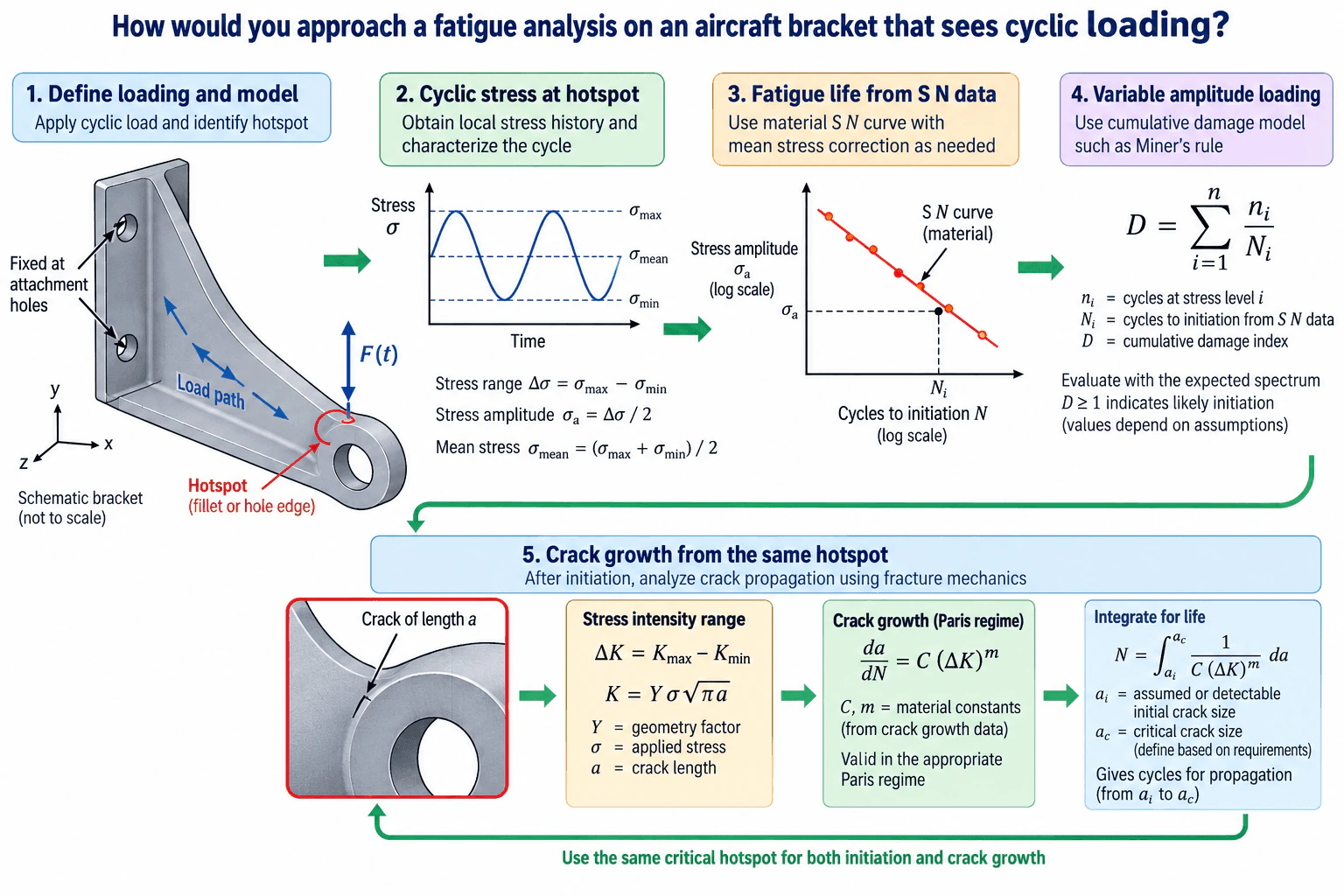
Explain the analysis path for a cyclically loaded aircraft bracket, including S-N behavior and cumulative damage, then extend the discussion to crack propagation, stress-intensity factors, and Paris-law considerations.
Short Interview Answer (30-60 seconds)
I would first define the bracket boundary conditions, attachment reactions, cyclic load F(t), operating spectrum, and likely stress concentration locations such as a fillet or hole edge. I would obtain the local stress history, calculate stress range, stress amplitude, and mean stress, then use appropriate S N data with a justified mean stress treatment when needed. For variable amplitude loading I would estimate cumulative damage using D = Σ(ni/Ni). I would then assess crack propagation from the same critical hotspot using ΔK = Kmax − Kmin and an applicable Paris relation, da/dN = C(ΔK)^m, integrating from an assumed or detectable initial crack size to a defined critical crack size.
Detailed Explanation
A fatigue analysis should follow the physical load path from the applied cyclic load to the critical local stress and then distinguish fatigue initiation from crack propagation. I would not assume material properties, dimensions, load spectra, crack sizes, or allowable life that were not supplied.
Useful Questions to Ask the Interviewer
What cyclic load spectrum, number of cycles, load ratio, and environmental conditions should I consider?
What material condition and applicable S N and crack growth data are available?
Should the assessment address initiation life only, or also crack propagation from an assumed or detectable initial crack to a critical crack size?
How to Explain It in an Interview
I would start by defining the bracket as the body, the attachment holes as the supports, the applied cyclic force F(t), the coordinate system, and the operating cycle. I would verify the reactions and load path, then identify likely fatigue hotspots such as the loaded hole edge or a fillet. The geometry remains schematic until actual dimensions and boundary conditions are supplied.
At the critical location I would obtain the local stress history using an appropriate mechanics model or a validated finite element result. From each cycle,
I would compare σa with appropriate S N data for the material and condition. If mean stress affects the applicable fatigue data, I would use a justified mean stress correction rather than assume one automatically.
For a variable amplitude spectrum, I would group cycles into representative stress levels and use a cumulative damage model such as Miner’s rule:
D = Σ(ni/Ni)
Here ni is the experienced number of cycles at stress level i and Ni is the corresponding cycles to initiation from the applicable S N data. D ≥ 1 indicates likely initiation under this simplified model, subject to its assumptions. Load sequence and interaction effects can limit the accuracy of linear cumulative damage.
For crack propagation, I would use the same physically credible hotspot. In linear elastic fracture mechanics,
ΔK = Kmax − Kmin K = Yσ√(πa)
where Y is a geometry factor, σ is the applied stress used by the stress intensity solution, and a is crack length. In the applicable Paris regime,
da/dN = C(ΔK)^m
where C and m come from suitable crack growth data. The propagation life can be estimated by integrating
N = ∫ from ai to ac [1 / (C(ΔK)^m)] da
where ai is an assumed or detectable initial crack size and ac is a critical crack size defined from applicable fracture requirements and material data.
Finally, I would validate the stress model, fatigue data applicability, operating spectrum, geometry factor, units, and sensitivity to uncertain inputs. I would also check whether threshold behavior, crack closure, environment, plasticity, or proximity to fracture toughness makes the simple Paris model inappropriate.
Why Interviewers Ask This
This tests whether the candidate can connect the bracket load path and local cyclic stress to fatigue initiation, variable amplitude cumulative damage, and fracture mechanics crack growth while stating the assumptions and limits of each model.
Common interview mistakes
Common mistakes include using nominal stress instead of the local hotspot stress, ignoring mean stress when the fatigue data require it, using S N data that do not match the material condition, applying Miner’s rule without a representative load spectrum, treating D = 1 as an exact physical failure point, starting crack growth at a location unrelated to the fatigue hotspot, using an incorrect geometry factor, applying Paris law outside its valid regime, inventing an initial or critical crack size, and treating an analytical result as proof of structural safety.
Interview tip
Present the analysis as one continuous mechanics path: define loads and supports, establish the load path, calculate the hotspot stress cycle, estimate initiation life from S N behavior, accumulate variable amplitude damage, then extend the same hotspot into stress intensity and crack growth. State the assumptions at each transition so the interviewer can see where each simplified model is valid and where additional evidence is required.
Interviewer may ask next
How would you validate that the fatigue life prediction is credible?
I would verify the free body diagram, reactions, boundary conditions, units, and load path first. I would compare the local stress prediction with a simpler mechanics estimate where possible and verify mesh convergence if finite element analysis is used. I would confirm that the S N data, crack growth data, stress ratio, environment, and geometry assumptions match the problem. I would also perform sensitivity checks on the load spectrum, local stress concentration, initial crack size, geometry factor, and material scatter. Physical test evidence would be used when required rather than treating the analytical prediction alone as proof of safety.
What changes if the bracket experiences an irregular flight load spectrum instead of constant amplitude cycling?
I would retain the measured or representative load history rather than replace it with one constant amplitude cycle. For initiation analysis I would determine the relevant cycle ranges and means, associate each group with the applicable fatigue life Ni, and accumulate damage with the selected cumulative damage model while acknowledging load sequence limitations. For crack growth I would evaluate the changing ΔK as both load and crack length evolve. If overload interaction, crack closure, threshold effects, or changing stress ratio materially affect propagation, the simple Paris relation would no longer be sufficient and a more appropriate validated crack growth model or test evidence would be required.
2. Describe (using STAR) a time you used structural analysis to complete an engineering task or project.Engineering MechanicsMediumBoeing
i Question Details
Use the situation, task, action, and result format for an example from your structural-analysis work.
Short Interview Answer (30-60 seconds)
I would answer with a real project from my experience and keep the STAR structure clear. I would describe the component, its supports, the governing loads, and the structural concern. Then I would explain my responsibility, how I established the load path and reactions, and how I evaluated stress, stiffness, deflection, fatigue, or buckling as appropriate. I would describe how I checked equilibrium, units, boundary conditions, assumptions, and sensitivity. I would finish with the actual engineering result, such as confirming the design, identifying a required change, or providing evidence for a design review, without claiming results I cannot support.
Detailed Explanation
A strong response should use a real project and show how structural analysis supported a specific engineering decision. The important point is not simply that analysis software was used. Explain how you represented the physical structure, which loads and supports mattered, what assumptions you made, how you checked the results, and what decision the analysis supported.
Useful Questions to Ask the Interviewer
Would you like the example to focus more on hand calculations, finite element analysis, or the overall structural reasoning?
Should I emphasize strength, stiffness, fatigue, buckling, or whichever failure mode governed the project?
Would you like me to include how I validated the analysis and communicated the result to the broader engineering team?
How to Explain It in an Interview
Situation: Briefly define the component or assembly, its function, its supports, the relevant coordinate directions, and the operating condition that created the structural concern. State only facts you can support. Explain whether the concern involved bending, axial loading, torsion, deflection, fatigue, buckling, or another relevant mechanics issue.
Task: State the engineering decision you were responsible for supporting. For example, you may have needed to determine whether an existing geometry met a structural requirement, identify a critical load case, compare design changes, or provide analysis evidence for a design review.
Action: Explain your personal contribution. First define the structural boundary and identify how forces and moments travel through the component into its supports. Use a free body diagram where appropriate and establish reactions from equilibrium. State important assumptions, such as idealized supports, linear elastic behavior, or simplified load distribution, and explain why those assumptions were reasonable for the intended analysis.
Then describe the structural method you actually used. Evaluate stress, strain, stiffness, deflection, fatigue, or buckling only as required by the problem. If you used finite element analysis, explain how you defined loads, constraints, contacts where relevant, mesh refinement, and the result quantities you reviewed instead of only naming the software.
Describe your checks. Confirm that reactions balance the applied forces and moments. Verify units, signs, and coordinate directions. Check that the deformation shape and stress distribution make physical sense. Compare important results with a simpler analytical calculation or limiting case when possible. If an uncertain load or support assumption materially affected the result, explain how you evaluated that sensitivity.
Result: State the actual outcome from your project. Explain what decision the analysis supported and what evidence you provided. If a design change was required, explain what the analysis revealed and how you verified the revised condition. Do not invent numerical margins, test results, dimensions, loads, or material properties.
Close with a practical lesson from the work, such as defining the load path before creating a detailed model or using independent checks to detect unrealistic boundary conditions.
Why Interviewers Ask This
Interviewers want to see whether you can turn a physical engineering problem into a defensible structural model, choose an appropriate analysis method, identify loads and supports, verify the load path, check assumptions, validate the results, and use the evidence to support an engineering decision. They also want you to distinguish clearly between your own actions and the work of the wider team.
Common interview mistakes
Common mistakes include describing only the analysis software, failing to define loads and supports, skipping the load path, presenting stress results without checking equilibrium or deformation behavior, claiming unsupported safety margins, confusing team activity with personal contribution, and giving a project result without explaining how the analysis affected the engineering decision.
Interview tip
Choose a real example where your own structural reasoning is easy to explain. Spend more time on how you defined the body, loads, supports, assumptions, analysis checks, and engineering decision than on software commands. Use exact loads, dimensions, stresses, margins, or test results only when you know they are accurate and traceable to your actual example.
Interviewer may ask next
How did you validate that your structural analysis was giving physically reasonable results?
I would describe the validation methods I actually used. Typical checks include confirming that support reactions balance the applied forces and moments, comparing stress or deflection with a simpler analytical calculation, checking whether the deformation shape follows the expected load path, refining the model where stress gradients are important, and testing sensitivity to uncertain boundary conditions or loads. Agreement among independent checks increases confidence, but analytical agreement does not replace required physical testing, certification, or formal approval.
What would you do if the load increased or the allowable deflection became more restrictive?
I would first identify which requirement becomes governing. I would update the applicable load case, keep the structural boundary and coordinate system clearly defined, recalculate reactions where necessary, and reevaluate stress, stiffness, deflection, fatigue, or buckling as applicable. I would then identify which design variables have the greatest physical influence on the governing response and compare feasible changes. Any revised design would go through the same equilibrium, unit, boundary condition, sensitivity, and validation checks before I recommended an engineering decision.
3. Explain what the stress-strain curve is.Materials And Material SelectionEasyBoeing
Short Interview Answer (30-60 seconds)
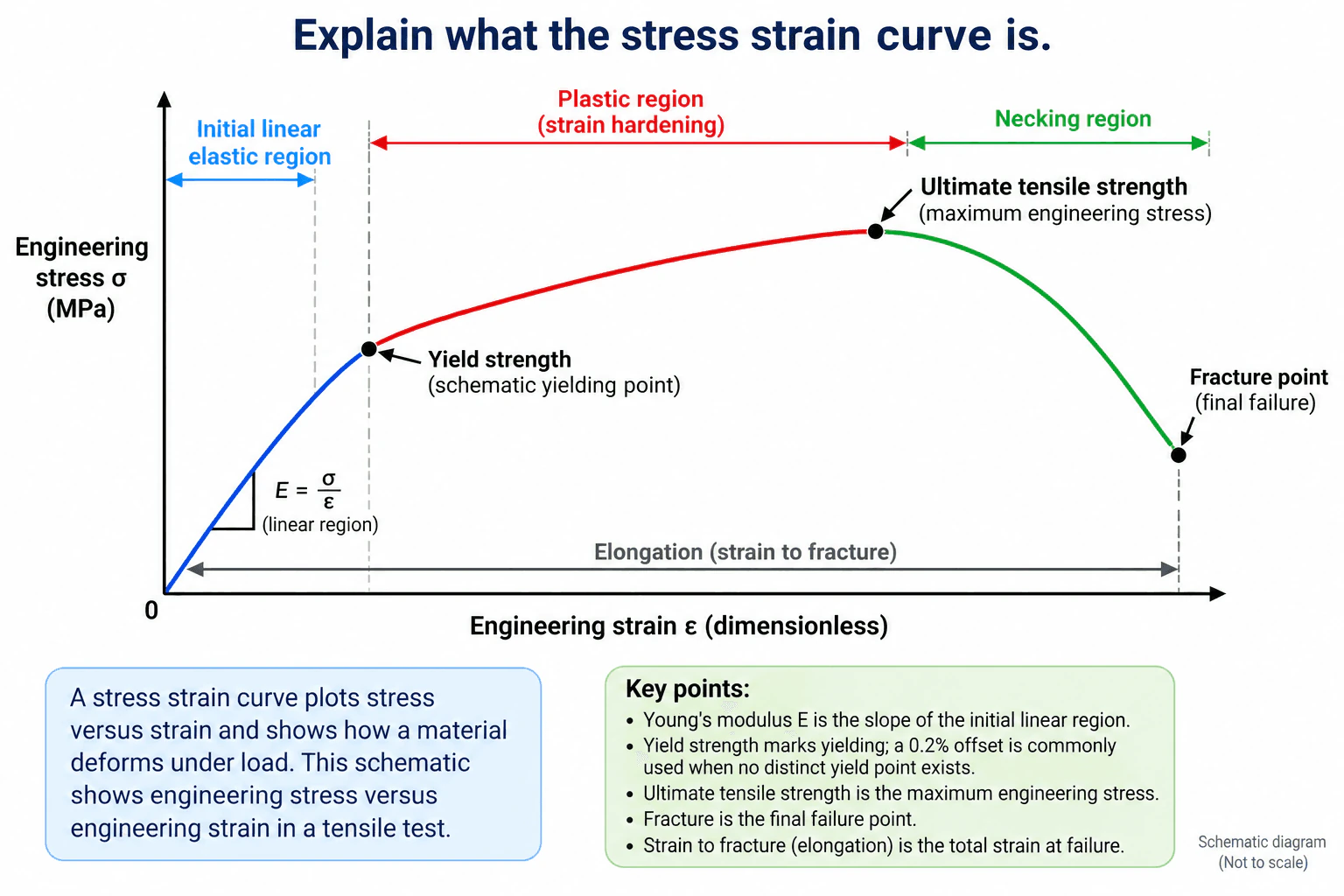
A stress strain curve shows how a material responds as it is loaded. In a tensile test, engineering stress σ is plotted against engineering strain ε. The initial linear elastic region gives Young’s modulus from the slope, E = σ/ε. Yield marks the transition into permanent plastic deformation. A ductile metal can then strain harden until it reaches ultimate tensile strength, which is the maximum engineering stress. After that, necking occurs and the engineering stress drops until fracture. The strain at fracture represents strain to fracture and is related to elongation and ductility.
Detailed Explanation
A stress strain curve is a graphical description of how a material deforms as load increases. For the ductile metal tensile example shown, the vertical axis is engineering stress σ and the horizontal axis is engineering strain ε.
Useful Questions to Ask the Interviewer
Are we discussing an engineering tensile stress strain curve for a ductile metal?
Should I focus on the main material properties identified from the curve?
Do you want me to explain the 0.2% offset method for materials without a distinct yield point?
How to Explain It in an Interview
I would read the curve from left to right.
The first part is the initial linear elastic region. Stress is approximately proportional to strain, and the slope is Young’s modulus E. In this linear region, E = σ/ε, so a steeper slope represents greater elastic stiffness.
Next is yielding. Yield strength marks the transition into plastic deformation. A distinct yield point is not present for every material, so a 0.2% offset method is commonly used when a clear yield point cannot be identified.
After yielding, a ductile metal is in the plastic region. It can continue carrying increasing engineering stress because of strain hardening. The curve rises until it reaches ultimate tensile strength, which is the maximum engineering stress on the curve.
After ultimate tensile strength, localized necking begins. The cross section reduces locally, and the engineering stress curve falls until the specimen reaches the fracture point.
The horizontal distance from zero strain to fracture represents strain to fracture. It is associated with elongation and gives an indication of ductility.
This is a schematic engineering stress strain curve. The exact curve shape and property values depend on material, material condition, temperature, strain rate, specimen condition, and test method. For design or material selection, I would use traceable data for the specified material condition rather than values read from a generic schematic curve.
Why Interviewers Ask This
Interviewers want to see whether I can interpret basic material behavior from a tensile test and distinguish stiffness, yielding, strength, ductility, necking, and fracture.
Common interview mistakes
Common mistakes are confusing stiffness with strength, treating yield strength and ultimate tensile strength as the same property, assuming every material has a distinct yield point, overlooking necking after ultimate tensile strength, and using values from a generic curve without checking the actual material condition and test basis.
Interview tip
Explain the curve in loading order: initial linear elasticity, yielding, plastic deformation and strain hardening, ultimate tensile strength, necking, and fracture. Tie each region to the material behavior or property it represents.
Interviewer may ask next
How would you validate a stress strain curve before using its properties for material selection?
I would confirm the material specification, material condition, heat treatment, specimen orientation, test temperature, strain rate, and applicable test method. I would also verify that the property data are traceable and representative of the actual design condition rather than relying on an unlabeled generic curve.
What changes if a material does not show a distinct yield point?
I would not invent a sharp yield point. For materials without a distinct yield point, an offset method such as the 0.2% offset method can be used to define a practical yield strength. I would state the method used so the reported value is traceable and comparable.
4. Why are aluminum alloys used over steel in certain airframe applications?Materials And Material SelectionHardBoeing
i Question Details
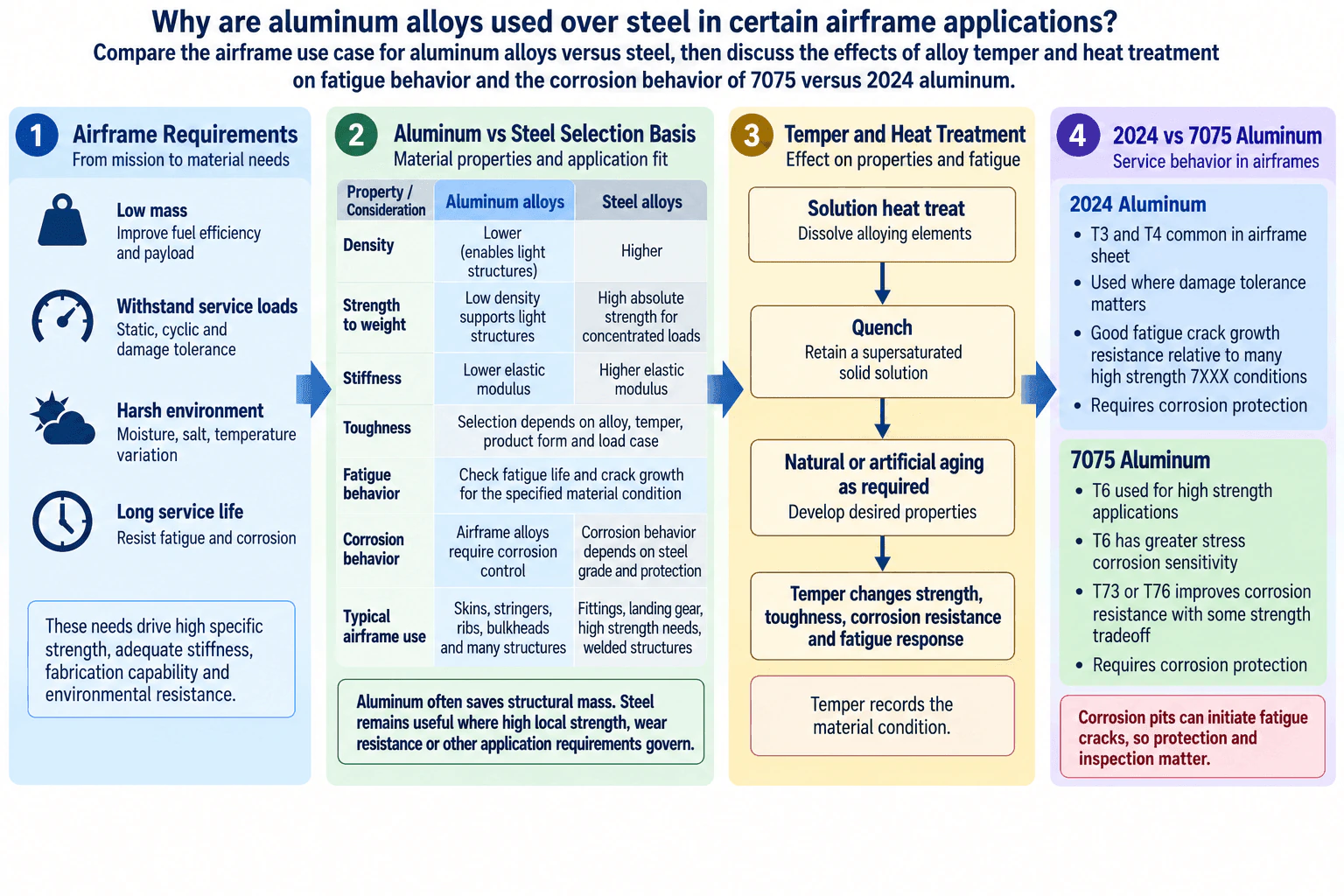
Compare the airframe use case for aluminum alloys versus steel, then discuss the effects of alloy temper and heat treatment on fatigue behavior and the corrosion behavior of 7075 versus 2024 aluminum.
Short Interview Answer (30-60 seconds)
Aluminum alloys are often selected for airframe structures because their lower density can reduce structural mass while still providing useful strength, stiffness, fatigue performance, and damage tolerance. Steel is denser but has a higher elastic modulus and can provide high absolute strength, so it remains useful for fittings, concentrated load regions, landing gear, wear sensitive parts, and other demanding applications. For aluminum, the exact temper matters because solution heat treatment, quenching, and natural or artificial aging change strength, toughness, corrosion resistance, and fatigue response. In particular, 2024 T3 and T4 are commonly used where damage tolerance matters, while 7075 T6 is used for high strength applications but has greater stress corrosion sensitivity. T73 or T76 improve corrosion resistance with some strength tradeoff.
Detailed Explanation
The choice is not simply aluminum versus steel based on one strength value. I would begin with the airframe requirements: mass target, static and cyclic loads, required service life, damage tolerance, temperature, moisture, salt exposure, corrosion risk, wear, and inspection assumptions. Aluminum alloys are attractive because their lower density supports lightweight structures. Steel is denser, but its higher elastic modulus and high absolute strength can make it preferable where concentrated loads, wear resistance, or other local requirements dominate.
For aluminum, the alloy designation alone is not enough. The specified material condition matters because heat treatment and aging change the properties. A typical precipitation hardening sequence is solution heat treatment, quenching to retain a supersaturated solid solution, then natural or artificial aging as required. The resulting temper changes strength, toughness, corrosion resistance, and fatigue response. Fatigue and crack growth data therefore need to match the exact alloy, temper, product form, loading, and environment.
For 2024 versus 7075, 2024 T3 and T4 are commonly used in airframe sheet and in applications where damage tolerance is important. They provide useful fatigue crack growth behavior compared with many high strength 7XXX conditions, but they still require corrosion protection. 7075 T6 is used where high strength is important, but this condition has greater stress corrosion sensitivity. T73 or T76 improve corrosion resistance relative to T6, with some strength tradeoff. Both alloy families require deliberate corrosion control because corrosion pits can become fatigue crack initiation sites.
Useful Questions to Ask the Interviewer
Is the governing requirement minimum mass, maximum local strength, fatigue life, damage tolerance, or corrosion resistance?
What alloy temper, stock form, environment, and load spectrum should I assume?
Are there temperature, galvanic compatibility, wear, or inspection constraints that could control the selection?
How to Explain It in an Interview
I would start with the service requirements rather than selecting a material by name. I would compare density, elastic modulus, strength, toughness, fatigue behavior, corrosion resistance, and the required material condition under comparable operating conditions.
For many skins, stringers, ribs, bulkheads, and similar structures, aluminum is attractive because its lower density can produce an efficient lightweight structure. Steel is heavier, but its higher elastic modulus and high absolute strength can make it appropriate for fittings, concentrated load paths, landing gear, wear sensitive regions, and other locations where local performance outweighs mass.
Then I would specify the aluminum condition. Solution heat treatment dissolves alloying elements into solid solution. Quenching retains a supersaturated solid solution. Natural or artificial aging then develops the required properties. The final temper changes strength, toughness, corrosion resistance, and fatigue response, so I would use property data that are traceable to the exact alloy, temper, product form, and loading condition.
For 2024 versus 7075, 2024 T3 or T4 is commonly associated with airframe sheet and applications where damage tolerance matters. 7075 T6 is attractive for high strength applications but has greater stress corrosion sensitivity. T73 or T76 improve corrosion resistance with some reduction in strength compared with T6. In either case, corrosion protection and inspection matter because corrosion pits can initiate fatigue cracks.
My final material selection would therefore be based on the complete load, life, mass, environment, temper, and inspection requirements rather than a single material property.
Why Interviewers Ask This
This question tests whether a mechanical design engineer can translate airframe mass, loading, service life, fatigue, damage tolerance, and environmental requirements into a defensible material selection. It also tests whether the engineer understands that aluminum properties depend on the exact alloy and material condition, and whether they can connect heat treatment, temper, fatigue behavior, corrosion resistance, and inspection requirements instead of comparing materials only by nominal strength.
Common interview mistakes
Common mistakes include saying aluminum is universally stronger than steel, comparing alloys without specifying temper or material condition, treating fatigue resistance as a single fixed property, ignoring the higher elastic modulus of steel, assuming all 7075 tempers have the same corrosion behavior, and discussing 2024 or 7075 without considering corrosion protection. Another mistake is selecting a material from nominal strength alone without checking density, toughness, fatigue crack growth, environmental exposure, stock form, property variability, galvanic compatibility, and inspection requirements.
Interview tip
Organize the answer as requirements, aluminum versus steel selection basis, temper and heat treatment effects, then 2024 versus 7075 service behavior. State clearly that aluminum is often chosen for mass efficiency rather than because it universally exceeds steel in strength. Tie fatigue and corrosion statements to the specified alloy and temper, then finish by explaining that the final decision requires traceable property data for the actual material condition and service environment.
Interviewer may ask next
What information would you validate before approving the material selection?
I would verify the service load spectrum, required life, temperature and moisture exposure, corrosion environment, galvanic couples, inspection assumptions, stock form, alloy, temper, and applicable property allowables. I would confirm that strength, toughness, fatigue, crack growth, and corrosion data correspond to the exact material condition rather than a generic alloy designation. I would also review property variability and environmental degradation that could change the governing failure mode.
How would the selection change if corrosion resistance became more important than peak strength?
I would favor a material condition with better corrosion and stress corrosion resistance even if that reduced peak strength. For 7075, that can favor T73 or T76 over T6 when the lower strength is acceptable. I would then reassess section sizing, fatigue life, damage tolerance, corrosion protection, and inspection requirements to confirm that the revised material condition still satisfies the structural requirements.
5. What do factor of safety and margin of safety mean?Safety And Design RiskEasyBoeing
i Question Details
Explain how they are calculated and what they represent physically.
Short Interview Answer (30-60 seconds)
A calculated factor of safety is capacity divided by demand for a specified failure mode. A required factor of safety is the minimum design multiplier to be met. Margin of safety expresses fractional reserve above a stated comparison requirement. With unfactored demand as the reference, margin equals calculated factor minus one. When a required factor is included, margin equals calculated factor divided by required factor, minus one. Positive margin exceeds that criterion, zero meets it exactly, and negative margin misses it. Both measures are dimensionless, not probabilities of failure, and neither establishes overall equipment safety. standards.nasa.gov
Detailed Explanation
Factor of safety compares capacity with demand, while margin of safety expresses how much reserve remains above a stated requirement. Always distinguish an available capacity ratio from a required design multiplier. standards.nasa.gov
Useful Questions to Ask the Interviewer
Which failure criterion are we checking, such as yielding, ultimate failure or buckling?
Do the supplied loads or allowable strengths already include safety factors?
Which application, operating conditions and jurisdiction determine the required factor?
How to Explain It in an Interview
Assumptions And Checks
No component, material, loads or jurisdiction are supplied. Consider a hypothetical straight tension member between its end attachments, supporting a suspended load. Take axial tension as positive. Assume static loading, constant temperature and geometry, and stress proportional to load. Failure could release the load toward operators during operation or maintenance. No cited standard is assumed mandatory for this unspecified application. Establish required factors from applicable requirements, confirming their assumptions about loads, material variability and verification evidence.
Engineering Method
Let S denote applicable strength and σ maximum service stress, both in megapascals (MPa), before applying the required factor. Define n as calculated factor, n_req as required factor, and MS as margin of safety.
n = S / σ
For checking a required factor:
MS = S / (n_req × σ) − 1 = n / n_req − 1
This is the factored demand convention illustrated in NASA structural guidance. standards.nasa.gov
For a comparison explicitly referenced to unfactored demand, MS = n − 1 instead. These are different baselines. If the allowable already incorporates the required factor, compare it directly with unfactored stress rather than applying that factor twice.
Match strength, stress and factor to the same failure criterion. Yield checks address permanent deformation; ultimate checks address failure such as rupture. standards.nasa.gov
Design Reasoning
For an illustrative yield check, assume S = 300 MPa, σ = 100 MPa and n_req = 2.0. These are teaching inputs, not measured properties or certification requirements.
n = 300 MPa / 100 MPa = 3.0
MS = 300 MPa / (2.0 × 100 MPa) − 1 = 0.50 = 50%
Units cancel. Capacity is three times service demand but only 50% above the factored requirement. Under these assumptions, stress can rise to 150 MPa before the required margin reaches zero. The margin referenced to unfactored demand would instead be 3.0 − 1 = 2.0, or 200%.
Positive MS exceeds the selected criterion; zero meets it exactly; negative misses it without necessarily implying failure at service load.
In redesign, greater section size can improve margin but adds mass. Changes in loads or material data require reassessment.
Before acceptance, verify material allowables, environment, geometry, attachments, load cases and analysis against appropriate inspection and test evidence. Assess fatigue, fracture, stress concentrations and buckling where applicable; this axial yield calculation does not cover them. standards.nasa.gov
For this example, use risk assessment and the hierarchy of controls to prioritize eliminating the suspended load hazard before adding protective measures. Consider load retention and machine guarding where relevant. Before maintenance, lower or positively support the load and verify safe isolation of stored energy. Check credible faults, guard effectiveness and residual risk without bypassing protection. cdc.gov
The conclusion is a conditional strength check, not approval of real equipment.
Why Interviewers Ask This
The judgment being evaluated is whether you can explain structural reserve using explicit assumptions and distinguish a strength check from a complete safety assessment.
Common interview mistakes
Confusing the calculated factor with the required factor; using MS = n − 1 without naming the reference; applying a factor twice; mixing yield and ultimate criteria; interpreting negative margin as certain immediate failure; and treating a passing structural check as a complete safety assessment. standards.nasa.gov
Interview tip
State the failure mode and the reference demand before giving either formula. Use one hypothetical example to distinguish available capacity from required reserve, then explain what must be verified before accepting a real design.
Interviewer may ask next
What would you verify before trusting a positive margin of safety?
I would verify applicable requirements, material data, environments, load cases and any factors already included. Then I would check geometry, attachments and analysis against inspection and test evidence. I would also review other failure modes and hazard controls; positive margin addresses only the evaluated criterion. standards.nasa.gov
What happens if the hypothetical example’s service load doubles?
With unchanged geometry and proportional stress, σ becomes 200 MPa. Keeping S = 300 MPa and n_req = 2.0 gives n = 300 MPa / 200 MPa = 1.5 and MS = 300 MPa / (2.0 × 200 MPa) − 1 = −0.25, or −25%. The required factor is missed even though the assumed yield strength has not been reached. I would reduce the permitted load or redesign for greater capacity. Increasing section size could add mass and affect interface loads, so I would reassess those tradeoffs rather than lower the required factor merely to obtain a passing margin.
6. How would you troubleshoot the following problem?NEWTroubleshooting And Failure AnalysisMediumBoeing
i Question Details
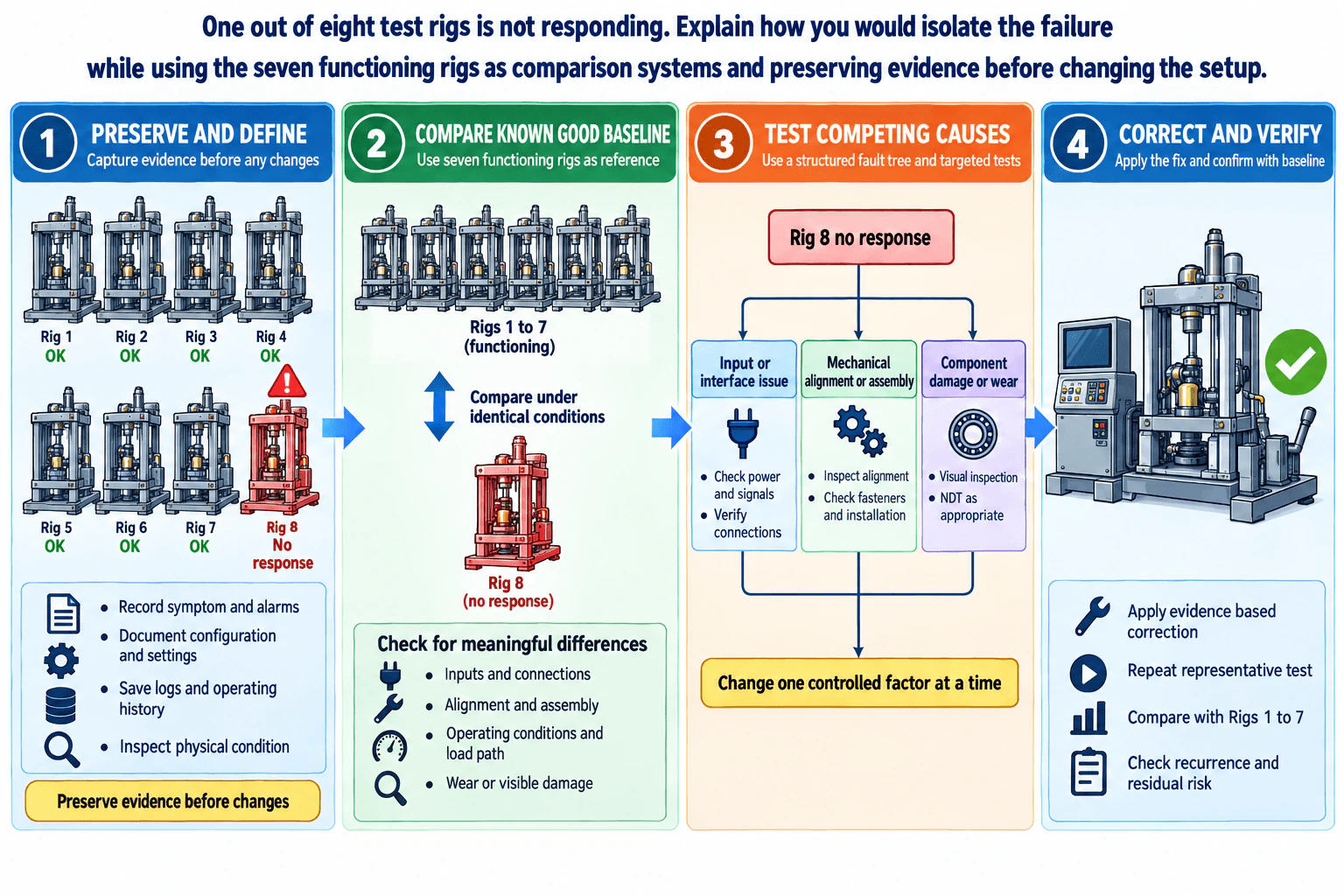
One out of eight test rigs is not responding. Explain how you would isolate the failure while using the seven functioning rigs as comparison systems and preserving evidence before changing the setup.
Short Interview Answer (30-60 seconds)
I would first preserve Rig 8 exactly as found by recording the symptom and alarms, documenting configuration and settings, saving logs and operating history, and inspecting its physical condition. Then I would compare Rig 8 with Rigs 1 through 7 under identical applicable conditions, focusing on inputs and connections, alignment and assembly, operating conditions and load path, and wear or visible damage. I would form competing hypotheses for an input or interface issue, a mechanical alignment or assembly issue, or component damage or wear. I would run targeted tests that distinguish those causes and change one controlled factor at a time where practical. Once the evidence supports a cause, I would apply the correction, repeat a representative test, compare the response with Rigs 1 through 7, and check recurrence and residual risk.
Detailed Explanation
The important principle is to preserve the failed condition before changing the setup, then use the seven functioning rigs as known good comparison systems. That gives me evidence for isolating meaningful differences instead of troubleshooting by trial and error.
Useful Questions to Ask the Interviewer
Did Rig 8 stop responding suddenly, intermittently, or after a recent setup, maintenance, or configuration change?
Are all eight rigs intended to have the same hardware, fixtures, settings, inputs, and operating conditions?
What evidence is currently available, such as alarms, logs, test data, inspection records, or maintenance history?
How to Explain It in an Interview
I would start by defining the observed symptom precisely. I would confirm what no response means, what input or command was applied, what output was expected, whether there was any partial response, and what the recent operating history shows.
Before changing the setup, I would preserve evidence. I would record the symptom and alarms, document configuration and settings, save logs and operating history, and inspect the physical condition. I would also define the investigation boundary so I know what can be inspected or tested without destroying useful evidence.
Next, I would compare Rig 8 with Rigs 1 through 7 under identical applicable conditions. I would look for meaningful differences in inputs and connections, alignment and assembly, operating conditions and load path, and wear or visible damage. I would not assume every difference is causal. I would use the comparison to create competing hypotheses.
A simple fault tree could group those hypotheses into an input or interface issue, a mechanical alignment or assembly issue, or component damage or wear. I would choose targeted tests that distinguish those branches. For example, I could check power and signals and verify connections for the interface branch, inspect alignment and fasteners for the mechanical branch, and perform visual inspection or appropriate nondestructive testing for possible damage or wear.
Where practical, I would change one controlled factor at a time so the effect of each action remains traceable. I would document what evidence supports or weakens each hypothesis rather than stopping at the first plausible explanation.
After the evidence identifies the most likely root cause, I would apply an evidence based correction and repeat a representative test. I would compare Rig 8 with Rigs 1 through 7, confirm normal response, check whether the issue recurs, and assess residual risk. I would close the investigation only when the corrective action is supported by repeatable evidence.
Why Interviewers Ask This
This evaluates whether I can preserve evidence, use functioning equipment as a controlled comparison, form competing failure hypotheses, select tests that distinguish among those hypotheses, and verify a corrective action with traceable evidence rather than guessing or changing the setup prematurely.
Common interview mistakes
Common mistakes include changing Rig 8 before documenting the failed condition, assuming the first plausible explanation is the root cause, comparing rigs under different operating conditions, changing several variables at once, replacing components without evidence, overlooking alignment or wear, failing to record test results, and declaring success after one passing test without checking recurrence or residual risk.
Interview tip
Present the method in a clear sequence: preserve evidence, compare Rig 8 with Rigs 1 through 7, form competing hypotheses, run targeted tests, change one controlled factor at a time where practical, then verify the corrective action with a representative test and recurrence check. Keep the reasoning evidence based and do not invent a failure result that was not provided.
Interviewer may ask next
What would you do if Rig 8 starts responding again before you identify the cause?
I would treat it as an intermittent failure rather than evidence that the problem is solved. I would preserve the available logs, configuration, operating history, and physical observations, then compare the conditions before and after recovery. I would investigate mechanisms that can appear intermittently, such as connections, alignment, binding, or developing wear, and try to reproduce the symptom under controlled conditions. I would not claim a root cause until repeatable evidence supports it.
What would you do if the seven functioning rigs are not exactly identical to Rig 8?
I would identify which differences are intentional and which could affect the symptom. I would compare only equivalent functions and account for known differences in hardware, fixtures, configuration, inputs, operating conditions, and load path. If no rig is a valid direct comparison, I would use the closest appropriate reference together with documented baseline data and state the limitation explicitly rather than treating a non equivalent rig as proof of the cause.
7. Why do you want to work for Boeing?BehavioralEasyBoeing
Interview tip:
Use STAR to structure your answer: briefly explain the Situation and Task, make Action the most detailed part, and finish with the Result. For example, describe a design experience that explains your interest in Boeing and aircraft engineering. State your responsibility, explain how you worked with others and checked an important design decision, and connect the outcome to what you would contribute and hope to learn at Boeing.
Situation
I want to work for Boeing because I want to apply my mechanical design skills to aircraft and take responsibility for details that affect how a part is built and maintained. That interest became clearer during a previous project. A trial assembly showed that a mounting bracket left too little room to reach a bolt, although the parts fit together in the computer model.
Task
I was responsible for improving the bracket design while preserving its strength and fit. I also needed to understand the assembly concern and give the team a clear drawing of the agreed change.
Action
I asked the assembly technician to show me where the tool was blocked. I checked that space in the model and compared changing the bracket shape with changing the installation sequence. I recommended a shape change because a special installation sequence would still make later removal depend on taking surrounding parts out first. I discussed the proposed shape with a manufacturing colleague to check whether it could be made using the planned process. I checked its strength and fit, then took my calculations and updated model to the design reviewer. I explained both the access benefit and the areas that needed review. After approval, I updated the drawing and worked with the assembly team to check the revised part. My contribution was the design change and its supporting checks. The team helped verify that it worked in practice.
Result
The next assembly check showed that the tool could reach the bolt without the earlier obstruction. I learned to check how people will build and maintain a part, not just whether it fits in a model. That is why this Boeing role appeals to me. I want to bring that practical care to aircraft design and learn how experienced aircraft engineers balance strength, weight, manufacturing, and maintenance.
Why Interviewers Ask This
Interviewers ask this to understand why you are choosing Boeing and whether your interest connects to the actual work of a Mechanical Design Engineer. A strong answer links a genuine motivation to relevant experience, explains what you would contribute, and shows a clear reason for wanting to grow in this role rather than relying only on the company name.
Interviewer may ask next
What would you hope to learn at Boeing that builds on this experience?
I would like to learn more about designing aircraft parts that must satisfy several needs at once, including strength, low weight, manufacturing, and maintenance access. The bracket project taught me to look beyond fit in the model. I would build on that by learning the team's design and review methods, asking experienced engineers to explain key decisions, and using that feedback in my own work.
How would you apply what you learned from the bracket project in this role?
I would check assembly and maintenance access while developing the design, rather than waiting for a trial assembly to reveal a problem. I would ask the relevant colleagues how the part would be installed, inspected, and removed. I would also document my checks and raise any unresolved concern during review. The lesson was not to assume that parts fitting together means the design is ready.
8. Where do you see yourself in 10 years?BehavioralEasyBoeing
Interview tip:
Use STAR to structure your answer: briefly explain the Situation and Task, make Action the most detailed part, and finish with the Result. For example, describe your current career direction, the design responsibility you hope to earn over 10 years, how you would build skills through feedback and collaboration, and the contribution you aim to make. Present the Result as a future goal, not an achievement that has already happened.
Situation
In 10 years, I hope to be a senior mechanical design engineer who can guide complex design work and support newer engineers. I want to stay involved in solving practical design problems, because that is the part of the career that interests me most.
Task
My goal is to earn that responsibility through sound design judgment and dependable work. That means understanding not just whether a design meets its requirements, but also whether it can be built, tested, and used safely.
Action
I would start by learning Boeing's design and review processes and becoming dependable on the parts assigned to me. I would ask experienced engineers to explain the reasoning behind their decisions. For example, I would work with manufacturing colleagues to understand whether a part is practical to make and use test results to check whether it performs as intended. I would discuss my progress with my manager and use specific feedback to choose what to learn next. As I became ready, I would take responsibility for designs involving several parts that must fit and work together. Over time, I would help newer engineers review their work and explain the lessons behind my advice. I would stay open to changing my development plan as the team's needs and my strengths became clearer.
Result
The result I am working toward is growing from owning individual parts to guiding larger designs and helping others make sound decisions. I would like to build that career at Boeing, with lessons from manufacturing and testing improving my judgment. The exact title matters less to me than the contribution I can make.
Why Interviewers Ask This
Interviewers want to understand whether your career goals fit the role and whether you have a realistic plan to grow. A strong answer shows clear interests, a willingness to keep learning, and ambition tied to useful contributions rather than a guaranteed title or promotion.
Interviewer may ask next
How would you measure progress toward that goal?
I would look at whether I can handle more complex design work, explain my decisions clearly, and address review feedback without repeating the same mistakes. I would ask my manager and colleagues in manufacturing and testing for specific feedback. As I gained experience, I would also look at whether I could help a newer engineer understand why a design decision makes sense.
Would you prefer to become a technical specialist or a people manager?
At this stage, I am more interested in becoming a technical specialist and leading design work. I would still want to mentor newer engineers and work closely with other teams. I would be open to management later if it suited my strengths and the team's needs, but I would not see management as the only way to grow.
9. How do you handle stress?BehavioralEasyBoeing
Interview tip:
Use STAR to structure your answer: briefly explain the Situation and Task, make Action the most detailed part, and finish with the Result. For example, describe a design change close to a deadline, how you managed the pressure, agreed on priorities, communicated workload concerns, and kept important checks in place. Show how your actions helped you stay focused without rushing or hiding problems.
Situation
During a previous project, I was preparing a mounting bracket design for review when a change to the surrounding assembly affected its fit. I also had routine drawing updates due, and I felt pressure to finish everything at once.
Task
I needed to prepare the revised bracket for review and explain what I could realistically finish. My goal was to manage the pressure without rushing important checks or leaving the team unsure about my progress.
Action
I paused, took a few slow breaths, and wrote down what had changed and what still needed checking. This helped me focus on the actual work instead of treating everything as equally urgent. I put the bracket fit check first because the assembly change could prevent the parts from fitting together. I explained the workload conflict to my lead, and we agreed which routine updates could wait. I then broke the bracket work into clear steps and worked through one step at a time. I confirmed the current assembly dimensions with the responsible engineer, revised the bracket, and asked a colleague to check the fit. I gave my lead brief updates, including any open questions. When I noticed myself rereading the same details without making progress, I took a short break and returned to my checklist. That was more useful than trying to push through and work faster.
Result
I completed the revised bracket package for review with the fit change checked. My lead also knew which drawing updates had moved and why. I felt more in control because I had clear priorities and a manageable next step. I learned that I handle stress best by pausing briefly, making a practical plan, and asking for support before pressure affects my work.
Why Interviewers Ask This
Interviewers want to know whether you can stay focused and make careful decisions when deadlines compete. A strong answer shows that you recognize stress, manage your response, communicate workload limits early, and seek help without avoiding responsibility or skipping important checks.
Interviewer may ask next
How did you decide which work could wait?
I looked at what the upcoming review needed and what the assembly change affected. The bracket fit needed checking before the design was ready for review. I discussed the other drawing deadlines with my lead rather than assuming they were less important. We agreed what could move, so I could focus without silently delaying someone else's work.
What would you do if you still felt overwhelmed after making that plan?
I would check whether the remaining work was still too much or whether an unanswered question was blocking me. In the bracket situation, I would tell my lead which check or drawing was at risk and ask for a specific change, such as help with routine updates. I would keep ownership of my design work, but I would not hide the pressure or skip checks to appear on schedule.
10. Tell me a time when you had to make a compromise within a group or project.BehavioralHardBoeing
Interview tip:
Use STAR to structure your answer: briefly explain the Situation and Task, make Action the most detailed part, and finish with the Result. For example, describe a design disagreement where you balanced your preferred solution with manufacturing needs. Explain how you listened, separated essential requirements from preferences, proposed a workable compromise, checked its effects, and gained agreement. Show what you gave up, what you protected, and what you learned.
Situation
During a previous project, I designed an equipment mounting bracket for a test setup. My design had several deep cutouts to reduce weight. The manufacturing team preferred a solid bracket because it would be simpler to make and would help protect the build date. We needed to agree before releasing the drawing.
Task
I was responsible for the bracket design. I needed to resolve the disagreement while keeping the equipment securely positioned, meeting the assembly weight limit, and giving manufacturing a practical design.
Action
I asked the machinist to walk me through the difficult features instead of defending my drawing straight away. Reaching the deep cutouts was the main concern. I compared the solid option with our weight limit and found that it was too heavy. I explained that the weight limit and mounting requirements were essential, but making the bracket as light as possible was my preference. I proposed one broad, shallow cutout instead of several deep ones. I accepted a heavier bracket than my original design, and manufacturing agreed to make the shallow cutout rather than a solid part. Before finalizing that compromise, I checked the revised assembly weight and whether the bracket could support the equipment without bending enough to affect its position. I reviewed mounting clearances with the assembly engineer, and the machinist confirmed that the simpler cutout was practical to make. I explained these checks to the design lead and obtained approval before releasing the revised drawing. I also recorded why we had changed the design so the team had one clear decision to follow.
Result
The team built the revised bracket, and it fitted correctly during trial assembly. We resolved the disagreement without dropping the required strength, mounting accuracy, or weight limit. I learned to distinguish an essential requirement from a personal design preference. I also learned that asking manufacturing to explain its concerns can lead to a better compromise than arguing for my first solution.
Why Interviewers Ask This
Interviewers ask this to see whether you can work through competing priorities without becoming defensive or agreeing to an unsafe shortcut. A strong answer shows that you listen, explain your own concerns, give up a preference when justified, and take responsibility for checking the compromise.
Interviewer may ask next
How did you decide that the added weight was an acceptable compromise?
I checked the weight of the full assembly with the revised bracket, not just the difference from my original design. The shallow cutout kept the assembly within its agreed weight limit. I also checked strength and equipment positioning separately, because meeting the weight limit alone would not make the design acceptable.
What would you do differently on a similar project?
I would involve manufacturing while I was still choosing the bracket shape. I would bring a simple sketch and explain the mounting and weight requirements before adding detailed cutouts. That would let us identify difficult features earlier and avoid spending time defending a design that could have been simpler from the start.
More questions load as you scroll
Mechanical Design Engineer Resume Examples
Explore the resume examples below to find the one that best matches your target Mechanical Design Engineer role.
Disclaimer: This interview guide is for educational and informational purposes only. It is designed to help readers prepare, but it does not guarantee any interview result, hiring decision, offer, or outcome. Interview questions, hiring criteria, and preferred answers can vary by employer, interviewer, industry, location, and time. All answers, examples, and explanations in this guide are suggested examples for interview preparation, not definitive answers or instructions for professional practice. They are based on research and judgment, are provided without warranties of any kind, and should be adapted to the question, role, and applicable laws and professional requirements. Diagrams are simplified illustrations intended to highlight the main concepts and their relationships; actual situations, systems, and practices may be more complex. Alternative approaches may be equally valid or better suited to a particular question, context, or interviewer. To the fullest extent permitted by applicable law, the contributors and publisher are not liable for decisions made, actions taken, or losses incurred based on this guide.
State Laws and Professional Responsibilities: Laws and requirements governing an occupation vary by state and jurisdiction. You are responsible for checking the current laws, licensing requirements, and scope-of-practice rules that apply to your location and role, and for ensuring that your answers and actions comply with them. Adapt examples in this guide to those requirements. This guide is not legal advice.
Company Notice: This guide is an independent educational resource and is not affiliated with, endorsed by, sponsored by, or approved by the company named in this guide. Company names identify reported interview experiences or the employer context of clearly labeled original practice exercises. Interview practices can change without notice, and inclusion of company-specific content does not mean these questions are official, complete, or guaranteed to be asked. To the fullest extent permitted by law, the author, contributors, and publisher are not responsible for outcomes related to use of this material.
Content Accuracy and Verification: To the fullest extent permitted by applicable law, we do not represent or warrant that interview guides, questions, answers, examples, or diagrams are accurate, complete, current, error-free, or suitable for any particular purpose. You are responsible for independently reviewing and verifying the information before relying on it.