This interview guide is for educational and informational purposes only. It is designed to help readers prepare, but it does not guarantee any interview result, hiring decision, offer, or outcome. Interview questions, hiring criteria, and preferred answers can vary by employer, interviewer, industry, location, and time. All answers, examples, and explanations in this guide are suggested examples for interview preparation, not definitive answers or instructions for professional practice. They are based on research and judgment, are provided without warranties of any kind, and should be adapted to the question, role, and applicable laws and professional requirements. Diagrams are simplified illustrations intended to highlight the main concepts and their relationships; actual situations, systems, and practices may be more complex. Alternative approaches may be equally valid or better suited to a particular question, context, or interviewer. To the fullest extent permitted by applicable law, the contributors and publisher are not liable for decisions made, actions taken, or losses incurred based on this guide.
State Laws and Professional Responsibilities
Laws and requirements governing an occupation vary by state and jurisdiction. You are responsible for checking the current laws, licensing requirements, and scope-of-practice rules that apply to your location and role, and for ensuring that your answers and actions comply with them. Adapt examples in this guide to those requirements. This guide is not legal advice.
Identity, Image, and Privacy Notice
To respect individual privacy, some names, profile photographs, avatars, biographical details, and other identifying information displayed in this guide may be replaced with pseudonyms, licensed stock images, illustrative avatars, composite images, or representative descriptions. Unless a person is expressly identified as an actual contributor, a displayed name, image, or profile should not be understood as depicting or identifying a specific candidate, interviewer, employee, or other real individual. These representations are provided for editorial and illustrative purposes only and do not imply endorsement, employment, participation, or affiliation with this guide or any company mentioned in it. Any resemblance to an actual person is coincidental.
Company Notice
This guide is an independent educational resource and is not affiliated with, endorsed by, sponsored by, or approved by the company named in this guide. Company names identify reported interview experiences or the employer context of clearly labeled original practice exercises. Interview practices can change without notice, and inclusion of company-specific content does not mean these questions are official, complete, or guaranteed to be asked. To the fullest extent permitted by law, the author, contributors, and publisher are not responsible for outcomes related to use of this material.
Content Accuracy and Verification
To the fullest extent permitted by applicable law, we do not represent or warrant that interview guides, questions, answers, examples, or diagrams are accurate, complete, current, error-free, or suitable for any particular purpose. You are responsible for independently reviewing and verifying the information before relying on it.
Questions or comments?
Contact us for general questions, or share feedback, technical corrections, and comments with the community.
1. Tell us about a time when you had to perform a simulation.NEWSimulation And Engineering AnalysisHardGe Aerospace
i Question Details
What was your approach, and what problem did you solve?
Short Interview Answer (30-60 seconds)
A representative example is a structural simulation used to support a mechanical design decision before physical testing. I first defined what decision the analysis needed to support, then simplified the geometry only where the simplification would not change the important load path. I defined the loads, supports, contacts, and material behavior, then used hand calculations to establish an expected range. After solving the FEA model, I checked reaction forces, deformation shape, mesh convergence, and possible singularities. I also varied important assumptions to see whether the conclusion changed. The simulation was useful because it identified where the design was sensitive and gave the team a focused basis for the next design and test decisions, while physical test correlation remained the final validation step.
Detailed Explanation
The important part of a simulation is not producing a stress contour. It is building the simplest model that represents the physics well enough to answer the design question, then checking whether the result is numerically and physically credible.
Useful Questions to Ask the Interviewer
What design decision should the simulation support, such as geometry selection, load capability, stiffness, fatigue risk, or test planning?
Which operating conditions, load cases, interfaces, and failure modes are most important?
Is physical test data available for correlation or validation?
How to Explain It in an Interview
Engineering Method
I would describe a structural FEA example by starting with the decision I needed to make rather than with the software. I first defined the physical system, coordinate directions, expected load path, interfaces, and operating conditions. I then selected model fidelity based on the required accuracy. Features that affected stiffness, contact, or local stress would remain, while irrelevant geometric detail could be removed.
Next I defined loads, supports, contacts, and material behavior. Before solving, I used equilibrium and simple hand calculations to estimate expected forces, deflections, or nominal stresses. Those estimates created an independent reference for the simulation.
I generated a mesh that represented the important geometry and refined regions with strong stress gradients. I then solved the model and checked whether the deformation shape made physical sense, whether reaction forces balanced the applied loads, and whether any rigid body motion appeared.
Assumptions And Checks
I treated mesh convergence separately from physical validation. I refined the mesh and observed whether the design quantity of interest stabilized. If a peak stress continued increasing near a sharp constraint or idealized point load, I treated it as a possible singularity rather than automatically accepting the maximum contour value.
I also performed sensitivity analysis on important assumptions such as support stiffness, contact behavior, load location, or material representation. If a reasonable change in an assumption changed the engineering conclusion, I would flag that uncertainty instead of presenting a single result as definitive.
Design Reasoning
The simulation supported the design decision by showing the load path, deformation behavior, sensitive regions, and assumptions that mattered most. I would compare the model with hand calculations first and then correlate it with physical test evidence when available. Agreement between the solver and itself is only numerical verification. Test correlation provides evidence that the model represents reality. I would document limitations and use the simulation together with calculations and testing before making a final engineering decision.
Why Interviewers Ask This
Interviewers are evaluating whether I can turn a physical engineering problem into an appropriate simulation, choose model fidelity based on the design decision, define defensible boundary conditions and assumptions, verify the numerical solution, and connect simulation results to physical evidence rather than accepting solver output at face value.
Common interview mistakes
Common mistakes include choosing simulation fidelity before defining the engineering decision, applying unrealistic boundary conditions, overconstraining the model, ignoring rigid body modes, reporting a singular peak stress as a physical result, assuming a converged solver means the model is correct, skipping mesh convergence, and treating simulation as a substitute for hand calculations or physical validation.
Interview tip
Explain the decision, physics, assumptions, checks, and validation in that order. Make clear what you personally defined or verified, and avoid presenting a colorful FEA contour as proof. Interviewers will usually learn more from how you challenged the model than from which solver you used.
Interviewer may ask next
How would you validate that the simulation was representing the real component correctly?
I would separate numerical verification from experimental validation. First I would verify equilibrium, deformation direction, mesh convergence, contact behavior, and sensitivity to important modeling assumptions. I would also compare suitable outputs with independent hand calculations. For validation, I would compare measurable quantities from a representative physical test, such as displacement, strain, temperature, frequency, or reaction load, with corresponding simulation predictions under equivalent conditions. If the correlation were poor, I would investigate boundary conditions, material behavior, contact assumptions, geometry idealization, and measurement uncertainty before changing the design based on the model.
What would you do if a more detailed simulation gave a different conclusion from the original model?
I would identify which added physics or modeling change caused the conclusion to move. I would compare loads, constraints, contacts, material behavior, mesh resolution, and geometric details one at a time where practical. I would then determine which model better represents the physical system and whether the design decision is sensitive to the uncertainty between them. If the difference remained important, I would use targeted calculations or testing to resolve it rather than simply choosing the model with the preferred result.
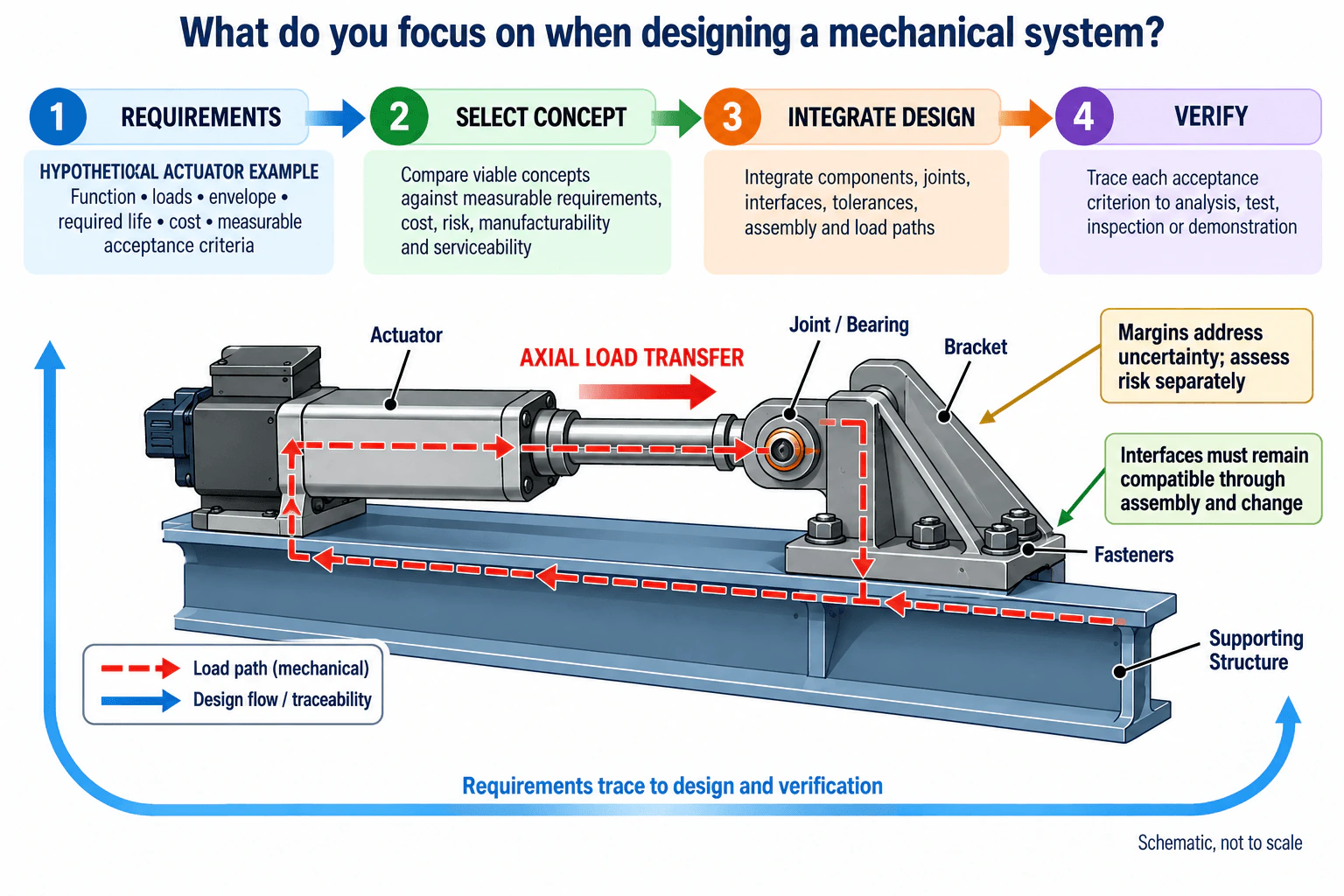
2. What do you focus on when designing a mechanical system?NEWMechanical DesignMediumGe Aerospace
Short Interview Answer (30-60 seconds)
I start by defining measurable requirements such as function, loads, envelope, required life, cost, and acceptance criteria. Then I compare viable concepts against those requirements and select one using explicit tradeoffs. After that I integrate the components, joints, interfaces, tolerances, manufacturing, assembly, serviceability, and load paths. I account for uncertainty with appropriate design margins and assess risk separately. Finally, I trace each acceptance criterion to a suitable verification method such as analysis, test, inspection, or demonstration.
Detailed Explanation
A strong mechanical design starts with the problem definition rather than the geometry. I want to know what the system must do, what loads and operating conditions it must withstand, where it must fit, how long it must perform, what cost constraints apply, and how success will be measured. Those requirements become the reference for later decisions.
For a hypothetical actuator assembly, for example, I would define its required function, relevant loads, available envelope, required life, cost constraints, and measurable acceptance criteria before choosing hardware. I would not invent dimensions, forces, materials, tolerances, or margins until the problem provides enough evidence to justify them.
Useful Questions to Ask the Interviewer
What are the most important functional requirements, load cases, operating conditions, and acceptance criteria?
What envelope, life, cost, manufacturing, assembly, and serviceability constraints should I treat as fixed?
Which interfaces or failure consequences should drive the concept selection and verification plan?
How to Explain It in an Interview
I organize the design around four connected steps.
First, I define the requirements. I separate known inputs from assumptions and unknowns, then make the important requirements measurable. That includes function, loads, envelope, required life, cost, operating conditions, interfaces, and acceptance criteria. I also define the physical boundary of the system so I know what is inside my design responsibility and what is an external interface.
Second, I compare viable concepts. I evaluate each concept against the same traceable requirements rather than selecting the first workable idea. Typical decision factors include performance, cost, risk, manufacturability, assembly, serviceability, packaging, and durability. The important point is that the selection has a documented engineering reason.
Third, I integrate the selected concept. I look at components, joints, bearings, fasteners, interfaces, tolerances, assembly sequence, manufacturing constraints, and the complete mechanical load path. For the actuator example, the load must transfer through the actuator, rod, joint, bracket, fasteners, supporting structure, and actuator mounting interface. I check that interfaces remain compatible as the design develops. I also consider uncertainty, tolerance variation, durability, safety, and appropriate design margins. Margin addresses uncertainty, while risk assessment remains a separate engineering activity.
Fourth, I verify the design against the requirements. Every acceptance criterion should map to appropriate evidence, such as analysis, test, inspection, or demonstration. I would check that the proposed evidence covers the relevant operating conditions and interfaces rather than assuming that one successful calculation proves the whole system is acceptable.
The key principle is traceability. Requirements drive concept selection, concept selection drives the integrated physical design, and verification closes the loop by showing whether the original measurable requirements have actually been met.
Why Interviewers Ask This
The interviewer is evaluating whether I can turn an open mechanical problem into a traceable design process, make justified tradeoffs, manage physical interfaces and load paths, account for uncertainty and practical constraints, and define evidence that demonstrates the finished design satisfies its requirements.
Interviewer may ask next
How would you handle uncertainty when the load cases are not fully known?
I would separate confirmed loads from assumptions and uncertain inputs, identify which uncertainties could materially change the design, and avoid inventing a single precise load. I would use bounded or clearly stated assumptions for concept work, apply justified design margins where appropriate, and assess the associated technical risk separately. I would also identify the analysis, measurement, or test evidence needed to reduce the uncertainty before finalizing critical dimensions, materials, joints, or acceptance decisions.
What would change if serviceability became much more important?
I would add serviceability as a higher priority requirement and reconsider the concept and interface decisions against it. That could change component access, joint selection, fastener placement, assembly sequence, replaceable modules, inspection access, and packaging. I would compare the resulting concepts against the same performance, cost, durability, manufacturing, and safety requirements so that better service access does not silently create an unacceptable tradeoff elsewhere.
3. How would you analyze failure modes in refractory metals subjected to high strain?NEWTroubleshooting And Failure AnalysisHardGe Aerospace
Short Interview Answer (30-60 seconds)
I would begin by defining the observed failure, the strain history, temperature, environment, geometry, and whether the loading was monotonic, cyclic, or impact driven. Then I would build competing hypotheses such as ductile rupture, brittle fracture, fatigue, creep interaction, oxidation assisted cracking, grain boundary failure, or local overload from stress concentration. I would preserve the fracture surface, inspect the wear pattern and deformation, review the load path, and use measurements such as microscopy, hardness, chemistry, dimensional inspection, and strain or temperature data to separate the hypotheses. I would identify the root cause only when the evidence is consistent across the material, geometry, and operating history, then verify the corrective action under representative conditions and check for recurrence and residual risk.
Detailed Explanation
Refractory metals can retain useful strength at very high temperatures, but high strain can still produce several different failure mechanisms. I would not start by assuming that a visible crack proves simple overload. I would reconstruct the loading and material history, examine the fracture evidence, and use controlled measurements to distinguish competing causes.
Useful Questions to Ask the Interviewer
What refractory metal or alloy is involved, and what temperature and environment did it experience during the failure?
Was the high strain produced by a single overload, repeated cycling, rapid impact, thermal expansion, or a combination of these effects?
Do we have the failed component, fracture surfaces, material certification, manufacturing history, and measured load, strain, or temperature data?
How to Explain It in an Interview
I would use a root cause analysis supported by a fault tree so that I compare several possible mechanisms instead of confirming the first theory.
First, I would define the symptom and boundary of the investigation. I would document where the crack, distortion, necking, surface damage, or complete separation occurred and preserve the fracture surface before cleaning or destructive testing. I would reconstruct the operating history, including strain magnitude, strain rate, temperature, environment, number of cycles, dwell time, and any abnormal event. If those values are unknown, I would state that explicitly.
Next, I would map the load path and local geometry. High nominal strain does not necessarily mean uniform strain. A notch, sharp transition, fastener interface, manufacturing defect, misalignment, or constraint can create a local strain concentration. I would compare the failure location with those features and check dimensions, tolerances, assembly condition, and permanent deformation.
Then I would form competing material hypotheses. Possible modes include ductile rupture from plastic instability, brittle fracture after loss of ductility, fatigue under repeated strain, creep interaction at elevated temperature, oxidation assisted cracking, grain boundary separation, or failure initiated by a defect or contaminated region. The relevant mechanisms depend strongly on alloy, temperature, strain rate, environment, and microstructure.
I would use the fracture surface and surrounding wear pattern as evidence. Microscopy can reveal features such as dimples, cleavage like facets, crack initiation sites, secondary cracking, grain boundary separation, or progressive crack growth. I would combine this with hardness, chemistry, microstructure, dimensional inspection, and available strain and temperature records. No single observation should determine the root cause by itself.
I would then compare the evidence against the fault tree and eliminate hypotheses that conflict with the measured behavior. If needed, I would run controlled material or component tests that reproduce the relevant strain, temperature, strain rate, and environment while changing one suspected variable at a time.
For corrective action verification, I would use the 8D structure or an equivalent documented process. The correction might involve geometry, material condition, surface protection, manufacturing control, assembly, or operating limits, depending on the proven cause. I would verify the change under representative conditions, inspect for the original failure signature, and assess recurrence and residual risk before closing the root cause analysis.
Why Interviewers Ask This
This evaluates whether the candidate can diagnose a difficult material failure systematically, distinguish competing mechanisms using physical evidence, connect fracture observations to loading and operating history, and verify a corrective action without assuming a preferred root cause.
Common interview mistakes
Common mistakes include assuming that a crack automatically means overload, ignoring temperature and strain rate effects, cleaning or damaging the fracture surface before examination, relying on one microscopy feature as proof, overlooking local geometry and assembly induced strain concentration, inventing material properties that were not measured, and declaring the corrective action successful without reproducing representative operating conditions.
Interview tip
Explain the investigation as an evidence driven sequence. State what is known, what is assumed, and what remains unknown. Show how each inspection or test separates competing failure mechanisms, and finish by describing how you would verify that the corrective action prevents recurrence rather than merely changing the appearance of the failure.
Interviewer may ask next
How would you validate that strain rate is contributing to the failure rather than temperature or a material defect?
I would design controlled comparison tests using representative material and geometry while holding temperature, environment, and specimen condition as constant as practical and varying strain rate across the relevant range. I would compare stress strain response, ductility, fracture location, and fracture surface features. I would also test or inspect material from unaffected regions to determine whether a preexisting defect or microstructural variation is present. Strain rate would become a stronger root cause candidate only if the failure response changes consistently with strain rate while the other variables remain controlled.
How would your analysis change if the refractory metal operates in a strongly oxidizing high temperature environment?
I would give much greater attention to surface degradation and oxidation assisted crack initiation. I would document exposure time and temperature, inspect oxide thickness and continuity, examine whether cracks originate at oxidized surfaces, and compare chemistry and microstructure near the surface with the interior. Controlled tests would need to reproduce the relevant environment as well as strain and temperature because testing only in laboratory air or an inert environment could miss the coupled mechanism. Any corrective action would then need verification against both the mechanical loading and the environmental exposure.
4. Tell us about your background and the projects you have done.NEWBehavioralMediumGe Aerospace
Interview tip:
Use STAR to structure your answer: briefly explain the Situation and Task, make Action the most detailed part, and finish with the Result. For example, describe your mechanical design background, the types of components or systems you have worked on, your responsibility on a representative project, the design and analysis steps you personally completed, how you worked with manufacturing and testing teams, the decisions you made, and what you learned from the final result.
Situation
In my last role, I worked as a mechanical design engineer on component design, design improvement, tolerance studies, drawing updates, and test support. My work usually started with a functional requirement and continued through design, analysis, review, manufacturing support, and testing. One representative project involved improving a mechanical component that was difficult to manufacture consistently while still meeting its load, fit, and durability requirements.
Task
I was responsible for reviewing the existing design, understanding the important requirements, and developing a revised design that could meet the mechanical needs while being easier to manufacture and inspect. I also needed to make sure the change would not create problems with surrounding parts or assembly interfaces.
Action
I first reviewed the drawings, interface dimensions, material requirements, loading conditions, and available test feedback so I could understand the real design constraints. I then spoke with manufacturing and test engineers to learn where the existing design was causing difficulty. Based on that information, I created several design concepts in CAD and compared them against the required load path, available space, assembly sequence, and manufacturing process. I used tolerance stack analysis to check how dimensional variation could affect fit and function. For the areas with higher structural concern, I used engineering calculations and finite element analysis to understand stress and deformation. I did not rely only on the analysis results. I checked whether the assumptions, constraints, and load cases matched the physical part. I selected the concept that gave a good balance between structural performance, manufacturability, inspection access, and assembly simplicity. I then updated the model and drawing, reviewed the important dimensions with manufacturing, and supported the design review by explaining the reason for each major change. After the part was produced, I worked with the test team to compare the physical behavior with the design expectations and reviewed any differences before closing the design activity.
Result
The revised design met the required functional and mechanical needs and was easier for the manufacturing team to produce and inspect. The project also strengthened my understanding that good mechanical design is not only about creating a part that works in CAD or analysis. I learned to involve manufacturing and testing early, verify assumptions carefully, and make design decisions based on the complete product lifecycle rather than one engineering discipline.
Why Interviewers Ask This
Interviewers ask this question to understand the candidate's mechanical design experience, the types of engineering work they have handled, and the level of personal responsibility they have taken on projects. A strong answer shows a clear technical foundation, practical design judgment, collaboration with other engineering functions, ownership of decisions, and the ability to explain past work in a structured and understandable way.
Interviewer may ask next
What was the most important design decision you made on that project?
The most important decision was choosing a design that balanced structural performance with manufacturability instead of optimizing only for stress. I compared the concepts using the required load path, tolerance sensitivity, assembly needs, and manufacturing feedback. That helped me select a design that met the mechanical requirements while also being practical to produce and inspect.
What would you do differently if you worked on a similar project again?
I would involve manufacturing and testing even earlier in the concept stage. Their feedback helped reveal practical issues that were not obvious from the CAD model alone. Bringing those teams into the first concept review would help eliminate weak options sooner and make the design process more efficient.
5. What is your favorite part of the Engineering Design Process?NEWBehavioralMediumGe Aerospace
Interview tip:
Use STAR to structure your answer: briefly explain the Situation and Task, make Action the most detailed part, and finish with the Result. For example, describe a mechanical design project where you enjoyed turning requirements into design concepts, comparing options, testing assumptions, working with other engineers, and refining the design based on what you learned.
Situation
My favorite part of the Engineering Design Process is the concept development and refinement stage. On one of my previous projects, I was working on a mechanical assembly that needed to meet several requirements at the same time, including strength, manufacturability, packaging space, and ease of assembly.
Task
My responsibility was to develop a practical design that satisfied those requirements without making the part more complex than necessary. I also needed to make sure the design could be reviewed clearly by the other engineers involved in the project.
Action
I started by turning the requirements into clear design constraints so I could understand what could change and what could not. I then created several concepts instead of committing to the first idea. I compared them based on load path, material use, manufacturing difficulty, assembly access, and likely failure points. For the stronger concepts, I built more detailed CAD models and checked important dimensions, interfaces, and clearances. I also used basic engineering calculations and analysis to challenge my assumptions before moving forward. I discussed the concepts with manufacturing and other engineering team members because they could identify practical issues that were not always obvious in the CAD model. I then refined the design based on that feedback. This is the part of the process I enjoy most because it combines creativity with engineering judgment. You start with an open problem, make decisions using evidence, and gradually turn the idea into something that can actually be built and used.
Result
The final design was accepted for the next stage of development and was easier for the team to review because the main design decisions and tradeoffs were clear. The experience reinforced why concept development is my favorite part of the process. It gives me the opportunity to solve the core engineering problem early, learn from other disciplines, and improve the design before changes become more difficult later.
Why Interviewers Ask This
Interviewers ask this question to understand which part of engineering work motivates the candidate and how the candidate thinks about the design process. A strong answer shows genuine interest in mechanical design while also demonstrating structured problem solving, practical judgment, collaboration, and an understanding that good designs are developed through evaluation and refinement.
Interviewer may ask next
How did you decide which design concept was worth developing further?
I compared each concept against the same requirements instead of choosing the one I personally liked most. I looked at the load path, available space, material use, manufacturing difficulty, assembly access, and possible failure points. I also asked other engineers and manufacturing team members for input. That helped me select the concept that offered the best overall balance rather than optimizing only one part of the problem.
What did you learn from working through that design process?
I learned that developing several concepts early can save effort later because it exposes tradeoffs before the design becomes difficult to change. I also learned that feedback from manufacturing and other engineering disciplines is most useful when it comes early. Their input helped me see practical issues that I might not have found by looking only at the CAD model or calculations.
6. What was one engineering process you improved?NEWBehavioralMediumGe Aerospace
Interview tip:
Use STAR to structure your answer: briefly explain the Situation and Task, make Action the most detailed part, and finish with the Result. For example, describe a design process that was causing avoidable rework, explain your responsibility, show how you found the cause, improved the workflow, involved the right people, and confirmed that the new process produced more consistent engineering work.
Situation
In my last role, our mechanical design review process was creating avoidable rework. Designers often completed detailed drawings before manufacturing and quality concerns were fully discussed. Important issues such as tolerance choices, inspection access, and assembly sequence were sometimes found late, which meant drawings had to be revised after a large amount of work was already complete.
Task
I wanted to improve the process so that important design risks were identified earlier. My responsibility was not to change the formal approval system. It was to make the engineering work leading into the review more structured and useful for everyone involved.
Action
I first looked at several recent design revisions and noted the types of issues that repeatedly caused changes. I found that many of them could have been discussed before detailed drawing release. I then created a simple review checklist that covered the items we were most likely to miss, including functional requirements, tolerance choices, material selection, manufacturing approach, assembly access, and inspection needs. I started using the checklist during my own design work before formal reviews. I also asked manufacturing and quality engineers to comment earlier when a design involved difficult features or inspection concerns. During reviews, I walked through the major risks instead of only presenting the finished geometry. I explained why each important design decision had been made and asked specific questions where I wanted input. After each review, I updated the checklist when we found a useful new lesson. I shared the approach with the rest of the team so they could use the same structure if it helped their work.
Result
The reviews became more focused, and we caught more manufacturing and inspection concerns before drawing release. That reduced avoidable revision work and made communication between design, manufacturing, and quality more consistent. I learned that process improvement does not always require a large new system. A simple structure can make a major difference when it helps the right people discuss the right risks at the right time.
Why Interviewers Ask This
Interviewers ask this question to understand whether a candidate notices inefficient engineering practices and takes practical ownership of improving them. A strong answer shows structured problem solving, sound engineering judgment, collaboration with other functions, and an ability to improve quality without adding unnecessary complexity.
Interviewer may ask next
How did you get manufacturing and quality engineers involved earlier in the process?
I made the request specific and tied it to decisions where their input was valuable. Instead of asking them to review an entire design without context, I highlighted areas such as difficult tolerances, inspection access, or assembly concerns. That made the discussion more focused and showed that I respected their time and expertise.
How did you know the improved process was actually helping?
I looked at the types of comments coming out of design reviews and whether major manufacturing or inspection concerns were still being discovered after drawing release. Over time, more of those concerns were being addressed during the earlier review discussions. I also saw that the review conversations became more structured because we were discussing risks and decisions instead of only reacting to completed drawings.
Mechanical Design Engineer Resume Examples
Explore the resume examples below to find the one that best matches your target Mechanical Design Engineer role.
Disclaimer: This interview guide is for educational and informational purposes only. It is designed to help readers prepare, but it does not guarantee any interview result, hiring decision, offer, or outcome. Interview questions, hiring criteria, and preferred answers can vary by employer, interviewer, industry, location, and time. All answers, examples, and explanations in this guide are suggested examples for interview preparation, not definitive answers or instructions for professional practice. They are based on research and judgment, are provided without warranties of any kind, and should be adapted to the question, role, and applicable laws and professional requirements. Diagrams are simplified illustrations intended to highlight the main concepts and their relationships; actual situations, systems, and practices may be more complex. Alternative approaches may be equally valid or better suited to a particular question, context, or interviewer. To the fullest extent permitted by applicable law, the contributors and publisher are not liable for decisions made, actions taken, or losses incurred based on this guide.
State Laws and Professional Responsibilities: Laws and requirements governing an occupation vary by state and jurisdiction. You are responsible for checking the current laws, licensing requirements, and scope-of-practice rules that apply to your location and role, and for ensuring that your answers and actions comply with them. Adapt examples in this guide to those requirements. This guide is not legal advice.
Company Notice: This guide is an independent educational resource and is not affiliated with, endorsed by, sponsored by, or approved by the company named in this guide. Company names identify reported interview experiences or the employer context of clearly labeled original practice exercises. Interview practices can change without notice, and inclusion of company-specific content does not mean these questions are official, complete, or guaranteed to be asked. To the fullest extent permitted by law, the author, contributors, and publisher are not responsible for outcomes related to use of this material.
Content Accuracy and Verification: To the fullest extent permitted by applicable law, we do not represent or warrant that interview guides, questions, answers, examples, or diagrams are accurate, complete, current, error-free, or suitable for any particular purpose. You are responsible for independently reviewing and verifying the information before relying on it.