This interview guide is for educational and informational purposes only. It is designed to help readers prepare, but it does not guarantee any interview result, hiring decision, offer, or outcome. Interview questions, hiring criteria, and preferred answers can vary by employer, interviewer, industry, location, and time. All answers, examples, and explanations in this guide are suggested examples for interview preparation, not definitive answers or instructions for professional practice. They are based on research and judgment, are provided without warranties of any kind, and should be adapted to the question, role, and applicable laws and professional requirements. Diagrams are simplified illustrations intended to highlight the main concepts and their relationships; actual situations, systems, and practices may be more complex. Alternative approaches may be equally valid or better suited to a particular question, context, or interviewer. To the fullest extent permitted by applicable law, the contributors and publisher are not liable for decisions made, actions taken, or losses incurred based on this guide.
State Laws and Professional Responsibilities
Laws and requirements governing an occupation vary by state and jurisdiction. You are responsible for checking the current laws, licensing requirements, and scope-of-practice rules that apply to your location and role, and for ensuring that your answers and actions comply with them. Adapt examples in this guide to those requirements. This guide is not legal advice.
Identity, Image, and Privacy Notice
To respect individual privacy, some names, profile photographs, avatars, biographical details, and other identifying information displayed in this guide may be replaced with pseudonyms, licensed stock images, illustrative avatars, composite images, or representative descriptions. Unless a person is expressly identified as an actual contributor, a displayed name, image, or profile should not be understood as depicting or identifying a specific candidate, interviewer, employee, or other real individual. These representations are provided for editorial and illustrative purposes only and do not imply endorsement, employment, participation, or affiliation with this guide or any company mentioned in it. Any resemblance to an actual person is coincidental.
Company Notice
This guide is an independent educational resource and is not affiliated with, endorsed by, sponsored by, or approved by the company named in this guide. Company names identify reported interview experiences or the employer context of clearly labeled original practice exercises. Interview practices can change without notice, and inclusion of company-specific content does not mean these questions are official, complete, or guaranteed to be asked. To the fullest extent permitted by law, the author, contributors, and publisher are not responsible for outcomes related to use of this material.
Content Accuracy and Verification
To the fullest extent permitted by applicable law, we do not represent or warrant that interview guides, questions, answers, examples, or diagrams are accurate, complete, current, error-free, or suitable for any particular purpose. You are responsible for independently reviewing and verifying the information before relying on it.
Questions or comments?
Contact us for general questions, or share feedback, technical corrections, and comments with the community.
1. Which cross-section gives the greatest resistance to bending for its mass?NEWEngineering MechanicsHardTesla
Short Interview Answer (30-60 seconds)
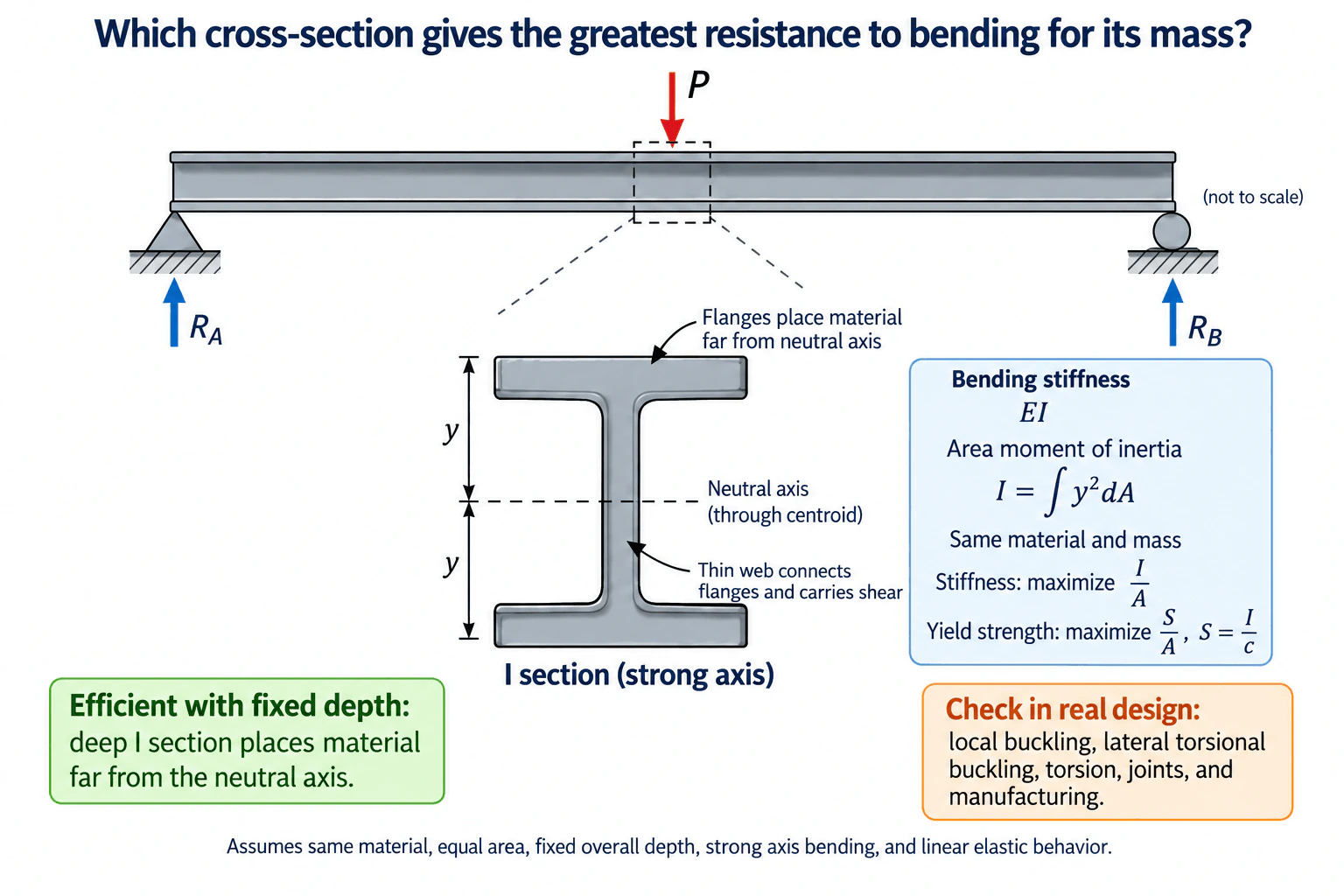
For the same material, equal mass per length, and fixed overall depth, the ideal bending efficient section places as much material as practical near the outer fibers, far from the neutral axis. A deep I section is a practical implementation of that idea. It gives a high area moment of inertia I for stiffness and a high elastic section modulus S = I/c for elastic bending strength. I would compare I/A for stiffness and S/A for yield resistance, then check local buckling, lateral torsional buckling, torsion, joints, and manufacturing constraints.
Detailed Explanation
The central idea is to place material as far from the neutral axis as practical. For the same material and equal mass per unit length, the cross sectional area A is equal because mass per unit length is proportional to density times area. Since I = ∫ y² dA, material farther from the neutral axis contributes much more to bending stiffness.
Useful Questions to Ask the Interviewer
Is the comparison based on stiffness, elastic yield strength, or both?
Is the overall section depth fixed by packaging or another geometric constraint?
Should I assume the same material and equal mass per unit length for every section?
How to Explain It in an Interview
Engineering Method
I would model a simply supported beam carrying a transverse load P with reactions RA and RB. The load magnitude and span are not given, so the comparison should remain symbolic. For the same material, equal mass per unit length means equal cross sectional area A.
For bending stiffness, the governing rigidity is EI. Because E is the same for every candidate section, the geometry with the largest I is stiffest in bending. The area moment of inertia is I = ∫ y² dA, so moving material toward the outer fibers increases I strongly. A deep I section follows this principle by concentrating much of its material in the flanges while using a relatively thin web to connect the flanges and carry much of the transverse shear.
For elastic bending strength, the extreme fiber stress can be written as σ = M/S, where S = I/c and c is the distance from the neutral axis to the extreme fiber. For equal area, I/A is a useful stiffness efficiency measure and S/A is a useful elastic strength efficiency measure.
Design Reasoning
With fixed overall depth, the idealized direction is to concentrate material near the two extreme fibers. A deep I section is a practical and efficient realization of that distribution for strong axis bending. It should not be described as an unconditional global optimum because the final geometry also depends on width, minimum thickness, stability, manufacturing, and packaging constraints.
Assumptions And Checks
The assumptions are the same material, equal area, fixed overall depth, strong axis bending, linear elastic behavior, and a static load case unless an operating cycle is specified. For a real design I would also check local buckling of the flange and web, lateral torsional buckling, torsional loading, connections, manufacturing constraints, and whether the real load path matches the simplified beam model.
Why Interviewers Ask This
This tests whether the candidate understands that bending efficiency depends on where material is placed relative to the neutral axis, can distinguish stiffness from elastic strength, states the geometric constraints behind the comparison, and recognizes practical limits such as buckling and torsion.
Common interview mistakes
Common mistakes are saying that an I section is always the absolute best shape, failing to state a depth or packaging constraint, using I alone as the measure of elastic bending strength instead of section modulus S, ignoring the bending axis, confusing mass with force, and overlooking local buckling, lateral torsional buckling, or torsional loading.
Interview tip
State the constraint before naming the section. A strong answer is that, for the same material, equal area, and fixed depth, material should be placed as far from the neutral axis as practical. Then distinguish I/A for stiffness from S/A for elastic bending strength and mention the stability checks that can change the final design.
Interviewer may ask next
How would you validate that an I section is actually the best practical choice for a real component?
I would first confirm the real load cases, supports, bending axis, packaging envelope, material, and mass target. Then I would compare candidate sections using I/A for stiffness and S/A for elastic bending strength. I would also evaluate local buckling, lateral torsional buckling, torsion, shear, connections, minimum thickness, and manufacturing constraints. The final geometry should then be validated using an appropriate structural analysis and physical testing when required rather than relying only on the simplified beam comparison.
What changes if the overall section depth is not fixed?
The answer becomes underconstrained. For fixed area and material, moving material farther from the neutral axis can continue increasing I, so there is no single finite optimum based only on bending resistance per mass. A practical comparison therefore needs another constraint such as maximum depth, width, minimum thickness, buckling resistance, manufacturing limits, or packaging space.
2. Which beam cross-section offers the best resistance to buckling relative to its mass?NEWEngineering MechanicsHardTesla
Short Interview Answer (30-60 seconds)
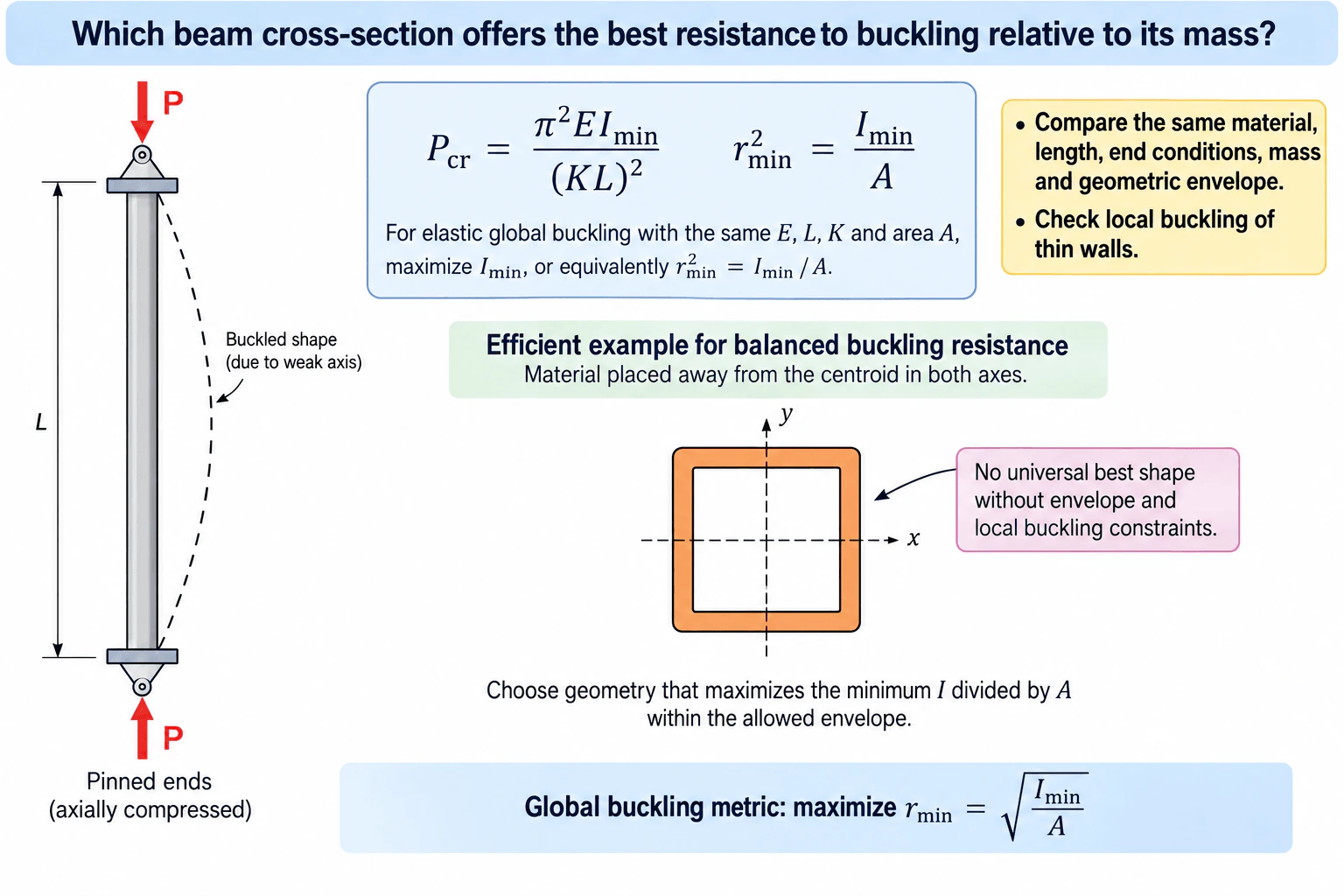
For elastic global buckling, there is no universal best cross section without defining the constraints. If material, length, end conditions, mass, and geometric envelope are fixed, Euler buckling resistance increases with the minimum principal second moment of area, I_min. Because mass per unit length is proportional to area A for a fixed material, the useful efficiency metric is r_min = sqrt(I_min/A). A closed symmetric hollow section is often an efficient example because it places material away from the centroid in both principal directions, but local wall buckling and the allowed envelope must also be checked.
Detailed Explanation
Treat the member as a straight slender column under axial compression. The load path is an axial force P through the end supports. Buckling can occur about either principal axis, so the governing section property is the smaller principal second moment of area, I_min. For a static elastic buckling check, fatigue cycling is not part of the governing model unless the interviewer adds cyclic loading.
Useful Questions to Ask the Interviewer
Are material, length, end conditions, total mass, and the geometric envelope fixed?
Should I consider only elastic global buckling, or also local buckling and yielding?
Is resistance required equally about both principal axes, or is one buckling direction dominant?
How to Explain It in an Interview
For a slender elastic column, Euler buckling gives:
P_cr = π² E I_min / (K L)²
P_cr is the critical elastic buckling load, E is Young's modulus, I_min is the minimum principal second moment of area, K is the effective length factor, and L is the unsupported length. For ideal pinned ends, K = 1.
If E, L, and K are fixed, increasing I_min increases the global buckling load. For a fixed material and fixed mass per unit length, cross sectional area A is also fixed. The useful mass efficiency metric is therefore:
r_min² = I_min / A
or
r_min = sqrt(I_min/A)
So I would choose the feasible geometry that maximizes the minimum I divided by A within the allowed geometric envelope.
The physical reason is that material farther from the centroid contributes more strongly to second moment of area. A closed symmetric hollow section is therefore an efficient example when balanced resistance about both principal axes matters, because material can be distributed away from the centroid in both directions.
I would not call that shape universally best. The result changes with the allowed width and height, wall thickness, loading direction, and end conditions. Thin walls can also buckle locally before the ideal global Euler load is reached.
To validate the choice, I would calculate the principal second moments of area, identify I_min, compare r_min at equal material and mass, check that the member is slender enough for Euler buckling to apply, and then check yielding and local wall buckling. The preferred design is the feasible section with the greatest minimum I/A after those constraints are satisfied.
Why Interviewers Ask This
This tests whether the candidate can connect Euler buckling, second moment of area, radius of gyration, weak axis behavior, mass efficiency, and local buckling while recognizing that no cross sectional shape is universally best without geometric and loading constraints.
Common interview mistakes
Common mistakes include comparing sections with different material or mass, using the larger second moment of area instead of I_min, ignoring the effective length factor, assuming a hollow section is always best, applying Euler buckling to a stocky member without checking applicability, and maximizing global buckling resistance while ignoring local wall buckling or yielding.
Interview tip
State the constraints before naming a shape. A strong answer identifies the governing metric as the minimum I divided by A for equal material and mass, explains why moving material away from the centroid improves that metric, and then qualifies the conclusion with geometric envelope limits, end conditions, local buckling, and yielding.
Interviewer may ask next
How would you verify that Euler buckling is the appropriate failure model?
I would determine the unsupported length, effective length factor, cross sectional area, and minimum principal second moment of area, then calculate the minimum radius of gyration and slenderness ratio. I would check whether the member is sufficiently slender for elastic global buckling to govern. I would also compare that condition with yielding and local wall buckling. If either occurs first, the simple Euler model alone is not sufficient.
What changes if buckling is expected mainly about one known axis?
Balanced resistance about both principal axes becomes less important. I would prioritize second moment of area about the governing buckling axis while still checking the other principal axis and relevant local or torsional instability modes. An I shaped section can be efficient when one direction dominates, while a closed symmetric hollow section is attractive when similar resistance is required in multiple directions.
3. How do you decide if a battery pack needs cooling?NEWMechanical DesignHardTesla
Short Interview Answer (30-60 seconds)
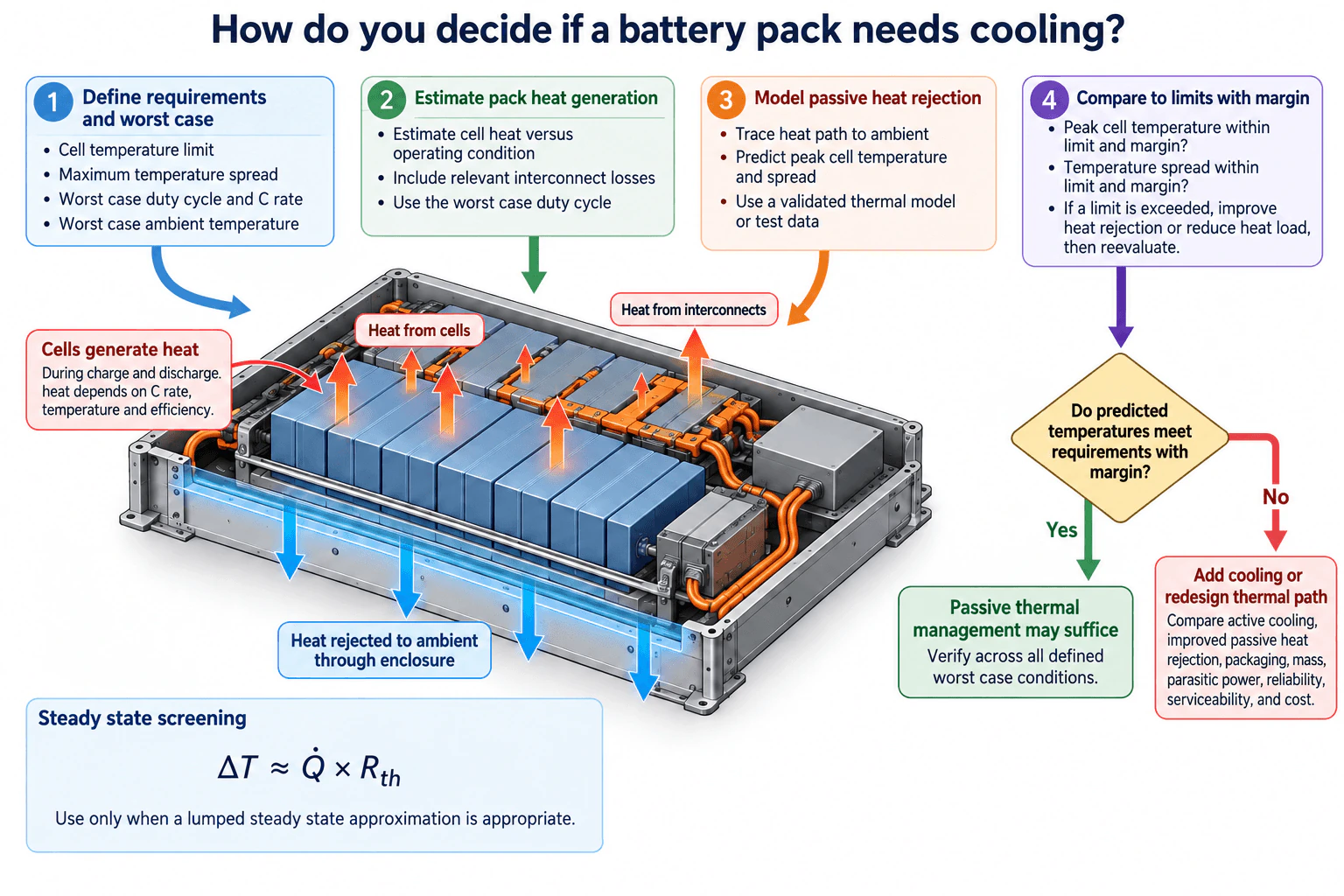
I would first define the allowable peak cell temperature, allowable temperature spread, worst case ambient temperature, duty cycle, and C rate. Then I would estimate heat generated by the cells and relevant interconnect losses and model how that heat travels through the pack interfaces and enclosure to ambient. I would compare the predicted peak cell temperature and temperature spread with their limits and required design margin. If passive heat rejection satisfies both requirements across the defined worst case conditions, passive thermal management may be sufficient. If a limit is exceeded, I would improve the heat rejection path or reduce heat load, then reevaluate. If that is not enough, I would compare active cooling concepts against packaging, mass, parasitic power, reliability, serviceability, and cost.
Detailed Explanation
The decision is based on whether the battery pack can keep its cells within defined temperature limits and temperature spread limits, with design margin, using its existing heat rejection path. I would not assume active cooling is required before doing that thermal assessment.
Useful Questions to Ask the Interviewer
What are the allowable peak cell temperature and maximum temperature spread?
What ambient temperature, duty cycle, and C rate define the worst case operating condition?
What packaging, mass, parasitic power, reliability, serviceability, and cost constraints apply to the thermal solution?
How to Explain It in an Interview
Engineering Method
First I define the thermal requirements and worst case operating condition. The important acceptance criteria are peak cell temperature and temperature spread, evaluated at the required ambient temperature, duty cycle, and C rate.
Next I estimate heat generation. Cells generate heat during charge and discharge, and the amount depends on operating condition, temperature, and efficiency. I would also include relevant interconnect losses. Then I trace the heat path from the cells through thermal interfaces and the enclosure to ambient.
For an early steady state screening calculation, I can use:
ΔT ≈ Q̇ × Rth
Here, ΔT is the temperature rise in K or °C difference, Q̇ is heat rate in W, and Rth is effective thermal resistance in K/W. This relationship is appropriate only when a lumped steady state approximation is reasonable.
Design Reasoning
I predict peak cell temperature and temperature spread using a validated thermal model or representative test data, then compare both with their limits and required design margin.
If the predicted temperatures meet the requirements with margin across all defined worst case conditions, passive thermal management may be sufficient. If a limit is exceeded, I would first look for ways to improve heat rejection or reduce heat generation and then reevaluate the design.
If those changes are insufficient, I would compare active cooling concepts with improved passive approaches using traceable requirements. The selection would consider thermal performance together with packaging, mass, parasitic power, reliability, serviceability, manufacturability, and cost.
Assumptions And Checks
I would verify the heat generation inputs, thermal interface assumptions, ambient boundary conditions, and model validity. I would also check transient conditions and local hot spots because a lumped steady state model can miss spatial gradients or short duration peaks. Before finalizing the design, I would validate the selected concept with representative thermal testing or a validated higher fidelity analysis.
Why Interviewers Ask This
The interviewer is testing whether I can convert thermal requirements and operating conditions into a traceable mechanical design decision. They want to see whether I define measurable temperature limits, identify the worst case heat load, understand the heat path from the cells to ambient, use an appropriate thermal model with stated assumptions, maintain design margin, and select additional cooling only when the existing thermal path cannot satisfy the requirements.
Interviewer may ask next
How would you validate that passive thermal management is sufficient?
I would test or model the pack under the defined worst case ambient temperature, duty cycle, and C rate and measure or predict both peak cell temperature and temperature spread. I would place measurement points at expected hot locations, verify the thermal boundary conditions, and compare the results with the acceptance limits and design margin. I would also evaluate transient behavior because a steady state screening calculation can miss short duration peaks. If either thermal requirement is exceeded, I would revise the heat rejection path or evaluate additional cooling.
What changes if packaging space is very limited?
I would keep the same thermal acceptance criteria but make package envelope an explicit concept selection constraint. I would first examine improvements to interfaces, heat spreading, and passive heat rejection that fit within the available space. If those changes cannot provide sufficient margin, I would evaluate compact active cooling concepts. The final choice would balance temperature control with mass, parasitic power, assembly, reliability, serviceability, manufacturability, and cost rather than optimizing thermal performance alone.
4. Are you comfortable with working long hours for months at a time?NEWBehavioralMediumTesla
Interview tip:
Use STAR to structure your answer: briefly explain the Situation and Task, make Action the most detailed part, and finish with the Result. For example, describe a demanding engineering period where you supported extended hours when the project required it, managed your workload carefully, communicated priorities with the team, protected design quality and safety, and maintained a sustainable pace over time.
Situation
During a previous mechanical design project, our team entered a demanding phase with overlapping design releases, prototype builds, testing, and design changes. The schedule required extra effort over an extended period because several dependent teams needed updated designs before they could continue their work.
Task
I was responsible for completing my mechanical design work, responding to test findings, and supporting design reviews without allowing the longer schedule to reduce the quality of my engineering decisions. I also needed to make sure urgent work received attention without treating every request as equally critical.
Action
I was comfortable working longer hours during that period because there was a clear project need and the additional effort was connected to important milestones. I organized my work by separating critical design issues from work that could safely wait. I focused first on problems that could affect safety, function, manufacturing, or testing. I kept my design calculations, drawings, tolerance decisions, and review notes organized so that fatigue would not lead to rushed changes. When new requests came in, I discussed priorities with the team instead of simply adding everything to the same urgent list. I also communicated early when two important tasks competed for the same time so we could make a deliberate decision about which one came first. I supported evening or extended work when necessary, but I also tried to use normal working hours efficiently and avoid creating unnecessary late work through poor planning. That approach helped me stay reliable during a demanding period while still maintaining the level of attention expected from a mechanical design engineer.
Result
We moved through the demanding project phase with the important design work completed and reviewed in a controlled way. I learned that I can handle extended periods of high workload when there is a real business or engineering need, but I believe the best results come from combining commitment with clear priorities, good communication, and a sustainable way of working.
Why Interviewers Ask This
Interviewers ask this question to understand how a candidate responds to sustained workload, schedule pressure, and demanding project periods. A strong answer shows commitment and flexibility while also demonstrating judgment, organization, communication, and an understanding that engineering quality and safety still matter when hours increase.
Interviewer may ask next
How did you make sure the longer hours did not affect the quality of your engineering work?
I relied on clear priorities and disciplined review habits. I gave safety, function, manufacturing, and testing issues the highest attention, and I kept calculations, drawings, tolerance decisions, and review notes organized. If I felt two urgent tasks could not both receive the attention they needed, I raised that early with the team so we could decide which one should come first instead of rushing both.
Would you be comfortable working that way again for several months?
Yes, when there is a genuine project need and the priorities are clear, I am willing to put in additional time for an extended period. I would still focus on planning the work carefully, communicating workload risks early, and protecting engineering quality. I have learned that sustained performance depends on working hard where it matters while also avoiding unnecessary hours caused by unclear priorities or poor coordination.
Mechanical Design Engineer Resume Examples
Explore the resume examples below to find the one that best matches your target Mechanical Design Engineer role.
Disclaimer: This interview guide is for educational and informational purposes only. It is designed to help readers prepare, but it does not guarantee any interview result, hiring decision, offer, or outcome. Interview questions, hiring criteria, and preferred answers can vary by employer, interviewer, industry, location, and time. All answers, examples, and explanations in this guide are suggested examples for interview preparation, not definitive answers or instructions for professional practice. They are based on research and judgment, are provided without warranties of any kind, and should be adapted to the question, role, and applicable laws and professional requirements. Diagrams are simplified illustrations intended to highlight the main concepts and their relationships; actual situations, systems, and practices may be more complex. Alternative approaches may be equally valid or better suited to a particular question, context, or interviewer. To the fullest extent permitted by applicable law, the contributors and publisher are not liable for decisions made, actions taken, or losses incurred based on this guide.
State Laws and Professional Responsibilities: Laws and requirements governing an occupation vary by state and jurisdiction. You are responsible for checking the current laws, licensing requirements, and scope-of-practice rules that apply to your location and role, and for ensuring that your answers and actions comply with them. Adapt examples in this guide to those requirements. This guide is not legal advice.
Company Notice: This guide is an independent educational resource and is not affiliated with, endorsed by, sponsored by, or approved by the company named in this guide. Company names identify reported interview experiences or the employer context of clearly labeled original practice exercises. Interview practices can change without notice, and inclusion of company-specific content does not mean these questions are official, complete, or guaranteed to be asked. To the fullest extent permitted by law, the author, contributors, and publisher are not responsible for outcomes related to use of this material.
Content Accuracy and Verification: To the fullest extent permitted by applicable law, we do not represent or warrant that interview guides, questions, answers, examples, or diagrams are accurate, complete, current, error-free, or suitable for any particular purpose. You are responsible for independently reviewing and verifying the information before relying on it.